

Submitted:
16 May 2026
Posted:
18 May 2026
You are already at the latest version
Abstract
In pregnancy physiologically based pharmacokinetic (PBPK) modelling within PK-Sim/Mobi, pregnancy stage is canonically parameterised on the fertilisation-age (FA) timescale, yet PK-Sim’s physiology database is indexed by chronological “Age”. The Open Systems Pharmacology (OSP) pregnancy framework therefore encodes FA on a dummy “Age” axis (30.00 years = FA 0 weeks; 30.75 years = FA 38 weeks) and generates pregnancy physiology vectors from FA 0 – 38 weeks discretised at 1-day intervals for database ingestion. Although the anchor points are publicly documented, an explicit closed-form transform and week-resolved lookup suitable for deterministic reproduction of daily physiology grids has not been routinely foregrounded in the literature or repository instructions. A unique affine mapping is derived, implied by the anchors, that provide forward and inverse equations in week- and day-space, quantifying rounding error in terms of FA-day misalignment, and supply a fertilization week (1-38) table for implementation-ready pregnancy virtual population creation in PK-Sim.
Keywords:
pregnancy PBPK modelling
; PK-Sim
; MoBi
; open systems pharmacology
; fertilization age
; dummy age mapping
; virtual pregnancy population
; pharmacometrics
1. Introduction
Pregnancy PBPK is intrinsically “time-nonstationary”: maternal distribution space, perfusion, filtration, binding milieu, and pregnancy-specific compartments evolve continuously, and these gestational dynamics can be pharmacokinetically consequential for both maternal exposure and foetal transfer [1]. Accordingly, pregnancy staging is a structural coordinate that chooses physiology trajectory that supports the mechanistic mass-balance system rather than an external metadata domain. Gestational age (GA) is commonly measured from the first day of the last menstrual period (LMP) in standard obstetric terminology, while "conceptional" or fertilisation age (FA) is approximately two weeks shorter [2]. FA is the biologically aligned independent variable for pregnancy-dependent regressions and scaling functions in the OSP pregnancy PBPK literature and infrastructure [3].
A critical implementation detail is that PK-Sim’s proprietary physiology database is configured by “Age” at specific support points, utilising interpolation for intermediate values [3]. Rather than introducing an additional independent axis into the database schema, the OSP pregnancy framework reuses chronological “Age” as a dummy proxy for FA, fixing 30.00 years as the onset of pregnancy and 30.75 years as FA 38 weeks [3,4]. The same tutorial describes generating pregnancy physiology vectors between FA 0 and 38 weeks, discretised at 1-day intervals, for integration as the pregnancy population “Pregnant (Dallmann et al. 2017)” in PK-Sim user interface (UI) [3]. Despite clear anchoring, practitioners building deterministic day-resolved physiology grids (FA-day 0 266) still require an explicit transform from FA to the dummy-age scale to avoid silent off-by-one-day or rounding discrepancies when constructing populations, importing MoBi pregnancy models, or scripting physiology vector assembly. This research letter formalises that mapping and supplies a week-resolved lookup table consistent with the documented endpoints implemented in several PBPK modelling efforts reported in the literature.
2. Methods
2.1. Coordinate Definitions
Let:
GA be gestational age (LMP-dated).
FA be fertilisation age (conceptional age), with the conventional relationship [3],
and .
2.2. Functional Framework and Anchors
FA = 0 weeks years.
FA = 38 weeks years.
The implicit deterministic mapping is the unique affine transform that sends the endpoints to , respectively since a single dummy axis must systematically represent a normal pregnancy stage and be congruent with PK-Sim's interpolative age-indexing. Thus defining:
Additionally, both the week-space and day-space equivalents were derived, along with the inverse corresponding transforms and , for direct encoding between FA and the PK-Sim dummy age grid. The day-space discretization uses days, consistent with the conception-to-term convention (~266 days) underpinning FA 38 weeks [2].
3. Results
3.1. Closed-Form Transforms
3.1.1. Fertilisation Weeks to PK-Sim Dummy Age
Let . Using the anchors above:
and the “years-from-30” offset is:
3.1.2. Fertilisation Days to PK-Sim Dummy Age for 1-Day Physiology Vectors
Let , where . Then:
So, the dummy-age increment per FA-day is:
The published OSP standard practice of creating pregnancy physiology vectors between FA 0 and 38 weeks at 1-day intervals and incorporating them into the pregnancy population database is directly consistent with this [3].
3.1.3. Inverse Transforms
For implementations that need to recover FA from a dummy-age value :
3.1.4. Practical Rounding Implication
Imprecise rounding of age can result in nontrivial FA-day offsets because gestation staging is specified on a narrow numeric range (30.00–30.75 years). For instance, a deviation of 0.001 years is equivalent to:
Therefore, truncating to three decimals can result in ~0.35-day stage error per 0.001 years of rounding, which is typically less than clinical dating uncertainty but can be mitigated in computational workflows by retaining at least four to six decimals.
4. Discussion
The dummy-age mapping is not a physiological model; it is an indexing transform. Nevertheless, it controls which pregnancy-dependent physiology state PK-Sim instantiates and therefore which parameter regime the PBPK mass-balance system operates in. This matters because pregnancy changes are progressive and can mechanistically affect core PK determinants [1].
Within the OSP pregnancy framework, pregnancy-induced anatomic and physiological changes are captured via regression equations as functions of FA (supported by a systematic meta-analytic repository), and the resulting vectors are integrated into PK-Sim’s population database by evaluating those regressions over FA 0–38 weeks at 1-day resolution [3,6]. That engineering choice makes the mapping equation the “coordinate transform” between (i) the scientific variable FA and (ii) the PK-Sim database’s age coordinate, and it therefore must be explicit in any reproducible pipeline that regenerates or audits pregnancy physiology vectors.
The OSP Pregnancy-Models instructions emphasise that pregnancy simulations are commonly run by combining a MoBi pregnancy model (exported to PKML) with a pregnancy population created in PK-Sim, rather than building a pregnancy simulation de novo in PK-Sim alone [4]. In such workflows, the practitioner must treat the “Age” field of the pregnancy individual/population as pregnancy stage, not maternal chronological age, because the pregnancy population “Pregnant (Dallmann et al. 2017)” is explicitly indexed by that dummy axis [5]. There are two practical implications regarding this: First, by expanding the population's "Age" range in PK-Sim, one is sampling pregnancy stage rather than demographics, i.e., dispersing simulations throughout FA. For example, stage-stratified sensitivity or trimester-spanning exposure projections may be desirable, but they must be deliberate. Second, the dummy-axis design has a structural drawback: because the age coordinate is "spent" on pregnancy stage, pregnancy-induced physiological changes are assumed to be independent of the mother's actual chronological age. The tutorial explicitly notes this conceptual trade-off — physiology at “30 years” is taken to represent pregnancy onset regardless of whether the real mother is 20 or 40 [3]. Any attempt to encode maternal-age effects therefore requires orthogonal covariate modelling rather than relying on PK-Sim’s age-dependent physiology machinery.
The binning of fertilisation age (FA) into trimester-defined intervals (Figure 1) can be substantiated as a pragmatic abstraction that reconciles the intrinsically continuous FA-driven physiology with clinically interpretable staging, without undermining the deterministic daily-resolution framework underpinning the PBPK implementation. While the OSP framework encodes pregnancy as a continuous FA trajectory mapped onto a dummy-age axis, the aggregation into first, second, and third trimesters introduces a higher-order stratification that aligns with well-characterised inflection points in maternal haemodynamic, organ scaling, and clearance pathways, thereby enhancing interpretability for translational inference. Importantly, this binning does not replace the underlying day-resolved physiology vectors but rather operates as a reporting and analytical layer that enables coherent summarisation of stage-dependent pharmacokinetic behaviour across clinically meaningful windows. Trimester stratification can also serve as a regularisation lens on FA-driven variability from a modelling viewpoint, reducing overinterpretation of local quantitative changes resulting from interpolation or rounding on the streamlined dummy-age scale. The discretisation implicitly assumes intra-trimester homogeneity, which is only an approximation given the monotonic and occasionally nonlinear evolution of physiological parameters, so this benefit ought to be used with substantive discipline. Trimester binning is therefore best justified when combined with sensitivity analyses that maintain the underlying temporal resolution, and it ought to be regarded as an engineered compromise that is analytically convenient but mechanistically subservient to the continuous FA mapping.
5. Conclusions
Gestation-dependent trajectories of organ volumes, flows, and renal parameters have long been highlighted in fundamental pregnancy physiology databases for PBPK, and algorithms for gestational scaling have been proposed [7]. Many of these parameters are expanded and re-expressed in the Dallmann et al. repository, which explicitly models central tendency and variability throughout pregnancy for PBPK implementation [8]. By providing the explicit transform and week-resolved lookup that are essentially required by the published anchors and the 1-day discretisation strategy, the current contribution strengthens the computational "coupling" between that physiology layer and PK-Sim's age-indexed database framework rather than competing with those physiological regression analyses.
Author Contributions
T.B.N. was solely responsible for all aspects of this manuscript. Conceptualization, T.B.N.; methodology, T.B.N.; software, T.B.N.; validation, T.B.N.; formal analysis, T.B.N.; investigation, T.B.N.; resources, T.B.N.; data curation, T.B.N.; writing—original draft preparation, T.B.N.; writing—review and editing, T.B.N.; visualization, T.B.N.; supervision, T.B.N.; project administration, T.B.N. Funding acquisition: not applicable, as no external funding was obtained for this work. The author has read and agreed to the published version of the manuscript.
Funding
This research received no external funding.
Institutional Review Board Statement
Not Applicable.
Informed Consent Statement
Not Applicable.
Data Availability Statement
No new empirical datasets were generated or analyzed in this study. All data derived supporting the Research Letter are included in the manuscript.
Conflicts of Interest
The author declares no conflict of interest.
Abbreviations
The following abbreviations are used in this manuscript:
| FA | Fertilisation Age |
| GA | Gestation Age |
| LMP | Last Menstrual Period |
| OSP | Open Systems Pharmacology |
| UI | User Interface |
| PBPK | Physiologically Based Pharmacokinetic Modelling |
References
- Soma-Pillay, P.; Catherine, N.-P.; Tolppanen, H.; Mebazaa, A.; Tolppanen, H.; Mebazaa, A. Physiological changes in pregnancy. Cardiovasc J. Afr. 2016, 27, 89–94. [Google Scholar] [CrossRef] [PubMed]
- Brown, H.L.; Adams, Melissa W. Approach to the Pregnant Woman and Prenatal Care. The Merck Manual of Doagnosis & Therapy [Internet], 20th edn; 2018 [cited 2026 Apr 7; p. 2319. Available online: https://www.msdmanuals.com/professional/pediatrics/perinatal-problems/gestational-age (accessed on 7 Apr 2026).
- Dallmann, A.; Solodenko, J.; Ince, I.; Eissing, T. Applied Concepts in PBPK Modeling: How to Extend an Open Systems Pharmacology Model to the Special Population of Pregnant Women. CPT Pharmacomet. Syst. Pharmacol. 2018, 7, 419–31. [Google Scholar] [CrossRef] [PubMed]
- Open-Systems-Pharmacology. Pregnancy-Models/README.md at master · Open-Systems-Pharmacology/Pregnancy-Models [Internet]. GitHub. 7 Apr 2026. Available online: https://github.com/Open-Systems-Pharmacology/Pregnancy-Models/blob/master/README.md (accessed on 7 Apr 2026).
- Creating Populations | v11 | Open Systems Pharmacology [Internet]. 2025. Available online: https://docs.open-systems-pharmacology.org/v12/working-with-pk-sim/pk-sim-documentation/pk-sim-creating-populations (accessed on 7 Apr 2026).
- Dallmann, A.; Ince, I.; Meyer, M.; Willmann, S.; Eissing, T.; Hempel, G. Gestation-Specific Changes in the Anatomy and Physiology of Healthy Pregnant Women: An Extended Repository of Model Parameters for Physiologically Based Pharmacokinetic Modeling in Pregnancy. Clin. Pharmacokinet. 2017, 56, 1303–30. [Google Scholar] [CrossRef] [PubMed]
- Abduljalil, K.; Furness, P.; Johnson, T.N.; Rostami-Hodjegan, A.; Soltani, H. Anatomical, physiological and metabolic changes with gestational age during normal pregnancy: a database for parameters required in physiologically based pharmacokinetic modelling. Clin. Pharmacokinet. 2012, 51, 365–96. [Google Scholar] [CrossRef] [PubMed]
- Dallmann, A.; Ince, I.; Meyer, M.; Willmann, S.; Eissing, T.; Hempel, G. Gestation-Specific Changes in the Anatomy and Physiology of Healthy Pregnant Women: An Extended Repository of Model Parameters for Physiologically Based Pharmacokinetic Modeling in Pregnancy. Clin. Pharmacokinet. 2017, 56, 1303–30. [Google Scholar] [CrossRef] [PubMed]
Figure 1.
Affine mapping of fertilisation age to PK-Sim dummy age. Six-decimal labelling shown for anchors (table precision). Secondary axis is ΔY = A − 30. Weekly nodes (FA 0–38w) with optional daily-resolution points (FA Day 0–266).
Figure 1.
Affine mapping of fertilisation age to PK-Sim dummy age. Six-decimal labelling shown for anchors (table precision). Secondary axis is ΔY = A − 30. Weekly nodes (FA 0–38w) with optional daily-resolution points (FA Day 0–266).
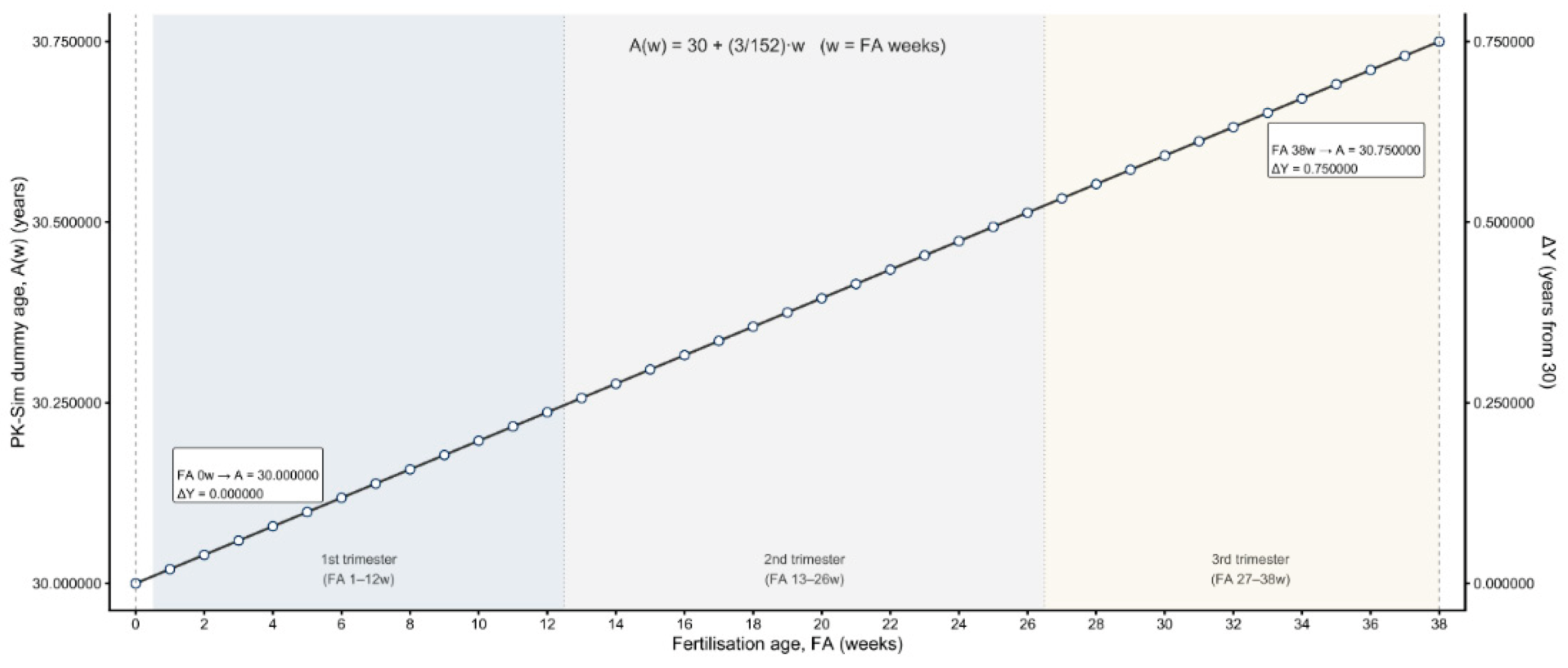

Table 1.
Fertilization Week (FA 1-38) mapped to the PK-Sim dummy age scale.
| Fertilization week (FA, w) | Years from 30, ΔY(w) | PK-Sim dummy age, A(w) (years) |
|---|---|---|
| 1 | 0.019737 | 30.019737 |
| 2 | 0.039474 | 30.039474 |
| 3 | 0.059211 | 30.059211 |
| 4 | 0.078947 | 30.078947 |
| 5 | 0.098684 | 30.098684 |
| 6 | 0.118421 | 30.118421 |
| 7 | 0.138158 | 30.138158 |
| 8 | 0.157895 | 30.157895 |
| 9 | 0.177632 | 30.177632 |
| 10 | 0.197368 | 30.197368 |
| 11 | 0.217105 | 30.217105 |
| 12 | 0.236842 | 30.236842 |
| 13 | 0.256579 | 30.256579 |
| 14 | 0.276316 | 30.276316 |
| 15 | 0.296053 | 30.296053 |
| 16 | 0.315789 | 30.315789 |
| 17 | 0.335526 | 30.335526 |
| 18 | 0.355263 | 30.355263 |
| 19 | 0.375000 | 30.375000 |
| 20 | 0.394737 | 30.394737 |
| 21 | 0.414474 | 30.414474 |
| 22 | 0.434211 | 30.434211 |
| 23 | 0.453947 | 30.453947 |
| 24 | 0.473684 | 30.473684 |
| 25 | 0.493421 | 30.493421 |
| 26 | 0.513158 | 30.513158 |
| 27 | 0.532895 | 30.532895 |
| 28 | 0.552632 | 30.552632 |
| 29 | 0.572368 | 30.572368 |
| 30 | 0.592105 | 30.592105 |
| 31 | 0.611842 | 30.611842 |
| 32 | 0.631579 | 30.631579 |
| 33 | 0.651316 | 30.651316 |
| 34 | 0.671053 | 30.671053 |
| 35 | 0.690789 | 30.690789 |
| 36 | 0.710526 | 30.710526 |
| 37 | 0.730263 | 30.730263 |
| 38 | 0.750000 | 30.750000 |
FA, fertilisation age; W, week.
Disclaimer/Publisher’s Note: The statements, opinions and data contained in all publications are solely those of the individual author(s) and contributor(s) and not of MDPI and/or the editor(s). MDPI and/or the editor(s) disclaim responsibility for any injury to people or property resulting from any ideas, methods, instructions or products referred to in the content. |
© 2026 by the authors. Licensee MDPI, Basel, Switzerland. This article is an open access article distributed under the terms and conditions of the Creative Commons Attribution (CC BY) license (http://creativecommons.org/licenses/by/4.0/).
Copyright: This open access article is published under a Creative Commons CC BY 4.0 license, which permit the free download, distribution, and reuse, provided that the author and preprint are cited in any reuse.


