

Submitted:
16 May 2026
Posted:
18 May 2026
You are already at the latest version
Abstract
Democratic systems rest on institutional counterbalances capable of limiting authority concentration. Historical transitions toward dictatorship often emerge not through abrupt institutional destruction, but progressive weakening of stabilizing mechanisms like parliamentary oversight, judicial autonomy, political pluralism, decentralized governance. Adolf Hitler’s power consolidation following the Weimar Republic’s collapse provides a historical example in which democratic counterbalances lost corrective capacity under economic crisis, institutional fragility, coordinated mass mobilization, etc. While the historical causes of authoritarian transitions have been extensively studied, the dynamics governing the failure of democratic stabilizing mechanisms is less characterized. We introduce a dynamical systems framework aimed at identifying early-warning signals associated with democratic destabilization and executive power concentration. We represented democratic governance as a multidimensional attractor stabilized by negative feedback mechanisms generated by institutional independence, distributed authority, informational plurality, constitutional constraints. Using historical data from Germany between 1928 and 1934, we built a composite systemic stress index integrating economic instability, war trauma, ideological vulnerability, institutional fragility, political polarization and Nazi mobilization. Simulations based on nonlinear response functions and state-space trajectories showed threshold-like transitions in which progressive stress accumulation was followed by accelerated concentration of political authority, once stabilizing feedbacks became insufficient. Democratic collapse could be interpreted as a loss of systemic resilience associated with attractor deformation and feedback amplification. Potential applications of nonlinear approaches include comparative analysis of institutional fragility, quantitative assessment of democratic resilience and development of early-warning frameworks for detecting conditions associated with excessive concentration of political power in contemporary political systems.
Keywords:
bifurcation
; resilience
; synchronization
; damping
; polarization
; Nazi
The transition from democratic governance to authoritarian concentration of power has been extensively examined across political science, modern history, sociology and institutional theory. Existing studies on the collapse of the Weimar Republic and the consolidation of power by Adolf Hitler emphasize a broad range of contributing factors, including the consequences of the Versailles Treaty, the psychological legacy of the First World War, polarization between extremist movements, anti-liberal ideological currents, economic destabilization during the Big Depression and the organizational and propagandistic capacity of the NSDAP together with Hilter’s charismatic figure (Feldman 1997; Fergusson 2010; Kershaw 1998; McDonough 2024; Sebestyen 2026; Straumann 2019; Tooze 2006). Additional analyses have focused on institutional fragility, presidential emergency powers, erosion of parliamentary legitimacy, paramilitary violence, the role of conservative elites and the progressive weakening of constitutional counterbalances after 1933 (Abraham 1988; Overy 1996; Welch 2002). Studies addressing ideological and cultural dimensions have further examined nationalism, propaganda, anti-liberal currents and the interaction between culture and authoritarian politics (Koonz 1992; Speer 1970; Ullrich 2016; Ullrich 2020). While these interpretations have provided detailed descriptions of authoritarian transition, they usually rely on linear causal schemes that only partially capture the nonlinear interactions between institutional, economic, ideological and social processes. As a result, the mechanisms through which democratic stabilizing structures progressively lose resilience and converge toward centralized executive authority are insufficiently formalized. In particular, the identification of threshold conditions preceding the collapse of democratic counterbalances has received comparatively limited quantitative treatment.
We introduce a dynamical systems representation of democratic stability aimed at examining how constitutional counterbalances progressively lose corrective capacity under interacting social, institutional and economic pressures. Rather than interpreting democratic collapse as the direct consequence of a single causal factor or abrupt institutional rupture, we conceptualize political governance as a metastable configuration maintained through distributed negative feedback mechanisms generated by parliamentary oversight, judicial independence, informational plurality, regional autonomy and constitutional constraints. Within this perspective, democratic systems occupy a bounded region of political state space in which destabilizing fluctuations can be partially absorbed without irreversible concentration of authority. Authoritarian consolidation is instead interpreted as a transition toward a competing attractor state characterized by synchronization of institutional structures around a centralized executive node and progressive reduction of corrective feedbacks.
We provide simulations to examine whether cumulative destabilizing processes can progressively deform the geometry of the democratic attractor landscape and produce threshold-like transitions associated with accelerated executive concentration. Our study focuses on the evolution of democratic counterbalance failure rather than exclusively on electoral ascent. Attention is directed toward the interaction between institutional weakening, ideological radicalization, polarization, economic destabilization and organized political mobilization. Instead of assuming linear proportionality between political stress and institutional response, our model allows for nonlinear amplification effects in which gradual increases in systemic pressure may initially produce limited institutional changes, but subsequently trigger rapid transitions once stabilizing mechanisms become insufficient. Therefore, democratic resilience is treated as a dynamic property emerging from the capacity of the political system to dissipate perturbations without converging toward highly centralized configurations. Within this conceptual structure, the late Weimar period provides a historically documented trajectory in which multiple destabilizing processes evolved simultaneously prior to the concentration of power by Adolf Hitler after 1933. By representing political destabilization as a trajectory-dependent process evolving within a multidimensional state space, our simulations aim to identify critical transition regions associated with the weakening of parliamentary and constitutional restraints and the subsequent acceleration of executive consolidation.
We will proceed as follows: first, we describe the historical variables and construction of the systemic stress index. Then, we present the dynamical systems model and simulation procedures. Finally, we analyze the resulting trajectories, threshold behavior and evolution of democratic counterbalance failure.
Methods
We assessed the concentration of political power in Germany between 1928 and 1934, focusing on the progressive weakening of democratic counterbalances after the erosion of parliamentary, institutional and civic restraints. Our simulations were based on six groups of destabilizing variables representing ideological vulnerability, war and Versailles trauma, institutional fragility, political polarization, economic shock and Nazi mobilization capacity. Each group was operationalized through historically interpretable indicators expressed in real units and subsequently transformed into normalized state variables. The normalized variables were combined into a weighted systemic-stress index through a nonlinear logistic response function designed to identify threshold-like transitions between partial democratic resilience and accelerated counterbalance failure. Therefore, our simulations aimed to reconstruct how interacting destabilizing processes progressively reshaped the political state space during the late Weimar period and facilitated convergence toward centralized executive authority after weakening of constitutional corrective mechanisms.
Data construction. We defined the observation window as , because this interval captures the movement from late Weimar instability to post-accession executive consolidation. For each year , we assembled six empirical or proxy variables corresponding to the causal blocks retained in our model. We assigned a specific historical indicator to each destabilizing dimension to achieve a quantifiable representation of the underlying political, institutional, economic and ideological processes.
- Ideological vulnerability incorporated: the broader ideological climate associated with anti-liberal and anti-rational currents, including selective reinterpretations of pre-war philosophical milieu, antisemitism, racial Darwinism, irrationalism, and support for authoritarian, nationalist and collectivist alternatives (Bullock 1962; Fest 1974; Haffner 1981; Koonz 1992; Ullrich 2016). These dimensions were treated as long-term cultural susceptibilities facilitating receptivity to anti-democratic narratives rather than as isolated doctrinal components. Ideological vulnerability was approximated by the combined anti-system vote share, expressed as percentage of valid votes.
- War and Versailles trauma incorporated: the social and psychological consequences of the First World War and Ruhr occupation, including widespread collective trauma, normalization of violence among veterans, persistence of paramilitary culture, symbolic appeal of national revival, the perception of national humiliation associated with the Versailles settlement and anti-Western nationalism (Evans 2004; McDonough 2024; Sebestyen 2026; Straumann 2019). These factors were interpreted as long-duration destabilizing conditions contributing to resentment against democratic institutions and postwar political arrangements. War and Versailles trauma was quantified by the reparations settlement, fixed at 132 billion gold marks, treated as a persistent structural burden rather than as a rapidly varying yearly driver.
- Institutional fragility integrated: structural weaknesses inherited from Wilhelmine authoritarian traditions, the limited historical consolidation of parliamentary democracy in Germany, skepticism toward parliamentary pluralism and Weimar representative democracy, chronic governmental instability, progressive reliance on presidential emergency authority and erosion of Reichstag centrality (Abraham 1988; Evans 2005). The resulting variable denoted the weakening of institutional counterbalances and the reduced corrective capacity of constitutional governance. Institutional fragility was quantified by the number of Article 48 emergency decrees or decree-laws per year.
- Polarization incorporated: anti-system political movements, intensifying conflict between ideological poles, fear of communist revolution, increasing delegitimization of political compromise and growing fragmentation between democratic and anti-democratic actors (Kershaw 1998; Shirer 1960). The variable represented the progressive reduction of cooperative political coupling within the Weimar political system. Polarization was approximated by the combined vote share of extreme parties.
- Economic shock incorporated: the cumulative consequences of postwar hyperinflation, widespread material insecurity, declining middle-class stability and general social discontent associated with the Great Depression (Feldman 1997; Fergusson 2010; Overy 1996; Tooze 2006; Turner 1985). Economic destabilization was interpreted as a major amplifier of institutional stress because abrupt deterioration in living conditions increased receptivity to centralized and anti-system political alternatives. Economic shock was quantified by registered unemployment in millions of individuals.
- Nazi mobilization capacity incorporated: Hitler’s personal charisma, his frequent underestimation by conservative elites, the organizational strength and youthful image of the Nazi Party, the of modern propaganda techniques, the expansion of paramilitary organizations and political violence and the promise of national rebirth (Kershaw 2000; Longerich 2019; Speer 1970; Welch 2002). These elements were treated as mechanisms transforming preexisting systemic instability into coordinated political consolidation and executive concentration. Nazi mobilization capacity was quantified by NSDAP membership in millions.
The empirical input vector for each year was therefore written as , where the six components denote ideology, war-Versailles burden, institutional fragility, polarization, economy and mobilization, respectively. Because the variables have different units, direct summation was avoided. Each variable was first transformed into a dimensionless state coordinate before entering the dynamical calculation.
Variable scaling. For each time-dependent variable , we applied min-max normalization,
Factor weights. We assigned weights to the six groups to construct a composite stress index. The weights were not interpreted as definitive historical causal coefficients, but as explicit modeling parameters used to encode the relative contribution of each factor block in the simulation. The sum of weights was constrained to one:
| Factor group | Symbol | Weight |
| Ideological vulnerability | 0.15 | |
| War and Versailles trauma | 0.15 | |
| Institutional fragility | 0.25 | |
| Political polarization | 0.15 | |
| Economic shock | 0.20 | |
| Nazi mobilization capacity | 0.10 |
Institutional fragility received the largest weight because the simulations focused on the failure of democratic counterbalances rather than on electoral growth alone. Indeed, our primary objective was not simply to reproduce the electoral expansion of the NSDAP, but examine the progressive failure of democratic counterbalances and the subsequent concentration of executive authority. Economic shock was given the second-largest weight because unemployment and material insecurity strongly altered the political state space. Ideology, war-Versailles burden and polarization were treated as intermediate contributors, while mobilization capacity was modeled as a conversion mechanism translating systemic stress into organized power.
Stress index. After normalization and weighting, was expressed as a percentage for visualization:
Outcome variable. We defined the dependent variable as executive power concentration or democratic counterbalance failure, denoted by . This variable was expressed as a percentage between and , where lower values indicate partial preservation of parliamentary and institutional counterweights, while higher values indicate increasing concentration of authority. We used historically anchored values rather than direct survey measurements, because the relevant outcome is institutional configuration rather than public preference alone. The anchor series was written as
Response function. We linked systemic stress to counterbalance failure using a logistic response function:
Parameter fitting. We estimated the logistic parameters by nonlinear least squares. The residual for each year was defined as
Dynamical interpretation. We interpreted the normalized state vector as a point in a six-dimensional political state space. The democratic configuration was represented as a region in which stabilizing feedbacks still counteract executive concentration. The authoritarian configuration was represented as a region toward which trajectories converge after stabilizing mechanisms lose corrective strength. In compact form, the yearly evolution can be written as
Simulation sequence and software tools. We followed a fixed technical sequence. First, we defined the annual time vector from 1928 to 1934. Second, we entered the six real-unit variables corresponding to the factor groups. Third, we normalized each time-varying series into a dimensionless coordinate. Fourth, we assigned the Versailles-war structural factor a constant normalized background value. Fifth, we multiplied each normalized coordinate by its predefined weight. Sixth, we summed the weighted components to obtain . Seventh, we fitted the logistic response linking to the institutional concentration anchor . Eighth, we extracted the threshold , steepness , baseline and amplitude . Ninth, we generated simulated values .
All calculations were performed using Python. Numerical arrays were managed with NumPy. Nonlinear least-squares fitting was performed with SciPy, specifically the curve_fit routine from scipy.optimize.
Results
We report on the temporal evolution of the six destabilizing factor groups, the resulting systemic-stress trajectories and the nonlinear transition associated with democratic counterbalance failure between 1928 and 1934. Our analyses quantify the interaction between institutional weakening, ideological radicalization, polarization, economic destabilization and Nazi mobilization capacity. Also, we examine the emergence of a threshold region associated with accelerated executive concentration.
Factor dynamics. Our six-factor reconstruction revealed partially synchronized but temporally heterogeneous trajectories across the destabilizing variables incorporated into the simulations. Ideological vulnerability progressively increased during the late Weimar period through expanding electoral support for anti-system parties (Figure 1, upper-left panel). War and Versailles trauma remained persistently elevated throughout the simulated interval, since the reparations burden was treated as a long-duration structural destabilizing background rather than a rapidly varying annual process (Figure 1, upper-middle panel). Institutional fragility showed a marked escalation after 1930 through increasing reliance on Article 48 emergency decrees and decree-laws, pointing towards progressive weakening of parliamentary corrective mechanisms (Figure 1, upper-right panel). Political polarization intensified through the growing electoral strength of extremist parties and increasing fragmentation between democratic and anti-democratic actors (Figure 1, lower-left panel). Economic shock simultaneously expanded through worsening unemployment and widespread social destabilization, in particular after the Great Depression (Figure 1, lower-middle panel). Nazi mobilization capacity also increased progressively through expansion of party organization, propaganda and coordinated political activity (Figure 1, lower-right panel).
Summarizing, the coordinated escalation of ideological, institutional, economic and organizational variables generated a coherent temporal shift toward increasing systemic destabilization and weakening democratic resilience.
Threshold transition. Our nonlinear simulations identified a threshold-like transition linking composite systemic stress to democratic counterbalance failure (Figure 2). The weighted integration of ideological vulnerability, war-related destabilization, institutional fragility, polarization, economic shock and Nazi mobilization capacity generated a progressively increasing systemic-stress trajectory. The stacked decomposition indicated that institutional weakening and economic destabilization became increasingly dominant contributors during the transition toward executive consolidation, while ideological and mobilizational components amplified the overall trajectory once destabilization accelerated. The trajectory representing historically anchored executive concentration remained relatively moderate during the early phase of the simulations, but subsequently approached the threshold region associated with rapid weakening of democratic corrective mechanisms. Above the estimated threshold, our simulated nonlinear response showed accelerated concentration of authority and progressive convergence toward an authoritarian attractor configuration.
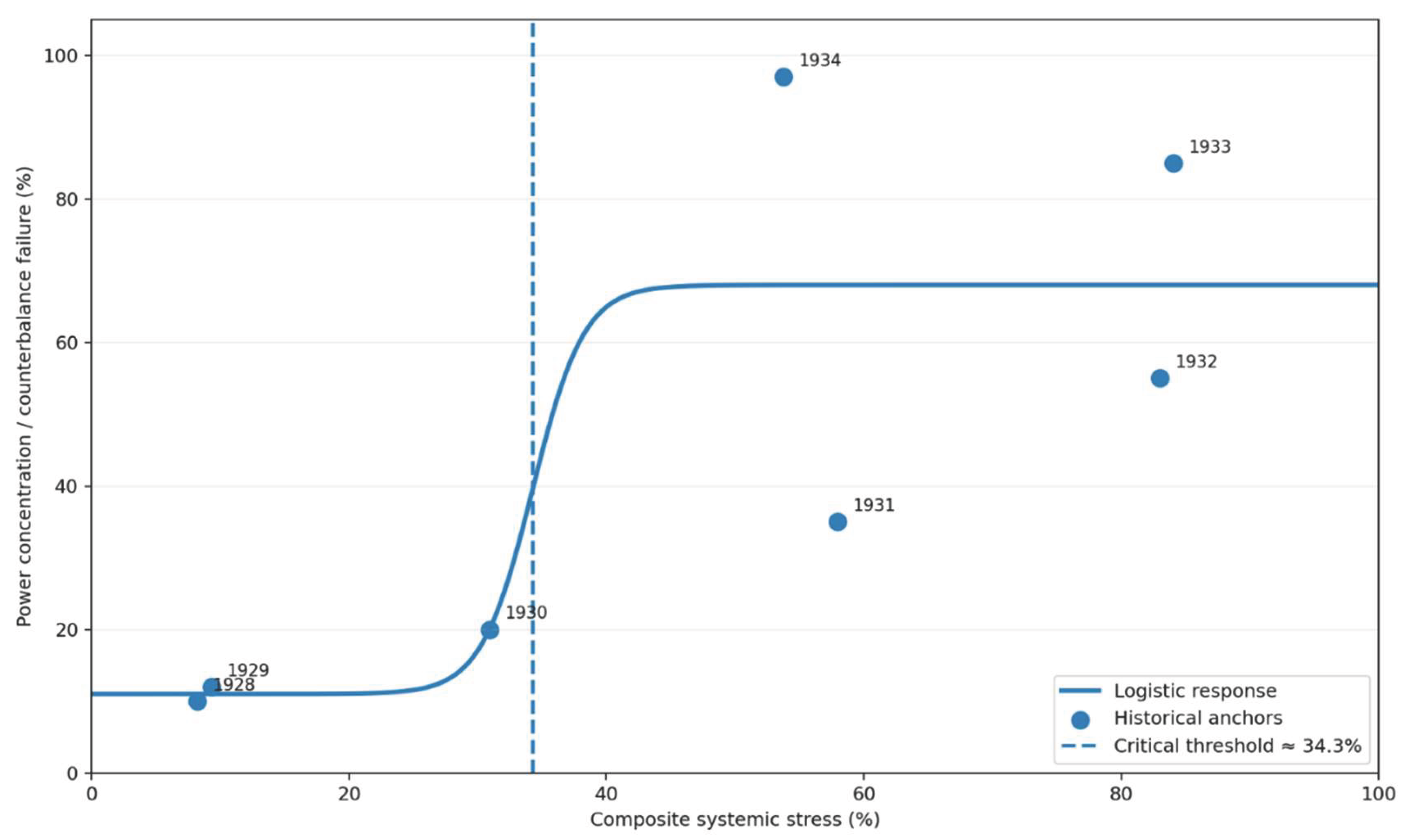
Further, logistic response analysis showed that lower levels of systemic stress were associated with comparatively limited institutional transformation, whereas higher stress levels produced abrupt increases in executive concentration and reduced corrective capacity (Figure 3). The inflection region of the fitted nonlinear trajectory corresponded to the critical transition zone separating partial institutional resilience from accelerated counterbalance failure.
Together, nonlinear simulations suggest that authoritarian consolidation emerged through cumulative amplification among interacting destabilizing processes, rather than isolated linear causal mechanisms.
Overall, the weakening of democratic counterbalances during the late Weimar period could be represented as a nonlinear transition emerging from interacting institutional, economic, ideological and organizational processes. Our simulations identified a critical stress region associated with accelerated executive concentration and progressive loss of stabilizing feedbacks. This supports the interpretation of authoritarian consolidation as a cumulative dynamical transformation rather than a single abrupt institutional rupture.
The upper-left panel reports ideological vulnerability through the electoral support for anti-system parties, expressed as percentage of valid votes.
The upper-middle panel shows the Versailles settlement burden represented through reparations commitments in billion gold marks, treated as a persistent structural destabilizing background.
The upper-right panel reports institutional fragility through the annual number of Article 48 emergency decrees and laws.
The lower-left panel illustrates political polarization through the combined electoral support for extremist parties.
The lower-middle panel reports economic shock using registered unemployment in millions of individuals.
The lower-right panel represents Nazi mobilization capacity through NSDAP membership in millions.
Conclusions
We asked whether collapse of democratic counterbalances and concentration of executive authority can be represented as a nonlinear transition emerging from the interaction of multiple destabilizing variables rather than from isolated historical events. To address this question, we reconstructed the political evolution of Germany between 1928 and 1934 using six groups of factors associated with ideological vulnerability, war-related and Versailles-related destabilization, institutional fragility, polarization, economic crisis and mobilization capacity linked to the NSDAP. Our simulations compared the temporal evolution of these variables with a modeled trajectory of executive concentration and weakening of democratic corrective mechanisms. We found that the combined escalation of institutional weakening, economic destabilization, extremist polarization and organized mobilization generated a progressive increase in systemic stress followed by a threshold-like transition associated with accelerated concentration of political authority. The estimated response curve suggested that democratic resilience was partially preserved below a critical stress region, whereas above this interval the system rapidly converged toward centralized executive control. Therefore, our reconstructed trajectories are consistent with the interpretation that authoritarian consolidation in the late Weimar Republic emerged through cumulative feedback amplification involving interacting institutional, economic and social processes. Our results also suggest that the weakening of democratic systems may be more appropriately described as a progressive loss of stabilizing feedbacks than as a single abrupt constitutional rupture.
Compared with conventional historical narratives, linear causal models and descriptive institutional analyses, our approach explicitly integrates heterogeneous variables into a unified dynamical representation. Several accounts examine economic crisis, propaganda, political violence, constitutional fragility or elite decisions separately, whereas our simulations treated these variables as interacting components of a coupled system evolving within a shared state space. In contrast to standard regression-based interpretations, the use of nonlinear response functions allowed the identification of threshold regions and accelerated transitions rather than assuming proportional linear responses. Unlike qualitative political analyses, our model incorporated weighted temporal trajectories expressed in historical units and represented the evolution of systemic stress quantitatively. Our approach also differs from traditional equilibrium-based political models, because it interprets democratic stability as a metastable condition maintained by negative feedback mechanisms rather than as a fixed institutional state. Our representation allows executive concentration to be examined as a trajectory-dependent process associated with deformation of the political attractor landscape and progressive reduction of institutional corrective capacity.
Our study has limitations. The outcome variable describing executive power concentration and democratic counterbalance failure was manually anchored from institutional interpretation rather than derived from a standardized quantitative historical dataset. Similarly, the weights assigned to the six factor groups were heuristic parameters chosen to preserve internal interpretability and dynamical consistency, but they were not inferred through large-scale statistical optimization or independently validated against external historical benchmarks. The Versailles-related component was treated as a constant structural background term, which stabilizes the simulations mathematically but simplifies the temporal complexity of postwar political dynamics. Several ideological variables, including irrationalism and pre-war philosophical accounts, were incorporated into broader latent dimensions without direct operationalization, limiting causal specificity. The estimated threshold near 34.3% systemic stress should therefore be interpreted cautiously because the temporal dataset is sparse and based on only seven yearly observations, making nonlinear fitting sensitive to perturbations. The dynamical-systems interpretation is conceptual, since no explicit differential-equation system, empirical attractor reconstruction, Lyapunov analysis or formal bifurcation analysis was computed. Additional unresolved questions concern the transferability of the modeled thresholds to other political systems, the temporal dependence of factor weights and the extent to which institutional resilience can be represented through measurable dynamical observables.
Experimentally testable hypotheses and predictions can be drawn. A first prediction is that democratic destabilization should exhibit nonlinear scaling rather than proportional response, such that modest increases in systemic stress below the estimated threshold produce limited institutional effects, whereas equivalent increases above the threshold generate accelerated concentration of executive authority. This prediction can be tested longitudinally by quantifying constitutional restrictions, emergency executive actions, judicial independence scores or media-centralization indices across historical and contemporary political systems.
A second prediction is that institutional fragility and economic destabilization should display stronger coupling with executive concentration than isolated ideological variables alone. Quantitatively, our model predicts that simultaneous increases in unemployment and emergency decree frequency should produce steeper transitions than either variable independently.
A third prediction is that increasing synchronization among political subsystems, including media alignment, party concentration and weakening of regional autonomy, should precede rapid executive consolidation by measurable temporal intervals. This may be tested through network analyses of parliamentary voting coherence, media ownership concentration or regional-governance homogenization.
A fourth prediction is that systems approaching threshold conditions should display increased variance and slower recovery after perturbation, analogous to critical slowing-down phenomena observed in nonlinear systems.
Future research may incorporate higher-resolution temporal datasets, comparative historical trajectories, adaptive time-dependent weights, stochastic perturbation terms, empirical attractor reconstruction and explicit differential-equation formulations. Additional directions include interdisciplinary integration of computational social modeling, agent-based political dynamics, social-network propagation models and information-theoretic measures of institutional diversity, in order to examine whether threshold behavior is stable under alternative representations of democratic resilience.
Our approach could also assess institutional robustness under complex social stress conditions. Weighted dynamical representations may assist comparative studies of constitutional resilience by integrating economic, political and organizational variables within a common temporal structure. Quantitative state-space representations could complement traditional political-risk methodologies by introducing threshold-sensitive indicators rather than exclusively linear trends. Similar procedures may also contribute to longitudinal archival studies, examining how emergency legislation, institutional centralization and polarization evolve jointly across different regimes.
In conclusion, we reconstructed the progressive weakening of democratic counterbalances in Germany between 1928 and 1934 through a dynamical representation integrating institutional, economic, ideological and organizational variables. Our simulations identified threshold-like transitions associated with accelerated executive concentration, suggesting that destabilization emerged from interacting processes rather than isolated events. Our data support the interpretation of authoritarian consolidation as a nonlinear transformation of political-system dynamics involving cumulative amplification of weakening stabilizing mechanisms.
Author Contributions
The Author performed: study concept and design, acquisition of data, analysis and interpretation of data, drafting of the manuscript, critical revision of the manuscript for important intellectual content, statistical analysis, obtained funding, administrative, technical and material support, study supervision.
Funding
This research did not receive any specific grant from funding agencies in the public, commercial or not-for-profit sectors.
Institutional Review Board Statement
This research does not contain any studies with human participants or animals performed by the Author.
Informed Consent Statement
The Author transfers all copyright ownership, in the event the work is published. The undersigned author warrants that the article is original, does not infringe on any copyright or other proprietary right of any third part, is not under consideration by another journal and has not been previously published.
Data Availability Statement
All data and materials generated or analyzed during this study are included in the manuscript. The Author had full access to all the data in the study and took responsibility for the integrity of the data and the accuracy of the data analysis.
Declaration of generative AI and AI-assisted technologies in the writing process
During the preparation of this work, the author used ChatGPT 5.3 to assist with data analysis and manuscript drafting and to improve spelling, grammar and general editing. After using this tool, the author reviewed and edited the content as needed, taking full responsibility for the content of the publication.
Conflicts of Interest
The Author does not have any known or potential conflict of interest including any financial, personal or other relationships with other people or organizations within three years of beginning the submitted work that could inappropriately influence or be perceived to influence their work.
Disclaimer
The views expressed are those of the author and do not necessarily reflect those of the affiliated institutions.
References
- Abraham, David. The Collapse of the Weimar Republic: Political Economy and Crisis, 2nd ed.; Holmes & Meier: New York, 1988. [Google Scholar]
- Bullock, Alan. Hitler: A Study in Tyranny, Revised ed.; Harper & Row: New York, 1962. [Google Scholar]
- Evans, Richard J. The Coming of the Third Reich; Penguin Press: New York, 2004. [Google Scholar]
- Evans, Richard J. The Third Reich in Power; Penguin Press: New York, 2005. [Google Scholar]
- Feldman, Gerald D. The Great Disorder: Politics, Economics and Society in the German Inflation, 1914–1924; Oxford University Press: Oxford, 1997. [Google Scholar]
- Fergusson, Adam. When Money Dies: The Nightmare of Deficit Spending, Devaluation and Hyperinflation in Weimar Germany; PublicAffairs: New York, 2010. [Google Scholar]
- Fest, Joachim C. Hitler; Richard; Winston, Clara, Translators; Harcourt Brace Jovanovich: New York, 1974. [Google Scholar]
- Haffner, Sebastian. The Meaning of Hitler; Osers, Ewald, Translator; Harvard University Press: Cambridge, MA, 1981. [Google Scholar]
- Kershaw, Ian. Hitler, 1889–1936: Hubris; W. W. Norton: New York, 1998. [Google Scholar]
- Kershaw, Ian. Hitler, 1936–1945: Nemesis; W. W. Norton: New York, 2000. [Google Scholar]
- Koonz, Claudia. Culture, Politics and the Censor. In Culture and Politics in Nineteenth- and Twentieth-Century Germany; German Historical Institute: Washington, DC, 1992; pp. 33–37. [Google Scholar]
- Longerich, Peter. Hitler: A Biography; Noakes, Jeremy; Sharpe, Lesley, Translators; Oxford University Press: Oxford, 2019. [Google Scholar]
- McDonough, Frank. The Weimar Years: Rise and Fall 1918–1933; Apollo: London, 2024. [Google Scholar]
- Overy, R. J. The Nazi Economic Recovery 1932–1938; Cambridge University Press: Cambridge, 1996. [Google Scholar]
- Sebestyen, Victor. Weimar Germany: Death of a Democracy; Weidenfeld & Nicolson: London, 2026. [Google Scholar]
- Shirer, William L. The Rise and Fall of the Third Reich: A History of Nazi Germany; Simon & Schuster: New York, 1960. [Google Scholar]
- Speer, Albert. Inside the Third Reich; Richard; Winston, Clara, Translators; Macmillan: New York, 1970. [Google Scholar]
- Straumann, Tobias. 1931: Debt, Crisis and the Rise of Hitler; Oxford University Press: Oxford, 2019. [Google Scholar]
- Tooze, Adam. The Wages of Destruction: The Making and Breaking of the Nazi Economy; Allen Lane: London, 2006. [Google Scholar]
- Turner; Ashby, Henry, Jr. German Big Business and the Rise of Hitler; Oxford University Press: New York, 1985. [Google Scholar]
- Ullrich, Volker. Hitler: Ascent; Chase, Jefferson, Translator; Alfred A. Knopf: New York, 2016. [Google Scholar]
- Ullrich, Volker. Hitler: Downfall; Chase, Jefferson, Translator; Alfred A. Knopf: New York, 2020. [Google Scholar]
- Welch, David. The Third Reich: Politics and Propaganda, 2nd ed.; Routledge: London, 2002. [Google Scholar]
Figure 1.
Six factor groups included in our simulation of democratic counterbalance failure in Germany between 1928 and 1934. The vertical dotted line indicates 1933, corresponding to the transition from parliamentary instability to executive consolidation.
Figure 1.
Six factor groups included in our simulation of democratic counterbalance failure in Germany between 1928 and 1934. The vertical dotted line indicates 1933, corresponding to the transition from parliamentary instability to executive consolidation.
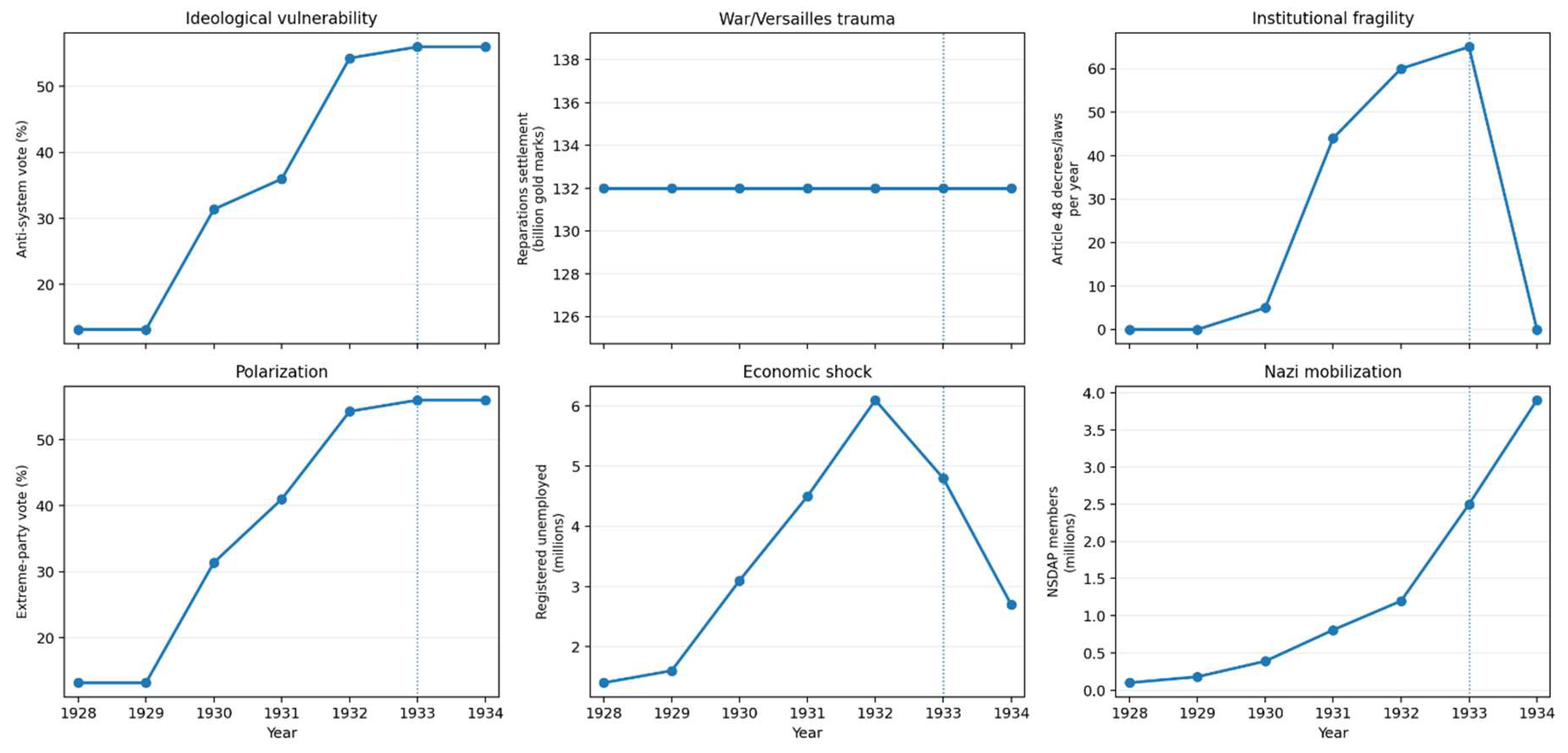
Figure 2.
Simulated threshold dynamics of democratic counterbalance failure between 1928 and 1934. The solid blue curve represents historically anchored estimates of executive power concentration and weakening of democratic counterbalances, while the dashed orange curve reports the corresponding nonlinear simulation output generated from the composite systemic stress index. The dotted blue trajectory indicates the temporal evolution of systemic stress derived from the weighted integration of the six factor groups included in our model. The horizontal dashed line marks the estimated critical threshold at approximately 34.3% systemic stress, above which the simulated dynamics transition from gradual institutional weakening to accelerated concentration of executive authority. Semi-transparent stacked bars represent the relative weighted contributions of different factor groups. The shaded vertical region identifies the phase of executive consolidation around 1933, when democratic stabilizing feedbacks progressively lose corrective capacity and the trajectory converges toward an authoritarian attractor state.
Figure 2.
Simulated threshold dynamics of democratic counterbalance failure between 1928 and 1934. The solid blue curve represents historically anchored estimates of executive power concentration and weakening of democratic counterbalances, while the dashed orange curve reports the corresponding nonlinear simulation output generated from the composite systemic stress index. The dotted blue trajectory indicates the temporal evolution of systemic stress derived from the weighted integration of the six factor groups included in our model. The horizontal dashed line marks the estimated critical threshold at approximately 34.3% systemic stress, above which the simulated dynamics transition from gradual institutional weakening to accelerated concentration of executive authority. Semi-transparent stacked bars represent the relative weighted contributions of different factor groups. The shaded vertical region identifies the phase of executive consolidation around 1933, when democratic stabilizing feedbacks progressively lose corrective capacity and the trajectory converges toward an authoritarian attractor state.
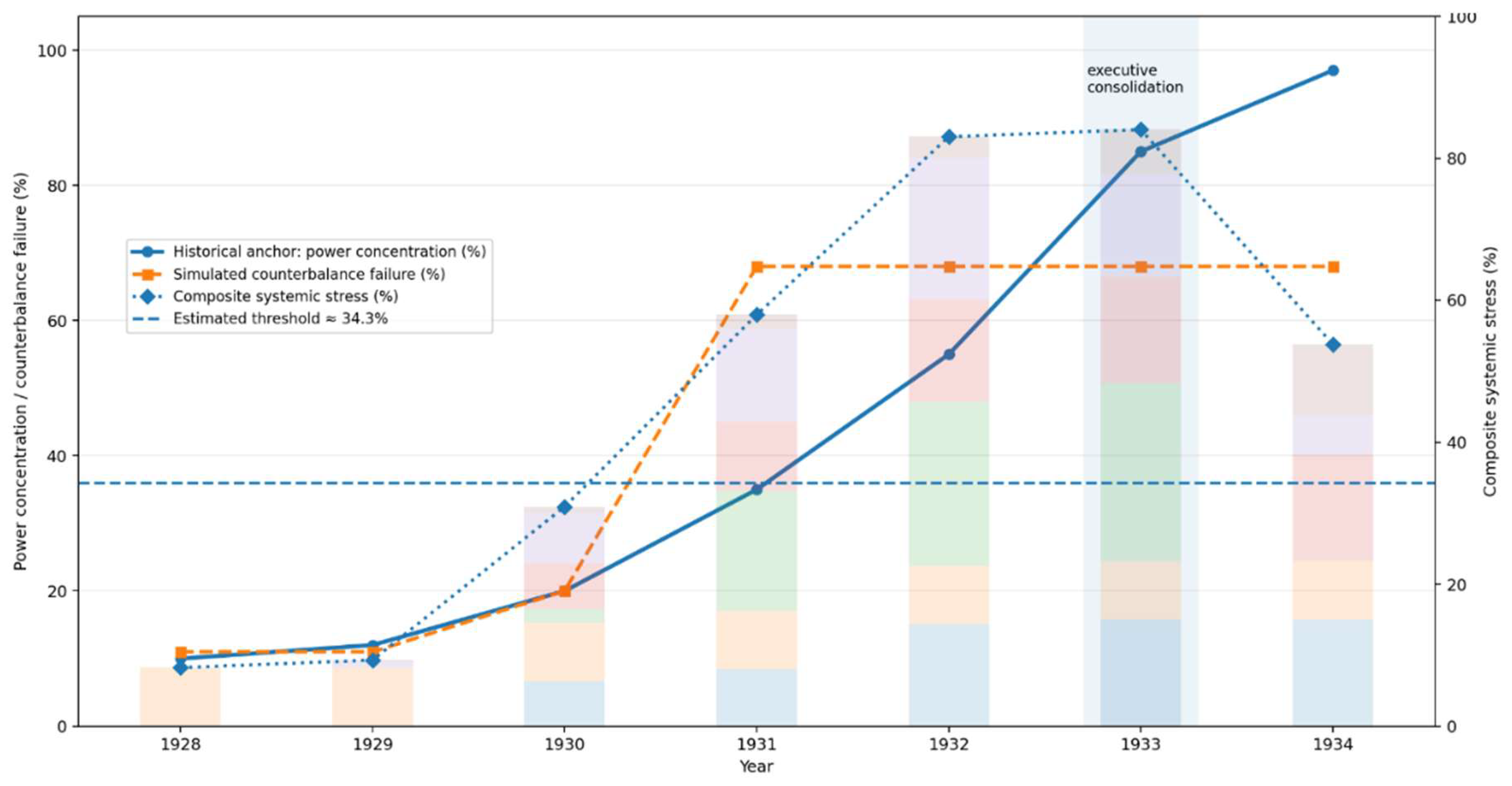
Figure 3.
Logistic response function relating composite systemic stress to the estimated degree of democratic counterbalance failure and executive power concentration. Each point corresponds to a historically anchored yearly state between 1928 and 1934. The continuous curve represents the fitted nonlinear response function used in our dynamical systems model. The vertical dashed line identifies the estimated critical threshold at approximately 34.3% systemic stress, corresponding to the inflection region of the logistic trajectory. Below this threshold, increases in stress are associated with relatively limited changes in executive concentration, indicating partial institutional resilience. Above the threshold, the system undergoes rapid acceleration toward high levels of centralized authority, reflecting loss of stabilizing democratic feedbacks and convergence toward an authoritarian regime configuration.
Figure 3.
Logistic response function relating composite systemic stress to the estimated degree of democratic counterbalance failure and executive power concentration. Each point corresponds to a historically anchored yearly state between 1928 and 1934. The continuous curve represents the fitted nonlinear response function used in our dynamical systems model. The vertical dashed line identifies the estimated critical threshold at approximately 34.3% systemic stress, corresponding to the inflection region of the logistic trajectory. Below this threshold, increases in stress are associated with relatively limited changes in executive concentration, indicating partial institutional resilience. Above the threshold, the system undergoes rapid acceleration toward high levels of centralized authority, reflecting loss of stabilizing democratic feedbacks and convergence toward an authoritarian regime configuration.
Disclaimer/Publisher’s Note: The statements, opinions and data contained in all publications are solely those of the individual author(s) and contributor(s) and not of MDPI and/or the editor(s). MDPI and/or the editor(s) disclaim responsibility for any injury to people or property resulting from any ideas, methods, instructions or products referred to in the content. |
© 2026 by the authors. Licensee MDPI, Basel, Switzerland. This article is an open access article distributed under the terms and conditions of the Creative Commons Attribution (CC BY) license (http://creativecommons.org/licenses/by/4.0/).
Copyright: This open access article is published under a Creative Commons CC BY 4.0 license, which permit the free download, distribution, and reuse, provided that the author and preprint are cited in any reuse.