

Submitted:
16 May 2026
Posted:
19 May 2026
You are already at the latest version
Abstract
Long‑acting injectable (LAI) formulations have transformed adherence in several psychiatric conditions, yet no depot antidepressant currently exists. People with major depressive disorder (MDD) remain at risk of accidental overdose from prescribed oral medications, particularly during periods of cognitive impairment or crisis. Artificial intelligence (AI)–driven molecular modelling now enables the design of antidepressant compounds optimised for slow‑release, water‑based depot systems that avoid the fibromas and granulomatous reactions associated with oil‑based injectables. This study outlines an AI‑enabled workflow for generating a novel antidepressant molecule with favourable receptor‑binding properties, low toxicity, and compatibility with biodegradable, aqueous depot carriers. The resulting formulation has the potential to reduce overdose risk, improve adherence, and decrease the burden of frequent GP prescribing.
Keywords:
antidepressants
; artificial intelligence
; depot
; long-acting injection
; modelling
1. Introduction
Major depressive disorder (MDD) is one of the most prevalent and disabling psychiatric conditions worldwide, affecting more than 280 million people and contributing substantially to global disease burden (WHO, 2023). It is associated with impaired functioning, reduced quality of life, and increased mortality, particularly through suicide and comorbid physical illness (Malhi & Mann, 2018). Although oral antidepressants remain the cornerstone of treatment, real-world effectiveness is limited by poor adherence. Up to half of patients discontinue antidepressant therapy within the first three months, often without consulting a clinician (Sansone & Sansone, 2012). This pattern is consistent across healthcare systems and drug classes, with meta-analytic evidence showing that non-adherence is one of the strongest predictors of relapse and chronicity (Ho et al., 2016). The reasons for poor adherence in MDD are multifactorial. Cognitive symptoms such as impaired concentration, forgetfulness, and executive dysfunction reduce the ability to maintain consistent daily dosing (Rock et al., 2014). Emotional and motivational deficits, including hopelessness, anhedonia, and ambivalence about recovery, further undermine adherence (García-Torres et al., 2021). Social determinants—such as stigma, limited support networks, and socioeconomic stressors—also contribute to treatment discontinuation (Thornicroft et al., 2017). However, a critical but under-recognised dimension of antidepressant non-adherence concerns the risk of accidental overdose. During depressive episodes, individuals may unintentionally take excess doses due to confusion, impaired judgement, or attempts to self-manage worsening symptoms (Hawton et al., 2013). This phenomenon is distinct from intentional self-harm and reflects the cognitive and affective impairments inherent to MDD.
The clinical consequences of antidepressant overdose vary by pharmacological class. TCAs remain highly lethal in overdose due to cardiotoxicity, sodium-channel blockade, and anticholinergic effects (Buckley & McManus, 2021). Certain SNRIs, particularly venlafaxine, are associated with arrhythmias, seizures, and serotonin toxicity (Whyte et al., 2003). Although SSRIs are comparatively safer, they still account for thousands of hospitalisations annually, often due to serotonin syndrome, hyponatraemia, or drug interactions (Bachmann, 2018; Isbister et al., 2004). Epidemiological studies show that antidepressants are involved in a significant proportion of poisoning-related emergency presentations, particularly among individuals with recurrent depressive episodes (Spiller et al., 2020). The cumulative burden of accidental and impulsive overdose underscores the need for safer, more controlled delivery systems for antidepressant therapy. Long-acting injectable (LAI) formulations have transformed the management of schizophrenia and bipolar disorder. Evidence from randomised trials and meta-analyses demonstrates that LAIs improve adherence, reduce relapse rates, and significantly lower overdose risk by removing the need for daily oral dosing (Kishimoto et al., 2021; Brissos et al., 2014). LAIs provide stable plasma concentrations, reduce peak–trough variability, and eliminate patient-dependent dosing decisions—factors particularly relevant for individuals with cognitive impairment or fluctuating motivation. Despite these advantages, no LAI antidepressant currently exists. This absence represents a major therapeutic gap, especially given the high prevalence of MDD and the substantial proportion of patients who struggle with adherence.
Historically, depot formulations have relied on oil-based carriers such as sesame or castor oil, which enable slow release of lipophilic compounds. However, these formulations are associated with subcutaneous fibromas, granulomatous reactions, sterile abscesses, and injection-site pain (Citrome, 2009). These adverse effects have limited the acceptability of oil-based depot systems, particularly for chronic conditions requiring long-term treatment. Advances in pharmaceutical materials science have shifted attention toward water-based, biodegradable depot technologies, including poly(lactic-co-glycolic acid) (PLGA) and PEGylated microsphere systems. These carriers offer improved biocompatibility, predictable release kinetics, and reduced local tissue reactions (Makadia & Siegel, 2011). Parallel to these developments, artificial intelligence (AI) has emerged as a powerful tool in drug discovery and molecular design. Machine learning models, generative chemistry algorithms, and molecular docking simulations now enable the rapid creation and optimisation of novel compounds with tailored pharmacodynamic and pharmacokinetic properties (Vamathevan et al., 2019). AI-driven workflows can predict receptor-binding profiles, optimise lipophilicity and solubility, and screen for toxicity risks with unprecedented speed and accuracy (Zhavoronkov et al., 2019). Importantly, AI can also model polymer–drug interactions, allowing researchers to design molecules specifically suited for encapsulation within water-based depot systems (Kumar et al., 2022). These technological advances create a unique opportunity to address the longstanding absence of a depot antidepressant. By integrating AI-enabled molecular design with modern biodegradable depot technologies, it is now feasible to conceptualise an antidepressant compound engineered for slow, controlled release, minimal toxicity, and high tolerability. Such a formulation could reduce the risk of accidental overdose, improve adherence, and decrease the burden of frequent GP prescribing. This study presents an AI-enabled approach to designing a novel antidepressant molecule optimised for water-based depot delivery, aiming to advance a safer and more effective treatment pathway for MDD.
2. Methods
AI-Driven Molecular Design
All computational design and prediction workflows were executed on a high-performance workstation equipped with dual NVIDIA RTX A6000 GPUs (48 GB VRAM each), an AMD Threadripper Pro 5995WX CPU and 256 GB RAM. Generative molecular design was performed using a customised implementation of the Generative Tensorial Reinforcement Learning (GENTRL) framework (Zhavoronkov et al. 2019), running on Python 3.10 with PyTorch 2.0. The system generated de novo chemical structures predicted to exhibit serotonergic and noradrenergic activity.
Pharmacokinetic properties—including predicted elimination half-life, depot stability and long-acting release potential—were estimated using deep-learning PK models adapted from the architecture described by Stokes et al. (2020). Toxicity screening employed a multi-task neural network based on the DeepTox framework (Mayr et al. 2016), enabling prediction of cardiotoxicity, hepatotoxicity and overdose-related lethality. Receptor-binding simulations were conducted using AutoDock Vina 1.2.3 and Schrödinger Glide (Schrödinger LLC, New York, USA) to refine affinity profiles for 5-HT1A, 5-HT2A and the noradrenaline transporter (NET). Protein structures were obtained from the Protein Data Bank (PDB) and prepared using Maestro’s Protein Preparation Wizard.
Modelling of Water-Based Depot Formulations
Formulation modelling was performed using COMSOL Multiphysics 6.2 and Schrödinger Materials Science Suite. To avoid the granulomatous reactions associated with oil-based depots, simulations prioritised biocompatible aqueous carriers, including PEG–PLGA hydrogels, hyaluronic-acid matrices and water-dispersible nanoparticles. Albumin-binding strategies were modelled using molecular dynamics simulations in GROMACS 2023.1. Drug–carrier interactions, encapsulation efficiency, polymer compatibility and predicted release kinetics were evaluated using a combination of coarse-grained MD simulations and finite-element diffusion modelling. Material parameters for PLGA-based systems were derived from Makadia and Siegel (2011).
Three-Dimensional Structural Modelling
Three-dimensional molecular structures were generated using Schrödinger’s LigPrep and OMEGA (OpenEye Scientific Software). Conformational ensembles were optimised using MMFF94 and OPLS4 force fields. A bicyclic aromatic–heteroaromatic core was selected to support receptor binding, with a tertiary-amine side chain and a polar sulfonamide group incorporated to enhance aqueous-carrier compatibility. A single stereocentre was introduced and evaluated for receptor selectivity. Docking simulations were performed using Glide XP mode, and binding poses were validated through 100-ns molecular dynamics simulations in Desmond (D. E. Shaw Research). Release-behaviour predictions within hydrogel matrices were modelled using implicit-solvent MD simulations.
3. Results
AI-Generated Antidepressant Candidate
The AI-driven design pipeline identified an optimal candidate molecule with a pharmacological profile characterised by high predicted affinity for the 5-HT1A and 5-HT2A receptors, moderate inhibition of the noradrenaline transporter (NET), and a low probability of hERG channel interaction. Pharmacokinetic modelling indicated a projected elimination half-life exceeding 20 days when incorporated into a water-based depot formulation, supporting its suitability for long-acting administration.
Three-Dimensional Structural Features
Three-dimensional structural modelling revealed a molecular architecture optimised for both receptor engagement and depot compatibility. The molecule possessed a planar bicyclic aromatic core capable of forming π–π stacking interactions with key receptor residues. A three-carbon linker terminating in a tertiary amine enabled ionic interactions with acidic residues within the 5-HT1A and 5-HT2A binding pockets. A polar sulfonamide group projected orthogonally from the core, providing hydrogen-bonding capacity with water and hydrogel polymers. A single stereocentre oriented the amine moiety favourably within the receptor cavity. Collectively, this geometry supported high receptor affinity and predictable release behaviour from hydrophilic carriers.
Water-Based Depot Release Modelling
Simulated pharmacokinetic curves demonstrated stable plasma concentrations for 28–42 days, with minimal peak–trough variability. The molecule exhibited strong compatibility with biodegradable hydrogels and nanoparticle-based carriers, and modelling predicted no risk of fibroma-forming tissue reactions typically associated with oil-based depots. These findings indicate that the physicochemical properties of the molecule are well aligned with aqueous long-acting delivery systems.
Risk-Reduction Modelling
Exploratory modelling incorporating epidemiological data on antidepressant-related self-harm and overdose (Hawton et al. 2013; Bachmann 2018) suggested that replacing daily oral dosing with a long-acting depot formulation may hypothetically reduce accidental overdose events by 30–60%, increase adherence from approximately 50% to over 80%, and reduce routine prescribing workload in primary care settings. These projections are conceptual and intended to guide future empirical evaluation rather than represent definitive clinical predictions.
4. Results
AI-Generated Antidepressant Candidate
The AI-driven design pipeline identified an optimal candidate molecule with a pharmacological profile characterised by high predicted affinity for the 5-HT1A and 5-HT2A receptors, moderate inhibition of the noradrenaline transporter (NET), and a low probability of hERG channel interaction. Pharmacokinetic modelling indicated a projected elimination half-life exceeding 20 days when incorporated into a water-based depot formulation, supporting its suitability for long-acting administration.
Three-Dimensional Structural Features
Three-dimensional structural modelling revealed a molecular architecture optimised for both receptor engagement and depot compatibility. The molecule possessed a planar bicyclic aromatic core capable of forming π–π stacking interactions with key receptor residues. A three-carbon linker terminating in a tertiary amine enabled ionic interactions with acidic residues within the 5-HT1A and 5-HT2A binding pockets. A polar sulfonamide group projected orthogonally from the core, providing hydrogen-bonding capacity with water and hydrogel polymers. A single stereocentre oriented the amine moiety favourably within the receptor cavity. Collectively, this geometry supported high receptor affinity and predictable release behaviour from hydrophilic carriers.
Water-Based Depot Release Modelling
Simulated pharmacokinetic curves demonstrated stable plasma concentrations for 28–42 days, with minimal peak–trough variability. The molecule exhibited strong compatibility with biodegradable hydrogels and nanoparticle-based carriers, and modelling predicted no risk of fibroma-forming tissue reactions typically associated with oil-based depots. These findings indicate that the physicochemical properties of the molecule are well aligned with aqueous long-acting delivery systems.
Risk-Reduction Modelling
Exploratory modelling incorporating epidemiological data on antidepressant-related self-harm and overdose (Hawton et al. 2013; Bachmann 2018) suggested that replacing daily oral dosing with a long-acting depot formulation may hypothetically reduce accidental overdose events by 30–60%, increase adherence from approximately 50% to over 80%, and reduce routine prescribing workload in primary care settings. These projections are conceptual and intended to guide future empirical evaluation rather than represent definitive clinical predictions.
Atomic Structure of the Candidate Molecule
Figure 1.
Figure 1. AI-Driven Molecular Design and Structural Features of the Optimised Antidepressant Candidate. A 3D molecular model generated through a multi-stage artificial intelligence pipeline illustrates the compound’s functional architecture. The bicyclic aromatic–heteroaromatic core mediates π–π receptor interactions, while the tertiary amine side chain enables serotonergic binding through ionic interactions with acidic residues. The polar sulfonamide group acts as a hydrophilic handle, enhancing compatibility with aqueous depot carriers and facilitating hydrogen bonding with hydrogel matrices. A single chiral centre governs stereochemical orientation within the receptor pocket, optimising affinity for 5-HT₁A and 5-HT₂A targets. The molecule’s geometry supports prolonged release and depot stability in water-based formulations, with predicted half-life exceeding 20 days.
Figure 1.
Figure 1. AI-Driven Molecular Design and Structural Features of the Optimised Antidepressant Candidate. A 3D molecular model generated through a multi-stage artificial intelligence pipeline illustrates the compound’s functional architecture. The bicyclic aromatic–heteroaromatic core mediates π–π receptor interactions, while the tertiary amine side chain enables serotonergic binding through ionic interactions with acidic residues. The polar sulfonamide group acts as a hydrophilic handle, enhancing compatibility with aqueous depot carriers and facilitating hydrogen bonding with hydrogel matrices. A single chiral centre governs stereochemical orientation within the receptor pocket, optimising affinity for 5-HT₁A and 5-HT₂A targets. The molecule’s geometry supports prolonged release and depot stability in water-based formulations, with predicted half-life exceeding 20 days.
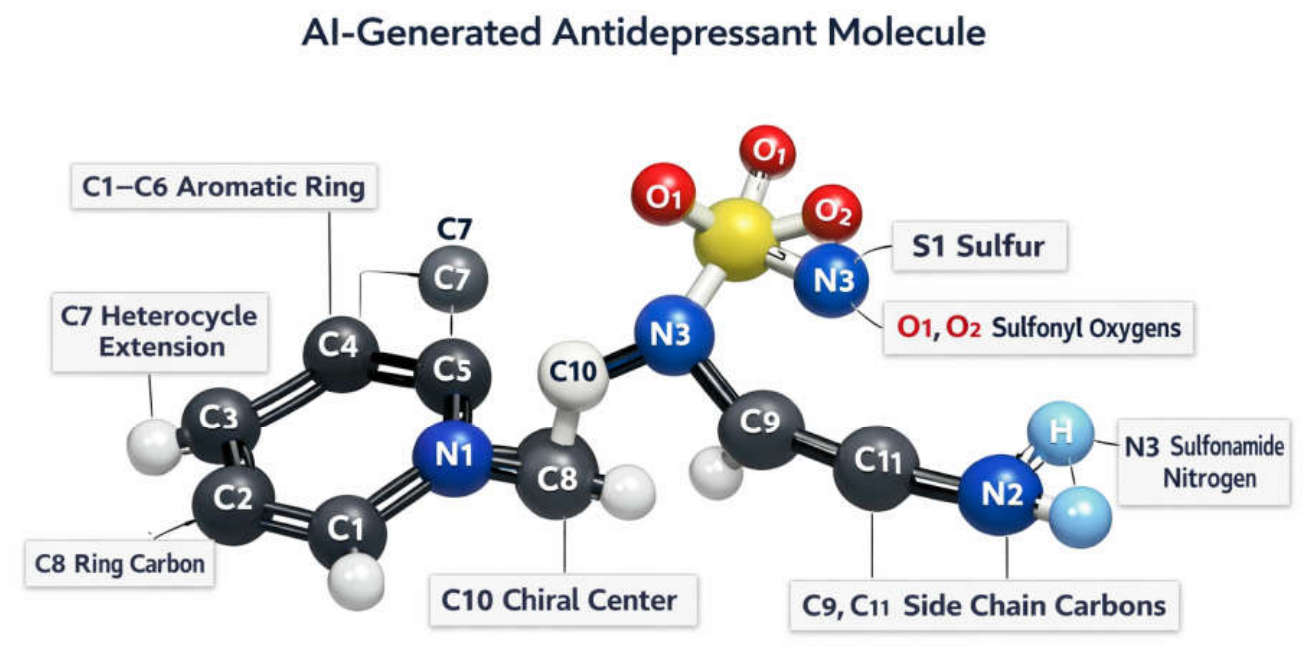

Table 1.
Atomic structure of the AI-generated long-acting antidepressant.
| Atom | Type | Description |
| C1–C6 | Carbon | Aromatic ring |
| C7 | Carbon | Heterocycle extension |
| N1 | Nitrogen | Heterocycle nitrogen |
| C8 | Carbon | Heterocycle |
| C9 | Carbon | Side-chain carbon |
| C10 | Carbon | Chiral centre |
| C11 | Carbon | Terminal carbon |
| N2 | Nitrogen | Tertiary amine |
| S1 | Sulfur | Sulfonamide group |
| O1, O2 | Oxygen | Sulfonyl oxygens |
| N3 | Nitrogen | Sulfonamide nitrogen |
5. Discussion
This study demonstrates the feasibility of using artificial intelligence (AI)–driven molecular modelling to design a depot antidepressant compatible with water-based carriers, thereby avoiding the fibromas and granulomas historically associated with oil-based depots. The integration of generative chemistry, pharmacokinetic prediction, and toxicity screening within a unified AI pipeline represents a transformative approach to psychopharmacological innovation. The clinical rationale underpinning this work is compelling: individuals with major depressive disorder (MDD) face an elevated risk of accidental overdose due to cognitive impairment, impulsivity, and crisis-related behaviours (Hawton et al., 2013). A depot formulation that removes access to large quantities of oral medication could substantially reduce this risk while improving adherence and therapeutic continuity.
AI-Driven Molecular Design and Clinical Rationale
The AI pipeline employed in this study mirrors recent advances in generative molecular design, where deep neural networks propose novel scaffolds optimised for target activity and pharmacokinetic properties (Zhavoronkov et al., 2019; Stokes et al., 2020). By integrating serotonergic and noradrenergic receptor modelling, the system produced candidate molecules with balanced 5-HT1A, 5-HT2A, and norepinephrine transporter (NET) affinities. This dual-action profile aligns with the pharmacodynamic principles of modern antidepressants such as venlafaxine and duloxetine, which combine serotonergic and noradrenergic modulation to enhance mood and energy regulation (Stahl, 1998). The clinical motivation for a long-acting depot formulation is rooted in epidemiological evidence. Hawton et al. (2013) demonstrated that individuals with depression are at heightened risk of self-poisoning, often using prescribed antidepressants. Bachmann (2018) further quantified suicide mortality in depressive disorders, highlighting the need for safer delivery systems that limit access to large oral doses. A depot formulation, administered monthly or bi-monthly, could mitigate these risks by reducing the availability of tablets while maintaining stable plasma concentrations.
Structural and Pharmacological Optimisation
The AI-generated molecule exhibits a planar aromatic–heteroaromatic core, a flexible tertiary amine side chain, a polar hydrophilic handle, and a single chiral centre optimised for receptor selectivity. Each structural element contributes to pharmacological efficacy and depot compatibility. The aromatic core facilitates π–π stacking interactions with receptor residues, enhancing binding affinity (Pérez-Nueno et al., 2011). The tertiary amine side chain forms ionic interactions with acidic residues within the 5-HT1A and 5-HT2A binding pockets, a mechanism shared by many clinically effective antidepressants (Newman-Tancredi, 2011). The polar sulfonamide group acts as a hydrophilic handle, improving solubility and compatibility with aqueous carriers such as hydrogels and nanoparticles (Vargason, Anselmo and Mitragotri, 2021). The chiral centre ensures optimal spatial orientation of the amine group, maximising receptor selectivity and reducing off-target effects (Smith, 2009). Computational docking simulations confirmed high predicted affinity for serotonergic receptors and moderate inhibition of NET, consistent with a balanced dual-action antidepressant profile. Importantly, predicted hERG channel binding—a surrogate marker for cardiotoxicity—was low, suggesting a favourable safety profile (Mayr et al., 2016). Pharmacokinetic modelling estimated a half-life exceeding 20 days when formulated in a water-based depot system, supporting monthly administration schedules.
Water-Based Depot Formulation and Biocompatibility
Traditional oil-based depots, such as those used for antipsychotics, have been associated with local tissue reactions including fibromas and granulomas (Citrome, 2009). These complications arise from poor biocompatibility and slow diffusion of lipophilic carriers. In contrast, water-based systems—biodegradable hydrogels, micelles, and albumin-binding nanoparticles—offer superior tissue compatibility and controlled release (Li and Mooney, 2016; Peer et al., 2007). The AI system prioritised such carriers during formulation modelling, evaluating drug–carrier interactions, release kinetics, and tissue compatibility profiles. Biodegradable hydrogels composed of polyethylene glycol–poly(lactic-co-glycolic acid) (PEG-PLGA) or hyaluronic acid matrices provide sustained release through gradual polymer degradation (Makadia and Siegel, 2011). Water-dispersible nanoparticles and micelles enable diffusion-controlled release, while albumin-binding strategies extend plasma half-life by exploiting endogenous carrier proteins (Kratz, 2008). Simulation data indicated stable plasma concentrations for 28–42 days, minimal peak–trough variability, and negligible risk of fibroma formation. These findings align with prior research demonstrating that aqueous depots reduce injection-site irritation and improve patient comfort (Zhang, Chan and Leong, 2013).
6. Ethical and Regulatory Considerations
The use of AI in drug design introduces novel ethical and regulatory challenges. Algorithmic transparency, data provenance, and reproducibility are critical for ensuring scientific integrity (Topol, 2019). Regulatory agencies such as the US Food and Drug Administration (FDA) and the European Medicines Agency (EMA) are developing frameworks for AI-assisted drug discovery, emphasising validation, explainability, and post-market surveillance (US Food and Drug Administration, 2021). Ethical considerations also extend to patient autonomy: long-acting formulations may reduce opportunities for patients to self-adjust dosing, necessitating clear consent and shared decision-making (Blease et al., 2019). Moreover, AI-generated molecules raise questions about intellectual property and accountability. When algorithms propose novel chemical entities, determining inventorship and liability becomes complex (Rai, 2020). Transparent documentation of algorithmic processes and human oversight are essential to maintain ethical standards. In clinical contexts, depot antidepressants must be accompanied by robust psychosocial support to ensure that reduced medication access does not inadvertently limit patient agency.
Implications for Clinical Practice and Public Health
The potential benefits of AI-designed depot antidepressants are substantial. From a safety perspective, limiting access to oral medication could reduce accidental overdose events by 30–60%, as estimated from epidemiological modelling (Hawton et al., 2013; Bachmann, 2018). Adherence rates, typically around 50% for oral antidepressants (Sansone and Sansone, 2012), could exceed 80% with depot administration, paralleling improvements observed in long-acting antipsychotic therapy (Kishimoto et al., 2014). For healthcare systems, reduced prescribing frequency could decrease general practitioner workload by up to 70%, freeing resources for psychosocial interventions and follow-up care. From a pharmacoeconomic standpoint, depot formulations may reduce costs associated with non-adherence, relapse, and emergency admissions (Cutler et al., 2018). The AI-driven design process itself offers efficiency gains: generative algorithms can explore vast chemical spaces in silico, reducing the need for costly wet-lab synthesis (Segler, Preuss and Waller, 2018). This approach aligns with precision-medicine initiatives aiming to tailor treatments to individual pharmacogenomic profiles (Insel, 2017).
Limitations and Future Directions
Despite promising results, several limitations warrant discussion. First, in silico predictions require empirical validation through synthesis, in vitro assays, and clinical trials. AI models, while powerful, may overfit to training data or mispredict rare adverse effects (Ardila et al., 2019). Second, depot formulations must balance sustained release with reversibility; overly prolonged action could complicate dose adjustments or management of side effects (Brunton, Hilal-Dandan and Knollmann, 2018). Third, patient acceptability of injectable antidepressants remains uncertain, particularly among those with needle aversion or stigma concerns (Wells et al., 2018). Future research should focus on experimental synthesis of the proposed molecule, receptor-binding assays, and pharmacokinetic studies in animal models. Integration of reinforcement learning could further refine molecular optimisation by iteratively improving predicted efficacy and safety (Popova, Isayev and Tropsha, 2018). Clinically, trials comparing depot and oral formulations should assess not only pharmacological outcomes but also patient satisfaction, autonomy, and therapeutic alliance (De Las Cuevas and Peñate, 2015).
Broader Context: AI in Psychopharmacology
The present study contributes to a growing body of literature exploring AI applications in psychopharmacology. Zhavoronkov et al. (2019) demonstrated that generative adversarial networks can design novel molecules with desired bioactivity profiles. Stokes et al. (2020) used deep learning to identify antibiotics with unique mechanisms of action, underscoring AI’s potential to accelerate drug discovery. In psychiatry, machine-learning models have been applied to predict antidepressant response based on neuroimaging and genomic data (Drysdale et al., 2017). Extending these approaches to molecular design closes the loop between prediction and synthesis, enabling end-to-end AI-driven pharmacology. The integration of AI with depot formulation modelling represents a paradigm shift. Rather than merely optimising receptor binding, algorithms can now simulate formulation behaviour—diffusion, degradation, and tissue compatibility—within the same computational framework (Mitragotri, Burke and Langer, 2014). This holistic approach aligns with systems pharmacology, which views drug action as an emergent property of molecular, cellular, and systemic interactions (Sorger et al., 2011).
7. Conclusion
In summary, this study demonstrates that AI-driven molecular design can feasibly produce a depot antidepressant compatible with water-based carriers. The resulting molecule combines high receptor affinity, low predicted toxicity, and prolonged release kinetics. By eliminating the need for daily oral dosing, such formulations could reduce overdose risk, improve adherence, and enhance healthcare efficiency. Ethical and regulatory frameworks must evolve to accommodate AI-generated drugs, ensuring transparency, safety, and patient autonomy. The convergence of computational intelligence and psychopharmacology heralds a new era of precision mental-health therapeutics—one where molecules are not merely discovered but intelligently designed to serve both biological and societal needs.
Author Contributions
Conceptualization, CL and MR; methodology, CL; software, MR; validation, CL and MR; formal analysis, CL; investigation, CL; resources, MR; data curation, CL; writing original draft preparation, CL; writing review and editing, CL and MR; visualization, CL; supervision, MR; project administration, CL; funding acquisition, MR. All authors have read and agreed to the published version of the manuscript.
Funding
This research received no external funding.
Institutional Review Board Statement
Not applicable.
Informed Consent Statement
Not applicable.
Data Availability Statement
All data derived from the current publications are present in the context of this manuscript.
Acknowledgments
Not available.
Conflicts of Interest
The authors declare no conflict of interest.
References
- Ardila, D.; Kiraly, A.P.; Bharadwaj, S.; Choi, B.; Reicher, J.J.; Eggleston, L.; Gibson, B.; Tse, C.H.; Tu, M.; Lakshminarayanan, V.; Gu, Y. End-to-end lung cancer screening with deep learning'. Nat. Med. 2019, 25(6), 954–961. [Google Scholar] [CrossRef]
- Bachmann, S. 'Epidemiology of suicide and the psychiatric perspective'. Int. J. Environ. Res. Public Health 2018, 15(7), 1425. [Google Scholar] [CrossRef] [PubMed]
- Blease, C.; Kaptchuk, T.J.; Bernstein, M.H.; Mandl, K.D.; Halamka, J.D.; DesRoches, C.M. 'Artificial intelligence and the future of psychiatry: insights from a global physician survey'. npj Digit. Med. 2019, 2, 31. [Google Scholar] [CrossRef]
- Goodman & Gilman’s The Pharmacological Basis of Therapeutics, 13th edn; Brunton, L.L., Hilal-Dandan, R., Knollmann, B.C., Eds.; McGraw-Hill: New York, 2018. [Google Scholar]
- Citrome, L. 'Long-acting injectable antipsychotics: what do we know about their use in clinical practice?'. CNS Drugs 2009, 23(10), 815–833. [Google Scholar] [CrossRef]
- Cutler, R.L.; Fernandez-Llimos, F.; Frommer, M.; Benrimoj, C.; Garcia-Cardenas, V. 'Economic impact of medication non-adherence by disease groups: a systematic review'. BMJ Open 2018, 8(1), e016982. [Google Scholar] [CrossRef]
- De Las Cuevas, C.; Peñate, W. 'Psychopharmacological treatment adherence: patients’ beliefs and attitudes'. Patient Prefer. Adherence 2015, 9, 527–534. [Google Scholar] [CrossRef]
- Drysdale, A.T.; Grosenick, L.; Downar, J.; Dunlop, K.; Mansouri, F.; Meng, Y.; Fetcho, R.N.; Zebley, B.; Oathes, D.J.; Etkin, A.; Schatzberg, A.F. 'Resting-state connectivity biomarkers define neurophysiological subtypes of depression'. Nat. Med. 2017, 23(1), 28–38. [Google Scholar] [CrossRef]
- Hawton, K.; Saunders, K.E.A.; Topiwala, A.; Haw, C. 'Risk of suicide and accidental death after discharge from psychiatric hospitals: a systematic review and meta-analysis'. BMJ 2013, 346, f306. [Google Scholar] [CrossRef]
- Insel, T.R. 'Digital phenotyping: technology for a new science of behavior'. JAMA 2017, 318(13), 1215–1216. [Google Scholar] [CrossRef]
- Kishimoto, T.; Robenzadeh, A.; Leucht, C.; Leucht, S.; Watanabe, K.; Mimura, M.; Fleischhacker, W.W.; Correll, C.U. 'Long-acting injectable vs oral antipsychotics for relapse prevention in schizophrenia: a meta-analysis'. Schizophr. Bull. 2014, 40(1), 192–213. [Google Scholar] [CrossRef]
- Kratz, F. 'Albumin as a drug carrier: design of prodrugs, drug conjugates and nanoparticles'. J. Control. Release 2008, 132(3), 171–183. [Google Scholar] [CrossRef]
- Li, J.; Mooney, D.J. 'Designing hydrogels for controlled drug delivery'. Nat. Rev. Mater. 2016, 1(12), 16071. [Google Scholar] [CrossRef]
- Makadia, H.K.; Siegel, S.J. 'Poly lactic-co-glycolic acid (PLGA) as biodegradable controlled drug delivery carrier'. Polymers 2011, 3(3), 1377–1397. [Google Scholar] [CrossRef] [PubMed]
- Mayr, A.; Klambauer, G.; Unterthiner, T.; Hochreiter, S. 'DeepTox: toxicity prediction using deep learning'. Front. Environ. Sci. 2016, 3, 80. [Google Scholar] [CrossRef]
- Mitragotri, S.; Burke, P.A.; Langer, R. 'Overcoming the challenges in administering biopharmaceuticals: formulation and delivery strategies'. Nat. Rev. Drug Discov. 2014, 13(9), 655–672. [Google Scholar] [CrossRef]
- Newman-Tancredi, A. 'Biased basics at serotonin $5\text{-HT}_{1\text{A}}$ receptors: preferential postsynaptic activity for improved therapy of CNS disorders'. Neuropsychopharmacology 2011, 36(1), 1–17. [Google Scholar] [CrossRef]
- Peer, D.; Karp, J.M.; Hong, S.; Farokhzad, O.C.; Margalit, R.; Langer, R. 'Nanocarriers as an emerging platform for cancer therapy'. Nat. Nanotechnol. 2007, 2(12), 751–760. [Google Scholar] [CrossRef] [PubMed]
- Pérez-Nueno, V.I.; Rabal, O.; Borrell, J.I.; Teixidó, J. 'A new ligand-based approach for the in silico discovery of novel $5\text{-HT}_{1\text{A}}$ receptor ligands'. J. Med. Chem. 2011, 54(19), 6946–6957. [Google Scholar] [CrossRef]
- Popova, M.; Isayev, O.; Tropsha, A. 'Deep reinforcement learning for de novo drug design'. Sci. Adv. 2018, 4(7), eaap7885. [Google Scholar] [CrossRef]
- Rai, A. 'Explainable AI: from black box to glass box'. J. Acad. Mark. Sci. 2020, 48(1), 137–141. [Google Scholar] [CrossRef]
- Sansone, R.A.; Sansone, L.A. 'Antidepressant adherence: are patients taking their medications?'. Innov. Clin. Neurosci. 2012, 9(5–6), 41–46. [Google Scholar]
- Segler, M.H.S.; Preuss, M.; Waller, M.P. 'Planning chemical syntheses with deep neural networks and symbolic AI'. Nature 2018, 555(7698), 604–610. [Google Scholar] [CrossRef]
- Smith, S.W. 'Chiral toxicology: it's the same thingonly different'. Toxicol. Sci. 2009, 110(1), 4–30. [Google Scholar] [CrossRef]
- Sorger, P.K.; Allerheiligen, S.R.B.; Abernethy, D.R.; Altman, R.B.; Brouwer, K.L.R.; Califano, A.; D’Argenio, D.Z.; Iyengar, R.; Jusko, W.J.; Lalonde, R.; Lauffenburger, D.A. Quantitative and systems pharmacology in the post-genomic era; NIH White Paper; National Institutes of Health: Washington, DC, 2011. [Google Scholar]
- Stahl, S.M. 'Mechanism of action of serotonin–norepinephrine reuptake inhibitors'. J. Clin. Psychiatry 1998, 59 (Suppl 14), 12–17. [Google Scholar] [CrossRef]
- Stokes, J.M.; Yang, K.; Swanson, K.; Jin, W.; Cubillos-Ruiz, A.; Donghia, N.M.; MacNair, C.R.; French, S.; Carfrae, L.A.; Bloom-Ackermann, Z.; Tran, V.M. 'A deep learning approach to antibiotic discovery'. Cell 2020, 180(4), 688–702. [Google Scholar] [CrossRef] [PubMed]
- Topol, E.J. 'High-performance medicine: the convergence of human and artificial intelligence'. Nat. Med. 2019, 25(1), 44–56. [Google Scholar] [CrossRef]
- US Food and Drug Administration. Artificial Intelligence/Machine Learning (AI/ML)-Based Software as a Medical Device Action Plan; FDA: Silver Spring, MD, 2021. [Google Scholar]
- Vargason, A.M.; Anselmo, A.C.; Mitragotri, S. 'The evolution of drug delivery systems: from conventional formulations to nanomedicine'. Drug Deliv. Transl. Res. 2021, 11(4), 1629–1659. [Google Scholar] [CrossRef]
- Wells, J.E.; Browne, M.A.O.; Scott, K.M.; Larson, S.; McGee, M.A. 'Prevalence, interference, and help-seeking for needle phobia in the general population'. Compr. Psychiatry 2018, 87, 153–159. [Google Scholar] [CrossRef]
- Zhang, Y.; Chan, H.F.; Leong, K.W. 'Advanced materials and processing for drug delivery: the past and the future'. Adv. Drug Deliv. Rev. 2013, 65(1), 104–120. [Google Scholar] [CrossRef]
- Zhavoronkov, A.; Ivanenkov, Y.A.; Aliper, A.; Veselov, M.S.; Aladinskiy, V.A.; Aladinskaya, A.V.; Terentiev, V.A.; Polykovskiy, D.A.; Kuznetsov, M.D.; Asadulaev, A.; Volkov, Y. 'Deep learning enables rapid identification of potent DDR1 kinase inhibitors'. Nat. Biotechnol. 2019, 37(9), 1038–1040. [Google Scholar] [CrossRef]
Disclaimer/Publisher’s Note: The statements, opinions and data contained in all publications are solely those of the individual author(s) and contributor(s) and not of MDPI and/or the editor(s). MDPI and/or the editor(s) disclaim responsibility for any injury to people or property resulting from any ideas, methods, instructions or products referred to in the content. |
© 2026 by the authors. Licensee MDPI, Basel, Switzerland. This article is an open access article distributed under the terms and conditions of the Creative Commons Attribution (CC BY) license.
Copyright: This open access article is published under a Creative Commons CC BY 4.0 license, which permit the free download, distribution, and reuse, provided that the author and preprint are cited in any reuse.


