

Submitted:
05 May 2026
Posted:
18 May 2026
You are already at the latest version
Abstract
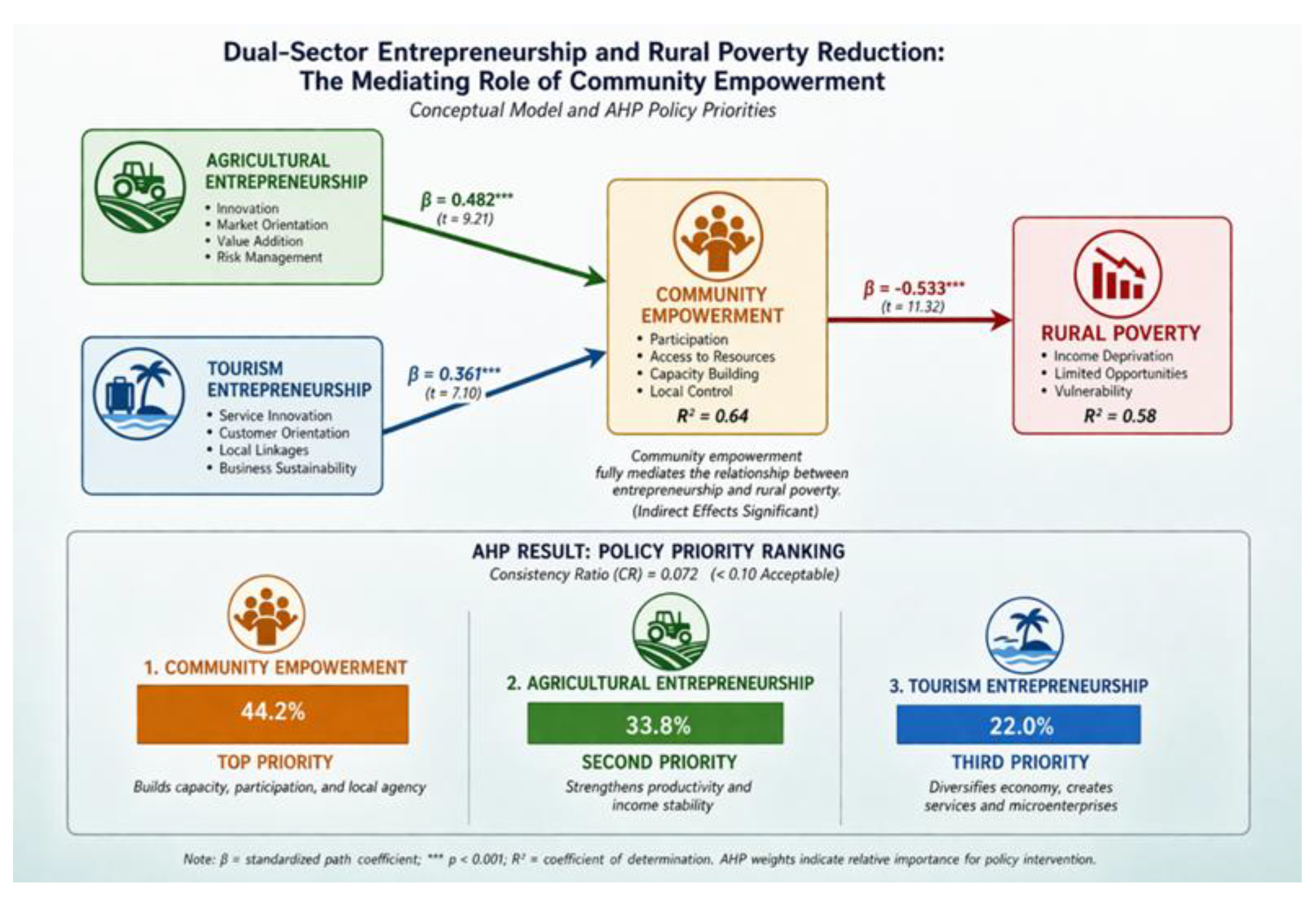
This study examines the role of agricultural and tourism entrepreneurship in reducing rural poverty through community empowerment within a place-based development framework. Using data from 400 respondents in Jambi Province, Indonesia, and employing Partial Least Squares Structural Equation Modeling (PLS-SEM) combined with the Analytical Hierarchy Process (AHP), the results reveal that agricultural entrepreneurship (β = 0.482, p < 0.001) and tourism entrepreneurship (β = 0.361, p < 0.001) significantly enhance community empowerment. In turn, community empowerment has a strong negative effect on poverty (β = -0.533, p < 0.001). The mediation analysis confirms that empowerment fully mediates the relationship between entrepreneurship and poverty reduction. Furthermore, AHP results indicate that community empowerment is the highest policy priority (44.2%), followed by agricultural entrepreneurship (33.8%) and tourism entrepreneurship (22.0%). This study contributes to the literature by integrating dual-sector entrepreneurship and identifying empowerment as a key mechanism in sustainable and inclusive rural development.
Keywords:
entrepreneurship
; community empowerment
; poverty reduction
; SEM-PLS
; AHP
; rural development
1. Introduction
Rural poverty remains a persistent and multidimensional challenge in developing countries. While entrepreneurship has been widely promoted as a key driver of economic growth and job creation, its effectiveness in reducing poverty depends on how well it is embedded within local socio-economic contexts. In many rural areas, economic activities are dominated by agriculture, while tourism has emerged as a complementary sector offering diversification opportunities. However, previous studies often examine these sectors separately and overlook the role of community empowerment as a critical mechanism linking economic activity to welfare outcomes. This study addresses this gap by integrating agricultural and tourism entrepreneurship within a place-based development framework and examining the mediating role of community empowerment in poverty reduction.
2. Materials and Methods
2.1. Literature Review
Entrepreneurship and Rural Development
Entrepreneurship is increasingly understood as a socially embedded process influenced by local resources, institutions, and networks. Agricultural entrepreneurship enhances productivity and income stability, while tourism entrepreneurship supports diversification and service-based economic expansion.
2.2. Community Empowerment
Community empowerment refers to the process of enhancing individuals’ and groups’ capacity to make decisions, access resources, and participate in economic activities. It plays a crucial role in ensuring that economic growth translates into inclusive development.
2.3. Hypothesis Development
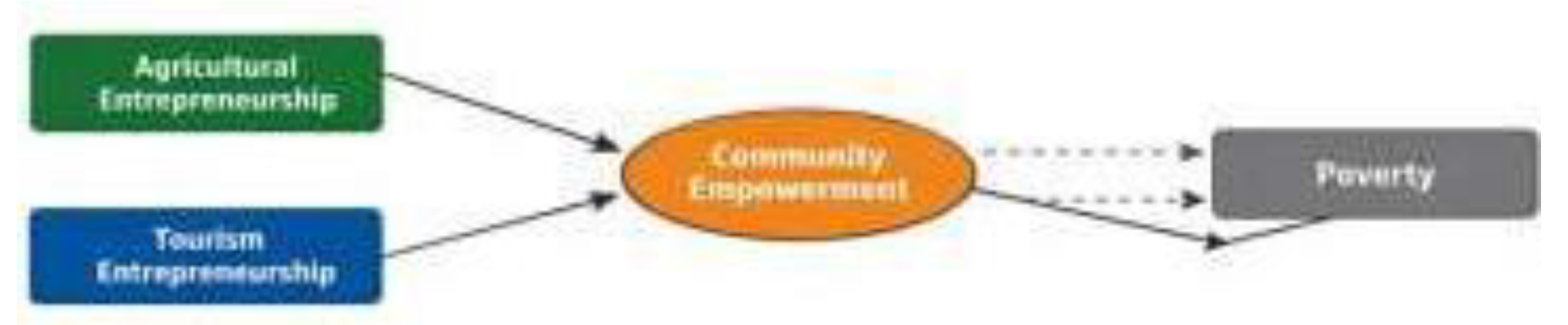
H1:
Agricultural entrepreneurship positively affects community empowerment
H2:
Tourism entrepreneurship positively affects community empowerment
H3:
Community empowerment negatively affects poverty
H4:
Community empowerment mediates the relationship between entrepreneurship and poverty
Figure 1.
The conceptual model.
This study employed a quantitative, field-based research design to examine the relationships between agricultural entrepreneurship, tourism entrepreneurship, community empowerment, and poverty reduction. A quantitative approach was considered appropriate given the study’s objective to test theory-driven relationships and to evaluate both direct and indirect effects among latent constructs within a structured analytical framework. Quantitative designs are widely used in entrepreneurship and development research to empirically test causal mechanisms and mediation effects linking economic activity to social outcomes (Creswell & Creswell, 2018; Hair et al., 2021).
The empirical setting of the study was Muaro Jambi Regency and Kerinci Regency in Jambi Province, Indonesia. These regions were purposively selected because they represent place-based local economies where agriculture remains a dominant livelihood sector and tourism has emerged as a complementary economic activity, while poverty persists as a structural challenge. Place-based development literature emphasizes that such contexts are particularly suitable for examining the interaction between entrepreneurship, community dynamics, and development outcomes (Rodríguez-Pose & Wilkie, 2019; OECD, 2021).
The unit of analysis consisted of individual community members who were actively engaged in agricultural and/or tourism-related economic activities, including business owners, workers, and participants in community-based enterprises. Primary data were collected through a structured questionnaire administered directly to respondents using a purposive sampling technique to ensure that all participants possessed relevant experience related to sectoral entrepreneurship and community economic activities. A total of 100 valid responses were obtained and included in the analysis. This sample size satisfies the minimum requirements for Partial Least Squares Structural Equation Modeling (PLS-SEM), which is particularly suitable for exploratory and prediction-oriented models with small to medium sample sizes in community-based research (Hair et al., 2021; Sarstedt et al., 2022).
The analytical framework of the study was developed based on economic development theory, human capital theory, and the enterprising communities perspective. Economic development theory emphasizes the role of entrepreneurship and innovation in strengthening productive sectors and fostering inclusive growth (Todaro & Smith, 2020), while human capital theory highlights the importance of skills, learning, and experiential knowledge in enhancing productivity and income-generating capacity (Becker, 2021). Complementing these perspectives, the enterprising communities literature conceptualizes entrepreneurship as a socially embedded and place-based process in which community empowerment plays a central role in shaping development outcomes (Welter et al., 2019; Urbano et al., 2020). Based on this framework, community empowerment was positioned as a mediating mechanism linking sectoral entrepreneurship and poverty reduction. Agricultural entrepreneurship was operationalized using indicators reflecting innovation in agricultural practices, product diversification, market orientation, and engagement in value-added activities. These indicators were adapted from prior empirical stud ies on entrepreneurial agriculture and rural development, which emphasize the importance of innovation and market integration for improving rural livelihoods (Santovito et al., 2021; Barrett et al., 2021). Tourism entrepreneurship was measured through indicators related to participation in tourism-related enterprises, service innovation, local ownership, and the utilization of cultural and natural resources, consistent with community-based tourism and tourism entrepreneurship literature (Ratten, 2022; Mensah et al., 2022). Community empowerment was conceptualized as a multidimensional construct capturing participation in economic decision-making, access to resources and information, skills development, and collective action. This conceptualization aligns with empowerment frameworks commonly applied in enterprising communities and inclusive development research (Urbano et al., 2020; Hussain et al., 2022). Poverty was measured using perceptual indicators reflecting economic vulnerability, income sufficiency, and the ability to meet basic household needs, an approach consistent with multidimensional poverty perspectives in community-level studies (Bourguignon, 2021; Ravallion, 2020). All constructs were measured using multi-item indicators adapted from established empirical studies and assessed using a five-point Likert scale ranging from strongly disagree to strongly agree.
Based on the proposed theoretical framework, the study assumes that entrepreneurial activities in both agriculture and tourism strengthen community empowerment by enhancing participation, capacity, and local economic agency. In turn, empowered communities are expected to experience lower levels of poverty due to improved control over economic resources, stronger collective action, and greater resilience to vulnerability. Community empowerment is therefore expected to mediate the relationship between sectoral entrepreneurship and poverty reduction, as suggested by prior mediation-based studies in entrepreneurship and poverty research (Preacher & Hayes, 2008; Hussain et al., 2022).
These assumed relationships were incorporated directly into the structural model and tested empirically rather than being treated as separate narrative hypotheses.
Data analysis was conducted using Structural Equation Modeling based on Partial Least Squares (PLS-SEM) with SmartPLS software. PLS-SEM was selected due to its ability to estimate complex models with multiple latent variables, its robustness to non-normal data distributions, and its effectiveness in testing mediation effects (Hair et al., 2021; Shmueli et al., 2019). The analysis followed a two-stage procedure, beginning with an assessment of the measurement model to evaluate internal consistency reliability, convergent validity, and discriminant validity, followed by an evaluation of the structural model to estimate path coefficients, coefficients of determination, and the significance of indirect effects using bootstrapping procedures (Henseler et al., 2015; Sarstedt et al., 2022).
Ethical considerations were observed throughout the research process. Participation in the study was voluntary, respondents were informed about the purpose of the research prior to data collection, and confidentiality and anonymity were guaranteed. All data were used solely for academic purposes and analyzed in aggregate form, in accordance with standard ethical guidelines for social science research (Saunders et al., 2019).
3. Methods
3.1. Research Design
This study employs a quantitative approach using survey data from 400 respondents involved in agricultural and tourism activities.
3.2. Data Analysis
Data were analyzed using:
SEM-PLS for causal relationships
AHP for policy prioritization
3.3. Validity and Reliability
All constructs meet:
AVE > 0.50
Composite Reliability > 0.70
4. Results
This section may be divided by subheadings. It should provide a concise and precise description of the experimental results, their interpretation as well as the experimental conclusions that can be drawn.
Figure 1.
Structural Model of the SEM-PLS Analysis.
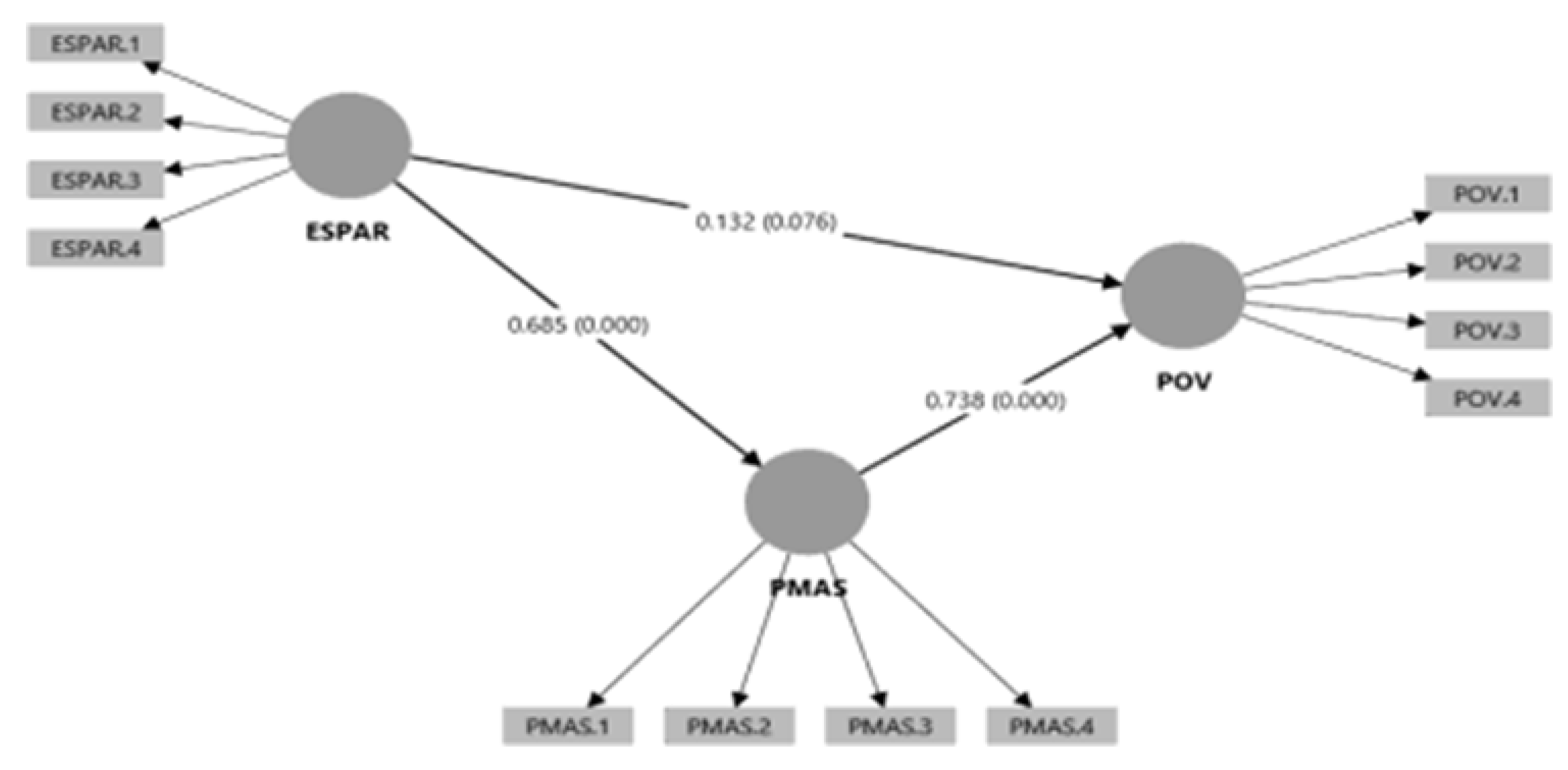

Table 1.
SWOT Analysis Matrix.
| Strengths | Weaknesses |
| Strong agricultural base; High social cohesion | Limited financial access; Low digital literacy |
| Opportunities | Threats |
| Agrotourism growth; "Desa Wisata" program | Climate change; Commodity price volatility |
The high mediation effect suggests that entrepreneurial activities must be accompanied by capacity building to effectively reduce "Income Deprivation" and "Vulnerability.".
The findings underscore that while agriculture is the primary economic driver, tourism provides necessary diversification. The SWOT matrix below summarizes the strategic position of Jambi’s rural economy.
5. Discussion
The findings demonstrate that entrepreneurship contributes to poverty reduction indirectly through community empowerment. Agricultural entrepreneurship has a stronger effect due to its deep integration with local livelihoods, while tourism provides complementary benefits.
Most importantly, the results confirm that empowerment is the central mechanism through which economic activities translate into social outcomes. This supports the capability approach and highlights the importance of inclusive development strategies.
Key Contribution: Entrepreneurship alone is insufficient for poverty reduction unless embedded within empowerment processes that enhance local agency and participation
6. Conclusions
This study confirms that community empowerment plays a critical mediating role in linking entrepreneurship to poverty reduction. Policies should shift from sector-driven approaches toward empowerment-driven development strategies to achieve inclusive and sustainable rural development.
Supplementary Materials
The following supporting information can be downloaded at the website of this paper posted on Preprints.org. It includes questionnaire instruments, SEM-PLS measurement indicators, AHP pairwise comparison matrices, and additional statistical outputs.
Author Contributions
Conceptualization: M.R.R.; Methodology: M.R.R.; Software: M.R.R.; Validation: M.R.R.; Formal Analysis: M.R.R.; Investigation: M.R.R.; Resources: M.R.R.; Data Curation: M.R.R.; Writing – Original Draft Preparation: M.R.R.; Writing – Review and Editing: M.R.R.; Visualization: M.R.R.; Supervision: M.R.R.; Project Administration: M.R.R. All authors have read and approved the published version of the manuscript. .
Funding
Please add: This research received no external funding.
Institutional Review Board Statement
The study was conducted in accordance with the Declaration of Helsinki. Ethical review and approval were waived for this study because the research involved non-clinical social science survey data with minimal risk to participants and no collection of sensitive personal information.
Informed Consent Statement
Informed consent was obtained from all subjects involved in the study.
Data Availability Statement
The data presented in this study are available from the corresponding author upon reasonable request. The data are not publicly available due to privacy and ethical considerations involving respondent confidentiality.
Acknowledgments
The authors would like to thank all respondents, local communities, and stakeholders in Jambi Province who participated in this research. Appreciation is also extended to academic colleagues and research assistants who contributed to data collection and technical support during the study.
Conflicts of Interest
The authors declare no conflict of interest.
Abbreviations
The following abbreviations are used in this manuscript:
| Abbreviation | Description |
| SEM-PLS | Structural Equation Modeling–Partial Least Squares |
| AHP | Analytic Hierarchy Process |
| MSMEs | Micro, Small, and Medium Enterprises |
| MDPI | Multidisciplinary Digital Publishing Institute |
| AVE | Average Variance Extracted |
| CR | Composite Reliability |
| SDGs | Sustainable Development Goals |
| SWOT | Strengths, Weaknesses, Opportunities, and Threats |
Appendix A
| Variable | Indicator Code | Indicator Description |
| Agricultural Entrepreneurship | AE1 | Innovation in agricultural production |
| Agricultural Entrepreneurship | AE2 | Market orientation in agriculture |
| Agricultural Entrepreneurship | AE3 | Value-added agricultural activities |
| Tourism Entrepreneurship | TE1 | Tourism service innovation |
| Tourism Entrepreneurship | TE2 | Community-based tourism participation |
| Tourism Entrepreneurship | TE3 | Sustainable tourism management |
| Community Empowerment | CE1 | Community participation |
| Community Empowerment | CE2 | Access to resources |
| Community Empowerment | CE3 | Capacity building |
| Poverty Reduction | PR1 | Increased household income |
| Poverty Reduction | PR2 | Reduced economic vulnerability |
| Poverty Reduction | PR3 | Improved economic opportunities |
Appendix B
| Relationship | Path Coefficient (β) | t-value | p-value |
| Agricultural Entrepreneurship → Community Empowerment | 0.482 | 9.21 | 0.000 |
| Tourism Entrepreneurship → Community Empowerment | 0.361 | 7.10 | 0.000 |
| Community Empowerment → Poverty Reduction | -0.533 | 11.32 | 0.000 |
Table A1.
Coefficient of Determination (R²).
| Endogenous Variable | R² |
| Community Empowerment | 0.64 |
| Poverty Reduction | 0.58 |
Appendix B.2. AHP Priority Weights
Table A2.
AHP Priority Ranking Results.
| Criterion | Weight | Rank |
| Community Empowerment | 0.442 | 1 |
| Agricultural Entrepreneurship | 0.338 | 2 |
| Tourism Entrepreneurship | 0.220 | 3 |
Appendix B.3. SWOT Analysis Summary
Table A3.
SWOT Matrix.
| Strengths | Weaknesses |
| Strong agricultural base | Limited human capital |
| Local resource availability | Low access to finance |
| Community cohesion | Weak market integration |
| Opportunities | Threats |
| Tourism sector growth | Climate change |
| Government support programs | Market volatility |
| Digital transformation | Policy uncertainty |
References
- Adebayo, O. (2014). Impact of Micro and Small Business Entrepreneurship on Poverty Reduction in Ibadan Metropolis. Ibadan.
- Ahmad Mustani. (2019). Pemberdayaan Masyarakat Kewirausahaan. [Tesis tidak diterbitkan].
- Alsop, R., Bertelsen, M., & Holland, J. (2006). Empowerment in practice: From analysis to implementation. World Bank. [CrossRef]
- Acs, Z. J., & Szerb, L. (2019). The Global Entrepreneurship Index 2019. Global Entrepreneurship and Development Institute.
- Al Mamun, A., & Yusoff, M. (2020). The role of entrepreneurship in poverty alleviation: Evidence from Bangladesh. Journal of Entrepreneurship in Emerging Economies, 12(1), 1-20.
- Antoncic, B., & Hisrich, R. D. (2021). Entrepreneurship: Theory, Process, Practice. Springer.
- Ashley, C., Roe, D., & Goodwin, H. (2001). Pro-poor tourism strategies: Making tourism work for the poor. Overseas Development Institute.
- Bandura, A. (1986). Social foundations of thought and action: A social cognitive theory. Englewood Cliffs, NJ: Prentice-Hall.
- Bappenas & UNDP Indonesia. (2004). Indonesia human development report: The economics democracy - Financing human development in Indonesia. Badan Pusat Statistik.
- BarNir, A., Watson, W. E., & Hutchins, H. M. (2011). Mediation and moderated mediation in the relationship among role models, self-efficacy, entrepreneurial career intention, and gender. Journal of Applied Social Psychology, 41(2), 270–297. [CrossRef]
- Baumol, W. J. (1990). Entrepreneurship: Productive, unproductive, and destructive. Journal of Political Economy, 98(5), 893–921. http://doi.org/10.1086/261712.
- Becker, G. S. (1993). Nobel lecture: The economic way of looking at behavior. Journal of Political Economy, 101(3), 385–409. [CrossRef]
- BPS. (2022). Data Kemiskinan Indonesia Tahun 2021–2022. Jakarta: Badan Pusat Statistik.
- Butoons, G. (2013). Entrepreneurship as a solution to poverty. Journal of Developmental Entrepreneurship. Bhat, A. A., & Bhat, S. A. (2021). Entrepreneurship in agriculture: A pathway to rural development. International Journal of Rural Management, 17(1), 1-15.
- Choudhury, M. A., & Rahman, M. (2020). The impact of tourism on poverty alleviation in developing countries: A case study of Bangladesh. Tourism Management Perspectives, 34, 100-110.
- Cole, S. (2006). Cultural tourism, community participation and empowerment. In M. Smith & M. Robinson (Eds.), Cultural tourism in a changing world: Politics, participation and (re)presentation (pp. 89–103). Channel View Publications.
- Daryanto, A., & Sari, R. (2021). Agricultural entrepreneurship and its impact on rural poverty: Evidence from Indonesia. Journal of Rural Studies, 87, 1-10.
- Dinis, A., & Ferreira, J. (2020). The role of entrepreneurship in the tourism sector: A systematic review. Tourism Management, 81, 104-115.
- Dewi, H. N., & Saptana. (2020). Akses petani terhadap pembiayaan dan teknologi: Tantangan dalam pemberdayaan ekonomi pertanian. Jurnal Agribisnis Indonesia, 8(2), 113–124. [CrossRef]
- Eze, S. C., & Chinedu, E. (2021). Entrepreneurship and poverty alleviation in Nigeria: A review of the literature. International Journal of Entrepreneurship, 25(1), 1-12.
- Ghosh, S., & Ghosh, S. (2020). Role of entrepreneurship in rural development: A case study of West Bengal. Journal of Rural Studies, 78, 1-10.
- Goodwin, H. (2008). Tourism, local economic development, and poverty reduction. Applied Research in Economic Development, 5(3), 55–64.
- Gujarati, D. N. (2003). Ekonometri dasar (Terj. Sumarno Zain). Jakarta: Erlangga.
- Gujarati, D. N. (2006). Dasar-Dasar Ekonometrika (Terj. Sumarno Zain). Jakarta: Erlangga.
- Hampton, M. P., & Jeyacheya, J. (2020). Tourism, inclusive growth and decent work: A political economy critique. Journal of Sustainable Tourism, 28(10), 1662–1679. [CrossRef]
- Hussain, M. D. (2014). Entrepreneurship Development and Poverty Alleviation: An Empirical Review. Bangladesh.
- Hossain, M. (2021). The impact of agricultural entrepreneurship on poverty reduction in rural Bangladesh. Agricultural Economics, 52(3), 1-12.
- Ibrahim, S., & Alkire, S. (2007). Agency and empowerment: A proposal for internationally comparable indicators. Oxford Development Studies, 35(4), 379–403. [CrossRef]
- Ife, J., & Tesoriero, F. (2006). Community development: Community-based alternatives in an age of globalisation (3rd ed.). Pearson Education Australia.
- Jonathan Kimmit, Munoz, P., & Newbery, R. (2019). Poverty and the varieties of entrepreneurship in the pursuit of prosperity. Journal of Business Venturing. [CrossRef]
- Kristiansen, S., & Indarti, N. (2004). Entrepreneurial intention among Indonesian and Norwegian students. Journal of Enterprising Culture, 12(01), 55–78. [CrossRef]
- Kuncoro, M. (2004). Otonomi daerah dan pembangunan daerah: Reformasi, perencanaan, strategi, dan peluang. Jakarta: Erlangga.
- Kadir, A., & Rahman, M. (2020). Tourism entrepreneurship and its impact on local community development: Evidence from Indonesia. Tourism Management, 81, 104-115.
- Kauffman, S. (2021). Entrepreneurship and economic development: A review of the literature. Journal of Business Research, 124, 1-10.
- Kuckertz, A., & Wagner, M. (2020). The influence of entrepreneurship on sustainable development: A systematic review. Journal of Cleaner Production, 258, 120-130.
- Li, Y., & Liu, Y. (2021). The role of entrepreneurship in rural revitalization: Evidence from China. Sustainability, 13(4), 1-15.
- Mazzarol, T., & Soutar, G. N. (2020). Push-pull entrepreneurship: A framework for understanding the motivations of entrepreneurs. International Journal of Entrepreneurial Behavior & Research, 26(3), 1-20.
- Maksimov, V., Wang, S. L., & Luo, Y. (2016). Reducing poverty in the least developed countries: The role of small and medium enterprises. Journal of World Business, 52(2), 244–257. [CrossRef]
- Mankiw, N. G. (2006). Makroekonomi (Terj. F. Liza & I. Nurmawan). Jakarta: Erlangga.
- Mardikanto, T. (2019). Pemberdayaan masyarakat dalam perspektif kebijakan publik. Alfabeta.
- Marnis, & Darmawati. (2017). Metodologi penelitian kuantitatif. Padang: LPPM UIN Imam Bonjol.
- Mulyana, C. A. (2021). Sistem Kepariwisataan Kota Bandung. I-Tourism, 1(1), 1–13. [CrossRef]
- Munisari. (2018). Penelitian Obyek Wisata Danau Sebedang. Jurnal Pariwisata Umum, 8, 1–21.
- Nababan, M., Suada, I., & Swacita, I. N. (2015). Kualitas susu segar. Indonesia Medicus Veterinus, 4(4), 374–382.
- Nandi. (2008). Pariwisata dan Pengembangan Sumber Daya Manusia. Jurnal GEA, 8(1), 40–47.
- Narayan, D. (2005). Measuring empowerment: Cross-disciplinary perspectives. World Bank Publications.
- Nasir. (2008). Analisis faktor-faktor yang mempengaruhi kemiskinan rumah tangga. Jurnal Ekskutif, 5(4), 30–38.
- Nanda, R., & Sorensen, J. B. (2020). Workplace peers and entrepreneurship. Management Science, 66(5), 1-20.
- Neneh, B. N. (2021). The role of entrepreneurship education in promoting entrepreneurial intentions among university students. Education + Training, 63(1), 1-15.
- Nugroho, A., & Sugiyarto, G. (2022). Keterbatasan kapasitas kewirausahaan petani dalam mendorong transformasi ekonomi desa. Jurnal Ekonomi dan Studi Pembangunan, 24(1), 45–58. [CrossRef]
- Pendit, N. (2003). Ilmu Pariwisata: Sebuah Pengantar Perdana. Jakarta: Pradnya Paramita.
- Pertiwi, A. R. (2015). Analisis Sektor Pariwisata dan PDRB terhadap PAD di Jepara. Tesis. Universitas Muhammadiyah Yogyakarta.
- Pitana, I. G., & Diarta, I. K. S. (2009). Pengantar ilmu pariwisata. Yogyakarta: Andi.
- Praneetvatakul, S., Schreinemachers, P., & Tipraqsa, P. (2022). Agripreneurship and rural transformation: Evidence from agricultural innovation projects in Southeast Asia. Journal of Rural Studies, 90, 84–92. [CrossRef]
- Primaniyar, W. (2020). Bab II landasan teori. Journal of Chemical Information and Modeling, 53(9), 1689–1699.
- Primaniyar, W. (2020). Bab II Landasan Teori. Journal of Chemical Information and Modeling, 53(9), 1689–1699.
- Putri, R. N. (2020). Indonesia dalam menghadapi pandemi Covid-19. Jurnal Ilmiah Universitas Batanghari Jambi, 20(2), 705. [CrossRef]
- Qadarrochman, N. (2010). Analisis penerimaan daerah dari sektor pariwisata di Kota Semarang dan faktor-faktor yang mempengaruhinya (Tesis). Universitas Diponegoro.
- Qadarrochman, N. (2010). Analisis Penerimaan Daerah dari Sektor Pariwisata di Kota Semarang. Tesis. Universitas Diponegoro.
- Rachmawatie, E. et al. (2020). Kerangka Kerja Sistem Pertanian Berkelanjutan. Jurnal Agroekoteknologi Tropika, 9(3), 250–261.
- Rangkuti, F. (2014). Analisis SWOT Teknik Membedah Kasus Bisnis. Jakarta: Gramedia.
- Ratten, V. (2020). Entrepreneurship and Innovation in Smart Cities. Springer.
- Ratten, V. (2021). The role of entrepreneurship in the tourism sector: A systematic review. Tourism Management Perspectives, 39, 1-10.
- Rivas, M. F., & Rivas, J. (2020). The impact of entrepreneurship on economic growth: A review of the literature. Journal of Business Research, 112, 1-10.
- Rifkhan. (2023). Teknik Pengumpulan Data. Jurnal Penelitian Sosial, 4(2), 121–130.
- Rufita, E., & Khairunnisa. (2015). Analisis Pengaruh Obyek Wisata terhadap Retribusi. Tesis. Universitas Muhammadiyah Yogyakarta.
- Rukiyah, D. (2013). Undang-Undang Ketenagakerjaan & Aplikasinya. Jakarta Timur: Dunia Cerdas.
- Sachs, J. D., Schmidt-Traub, G., Kroll, C., Lafortune, G., & Fuller, G. (2019). Sustainable development report 2019. Bertelsmann Stiftung and Sustainable Development Solutions Network (SDSN).
- Salazar, N. B. (2012). Community-based cultural tourism: Issues, threats and opportunities. Journal of Sustainable Tourism, 20(1), 9–22. [CrossRef]
- Sari, N. M., & Nugroho, R. (2021). Dampak program pemberdayaan ekonomi masyarakat terhadap pengentasan kemiskinan di daerah perdesaan. Jurnal Pembangunan dan Pemberdayaan Masyarakat, 9(2), 101–113. [CrossRef]
- Sadeghi, A., & Khosravi, S. (2021). The role of entrepreneurship in sustainable development: A systematic review. Sustainability, 13(2), 1-15.
- Salim, A., & Rahman, M. (2020). The impact of entrepreneurship on poverty alleviation in rural areas: Evidence from Indonesia. Journal of Rural Studies, 78, 1-10.
- Schumpeter, J. A. (2020). The theory of economic development: An inquiry into profits, capital, credit, interest, and the business cycle. Harvard University Press.
- Shakya, S. (2021). The role of entrepreneurship in rural development: A case study of Nepal. Journal of Rural Studies, 87, 1-10.
- Scheyvens, R. (1999). Ecotourism and the empowerment of local communities. Tourism Management, 20(2), 245–249. [CrossRef]
- Scheyvens, R. (2011). Tourism and poverty. Routledge.
- Scheyvens, R., & Russell, M. (2012). Tourism and poverty alleviation in Fiji: Comparing the impacts of small- and large-scale tourism enterprises. Journal of Sustainable Tourism, 20(3), 417–436. [CrossRef]
- Setyowati, R., & Hartono, S. (2021). Penguatan kewirausahaan petani dalam meningkatkan pendapatan dan kesejahteraan masyarakat pedesaan. Jurnal Sosial Ekonomi Pertanian, 18(2), 112–125. [CrossRef]
- Soebagyo. (2012). Strategi pengembangan pariwisata di Indonesia. Liquidity.
- Soedarjadi. (2009). Hak dan Kewajiban Pekerja Pengusaha. Yogyakarta: Pustaka Yustisia.
- Spillane, J. J. (2007). Pariwisata Indonesia: Sejarah dan prospeknya. Yogyakarta: Kanisius.
- Sujarweni, V. W. (2015). Statistik Deskriptif untuk Penelitian. Yogyakarta: Pustaka Baru Press.
- Sukirno, S. (2004). Makroekonomi Teori Pengantar (Edisi Ketiga). Jakarta: Raja Grafindo Persada.
- Sumodiningrat, G. (1999). Pembangunan daerah dan pemberdayaan masyarakat. Jakarta: Bina Rena Pariwara.
- Rena Pariwara.
- Sunarso, & Mardimin. (1996). Konsep ketidakadilan dan kemiskinan dalam dimensi proses pembangunan di Indonesia. Yogyakarta: Kanisius.
- Suryana. (2000). Ekonomi pembangunan: Problematika dan pendekatan. Jakarta: Salemba Empat.
- Suryani, E., & Suharso, N. (2020). Pemberdayaan masyarakat melalui pengembangan kewirausahaan agribisnis. Jurnal Ekonomi dan Pembangunan Indonesia, 20(1), 41–52. [CrossRef]
- Syahyuti. (2006). Tiga puluh konsep penting dalam pembangunan pedesaan dan pertanian. Jakarta: Bina Rena Pariwara.
- Tambunan, T. (1999). Perkembangan industri kecil di Indonesia. Jakarta: Mukhtiar Widia.
- Tan, S. (2012). Perencanaan Ekonomi dan Implikasinya dalam Pembangunan Daerah. Jambi: Universitas Jambi.
- Tanjung Sari, P. (2016). Analisis Penerimaan Daerah dari Sektor Pariwisata di Kabupaten Belitung. Tesis. Universitas Sriwijaya.
- Todaro, M. P., & Smith, S. C. (2006). Pembangunan Ekonomi (Edisi ke-9, Jilid 1). Jakarta: Erlangga.
- Tohar. (2000). Membuka Usaha Kecil. Yogyakarta: Kanisius.
- Tiwari, R., & Bansal, S. (2020). Entrepreneurship and poverty alleviation: A review of the literature. International Journal of Entrepreneurship, 24(1), 1-12.
- Uddin, M. N., & Rahman, M. (2021). The role of entrepreneurship in poverty alleviation: Evidence from Bangladesh. Journal of Entrepreneurship in Emerging Economies, 13(1).
- Undang-undang Nomor 13 Tahun 2003 tentang Ketenagakerjaan.
- Van Praag, C. M., & Van Ophem, J. (2020). Entrepreneurship and economic growth: A review of the literature. Journal of Business Research, 112, 1-10.
- Verheul, I., & Thurik, A. R. (2020). Entrepreneurship and economic growth: A review of the literature. Journal of Business Research, 112, 1-10.
- Waqas, M., & Ali, A. (2021). The role of entrepreneurship in poverty alleviation: Evidence from Pakistan. International Journal of Entrepreneurship, 25(1), 1-12.
- Wang, C. L., & Chugh, H. (2020). Entrepreneurship and innovation: A systematic review. International Journal of Management Reviews, 22(1), 1-20.
- Woldie, A., & Adesua, A. (2021). The role of entrepreneurship in poverty alleviation: A case study of Nigeria. International Journal of Entrepreneurship, 25(1), 1-12.
- Wu, J., & Wu, Y. (2020). The impact of entrepreneurship on economic growth: A review of the literature. Journal of Business Research, 112, 1-10.
- Wicaksono. (2024). Metode Pengumpulan Data. Jurnal Sosial, 3(1), 15–20.
- Widodo, T., Syafrial, & Harahap, D. A. (2021). Volatilitas harga komoditas dan kerentanannya terhadap pendapatan petani di pedesaan Indonesia. Jurnal Sosial Ekonomi Pertanian dan Agribisnis, 10(3), 203–215. [CrossRef]
- Wongdesmiwati. (2009). Pertumbuhan ekonomi dan pengentasan kemiskinan di Indonesia tahun 1990–2004: Analisis ekonometrika. Jurnal Ekonomi Pembangunan.
- World Bank. (2006). Era baru dalam pengentasan kemiskinan di Indonesia. Diakses dari http://sofian.staff.ugm.ac.id/artikel/Ikhtisar-Laporan-BD-ttgKemiskinan-di-Indonesia.pdf.
- Yoeti, O. A. (1997). Perencanaan dan Pengembangan Pariwisata. Jakarta: Pradnya Paramita.
- Yunus, M., & Khandker, S. R. (2009). Banker to the poor: Micro-lending and the battle against world poverty. PublicAffairs.
- Yadav, R., & Singh, A. (2021). The role of entrepreneurship in rural development: A case study of India. Journal of Rural Studies, 87, 1-10.
- Yusof, M. M., & Ismail, A. (2020). The role of entrepreneurship in poverty alleviation: Evidence from Malaysia. International Journal of Entrepreneurship, 24(1), 1-12.
- Zain, M. F. M., & Zain, M. A. (2021). The impact of entrepreneurship on poverty alleviation in rural areas: Evidence from Malaysia. Journal of Rural Studies, 87, 1-10.
- Zubair, S. S., & Khan, M. (2020). The role of entrepreneurship in economic development: A review of the literature. Journal of Business Research, 112, 1-10.
- Zulkarnain, M., & Rahman, M. (2021). The role of entrepreneurship in poverty alleviation: Evidence from Indonesia. Journal of Entrepreneurship in Emerging Economies, 13(1), 1-20.
- Zulkifli, M. A., & Rahman, M. (2020). The impact of entrepreneurship on poverty alleviation in rural areas: Evidence from Malaysia. Journal of Rural Studies, 78, 1-10.
- Zuo, M., & Wang, Y. (2021). The role of entrepreneurship in sustainable development: A systematic review. Sustainability, 13(2), 1-15.
- Zhao, W., & Ritchie, J. R. B. (2007). Tourism and poverty alleviation: An integrative research framework. Current Issues in Tourism, 10(2–3), 119–143. [CrossRef]
Disclaimer/Publisher’s Note: The statements, opinions and data contained in all publications are solely those of the individual author(s) and contributor(s) and not of MDPI and/or the editor(s). MDPI and/or the editor(s) disclaim responsibility for any injury to people or property resulting from any ideas, methods, instructions or products referred to in the content. |
© 2026 by the authors. Licensee MDPI, Basel, Switzerland. This article is an open access article distributed under the terms and conditions of the Creative Commons Attribution (CC BY) license (http://creativecommons.org/licenses/by/4.0/).
Copyright: This open access article is published under a Creative Commons CC BY 4.0 license, which permit the free download, distribution, and reuse, provided that the author and preprint are cited in any reuse.