

Submitted:
15 May 2026
Posted:
18 May 2026
You are already at the latest version
Abstract
Thymosin beta-4 (TB4) and the related compound commonly referred to as TB-500 are widely discussed in tissue healing and musculoskeletal medicine, but the scope and nature of the supporting literature remain unclear. We conducted a scoping review to map the evidence on TB4 and TB-500 in tissue healing, regeneration, and musculoskeletal repair. PubMed, Europe PMC, and ClinicalTrials.gov were searched through March 2026. English-language in vitro, animal, human, and registered clinical trial sources directly evaluating TB4, TB-500, or included derivatives in repair-related contexts were eligible. Of 1772 records identified, 80 studies were included. The evidence base was weighted toward mixed and in vitro designs, and most studies evaluated TB4 rather than TB-500. The most common tissue categories were wound/skin/soft tissue, vascular/endothelial, ocular/cornea, and bone. Direct musculoskeletal tissue categories such as tendon, ligament, muscle, cartilage, and spine/intervertebral disc were comparatively sparse. Human evidence was concentrated in ocular/cornea and wound/skin/soft tissue settings, whereas direct TB-500 evidence was limited to a single included study. Overall, the mapped literature supports the popular interest in several repair-related pathways but remains unevenly distributed and largely preclinical, with limited human evidence directly relevant to musculoskeletal applications.
Keywords:
thymosin beta-4
; TB-500
; scoping review
; tissue healing
; musculoskeletal repair
; regenerative medicine
; sports medicine
1. Introduction
Peptides are short chains of amino acids that have played an important role in therapeutics for more than a century, beginning with the introduction of insulin in 1921. Advances in peptide synthesis, structural modification, and delivery systems have accelerated development in this therapeutic class, and more than 80 peptide drugs have now been approved worldwide, with more than 170 additional peptide agents in active clinical development and many more in preclinical study [1]. At the same time, public interest has expanded beyond regulated peptide therapeutics to investigational and unapproved peptides promoted for tissue healing, recovery, and performance, giving this area growing clinical and policy relevance [2,3].
Thymosin beta-4 (TB4) is a multifunctional and widely distributed 43-amino-acid peptide and the most abundant beta-thymosin in the human body [4]. It has been implicated in several biologic processes relevant to tissue repair, including promotion of angiogenesis and cell proliferation and inhibition of apoptosis and inflammation [4]. A related compound commonly referred to as TB-500 has been promoted for tissue healing and musculoskeletal injury recovery despite limited clinical evidence [4]. However, the extent, types, and musculoskeletal relevance of the available evidence across preclinical and human studies remain unclear. No comprehensive scoping review has specifically mapped the literature on TB4 and TB-500 in tissue healing, regeneration, and musculoskeletal repair.
This uncertainty is especially important in the current regulatory and public-policy context. The U.S. Food and Drug Administration currently list TB4 fragment (LKKTETQ) among bulk drug substances that may present significant safety risks in compounding because of limited human exposure and safety data [5]. The World Anti-Doping Agency also classifies TB4 and its derivatives, including TB-500, as prohibited substances under the 2026 Prohibited List [6]. More broadly, recent sports medicine and peptide reviews have emphasized that patient demand, direct-to-consumer marketing, and off-label or unapproved peptide use are expanding faster than the human evidence base [2,3]. In this setting, the purpose of this scoping review is to map the existing literature on TB4 and TB-500 in tissue healing, regeneration, and musculoskeletal repair across preclinical and clinical research. Specifically, this review aims to characterize the tissues studied, summarize the mechanisms of action and study designs represented in the literature, determine whether human clinical studies exist, and identify gaps relevant to musculoskeletal medicine and orthopedic applications.
2. Methods
2.1. Protocol and Reporting Framework
This scoping review was conducted to map the available literature on thymosin beta-4 (TB4) and TB-500 in tissue healing, regeneration, and musculoskeletal repair across preclinical and clinical research. The objective was to characterize the extent, range, and nature of the evidence, including study designs, tissues studied, proposed mechanisms of action, and major evidence gaps, rather than to estimate treatment effectiveness or perform quantitative pooling. The review was conducted and reported in accordance with the Preferred Reporting Items for Systematic Reviews and Meta-Analyses extension for Scoping Reviews (PRISMA-ScR) [7]. A protocol was registered prospectively in the Open Science Framework before data extraction commenced April 2nd, 2026 (https://doi.org/10.17605/osf.io/jtdh4).
2.2. Eligibility Criteria
Eligibility criteria were developed using the population, concept, and context framework for scoping reviews. Sources of evidence were eligible if they directly evaluated TB4, TB-500, or an included derivative in relation to tissue healing, regeneration, repair, or relevant biologic mechanisms. Eligible evidence included in vitro studies, animal studies, human clinical studies, and registered clinical trials involving musculoskeletal tissues or related repair contexts, including tendon, ligament, muscle, bone, cartilage, wound healing, and broader tissue regeneration models relevant to musculoskeletal healing. Studies evaluating angiogenesis, fibrosis, inflammation, cell migration, collagen deposition, histologic healing, biomechanical strength, or related repair outcomes were eligible when they directly involved TB4 or TB-500. Review articles, editorials, opinion pieces, conference abstracts without full text, duplicate records, studies not involving TB4 or TB-500, and studies unrelated to tissue healing or regeneration were excluded. Studies focused exclusively on unrelated organ systems without relevance to tissue repair or regeneration were also excluded. Only English-language sources were included. No publication year restrictions were applied.
2.3. Information Sources and Search Strategy
Searches were conducted in PubMed, Europe PMC, and ClinicalTrials.gov using database-specific adaptations of controlled vocabulary and keyword terms related to thymosin beta-4/TB-500 and tissue healing, regeneration, or musculoskeletal repair. The final search was executed on March 26th, 2026. Limits included English language only, with no publication year restriction. The complete database-specific search strategies for PubMed, Europe PMC, and ClinicalTrials.gov are provided in Supplementary Appendix S1.
2.4. Selection of Sources of Evidence
Records retrieved from all sources were imported for screening and deduplication. Records were managed in Rayyan during deduplication and title and abstract screening. Included studies and extracted data were subsequently transferred to Microsoft Excel for data charting and synthesis. Title and abstract screening and full-text screening were conducted independently by two reviewers. Disagreements were resolved through discussion and consensus. If eligibility was unclear at the title and abstract stage, the record was advanced to full-text review to avoid premature exclusion. Screening was not blinded to author names, journal names, or publication year.
2.5. Data Charting Process
Data were charted using a standardized Microsoft Excel extraction form developed for this review. Pilot extraction was performed on a small number of included studies to refine the extraction fields before final charting. One reviewer extracted data from each included study, and a second reviewer verified the extracted data for accuracy and completeness. Discrepancies were resolved through discussion and review of the full text until consensus was reached. Extractors had access to full study information, including authors, journals, and study results. Authors of included studies were not contacted for additional data or clarification. Missing information was recorded as not reported.
2.6. Data Items
The following variables were charted from each included source of evidence: author, year of publication, study type, country when available, tissue studied, injury or disease model, intervention type, dose when reported, route of administration when reported, comparator or control condition, mechanisms studied, outcomes measured, key findings, and study limitations or notes. Mechanisms of interest included angiogenesis, inflammation, fibrosis, cell migration, and collagen deposition. Outcomes of interest included healing, regeneration, histologic outcomes, and biomechanical strength. Mechanism categories were assigned using prespecified dominant domains. “Not explicitly mechanistic” was used for studies that reported repair-related, functional, histologic, safety, or other outcomes without explicitly evaluating a named biologic pathway. “Other” was used for studies with a mechanistic focus that did not fit the prespecified categories of angiogenesis, cell migration, inflammation, fibrosis, or collagen/ECM remodeling. Data charting was designed to support descriptive mapping of the literature rather than quantitative effect size extraction. The final charted dataset and coding definitions are provided in Supplementary File S2.
2.7. Critical Appraisal
No formal risk of bias assessment or methodological quality appraisal was performed. This approach was chosen because the purpose of the review was to map the literature and summarize study characteristics, tissues studied, mechanisms, and research themes rather than evaluate treatment effectiveness or exclude studies based on methodological quality. Accordingly, studies were not excluded based on study quality.
2.8. Synthesis of Results
Extracted data were synthesized using descriptive and narrative methods. Studies were organized into tables and grouped by study type, tissue studied, intervention type, mechanisms of action, and outcomes measured. The synthesis focused on identifying research trends, commonly studied tissues and mechanisms, the balance of preclinical and clinical evidence, and major gaps in the literature relevant to musculoskeletal healing and regeneration. No meta-analysis, pooled effect estimation, publication bias analysis, or sensitivity analysis was performed.
3. Results
3.1. Study Selection
The search identified 1772 records from PubMed, Europe PMC, and ClinicalTrials.gov. After removal of 266 duplicate records, 1506 records underwent title and abstract screening, of which 1382 were excluded. Full-text review was performed for 124 reports. Forty four full-text reports were excluded for the following reasons: did not evaluate a relevant repair-related outcome or mechanism (n = 15), did not address musculoskeletal healing, regeneration, or repair (n = 12), did not directly evaluate TB4, TB-500, or an included derivative (n = 11), not original primary research (n = 2), ClinicalTrials.gov record corresponded to a published manuscript (n = 3), and duplicate identified during full-text screening (n = 1). Eighty studies were included in the final scoping review (Figure 1).
3.2. Characteristics of Included Sources of Evidence
Overall, the evidence base was weighted toward mixed and in vitro designs. Of the 80 included studies, 27 (33.8%) were coded as mixed studies, 23 (28.8%) as in vitro studies, 19 (23.8%) as human studies, and 11 (13.8%) as animal studies. By tissue, the literature was concentrated in wound/skin/soft tissue (22/80, 27.5%) and vascular/endothelial settings (17/80, 21.3%), followed by ocular/cornea (8/80, 10.0%), bone (7/80, 8.8%), and Multiple/other (7/80, 8.8%). Smaller categories included cartilage (4/80, 5.0%), adipose/fat graft (3/80, 3.8%), ligament (3/80, 3.8%), tendon (2/80, 2.5%), Multiple (2/80, 2.5%), Other/Not reported (2/80, 2.5%), spine/intervertebral disc (2/80, 2.5%), and muscle (1/80, 1.3%). The distribution of included studies across tissue categories and study types is shown in Figure 2.
TB4 accounted for most included interventions (70/80, 87.5%). Five studies (6.3%) were categorized as no direct intervention or endogenous-only, four (5.0%) as derivative or fragment studies, and one (1.3%) as a direct TB-500 study. The most common mechanism categories were not explicitly mechanistic (21/80, 26.3%), meaning no dominant named pathway was directly evaluated, other (19/80, 23.8%), meaning a mechanistic focus was present but did not fit a prespecified mechanism category, and angiogenesis (19/80, 23.8%), followed by cell migration (10/80, 12.5%), inflammation (5/80, 6.3%), collagen/ECM remodeling (4/80, 5.0%), and fibrosis (2/80, 2.5%). Outcome categories were led by molecular/cellular markers (38/80, 47.5%), healing/repair (21/80, 26.3%), and functional outcomes (10/80, 12.5%), with smaller numbers of regeneration (5/80, 6.3%), safety/PK/tolerability (3/80, 3.8%), histology (2/80, 2.5%), and biomechanical strength (1/80, 1.3%). Characteristics of individual included studies are presented in Table 1. Grouped distributions by tissue, study type, and intervention are summarized in Table 2, and mechanism and outcome distributions are summarized in Table 3.
3.3. Synthesis by Study Type
Mixed studies comprised the largest study-type category and frequently integrated cell-based assays with in vivo repair models or paired biomaterial and delivery platforms with preclinical repair [10,12,13,15,16,17,19,22,23,30,34,36,37,45,46,49,50,53,54,59,60,63,65,67,70,72,80]. In vitro studies were the main source of molecular and cellular outcome data and were concentrated in vascular/endothelial, cartilage, adipose/fat graft, and spine/intervertebral disc settings [9,20,21,25,27,31,35,39,40,43,47,48,51,52,55,56,57,58,64,73,76,79,81]. Human studies were concentrated in ocular/cornea and wound/skin/soft tissue contexts and more often reported clinical, functional, or safety-type outcomes than direct mechanistic endpoints [8,18,24,26,29,33,38,41,42,44,66,68,77,82,83,84,85,86,87]. Animal studies formed the smallest study-type category and were more often associated with healing/repair, regeneration, or biomechanical outcomes [11,14,28,32,61,62,69,71,74,75,78].
3.4. Synthesis by Tissue
Wound/skin/soft tissue was the largest tissue category and spanned animal, human, in vitro, and mixed designs [15,18,24,28,30,34,35,36,38,45,46,49,50,53,59,60,61,62,63,64,72,80]. Vascular/endothelial was the second largest category and was dominated by in vitro studies [23,27,31,32,37,39,40,43,44,48,51,52,54,55,57,58,65]. Ocular/cornea included only human studies [26,29,68,82,84,85,86,87]. Bone included animal, in vitro, and mixed designs [10,11,12,56,69,73,75].
The direct musculoskeletal tissue categories were less evenly represented. Cartilage evidence was limited and indirect, with included studies consisting of endogenous, transcriptomic, proteomic, or secretome-based work rather than direct administered TB4 or TB-500 interventions [9,41,66,77]. Ligament included few studies and was represented by medial collateral ligament and periodontal ligament models [19,70,74]. Tendon was represented by two preclinical studies, one endogenous Achilles tendon-healing study and one mixed tendon tissue-engineering study [14,67]. Muscle was represented by a single mixed study of injury-induced TB4 expression and myoblast chemotaxis [13]. Spine/intervertebral disc studies were limited to in vitro work [76,79], and adipose/fat graft studies were limited to in vitro and mixed designs [17,20,21].
3.5. Synthesis by Intervention, Mechanism, and Outcome
Across study types and tissues, most included studies evaluated TB4 directly, whereas endogenous-only, derivative or fragment, and TB-500 studies accounted for a small minority of the mapped literature (Table 2). Endogenous-only or no direct intervention studies were few and clustered in cartilage and tendon settings [9,14,41,66,77]. Derivative or fragment studies were uncommon and were represented by mast-cell, angiogenesis-focused, and wound-healing preclinical work [25,37,60,72]. Direct TB-500 evidence was limited to a single mixed study centered on metabolite profiling and fibroblast wound-healing screening [16].
Mechanistically, the literature was heterogeneous. The largest categories were not explicitly mechanistic, indicating that no dominant named pathway was directly evaluated, Other, indicating that a mechanistic focus was present but did not fit a prespecified mechanism category, and angiogenesis. Angiogenesis-focused studies were especially common in vascular/endothelial and wound/skin/soft tissue settings [10,12,21,28,30,32,34,36,37,40,45,46,48,50,51,54,57,58,60]. Cell-migration studies were identified across endothelial, wound, tendon, muscle, and adipose settings [13,23,43,47,49,52,61,64,67,72]. Collagen/ECM remodeling and fibrosis were less frequently represented [15,22,53,55,65,80].
3.6. Descriptive Evidence Gaps
Several descriptive gaps were evident in the mapped literature. Direct TB-500 evidence was minimal and limited to a single included study [16]. Human evidence was concentrated in ocular/cornea and wound/skin/soft tissue applications [18,24,26,29,38,63,68,82,84,85,86,87]. Direct musculoskeletal tissue categories remained sparsely represented overall, particularly tendon, ligament, muscle, and spine/intervertebral disc. Cartilage evidence was also limited and indirect, with included cartilage studies reflecting endogenous or no direct intervention approaches rather than administered TB4 or TB-500 interventions [9,41,66,77]. In addition, molecular/cellular marker outcomes predominated, whereas biomechanical strength, histology, and safety/PK/tolerability outcomes were less frequent.
4. Discussion
4.1. Main Findings
This scoping review mapped 80 studies addressing TB4 and TB-500 in tissue healing, regeneration, and musculoskeletal repair. Several patterns were consistent across the included literature. First, the evidence base was weighted toward preclinical and mechanistic work rather than human musculoskeletal studies. Second, the tissue distribution was concentrated in wound/skin/soft tissue, vascular/endothelial, and ocular settings, whereas direct musculoskeletal tissues such as tendon, ligament, muscle, cartilage, and spine/intervertebral disc were comparatively sparse. Third, most interventions studied TB4 rather than TB-500, and direct TB-500 evidence was limited to a single mixed experimental study [16].
These findings are broadly consistent with the wider background literature, which describes TB4 as a multifunctional peptide with reported roles in angiogenesis, cell migration, inflammation modulation, and tissue repair while also emphasizing that exploratory biologic promise has outpaced direct clinical validation [1,4,88]. Within the included studies, angiogenesis and cell migration were among the most common mechanistic themes [10,12,13,21,23,28,30,32,34,36,37,40,43,45,46,47,48,49,50,51,52,54,57,58,60,61,64,67,72]. At the same time, a substantial portion of the literature was not explicitly mechanistic, and many studies reported molecular or cellular endpoints rather than clinically interpretable healing outcomes. Taken together, the mapped evidence suggests that biologic plausibility and clinical readiness should not be treated as equivalent concepts in this area [1,2,3,4,88,89].
4.2. Relevance to Musculoskeletal and Sports Medicine
From a musculoskeletal and sports medicine perspective, the central finding of this review is not that TB4 or TB-500 lack biologic activity. Rather, it is that the published literature does not match the way these peptides are often discussed in clinical, performance, or public-facing settings [1,2,3,90,91,92]. Human evidence in this review was concentrated in ocular/cornea and wound/skin/soft tissue applications [18,24,26,29,38,63,68,82,84,85,86,87]. No human interventional studies of administered TB4 or TB-500 were identified in tendon, ligament, muscle, bone, cartilage, adipose/fat graft, or spine/intervertebral disc categories; the human cartilage studies were endogenous/no direct intervention studies rather than administered peptide interventions [9,41,66,77]. This disconnect is clinically relevant because peptides have attracted increasing attention in regenerative medicine and sports medicine more broadly, while TB4- and TB-500-related products remain under regulatory and anti-doping scrutiny [1,3,5,6,90,91].
Another important point is that the literature captured under the umbrella of TB4 and TB-500 is not methodologically uniform. The mapped studies included direct peptide administration, endogenous-expression studies, derivative or fragment work, and biomaterial-assisted or cell-assisted delivery strategies [9,14,16,19,25,37,60,67,72]. These approaches are biologically related, but they are not interchangeable when the question is whether a specific peptide or peptide-labeled product has clinically useful effects [4,9,16,25,37,60,67,72,88]. That distinction is especially important in musculoskeletal medicine, where clinical interest often focuses on direct treatment claims for tendon, ligament, cartilage, muscle, or bone injury, yet the underlying literature remains concentrated elsewhere. That mismatch may be amplified by online marketing, gray-market distribution, and user-driven discussion forums that can blur the difference between mechanistic signal, product labeling, and clinically validated use [90,91,92].
4.3. Implications for Future Research
The clearest research gap is the absence of direct human musculoskeletal interventional studies of administered TB4 or TB-500. Future work should prioritize clearly defined clinical indications in tendon, ligament, muscle, cartilage, and bone rather than relying on extrapolation from ocular, wound, or vascular models. Within preclinical research, greater consistency in tissue-specific models, dose selection, route of administration, comparator choice, and endpoint reporting would make the literature easier to interpret across studies. More work is also needed to separate peptide effects from platform effects in combination studies pairing TB4 with scaffolds, hydrogels, exosomes, or stem cell-based approaches [10,12,20,21,50,67].
A second priority is clearer intervention definition. The current literature includes TB4, TB-500, and shorter derivative or fragment constructs, but these categories are often discussed together despite limited direct equivalence data [16,25,37,60,72]. Future studies should distinguish these interventions explicitly and report formulation, sequence, dose, route, and comparator details in a way that supports translation and reproducibility. For clinicians and researchers, that would make it easier to determine whether a study meaningfully informs a specific musculoskeletal use case or instead reflects a related but different biologic strategy. More broadly, the preclinical literature should be interpreted with the same caution applied in other areas of biomedical translation, where encouraging animal and mechanistic signals often fail to translate cleanly into human benefit [89].
4.4. Limitations of This Scoping Review
This review has several limitations. As a scoping review, it was designed to map the literature rather than evaluate treatment efficacy, and no formal risk of bias or methodological quality appraisal was performed [7]. The search was limited to PubMed, Europe PMC, and ClinicalTrials.gov, and only English-language sources were included. Grey literature capture was limited, conference abstracts without full text were excluded, and authors were not contacted for missing information. Accordingly, some relevant evidence may not have been captured.
The synthesis also relied on structured categorization of dominant tissue, mechanism, intervention, and outcome domains. For studies spanning multiple tissues or mechanistic pathways, those classifications necessarily simplified more complex experimental designs. In addition, the literature was heterogeneous across study type, intervention format, and reported outcomes, so quantitative pooling was neither planned nor appropriate. These limitations should be kept in mind when interpreting the breadth of the mapped literature and the relative prominence of specific categories within it.
5. Conclusions
In this scoping review, the literature on TB4 and TB-500 in tissue healing, regeneration, and musculoskeletal repair was broad but uneven. The mapped evidence was dominated by preclinical studies, concentrated in wound/skin/soft tissue, vascular/endothelial, and ocular settings, and centered on TB4 rather than TB-500. Human evidence directly relevant to musculoskeletal applications was limited, and direct TB-500 evidence was minimal.
Overall, the available literature supports biologic interest in several repair-related pathways but provides limited human clinical evidence for musculoskeletal use. Future work should prioritize clearly defined musculoskeletal indications, direct human studies, and better separation of TB4, TB-500, and derivative interventions. In broader context, these findings support a cautious distinction between mechanistic interest and clinically actionable evidence in a landscape shaped by strong public enthusiasm, online commercialization, and limited direct validation [3,89,90,91,92].
Supplementary Materials
The following supporting information can be downloaded at the website of this paper posted on Preprints.org and can be downloaded at: https://doi.org/10.17605/osf.io/jtdh4, Supplementary Appendix S1: Electronic search strategies for PubMed, Europe PMC, and ClinicalTrials.gov; Supplementary File S2: final charted dataset, coding definitions, and screening summary.
Author Contributions
Conceptualization, F.M. and D.C.; methodology, F.M. and D.C.; investigation, F.M. and E.H.; data curation, F.M. and E.H.; formal analysis, F.M.; visualization, F.M.; writing, original draft preparation, F.M. and E.H.; writing, review and editing, F.M., E.H., T.M. and D.C.; supervision, F.M. and D.C.; project administration, F.M. All authors have read and agreed to the published version of the manuscript.
Funding
This research received no external funding.
Institutional Review Board Statement
Not applicable.
Informed Consent Statement
Not applicable.
Data Availability Statement
The final charted dataset, coding definitions, and screening summary supporting this scoping review are provided in Supplementary File S2. The review protocol was registered through the Open Science Framework: https://doi.org/10.17605/osf.io/jtdh4. Additional project audit materials are maintained by the corresponding author and are available on reasonable request.
Acknowledgments
Flynn McGuire thanks Daniel M. Cushman, MD, for mentorship and guidance during the development of this review. During the preparation of this manuscript, the authors used ChatGPT (OpenAI, GPT-5.4 Thinking) to assist with preparation of draft tables, figures, and text editing. The authors reviewed and edited the output and take full responsibility for the content of this publication.
Conflicts of Interest
The authors declare no conflicts of interest.
Abbreviations
The following abbreviations are used in this manuscript:
| Abbreviation | Definition |
| ECM | extracellular matrix |
| FDA | U.S. Food and Drug Administration |
| PCC | population, concept, and context |
| PK | pharmacokinetic |
| PRISMA-ScR | Preferred Reporting Items for Systematic Reviews and Meta-Analyses extension for Scoping Reviews |
| TB4 | thymosin beta-4 |
| TB-500 | peptide commonly referred to as TB-500 |
| WADA | World Anti-Doping Agency |
References
- Wang, L.; Wang, N.; Zhang, W.; Cheng, X.; Yan, Z.; Shao, G.; Wang, X.; Wang, R.; Fu, C. Therapeutic Peptides: Current Applications and Future Directions. Sig Transduct Target Ther 2022, 7, 48. [CrossRef]
- Mayfield, C.K.; Bolia, I.K.; Feingold, C.L.; Lin, E.H.; Liu, J.N.; Hatch, G.F.R.; Gamradt, S.C.; Weber, A.E. Injectable Peptide Therapy: A Primer for Orthopaedic and Sports Medicine Physicians. Am. J. Sports Med. 2026, 54, 223–229. [CrossRef]
- Mendias, C.L.; Awan, T.M. Safety and Efficacy of Approved and Unapproved Peptide Therapies for Musculoskeletal Injuries and Athletic Performance. Sports Med. 2026. [CrossRef]
- Xing, Y.; Ye, Y.; Zuo, H.; Li, Y. Progress on the Function and Application of Thymosin Β4. Front Endocrinol. 2021, 12, 767785. [CrossRef]
- FDA.gov Certain Bulk Drug Substances for Use in Compounding That May Present Significant Safety Risks Available online: https://www.fda.gov/drugs/human-drug-compounding/certain-bulk-drug-substances-use-compounding-may-present-significant-safety-risks (accessed on 19 April 2026).
- Prohibited List Available online: https://www.wada-ama.org/en/resources/world-anti-doping-code-and-international-standards/prohibited-list (accessed on 23 April 2026).
- Tricco, A.C.; Lillie, E.; Zarin, W.; O’Brien, K.K.; Colquhoun, H.; Levac, D.; Moher, D.; Peters, M.D.J.; Horsley, T.; Weeks, L.; et al. PRISMA Extension for Scoping Reviews (PRISMA-ScR): Checklist and Explanation. Ann. Intern. Med. 2018, 169, 467–473. [CrossRef]
- Lee, E.; Padgett, B. Intra-Articular Injection of BPC 157 for Multiple Types of Knee Pain. Altern. Ther. Health Med. 2021, 27, 8–14.
- Lee, Y.; Park, Y.S.; Choi, N.Y.; Kim, Y.I.; Koh, Y.-G. Proteomic analysis reveals commonly secreted proteins of mesenchymal stem cells derived from bone marrow, adipose tissue, and synovial membrane to show potential for cartilage regeneration in knee osteoarthritis. Stem Cells Int. 2021, 2021, 6694299. [CrossRef]
- Yanhai Xi, Zhen Zhang, Zixuan Zhao, Ba Qiu, Weiheng Wang, Guohua Xu, Zheru Sun, Feng Shi, Wenkui Liang, and Jun Wu. Injectable Thymosin β4-Modified Hyaluronic Acid Hydrogel with Exosomes for Stem Cell Homing and Neuronic–Angiogenic–Osteogenic Coupled Cranial Repair. ACS Nano 2025, 19, 22710-22724. [CrossRef]
- Kazutaka Adachi DDS. Effects of thymosin β4 on the bone formation of calvarial defects in rats. Journal of Prosthodontic Research 2013, 57, 162-168. [CrossRef]
- Xuan Li. ROS-responsive hydrogel coating modified titanium promotes vascularization and osteointegration of bone defects by orchestrating immunomodulation. Biomaterials 2022, 287, 121683. [CrossRef]
- Tokura, Y.; Nakayama, Y.; Fukada, S.-I.; Nara, N.; Yamamoto, H.; Matsuda, R.; Hara, T. Muscle injury-induced thymosin β4 acts as a chemoattractant for myoblasts. J. Biochem. 2011, 149, 43–48. [CrossRef]
- Ahmed, A.S.; Li, J.; Schizas, N.; Ahmed, M.; Östenson, C.-G.; Salo, P.; Hewitt, C.; Hart, D.A.; Ackermann, P.W. Expressional changes in growth and inflammatory mediators during Achilles tendon repair in diabetic rats: new insights into a possible basis for compromised healing. Cell Tissue Res. 2014, 357, 109–117. [CrossRef]
- H. Paul Ehrlich and Sprague W. Hazard. Thymosin β4 affecting the cytoskeleton organization of the myofibroblasts. Ann NY Acad Sci 2012, 1269, 74-78. [CrossRef]
- Khandoker Asiqur Rahaman. Simultaneous quantification of TB-500 and its metabolites in in-vitro experiments and rats by UHPLC-Q-Exactive orbitrap MS/MS and their screening by wound healing activities in-vitro. Journal of Chromatography B 2024, 1235, 124033. [CrossRef]
- Xiaoyu Zhang. Enhancing fat graft survival: thymosin beta-4 facilitates mitochondrial transfer from ADSCs via tunneling nanotubes by upregulating the Rac/F-actin pathway. Free Radical Biology and Medicine 2025, 228, 281-298. [CrossRef]
- Rui Yu,1 Qingbin Lin,1 Yanfang Zhai,1. Recombinant human thymosin beta-4 (rhTβ4) improved scalp condition and microbiome homeostasis in seborrheic dermatitis. Microbial Biotechnology 2021, 14, 2152-2163. [CrossRef]
- Sang-Im Lee, Jin-Kyu Yi, Won-Jung Bae, Soojung Lee, Hee-Jae Cha, Eun-Cheol Kim. Thymosin Beta-4 Suppresses Osteoclastic Differentiation and Inflammatory Responses in Human Periodontal Ligament Cells. 2016. [CrossRef]
- Wandi Li. The preliminary study of exosomes derived from thymosin beta 4-treated adipose-derived stem cells in fat grafting. 2023. [CrossRef]
- Wandi Li. In Vitro Study of Thymosin Beta 4 Promoting Transplanted Fat Survival by Regulating Adipose-Derived Stem Cells. 2024. [CrossRef]
- Huff, T.; Otto, A.M.; Müller, C.S.G.; Meier, M.; Hannappel, E. Thymosin β4 is released from human blood platelets and attached by factor XIIIa (transglutaminase) to fibrin and collagen. FASEB J. 2002, 16, 691–696. [CrossRef]
- Malinda, K.M.; Goldstein, A.L.; Kleinman, H.K. Thymosin β4 stimulates directional migration of human umbilical vein endothelial cells. FASEB J. 1997, 11, 474–481. [CrossRef]
- BLUS-10. Thymosin β-4 and Venous Ulcers. Ann NY Acad Sci 2007, 1112, 407-412. [CrossRef]
- Janina Wyczo’łkowska, Aurelia Walczak-Drzewiecka, Waldemar Wagner,. Thymosin β4 and thymosin β4-derived peptides induce mast cell exocytosis. 2007. [CrossRef]
- Sosne, G.; Dunn, S.P.; Kim, C. Thymosin β4 Significantly Improves Signs and Symptoms of Severe Dry Eye in a Phase 2 Randomized Trial. Cornea 2015, 34, 491–496. [CrossRef]
- Freeman, K.W.; Bowman, B.R.; Zetter, B.R. Regenerative protein thymosin β4 is a novel regulator of purinergic signaling. FASEB J. 2011, 25, 907–915. [CrossRef]
- Xiankui Li a, Lishu Zheng b, Fuwang Peng b, Chengyu Qi b, Xiaoguang Zhang b,. Recombinant thymosin beta 4 can promote full-thickness cutaneous wound healing. 2007. [CrossRef]
- Sosne and Ousler. Thymosin beta 4 ophthalmic solution for dry eye a randomized, placebo-controlled, Phase II clinical. 2015. [CrossRef]
- Katherine M. Malinda. Thymosin β4 Accelerates Wound Healing. 1999. [CrossRef]
- Khalid N.I. Al-Nedawi. Thymosin β4 induces the synthesis of plasminogen activator inhibitor 1 in cultured endothelial cells and increases its extracellular expression. 2004. [CrossRef]
- Jong-Ho Kim, I-Rang Lim, Chi-Yeon Park, Hyung Joon Joo, Ji-Min Noh, Seung-Cheol Choi, Soon Jun Hong and Do-Sun Lim. Thymosin 4-Enhancing Therapeutic Efficacy of Human Adipose-Derived Stem Cells in Mouse Ischemic Hindlimb Model. 2020. [CrossRef]
- anti- fibrotic property promoting tissue repair.1 In the recent years, stud-. A first-in-human, randomized, double-blind, single- and multiple-dose, phase I study of recombinant human thymosin β4 in healthy Chinese volunteers. J Cellular Molecular Medi 2021, 25, 8222-8228. [CrossRef]
- D. Philpa, A.L. Goldsteinb, H.K. Kleinmana,∗. Thymosin β4 promotes angiogenesis, wound healing, and hair follicle development. 2004. [CrossRef]
- Reti, R.; Kwon, E.; Qiu, P.; Wheater, M.; Sosne, G. Thymosin beta4 is cytoprotective in human gingival fibroblasts. Eur. J. Oral Sci. 2008, 116, 424–430. [CrossRef]
- Philp, D.; Huff, T.; Gho, Y.S.; Hannappel, E.; Kleinman, H.K. The actin binding site on thymosin β4 promotes angiogenesis. FASEB J. 2003, 17, 2103–2105. [CrossRef]
- Monica Dettina,1, Francesca Ghezzoa,1, Maria Teresa Conconib, Luca Urbanib,. In vitro and in vivo pro-angiogenic effects of thymosin-β4-derived peptides. 2011. [CrossRef]
- G. Guarnera,1 A. DeRosa,2 and R. Camerini2 on behalf of 8 European sites. The effect of thymosin treatment of venous ulcers. Ann NY Acad Sci 2010, 1194, 207-212. [CrossRef]
- Sokho Kim and Jungkee Kwon. Actin cytoskeletal rearrangement and dysfunction due to activation of the receptor for advanced glycation end products is inhibited by thymosin beta 4. 2015. [CrossRef]
- Lv, S.; Cheng, G.; Zhou, Y.; Xu, G. Thymosin beta4 induces angiogenesis through Notch signaling in endothelial cells. Mol. Cell. Biochem. 2013, 381, 283–290. [CrossRef]
- Min Weia,⁎, Dongmei Duanb, Yujie Liua, Zhigang Wanga, Zhongli Lia. Increased thymosin β4 levels in the serum and SF of knee osteoarthritis patients correlate with dise. 2013. [CrossRef]
- Dennis Ruff,1 David Crockford,2 Gino Girardi,2 and Yuxin Zhang2. A randomized, placebocontrolled, single and multiple dose study of intravenous thymosin 4 in healthy volunteers. 2010. [CrossRef]
- Anna Selmia,1, Mariusz Malinowskib,1, Wojciech Brutkowskic, Radoslaw Bednareka,. Thymosin β4 promotes the migration of endothelial cells without intracellular Ca2+ elevation. 2012. [CrossRef]
- Junhui Zhu. Safety and efficacy of autologous thymosin β4 pre-treated endothelial progenitor cell transplantation in patients with acute ST segment elevation myocardial infarction: A pilot study. Cytotherapy 2016, 18, 1037-1042. [CrossRef]
- Sokho Kim and Jungkee Kwon. Thymosin β4 has a major role in dermal burn wound healing that involves actin cytoskeletal remodelling via heat-shock protein 70. J Tissue Eng Regen Med 2017, 11, 1262-1273. [CrossRef]
- In the present study, whether T β4 improved angiogenesis by. Thymosin β4 promotes endothelial progenitor cell angiogenesis via a vascular endothelial growth fact. 2018. [CrossRef]
- Thymosin /H92524 is rapidly internalized by cells and does not. Thymosin β4 is rapidly internalized by cells and does not induce intracellular Ca2+ elevation. Ann NY Acad Sci 2012, 1269, 44-52. [CrossRef]
- Mee Sun Ock,1 Kyoung Seob Song,2 Hynda Kleinman,4 and Hee-Jae Cha1,3. Thymosin β4 stabilizes hypoxia-inducible factor-1α protein in an oxygen-independent manner. Ann NY Acad Sci 2012, 1269, 79-83. [CrossRef]
- Philp, D.; Badamchian, M.; Scheremeta, B.; Nguyen, M.; Goldstein, A.L.; Kleinman, H.K. Thymosin β4 and a synthetic peptide containing its actin-binding domain promote dermal wound repair in db/db diabetic mice and in aged mice. Wound Repair Regen. 2003, 11, 19–24. [CrossRef]
- Cutaneous Wound Healing and Increases Angiogenesis. Controlled Release of Thymosin Beta 4 Using a Collagen–Chitosan Sponge Scaffold Augments Cutaneous Wound Healing and Increases Angiogenesis in Diabetic Rats with Hindlimb Ischemia. Tissue Engineering Part A 2015, 21, 541-549. [CrossRef]
- Zhao, Y.; Qiu, F.; Xu, S.; Yu, L.; Fu, G. Thymosin β4 activates integrin-linked kinase and decreases endothelial progenitor cells apoptosis under serum deprivation. J. Cell. Physiol. 2011, 226, 2798–2806. [CrossRef]
- Qiu, F.-Y.; Song, X.-X.; Zheng, H.; Zhao, Y.-B.; Fu, G.-S. Thymosin β4 Induces Endothelial Progenitor Cell Migration via PI3K/Akt/eNOS Signal Transduction Pathway. J. Cardiovasc. Pharmacol. 2009, 53, 209–214. [CrossRef]
- Philp, D.; Scheremeta, B.; Sibliss, K.; Zhou, M.; Fine, E.L.; Nguyen, M.; Wahl, L.; Hoffman, M.P.; Kleinman, H.K. Thymosin β4 promotes matrix metalloproteinase expression during wound repair. J. Cell. Physiol. 2006, 208, 195–200. [CrossRef]
- neovascularization: role of the PI3K/AKT pathway, Expert Opinion on Biological Therapy,. Thymosin-β4-mediated therapeutic neovascularization: role of the PI3K/AKT pathway. 2015. [CrossRef]
- metalloproteinase synthesis to promote endothelial cell motility. In particular and quite unexpectedly,. Spatial Coordination of Actin Polymerization and ILK–Akt2 Activity during Endothelial Cell Migration. 2009. [CrossRef]
- Baik-Dong Choi1/commaori†, Do-Seon Lim2/commaori†, Seung-Yeon Lee1, Tae-Hee Nho1, Soon-Jeong Jeong3,. Thymosin β 4 Reduces H2 O2 Induced Oxidative Stress in MC3T3-E1 Cells o. 2018. [CrossRef]
- Jin-Ok Jo. Thymosin β4 induces the expression of vascular endothelial growth factor (VEGF) in a hypoxia-inducible factor (HIF)-1α-dependent manner. BBA - Molecular Cell Research 2010, 1803, 1244-1251. [CrossRef]
- Li, J.; Qiu, F.; Yu, L.; Zhao, Y.; Fu, G.; Zhou, B. Thymosin β4 reduces senescence of endothelial progenitor cells via the PI3K/Akt/eNOS signal transduction pathway. Mol. Med. Rep. 2013, 7, 598–602. [CrossRef]
- Promotes Cell Proliferation and Healing Wound in Mice. The Escherichia coli -Derived Thymosin β 4 Concatemer Promotes Cell Proliferation and. 2013. [CrossRef]
- Zachman, A.L.; Crowder, S.W.; Ortiz, O.; Zienkiewicz, K.J.; Bronikowski, C.M.; Yu, S.S.; Giorgio, T.D.; Guelcher, S.A.; Kohn, J.; Sung, H.-J. Pro-angiogenic and anti-inflammatory regulation by functional peptides loaded in polymeric implants for soft tissue regeneration. Tissue Eng. Part A 2013, 19, 437–447. [CrossRef]
- Yuting Lin, MD1,2 Bin Lin, MD2,3 Dingsheng Lin, MD1 Guiqian Huang, MD2 Bin Cao, MD1. Effect of Thymosin β4 on the Survival of Random Skin Flaps in Rats. 2015. [CrossRef]
- Sokho Kim, Jungkee Kwon⁎. Thymosin beta 4 improves dermal burn wound healing via downregulation of receptor of advanced glycation end products in db/db mice. 2014. [CrossRef]
- He, S.; Yuan, M.; Feng, C.; Zhang, Y.; Che, J. Low-temperature fabrication of thymosin β4-loaded soluble microneedles to promote wound healing by specific binding to downregulated immune regulators Vsig4 and IL22rɑ2. Adv. Healthc. Mater. 2026, 15, e04878. [CrossRef]
- Nina Stadelmann. Growth factors IGF-1 and KGF and adipose-derived stem cells promote migration and viability of primary human keratinocytes in an in vitro wound model. 2025. [CrossRef]
- Liping Su. Thymosin beta-4 improves endothelial function and reparative potency of diabetic endothelial cells differentiated from patient induced pluripotent stem cells. 2022. [CrossRef]
- Rocío Paz-González. Proteomic profiling of human menisci from mild joint degeneration and end-stage osteoarthritis versus healthy controls. Osteoarthritis and Cartilage Open 2023, 5, 100417. [CrossRef]
- Shaohua Wu. Electrospun thymosin Beta-4 loaded PLGA/PLA nanofiber/ microfiber hybrid yarns for tendon tissue engineering application. Materials Science & Engineering C 2019, 106, 110268. [CrossRef]
- Gabriel Sosne, Hynda K. Kleinman, Clark Springs, Robert Hollis Gross, Jihye Sung and Shinwook Kang. 0.1% RGN-259 (Thymosin ß4) Ophthalmic Solution Promotes Healing and Improves Comfort in Neurotrophic Keratopathy Patients in a Randomized, Placebo-Controlled, Double-Masked Phase III Clinical Trial. 2023. [CrossRef]
- Kou Matsuo, DDS, PhD, a Yosuke Akasaki, DDS, b Kazutaka Adachi, DDS, b Min Zhang, MD, PhD, c. Promoting effects of thymosin β4 on granulation tissue and new bone formation after tooth extraction. 2012. [CrossRef]
- Sang-Im Leea,1, Deok-Won Leeb,1, Hyung-Mun Yuna, Hee-Jae Chac, Cheol-Hyeon Baed,. Expression of thymosin beta-4 in human periodontal ligament cells and mouse periodontal tissue and i. 2015. [CrossRef]
- Christopher F. Spurney1, Hee-Jae Cha2, Arpana Sali3, Gouri S. Pandey3, Emidio Pistilli4, Alfredo D.. Evaluation of Skeletal and Cardiac Muscle Function after Chronic Administration of Thymosin β-4 in t. 2010. [CrossRef]
- Xu, T.-J.; Wang, Q.; Ma, X.-W.; Zhang, Z.; Zhang, W.; Xue, X.-C.; Zhang, C.; Hao, Q.; Li, W.-N.; Zhang, Y.-Q.; et al. A novel dimeric thymosin beta 4 with enhanced activities accelerates the rate of wound healing. Drug Des. Devel. Ther. 2013, 7, 1075–1088. [CrossRef]
- Baik-Dong Choi1/commaori†, Soon-Jeong Jeong2/commaori†, Hye-Yon Lee1, Do-Seon Lim3, Byung-Ho Lee2,. The Effect of Thymosin β4 for Osteoblast Adhesion on Titanium Surface. 2015. [CrossRef]
- Xu, B.; Yang, M.; Li, Z.; Zhang, Y.; Jiang, Z.; Guan, S.; Jiang, D. Thymosin β4 enhances the healing of medial collateral ligament injury in rat. Regul. Pept. 2013, 184, 1–5. [CrossRef]
- Rhys D. Brady,1 Brian L. Grills,1 Johannes A. Schuijers,1 Alex R. Ward,1 Brett A. Tonkin,2 Nicole C. Walsh,2. Thymosin β4 administration enhances fracture healing in mice. Journal Orthopaedic Research 2014, 32, 1277-1282. [CrossRef]
- Wang, Y.-Y.; Zhu, Q.-S.; Wang, Y.-W.; Yin, R.-F. Thymosin beta-4 recombinant adeno-associated virus enhances human nucleus pulposus cell proliferation and reduces cell apoptosis and senescence. Chin. Med. J. 2015, 128, 1529–1535. [CrossRef]
- Aki, T.; Hashimoto, K.; Ogasawara, M.; Itoi, E. A whole-genome transcriptome analysis of articular chondrocytes in secondary osteoarthritis of the hip. PLoS One 2018, 13, e0199734. [CrossRef]
- Lin, G.; Chen, Y.; Slack, J.M.W. Imparting regenerative capacity to limbs by progenitor cell transplantation. Dev. Cell 2013, 24, 41–51. [CrossRef]
- bhuvaneswari. Exogenous thymosin β4 prevents apoptosis in human intervertebral annulus cells in vitro. 2010. [CrossRef]
- H. Paul Ehrlich and Sprague W. Hazard III. Thymosin β4 enhances repair by organizing connective tissue and preventing the appearance of myofibroblasts. Ann NY Acad Sci 2010, 1194, 118-124. [CrossRef]
- Qiu, P.; Kurpakus Wheater, M.; Qiu, Y.; Sosne, G. Thymosin β4 inhibits TNF-α-induced NF-κB activation, IL-8 expression, and the sensitizing effects by its partners PINCH-1 and ILK. FASEB J. 2011, 25, 1815–1826. [CrossRef]
- ReGenTree, LLC. A Phase 2 Study of the Safety and Efficacy of Thymosin Beta 4 for Treating Corneal Wounds (NCT00598871). ClinicalTrials.gov registry record, 2007. Available online: https://clinicaltrials.gov/study/NCT00598871.
- RegeneRx Biopharmaceuticals, Inc. A Study of the Safety and Efficacy of Injectable Thymosin Beta 4 for Treating Acute Myocardial Infarction (NCT01311518). ClinicalTrials.gov registry record, 2011. Available online: https://clinicaltrials.gov/study/NCT01311518.
- ReGenTree, LLC. Assessment of the Safety and Efficacy of RGN-259 Ophthalmic Solutions for Dry Eye Syndrome: ARISE-1 (NCT02597803). ClinicalTrials.gov registry record, 2015. Available online: https://clinicaltrials.gov/study/NCT02597803.
- ReGenTree, LLC. Assessment of the Safety and Efficacy of RGN-259 Ophthalmic Solutions for Dry Eye Syndrome: ARISE-2 (NCT02974907). ClinicalTrials.gov registry record, 2016. Available online: https://clinicaltrials.gov/study/NCT02974907.
- ReGenTree, LLC. Assessment of the Safety and Efficacy of RGN-259 Ophthalmic Solutions for Dry Eye Syndrome: ARISE-3 (NCT03937882). ClinicalTrials.gov registry record, 2019. Available online: https://clinicaltrials.gov/study/NCT03937882.
- ReGenTree, LLC. Assessment of the Safety and Efficacy of 0.1% RGN-259 Ophthalmic Solution for the Treatment of NK: SEER-2 (NCT05555589). ClinicalTrials.gov registry record, 2022. Available online: https://clinicaltrials.gov/study/NCT05555589.
- Goldstein, A.L.; Kleinman, H.K. Advances in the Basic and Clinical Applications of Thymosin β4. Expert Opin. Biol. Ther. 2015, 15, S139–S145. [CrossRef]
- Marshall, L.J.; Bailey, J.; Cassotta, M.; Herrmann, K.; Pistollato, F. Poor Translatability of Biomedical Research Using Animals: A Narrative Review. Altern. Lab. Anim. 2023, 51, 102–135. [CrossRef]
- Turnock, L.; Gibbs, N. Click, Click, Buy: The Market for Novel Synthetic Peptide Hormones on Mainstream E-Commerce Platforms in the UK. Perform. Enhanc. Health 2023, 11, 100251. [CrossRef]
- Delcourt, V.; Garcia, P.; Bouscarel, M.; Loup, B.; Bailly-Chouriberry, L.; Chabot, B.; Popot, M.-A.; Barnabé, A. TB500/TB1000 and SGF1000: A Scientific Approach for a Better Understanding of Misbranded and Adulterated Drugs. Drug Test. Anal. 2023, 15, 431–436. [CrossRef]
- Rosenberg, A.E.; Taylor, B.; Rasquinha, R.D.; Khan, H.; Quinn, M.; Marcaccio, S.; Lemme, N. Injuries, Injections, and Internet Forums: A Qualitative Study of Reddit User Perspectives on Peptide Therapy After Orthopaedic Surgery. Sports Health 2026. [CrossRef]
Figure 1.
PRISMA flow diagram of study selection. Flow diagram showing record identification, deduplication, screening, full-text eligibility assessment, exclusion reasons, and final inclusion.
Figure 1.
PRISMA flow diagram of study selection. Flow diagram showing record identification, deduplication, screening, full-text eligibility assessment, exclusion reasons, and final inclusion.
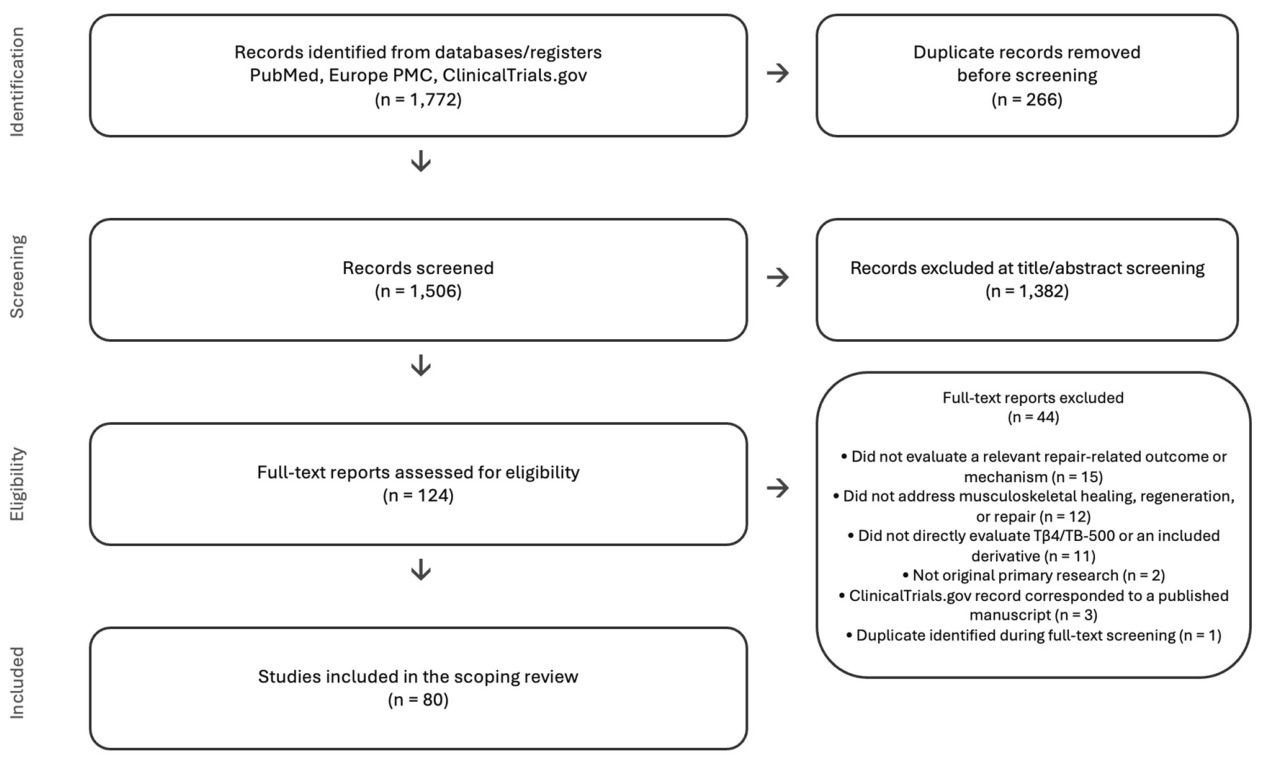
Figure 2.
Evidence map of included studies by tissue category and study type. Heatmap summarizing the number of included studies within each cross-classified tissue and study-type cell. ** Denotes musculoskeletal categories.
Figure 2.
Evidence map of included studies by tissue category and study type. Heatmap summarizing the number of included studies within each cross-classified tissue and study-type cell. ** Denotes musculoskeletal categories.
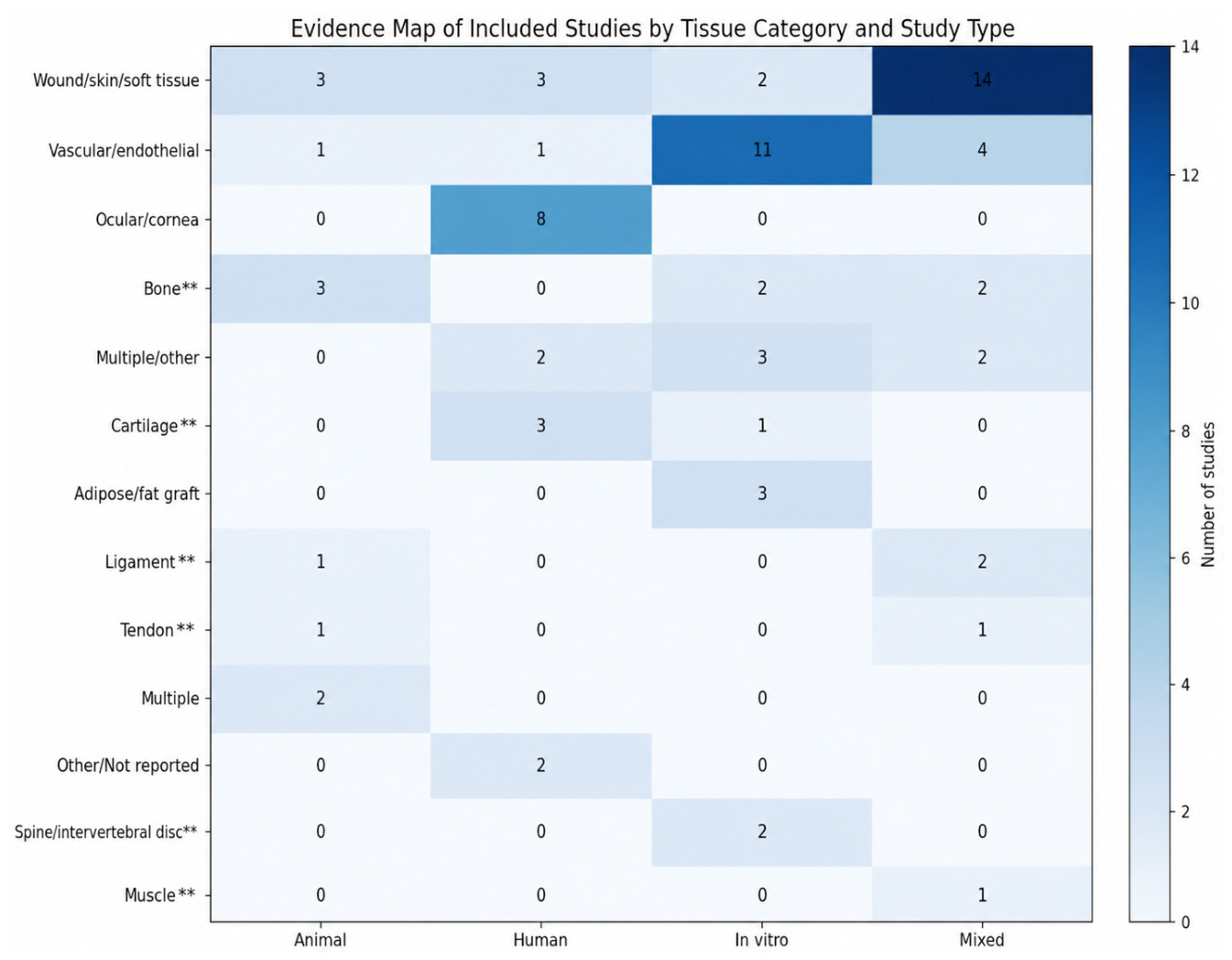

Table 1.
Characteristics of included studies.
| Study ID | Author | Year | Study type | Tissue studied | Intervention | Primary mechanism category | Primary outcome category | Ref. |
| 1 | Lee | 2021 | Human | Multiple/other | TB4 | Not explicitly mechanistic | Functional outcome | [8] |
| 2 | Lee | 2021 | In vitro | Cartilage | No direct intervention/endogenous-only | Other | Molecular/cellular marker | [9] |
| 3 | Xi | 2025 | Mixed | Bone | TB4 | Angiogenesis | Regeneration | [10] |
| 4 | Adachi | 2013 | Animal | Bone | TB4 | Not explicitly mechanistic | Regeneration | [11] |
| 5 | Li | 2022 | Mixed | Bone | TB4 | Angiogenesis | Regeneration | [12] |
| 6 | Tokura | 2011 | Mixed | Muscle | TB4 | Cell migration | Molecular/cellular marker | [13] |
| 7 | Ahmed | 2014 | Animal | Tendon | No direct intervention/endogenous-only | Inflammation | Healing/repair | [14] |
| 8 | Ehrlich | 2012 | Mixed | Wound/skin/soft tissue | TB4 | Fibrosis | Histology | [15] |
| 9 | Rahaman | 2024 | Mixed | Multiple/other | TB-500 | Other | Molecular/cellular marker | [16] |
| 10 | Zhang | 2025 | Mixed | Adipose/fat graft | TB4 | Other | Molecular/cellular marker | [17] |
| 11 | Yu | 2021 | Human | Wound/skin/soft tissue | TB4 | Other | Functional outcome | [18] |
| 12 | Lee | 2016 | Mixed | Ligament | TB4 | Inflammation | Healing/repair | [19] |
| 13 | Li | 2023 | In vitro | Adipose/fat graft | TB4 | Other | Molecular/cellular marker | [20] |
| 14 | Li | 2024 | In vitro | Adipose/fat graft | TB4 | Angiogenesis | Molecular/cellular marker | [21] |
| 15 | Huff | 2002 | Mixed | Multiple/other | TB4 | Collagen/ECM remodeling | Molecular/cellular marker | [22] |
| 16 | Malinda | 1997 | Mixed | Vascular/endothelial | TB4 | Cell migration | Molecular/cellular marker | [23] |
| 17 | Guarnera | 2007 | Human | Wound/skin/soft tissue | TB4 | Not explicitly mechanistic | Healing/repair | [24] |
| 18 | Wyczółkowska | 2007 | In vitro | Multiple/other | Derivative/fragment | Inflammation | Molecular/cellular marker | [25] |
| 19 | Sosne | 2015 | Human | Ocular/cornea | TB4 | Not explicitly mechanistic | Functional outcome | [26] |
| 20 | Freeman | 2011 | In vitro | Vascular/endothelial | TB4 | Other | Molecular/cellular marker | [27] |
| 21 | Li | 2007 | Animal | Wound/skin/soft tissue | TB4 | Angiogenesis | Healing/repair | [28] |
| 22 | Sosne | 2015 | Human | Ocular/cornea | TB4 | Not explicitly mechanistic | Functional outcome | [29] |
| 23 | Malinda | 1999 | Mixed | Wound/skin/soft tissue | TB4 | Angiogenesis | Healing/repair | [30] |
| 24 | Al-Nedawi | 2004 | In vitro | Vascular/endothelial | TB4 | Other | Molecular/cellular marker | [31] |
| 25 | Kim | 2020 | Animal | Vascular/endothelial | TB4 | Angiogenesis | Molecular/cellular marker | [32] |
| 26 | Wang | 2021 | Human | Other/Not reported | TB4 | Not explicitly mechanistic | Safety/PK/tolerability | [33] |
| 27 | Philp | 2004 | Mixed | Wound/skin/soft tissue | TB4 | Angiogenesis | Healing/repair | [34] |
| 28 | Reti | 2008 | In vitro | Wound/skin/soft tissue | TB4 | Other | Molecular/cellular marker | [35] |
| 29 | Philp | 2003 | Mixed | Wound/skin/soft tissue | TB4 | Angiogenesis | Healing/repair | [36] |
| 30 | Dettin | 2011 | Mixed | Vascular/endothelial | Derivative/fragment | Angiogenesis | Molecular/cellular marker | [37] |
| 31 | Guarnera | 2010 | Human | Wound/skin/soft tissue | TB4 | Not explicitly mechanistic | Healing/repair | [38] |
| 32 | Kim | 2015 | In vitro | Vascular/endothelial | TB4 | Other | Molecular/cellular marker | [39] |
| 33 | Lv | 2013 | In vitro | Vascular/endothelial | TB4 | Angiogenesis | Molecular/cellular marker | [40] |
| 34 | Wei | 2013 | Human | Cartilage | No direct intervention/endogenous-only | Other | Molecular/cellular marker | [41] |
| 35 | Ruff | 2010 | Human | Other/Not reported | TB4 | Not explicitly mechanistic | Safety/PK/tolerability | [42] |
| 36 | Selmi | 2012 | In vitro | Vascular/endothelial | TB4 | Cell migration | Molecular/cellular marker | [43] |
| 37 | Zhu | 2016 | Human | Vascular/endothelial | TB4 | Not explicitly mechanistic | Functional outcome | [44] |
| 38 | Kim | 2017 | Mixed | Wound/skin/soft tissue | TB4 | Angiogenesis | Healing/repair | [45] |
| 39 | Zhao | 2018 | Mixed | Wound/skin/soft tissue | TB4 | Angiogenesis | Healing/repair | [46] |
| 40 | Cierniewski | 2012 | In vitro | Multiple/other | TB4 | Cell migration | Molecular/cellular marker | [47] |
| 41 | Ock | 2012 | In vitro | Vascular/endothelial | TB4 | Angiogenesis | Molecular/cellular marker | [48] |
| 42 | Philp | 2003 | Mixed | Wound/skin/soft tissue | TB4 | Cell migration | Healing/repair | [49] |
| 43 | Ti | 2015 | Mixed | Wound/skin/soft tissue | TB4 | Angiogenesis | Healing/repair | [50] |
| 44 | Zhao | 2011 | In vitro | Vascular/endothelial | TB4 | Angiogenesis | Molecular/cellular marker | [51] |
| 45 | Qiu | 2009 | In vitro | Vascular/endothelial | TB4 | Cell migration | Molecular/cellular marker | [52] |
| 46 | Philp | 2006 | Mixed | Wound/skin/soft tissue | TB4 | Collagen/ECM remodeling | Molecular/cellular marker | [53] |
| 47 | Trenkwalder | 2015 | Mixed | Vascular/endothelial | TB4 | Angiogenesis | Functional outcome | [54] |
| 48 | Fan | 2009 | In vitro | Vascular/endothelial | TB4 | Collagen/ECM remodeling | Molecular/cellular marker | [55] |
| 49 | Choi | 2018 | In vitro | Bone | TB4 | Other | Molecular/cellular marker | [56] |
| 50 | Jo | 2010 | In vitro | Vascular/endothelial | TB4 | Angiogenesis | Molecular/cellular marker | [57] |
| 51 | Li | 2013 | In vitro | Vascular/endothelial | TB4 | Angiogenesis | Molecular/cellular marker | [58] |
| 52 | Wang | 2013 | Mixed | Wound/skin/soft tissue | TB4 | Other | Healing/repair | [59] |
| 53 | Zachman | 2013 | Mixed | Wound/skin/soft tissue | Derivative/fragment | Angiogenesis | Molecular/cellular marker | [60] |
| 54 | Lin | 2015 | Animal | Wound/skin/soft tissue | TB4 | Cell migration | Healing/repair | [61] |
| 55 | Kim | 2014 | Animal | Wound/skin/soft tissue | TB4 | Inflammation | Healing/repair | [62] |
| 56 | He | 2026 | Mixed | Wound/skin/soft tissue | TB4 | Not explicitly mechanistic | Healing/repair | [63] |
| 57 | Stadelmann | 2025 | In vitro | Wound/skin/soft tissue | TB4 | Cell migration | Molecular/cellular marker | [64] |
| 58 | Su | 2022 | Mixed | Vascular/endothelial | TB4 | Collagen/ECM remodeling | Molecular/cellular marker | [65] |
| 59 | Paz-González | 2023 | Human | Cartilage | No direct intervention/endogenous-only | Other | Molecular/cellular marker | [66] |
| 60 | Wu | 2020 | Mixed | Tendon | TB4 | Cell migration | Molecular/cellular marker | [67] |
| 61 | Sosne | 2023 | Human | Ocular/cornea | TB4 | Not explicitly mechanistic | Healing/repair | [68] |
| 62 | Matsuo | 2012 | Animal | Bone | TB4 | Other | Regeneration | [69] |
| 63 | Lee | 2015 | Mixed | Ligament | TB4 | Other | Molecular/cellular marker | [70] |
| 64 | Spurney | 2010 | Animal | Multiple | TB4 | Not explicitly mechanistic | Functional outcome | [71] |
| 65 | Xu | 2013 | Mixed | Wound/skin/soft tissue | Derivative/fragment | Cell migration | Healing/repair | [72] |
| 66 | Choi | 2015 | In vitro | Bone | TB4 | Other | Molecular/cellular marker | [73] |
| 67 | Xu | 2013 | Animal | Ligament | TB4 | Not explicitly mechanistic | Biomechanical strength | [74] |
| 68 | Brady | 2014 | Animal | Bone | TB4 | Not explicitly mechanistic | Healing/repair | [75] |
| 69 | Wang | 2015 | In vitro | Spine/intervertebral disc | TB4 | Other | Molecular/cellular marker | [76] |
| 70 | Aki | 2018 | Human | Cartilage | No direct intervention/endogenous-only | Other | Molecular/cellular marker | [77] |
| 71 | Lin | 2013 | Animal | Multiple | TB4 | Not explicitly mechanistic | Regeneration | [78] |
| 72 | Tapp | 2010 | In vitro | Spine/intervertebral disc | TB4 | Other | Molecular/cellular marker | [79] |
| 73 | Ehrlich | 2010 | Mixed | Wound/skin/soft tissue | TB4 | Fibrosis | Histology | [80] |
| 74 | Qiu | 2011 | In vitro | Multiple/other | TB4 | Inflammation | Molecular/cellular marker | [81] |
| 75 | ReGenTree, LLC | 2007 | Human | Ocular/cornea | TB4 | Not explicitly mechanistic | Healing/repair | [82] |
| 76 | RegeneRx Biopharmaceuticals, Inc. | 2011 | Human | Multiple/other | TB4 | Not explicitly mechanistic | Safety/PK/tolerability | [83] |
| 77 | ReGenTree, LLC | 2015 | Human | Ocular/cornea | TB4 | Not explicitly mechanistic | Functional outcome | [84] |
| 78 | ReGenTree, LLC | 2016 | Human | Ocular/cornea | TB4 | Not explicitly mechanistic | Functional outcome | [85] |
| 79 | ReGenTree, LLC | 2019 | Human | Ocular/cornea | TB4 | Not explicitly mechanistic | Functional outcome | [86] |
| 80 | ReGenTree, LLC | 2022 | Human | Ocular/cornea | TB4 | Not explicitly mechanistic | Healing/repair | [87] |
Table 1. Study-level characteristics for all 80 included sources in StudyID order. Structured fields reflect the finalized coded workbook, and numeric citations correspond to the final manuscript reference list.
Table 2.
Grouped synthesis summary by tissue, study type, and intervention.
| Tissue category | Total n | % | Animal | Human | In vitro | Mixed | TB4 | TB-500 | Derivative/fragment | Endogenous-only / no direct intervention |
| Wound/skin/soft tissue | 22 | 27.5 | 3 | 3 | 2 | 14 | 20 | 0 | 2 | 0 |
| Vascular/endothelial | 17 | 21.3 | 1 | 1 | 11 | 4 | 16 | 0 | 1 | 0 |
| Ocular/cornea | 8 | 10.0 | 0 | 8 | 0 | 0 | 8 | 0 | 0 | 0 |
| Bone | 7 | 8.8 | 3 | 0 | 2 | 2 | 7 | 0 | 0 | 0 |
| Multiple/other | 7 | 8.8 | 0 | 2 | 3 | 2 | 5 | 1 | 1 | 0 |
| Cartilage | 4 | 5.0 | 0 | 3 | 1 | 0 | 0 | 0 | 0 | 4 |
| Adipose/fat graft | 3 | 3.8 | 0 | 0 | 2 | 1 | 3 | 0 | 0 | 0 |
| Ligament | 3 | 3.8 | 1 | 0 | 0 | 2 | 3 | 0 | 0 | 0 |
| Tendon | 2 | 2.5 | 1 | 0 | 0 | 1 | 1 | 0 | 0 | 1 |
| Multiple | 2 | 2.5 | 2 | 0 | 0 | 0 | 2 | 0 | 0 | 0 |
| Other/Not reported | 2 | 2.5 | 0 | 2 | 0 | 0 | 2 | 0 | 0 | 0 |
| Spine/intervertebral disc | 2 | 2.5 | 0 | 0 | 2 | 0 | 2 | 0 | 0 | 0 |
| Muscle | 1 | 1.3 | 0 | 0 | 0 | 1 | 1 | 0 | 0 | 0 |
Table 2. Grouped summary of distributions by tissue, study type, and intervention across the 80 included studies. Percentages are calculated from the 80 included studies.
Table 3.
Mechanism and outcome summary.
| Panel A. Mechanism categories | |||
| Mechanism category | Count | % | Most represented tissue(s) |
| Not explicitly mechanistic | 21 | 26.3 | Ocular/cornea (8) |
| Other | 19 | 23.8 | Cartilage (4) |
| Angiogenesis | 19 | 23.8 | Vascular/endothelial (8); Wound/skin/soft tissue (8) |
| Cell migration | 10 | 12.5 | Wound/skin/soft tissue (4) |
| Inflammation | 5 | 6.3 | Multiple/other (2) |
| Collagen/ECM remodeling | 4 | 5.0 | Vascular/endothelial (2) |
| Fibrosis | 2 | 2.5 | Wound/skin/soft tissue (2) |
| Panel B. Outcome categories | |||
| Outcome category | Count | % | Most represented study type(s) |
| Molecular/cellular marker | 38 | 47.5 | In vitro (23) |
| Healing/repair | 21 | 26.3 | Mixed (11) |
| Functional outcome | 10 | 12.5 | Human (8) |
| Regeneration | 5 | 6.3 | Animal (3) |
| Safety/PK/tolerability | 3 | 3.8 | Human (3) |
| Histology | 2 | 2.5 | Mixed (2) |
| Biomechanical strength | 1 | 1.3 | Animal (1) |
Table 3. Summary of mechanism categories (Panel A) and outcome categories (Panel B) across the included literature. “Not explicitly mechanistic” indicates studies that did not directly evaluate a named biologic pathway. “Other” indicates studies with a mechanistic focus that did not fit the prespecified mechanism categories. Dominant tissue and study type patterns are descriptive summaries from data extraction and do not imply exclusive one-to-one mapping.
Disclaimer/Publisher’s Note: The statements, opinions and data contained in all publications are solely those of the individual author(s) and contributor(s) and not of MDPI and/or the editor(s). MDPI and/or the editor(s) disclaim responsibility for any injury to people or property resulting from any ideas, methods, instructions or products referred to in the content. |
© 2026 by the authors. Licensee MDPI, Basel, Switzerland. This article is an open access article distributed under the terms and conditions of the Creative Commons Attribution (CC BY) license.
Copyright: This open access article is published under a Creative Commons CC BY 4.0 license, which permit the free download, distribution, and reuse, provided that the author and preprint are cited in any reuse.