

Submitted:
15 May 2026
Posted:
18 May 2026
You are already at the latest version
Abstract
Social media platforms and user-generated content (UGC) have become central to how travelers discover and evaluate cultural destinations. Yet lesser-known second-tier heritage sites remain substantially underrepresented in digital tourism research. This study investigates how Chinese tourists perceive and engage with the intangible cultural heritage (ICH) of Lamphun, Thailand, through UGC collected from three major Chinese social media platforms (WeChat, Douyin, and Rednote) spanning the period from 2019 to 2023. A total of 642 relevant posts were analyzed using a mixed-methods analytical framework comprising VADER-based sentiment analysis, machine learning classification of tourism intention, and TF-IDF-driven thematic clustering. Results indicate an overall predominance of positive sentiment, particularly toward social rituals, festive events, and traditional craftsmanship, with positive sentiment emerging as the strongest predictor of travel intention. Digital engagement metrics, notably likes and favorites, further amplified the impact of intention-bearing content, while thematic clustering revealed four distinct experiential dimensions, with festival and ritual-centered narratives generating the highest sentiment and tourism intention scores. These findings demonstrate the strategic value of integrating advanced UGC analytics into destination marketing frameworks, offering actionable insights for promoting underrepresented cultural heritage destinations within the increasingly competitive global digital tourism landscape.
Keywords:
cultural tourism
; ICH tourism
; digital transformation
; sentiment analysis
; thematic clustering
1. Introduction
The digital transformation of tourism has fundamentally reshaped how prospective travelers discover and engage with destinations, particularly through social media and emerging technologies. Social media platforms serve as important sources of information and cultural trends, enabling users to share personal experiences, opinions, and generational perspectives (Di Gangi & Wasko, 2016). These developments have restructured the tourism ecosystem by enabling real-time information exchange, peer-to-peer communication, and the democratization of travel knowledge (Buhalis & Law, 2008; Xiang & Gretzel, 2010; Nikolskaya et al., 2021). Such changes extend beyond mere technological adoption to encompass fundamental changes in how tourists search for information, make decisions, and share experiences (Neuhofer et al., 2015). The exponential advancement of mobile technologies coupled with pervasive internet connectivity has enabled real-time tourist experiences in which tourists continuously engage with digital platforms throughout the entire journey, from inspiration and trip planning to on-site experience and post-trip sharing (Wang et al., 2014; Bathla et al., 2024). Digital information and technologies are also rapidly transforming cultural heritage tourism by providing innovative tools and techniques to engage visitors, create immersive experiences and promote more sustainable preservation (Abdo, 2019). The intersection of digital technologies and cultural heritage has created new opportunities for destination marketing, visitor engagement and heritage preservation (Gretzel et al., 2015; Abdelhamed, 2023; Yang & Shen, 2024).
Cultural heritage tourism represents a significant and growing segment of the global tourism market (Timothy & Nyaupane, 2009; Richards, 2018) particularly in the context of Intangible Cultural Heritage (ICH), which provides a unique tourism opportunity for authentic cultural experiences and profound engagement with the local traditions and customs (Zayachka, 2023). These cultural attractions are defining constituents of a society, including its art, architecture, historical and cultural heritage, gastronomy, literature, music, and other creative activities, which encompass the customs, values, beliefs and way of life (World Tourism Organization, 2019; Angelini et al., 2020). This form of tourism is characterized by the visitor's primary motivation to learn, discover, and engage with a destination’s tangible and intangible cultural resources (Al-Ababneh & Masadeh, 2019). Tourists increasingly travel to experience local culture, customs, and traditions at diverse destinations (Gnoth & Zins, 2011). Contemporary cultural tourists seek authentic, immersive experiences that allow them to engage deeply with local communities and traditions rather than merely observing cultural artifacts (Mkono, 2012; Wasela, 2023). The trend of cultural tourism has shifted from product culture to process culture, indicating an increasing interest among tourists in cultural experiences across different destinations (OECD, 2008; Espeso-Molinero, 2022). This shift reflects a broader transformation in tourist motivations from passive consumption of cultural products to active participation in cultural experiences and co-creation of meaning (Richards & Wilson, 2006; Tan et al., 2013; Sharma & Aggarwal, 2024).
As the use of social media platforms has increased dramatically, especially in the tourism industry, social media has become a valuable resource for analyzing social trends and opinions (Islam, 2021; Leelawat et al., 2022). Social media and user-generated content (UGC) exert influence through specific roles in various stages and components of tourism decision-making, acting as need generators and supporters that inspire users to include destinations in future travel plans and strengthen the desire to travel (Ngai et al., 2014; Liu et al., 2019). Social media platforms facilitate electronic word-of-mouth (eWOM) at unprecedented scale and speed, enabling travelers to share experiences and recommendations with audiences instantaneously (Litvin et al., 2008). Online reviews serve a significant role in tourism covering before, during, and after the journey, providing essential information to others in the dynamic travel process (Zeng & Gerritsen, 2014). In particular, younger-generation tourists largely depend on digital information to support decision-making (Wang & Park, 2023). Generation Z primarily interacts with brands through online platforms, with branding dimensions such as brand image, trust, and online brand experience significantly shaping their purchase intentions and highlighting the broader importance of digital engagement strategies in influencing this demographic's decision-making (Theocharis et al., 2025). Social media has fundamentally altered destination image formation by enabling tourists to access diverse, real-time perspectives from other travelers rather than relying solely on official marketing communications (Govers et al., 2007; Stepchenkova & Morrison, 2008). Online social media UGC may surpass traditional marketing communications in credibility and persuasiveness (Fotis et al., 2012; Leung et al., 2013). The volume, velocity, and variety of tourism-related UGC have created both opportunities and challenges for destination marketers. Understanding tourist perceptions and preferences for marketing purposes through this data has consequently become a central concern for researchers (Mariani et al., 2016; Lee et al., 2016; Lin et al., 2021).
Sentiment analysis has been used to analyze large sets of UGC, such as online comments, social media posts and consumer opinions, providing information regarding tourists’ opinions and attitudes. This has yielded deeper insights into tourists’ experience preferences and consumer perceptions (Pang & Lee, 2008; Liu, 2012; Balahur et al., 2013; Borrajo-Millán et al., 2021). Sawant and Desai (2015) noted that mining of big data has become an important capability in tourism marketing, as the data sets can be analyzed to predict trends and, as a result, determine which marketing strategies are effectively targeted to different segments of consumer markets. Furthermore, complex analytical approaches are required to capture the complexity, temporality, and heterogeneity of tourist perceptions as the dynamic, co-created nature of destination image in social media environments (Choi et al., 2007; Marine-Roig & Clavé, 2015).
Among global outbound tourism markets, Chinese tourists are especially noteworthy and have a significant role as a major source of international tourists (Quer & Peng, 2022; Lushchyk, 2023). With over a billion internet users and rapid digital and social media adoption, as of December 2022, nearly all internet access of China’s netizens was via mobile phones (Lai & To 2012; China Internet Network Information Center, 2023). The growth of tourism in China has been aided by the Internet, which provides a more efficient means of communicating cultural and historical heritage (Ma et al., 2003; Ma & Mohame, 2023). Moreover, the new generation of Chinese tourists seeks quality travel experiences. Tourism activities, communication channels and media were identified as key factors in travel prioritization (Lojo, 2020; Kaewyu et al., 2020). The digital behavior of Chinese tourists is distinctive owing to a unique digital ecosystem in which major global platforms are inaccessible and domestic social media platforms operate with considerable independence (Yuan et al., 2022). These platforms combine social networking, content sharing, e-commerce, and travel planning functionalities in ways that profoundly influence Chinese tourist information-seeking behavior and decision-making processes (Li et al., 2015; Basnyat & Jiahui, 2020).
Despite Chinese tourists’ strong presence in digital spaces, lesser-known cultural destinations often lack visibility in Chinese social media discourse. Lamphun, a culturally rich city situated in the upper north of Thailand near Chiang Mai, the principal tourism center of northern Thailand, represents such a case. Lamphun possesses several registered intangible cultural heritage elements, including traditional textiles, rituals, and festivals. While Lamphun possesses considerable cultural capital with significant tourism potential, this relatively well-known provincial town attracts only approximately 1 million tourists per year compared to around 10 million annual visitors to the neighboring city of Chiang Mai. Notably, only around 2,500 Chinese tourists visited Lamphun between 2018 and 2023 (Ministry of Tourism and Sports, 2023), underscoring the destination's limited visibility among Chinese travelers.
Significant research gaps persist despite the increasing importance of cultural tourism, especially its intangible dimensions, and the critical role of Chinese tourists in global tourism markets. Studies in cultural tourism tend to gravitate towards well-established destinations, potentially leaving lesser-known cultural destinations under-explored (Chhabra et al., 2003; Alivizatou, 2012). Furthermore, few studies have combined sentiment analysis with other methods to examine intangible cultural heritage tourism engagement specifically through the lens of Chinese digital platforms. The study situates its findings within broader discourses of transformational digital tourism, demonstrating how advanced analytics can amplify the marketing strategies of underrepresented cultural destinations and reframe ICH experiences for global audiences.
2. Materials and Methods
2.1. Research Design and Overview
This research employs an advanced mixed-methods social media content analytics approach, collecting data from Chinese social media platforms, focusing on UGC related to Lamphun cultural heritage tourism. Web scraping techniques were employed to collect posts and comments by Chinese users from 2019-2023, yielding an initial dataset from three primary platforms: WeChat, Douyin (TikTok), and Rednote. The analytic framework integrates sentiment analysis with machine learning-based tourism intention analysis and thematic clustering. This multi-method approach aligns with contemporary best practices in tourism analytics, which emphasize integrating complementary techniques to provide comprehensive insights into complex phenomena (Mirzaalian & Halpenny, 2019; Gour et al., 2021). The selection of WeChat, Douyin, and Rednote reflects the dominant platforms used by Chinese users for information sharing, with each platform serving distinct functions (Yuan et al., 2022; Dai, 2023). The study follows a data mining and analytics framework (Figure 1) using Python-based tools and the Orange Data Mining software to systematically analyze UGC from WeChat, Douyin and Rednote.
2.2. Data Collection
Social media data were collected via web scraping techniques from WeChat, Douyin, and Rednote, focusing on posts and comments published between 2019 and 2023. Keywords used in the scraping included terms in Chinese equivalent to ‘Lamphun tourism,’ ‘Cultural heritage in Lamphun,’ and specific cultural elements, for example, ‘Lamphun’s Lantern Festival’. Data were structured as spreadsheets containing timestamped entries, pseudonymized usernames, content text, engagement metrics (likes, comments, favorites, and shares), and topic labels. All original content was in Chinese.
2.3. Data Preprocessing
The collected Chinese-language content was subsequently translated and labelled using NLP preprocessing for further analysis. Content was translated into English using AI-assisted tools, followed by structured transformation, tokenization, filtering, and removal of duplicates and noise. The cleaned data were formatted as a CSV file for subsequent analytical procedures.
AI-assisted machine translation tools were used to support preprocessing of Chinese-language source data, all translated content was reviewed and verified by the authors.
2.4. Data Analysis
2.4.1. Sentiment Analysis and Tourism Intention
Sentiment analysis was conducted within Orange Data software. Using a VADER (Valence Aware Dictionary and Sentiment Reasoner) lexicon-based approach, the analysis classified sentiments into positive, neutral, and negative categories across different aspects of tourism experiences. VADER is a lexicon and rule-based sentiment analysis tool specifically designed for social media text, with demonstrated effectiveness in handling informal language, emoticons, slang, and other features common in user-generated content (Hutto & Gilbert, 2014). Polarity scores ranged from -1 (negative) to +1 (positive). Sentiment scores were computed across the five UNESCO ICH categories relevant to Lamphun’s cultural tourism.
To investigate the relationships among UGC sentiment, engagement metrics and the expression of tourism intention, a semantic analysis of UGC content was conducted. Tourism intention signals were operationalized as a binary variable, determined through a machine learning augmented rule-based classification applied to the dataset (Abel & Lantow, 2019; Hamroun & Gouider, 2020; Liu & Beldona, 2021). Posts were assigned as intention-driven if they contained explicit pre-defined indicators of tourism motivation, such as expressions of willingness to visit, recommendations, references to festival attendance, or evidence of travel planning. Posts without such expressions were classified as non-intention or without intention. The keyword set was developed iteratively from exploratory corpus review and domain-specific vocabulary.
Classification was implemented programmatically and integrated into the cleaned dataset. A chi-square test of independence was performed to assess the relationship between sentiment and tourism intention, followed by pairwise comparisons using Fisher’s Exact Test for specific group contrasts. To evaluate the relationship between engagement metrics (likes, comments, favorites, shares) and intention, non-parametric Mann–Whitney U tests were applied. Given the potential non-linearity and multicollinearity in the engagement data, a Random Forest classifier was used to explore the predictive capacity of sentiment and engagement features for tourism intention.
2.4.2. Term Frequency-Inverse Document Frequency (TF-IDF) Analysis and Tourism Theme Clustering
TF-IDF analysis was performed using the Orange Data Mining software; thereafter, thematic clustering analysis was conducted using K-means applied to TF-IDF keyword vectors. K-means clustering is an unsupervised machine learning algorithm that partitions documents into clusters based on the similarity of their TF-IDF vectors, enabling discovery of thematic structure in large text corpora without predefined categories (Jain, 2009; Kwale, 2013; Li et al., 2019). K-means has proved effective for identifying tourism themes, destination attributes, and tourist experience dimensions from social media content (Arefieva V et al., 2021; Harish et al., 2023). The optimal number of clusters was determined using the Elbow method. High-ranking TF-IDF terms from cluster centroids were used to characterize the thematic structure of each cluster. Cluster-level tourism intention was calculated as the proportion of intentional posts, and average sentiment score was calculated within each cluster.
2.4.3. Data Visualisation and Interpretation
Frequently occurring terms within the dataset were visualized using a word cloud, highlighting core themes and tourist interests. Keyword prominence corresponded directly to frequency of mentions, enabling stakeholders to identify key themes and concepts relevant to tourism practitioners and destination managers. Additionally, this visualization assisted policymakers and tourism managers in decision-making by highlighting overarching themes that indicate areas of significant value or those requiring improvement (Filatova, 2016; Dobrea et al., 2023). Principal Component Analysis (PCA) was applied to thematic clustering to reduce dimensionality and visualize the clusters in two dimensions, enabling the interpretation of data distributions and group separation.
3. Results
A total of 5,663 posts and more than 10,000 comments were collected during the 2019-2023 period. The data spanned multiple sources, user types, and temporal frames. After filtering for relevance keywords, the dataset was refined to 642 messages directly pertaining to the research focus.
3.1. Sentiment Analysis and Tourism Intention
3.1.1. Sentiment Analysis
The results revealed significant patterns in Chinese tourists' perceptions of Lamphun, indicating an overall prevalence of positive sentiment, with 367 positive reviews across all components, yielding an average sentiment score of 0.3554. The analysis also identified 210 neutral reviews and 65 negative reviews within the dataset. Notably, different aspects of the tourism experience elicited varying sentiment distributions. ‘Knowledge and practices concerning nature and the universe’ garnered 188 positive reviews with an average sentiment score of 0.2997, along with 117 neutral and 40 negative reviews, representing the highest proportion of negative sentiment among all categories. ‘Social practices, rituals, and festive events’ achieved the highest sentiment score with 109 positive reviews, 56 neutral reviews and 8 negative reviews recorded. ‘Traditional craftsmanship’ elements received uniformly positive reviews with no negative sentiment, recording a relatively high sentiment score of 0.4752. ‘Performing arts’ received 20 positive reviews with the lowest average sentiment score. Overall, sentiment of posts toward Lamphun was predominantly positive, as summarized in Table 1.
3.1.2. Sentiment and Tourism Intention Analysis
A chi-square test of independence indicated a statistically significant association between sentiment and tourism intention (χ² = 94.129, p < 0.001). Pairwise comparisons revealed a significant difference in tourism intention between the positive sentiment group and other groups, while the differences between the neutral and negative groups were not significant. The results are summarized in Table 2 and Figure 2.
In terms of engagement metrics and tourism intention, all engagement metrics showed significant differences between intention and non-intention groups. The Random Forest model achieved 86.3% classification accuracy, with intention contents predicted with an F1-score of 0.756 (Table 3 and Table 4).
Feature importance scores derived from the Random Forest model indicated that sentiment score ranked as the most important predictor of intentional posts, followed by likes, and favorites (Table 5).
3.2. TF-IDF and Tourism Theme Clustering
3.2.1. TF-IDF and Word Cloud Visualization
The high-frequency terms analysis identified ‘festival,’ ‘chiangmai,’ and ‘lanterns’ as having the highest overall TF-IDF scores (Table 6).
The TF-IDF analysis further quantified keyword significance within the dataset, complementing the Word cloud visualization with statistical precision. The Word cloud visualization, as shown in Figure 3, represents frequently occurring keywords from Chinese tourists' posts about Lamphun. ‘chiangmai’, which refers to Chiang Mai, is the most frequently mentioned term, located in the center of the word cloud highlighting prominent elements. Other frequently mentioned terms include ‘festival,’ ‘lanterns,’ ‘temple,’ ‘travel,’ ‘café,’ ‘city,’ and others.
3.2.2. Tourism Themes Clustering and PCA Visualization
A total of four theme clusters were identified, each representing a semantically coherent group of tourist-generated content, summarized in Table 7. The themes span a broad spectrum of cultural and experiential dimensions. Several clusters captured Chiang Mai and culturally significant festive atmospheres, particularly associated with the Loy Krathong festival and related ritual practices, combined with local gastronomy and temple visits. Other clusters related to religious and historical heritage sites. One cluster reflected pandemic-era travel behaviors and tourism experiences. Another cluster highlighted modern tourism activities, such as visiting coffee shops or cafes, incorporating local landscapes, and local food. Cluster 2, primarily associated with festival, exhibited the highest average sentiment score and tourism intention. The pandemic-related cluster (Cluster 3) recorded an intention proportion of 0.703 with the lowest average sentiment score across four clusters. Cluster 0 demonstrated an average sentiment score of 0.588 with a tourism intention of 0.689. Cluster 1 similarly featured food-related keywords; however, it recorded the lowest average sentiment score and tourism intention among all clusters.
The principal component analysis (PCA) projection illustrated the spatial distribution of the four thematic clusters in a two-dimensional component space (Figure 4). The plot illustrated the relative separation and proximity of clusters, with some themes appearing more compact while others exhibited a wider spread across the principal component space. Clusters 0 and 1 (Cafe culture and Local cuisine) were located near the center of the plot, forming compact groupings with partial overlap. Cluster 2 (Major Festival and Ritual Symbolism Theme) was positioned further apart from the central grouping, exhibiting greater separation along the principal component axes. Cluster 3 (Pandemic-related and Local life experiences) occupied a more peripheral position relative to the other clusters, separated from the main grouping along the second principal component axis.
4. Discussion
The findings of this study offer meaningful insights into how Chinese tourists engage with and respond to Lamphun's cultural tourism offerings through digital media platforms. This study contributes to the literature by applying sentiment analysis and thematic clustering to examine destination perception and tourism intention among Chinese visitors to a second-tier heritage city in northern Thailand. The sentiment analysis conducted in this study demonstrated consistently positive perceptions across the five UNESCO intangible cultural heritage categories, signifying a favorable response to Lamphun's cultural tourism among Chinese tourists. This primarily positive response aligns with overall trends in outbound Chinese tourism. The category with the most discussion was 'Knowledge and practices concerning nature and the universe', followed by 'Social practices, rituals and festival events'. Both categories are associated with the culinary culture and festivals, highlighting their importance as vehicles for connecting tourists with the local community. Chinese outbound visitors are driven by diverse motivations, with cultural differences and exploration frequently serving as substantial motivators (Otafiire et al., 2019). This demographic has also demonstrated a strong willingness to engage with local food culture as part of the cultural tourism experience. Thailand’s vibrant culture largely fascinates Chinese travelers, enhances the travel experience, and motivates return visits (Shi, 2021). This finding aligns with studies that emphasized the role of festival and culinary experiences in cultural tourism engagement (Gnoth & Zins, 2011; López-Guzmán et al., 2016). The results also indicate particularly strong positive sentiment toward ‘Social practices, rituals, and festive events’ and ‘Traditional craftsmanship’. These findings suggest that both aspects resonate most effectively with Chinese visitors. Both are closely associated with Lamphun’s major festival, the Hundred Thousand Lanterns Festival, characterized by the hanging of countless paper lanterns throughout the Haripunchai temple area and surrounding city center. The strong response to 'Traditional craftsmanship' further reflects growing interest in Lamphun's heritage brocade flower fabric, a locally distinctive textile tradition. Richards (2018) indicated that recent trends show a shift from tangible to intangible heritage. International travelers are particularly attracted to both expressions of culture due to their visual and interactive aspects. Lamphun’s brocade flower fabric has emerged as a noteworthy intangible cultural heritage artifact attracting increasing attention from Chinese tourists. This high-quality, locally made fabric offers a promising direction for heritage tourism. The fact that ‘Oral traditions and expressions’ and ‘Performing arts’ received relatively few reviews, with ‘Traditional craftsmanship’ receiving fewer still, points towards limited experience in elaborating these culturally significant elements. These specific aspects of cultural heritage were found to have strong ties to local religious and historical stories, particularly the legend of Lamphun’s ancient princess, Chanmadevi, and associated local performative traditions. These aspects of intangible cultural heritage are deeply embedded in local mythology, ritual practice, and historical narrative, offering nuanced insights into the region's cultural epistemology and traditional performative arts (McKerrell & Pfeiffer, 2019; Lin & Chen, 2025). Their limited digital visibility may reflect the challenges of communicating intangible or performative traditions through social media formats. This pattern suggests that targeted digital content or social media strategies could increase the visibility of less-discussed cultural elements (Wanju et al., 2025).
Regarding the highest number of negative sentiment reviews of ‘Knowledge and practices concerning nature and the universe’, overall sentiment remained positive. Chinese visitors' strong interest in novel culinary experience is well documented. Cheng & Jiang (2024) suggested that the availability of varied cuisine in Thailand is one of the key factors shaping its destination image. The diversity and accessibility of local dishes are important factors in Chinese visitors’ overall satisfaction (Satchapappichit, 2020). However, this result may indicate that certain elements of Lamphun's cultural offerings do not fully align with Chinese tourists’ expectations, particularly given that differences in gastronomic habits and culinary traditions can present genuine challenges for Chinese visitors (Zhang & Niyomsilp, 2020).
The analysis of tourism intention revealed it was more frequently expressed in posts characterized by positive sentiment and higher engagement metrics. The prominence of positive sentiment in intention-bearing UGC suggests that a positive attitude and emotion act as key stimuli for prospective travel behavior. This finding is consistent with Afshardoost and Eshaghi (2020), who concluded that a positive destination image strongly influences intention to visit or recommend. The favorable emotional evaluations also strengthen attitudes and subsequently increase the likelihood of the intended action (Lam & Hsu, 2005; Kiatkawsin & Han, 2017). All engagement metrics, including likes, comments, favorites, and shares, showed significant differences between intention and non-intention groups based on Mann-Whitney U tests, indicating that interactive engagement amplifies both the reach and persuasive value of user-generated content. High engagement signals authenticity and trustworthiness, making content more persuasive and more likely to influence travel attitudes and behaviors, including purchase intentions and brand loyalty (Mathur et al., 2021; Konak, 2024). Engagement behaviors also serve as social endorsement mechanisms, amplifying the reach and impact of UGC by encouraging further interaction and content dissemination, increasing the perceived credibility and appeal of the destination (Aljarah et al., 2022; Kaukuntla, 2025). The pattern observed in this study aligns with earlier research identifying interactive digital responses as mediators between exposure to tourism content and decision-making (Cheung et al., 2021). The Random Forest model confirmed that sentiment score was the most important predictor of tourism intention, followed by likes and favorites. This emphasizes the combined role of emotional tone and digital interaction in signaling travel propensity. Other predictive analytics studies reported comparable results that models integrating affective and engagement variables demonstrated superior accuracy in forecasting travel intentions compared to sentiment-only approaches (Li et al., 2022). The inclusion of digital accessibility and social influence metrics further refines these predictive models, reflecting how modern consumers navigate information and form intentions within a digital ecosystem (Tiwari & Joshi, 2020). The lower importance of comments in prediction reflects the varied nature of comment behavior. Studies consistently find that subjective or unstructured variables (e.g., comments) tend to have lower importance in such models. Due to the heterogeneous content, comments usually include questions, clarifications, or criticisms that do not necessarily indicate a user's travel intention, reducing the predictive power in the model (Hagenauer & Helbich, 2017; Cheng et al., 2018). Similarly, shares emerged as the lowest importance predictor in the present model. This is consistent with Tsekouropoulos (2019) suggesting that sharing behavior is driven by a complex and inconsistent set of factors that limits its predictive power.
With respect to the Word cloud and TF-IDF analysis, the data demonstrated that digital media functioned not merely as a promotional channel, but as a transformative medium in shaping cultural engagement with a destination. The most prominently weighted terms identified from Lamphun-related content included "festival," "chiangmai," "lanterns," "temple," and "cafe." The emergence of "chiangmai" as a high-weighted term is particularly noteworthy, as it reflects a close association in tourist discussion between Lamphun and the neighboring city of Chiang Mai. This finding suggests that many visitors perceive Lamphun as part of a broader regional itinerary centered on Chiang Mai, rather than as an independent destination. This observation aligns with tourism statistics showing substantially higher international visitation rates to Chiang Mai (Ministry of Tourism and Sports, 2023), and points toward the potential value of collaborative regional tourism development strategies that leverage this perceived connection between the two cities. Tourists based in major cities who are seeking alternative experiences may venture into second-tier cities owing to their distinctive cultural attractions, local food, culture, and more affordable prices (Fakfare et al., 2020). However, the benefits of this spillover effect are not uniform across destinations. Cities with significant heritage assets tend to benefit more substantially from the overflow of tourism from larger urban centers compared to those with fewer major heritage elements (Tian et al., 2021). Lamphun, with its rich intangible cultural heritage, is well positioned to attract visitors seeking fresh experiences away from the heavily visited city of Chiang Mai. The high frequency of ‘festival,’ ‘temple,’ and ‘lanterns’ suggests that tourists are particularly interested in cultural heritage related to festivals and religious sites in Lamphun, especially the Hundred Thousand Lanterns festival, celebrated at Haripunchai temple or ‘Wat Phra That Haripunchai’. These findings demonstrate that cultural celebrations and historical temples constitute core elements of Lamphun's tourism appeal to Chinese visitors. Consistent with Wang et al. (2015), the findings of this study determined that Chinese tourists are driven by religious faith, desire for cultural enrichment, and need for mental rejuvenation when visiting religious heritage sites. The emergence of "cafe" as a notable term also reflects a growing interest among Chinese tourists in contemporary leisure experiences, suggesting that Lamphun's appeal extends beyond traditional heritage tourism into lifestyle-oriented activities.
The thematic clustering revealed four distinct clusters that reflect the interplay between cultural specificity, experiential diversity, and temporal context in shaping destination perception among Chinese tourists. Clusters 0 and 1, positioned closely in the PCA space, both indicate an overlapping thematic focus on local cuisine and cafe culture, though with divergent sentiment and intention outcomes. The cluster centered on contemporary cafe hopping, city exploration, and local food experiences (Cluster 0) recorded a high sentiment score and a relatively strong tourism intention. By contrast, the cluster associated with local cuisine and religious sites (Cluster 1) recorded the lowest scores across both metrics despite being thematically proximate. The results suggest that the appeal of food and religious heritage may be amplified when integrated within broader lifestyle-oriented narratives, such as cafe hopping and urban exploration. The outcomes align with the evolving preferences of younger Chinese tourists. Gao et al. (2021) found that younger Chinese tourists favored contemporary leisure activities that complement the historical significance of chosen destinations. This shift indicates a broader movement toward integrating cultural exploration with leisure pursuits. This trend also indicates a diversification of travel motivations beyond traditional sightseeing (Hu and Chen, 2023). Festival-centered narratives (Cluster 2), particularly centered on Loy Krathong celebrations, temple rituals, and lantern symbolism, emerged as the strongest drivers of both positive sentiment and tourism intention across all clusters. Its thematic distance from other clusters in the PCA space further underscores the unique and highly distinctive character of its content. These elements embody affective engagement and symbolic experiences, resonating with the notion that participation in culturally embedded rituals strengthens travel motivation. The study revealed that sensory immersion, narrative symbolism, and opportunities for cultural participation associated with the festival experience significantly enhance the memorability of heritage encounters, ultimately strengthening behavioral intention among visitors (Ye et al., 2025). Notably, Pandemic-related and local life experiences (Cluster 3) presented a low average sentiment score yet relatively high tourism intention. This pattern suggests that negative or constrained contextual circumstances do not necessarily eliminate the desire to travel. Instead, such circumstances shift interest toward destinations perceived as safe, authentic, or resilient, and foster new forms of travel planning. Research indicates that travel restrictions can produce a dual effect: suppressing immediate travel plans while simultaneously intensifying future travel desire, a pattern described as 'compensatory' or 'revenge' travel driven by the emotional and cognitive need to compensate for lost experiences (Kim et al., 2021; Zhang et al., 2021; Wang & Xia, 2021).
5. Conclusions
This study examines Chinese tourists’ engagement with Lamphun’s intangible cultural heritage through an integrated digital analytics framework, with the aim of identifying sentiment patterns, intention drivers, and thematic trends. The study identified key patterns in tourist discourse that can guide strategic marketing and heritage management decisions for this second-tier destination in northern Thailand. The findings revealed a predominance of positive sentiment toward Lamphun's cultural offerings in ‘social practices, rituals and festive events’ and ‘traditional craftsmanship’. Culinary-related heritage, however, attracted the most negative feedback, pointing to a gap between tourist expectations and the actual culinary experience, as well as to the influence of broader cultural differences. A strong and statistically significant relationship was found between positive sentiment and tourism intention. Posts reflecting positive emotional responses were far more likely to express a desire to visit Lamphun, and these posts also attracted considerably higher engagement in the form of likes, favorites, comments, and shares.
The thematic clustering produced four distinct content groups, each reflecting a different dimension of how Chinese tourists engage with the destination. Festival and ritual-related content consistently generated the highest sentiment and the strongest tourism intention, establishing the Hundred Thousand Lanterns Festival (or Loy Krathong) as the most powerful asset in Lamphun's tourism portfolio. Content centered on cafe culture and urban exploration also performed strongly, while content linking local cuisine with religious sites showed comparatively lower scores in both sentiment and intention. Notably, content associated with pandemic-era experiences reflected low sentiment but relatively high tourism intention, suggesting that disrupted travel periods can intensify rather than diminish the desire to visit meaningful destinations.
These findings carry clear implications for those responsible for promoting and managing Lamphun as a tourism destination. Festival-driven campaigns should be given the highest marketing priority, as they generate the strongest emotional engagement and the clearest expression of travel intent among Chinese audiences. Culinary heritage can be made more compelling by connecting it with cafe culture and contemporary lifestyle narratives that resonate with younger Chinese travelers. Positioning Lamphun as a complementary destination to Chiang Mai, rather than an independent competitor, offers a practical and effective route to increasing visitor numbers and spending. Sustained government investment in tourism infrastructure and policies tailored to second-tier destinations will also be essential in ensuring that Lamphun's growth as a heritage tourism destination remains both economically viable and culturally sustainable over the long term.
As with most studies, there are limitations to consider. The data were sourced from three Chinese social media platforms and covered a defined period, meaning that the views of less digitally active visitors may not be fully represented. Future studies could build on these findings by examining a larger dataset over a longer timeframe, conducting comparative analyses across multiple second-tier heritage cities, or incorporating complementary methods to further explore the relationship between digital engagement and tourism behavior at cultural destinations, and examine how second-tier status shapes both opportunities and challenges in digital tourism marketing.
Author Contributions
Conceptualization, P.W. and N.M.; Methodology, P.W., P.O., and C.K.; Software, P.W.; Validation, P.W., P.O. and N.M.; Formal Analysis, P.W.; Investigation, P.W.; Data Curation, P.W.; Writing – Original Draft Preparation, P.W.; Writing – Review & Editing, P.W., P.O., C.K. and N.M.; Visualization, P.W.; Supervision, P.O. and C.K.; Project Administration, P.W. and P.O.
Funding
This research received no external funding.
Institutional Review Board Statement
Ethical review and approval were waived for this study as it involved analysis of publicly available social media content and did not include direct interaction with or recruitment of human participants.
Informed Consent Statement
Not applicable.
Data Availability Statement
The original contributions presented in this study are included in the article. Further inquiries can be directed to the corresponding author.
Acknowledgments
The authors wish to express their sincere gratitude to Assistant Professor Dr. Nopasit Chakpitak and Assistant Professor Dr. Aniwat Phaphuangwittayakul for their valuable guidance and suggestions on machine learning methodologies employed in this study. The authors also acknowledge the International College of Digital Innovation (ICDI), Chiang Mai University, for providing access to computational resources and facilities that supported the machine learning components of this research. During the preparation of this manuscript, the authors used AI-assisted machine translation tools to support the preprocessing of Chinese-language source data, as described in Section 2.3. AI language tools were additionally used to support grammar correction and academic language editing. All intellectual content, data, analysis, interpretations, and conclusions are the authors' own. The authors have reviewed and edited the outputs and take full responsibility for the content of this publication.
Conflicts of Interest
The authors declare no conflict of interest.
References
- Abdelhamed, M. Digital transformation in tourism and its role in preserving heritage. J. Tour. Hotel. Herit. 2023, 7(1), 44–57. [Google Scholar] [CrossRef]
- Abdo, A. Digital Heritage Applications and its Impact on Cultural Tourism. J. Assoc. Arab Univ. Tour. Hosp. 2019, 17(1), 37–50. [Google Scholar] [CrossRef]
- Abel, J.; Lantow, B. A Methodological Framework for Dictionary and Rule-based Text Classification. In Proceedings of the 11th International Joint Conference on Knowledge Discovery, Knowledge Engineering and Knowledge Management (IC3K 2019); SCITEPRESS – Science and Technology Publications: Lda, 2019; pp. 330–337. [Google Scholar] [CrossRef]
- Afshardoost, M.; Eshaghi, M. S. Destination image and tourist behavioural intentions: A meta-analysis. Tour. Manag. 2020, 81, 104154. [Google Scholar] [CrossRef]
- Al-Ababneh, M. A.; Masadeh, M. Creative Cultural tourism as a new model for cultural tourism. J. Tour. Manag. Res. 2019, 6(2), 109–118. [Google Scholar] [CrossRef]
- Alivizatou, M. Intangible Heritage and the museum: New Perspectives on Cultural Preservation; Left Coast Press, 2012. [Google Scholar]
- Aljarah, A.; Sawaftah, D.; Ibrahim, B.; Lahuerta-Otero, E. The differential impact of user- and firm-generated content on online brand advocacy: customer engagement and brand familiarity matter. Eur. J. Innov. Manag. 2022, 27(4), 1160–1181. [Google Scholar] [CrossRef]
- Angelini, L.; Borlizzi, D.; Carlucci, A.; Ciardella, G.; Destefanis, A.; Governale, G.; Morfini, I. Cultural tourism development and the impact on local communities: a case study from the South of Italy. SHILAP Rev. De Lepidopterol. 2020. [Google Scholar] [CrossRef]
- Arefieva, V.; Egger, R.; Yu, J. A machine learning approach to cluster destination image on Instagram. Tour. Manag. 2021, 85, 104318. [Google Scholar] [CrossRef]
- Balahur, A.; Steinberger, R.; Kabadjov, M.; Zavarella, V.; Van Der Goot, E.; Halkia, M.; Pouliquen, B.; Belyaeva, J. Sentiment Analysis in the News. In Proceedings of the 7th International Conference on Language Resources and Evaluation (LREC'2010) arXiv; Cornell University, 2013; pp. 2216–2220. [Google Scholar] [CrossRef]
- Basnyat, S.; Jiahui, Y. The role of social media in shaping tourists’ travel decisions. Adv. Hosp. Tour. Serv. Ind. (AHTSI) Book Ser. 2020, 52–65. [Google Scholar] [CrossRef]
- Bathla, G.; Raina, A.; Tripathi, R.; Rana, V. S.; Singh, A. Assessing the impact of digital innovations on tourist decision making and behavior. Adv. Hosp. Tour. Serv. Ind. (AHTSI) Book Ser. 2024, 317–334. [Google Scholar] [CrossRef]
- Borrajo-Millán, F.; Alonso-Almeida, M.; Escat-Cortes, M.; Yi, L. Sentiment analysis to measure quality and build sustainability in tourism destinations. Sustainability 2021, 13(11), 6015. [Google Scholar] [CrossRef]
- Buhalis, D.; Law, R. Progress in information technology and tourism management: 20 years on and 10 years after the Internet—The state of eTourism research. Tour. Manag. 2008, 29(4), 609–623. [Google Scholar] [CrossRef]
- Cheng, J.; Jiang, S. Exploring Thailand as a gastronomic tourism destination: A structural equation model approach. J. Infrastruct. Policy Dev. 2024, 8(11), 8214. [Google Scholar] [CrossRef]
- Cheng, L.; Chen, X.; De Vos, J.; Lai, X.; Witlox, F. Applying a random forest method approach to model travel mode choice behavior. Travel Behav. Soc. 2018, 14, 1–10. [Google Scholar] [CrossRef]
- Cheung, M. L.; Leung, W. K.; Cheah, J.; Ting, H. Exploring the effectiveness of emotional and rational user-generated contents in digital tourism platforms. J. Vacat. Mark. 2021, 28(2), 152–170. [Google Scholar] [CrossRef]
- Chhabra, D.; Healy, R.; Sills, E. Staged authenticity and heritage tourism. Ann. Tour. Res. 2003, 30(3), 702–719. [Google Scholar] [CrossRef]
- China Internet Network Information Center. The 51st Statistical Report on China’s Internet Development. China Internet Network Information Center (CNNIC). 2023. Available online: https://www.cnnic.com.cn/IDR/ReportDownloads/202307/P020230707514088128694.pdf.
- Choi, S.; Lehto, X. Y.; Morrison, A. M. Destination image representation on the web: Content analysis of Macau travel related websites. Tour. Manag. 2007, 28(1), 118–129. [Google Scholar] [CrossRef]
- Dai, P. The evolution of Chinese internet culture: A study on the social media platforms’ role and their impact on online trends. Commun. Humanit. Res. 2023, 12(1), 254–262. [Google Scholar] [CrossRef]
- Di Gangi, P. M.; Wasko, M. M. Social Media Engagement Theory. J. Organ. End. User Comput. 2016, 28(2), 53–73. [Google Scholar] [CrossRef]
- Dobrea, R.; Marin, A.; Dima, C.; Moncea, M. The relationship between the tourism industry and sustainable development goals word cloud analysis. Amfiteatru Econ. 2023, 25(Special 17), 1131. [Google Scholar] [CrossRef]
- Espeso-Molinero, P. Trends in cultural tourism. Smart Tour. 2022, 3(2), 13. [Google Scholar] [CrossRef]
- Fakfare, P.; Talawanich, S.; Wattanacharoensil, W. A scale development and validation on domestic tourists’ motivation: the case of second-tier tourism destinations. Asia Pac. J. Tour. Res. 2020, 25(5), 489–504. [Google Scholar] [CrossRef]
- Filatova, O. More than a word cloud. TESOL J. 2016, 7(2), 438–448. [Google Scholar] [CrossRef]
- Fotis, J.; Buhalis, D.; Rossides, N. Social Media Use and Impact during the Holiday Travel Planning Process. Inf. Commun. Technol. Tour. 2012 2012, 13–24. [Google Scholar] [CrossRef]
- Gao, J.; Zhang, C.; Zhou, X.; Cao, R. Chinese tourists’ perceptions and consumption of cultural heritage: a generational perspective. Asia Pac. J. Tour. Res. 2021, 26(7), 719–731. [Google Scholar] [CrossRef]
- Gnoth, J.; Zins, A. H. Developing a tourism cultural contact scale. J. Bus. Res. 2011, 66(6), 738–744. [Google Scholar] [CrossRef]
- Gour, A.; Aggarwal, S.; Erdem, M. Reading between the lines: analyzing online reviews by using a multi-method Web-analytics approach. Int. J. Contemp. Hosp. Manag. 2021, 33(2), 490–512. [Google Scholar] [CrossRef]
- Govers, R.; Go, F. M.; Kumar, K. Promoting Tourism Destination Image. J. Travel Res. 2007, 46(1), 15–23. [Google Scholar] [CrossRef]
- Gretzel, U.; Sigala, M.; Xiang, Z.; Koo, C. Smart tourism: foundations and developments. Electron. Mark. 2015, 25(3), 179–188. [Google Scholar] [CrossRef]
- Hagenauer, J.; Helbich, M. A comparative study of machine learning classifiers for modeling travel mode choice. Expert Syst. With Appl. 2017, 78, 273–282. [Google Scholar] [CrossRef]
- Hamroun, M.; Gouider, M. S. A survey on intention analysis: successful approaches and open challenges. J. Intell. Inf. Syst. 2020, 55(3), 423–443. [Google Scholar] [CrossRef]
- Harish, T.; Neeha, S.; Deepika, T.; Haritha, L.; Kameswari, T. Machine learning approach to cluster destination image on Social Networks. Int. J. Innov. Res. Eng. Manag. 2023, 10(2), 118–120. [Google Scholar] [CrossRef]
- Hu, T.; Chen, H. Little-known leisure places: Chinese tourists’ preferences for visiting niche tourism destinations. Asia Pac. J. Tour. Res. 2023, 28(11), 1261–1278. [Google Scholar] [CrossRef]
- Hutto, C.; Gilbert, E. VADER: A Parsimonious Rule-Based Model for Sentiment Analysis of Social Media Text. Proc. Int. AAAI Conf. Web Soc. Media 2014, 8(1), 216–225. [Google Scholar] [CrossRef]
- Islam, M. T. Applications of Social Media in the tourism Industry: a review. SEISENSE J. Manag. 2021, 4(1), 59–68. [Google Scholar] [CrossRef]
- Jain, A. K. Data clustering: 50 years beyond K-means. Pattern Recognit. Lett. 2009, 31(8), 651–666. [Google Scholar] [CrossRef]
- Kaewyu, P.; Pakdeepinit, P.; Madtyampurush, W. Behaviour of Independent Chinese Tourists Travelling in Lanna Civilization Area, Thailand. WMS J. Manag. 2020, 9(3), 102–112. Available online: https://so06.tci-thaijo.org/index.php/wms/article/view/243629.
- Kaukuntla, P. R. Analyzing the impact of Social proof and User-Generated Content on engagement using Data-Driven Methods. Int. Sci. J. Eng. Manag. 2025, 04(02), 1–7. [Google Scholar] [CrossRef]
- Kiatkawsin, K.; Han, H. An alternative interpretation of attitude and extension of the value–attitude–behavior hierarchy: the destination attributes of Chiang Mai, Thailand. Asia Pac. J. Tour. Res. 2017, 22(5), 481–500. [Google Scholar] [CrossRef]
- Kim, E. E. K.; Seo, K.; Choi, Y. Compensatory travel post COVID-19: Cognitive and Emotional effects of risk perception. J. Travel Res. 2021, 61(8), 1895–1909. [Google Scholar] [CrossRef]
- Konak, Y. The Impact of User-Generated Content on Social Media Marketing Effectiveness. Mark. Digit. Technol. 2024, 7(3), 83–98. [Google Scholar] [CrossRef]
- Kwale, F. M. A critical review of K Means text clustering Algorithms. Int. J. Adv. Res. Comput. Sci. 2013, 4(9), 27–34. [Google Scholar] [CrossRef]
- Lai, L. S.; To, W. The emergence of China in the internet market. IT Prof. 2012, 14(1), 6–9. [Google Scholar] [CrossRef]
- Lam, T.; Hsu, C. H. Predicting behavioral intention of choosing a travel destination. Tour. Manag. 2005, 27(4), 589–599. [Google Scholar] [CrossRef]
- Lee, Y.; Kim, S. Y.; Chung, N.; Ahn, K.; Lee, J. When social media met commerce: a model of perceived customer value in group-buying. J. Serv. Mark. 2016, 30(4), 398–410. [Google Scholar] [CrossRef]
- Leelawat, N.; Jariyapongpaiboon, S.; Promjun, A.; Boonyarak, S.; Saengtabtim, K.; Laosunthara, A.; Yudha, A. K.; Tang, J. Twitter data sentiment analysis of tourism in Thailand during the COVID-19 pandemic using machine learning. Heliyon 2022, 8(10), e10894. [Google Scholar] [CrossRef]
- Leung, D.; Law, R.; Van Hoof, H.; Buhalis, D. Social Media in Tourism and Hospitality: A Literature review. J. Travel Tour. Mark. 2013, 30(1–2), 3–22. [Google Scholar] [CrossRef]
- Li, L.; Zheng, S.; Wang, Z. An Exploratory Study on Social Media in China. In Information and Communication Technologies in Tourism 2015; Tussyadiah, I., Inversini, A., Eds.; Springer, 2015; pp. 255–267. [Google Scholar] [CrossRef]
- Li, Y.; Lin, Z.; Xiao, S. Using social media big data for tourist demand forecasting: A new machine learning analytical approach. J. Digit. Econ. 2022, 1(1), 32–43. [Google Scholar] [CrossRef]
- Li, Z.; Jia, L.; Su, B. Improved K-Means Algorithm for Finding Public Opinion of Mount Emei Tourism, 2019 15th International Conference on Computational Intelligence and Security (CIS); IEEE, 2019; pp. 192–196. [Google Scholar] [CrossRef]
- Lin, M. S.; Liang, Y.; Xue, J. X.; Pan, B.; Schroeder, A. Destination image through social media analytics and survey method. Int. J. Contemp. Hosp. Manag. 2021, 33(6), 2219–2238. [Google Scholar] [CrossRef]
- Lin, X.; Chen, Y. The cultural Semiotic characteristics of Zhanjiang Nuo dance and innovative pathways for digital empowerment in its transmission. J. Humanit. Arts Soc. Sci. 2025, 9(1), 62–71. [Google Scholar] [CrossRef]
- Litvin, S. W.; Goldsmith, R. E.; Pan, B. Electronic word-of-mouth in hospitality and tourism management. Tour. Manag. 2008, 29(3), 458–468. [Google Scholar] [CrossRef]
- Liu, B. Sentiment analysis and opinion mining. Synth. Lect. Hum. Lang. Technol. 2012, 5(1), 1–167. [Google Scholar] [CrossRef]
- Liu, X.; Mehraliyev, F.; Liu, C.; Schuckert, M. The roles of social media in tourists’ choices of travel components. Tour. Stud. 2019, 20(1), 27–48. [Google Scholar] [CrossRef]
- Liu, Y.; Beldona, S. Extracting revisit intentions from social media big data: a rule-based classification model. Int. J. Contemp. Hosp. Manag. 2021, 33(6), 2176–2193. [Google Scholar] [CrossRef]
- Lojo, A. Young Chinese in Europe. Tourism 2020, 68(1), 7–20. [Google Scholar] [CrossRef]
- López-Guzmán, T.; José, M.; Elide, D. Culinary travel as new approach for cultural tourism. Turizam 2016, 20(1), 1–11. [Google Scholar] [CrossRef]
- Lushchyk, M. V. Features of the outbound tourist market of China in the current realities. J. Geol. Geogr. Geoecology 2023, 32(2), 310–325. [Google Scholar] [CrossRef] [PubMed]
- Ma, J. X.; Buhalis, D.; Song, H. ICTs and Internet adoption in China’s tourism industry. Int. J. Inf. Manag. 2003, 23(6), 451–467. [Google Scholar] [CrossRef]
- Ma, S.N.Z.; Mohame, B. B. Heritage tourism and cultural identity in China: challenges and opportunities for development. Int. J. Prof. Bus. Rev. 2023, 8(7), e02393. [Google Scholar] [CrossRef]
- Mariani, M. M.; Di Felice, M.; Mura, M. Facebook as a destination marketing tool: Evidence from Italian regional Destination Management Organizations. Tour. Manag. 2016, 54, 321–343. [Google Scholar] [CrossRef]
- Marine-Roig, E.; Clavé, S. A. Tourism analytics with massive user-generated content: A case study of Barcelona. J. Destin. Mark. Manag. 2015, 4(3), 162–172. [Google Scholar] [CrossRef]
- Mathur, S.; Tewari, A.; Singh, A. Modeling the Factors affecting Online Purchase Intention: The Mediating Effect of Consumer’s Attitude towards User- Generated Content. J. Mark. Commun. 2021, 28(7), 725–744. [Google Scholar] [CrossRef]
- McKerrell, S.; Pfeiffer, K. On the relationship between performance and intangible cultural heritage. Herit. Festiv. Eur. Perform. Identities 2019, 18–28. [Google Scholar] [CrossRef]
- Ministry of Tourism and Sports. (2023). Tourism Statistics 2023. In Ministry of Tourism and Sports. Retrieved December 14, 2023. Available online: https://www.mots.go.th/news/category/704.
- Mirzaalian, F.; Halpenny, E. Social media analytics in hospitality and tourism. J. Hosp. Tour. Technol. 2019, 10(4), 764–790. [Google Scholar] [CrossRef]
- Mkono, M. Authenticity does matter. Ann. Tour. Res. 2012, 39(1), 480–483. [Google Scholar] [CrossRef]
- Neuhofer, B.; Buhalis, D.; Ladkin, A. Smart technologies for personalized experiences: a case study in the hospitality domain. Electron. Mark. 2015, 25(3), 243–254. [Google Scholar] [CrossRef]
- Ngai, E. W.; Tao, S. S.; Moon, K. K. Social media research: Theories, constructs, and conceptual frameworks. Int. J. Inf. Manag. 2014, 35(1), 33–44. [Google Scholar] [CrossRef]
- Nikolskaya, E. Y. The impact of digital technologies on the transformation of the tourism and hospitality industry. Rev. Gestão Inovação E Tecnol. 2021, 11(4), 623–632. [Google Scholar] [CrossRef]
- OECD. The impact of culture on tourism. In OECD eBooks; 2008. [Google Scholar] [CrossRef]
- Otafiire, E.; Lin, W.; Blažević, M. The travel motives of outbound Chinese tourists. Tur. Posl. 2019, (24). [Google Scholar] [CrossRef]
- Pang, B.; Lee, L. Opinion mining and sentiment analysis. In now publishers, Inc. eBooks; 2008. [Google Scholar] [CrossRef]
- Quer, D.; Peng, J. Development of China’s outbound tourism. Chin. Outbound Tour. Behav. 2022, 61–73. [Google Scholar] [CrossRef]
- Richards, G. Cultural tourism: A review of recent research and trends. J. Hosp. Tour. Manag. 2018, 36, 12–21. [Google Scholar] [CrossRef]
- Richards, G.; Wilson, J. Developing creativity in tourist experiences: A solution to the serial reproduction of culture? Tour. Manag. 2006, 27(6), 1209–1223. [Google Scholar] [CrossRef]
- Satchapappichit, S. Factors Influencing Chinese Visitors’ Dining Experiences with Thai Cuisine in Bangkok, Thailand. ABAC J. 2020, 40(4), 58–77. Available online: https://www.assumptionjournal.au.edu/index.php/abacjournal/article/view/3871.
- Sawant, P. G.; Desai, B. L. Big Data Mining: Challenges and Opportunities to Forecast Future Scenario. Int. J. Innov. Res. Comput. Commun. Eng. (IJIRCCE) 2015, 3(6), 5228–5232. [Google Scholar] [CrossRef]
- Sharma, I.; Aggarwal, A. Exploring the relationship between tourist experiences at creative tourist destinations and their intentions to indulge in Co-Creation activities. Adv. Hosp. Tour. Serv. Ind. (AHTSI) Book Ser. 2024, 71–87. [Google Scholar] [CrossRef]
- Shi, Y. The Influence of Consumer Affinity on Revisit Intention over time——A Case Study Chinese Tourists’ Perception of Thailand. E3S Web Conf. 2021, 251, 01012. [Google Scholar] [CrossRef]
- Stepchenkova, S.; Morrison, A. M. Russia’s destination image among American pleasure travelers: Revisiting Echtner and Ritchie. Tour. Manag. 2008, 29(3), 548–560. [Google Scholar] [CrossRef]
- Tan, S.; Kung, S.; Luh, D. A MODEL OF ‘CREATIVE EXPERIENCE’ IN CREATIVE TOURISM. Ann. Tour. Res. 2013, 41, 153–174. [Google Scholar] [CrossRef]
- Theocharis, D.; Tsekouropoulos, G.; Chatzigeorgiou, C.; Kokkinis, G. Empirical Categorization of Factors Affecting Online Consumer Behavior of Gen Z Regarding Newly Launched Technological Products and Moderating Impact of Perceived Risk. Behav. Sci. 2025, 15(3), 371. [Google Scholar] [CrossRef]
- Tian, L.; Pu, W.; Su, C.; Chen, M.; Lin, Y. Asymmetric effects of China’s tourism on the economy at the city level: a moderating role of spatial disparities in top level tourist attractions. Curr. Issues Tour. 2021, 25(16), 2648–2664. [Google Scholar] [CrossRef]
- Timothy, D. J.; Nyaupane, G. P. Cultural heritage and tourism in the developing world: A Regional Perspective; Taylor & Francis, 2009. [Google Scholar]
- Tiwari, P.; Joshi, H. Factors influencing online purchase intention towards online shopping of Gen Z. Int. J. Bus. Compet. Growth 2020, 7(2), 175. [Google Scholar] [CrossRef]
- Tsekouropoulos, G. Viral advertising: message quality, trust and consumers intention to share the content in social media. Int. J. Technol. Mark. 2019, 13(2), 111. [Google Scholar] [CrossRef]
- Wang, D.; Xiang, Z.; Fesenmaier, D. R. Smartphone use in everyday life and travel. J. Travel Res. 2014, 55(1), 52–63. [Google Scholar] [CrossRef]
- Wang, J.; Xia, L. Revenge travel: nostalgia and desire for leisure travel post COVID-19. J. Travel Tour. Mark. 2021, 38(9), 935–955. [Google Scholar] [CrossRef]
- Wang, T.; Park, J. Destination information search in social media and travel intention of Generation Z university students. J. China Tour. Res. 2023, 19(3), 570–588. [Google Scholar] [CrossRef]
- Wang, W.; Chen, J. S.; Huang, K. Religious Tourist Motivation in Buddhist Mountain: The Case from China. Asia Pac. J. Tour. Res. 2015, 21(1), 57–72. [Google Scholar] [CrossRef]
- Wanju, T.; Zijuan, W.; Yijie, T. ICH and E-Commerce: Bridging Tradition and Modernity in Cultural and Creative Products. J. Econ. Manag. Trade 2025, 31(1), 1–8. [Google Scholar] [CrossRef]
- Wasela, K. The role of intangible cultural heritage in the development of cultural tourism. Int. J. Eco-Cult. Tour. Hosp. Plan. Dev. 2023, 6(2), 15–28. [Google Scholar] [CrossRef]
- World Tourism Organization. UNWTO Tourism Definitions. In World Tourism Organization (UNWTO) eBooks; UNWTO, 2019. [Google Scholar] [CrossRef]
- Xiang, Z.; Gretzel, U. Role of social media in online travel information search. Tour. Manag. 2010, 31(2), 179–188. [Google Scholar] [CrossRef]
- Yang, Y.; Shen, H. Digital marketing practices in tourism: advances in the cultural heritage of China. Edw. Elgar Publ. eBooks 2024, 222–236. [Google Scholar] [CrossRef]
- Ye, S.; Shi, L.; Wu, J.; Hyuk, G. Beyond the tangible: factors influencing memorable experiences in intangible culture heritage tourism in Wuxi, China. SAGE Open 2025, 15(1). [Google Scholar] [CrossRef]
- Yuan, Y.; Chan, C.; Eichelberger, S.; Ma, H.; Pikkemaat, B. The effect of social media on travel planning process by Chinese tourists: the way forward to tourism futures. J. Tour. Futur. 2022. [Google Scholar] [CrossRef]
- Zayachka, P. Intangible Cultural Heritage as a resource for development of sustainable cultural tourism. Cult. Hist. Herit. Preserv. Present. Digit. 2023, 9(1), 141–153. [Google Scholar] [CrossRef]
- Zeng, B.; Gerritsen, R. What do we know about social media in tourism? A review. Tour. Manag. Perspect. 2014, 10, 27–36. [Google Scholar] [CrossRef]
- Zhang, B.; Niyomsilp, E. The relationship between tourism destination image, perceived value and post-visiting behavioral intention of Chinese tourist to Thailand. Int. Bus. Res. 2020, 13(11), 96. [Google Scholar] [CrossRef]
- Zhang, Y.; Lingyi, M.; Peixue, L.; Lu, Y.; Zhang, J. COVID-19’s impact on tourism: will compensatory travel intention appear? Asia Pac. J. Tour. Res. 2021, 26(7), 732–747. [Google Scholar] [CrossRef]
Figure 1.
Overview of the data mining and analytical framework employed in this study.
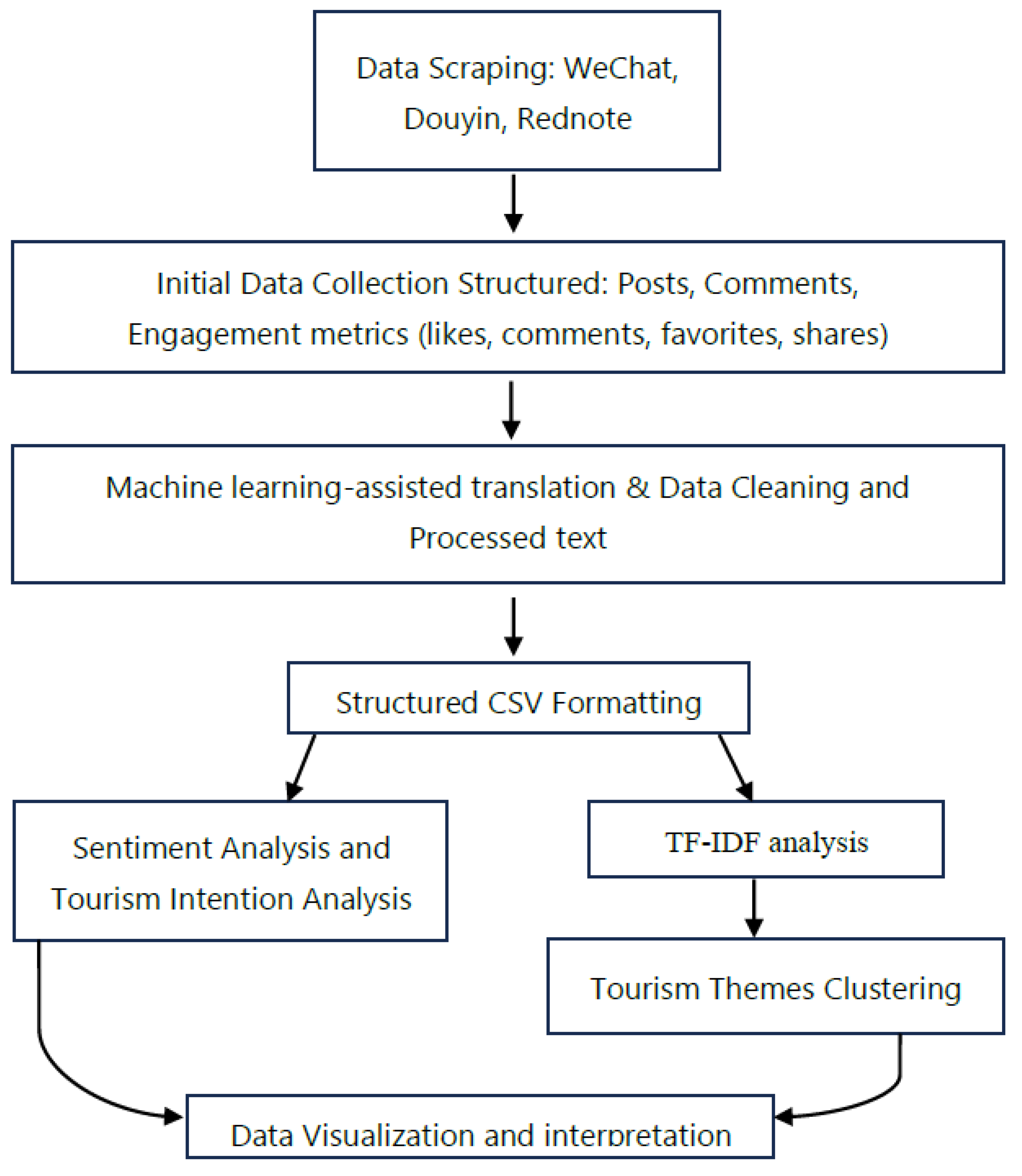
Figure 2.
Distribution of tourism intention across sentiment categories with Fisher’s exact test results (* indicates p < 0.01, n.s. = non-significant).
Figure 2.
Distribution of tourism intention across sentiment categories with Fisher’s exact test results (* indicates p < 0.01, n.s. = non-significant).
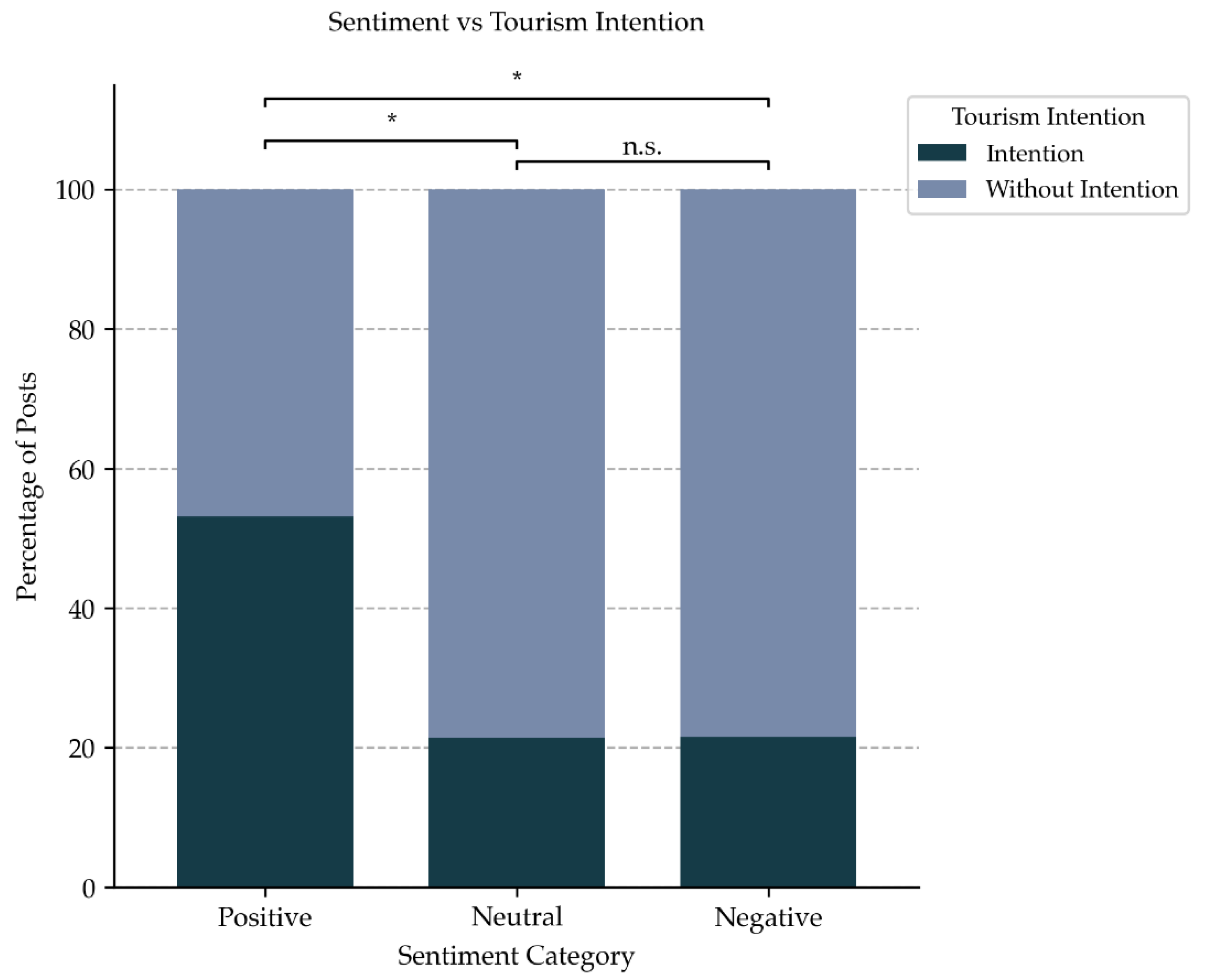
Figure 3.
Word cloud visualization of Lamphun-related posts.
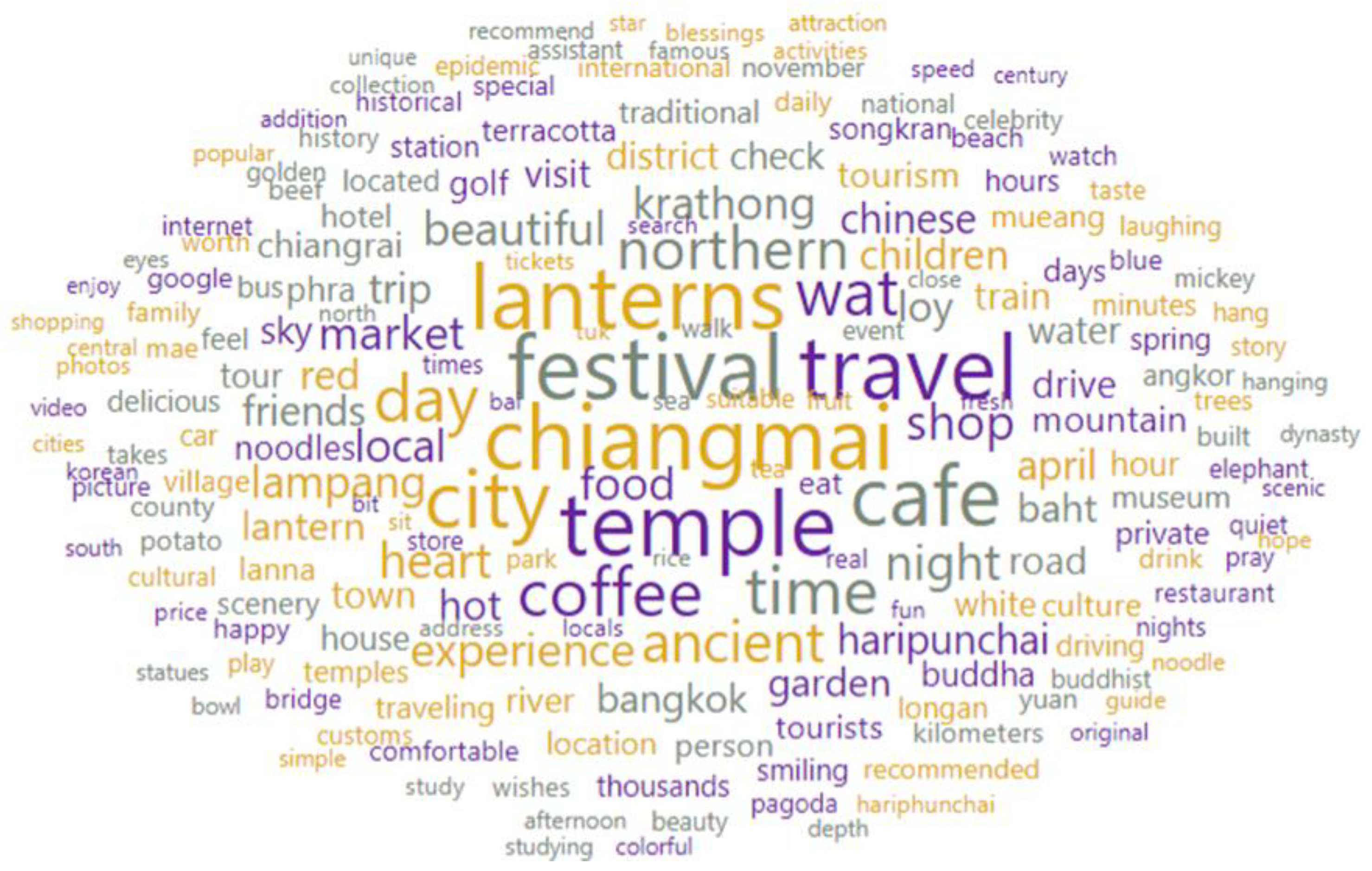
Figure 4.
Two-dimensional PCA representation of TF-IDF Matrix for Thematic Clustering. Each point represents a tourism-related content entry distributed along the first and second principal components (PCA1 and PCA2), with colors indicating cluster membership as determined by K-means analysis.
Figure 4.
Two-dimensional PCA representation of TF-IDF Matrix for Thematic Clustering. Each point represents a tourism-related content entry distributed along the first and second principal components (PCA1 and PCA2), with colors indicating cluster membership as determined by K-means analysis.
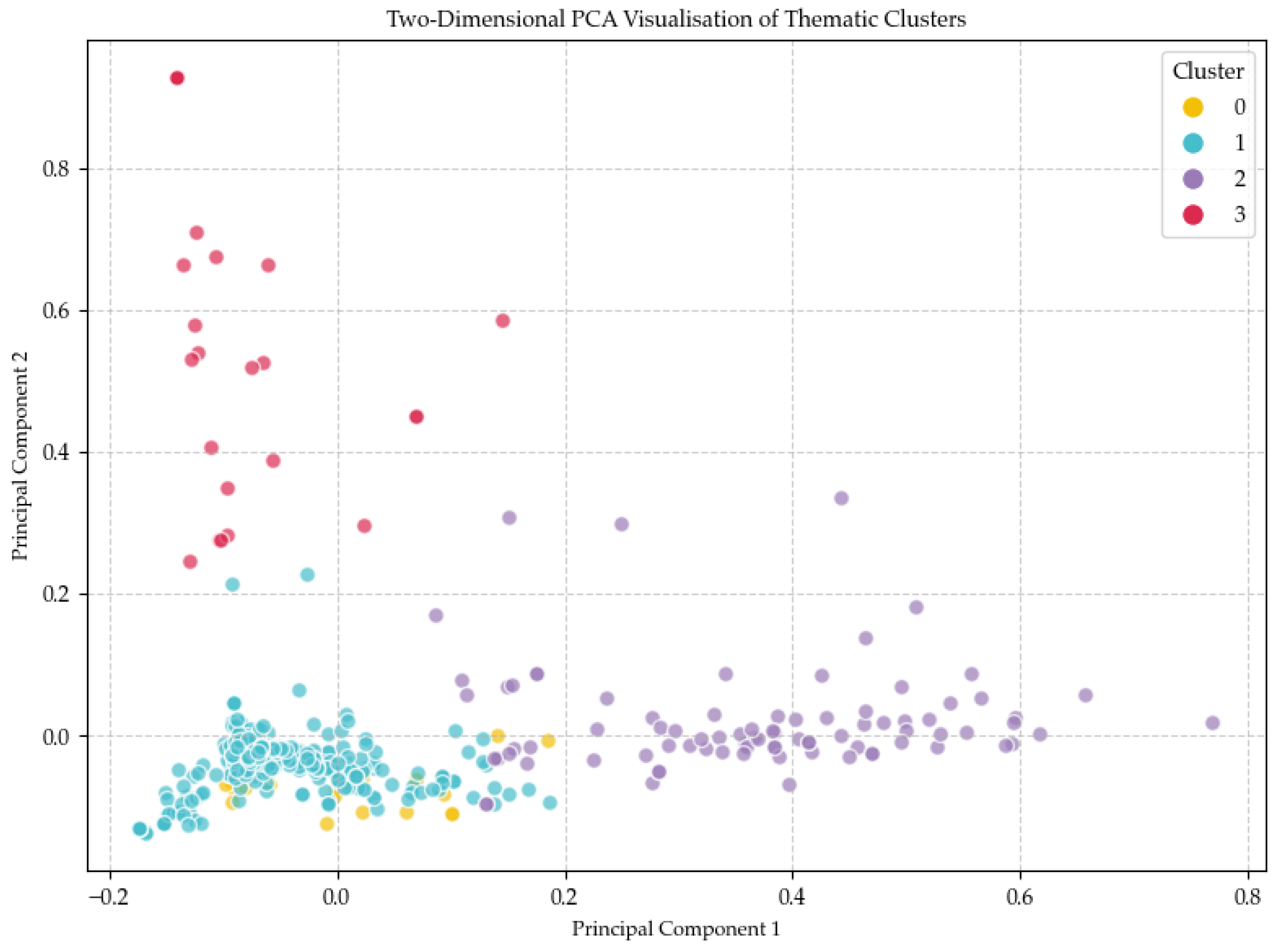

Table 1.
Sentiment analysis of posts related to Lamphun categorized by UNESCO’s ICH elements.
| ICH Elements |
Sentiment Classification |
Review Volume |
Average Sentiment Score |
| Oral traditions and expressions | Positive | 36 | 0.2967 |
| Neutral | 18 | ||
| Negative | 9 | ||
| Performing arts | Positive | 20 | 0.1266 |
| Neutral | 14 | ||
| Negative | 8 | ||
| Social practices, rituals and festival events | Positive | 109 | 0.5302 |
| Neutral | 56 | ||
| Negative | 8 | ||
|
Knowledge and practices concerning nature and the universe |
Positive | 188 | 0.2997 |
| Neutral | 117 | ||
| Negative | 40 | ||
| Traditional craftsmanship | Positive | 14 | 0.4752 |
| Neutral | 5 | ||
| Negative | 0 | ||
| Overall Lamphun reviews | Positive | 367 | 0.3554 |
| Neutral | 210 | ||
| Negative | 65 |
Table 2.
Fisher’s Exact Test for Pairwise Sentiment Comparisons.
| Sentiment categories | Odds Ratio | p-value |
| Positive vs Neutral | 16.877 | < 0.001* |
| Positive vs Negative | 13.781 | < 0.001* |
| Neutral vs Negative | 0.817 | 0.7226 |
* indicates statistically significant.
Table 3.
Mann–Whitney U Tests for Engagement Metrics by Intention and Non-intention.
| Engagement Metric | U-Statistic | p-value |
| Likes | 15593.0 | < 0.001* |
| Comments | 23075.0 | |
| Favorites | 20128.0 | |
| Shares | 24357.5 |
Table 4.
Random Forest Classification Report.
| Classification | Precision | Recall | F1-score | Support |
| With intention | 0.708 | 0.810 | 0.756 | 42 |
| Without intention | 0.929 | 0.882 | 0.905 | 119 |
| Accuracy | 0.863 | 161 | ||
| Macro avg. | 0.819 | 0.846 | 0.830 | 161 |
| Weighted avg. | 0.872 | 0.863 | 0.866 | 161 |
Table 5.
Feature Importance from Random Forest.
| Feature | Importance |
| Sentiment score | 0.556 |
| Likes | 0.146 |
| Comments | 0.083 |
| Favorites | 0.139 |
| Shares | 0.076 |
Table 6.
Top 20 words with TF-IDF Score.
| Words | TF-IDF Score | Words | TF-IDF Score |
| festival | 0.0377073 | beautiful | 0.0172665 |
| chiangmai | 0.0367715 | food | 0.0152131 |
| lanterns | 0.0325178 | travel | 0.0144857 |
| epidemic | 0.0291592 | night | 0.0133945 |
| day | 0.0239269 | cafe | 0.0126642 |
| delicious | 0.0222118 | restaurant | 0.0123372 |
| pot | 0.0200892 | meat | 0.0121968 |
| lanterns festival | 0.0197876 | longan | 0.0112729 |
| times | 0.0185547 | favorite | 0.0111814 |
| temple | 0.0183071 | photos | 0.0106891 |
Table 7.
Summary of thematic clusters, keywords, suggested theme, average sentiment and tourism intention proportions.
Table 7.
Summary of thematic clusters, keywords, suggested theme, average sentiment and tourism intention proportions.
| Cluster | Keywords | Suggested Theme |
Average Sentiment |
Tourism Intention |
| 0 | food, chiangmai, shop, meat, day, travel, vegetarian, coffee, restaurant, longan | Contemporary cafe hopping, City exploring and local food experiences | 0.588 | 0.689 |
| 1 | delicious, pot, chiangmai, day, times, beautiful, favourite, photos, drinks, temple | Local cuisine and religious-related sites | 0.272 | 0.258 |
| 2 | festival, lanterns, lanterns festival, chiangmai, temple, night, water, loy, krathong, beautiful | Major festival and ritual symbolism | 0.818 | 1 |
| 3 | epidemic, festival, times, travel, return, school, bangkok, covid, domestic, restrictions | Pandemic-related and local life experiences | 0.183 | 0.703 |
Disclaimer/Publisher’s Note: The statements, opinions and data contained in all publications are solely those of the individual author(s) and contributor(s) and not of MDPI and/or the editor(s). MDPI and/or the editor(s) disclaim responsibility for any injury to people or property resulting from any ideas, methods, instructions or products referred to in the content. |
© 2026 by the authors. Licensee MDPI, Basel, Switzerland. This article is an open access article distributed under the terms and conditions of the Creative Commons Attribution (CC BY) license (http://creativecommons.org/licenses/by/4.0/).
Copyright: This open access article is published under a Creative Commons CC BY 4.0 license, which permit the free download, distribution, and reuse, provided that the author and preprint are cited in any reuse.