

Submitted:
11 May 2026
Posted:
12 May 2026
You are already at the latest version
Abstract
Background and Objectives: Myocardial injury after noncardiac surgery (MINS) is a major determinant of perioperative morbidity and mortality. Its largely silent clinical course often makes early diagnosis difficult and challenging. Cardiac Cycle Efficiency (CCE), is a new parameter that reflects the energy efficiency of the cardiovascular system. This study aimed to evaluate the relationship between intraoperative CCE values and postoperative myocardial injury. Materials and Methods: This prospective observational study included 50 adult patients. The CCE parameters, including baseline CCE, minimum CCE, mean CCE, ΔCCE, and the duration and percentage of CCE<0, were continuously recorded. In all patients, high-sensitivity troponin I (hs-TnI) levels were measured on the postoperative days 1, 2, and 3. The primary endpoint was defined as exceeding the 99th percentile upper limit of the hs-TnI values. Results: Postoperative troponin elevation above the 99th percentile upper reference limit was identified in 11 patients (22%); none of these patients had accompanying ischemic symptoms or new ECG changes. Comparison of CCE-derived parameters between the elevated and normal troponin groups yielded no statistically significant differences for any variable (MinCCE p=0.87, MeanCCE p=0.74, DeltaCCE p=0.69, CCE index p=0.50, time with CCE<0 p=0.19, CCE<0 percentage p=0.51). Spearman rank correlation analysis similarly demonstrated no significant association between any CCE parameter and peak troponin levels; the closest trend was observed for MinCCE (r=–0.244, p=0.08), which nonetheless did not reach statistical significance. On ROC curve analysis, none of the CCE parameters exhibited meaningful discriminative ability, with the highest AUC recorded for cumulative time with CCE below zero (AUC=0.63, 95% CI: 0.43–0.83, p=0.19). Conclusions: Intraoperative CCE parameters failed to predict postoperative troponin elevation in patients at low-to-moderate risk undergoing elective noncardiac surgery. These findings indicate that CCE is not a reliable, standalone predictive marker in this patient population. Studies involving higher-risk patient groups and larger sample sizes are required.
Keywords:
perioperative myocardial injury
; cardiac cycle efficiency (CCE)
; PRAM (Pressure Recording Analytical Method)
; non-cardiac surgery
; troponin
1. Introduction
Perioperative myocardial damage is regarded as one of the leading causes of early morbidity and mortality after noncardiac procedures. Recent research has indicated that a considerable proportion of individuals following non-cardiac surgery have troponin increase without clinical symptoms, and this condition is highly related with long-term mortality. This condition is defined as “myocardial injury after non-cardiac surgery (MINS),” and its frequently silent course poses a challenge for early diagnosis in clinical practice. The fact that perioperative myocardial injury often occurs without classic symptoms or significant electrocardiographic changes has increased the need for physiological indicators that can provide early intraoperative warnings [1,2,3].
The pathophysiology of perioperative myocardial injury is multifactorial, involving factors such as myocardial oxygen supply demand imbalance, hemodynamic instability, anemia, inflammatory response, and increased sympathetic activity. In particular, a significant association between intraoperative hypotension, tachycardia, tissue perfusion disorders, and myocardial injury has been reported [4,5]. However, traditional hemodynamic parameters, such as mean arterial pressure, cardiac output, or heart rate alone, may not adequately reflect the energy efficiency of the myocardium or the overall state of cardiovascular performance. Therefore, in recent years, studies aiming for a more comprehensive assessment of cardiac performance using advanced hemodynamic monitoring techniques have increased [6].
The pressure recording analytical method (PRAM) technology, based on pulse contour analysis, enables the calculation of new parameters that reflect the energy utilization of the cardiovascular system and ventriculo-arterial interaction. One such parameter, Cardiac Cycle Efficiency (CCE), is a global performance index that demonstrates the relationship between the energy used throughout the cardiac cycle and effective systolic energy [7]. A decrease in CCE may reflect conditions such as ventriculo-arterial mismatch, increased afterload, reduced contractility, increased cardiac workload, and cardiac stress. Previous research has shown that CCE may be linked with prognosis and hemodynamic stability in critical care patients and that it shows a negative correlation with pro-BNP levels in cardiac surgery patients [8,9,10,11].
This study aims to assess the link between intraoperative CCE values obtained using PRAM-based enhanced hemodynamic monitoring and postoperative myocardial injury.
2. Materıals and Methods
2.1. Study Design and Ethics
This study was designed and carried out as a single-center, prospective, observational clinical trial. The study protocol was approved by the appropriate local ethics committee (Dicle University Medical Faculty Ethics Committee For Noninterventional Studies, approval number: 12-12.04.2023) and conducted in accordance with the principles of the Declaration of Helsinki. All participants provided written informed consent.
2.2. Patient Selection
A total of 54 adult patients who underwent elective surgery under general anesthesia between 2023 and 2026 and for whom the PRAM-based MostCare/MoSCARE (Vygon Health, Padua, Italy) device was used for intraoperative advanced hemodynamic monitoring were included. Four patients were excluded due to insufficient data, and analyses were conducted on data from 50 patients.
The inclusion criteria were as follows: age ≥ 18 years, having undergone elective surgical intervention under general anesthesia, intraoperative hemodynamic monitoring with the PRAM method via intra-arterial catheter with recorded data, and availability of complete postoperative troponin and ECG data.
The exclusion criteria were as follows: preoperative diagnosis of acute myocardial infarction, severe arrhythmia such as persistent atrial fibrillation or ventricular pacing, mechanical circulatory support, cardiac surgery, advanced liver or kidney dysfunction, preoperative bradycardia (heart rate <40/min), and missing hemodynamic data.
2.3. Anesthesia Management
After performing the Allen test on all patients, local anesthesia was administered using 2% lidocaine, followed by radial artery cannulation with a 20G angiocatheter. Standard monitoring was applied upon arrival in the operating room, and preoperatively initiated advanced monitoring data were continued intraoperatively.
2.4. Anesthesia Induction and Maintenance
All patients received premedication with 0.03–0.05 mg/kg midazolam before anesthesia was induced. Induction was performed using fentanyl (2–4 mcg/kg) and propofol (1–2 mg/kg). Rocuronium (0.6–0.9 mg/kg) was chosen for neuromuscular blockade to facilitate endotracheal intubation. For maintenance of anesthesia, sevoflurane was used in an air/oxygen mixture; depth monitoring targeted 0.8–1.2 MAC, and sevoflurane concentration was maintained at approximately 2.1% (equivalent to 0.9 MAC). For analgesia, fentanyl infusion or intermittent IV bolus doses were administered throughout the surgery. Rocuronium was administered in intermittent doses to maintain a moderate or deep level of neuromuscular blockade during surgery. The targeted bispectral index (BIS) values for anesthesia depth (Covidien, Boulder, CO, USA) were between 40 and 60.
2.5. Mechanical Ventilation Strategy
Patients were ventilated in pressure-controlled ventilation (PCV) mode, with a tidal volume of 6–8 mL/kg based on ideal body weight and a respiratory rate of 10–12 breaths/min. Positive end-expiratory pressure (PEEP) was set at 5–8 cmH2O, the inspiratory/expiratory ratio was 1:2, and the inspiratory oxygen fraction (FiO2) was set at 0.5. Peak inspiratory pressures (Ppeak) were maintained below 35–40 cmH2O throughout the procedure. Fluid and Blood Product Management
Fluid management was guided by invasive hemodynamic data, pulse pressure variation (PPV) from the arterial catheter, and stroke volume variation (SVV) measured using TEE. Intraoperative fluid management was individualized using stroke-based dynamic parameters obtained using the MostCare device. The basal maintenance crystalloid dose was limited (2–4 mL/kg/h), and additional fluid requirements were determined according to the patient’s fluid responsiveness. Accordingly, when the stroke volume variation (SVV) exceeded 13% or the pulse pressure variation (PPV) exceeded 12%, 250 mL functional fluid boluses were administered until the targeted SVV value fell below 10%. For blood product transfusion, hematocrit levels were individualized for each patient, and monitoring without transfusion was allowed down to a value of 21% (within the clinical tolerance).
2.6. Recovery and Extubation
At the end of the operation, sugammadex (2–4 mg/kg, IV) was used under TOF (Train-of-Four) monitoring to reverse the neuromuscular blockade. Patients who regained adequate spontaneous respiratory effort, muscle strength, and consciousness and met the extubation criteria were extubated and transferred to the PACU.
2.7. Definition of Myocardial Injury
High-sensitivity troponin I (hs-TnI) levels were measured on postoperative days 1, 2, and 3 in all patients. Troponin elevation was defined as an hs-TnI value exceeding the 99th percentile upper reference limit of the local assay. Standard 12-lead ECGs were obtained postoperatively from all patients and reviewed by an experienced clinician for evidence of myocardial ischemia.
2.8. Hemodynamic Monitoring
An invasive arterial catheter was placed in the radial artery of all patients. The arterial pressure waveform was connected to the MostCare (Vytech Health™, Vygon, Padova, Italy) monitor and analyzed using the Pressure Recording Analytical Method (PRAM). To exclude underdamping and overdamping in the arterial pressure waveform, a square-wave (fast flush) test was performed using 0.9% isotonic saline solution. Hemodynamic data were recorded at 30-second intervals and obtained via an external data card. Using the PRAM algorithm, the following parameters were recorded beat-to-beat: Cardiac Cycle Efficiency (CCE), Cardiac Output (CO), Cardiac Index (CI), Stroke Volume (SV), Stroke Volume Variation (SVV), Systemic Vascular Resistance Index (SVRI), maximal pressure derivative (dP/dtmax), arterial elastance dynamic (EaDyn), mean arterial pressure (MAP), and heart rate (HR). All data were continuously recorded throughout the intraoperative period, and artifacts were manually checked and removed from the dataset prior to analysis. In addition, to exclude conditions where hemodynamic stability could not be achieved and that might compromise measurement reliability, measurements with fluctuations in CCE greater than ±0.10 during the 1-minute period prior to data collection were excluded from analysis.
2.9. Measurement and Definition of Cardiac Cycle Efficiency (CCE)
The CCE is a dimensionless parameter ranging from –1 to +1 that represents the energy efficiency of the cardiovascular system. Calculated using the PRAM algorithm, CCE assesses the relationship between the total energy consumed by the heart during a cardiac cycle (Wbeat) and effective systolic work (Wsys), together with a time-dependent impedance factor [K(t)] reflecting the dynamic properties of the arterial system. In this context, CCE reflects the global energy efficiency of the cardiovascular system as a result of the integrated interaction between the heart, arterial system, venous return, and pulmonary circulation. Positive CCE values indicate a hemodynamically efficient state in which the cardiac system generates effective flow with minimal energy expenditure, whereas negative values denote energy inefficiency, particularly in conditions with increased vascular load or ventriculo-arterial uncoupling [12]. CCE is a continuous, objective, and operator-independent parameter that reflects the capacity of the cardiovascular system to maintain dynamic balance under various physiological and pathophysiological conditions. In this study, the baseline CCE before anesthetic induction, intraoperative minimum CCE, intraoperative mean CCE, and ΔCCE (baseline CCE – minimum CCE) were analyzed. Additionally, the total duration of the intraoperative period when the CCE value remained below zero and the ratio of this duration to the total anesthesia time (%) were calculated. A CCE < 0 was considered a parameter reflecting periods of energy inefficiency in the cardiovascular system.
2.10. Statistical Analyses
All statistical analyses were conducted with IBM SPSS Statistics (IBM Corp., Armonk, NY, USA). Normality of continuous variables was assessed by the Shapiro-Wilk test; normally distributed variables are reported as mean ± standard deviation and non-normally distributed variables as median (interquartile range). Categorical data are presented as frequencies and percentages. Between-group differences for continuous variables were assessed using the Mann-Whitney U test, and categorical comparisons were performed with the Chi-square test or Fisher's exact test, as appropriate. Associations between intraoperative CCE parameters and postoperative troponin levels were assessed by Spearman's rank correlation. Because troponin values exhibited a markedly right-skewed distribution, natural logarithmic transformation (ln) was applied prior to regression modelling. The discriminative capacity of CCE parameters for postoperative myocardial injury was assessed by receiver operating characteristic (ROC) curve analysis, with area under the curve (AUC), sensitivity, and specificity reported at the optimal cut-off point. Independent predictors of ln-transformed troponin were identified through multivariable linear regression. A two-tailed p-value of less than 0.05 was considered statistically significant. Sample size estimation was performed a priori using GPower software; assuming a medium effect size (f²=0.15), α=0.05, and 80% statistical power, a minimum of 34 patients was deemed sufficient.
3. Results
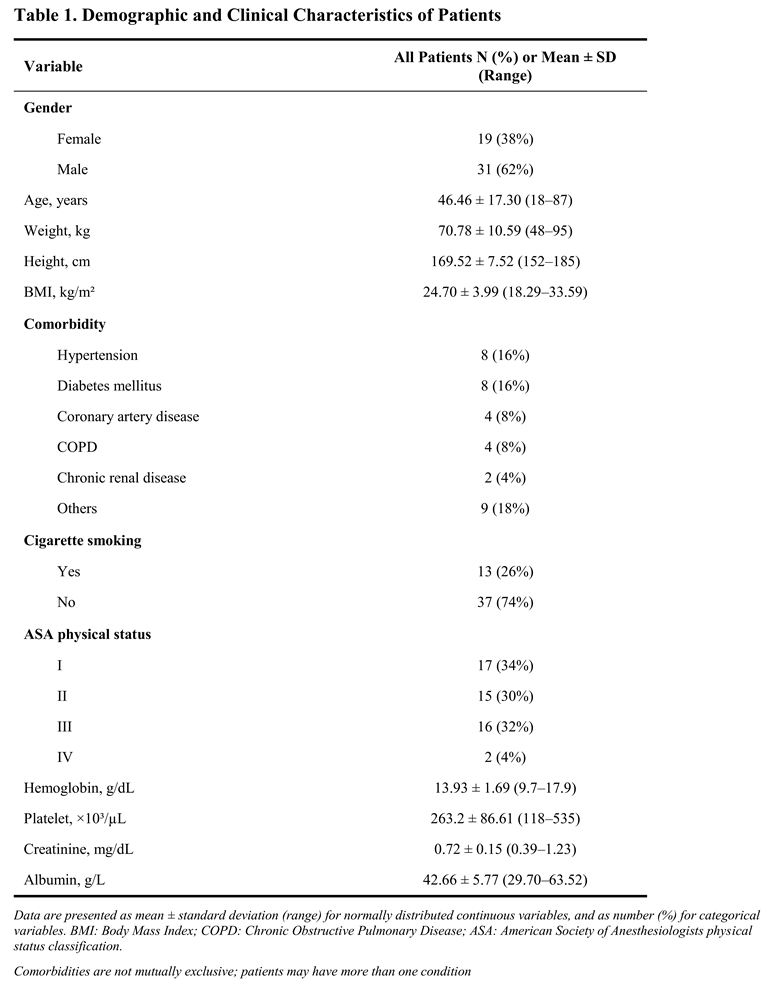
The study cohort comprised 50 patients, of whom 31 (62%) were male and 19 (38%) were female. Mean age was 46.46 ± 17.30 years. ASA physical status distribution was as follows: 17 patients (34%) ASA I, 15 (30%) ASA II, 16 (32%) ASA III, and 2 (4%) ASA IV. Hypertension and diabetes mellitus were the most frequently encountered comorbidities, each present in 8 patients (16%). Baseline laboratory values were within clinically acceptable limits and are detailed in Table 1.
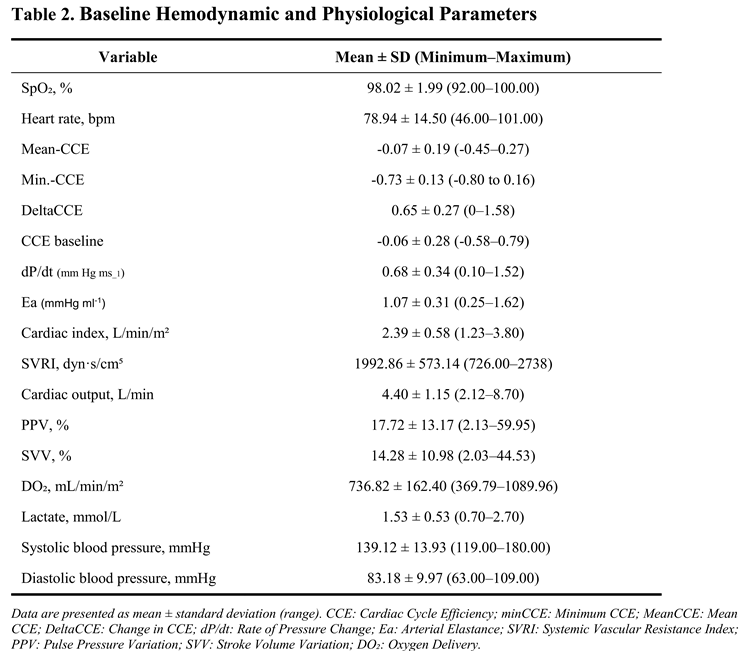
The hemodynamic parameters prior to induction are presented in Table 2. The mean oxygen saturation was 98.02 ± 1.99%, heart rate was 78.94 ± 14.50 beats/min, systolic blood pressure was 139.12 ± 13.93 mmHg, and diastolic blood pressure was 83.18 ± 9.97 mmHg. The cardiac index was 2.39 ± 0.58 L/min/m², cardiac output was 4.40 ± 1.15 L/min, and oxygen delivery (DO₂) was 736.82 ± 162.40 mL/min/m². When examining the CCE parameters, the mean CCE was –0.08 ± 0.21, minimum CCE was–0.78 ± 0.23, delta GCE was 0.79 ± 0.41, and the baseline CCE was –0.06 ± 0.28.
Postoperative hs-TnI levels were measured over three consecutive days. Eleven patients (22%) had hs-TnI values exceeding the 99th percentile upper reference limit; however, none of these patients demonstrated accompanying ischemic symptoms or new ECG changes. Given the right-skewed distribution of troponin values, logarithmic transformation (ln) was applied for subsequent analyses.
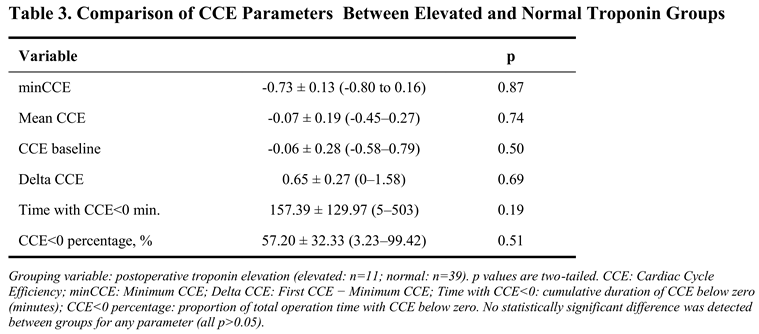
In the comparison of CCE parameters between the high troponin (n=11) and normal (n=39) groups using the Mann-Whitney U test, no statistically significant differences were found for any variable (Table 3). Minimum CCE (p=0.87), mean CCE (p=0.74), delta CCE (p=0.69), baseline CCE (p=0.50), duration of GCE<0 (p=0.19), and percentage of CCE<0 (p=0.51) were similar between the groups (Table 3).
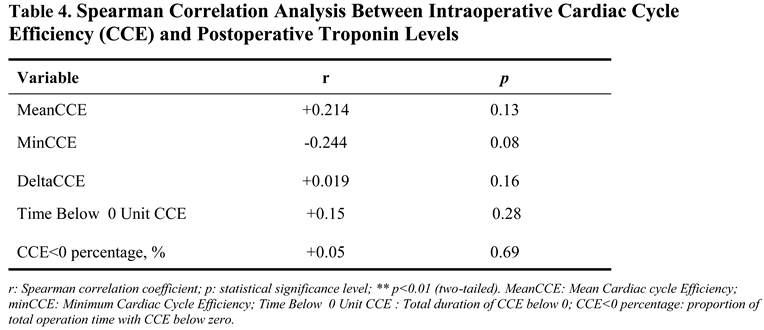
In the Spearman correlation analysis, none of the CCE parameters showed a statistically significant relationship with postoperative peak troponin levels (Table 4). A weak positive correlation was observed between the mean CCE and troponin I levels (r=+0.214, p=0.13). Although the minimum CCE did not reach statistical significance, it showed a trend (r=–0.244, p=0.08). Delta CCE (r=+0.019, p=0.16), duration of CCE<0 (r=+0.15, p=0.28), and percentage of CCE<0 (r=+0.05, p=0.69) did not show significant associations.
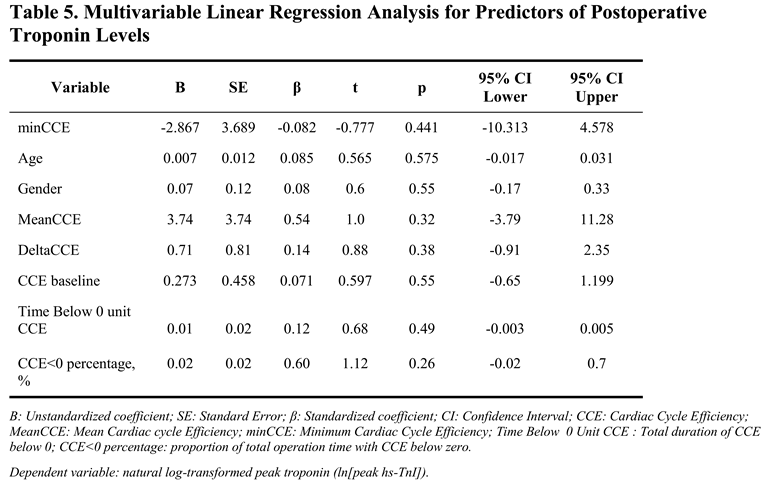
In the multivariate linear regression analysis, in which ln(peak troponin) was the dependent variable, none of the CCE parameters were identified as independent predictors (Table 5). Regression coefficients reflect the effect on ln-transformed troponin, and interpretation is based on relative variation. The strongest trend was observed with the mean CCE (B=3.74, β=0.54, p=0.32), but statistical significance was not reached.
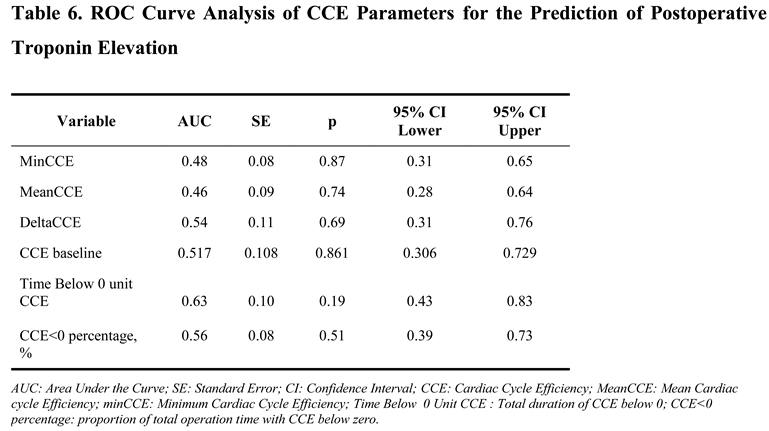
In the ROC curve analysis, none of the parameters based on the GCE<0 threshold showed significant discriminative power for postoperative troponin elevation (Table 6). The highest AUC value was obtained for the duration of CCE<0 (AUC=0.63, p=0.19). The mean CCE (AUC=0.46, p=0.74), minimum CCE (AUC=0.48, p=0.87), delta CCE (AUC=0.54, p=0.69), baseline CCE (AUC=0.517, p=0.861), and percentage of CCE<0 (AUC=0.56, p=0.51) did not demonstrate significant discriminative ability.
4. Discussion
In this prospective observational study, we investigated whether Cardiac Cycle Efficiency (CCE), a new hemodynamic parameter measured continuously by the Pressure Recording Analytical Method (PRAM), could predict postoperative troponin elevation in 50 patients undergoing noncardiac surgery. The main finding is that all parameters based on the CCE<0 threshold (MinCCE, MeanCCE, DeltaCCE, baseline CCE, duration of CCE<0, and percentage of CCE<0) were insufficient to predict postoperative myocardial injury. Group comparisons, correlation analyses, multivariate regression, and ROC curve analyses consistently supported this result.
The CCE is a dimensionless parameter derived from arterial waveform analysis using the PRAM algorithm and ranges between –1 and +1. Values close to +1 represent optimal ventriculo-arterial coupling, whereas negative values reflect a dissipative state of cardiac work in which myocardial energy consumption exceeds production [7,8]. PRAM, developed by Romano et al., offers a unique parameter that integrates the mechanical work of the myocardium and vascular characteristics, allowing for real-time, beat-to-beat calculation [7]. Our study findings both align with and diverge from the current literature exploring the clinical application of the CCE parameter. Scolletta et al. demonstrated a very strong negative correlation (r=–0.89) between CCE and pro-BNP levels in 25 high-risk patients undergoing cardiac surgery (11). Although the negative correlation observed in our study between MinCCE and troponin (r=–0.244, p=0.08) aligns with this physiological expectation, it did not reach statistical significance. This discrepancy may be attributable to differences in patient populations (cardiac vs. non-cardiac) and biomarkers used (pro-BNP vs. troponin). The most promising data regarding the predictive value of CCE have come from the pediatric population. Han et al. showed that intraoperative CCE values significantly predicted postoperative clinical outcomes (inotrope requirement, intensive care unit length of stay) in pediatric cardiac surgery patients [12]. Similarly, Zhou et al. examined the dynamic changes in CCE during spontaneous breathing trials (SBT) in patients requiring prolonged mechanical ventilation after cardiac surgery and reported that CCE significantly decreased in the weaning failure group (p=0.007), while it remained stable in the successful group [13]. These findings indicate that ventriculo-arterial coupling dysfunction is more pronounced in high-risk populations and that the predictive power of CCE may only become apparent when sufficient physiological variations are present.
However, in our study, none of the CCE parameters showed a significant relationship with postoperative troponin elevation in an elective, ASA I–III class, low–moderate risk, non-cardiac surgical population (all p>0.05; AUC 0.46–0.63). These negative findings are in parallel with those of a study by Donati et al. (10), which reported that momentary CCE values in 157 intensive care patients were insufficient to predict clinical outcomes. Seker et al. observed a significant decrease in CCE during total knee arthroplasty with tourniquet application but emphasized that further studies are needed to investigate its relationship with myocardial injury [14]. As Romano pointed out, a shift of CCE to negative values reflects a dissipative state [7]; however, a sufficient duration of exposure is required for this to result in clinically significant myocardial injury. In elective low-risk surgery, episodes of negative CCE are short-lived, tolerated by the myocardial reserve, and do not cause troponin elevation. Therefore, the predictive value of CCE largely depends on the population’s risk level and the cumulative burden of myocardial stress.
The CCE reflects the balance between the work performed by the heart and the vascular load. The minimum CCE represents the lowest value at a single time point, whereas the mean CCE reflects the efficiency throughout the intraoperative process. Notably, neither parameter showed a significant correlation with troponin (for MinCCE r=–0.244, p=0.08; for MeanCCE r=+0.214, p=0.13) in this study. The inability of short-term declines in CCE to explain myocardial stress can be interpreted through the concept of hemodynamic coherence: even when macrocirculatory parameters appear normal, an imbalance between oxygen delivery and consumption at the tissue level can result in organ damage [15,16]. The absence of a significant relationship between CCE<0 duration (p=0.19) and percentage (p=0.51) in our study indicates that either prolonged loss of efficiency does not occur, or the durations observed do not exceed the threshold for myocardial injury in this low-risk population. Additionally, outlier values such as minimum CCE and DeltaCCE merely represent temporary hemodynamic fluctuations; the mean CCE and CCE index cannot distinguish the contributions of accompanying factors such as hypotension duration, vasopressor exposure, or anemia. Perioperative myocardial stress is a multifactorial and time-dependent process, and CCE measurements do not directly reflect cellular damage mechanisms, such as ischemia-reperfusion, inflammation, or oxidative stress. The low statistical power (only 11 patients in the high troponin group) may also have contributed to these negative findings.
The limitations of our study include the small sample size, right-skewed distribution of troponin levels, single-center design, and the fact that perioperative troponin elevation is often due to an imbalance between oxygen supply and consumption, involving heterogeneous mechanisms. This highlights the difficulty in predicting myocardial injury using a single hemodynamic parameter [17]. Finally, the observational design precludes causal inference.
5. Conclusions
In low-to-moderate risk patients undergoing elective non-cardiac surgery, intraoperative CCE parameters derived from PRAM-based monitoring did not significantly predict postoperative troponin elevation. Current evidence is insufficient to support the routine incorporation of CCE into perioperative cardiac risk stratification in this population. The directional trends observed for minimum CCE and cumulative time with CCE below zero suggest a plausible physiological association that warrants further investigation in higher-risk surgical populations, with larger sample sizes and alternative CCE threshold definitions.
Author Contributions
Conceptualization, A.K. and I.A.; Methodology, F.S. and A.K. Data curation, I.A., G.K. and F.S.; Formal analysis, I.A. and A.K.; Supervision, I.A.; Validation, A.K.; Writing—original draft, A.K.; Writing—review & editing, I.A.,A.K.,F.S, and G.K. All authors have read and agreed to the published version of the manuscript.:
Funding
No funding was received for this study.
Institutional Review Board Statement
This study involved human participants and abided by the ethical standards of the Institutional and National Research Committee and the 1964 Declaration of Helsinki and its later amendments or comparable ethical standards. The institutional review board (IRB) of Dicle University Medical Faculty Ethics Committee For Noninterventional Studies, approved this study on 12 April 2023 (Approval number:12).
Informed Consent Statement
The informed consent requirement was waived due to this retrospective analysis. However, preoperative informed consent was obtained for all stages of the surgery.
Data Availability Statement
The datasets analyzed during the current study are available from the corresponding author on reasonable request.
Conflicts of Interest
The authors declare no conflicts of interest.
References
- Devereaux, P.J.; Biccard, B.M.; Sigamani, A.; Xavier, D.; Chan, M.T.V.; Srinathan, S.K.; et al. Association of postoperative high-sensitivity troponin levels with myocardial injury and 30-day mortality among patients undergoing noncardiac surgery. JAMA 2017, 317, 1642–1651. [Google Scholar] [CrossRef] [PubMed]
- Botto, F.; Alonso-Coello, P.; Chan, M.T.; et al. Myocardial injury after noncardiac surgery: A large, international, prospective cohort study establishing diagnostic criteria, characteristics, predictors, and 30-day outcomes. Anesthesiology 2014, 120, 564–578. [Google Scholar] [CrossRef] [PubMed]
- Devereaux, P.J.; Xavier, D.; Pogue, J.; Guyatt, G.; Sigamani, A.; Garutti, I.; et al. Characteristics and short-term prognosis of perioperative myocardial infarction in patients undergoing noncardiac surgery. Ann. Intern. Med. 2011, 154, 523–528. [Google Scholar] [CrossRef] [PubMed]
- Walsh, M.; Devereaux, P.J.; Garg, A.X.; Kurz, A.; Turan, A.; Rodseth, R.N.; et al. Relationship between intraoperative mean arterial pressure and clinical outcomes after noncardiac surgery. Anesthesiology 2013, 119, 507–515. [Google Scholar] [CrossRef] [PubMed]
- Sessler, D.I.; Khanna, A.K. Perioperative myocardial injury and the contribution of hypotension. Intensive Care Med. 2018, 44, 811–822. [Google Scholar] [CrossRef] [PubMed]
- Cannesson, M.; Pestel, G.; Ricks, C.; Hoeft, A.; Perel, A. Hemodynamic monitoring and management in patients undergoing high risk surgery: A survey among North American and European anesthesiologists. Crit. Care 2011, 15, R197. [Google Scholar] [CrossRef] [PubMed]
- Romano, S.M. Cardiac cycle efficiency: A new parameter able to fully evaluate the dynamic interplay of the cardiovascular system. Int. J. Cardiol. 2012, 155, 326–327. [Google Scholar] [CrossRef] [PubMed]
- Scolletta, S.; Romano, S.M.; Biagioli, B.; Capannini, G.; Giomarelli, P. Pressure recording analytical method (PRAM) for measurement of cardiac output during various haemodynamic states. Br. J. Anaesth. 2005, 95, 159–165. [Google Scholar] [CrossRef]
- Romagnoli, S.; Franchi, F.; Ricci, Z.; Scolletta, S.; Payen, D. The pressure recording analytical method (PRAM): Technical concepts and literature review. J. Cardiothorac. Vasc. Anesth. 2017, 31, 1460–1470. [Google Scholar] [CrossRef] [PubMed]
- Donati, A.; Loggi, S.; Scorcella, C.; Lombrano, M.; Botticelli, L.; Melia, M.; et al. Cardiac cycle efficiency as prognostic index in ICUs. Crit. Care 2011, 15 (Suppl. S1), P55. [Google Scholar] [CrossRef]
- Scolletta, S.; Carlucci, F.; Tabucchi, A.; Franchi, F.; Romano, S.; Giomarelli, P.; et al. Cardiac cycle efficiency correlates with pro-B-type natriuretic peptide in cardiac surgery patients. Crit. Care 2008, 12 (Suppl. S2), P249. [Google Scholar] [CrossRef]
- Han, D.; Pan, S.; Li, H.; Meng, L.; Luo, Y.; Ou-Yang, C. Prognostic value of cardiac cycle efficiency in children undergoing cardiac surgery: A prospective observational study. Br. J. Anaesth. 2020, 125, 321–329. [Google Scholar] [CrossRef] [PubMed]
- Zhou, Y.; Liu, S.; Mi, L.; Yang, Y.; Yuan, S.; He, H.; et al. Pressure record analysis method parameters during weaning success and failure from mechanical ventilation in prolonged ventilated patients after cardiac surgery. J. Thorac. Dis. 2025, 17, 10220–10229. [Google Scholar] [CrossRef] [PubMed]
- Seker, M.; Aktas Yildirim, S.; Ulugol, H.; Gucyetmez, B.; Toraman, F. Cardiovascular effects of tourniquet application with cardiac cycle efficiency: A prospective observational study. J. Clin. Med. 2024, 13, 2745. [Google Scholar] [CrossRef] [PubMed]
- Ince, C. Hemodynamic coherence and the rationale for monitoring the microcirculation. Crit. Care 2015, 19 (Suppl. S3), S8. [Google Scholar] [CrossRef] [PubMed]
- Dubin, A.; Henriquez, E.; Hernández, G. Monitoring peripheral perfusion and microcirculation. Curr. Opin. Crit. Care 2018, 24, 173–180. [Google Scholar] [CrossRef] [PubMed]
- Thygesen, K.; Alpert, J.S.; Jaffe, A.S.; Chaitman, B.R.; Bax, J.J.; Morrow, D.A.; et al. Fourth universal definition of myocardial infarction (2018). Circulation 2018, 138, e618–e651. [Google Scholar] [CrossRef] [PubMed]
Disclaimer/Publisher’s Note: The statements, opinions and data contained in all publications are solely those of the individual author(s) and contributor(s) and not of MDPI and/or the editor(s). MDPI and/or the editor(s) disclaim responsibility for any injury to people or property resulting from any ideas, methods, instructions or products referred to in the content. |
© 2026 by the authors. Licensee MDPI, Basel, Switzerland. This article is an open access article distributed under the terms and conditions of the Creative Commons Attribution (CC BY) license (http://creativecommons.org/licenses/by/4.0/).
Copyright: This open access article is published under a Creative Commons CC BY 4.0 license, which permit the free download, distribution, and reuse, provided that the author and preprint are cited in any reuse.


