

Submitted:
11 May 2026
Posted:
11 May 2026
You are already at the latest version
Abstract
Public trust is essential for the effectiveness and long-term sustainability of open government data (OGD) initiatives, particularly in small island developing states (SIDS), where digital governance systems often operate under infrastructural and institutional constraints. Despite growing global research on OGD trust, limited research has examined how the quality dimensions of information systems' success models shape citizens’ trust in OGD platforms within Caribbean SIDS. This study investigates the effects of service quality, system quality, information quality, and data quality on public trust in OGD using an extended information systems success model (ISSM). Data were collected through an online survey of 904 respondents across Caribbean SIDS and analysed using partial least squares structural equation modelling (PLS-SEM). The findings indicate that all proposed relationships were statistically significant. Data quality emerged as the strongest predictor of public trust, followed by system quality. Service quality also significantly influenced system quality, information quality, and data quality. In addition, system quality, information quality, and data quality mediated the relationship between service quality and public trust in OGD. This study extends the ISSM framework by conceptualising data quality as a distinct construct within OGD environments. The findings provide practical insights for governments seeking to strengthen transparency, citizen engagement, and sustainable digital governance through higher-quality OGD systems and datasets. The results further highlight the role of open government platforms in improving public service delivery by providing citizens with complete, accurate, and accessible data, interactive feedback mechanisms, and effective data visualisation tools that support informed decision-making and public participation.
Keywords:
open government data
; public trust
; information systems success model
; small island developing states
; digital governance
; data quality
; sustainable governance
; PLS-SEM
1. Introduction
The rapid advancement of digital technologies has transformed how governments interact with citizens through digital governance initiatives, such as open government data (OGD). OGD refers to government-generated data that are freely accessible for public access, use, reuse, and distribution through digital platforms and online portals [1,2]. Governments worldwide are increasingly using OGD initiatives to improve transparency, accountability, citizen participation, and evidence-based policymaking while supporting broader sustainable development objectives, including Sustainable Development Goal (SDG) 16, which promotes effective, accountable, and transparent institutions [3,4,5,6,7,8,9,10,11,12]. By enabling public access to government information, OGD initiatives can strengthen institutional openness, promote innovation, and encourage collaborative governance.
Despite these potential benefits, the effectiveness and long-term sustainability of OGD initiatives depend heavily on citizens’ willingness to trust and use government-provided data [13,14,15,16]. Public trust is particularly important in digital governance environments because citizens often rely on digital platforms to access information, evaluate government performance, and support decision-making processes. Prior studies suggest that citizens are more likely to engage with OGD platforms when systems are reliable, information is understandable, datasets are accurate, and institutional support services are effective [17,18,19,20]. Conversely, poor-quality systems, inaccessible information, inconsistent datasets, and inadequate support mechanisms may reduce trust and limit the societal value of OGD initiatives [6].
Although research on OGD and digital government has expanded considerably, existing studies have primarily focused on developed or large emerging economies [16,21,22,23]. Comparatively little attention has been paid to small island developing states (SIDS), despite their distinct digital governance environments and institutional challenges. SIDS are often characterised by limited institutional capacity, fragmented digital infrastructure, resource constraints, and vulnerability to external economic and environmental shocks [24,25,26,27]. These contextual conditions may significantly influence how citizens evaluate and trust digital government systems and public-sector data platforms.
While [14] examined the effects of data quality, system quality, and service quality on public trust in OGD using a global sample, their study did not focus on SIDS contexts, examine Caribbean digital governance environments, or model information quality as a distinct ISSM dimension. This study extends prior OGD trust research by examining Caribbean SIDS, separating data quality from information quality, and testing both direct and mediated relationships among service quality, system quality, information quality, data quality, and public trust.
Within the broader SIDS category, Caribbean states provide an important regional context for examining trust in the OGD because many countries in the region are actively pursuing digital transformation and open government initiatives while simultaneously facing infrastructural and governance constraints [28,29]. In relatively small and socially interconnected societies, public perceptions of transparency, responsiveness, and institutional reliability strongly influence trust in government systems. However, empirical evidence explaining how citizens in SIDS evaluate the quality dimensions that shape trust in OGD platforms remains limited.
To address this gap, this study adopts the information systems success model (ISSM) developed by DeLone and McLean [30,31] as the theoretical foundation for examining public trust in OGDs. The ISSM has been widely applied to explain how system quality, information quality, and service quality influence user perceptions and behavioural outcomes in digital environments [18,19,20,32]. This study extends the ISSM by incorporating data quality as a distinct construct to capture better the characteristics of OGD systems, in which the reliability, completeness, consistency, and timeliness of datasets are central to public trust formation [6,22].
Accordingly, this study investigates the effects of service quality, system quality, information quality, and data quality on public trust in OGDs within Caribbean SIDS contexts. Specifically, this study seeks to answer the following research questions:
- What factors influence citizens’ trust in open government data?
- How do the quality dimensions of the information systems success model influence citizens’ trust in open government data?
This study contributes to the literature in three important ways. First, it provides empirical evidence from Caribbean SIDS, a context that remains underrepresented in research on OGD trust, digital governance, and ISSM. Second, it extends prior ISSM-based OGD trust studies by conceptualising information quality and data quality as distinct constructs, thereby recognising the difference between how government information is presented and the intrinsic reliability of the underlying datasets. Third, the study advances understanding of trust formation by examining both direct and mediated relationships among service quality, system quality, information quality, data quality, and public trust in OGD. These contributions provide practical insights for policymakers seeking to strengthen transparency, citizen engagement, resilient digital governance, and sustainable public-sector innovation through higher-quality OGD systems and services.
2. Theoretical Framework
2.1. Information Systems Success Model and Trust in Open Government Data
The Information Systems Success Model (ISSM), developed by DeLone and McLean [30,31], is one of the most widely applied theoretical frameworks for evaluating the effectiveness of information systems. The model proposes that users’ perceptions of system-related quality dimensions influence behavioural and organisational outcomes through interconnected constructs, including system, information, and service quality; use; user satisfaction; and net benefits. The ISSM has been extensively applied in information systems, e-government, and digital governance research to explain how perceptions of quality shape user attitudes, trust, and behavioural intentions [18,19,20,32].
Within open government data (OGD) environments, ISSM provides a theoretical foundation for understanding how citizens evaluate government data platforms. OGD systems rely on digital technologies to disseminate public sector information and facilitate citizen engagement. Consequently, citizens’ trust in OGD is influenced not only by the quality of government datasets but also by the usability, accessibility, reliability, and support mechanisms associated with the platforms through which the data are delivered. Prior studies suggest that system quality, information quality, and service quality significantly influence citizens’ perceptions of transparency, credibility, and trust in digital government services [7,8,9,14,17,23,33,34,35].
Drawing on trust theory, this study argues that quality dimensions function as trust-building signals that reduce uncertainty and perceived risk in digital governance environments. Citizens interacting with OGD platforms often evaluate whether government systems and datasets are reliable, understandable, accessible, and beneficial for public use. Therefore, high-quality systems, services, information, and datasets may strengthen perceptions of institutional competence, transparency, and accountability, thereby enhancing public trust. Conversely, poor-quality systems, unclear information, inconsistent datasets, and inadequate support mechanisms may weaken confidence in both OGD platforms and the institutions responsible for them.
This study focuses on four quality dimensions within the ISSM framework: system quality, information quality, service quality, and data quality. System quality refers to the technical performance of OGD platforms, including usability, accessibility, reliability, and response efficiency. Information quality reflects the relevance, clarity, usefulness, and comprehensibility of the information presented to users. Service quality captures the level of support, responsiveness, and assistance provided to users interacting with the platform. These dimensions have consistently been identified as important determinants of user trust and engagement in digital government research [18,19,20,22,35].
In addition to the established ISSM dimensions, this study conceptualises data quality as a distinct construct given its particular importance in OGD environments. Although information quality and data quality are related, they represent conceptually different dimensions. Data quality refers to the intrinsic characteristics of datasets, including accuracy, completeness, consistency, reliability, and timeliness. In contrast, information quality relates to how information derived from datasets is organised, presented, and interpreted for users. This distinction is particularly important in OGD contexts because technically accurate datasets may still fail to build trust if the information presented is difficult to interpret or poorly communicated. Incorporating data quality as a separate construct, therefore, extends the ISSM framework and better reflects the characteristics of OGD systems.
The application of the ISSM is especially relevant in small island developing states (SIDS), where digital governance systems often operate under infrastructural, institutional, and resource constraints [24,25,26,27]. Variations in digital infrastructure, technical capacity, and data governance practices across SIDS may significantly influence how citizens evaluate OGD platforms and government transparency initiatives. In such environments, citizens may rely heavily on observable quality indicators to assess the trustworthiness of government systems and public-sector data. Therefore, understanding how these quality dimensions influence trust is important for strengthening citizen engagement and promoting sustainable digital governance within SIDS.
Based on ISSM and trust theory, this study conceptualises public trust in OGD as the primary dependent variable influenced by the interrelationships among service quality, system quality, information quality, and data quality. Figure 1 presents the proposed research framework and hypothesised relationships among the constructs.
2.2. Open Government Data in Small Island Developing States
Small Island Developing States represent a unique group of countries characterised by relatively small populations, geographic isolation, limited economic diversification, and vulnerability to external economic and environmental shocks [24,25,26]. These structural conditions significantly influence the implementation and sustainability of digital government initiatives, including OGD systems. Although many SIDS governments have increasingly adopted digital transformation strategies to improve governance, transparency, and public service delivery, the development of OGD ecosystems remains uneven due to infrastructural, institutional, and resource constraints.
Within the broader SIDS category, Caribbean Community member states provide a particularly relevant context for examining public trust in OGD. Countries across the region share similar governance structures, socioeconomic conditions, and digital transformation challenges, including varying levels of technological readiness, institutional capacity, and data governance maturity [28,29]. Regional initiatives supported by organisations such as CARICOM, the World Bank, and the Inter-American Development Bank have encouraged greater adoption of digital governance and open data initiatives across the Caribbean. However, disparities remain in terms of digital infrastructure, platform development, data standardisation, and institutional effectiveness.
These contextual conditions have important implications for citizens’ evaluations of the quality of OGD dimensions. System quality may be affected by inconsistent Internet connectivity, technological limitations, and infrastructural constraints, which influence platform usability, accessibility, and reliability. Similarly, service quality may be constrained by limited technical expertise, insufficient user support mechanisms, and resource limitations within public-sector institutions. These challenges may shape citizens’ experiences and evaluations of OGD platforms.
Data quality and information quality remain important concerns in many SIDS environments. Fragmented data governance practices, inconsistent data management procedures, and limited standardisation across public institutions may reduce the accuracy, completeness, consistency, and timeliness of government datasets [6,22]. In addition, difficulties related to information presentation, accessibility, and interpretation may limit citizens’ ability to utilise OGD effectively, particularly among users with varying levels of digital literacy and technical competence.
Trust is especially important in SIDS because public institutions often operate within relatively small and socially interconnected societies where perceptions of government responsiveness, accountability, and transparency are highly visible. In such environments, citizens may rely heavily on observable quality indicators, such as system usability, dataset reliability, information clarity, and service responsiveness, when evaluating the trustworthiness of OGD platforms. Strengthening these quality dimensions is therefore essential for improving citizen engagement, institutional trust, and the long-term sustainability of digital governance initiatives in SIDS contexts.
Despite increasing global interest in OGD and digital governance, empirical research examining trust in OGD within SIDS remains limited. Most prior studies have focused on developed or large emerging economies, where institutional capacities and technological infrastructures differ substantially from those of small island states. Consequently, existing findings may not fully explain how trust in OGD is formed within SIDS environments. This study addresses an important gap in the literature by examining how service quality, system quality, information quality, and data quality influence public trust in OGD within Caribbean SIDS contexts.
2.3. Hypotheses Development
2.3.1. Service Quality
Service quality refers to the extent to which users receive adequate support, responsiveness, assistance, and guidance when interacting with OGD platforms. In digital governance environments, service quality reflects the ability of government institutions to provide effective support mechanisms that facilitate citizens’ interactions with digital systems and datasets. Prior studies in information systems and e-government research consistently identify service quality as an important determinant of user trust because responsive and supportive services reduce uncertainty and strengthen perceptions of institutional competence and reliability [18,19,20,35].
In OGD contexts, service quality may include user assistance, help desks, communication channels, tutorials, and feedback mechanisms that support citizens in accessing and interpreting government datasets. Effective support services improve users’ confidence when interacting with digital platforms and contribute to perceptions of transparency and responsiveness [22,23,33,34]. This relationship may be particularly important in SIDS, where varying levels of digital literacy and technical expertise may increase citizens’ reliance on institutional support when engaging with OGD systems.
Beyond its direct influence on trust, service quality may also shape users’ perceptions of other quality dimensions in OGD environments. Responsive support services can enhance perceptions of data quality by helping users understand the relevance and reliability of datasets. Similarly, effective assistance and communication mechanisms may improve perceptions of information quality by facilitating clearer interpretations and accessibility of government information. Service quality may also influence system quality, as responsive support can improve users’ overall experience with digital platforms and mitigate the impact of technical limitations. Accordingly, the following hypotheses were proposed:
H1
: Service quality positively influences trust in Open Government Data.
H2:
Service quality positively influences data quality.
H3:
Service quality positively influences information quality.
H4:
Service quality positively influences system quality.
2.3.2. System Quality
System quality refers to the technical performance and functional characteristics of OGD platforms, including usability, accessibility, reliability, efficiency, and response time. In information systems research, system quality is widely recognised as an important determinant of user perceptions and behavioural outcomes because it influences the effectiveness of users’ interactions with digital platforms and their access to information [30,35].
In OGD environments, system quality is particularly important because citizens rely on digital platforms to access, search, visualise, and utilise government datasets. Features such as intuitive navigation, stable performance, efficient search functionality, and fast response times can improve user experiences and reduce technological barriers to engagement [22]. Prior studies have shown that reliable and user-friendly systems positively influence trust in digital government services by reducing perceived risk and uncertainty [17,23,33,34].
System quality may also influence how citizens evaluate information quality and data quality. Effective platform functionalities, such as search tools, filtering capabilities, and visualisation features, can improve users’ ability to access, interpret, and utilise government information. Similarly, technically reliable systems may strengthen perceptions of dataset accessibility, consistency, and completeness by ensuring stable and efficient delivery of government data. In SIDS contexts, where infrastructural limitations may affect digital platform performance, system quality may play a particularly important role in shaping trust in OGD initiatives. Therefore, we propose the following hypotheses:
H5:
System quality positively influences trust in Open Government Data.
H6:
System quality positively influences information quality.
H7:
System quality positively influences data quality.
2.3.3. Information Quality
Information quality refers to the extent to which information presented through OGD platforms is relevant, understandable, useful, accurate, and clearly organised. In digital governance environments, information quality plays an important role in shaping citizens’ perceptions of transparency, credibility, and usefulness because users rely on government information to support decision-making and evaluate institutional performance [17,35].
Prior research suggests that high-quality information reduces uncertainty and strengthens trust by enabling users to interpret and utilise government information more effectively [18,19,20,23,33,34]. Information that is well-structured, timely, relevant, and easy to understand may enhance perceptions of transparency and accountability. In OGD contexts, this is particularly important because datasets often require interpretation and contextualisation before citizens and organisations can use them meaningfully. Within SIDS environments, varying levels of digital literacy and technical expertise may further increase the importance of information quality in shaping trust. Citizens may be more likely to trust OGD platforms when information is presented in accessible and understandable formats that reduce cognitive complexity and facilitate data interpretation. Accordingly, the following hypothesis is proposed:
H8:
Higher information quality positively influences trust in open government data.
2.3.4. Data Quality
Data quality refers to the intrinsic characteristics of a dataset, including accuracy, completeness, consistency, reliability, and timeliness. In OGD environments, data quality is a foundational determinant of trust, as citizens’ confidence in government data largely depends on whether the datasets are perceived as credible, dependable and current [22,35].
Previous studies in digital governance and information systems research indicate that accurate and complete datasets strengthen perceptions of transparency and institutional accountability by signalling that governments are capable of managing and disseminating reliable information [17,23,33]. Conversely, outdated, inconsistent, or incomplete datasets may undermine trust and discourage engagement with OGD platforms.
The importance of data quality may be particularly pronounced in SIDS contexts, where fragmented data governance systems, limited institutional resources, and inconsistent data management practices undermine the reliability and availability of government datasets. In such environments, citizens may rely heavily on their perceptions of dataset quality when evaluating the trustworthiness of OGD platforms and the institutions responsible for them. Therefore, the following hypothesis is proposed:
H9:
Data quality positively influences trust in Open Government Data.
2.3.5. Public Trust in Open Government Data
Public (citizen) trust in open government data refers to the extent to which citizens perceive government-provided data and digital platforms as reliable, credible, transparent, and suitable for public use and decision-making. In OGD environments, trust reflects citizens’ confidence in both the technological systems through which data are delivered and the public institutions responsible for managing and disseminating that data [3,4,5,33,34]. Prior research suggests that trust plays an important role in the adoption, use, and long-term sustainability of OGD initiatives because citizens are more likely to engage with government platforms when they perceive the underlying systems and data as dependable and transparent [29,36,37,38,39].
In OGD contexts, trust is often shaped by users’ evaluations of quality-related factors, including system quality, information quality, data quality, and service quality, which function as signals of institutional competence and reliability [17,35]. High-quality systems and reliable datasets may therefore strengthen perceptions of transparency, accountability, and government effectiveness. In contrast, poor-quality systems and inconsistent data may undermine public confidence in digital government initiatives. Accordingly, this study conceptualises public trust in OGD as the primary dependent variable influenced by service quality, system quality, information quality, and data quality within the proposed extended information systems success model framework.
3. Methodology
This study employed a quantitative research design to examine the factors influencing public trust in OGD in SIDS. Grounded in the ISSM, this study investigated the effects of service quality, system quality, information quality, and data quality on public trust in OGD platforms. A quantitative approach was considered appropriate because it enables the systematic examination of relationships among latent constructs and supports the empirical testing of hypothesised relationships within the proposed research framework [40,41,42]. A cross-sectional survey design was adopted to collect data from individuals who were aware of or had prior experience with OGD platforms in the SIDS context. Cross-sectional surveys are widely used in information systems and digital governance research because they effectively capture users’ perceptions, attitudes, and evaluations at a specific point in time [18,19,20,23,34].
3.1. Instrument Development
Data were collected using a structured online questionnaire consisting of two sections. The first section measured the study constructs, including public trust in OGD, system quality, information quality, data quality, and service quality. The second section collected demographic information, including respondents’ age, gender, educational background, occupation, and country of residence. The measurement items were adapted from previously validated scales in information systems, e-government, and OGD literature to ensure content validity and construct reliability [32,35]. Minor wording modifications were made to align the items with the OGD context and the characteristics of SIDS environments. Table 1 presents the study constructs, measurement items, and their corresponding sources.
All measurement items were assessed using a five-point Likert scale ranging from 1 (“strongly disagree”) to 5 (“strongly agree”). The Likert-scale approach is widely applied in behavioural and information systems research because it effectively captures respondents’ perceptions and attitudes while remaining easy for participants to understand and complete [43]. Prior to distribution, the questionnaire was reviewed and refined to ensure clarity, consistency, and contextual relevance. Particular attention was given to ensuring that respondents from different SIDS contexts could clearly understand the wording and intent of the measurement items.
3.2. Data Collection and Sampling
Data were collected through an online survey administered via Google Forms between March and April 2026. The survey targeted individuals who were aware of or had prior experience using OGD platforms in SIDS environments. Online distribution was considered appropriate because OGD users primarily interact with government data platforms through Internet-based technologies. A non-probability sampling approach combining convenience and snowball sampling was employed because no comprehensive sampling frame exists for OGD users across SIDS countries. Convenience sampling enabled the study to reach accessible respondents familiar with OGD systems, whereas snowball sampling facilitated broader participation through professional and social networks [44].
The survey link was distributed through multiple digital channels, including Facebook, WhatsApp, LinkedIn, Twitter, email invitations, professional networks, and open-data communities. Additional efforts were made to reach businesses, organisations, and digitally engaged individuals across Caribbean SIDS member states to improve contextual diversity and representation. A total of 904 valid responses were retained for analysis following data screening and cleaning procedures. The sample size exceeded the minimum requirements recommended for PLS-SEM and was considered adequate for estimating the proposed structural model [40,41,42]. Participation in the study was voluntary. Respondents completed an electronic consent form before accessing the questionnaire, and all responses were collected anonymously. No personally identifiable information was recorded.
3.3. Data Analysis Technique
The collected data were analysed using PLS-SEM, which is widely used in information systems, e-government, and behavioural research to examine complex relationships among latent constructs [40,41,42,45]. This technique is particularly appropriate for exploratory and prediction-oriented research involving multiple constructs and simultaneous relationships. The analysis followed a two-stage approach, comprising assessments of the measurement and structural models. The measurement model was evaluated using Cronbach’s alpha, composite reliability (CR), and average variance extracted (AVE) to assess reliability and convergent validity [40,41,42,46]. Discriminant validity was examined using the Fornell–Larcker criterion and the heterotrait–monotrait (HTMT) ratio [4,47]. The structural model was subsequently evaluated using path coefficients, t-values, p-values, coefficients of determination (R2), effect sizes (f2), and predictive relevance (Q2). A bootstrapping procedure with a large number of resamples was conducted to assess the statistical significance of the hypothesised relationships. Bootstrapping is recommended in PLS-SEM because it does not rely on distributional assumptions and provides robust estimates of standard errors and confidence intervals [41,49].
3.4. Ethical Considerations
Ethical considerations were carefully addressed throughout the study. Participation was entirely voluntary, and respondents were informed about the purpose and nature of the research prior to completing the questionnaire. Respondents were assured that all responses would remain anonymous and confidential and would be used solely for academic research purposes. No personally identifiable information was collected, and all data were analysed in aggregate. The study complied with the established ethical principles for social science and behavioural research [50].
4. Results
4.1. Respondent Demographics
Table 2 presents the demographic characteristics of the respondents included in this study. A total of 904 valid responses were retained for analysis following data screening and cleaning procedures. Respondents represented several Caribbean SIDS, with the largest proportions originating from Saint Vincent and the Grenadines (27.32%), Saint Lucia (20.24%), and Saint Kitts and Nevis (11.73%). Additional respondents were drawn from Grenada, Jamaica, Dominica, Barbados, and Haiti, thereby enhancing the study’s regional relevance. Regarding experience with open government data (OGD), 33.41% of respondents reported less than 1 year of experience, while 31.86% reported 5 years or more of experience using OGD platforms. This distribution suggests that the sample included both relatively new and experienced OGD users.
Female respondents accounted for 56.31% of the sample, while male respondents represented 43.69%. Most respondents were aged 25–34 years (34.51%), followed by those aged 35–44 years (29.65%). In terms of educational or professional background, the largest groups were Business and Management (21.24%) and Engineering and Technology (19.47%), followed by Education (15.04%) and Social Sciences (13.94%). The demographic findings indicate that the study captured a diverse sample across multiple Caribbean SIDS contexts, demographic categories, and academic backgrounds.
4.2. Descriptive Statistics and Normality Assessment
Descriptive statistics and normality assessments were conducted for all measurement items prior to the structural model analysis. The mean values ranged from 3.081 to 3.551, as shown in Table 3, indicating generally moderate-to-positive perceptions of service quality, system quality, information quality, data quality, and trust in OGD. Standard deviation values ranged from 0.703 to 1.003, indicating moderate variability across the measurement items. Skewness values ranged from -0.138 to -0.855, suggesting moderate negative skewness toward higher levels of agreement. Excess kurtosis values ranged from -0.593 to 0.903, indicating no evidence of severe kurtosis. The Cramér–von Mises normality test produced statistically significant p-values (p < 0.001) for all indicators, indicating deviations from normality. However, this does not present a major concern because PLS-SEM is robust to non-normal data distributions [40,41,42,45].
4.3. Measurement Model Assessment
4.3.1. Common Method Bias
Because the study relied on self-reported cross-sectional survey data collected from a single source, common method bias (CMB) was assessed. Following the recommendations of Podsakoff [50], Harman’s single-factor test was initially conducted to determine whether a single factor accounted for the majority of the variance in the data. The results indicated that the first factor explained less than 50% of the total variance, suggesting that common method bias was unlikely to pose a serious concern in this study. In addition, full collinearity assessments were conducted using variance inflation factor (VIF) values to further evaluate the potential presence of common method variance, consistent with recommendations for PLS-SEM research [40,41,42,51]. The inner-model collinearity statistics showed that all VIF values ranged from 1.000 to 1.406, well below the recommended threshold of 3.3. Similarly, the outer-model collinearity statistics indicated that all indicator-level VIF values ranged from 1.539 to 2.838 and remained below the critical threshold. These findings, presented in Table 4 and Table 5, suggest that common method bias and multicollinearity did not significantly affect the study’s results. In addition, procedural safeguards were implemented during questionnaire design, including respondent anonymity, voluntary participation, and the use of clear, concise measurement items, to minimise the likelihood of common method bias.
4.3.2. Construct Validity
The measurement model was evaluated using Cronbach’s alpha, composite reliability (CR), and average variance extracted (AVE). As presented in Table 6, all constructs demonstrated satisfactory internal consistency reliability, with Cronbach’s alpha values ranging from 0.808 to 0.861 and composite reliability values ranging from 0.874 to 0.905, exceeding the recommended threshold of 0.70 [40,41,42]. Convergent validity was assessed using AVE values. All constructs exceeded the recommended threshold of 0.50, with AVE values ranging from 0.635 to 0.706 [46]. These findings confirm satisfactory convergent validity for all constructs. The results indicate that the measurement model demonstrated acceptable reliability and convergent validity.
4.4. Discriminant Validity
Discriminant validity was assessed to determine whether the constructs in the study were empirically distinct from one another. Consistent with recommended PLS-SEM procedures, discriminant validity was evaluated using three approaches: the Heterotrait–Monotrait (HTMT) ratio, the Fornell–Larcker criterion, and cross-loadings analysis [40,41,42,48].
The HTMT results indicate that all values are below the recommended threshold of 0.85, confirming satisfactory discriminant validity among the constructs, as presented in Table 7 [48]. Similarly, the Fornell–Larcker criterion showed that the square root of the AVE for each construct exceeded its correlations with all other constructs, further supporting discriminant validity (see Table 8). The cross-loadings analysis (see Table 9) also demonstrated that all measurement items loaded more strongly on their respective constructs than on other constructs, with all factor loadings exceeding the recommended threshold of 0.70. These findings confirm that the constructs were empirically distinct and exhibited satisfactory discriminant validity.
4.5. Structural Model Assessment and Hypotheses Testing
The structural model was evaluated using partial least squares structural equation modelling (PLS-SEM) and bootstrapping procedures to assess the hypothesised relationships among the constructs. Table 10 presents the path coefficients, t-statistics, and p-values for the proposed hypotheses. The results indicate that all hypothesised relationships were statistically significant, thereby supporting H1–H9. Among the direct predictors of public trust in open government data (OGD), data quality demonstrated the strongest positive effect on trust (β = 0.333, p < 0.001), followed by system quality (β = 0.160, p < 0.001), service quality (β = 0.121, p = 0.002), and information quality (β = 0.112, p = 0.020).
Service quality significantly influenced system quality (β = 0.407, p < 0.001), information quality (β = 0.260, p < 0.001), and data quality (β = 0.306, p < 0.001). In addition, system quality significantly influenced both information quality (β = 0.334, p < 0.001) and data quality (β = 0.274, p < 0.001). The findings support the applicability of the extended ISSM in explaining public trust in OGD within SIDS contexts.
4.5. Indirect Effects Analysis
Indirect effects were examined using bootstrapping procedures to assess the mediating roles of system quality, information quality, and data quality within the proposed framework. The results revealed several significant indirect effects. Service quality positively influenced public trust in OGD through system quality (β = 0.065, p < 0.001), information quality (β = 0.029, p = 0.040), and data quality (β = 0.102, p < 0.001). In addition, system quality significantly influenced trust indirectly through information quality (β = 0.037, p = 0.024) and data quality (β = 0.091, p < 0.001).
Sequential mediation effects were also observed. Service quality significantly influenced trust through the pathways of system quality and data quality (β = 0.037, p < 0.001) and system quality and information quality (β = 0.015, p = 0.027). The findings, as presented in Table 11, indicate that trust in OGD is shaped not only by direct perceptions of quality but also by the interrelationships among service quality, system quality, information quality, and data quality.
4.6. Effect Size Assessment (f2)
To examine effect sizes (f2), the relative contribution of each exogenous construct to the endogenous constructs within the structural model was assessed. According to [40,41,42], f2 values of 0.02, 0.15, and 0.35 indicate small, medium, and large effects, respectively. As presented in Table 12, most relationships demonstrated small-to-moderate effect sizes. Among the predictors of public trust in Open Government Data, data quality had the largest effect size (f2 = 0.118), indicating it contributed the most to explaining trust in OGD. System quality demonstrated a smaller effect on trust (f2 = 0.027), whereas service quality (f2 = 0.015) and information quality (f2 = 0.013) showed relatively weak effects.
Regarding the antecedents of data quality, service quality demonstrated a small-to-moderate effect (f2 = 0.102), whereas system quality also exhibited a significant contribution (f2 = 0.082). For information quality, system quality produced the strongest effect size (f2 = 0.124), followed by service quality (f2 = 0.075). The largest effect size observed in the model was the relationship between service quality and system quality (f2 = 0.198), indicating a moderate effect. This finding suggests that service-related support mechanisms substantially influence users’ perceptions of platform usability, accessibility, and technical performance. The f2 results indicate that the quality dimensions included in the extended ISSM framework contribute meaningfully to explaining trust in OGD and related quality perceptions within SIDS contexts.
4.7. Model Fit Assessment
The overall model fit was assessed using the standardised root mean square residual (SRMR), geodesic discrepancy (d_G), squared Euclidean distance (d_ULS), normed fit index (NFI), and chi-square statistics. Table 13 presents the model fit results. The SRMR values for both the saturated (0.058) and estimated (0.064) models were below the recommended threshold of 0.08, indicating an acceptable model fit [40,41,42]. The discrepancy measures, d_ULS and d_G, also suggested satisfactory model performance, indicating that the proposed model adequately reproduced the covariance structure of the observed data.
The NFI values for the saturated (0.835) and estimated (0.834) models were slightly below the conventional threshold of 0.90. However, they remained acceptable for exploratory and prediction-oriented PLS-SEM research [45]. In addition, the chi-square values for the saturated and estimated models were relatively close, indicating consistency between the proposed structural model and the observed data. These findings suggest that the proposed structural model demonstrated an acceptable overall fit and was suitable for examining the relationships among service quality, system quality, information quality, data quality, and public trust in OGDs.
4.8. Structural Model Illustration
Figure 2 presents the final structural model generated using PLS-SEM analysis. The figure illustrates the hypothesised relationships among service quality (SerQ), system quality (SysQ), information quality (IQ), data quality (DQ), and trust in Open Government Data (TROGD), including standardised path coefficients, factor loadings, and R-squared values.
The results indicate that service quality significantly influences system quality (β = 0.407), information quality (β = 0.260), and data quality (β = 0.306). System quality also has significant positive effects on information quality (β = 0.334), data quality (β = 0.274), and trust in OGD (β = 0.160). Furthermore, both information quality (β = 0.112) and data quality (β = 0.333) positively influence trust in OGD. Among the trust predictors, data quality has the strongest direct effect, underscoring the importance of accurate, complete, and reliable datasets in fostering public trust in OGD platforms in SIDS contexts. The figure also presents the R2 values for the endogenous constructs. The model explained:
- 16.5% of the variance in system quality,
- 25.0% of the variance in information quality,
- 23.7% of the variance in data quality,
- and 31.1% of the variance in public trust in the OGD.
These findings suggest that the proposed framework demonstrates moderate explanatory power in predicting trust in the OGD and related quality dimensions. The results further support the applicability of the extended Information Systems Success Model (ISSM) in explaining trust formation in digital government environments in Small Island Developing States.
Additionally, the factor loadings shown in the figure indicate that all measurement items loaded strongly onto their respective constructs, with values exceeding the recommended threshold of 0.70. This further confirms the measurement model’s reliability and validity.
5. Discussion
5.1. Trust Formation in Open Government Data
This study examined the factors influencing public trust in open government data within small island developing states using an extended information systems success model. The findings demonstrated that service quality, system quality, information quality, and data quality significantly influence citizens’ trust in OGD platforms. These results support the applicability of the ISSM for explaining trust formation in digital governance environments and reinforce prior studies suggesting that citizens evaluate OGD systems across multiple interconnected quality dimensions [14,17,23,33,34]. The findings are consistent with recent ISSM-based OGD studies that emphasise the importance of system effectiveness, service responsiveness, and data reliability in shaping citizens’ trust in government platforms [14,23,52]. Within digital governance environments, these quality dimensions function as trust-building signals that reduce uncertainty and strengthen perceptions of institutional competence, transparency, and accountability. The results further suggest that trust in OGD is shaped not only by technical platform performance but also by the broader quality of institutional support and public sector data governance practices. The study also supports the emerging digital governance literature, which highlights the strategic role of OGD in promoting citizen engagement, collaborative governance, and sustainable policy innovation [6,10,11,12]. In SIDS contexts, where governments continue to pursue digital transformation amid infrastructural and institutional constraints, public trust is particularly important for sustaining citizen participation in OGD initiatives and the broader digital governance ecosystem.
5.2. The Importance of Data Quality in OGD Trust Formation
One of the most important findings of this study is that data quality is the strongest predictor of public trust in OGD. This finding indicates that citizens place substantial importance on the accuracy, completeness, consistency, reliability, and timeliness of government datasets when evaluating the trustworthiness of OGD platforms. This result aligns with prior research demonstrating that perceptions of reliable and high-quality datasets significantly influence citizens’ trust in digital government systems [14,22,35]. The findings further extend recent ISSM and OGD literature by demonstrating that data quality may play a particularly important role in SIDS contexts, where fragmented data governance systems, institutional resource limitations, and inconsistent public-sector data management practices may increase citizens’ sensitivity to dataset reliability. Similar concerns regarding data consistency, interoperability, and information reliability have also been highlighted in recent digital governance studies examining OGD implementation challenges in developing countries [10,11,12,23,52]. Importantly, the results support the theoretical distinction between information quality and data quality proposed in this study. While previous ISSM-based studies frequently treat these dimensions as closely overlapping constructs, the findings indicate that the intrinsic quality of datasets independently influences trust in OGD. This contribution is theoretically significant because it suggests that technically functional systems and clearly presented information may still fail to generate trust if citizens perceive weaknesses in the underlying datasets themselves. The findings strengthen recent calls in the OGD literature for more comprehensive approaches to evaluating data governance quality in digital government ecosystems [6,10,11,12,14]. This finding differs from [14], who found service quality to be the most fundamental motivator of citizens’ trust in OGD. In contrast, the present study found that data quality was the strongest predictor of trust. This difference may reflect the Caribbean SIDS context, where citizens may be especially sensitive to the accuracy, completeness, consistency, and timeliness of government datasets because of fragmented data governance systems, limited institutional capacity, and uneven digital infrastructure.
5.3. Interrelationships Among Quality Dimensions
The study further revealed significant interrelationships among service quality, system quality, information quality, and data quality. Service quality significantly influenced system quality, information quality, and data quality, indicating that institutional support mechanisms contribute to broader perceptions of platform effectiveness and government reliability. These findings are consistent with recent ISSM studies, which suggest that responsive support services and communication mechanisms improve citizens’ perceptions of digital government quality and usability [14,23,52]. In addition, system quality significantly influenced both information quality and data quality. This finding highlights the interconnected nature of OGD quality dimensions and suggests that technically effective systems improve users’ ability to access, interpret, and utilise government information and datasets effectively. Features such as search functionality, accessibility, platform stability, and visualisation capabilities may therefore indirectly strengthen trust by improving perceptions of data usability and information clarity. Similar relationships between system quality and information-related perceptions have been identified in recent e-government and ISSM research examining digitally evolving governance environments [35,53,54,55]. The indirect effects analysis further demonstrated that system quality, information quality, and data quality mediate the relationship between service quality and public trust in OGD. These findings suggest that trust formation in OGD occurs through a network of interconnected quality perceptions rather than through isolated direct effects. The results, therefore, support the integrated structure of the extended ISSM framework proposed in this study and reinforce recent arguments that successful OGD ecosystems require coordinated improvements across technical, informational, and institutional dimensions [10,11,12,14].
5.4. Implications for SIDS and Sustainable Digital Governance
The findings have important implications for sustainable digital governance within SIDS contexts. Governments across many SIDS continue to pursue digital transformation initiatives to improve transparency, citizen participation, and institutional accountability. However, the effectiveness and long-term sustainability of these initiatives depend largely on citizens’ willingness to trust and engage with digital government systems. The results suggest that strengthening trust in OGD requires more than simply increasing data availability. Governments must also prioritise dataset reliability, platform usability, information accessibility, and responsive support services. Recent digital governance research further emphasises that sustainable OGD ecosystems require integrated governance approaches that combine technological infrastructure, institutional capacity, interoperability, and mechanisms for citizen engagement [7,8,9,56,57]. Within SIDS environments, infrastructural limitations, uneven technological maturity, and fragmented data governance practices may undermine public confidence in digital government initiatives. Investments in high-quality OGD systems may therefore contribute not only to transparency and accountability but also to broader sustainable development objectives by promoting citizen participation, evidence-based policymaking, and institutional resilience. These findings reinforce recent scholarship positioning OGD as a strategic mechanism for strengthening sustainable governance and public-sector innovation within digitally evolving societies [6,10,11,12]. The findings also have broader implications for sustainable development and institutional resilience within SIDS contexts. By improving transparency, accountability, and citizen access to government information, trustworthy OGD systems may contribute to Sustainable Development Goal 16, which emphasises effective, accountable, and inclusive institutions. In resource-constrained governance environments, resilient digital governance systems supported by high-quality data infrastructures may further enhance evidence-based policymaking, public-sector innovation, and long-term institutional sustainability.
5.5. Theoretical Contributions
This study contributes to the literature in several important ways. First, it extends the information systems success model by conceptualising data quality as a distinct construct within OGD environments. While prior ISSM studies have primarily focused on system quality, information quality, and service quality, the present findings demonstrate that data quality represents an independent and influential determinant of public trust in OGD. This contribution advances recent ISSM and digital governance research examining the unique characteristics of OGD systems and data-driven governance environments [14,23,52]. This contribution is particularly important because prior OGD trust studies have often combined or closely linked data quality and information quality. By separating these constructs, this study demonstrates that the intrinsic quality of datasets has a stronger effect on public trust than the way information is presented. This distinction extends ISSM theorising in OGD environments and provides a more precise explanation of trust formation in data-driven digital governance systems. Second, the study contributes to digital governance literature by positioning public trust as a central outcome variable within OGD environments. Much prior research has focused primarily on technology adoption, continuance intention, or user satisfaction. In contrast, the present study demonstrates that trust is a critical factor in the effectiveness and sustainability of OGD initiatives, particularly in resource-constrained digital governance environments. Third, the study provides empirical evidence from Caribbean SIDS, a context that remains underrepresented in ISSM, e-government, and OGD research. Therefore, the findings contribute to a more context-sensitive understanding of trust formation within digitally evolving and institutionally constrained governance environments.
5.6. Practical Implications
The findings offer several practical implications for governments and policymakers seeking to strengthen trust in OGD initiatives within SIDS contexts. First, governments should prioritise improving data governance practices to ensure that datasets are accurate, complete, consistent, and regularly updated. Because data quality emerged as the strongest predictor of trust, investments in dataset reliability may substantially improve citizens’ confidence in OGD platforms. Second, governments should improve the usability, accessibility, and technical reliability of OGD systems. User-friendly interfaces, efficient search functionality, stable platform performance, and accessible visualisation tools may enhance citizens’ experiences and encourage continued engagement with OGD platforms. Recent ISSM-based digital governance studies similarly emphasise that system reliability and usability are essential for improving public confidence in digital services [23,52,53,54,55].
Third, public-sector institutions should strengthen user-support services, including guidance mechanisms, tutorials, communication channels, and help desks. Responsive support systems may improve not only direct trust perceptions but also broader evaluations of the system, information, and data quality. Finally, policymakers in SIDS should adopt integrated approaches to digital governance that combine technical system development with institutional transparency, citizen engagement, and sustainable data management practices. Such strategies may strengthen long-term public trust and improve the sustainability of digital government initiatives.
6. Conclusions
This study examined the factors influencing public trust in open government data within small island developing states using an extended information systems success model. The findings demonstrated that service quality, system quality, information quality, and data quality significantly influence citizens’ trust in OGD platforms. Among these factors, data quality emerged as the strongest predictor of public trust, highlighting the critical importance of accurate, complete, reliable, and timely government datasets in digital governance environments. The study further revealed that service quality significantly influences system quality, information quality, and data quality, whereas system quality positively affects both information quality and data quality. The indirect effects analysis additionally showed that system quality, information quality, and data quality mediate the relationship between service quality and public trust in OGD. These findings indicate that interconnected technical, informational, and institutional quality dimensions shape trust formation within OGD environments.
From a theoretical perspective, this study extends prior ISSM-based OGD trust research by conceptualising data quality and information quality as distinct constructs and by demonstrating that data quality is the strongest predictor of public trust in Caribbean SIDS. The findings also contribute to digital governance literature by positioning public trust as a central outcome variable within OGD environments and by providing empirical evidence from Caribbean SIDS. This context remains underrepresented in prior research. From a practical perspective, the findings suggest that governments seeking to strengthen public trust in OGDs should prioritise improving dataset reliability, platform usability, information accessibility, and user support services. Strengthening these quality dimensions may enhance citizen engagement, institutional transparency, and the long-term sustainability of digital governance initiatives within SIDS contexts. The study demonstrates that high-quality OGD systems and datasets are essential for fostering public trust, strengthening institutional transparency, and supporting resilient and sustainable digital governance in Small Island Developing States. The findings further contribute to Sustainable Development Goal 16 by highlighting the importance of trustworthy and transparent digital governance systems for inclusive public-sector innovation.
7. Limitations and Future Research
This study has several limitations that should be considered when interpreting the findings. First, it employed a cross-sectional research design, which captured respondents’ perceptions at a single point in time. As a result, the findings do not fully capture how public trust in open government data may evolve as digital governance systems and citizen experiences change. Future studies could adopt longitudinal approaches to examine changes in trust formation and OGD engagement across different stages of digital transformation. Second, it relied on self-reported survey data from a single source, which may have introduced common method bias and subjective response effects. Although procedural and statistical measures were implemented to minimise this concern, future research could incorporate multiple data sources, behavioural usage data, or mixed-method approaches to strengthen the robustness of the findings.
Third, this study employed non-probability sampling techniques, including convenience and snowball sampling, because no comprehensive sampling frame exists for OGD users across SIDS contexts. Although this study obtained a large, regionally diverse sample, the findings may not be generalisable to all citizens of Caribbean SIDS or to other developing regions. Future studies could utilise probability-based sampling approaches where feasible to improve generalisability. Fourth, this study focused specifically on Caribbean small island developing states. While this context provides important insights into digital governance in resource-constrained environments, institutional conditions, technological maturity, and governance structures may differ in other SIDS regions, such as those in the Pacific or the Indian Ocean. Future comparative studies across different SIDS regions could provide a broader understanding of trust formation in OGD environments.
In addition, this study primarily focused on quality-related determinants of trust within the extended information systems success model framework. Other potentially important factors, such as digital literacy, privacy concerns, perceived transparency, political trust, institutional reputation, and cultural influences, were not examined. Future research could integrate these variables to develop a more comprehensive understanding of public trust in OGDs. Finally, future studies could examine the long-term societal and sustainability impacts of trusted OGD systems, including their influence on citizen participation, public sector innovation, evidence-based policymaking, and sustainable digital governance outcomes.
Author Contributions
All authors contributed equally to this study. All authors have discussed the results and contributed to the final manuscript. All authors have read and agreed to the published version of this manuscript.
Funding
This research received no external funding.
Institutional Review Board Statement
This study involved a non-interventional, anonymous questionnaire survey conducted in the Caribbean Community’s Small Island Developing States in accordance with the Declaration of Helsinki. According to institutional guidelines for anonymous non-interventional survey research, formal ethics committee approval was not required. Institutional approval to conduct the research was granted by the author’s university prior to data collection. Participation was entirely voluntary; all participants were informed of the study’s purpose, and anonymity and confidentiality were assured. No personally identifiable information was collected, and informed consent was obtained from all participants before participation.
Informed Consent Statement
Informed consent was obtained electronically from all participants before survey completion. All procedures involving human participants were conducted in accordance with the ethical standards of the relevant institutional research guidelines and the principles of the Declaration of Helsinki.
Data Availability Statement
Raw data supporting the conclusions of this article will be available from the corresponding author upon reasonable request.
Conflicts of Interest
The authors declare no conflicts of interest.
References
- Attard, J.; Orlandi, F.; Scerri, S.; Auer, S. A systematic review of open government data initiatives. Gov. Inf. Q. 2015, 32(4), 399–418. [Google Scholar] [CrossRef]
- Dawes, S. S.; Vidiasova, L.; Parkhimovich, O. Planning and designing open government data programs: An ecosystem approach. Gov. Inf. Q. 2016, 33(1), 15–27. [Google Scholar] [CrossRef]
- Jetzek, T.; Avital, M.; Bjørn-Andersen, N. The value of open government data: A strategic analysis framework. 2012. [Google Scholar]
- Huang, H.; Liao, C. Z. P.; Liao, H. C.; Chen, D. Y. Resisting by workarounds: Unraveling the barriers of implementing open government data policy. Gov. Inf. Q. 2020, 37(4), 101495. [Google Scholar] [CrossRef]
- Zeleti, F. A.; Ojo, A.; Curry, E. Exploring the economic value of open government data. Gov. Inf. Q. 2016, 33(3), 535–551. [Google Scholar] [CrossRef]
- Wirtz, B. W.; Weyerer, J. C.; Becker, M.; Müller, W. M. Open government data: A systematic literature review of empirical research. Electron. Mark. 2022, 32(4), 2381. [Google Scholar] [CrossRef] [PubMed]
- Jetzek, T.; Avital, M.; Bjorn-Andersen, N. The sustainable value of open government data. J. Assoc. Inf. Syst. 2019, 20(6), 6. [Google Scholar] [CrossRef]
- Linkov, I.; Trump, B. D.; Poinsatte-Jones, K.; Florin, M. V. Governance strategies for a sustainable digital world. Sustainability 2018, 10(2), 440. [Google Scholar] [CrossRef]
- Jibladze, M.; Manvelidze, I.; Zoidze, I.; Phartenadze, G. E-governance under the framework of open governance in Georgia: current situation, problems and opportunities. Public Adm. Policy 2024, 27(2), 193–205. [Google Scholar] [CrossRef]
- Gill, A. S.; Germann, S. Conceptual and normative approaches to AI governance for a global digital ecosystem supportive of the UN Sustainable Development Goals (SDGs). AI Ethics 2022, 2(2), 293–301. [Google Scholar] [CrossRef]
- de Magalhães Santos, L. G. Open government data in the Brazilian digital government: Enabling an SDG acceleration agenda. Comput. Law. Secur. Rev. 2024, 54, 106029. [Google Scholar] [CrossRef]
- Durkiewicz, J.; Janowski, T. Is digital government advancing sustainable governance? A study of OECD/EU countries. Sustainability 2021, 13(24), 13603. [Google Scholar] [CrossRef]
- Prasodjo, T. Public Trust Reloaded: The Impact of Data Transparency and Digital Participation on Government Legitimacy in the Era of Open Government. Gold. Ratio Soc. Sci. Educ. 2026, 6(1), 53–67. [Google Scholar] [CrossRef]
- Almuqrin, A.; Mutambik, I.; Alomran, A.; Gauthier, J.; Abusharhah, M. Factors influencing public trust in open government data. Sustainability 2022, 14(15), 9765. [Google Scholar] [CrossRef]
- Tan, E. Designing an AI compatible open government data ecosystem for public governance. Inf. Polity 2023, 28(4), 541–557. [Google Scholar] [CrossRef]
- Rana, N. P.; Dwivedi, Y. K.; Lal, B.; Williams, M. D.; Clement, M. Citizens’ adoption of an electronic government system: towards a unified view. Inf. Syst. Front. 2017, 19(3), 549–568. [Google Scholar] [CrossRef]
- Zhao, Y.; Liang, Y.; Yao, C.; Han, X. Key factors and generation mechanisms of open government data performance: A mixed methods study in the case of China. Gov. Inf. Q. 2022, 39(4), 101717. [Google Scholar] [CrossRef]
- Mphahlele, N. S.; Kekwaletswe, R. M.; Seaba, T. R. Model to explain use of E-Government service change: Use of unified theory of acceptance and use of technology and information systems success model to explain use of E-Government service change: Emerging market case. Telemat. Inform. Rep. 2025, 17, 100190. [Google Scholar] [CrossRef]
- Stefanovic, D.; Milicevic, A.; Havzi, S.; Lolic, T.; Ivic, A. Information systems success models in the E-government: Context: A systematic literature review. In 2021 20th International Symposium INFOTEH-JAHORINA (INFOTEH); IEEE, March 2021; pp. 1–6. [Google Scholar] [CrossRef]
- Abdulkareem, A. K.; Ramli, R. M. Does digital literacy predict e-government performance? An extension of Delone and Mclean information system success model. Electron. Gov. An. Int. J. 2021, 17(4), 466–493. [Google Scholar] [CrossRef]
- AbdulKareem, A. K.; Oladimeji, K. A. Cultivating the digital citizen: trust, digital literacy and e-government adoption. Transform. Gov. People Process Policy 2024, 18(2), 270–286. [Google Scholar] [CrossRef]
- Purwanto, A.; Zuiderwijk, A.; Janssen, M. Citizens’ trust in open government data: a quantitative study about the effects of data quality, system quality and service quality. In Proceedings of the 21st Annual International Conference on Digital Government Research, 2020, June; pp. 310–318. [Google Scholar] [CrossRef]
- Wirtz, B. W.; Weyerer, J. C.; Rösch, M. Open government and citizen participation: an empirical analysis of citizen expectancy towards open government data. Int. Rev. Adm. Sci. 2019, 85(3), 566–586. [Google Scholar] [CrossRef]
- Briguglio, L. Small island developing states and their economic vulnerabilities. World Dev. 1995, 23(9), 1615–1632. [Google Scholar] [CrossRef]
- Sachs, J.; Massa, I.; Marinescu, S.; Lafortune, G. Decade of Action and Small Island Developing States: Measuring and Addressing SIDS’Vulnerabilities to Accelerate SDG Progress. In Sustainable Development Solutions Network; 2022. [Google Scholar]
- Meddeb, R. How innovation can shape a new type of development in small island developing states. J. Int. Aff. 2022, 74(2), 97–110. Available online: https://www.jstor.org/stable/27169805.
- Mikheeva, V. I. Small island developing states’(SIDS) problems in the focus of sustainable developing goals (SDGs). In Institute of Scientific Communications Conference; Springer International Publishing: Cham, December 2019; pp. 1354–1359. [Google Scholar] [CrossRef]
- Hong, S.; Kim, S. H.; Kwon, M. Determinants of digital innovation in the public sector. Gov. Inf. Q. 2022, 39(4), 101723. [Google Scholar] [CrossRef]
- Gurin, J. Open governments, open data: A new lever for transparency, citizen engagement, and economic growth. SAIS Rev. Int. Aff. 2014, 34(1), 71–82. [Google Scholar] [CrossRef]
- DeLone, W. H.; McLean, E. R. The DeLone and McLean model of information systems success: A ten-year update. J. Manag. Inf. Syst. 2003, 19(4), 9–30. [Google Scholar] [CrossRef]
- DeLone, W. H.; McLean, E. R. Information systems success measurement. Found. Trends Inf. Syst. 2016, 2(1), 1–116. [Google Scholar] [CrossRef]
- Petter, S.; DeLone, W.; McLean, E. R. Information systems success: The quest for the independent variables. J. Manag. Inf. Syst. 2013, 29(4), 7–62. [Google Scholar] [CrossRef]
- Mora, L.; Kummitha, R. K. R.; Esposito, G. Not everything is as it seems: Digital technology affordance, pandemic control, and the mediating role of sociomaterial arrangements. Gov. Inf. Q. 2021, 38(4), 101599. [Google Scholar] [CrossRef]
- Khurshid, M. M.; Zakaria, N. H.; Arfeen, M. I.; Rashid, A.; Nasir, S. U.; Shehzad, H. M. F. Factors influencing citizens’ intention to use open government data—a case study of Pakistan. Big Data Cogn. Comput. 2022, 6(1), 31. [Google Scholar] [CrossRef]
- Wang, C.; Teo, T. S. Online service quality and perceived value in mobile government success: An empirical study of mobile police in China. Int. J. Inf. Manag. 2020, 52, 102076. [Google Scholar] [CrossRef]
- Benedetti, M.; Gaeta, M.; Russo, C.; Tangi, L.; Vanini, I. Making Sense of Open Data Policies: a Self-Evaluation Tool for Public Administrations. EGOV-CeDEM-ePart-* 2021, 281–287. [Google Scholar]
- Purwanto, A.; Zuiderwijk, A.; Janssen, M. Citizen engagement with open government data: A systematic literature review of drivers and inhibitors. Res. Anthol. Citiz. Engagem. Act. Soc. Change 2022, 1539–1566. [Google Scholar]
- Munir, S.; Sadiq, S.; Abbas, N.; Rasul, F. E-governance initiatives and citizen participation at global perspective: systematic literature review. Sustain. Bus. Soc. Emerg. Econ. 2024, 6(3), 317–336. [Google Scholar] [CrossRef]
- Liu, C.; Zowghi, D. Citizen involvement in digital transformation: a systematic review and a framework. Online Inf. Rev. 2023, 47(4), 644–660. [Google Scholar] [CrossRef]
- Sarstedt, M.; Ringle, C. M.; Hair, J. F. Partial least squares structural equation modeling. In Handbook of market research; Springer International Publishing: Cham, 2021; pp. 587–632. [Google Scholar] [CrossRef]
- Leguina, A. A primer on partial least squares structural equation modeling (PLS-SEM). 2015. [Google Scholar] [CrossRef]
- Hair, J. F.; Hult, G. T. M.; Ringle, C. M.; Sarstedt, M.; Danks, N. P.; Ray, S. Partial least squares structural equation modeling (PLS-SEM) using R: A workbook; Springer international publishing, 2021. [Google Scholar] [CrossRef]
- Joshi, A.; Kale, S.; Chandel, S.; Pal, D. K. Likert scale: Explored and explained. Br. J. Appl. Sci. Technol. 2015, 7(4), 396–403. [Google Scholar] [CrossRef]
- Etikan, I.; Musa, S. A.; Alkassim, R. S. Comparison of convenience sampling and purposive sampling. Am. J. Theor. Appl. Stat. 2016, 5(1), 1–4. [Google Scholar] [CrossRef]
- Sarstedt, M.; Ringle, C. M.; Cheah, J. H.; Ting, H.; Moisescu, O. I.; Radomir, L. Structural model robustness checks in PLS-SEM. Tour. Econ. 2020, 26(4), 531–554. [Google Scholar] [CrossRef]
- Fornell, C.; Larcker, D. F. Evaluating structural equation models with unobservable variables and measurement error. J. Mark. Res. 1981, 18(1), 39–50. [Google Scholar] [CrossRef]
- Hair, J. F.; Ringle, C. M.; Sarstedt, M. PLSSEM: Indeed a Silver. J. Mark. Theory Pract. 2011, 19(2), 139–152. [Google Scholar] [CrossRef]
- Henseler, J.; Ringle, C. M.; Sarstedt, M. A new criterion for assessing discriminant validity in variance-based structural equation modeling. J. Acad. Mark. Sci. 2015, 43(1), 115–135. [Google Scholar] [CrossRef]
- Sarstedt, M.; Hair, J. F.; Pick, M.; Liengaard, B. D.; Radomir, L.; Ringle, C. M. Progress in partial least squares structural equation modeling use in marketing research in the last decade. Psychol. Mark. 2022, 39(5), 1035–1064. [Google Scholar] [CrossRef]
- Podsakoff, P. M.; MacKenzie, S. B.; Lee, J. Y.; Podsakoff, N. P. Common method biases in behavioral research: a critical review of the literature and recommended remedies. J. Appl. Psychol. 2003, 88(5), 879. Available online: https://psycnet.apa.org/doi/10.1037/0021-9010.88.5.879. [CrossRef]
- Kock, N. Common method bias in PLS-SEM: A full collinearity assessment approach. Int. J. E-Collab. (ijec) 2015, 11(4), 1–10. [Google Scholar] [CrossRef]
- Zhang, W.; Jiang, H.; Shao, Q.; Shao, T. Construction of the evaluation model of open government data platform: From the perspective of citizens’ sustainable use. Sustainability 2022, 14(3), 1415. [Google Scholar] [CrossRef]
- Nyadzi, B. K.; Morris, J. C. E-Government and Public Trust in Developing Countries: A Systematic Review and Research Agenda. Int. J. Public Adm. 2026, 1–25. [Google Scholar] [CrossRef]
- Wulandari, R. W. R. Digital Service Quality, Institutional Trust, and Citizen Satisfaction in Indonesian Municipal E-Government Systems. Oikonomia Rev. J. Econ. Manag. Account. 2025, 1(1), 1–13. Available online: https://ejournal.kalampractica.com/index.php/oikonomia/article/view/43.
- Nawafleh, S.; Khasawneh, A. Drivers of citizens E-loyalty in E-government services: E-service quality mediated by E-trust based on moderation role by system anxiety. Transform. Gov. People Process Policy 2024, 18(2), 217–240. [Google Scholar] [CrossRef]
- OECD. Communicating Open Government. A How-to-Guide. OECD.org. 2019. Available online: https://www.opengovpartnership.org/wp-content/uploads/2019/05/OECD_OGP_CommsGuide_22052019.pdf (accessed on 1 March 2026).
- OECD. “Digital Government Index and Open, Useful and Re-usable Data Index: 2025 Results and Key Findings”. In OECD Working Papers on Public Governance; OECD Publishing: Paris, 2026; Volume No. 90. [Google Scholar] [CrossRef]
Figure 1.
Theoretical framework.
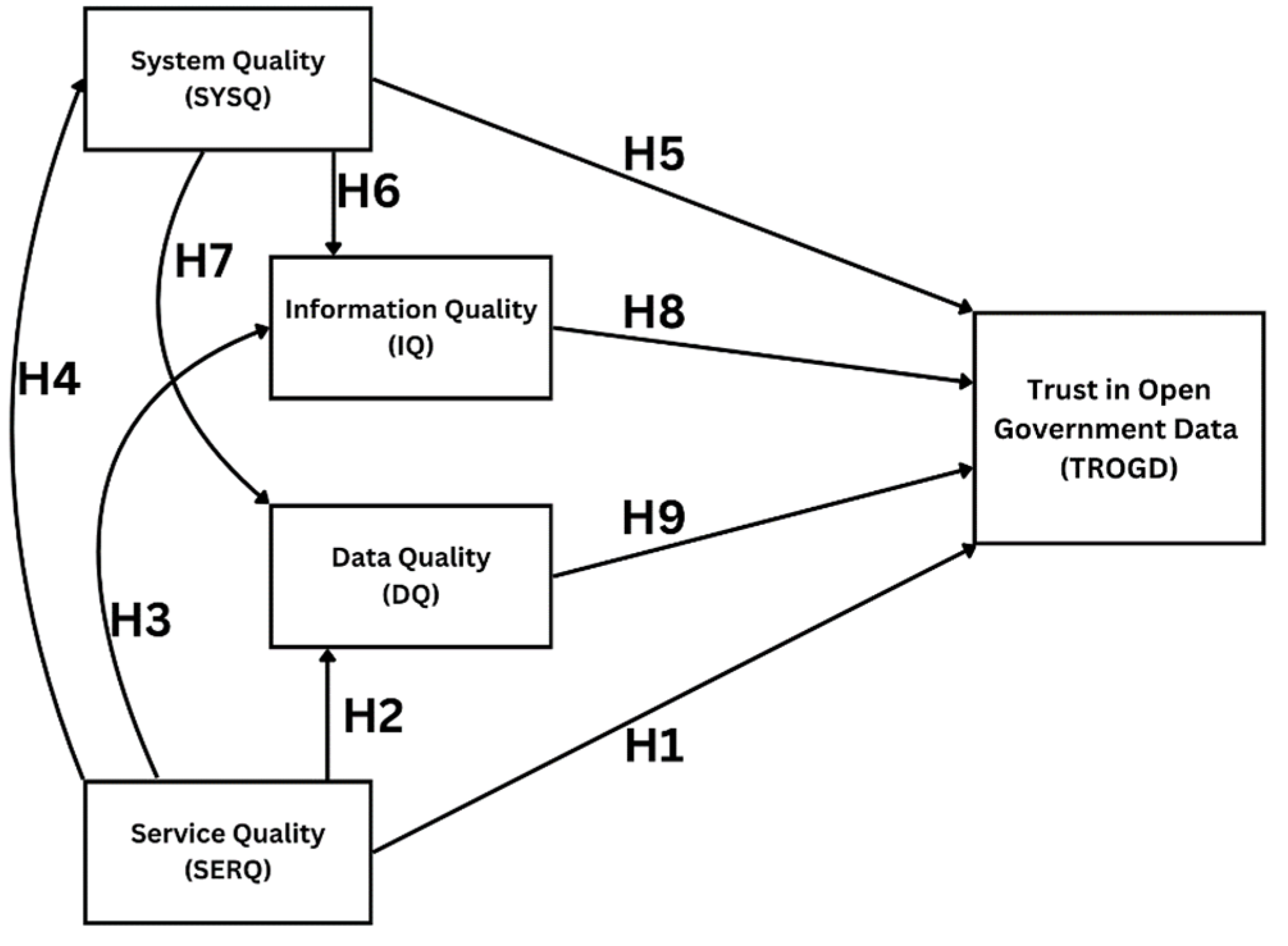
Figure 2.
Structural model results.
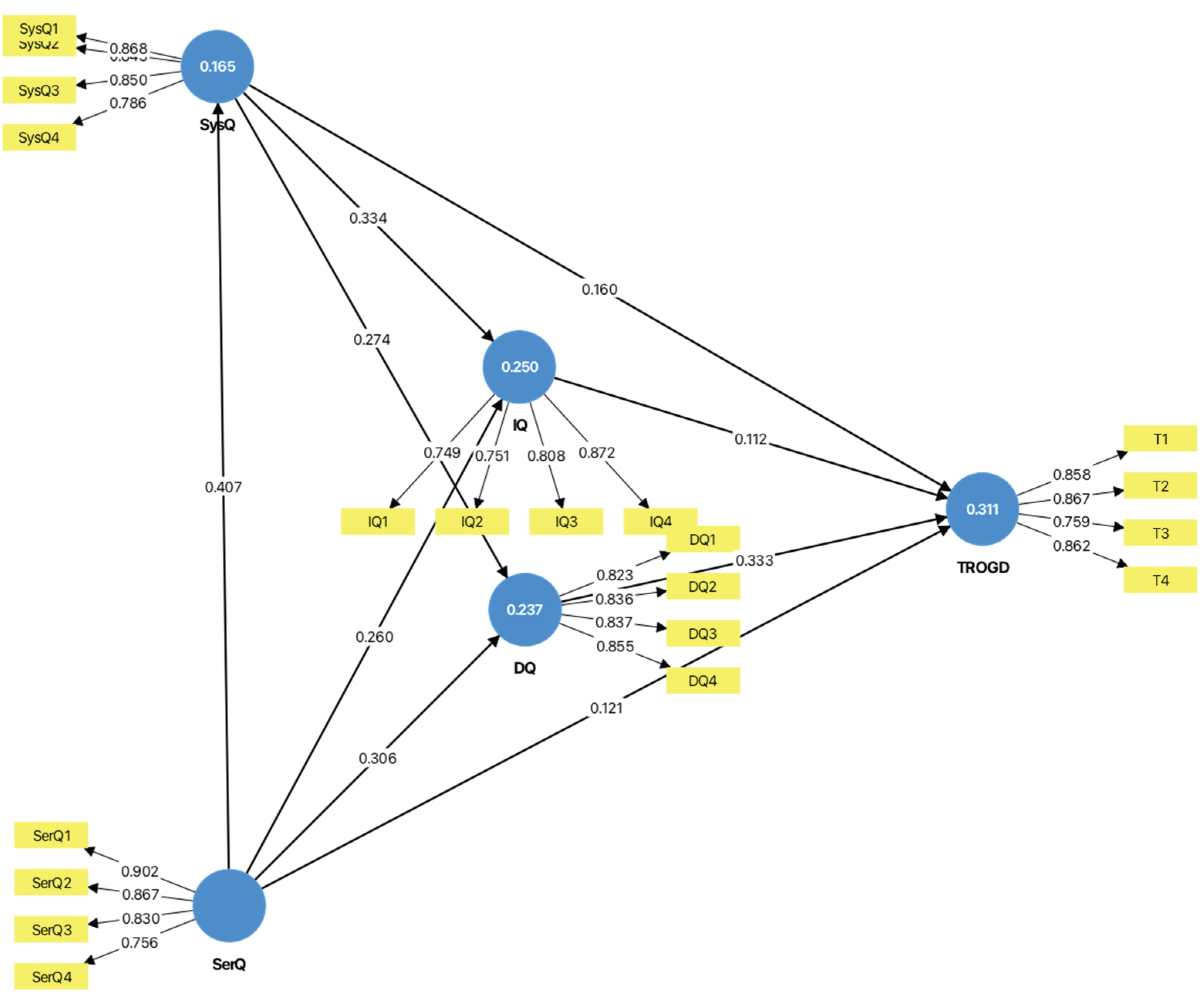

Table 1.
Constructs.
| Construct | Definition | Items | Source |
| Public Trust in OGD (TROGD) | The degree to which citizens believe that open government data and platforms are reliable, credible, and trustworthy. | TROGD1: I trust the data provided by the government. TROGD2: I believe the data provided by the government on the platform is reliable. TROGD3: I feel confident using the OGD platform for decision-making. TROGD4: Overall, I consider the government data on the platform to be trustworthy. |
33,34,23,17 |
| System Quality (SYSQ) | The technical performance of OGD platforms includes their usability, accessibility, reliability, and response time. | SYSQ1: The OGD platform is easy to use. SYSQ2: The platform is reliable and available when needed. SYSQ3: The platform provides clear guidance for accessing data. SYSQ4: The platform responds quickly when I use it. |
30,35 |
|
Information Quality (IQ) |
The quality of information presented, including accuracy, relevance, completeness, and timeliness. | IQ1: The information provided on the platform is well organised. IQ2: The information on the platform is relevant to my needs. IQ3: The information on the platform is easy to understand. IQ4: The information on the platform is presented clearly and in a useful format. |
30,17 |
| Data Quality (DQ) | The intrinsic qualities of datasets include accuracy, consistency, completeness, and timeliness. | DQ1: The data provided on the platform is accurate. DQ2: The data provided on the platform is complete. DQ3: The data provided on the platform is consistent across different sources. DQ4: The data provided on the platform is up to date. |
22,6 |
| Service Quality (SERQ) | The level of support provided to users includes responsiveness, assistance, and guidance. | SERQ1: The OGD platform provides helpful support when needed. SERQ2: The assistance provided by the platform is responsive. SERQ3: Guidance for using data on the platform is helpful. SERQ4: The platform enables effective communication with service providers. |
18,19,20,32 |
Table 2.
Respondent Demographics.
| Category | Subcategory | Total | Percentage |
| Barbados | 72 | 7.96% | |
| Dominica | 76 | 8.41% | |
| Country of | Grenada | 86 | 9.51% |
| Origin | Haiti | 54 | 5.97% |
| Jamaica | 80 | 8.85% | |
| Saint Kitts and Nevis | 106 | 11.73% | |
| Saint Lucia | 183 | 20.24% | |
| Saint Vincent and the Grenadines | 247 | 27.32% | |
| Years of | Less than 1 year | 302 | 33.41% |
| Experience | 1 to less than 3 years | 152 | 16.81% |
| with OGD | 3 to less than 5 years | 162 | 17.92% |
| 5 years or more | 288 | 31.86% | |
| Gender | Male | 395 | 43.69% |
| Female | 509 | 56.31% | |
| 18–24 | 168 | 18.58% | |
| 25–34 | 312 | 34.51% | |
| Age | 35–44 | 268 | 29.65% |
| 45–54 | 99 | 10.95% | |
| 55–65 | 57 | 6.31% | |
| Arts and Creative Fields | 35 | 3.87% | |
| Business and Management | 192 | 21.24% | |
| Field of | Other | 30 | 3.32% |
| Study | Education | 136 | 15.04% |
| (Major) | Engineering and Technology | 176 | 19.47% |
| Health and Medical Sciences | 121 | 13.38% | |
| Law, Humanities, and Society | 47 | 5.20% | |
| Natural Sciences | 15 | 1.66% | |
| Social Sciences | 126 | 13.94% | |
| Tourism & Hospitality Management | 26 | 2.88% |
Table 3.
Descriptive Statistics and Normality Assessment.
| Item | Mean |
Standard Deviation |
Excess Kurtosis |
Skewness |
Cramér–von Mises p-value |
| DQ1 | 3.355 | 0.703 | 0.903 | -0.547 | 0.000 |
| DQ2 | 3.261 | 0.785 | -0.545 | -0.179 | 0.000 |
| DQ3 | 3.364 | 0.833 | -0.076 | -0.766 | 0.000 |
| DQ4 | 3.081 | 1.003 | -0.515 | -0.400 | 0.000 |
| IQ1 | 3.406 | 0.836 | 0.014 | -0.571 | 0.000 |
| IQ2 | 3.350 | 0.736 | 0.298 | -0.423 | 0.000 |
| IQ3 | 3.551 | 0.737 | 0.833 | -0.855 | 0.000 |
| IQ4 | 3.418 | 0.817 | 0.014 | -0.563 | 0.000 |
| SerQ1 | 3.433 | 0.816 | 0.218 | -0.663 | 0.000 |
| SerQ2 | 3.337 | 0.817 | 0.153 | -0.546 | 0.000 |
| SerQ3 | 3.494 | 0.710 | 0.166 | -0.138 | 0.000 |
| SerQ4 | 3.220 | 0.857 | -0.593 | -0.428 | 0.000 |
| SysQ1 | 3.437 | 0.751 | 0.424 | -0.458 | 0.000 |
| SysQ2 | 3.373 | 0.810 | 0.050 | -0.428 | 0.000 |
| SysQ3 | 3.409 | 0.785 | 0.096 | -0.503 | 0.000 |
| SysQ4 | 3.397 | 0.760 | 0.090 | -0.156 | 0.000 |
| T1 | 3.399 | 0.818 | 0.567 | -0.634 | 0.000 |
| T2 | 3.510 | 0.884 | -0.001 | -0.387 | 0.000 |
| T3 | 3.421 | 0.824 | 0.001 | -0.656 | 0.000 |
| T4 | 3.531 | 0.752 | 0.502 | -0.520 | 0.000 |
Table 4.
Inner Model Collinearity Statistics (VIF).
| Relationship | VIF |
| DQ → TROGD | 1.364 |
| IQ → TROGD | 1.387 |
| SerQ → DQ | 1.198 |
| SerQ → IQ | 1.198 |
| SerQ → SysQ | 1.000 |
| SerQ → TROGD | 1.376 |
| SysQ → DQ | 1.198 |
| SysQ → IQ | 1.198 |
| SysQ → TROGD | 1.406 |
All VIF values were below the threshold of 3.3.
Table 5.
Outer Model Collinearity Statistics (VIF).
| Indicator Group | VIF Range |
| Data Quality Indicators | 1.844–2.327 |
| Information Quality Indicators | 1.539–2.395 |
| Service Quality Indicators | 1.672–2.838 |
| System Quality Indicators | 1.756–2.303 |
| Trust Indicators | 1.647–2.345 |
All VIF values were below the threshold of 3.3.
Table 6.
Reliability and Convergent Validity Assessment.
| Construct | Cronbach’s Alpha | Composite Reliability | Average Variance Extracted (AVE) |
| DQ | 0.858 | 0.904 | 0.702 |
| IQ | 0.808 | 0.874 | 0.635 |
| SERQ | 0.861 | 0.905 | 0.706 |
| SYSQ | 0.858 | 0.904 | 0.701 |
| TROGD | 0.858 | 0.904 | 0.702 |
Table 7.
HTMT Discriminant Validity Matrix.
| Construct | DQ | IQ | SerQ | SysQ | TROGD |
| DQ | |||||
| IQ | 0.465 | ||||
| SerQ | 0.481 | 0.464 | |||
| SysQ | 0.459 | 0.522 | 0.467 | ||
| TROGD | 0.567 | 0.425 | 0.421 | 0.453 |
Table 8.
Fornell–Larcker Criterion.
| Construct | DQ | IQ | SerQ | SysQ | TROGD |
| DQ | 0.838 | ||||
| IQ | 0.391 | 0.797 | |||
| SerQ | 0.417 | 0.396 | 0.840 | ||
| SysQ | 0.399 | 0.440 | 0.407 | 0.837 | |
| TROGD | 0.491 | 0.361 | 0.369 | 0.392 | 0.838 |
Table 9.
Cross-Loadings.
| Indicator | DQ | IQ | SerQ | SysQ | TROGD |
| DQ1 | 0.823 | ||||
| DQ2 | 0.836 | ||||
| DQ3 | 0.837 | ||||
| DQ4 | 0.855 | ||||
| IQ1 | 0.749 | ||||
| IQ2 | 0.751 | ||||
| IQ3 | 0.808 | ||||
| IQ4 | 0.872 | ||||
| SerQ1 | 0.902 | ||||
| SerQ2 | 0.867 | ||||
| SerQ3 | 0.830 | ||||
| SerQ4 | 0.756 | ||||
| SysQ1 | 0.868 | ||||
| SysQ2 | 0.843 | ||||
| SysQ3 | 0.850 | ||||
| SysQ4 | 0.786 | ||||
| T1 | 0.858 | ||||
| T2 | 0.867 | ||||
| T3 | 0.759 | ||||
| T4 | 0.862 |
Table 10.
Structural Model Results and Hypotheses Testing.
| Hypothesis | Relationship | Path Coefficient (β) | T-Statistic | P-Value | Decision |
| H1 | SerQ → TROGD | 0.121 | 3.160 | 0.002 | Supported |
| H2 | SerQ → DQ | 0.306 | 8.180 | 0.000 | Supported |
| H3 | SerQ → IQ | 0.260 | 6.981 | 0.000 | Supported |
| H4 | SerQ → SysQ | 0.407 | 13.287 | 0.000 | Supported |
| H5 | SysQ → TROGD | 0.160 | 4.018 | 0.000 | Supported |
| H6 | SysQ → IQ | 0.334 | 8.628 | 0.000 | Supported |
| H7 | SysQ → DQ | 0.274 | 7.317 | 0.000 | Supported |
| H8 | IQ → TROGD | 0.112 | 2.330 | 0.020 | Supported |
| H9 | DQ → TROGD | 0.333 | 8.313 | 0.000 | Supported |
Table 11.
Specific Indirect Effects.
| Indirect Relationship | Path Coefficient (β) | T-Statistic | P-Value | Result |
| SerQ → SysQ → TROGD | 0.065 | 3.815 | 0.000 | Significant |
| SerQ → IQ → TROGD | 0.029 | 2.055 | 0.040 | Significant |
| SerQ → DQ → TROGD | 0.102 | 5.654 | 0.000 | Significant |
| SysQ → IQ → TROGD | 0.037 | 2.258 | 0.024 | Significant |
| SysQ → DQ → TROGD | 0.091 | 5.361 | 0.000 | Significant |
| SerQ → SysQ → DQ → TROGD | 0.037 | 4.799 | 0.000 | Significant |
| SerQ → SysQ → IQ → TROGD | 0.015 | 2.210 | 0.027 | Significant |
| SerQ → SysQ → DQ | 0.112 | 6.370 | 0.000 | Significant |
| SerQ → SysQ → IQ | 0.136 | 6.970 | 0.000 | Significant |
Table 12.
Effect Size Assessment (f2).
| Relationship | f2 | Effect Size Interpretation |
| DQ → TROGD | 0.118 | Small to moderate |
| IQ → TROGD | 0.013 | Small |
| SerQ → DQ | 0.102 | Small to moderate |
| SerQ → IQ | 0.075 | Small |
| SerQ → SysQ | 0.198 | Moderate |
| SerQ → TROGD | 0.015 | Small |
| SysQ → DQ | 0.082 | Small |
| SysQ → IQ | 0.124 | Small to moderate |
| SysQ → TROGD | 0.027 | Small |
Table 13.
Model Fit Assessment.
| Model Fit Index | Saturated Model | Estimated Model |
| SRMR | 0.058 | 0.064 |
| d_ULS | 0.695 | 0.854 |
| d_G | 0.289 | 0.294 |
| Chi-square | 1602.097 | 1608.842 |
| NFI | 0.835 | 0.834 |
Short Biography of Authors
 |
Darron Rodan John is a Doctoral candidate in Business Administration within the Department of Information Management, College of Management at the National Dong Hwa University in the Republic of China (Taiwan). His research focuses on digital technology adoption and transformation, with particular interest in the adoption of digital banking services among college students, public-sector digital adoption, e-government transformation, digital inclusion and accessibility, change management, and digital adoption frameworks. He holds a Master’s degree in Information Management from National Dong Hwa University and a Bachelor’s degree in Computer Science and Information Engineering from the same institution. His academic work centres on understanding how technological, behavioural, and contextual factors influence the adoption of digital systems, particularly in developing and small-island contexts. |
 |
Dr. Fang-Ming Hsu (許芳銘) is a professor of information management and Dean of the College of Management at National Dong Hwa University. His research interests mainly focus on Information system management, Knowledge Management, Text Mining, Electronic file management, etc. He received his PhD in Management from the Institute of Management Science, National Chiao Tung University, Graduate School of Business Administration; a Master’s degree from the Institute of Computer Engineering, National Chiao Tung University; and a Bachelor’s degree in Computer Engineering from the same university. |
 |
Dr. Yuh-Jai Chen (陳玉佳) is an assistant professor of information management at the College of Management, National Dong Hwa University. His research focuses on Applied Statistics, Data Analytics, Business Ethics, and Organisational Behaviour. He holds a PhD in Applied Statistics and Applied Psychology from Columbia University. |
Disclaimer/Publisher’s Note: The statements, opinions and data contained in all publications are solely those of the individual author(s) and contributor(s) and not of MDPI and/or the editor(s). MDPI and/or the editor(s) disclaim responsibility for any injury to people or property resulting from any ideas, methods, instructions or products referred to in the content. |
© 2026 by the authors. Licensee MDPI, Basel, Switzerland. This article is an open access article distributed under the terms and conditions of the Creative Commons Attribution (CC BY) license (http://creativecommons.org/licenses/by/4.0/).
Copyright: This open access article is published under a Creative Commons CC BY 4.0 license, which permit the free download, distribution, and reuse, provided that the author and preprint are cited in any reuse.