
Submitted:
11 May 2026
Posted:
11 May 2026
You are already at the latest version
Abstract
Drug recall is a critical regulatory mechanism implemented to protect public health by removing defective, unsafe, or non-compliant pharmaceutical products from the market. Despite stringent regulatory approval processes, issues related to manufacturing defects, contamination, labeling errors, stability failures, and post-marketing safety concerns may lead to drug recalls. Regulatory authorities across the world, including the Central Drugs Standard Control Organization (CDSCO), the United States Food and Drug Administration (US FDA), the European Medicines Agency (EMA), and other national agencies, have developed structured recall guidelines and rapid alert systems to ensure timely withdrawal of defective products. Drug recalls are typically classified based on the level of health risk and may be executed at different levels of the distribution chain, including wholesale, retail, and consumer levels. Effective recall management involves risk assessment, recall communication, product traceability, documentation, and recall effectiveness checks. Pharmacovigilance systems also play an important role in identifying adverse drug reactions and quality defects that may lead to product recalls. This review article provides a comprehensive overview of drug recall systems, including causes of recalls, regulatory frameworks in India and other countries, recall classification, recall procedures, rapid alert systems, and global recall trends. The article also discusses challenges in recall implementation and provides recommendations to strengthen drug recall systems and regulatory coordination worldwide.
Keywords:
drug recall
; pharmaceutical regulation
; CDSCO
; FDA
; rapid alert system
; recall classification
; pharmacovigilance
; drug safety
; regulatory framework
; product recall
1. Introduction
1.1. Background of Pharmaceutical Product Recalls
Drug recalls are an essential regulatory mechanism designed to protect public health by removing defective, contaminated, substandard, or potentially harmful pharmaceutical products from the market. Recalls may involve specific batches, lots, or entire product lines because of safety concerns, manufacturing defects, labeling errors, contamination, potency variation, or quality failures (Table 1) (Natof and Pellegrini, 2025; FDA, 2009). Regulatory authorities require manufacturers to initiate timely corrective actions and communicate relevant safety information to healthcare professionals and regulatory agencies when quality defects are identified (FDA, 2019).
The United States Food and Drug Administration (USFDA) defines a recall as a corrective action undertaken to remove products that violate regulatory requirements (USFDA, 2025). Although most recalls are voluntarily initiated by manufacturers, regulatory agencies may mandate product withdrawal when public health risks are significant and corrective measures are inadequate (USFDA, 2024). Consequently, pharmaceutical companies are expected to maintain robust recall management systems involving quality assurance, pharmacovigilance, manufacturing, regulatory affairs, supply chain, and legal teams to ensure rapid recall execution (Miglani A et al. 2022).
Despite advances in pharmaceutical manufacturing technologies and Good Manufacturing Practices (GMP), defective medicines continue to enter healthcare systems globally. Such products may cause therapeutic failure, toxicity, adverse drug reactions, contamination-related complications, or mortality, resulting in major clinical, economic, and reputational consequences (Patel R et al. 2024). Therefore, complaint handling and recall procedures remain fundamental components of pharmaceutical quality management systems (Mattingly AN et al. 2022).
Drug recalls are generally categorized according to health risk severity into Class I, Class II, and Class III recalls (FDA, 2019). Class I recalls involve products capable of causing serious adverse health consequences or death, whereas Class II recalls involve temporary or medically reversible effects. Class III recalls are associated with products unlikely to cause significant harm but that violate regulatory standards, such as packaging or labeling defects (Natof and Pellegrini, 2025).
Globalization of pharmaceutical manufacturing and distribution has further complicated recall management. Modern supply chains involve multinational manufacturers, distributors, and healthcare systems operating across multiple regulatory jurisdictions, increasing the risk of widespread exposure to defective medicines (McManus D and Naughton BD, 2022). Consequently, regulatory agencies including the FDA, EMA, CDSCO, and WHO have strengthened surveillance systems, pharmacovigilance programs, and recall frameworks to improve patient safety and regulatory coordination (WHO, 2017).
Recent studies indicate that pharmaceutical recalls are increasing because of enhanced regulatory inspections, improved pharmacovigilance systems, and advanced analytical technologies capable of detecting impurities and manufacturing deviations (Eissa, 2019). Major causes of recalls include microbial contamination, nitrosamine impurities, stability failures, packaging defects, and deviations from current Good Manufacturing Practices (cGMP) (Hall K et al. 2016; Patel R et al. 2024). Long-term recall analyses additionally suggest that inadequate quality systems and process validation failures remain major contributors to recall incidents worldwide (Eissa, 2019).
The World Health Organization has also highlighted the growing threat of substandard and falsified medicines within global healthcare systems. Substandard medicines fail to meet approved quality specifications, whereas falsified medicines deliberately misrepresent identity, composition, or source (WHO, 2017). Such products compromise therapeutic outcomes, contribute to antimicrobial resistance, and undermine public confidence in healthcare systems. Therefore, effective recall systems remain critical for minimizing patient exposure to unsafe medicines and maintaining pharmaceutical supply chain integrity.
1.2. Public Health Significance of Drug Recalls
Drug recall systems are critical public health safeguards that prevent patient exposure to defective, contaminated, adulterated, or therapeutically ineffective medicines. Even minor pharmaceutical quality defects may lead to treatment failure, toxicity, adverse drug reactions, hospitalization, or death (Patel R et al. 2024). Consequently, efficient recall mechanisms are considered essential regulatory interventions for maintaining patient safety and public trust in healthcare systems (USFDA, 2025).
The public health importance of recalls has increased because of the rising prevalence of substandard and falsified medicines globally. Poor-quality pharmaceutical products may contain incorrect active ingredient concentrations, microbial contamination, harmful impurities, or inadequate stability profiles, leading to reduced therapeutic efficacy and increased adverse effects (Oliveira CLCG et al. 2023). Falsified medicines present even greater risks because they intentionally misrepresent product identity or composition (WHO, 2017).
Drug recalls also contribute significantly to controlling antimicrobial resistance (AMR). Sub-therapeutic antibiotic formulations may fail to eliminate infectious organisms effectively, thereby promoting resistant microbial strains (Bahizi M et al. 2024). The WHO has repeatedly emphasized the association between poor-quality medicines and increasing AMR as a major global health concern (WHO, 2017).
In addition to patient harm, pharmaceutical recalls impose substantial economic and social burdens. Manufacturers may experience product retrieval costs, legal liabilities, manufacturing disruptions, and reputational damage, while healthcare systems face increased hospitalization rates and treatment expenditures (Miglani A et al. 2022; McManus D and Naughton BD, 2022). Effective recall systems therefore require coordinated communication, traceability mechanisms, pharmacovigilance reporting, and post-recall effectiveness evaluations to minimize public health risks (Natof and Pellegrini, 2025).
1.3. Evolution of Global Recall Regulations
Pharmaceutical recall regulations have evolved substantially in response to historical public health tragedies, globalization of pharmaceutical supply chains, and advances in pharmaceutical manufacturing. Events such as the sulfanilamide disaster and thalidomide tragedy played major roles in shaping modern pharmaceutical safety regulations and post-marketing surveillance systems (Miglani A et al. 2022).
In the United States, the Federal Food, Drug, and Cosmetic Act strengthened FDA authority over pharmaceutical safety, manufacturing, and recall enforcement. Current FDA systems include structured recall classifications, risk assessment procedures, public notification mechanisms, and recall effectiveness evaluations (FDA, 2019; USFDA, 2024). Similarly, the European Medicines Agency (EMA) established harmonized pharmacovigilance and rapid alert systems to facilitate cross-border coordination among European Union member states (McManus D and Naughton BD, 2022).
The World Health Organization has additionally contributed to global harmonization through GMP guidelines, pharmacovigilance standards, and international surveillance systems addressing substandard and falsified medicines (WHO, 2017). Countries including India, Canada, Australia, Japan, and Saudi Arabia have also strengthened national recall systems and pharmaceutical quality oversight mechanisms.
Technological advancements such as barcode traceability, serialization, electronic pharmacovigilance databases, and digital supply chain monitoring systems have improved recall implementation efficiency (Patel R et al. 2024). However, significant challenges persist because of differences in legal authority, reporting systems, enforcement capabilities, and recall communication practices across countries (McManus D and Naughton BD, 2022). Continued international collaboration and regulatory modernization therefore remain essential for improving global pharmaceutical recall effectiveness.
1.4. Scope and Objectives of the Review
This review provides a comprehensive overview of pharmaceutical drug recall systems, including their regulatory frameworks, classifications, causes, management procedures, and public health implications. The review examines major causes of pharmaceutical recalls such as contamination, labeling defects, manufacturing irregularities, potency variation, packaging failures, and non-compliance with Good Manufacturing Practices (GMP).
Special emphasis is placed on regulatory systems implemented by agencies including the FDA, WHO, EMA, and CDSCO, with focus on pharmacovigilance, rapid alert mechanisms, traceability systems, recall communication strategies, and effectiveness evaluations (USFDA, 2024; WHO, 2017). The review additionally evaluates global trends in pharmaceutical recalls, substandard and falsified medicines, and regulatory enforcement patterns using published evidence from multiple regions (Patel R et al. 2024; Almutairi M et al. 2024).
Finally, this review aims to highlight the importance of efficient recall systems in minimizing patient harm, reducing antimicrobial resistance, strengthening pharmaceutical quality assurance, and improving global medication safety.
2. Fundamentals of Drug Recall Systems
2.1. Definition and Regulatory Concept of Drug Recall
Drug recalls are critical regulatory interventions intended to remove or correct pharmaceutical products that fail to meet established standards of safety, quality, efficacy, manufacturing, or labeling. Regulatory agencies including the FDA, EMA, MHRA, CDSCO, and WHO recognize recalls as essential public-health measures for minimizing patient exposure to defective medicines. Although recalls are commonly initiated voluntarily by manufacturers, regulatory authorities retain the power to mandate product withdrawal when public health risks are significant. Natof and Pellegrini (2025) emphasized that recalls reflect broader weaknesses in pharmaceutical governance, quality assurance, and post-marketing surveillance systems rather than isolated manufacturing failures alone.
Modern recall systems have evolved from reactive withdrawal models toward proactive risk-management frameworks integrating pharmacovigilance, lifecycle quality oversight, and predictive surveillance. Strom (2006) and Psaty and Burke (2006) highlighted the importance of combining adverse-event reporting, electronic health records, inspection findings, and real-world evidence for early safety signal detection. Consequently, recalls are increasingly linked with Good Manufacturing Practice (GMP), Quality Risk Management (QRM), and Corrective and Preventive Action (CAPA) systems.
Several studies indicate that many recalls arise from deficiencies in sterility assurance, contamination control, process validation, labeling accuracy, and data integrity rather than intrinsic drug toxicity. Gupta and Nayak (2014) reported that failures in pharmaceutical quality systems remain major contributors to recalls globally. Recent nitrosamine contamination incidents involving ranitidine and angiotensin receptor blockers further exposed vulnerabilities associated with globalized API sourcing and impurity surveillance.
Despite efforts toward international harmonization through ICH and WHO guidance, important differences persist across regulatory systems. Wiktorowicz et al. (2012) and Downing et al. (2012) identified substantial variability in recall transparency, post-marketing evidence requirements, and enforcement practices among major regulatory authorities. In low- and middle-income countries, recall systems additionally face limitations related to pharmacovigilance infrastructure, laboratory capacity, and product traceability. Almuzaini et al. (2013), Fryze et al. (2025), and Neupane et al. (2022) highlighted the growing challenges posed by substandard and falsified medicines within global pharmaceutical supply chains.
2.2. Objectives of Drug Recall
The primary objective of drug recall systems is protection of public health through rapid identification and removal of defective pharmaceutical products from circulation. However, recalls also function as crisis-management tools, quality-assurance mechanisms, and instruments of regulatory accountability. Nagaich and Sadhna (2015) noted that effective recall systems depend not only on product withdrawal speed but also on communication efficiency, supply-chain traceability, and implementation of corrective actions.
Drug recalls play an important role in reducing morbidity and mortality associated with adverse drug events. Moore et al. (2007) and Budnitz et al. (2011) demonstrated the substantial clinical burden associated with defective medicines, particularly among vulnerable patient populations. Delayed signal detection and ineffective communication, however, may reduce recall effectiveness despite appropriate regulatory action.
Recalls also influence public trust in healthcare systems and regulatory agencies. Poland (2011) and Rhodes et al. (2024) observed that poorly managed recall communication may contribute to public distrust and treatment hesitancy, especially during high-profile safety controversies. Consequently, transparency and evidence-based risk communication have become essential components of modern recall governance.
Beyond immediate hazard containment, recalls function as organizational learning mechanisms. Lin et al. (2023) demonstrated that recall investigations frequently reveal systemic weaknesses involving supplier qualification, environmental monitoring, analytical validation, and data governance. In addition, large-scale recalls may disrupt pharmaceutical supply chains and contribute to medicine shortages. Livingston et al. (2020) highlighted the importance of coordinated action among manufacturers, healthcare systems, wholesalers, and regulators to balance patient safety with continuity of medicine access.
2.3. Classification of Drug Recalls
Drug recalls are generally classified according to the severity of associated health risk. The FDA framework categorizes recalls into Class I, Class II, and Class III events and is widely adopted internationally.
Class I recalls involve products capable of causing serious adverse health consequences or death, including contaminated sterile injectables, toxic impurities, or critical labeling errors. Hall et al. (2016) and Wang et al. (2012) noted that these recalls frequently involve high-risk therapeutic settings such as oncology and critical care.
Class II recalls involve products associated with temporary or medically reversible adverse effects. Common causes include stability failures, packaging defects, and manufacturing deviations with limited immediate clinical impact. Algabbani et al. (2023) demonstrated that even moderate-risk recalls may disrupt prescribing practices and patient adherence.
Class III recalls concern products unlikely to cause significant harm but that violate regulatory standards, such as minor labeling inconsistencies. Nevertheless, Gupta and Nayak (2014) argued that repeated low-severity recalls may indicate broader weaknesses in pharmaceutical quality culture.
Modern recall classification additionally considers causative mechanisms including contamination, sterility failure, subpotency, superpotency, particulate matter, GMP non-compliance, nitrosamine impurities, and data-integrity violations. Nagaich and Sadhna (2015) and Fryze et al. (2025) highlighted the increasing importance of falsified and substandard medicines within recall systems. Furthermore, biologics and medical devices present unique challenges involving software defects, immunogenicity, cold-chain stability, and batch consistency. Connor et al. (2017), Day et al. (2016), Vajapey and Li (2020), and Giezen et al. (2008) emphasized the growing importance of post-marketing surveillance for advanced pharmaceutical products.
2.4. Recall Severity and Risk-Based Approach
Modern recall governance increasingly relies on risk-based decision-making frameworks aligned with ICH Q9 Quality Risk Management principles. Contemporary systems integrate hazard identification, exposure assessment, patient vulnerability analysis, and evaluation of clinical consequences to determine the urgency and scale of recall actions.
Severity assessment depends on factors including toxicity profile, route of administration, duration of exposure, detectability of defects, and characteristics of the exposed population. Lin et al. (2023) emphasized that recall severity reflects both the nature of the defect and the effectiveness of existing quality-control systems.
Risk-based approaches also influence communication strategies and market actions. Depending on severity, regulators may implement wholesale-level recalls, consumer-level withdrawal campaigns, or targeted advisories. Rhodes et al. (2024) observed that ineffective communication remains a major limitation of many recall systems because delayed or excessively technical notices may reduce compliance and prolong exposure risk.
Digital technologies are increasingly transforming recall management. Yom-Tov and Diaz-Aviles (2017) demonstrated the usefulness of internet-search surveillance for early safety signal detection, while Stergachis et al. (2011) highlighted the value of automated healthcare databases for identifying clusters of adverse events. These developments support the transition toward predictive pharmacovigilance models integrating artificial intelligence, real-world evidence analytics, and digital traceability systems.
Post-recall governance additionally requires root-cause investigations, supplier oversight strengthening, CAPA implementation, and manufacturing remediation before product re-entry. Avorn (2015) emphasized that sustainable pharmaceutical safety depends on continuous integration between regulatory oversight and organizational quality culture. Nevertheless, substantial disparities remain across developing regulatory systems because of limitations in laboratory infrastructure, pharmacovigilance reporting, and supply-chain traceability (Neupane et al. 2022).
2.5. Impact of Drug Recalls on Healthcare Systems and Industry
Drug recalls influence healthcare delivery, pharmaceutical markets, regulatory credibility, and public trust simultaneously. Clinical consequences may arise not only from exposure to defective products but also from treatment interruption and forced therapeutic substitution. Algabbani et al. (2023) and Świeczkowski et al. (2022) reported that contamination-related recalls may reduce medication adherence and increase patient anxiety, particularly among individuals receiving chronic therapies.
Healthcare institutions also experience substantial operational burdens during recall implementation. McNaughton et al. (2014) and Koczmara et al. (2010) highlighted challenges involving inventory tracing, patient notification, electronic record reconciliation, and therapeutic replacement management, especially for injectable medicines and biologics. Economically, recalls impose direct costs related to product retrieval, destruction, litigation, regulatory penalties, and manufacturing remediation, while indirect effects include reputational damage and supply-chain instability. Livingston et al. (2020) argued that recurring recalls expose structural weaknesses within global pharmaceutical manufacturing systems. From an industrial perspective, recalls increasingly reflect organizational quality culture and governance effectiveness. Kesselheim et al. (2015), Carpenter et al. (2008), and Banzi et al. (2015) suggested that accelerated approval pathways and commercial pressures may contribute to post-marketing safety issues and increased dependence on pharmacovigilance systems. At the societal level, repeated recalls may weaken confidence in regulatory institutions and pharmaceutical manufacturers. Hamburg and Sharfstein (2009) and Healy et al. (2006) emphasized that regulatory legitimacy depends heavily on transparent communication, evidence-based decision-making, and effective post-marketing surveillance. Despite these challenges, recalls remain indispensable components of modern pharmacovigilance systems. Effective recall governance supports rapid hazard containment, manufacturing accountability, continuous quality improvement, and protection of global medication safety.
3. Major Causes of Pharmaceutical Product Recalls
3.1. Manufacturing and GMP Deficiencies
Failures in pharmaceutical manufacturing and non-compliance with Good Manufacturing Practice (GMP) requirements remain the predominant causes of drug recalls worldwide. Regulatory evaluations by Hall et al. (2016) and Wang et al. (2012) showed that many FDA recall actions originate from deficiencies in process validation, environmental monitoring, documentation practices, and data integrity controls. These incidents rarely represent isolated technical errors; rather, they often expose broader weaknesses in organizational quality systems and manufacturing governance.
The globalization of pharmaceutical production has intensified these vulnerabilities. Outsourcing of active pharmaceutical ingredient (API) manufacturing and contract production has fragmented accountability across multinational supply chains, making oversight increasingly difficult. Gupta and Nayak (2014) argued that uneven GMP enforcement across jurisdictions contributes significantly to recurrent recall events, particularly in resource-limited regulatory environments where inspection capacity and analytical infrastructure remain inadequate.
In response, agencies such as the FDA, EMA, MHRA, and CDSCO have increasingly promoted lifecycle-oriented quality frameworks incorporating Quality by Design (QbD), risk-based validation, and CAPA systems. Nevertheless, repeated enforcement actions involving sterility failures, cross-contamination, and falsified manufacturing records indicate that regulatory compliance alone does not guarantee a functional quality culture. Lin et al. (2023) noted that many recalls emerge despite the formal presence of quality systems because risk-management practices are poorly integrated into operational decision-making.
The consequences of GMP-related recalls extend beyond regulatory enforcement. Manufacturing shutdowns associated with compliance violations can trigger critical medicine shortages, particularly for sterile injectables and low-margin generic products manufactured by limited suppliers. Livingston et al. (2020) observed that these disruptions may compromise treatment continuity, increase medication substitution, and elevate healthcare costs, especially in oncology and intensive care settings.
Data integrity violations have also become a major regulatory concern. Increasingly, inspectors report manipulated analytical results, incomplete batch documentation, and electronic record falsification. Such breaches undermine confidence in product quality testing and weaken the reliability of post-release surveillance systems. Consequently, regulators now place greater emphasis on digital audit trails, independent quality oversight, and electronic data governance.
3.2. Microbial and Chemical Contamination
Microbial and chemical contamination remain among the most clinically severe causes of pharmaceutical recalls and are frequently associated with Class I regulatory actions. Contamination involving injectable products, ophthalmics, biologics, and compounded medicines is particularly dangerous because exposure may directly result in invasive infection or toxic injury. Nagaich and Sadhna (2015) emphasized that microbial contamination events commonly reflect failures in aseptic processing, water-system validation, environmental monitoring, and personnel hygiene practices.
The implications of contamination-related recalls often extend far beyond individual defective batches. Outbreaks involving contaminated sterile products have been linked to sepsis, fungal meningitis, and multidrug-resistant infections. Hall et al. (2016) reported that such recalls frequently require extensive facility remediation and prolonged regulatory oversight because they reveal systemic breakdowns in sterility assurance systems rather than isolated manufacturing lapses.
Chemical contamination has emerged as an equally critical issue. Residual solvents, degradation byproducts, heavy metals, and cross-contamination from shared equipment have all contributed to major global recalls. Świeczkowski et al. (2022) highlighted the heightened concern surrounding contamination of chronic cardiovascular therapies, where prolonged exposure among vulnerable patient populations amplified public health risks and regulatory scrutiny.
Globalized supply chains further complicate contamination control. Concentration of API production within geographically limited manufacturing hubs increases dependence on variable environmental standards and inconsistent oversight mechanisms. Neupane et al. (2022) demonstrated that contamination-related recalls in developing countries frequently reflect infrastructural limitations involving microbiological testing, water purification, and quality-control capacity.
Communication during contamination events also remains problematic. According to Rhodes et al. (2024), delayed or poorly contextualized advisories may provoke confusion among clinicians and patients, occasionally leading to abrupt discontinuation of essential therapies without adequate clinical guidance. In such situations, recall communication itself can become a secondary patient safety challenge.
3.3. Nitrosamine and Genotoxic Impurities
The discovery of nitrosamine impurities in angiotensin receptor blockers, ranitidine, metformin, and other widely used medicines marked a major turning point in pharmaceutical quality regulation. These recalls fundamentally reshaped regulatory approaches toward impurity surveillance, process chemistry evaluation, and lifecycle risk assessment. Regulatory agencies rapidly introduced enhanced testing requirements and revised acceptable intake limits for nitrosamines and related genotoxic compounds.
Unlike conventional contamination incidents associated with overt manufacturing negligence, nitrosamine formation often resulted from unintended chemical interactions involving solvents, catalysts, and process intermediates. Gupta and Nayak (2014) and Lin et al. (2023) argued that these events exposed limitations in traditional quality paradigms, which historically focused more heavily on microbiological and physical defects than on trace-level chemical impurities.
The regulatory response demonstrated increasing reliance on science-based risk stratification. Rather than immediate universal withdrawal, agencies often balanced theoretical carcinogenic risk against the clinical consequences of treatment interruption. This approach proved particularly important for cardiovascular and antidiabetic medicines used chronically by millions of patients. Świeczkowski et al. (2022) noted that abrupt withdrawal without therapeutic alternatives risked generating substantial secondary morbidity.
Nitrosamine recalls also exposed weaknesses in supply-chain transparency. Many firms lacked adequate oversight of upstream solvent recovery practices, raw material sourcing, and supplier process modifications. As a result, regulators strengthened expectations regarding supplier qualification, impurity mapping, and implementation of ICH M7 guidance for mutagenic impurities.
From a communication perspective, these recalls presented unusual challenges because associated risks were probabilistic and long-term rather than immediately observable. Rhodes et al. (2024) emphasized that communicating theoretical carcinogenic risks required careful balancing of transparency and proportionality to avoid unnecessary panic and generalized distrust in medicines.
3.4. Labeling and Packaging Errors
Labeling and packaging defects continue to contribute substantially to pharmaceutical recalls despite advances in automation and serialization technologies. Common issues include incorrect strength declarations, missing warnings, barcode failures, mislabeled containers, and packaging mix-ups involving look-alike or sound-alike products. Although many such recalls fall within Class II or III categories, the consequences can still be clinically significant when high-alert or pediatric medicines are involved.
Aronson (2009) argued that medication errors frequently arise from system-level design failures rather than isolated human mistakes. Poor packaging design, inadequate label readability, and confusing product presentation may all contribute to dispensing and administration errors across healthcare settings. Consequently, regulatory investigations increasingly incorporate human-factors analysis alongside traditional GMP review.
Globalized pharmaceutical distribution systems have added further complexity. Serialization mismatches and electronic labeling errors may rapidly propagate across international supply chains before detection occurs. Hall et al. (2016) noted that labeling-related recalls often involve multiple distributed batches, increasing logistical burden and recall scale.
Operational challenges are especially pronounced in outpatient settings. McNaughton et al. (2014) highlighted the difficulty of rapidly identifying affected patients and reconciling dispensing records during labeling-related recalls, particularly when recall notices are vague or poorly contextualized.
Regulatory authorities have responded by strengthening expectations surrounding barcode verification, tamper-evident packaging, and readability testing. However, recurrent packaging recalls suggest that technological safeguards alone remain insufficient without strong organizational quality culture and interdisciplinary risk assessment involving pharmacists, clinicians, and human-factors experts.
3.5. Stability Failures and Degradation Products
Stability-related defects represent another major source of pharmaceutical recalls, particularly for products sensitive to humidity, oxidation, temperature variation, or prolonged storage conditions. Such recalls occur when medicines fail to maintain potency, purity, dissolution characteristics, or microbiological integrity throughout their approved shelf life. Wang et al. (2012) reported that stability failures commonly affect widely distributed oral dosage forms, thereby increasing the operational scale of recall activities.
The growing complexity of pharmaceutical formulations has intensified these challenges. Biologics, modified-release systems, peptides, and nanotechnology-based medicines often display greater environmental sensitivity than conventional formulations. Regulators therefore increasingly require sophisticated stability-indicating analytical methods and forced degradation studies during both development and post-marketing surveillance.
The ranitidine NDMA crisis further demonstrated that degradation products themselves may become toxicological hazards. Avorn (2015) emphasized that pre-approval stability testing cannot fully predict long-term degradation behavior under real-world distribution and storage conditions, reinforcing the importance of ongoing post-marketing monitoring.
Supply-chain weaknesses also contribute significantly to stability failures. Livingston et al. (2020) observed that transportation delays, inadequate cold-chain management, and poor storage practices may compromise pharmaceutical integrity long after manufacturing release. These vulnerabilities are particularly severe in low-resource settings lacking reliable temperature-monitoring infrastructure. Neupane et al. (2022) documented several recalls linked to inadequate storage and distribution conditions in developing markets.
Economically, stability-related recalls are especially damaging because affected products are often widely distributed before degradation becomes detectable. Beyond immediate financial losses, repeated stability failures may erode long-term clinician and patient confidence in product reliability.
3.6. Counterfeit and Substandard Medicines
Counterfeit and substandard medicines increasingly threaten global pharmaceutical quality systems and are now significant contributors to recall activity. Counterfeit medicines involve deliberate fraudulent misrepresentation, whereas substandard medicines fail to meet quality specifications despite legitimate manufacturing intent. In practice, however, these categories frequently overlap within complex supply chains. Almuzaini et al. (2013) and Fryze et al. (2025) emphasized that this distinction is often difficult to operationalize in real-world regulatory settings.
Expansion of online pharmaceutical commerce and globalization of medicine distribution have intensified opportunities for counterfeit infiltration. Weak serialization systems, fragmented supply chains, and inconsistent regulatory oversight create persistent vulnerabilities, particularly in low-resource regions. Świeczkowski et al. (2022) warned that counterfeit cardiovascular therapies pose severe public health risks because subtherapeutic exposure or treatment interruption may precipitate catastrophic outcomes.
Substandard medicines remain particularly prevalent in low- and middle-income countries where manufacturing oversight and analytical testing capacity are limited. Neupane et al. (2022) documented frequent recalls in Nepal involving assay deviations, dissolution failures, and labeling inconsistencies, highlighting ongoing inequities in global medicine quality assurance.
Counterfeit-related recalls also present distinct enforcement challenges because they frequently involve transnational criminal networks. Effective response therefore requires coordination between regulatory agencies, customs authorities, law-enforcement bodies, and international organizations such as WHO and Interpol. Nevertheless, fragmented legal frameworks continue to hinder consistent global enforcement.
Beyond toxicological harm, counterfeit medicine incidents can significantly damage public confidence in healthcare systems and generic medicines. Rhodes et al. (2024) argued that poorly framed recall communication may unintentionally amplify mistrust if regulators fail to distinguish isolated falsification events from broader systemic quality failures.
3.7. Adverse Drug Reactions and Pharmacovigilance Signals
Not all recalls originate from manufacturing defects. A substantial proportion result from post-marketing identification of previously unrecognized adverse drug reactions (ADRs) and pharmacovigilance safety signals. Such recalls reflect the inherent limitations of pre-approval clinical trials, which are often unable to detect rare, delayed, or population-specific toxicities. Edwards and Aronson (2000) emphasized that spontaneous ADR reporting systems remain central to modern drug safety surveillance despite limitations including underreporting and reporting bias.
Large pharmacovigilance systems such as FAERS, EudraVigilance, and VAERS have substantially expanded the capacity for early signal detection. Shimabukuro et al. (2015) demonstrated how large-scale surveillance databases facilitate identification of rare adverse events requiring regulatory intervention. Similarly, Moore et al. (2007) reported major increases in serious adverse-event reporting over time, reflecting growing dependence on post-marketing pharmacovigilance.
Several high-profile withdrawals have exposed limitations in accelerated approval pathways and pre-market evidence generation. Lasser et al. (2002) and Downing et al. (2017) showed that serious safety concerns often emerge years after approval, particularly for products introduced through expedited review mechanisms. Banzi et al. (2015) further argued that approval of medicines with uncertain benefit–risk profiles increases reliance on post-marketing recall systems to identify latent harms.
These recalls also reveal tensions between therapeutic innovation and long-term safety assurance. Carpenter et al. (2008) and Furberg et al. (2006) questioned whether compressed review timelines may compromise characterization of rare toxicities before commercialization.
Modern pharmacovigilance increasingly integrates digital surveillance, real-world evidence, and predictive analytics. Yom-Tov and Diaz-Aviles (2017) demonstrated that internet search behavior may serve as an early indicator of emerging safety concerns before formal reporting thresholds are reached. However, challenges related to signal validation, false-positive detection, and integration of heterogeneous datasets remain unresolved.
The impact of pharmacovigilance-driven recalls extends beyond individual products. Healy et al. (2006) and Poland (2011) observed that controversial safety-related withdrawals can generate broader skepticism toward therapeutic classes, manufacturers, and regulatory institutions. Effective recall governance therefore depends not only on robust scientific assessment, but also on transparent and evidence-based communication capable of maintaining public trust while protecting patient safety. The major causes of drug recalls and their associated regulatory actions are presented in Table 2.
4. Regulatory Frameworks Governing Drug Recalls
4.1. Drug Recall Regulations in India
India’s pharmaceutical recall governance is primarily regulated under the Drugs and Cosmetics Act, 1940 and Drugs and Cosmetics Rules, 1945, supplemented by the Central Drugs Standard Control Organization (CDSCO) guidance on rapid alerts and product recalls. Unlike the United States and European Union, India historically lacked a legally binding nationwide recall statute, resulting in significant dependence on voluntary manufacturer compliance. Gupta and Nayak (2014) observed that this regulatory gap contributed to inconsistent recall execution, delayed market withdrawal, and inadequate post-recall monitoring, particularly within decentralized supply chains involving multiple distributors and state authorities.
Recent years have witnessed increasing regulatory emphasis on risk-based recall management due to contamination crises, export-related quality concerns, and international scrutiny of Indian pharmaceutical manufacturing standards. Nagaich and Sadhna (2015) argued that globalization of Indian pharmaceutical exports has forced regulators to strengthen GMP surveillance, pharmacovigilance integration, and product traceability systems. Nevertheless, operational fragmentation between central and state drug authorities continues to complicate rapid implementation of Class I recall actions involving serious patient safety risks.
India’s recall framework broadly categorizes recalls into Class I, II, and III according to potential health hazards, mirroring international regulatory models. However, recall communication remains a major challenge. Rhodes et al. (2024) emphasized that ineffective dissemination of recall information may lead to patient confusion, treatment interruption, and reduced confidence in healthcare systems. Such concerns are amplified in India because of uneven digital infrastructure and variable healthcare accessibility across regions.
4.2. Role of CDSCO and DCGI in Recall Management
The Central Drugs Standard Control Organization (CDSCO) and the Drugs Controller General of India (DCGI) serve as the principal authorities responsible for pharmaceutical recall oversight, regulatory enforcement, and coordination of post-marketing surveillance activities. Their responsibilities include risk assessment, recall classification, rapid alert issuance, coordination with state regulators, and verification of corrective and preventive action (CAPA) implementation.
The CDSCO increasingly adopts risk-based approaches consistent with international pharmacovigilance standards. Class I recalls involve products with reasonable probability of causing serious adverse health consequences or death, requiring immediate withdrawal and public notification. Class II recalls concern temporary or medically reversible risks, whereas Class III recalls relate to minor quality deviations unlikely to produce clinical harm. Hall et al. (2016) and Wang et al. (2012) demonstrated that such classification systems improve prioritization of regulatory resources and facilitate rapid response during public health emergencies.
Integration of recall systems with the Pharmacovigilance Programme of India (PvPI) represents a significant regulatory advancement. Safety signals arising from adverse drug reaction reporting, quality complaints, and GMP inspections increasingly contribute to recall decision-making processes. However, Gupta and Nayak (2014) noted that limited enforcement capacity, inadequate laboratory infrastructure, and inconsistent market surveillance continue to hinder effective nationwide implementation.
The CDSCO has also expanded focus toward supply-chain integrity and falsified medicines. Fryze et al. (2025) highlighted the growing importance of international cooperation and digital traceability mechanisms in preventing circulation of substandard pharmaceuticals through legitimate markets. Despite regulatory modernization efforts, post-recall effectiveness audits and public transparency remain relatively underdeveloped compared with mature regulatory jurisdictions.
4.3. US FDA Recall Framework
The U.S. Food and Drug Administration (FDA) operates one of the world’s most comprehensive pharmaceutical recall systems, integrating post-marketing surveillance, GMP enforcement, adverse event reporting, and centralized regulatory authority. FDA recalls are generally voluntary actions initiated by manufacturers; however, the agency retains authority to mandate recalls under circumstances involving significant public health threats. Natof and Pellegrini (2025) emphasized that the FDA framework functions as a lifecycle-based quality-risk management system rather than a purely reactive enforcement mechanism.
FDA recalls are stratified into Class I, II, and III categories according to the severity of clinical risk. Hall et al. (2016) reported that although Class II recalls are numerically dominant, Class I recalls generate the greatest regulatory concern because they frequently involve contamination, sterility failures, or potentially fatal labeling defects. The FDA further applies risk-based recall strategies at the consumer, retail, or wholesale level depending on exposure magnitude and distribution complexity.
The FDA framework is closely integrated with pharmacovigilance systems such as FAERS and MedWatch. Moore et al. (2007) and Downing et al. (2017) demonstrated that serious post-marketing safety events frequently emerge after widespread clinical use, reinforcing the importance of continuous surveillance beyond product approval. Digital signal detection strategies are also increasingly utilized. Yom-Tov and Diaz-Aviles (2017) suggested that internet search query monitoring may contribute to earlier detection of emerging recall signals.
Despite its advanced infrastructure, the FDA system has faced criticism regarding delayed recall action, accelerated approval pathways, and communication inconsistencies. Furberg et al. (2006) and Carpenter et al. (2008) argued that commercial pressures and compressed review timelines may compromise long-term safety assessment, thereby increasing dependence on post-marketing recall mechanisms.
4.4. European Medicines Agency (EMA) Recall System
The European Medicines Agency (EMA) coordinates pharmaceutical recall management through collaboration with national competent authorities and the EudraVigilance pharmacovigilance network. Unlike the centralized FDA model, the European system operates through a decentralized yet harmonized regulatory structure emphasizing precautionary regulation and multinational coordination. Wiktorowicz et al. (2012) noted that European pharmacovigilance frameworks generally demonstrate stronger integration between risk communication, post-marketing surveillance, and cross-border regulatory cooperation.
The EMA utilizes rapid alert systems for quality defects, GMP non-compliance, and pharmacovigilance-related safety concerns. Giezen et al. (2008) observed that biologics and advanced therapeutics often undergo intensive post-marketing surveillance because manufacturing variability and long-term safety profiles may remain incompletely characterized during pre-approval evaluation.
The nitrosamine contamination crisis significantly influenced European recall governance. Regulatory authorities implemented harmonized impurity testing protocols, enhanced supplier risk assessments, and lifecycle impurity monitoring requirements. Banzi et al. (2015) argued that increasing approval of therapeutics with uncertain long-term benefit-risk profiles has expanded reliance on post-marketing recall and surveillance systems across Europe.
Nevertheless, the EMA framework faces challenges related to regulatory heterogeneity, multilingual communication barriers, and variation in enforcement intensity among member states. Rhodes et al. (2024) emphasized that inconsistent recall messaging across jurisdictions may contribute to patient anxiety and reduced therapeutic adherence during large-scale safety events.
4.5. China National Medical Products Administration (NMPA) Recall System
The National Medical Products Administration (NMPA) of China has undergone substantial regulatory modernization in response to repeated quality controversies, globalization of API manufacturing, and increasing international oversight expectations. China’s recall framework now incorporates mandatory reporting obligations, risk-based recall classification, GMP inspection systems, and post-marketing surveillance mechanisms increasingly aligned with international regulatory standards.
China occupies a critical position within global pharmaceutical supply chains because of its major role in API production. Livingston et al. (2020) highlighted that manufacturing failures or contamination incidents originating within concentrated API supply networks may produce international shortages and widespread recall cascades. Consequently, the NMPA has strengthened inspection programs, electronic traceability systems, and international regulatory collaboration.
Despite these reforms, concerns remain regarding transparency, public disclosure practices, and consistency of enforcement across manufacturing regions. International coordination may become difficult when products manufactured in China are distributed globally under multiple supply arrangements. These complexities have intensified calls for greater harmonization between Chinese regulatory practices and international GMP expectations.
4.6. WHO Guidelines on Pharmaceutical Recalls
The World Health Organization (WHO) plays a central role in promoting harmonized pharmaceutical recall standards, particularly within low- and middle-income countries lacking mature regulatory infrastructures. WHO guidance emphasizes risk-based recalls, rapid alert systems, pharmacovigilance integration, and cross-border information sharing. These frameworks are especially important during multinational contamination incidents and distribution of falsified medicines.
Neupane et al. (2022) demonstrated that WHO-supported quality surveillance systems contribute substantially to identification of substandard medicines in resource-limited healthcare environments. Similarly, Fryze et al. (2025) highlighted the increasing importance of WHO coordination in responding to falsified medicines infiltrating legitimate supply chains.
WHO recall guidance also promotes post-recall corrective actions involving CAPA implementation, root-cause investigation, and strengthened supply-chain governance. However, the effectiveness of WHO recommendations depends heavily on national regulatory capacity and political commitment. Variability in pharmacovigilance infrastructure, laboratory capability, and digital traceability systems continues to limit harmonized implementation across jurisdictions.
4.7. Comparative Analysis of International Recall Systems
Although major regulatory systems increasingly converge around risk-based recall classification, pharmacovigilance integration, and GMP-centered oversight, substantial international differences remain in enforcement authority, transparency, communication practices, and supply-chain governance. Wiktorowicz et al. (2012) demonstrated that the FDA model emphasizes centralized regulatory intervention, whereas the EMA framework prioritizes multinational coordination and precautionary decision-making.
Emerging economies such as India and China have strengthened recall governance significantly, yet operational challenges involving traceability, infrastructure, and enforcement consistency remain prominent. Gupta and Nayak (2014) argued that rapidly expanding pharmaceutical production in developing economies often outpaces regulatory surveillance capacity, increasing dependence on reactive recall mechanisms.
Communication effectiveness represents another major point of divergence. Rhodes et al. (2024) observed that inconsistent or delayed recall communication may contribute to “educated hesitancy,” where patients lose confidence not only in recalled products but also in broader therapeutic categories and regulatory systems. Algabbani et al. (2023) similarly demonstrated that poorly coordinated recalls may generate unintended clinical and economic consequences, including treatment interruption, medicine shortages, and healthcare expenditure escalation.
Global harmonization efforts led by World Health Organization and International Council for Harmonization of Technical Requirements for Pharmaceuticals for Human Use have improved convergence in quality standards and pharmacovigilance expectations. However, fragmentation persists because of political, legal, and infrastructural differences among jurisdictions. A comparative overview of major international drug recall regulatory systems is presented in Table 3. Future advancement of international recall systems will likely depend on interoperable digital traceability platforms, stronger cross-border pharmacovigilance networks, harmonized impurity standards, and integration of predictive risk analytics capable of identifying emerging pharmaceutical threats before widespread patient exposure occurs.
5. Drug Recall Classification and Risk Assessment
The Figure 1 illustrates the comparative classification of pharmaceutical drug recalls according to the severity of associated patient risk and regulatory urgency. Class I recalls involve products capable of causing serious adverse health outcomes or death, whereas Class II recalls are associated with temporary or medically reversible effects. Class III recalls generally involve minimal clinical risk but represent non-compliance with regulatory standards. The diagram additionally summarizes corresponding FDA, EMA, and MHRA recall categorization systems and highlights differences in communication intensity, monitoring requirements, and market withdrawal actions.
5.1. Class I Recalls
Class I recalls constitute the most severe category of pharmaceutical recall and are initiated when there is a reasonable probability that exposure to a defective medicinal product may result in serious adverse health consequences or mortality. Regulatory agencies including the U.S. Food and Drug Administration (FDA), European Medicines Agency (EMA), Medicines and Healthcare products Regulatory Agency (MHRA), and Central Drugs Standard Control Organization (CDSCO) employ this classification for critical events such as microbial contamination of sterile products, toxic nitrosamine impurities, superpotent or subpotent formulations, and life-threatening labeling errors. Hall et al. (2016) and Wang et al. (2012) demonstrated that although Class I recalls occur less frequently than moderate-risk recalls, they account for disproportionate regulatory attention because of their direct implications for morbidity and mortality. Such recalls frequently involve injectable formulations, oncology products, cardiovascular medicines, and biologics where even minor deviations from quality specifications may produce catastrophic clinical outcomes.
Recent nitrosamine-related recalls involving angiotensin receptor blockers and other chronic-use medicines highlighted the evolving complexity of risk-based recall governance and exposed limitations in global supply-chain oversight. Świeczkowski et al. (2022) emphasized that globalization of active pharmaceutical ingredient manufacturing has increased vulnerability to cross-border contamination events, thereby complicating traceability and recall execution. Regulatory authorities increasingly require rapid Health Hazard Evaluation (HHE), accelerated root-cause investigations, and immediate field correction measures during Class I events. However, recall communication failures remain a substantial concern. Rhodes et al. (2024) reported that delayed dissemination of safety alerts and inconsistent public messaging can intensify patient anxiety, treatment discontinuation, and “educated hesitancy,” particularly among patients dependent on long-term therapies. Consequently, post-recall corrective and preventive actions (CAPA), enhanced supplier qualification, and continuous pharmacovigilance surveillance are now considered integral components of Class I recall management rather than secondary regulatory obligations.
5.2. Class II Recalls
Class II recalls involve products that may cause temporary or medically reversible adverse health effects, with the probability of serious harm considered relatively low. This category represents the largest proportion of pharmaceutical recalls internationally and commonly includes deviations associated with labeling inconsistencies, packaging defects, dissolution failures, particulate contamination, and minor stability deviations. Nagaich and Sadhna (2015) observed that Class II recalls frequently originate from deficiencies in Good Manufacturing Practice (GMP) implementation rather than intrinsic pharmacological toxicity. Similarly, Hall et al. (2016) identified manufacturing irregularities and packaging defects as recurring contributors to moderate-risk recall actions in the United States.
Despite being categorized as lower-risk events, Class II recalls impose substantial operational and economic burdens on healthcare systems and pharmaceutical manufacturers. Livingston et al. (2020) noted that widespread recall activity can destabilize medicine supply chains, generate drug shortages, and increase procurement costs for hospitals and national health systems. The consequences are particularly pronounced for essential medicines with limited therapeutic alternatives. Regulatory agencies therefore increasingly emphasize risk communication strategies aimed at balancing patient safety with continuity of care. In several jurisdictions, including the European Union and Canada, regulators have shifted toward proportionate recall models that incorporate risk-benefit evaluation, market dependency assessment, and post-distribution surveillance to avoid unnecessary treatment interruptions. Such approaches reflect a broader transition from purely compliance-driven recall frameworks toward patient-centered pharmaceutical risk governance.
5.3. Class III Recalls
Class III recalls are initiated when exposure to a product is unlikely to cause adverse health consequences but nevertheless violates regulatory standards or quality specifications. These recalls typically involve minor labeling discrepancies, container defects, typographical errors, or cosmetic packaging abnormalities that do not compromise therapeutic efficacy or patient safety directly. Although Class III recalls are generally perceived as low-priority events, repeated occurrences may indicate systemic weaknesses in pharmaceutical quality systems and organizational quality culture. Gupta and Nayak (2014) argued that recurring low-risk recalls often reveal inadequate process validation, weak documentation practices, and insufficient quality assurance oversight within manufacturing facilities.
From a regulatory perspective, Class III recalls serve an important preventive function within lifecycle pharmaceutical quality management. Agencies such as the FDA and EMA increasingly utilize trend analysis of low-risk recalls to identify manufacturing sites with deteriorating compliance performance. Lin et al. (2023) further demonstrated that cumulative minor deviations may act as predictive indicators for future high-risk quality failures if corrective interventions are delayed. Consequently, modern recall systems incorporate risk trending, deviation analytics, and digital quality surveillance tools to detect early warning signals before escalation into Class I or II events. This preventive orientation aligns with International Council for Harmonization of Technical Requirements for Pharmaceuticals for Human Use principles emphasizing quality-by-design, continual process verification, and proactive risk mitigation. The classification of drug recalls according to risk severity is summarized in Table 4.
5.4. Health Hazard Evaluation and Risk Assessment Models
Health Hazard Evaluation constitutes the scientific foundation of pharmaceutical recall classification and regulatory decision-making. Regulatory agencies employ multidimensional risk assessment frameworks integrating toxicological evidence, exposure duration, route of administration, patient vulnerability, and probability of harm. The FDA’s Health Hazard Evaluation process, alongside comparable EMA and WHO methodologies, prioritizes assessment of clinical severity, reversibility of adverse effects, and population-level exposure. Edwards and Aronson (2000) emphasized that accurate characterization of adverse drug reactions is central to determining recall urgency and public health impact. Similarly, Moore et al. (2007) demonstrated that post-marketing adverse event reporting systems remain critical for detecting emerging safety concerns requiring regulatory intervention.
Contemporary risk assessment models increasingly incorporate predictive analytics, pharmacovigilance databases, and real-world evidence. Yom-Tov and Diaz-Aviles (2017) demonstrated the utility of internet search engine behavior in predicting potential drug recalls before formal regulatory announcements, suggesting that digital epidemiology may enhance early signal detection. In parallel, Stergachis et al. (2011) highlighted the growing role of automated healthcare surveillance systems in identifying adverse drug events associated with defective pharmaceutical products. Nevertheless, significant heterogeneity persists across international recall frameworks regarding risk scoring methodologies, communication thresholds, and recall initiation criteria. Wiktorowicz et al. (2012) noted that divergent pharmacovigilance philosophies between North American and European regulatory systems continue to complicate harmonization efforts, particularly for globally distributed products manufactured through complex multinational supply chains.
5.5. Recall Prioritization Based on Patient Safety
Modern pharmaceutical recall systems increasingly prioritize patient-centered risk management rather than purely regulatory compliance metrics. Recall prioritization frameworks now integrate therapeutic necessity, patient vulnerability, disease severity, and availability of substitute therapies into regulatory decision-making processes. Products intended for pediatric, geriatric, oncology, transplant, or intensive care populations are typically assigned elevated recall priority because of increased susceptibility to adverse outcomes. Budnitz et al. (2011) demonstrated that older adults experience disproportionately high rates of hospitalization related to adverse drug events, reinforcing the need for vulnerability-based recall prioritization strategies. Similarly, Carleton et al. (2007) highlighted the importance of enhanced pharmacovigilance surveillance in pediatric populations where safety signals may emerge differently than in adults.
Patient safety considerations also extend beyond direct toxicological risk to encompass indirect harms associated with abrupt therapy discontinuation, medication shortages, and erosion of public confidence in healthcare systems. Algabbani et al. (2023) reported that large-scale pantoprazole recalls generated unintended treatment disruptions and prescribing uncertainty within healthcare institutions, illustrating how poorly coordinated recalls may themselves create secondary clinical risks. Rhodes et al. (2024) further argued that ineffective recall communication strategies can amplify misinformation and reduce adherence even among unaffected product batches. Consequently, contemporary recall management increasingly emphasizes transparent risk communication, stakeholder coordination, and post-recall monitoring to minimize collateral harm.
Globally, regulatory authorities are moving toward integrated risk-based recall ecosystems combining pharmacovigilance, quality surveillance, artificial intelligence–supported signal detection, and supply-chain traceability systems. Nevertheless, disparities in regulatory capacity, digital infrastructure, and enforcement authority continue to challenge harmonized implementation, particularly in low- and middle-income countries. As emphasized by Neupane et al. (2022) and Fryze et al. (2025), strengthening international collaboration, improving recall traceability mechanisms, and standardizing risk assessment methodologies remain essential for advancing global pharmaceutical safety governance.
6. Drug Recall Process and Supply Chain Management
6.1. Recall Initiation and Decision-Making
Drug recall initiation represents a critical interface between pharmaceutical quality systems, pharmacovigilance, and regulatory risk management. Recalls are commonly triggered by manufacturing deviations, contamination events, stability failures, falsification, or emerging safety signals identified through adverse-event reporting systems and post-marketing surveillance networks. Regulatory authorities such as the FDA, EMA, MHRA, and CDSCO increasingly rely on structured risk-based frameworks when determining whether recall action is necessary. Hall et al. (2016) and Wang et al. (2012) demonstrated that recall decisions rarely depend on isolated quality defects alone; regulators instead evaluate clinical severity, extent of product distribution, patient exposure, and therapeutic necessity through formal Health Hazard Evaluations.
Over time, recall governance has shifted from reactive enforcement toward preventive quality-risk management. Lin et al. (2023) emphasized that contemporary pharmaceutical systems increasingly integrate deviation trending, root-cause analysis, and predictive risk assessment to identify defects before widespread patient exposure occurs. However, international inconsistency in recall thresholds and regulatory expectations continues to complicate multinational coordination, particularly for products manufactured through fragmented global supply chains. Nitrosamine-related recalls illustrated how delayed interagency communication and uneven regulatory responses may prolong exposure and create uncertainty across jurisdictions.
As a result, recall initiation now depends heavily on multidisciplinary collaboration involving manufacturers, pharmacovigilance units, contract manufacturing organizations, distributors, and national regulatory agencies. This integrated approach reflects the growing recognition that modern recall management is not solely a manufacturing issue, but a broader systems-level public health function.
The Figure 2 presents the integrated workflow involved in modern pharmaceutical drug recall management from initial safety signal detection to post-recall surveillance and closure. It demonstrates the sequential processes of risk assessment, regulatory classification, authority notification, product traceability, market withdrawal, and recall execution across the pharmaceutical supply chain. The framework additionally highlights the role of pharmacovigilance systems, regulatory oversight, CAPA implementation, and stakeholder communication in supporting effective recall governance. Continuous monitoring and quality-system feedback mechanisms are illustrated as essential elements for preventing recurrence of product-related safety failures.
6.2. Regulatory Notification and Rapid Alert Systems
Rapid regulatory notification is essential for minimizing patient exposure during high-risk recall events. Most advanced regulatory frameworks operate centralized rapid alert systems designed to disseminate recall information across manufacturers, distributors, hospitals, pharmacies, and international regulators. Within Europe, the EMA coordinates quality defect alerts through the Rapid Alert System, while the FDA utilizes MedWatch notifications, Enforcement Reports, and Recall Enterprise databases. Similar mechanisms are increasingly being adopted in emerging regulatory systems through WHO-supported harmonization initiatives.
Nagaich and Sadhna (2015) noted that recall effectiveness depends as much on communication speed and transparency as on technical recall classification itself. Yet communication delays remain a persistent weakness in global recall governance. Rhodes et al. (2024) demonstrated that fragmented or inconsistent communication may generate confusion among healthcare providers and patients, potentially resulting in treatment interruption and reduced confidence in regulatory institutions. Supply-chain complexity further complicates rapid dissemination. Pharmaceutical products frequently pass through multiple intermediaries before reaching patients, making targeted withdrawal difficult. Livingston et al. (2020) observed that decentralized distribution networks significantly impair recall responsiveness, particularly during multinational contamination incidents. Consequently, regulators increasingly advocate interoperable digital notification systems linked to serialization platforms, electronic prescribing networks, and pharmacovigilance databases to improve recall coordination and traceability.
The Figure 3 illustrates the communication architecture used during pharmaceutical recall management for rapid dissemination of safety alerts across healthcare supply chains. It highlights the interaction between regulatory authorities, manufacturers, distributors, healthcare institutions, pharmacies, and consumers through multi-channel communication systems. The framework also demonstrates the role of product traceability, real-time information exchange, and regulatory reporting in supporting efficient recall execution and market withdrawal. Key outcomes include improved patient safety, minimized exposure risk, enhanced regulatory compliance, and strengthened supply-chain resilience.
6.3. Recall Communication Strategies
Recall communication has evolved into a central component of pharmaceutical risk management rather than a purely administrative obligation. Inadequate communication during recalls may produce secondary harms including medication nonadherence, inappropriate therapeutic substitution, panic-driven stockpiling, and erosion of trust in healthcare systems. Rhodes et al. (2024) argued that poorly contextualized recall announcements may intensify “educated hesitancy,” especially among patients dependent on chronic or life-sustaining therapies.
This challenge became particularly visible during recalls involving antihypertensive agents and proton pump inhibitors, where unclear messaging generated confusion regarding whether treatment continuation remained appropriate. Modern communication strategies therefore increasingly emphasize proportionality, clarity, and stakeholder-specific messaging. High-risk Class I recalls generally require immediate public advisories and clinician alerts, whereas lower-risk recalls may involve more targeted communication approaches.
Healthcare professionals, particularly pharmacists, play a critical intermediary role. Herdeiro et al. (2012) highlighted the importance of pharmacists in translating recall information into actionable clinical guidance and minimizing unnecessary therapy discontinuation. Nevertheless, communication efficiency remains uneven across healthcare systems because of disparities in digital literacy and infrastructure. To address these limitations, regulators are increasingly incorporating social media surveillance, electronic health-record integration, and automated mobile notification systems into pharmacovigilance communication frameworks.
6.4. Product Traceability and Batch Tracking
Effective recall execution depends fundamentally on accurate product traceability and batch-level tracking. Modern pharmaceutical supply chains involve multinational manufacturing, third-party logistics providers, repackaging facilities, and parallel trade systems, all of which complicate identification of affected products. Świeczkowski et al. (2022) argued that globalization of API sourcing has substantially increased traceability challenges, particularly during contamination-related recalls. Likewise, Fryze et al. (2025) demonstrated that falsified and substandard medicines frequently exploit weaknesses in serialization and tracking systems to infiltrate legitimate distribution channels.
In response, regulators have strengthened track-and-trace requirements through serialization, barcoding, and digital authentication technologies. The FDA Drug Supply Chain Security Act (DSCSA) and the European Falsified Medicines Directive represent major efforts to improve end-to-end traceability. Such systems enable rapid identification of affected lots, reduce unnecessary product withdrawal, and support forensic investigation during quality failures.
Despite progress, implementation disparities remain substantial. Many low- and middle-income countries continue to face limited digital infrastructure and fragmented supply-chain oversight. Neupane et al. (2022) reported that inadequate traceability systems significantly delay recall execution in developing healthcare markets, prolonging patient exposure and weakening overall recall effectiveness.
6.5. Product Retrieval, Quarantine, and Disposal
Once recall notification is issued, affected products must be rapidly retrieved, quarantined, and disposed of according to regulatory and environmental requirements. Retrieval operations become especially complex during Class I recalls involving hospital-administered products or geographically widespread distribution networks. McNaughton et al. (2014) emphasized that hospital pharmacy systems are central to isolating defective stock, preventing continued dispensing, and coordinating replacement therapies.
Failures in quarantine procedures may allow recalled medicines to remain in circulation despite formal regulatory action. Disposal processes introduce additional complications, particularly for biologics, cytotoxic medicines, and controlled substances that require specialized destruction protocols and environmental safeguards.
The economic impact of retrieval and disposal is substantial. Algabbani et al. (2023) demonstrated that large-scale recalls generate significant financial losses related to reverse logistics, inventory destruction, emergency procurement, and therapeutic substitution. Beyond direct costs, supply disruption may compromise continuity of care and place additional pressure on healthcare procurement systems. Consequently, recall preparedness is increasingly integrated into broader pharmaceutical supply-chain resilience and enterprise risk-management strategies.
6.6. Recall Closure and Effectiveness Checks
Recall closure represents the final stage of the recall lifecycle and requires confirmation that all reasonable measures have been taken to remove affected products from circulation and patient use. Regulatory authorities generally require manufacturers to conduct effectiveness checks evaluating retrieval rates, adequacy of stakeholder notification, and implementation of Corrective and Preventive Actions (CAPA). According to Natof and Pellegrini (2023), recall termination depends on regulatory satisfaction that both immediate risks and underlying systemic deficiencies have been adequately addressed.
Modern effectiveness assessments extend beyond simple product retrieval metrics. Increasingly, regulators evaluate organizational quality maturity, supplier oversight, deviation management systems, and broader quality-culture deficiencies revealed during recall investigations. Avorn (2015) argued that recalls should function as continuous learning mechanisms within pharmaceutical governance rather than isolated enforcement episodes. Similarly, Downing et al. (2017) demonstrated that post-marketing safety events frequently expose limitations in preapproval quality and safety evaluation systems.
Nevertheless, international variation in recall closure standards remains substantial. Wiktorowicz et al. (2012) noted that differing regulatory philosophies between North American and European authorities continue to complicate harmonized post-recall oversight. Emerging integration of artificial intelligence, real-world evidence platforms, and global pharmacovigilance databases may strengthen future effectiveness monitoring and facilitate earlier identification of systemic quality risks.
7. Role of Pharmacovigilance and Post-Marketing Surveillance
The Figure 4 demonstrates the central role of pharmacovigilance systems in identifying, evaluating, and managing pharmaceutical safety risks associated with defective medicinal products. It outlines the progression from signal detection and causality assessment to regulatory decision-making, recall execution, and post-recall monitoring activities. The framework emphasizes the integration of adverse-event reporting, risk characterization, stakeholder communication, and product traceability within recall management systems. Continuous feedback and quality-improvement mechanisms are additionally illustrated as essential elements for strengthening patient safety and regulatory compliance.
7.1. Adverse Drug Reaction Monitoring
Adverse drug reaction (ADR) monitoring forms the foundation of modern pharmacovigilance and remains a major driver of pharmaceutical recalls and regulatory safety interventions. Premarketing clinical trials, although essential for evaluating efficacy and baseline safety, often fail to identify rare, delayed, or population-specific adverse effects because of limited sample sizes and controlled study conditions. Edwards and Aronson (2000) emphasized that post-marketing surveillance is therefore indispensable for identifying clinically significant harms emerging during real-world therapeutic use.
Systems such as FAERS, EudraVigilance, and WHO VigiBase have become central components of global recall governance. Their importance has increased alongside the growing complexity of biologics, oncology therapeutics, and advanced medicinal products whose safety profiles may evolve substantially after commercialization. Moore et al. (2007) demonstrated that serious adverse drug events are frequently underrecognized during early marketing phases, delaying regulatory intervention and recall action. Likewise, Budnitz et al. (2011) highlighted the significant burden of medication-related hospitalization among elderly patients exposed to polypharmacy.
Modern ADR monitoring increasingly extends beyond conventional toxicological surveillance. Contemporary pharmacovigilance systems now incorporate medication errors, therapeutic failures, counterfeit exposure, and quality-related adverse events. Aronson (2009) argued that medication-related harm should be interpreted within broader healthcare-system and quality-failure contexts rather than purely pharmacodynamic frameworks. This shift has strengthened the operational linkage between pharmacovigilance and recall management.
7.2. Signal Detection and Safety Assessment
Signal detection constitutes the analytical core of post-marketing surveillance and functions as an early warning mechanism for potential recall events. Contemporary regulators employ multiple methodologies including disproportionality analysis, Bayesian modeling, literature surveillance, machine learning algorithms, and real-world healthcare database analysis.
Shimabukuro et al. (2015) demonstrated that vaccine surveillance systems such as VAERS depend heavily on rapid signal detection to identify emerging risks before widespread patient exposure occurs. Similar analytical approaches are now increasingly applied across broader pharmaceutical safety ecosystems.
Despite technological advances, signal detection remains methodologically challenging. Underreporting, reporting bias, incomplete causality assessment, and media-driven reporting surges frequently complicate interpretation of safety data. Poland (2011) noted that vaccine-related safety controversies may become strongly influenced by public perception and communication dynamics rather than scientific evidence alone, occasionally accelerating precautionary regulatory action before causal relationships are fully established.
To address these concerns, regulators increasingly employ structured benefit–risk evaluation frameworks before initiating recalls. Eichler et al. (2011) argued that discrepancies between clinical-trial efficacy and real-world therapeutic performance complicate post-marketing assessment and may obscure early indicators of product-related harm. Similarly, Giezen et al. (2008) observed that biologics approved through accelerated pathways often undergo more frequent post-marketing regulatory interventions because preapproval datasets incompletely characterize long-term safety and immunogenicity risks.
Consequently, modern signal evaluation increasingly integrates pharmacovigilance findings with manufacturing inspections, epidemiological evidence, and quality defect investigations before recall classification decisions are finalized.
7.3. Integration of Pharmacovigilance with Recall Systems
Integration between pharmacovigilance and recall systems has become a defining feature of contemporary pharmaceutical regulation. Historically, recalls were primarily associated with manufacturing defects, whereas pharmacovigilance focused on clinical adverse reactions. However, globalization of pharmaceutical production and increasing therapeutic complexity have blurred these boundaries.
Avorn (2015) emphasized that effective drug-safety governance now requires continuous interaction between quality assurance systems, pharmacovigilance databases, and regulatory enforcement structures. This integration is particularly important for identifying quality-related adverse events associated with contamination, degradation products, sterility failures, or falsified medicines.
Świeczkowski et al. (2022) demonstrated that several cardiovascular medicine recalls emerged through combined analysis of laboratory investigations and adverse-event reports. Likewise, Fryze et al. (2025) noted that substandard medicines frequently evade conventional manufacturing oversight and become detectable only through integrated post-marketing surveillance systems linking pharmacovigilance intelligence with supply-chain monitoring.
Operational fragmentation nevertheless remains a major challenge globally. Wiktorowicz et al. (2012) identified substantial differences between North American and European pharmacovigilance architectures, particularly regarding transparency, information sharing, and recall communication. In many low- and middle-income countries, weak coordination between pharmacovigilance centers and regulatory agencies continues to delay escalation of safety concerns into formal recall actions.
7.4. Real-World Evidence in Recall Decisions
Real-world evidence (RWE) has become increasingly influential in recall-related regulatory decision-making. Unlike controlled clinical trials, RWE incorporates data derived from electronic health records, insurance claims, patient registries, observational studies, and digital health systems reflecting routine clinical practice.
Downing et al. (2017) demonstrated that many important safety events become apparent only after large-scale exposure in heterogeneous patient populations, highlighting the limitations of preapproval evidence frameworks. RWE has therefore become particularly valuable for identifying delayed toxicities, rare adverse events, and population-specific vulnerabilities.
Automated healthcare surveillance systems have further expanded the role of real-world data in recall governance. Stergachis et al. (2011) showed that database-driven surveillance substantially improves early identification of adverse-event clusters potentially requiring regulatory intervention. Similarly, Yom-Tov and Diaz-Aviles (2017) illustrated how internet search behavior may predict emerging recall signals before formal regulatory announcements.
However, reliance on RWE also introduces methodological concerns including confounding bias, incomplete documentation, heterogeneous data quality, and uncertain causal inference. Regulators therefore increasingly favor hybrid surveillance models combining spontaneous reporting, epidemiological analysis, manufacturing inspections, and real-world evidence to strengthen recall decision reliability.
As pharmaceutical development moves toward personalized medicine, biologics, and advanced therapies, multidimensional post-marketing surveillance frameworks integrating pharmacovigilance, digital analytics, and real-world evidence are likely to become increasingly central to future recall governance.
8. Emerging Trends in Pharmaceutical Recalls
8.1. Increase in Sterile Product Recalls
Sterile pharmaceutical products have become increasingly prominent in global recall statistics because contamination of injectable and ophthalmic preparations can lead to immediate and life-threatening harm. Products such as parenteral nutrition solutions, compounded sterile medicines, and biologics are particularly vulnerable to microbial contamination, endotoxin exposure, and particulate matter defects. Hall et al. (2016) observed that sterile-product recalls disproportionately fall within Class I categories owing to their strong association with sepsis, embolism, and systemic toxicity.
Several structural changes within pharmaceutical manufacturing have contributed to this trend. Outsourcing of sterile production, aging manufacturing facilities, and growing reliance on highly complex aseptic processing systems have collectively increased operational vulnerability. Connor et al. (2017) and Talati et al. (2018) demonstrated that recalls involving sterile products and medical devices frequently reveal deeper systemic weaknesses in contamination-control strategies and manufacturing governance rather than isolated technical errors.
Regulators have consequently intensified scrutiny of aseptic validation, environmental monitoring, and contamination-control programs under revised current Good Manufacturing Practice (cGMP) frameworks. At the same time, the consequences of sterile recalls extend far beyond manufacturing compliance. Livingston et al. (2020) emphasized that shortages involving injectable medicines can destabilize hospital supply chains and compromise continuity of care for critically ill patients in oncology, surgery, and intensive care settings. In many cases, therapeutic substitution itself introduces additional medication-safety risks.
8.2. Nitrosamine-Related Global Recalls
Nitrosamine contamination represents one of the most consequential pharmaceutical quality crises of the past decade. Initially identified in angiotensin receptor blockers and later detected in ranitidine, metformin, and several other widely prescribed medicines, these recalls exposed substantial weaknesses in global manufacturing oversight and impurity surveillance systems.
Regulatory investigations linked nitrosamine formation to solvent reuse, contaminated raw materials, process modifications, and inadequate impurity testing. Gupta and Nayak (2014) argued that increasingly globalized pharmaceutical sourcing has created complex manufacturing interdependencies that challenge conventional quality governance models. Similar concerns were raised by Neupane et al. (2022), who noted that many developing regulatory systems lack advanced analytical infrastructure necessary for rapid contaminant detection and coordinated recall execution.
The crisis also revealed major inconsistencies in international regulatory responses. Variability in acceptable impurity thresholds and recall timelines created uncertainty among clinicians and patients, particularly during prolonged investigations involving chronic cardiovascular therapies. Rhodes et al. (2024) observed that poorly contextualized communication surrounding carcinogenic risk often amplified public distrust and medication discontinuation despite uncertain absolute risk magnitude.
As a result, regulatory agencies increasingly emphasize transparent toxicological communication, lifecycle impurity monitoring, and science-based benefit–risk assessment during contamination-related recalls. Major recent global pharmaceutical recalls associated with nitrosamine contamination are summarized in Table 5.
8.3. Data Integrity and Digital Compliance Issues
Data integrity failures have emerged as a major driver of pharmaceutical recalls and regulatory enforcement actions. Increasingly, regulators recognize that manipulated analytical records, incomplete batch documentation, and deficient electronic quality systems may compromise product safety even when immediate clinical harm is not evident.
FDA warning letters, EMA inspections, and MHRA enforcement reports have repeatedly identified falsified chromatographic results, undocumented deviations, and inadequate audit-trail controls as indicators of broader quality-system failure. According to Lin et al. (2023), ineffective quality cultures and weak risk-governance practices frequently precede major recall events.
The digitalization of pharmaceutical manufacturing has further complicated compliance oversight. Electronic batch records, cloud-based data systems, automated analytical platforms, and interconnected manufacturing software have introduced new vulnerabilities related to cybersecurity, data manipulation, and computerized system validation.
Consequently, regulators are increasingly integrating digital compliance assessment into recall-risk evaluation. Contemporary inspections now routinely examine data governance architecture, audit-trail integrity, and computerized system validation as part of recall-related investigations. These developments reflect a broader transition from retrospective enforcement toward predictive compliance surveillance based on continuous quality intelligence.
8.4. Biologics and Advanced Therapy Product Recalls
Biologics and advanced therapy medicinal products (ATMPs) present uniquely complex recall challenges because their quality attributes are highly sensitive to manufacturing variability. Unlike conventional small-molecule drugs, biologics depend on living systems and sophisticated production processes, making them vulnerable to subtle deviations capable of altering immunogenicity, potency, or long-term stability.
Giezen et al. (2008) demonstrated that biologics are associated with comparatively frequent post-marketing regulatory interventions because preapproval studies often incompletely characterize long-term safety profiles. The emergence of gene therapies, CAR-T cell therapies, and tissue-engineered products has intensified these concerns further.
Many advanced therapies involve decentralized manufacturing, individualized patient-specific processing, and strict cold-chain dependence, creating unprecedented challenges in traceability and recall execution. Banzi et al. (2015) argued that accelerated approval pathways may increase post-marketing uncertainty and heighten dependence on pharmacovigilance systems for ongoing safety evaluation.
Biologic recalls also raise ethical and logistical concerns because replacement therapies are often unavailable or clinically non-equivalent. Regulators therefore increasingly advocate long-term patient registries, enhanced lifecycle quality management, and advanced comparability analytics to strengthen surveillance and facilitate early detection of biologic-related safety signals.
8.5. AI and Predictive Analytics in Recall Prevention
Artificial intelligence (AI) and predictive analytics are rapidly reshaping pharmaceutical surveillance and recall-prevention strategies. Traditional recall systems have historically been reactive, responding only after defects or adverse events become clinically apparent. Emerging AI-driven approaches instead aim to identify early indicators of manufacturing instability, pharmacovigilance signals, and supply-chain vulnerability before large-scale patient exposure occurs.
Yom-Tov and Diaz-Aviles (2017) demonstrated that internet search behavior may provide predictive insight into impending recall events, highlighting the broader potential of digital epidemiology. Machine-learning models are increasingly being applied to pharmacovigilance databases, electronic health records, and manufacturing-trend analysis to identify weak safety signals that conventional statistical methods may overlook.
Despite this promise, important ethical and regulatory concerns remain unresolved. Algorithmic bias, cybersecurity risks, lack of transparency, and inconsistent international standards complicate implementation of AI-driven pharmacovigilance systems. Regulatory agencies such as the FDA and EMA have therefore adopted cautious approaches emphasizing explainable AI frameworks, validation requirements, and continued human oversight.
Nevertheless, predictive analytics is likely to become increasingly central to future recall governance. Integration of AI with blockchain-enabled traceability, digital twins, serialization systems, and real-time manufacturing analytics may gradually transform recalls from reactive crisis management into anticipatory risk-prevention systems.
9. Challenges in Current Drug Recall Systems
9.1. Inefficient Product Traceability
Inefficient traceability remains one of the most persistent operational weaknesses in modern drug recall systems. Although serialization and electronic batch-tracking technologies have improved supply-chain visibility, many pharmaceutical distribution networks remain fragmented across manufacturers, wholesalers, repackagers, and retail pharmacies.
Hall et al. (2016) and Wang et al. (2012) demonstrated that delayed identification of affected batches can significantly prolong recall timelines, especially during high-risk Class I events involving contamination or sterility failure. The challenge extends beyond technical limitations and reflects broader governance failures in supply-chain integration.
Global pharmaceutical manufacturing increasingly depends on outsourced production, third-party logistics providers, and geographically dispersed API suppliers. Livingston et al. (2020) emphasized that tracing defective products often requires coordination across multiple jurisdictions with differing documentation systems and regulatory standards. Limited interoperability between enterprise resource-planning systems further complicates rapid retrieval of distribution data during emergencies.
Weak traceability frameworks also facilitate infiltration of falsified medicines into legitimate markets. Fryze et al. (2025) reported that counterfeit products frequently exploit gaps in serialization enforcement and downstream verification systems, particularly in low-resource settings where manual inventory management remains common.
9.2. Delayed Recall Communication
Delayed communication continues to undermine recall effectiveness globally. Even within advanced regulatory systems, significant time gaps often occur between hazard identification, regulatory assessment, and dissemination of recall information to healthcare professionals and patients.
Rhodes et al. (2024) argued that communication inefficiencies contribute directly to preventable patient exposure, particularly during rapidly evolving contamination crises. Several structural factors contribute to these delays. Manufacturers may hesitate to escalate quality concerns because of financial or reputational consequences, while regulators often require extensive verification before issuing public advisories.
Operational barriers within healthcare institutions further complicate implementation. McNaughton et al. (2014) observed that hospital pharmacy systems frequently struggle with fragmented notification pathways and inconsistent integration with clinical information systems. Similarly, Koczmara et al. (2010) identified substantial variability in institutional recall-response protocols across healthcare organizations.
Communication failures also carry broader societal implications. Poland (2011) demonstrated that poorly contextualized safety messaging may increase public anxiety and erode trust in medicines and vaccination programs. Nitrosamine-related recalls illustrated how inconsistent international communication can create confusion regarding actual risk magnitude and appropriate therapeutic alternatives.
9.3. Global Supply Chain Complexity
Globalization has fundamentally transformed pharmaceutical manufacturing and, in turn, the operational complexity of drug recalls. Modern medicines frequently involve raw materials sourced from multiple countries, formulation in different regions, and worldwide distribution of finished products.
Gupta and Nayak (2014) emphasized that this transnational manufacturing structure complicates regulatory oversight and increases vulnerability to quality failures. Nitrosamine-related recalls highlighted how a single upstream defect may trigger simultaneous recalls across dozens of countries because multiple manufacturers depend on shared API suppliers.
Świeczkowski et al. (2022) noted that cardiovascular medicines were especially vulnerable because of extensive dependence on globally interconnected raw-material networks. These events exposed deficiencies in supplier qualification, process-change monitoring, and international inspection coordination.
Globalization has also amplified the economic consequences of recalls. Livingston et al. (2020) demonstrated that major recall events frequently generate drug shortages, disrupt hospital procurement systems, and compromise treatment continuity. The COVID-19 pandemic further exposed the fragility of pharmaceutical supply chains by illustrating how transportation restrictions and manufacturing shutdowns can intensify recall-related shortages.
9.4. Regulatory Harmonization Issues
Despite efforts toward international convergence, regulatory harmonization remains incomplete within global recall governance. Organizations such as ICH, WHO, and PIC/S have improved alignment in GMP and pharmacovigilance standards, yet major differences persist in recall classification, reporting thresholds, enforcement authority, and public disclosure practices.
Wiktorowicz et al. (2012) highlighted important differences between North American and European pharmacovigilance systems, particularly regarding transparency and post-marketing surveillance integration. Likewise, Downing et al. (2012) demonstrated that regulatory agencies frequently reach different conclusions regarding therapeutic risk–benefit balance, resulting in asynchronous recall decisions across jurisdictions.
Such inconsistencies complicate multinational recall coordination and may permit continued circulation of defective products in less regulated markets. The challenge is particularly evident for biologics and rapidly approved therapies where long-term safety uncertainty remains substantial. Banzi et al. (2015) argued that accelerated approval pathways increase dependence on post-marketing evidence while simultaneously complicating harmonized recall thresholds.
9.5. Recall Management in Low- and Middle-Income Countries
Low- and middle-income countries (LMICs) face disproportionate challenges in implementing effective recall systems. Limited regulatory infrastructure, fragmented pharmacovigilance networks, inadequate laboratory capacity, and resource constraints frequently delay detection and management of defective medicines.
Neupane et al. (2022) reported that recall systems in many developing regions remain largely reactive, with interventions often initiated only after substantial patient exposure has occurred. The widespread circulation of substandard and falsified medicines further intensifies these vulnerabilities.
Almuzaini et al. (2013) demonstrated that weak enforcement and fragmented supply-chain oversight increase susceptibility to counterfeit infiltration in LMIC markets. Informal medicine-distribution channels operating outside effective regulatory supervision make retrieval during recalls especially difficult.
Technical limitations also remain substantial. Fryze et al. (2025) noted that many regulatory agencies lack the digital infrastructure and advanced analytical capabilities necessary for modern contamination detection and coordinated recall management. Although WHO has expanded regulatory-strengthening initiatives, workforce shortages and funding limitations continue to impede progress.
9.6. Economic and Reputational Impact on Pharmaceutical Companies
Drug recalls impose major financial, operational, and reputational burdens on pharmaceutical manufacturers. Beyond direct retrieval costs, recalls often generate litigation expenses, regulatory penalties, manufacturing shutdowns, market-share erosion, and long-term damage to corporate credibility.
Nagaich and Sadhna (2015) described recalls as one of the most severe crises confronting pharmaceutical firms because they directly challenge public confidence in product quality and patient safety. Economic consequences are particularly severe during Class I recalls involving sterile injectables, oncology products, or cardiovascular medicines.
Algabbani et al. (2023) demonstrated that even precautionary recalls may disrupt prescribing patterns, generate medicine shortages, and increase healthcare expenditure because of forced therapeutic substitution. Importantly, reputational consequences frequently persist long after formal regulatory closure.
McCormick et al. (2018) suggested that major post-marketing safety controversies can influence broader public perceptions of pharmaceutical innovation and regulatory reliability. Repeated recalls involving data-integrity violations or manufacturing noncompliance may also trigger intensified inspections, import alerts, and loss of international market access. As a result, pharmaceutical companies increasingly treat recall prevention as a strategic component of enterprise risk governance rather than merely a regulatory compliance obligation. As a result, pharmaceutical companies increasingly treat recall prevention as a strategic component of enterprise risk governance rather than merely a regulatory compliance obligation. Key challenges and proposed solutions in drug recall management systems are summarized in Table 6.
10. Future Perspectives and Innovations
The Figure 5 illustrates emerging digital technologies expected to transform pharmaceutical recall management through predictive, data-driven, and interconnected surveillance systems. It highlights the application of artificial intelligence, blockchain traceability, IoT-based monitoring, cloud integration, advanced analytics, and digital communication platforms in improving recall efficiency and patient safety. The framework also demonstrates the importance of interoperability, cybersecurity, regulatory technology, and global information sharing in strengthening modern recall ecosystems. These technologies collectively support faster signal detection, improved traceability, enhanced transparency, and more resilient pharmaceutical supply chains.
10.1. Blockchain-Based Pharmaceutical Traceability
Blockchain technology is increasingly being explored as a potential solution to longstanding weaknesses in pharmaceutical traceability and recall coordination. Unlike conventional centralized databases, blockchain systems create immutable and time-stamped transaction records distributed across multiple stakeholders within the supply chain. Such architectures may substantially improve recall efficiency by enabling rapid identification of affected batches, distribution pathways, and inventory locations during quality crises.
The technology is particularly relevant in combating counterfeit medicines and unauthorized product diversion. Fryze et al. (2025) emphasized that falsified medicines frequently exploit fragmented documentation systems and weak downstream verification mechanisms. Blockchain-enabled serialization could therefore strengthen authentication processes and improve supply-chain transparency. Regulatory authorities such as the FDA and EMA have already initiated exploratory programs examining distributed-ledger technologies within broader pharmaceutical digitalization strategies.
Despite its promise, practical implementation remains challenging. Large-scale deployment would require interoperability among manufacturers, distributors, pharmacies, healthcare institutions, and regulators operating under different technical and legal standards. Concerns related to cybersecurity, infrastructure cost, data governance, and regulatory harmonization continue to limit widespread adoption. Consequently, blockchain currently represents a strategically important but still transitional component of future pharmaceutical recall ecosystems.
10.2. Artificial Intelligence in Recall Surveillance
Artificial intelligence (AI) is reshaping pharmacovigilance and recall surveillance by enabling increasingly predictive approaches to pharmaceutical safety management. Traditional recall systems have largely functioned reactively, responding only after adverse events or manufacturing failures become clinically apparent. AI-driven surveillance models instead seek to identify subtle indicators of instability through continuous analysis of manufacturing trends, adverse-event databases, supply-chain anomalies, and digital behavioral patterns.
Yom-Tov and Diaz-Aviles (2017) demonstrated that internet search behavior may predict emerging safety concerns before formal regulatory alerts are issued. Similarly, machine-learning tools are increasingly being integrated into pharmacovigilance systems for automated signal prioritization, trend recognition, and risk classification. Such technologies may significantly improve responsiveness during rapidly evolving contamination events or biologic safety crises.
However, implementation of AI-based surveillance introduces important scientific and ethical concerns. Algorithmic bias, limited explainability, inconsistent data quality, and cybersecurity vulnerabilities may compromise reliability if predictive systems are insufficiently validated. Regulatory agencies therefore continue to emphasize human oversight and transparent algorithm governance within AI-supported pharmacovigilance frameworks. Future success will likely depend on balancing technological innovation with rigorous regulatory accountability and scientific transparency.
10.3. Digital Recall Management Systems
Digital recall management systems are gradually replacing fragmented and paper-based workflows with integrated electronic platforms capable of real-time coordination. These systems commonly incorporate barcode verification, automated notifications, inventory reconciliation, electronic documentation, and recall-effectiveness monitoring.
McNaughton et al. (2014) observed that digital integration within hospital pharmacy systems substantially improves recall execution and reduces the likelihood of continued dispensing of defective products. Integration between pharmacovigilance databases, enterprise quality systems, and distribution networks also facilitates faster root-cause analysis and CAPA implementation during multinational recall events.
Nevertheless, disparities in digital infrastructure remain significant. Many healthcare systems, particularly in resource-limited settings, still rely heavily on manual recall procedures lacking real-time interoperability. As a result, modernization of recall management remains closely linked to broader investments in healthcare informatics, supply-chain digitalization, and regulatory infrastructure.
10.4. Global Regulatory Harmonization Initiatives
Global regulatory harmonization is increasingly recognized as essential for improving the consistency and efficiency of pharmaceutical recall systems. International initiatives led by ICH, WHO, PIC/S, and anti-counterfeiting taskforces seek to reduce fragmentation in GMP standards, pharmacovigilance practices, and recall coordination procedures.
Downing et al. (2012) highlighted substantial differences in regulatory review pathways and post-marketing oversight among major international agencies, reinforcing the need for more coordinated global governance. Harmonized recall classifications, shared pharmacovigilance databases, and standardized communication protocols could significantly improve multinational recall management while reducing duplication of regulatory effort.
Complete harmonization, however, remains difficult to achieve. Political priorities, legal frameworks, economic interests, and differences in technical capacity continue to shape national regulatory decisions. Consequently, future progress is likely to occur incrementally through mutual recognition agreements, collaborative inspections, and expanded international pharmacovigilance partnerships rather than through universal regulatory unification.
10.5. Strengthening Recall Preparedness Through Mock Recall Programs
Mock recall programs have become increasingly important within pharmaceutical quality systems because they provide proactive assessment of organizational recall readiness under simulated emergency conditions. Regulatory agencies including the FDA, MHRA, and WHO encourage periodic mock recalls to evaluate traceability systems, communication procedures, and retrieval efficiency.
According to Lin et al. (2023), organizations with mature risk-management cultures generally demonstrate faster recall responsiveness and more effective CAPA implementation. Mock recalls help identify operational weaknesses before actual crises occur and improve coordination among quality assurance, manufacturing, logistics, pharmacovigilance, and regulatory affairs teams.
Modern simulation exercises increasingly incorporate digital modeling, cross-border coordination scenarios, and cybersecurity disruptions reflecting evolving pharmaceutical risk environments. These developments indicate a broader transition from reactive recall management toward preventive preparedness and resilience-oriented quality governance.
11. Recommendations
11.1. Strengthening GMP and Quality Risk Management
Strengthening Good Manufacturing Practice (GMP) compliance and quality-risk management remains central to reducing recall frequency and severity. Contemporary recalls increasingly arise from systemic failures involving contamination control, supplier oversight, data integrity, and inadequate deviation management rather than isolated production errors.
Gupta and Nayak (2014) emphasized that sustainable recall prevention requires embedding risk-based quality culture throughout the pharmaceutical lifecycle. Regulators should therefore place greater emphasis on proactive quality metrics, contamination-control systems, and advanced process-verification frameworks.
Integration of Quality by Design principles, continuous manufacturing technologies, and enhanced environmental monitoring may substantially reduce vulnerability to recalls, particularly for sterile products, biologics, and advanced therapies.
11.2. Enhancing International Regulatory Collaboration
International regulatory collaboration remains essential for improving consistency in recall classification, communication, and enforcement. Shared pharmacovigilance databases, joint inspections, and coordinated rapid-alert systems could significantly strengthen global responsiveness to emerging pharmaceutical risks.
Wiktorowicz et al. (2012) demonstrated that fragmented regulatory frameworks create inefficiencies in post-marketing safety governance and contribute to inconsistent recall execution across jurisdictions. Greater harmonization among the FDA, EMA, MHRA, CDSCO, WHO, and other authorities would improve multinational coordination while reducing opportunities for regulatory arbitrage and delayed enforcement.
11.3. Improving Recall Communication Infrastructure
Recall communication systems require substantial modernization to ensure timely, transparent, and clinically meaningful dissemination of safety information. Rhodes et al. (2024) emphasized that ineffective communication strategies may intensify public confusion, medication nonadherence, and distrust toward healthcare systems.
Future communication frameworks should integrate multilingual digital platforms, automated clinician alerts, mobile-notification systems, and pharmacy information technologies. Equally important is the need for contextualized scientific communication capable of balancing transparency with proportional risk explanation to minimize unnecessary panic during major recall events.
11.4. Integration of Pharmacovigilance and Quality Systems
Pharmacovigilance and pharmaceutical quality management should operate as interconnected components of a unified risk-governance framework. Historically, separation between manufacturing oversight and clinical safety surveillance has limited the effectiveness of post-marketing safety management.
Avorn (2015) argued that integration of adverse-event monitoring, manufacturing deviations, laboratory investigations, and supply-chain analytics is necessary for earlier identification of emerging recall risks. Such convergence is particularly important for biologics, sterile products, and advanced therapies where subtle quality defects may first appear as clinical safety signals.
Integrated digital platforms combining pharmacovigilance intelligence with quality-surveillance systems may therefore strengthen both preventive risk management and recall responsiveness.
11.5. Capacity Building and Industry Training
Long-term improvement in recall systems requires sustained investment in regulatory science education, workforce development, and multidisciplinary training. Regulatory personnel, pharmacovigilance professionals, manufacturing staff, and healthcare providers must possess advanced competencies in recall coordination, crisis communication, risk assessment, and data-integrity management.
Neupane et al. (2022) highlighted that many low- and middle-income countries continue to face major constraints related to technical expertise and regulatory infrastructure. International organizations and mature regulatory agencies should therefore expand collaborative training programs, laboratory-strengthening initiatives, and technical-support frameworks to improve global pharmaceutical safety governance.
12. Future Directions and Conclusions
Drug recall systems have evolved from relatively narrow regulatory enforcement mechanisms into multidimensional components of global pharmacovigilance and pharmaceutical quality governance. Modern recall frameworks increasingly integrate post-marketing surveillance, supply-chain oversight, risk-based decision-making, and patient-safety management within highly interconnected healthcare environments. Despite substantial regulatory modernization by agencies such as the FDA, EMA, MHRA, CDSCO, and WHO, recurring recall events continue to expose structural weaknesses involving manufacturing failures, inadequate traceability, fragmented international coordination, and delayed communication.
Hall et al. (2016) and Wang et al. (2012) demonstrated that recalls remain frequent across multiple therapeutic categories, underscoring the continuing difficulty of maintaining pharmaceutical quality consistency throughout the product lifecycle. These challenges have intensified with globalization of pharmaceutical production. Outsourced API manufacturing, multinational distribution systems, and contract production networks have increased exposure to contamination risks, data-integrity failures, and supply-chain disruptions.
According to Livingston et al. (2020), modern pharmaceutical supply chains exhibit substantial fragility during major recall events, particularly when sterile products or essential medicines are involved. Nitrosamine-related contamination crises further illustrated how a single upstream manufacturing defect may rapidly escalate into an international public-health concern with extensive clinical and economic consequences. Świeczkowski et al. (2022) and Fryze et al. (2025) similarly highlighted the growing intersection between recalls and the global burden of falsified or substandard medicines, reinforcing the need for stronger traceability and surveillance systems.
A major shift within contemporary pharmacovigilance involves movement from reactive recall execution toward predictive safety governance. Traditional recall systems depended heavily on spontaneous adverse-event reporting and retrospective investigation. Increasingly, however, regulators are incorporating artificial intelligence, real-world evidence, digital epidemiology, and integrated quality-risk analytics into surveillance frameworks capable of identifying emerging threats earlier in the product lifecycle.
Yom-Tov and Diaz-Aviles (2017) demonstrated the predictive potential of internet-based behavioral data for identifying safety concerns before formal regulatory intervention occurs. Similarly, automated surveillance systems and integrated pharmacovigilance platforms may facilitate earlier intervention before widespread patient exposure develops. These developments suggest a gradual transition toward preventive pharmaceutical governance grounded in continuous quality intelligence.
Despite technological progress, major deficiencies remain in communication and international harmonization. Rhodes et al. (2024) emphasized that delayed or inconsistent communication may amplify public confusion, reduce treatment adherence, and undermine confidence in healthcare institutions. Such consequences become especially significant during Class I recalls involving substantial morbidity or mortality risk.
Regulatory divergence further complicates multinational coordination. Wiktorowicz et al. (2012) and Downing et al. (2012) demonstrated that differences in classification systems, enforcement thresholds, and disclosure practices frequently result in asynchronous safety actions and inconsistent public messaging across jurisdictions. Greater international collaboration therefore remains essential for achieving coherent global recall governance.
The difficulties confronting low- and middle-income countries also highlight persistent inequities within global pharmaceutical safety systems. Neupane et al. (2022) demonstrated that inadequate laboratory infrastructure, fragmented pharmacovigilance systems, limited staffing, and weak digital traceability substantially impair recall effectiveness in resource-constrained settings. These vulnerabilities increase susceptibility to counterfeit medicines, delayed defect detection, and prolonged patient exposure to unsafe products.
Future advancement in recall management will depend on successful integration of digital technologies, harmonized regulation, and preventive quality systems. Blockchain-enabled traceability, AI-supported signal detection, predictive manufacturing analytics, and electronic recall coordination platforms offer important opportunities to improve transparency and responsiveness. However, technological innovation alone will not resolve systemic weaknesses unless accompanied by strong quality culture, robust GMP compliance, transparent governance, and coordinated international oversight.
Lin et al. (2023) emphasized that organizations with mature risk-control systems consistently demonstrate superior recall responsiveness and more effective corrective-action implementation. Ultimately, effective recall governance requires balancing rapid risk mitigation with scientific rigor, continuity of patient care, and regulatory transparency.
As pharmaceutical innovation advances through biologics, personalized medicine, and globally distributed manufacturing systems, recall frameworks must evolve accordingly to address increasingly complex safety challenges. Sustained collaboration among regulators, manufacturers, healthcare institutions, pharmacovigilance professionals, and international public-health organizations will remain essential for protecting patient safety while maintaining public confidence in modern therapeutics.
Author’s Contributions
Conceptualization, Literature Search: Sachin Kumar, and Saurabh Chaturvedi; Writing- Original Draft: Sachin Kumar, and Saurabh Chaturvedi; Writing- Review and Editing: Sachin Kumar, and Saurabh Chaturvedi; Visualization: Sachin Kumar, and Saurabh Chaturvedi; Supervision & Project Lead: Sachin Kumar, and Saurabh Chaturvedi; All the authors have read and verified the manuscript.
Acknowledgments
We acknowledge the graduate fellows for their critical comments and contributions in finalizing this review.
Financial Support and Sponsorship
Nil.
Declaration of Competing Interest
The authors declare that they have no competing interests.:
References
- Patel, R.; Vhora, A.; Jain, D.; et al. A retrospective regulatory analysis of FDA recalls carried out by pharmaceutical companies from 2012 to 2023. Drug Discov. Today 2024, 29, 103993. [Google Scholar] [CrossRef]
- USFDA. Drug recalls. 2025. Available online: https://www.fda.gov/drugs/drug-safety-and-availability/drug-recalls (accessed on 9 May 2026).
- Fda.gov [safety/recalls/ucm. U.S. Department of Health & Human Services. Available online: http://www.fda.gov/ICECI/ComplianceManuals/RegulatoryProceduresManual/ucm177309.htm (accessed on 9 May 2026).
- FDA. Recalls background and definitions. 2019. Available online: https://www.fda.gov/safety/industry-guidance-recalls/recalls-background-and-definitions (accessed on 9 May 2026).
- Oliveira, C.L.C.G.; Machado, V.F.; de Freitas Tavares, H.; et al. Recall of substandard medicines in Brazil during the period 2010–2018. BMC Health Serv. Res. 2023, 23, 238. [Google Scholar] [CrossRef] [PubMed]
- World Health Organization. A study on the public health and socioeconomic impact of substandard and falsified medical products; World Health Organization: Geneva, 2017; Available online: https://iris.who.int/handle/10665/331690 (accessed on 9 May 2026).
- Eissa, M.E. Drug recall monitoring and trend analysis: a multidimensional study. Glob. J. Qual. Saf. Healthc. 2019, 2, 34–39. [Google Scholar] [CrossRef]
- Almutairi, M.; Algabbani, A.; Alasiri, A.; et al. Human medicines recall announcements in Saudi Arabia between 2017 and 2022: an Analysis of Saudi Food and Drug Authority (SFDA) reports. Ther. Innov. Regul. Sci. 2024, 58, 689–695. [Google Scholar] [CrossRef] [PubMed]
- Bahizi, M.; Nyirimigabo, E.; Ntirenganya, L.; et al. A four-year assessment of the characteristics of Rwandan FDA drug recalls. BMC Public Health 2024, 24, 1784. [Google Scholar] [CrossRef]
- Miglani, A.; Saini, C.; Musyuni, P.; et al. A review and analysis of product recall for pharmaceutical drug product. J. Generic Med. 2022, 18, 72–81. [Google Scholar] [CrossRef]
- USFDA. Chapter 7: Recall procedures, Regulatory Procedures Manual, 2024. Available online: https://www.fda.gov/inspections-compliance-enforcement-and-criminal-investigations/compliance-manuals/regulatory-procedures-manual.
- Mattingly, A.N.; Mattingly, T.J.; Nguyen Phan, A.L.; et al. Categorization and comparisons of drug recalls for manufacturers and compounders. J. Am. Pharm. Assoc. 2022, 62, 1344–1350. [Google Scholar] [CrossRef] [PubMed]
- Department of Drug Administration. Kathmandu, 2025. Available online: https://dda.gov.np/ (accessed on 9 May 2026).
- USFDA. FDA 101: product recalls. 2025. Available online: https://www.fda.gov/consumers/consumer-updates/fda-101-product-recalls (accessed on 9 May 2026).
- McManus, D.; Naughton, B.D. A systematic review of substandard, falsified, unlicensed and unregistered medicine sampling studies: a focus on context, prevalence, and quality. BMJ Glob. Health 2020, 5, e002393. [Google Scholar] [CrossRef]
- Barma, S.; Pathak, N.; Dhungana, S.; Jha, P.K.; Shrestha, S. Drug recall, its frequencies and conclusion: a retrospective secondary analysis involving 2-year publicly available data from Nepal. Ther. Adv. Drug Saf. 2025, 16, 20420986251398725. [Google Scholar] [CrossRef]
- Algabbani, A.M.; Alwhaibi, M.; Balkhi, B.; et al. The inadvertent consequences of drug recalls: A case study of a recall of pantoprazole products in Saudi Arabia. Saudi Pharm. J. 2023, 31(6), 101726. [Google Scholar] [CrossRef] [PubMed]
- Lin, I.D.; Chen, Y.C.; Wu, H.H. Risk control drives risk assessment and risk review: A cause-and-effect analysis of pharmaceutical drug recalls. Front Public Health 2023, 11, 1171234. [Google Scholar]
- Fryze, I.; Nowakowska, J.; Merks, P. Substandard and falsified medicine recalls in the legitimate pharmaceutical market: A systematic review. Front Pharmacol. 2025, 16, 1457821. [Google Scholar]
- Rhodes, P.; O’Hara, K.; Singh, N. Pharmaceutical product recall and educated hesitancy: A review of regulatory communication systems. Drug Saf. 2024, 47(2), 145–158. [Google Scholar]
- Yom-Tov, E.; Diaz-Aviles, E. Predicting Drug Recalls From Internet Search Engine Queries. J. Med. Internet Res. 2017, 19(10), e337. [Google Scholar]
- Livingston, A.N.; Downing, N.S.; Krumholz, H.M.; Ross, J.S. Drug and medical device product failures and the stability of the pharmaceutical and medical device supply chains. Expert Rev. Med. Devices 2020, 17(8), 721–732. [Google Scholar] [CrossRef]
- Neupane, A.; Aryal, N.; Banjara, M.R.; et al. Review of drug recalls and quality of pharmaceutical products in Nepal. J. Pharm. Policy Pract. 2022, 15(1), 51. [Google Scholar] [CrossRef] [PubMed]
- Nagaich, U.; Sadhna, D. Drug recall: An incubus for pharmaceutical companies and most serious drug recall of history. Int. J. Pharm. Investig. 2015, 5(1), 13–19. [Google Scholar] [CrossRef]
- Natof, T.; Pellegrini, M.V. Food and Drug Administration Recalls. In StatPearls [Internet]; StatPearls Publishing: Treasure Island (FL), 1 May 2023. [Google Scholar] [PubMed]
- Świeczkowski, D.; Merks, P.; Gruchala, M.; Jaguszewski, M.J. The plague of unexpected drug recalls and the pandemic of falsified medications in cardiovascular medicine. Eur. Heart J. Cardiovasc Pharmacother. 2022, 8(2), 166–172. [Google Scholar]
- Hall, K.; Stewart, T.; Chang, J.; Freeman, M.K. Characteristics of FDA drug recalls: A 30-month analysis. Am. J. Health Syst. Pharm. 2016, 73(4), 235–240. [Google Scholar] [CrossRef]
- Wang, B.; Gagne, J.J.; Choudhry, N.K. The epidemiology of drug recalls in the United States. Arch. Intern Med. 2012, 172(14), 1109–1110. [Google Scholar] [CrossRef]
- Shimabukuro, T.T.; Nguyen, M.; Martin, D.; DeStefano, F. Safety monitoring in the Vaccine Adverse Event Reporting System (VAERS). Vaccine 2015, 33(36), 4398–4405. [Google Scholar] [CrossRef]
- Poland, G.A. Vaccines against Lyme disease: What happened and what lessons can we learn? Clin. Infect. Dis. 2011, 52 Suppl 3, S253–S258. [Google Scholar] [CrossRef]
- Connor, M.J.; Tringale, K.; Moiseenko, V.; et al. Medical Device Recalls in Radiation Oncology: Analysis of US Food and Drug Administration Data, 2002-2015. Int. J. Radiat. Oncol. Biol. Phys. 2017, 98(2), 438–446. [Google Scholar] [CrossRef]
- Day, C.S.; Park, D.J.; Rozenshteyn, F.S.; Owusu-Sarpong, N.; Gonzalez, A. Analysis of FDA-Approved Orthopaedic Devices and Their Recalls. J. Bone Jt. Surg. Am. 2016, 98(6), 517–524. [Google Scholar] [CrossRef]
- Talati, R.K.; Gupta, A.S.; Xu, S.; Ghobadi, C.W. Major FDA medical device recalls in ophthalmology from 2003 to 2015. Can. J. Ophthalmol. 2018, 53(2), 98–103. [Google Scholar] [CrossRef] [PubMed]
- Vajapey, S.P.; Li, M. Medical Device Recalls in Orthopedics: Recent Trends and Areas for Improvement. J. Arthroplast. 2020, 35(8), 2259–2266. [Google Scholar] [CrossRef] [PubMed]
- Downing, N.S.; Shah, N.D.; Aminawung, J.A.; et al. Postmarket safety events among novel therapeutics approved by the US Food and Drug Administration between 2001 and 2010. JAMA 2017, 317(18), 1854–1863. [Google Scholar] [CrossRef] [PubMed]
- McNaughton, E.C.; Elnour, A.A.; et al. Drug recall management and patient safety in hospital pharmacy systems. Drug Saf. 2014, 37(9), 699–707. [Google Scholar]
- Stergachis, A.; Brown, J.S.; et al. Automated surveillance for adverse drug events and recalls in healthcare databases. Pharmacoepidemiol Drug Saf. 2011, 20(3), 223–230. [Google Scholar]
- Avorn, J. Regulation of pharmaceuticals and the role of post-marketing surveillance. N Engl. J. Med. 2015, 372(11), 1060–1062. [Google Scholar]
- Kesselheim, A.S.; Franklin, J.M.; Avorn, J. Determinants of market withdrawals of prescription drugs in the United States. JAMA Intern Med. 2015, 175(5), 811–813. [Google Scholar]
- Almuzaini, T.; Choonara, I.; Sammons, H. Substandard and counterfeit medicines: A systematic review of the literature. BMJ Open. 2013, 3(8), e002923. [Google Scholar] [CrossRef]
- Gupta, S.K.; Nayak, R.P. Regulatory challenges in ensuring quality medicines and handling drug recalls. J. Pharm. Bioallied Sci. 2014, 6(1), 1–5. [Google Scholar]
- Koczmara, C.; Hyland, S.; Cheng, R.; et al. Medication incident reporting and recall systems in hospitals. Healthc. Q. 2010, 13 Spec No, 86–92. [Google Scholar]
- Chen, E.Y.; Raghunathan, V.; Prasad, V. Characteristics of oncology drug recalls and withdrawals in the United States. J. Oncol. Pract. 2018, 14(8), e452–e459. [Google Scholar]
- Rawson, N.S.B. Canadian drug regulation and post-market surveillance. CMAJ 2012, 184(10), E567–E573. [Google Scholar] [CrossRef]
- Carleton, B.C.; Smith, M.A.; Gelin, M.N.; Heathcote, S.C. Paediatric adverse drug reaction reporting and signal detection in Canada. Br. J. Clin. Pharmacol. 2007, 64(5), 698–703. [Google Scholar]
- Edwards, I.R.; Aronson, J.K. Adverse drug reactions: Definitions, diagnosis, and management. Lancet 2000, 356(9237), 1255–1259. [Google Scholar] [CrossRef] [PubMed]
- Strom, B.L. How the US drug safety system should be changed. JAMA 2006, 295(17), 2072–2075. [Google Scholar] [CrossRef]
- Moore, T.J.; Cohen, M.R.; Furberg, C.D. Serious adverse drug events reported to the Food and Drug Administration, 1998-2005. Arch. Intern Med. 2007, 167(16), 1752–1759. [Google Scholar] [CrossRef]
- Psaty, B.M.; Burke, S.P. Protecting the health of the public — Institute of Medicine recommendations on drug safety. N Engl. J. Med. 2006, 355(17), 1753–1755. [Google Scholar] [CrossRef]
- Institute of Medicine. The Future of Drug Safety: Promoting and Protecting the Health of the Public. N Engl. J. Med. 2007, 356(10), 1030–1031. [Google Scholar]
- McCormick, D.; Himmelstein, D.U.; Woolhandler, S.; Wolfe, S.M.; Bor, D.H. Relationship between low-quality-journal publications and serious adverse events among new drugs approved by the US Food and Drug Administration. Health Aff. (Millwood) 2018, 37(4), 645–652. [Google Scholar]
- Hwang, T.J.; Carpenter, D.; Kesselheim, A.S. Postmarketing studies and pediatric drug safety: Regulatory challenges and recall implications. Pediatrics 2014, 134(2), e604–e608. [Google Scholar]
- Wiktorowicz, M.E.; Lexchin, J.; Moscou, K. Pharmacovigilance in Europe and North America: Divergent approaches to drug regulation and recalls. Health Policy 2012, 107(1), 98–110. [Google Scholar]
- Herdeiro, M.T.; Ferreira, M.; Ribeiro-Vaz, I.; Polónia, J.; Costa-Pereira, A. The influence of pharmacists in adverse drug reaction reporting systems and recall communication. Br. J. Clin. Pharmacol. 2012, 74(5), 878–886. [Google Scholar]
- Healy, D.; Langmaak, C.; Savage, M. Did regulators fail over selective serotonin reuptake inhibitors and withdrawal reactions? Int. J. Risk Saf. Med. 2006, 18(3), 145–165. [Google Scholar]
- Banzi, R.; Gerardi, C.; Bertele, V.; Garattini, S. Approvals of drugs with uncertain benefit-risk profiles in Europe and implications for post-marketing surveillance. Eur. J. Intern Med. 2015, 26(8), 572–584. [Google Scholar] [CrossRef]
- Kesselheim, A.S.; Mello, M.M.; Studdert, D.M. Strategies and practices in off-label marketing of pharmaceuticals: Implications for recalls and safety. PLoS Med. 2011, 8(4), e1000431. [Google Scholar] [CrossRef] [PubMed]
- Eichler, H.G.; Abadie, E.; Breckenridge, A.; et al. Bridging the efficacy-effectiveness gap: A regulator’s perspective on addressing variability of drug responses. Nat. Rev. Drug Discov. 2011, 10(7), 495–506. [Google Scholar] [CrossRef] [PubMed]
- Giezen, T.J.; Mantel-Teeuwisse, A.K.; Straus, S.M.; et al. Safety-related regulatory actions for biologicals approved in the United States and the European Union. JAMA 2008, 300(16), 1887–1896. [Google Scholar] [CrossRef] [PubMed]
- Carpenter, D.; Zucker, E.J.; Avorn, J. Drug-review deadlines and safety problems. N Engl. J. Med. 2008, 358(13), 1354–1361. [Google Scholar] [CrossRef] [PubMed]
- Lasser, K.E.; Allen, P.D.; Woolhandler, S.J.; Himmelstein, D.U.; Wolfe, S.M.; Bor, D.H. Timing of new black box warnings and withdrawals for prescription medications. JAMA 2002, 287(17), 2215–2220. [Google Scholar] [CrossRef]
- Furberg, C.D.; Levin, A.A.; Gross, P.A.; Shapiro, R.S.; Strom, B.L. The FDA and drug safety: A proposal for sweeping changes. Arch. Intern Med. 2006, 166(18), 1938–1942. [Google Scholar] [CrossRef] [PubMed]
- Downing, N.S.; Aminawung, J.A.; Shah, N.D.; Braunstein, J.B.; Krumholz, H.M.; Ross, J.S. Regulatory review of novel therapeutics — comparison of three regulatory agencies. N Engl. J. Med. 2012, 366(24), 2284–2293. [Google Scholar] [CrossRef]
- Lexchin, J. New drugs and safety: What happened to new active substances approved in Canada between 1995 and 2010? Arch. Intern Med. 2012, 172(21), 1680–1681. [Google Scholar] [CrossRef]
- Moore, T.J.; Glenmullen, J.; Mattison, D.R. Reports of pathological gambling, hypersexuality, and compulsive shopping associated with dopamine receptor agonist drugs. JAMA Intern Med. 2014, 174(12), 1930–1933. [Google Scholar] [CrossRef]
- Aronson, J.K. Medication errors: Definitions and classification. Br. J. Clin. Pharmacol. 2009, 67(6), 599–604. [Google Scholar] [CrossRef]
- Classen, D.C.; Pestotnik, S.L.; Evans, R.S.; Lloyd, J.F.; Burke, J.P. Adverse drug events in hospitalized patients: Excess length of stay, extra costs, and attributable mortality. JAMA 1997, 277(4), 301–306. [Google Scholar] [CrossRef] [PubMed]
- Budnitz, D.S.; Lovegrove, M.C.; Shehab, N.; Richards, C.L. Emergency hospitalizations for adverse drug events in older Americans. N Engl. J. Med. 2011, 365(21), 2002–2012. [Google Scholar] [CrossRef]
- Light, D.W.; Lexchin, J.R. Pharmaceutical research and development: What do we get for all that money? BMJ 2012, 345, e4348. [Google Scholar] [CrossRef] [PubMed]
- Hamburg, M.A.; Sharfstein, J.M. The FDA as a public health agency. N Engl. J. Med. 2009, 360(24), 2493–2495. [Google Scholar] [CrossRef]
Figure 1.
Classification Hierarchy of Drug Recalls.
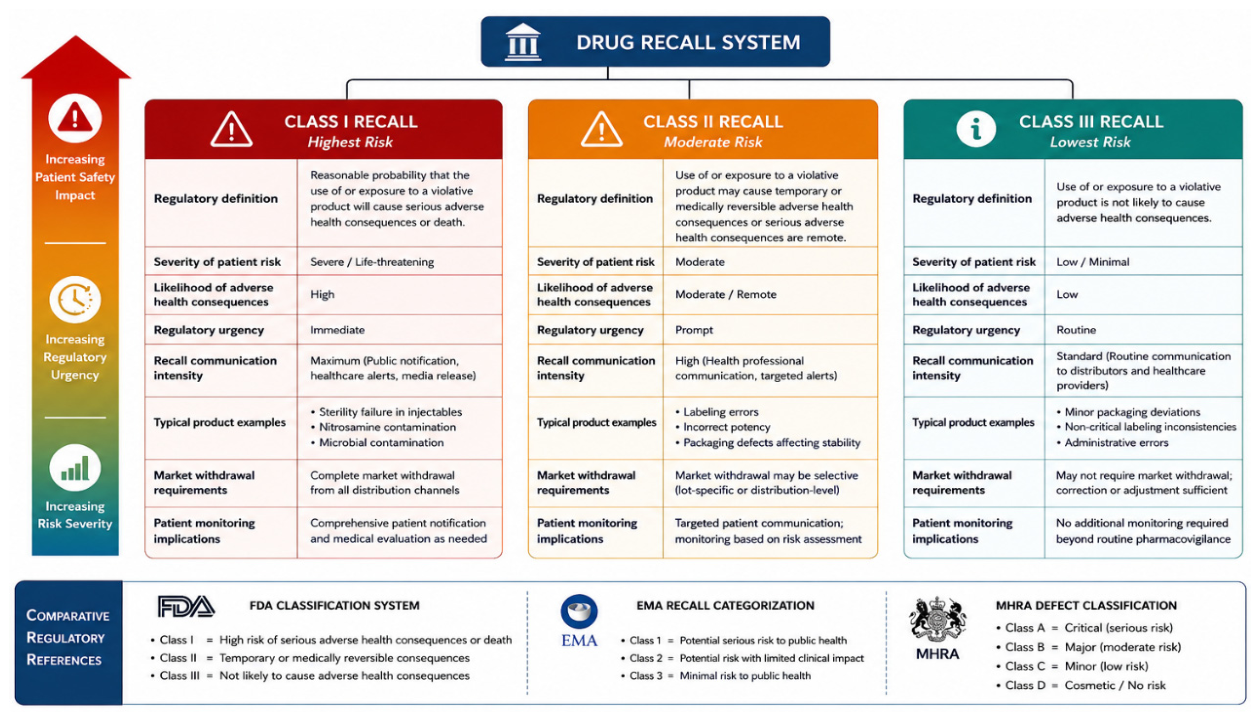
Figure 2.
Global Drug Recall Workflow and Decision making process.
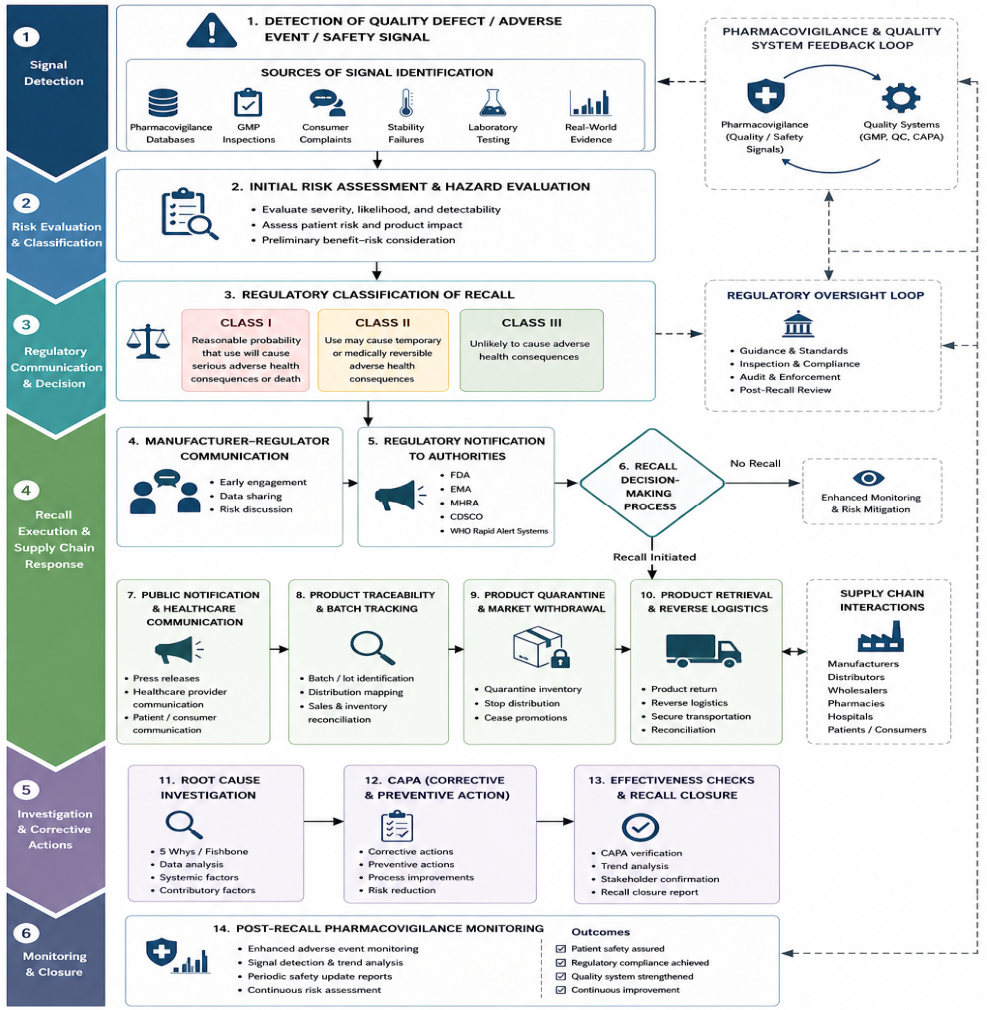
Figure 3.
Rapid Alert and Recall Communication Network in Pharmaceutical Supply Chains.
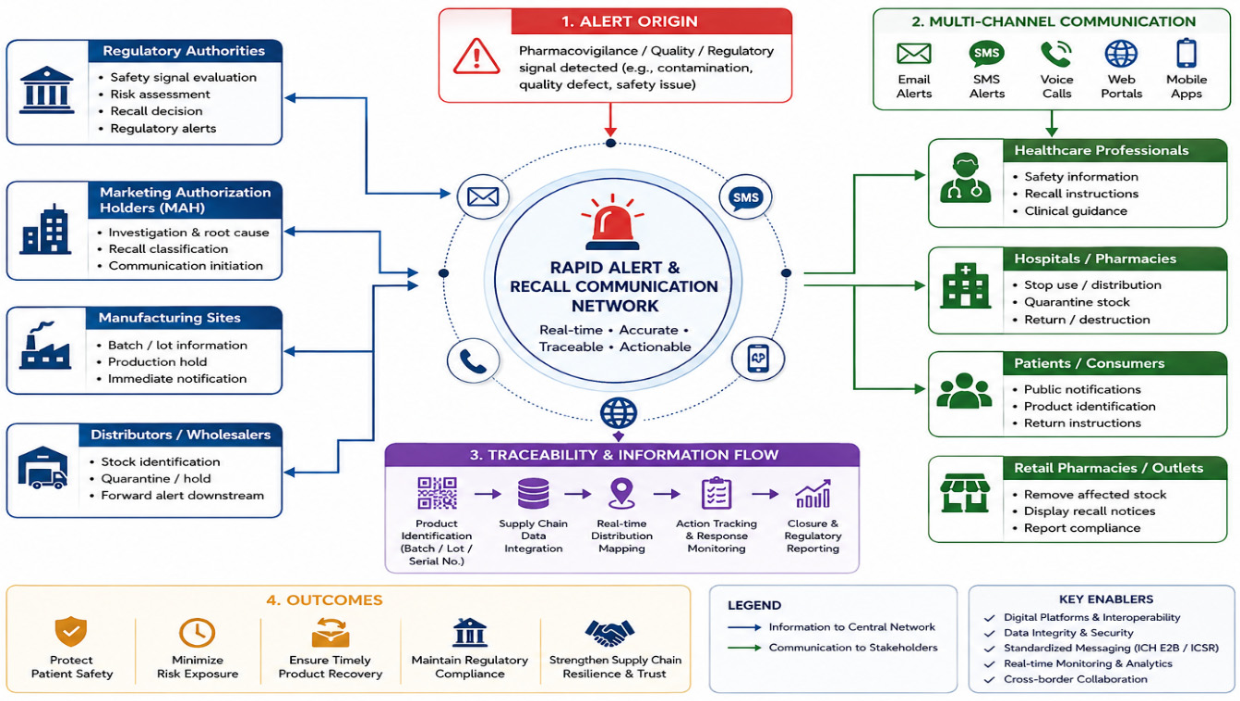
Figure 4.
Role of Pharmacovigilance in Drug Recall Management.
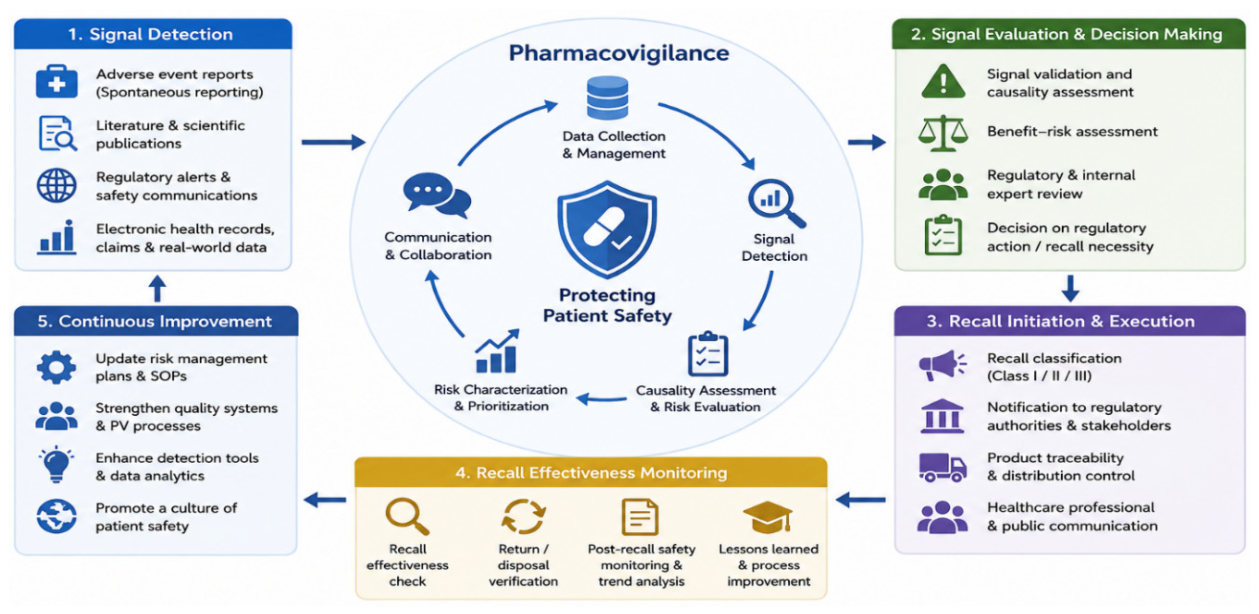
Figure 5.
Future Digital Technologies in Drug Recall Systems.
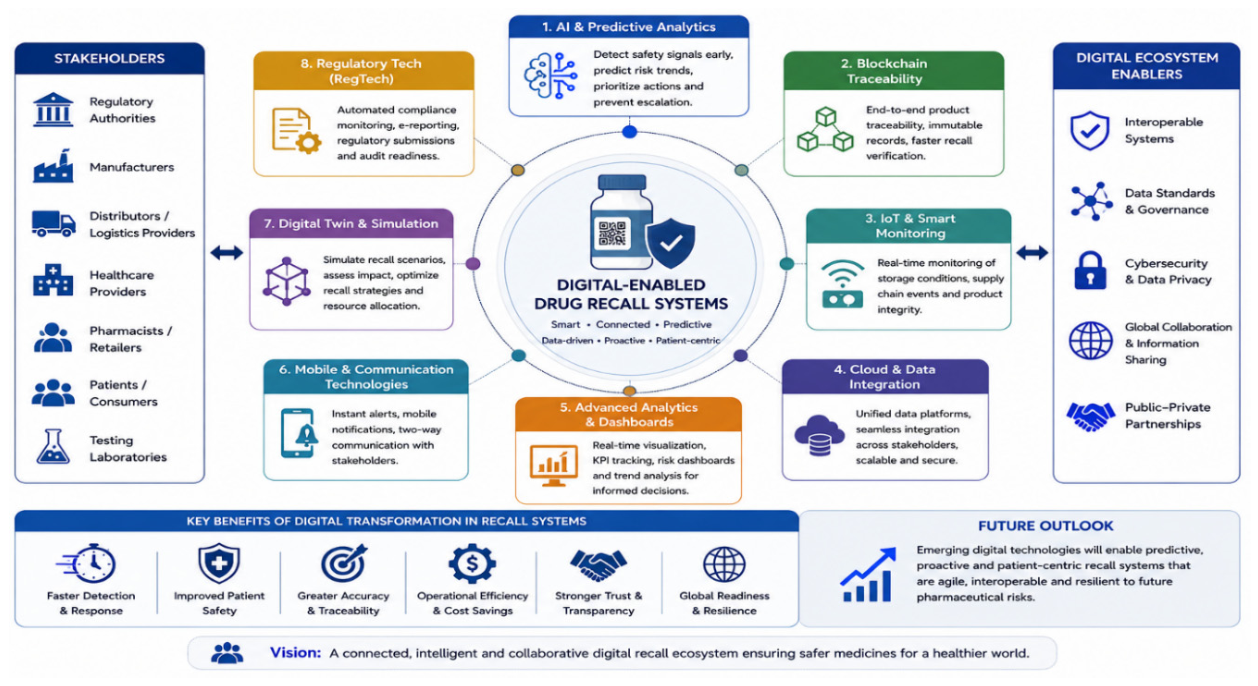

Table 1.
Comparative Difference between Drug Recall and Drug Withdrawal.
| Aspect | Drug Recall | Drug Withdrawal |
| Definition | A drug recall refers to the removal of a pharmaceutical product from the market because it violates regulatory standards or is found to have quality, safety, labeling, packaging, or manufacturing defects. | Drug withdrawal refers to the permanent or long-term removal of a drug from the market when its overall risks are considered greater than its therapeutic benefits. |
| Primary Reason | Usually initiated due to contamination, incorrect labeling, packaging defects, potency variation, microbial contamination, or manufacturing errors. | Generally occurs because of serious adverse drug reactions, toxicity, lack of efficacy, or unfavorable risk–benefit profile identified after marketing. |
| Nature of Action | Mostly corrective and may involve removal of a specific batch, lot, or affected production series. | Often involves discontinuation of the entire product from the market. |
| Regulatory Basis | Conducted when the product violates standards established by regulatory authorities such as the FDA. | Occurs after reassessment of the drug’s safety and therapeutic effectiveness by regulatory agencies. |
| Initiation | Usually initiated voluntarily by manufacturers or requested by regulatory authorities. | Commonly initiated or mandated by regulatory authorities after scientific evaluation of risk. |
| Scope | May affect only selected lots or batches of a drug product. | Typically affects the entire drug product and all marketed batches. |
| Risk to Patients | Risk may range from minor quality defects to serious health hazards depending on recall classification. | Usually associated with significant or unacceptable risks to patient health. |
| Classification | Classified into Class I, Class II, and Class III recalls depending on severity of harm. | Does not generally follow recall classification categories. |
| Possibility of Reintroduction | The product may return to the market after correction of the identified defect and regulatory approval. | Reintroduction is uncommon unless substantial new evidence proves safety and efficacy. |
| Example Situations | Presence of impurities, sterility failure, labeling mistakes, or defective packaging. | Withdrawal due to severe adverse effects such as hepatotoxicity, cardiotoxicity, or carcinogenic risk. |
| Public Health Objective | To rapidly prevent exposure to defective or potentially harmful products already distributed in the market. | To protect public health by discontinuing drugs whose risks outweigh therapeutic benefits. |
Table 2.
Common Causes of Drug Recalls and Associated Regulatory Actions.
|
Common Cause of Recall |
Examples of Affected Products | Associated Patient Safety Risks | Typical Recall Class | Regulatory Actions | Corrective and Preventive Actions (CAPA) | Supply Chain Implications | Pharmacovigilance/GMP Considerations |
| Nitrosamine contamination | Ranitidine, valsartan, losartan, metformin | Long-term carcinogenicity risk due to NDMA/NDEA exposure | Class I or II | FDA, EMA, and MHRA initiated market withdrawal, impurity testing mandates, and revised acceptable intake limits | API process redesign, impurity risk assessment, enhanced analytical surveillance | Global shortages of antihypertensive and antidiabetic agents; API supplier disruption | Emphasis on ICH M7 compliance, continuous quality verification, and risk-based impurity monitoring (Świeczkowski et al., 2022; Fryze et al., 2025) |
| Sterility failures | Injectable anesthetics, ophthalmic solutions, parenteral nutrition products | Sepsis, bloodstream infections, mortality in critically ill patients | Class I | Manufacturing site inspections, import alerts, mandatory recalls, warning letters | Environmental monitoring reinforcement, aseptic process validation, personnel retraining | Hospital procurement disruption and increased reliance on alternative suppliers | Strong linkage with GMP deviations and contamination control strategies (Hall et al., 2016; Gupta and Nayak, 2014) |
| Microbial contamination | Liquid oral formulations, non-sterile syrups, compounded medicines | Opportunistic infections, pediatric toxicity, immunocompromised patient harm | Class I or II | Product seizure, public health advisories, recall expansion | Water system remediation, microbiological testing enhancement | Interrupted distribution in pediatric and critical care sectors | Need for robust microbial quality surveillance and pharmacovigilance reporting integration (Neupane et al., 2022) |
| Labeling errors | Incorrect strength labeling, wrong dosage instructions | Medication errors, overdose, therapeutic failure | Class II or III | Safety alerts, relabeling orders, recall notices | Barcode verification systems, packaging line automation | Retail pharmacy confusion and inventory reconciliation burdens | Medication error prevention and human-factor risk assessment remain central concerns (Aronson, 2009) |
| Data integrity violations | Manipulated QC records, falsified batch documentation | Release of potentially unsafe or substandard medicines | Class II | FDA warning letters, EMA GMP non-compliance notices, import bans | Electronic data governance, audit trail monitoring, quality culture strengthening | Supplier disqualification and interruption of international trade | Increasing regulatory focus on ALCOA+ data integrity principles and digital compliance systems (Lin et al., 2023) |
| Cross-contamination | Hormonal products, beta-lactam antibiotics | Unexpected pharmacological exposure, allergic reactions | Class I or II | Facility shutdowns, mandatory remediation plans | Dedicated manufacturing lines, HVAC redesign, cleaning validation | Reduced manufacturing capacity and delayed product availability | GMP failures in segregation and cleaning procedures are common underlying causes (Nagaich and Sadhna, 2015) |
| Incorrect potency | Sub-potent antibiotics, super-potent cardiovascular agents | Therapeutic failure or toxicity | Class I or II | Recall classification based on dose deviation severity | Process validation review, analytical recalibration, in-process controls | Clinical substitution burden and increased pharmacoeconomic costs | Ongoing post-marketing quality surveillance is critical for dose consistency (Wang et al., 2012) |
| Presence of particulate matter |
Injectable biologics and infusion products | Embolism, inflammatory reactions, vascular injury | Class I | Immediate recall and clinical advisories for healthcare institutions | Enhanced visual inspection systems and container closure integrity testing | Hospital stock quarantines and emergency redistribution | Sterile manufacturing oversight and container compatibility remain critical GMP domains (Connor et al., 2017) |
| Packaging defects | Blister leakage, container closure failures | Product degradation, reduced stability, contamination | Class II or III | Packaging redesign requests and targeted recalls | Packaging qualification studies and transport validation | Distribution delays and increased reverse logistics costs | Stability monitoring and packaging integrity testing are increasingly emphasized (Livingston et al., 2020) |
| Counterfeit/substandard medicines | Falsified cardiovascular and anti-infective medicines | Therapeutic failure, toxicity, antimicrobial resistance | Class I | WHO alerts, customs enforcement, international recall coordination | Serialization, track-and-trace implementation, anti-counterfeiting technologies | Severe disruption of legitimate supply chains and public trust erosion | Integration of pharmacovigilance with anti-counterfeiting surveillance is increasingly necessary (Almuzaini et al., 2013; Fryze et al., 2025) |
Table 3.
Comparison of Drug Recall Regulatory Frameworks across Major Countries.
| Regulatory Authority | Recall Classification System | Legal Authority | Mandatory vs Voluntary Recalls | Rapid Alert System | Public Notification Mechanism | Traceability Requirements | Pharmacovigilance Integration | Post-Recall Effectiveness Checks | Digital Serialization Requirements | Major Regulatory Challenges |
| FDA (United States) | Class I, II, III | Federal Food, Drug, and Cosmetic Act | Primarily voluntary, mandatory authority in selected cases | FDA Recall Enterprise System | Public recall database and MedWatch alerts | DSCSA track-and-trace requirements | Strong integration with FAERS and post-marketing surveillance | Extensive effectiveness audits | Mandatory serialization under DSCSA | Globalized supply chains and API dependency |
| EMA (European Union) | Class 1, 2, 3 and caution-in-use | EU pharmaceutical legislation and member-state enforcement | Combination of voluntary and regulatory-directed recalls | Rapid Alert System (RAS) | EMA and national competent authority alerts | Falsified Medicines Directive serialization | EudraVigilance-linked safety surveillance | Coordinated EU market withdrawal verification | Mandatory serialization and verification systems | Cross-border harmonization across member states |
| MHRA (United Kingdom) | Class 1–4 recalls | Human Medicines Regulations | Regulatory authority may mandate recalls | Central Alerting System (CAS) | Drug Alert notices and healthcare communication systems | National serialization framework | Yellow Card Scheme integration | Recall effectiveness assessments | Continued post-Brexit serialization adaptation | Regulatory divergence after Brexit |
| CDSCO (India) | Class I, II, III (adopted framework) | Drugs and Cosmetics Act | Predominantly voluntary with regulatory oversight | National Rapid Alert System evolving | CDSCO notices and state regulator alerts | Limited nationwide digital traceability | PvPI integration remains developing | Variable implementation across states | Emerging barcode and QR initiatives | Fragmented enforcement capacity and informal distribution networks |
| Health Canada | Type I, II, III recalls | Food and Drugs Act | Voluntary but strongly regulated | Recall and Safety Alerts Database | Public advisories and risk communications | Drug establishment licensing oversight | Canada Vigilance Program linkage | Recall monitoring and compliance verification | Progressive serialization adoption | Cross-border coordination with US supply chains |
| WHO International Framework | Risk-based advisories | Non-binding international guidance | Collaborative coordination model | WHO Global Surveillance and Monitoring System | International medical product alerts | Encourages traceability strengthening | Integrated global pharmacovigilance support | Country-level implementation variability | Encourages digital track-and-trace systems | Limited enforcement authority in LMICs |
Table 4.
Classification of Drug Recalls Based on Risk Severity.
| Parameter | Class I Recall | Class II Recall | Class III Recall |
| Regulatory Definition | Reasonable probability of serious adverse health consequences or death | Temporary or medically reversible adverse effects possible | Unlikely to cause adverse health consequences |
| Severity of Hazard | Life-threatening | Moderate clinical risk | Minimal clinical risk |
| Potential Clinical Consequences | Mortality, severe toxicity, irreversible injury | Reversible toxicity, reduced therapeutic effect | Minor quality deviation |
| Typical Examples | Sterile injectable contamination, nitrosamine carcinogen exposure | Incorrect labeling, sub-potent products | Packaging defects without clinical impact |
| Regulatory Urgency | Immediate | Rapid but less critical | Routine corrective action |
| Recall Communication Intensity | Extensive public alerts and media dissemination | Targeted healthcare communication | Limited distributor-level communication |
| Product Retrieval Requirements | Immediate market withdrawal and patient-level retrieval | Supply chain retrieval and pharmacy quarantine | Controlled inventory correction |
| Patient Monitoring Needs | Active clinical follow-up often required | Monitoring based on exposure assessment | Usually unnecessary |
| Pharmacovigilance Implications | Intensive signal monitoring and adverse event tracking | Focused surveillance for emerging safety signals | Limited pharmacovigilance intervention |
| Recent Recall Examples | NDMA-contaminated ranitidine | Mislabeling of antihypertensive products | Carton labeling inconsistencies |
Table 5.
Recent Major Global Pharmaceutical Recalls Related to Nitrosamine Contamination.
| Drug | Nitrosamine Impurity | Year(s) of Recall | Major Regulatory Agencies Involved | Source of Contamination | Potential Risk | Regulatory Response | Manufacturing/API Findings | Supply Chain Consequences | Public Health Implications |
| Ranitidine | NDMA | 2019–2020 | FDA, EMA, MHRA, WHO | Molecular instability during storage | Probable carcinogenicity | Global market withdrawal | Degradation-associated impurity formation | Worldwide shortages of acid-suppressive therapy | Loss of public confidence in OTC medicines |
| Valsartan | NDMA/NDEA | 2018 | FDA, EMA, Health Canada | Solvent/process modification in API synthesis | Long-term cancer risk | Large-scale international recall | API manufacturing deviations in overseas facilities | Major antihypertensive shortages | Triggered intensified API oversight |
| Losartan | NDMA/NDEA | 2018–2021 | FDA, EMA, MHRA | Contaminated API synthesis pathways | Carcinogenic exposure concern | Expanded impurity testing requirements | Multi-site manufacturing variability | Repeated recall cycles and supplier instability | Increased scrutiny of generic manufacturing |
| Metformin | NDMA | 2020 | FDA, Health Canada, EMA | Stability-related impurity formation | Chronic carcinogenic exposure | Targeted extended-release product recalls | Manufacturing and storage-related concerns | Disruption in diabetes medicine supply | Patient adherence concerns due to recall anxiety |
| Rifampicin | MNP impurity | 2020–2021 | WHO, EMA | Nitrosamine generation during manufacturing | Theoretical mutagenic risk | Temporary acceptable intake guidance | Limited alternative suppliers | Tuberculosis treatment continuity concerns | Risk-benefit balancing in essential medicines |
| Varenicline | N-nitroso-varenicline | 2021 | FDA, EMA | API impurity contamination | Potential carcinogenicity | Recall and manufacturing review | Impurity control deficiencies | Smoking cessation therapy shortages | Interrupted cessation programs |
| Sitagliptin and related agents | Nitroso impurities | 2022–2023 | FDA, EMA | API-related contamination pathways | Long-term carcinogenic concern | Risk-based temporary limits permitted | Ongoing impurity assessment programs | Selective supply interruption | Regulatory shift toward lifecycle impurity management |
Table 6.
Challenges and Proposed Solutions in Drug Recall Management Systems.
| Major Challenge | Root Cause | Patient Safety Impact | Regulatory Implications | Supply Chain Consequences | Proposed Solutions | Future Strategies |
| Inefficient traceability | Fragmented distribution systems | Delayed removal of harmful products | Reduced recall effectiveness | Incomplete product retrieval | Blockchain-enabled track-and-trace systems | Global interoperable serialization |
| Delayed recall communication | Weak digital infrastructure | Continued patient exposure | Public trust erosion | Retail-level confusion | Real-time digital alert systems | AI-assisted communication platforms |
| Global supply chain complexity | Outsourced API manufacturing | Increased contamination risk | Inspection limitations | Multi-country shortages | Supplier diversification and risk mapping | International manufacturing transparency |
| Data integrity failures | Manual documentation and weak oversight | Release of compromised products | Regulatory sanctions and import bans | Supplier disqualification | Electronic quality management systems | AI-driven audit trail surveillance |
| Lack of harmonized regulations | Variable legal frameworks | Inconsistent patient protection | Cross-border enforcement gaps | Recall coordination delays | ICH-aligned recall standards | Expanded WHO-led harmonization |
| Counterfeit medicine infiltration | Weak market surveillance | Toxicity and therapeutic failure | Customs and enforcement burden | Disruption of legitimate markets | Serialization and authentication technologies | Integrated anti-counterfeit intelligence networks |
| Weak pharmacovigilance integration | Siloed safety and quality systems | Delayed signal recognition | Incomplete risk assessment | Poor recall prioritization | Unified PV-quality databases | Predictive pharmacovigilance ecosystems |
| Inadequate recall preparedness | Limited mock recall exercises | Operational delays during crises | Non-compliance findings | Inventory management failures | Routine mock recalls and simulation exercises | Recall readiness benchmarking programs |
| Limited digital infrastructure in LMICs | Resource constraints | Under-reporting and delayed recalls | Weak enforcement capability | Informal market penetration | International technical assistance | Cloud-based recall management platforms |
Disclaimer/Publisher’s Note: The statements, opinions and data contained in all publications are solely those of the individual author(s) and contributor(s) and not of MDPI and/or the editor(s). MDPI and/or the editor(s) disclaim responsibility for any injury to people or property resulting from any ideas, methods, instructions or products referred to in the content. |
© 2026 by the authors. Licensee MDPI, Basel, Switzerland. This article is an open access article distributed under the terms and conditions of the Creative Commons Attribution (CC BY) license (http://creativecommons.org/licenses/by/4.0/).
Copyright: This open access article is published under a Creative Commons CC BY 4.0 license, which permit the free download, distribution, and reuse, provided that the author and preprint are cited in any reuse.