

Submitted:
09 May 2026
Posted:
11 May 2026
You are already at the latest version
Abstract
Dengue remains a major public health problem in tropical and subtropical regions, particularly in Latin America. Acute kidney injury (AKI) is one of the severe complications associated with dengue and has been linked to worse clinical outcomes, including prolonged hospitalization, need for renal replacement therapy, and increased mortality. This review aimed to summarize the available evidence on the epidemiology, pathophysiology, clinical manifestations, diagnosis, management, and prognosis of dengue-associated AKI, while also providing an overview of the literature from Latin America. This manuscript was developed as a narrative review. For the Latin America-specific overview, a focused structured search was conducted in PubMed, ScienceDirect, Cochrane Library, LILACS, and Web of Science, including studies published up to December 2025. The available data suggest that AKI in dengue is multifactorial, involving plasma leakage, renal hypoperfusion, endothelial dysfunction, tubular injury, rhabdomyolysis, thrombotic microangiopathy, and inflammatory renal damage. Clinically, AKI has been associated with oliguria, proteinuria, elevated serum creatinine, renal replacement therapy, and higher mortality. Only four eligible indexed studies from Latin America were identified in our search, all from Brazil, with small sample sizes and incomplete reporting of renal outcomes; however, additional unpublished or non-indexed local data may exist. In summary, dengue-associated AKI is a relevant complication of severe dengue, but the evidence available from Latin America remains limited. These findings highlight the need for improved renal surveillance and standardized reporting in dengue-endemic settings across Latin America.
Keywords:
dengue
; acute kidney injury
; severe dengue
; renal replacement therapy
; Latin America
; mortality
1. Introduction
Dengue virus (DENV) infection is an arboviral disease transmitted by Aedes aegypti and Aedes albopictus mosquitoes, endemic to tropical and subtropical regions [1]. In the Americas, according to estimates from the Pan American Health Organization (PAHO), more than 10 million cases were reported in 2024, and in 2023, the region accounted for 80% of global cases [2]. This recent increase reflects a marked rise compared with previous reporting periods and underscores that dengue burden in the Americas has reached historically unprecedented levels [3]. The rapid growth of DENV, with the co-circulation of multiple serotypes and the resulting variability in clinical outcomes, represents a priority threat to public health in the Americas [4]. Its transmission is determined by vector density, climate change, and the susceptibility of human populations [5,6]. This entails significant economic and health costs associated with hospitalization, intensive care use, and lost productivity [7].
DENV belongs to the Flaviviridae family and consists of four antigenically distinct serotypes (DENV1-4) [8]. These serotypes are genetically similar and share approximately 65% of their genome [9]. The viral genome has three structural proteins (C, prM, and E) that form the components of the virion and seven non-structural proteins (NS1, NS2A/B, NS3, NS4A/B, NS5) involved in viral RNA replication [10]. The incubation period for dengue varies from 3 to 10 days (average 4–7 days) [11]. Once inside the host, DENV infects a variety of cells and tissues, including monocytes/macrophages, lymphocytes, and endothelial cells, as well as organs such as the lungs, stomach, and kidneys [4].
The clinical spectrum of the disease is heterogeneous and can range from mild, self-limiting illnesses to severe, fulminant forms [12]. The severity of dengue depends on immunopathological mechanisms involving both viral and host factors, leading to microvascular and circulatory damage [13]. The disease can progress during the critical phase, with severe plasma loss, contributing to dengue shock syndrome and multiple organ dysfunction [14]. Furthermore, the genetic background associated with the immune response, including antibody-dependent amplification in secondary infections with heterologous serotypes, has been linked to worse outcomes [13].
The pathophysiological mechanisms underlying DENV-induced kidney injury remain incompletely understood [15]. However, several etiologies have been proposed that frequently coexist, including hemodynamic instability, direct viral invasion and tubular cytotoxicity, rhabdomyolysis, and immune-mediated mechanisms [1]. No single mechanism appears to predominate, and two or more pathogenic mechanisms often coexist [16]. Histopathologically, acute tubular necrosis in the proximal convoluted tubules is the main finding [8]. Clinically, acute kidney injury (AKI) may be accompanied by elevated serum creatinine (CrS), proteinuria, and, in some cases, hematuria. Glomerular patterns (nephrotic syndrome) and, less frequently, hemolytic uremic syndrome have also been described [17]. Currently, no specific antiviral therapy is approved to modify the course of dengue; therefore, the treatment of AKI involves supportive care, with goal-directed hemodynamic resuscitation and renal replacement therapy (RRT) when indicated [13].
In Latin America, clinical information on AKI secondary to dengue is scarce and scattered. This gap is particularly relevant because AKI has also been recognized as an important complication in other severe tropical infectious diseases in the region [18]. The objective of this review is to describe and synthesize the epidemiological, pathophysiological, and therapeutic evidence on AKI attributed to DENV, and to assess its relevance in patients with severe dengue in Latin America, identifying knowledge gaps and operational considerations for health systems with heterogeneous access to laboratory testing, renal monitoring, intensive care, and RRT. This manuscript was developed as a narrative review. The global sections on pathophysiology, clinical manifestations, diagnosis, management, and prognosis were based on a non-systematic, topic-driven literature review. In contrast, the Latin America-specific overview was based on a focused structured search.
2. Etiological Agent and Transmission Cycle
DENV is a positive-sense, single-stranded RNA flavivirus responsible for one of the most widespread tropical infectious diseases in recent decades [6,19]. Its genome is encapsulated and surrounded by a lipid envelope. The virion expresses three structural proteins: C, prM/M, and E [10,20]. prM is crucial for preventing premature fusion of the E protein before the virions mature [21]. Non-structural (NS) proteins include NS1, NS2A, NS2B, NS3, NS4A, NS4B, and NS5 [13]. These lipid-associated structures are essential for transcription, assembly, replication, invasion, and immune evasion in the host [20,22,23]. See Table 1.
The virus has four serotypes (DENV-1, DENV-2, DENV-3, and DENV-4) and is transmitted by female mosquitoes of the genus Aedes, primarily Aedes aegypti and, less frequently, Aedes albopictus (adapted to colder climates) [8]. The serotypes are genetically similar and share approximately 65% of their genomes [9]. The incubation period in humans is 3 to 10 days (average of 4–7 days) [11]. During viremia (usually ~5 days), mosquitoes become infected by feeding on the blood of viremic individuals [37]. The virus replicates in the mosquito’s midgut and reaches the salivary glands after an extrinsic incubation period [38]; infectious saliva is inoculated during feeding, introducing the virus into the bloodstream of the new host and initiating another cycle [4,9].
3. Immunity and Determinants of Severity
Following initial infection with any DENV serotype, immunological memory develops, providing homotypic protection and partial, transient heterotypic protection [13]. The host’s genetic background, certain viral variants, and immune responses modulated by prior infections have been associated with an increased risk of severe disease [13]. In Latin America, multiple analyses have identified DENV-2 as a determinant strongly associated with severe dengue in different contexts [39], partly due to its high replicative efficiency and the intensification of inflammatory and apoptotic responses in host cells [40,41]. Furthermore, secondary heterotypic infections are associated with severe forms and a higher risk of mortality [42].
In addition to shaping systemic immune responses, DENV non-structural proteins also contribute to immune evasion by interfering with intracellular antiviral signaling pathways. NS4B inhibits type I interferon signaling [35]. NS5 mediates STAT2 binding and degradation, thereby impairing antiviral interferon responses [36]. Moreover, DENV also targets mitochondria-linked innate immune defenses: NS3 can antagonize Retinoic acid-Inducible Gene I (RIG-I) translocation to mitochondria-associated Mitochondrial Antiviral Signaling protein (MAVS) [43], and NS2B promotes cyclic GMP–AMP synthase (cGAS) degradation, thereby impairing mitochondrial Deoxyribonucleic Acid (DNA) sensing during infection [44].
4. Pathophysiology
4.1. Hemodynamic Mechanisms
Plasma leakage is a central event in severe dengue and underlies renal hemodynamic compromise [28,45]. In experimental models, the dengue NS1 protein has been shown to induce vascular leakage on its own, with increased vascular permeability and inflammatory cytokine production [46]. Furthermore, NS1 has been shown to alter the endothelial glycocalyx, leading to loss of vascular barrier integrity [47]. Additionally, experimental studies have identified that mast cell-derived tryptase also contributes to the disruption of endothelial junctions and plasma leakage [48]. Together, these mechanisms promote effective hypovolemia and, in the most severe cases, shock, leading to prerenal AKI and potentially initiating the transition to established tubular damage. See Figure 1.
4.2. Tubular and Vascular Damage
When renal hypoperfusion persists in the critical phase, AKI can progress to acute tubular necrosis [49]. Edema and hemorrhage, as well as tubular injury with cell detachment and necrosis, have been described in autopsies of fatal cases, findings consistent with established ischemic damage [8]. These same studies also observed thrombi in the glomerular capillaries and intratubular blood material, suggesting that, in addition to the hemodynamic component, a microangiopathic component may coexist in some patients [8,50]. This possibility has also been supported by renal biopsy cases showing glomerular microthrombi consistent with dengue-associated thrombotic microangiopathy [51,52]. Taken together, these findings indicate that AKI in dengue should not be understood solely as a consequence of hypovolemia, but rather as the result of an interaction between tubular ischemia, endothelial injury, and microvascular damage [8,52]. See Figure 2A,B.
These observations also suggest that, in selected severe cases, a microangiopathic component may contribute to greater clinical severity, potentially favoring more pronounced renal dysfunction and the need for renal replacement therapy. However, direct clinical correlations with outcomes such as RRT requirement or mortality remain insufficiently characterized in the available literature.
4.3. Rhabdomyolysis and Myoglobinuria
Rhabdomyolysis constitutes an additional and potentially treatable mechanism of dengue-associated AKI [53,54]. The most direct evidence comes from renal biopsy reports documenting acute tubular necrosis (ATN) with tubular myoglobin deposition, consistent with pigment nephropathy secondary to muscle damage [55]. Other original cases described myoglobinuria, marked elevation of creatine kinase, and the need for dialysis in the context of severe dengue [54,56]. In parallel, experimental studies demonstrated that the virus can infect human muscle satellite cells, while human studies documented an increase in TNF during acute infection [57,58]. Taken together, these findings support the idea that muscle damage may result from both direct viral injury and a myotoxic inflammatory response [57,58]. See Figure 2C.
4.4. Direct Inflammatory and Viral Involvement of the Kidney
Renal involvement in dengue appears to extend beyond hemodynamic alteration [8,59]. A tissue study of fatal dengue cases detected NS1 antigen in the kidney, although the authors noted that these findings did not allow a definitive distinction between antigen within the renal parenchyma and antigen present in residual intravascular blood [60]. In line with this, a subsequent histopathological study documented severe renal damage in human autopsies but did not consistently demonstrate active viral replication in the kidney [8]. More recent studies in fatal DENV-4 infection and in children with fatal dengue identified NS3 in renal tissue, together with mononuclear infiltrates, edema, vascular congestion, and increased expression of inflammatory and endothelial-related mediators, including TNF-α, IFN-γ, MMP-9, VCAM-1, VEGFR-2, and RANTES [59,61]. Taken together, these findings suggest that renal involvement in severe dengue may span a spectrum ranging from secondary systemic inflammatory injury to possible local viral participation. However, this interpretation should remain cautious, as the available studies are limited and do not yet conclusively establish active viral replication within the renal parenchyma [8,59,60,61].
5. Clinical Manifestations
Patients infected with dengue may be asymptomatic or present symptoms ranging from moderate to severe, possibly resulting in fatal outcomes [12]. Clinically, dengue infection progresses through three phases: febrile, critical, and recovery [4]. The febrile phase lasts approximately one week and is distinguished by high fever, severe headache, myalgia and arthralgia, retro-orbital pain, fatigue, nausea, vomiting, anorexia, and minor bleeding [62]. The critical phase is characterized by increased vascular permeability with plasma leakage and may also be accompanied by significant bleeding [4]. The critical phase usually develops as viremia declines and is driven mainly by host inflammatory and vascular responses rather than by viral replication alone [14,63]. The disease can progress during the critical or recovery phase, with severe plasma loss, hemorrhage, or multiple organ failure, which can lead to death [64]. The recovery phase is characterized by progressive reabsorption of extravascular fluid, accompanied by clinical improvement, return of appetite, and hemodynamic stabilization [65].
In the context of severe dengue, AKI affects approximately 35% of patients in a recent multicenter cohort [66]. This complication increases the need for dialysis, prolongs hospital stay, and is associated with higher mortality [15,67]. The main renal manifestations include proteinuria and oliguria, which are frequently reported [53,68]. Among the prognostic pathological findings are ATN [55,69], rhabdomyolysis with myoglobinuria [55], and glomerular patterns, including glomerulonephritis in selected reports and series [68,70]. Laboratory abnormalities in dengue-associated renal involvement are diverse and involve both urinary and serum markers. Urinalysis often finds hematuria in 59.3% and microalbuminuria in 65.9% of patients [71,72]. Elevated serum CrS is a common finding in patients with dengue-associated kidney involvement [53]. Electrolyte problems are also common. In studies from Latin America and Asia, hyponatremia rates vary widely, from 21% to 62%, with an average of 45.3% [73,74,75]. Hypocalcemia is more common in moderate to severe cases, especially in children [76,77]. Such variability is probably related to differences in case mix, disease severity, timing of assessment, and study methodology.
6. Diagnosis
Dengue should be diagnosed based on clinical suspicion, especially in patients with a compatible epidemiological context [15]. Etiological confirmation can be performed using direct and indirect methods. Direct methods include detection of the viral genome by RT-PCR, particularly useful in the early phase of the disease, and NS1 antigen detection, which can be performed from the first days of clinical presentation [78]. Among indirect methods, IgM and IgG serological tests are useful both for diagnostic confirmation and for differentiating primary from secondary infection [79]. In this context, IgM becomes more useful from the fifth day of symptoms onward [78], while the combination of NS1 with IgM/IgG increases diagnostic sensitivity and widens the detection window [80].
Among the systemic complications of dengue, AKI is particularly significant due to its association with worse clinical outcomes [15]. In a clinical cohort, Hussain et al. documented AKI in 14% of the patients evaluated [74]. Within this group, KDIGO stage 1 predominated, followed by KDIGO 2 and KDIGO 3 [74]. These findings reinforce the need for early recognition of renal involvement during the course of infection [71].
The diagnostic evaluation of AKI is based primarily on serum CrS, blood urea nitrogen, urine output, and estimated glomerular filtration rate [81]. However, these parameters have limitations, as they are frequently altered once kidney injury is established [82]. Even so, they remain the basis for clinical management and severity stratification [81]. In this regard, the KDIGO criteria classify AKI based on increased serum CrS and decreased urine output [81].
In addition to traditional markers useful in AKI [81], biomarkers with the potential to identify kidney injury at earlier stages have been evaluated. Among these, serum cystatin C has shown better performance than CrS in detecting early AKI [83], while markers of tubular injury such as NGAL, KIM-1, IL-18, and L-FABP have demonstrated utility in recognizing intrinsic kidney damage before the evident rise in CrS [84]. More recently, the urinary combination [TIMP-2]×[IGFBP7] has emerged as a marker of tubular stress and early AKI risk in critically ill patients [85,86]. However, in dengue, evidence supporting the clinical utility of these biomarkers remains limited; therefore, they should currently be considered complementary to conventional clinical and laboratory evaluation [87]. In resource-limited settings, early recognition of dengue-associated AKI still relies primarily on clinical assessment, urine output monitoring, serial serum CrS measurement, and timely identification of hypovolemia or shock. In this context, advanced biomarkers may be unavailable or of limited practical applicability.
7. Management Strategy
Prevention of dengue-associated AKI is one of the most important pillars of management [87]. Treatment at the onset of the critical phase of the disease consists of monitoring in the intensive care unit, including vital signs, hematocrit, platelet count, urine output, hemorrhagic manifestations, and level of consciousness [49]. Although there is no targeted management strategy for AKI prevention, the priority is to restore circulating volume through the administration of crystalloid solutions [88]. The clinical management algorithm formulated by the PAHO emphasizes fluid resuscitation as a treatment priority, according to the risk group, and the use of intensive intravenous regimens in patients with severe dengue [89]. According to these risk groups, in the critical phase and in categories B2 and C, capillary leak, hypovolemia, and renal hypoperfusion occur, leading to elevated renal biomarkers. Therefore, timely and appropriate volume replacement plays a central role [89,90]. If AKI worsens, RRT via hemodialysis is indicated, as is routinely used [49]. Although the critical phase is strongly influenced by host inflammatory and vascular responses, routine corticosteroid or immunomodulatory therapy has not shown an established clinical benefit in severe dengue and is not part of standard supportive care [91,92].
8. Prognosis
Recovery of renal function after dengue-associated AKI is a significant factor in morbidity, as failure to recover can have long-term consequences [87]. Short-term improvement in renal function at hospital discharge has been reported in some patients with dengue-associated AKI [17]. However, other studies have shown unsatisfactory recovery of renal function [74], and persistent kidney injury has been reported in up to 45-48% of cases [17]. Long-term renal sequelae remain poorly characterized in Latin America and represent an important area for future prospective research.
9. Overview of Acute Kidney Injury Associated with Dengue Virus in Latin America
Dengue is a serious public health problem in Latin America, exacerbated by climatic phenomena in tropical and subtropical regions [1]. According to PAHO estimates, more than 10 million cases were reported annually in 2024, reaching record highs in 2023 [2]. Despite this, to date, information on AKI secondary to dengue is limited in Latin America, making it difficult to determine the current burden of the disease.
To address this gap, we performed a focused structured search in PubMed, ScienceDirect, the Cochrane Library, LILACS, and Web of Science to identify studies reporting epidemiology, RRT requirements, and mortality associated with dengue-related AKI in Latin America. The search encompassed studies published from the inception of each database until December 2025. Search terms comprised a combination of keywords and MeSH terms related to AKI and dengue, including “Dengue,” “Acute Kidney Injury,” and “Latin America.” The detailed search strategy is provided in Supplementary Table 1. Articles were limited to English and Spanish. Duplicate records and articles without available abstracts were excluded. Table 2 summarizes the studies that met the search criteria.
9.1. Overall Findings
Only four eligible studies on dengue-associated AKI in Latin America were identified, all conducted in Brazil. The available evidence was limited to small case reports, case series, and post-mortem series, with heterogeneous and incomplete reporting of renal outcomes, including limited use of uniform KDIGO staging, incomplete reporting of baseline CrS and urine output, sparse information on renal replacement therapy, and minimal follow-up regarding renal recovery after discharge. This scarcity of studies should not be interpreted as evidence of low clinical relevance, but may instead reflect underreporting of renal outcomes, limited follow-up of kidney function, and restricted visibility of locally published literature not indexed in major databases. The frequency of acute kidney injury varied among studies and was not reported in some cases. Mortality was high in series including fatal cases, whereas the need for RRT was explicitly documented in two of the available studies. Overall, these findings reflect a limited evidence base, with a predominance of severe cases and a high risk of selection bias.
These findings also highlight the need for more standardized reporting of renal outcomes in dengue cohorts from Latin America, particularly in settings where differences in diagnostic and therapeutic resources may further limit comparability across studies, including AKI definition and staging, baseline CrS or the method used for its estimation, urine output, need for renal replacement therapy, and renal recovery at discharge.
10. Conclusions
Acute kidney injury is a relevant complication of severe dengue and has been associated with worse clinical outcomes, including the requirement for renal replacement therapy and death. Current evidence indicates that renal injury in dengue is likely multifactorial, involving hemodynamic disturbances, endothelial dysfunction, tubular damage, rhabdomyolysis, thrombotic microangiopathy, and inflammatory mechanisms. In Latin America, however, the available evidence remains limited, with few published studies and inconsistent reporting of renal outcomes. As a result, the true regional burden of dengue-associated acute kidney injury is still uncertain. Further multicenter studies with standardized definitions and outcome reporting are needed to better characterize this complication and support earlier recognition and management in clinical practice.
Supplementary Materials
The following supporting information can be downloaded at the website of this paper posted on Preprints.org, Table S1. Search strategy summary.
Author Contributions
Conceptualization, C.R.-B., and E.O.-R.; data curation, M.R-R., C.M.-C., and A.B.-P.; formal analysis, E.O.-R.; methodology, D.R.-B., and E.O.-R.; project administration, V.B.-M., and E.O.-R.; visualization, L.C.-M., J.C.-G., and E.O.-R.; writing—original draft preparation, C.R.-M., A.P.-B., M.R.-R., C.M.-C., A.B.-P., L.C.-M., D.R.-B., H.D.-R., V.B.-M., C.B.-S., J.C.-G., L.A.-M., and E.O.-R.; writing—review and editing, C.R.-M., A.P.-B., M.R.-R., C.M.-C., A.B.-P., L.C.-M., D.R.-B., H.D.-R., V.B.-M., C.B.-S., J.C.-G., L.A.-M., and E.O.-R.; The corresponding author attests that all listed authors meet authorship criteria and that no others meeting the criteria have been omitted. All authors have read and agreed to the published version of the manuscript.
Funding
This research received no external funding.
Institutional Review Board Statement
Not applicable.
Informed Consent Statement
Not applicable.
Data Availability Statement
No new primary data were generated in this study. All data analyzed were derived from previously published studies included in this review. The decision log, checklist, and full search strategies are available in the supplementary materials.
Acknowledgments
During the preparation of this manuscript, the authors used AI to assist with language editing. The authors reviewed and edited the output and take full responsibility for the content of this publication.
Conflicts of Interest
The authors declare no conflict of interest.
Abbreviations
The following abbreviations are used in this manuscript:
| AKI | Acute kidney injury |
| ATN | Acute tubular necrosis |
| cGAS | cyclic GMP–AMP synthase |
| CrS | Serum creatinine |
| DENV | Dengue virus |
| DNA | Deoxyribonucleic Acid |
| IFN | Interferon |
| IFN-γ | Interferon gamma |
| IgG | Immunoglobulin G |
| IgM | Immunoglobulin M |
| IL-6 | Interleukin-6 |
| IL-18 | Interleukin-18 |
| KDIGO | Kidney Disease: Improving Global Outcomes |
| KIM-1 | Kidney injury molecule-1 |
| L-FABP | Liver-type fatty acid-binding protein |
| MAVS | Mitochondrial Antiviral Signaling protein |
| MIF | Macrophage migration inhibitory factor |
| MMP-9 | Matrix metalloproteinase-9 |
| NGAL | Neutrophil gelatinase-associated lipocalin |
| NS | Non-structural |
| NS1 | Non-structural protein 1 |
| NS2A | Non-structural protein 2A |
| NS2B | Non-structural protein 2B |
| NS3 | Non-structural protein 3 |
| NS4A | Non-structural protein 4A |
| NS4B | Non-structural protein 4B |
| NS5 | Non-structural protein 5 |
| PAHO | Pan American Health Organization |
| prM | Premembrane protein |
| RIG-I | Retinoic acid-Inducible Gene I |
| RNA | Ribonucleic acid |
| RRT | Renal replacement therapy |
| RT-PCR | Reverse transcription polymerase chain reaction |
| TLR4 | Toll-like receptor 4 |
| TNF | Tumor necrosis factor |
| TNF-α | Tumor necrosis factor alpha |
| VCAM-1 | Vascular cell adhesion molecule 1 |
| VEGFR-2 | Vascular endothelial growth factor receptor 2 |
References
- Bushi, G.; Shabil, M.; Padhi, B.K.; Ahmed, M.; Pandey, P.; Satapathy, P.; Rustagi, S.; Pradhan, K.B.; Al-qaim, Z.H.; Sah, R. Prevalence of Acute Kidney Injury among Dengue Cases: A Systematic Review and Meta-Analysis. Trans. R. Soc. Trop. Med. Hyg. 2024, 118, 1–11. [Google Scholar] [CrossRef] [PubMed]
- Gallego-Munuera, M.; Colomé-Hidalgo, M. Letalidad Por Dengue Y Desigualdades En La Región de Las Américas Entre El 2014 Y El 2023. Rev. Panam. Salud Pública 2024, 48, 1. [Google Scholar] [CrossRef]
- Pan American Health Organization. Epidemiological Update—Increase in Dengue Cases in the Region of the Americas—18 June 2024. Available online: https://www.paho.org/en/documents/epidemiological-update-increase-dengue-cases-region-americas-18-june-2024 (accessed on 7 May 2026).
- de Almeida, M.T.; Merighi, D.G.S.; Visnardi, A.B.; Boneto Gonçalves, C.A.; Amorim, V.M. de F.; Ferrari, A.S. de A.; de Souza, A.S.; Guzzo, C.R. Latin America’s Dengue Outbreak Poses a Global Health Threat. Viruses 2025, 17, 57. [Google Scholar] [CrossRef] [PubMed]
- Waickman, A.T.; Lu, J.Q.; Fang, H.; Waldran, M.J.; Gebo, C.; Currier, J.R.; Ware, L.; Van Wesenbeeck, L.; Verpoorten, N.; Lenz, O.; et al. Evolution of Inflammation and Immunity in a Dengue Virus 1 Human Infection Model. Sci. Transl. Med. 2022, 14. [Google Scholar] [CrossRef]
- Haider, N.; Hasan, M.N.; Onyango, J.; Billah, M.; Khan, S.; Papakonstantinou, D.; Paudyal, P.; Asaduzzaman, M. Global Dengue Epidemic Worsens with Record 14 Million Cases and 9000 Deaths Reported in 2024. Int. J. Infect. Dis. 2025, 158, 107940. [Google Scholar] [CrossRef]
- Chua, C.L.L.; Morales, R.F.; Chia, P.Y.; Yeo, T.W.; Teo, A. Neutrophils—an Understudied Bystander in Dengue? Trends Microbiol. 2024, 32, 1132–1142. [Google Scholar] [CrossRef]
- Póvoa, T.F.; Alves, A.M.B.; Oliveira, C.A.B.; Nuovo, G.J.; Chagas, V.L.A.; Paes, M. V. The Pathology of Severe Dengue in Multiple Organs of Human Fatal Cases: Histopathology, Ultrastructure and Virus Replication. PLoS ONE 2014, 9, e83386. [Google Scholar] [CrossRef]
- Mallhi, T.H.; Khan, Y.H.; Adnan, A.S.; Tanveer, N.; Aftab, R.A. Dengue Viral Infection (DVI) and Expanded Dengue Syndrome (EDS). In Expanded Dengue Syndrome; Springer: Singapore, 2021; pp. 1–22. [Google Scholar]
- Perera, R.; Kuhn, R.J. Structural Proteomics of Dengue Virus. Curr. Opin. Microbiol. 2008, 11, 369–377. [Google Scholar] [CrossRef]
- Medić, A.; Savić, V.; Klobučar, A.; Bogdanić, M.; Curman Posavec, M.; Nonković, D.; Barbić, L.; Rončević, I.; Stevanović, V.; Vilibić-Čavlek, T. Epidemiological and Entomological Study After the Possible Re-Emergence of Dengue Fever in Croatia, 2024. Microorganisms 2025, 13, 565. [Google Scholar] [CrossRef] [PubMed]
- Narvaez, F.; Montenegro, C.; Juarez, J.G.; Zambrana, J.V.; Gonzalez, K.; Videa, E.; Arguello, S.; Barrios, F.; Ojeda, S.; Plazaola, M.; et al. Dengue Severity by Serotype and Immune Status in 19 Years of Pediatric Clinical Studies in Nicaragua. PLoS Negl. Trop. Dis. 2025, 19, e0012811. [Google Scholar] [CrossRef]
- Khanam, A.; Gutiérrez-Barbosa, H.; Lyke, K.E.; Chua, J. V. Immune-Mediated Pathogenesis in Dengue Virus Infection. Viruses 2022, 14, 2575. [Google Scholar] [CrossRef]
- Rodrigo, C.; Sigera, C.; Fernando, D.; Rajapakse, S. Plasma Leakage in Dengue: A Systematic Review of Prospective Observational Studies. BMC Infect. Dis. 2021, 21, 1082. [Google Scholar] [CrossRef] [PubMed]
- Wang, C.; Hong, W.; Ou, Z.; Yang, H.; Zhao, L.; Zhang, Z.; Zhang, F. Prevalence, Characteristics, and Outcomes Associated with Acute Kidney Injury among Adult Patients with Severe Dengue in Mainland China. Am. J. Trop. Med. Hyg. 2023, 109, 404–412. [Google Scholar] [CrossRef] [PubMed]
- Mallhi, T.H.; Khan, Y.H.; Adnan, A.S.; Tanveer, N.; Aftab, R.A. Dengue-Induced Renal Complications. In Expanded Dengue Syndrome; Springer: Singapore, 2021; pp. 35–54. [Google Scholar]
- Mallhi, T.H.; Khan, A.H.; Adnan, A.S.; Sarriff, A.; Khan, Y.H.; Gan, S.H. Short-Term Renal Outcomes Following Acute Kidney Injury among Dengue Patients: A Follow-up Analysis from Large Prospective Cohort. PLoS ONE 2018, 13, e0192510. [Google Scholar] [CrossRef]
- Osorio-Rodríguez, E.; Rodelo-Barrios, D.; Rebolledo-Maldonado, C.; Polo-Barranco, A.; Patiño-Patiño, J.; Aldana-Roa, M.; Sánchez-Daza, V.; Sierra-Ordoñez, E.; Bettin-Martínez, A. Acute Kidney Injury Associated with Severe Leptospirosis: Fatal Re-Emerging Disease in Latin America. Kidney Dial. 2024, 4, 78–92. [Google Scholar] [CrossRef]
- Fiora, M.B.; Gonzalvez, M.L.; Aguirreb, J.P.; Bacigalupo, A.; Garnero, A.; Rosa, A.M.; Obrador, M.D.; Grecco, C. Observational Study of Clinical, Epidemiological, and Laboratory Characteristics of Pediatric Patients with Dengue in the City of Córdoba. Arch. Argent. Pediatr. 2024, 122. [Google Scholar] [CrossRef]
- Villareal, V.A.; Rodgers, M.A.; Costello, D.A.; Yang, P.L. Targeting Host Lipid Synthesis and Metabolism to Inhibit Dengue and Hepatitis C Viruses. Antivir. Res. 2015, 124, 110–121. [Google Scholar] [CrossRef]
- Yu, I.-M.; Holdaway, H.A.; Chipman, P.R.; Kuhn, R.J.; Rossmann, M.G.; Chen, J. Association of the Pr Peptides with Dengue Virus at Acidic pH Blocks Membrane Fusion. J. Virol. 2009, 83, 12101–12107. [Google Scholar] [CrossRef] [PubMed]
- Samsa, M.M.; Mondotte, J.A.; Iglesias, N.G.; Assunção-Miranda, I.; Barbosa-Lima, G.; Da Poian, A.T.; Bozza, P.T.; Gamarnik, A. V. Dengue Virus Capsid Protein Usurps Lipid Droplets for Viral Particle Formation. PLoS Pathog. 2009, 5, e1000632. [Google Scholar] [CrossRef]
- Campbell, O.; Monje-Galvan, V. Protein-Driven Membrane Remodeling: Molecular Perspectives from Flaviviridae Infections. Biophys. J. 2023, 122, 1890–1899. [Google Scholar] [CrossRef] [PubMed]
- Ma, L.; Jones, C.T.; Groesch, T.D.; Kuhn, R.J.; Post, C.B. Solution Structure of Dengue Virus Capsid Protein Reveals Another Fold. Proc. Natl. Acad. Sci. 2004, 101, 3414–3419. [Google Scholar] [CrossRef]
- Mukherjee, S.; Sirohi, D.; Dowd, K.A.; Chen, Z.; Diamond, M.S.; Kuhn, R.J.; Pierson, T.C. Enhancing Dengue Virus Maturation Using a Stable Furin over-Expressing Cell Line. Virology 2016, 497, 33–40. [Google Scholar] [CrossRef] [PubMed]
- Modis, Y.; Ogata, S.; Clements, D.; Harrison, S.C. Structure of the Dengue Virus Envelope Protein after Membrane Fusion. Nature 2004, 427, 313–319. [Google Scholar] [CrossRef]
- Avirutnan, P.; Punyadee, N.; Noisakran, S.; Komoltri, C.; Thiemmeca, S.; Auethavornanan, K.; Jairungsri, A.; Kanlaya, R.; Tangthawornchaikul, N.; Puttikhunt, C.; et al. Vascular Leakage in Severe Dengue Virus Infections: A Potential Role for the Nonstructural Viral Protein NS1 and Complement. J. Infect. Dis. 2006, 193, 1078–1088. [Google Scholar] [CrossRef]
- Beatty, P.R.; Puerta-Guardo, H.; Killingbeck, S.S.; Glasner, D.R.; Hopkins, K.; Harris, E. Dengue Virus NS1 Triggers Endothelial Permeability and Vascular Leak That Is Prevented by NS1 Vaccination. Sci. Transl. Med. 2015, 7. [Google Scholar] [CrossRef] [PubMed]
- Modhiran, N.; Watterson, D.; Muller, D.A.; Panetta, A.K.; Sester, D.P.; Liu, L.; Hume, D.A.; Stacey, K.J.; Young, P.R. Dengue Virus NS1 Protein Activates Cells via Toll-like Receptor 4 and Disrupts Endothelial Cell Monolayer Integrity. Sci. Transl. Med. 2015, 7. [Google Scholar] [CrossRef] [PubMed]
- Xie, X.; Zou, J.; Puttikhunt, C.; Yuan, Z.; Shi, P.-Y. Two Distinct Sets of NS2A Molecules Are Responsible for Dengue Virus RNA Synthesis and Virion Assembly. J. Virol. 2015, 89, 1298–1313. [Google Scholar] [CrossRef]
- Xie, X.; Zou, J.; Zhang, X.; Zhou, Y.; Routh, A.L.; Kang, C.; Popov, V.L.; Chen, X.; Wang, Q.-Y.; Dong, H.; et al. Dengue NS2A Protein Orchestrates Virus Assembly. Cell Host Microbe 2019, 26, 606–622.e8. [Google Scholar] [CrossRef]
- Yusof, R.; Clum, S.; Wetzel, M.; Murthy, H.M.K.; Padmanabhan, R. Purified NS2B/NS3 Serine Protease of Dengue Virus Type 2 Exhibits Cofactor NS2B Dependence for Cleavage of Substrates with Dibasic Amino Acids in Vitro. J. Biol. Chem. 2000, 275, 9963–9969. [Google Scholar] [CrossRef]
- Leung, D.; Schroder, K.; White, H.; Fang, N.-X.; Stoermer, M.J.; Abbenante, G.; Martin, J.L.; Young, P.R.; Fairlie, D.P. Activity of Recombinant Dengue 2 Virus NS3 Protease in the Presence of a Truncated NS2B Co-Factor, Small Peptide Substrates, and Inhibitors. J. Biol. Chem. 2001, 276, 45762–45771. [Google Scholar] [CrossRef] [PubMed]
- Miller, S.; Kastner, S.; Krijnse-Locker, J.; Bühler, S.; Bartenschlager, R. The Non-Structural Protein 4A of Dengue Virus Is an Integral Membrane Protein Inducing Membrane Alterations in a 2K-Regulated Manner. J. Biol. Chem. 2007, 282, 8873–8882. [Google Scholar] [CrossRef] [PubMed]
- Muñoz-Jordán, J.L.; Laurent-Rolle, M.; Ashour, J.; Martínez-Sobrido, L.; Ashok, M.; Lipkin, W.I.; García-Sastre, A. Inhibition of Alpha/Beta Interferon Signaling by the NS4B Protein of Flaviviruses. J. Virol. 2005, 79, 8004–8013. [Google Scholar] [CrossRef]
- Ashour, J.; Laurent-Rolle, M.; Shi, P.-Y.; García-Sastre, A. NS5 of Dengue Virus Mediates STAT2 Binding and Degradation. J. Virol. 2009, 83, 5408–5418. [Google Scholar] [CrossRef]
- Hurtado-Gómez, L.; Escorcia-Lindo, K.; Rosero, J.S.; Solano Llanos, N.; Barrios Sánchez, C.; Díaz Pérez, A.; Díaz-Olmos, Y.; García, J.; Bello-Lemus, Y.; Pacheco-Londoño, L.C.; et al. Development and Validation of a Combined RT-LAMP Assay for the Rapid and Sensitive Detection of Dengue Virus in Clinical Samples from Colombia. Diagnostics 2025, 15, 570. [Google Scholar] [CrossRef] [PubMed]
- Pourzangiabadi, M.; Najafi, H.; Fallah, A.; Goudarzi, A.; Pouladi, I. Dengue Virus: Etiology, Epidemiology, Pathobiology, and Developments in Diagnosis and Control—A Comprehensive Review. Infect. Genet. Evol. 2025, 127, 105710. [Google Scholar] [CrossRef]
- Vicente, C.R.; Herbinger, K.-H.; Fröschl, G.; Malta Romano, C.; de Souza Areias Cabidelle, A.; Cerutti Junior, C. Serotype Influences on Dengue Severity: A Cross-Sectional Study on 485 Confirmed Dengue Cases in Vitória, Brazil. BMC Infect. Dis. 2016, 16, 320. [Google Scholar] [CrossRef]
- Vaughn, D.W.; Green, S.; Kalayanarooj, S.; Innis, B.L.; Nimmannitya, S.; Suntayakorn, S.; Endy, T.P.; Raengsakulrach, B.; Rothman, A.L.; Ennis, F.A.; et al. Dengue Viremia Titer, Antibody Response Pattern, and Virus Serotype Correlate with Disease Severity. J. Infect. Dis. 2000, 181, 2–9. [Google Scholar] [CrossRef]
- Valero, N.; Mosquera, J.; Añez, G.; Levy, A.; Marcucci, R.; de Mon, M.A. Differential Oxidative Stress Induced by Dengue Virus in Monocytes from Human Neonates, Adult and Elderly Individuals. PLoS ONE 2013, 8, e73221. [Google Scholar] [CrossRef]
- Thomas, L.; Najioullah, F.; Besnier, F.; Valentino, R.; Césaire, J.R.R.; Cabié, A. Clinical Presentation of Dengue by Serotype and Year of Epidemic in Martinique. Am. Soc. Trop. Med. Hyg. 2014, 91, 138–145. [Google Scholar] [CrossRef] [PubMed]
- Chan, Y.K.; Gack, M.U. A Phosphomimetic-Based Mechanism of Dengue Virus to Antagonize Innate Immunity. Nat. Immunol. 2016, 17, 523–530. [Google Scholar] [CrossRef]
- Aguirre, S.; Luthra, P.; Sanchez-Aparicio, M.T.; Maestre, A.M.; Patel, J.; Lamothe, F.; Fredericks, A.C.; Tripathi, S.; Zhu, T.; Pintado-Silva, J.; et al. Dengue Virus NS2B Protein Targets cGAS for Degradation and Prevents Mitochondrial DNA Sensing during Infection. Nat. Microbiol. 2017, 2, 17037. [Google Scholar] [CrossRef]
- Jácome, F.C.; Caldas, G.C.; Rasinhas, A. da C.; de Almeida, A.L.T.; de Souza, D.D.C.; Paulino, A.C.; da Silva, M.A.N.; Barth, O.M.; dos Santos, F.B.; Barreto-Vieira, D.F. Brazilian Dengue Virus Type 2-Associated Renal Involvement in a Murine Model: Outcomes after Infection by Two Lineages of the Asian/American Genotype. Pathogens 2021, 10, 1084. [Google Scholar] [CrossRef]
- Chen, H.-R.; Chuang, Y.-C.; Lin, Y.-S.; Liu, H.-S.; Liu, C.-C.; Perng, G.-C.; Yeh, T.-M. Dengue Virus Nonstructural Protein 1 Induces Vascular Leakage through Macrophage Migration Inhibitory Factor and Autophagy. PLoS Negl. Trop. Dis. 2016, 10, e0004828. [Google Scholar] [CrossRef] [PubMed]
- Puerta-Guardo, H.; Glasner, D.R.; Harris, E. Dengue Virus NS1 Disrupts the Endothelial Glycocalyx, Leading to Hyperpermeability. PLoS Pathog. 2016, 12, e1005738. [Google Scholar] [CrossRef] [PubMed]
- Rathore, A.P.S.; Mantri, C.K.; Aman, S.A.B.; Syenina, A.; Ooi, J.; Jagaraj, C.J.; Goh, C.C.; Tissera, H.; Wilder-Smith, A.; Ng, L.G.; et al. Dengue Virus–elicited Tryptase Induces Endothelial Permeability and Shock. J. Clin. Invest. 2019, 129, 4180–4193. [Google Scholar] [CrossRef]
- Tejo, A.M.; Hamasaki, D.T.; Menezes, L.M.; Ho, Y.-L. Severe Dengue in the Intensive Care Unit. J. Intensive Med. 2024, 4, 16–33. [Google Scholar] [CrossRef]
- Rivera, J.A.; Rengifo, A.C.; Parra, E.A.; Castellanos, J.E.; Caldas, M.L. Illustrated Histopathological Features of Fatal Dengue Cases in Colombia. Biomédica 2020, 40, 438–447. [Google Scholar] [CrossRef]
- Wiersinga, W.J.; Scheepstra, C.G.; Kasanardjo, J.S.; de Vries, P.J.; Zaaijer, H.; Geerlings, S.E. Dengue Fever-Induced Hemolytic Uremic Syndrome. Clin. Infect. Dis. 2006, 43, 800–801. [Google Scholar] [CrossRef]
- Bhargava, V.; Gupta, P.; Kauntia, R.; Bajpai, G. Dengue Fever-Induced Thrombotic Microangiopathy: An Unusual Cause of Renal Failure. Indian J. Nephrol. 2017, 27, 321. [Google Scholar] [CrossRef]
- Bignardi, P.R.; Pinto, G.R.; Boscarioli, M.L.N.; Lima, R.A.A.; Delfino, V.D.A. Acute Kidney Injury Associated with Dengue Virus Infection: A Review. Braz. J. Nephrol. 2022, 44, 232–237. [Google Scholar] [CrossRef] [PubMed]
- Wijesinghe, A.; Gnanapragash, N.; Ranasinghe, G.; Ragunathan, M.K. Acute Renal Failure due to Rhabdomyolysis Following Dengue Viral Infection: A Case Report. J. Med. Case Rep. 2013, 7, 195. [Google Scholar] [CrossRef]
- Repizo, L.P.; Malheiros, D.M.; Yu, L.; Barros, R.T.; Burdmann, E.A. BIOPSY PROVEN ACUTE TUBULAR NECROSIS DUE TO RHABDOMYOLYSIS IN A DENGUE FEVER PATIENT: A CASE REPORT AND REVIEW OF LITERATURE. Rev. Inst. Med. Trop. Sao Paulo 2014, 56, 85–88. [Google Scholar] [CrossRef] [PubMed]
- Davis, J.S.; Bourke, P. Rhabdomyolysis Associated with Dengue Virus Infection. Clin. Infect. Dis. 2004, 38, e109–e111. [Google Scholar] [CrossRef]
- Warke, R. V.; Becerra, A.; Zawadzka, A.; Schmidt, D.J.; Martin, K.J.; Giaya, K.; Dinsmore, J.H.; Woda, M.; Hendricks, G.; Levine, T.; et al. Efficient Dengue Virus (DENV) Infection of Human Muscle Satellite Cells Upregulates Type I Interferon Response Genes and Differentially Modulates MHC I Expression on Bystander and DENV-Infected Cells. J. Gen. Virol. 2008, 89, 1605–1615. [Google Scholar] [CrossRef] [PubMed]
- Gagnon, S.J.; Mori, M.; Kurane, I.; Green, S.; Vaughn, D.W.; Kalayanarooj, S.; Suntayakorn, S.; Ennis, F.A.; Rothman, A.L. Cytokine Gene Expression and Protein Production in Peripheral Blood Mononuclear Cells of Children with Acute Dengue Virus Infections. J. Med. Virol. 2002, 67, 41–46. [Google Scholar] [CrossRef]
- Nunes, P.C.G.; Rioja, L. da S.; Coelho, J.M.C. de O.; Salomão, N.G.; Rabelo, K.; José, C.C.; Rodrigues, F. das C. de C.; de Azeredo, E.L.; Basílio-de-Oliveira, C.A.; Basílio-de-Oliveira, R.; et al. Renal Injury in DENV-4 Fatal Cases: Viremia, Immune Response and Cytokine Profile. Pathogens 2019, 8, 223. [Google Scholar] [CrossRef]
- Lima, M. da R.Q.; Nogueira, R.M.R.; Schatzmayr, H.G.; de Filippis, A.M.B.; Limonta, D.; dos Santos, F.B. A New Approach to Dengue Fatal Cases Diagnosis: NS1 Antigen Capture in Tissues. PLoS Negl. Trop. Dis. 2011, 5, e1147. [Google Scholar] [CrossRef] [PubMed]
- de Lima Siqueira Oliveira, L.; de Andrade Vieira Alves, F.; Rabelo, K.; Moragas, L.J.; Mohana-Borges, R.; de Carvalho, J.J.; Basílio-de-Oliveira, C.; Basílio-de-Oliveira, R.; Rosman, F.C.; Salomão, N.G.; et al. Immunopathology of Renal Tissue in Fatal Cases of Dengue in Children. Pathogens 2022, 11, 1543. [Google Scholar] [CrossRef]
- Kalimuddin, S.; Chia, P.Y.; Low, J.G.; Ooi, E.E. Dengue and Severe Dengue. Clin. Microbiol. Rev. 2025, 38. [Google Scholar] [CrossRef]
- Malavige, G.N.; Ogg, G.S. Pathogenesis of Vascular Leak in Dengue Virus Infection. Immunology 2017, 151, 261–269. [Google Scholar] [CrossRef]
- Organización Panamericana de la Salud Dengue. Available online: https://www.paho.org/es/temas/dengue (accessed on 7 May 2026).
- Organización Panamericana de la Salud Herramienta Interactiva: Algoritmos Para El Manejo Clínico de Los Casos de Dengue. Available online: https://www.paho.org/es/herramienta-interactiva-algoritmos-para-manejo-clinico-casos-dengue (accessed on 7 May 2026).
- Yang, C.-H.; Lee, I.-K.; Chen, Y.-C.; Huang, W.-C.; Hsu, J.-C.; Tai, C.-H.; Huang, C.-H.; Lin, C.-Y.; Chen, Y.-H. Prognostic Factors in Severe Dengue Patients: A Multi-Center Retrospective Cohort Study. PLoS Negl. Trop. Dis. 2025, 19, e0012846. [Google Scholar] [CrossRef]
- HARDI, F.; Suhardjono, S.; Kristianto, A. WCN23-0605 DENGUE ASSOCIATION ACUTE KIDNEY INJURY: A CASE REPORT. Kidney Int. Rep. 2023, 8, S9–S10. [Google Scholar] [CrossRef]
- Oliveira, J.F.P.; Burdmann, E.A. Dengue-Associated Acute Kidney Injury. Clin. Kidney J. 2015, 8, 681–685. [Google Scholar] [CrossRef]
- Mohsin, N.; Mohamed, E.; Gaber, M.; Obaidani, I.; Budruddin, M.; Al Busaidy, S. Acute Tubular Necrosis Associated with Non-Hemorrhagic Dengue Fever: A Case Report. Ren. Fail. 2009, 31, 736–739. [Google Scholar] [CrossRef]
- Bhagat, M.; Zaki, S.A.; Sharma, S.; Manglani, M. V Acute Glomerulonephritis in Dengue Haemorrhagic Fever in the Absence of Shock, Sepsis, Haemolysis or Rhabdomyolysis. Paediatr. Int. Child. Health 2012, 32, 161–163. [Google Scholar] [CrossRef]
- Diptyanusa, A.; Phumratanaprapin, W.; Phonrat, B.; Poovorawan, K.; Hanboonkunupakarn, B.; Sriboonvorakul, N.; Thisyakorn, U. Characteristics and Associated Factors of Acute Kidney Injury among Adult Dengue Patients: A Retrospective Single-Center Study. PLoS ONE 2019, 14, e0210360. [Google Scholar] [CrossRef]
- Gurugama, P.; Jayarajah, U.; Wanigasuriya, K.; Wijewickrama, A.; Perera, J.; Seneviratne, S.L. Renal Manifestations of Dengue Virus Infections. J. Clin. Virol. 2018, 101, 1–6. [Google Scholar] [CrossRef]
- Rehman, F.U.; Omair, S.F.; Memon, F.; Amin, I.; Rind, B.J.; Aziz, S. Electrolyte Imbalance at Admission Does Not Predict the Length of Stay or Mortality in Dengue-Infected Patients. Cureus 2020. [Google Scholar] [CrossRef]
- Mallhi, T.H.; Khan, A.H.; Adnan, A.S.; Sarriff, A.; Khan, Y.H.; Jummaat, F. Incidence, Characteristics and Risk Factors of Acute Kidney Injury among Dengue Patients: A Retrospective Analysis. PLoS ONE 2015, 10, e0138465. [Google Scholar] [CrossRef]
- Basu, B.; Roy, B. Acute Renal Failure Adversely Affects Survival in Pediatric Dengue Infection. Indian J. Crit. Care Med. 2018, 22, 30–33. [Google Scholar] [CrossRef]
- Singh, A.; Dnyanesh, D. The Prevalence of Hypocalcemia in Children with Dengue Infection: A 1-Year Cross-Sectional Study. Indian J. Heal. Sci. Biomed. Res. 2019, 12, 166. [Google Scholar] [CrossRef]
- Shivanthan, M.; Rajapakse, S. Dengue and Calcium. Int. J. Crit. Illn. Inj. Sci. 2014, 4, 314. [Google Scholar] [CrossRef]
- Pillay, K.; Keddie, S.H.; Fitchett, E.; Akinde, C.; Bärenbold, O.; Bradley, J.; Falconer, J.; Keogh, R.H.; Lim, Z.N.; Nezafat Maldonado, B.; et al. Evaluating the Performance of Common Reference Laboratory Tests for Acute Dengue Diagnosis: A Systematic Review and Meta-Analysis of RT-PCR, NS1 ELISA, and IgM ELISA. Lancet Microbe 2025, 6, 101088. [Google Scholar] [CrossRef]
- Kalra, C.; Mittal, G.; Gupta, P.; Agarwal, R.K.; Ahmad, S. Role of IgM/ IgG Ratio in Distinguishing Primary and Secondary Dengue Viral Infections: A Cross-Sectional Study. Cureus 2024. [Google Scholar] [CrossRef]
- Bin Suaydan, R.A.; Alsalem, W.S.; Zaki, E.A.; Stead, Z.S.; Alhejaili, A.Y.; Rajeh, A.A.; Alabbad, S.S.; Bukhari, D.; Aljurayyan, A.N.; Alshuwaier, A.; et al. Combining Non-Structural Protein 1 and IgM Tests for Acute Dengue Diagnosis in Saudi Arabia. Int. Health 2025. [Google Scholar] [CrossRef]
- Khwaja, A. KDIGO Clinical Practice Guidelines for Acute Kidney Injury. Nephron Clin. Pract. 2012, 120, c179–c184. [Google Scholar] [CrossRef]
- Matuszkiewicz-Rowińska, J.; Małyszko, J. Acute Kidney Injury, Its Definition, and Treatment in Adults: Guidelines and Reality. Pol. Arch. Intern. Med. 2020. [Google Scholar] [CrossRef]
- Soto, K.; Coelho, S.; Rodrigues, B.; Martins, H.; Frade, F.; Lopes, S.; Cunha, L.; Papoila, A.L.; Devarajan, P. Cystatin C as a Marker of Acute Kidney Injury in the Emergency Department. Clin. J. Am. Soc. Nephrol. 2010, 5, 1745–1754. [Google Scholar] [CrossRef]
- Nickolas, T.L.; Schmidt-Ott, K.M.; Canetta, P.; Forster, C.; Singer, E.; Sise, M.; Elger, A.; Maarouf, O.; Sola-Del Valle, D.A.; O’Rourke, M.; et al. Diagnostic and Prognostic Stratification in the Emergency Department Using Urinary Biomarkers of Nephron Damage. J. Am. Coll. Cardiol. 2012, 59, 246–255. [Google Scholar] [CrossRef]
- Gocze, I.; Koch, M.; Renner, P.; Zeman, F.; Graf, B.M.; Dahlke, M.H.; Nerlich, M.; Schlitt, H.J.; Kellum, J.A.; Bein, T. Urinary Biomarkers TIMP-2 and IGFBP7 Early Predict Acute Kidney Injury after Major Surgery. PLoS ONE 2015, 10, e0120863. [Google Scholar] [CrossRef]
- Meersch, M.; Schmidt, C.; Van Aken, H.; Martens, S.; Rossaint, J.; Singbartl, K.; Görlich, D.; Kellum, J.A.; Zarbock, A. Urinary TIMP-2 and IGFBP7 as Early Biomarkers of Acute Kidney Injury and Renal Recovery Following Cardiac Surgery. PLoS ONE 2014, 9, e93460. [Google Scholar] [CrossRef]
- Diptyanusa, A.; Phumratanaprapin, W. Predictors and Outcomes of Dengue-Associated Acute Kidney Injury. Am. J. Trop. Med. Hyg. 2021. [Google Scholar] [CrossRef]
- Aguiar, G.R.F.; da Silva Júnior, G.B.; Ramalho, J. de A.M.; Srisawat, N.; Daher, E. de F. Common Arboviruses and the Kidney: A Review. Braz. J. Nephrol. 2024, 46. [Google Scholar] [CrossRef]
- Organización Panamericana de la Salud. Directrices Para El Manejo Del Dengue Grave En Unidades de Cuidados Intensivos; Organización Panamericana de la Salud, 2025; ISBN 9789275330487. [Google Scholar]
- Yang, Z.-S.; Baua, A.D.; Hemdan, M.S.; Assavalapsakul, W.; Wang, W.-H.; Lin, C.-Y.; Chao, D.-Y.; Chen, Y.-H.; Wang, S.-F. Dengue Virus Infection: A Systematic Review of Pathogenesis, Diagnosis and Management. J. Infect. Public Health 2025, 18, 102982. [Google Scholar] [CrossRef]
- Zhang, F.; Kramer, C. V Corticosteroids for Dengue Infection. Cochrane Database Syst. Rev. 2014, 2014, CD003488. [Google Scholar] [CrossRef]
- Rajapakse, S.; Rodrigo, C.; Maduranga, S.; Rajapakse, A.C. Corticosteroids in the Treatment of Dengue Shock Syndrome. Infect. Drug Resist. 2014, 7, 137–143. [Google Scholar] [CrossRef]
- Coelho Júnior, J.L.; Israel, K.C.P.; Machado, C.E.E.; Muniz, M.P.R.; Gatto, G.C.; Barros, F.H.S.; Cunha, K. de A.; de Lacerda, M.V.G.; Neves, P.D.M. de M.; Silva, G.E.B. Thrombotic Microangiopathy Associated with Arboviral Infection: Report of 3 Cases. PLoS Negl. Trop. Dis. 2021, 15, e0009790. [Google Scholar] [CrossRef]
Figure 1.
Endothelial dysfunction in severe dengue. Circulating dengue virus nonstructural protein 1 (NS1) disrupts the endothelial barrier through direct and inflammatory mechanisms. NS1 induces glycocalyx degradation and activates toll-like receptor 4 (TLR4), promoting the release of mediators such as macrophage migration inhibitory factor (MIF), tumor necrosis factor alpha (TNF-α), and interleukin-6 (IL-6), leading to junctional disruption and VE-cadherin disorganization. In addition, mast cell activation and tryptase release contribute to tight junction disruption. These mechanisms converge in endothelial hyperpermeability, plasma leakage, and effective hypovolemia. Abbreviations: NS1: nonstructural protein 1; TLR4: toll-like receptor 4; MIF: macrophage migration inhibitory factor; TNF-α: tumor necrosis factor alpha; IL-6: interleukin-6. Created with BioRender https://BioRender.com/fqigd29; figure preparation was completed in April 2026.
Figure 1.
Endothelial dysfunction in severe dengue. Circulating dengue virus nonstructural protein 1 (NS1) disrupts the endothelial barrier through direct and inflammatory mechanisms. NS1 induces glycocalyx degradation and activates toll-like receptor 4 (TLR4), promoting the release of mediators such as macrophage migration inhibitory factor (MIF), tumor necrosis factor alpha (TNF-α), and interleukin-6 (IL-6), leading to junctional disruption and VE-cadherin disorganization. In addition, mast cell activation and tryptase release contribute to tight junction disruption. These mechanisms converge in endothelial hyperpermeability, plasma leakage, and effective hypovolemia. Abbreviations: NS1: nonstructural protein 1; TLR4: toll-like receptor 4; MIF: macrophage migration inhibitory factor; TNF-α: tumor necrosis factor alpha; IL-6: interleukin-6. Created with BioRender https://BioRender.com/fqigd29; figure preparation was completed in April 2026.
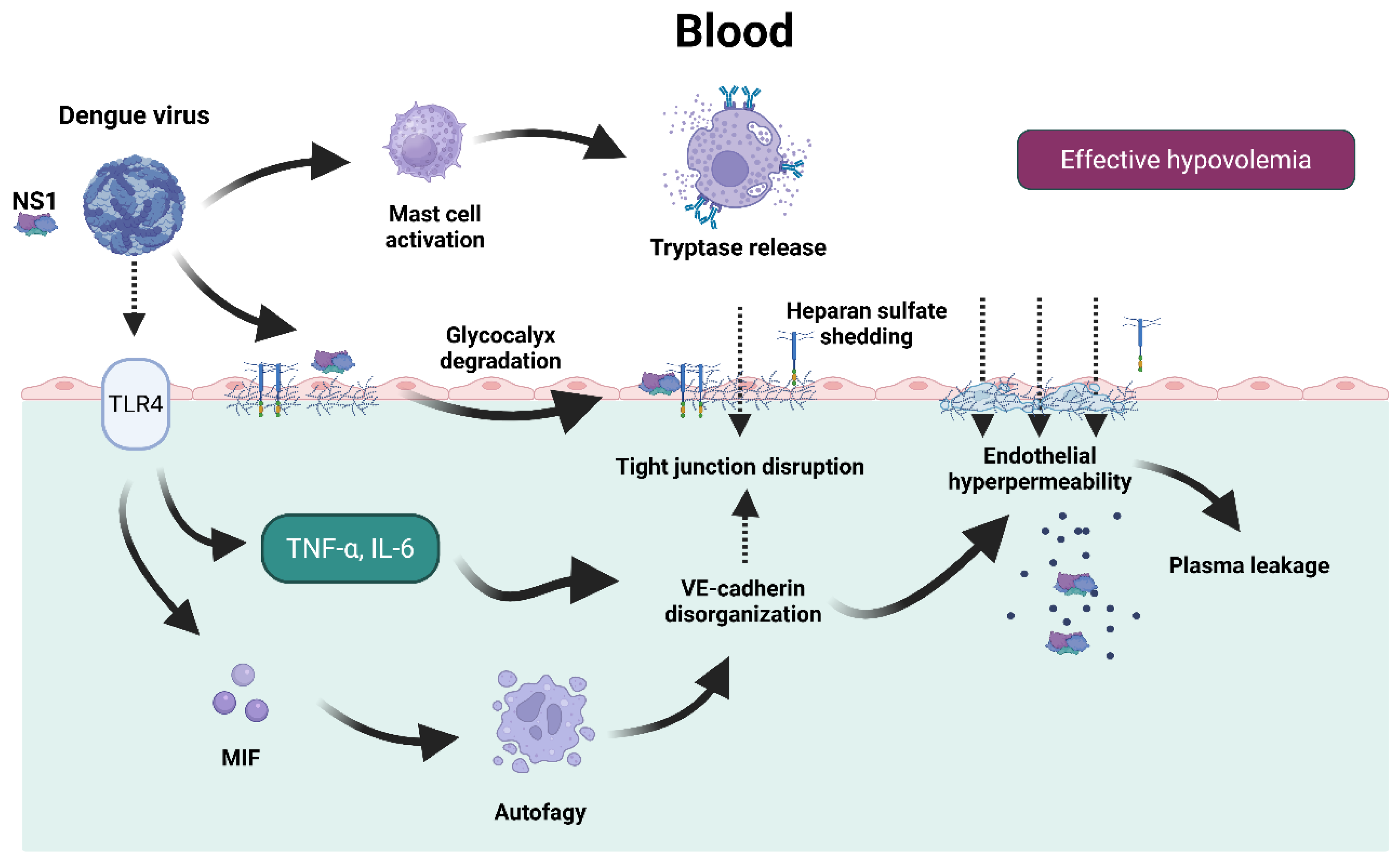
Figure 2.
Mechanistic pathways of acute kidney injury in dengue. (A) Renal hypoperfusion leads to ischemia–reperfusion injury, mitochondrial dysfunction, oxidative stress, and tubular epithelial damage with cast formation. (B) Glomerular injury is characterized by endothelial dysfunction, capillary thrombosis, and inflammatory cell infiltration, consistent with thrombotic microangiopathy. (C) Rhabdomyolysis contributes to renal injury through myoglobin release and heme-mediated oxidative stress, promoting pigment-induced tubular toxicity. These interconnected pathways converge to produce acute kidney injury (AKI). Created with BioRender https://BioRender.com/gykx40e; figure preparation was completed in April 2026.
Figure 2.
Mechanistic pathways of acute kidney injury in dengue. (A) Renal hypoperfusion leads to ischemia–reperfusion injury, mitochondrial dysfunction, oxidative stress, and tubular epithelial damage with cast formation. (B) Glomerular injury is characterized by endothelial dysfunction, capillary thrombosis, and inflammatory cell infiltration, consistent with thrombotic microangiopathy. (C) Rhabdomyolysis contributes to renal injury through myoglobin release and heme-mediated oxidative stress, promoting pigment-induced tubular toxicity. These interconnected pathways converge to produce acute kidney injury (AKI). Created with BioRender https://BioRender.com/gykx40e; figure preparation was completed in April 2026.
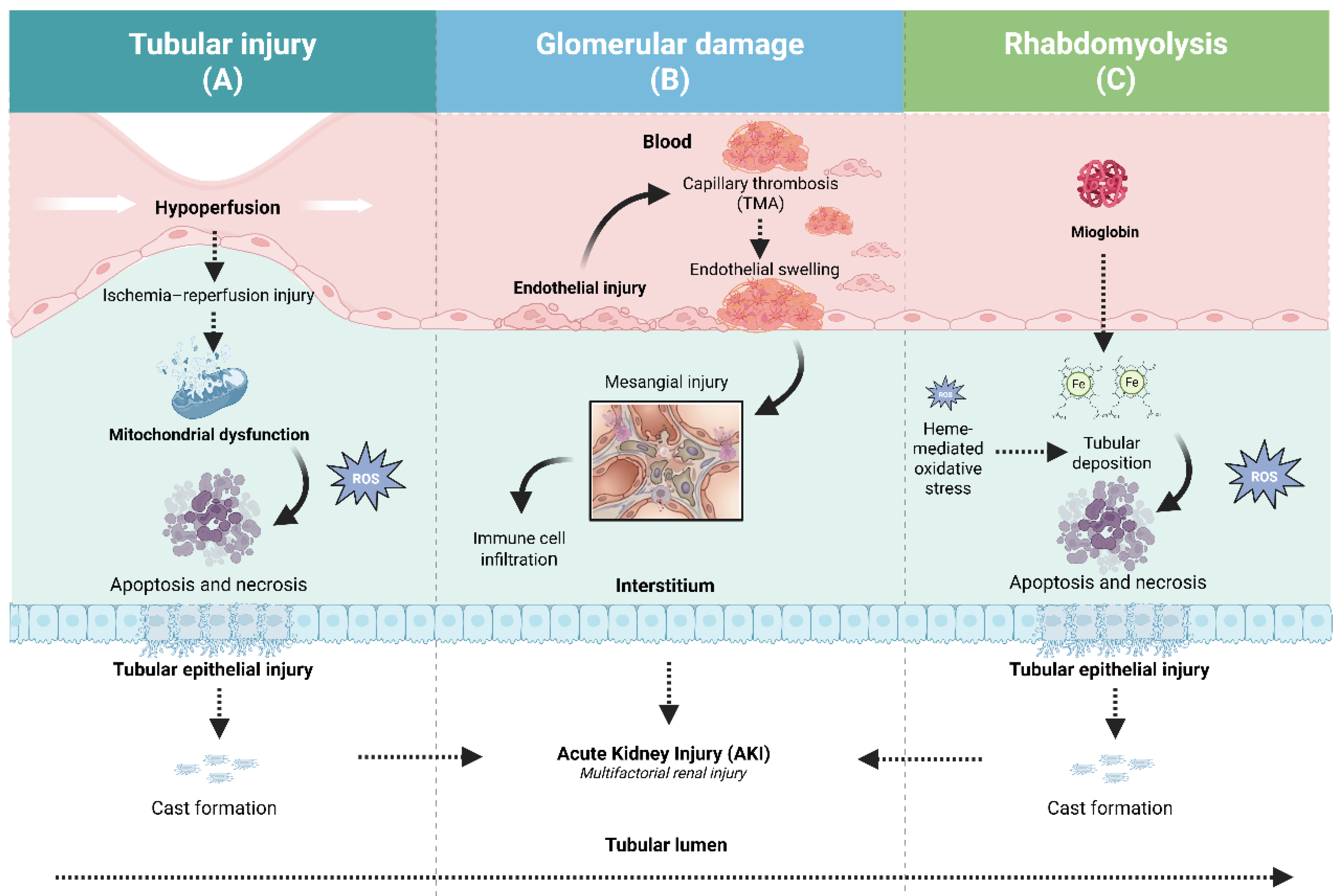

Table 1.
Principal functions of DENV proteins (structural and non-structural).
| Protein | Main function | Role in pathogenesis / immune evasion | Reference |
|---|---|---|---|
| Structural | |||
| C (Capsid) | Packages the genomic RNA, drives nucleocapsid assembly, and interacts with cellular membranes | Contributes to virion stability and may modulate host cellular responses and apoptosis-related pathways | Ma L et al., [24]; Samsa MM et al., [22] |
| prM/M | Functions as a chaperone for E protein, prevents premature fusion, and participates in virion maturation after furin cleavage (prM→M) | Regulates virion maturation and stability; partially immature prM-containing particles may alter antibody neutralization | Yu IM et al., [21]; Mukherjee S et al., [25] |
| E (Envelope) | Mediates receptor binding and membrane fusion through the dimer-to-trimer rearrangement | Major target of neutralizing antibodies and a key determinant of viral tropism | Modis Y et al., [26] |
| Non-structural | |||
| NS1 | Secreted and membrane-associated glycoprotein that acts as a replication cofactor | Involved in endothelial dysfunction, complement activation, immune evasion, and serves as an important serological marker | Avirutnan P et al., [27]; Beatty PR et al., [28]; Modhiran N et al., [29] |
| NS2A | Participates in replication complex assembly and membrane remodeling | May modulate membrane permeability and contribute to innate immune evasion | Xie X [30]; Xie X [31] |
| NS2B | Essential cofactor of the NS3 protease | Enables viral polyprotein processing | Yusof R [32]; Leung D [33] |
| NS3 | Viral protease (in complex with NS2B), helicase, and NTPase | Essential for RNA replication and protein maturation | Yusof R [32]; Leung D [33] |
| NS4A | Promotes intracellular membrane remodeling and supports viral replication | Induces replication vesicles and endoplasmic reticulum stress | Miller S [34] |
| NS4B | Antagonist of innate immune signaling | Inhibits interferon signaling pathways and promotes viral replication | Muñoz-Jordán JL [35] |
| NS5 | RNA-dependent RNA polymerase and methyltransferase required for viral RNA capping | Drives genome replication and antagonizes interferon-mediated antiviral responses | Ashour J [36] |
Abbreviations: C: capsid; prM: premembrane protein; M: membrane protein; E: envelope protein; NS: non-structural protein; RNA: ribonucleic acid; NTPase: nucleoside triphosphatase; IFN: interferon. Note: This table highlights DENV protein functions most relevant to the mechanistic discussion of renal involvement and does not intend to summarize all known viral functions.
Table 2.
Renal outcomes reported in studies of dengue patients from Latin America.
| Author | Design | Serotype(s) | AKI n/N (%) | Oliguria, n/N (%) | RRT, n/N (%) | Mortality, n/N (%) |
|---|---|---|---|---|---|---|
| Póvoa et al., 2014 [8] |
Post-mortem case series | DENV-3 | 1/4 (25) | 1/4 (25) | NR | 4/4 (100) |
| Repizo et al., 2014 [55] |
Case report | NR | 1/1 (100) | NR | 1/1 (100) | 0/1 (0) |
| Guerra Nunes et al., 2019 [59] |
Case series | NR | NR | NR | NR | 4/4 (100) |
| Coelho Júnior et al., 2021 [93] |
Case series | NR | 2/2 (100) | 1/2 (50) | 2/2 (100) | 0/2 (0) |
Abbreviations: AKI, acute kidney injury; NR, not reported; RRT, renal replacement therapy.
Disclaimer/Publisher’s Note: The statements, opinions and data contained in all publications are solely those of the individual author(s) and contributor(s) and not of MDPI and/or the editor(s). MDPI and/or the editor(s) disclaim responsibility for any injury to people or property resulting from any ideas, methods, instructions or products referred to in the content. |
© 2026 by the authors. Licensee MDPI, Basel, Switzerland. This article is an open access article distributed under the terms and conditions of the Creative Commons Attribution (CC BY) license (http://creativecommons.org/licenses/by/4.0/).
Copyright: This open access article is published under a Creative Commons CC BY 4.0 license, which permit the free download, distribution, and reuse, provided that the author and preprint are cited in any reuse.


