

Submitted:
08 May 2026
Posted:
09 May 2026
You are already at the latest version
Abstract
Bitter taste receptors (T2Rs), specifically T2R38, are present in the respiratory epithelium and react with bacterial quorum-sensing molecules to induce an innate immunity response. Although T2R38 polymorphisms have been correlated with susceptibility to chronic rhinosinusitis (CRS), they have not yet been explored in odontogenic rhinosinusitis (ORS), a distinct form of CRS with particular microbial and inflammatory features. Objectives: We aim to establish a proof-of-concept methodology for investigating T2R38 genetic variants in ORS using direct maxillary sinus tissue analysis and demonstrate the feasibility of this translational approach. Methods: We conducted a prospective case-control study of 36 ORS patients and 37 controls undergoing septoplasty without sinonasal disease. Maxillary sinus mucosal biopsies were obtained intraoperatively with informed consent. Genomic DNA was extracted using the PureLink Genomic DNA Mini Kit and quantified via NanoDrop spectrophotometry. T2R38 haplotypes were determined and classified as taster (PAV/PAV), non-taster (AVI/AVI), or intermediate (PAV/AVI) phenotype. Results: T2R38 phenotype distributions between ORS patients and controls were: tasters 11.1% vs 18.9%, non-tasters 27.8% vs 18.9%, and intermediate phenotypes 50.0% vs 37.8%, respectively. Statistical analysis revealed no significant association between T2R38 phenotypes and ORS susceptibility (Pearson χ² = 0.372, df = 1, p = 0.542; Fisher's exact test p = 0.595). The effect size was minimal (φ = 0.07). Non-taster phenotype showed a non-significant trend toward higher prevalence in ORS patients (OR = 1.4, 95% CI: 0.5–3.9, p > 0.5), though this finding lacks statistical power given the sample size. Conclusion: This proof-of-concept study successfully demonstrates the feasibility of T2R38 genotyping from maxillary sinus mucosa in ORS patients, establishing a novel methodological framework for investigating genetic factors in odontogenic sinonasal disease. While preliminary findings suggest potential phenotype differences (non-taster prevalence: 27.8% vs 18.9%), the study's primary value lies in validating the translational approach and informing power calculations for definitive multicenter investigations. This methodology provides the foundation for future studies to elucidate the role of taste receptor genetics in ORS pathogenesis and potentially guide personalized therapeutic strategies.
Keywords:
bitter taste receptor
; odontogenic rhinosinusitis
; T2R38
; bacterial infection
; nitric oxide
Introduction
Chronic rhinosinusitis (CRS) is a frequent inflammatory condition of the nasal and paranasal sinus mucosa, affecting approximately 11% of the adult population and significantly impacting quality of life and healthcare systems worldwide [1].
ORS represents a distinct clinical subtype among CRS, account for 25% to 40% of all chronic maxillary sinusitis, [2,3] occurs unilaterally most commonly, [4,5,6] and represents 45% to 75% of unilateral maxillary sinus opacification on computed tomography (CT).
Etiology is attributed to dental infections, iatrogenic injury during dental procedures, or the migration of dental materials into the maxillary sinus, periodontal disease that had perforated the Schneiderian membrane, implant procedure with the very frequent maxillary grafting, irritation and secondary infection caused by intra-antral foreign bodies, with no prior sinonasal inflammation [7,8,9].
The frequency of this pathology is quite often underestimated, according to de Wuokko-Landén et al. approximately 15% of acute rhinosinusitis may be odontogenic [10]. Regarding CRS approximately a quarter of the diagnosed cases could be of dental causes [11].
ORS typically involves polymicrobial aerobic-anaerobic bacteria of oral origin, most frequently found are Peptostreptococcus spp, Prevotella intermedia, and Fusobacterium [11] and presents unique microbiological and radiological features, distinguishing it from classical CRS [2,9,12].
Management ORS involves a shared decision-making process between the otolaryngologist and the dentist [3]. However, interdisciplinary collaboration is not always easy to achieve, and ORS can become difficult to treat.
In recent years, bitter taste receptors (T2Rs), particularly T2R38, have emerged as key components in innate immunity of the upper airways and gastrointestinal system. These receptors, initially described in gustatory cells [13], are also expressed in the respiratory epithelium where they detect bacterial quorum-sensing molecules and trigger nitric oxide production, mucociliary clearance, and antimicrobial responses [4,5,6,12,13]. Based on existing studies, the presence of bitter taste receptors may represent a viable therapeutic target in the treatment of CRS Several studies have demonstrated that certain TAS2R38 genotypes, especially the non-functional AVI/AVI variant, is linked to increased susceptibility to CRS and complications after sinus surgery [14,15,16,17]. However, the role of bitter taste receptors in odontogenic rhinosinusitis has not been explored to date.
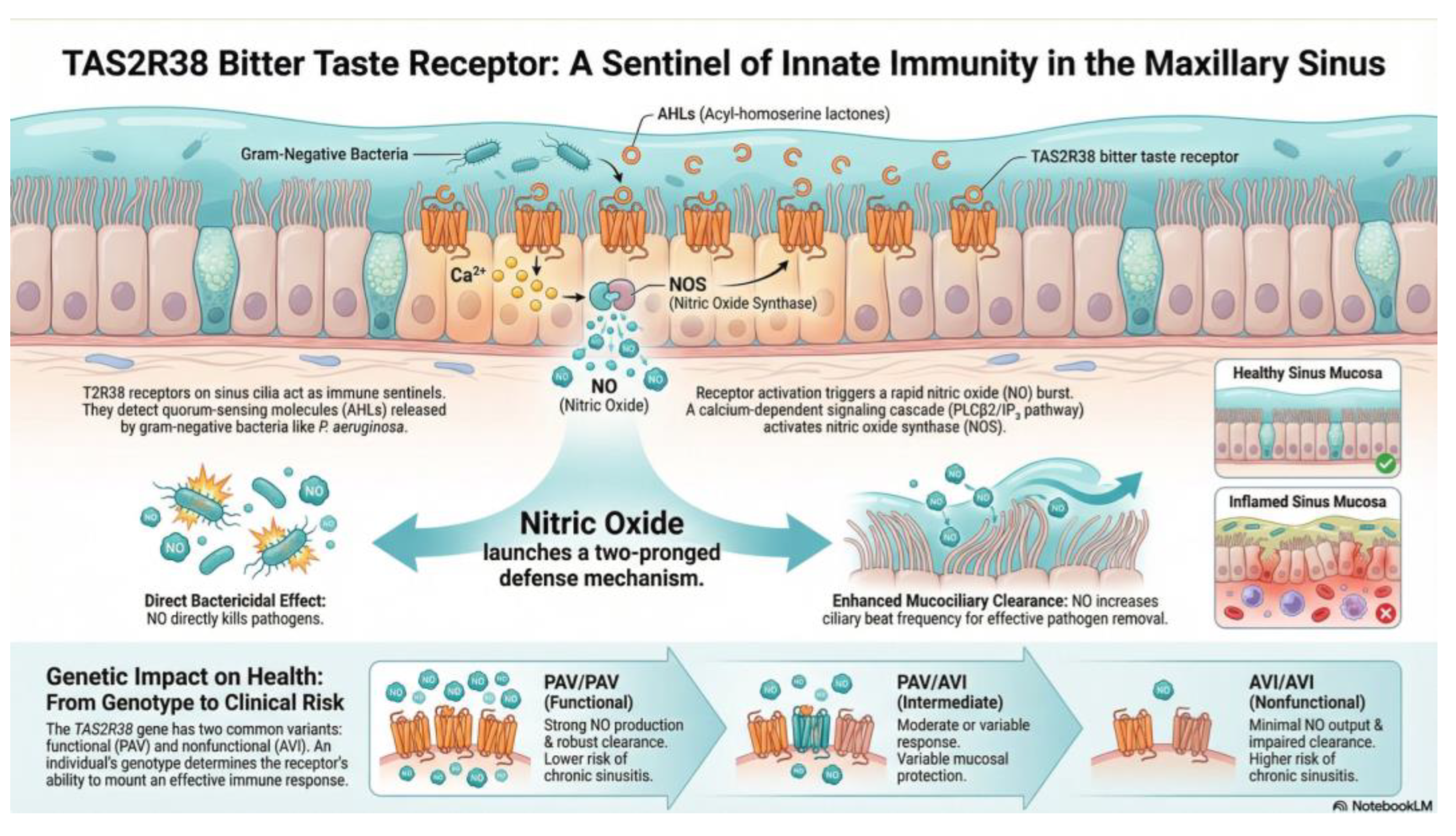
Bitter taste receptors (T2Rs) are G protein-coupled receptors (GPCRs) are found in ciliated epithelial cells and solitary chemosensory cells (SCCs) of the upper respiratory tract. T2R38, one of the most studied bitter taste receptors, can recognize acyl-homoserine lactones (AHLs) and quinolones, signaling molecules secreted by Gram-negative bacteria such as Pseudomonas aeruginosa [18].
Given the distinct etiopathogenesis of ORS, which involves direct exposure of the sinus mucosa to oral pathogens and dental infection and inflammation, we hypothesized that genetic variations in bitter taste receptors may influence individual susceptibility to ORS. This study aims to compare the genotypic profile of TAS2R38 in patients with ORS versus control patients with septal deviation and without sinus pathology, in the Romanian population, to explore a possible immunogenetic predisposition to this subtype of sinusitis.
Figure 1.
The implications of TAS2R38 Bitter Taste Receptors in the Immunity of the Maxillary Sinus.
Figure 1.
The implications of TAS2R38 Bitter Taste Receptors in the Immunity of the Maxillary Sinus.
Method& Materials
Study design
We performed a prospective study from 1st of January 2023 till 10th of November 2024 where we enrolled subjects presenting with odontogenic sinusitis. Eligible patients presenting during the study period were consecutively enrolled to ensure an unbiased and representative sample.
Inclusion criteria – Odontogenic maxillary sinusitis group
- Men and women age 18-65 years that gave us explicit consent for harvesting mucosal biopsy from the affected sinus during surgery for histologic or molecular analysis
- Diagnosis of odontogenic maxillary sinusitis confirmed by CT scan, which was re-evaluated at admission by the attending surgeon.
- Lund-Mackay score >3 on the affected sinus
- Complete endoscopic evaluation confirming sinus involvement
- Indication for Functional Endoscopic Sinus Surgery (FESS)
- Presence of at least one symptom for ≥ 6 weeks including: ongoing purulent rhinorrhea, facial pressure, foul odor, nasal obstruction.
- History of previous sinus surgery permitted
- Non-smoker
Exclusion criteria - Odontogenic maxillary sinusitis group
- Age<18 or >65
- Active or chronic immune disorders or current immunosuppressive therapy
- Acute upper respiratory infection at the time of enrollment
- Smokers
- Pregnancy or lactation
Control group- Inclusion criteria
- Men and women with the age between 18 and 65 undergoing septoplasty secondary to septal deviation
- Absence of clinical or endoscopic signs of sinus disease at the time of evaluation
- Willingness to provide informed consent for use of biopsy material in research
- No requirement for CT imaging beyond clinical indications, in accordance with ethical standards.
- Not age- or sex-matched to the study group but recruited from the same patient population.
- Septal mucosal biopsy obtained from standardized anterior septal location to ensure sampling consistency
Control group- Exclusion criteria
- Patient with history of endoscopic evidence of acute or chronic rhinosinusitis
- Previous sinonasal or maxillofacial surgery
- Systemic inflammation or immunologic disorders
- Recent prescribed or self-administered antibiotic or corticosteroid therapy- 4 weeks prior surgery
- Smokers
- Pregnancy or lactation
Ethical Approval & Consent
All procedures involving human participants were conducted in agreement with the ethical standards of the Institutional Research Committee of The University of medicine and Pharmacy “Iuliu Hatieganu” (Approval No. [DEP245/29.08.2022]) and with the 1964 Helsinki declaration and its later amendments. Written informed consent was obtained from all participants prior to enrollment. Biopsies were performed under general anesthesia, minimizing discomfort and bleeding. Participants provided specific consent for genetic testing and storage of genomic material. No financial compensation was offered; participations was voluntary.
Sample Collection & Preservation
The biologic material was preserved as it has been harvested, within 5 minutes of excision, in a liquid nitrogen container, transported, stored and processed together at the Genomics Department, MEDFUTURE Institute for Biomedical Research at the University of Medicine and Pharmacy “Iuliu Hațieganu”, Cluj Napoca. Sterile and surgical instruments and DNase/RNase -free 2 ml tubes were used. Each sample was labeled with a unique identifier to maintain confidentiality. Samples were stored ant -196 °C and processed in one batch within 24 months of collection.
DNA extraction
At least 25 ng of tissue was used per extraction. DNA was extracted from tissue samples from 36 cases and 37 controls using the Purelink Genomic DNA Mini Kit (ThermoFisher Scientific). The extracted DNA was quantified using the Nanodrop spectrophotometer and the DNA concentration was between 6.2-435.9ng/µl.
SNP genotyping assay
For the genotyping analysis, we analyzed the TAS2R38 rs713598, rs1726866, and rs10246939 using three different SNP assays: c_8876467_10, c_9506827_10, and c_9506826_from ThermoFisher Scientific. These SNPs were selected due to their known functional relevance in bitter taste receptor signaling and potential modulation of sinonasal immunity. Mainly we used 40ng/ µl of DNA, 5µl of TaqMan Genotyping Master mix 2X (ThermoFisher Scientific), 0.5µl of SNP assay 20X, and 3.5µl of DNase-free water. The reactions were amplified on the Viia 7 real-time PCR instrument using the following protocol: 1 cycle-60°C-30sec; 1 cycle -95°C -10 min, 45 cycles -95°C-15sec and 60°C-1 min, 1 cycle-60°C -30 sec. The data analysis was done on the instrument’s software, which discriminates between homozygote for the wildtype allele, heterozygote or homozygote for the mutant allele.
Optional Methodological Enhancements
Laboratory personnel performing the DNA extraction and genotyping were aware of the case or control status of the samples. They were blinded to the expected genotypes and the study hypotheses, reducing the risk of observer bias. All samples were processed simultaneously using the same kit and reagents, ensuring uniform handling and minimizing batch effects. This approach maintained procedural consistency across all samples and strengthened the reliability and comparability of genotyping results between cases and controls.
Results
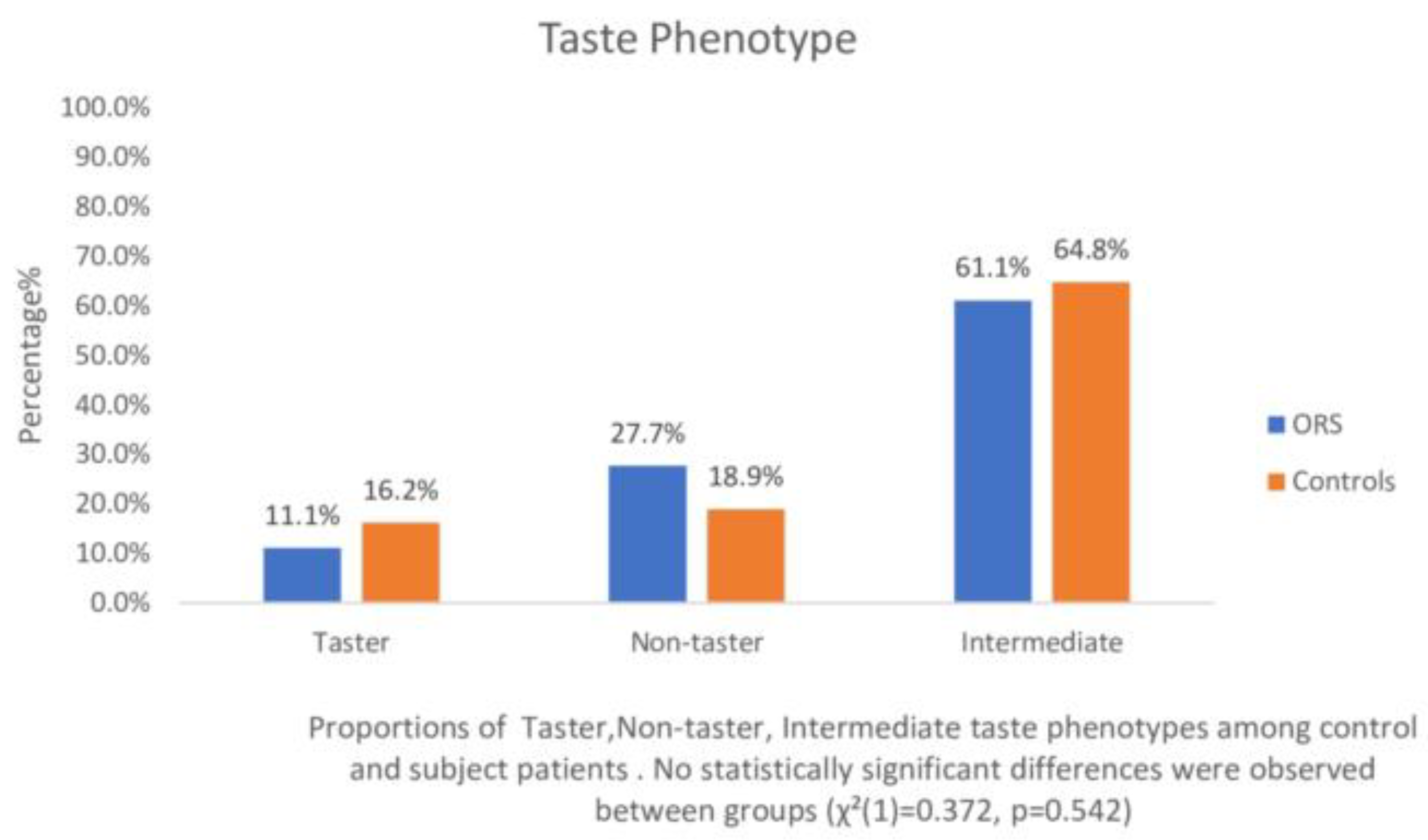
In the odontogenic sinusitis group, we have found 4(11.1%) Taster (PAV/PAV), 10(27.8%) Non-taster (AVI/AVI), 18(50%) Intermediate (PAV/AVI), 2(5.6%) Mixed, 2(5.6%) Incomplete. For the control group there are 7(18.9%) Tasters, 7(18.9) Non-tasters,14(37.8%) Intermediate, 6(16.2%) Mixed, 3(8.1%) Incomplete.
“Mixed“define genotypes that don’t fit classic PAV or AVI patterns (atypical or inconsistent SNP combinations), possibly rare or recombined haplotypes, not clearly assignable to PAV or AVI and TAS2R38 haplotypes (PAV and AVI) are defined by a specific pattern across all 3 SNPs. These could be: recombination variants, sequencing/genotyping errors or rare haplotypes not covered by PAV/AVI nomenclature. The genotype distributions of the polymorphism did not deviate significantly from Hardy–Weinberg equilibrium in either the odontogenic sinusitis group or the control group.
The” Incomplete data” describe missing genotype data for one or more SNPs.
“Mixed” and “Incomplete data” were included in the intermediate group.
Statistical Analysis
All statistical analyses were conducted using MedCalc® Statistical Software version 23.3.7 (MedCalc Software Ltd., Ostend, Belgium; https://www.medcalc.org; 2025). SNP genotype frequencies in cases and controls were tested for Hardy-Weinberg equilibrium. Differences between groups were verified using the Fisher’s exact test. A p value <0.05 was considered statistically significant.
The distribution of taste phenotypes did not differ significantly between the two groups (Pearson χ² (1) = 0.372, p = 0.542; Fisher’s exact p = 0.595). The phi coefficient, indicating effect size, was 0.07, consistent with a very small effect. The odds ratio for being a nontaster in the ORS group versus controls was 1.4 (95% CI: 0.5–3.9), suggesting a non-significant trend toward higher nontaster prevalence in the ORS group.
Figure 2.
Proportions of Taster, Non-taster, Intermediate taste phenotypes among control and subject patients. No statistically significant differences were observed between groups (χ²(1)=0.372, p=0.542).
Figure 2.
Proportions of Taster, Non-taster, Intermediate taste phenotypes among control and subject patients. No statistically significant differences were observed between groups (χ²(1)=0.372, p=0.542).
Pearson Chi-Square: χ² (1) =0.372, p=0.542
Fisher’s exact (2-sided): p=0.595
Phi coefficient (equivalent to Cramér’s V for 2×2): ≈0.07 → trivial
Odds ratio for Non-taster (ORS vs Control) =1.4
(95% CI ≈ 0.5–3.9, p > 0.5)
Discussions
The role of polymicrobial biofilms has been a major focus of discussion in the scientific literature, particularly concerning ORS cases that show resistance to treatment. Bacterial biofilms are dynamic, multispecies microbial communities in which bacteria replicate, maintain metabolic activity, and become embedded in a matrix composed primarily of exopolysaccharides, proteins, and nucleic acids [5].
Dr. Matthias Troeltzsch and co. conclude that the pathologies associated with dental implants are recognized as important etiological factors in maxillary sinusitis that necessitates surgical management [7]. Until recently, odontogenic rhinosinusitis was classified within the broader framework of chronic rhinosinusitis and largely regarded as an anatomical variant defined by its dental origin rather than as a pathophysiological distinct condition [1]. This classification has increasingly been questioned as accumulating clinical, microbiological, and immunological evidence suggests that ORS is not a uniform entity, but rather an umbrella term encompassing several mechanistically distinct subtypes determined by their underlying dental cause. The main categories that are periapical pathology, periodontal disease, implant-related sinusitis, and iatrogenic post-surgical disease, differ substantially in terms of the microbial inoculum introduced into the sinus, the chronicity of bacterial translocation, and the tissue environment in which the inflammatory response develops.
Periapical pathology typically introduces a predominantly polymicrobial anaerobic immunostimulant through direct apical-to-sinus fistulization, most often resulting in a chronic, low-grade inflammatory profile [19]. Periodontal disease, in contrast, introduces a biofilm community that is already shaped by subgingival dysbiosis, commonly enriched in Porphyromonas gingivalis, Treponema denticola, and Tannerella forsythia, and characterized by the well-documented immune-modulating and immune-evasive properties of this microbial conglomerate [20]. Implant-related sinusitis, an increasingly recognized subtype in the era of reconstructive dentistry [7], represents a more complex scenario in which infectious processes coexist with mechanical irritation and foreign-body–driven immune activation, including increased expression of IL-4 and IL-13, creating an inflammatory environment that is not fully captured by existing CRS endotype frameworks [21]. Iatrogenic ORS, typically arising from sinus floor perforation or sinus-lifting procedures, represents a temporally defined acute inoculation event occurring in a previously healthy sinus and may therefore be more easily resolved once the dental source has been eliminated than more chronic subtypes.
These etiological differences have important implications for the inflammatory profile of the sinus mucosa and, importantly, for research on TAS2R38 genotype. The capacity of the colonizing microbial community to activate T2R38 signaling is likely to vary across these etiological subtypes, meaning that the functional impact of PAV/PAV versus AVI/AVI genotype status may not be uniform throughout the ORS spectrum. For this reason, future studies should incorporate structured etiological stratification as a central analytical variable rather than treating ORS as a single, homogeneous condition. Such an approach may help clarify genotype–endotype relationships that could otherwise remain obscured in aggregated analyses.
Odontogenic maxillary sinusitis is known to be enriched for anaerobes such as Fusobacterium, Prevotella, Porphyromonas and mixed anaerobic flora, with lower prevalence of Staphylococcus and Pseudomonas compared with CRS [22,23,24]. In CRS the predominant bacteria found are Staphylococcus aureus and anaerobes (Prevotella, Porphyromonas, Fusobacterium, Peptostreptococcus), with gram-negative rods appearing more frequently in nosocomial or high-risk settings [25,26,27]. Recent meta-analyses and microbiome studies confirm the distinct profile, with Fusobacterium and anaerobes beeing indicators for odontogenic disease [23,28].
Human neutrophils express functional T2R38 receptors. The Pseudomonas aeruginosa quorum-sensing molecule 3-oxo-C12-HSL (AHL-12) is internalized and co-localizes with T2R38, with direct interaction confirmed by pull-down assays. Blocking T2R38 reduces AHL-12 binding and activation, indicating that T2R38 functions as a receptor for this AHL molecule [29,30]. Structural and functional studies of airway bitter taste receptors have shown that 3-oxo-C12-HSL and C8-AHL can activate other receptors in this family, including T2R4, T2R14, and T2R20, at a micromolar higher potency. These interactions involve defined binding sites located in extracellular loop 2 of the receptors [31]. Available evidence indicates that T2R38, together with other T2Rs, contributes to the detection of AHL-mediated signaling from gram-negative bacteria including Pseudomonas aeruginosa [30,31,32,33]. T2R38 activation differs qualitatively by bacterial group: gram-negative pathogens primarily engage T2R38 via specific quorum-sensing signals (AHLs, quinolones), whereas gram-positive–rich communities appear to activate T2R38 via broader small-molecule metabolites rather than known peptide QSMs [34,35].
A key mechanistic consideration arising from the microbial profile of ORS concerns the capacity of the dominant odontogenic anaerobes to engage T2R38-mediated innate defenses. The existing literature on T2R38 activation is based on Pseudomonas aeruginosa, where the 3-oxo-C12-HSL serves as the canonical agonist. In contrast, the main organisms in ORS: Fusobacterium nucleatum, Prevotella intermedia, and Porphyromonas gingivalis are gram-negative anaerobes that do not utilize classical AHL-based quorum sensing. Instead, they primarily use the LuxS/AI-2 system, generating (2S,4S)-2-methyl-2,3,3,4-tetrahydroxytetrahydrofuran borate (S-THMF-borate) as their principal interspecies signaling molecule [36,37], along with species-specific effectors such as gingipain proteases and d-amino acid–containing peptides from P. gingivalis. Whether these non-AHL quorum-sensing molecules can functionally activate T2R38 or related receptors (T2R4, T2R14, T2R20) remains largely unexplored.
Interestingly, short-chain fatty acids, particularly butyrate and propionate, which are abundant end-products of anaerobic fermentation by all three genera, have been shown to activate bitter taste receptors at physiologically relevant concentrations [38]. This suggests a potential alternative pathway for T2R engagement in the anaerobe-rich ORS microenvironment. Additionally, P. gingivalis can subvert pattern recognition pathways through its atypical lipid A structure, acting as a TLR4 antagonist rather than an agonist [39,40], while its gingipain proteases actively degrade complement components and immunoglobulins, further attenuating mucosal defense [20].
In polymicrobial ORS biofilms, cross-species AI-2 signals can modulate gene expression across species, and minor aerobic or facultatively anaerobic gram-negative constituents, such as Pseudomonas or Haemophilus. That may generate AHL signals sufficient to engage T2R38, even if they are not numerically dominant. Together, these observations suggest that T2R38 may function less as a direct sentinel of the primary ORS pathogens and more as a detector of the broader quorum-sensing environment within the polymicrobial biofilm. In this framework, the protective advantage of the PAV/PAV functional genotype in the maxillary sinus would operate through enhanced NO-driven mucociliary clearance in response to metabolic cues from the biofilm, rather than through direct recognition of species-specific AHLs. In an opposite manner, AVI/AVI non-tasters, lacking this signal amplification, may be more susceptible to persistent colonization by anaerobe-dominated communities, because these organisms are relatively weak activators of T2R38 through canonical pathways. This creates a selective susceptibility that is mechanistically distinct from, but conceptually parallel to the gram-negative vulnerability observed in CRS. This hypothesis is biologically testable and provides a strong rationale for integrating sinus microbiome sequencing with T2R functional phenotyping in future ORS cohort studies.
Current evidence supports immunological distinctions between odontogenic rhinosinusitis and classic chronic rhinosinusitis. Histopathological studies show that eosinophilic infiltration, although present in a substantial proportion of ORS cases (39.1%), occurs significantly less frequently than in chronic rhinosinusitis with nasal polyps (CRSwNP), where it is reported in 63.2% of cases (p < 0.05). In addition, ORS demonstrates lower levels of squamous metaplasia and fibrosis compared with CRSwNP, and its inflammatory pattern more closely resembles that observed in chronic rhinosinusitis without nasal polyps (CRSsNP), often accompanied by pronounced acute-on-chronic inflammatory changes [41].By contrast, CRSwNP is typically associated with type 2 inflammation, characterized by eosinophil-dominant tissue infiltration, submucosal oedema, and increased expression of IL-4, IL-5, and IL-13 [42,43,44]. This immunological profile is not consistently observed in ORS.
Mucociliary dysfunction is a well-established contributor to chronic rhinosinusitis pathogenesis, but its role in ORS may be comparatively less pronounced. Histological studies have suggested that the Schneiderian membrane in ORS may exhibit relatively preserved epithelial barrier integrity, reflected by increased expression of tight junction proteins [42]. However, direct functional comparisons of mucociliary clearance between odontogenic and non-odontogenic types of sinusitis remain limited in the current literature, highlighting an important methodological gap.
Taken together, the microbiological, immunological, and genetic evidence supports a coherent model of ORS that is mechanistically distinct from classic CRS, justifying its conceptualization as an independent disease entity rather than a mere anatomica variant of chronic rhinosinusitis. The initiating event, odontogenic bacterial translocation into the maxillary sinus, introduces a polymicrobial, anaerobe-dominated community [22,23,24] that, as described above, relies on LuxS/AI-2 and SCFA-mediated intercellular signaling rather than AHL chemistry. This has a direct consequence for first-line epithelial defense: the NO-driven mucociliary clearance axis [45,46] receives a comparatively weak activating stimulus from the dominant ORS flora, even in PAV/PAV individuals, as SCFA-mediated T2R engagement provides only a lower-potency compensatory signal insufficient to substitute for AHL-driven activation. In AVI/AVI non-tasters, this already attenuated response is further diminished by intrinsically reduced T2R38 receptor function [47,48], producing a compounded innate defense deficit that is qualitatively and quantitatively distinct from that observed in gram-negative-dominant CRS. The downstream immunological consequence of this failure of early innate clearance is not type 2 polarization — the absence of sufficient aeroallergen or staphylococcal superantigen exposure precludes the IL-4/IL-5/IL-13 axis characteristic of CRSwNP [42,43,44] but rather the neutrophil-dominant, acute-on-chronic inflammatory state histopathologically established above [41,42]. We propose that the preserved epithelial tight junction integrity observed in ORS should not be interpreted as a marker of immunological competence. Rather, it reflects a fundamentally different failure mode: not barrier destruction driven by eosinophil-mediated remodeling, but clearance paralysis resulting from insufficient T2R38 engagement during the critical early window of colonization, a deficit further amplified by the active immune subversion mechanisms of P. gingivalis described above [20,39,49]. We further propose that TAS2R38 genotype operates not as a binary susceptibility switch but as a quantitative modulator of innate response threshold, with AVI/AVI individuals positioned at the vulnerable end of a continuous spectrum shaped by both receptor function and the intrinsically low T2R38-activating potential of the colonizing microbiota. Clinically, this model predicts that AVI/AVI patients with odontogenic implant-related or periodontal sinusitis, where anaerobe burden is highest, represent the subgroup at greatest risk of biofilm persistence, medical treatment failure, and disease recurrence following surgical intervention [7,47,48], and therefore the population most likely to benefit from adjunctive T2R agonist-based topical therapy aimed at pharmacologically restoring receptor-mediated innate signaling.
Starting with the established evidence that TAS2R38 Polymorphisms influence the course of chronic rhinosinusitis and upper airway defensive mechanisms [50,51], the present study establishes the first methodological framework for investigating bitter taste receptor TAS2R38 and related T2Rs on cilia from maxillary, ethmoid, sphenoid, and middle turbinate epithelium, confirming that the NO mucociliary clearance axis operates directly within the maxillary sinus mucosa [45]. Given the relatively dependent drainage anatomy of the maxillary sinus and its high predilection for stagnant mucus and biofilm accumulation, a pathway coupling bacterial sensing to rapid NO release and ciliary acceleration is particularly critical for local clearance and biofilm control [46,52]. Functional T2R38 (PAV/PAV) is associated with better bacterial clearance, fewer infections, and reduced need for sinus surgery, whereas AVI/AVI genotypes are linked to more frequent gram-negative infection, biofilm formation, and medically recalcitrant CRS [18,46,47,48]. These associations are derived largely from maxillary and other sinus tissue in surgical CRS cohorts and have not been established in ORS.
TAS2R38 genotype-based risk stratification holds potential for predicting susceptibility to maxillary sinus infection and likelihood of surgical intervention [47]. T2R agonists — including quinine and flavones — increase NO production and ciliary beating in sinonasal cultures and are under investigation as topical therapies to enhance innate maxillary sinus defenses, particularly in patients with attenuated T2R38 function [49].
This study characterizes TAS2R38 genotype without a corresponding functional phenotypic assessment, representing an important methodological boundary that warrants explicit acknowledgment. The relationship between germline genotype and receptor functional output is not strictly deterministic: post-translational mechanisms including glycosylation, membrane trafficking efficiency, and G-protein coupling fidelity can modulate T2R38 activity independently of haplotype status. In the acutely inflamed ORS sinus environment, characterized by elevated IL-1β, TNF-α, and IL-17A, receptor expression may be further downregulated at the transcriptional level. Thus, even PAV/PAV individuals could exhibit attenuated T2R38 signaling during acute-on-chronic inflammatory episodes. On the oppsite spectrum, post-surgical resolution may restore receptor expression closer to genotype-predicted levels, such that functional phenotyping performed exclusively at the time of surgery may not accurately reflect a patient’s baseline immunological capacity. Validated strategies exist to bridge this genotype-phenotype gap. Systemic PROP or PTC taste testing provides a rapid, non-invasive surrogate of T2R38 functional status and has been used to stratify taster versus non-taster phenotypes independently of genotype in prior CRS cohorts. For sinonasal-specific functional assessment, ex vivo measurement of ciliary beat frequency (CBF) or nasal nitric oxide (nNO) from surgical brushings cultured at the air-liquid interface allows controlled bitter agonist challenge with direct receptor activity quantification, a protocol already established in cystic fibrosis and primary ciliary dyskinesia research programs. Immunofluorescence quantification of T2R38 protein in surgical mucosal specimens, architecturally accessible within the present study’s tissue collection protocol, can provide an intermediate layer of evidence between genotype and functional output, distinguishing whether reduced activity reflects receptor absence, mislocalization, or uncoupling. Future studies should incorporate at minimum a two-tier phenotyping strategy combining systemic taste testing at enrollment with ex vivo CBF or nNO functional assessment from surgical tissue, enabling construction of a genotype-expression-function axis that is currently absent from the ORS literature.
Unlike previous studies that analyzed nasal polyps, inferior turbinate, or ethmoid tissue, our approach samples directly from the diseased odontogenic sinus environment during an acute episode. The inclusion of only non-smoking patients without autoimmune diseases minimized potential confounders that may alter TAS2R expression, though this approach limited recruitment. This methodological rigor, while difficult for subject enrollment, enhances the translational validity of our protocol despite the limited sample size. Successful DNA extraction and genotyping from inflamed sinus mucosa demonstrates the practicability of this direct tissue approach for future genetic investigations in ORS.
Future research should evolve in several important areas to advance this translational methodology toward clinically meaningful applications. First, enlarging cohort size is essential to achieve adequate statistical power and adding stratification by established ORS severity classifications and microbiological profiles. Second, integrating sinus microbiome sequencing with TAS2R profiling could identify genotype-microbiota interactions influencing disease persistence or recurrence, and would allow prospective validation of the pathophysiological model proposed here. Functional mucociliary assessment across ORS and non-ORS sinusitis subtypes, combined with longitudinal immune endotype profiling following elimination of the odontogenic source, would directly address the methodological gaps identified above. Third, including patients with smoking history or autoimmune diseases in separate analytical cohorts would clarify the impact of these factors upon the genetic patterns. Finally, longitudinal follow-up of surgically treated ORS patients could assess whether TAS2R phenotype and genotype predict treatment outcomes, symptom resolution, or disease recurrence. These research directions provide a clear pathway from methodological validation toward statistically robust and clinically meaningful conclusions.
The present study was prospectively designed as a pilot, proof-of-concept investigation, with the primary objectives of: 1. establishing the feasibility of TAS2R38 genotyping in an odontogenic sinusitis population; 2. generating preliminary non-taster prevalence estimates, to inform future sample size planning and 3. to verify Hardy–Weinberg equilibrium in both groups, which is necessary for valid genotype–phenotype analysis. All three objectives were successfully achieved. Therefore, the lack of statistical significance in the comparison between groups represents the expected outcome of an exploratory study and should not be interpreted as evidence against the underlying biological hypothesis.
Sample size estimation for a future confirmational study was based on a minimum clinically relevant odds ratio (OR) of 2.0, consistent with effect sizes reported in the established TAS2R38 literature in chronic rhinosinusitis populations. In particular, Adappa ND. and colleagues [52] reported a significant enrichment of the AVI/AVI non-taster genotype among patients with chronic rhinosinusitis with nasal polyps refractory to standard medical therapy, with odds ratios ranging from approximately 2.0 to 3.5. Subsequent studies by Jeruzal-Świątecka J. et al. [53]. and Dżaman K et al. [54] further examined the relationship between TAS2R38 polymorphisms and sinonasal inflammatory disease. In particular, Jeruzal-Świątecka J. et al. reported an odds ratio of 1.43 for AVI haplotype frequency increase in CRSwNP compared to controls, indicating a modest but significant increase in risk. This magnitude is notably consistent with the directional trend observed in the present pilot study (OR 1.4, 95% CI 0.5–3.9), although the wide confidence interval reflects the limited sample size of the current cohort
Using a baseline non-taster prevalence of 18.9%—as observed in our control group—which is slightly below the reported European AVI/AVI frequency range of 25–30% [55,56], this relative reduction of non-tasters in the control cohort may reflect a degree of taster-mediated protection against sinonasal disease. This hypothesis is consistent with findings from Adappa et al. in CRSwNP [52]. Importantly, this feature makes our between-group comparison inherently conservative: when the control non-taster prevalence is already below the expected population baseline, the observed odds ratio of 1.4 likely underestimates the true magnitude of non-taster enrichment in ORS relative to the general population.
Based on these assumptions, applying a target OR of 2.0, a two-sided α of 0.05, and 80% power (β = 0.20), the estimated sample size required for a confirmatory trial is approximately 193 patients per group (386 total). To achieve 90% power under the same assumptions, roughly 260 patients per group (520 total) would be needed. These estimates, along with sensitivity analyses across a range of clinically plausible effect sizes, are summarized in Table 1.
After applying a pragmatic 10% attrition correction, consistent with the 5.6–8.1% rate of incomplete genotyping observed in the current pilot, the adjusted recruitment targets are approximately 215 participants per group (430 total) for 80% power and 290 per group (580 total) for 90% power. The observed OR of 1.4 is not used as the basis for sample size estimation, given the well-known limitations of post-hoc power calculations in underpowered studies; it is presented as preliminary empirical evidence confirming that the direction of effect aligns with both the a priori biological hypothesis and the literature-derived effect size used for confirmatory study planning.
Conclusions
Data collected indicate that, in this cohort, taste phenotype alone is not strongly associated with odontogenic rhinosinusitis. The observed difference may be too small to detect without a larger sample. While not reaching statistical significance, the observed trends may point toward a biological relevance warranting further investigation.
Author Contributions
The authors declare no conflict of interest. AL.GO. defined the research objectives, collected the data, carried out the investigation, interpreted the findings, and wrote the original manuscript draft. Conceptualization of the research was made by Professor S.A. and AL.GO. The present study was performed under the supervision and critical revision of Professor S. A. and professor A.R; I.BN. and Ș.S. contributed to study design, development of the genetic testing strategy, and methodological guidance. LA.P. contributed to sample processing and laboratory procedures. ȘC.V. performed the statistical analysis and contributed to interpretation of the data. V.T. was responsible in data curation, project administration, corresponding author.
Funding
This study has been supported by Research Grant No.882/48/12.01.2022 from Iuliu Hatieganu University of Medicine and Pharmacy, Cluj-Napoca.
Conflicts of Interest
The authors declare no conflict of interest.
References
- Fokkens, W.J.; Lund, V.J.; Hopkins, C.; Hellings, P.W.; Kern, R.; Reitsma, S.; et al. European position paper on rhinosinusitis and nasal polyps 2020. Rhinology 2020, 58, 1–464. [Google Scholar] [CrossRef]
- Craig, J.R.; Poetker, D.M.; Aksoy, U.; Allevi, F.; Biglioli, F.; Cha, B.Y.; et al. Diagnosing odontogenic sinusitis: An international multidisciplinary consensus statement. Int. Forum Allergy Rhinol. 2021, 11, 1235–1248. [Google Scholar] [CrossRef]
- Craig, J.R.; Tataryn, R.W.; Aghaloo, T.L.; Pokorny, A.T.; Gray, S.T.; Mattos, J.L.; et al. Management of odontogenic sinusitis: multidisciplinary consensus statement. Int. Forum Allergy Rhinol. 2020, 10, 901–912. [Google Scholar] [CrossRef]
- Melén, I.; Lindahl, L.; Andréasson, L.; Rundcrantz, H. Chronic maxillary sinusitis. Definition, diagnosis and relation to dental infections and nasal polyposis. Acta Otolaryngol. 1986, 101, 320–327. [Google Scholar] [CrossRef] [PubMed]
- Martu, C.; Martu, M.A.; Maftei, G.A.; Diaconu-Popa, D.A.; Radulescu, L. Odontogenic sinusitis: From diagnosis to treatment possibilities—a narrative review of recent data. Diagnostics 2022, 12, 1600. [Google Scholar] [CrossRef]
- Turfe, Z.; Ahmad, A.; Peterson, E.I.; Craig, J.R. Odontogenic sinusitis is a common cause of unilateral sinus disease with maxillary sinus opacification. Int. Forum Allergy Rhinol. 2019, 9, 1515–1520. [Google Scholar] [CrossRef] [PubMed]
- Troeltzsch, M.; Pache, C.; Troeltzsch, M.; Kaeppler, G.; Ehrenfeld, M.; Otto, S.; et al. Etiology and clinical characteristics of symptomatic unilateral maxillary sinusitis: A review of 174 cases. J. Craniomaxillofac Surg. 2015, 43, 1522–1529. [Google Scholar] [CrossRef] [PubMed]
- Saibene, A.M.; Collurà, F.; Pipolo, C.; Bulfamante, A.M.; Lozza, P.; Maccari, A.; et al. Odontogenic rhinosinusitis and sinonasal complications of dental disease or treatment: prospective validation of a classification and treatment protocol. Eur. Arch. Otorhinolaryngol. 2019, 276, 401–406. [Google Scholar] [CrossRef] [PubMed] [PubMed Central]
- Felisati, G.; Chiapasco, M.; Lozza, P.; Saibene, A.M.; Pipolo, C.; Zaniboni, M.; et al. Sinonasal Complications Resulting from Dental Treatment: Outcome-Oriented Proposal of Classification and Surgical Protocol. Am. J. Rhinol Allergy 2013, 27, e101–e106. [Google Scholar] [CrossRef] [PubMed]
- Brook, I. Sinusitis of odontogenic origin. Otolaryngol. Head. Neck Surg. 2006, 135, 349–355. [Google Scholar] [CrossRef] [PubMed]
- Wuokko-Landén, A.; Blomgren, K.; Välimaa, H. Acute rhinosinusitis - are we forgetting the possibility of a dental origin? A retrospective study of 385 patients. Acta Otolaryngol. 2019, 139, 783–787. [Google Scholar] [CrossRef] [PubMed]
- Albu, S.; Baciut, M. Failures in endoscopic surgery of the maxillary sinus. Otolaryngol. Head. Neck Surg. 2010, 142, 196–201. [Google Scholar] [CrossRef] [PubMed]
- Carey, R.M.; Lee, R.J. Taste Receptors in Upper Airway Innate Immunity. Nutrients 2019, 11, 2017. [Google Scholar] [CrossRef] [PubMed] [PubMed Central]
- Lee, R.J.; Cohen, N.A. Taste receptors in innate immunity. Cell Mol. Life Sci. 2014, 72, 217–236. [Google Scholar] [CrossRef] [PubMed] [PubMed Central]
- Chen, J.H.; Song, C.I.; Hura, N.; Saraswathula, A.; Seal, S.M.; Lane, A.P.; et al. Taste receptors in chronic rhinosinusitus, what is the evidence? A systematic review. Int. Forum Allergy Rhinol. 2022, 12, 917–934. [Google Scholar] [CrossRef] [PubMed]
- Adappa, N.D.; Zhang, Z.; Palmer, J.N.; Kennedy, D.W.; Doghramji, L.; Lysenko, A.; et al. The bitter taste receptor T2R38 is an independent risk factor for chronic rhinosinusitis requiring sinus surgery. Int. Forum Allergy Rhinol. 2014, 4, 3–7. [Google Scholar] [CrossRef] [PubMed] [PubMed Central]
- Gallo, S.; Grossi, S.; Montrasio, G.; Binelli, G.; Cinquetti, R.; Simmen, D.; et al. TAS2R38 taste receptor gene and chronic rhinosinusitis: new data from an Italian population. BMC Med. Genet. 2016, 17, 54. [Google Scholar] [CrossRef] [PubMed] [PubMed Central]
- Lee, R.J.; Xiong, G.; Kofonow, J.M.; Chen, B.; Lysenko, A.; Jiang, P.; et al. T2R38 taste receptor polymorphisms underlie susceptibility to upper respiratory infection. J. Clin. Invest. 2012, 122, 4145–4159. [Google Scholar] [CrossRef] [PubMed] [PubMed Central]
- Kwiatkowska, M.A.; Szczygielski, K.; Chloupek, A.; Szczupak, P.; Jurkiewicz, D. Clinical characteristics of odontogenic sinusitis with periapical lesions. Am. J. Otolaryngol. 2022, 43, 103338. [Google Scholar] [CrossRef]
- Hajishengallis, G. Immune evasion strategies of Porphyromonas gingivalis. J. Oral. Biosci. 2011, 53, 233–240. [Google Scholar] [CrossRef] [PubMed] [PubMed Central]
- Anderson, J.M.; Rodriguez, A.; Chang, D.T. FOREIGN BODY REACTION TO BIOMATERIALS. Semin Immunol. 2008, 20, 86–100. [Google Scholar] [CrossRef] [PubMed] [PubMed Central]
- Lu, Y.T.; Wang, S.H.; Liou, M.L.; Lee, C.Y.; Li, Y.X.; Lu, Y.C.; et al. Microbiota dysbiosis in odontogenic rhinosinusitis and its association with anaerobic bacteria. Sci. Rep. 2022, 12, 21023. [Google Scholar] [CrossRef] [PubMed]
- Yassin-Kassab, A.; Bhargava, P.; Tibbetts, R.J.; Griggs, Z.H.; Peterson, E.I.; Craig, J.R. Comparison of bacterial maxillary sinus cultures between odontogenic sinusitis and chronic rhinosinusitis. Int. Forum Allergy Rhinol. 2021, 11, 40–47. [Google Scholar] [CrossRef]
- Lu, C.; Zhao, Y.; Qin, Y.; Zhang, X.; Yang, X.; Zhao, Y.; et al. Odontogenic Maxillary Sinusitis Microbiology Compared With Chronic Rhinosinusitis: A Meta-Analysis. Am. J. Rhinol. Allergy 2024, 38, 324–332. [Google Scholar] [CrossRef]
- Brook, I. Microbiology of chronic rhinosinusitis. Eur. J. Clin. Microbiol. Infect. Dis. 2016, 35, 1059–1068. [Google Scholar] [CrossRef]
- Koeller, K.; Herlemann, D.P.R.; Schuldt, T.; Ovari, A.; Guder, E.; Podbielski, A.; et al. Microbiome and Culture Based Analysis of Chronic Rhinosinusitis Compared to Healthy Sinus Mucosa. Front Microbiol. 2018, 9. [Google Scholar] [CrossRef]
- Psaltis, A.J.; Mackenzie, B.W.; Cope, E.K.; Ramakrishnan, V.R. Unraveling the role of the microbiome in chronic rhinosinusitis. J. Allergy Clin. Immunol. 2022, 149, 1513–1521. [Google Scholar] [CrossRef] [PubMed]
- Koeller, K.; Herlemann, D.P.R.; Schuldt, T.; Ovari, A.; Guder, E.; Podbielski, A.; et al. Microbiome and Culture Based Analysis of Chronic Rhinosinusitis Compared to Healthy Sinus Mucosa. Front Microbiol. 2018, 9. [Google Scholar] [CrossRef]
- Maurer, S.; Wabnitz, G.H.; Kahle, N.A.; Stegmaier, S.; Prior, B.; Giese, T.; et al. Tasting Pseudomonas aeruginosa Biofilms: Human Neutrophils Express the Bitter Receptor T2R38 as Sensor for the Quorum Sensing Molecule N-(3-Oxododecanoyl)-l-Homoserine Lactone. Front Immunol. 2015, 6. [Google Scholar] [CrossRef]
- Gaida, M.M.; Dapunt, U.; Hänsch, G.M. Sensing developing biofilms: the bitter receptor T2R38 on myeloid cells. Pathog. Dis. 2016, 74, ftw004. [Google Scholar] [CrossRef] [PubMed]
- Jaggupilli, A.; Singh, N.; Jesus, V.C.D.; Duan, K.; Chelikani, P. Characterization of the Binding Sites for Bacterial Acyl Homoserine Lactones (AHLs) on Human Bitter Taste Receptors (T2Rs). ACS Infect. Dis. 2018, 4, 1146–1156. [Google Scholar] [CrossRef] [PubMed]
- Maurer, S.; Wabnitz, G.H.; Kahle, N.A.; Stegmaier, S.; Prior, B.; Giese, T.; et al. Tasting Pseudomonas aeruginosa Biofilms: Human Neutrophils Express the Bitter Receptor T2R38 as Sensor for the Quorum Sensing Molecule N-(3-Oxododecanoyl)-l-Homoserine Lactone. Front Immunol. 2015, 6. [Google Scholar] [CrossRef] [PubMed]
- Coquant, G.; Grill, J.P.; Seksik, P. Impact of N-Acyl-Homoserine Lactones, Quorum Sensing Molecules, on Gut Immunity. Front Immunol. 2020, 11, 1827. [Google Scholar] [CrossRef] [PubMed]
- Freund, J.R.; Mansfield, C.J.; Doghramji, L.J.; Adappa, N.D.; Palmer, J.N.; Kennedy, D.W.; et al. Activation of airway epithelial bitter taste receptors by Pseudomonas aeruginosa quinolones modulates calcium, cyclic-AMP, and nitric oxide signaling. J. Biol. Chem. 2018, 293, 9824–9840. [Google Scholar] [CrossRef] [PubMed] [PubMed Central]
- Verbeurgt, C.; Veithen, A.; Carlot, S.; Tarabichi, M.; Dumont, J.E.; Hassid, S.; et al. The human bitter taste receptor T2R38 is broadly tuned for bacterial compounds. PLoS ONE 2017, 12, e0181302. [Google Scholar] [CrossRef]
- Frias, J.; Olle, E.; Alsina, M. Periodontal pathogens produce quorum sensing signal molecules. Infect. Immun. 2001, 69, 3431–3434. [Google Scholar] [CrossRef] [PubMed] [PubMed Central]
- Chen, X.; Schauder, S.; Potier, N.; Van Dorsselaer, A.; Pelczer, I.; Bassler, B.L.; et al. Structural identification of a bacterial quorum-sensing signal containing boron. Nature 2002, 415, 545–549. [Google Scholar] [CrossRef] [PubMed]
- Bloxham, C.J.; Foster, S.R.; Thomas, W.G. A Bitter Taste in Your Heart. Front Physiol. 2020, 11. [Google Scholar] [CrossRef]
- Coats, S.R.; Jones, J.W.; Do, C.T.; Braham, P.H.; Bainbridge, B.W.; To, T.T.; et al. Human Toll-like receptor 4 responses to P. gingivalis are regulated by lipid A 1- and 4’- phosphatase activities. Cell Microbiol. 2009, 11, 1587–1599. [Google Scholar] [CrossRef] [PubMed] [PubMed Central]
- Rangarajan, S.; Orujyan, D.; Rangchaikul, P.; Radwan, M.M. Critical Role of Inflammation and Specialized Pro-Resolving Mediators in the Pathogenesis of Atherosclerosis. Biomedicines 2022, 10. [Google Scholar] [CrossRef]
- Raman, A.; Papagiannopoulos, P.; Kuhar, H.N.; Gattuso, P.; Batra, P.S.; Tajudeen, B.A. Histopathologic Features of Chronic Sinusitis Precipitated by Odontogenic Infection. Am. J. Rhinol. Allergy 2019, 33, 113–120. [Google Scholar] [CrossRef] [PubMed]
- Zhang, Y.; Lan, F.; Li, Y.; Wang, C.; Zhang, L. Formation of papillary mucosa folds and enhancement of epithelial barrier in odontogenic sinusitis. Int. Forum Allergy Rhinol. 2019, 9, 1281–1288. [Google Scholar] [CrossRef]
- Cardell, L.O.; Stjärne, P.; Jonstam, K.; Bachert, C. Endotypes of chronic rhinosinusitis: Impact on management. J. Allergy Clin. Immunol. 2020, 145, 752–756. [Google Scholar] [CrossRef] [PubMed]
- Kato, A.; Schleimer, R.P.; Bleier, B.S. Mechanisms and pathogenesis of chronic rhinosinusitis. J. Allergy Clin. Immunol. 2022, 149, 1491–1503. [Google Scholar] [CrossRef] [PubMed]
- Yan, C.H.; Hahn, S.; McMahon, D.; Bonislawski, D.; Kennedy, D.W.; Adappa, N.D.; et al. Nitric Oxide Production is Stimulated by Bitter Taste Receptors Ubiquitously Expressed in the Sinonasal Cavity. Am. J. Rhinol. Allergy 2017, 31, 85–92. [Google Scholar] [CrossRef] [PubMed]
- Douglas, J.E.; Cohen, N.A. Taste Receptors Mediate Sinonasal Immunity and Respiratory Disease. Int. J. Mol. Sci. 2017, 18. [Google Scholar] [CrossRef]
- Adappa, N.D.; Zhang, Z.; Palmer, J.N.; Kennedy, D.W.; Doghramji, L.; Lysenko, A.; et al. The bitter taste receptor T2R38 is an independent risk factor for chronic rhinosinusitis requiring sinus surgery. Int. Forum Allergy Rhinol. 2014, 4, 3–7. [Google Scholar] [CrossRef]
- Adappa, N.D.; Howland, T.J.; Palmer, J.N.; Kennedy, D.W.; Doghramji, L.; Lysenko, A.; et al. Genetics of the taste receptor T2R38 correlates with chronic rhinosinusitis necessitating surgical intervention. Int. Forum Allergy Rhinol. 2013, 3, 184–187. [Google Scholar] [CrossRef]
- Maina, I.W.; Workman, A.D.; Cohen, N.A. The role of bitter and sweet taste receptors in upper airway innate immunity: Recent advances and future directions. World J. Otorhinolaryngol.-Head. Neck Surg. 2018, 4, 200–208. [Google Scholar] [CrossRef]
- Jeruzal-Świątecka, J.; Fendler, W.; Pietruszewska, W. Clinical Role of Extraoral Bitter Taste Receptors. Int. J. Mol. Sci. 2020, 21, 5156. [Google Scholar] [CrossRef] [PubMed] [PubMed Central]
- Dżaman, K.; Piskadło-Zborowska, K.; Czerwaty, K.; Jowik, R.; Stachowiak, M.; Sarnowska, E. The impact of the bitter taste receptor on the predisposition to chronic rhinosinusitis. Acta Otorhinolaryngol. Ital. 2025, 45, 116–123. [Google Scholar] [CrossRef] [PubMed] [PubMed Central]
- Adappa, N.D.; Truesdale, C.M.; Workman, A.D.; Doghramji, L.; Mansfield, C.; Kennedy, D.W.; et al. Correlation of T2R38 taste phenotype and in vitro biofilm formation from nonpolypoid chronic rhinosinusitis patients. Int. Forum Allergy Rhinol. 2016, 6, 783–791. [Google Scholar] [CrossRef]
- Jeruzal-Świątecka, J.; Borkowska, E.M.; Borkowska, M.; Pietruszewska, W. TAS2R38 Bitter Taste Receptor Polymorphisms in Patients with Chronic Rhinosinusitis with Nasal Polyps Preliminary Data in Polish Population. Biomedicines 2024, 12, 168. [Google Scholar] [CrossRef] [PubMed] [PubMed Central]
- Dżaman, K.; Zagor, M.; Stachowiak, M.; Bielińska, B.; Sarnowska, E.; Krzeski, A.; et al. The correlation of TAS2R38 gene variants with higher risk for chronic rhinosinusitis in Polish patients. Otolaryngol. Pol. 2016, 70, 13–18. [Google Scholar] [CrossRef] [PubMed]
- Kyung, K.U.; Jorgenson, E.; Coon, H.; Leppert, M.; Risch, N.; Drayna, D. Positional cloning of the human quantitative trait locus underlying taste sensitivity to phenylthiocarbamide. Science 2003, 299, 1221–1225. [Google Scholar] [CrossRef]
- Bufe, B.; Breslin, P.A.S.; Kuhn, C.; Reed, D.R.; Tharp, C.D.; Slack, J.P.; et al. The molecular basis of individual differences in phenylthiocarbamide and propylthiouracil bitterness perception. Curr. Biol. 2005, 15, 322–327. [Google Scholar] [CrossRef] [PubMed] [PubMed Central]

Table 1.
Sample size estimates for a confirmatory study by assumed OR and power level.
| Assumed OR | Non-taster prevalence in controls | Power 80% (per group) | Power 90% (per group) | Attrition-adjusted 80% | Attrition-adjusted 90% |
|---|---|---|---|---|---|
| 1.4 (observed) | 18.9% | ~351 | ~470 | ~386 | ~517 |
| 2.0 (literature-based, primary) | 18.9% | ~193 | ~260 | ~215 | ~290 |
| 2.5 (literature-based, upper) | 18.9% | ~120 | ~162 | ~132 | ~178 |
| 3.0 | 18.9% | ~83 | ~112 | ~91 | ~123 |
Legend: All estimates based on two-sided Fisher’s exact test, α = 0.05. Attrition correction of 10% applied to all cells.
Disclaimer/Publisher’s Note: The statements, opinions and data contained in all publications are solely those of the individual author(s) and contributor(s) and not of MDPI and/or the editor(s). MDPI and/or the editor(s) disclaim responsibility for any injury to people or property resulting from any ideas, methods, instructions or products referred to in the content. |
© 2026 by the authors. Licensee MDPI, Basel, Switzerland. This article is an open access article distributed under the terms and conditions of the Creative Commons Attribution (CC BY) license.
Copyright: This open access article is published under a Creative Commons CC BY 4.0 license, which permit the free download, distribution, and reuse, provided that the author and preprint are cited in any reuse.


