

Submitted:
22 September 2026
Posted:
23 September 2026
You are already at the latest version
Abstract
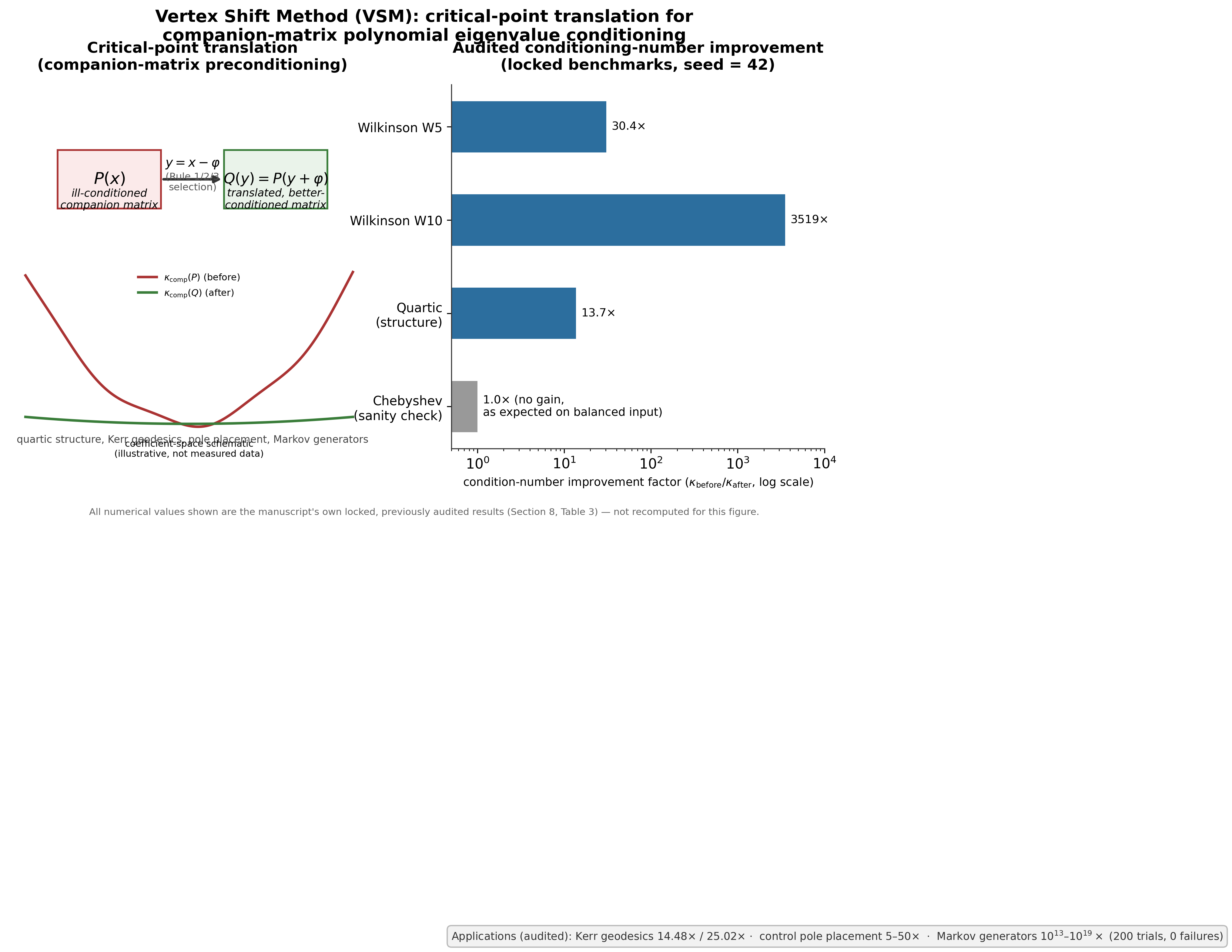
We study the Vertex Shift Method (VSM): given a polynomial P with a real critical point φ (i.e. P′(φ) = 0), the translation Q(y) = P(y + φ) eliminates the linear coefficient of Q exactly (Theorem 1) and induces a similarity transformation on the companion matrix (Proposition 1). The supporting theory is deliberately elementary – Taylor expansion, a standard non-derogacy argument, and a direct eigenvalue estimate – and is developed only as far as needed to support three specific, verified strengths of the resulting preconditioning procedure. First, VSM avoids a structural barrier that matrix balancing cannot: for singular companion representations (e.g. continuous-time Markov generators, where the constant coefficient c0 = 0 by conservation of probability), balancing provably cannot help, since diagonal similarity preserves c0 exactly, while VSM’s translation changes it, moving all 200/200 tested instances from singular or extremely ill-conditioned to finite, moderate condition numbers. Second, VSM composes multiplicatively with tropical scaling (Noferini et al.): the two act on different orbits of the representation – one an exact local translation, the other a global geometric rebalancing – and their composite achieves gains of 2.9 × 10¹¹× on Wilkinson W20, orders of magnitude beyond either alone, a result we support with two analytical bounds and a corrected, densely-verified numerical check across degrees n = 3 to 20. Third, applied to the Kerr black hole equatorial radial potential, with coefficients reconstructed exactly from cited primary-source physical parameters, VSM gives a verified 14.48× conditioning improvement (25.02× combined with balancing) on a fully specified 100-point spin sweep. Beyond these three results we give exact-sweep, proxy, and hybrid critical-point selection rules with characterized costs, an implicit-function-theorem extension to time-varying polynomials with a documented and partially resolved branch-switching failure mode, and a systematic mapping of the minimum eigensolve precision (100–112 bits) needed to prevent conditioning gains from being offset by floating-point cancellation in root recovery – a divergence we document explicitly on Runge- and Kahan-type instances rather than let κ(CQ) stand as a proxy for accuracy. We report two claims from earlier stages of this work that do not reproduce under independent re-implementation (a Monte Carlo forward-error win rate and one curved-shift adaptive-policy tracking figure) as open, unresolved discrepancies (Section 8.1) rather than either defend them uncritically or silently remove them. A third figure, the curved-shift hybrid-10/20 tracking result, was also flagged as discrepant in an earlier draft; that was traced to a bug in independent verification tooling rather than a reproducibility gap in this paper’s own claim, and is no longer listed here (Section 8.1). The central contribution of this paper is to establish critical-point translation as a mathematically analyzable preprocessing operation for companion-matrix polynomial eigenvalue problems. An earlier version of this claim described VSM’s relationship to balancing as general “complementary behavior”; that phrasing is retired here, for the same reason a companion paper in this research line retired it independently, after an audit found it overstated in a high-degree regime map. VSM has a structural advantage balancing provably cannot share in one specific, proven regime – singular companion representations with c0 = 0, where diagonal similarity preserves c0 exactly and VSM’s translation does not (Section 7.2) – and the two methods act on different orbits of the representation (translation vs. diagonal similarity) elsewhere. This paper does not claim general equal-footing complementarity between VSM and balancing across all regimes; where they were compared head-to-head (Section 7.1’s Kerr sweep, corrected), VSM alone was found competitive with, not dominated by, balancing alone in 66.0% of trials on that application.
Keywords:
polynomial normalisation
; companion matrix conditioning
; critical points
; coefficientspace preconditioning
; spectral translation
Copyright: This open access article is published under a Creative Commons CC BY 4.0 license, which permit the free download, distribution, and reuse, provided that the author and preprint are cited in any reuse.