

Submitted:
06 July 2026
Posted:
07 July 2026
You are already at the latest version
Abstract
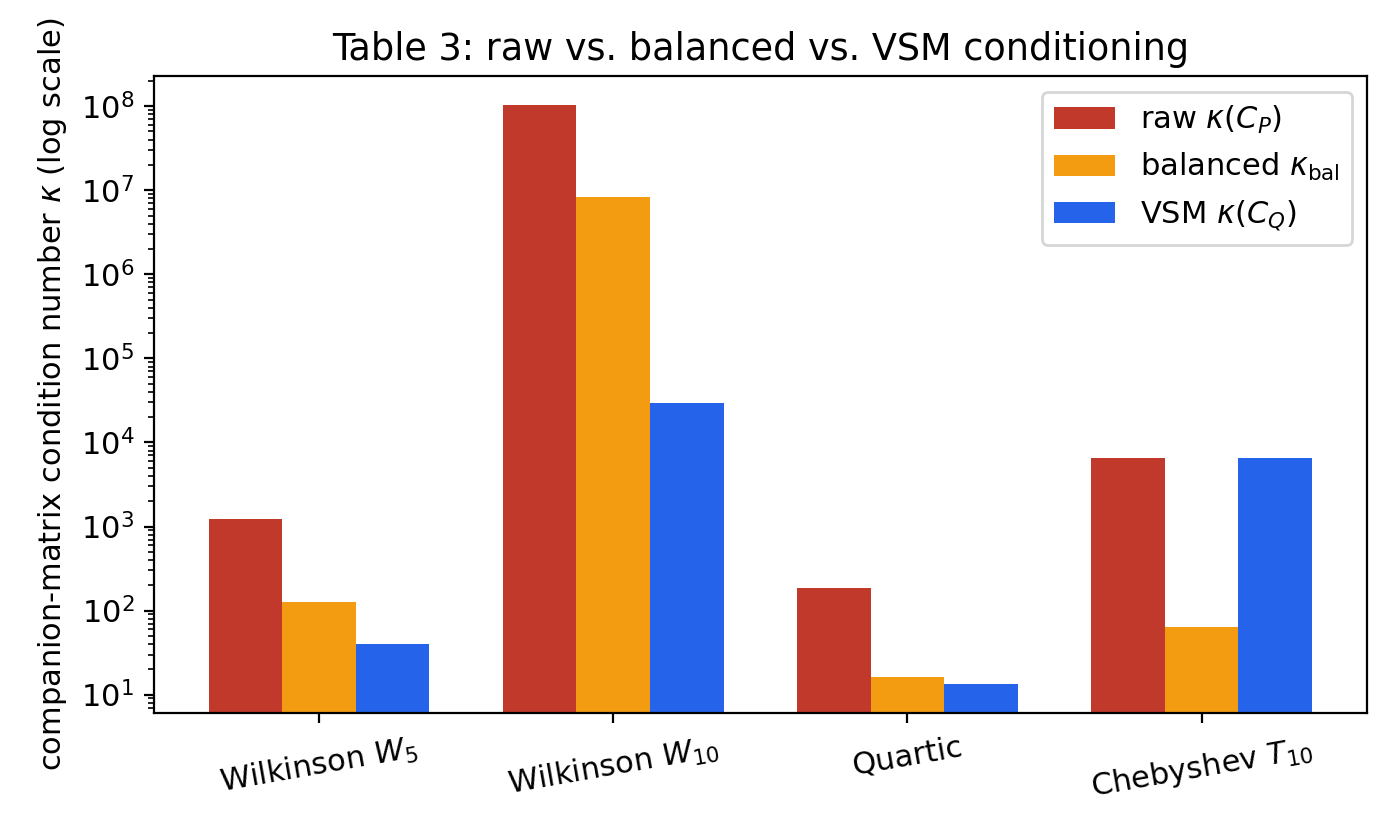
We study a coefficient-space normalization for univariate polynomials: given P(x) = aₙxⁿ + ... + a₁x + a₀, shift to Q(y) = P(y+φ) at a critical point φ satisfying P′(φ) = 0. This eliminates the linear coefficient of Q and, for the companion matrix construction, typically reduces the condition number κ substantially. The method generalizes a classical quadratic identity (the vertex of a parabola sits at −b/2a) to arbitrary degree, and we call it the Vertex Shift Method (VSM). We establish that the shifted companion matrix is similar to the spectrally translated original companion matrix, a direct-conditioning selection rule for choosing among the n−1 available critical points, a dynamic extension (Curved Shift) for time-varying polynomial families together with its breakdown condition and a hybrid tracking algorithm, and a lower bound exposing a structural limitation of similarity-based conditioning transformations in general, including but not limited to diagonal balancing. Re-audited benchmarks on four polynomial families give conditioning gains from 1× (correctly, no gain, on an already-balanced Chebyshev polynomial) to 3519× (Wilkinson W₁₀); five additional legacy instances are reported separately because their exact original data were not preserved, with one of them (Wilkinson W₁₅) independently re-audited under the current method. We report failure modes and the regimes in which balancing outperforms VSM as openly as the regimes in which it does not, and give two validated applications: a singularity-avoiding companion representation for singular Markov generator polynomials, and Kerr black hole geodesic conditioning, whose coefficient vector is reconstructed exactly from explicit physical parameters using the primary-source radial-potential formulas of Compère and Druart and Teo.
Keywords:
polynomial normalization
; companion matrix conditioning
; critical points
; coefficientspace preconditioning
; spectral translation
Copyright: This open access article is published under a Creative Commons CC BY 4.0 license, which permit the free download, distribution, and reuse, provided that the author and preprint are cited in any reuse.


