

Submitted:
05 May 2026
Posted:
07 May 2026
You are already at the latest version
Abstract
Background: The adaptogen concept, first formalized over half a century ago, describes pharmacological agents that increase nonspecific resistance to stress. Despite extensive clinical evidence supporting the efficacy of adaptogenic botanicals, the concept has re-mained largely phenomenological, lacking a mechanistic framework compatible with modern molecular pharmacology. This has limited its acceptance in evidence-based medi-cine. Aims: We propose that hydroponically cultivated red Panax ginseng preparation HRG80, with its chemically reproducible composition and multilevel evidence base, constitutes a case study through which the mechanistic basis of adaptogenic action can be examined across molecular, cellular, neurophysiological, and clinical levels. Methods: We identified all published preclinical and clinical studies conducted on HRG80 through PubMed, Scopus, and manual citation tracking (last search: March 2026). Ten published studies met the inclusion criterion, including three randomized, dou-ble-blind, placebo-controlled clinical trials and two open-label trials, encompassing ap-proximately 440 human subjects. One manuscript in preparation and one unpublished preclinical gut-brain axis dataset were included with appropriate caveats. We integrated transcriptomic, electrophysiological, in vitro, in vivo, and clinical evidence into a pro-posed mechanistic model. Results: The converging evidence supports a three-tier temporal model of adaptogenic ac-tion. The acute tier (minutes to hours) involves modulation of NMDA and Kainate gluta-mate receptors, enhancing hippocampal long-term potentiation. The subacute tier (days to weeks) involves activation of CREB signaling and the slit-robo axonal guidance pathway, producing structural neuroplasticity functionally equivalent to brain-derived neu-rotrophic factor stimulation. The chronic tier (weeks to months), based on in vitro evidence in non-neuronal models, involves DNMT inhibition and epigenetic reprogramming, sug-gesting a potential mechanism for durable changes in cellular stress resilience. Tran-scriptomic analysis identified 1,061 genes uniquely modulated by the whole extract and not by isolated ginsenosides, consistent with the hypothesis that the adaptogenic effect is an emergent property of the phytochemical network. Preliminary preclinical data from a gut-brain axis model suggest that HRG80 protects intestinal barrier integrity and attenu-ates neuroinflammation, providing a plausible systemic pathway from oral intake to cen-tral effects. Conclusion: HRG80 provides convergent multilevel evidence suggesting that adaptogenic nonspecificity may reflect a hierarchically organized multi-specificity operating across distinct temporal scales. If confirmed by independent replication and further mechanistic studies, this framework could offer a template for the systematic investigation of other adaptogenic botanicals.
Keywords:
adaptogen
; Panax ginseng
; network pharmacology
; HRG80
; rare ginsenosides
; nonspecific stress resistance
; long-term potentiation
; sirtuin
; epigenetics
; neuroplasticity
1. Introduction: The Unresolved Paradox of the Adaptogen
The concept of the adaptogen occupies a peculiar position in modern pharmacology. First defined by Lazarev in 1958 [1] and formalized by Brekhman and Dardymov in 1969 [2], it describes a class of pharmacological agents that increase the organism’s nonspecific resistance to stress — a definition that is simultaneously intuitive and, from the perspective of target-based drug discovery, almost incoherent. How can a substance act nonspecifically? Against what molecular target does it exert this action? If the target is nonspecific, how can the effect be reproducible?
These questions have haunted the adaptogen concept for over half a century. Despite extensive clinical evidence supporting the efficacy of adaptogenic botanicals such as Panax ginseng, Rhodiola rosea, Eleutherococcus senticosus, and Schisandra chinensis in stress-related conditions [3,4,5,6,7,8], the concept has remained largely phenomenological. The European Medicines Agency’s 2014 assessment report on Panax ginseng illustrates the consequence: despite millennia of traditional use and hundreds of publications, ginseng has not achieved “well-established use” status, primarily due to the heterogeneity of preparations and the inconsistency of results across studies [9].
The core problem is not empirical but conceptual. The dominant paradigm of modern pharmacology — one molecule, one target, one disease — was developed for synthetic drugs designed to modulate a single enzyme or receptor. This framework has been extraordinarily productive for acute conditions and single-pathway diseases. However, it is structurally ill-suited to evaluate agents whose mechanism of action is intrinsically polypharmacological, operating across multiple molecular targets simultaneously. The adaptogen, by definition, is such an agent.
The emergence of systems biology and network pharmacology over the past two decades has provided the conceptual tools necessary to bridge this gap [10,11,12]. The network pharmacology framework, applied to adaptogens by Panossian and colleagues [10,13,14], reconceptualizes pharmacological action not as a single ligand-receptor interaction but as a perturbation of an intracellular signaling network. In this framework, the “nonspecificity” of adaptogens is reinterpreted not as a lack of molecular specificity but as a multi-target specificity that modulates the global state of cellular stress-response networks.
What has been lacking is a concrete, well-documented illustration — a single, chemically defined adaptogenic preparation with sufficient multilevel data to trace a plausible chain from molecular targets through cellular mechanisms to clinical outcomes. In this article, we examine whether hydroponically cultivated red Panax ginseng preparation HRG80™ constitutes such a case study. We synthesize data from nine published studies and one preclinical gut-brain axis dataset (currently under separate publication), spanning transcriptomics, network pharmacology, receptor-level electrophysiology, in vitro and in vivo pharmacology, quantitative electroencephalography, and four randomized controlled clinical trials — all conducted on the same chemically defined and reproducible preparation — to construct a proposed, mechanistically informed model of adaptogenic action. The strengths and limitations of this evidence base, including the absence of independent replication and the preliminary nature of certain datasets, are discussed in Section 11.3.
1.1. Scope and Methodological Approach
This article is a narrative literature review, as defined in the typology of Grant and Booth [34], not a systematic review, scoping review, or meta-analysis. Narrative reviews aim to summarize and interpret a body of literature on a specific topic, typically without a standardized search protocol or formal quality assessment and are appropriate when the evidence base is heterogeneous in design and methodology [34]. This approach was selected because the HRG80 evidence base spans fundamentally different study types (transcriptomic, in vitro, ex vivo, in vivo, and clinical) that cannot be meaningfully combined through meta-analytic methods.
The objective of this review is to integrate the available multilevel evidence for HRG80 into a coherent mechanistic framework for adaptogenic action, organized as a three-tier temporal model. The aim is to propose a testable framework that may guide future investigation, not to assert that the mechanism has been definitively established.
A methodological transparency note is warranted: the published HRG80 evidence base originates from a limited number of research groups with ties to the preparation’s manufacturer (Botalys SA) or its distributor (EuroPharma USA). Some authors of this review have affiliations with these entities (see Conflicts of Interest). While this proximity has enabled the depth and coherence of the research program, it also means that independent external validation of the findings is not yet available. We have aimed for balanced interpretation throughout but recognize that the reader should weigh the evidence accordingly.
2. The Evolution of the Adaptogen Concept
2.1. From Empirical Observation to Formal Definition (1958–1969)
In the first definition of adaptogens dated 1958, the toxicologist Lazarev focused on the so-called “state of non-specific resistance of organism” (SNIR) [1], a concept associated with the notions of “adaptability” as defined by Georges Canguilhem in 1943 and “stress” as described by Cannon and Hans Selye [3]. Lazarev’s insight was that certain plant-derived substances did not fit existing pharmacological categories: they were neither stimulants (which increase performance at the cost of subsequent depletion) nor sedatives (which reduce reactivity). Instead, they appeared to widen the adaptive range of the organism, allowing it to maintain homeostasis under conditions that would otherwise cause decompensation.
Brekhman and Dardymov formalized this observation in 1969 with three operational criteria [2]: (1) an adaptogen must be innocuous and cause minimal disturbance to the normal physiological functions; (2) its action must be nonspecific, increasing resistance to a wide variety of adverse influences; and (3) it must have a normalizing action irrespective of the direction of the preceding pathological change. These criteria remain the definitional backbone of the concept, but they are entirely phenomenological. They describe what an adaptogen does, not how it works.
2.2. The Molecular Turn: Stress-Response Pathways (1990–2010)
The first mechanistic advances came from studies of the hypothalamic-pituitary-adrenal (HPA) axis and intracellular stress-signaling cascades. Adaptogens were shown to modulate cortisol levels, heat shock protein expression (Hsp70), stress-activated protein kinases (JNK, p38 MAPK), and the transcription factor Nrf2 [3,15,16]. These findings localized adaptogenic action to specific signaling nodes but raised new questions: how could a single botanical preparation modulate multiple, seemingly unrelated stress-response pathways?
2.3. The Network Pharmacology Framework (2017–Present)
The resolution came with the application of network pharmacology and systems biology approaches to adaptogenic plants [10,13,14]. Panossian and colleagues proposed that adaptogens act not on individual molecular targets but on the intracellular signaling network as a whole, modifying its topology and dynamics in ways that increase the system’s robustness to perturbation [10]. In this framework, the active constituents of an adaptogenic extract serve as multiple low-affinity inputs to the network, collectively shifting it toward a more resilient state — much as a climate change alters an entire ecosystem rather than a single species.
This model generates three testable expectations. First, the transcriptomic signature of an adaptogenic extract should be broad (affecting hundreds to thousands of genes), network-structured (enriched in multiple interacting pathways rather than a single cascade), and concentration-dependent (different concentrations activating different network neighborhoods). Second, the whole extract should exhibit activities not reducible to the sum of its isolated components. Third, the clinical effects should span multiple functional domains. We examine below the extent to which the available evidence for HRG80 is consistent with these expectations, while acknowledging that definitive validation would require independent replication across different preparations and research groups.
3. HRG80: A Chemically Defined and Reproducible Adaptogenic Preparation
A fundamental prerequisite for mechanistic investigation is chemical reproducibility. The failure to achieve this has been the principal obstacle to cumulative evidence-building for ginseng [9]. Each study using a different preparation with a different ginsenoside profile is, in pharmacological terms, a study of a different drug.
HRG80 addresses this through a proprietary vertical farming technology. Panax ginseng roots are hydroponically cultivated under strictly controlled conditions (FSSC22000 certified), ensuring batch-to-batch chemical reproducibility [17,18,19]. Following harvest, roots are steam-cooked at 130 °C (two successive 90-min cycles) to convert major ginsenosides into pharmacologically more active rare ginsenosides through deglycosylation. The resulting red ginseng powder is characterized by UHPLC with quantification of 23 individual ginsenosides.
Across all published studies, HRG80 consistently contains 11–15% total ginsenosides, of which more than 80% are rare ginsenosides (Rg3, Rg5, Rk1, Rk2, Rh2, Rh3, Rh4, compound K, protopanaxadiol, protopanaxatriol) [17,18,19,20]. The rare-to-major ginsenoside ratio is approximately 82:18, compared to 31:69 for conventional six-year-old white ginseng [17]. This is pharmacologically significant because rare ginsenosides bypass the rate-limiting gut microbial deglycosylation step required for major ginsenosides to become bioavailable [21,22], resulting in faster onset and higher systemic exposure.
The aseptic culture conditions eliminate pesticide, mycotoxin, and heavy metal contamination, and the hydroponic process excludes soil-borne variability. DNA identity testing (PCR) confirms Panax ginseng species identity. This level of chemical standardization enables the cumulative integration of data across studies with reasonable confidence that the same molecular entity is being investigated — a prerequisite that has been notably lacking in the broader ginseng literature.
4. Transcriptomic Evidence: The Molecular Landscape of Adaptogenic Action
4.1. Ginsenoside Rg5 as a Model Compound
The transcriptomic investigation began with ginsenoside Rg5, one of the principal rare ginsenosides in HRG80 (approximately 1.4–1.6% of root powder by weight, approximately 250-fold more concentrated than in white ginseng; note: the most abundant rare ginsenoside in HRG80 by UHPLC quantification is Rg3, followed by Rk1, with Rg5 ranking third [17,18]) [23]. Using genome-wide mRNA microarray analysis on murine HT22 hippocampal neurons, Panossian et al. mapped the dose-response landscape of Rg5 across concentrations spanning 14 orders of magnitude (10−4 to 10−18 M) [23].
The results revealed three characteristics consistent with the network pharmacology model:
First, broad network engagement: approximately 370 genes were deregulated at physiological concentrations (10−6 to 10−18 M), while 1,670 genes were affected at the toxic concentration (10−4 M), with hormetic reversal of many gene expression changes. Ingenuity Pathway Analysis (IPA) identified simultaneous modulation of cholesterol biosynthesis, CREB signaling, and sirtuin pathways, alongside predicted inhibition of neuroinflammation, cellular senescence, and apoptosis [23].
Second, concentration-specific gene signatures: 54–67% of deregulated genes were unique to each concentration, and only a single gene (Ca6) was affected at all concentrations tested. This suggests that adaptogens do not simply produce more or less of the same effect at different doses — they engage qualitatively different network neighborhoods depending on concentration, consistent with the multi-target, network-level model of action [23].
Third, coordinated anti-aging signatures: Rg5 inhibited apoptosis, chromatin condensation, and DNA fragmentation while simultaneously activating DNA repair pathways at all physiological concentrations. Key sirtuin pathway genes were modulated, including SIRT2, NAMPT, PPARGC1A (PGC-1α), FOXO1/3, SOD2, NQO1, WRN, OGG1, autophagy genes, and MTOR. Cell division cycle pathways were activated while cellular senescence pathways were inhibited [23]. This simultaneous pro-repair, anti-senescence program is consistent with the adaptogen concept: not the blockade of a pathological process but the enhancement of the cell’s intrinsic resilience.
4.2. Whole Extract vs. Isolated Ginsenosides: Evidence for Emergent Polypharmacology
The second transcriptomic investigation compared HRG80 whole extract (at five concentrations) with white ginseng and four isolated ginsenosides (Rb1, Rg3, Rg5, Rk1) on HT22 neurons [24]. This study provided compelling evidence for the network pharmacology model of adaptogenic action.
HRG80 affected 1,703 unique genes across all tested concentrations. The four isolated ginsenosides, combined, affected 1,678 genes. However, only 642 genes were shared between the two sets, meaning that 1,061 genes (62%) were uniquely modulated by HRG80 and not by any tested ginsenoside alone [24]. Furthermore, only a single gene (SUOX) was common to all four ginsenosides and HRG80. This observation is consistent with the hypothesis that the pharmacological activity of the whole extract is not fully accounted for by the sum of its individual ginsenoside components, suggesting the presence of emergent network-level interactions among multiple bioactive compounds and their cellular targets. However, this inference is based on a single cell line (HT22) and a limited set of isolated ginsenosides; broader comparisons across cell types and compound combinations would be needed to confirm this interpretation.
The comparison with white ginseng was equally revealing. Of approximately 850 total deregulated genes between the two preparations, only 66 were shared (16–18% overlap) [24], despite both being derived from the same species. This minimal overlap, driven by the 250-fold higher concentration of Rg5 and other rare ginsenosides in HRG80, suggests that the steaming and hydroponic cultivation processes do not simply increase potency — they generate a qualitatively different pharmacological entity.
Transcriptomic pathway analysis predicted that HRG80 significantly modulated the sirtuin signaling pathway, alongside modulation of seven additional canonical pathways: neuroinflammation, cellular senescence, ferroptosis, WNT/β-catenin, PKA signaling, estrogen receptor signaling, and adrenomedullin signaling [24] — for a total of eight pathways including sirtuin signaling.
5. From Oral Intake to Central Effect: The Gut-Brain Relay
Before examining the central mechanisms through which HRG80 modulates synaptic function, neuroplasticity, and epigenetic programming (Section 6, Section 7 and Section 8), a foundational question must be addressed: how does an orally administered botanical extract produce effects in hippocampal and cortical neurons? Ginsenosides traverse the gastrointestinal tract before reaching the systemic circulation, and the integrity of the intestinal barrier determines both the magnitude and the kinetics of their systemic bioavailability.
Preliminary preclinical data from the MICROBIOSTRESS research program (UCLouvain Louvain Drug Research Institute, WP3; in collaboration with Botalys SA), currently being prepared for independent publication, provide initial evidence relevant to this question [32]. The following results should be considered preliminary pending peer-reviewed publication of the full dataset, and the mechanistic inferences drawn from them should be interpreted with corresponding caution.
5.1. Experimental Model
Balb/c mice (n = 9 per group), an intrinsically anxiety-prone strain, received HRG80 at 0.5% in standard chow for 28 days, followed by intraperitoneal LPS injection (E. coli 0127:B8, 1 mg/kg) on day 28 to induce systemic inflammation. An active comparator (mélisse extract, 0.3%) was included. Endpoints spanned the gut-brain axis: intestinal tight junction expression (ZO-1, occludin), hepatic inflammation (IL1β, F4/80), serum corticosterone (4 h and 48 h post-LPS), neuroinflammatory markers in three brain regions (hippocampus, hypothalamus, prefrontal cortex), neurotrophic factors (BDNF), glucocorticoid receptors (MR, GR), and behavioral outcomes (Light-Dark Box Test, Forced Swimming Test).
5.2. Intestinal Barrier Protection
LPS significantly decreased ileal expression of ZO-1 (p < 0.01 vs. CT) and occludin. HRG80 pretreatment restored ZO-1 expression to near-control levels (p < 0.05 vs. LPS). In the context of oral supplementation, barrier preservation may limit endotoxin translocation into the portal circulation, reducing the inflammatory signal that would otherwise propagate systemically and centrally. If confirmed, this finding would position the intestinal epithelium as an early pharmacological target in the HRG80 mechanism of action.
5.3. HPA Axis Normalization
At 4 h post-LPS, serum corticosterone in the LPS group surged to approximately 500,000 pg/mL (p < 0.001 vs. CT). HRG80 pretreatment reduced this response by approximately 70% (p < 0.0001), to approximately 150,000 pg/mL. At 48 h (post-FST), the HRG80 group returned to near-baseline levels, while LPS and LPS+mélisse groups remained significantly elevated (p < 0.01). This pattern is consistent with normalization rather than suppression of the HPA axis — an observation aligned with the “bidirectional regulation” that Brekhman’s third criterion describes [2]. The mélisse comparator did not produce this effect, suggesting specificity for the ginseng preparation.
5.4. Central Neuroinflammation and Neurotrophic Response
HRG80 attenuated neuroinflammation across all three brain regions examined. In the hypothalamus: TNFα (p < 0.05), CD45 (p < 0.01), IL1β (p < 0.01), and CCL2 (p < 0.01) were significantly reduced. In the hippocampus: TNFα (p < 0.01), CD45 (p < 0.01), and IL1β (p < 0.01) were attenuated, with upregulation of the mineralocorticoid receptor (MR, p < 0.05) suggesting improved glucocorticoid sensitivity. In the prefrontal cortex: TNFα (p < 0.001) and CD45 (p < 0.01) were significantly reduced.
A notable finding was a marked upregulation of BDNF in the hypothalamus (p < 0.001). This in vivo BDNF response is noteworthy because it provides convergent evidence, in a living organism, for the BDNF-mimetic activity observed in vitro by Lelong et al. [20]. The consistency between in vitro neuroplasticity data (Section 6.2) and in vivo hypothalamic BDNF upregulation strengthens the plausibility that HRG80 activates neurotrophic signaling pathways, though the different experimental contexts (cell culture vs. LPS-challenged mice) preclude direct mechanistic equivalence.
5.5. Hepatoprotection and Peripheral Anti-Inflammatory Action
LPS induced significant hepatomegaly (p < 0.05) and steatosis. HRG80 normalized liver weight and reduced hepatic IL1β expression (p < 0.05 vs. LPS). This peripheral anti-inflammatory action is consistent with the sirtuin/NF-κB pathway engagement identified in the transcriptomic analysis [23,24] and suggests that the anti-inflammatory effects of HRG80 are not limited to the brain but may operate systemically.
5.6. Behavioral Activation Independent of Stress Challenge
Before any LPS challenge (day 22), HRG80-fed mice already exhibited increased exploratory behavior: higher velocity (p < 0.05) and more transitions (p < 0.05) in the Light-Dark Box Test. This intrinsic pro-exploratory effect, independent of the inflammatory model, suggests that the 28-day supplementation period produced a basal shift in anxiety-related behavior — consistent with the structural neuroplasticity mechanism described in Section 6.2.
5.7. The Oral-to-Brain Pathway: A Working Hypothesis
Taken together, these preliminary observations are consistent with a plausible sequence linking oral HRG80 administration to central effects: intestinal barrier support (ZO-1, occludin) → reduced peripheral inflammation (hepatic IL1β) → attenuated central neuroinflammation (hypothalamus, hippocampus, prefrontal cortex) → BDNF upregulation → HPA axis normalization. However, this sequence is inferred from correlative endpoints measured in a single mouse model (n = 9 per group); formal demonstration of causality would require targeted pathway interventions (e.g., barrier disruption, receptor antagonism, or conditional knockout models). The proposed pathway should therefore be regarded as a working hypothesis rather than an established causal chain.
This gut-brain relay, if confirmed, would operate on a subacute-to-chronic timescale and would be mechanistically distinct from the acute synaptic effects of HRG80, which depend on the intrinsic pharmacokinetics of rare ginsenosides reaching the CNS via transcellular absorption. The relay would function not as the delivery route for ginsenosides themselves but rather as the immunological and endocrine conditioning pathway that reduces the inflammatory and glucocorticoid burden on the CNS — potentially creating a permissive environment in which the subacute and chronic tiers of the adaptogenic model can operate.
6. Identified Central Mechanisms: From Network Perturbation to Receptor Targets
6.1. NMDA and Kainate Receptor Modulation: The Acute Synaptic Mechanism
While transcriptomics maps the breadth of adaptogenic network engagement, receptor-level pharmacology identifies the specific molecular entry points. Dimpfel et al. conducted an ex vivo study in which rats received oral HRG80 or standard ginseng preparation (SGP) for one week, after which hippocampal slices were tested for long-term potentiation (LTP) — the electrophysiological correlate of memory consolidation [25].
HRG80 dose-dependently enhanced population spike amplitude in response to both single stimulation and theta-burst stimulation. HRG80 was approximately twice as potent as SGP (25 mg/kg HRG80 produced equivalent effects to 50 mg/kg SGP), and HRG80 was active at the lowest dose tested (10 mg/kg) where SGP showed no effect [25].
The mechanistic dissection using six glutamate receptor antagonists revealed a specific pharmacological profile: only NMDA receptor (MK-801) and Kainate receptor (UBP-302) antagonists abolished the HRG80-induced LTP enhancement. AMPA receptor antagonists and all three classes of metabotropic glutamate receptor antagonists (mGluRI, mGluRII, mGluRIII) were without effect [25]. This selectivity — Ginkgo biloba, by comparison, acts through multiple glutamate receptor subtypes — identifies NMDA and Kainate receptors as the primary synaptic entry points for the acute effects of HRG80 on hippocampal plasticity.
The dual NMDA/Kainate modulation is pharmacologically coherent. NMDA receptors mediate the induction of LTP through calcium influx, while Kainate receptors modulate presynaptic glutamate release probability and contribute to synaptic plasticity in the mossy fiber pathway [26]. The coordinate modulation of both receptor types by HRG80 could produce a synergistic enhancement of hippocampal plasticity that exceeds what either target alone would achieve — an illustration, at the receptor level, of the multi-target principle hypothesized for adaptogenic action.
A critical translational caveat must be noted regarding Tier 1. The LTP enhancement was demonstrated in an ex vivo preparation following one week of oral administration at doses of 10–50 mg/kg in rats [25]. While this establishes that oral HRG80 can produce measurable effects on hippocampal tissue, the concentrations of ginsenosides reaching hippocampal neurons in vivo remain unknown. Oral bioavailability of ginsenosides is generally low, with published pharmacokinetic studies reporting oral bioavailability ranging from less than 1% to approximately 5%, with extensive first-pass metabolism and gut microbial transformation [22]. Rare ginsenosides, being already deglycosylated, bypass one rate-limiting step (microbial conversion), which may partially mitigate this limitation; however, no pharmacokinetic study has been conducted specifically with HRG80 to quantify plasma or CNS ginsenoside levels following oral administration. The acute clinical effects observed from Day 1 of supplementation in Mariage et al. [17] are consistent with rapid systemic availability but do not constitute pharmacokinetic evidence. Human PK/PD studies correlating plasma ginsenoside levels with cognitive and EEG endpoints represent a critical gap in the evidence base (see Section 11.3, Future Directions).
6.2. Structural Neuroplasticity: The BDNF-Mimetic Mechanism
Lelong et al. investigated the effects of HRG80 extract on primary hippocampal and cortical neurons, providing a link between receptor-level modulation and structural neuroplasticity [20]. In primary hippocampal cultures treated for 7 days, the extract at 1 μg/mL significantly increased the number of differentiated MAP2-positive neurons, total neurite network length (at 0.5 and 1 μg/mL), and PSD-95 post-synaptic density area — three independent markers of neuronal maturation, axonal growth, and synapse formation, respectively. The magnitude of these effects at 1 μg/mL was equivalent to that of brain-derived neurotrophic factor (BDNF) at 50 ng/mL [20], the canonical neurotrophin driving hippocampal plasticity.
This BDNF-mimetic potency is mechanistically noteworthy. BDNF decline is one of the best-documented correlates of age-related cognitive impairment [27], and BDNF signaling through TrkB receptors activates the CREB transcription factor identified in the Rg5 transcriptomic study [23]. Reactome pathway analysis of the most highly regulated genes at 1 μg/mL identified enrichment in “nervous system development,” the “slit-robo pathway” (critical for axonal guidance, neuronal migration, and spinogenesis in hippocampal CA1, CA3, and dentate gyrus), and “cellular response to stress” [20]. The convergence of CREB activation (transcriptomics), BDNF-equivalent functional effects (hippocampal culture), slit-robo pathway engagement (pathway analysis), and in vivo hypothalamic BDNF upregulation under inflammatory challenge (Section 5.4, p < 0.001) delineates a coherent trophic mechanism operating downstream of the acute synaptic effects, supported by convergent in vitro and in vivo observations — though the different experimental contexts and models used in each study preclude direct mechanistic equivalence.
Complementing the trophic effects, the extract at 5 μg/mL protected mature cortical neurons from glutamate-induced excitotoxicity, improving both neuronal survival and neurite network integrity [20]. This neuroprotective action is the functional counterpart of the anti-apoptotic and DNA repair gene signatures identified by transcriptomics [23], and it addresses a critical aspect of age-related neurodegeneration: the progressive vulnerability of neurons to excitotoxic stress caused by impaired glutamate reuptake and dysregulated calcium homeostasis [28].
6.3. Epigenetic Reprogramming: The DNMT Inhibition Mechanism
The deepest level of mechanistic action was investigated by Okuno et al., who demonstrated that HRG80 extract inhibits DNA methyltransferases (DNMT1, DNMT3A, DNMT3B) at both mRNA and protein levels in colorectal cancer cell lines [29]. This study, published in Carcinogenesis (Oxford University Press) and funded by multiple NCI/NIH grants, constitutes the first evidence of any ginseng preparation acting as an epigenetic demethylating agent.
DNMT inhibition produced global DNA hypomethylation — LINE-1 methylation decreased by more than 10% after 28 days of treatment — and genome-wide redistribution of methylation marks (6,329 hypomethylated and 8,951 hypermethylated CpG probes in RKO cells) [29]. This is not a targeted effect on a single promoter; it represents a broad reprogramming of the epigenomic landscape. The effects were validated in patient-derived 3D tumor organoids, confirming relevance in a more complex cellular model.
From the adaptogen perspective, DNMT inhibition represents a plausible candidate mechanism for the longest-timescale effects hypothesized by the model. While receptor modulation (NMDA/Kainate) operates on seconds-to-minutes, and structural plasticity (CREB/slit-robo) on days-to-weeks, epigenetic reprogramming operates on weeks-to-months and can produce durable changes in cellular phenotype. However, a critical limitation must be noted: the DNMT inhibition data were generated exclusively in colorectal cancer cell lines (RKO, HCT-116, SW480, HT-29) and patient-derived tumor organoids [29]. Cancer cells exhibit fundamentally different epigenomic landscapes from normal neurons, including global hypomethylation, aberrant DNMT expression, and altered chromatin accessibility. Whether HRG80 produces comparable DNMT inhibition in neuronal or other non-transformed cell types remains unknown. The extension of these findings to the proposed Tier 3 of adaptogenic action in the nervous system should therefore be understood as a hypothesis requiring experimental validation in relevant models — ideally primary neurons, iPSC-derived neural cultures, or in vivo brain tissue. This three-tier temporal architecture, which we develop formally in Section 9, is a proposed distinctive feature of adaptogenic pharmacology.
7. The Neurophysiological Bridge: From Molecules to Brain Activity
The translation from cellular mechanisms to human brain function was investigated by quantitative electroencephalography (qEEG). In a randomized, double-blind, placebo-controlled, three-arm crossover trial, Dimpfel et al. measured spectral power changes across 17 brain regions and six frequency bands after four weeks of HRG80, white ginseng, or placebo administration in 30 elderly subjects (60–75 years) [19].
HRG80 produced a distinctive neurophysiological signature characterized by simultaneous modulation of four neurotransmitter systems: (1) decreased α1 spectral power (serotonergic neurotransmission) in frontal and temporal regions, indicating cortical activation; (2) decreased α2 power (dopaminergic neurotransmission), indicating mood enhancement via the pleasure-reward pathway; (3) modulation of β2 power (GABAergic neurotransmission), indicating calming without sedation; and (4) attenuation of δ/θ powers during relaxation, which is particularly noteworthy because elevated frontotemporal δ/θ power is an established neurophysiological biomarker of mild cognitive impairment (MCI) [19,30].
This multi-system modulation pattern is consistent with the neurophysiological expression of adaptogenic action: not a unidirectional push (as with a stimulant increasing arousal or a sedative decreasing it) but a simultaneous recalibration of multiple systems toward a more balanced state. Discriminant analysis revealed that HRG80 and white ginseng projected as near neighbors in the overall EEG fingerprint space but differed significantly in the specific brain regions affected, particularly in frontal lobe involvement during cognitive tasks — consistent with the cognitive effects of HRG80 observed in clinical trials [17,19].
8. Clinical Evidence: Multi-Domain Effects Across Populations
The network pharmacology model predicts that an adaptogen should produce clinically measurable effects across multiple functional domains and in diverse populations, reflecting the breadth of its molecular engagement. Three randomized, double-blind, placebo-controlled trials and two open-label trials provide evidence relevant to this prediction.
8.1. Cognitive Performance and Stress in Healthy Adults
Mariage et al. conducted a pilot randomized, double-blind, placebo-controlled, three-arm crossover trial in 50 healthy subjects experiencing occupational stress [17]. HRG80 (~418 mg/day ginseng root, two capsules of 209 mg each) was compared to conventional white ginseng (Arkopharma, 382 mg/day) and placebo over 14 days, with assessments at Days 1, 5, and 12. HRG80 significantly improved attention (d2 test error rate, time × treatment interaction p < 0.0001 vs. placebo) with effects detectable from the first day of administration — consistent with an acute onset mechanism. White ginseng did not differ significantly from placebo for attention (p = 0.65). For perceived stress, HRG80 reduced scores from Day 5 while white ginseng required 12 days, consistent with the faster bioavailability of rare ginsenosides. The memory test also showed significant improvement with HRG80 (p < 0.0001 vs. placebo) [17].
As a pilot study, these results should be interpreted with appropriate caution: the sample size (n = 50) and short duration (12 days per arm) limit generalizability, and the crossover design with its associated carryover risk requires caution in interpreting the time × treatment interaction. Effect sizes were not reported in the original publication and should be calculated and reported in future analyses to assess clinical meaningfulness.
8.2. Stress, Emotional Processing, and Cognition in Moderately Stressed Adults
Dormal et al. conducted the largest HRG80 trial to date: a randomized, double-blind, placebo-controlled study in 149 moderately stressed adults (142 in the intention-to-treat analysis) at the Université Catholique de Louvain [18]. At a dose of only 200 mg/day for three weeks, HRG80 produced significantly greater reductions in perceived stress (PSS, p = 0.040) and negative affect (PANAS, p = 0.032) compared to placebo. The reduction in depressive symptoms did not reach statistical significance at the conventional threshold (BDI, p = 0.073). Cognitively, the ginseng group showed significantly faster response latencies on the CANTAB One Touch Stockings of Cambridge spatial planning task (p = 0.036) and fewer errors on the Paired Associates Learning visual memory task (within-group p = 0.029) [18].
The simultaneous improvement across stress, emotional, and cognitive domains — three distinct functional systems — in a single trial is consistent with multi-target adaptogenic pharmacology. While no single-receptor mechanism can readily account for simultaneous effects on perceived stress (HPA axis/cortisol), negative affect (serotonergic/dopaminergic), and spatial planning (prefrontal-hippocampal circuitry), alternative explanations including independent mechanisms for different outcomes and population-specific responses cannot be excluded.
8.3. Brain Activity and Cognition in Elderly Subjects
The qEEG trial by Dimpfel et al. in 30 elderly subjects [19], described in Section 7, demonstrated that both HRG80 and white ginseng significantly modulated electrical brain activity compared to placebo after four weeks. HRG80 showed more extensive frontal lobe involvement during cognitive testing (seven electrode positions vs. three for white ginseng during the d2 attention test), and its attenuation of δ/θ spectral power represents a potential improvement in a validated MCI biomarker. The tolerability was uniformly rated as “very good” by all 30 participants across all three treatments [19].
8.4. In Vivo Cognitive Function in Aging
Bridging the clinical and preclinical domains, Lelong et al. demonstrated that oral administration of HRG80 root powder (50 mg/kg/day for 7 days) to 18-month-old mice restored short-term spatial memory in the Y-maze forced alternation test to a level comparable to 2-month-old cognitively fit controls [20]. Additionally, the treatment significantly reduced the latency to exit the entry arm — a proxy for apathy, which is a negative predictor of cognitive performance in elderly individuals [20]. Importantly, the treatment did not affect body mass or total locomotor activity, confirming that the cognitive improvement was not secondary to motor or metabolic changes.
8.5. Physical Performance and Muscle Recovery in Athletes
Extending the evidence beyond cognitive and emotional domains, Hovhannisyan et al. conducted an open-label, randomized, crossover trial in 20 elite weightlifters of the Armenian National Team [31]. Both HRG80 capsules (400 mg/day) and γ-cyclodextrin-based HRG80 chewable tablets (100 mg/day) significantly reduced muscle soreness compared to no-treatment control during 10 days of intense resistance exercise (interaction p < 0.0001). The γ-cyclodextrin formulation achieved equivalent efficacy at one-quarter the dose, with earlier onset (Day 5 vs. Day 8). Additionally, capsule treatment significantly improved neuromuscular performance on the push-ups on uneven bars test (interaction p = 0.0005 vs. control, maximal effect Day 7) [31].
This study was conducted as an open-label trial without blinding or placebo control, which limits the strength of causal inference. The reported effects on muscle soreness, in particular, are susceptible to expectation bias. These results should be considered hypothesis-generating and await confirmation in a blinded, placebo-controlled design.
8.6. Energy, Cognition, and Quality of Life in Chronic Fatigue Syndrome
Teitelbaum and Goudie conducted an open-label, prospective pilot trial in 188 patients with severe chronic fatigue syndrome (CFS) and/or fibromyalgia (FMS), including a subgroup with post-viral onset (40.4% of sample) [33]. Patients received HRG80 capsules (200–400 mg/day) or γ-cyclodextrin chewable tablets (100–200 mg/day) for one month. The primary outcome was a composite VAS score (energy + well-being + mental clarity, range 0–30).
In the full sample, the composite VAS score improved from 12.2 to 17.1 (p < 0.001, d = 1.04). Among the 60.1% of subjects who self-reported improvement (n = 113), the composite score increased from 11.9 to 18.8 (p < 0.001, d = 1.67), with effect sizes exceeding d = 1.0 for energy (d = 1.40), well-being (d = 1.74), mental clarity (d = 1.45), and stamina (d = 1.41). There was no significant difference between post-viral and non-post-viral subgroups (treatment x group interaction: all p > 0.05), nor between capsule and tablet formulations (all p > 0.05).
This study has substantial methodological limitations: there was no placebo control, no blinding, outcomes were entirely subjective (VAS), and 64 of 258 enrolled participants (24.8%) were lost to follow-up. Furthermore, 19 participants reported side effects including overstimulation (n = 7), gastrointestinal symptoms (n = 4), and headaches (n = 3). The large effect sizes should therefore be interpreted with caution, as they are inflated by the absence of a placebo comparator. Nevertheless, the study extends the HRG80 evidence base to a previously unexamined clinical population (CFS/FMS) and is the largest single HRG80 trial by enrollment (n = 188 completed). The results are hypothesis-generating and justify a randomized, placebo-controlled confirmatory trial in this population.
8.7. Summary of Clinical Evidence
The capacity of HRG80 to produce measurable effects on cognitive function in office workers, emotional well-being in stressed adults, memory in aged animals, and muscle recovery in elite athletes — across different physiological challenges and populations — is consistent with the nonspecific stress resistance that defines the adaptogen concept. While the breadth of these effects across distinct populations and functional domains is consistent with a multi-target mechanism, alternative explanations — including independent mechanisms for different outcomes, population-specific placebo responses, or methodological heterogeneity across trials — cannot be excluded. The multi-domain pattern is suggestive but not dispositive evidence for a unified network-level mechanism.
9. The Three-Tier Temporal Model of Adaptogenic Action
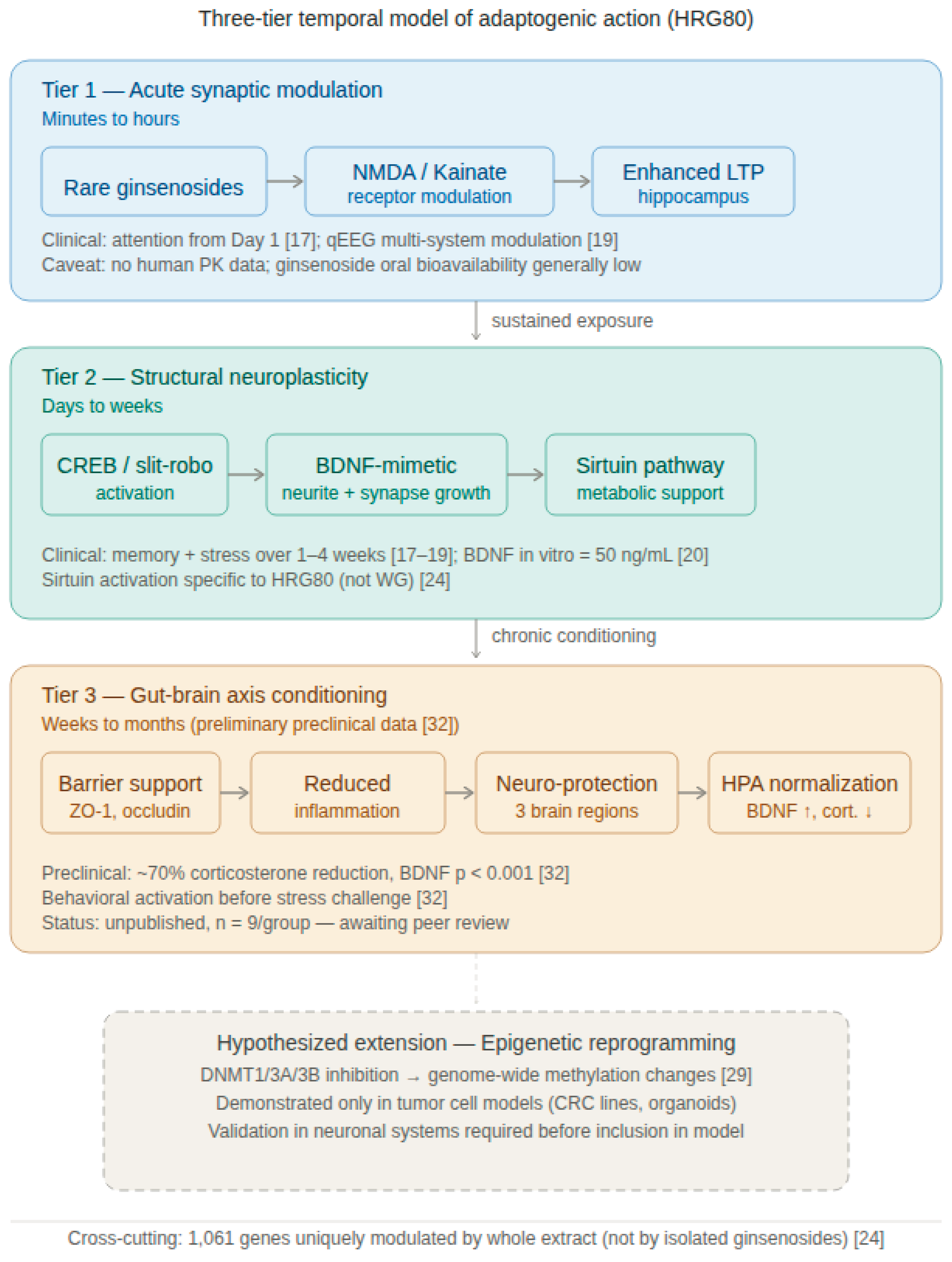
Integrating the molecular, cellular, physiological, clinical, and gut-brain axis evidence, we propose a model of adaptogenic action organized into three mechanistically distinct tiers operating on different temporal scales. The gut-brain relay documented in Section 5, if confirmed, would function not as a separate mechanism but as the systemic conditioning architecture that enables the subacute and chronic tiers — while the acute tier relies on the intrinsic pharmacokinetic properties of rare ginsenosides (Figure 1).
Tier 1 — Acute synaptic modulation (minutes to hours). HRG80 ginsenosides — structurally related to steroid hormones due to their triterpene scaffold — interact with ionotropic glutamate receptors, specifically NMDA and Kainate subtypes, in the hippocampus and associated circuits. This enhances long-term potentiation, the physiological substrate of memory consolidation, and is consistent with the measurable improvements in attention observed from the first day of administration. At the qEEG level, this corresponds to the simultaneous modulation of multiple neurotransmitter systems (serotonergic, dopaminergic, glutamatergic, GABAergic), suggesting a recalibration of brain network dynamics rather than a unidirectional pharmacological push. At this acute timescale, the gut-brain relay described in Section 5 is not yet operative; the rapid onset is instead attributable to the inherent pharmacokinetic advantage of rare ginsenosides, which — unlike major ginsenosides — bypass the rate-limiting gut microbial deglycosylation step and reach the systemic circulation directly via transcellular absorption [17,21,22].
Tier 2 — Structural neuroplasticity and neuroendocrine normalization (days to weeks). Sustained receptor stimulation activates intracellular signaling cascades — particularly CREB and the slit-robo axonal guidance pathway — that induce structural remodeling: neurite outgrowth, synaptogenesis (PSD-95 upregulation), and neuronal differentiation. This BDNF-mimetic program may compensate for the age-related decline in neurotrophic support that underlies progressive cognitive deterioration. The preliminary gut-brain data provide two reinforcing observations for this tier. First, the in vivo BDNF upregulation in the hypothalamus (p < 0.001, Section 5.4) provides convergent evidence, in a living organism, for the BDNF-mimetic activity observed in vitro [20]. Second, the ~70% reduction in corticosterone (Section 5.3) and the attenuation of neuroinflammation across three brain regions suggest that HRG80 simultaneously reduces the inflammatory and glucocorticoid burden that would otherwise suppress neuroplasticity. The sirtuin pathway activation (NAMPT, PGC-1α, FOXO, SOD2) — observed for HRG80 and absent in white ginseng at equivalent concentrations — may provide metabolic support for these energy-demanding structural changes through enhanced mitochondrial biogenesis and NAD+ metabolism. Clinically, this tier is consistent with the progressive improvements in memory, stress resilience, and emotional processing observed over 1–3 weeks of supplementation, and the intrinsic behavioral activation observed before any stress challenge (Section 5.6).
Tier 3 — Gut-brain axis conditioning and neuroendocrine normalization (weeks to months). Preliminary preclinical data from the MICROBIOSTRESS research program (UCLouvain; Section 5) [32] suggest that chronic HRG80 administration protects intestinal barrier integrity (ZO-1, occludin), reduces peripheral inflammation (hepatic IL1β), attenuates central neuroinflammation across three brain regions (hypothalamus, hippocampus, prefrontal cortex), upregulates BDNF in the hypothalamus, and normalizes HPA axis reactivity (approximately 70% corticosterone reduction). This systemic conditioning pathway — if confirmed by peer-reviewed publication and independent replication — would provide a plausible mechanism linking oral intake to durable central effects that cannot be explained by the limited direct bioavailability of ginsenosides alone. The intrinsic pro-exploratory behavioral effect observed before any inflammatory challenge (Section 5.6) is consistent with a basal shift mediated by chronic gut-brain axis conditioning rather than acute receptor modulation. However, these observations derive from a single mouse model (n = 9 per group) with correlative endpoints, and formal demonstration of causality would require targeted pathway interventions.
Hypothesized extension — Epigenetic reprogramming. At the deepest level hypothesized by the model, HRG80 inhibits DNA methyltransferases (DNMT1, DNMT3A, DNMT3B), producing genome-wide redistribution of DNA methylation marks [29]. This represents a plausible candidate mechanism for the longest-timescale effects. However, the DNMT inhibition data were generated exclusively in colorectal cancer cell lines and patient-derived tumor organoids [29], which exhibit fundamentally different epigenomic landscapes from normal neurons. Whether HRG80 produces comparable effects in neuronal or other non-transformed cell types is unknown. This hypothesized extension should be understood as a direction for future investigation rather than a component of the model supported by current evidence.
This three-tier temporal model offers a framework for understanding the paradox of adaptogenic nonspecificity. The “nonspecific” increase in stress resistance would not be produced by a single molecular switch but by the coordinated engagement of three hierarchically nested mechanisms — synaptic, trophic, and systemic — each operating at the appropriate temporal scale. The acute tier provides immediate functional benefit through the intrinsic pharmacokinetic properties of rare ginsenosides; the subacute tier builds structural capacity while normalizing the neuroendocrine stress axis; and the chronic tier conditions the neuroendocrine and immunological environment through gut-brain axis modulation. Each tier would prepare the substrate for the next.
10. Evidence for Emergent Polypharmacology in the Whole Extract
A recurrent question in botanical pharmacology is whether the active principle can be isolated and purified for pharmaceutical development. The transcriptomic data from HRG80 provide evidence against a reductionist approach for this particular preparation: the 1,061 genes uniquely modulated by the whole extract and not by any of the four individual ginsenosides tested suggest that the pharmacological activity involves network-level interactions that would be lost upon isolation of single compounds [24]. Whether this finding generalizes to other adaptogenic preparations remains to be determined.
This multi-component, multi-target architecture may account for the broad therapeutic window observed for HRG80 (effective from 100 to approximately 420 mg/day with no dose-limiting toxicity), the effects across multiple functional domains (cognition, stress, mood, physical recovery), and the favorable safety profile (zero serious adverse events across approximately 250 human subjects in five clinical studies). A high-affinity, single-target drug powerful enough to modulate 1,703 genes would inevitably produce mechanism-based toxicity. If confirmed, this distributed, low-affinity perturbation model would represent a pharmacological approach fundamentally distinct from single-target drug design — analogous to a sustained environmental influence reshaping a landscape rather than a single targeted intervention.
The standardization strategy follows directly from this insight. Rather than isolating and concentrating a single ginsenoside, HRG80 is standardized to the rare ginsenoside profile as a whole, preserving the network of molecular interactions that generates the observed pharmacological effects. The controlled cultivation and processing conditions ensure that this network is reproducible from batch to batch — addressing the heterogeneity problem that has plagued ginseng research without sacrificing the polypharmacological principle that underpins the adaptogen concept.
11. Discussion: Implications for Adaptogen Science and Pharmacology
11.1. Toward a Mechanistic Redefinition of the Adaptogen
The evidence synthesized here is consistent with a transition from a purely phenomenological description of adaptogens toward a more mechanistically informed pharmacological framework. While the data do not yet constitute a definitive redefinition — given the limitations discussed below — they illustrate how multilevel investigation of a single, chemically standardized preparation can generate testable mechanistic hypotheses.
On the basis of the evidence reviewed, an adaptogen may be provisionally characterized as a multi-component pharmacological agent that modulates the intracellular stress-response network through distributed, multi-target interactions, producing a temporally organized cascade of effects — acute synaptic modulation, subacute structural plasticity, and (hypothetically) chronic epigenetic reprogramming — that collectively increase the organism’s adaptive capacity across multiple functional domains.
This working definition retains the three criteria of Brekhman and Dardymov (innocuity, nonspecificity, normalization) but provides candidate mechanistic substrates for each: innocuity may arise from distributed low-affinity interactions that avoid single-target overactivation; nonspecificity may arise from simultaneous multi-pathway engagement; and normalization may arise from the network-level recalibration of signaling dynamics toward a more resilient steady state.
11.2. A Template for Other Adaptogens
The multilevel approach applied here to HRG80 — chemistry → transcriptomics → network pharmacology → receptor identification → cellular function → neurophysiology → clinical outcomes — can serve as a methodological template for the mechanistic investigation of other adaptogenic botanicals. The critical prerequisite is chemical reproducibility: without a defined and consistent preparation, cumulative evidence-building across studies is impossible. For botanicals such as Rhodiola rosea (standardized to salidroside and rosavins), Withania somnifera (standardized to withanolides), and Schisandra chinensis (standardized to schisandrins), similar multilevel investigations are now feasible and would substantially advance the field.
11.3. Limitations
Several limitations must be acknowledged.
Limitations of individual evidence components. First, the Tier 3 epigenetic mechanism (DNMT inhibition) has been demonstrated only in vitro and in tumor cell models; its relevance to normal human neurons remains to be established. Second, while the preclinical gut-brain axis study (Section 5) has demonstrated BDNF upregulation and corticosterone normalization in mice, these data have not yet undergone independent peer review and should be interpreted as preliminary; no human study has yet measured BDNF, cortisol, or other objective biomarkers of stress and neuroplasticity during HRG80 supplementation. Third, the longest clinical exposure is four weeks; studies of 12 weeks or more are needed to evaluate the chronic tier of the model and to address long-term safety. Fourth, the clinical trials, while consistent and well-designed, include relatively modest sample sizes for some studies (n = 30–50); larger confirmatory trials with regulatory-grade endpoints would strengthen the evidence base. Finally, while the transcriptomic and pathway data are suggestive of anti-aging effects (senescence inhibition, sirtuin activation, DNA repair), direct human evidence for these effects (e.g., telomere length, epigenetic age) has not been generated.
Limitations of the evidence structure. A further limitation concerns the structure of the evidence base itself. All published preclinical and clinical studies on HRG80 were conducted within a research network associated with the preparation’s manufacturer (Botalys SA) or its distributor (EuroPharma USA), and some authors of this review are affiliated with these entities (see Conflicts of Interest). While this research-industry proximity is common in botanical pharmacology and has enabled a depth of investigation unusual for a single preparation, it also means that the entire body of evidence presented here lacks independent external validation. The confirmatory value of findings that have not been replicated by unaffiliated research groups is inherently limited, regardless of the methodological quality of individual studies. We consider independent replication — particularly of the transcriptomic signatures, the NMDA/Kainate receptor specificity, and the clinical cognitive outcomes — to be the single most important priority for advancing the credibility of this evidence base.
The narrative nature of this review, combined with the authors’ affiliations, creates an inherent risk of confirmation bias in the selection and interpretation of evidence. We have attempted to mitigate this through explicit acknowledgment of limitations, conservative language in our conclusions, and transparent disclosure of conflicts of interest.
11.4. Alternative Explanations and Competing Hypotheses
Several alternative explanations for the observed effects must be considered. First, the clinical improvements could reflect nonspecific placebo and expectation effects, particularly in the open-label trials; no trial included a blinding assessment questionnaire. Second, the multi-domain clinical effects attributed to a unified network-level mechanism could instead reflect independent, unrelated pharmacological actions of different ginsenosides on different targets — polypharmacology without emergent properties. Third, the three-tier temporal model is constructed post hoc from heterogeneous evidence sources that were not designed to test temporal tier hypotheses; the temporal ordering has not been experimentally demonstrated through time-course studies measuring molecular, cellular, and clinical endpoints in the same subjects. Fourth, the apparently specific NMDA/Kainate receptor profile [25] could be an artifact of the ex vivo model; the hippocampal slice preparation removes the blood-brain barrier, systemic metabolism, and competing CNS inputs. Fifth, the superior efficacy of HRG80 relative to white ginseng [17,19] could reflect dose differences (approximately 3-fold more total ginsenosides per capsule) rather than qualitative pharmacological differences, though the qEEG fingerprint differences suggest at least partially distinct mechanisms [19].
11.5. Comparison with Other Adaptogenic Preparations
The evidence base for HRG80 should be contextualized within the broader landscape of adaptogen research. Rhodiola rosea (standardized to salidroside and rosavins) has been studied in over 30 clinical trials for fatigue, stress, and cognitive performance [3], with a mechanism involving direct cortisol inhibition and stress-activated protein kinase modulation [13,14], but no preparation has been investigated with the multilevel molecular-to-clinical approach applied here. Withania somnifera (ashwagandha, standardized to withanolides) has accumulated substantial clinical evidence for anxiety and cognition, with a mechanism involving GABAergic modulation and cortisol reduction that partially overlaps with the HPA axis normalization proposed for HRG80. Schisandra chinensis (standardized to schisandrins) has demonstrated hepatoprotective and cognitive effects via Nrf2 activation, partially overlapping with the sirtuin/NQO1 signatures observed for HRG80 [3,16]. What distinguishes the HRG80 evidence base is not necessarily superior clinical efficacy — no head-to-head trials against other adaptogens have been conducted — but rather the depth of multilevel mechanistic characterization within a single, chemically reproducible preparation. Whether the three-tier temporal model applies specifically to HRG80 or reflects a general architecture of adaptogenic action can only be answered by applying the same multilevel investigative template to other standardized preparations.
11.6. Future Research
We recommend the following priorities for future investigation: (1) a 12-week randomized controlled trial in a mild cognitive impairment population with CANTAB cognitive endpoints and biomarker panel (BDNF, cortisol, inflammatory markers); (2) a human pharmacokinetic/pharmacodynamic study correlating plasma ginsenoside levels with EEG and cognitive endpoints; (3) measurement of peripheral epigenetic markers (DNA methylation age, PBMC transcriptomics) after chronic supplementation; (4) validation of DNMT inhibition in neuronal models; and (5) application of the same multilevel template to other adaptogenic preparations to test the generalizability of the three-tier model.
12. Conclusions
For over half a century, the adaptogen has been defined by what it does — increases nonspecific stress resistance — without an adequate mechanistic framework. The multilevel evidence accumulated for HRG80 red Panax ginseng, while originating from a single research program and subject to the limitations discussed above, illustrates that a coherent mechanistic narrative can be constructed for a chemically standardized adaptogenic preparation, spanning defined chemistry, transcriptomic network engagement, identified receptor targets, neurophysiological correlates, and multi-domain clinical effects.
The three-tier temporal model proposed here — acute synaptic modulation, subacute structural neuroplasticity, and a hypothesized chronic epigenetic tier — offers a testable framework that may guide future investigation of HRG80 and other adaptogenic botanicals. The irreducibility of the whole-extract transcriptomic signature to individual ginsenosides is consistent with the network pharmacology model and supports the continued investigation of standardized whole-plant preparations alongside isolated compound approaches.
Significant gaps remain. The epigenetic tier requires validation in neuronal models. The gut-brain relay data await peer-reviewed publication. No independent replication of the key findings exists. The clinical evidence, while consistent and suggestive of multi-domain efficacy, is based on relatively small trials of short duration. Addressing these gaps — particularly through independent replication and longer-duration clinical studies with biomarker endpoints — will determine whether the mechanistic framework proposed here can be confirmed and generalized to the broader class of adaptogenic botanicals.
Author Contributions
conceptualization: P.-A.M.; literature review and evidence synthesis: P.-A.M., S.D., and C.L.; writing — original draft: P.-A.M.; writing — review and editing: P.-A.M., S.D., and C.L.; preclinical neuroplasticity data (Section 6.2): C.L. and S.D.; provision of unpublished gut-brain axis data (Section 5): P.-A.M. (via Botalys SA research program). All authors have read and agreed to the published version of the manuscript.
Funding
This work received no external funding for the preparation of this review.
Data Availability Statement
This article is a narrative review and did not generate new primary data. The unpublished preclinical data referenced in Section 5 are currently being prepared for independent publication; requests for access to these data should be directed to the corresponding author.
Acknowledgments
The authors are grateful to Alexander Panossian for reviewing the manuscript and providing valuable critical comments.
Conflicts of Interest
P.-A.M. is CEO and co-founder of Botalys SA, the company that developed, manufactures, and commercializes HRG80. S.D. is employed by Botalys SA. P.-A.M. has a direct financial interest in the commercial success of HRG80. C.L. is employed by Botalys SA and holds a voluntary researcher appointment at the University of Mons (UMONS), Department of Neurosciences. The unpublished preclinical data described in Section 5 were generated in a research program co-funded by Botalys SA. These conflicts were managed through transparent reporting and the inclusion of an explicit methodological limitations section (Section 11.3), but the reader should be aware of them when evaluating the interpretations and conclusions presented.
References
- Lazarev, N.V. General and specific in the action of pharmacological agents on the body (in Russian). In: Questions of general pharmacology and on the mechanism of action of some medicinal substances; Leningrad, 1958.
- Brekhman, I.I.; Dardymov, I.V. New substances of plant origin which increase nonspecific resistance. Annu. Rev. Pharmacol. 1969, 9, 419–430. [Google Scholar] [CrossRef]
- Panossian, A.G.; Efferth, T.; Shikov, A.N.; et al. Evolution of the adaptogenic concept from traditional use to medical systems: Pharmacology of stress- and aging-related diseases. Med. Res. Rev. 2021, 41, 630–703. [Google Scholar] [CrossRef]
- Lee, S.; Rhee, D.K. Effects of ginseng on stress-related depression, anxiety, and the hypothalamic-pituitary-adrenal axis. J. Ginseng Res. 2017, 41, 589–594. [Google Scholar] [CrossRef] [PubMed]
- Liao, L.Y.; He, Y.F.; Li, L.; et al. A preliminary review of studies on adaptogens: comparison of their bioactivity in TCM with that of ginseng-like herbs used worldwide. Chin. Med. 2018, 13, 57. [Google Scholar] [CrossRef]
- Todorova, V.; Ivanov, K.; Delattre, C.; et al. Plant Adaptogens — History and Future Perspectives. Nutrients 2021, 13, 2861. [Google Scholar] [CrossRef]
- Ito, H.; Ito, M. Recent trends in ginseng research. J. Nat. Med. 2024, 78, 455–466. [Google Scholar] [CrossRef]
- Zhou, G.; Wang, C.Z.; Mohammadi, S.; et al. Pharmacological Effects of Ginseng: Multiple Constituents Multiple Actions on Humans. Am. J. Chin. Med. 2023, 51, 1085–1104. [Google Scholar] [CrossRef]
- EMA/HMPC/321232/2012. Assessment Report on Panax ginseng C.A. Meyer, Radix. European Medicines Agency: Amsterdam, 2014.
- Panossian, A. Understanding adaptogenic activity: Specificity of the pharmacological action of adaptogens and other phytochemicals. Ann. N. Y. Acad. Sci. 2017, 1401, 49–64. [Google Scholar] [CrossRef] [PubMed]
- Panossian, A.; Seo, E.J.; Efferth, T. Novel molecular mechanisms for the adaptogenic effects of herbal extracts on isolated brain cells using systems biology. Phytomedicine 2018, 50, 257–284. [Google Scholar] [CrossRef]
- Panossian, A.; Brendler, T. The Role of Adaptogens in Prophylaxis and Treatment of Viral Respiratory Infections. Pharmaceuticals 2020, 13, 236. [Google Scholar] [CrossRef] [PubMed]
- Panossian, A.; Hambardzumyan, M.; Hovhanissyan, A.; Wikman, G. The adaptogens rhodiola and schizandra modify the response to immobilization stress in rabbits by suppressing the increase of phosphorylated stress-activated protein kinase, nitric oxide and cortisol. Drug Target Insights 2007, 2, 39–54. [Google Scholar] [CrossRef]
- Panossian, A.; Wikman, G. Effects of adaptogens on the central nervous system and the molecular mechanisms associated with their stress-protective activity. Pharmaceuticals 2010, 3, 188–224. [Google Scholar] [CrossRef] [PubMed]
- Panossian, A.; Wikman, G. Evidence-based efficacy of adaptogens in fatigue, and molecular mechanisms related to their stress-protective activity. Curr. Clin. Pharmacol. 2009, 4, 198–219. [Google Scholar] [CrossRef] [PubMed]
- Panossian, A.; Hamm, R.; Kadioglu, O.; Wikman, G.; Efferth, T. Synergy and antagonism of active constituents of ADAPT-232 on transcriptional level of metabolic regulation of isolated neuroglial cells. Front. Neurosci. 2013, 7, 16. [Google Scholar] [CrossRef]
- Mariage, P.A.; Hovhannisyan, A.; Panossian, A.G. Efficacy of Panax ginseng Meyer Herbal Preparation HRG80 in Preventing and Mitigating Stress-Induced Failure of Cognitive Functions in Healthy Subjects: A Pilot, Randomized, Double-Blind, Placebo-Controlled Crossover Trial. Pharmaceuticals 2020, 13, 57. [Google Scholar] [CrossRef]
- Dormal, V.; Jonniaux, L.; Buchet, M.; Simar, L.; Copine, S.; Deldicque, L. Effect of Hydroponically Grown Red Panax ginseng on Perceived Stress Level, Emotional Processing, and Cognitive Functions in Moderately Stressed Adults: A Randomized, Double-Blind, Placebo-Controlled Study. Nutrients 2025, 17, 955. [Google Scholar] [CrossRef] [PubMed]
- Dimpfel, W.; Mariage, P.A.; Panossian, A.G. Effects of Red and White Ginseng Preparations on Electrical Activity of the Brain in Elderly Subjects: A Randomized, Double-Blind, Placebo-Controlled, Three-Armed Cross-Over Study. Pharmaceuticals 2021, 14, 182. [Google Scholar] [CrossRef]
- Lelong, C.; Mandoux, A.; Houyoux, N.; Defrère, S.; Mariage, P.A. Red Panax ginseng root promotes neuronal plasticity in vitro and improves cognitive function in aged animals. Funct. Foods Health Dis. 2024, 14(8), 574–588. [Google Scholar] [CrossRef]
- Li, M.; Ma, M.; Wu, Z.; et al. Advances in the biosynthesis and metabolic engineering of rare ginsenosides. Appl. Microbiol. Biotechnol. 2023, 107, 3391–3404. [Google Scholar] [CrossRef]
- Pan, W.; Xue, B.; Yang, C.; et al. Biopharmaceutical characters and bioavailability improving strategies of ginsenosides. Fitoterapia 2018, 129, 272–282. [Google Scholar] [CrossRef]
- Panossian, A.; Abdelfatah, S.; Efferth, T. Network Pharmacology of Ginseng (Part I): mRNA Expression Profile of Murine Hippocampal Neurons Treated with Ginsenoside Rg5. Pharmaceuticals, in preparation.
- Panossian, A.; Abdelfatah, S.; Efferth, T. Network Pharmacology of Ginseng (Part II): The Differential Effects of Red Ginseng and Ginsenoside Rg5 in Cancer and Heart Diseases as Determined by Transcriptomics. Pharmaceuticals 2021, 14, 1010. [Google Scholar] [CrossRef] [PubMed]
- Dimpfel, W.; Schombert, L.; Panossian, A.G. Panax ginseng Preparations Enhance Long Term Potentiation in Rat Hippocampal Slices by Glutamatergic NMDA and Kainate Receptor Mediated Transmission. J. Altern. Complement. Integr. Med. 2020, 6, 1–9. [Google Scholar] [CrossRef]
- Bhatt, D.K.; Bhatt, C.J. Kainate receptors — physiology and relevance for synaptic plasticity. Curr. Neuropharmacol. 2023, 21, 1531–1546. [Google Scholar]
- Pisani, A.; Paciello, F.; Del Vecchio, V.; et al. The role of BDNF as a biomarker in cognitive and sensory neurodegeneration. J. Pers. Med. 2023, 13, 652. [Google Scholar] [CrossRef]
- Olde Engberink, A.H.O.; de Torres Gutiérrez, P.; Chiosso, A.; et al. Aging affects GABAergic function and calcium homeostasis in the mammalian central clock. Front. Neurosci. 2023, 17, 1178457. [Google Scholar] [CrossRef] [PubMed]
- Okuno, M. et al. Ginseng mediates anticancer activity by inhibiting DNMTs. Carcinogenesis (Oxford) 2023.
- Dimpfel, W. Neurophysiological Biomarker of Mild Cognitive Impairment. Adv. Alzheimers Dis. 2014, 3, 64–77. [Google Scholar] [CrossRef]
- Hovhannisyan, A.S.; Mosinyan, D.N.; Hayrumyan, S.A.; Panossian, A.G. Study of Red Ginseng Preparation HRG80 for Relieving Muscle Pain/Soreness and Supporting the Neuromuscular Performance of Elite Weightlifters in Intense Resistance Exercise: An Open-Label, Randomized, Crossover Trial. Phys. Med. Rehabil. Int. 2022, 9(3), 1207. [Google Scholar]
- Neyrinck, A.M.; Cani, P.D.; Delzenne, N.M. MICROBIOSTRESS WP3: Preclinical evaluation of HRG80 Red Ginseng in a Balb/c LPS-induced neuroinflammatory stress model. Unpublished data, Botalys SA/UCLouvain Louvain Drug Research Institute; 2023. [Data currently being prepared for independent publication.].
- Teitelbaum, J.; Goudie, S. An Open-Label, Pilot Trial of HRG80™ Red Ginseng in Chronic Fatigue Syndrome, Fibromyalgia, and Post-Viral Fatigue. Pharmaceuticals 2022, 15, 43. [Google Scholar] [CrossRef] [PubMed]
- Grant, M.J.; Booth, A. A typology of reviews: an analysis of 14 review types and associated methodologies. Health Inf. Libr. J. 2009, 26, 91–108. [Google Scholar] [CrossRef]
Figure 1.
The Three-Tier Temporal Model of Adaptogenic Action. Schematic representation of the proposed hierarchically organized mechanism of HRG80, illustrating the three temporal tiers of the adaptogenic model. Tier 1 (Acute, minutes–hours): modulation of NMDA and Kainate ionotropic glutamate receptors → enhanced hippocampal LTP → immediate cognitive improvement. Tier 2 (Subacute, days–weeks): CREB activation + slit-robo pathway engagement → neuritogenesis, synaptogenesis (PSD-95↑), neuronal differentiation (BDNF-mimetic effect) + sirtuin pathway activation (NAMPT, PGC-1α, FOXO, SOD2) → structural neuroplasticity and metabolic support. Tier 3 (Chronic, weeks–months; preliminary preclinical): Gut-brain axis conditioning: intestinal barrier protection (ZO-1, occludin) → reduced peripheral inflammation → attenuated central neuroinflammation (hypothalamus, hippocampus, prefrontal cortex) → BDNF upregulation + HPA axis normalization. Based on preliminary preclinical data [32]; unpublished, n = 9/group. Hypothesized extension: DNMT1/3A/3B inhibition → genome-wide DNA methylation reprogramming (demonstrated only in tumor cell models [29]; validation in neuronal systems required).
Figure 1.
The Three-Tier Temporal Model of Adaptogenic Action. Schematic representation of the proposed hierarchically organized mechanism of HRG80, illustrating the three temporal tiers of the adaptogenic model. Tier 1 (Acute, minutes–hours): modulation of NMDA and Kainate ionotropic glutamate receptors → enhanced hippocampal LTP → immediate cognitive improvement. Tier 2 (Subacute, days–weeks): CREB activation + slit-robo pathway engagement → neuritogenesis, synaptogenesis (PSD-95↑), neuronal differentiation (BDNF-mimetic effect) + sirtuin pathway activation (NAMPT, PGC-1α, FOXO, SOD2) → structural neuroplasticity and metabolic support. Tier 3 (Chronic, weeks–months; preliminary preclinical): Gut-brain axis conditioning: intestinal barrier protection (ZO-1, occludin) → reduced peripheral inflammation → attenuated central neuroinflammation (hypothalamus, hippocampus, prefrontal cortex) → BDNF upregulation + HPA axis normalization. Based on preliminary preclinical data [32]; unpublished, n = 9/group. Hypothesized extension: DNMT1/3A/3B inhibition → genome-wide DNA methylation reprogramming (demonstrated only in tumor cell models [29]; validation in neuronal systems required).
Disclaimer/Publisher’s Note: The statements, opinions and data contained in all publications are solely those of the individual author(s) and contributor(s) and not of MDPI and/or the editor(s). MDPI and/or the editor(s) disclaim responsibility for any injury to people or property resulting from any ideas, methods, instructions or products referred to in the content. |
© 2026 by the authors. Licensee MDPI, Basel, Switzerland. This article is an open access article distributed under the terms and conditions of the Creative Commons Attribution (CC BY) license (http://creativecommons.org/licenses/by/4.0/).
Copyright: This open access article is published under a Creative Commons CC BY 4.0 license, which permit the free download, distribution, and reuse, provided that the author and preprint are cited in any reuse.


