
Submitted:
02 May 2026
Posted:
05 May 2026
You are already at the latest version
Abstract
Background/Objectives: Handgrip strength is a widely used indicator of physical function that is associated with various health outcomes of older adults. However, the relationship between lifestyle factors and handgrip strength, as well as the age-associated relationship between them, remains insufficiently understood. This study examined age-adjusted associations between multiple lifestyle factors and handgrip strength among older women. Methods: During this cross-sectional study of 2,206 older women, handgrip strength was categorized into low, middle, and high tertiles. Lifestyle factors such as dietary status, exercise frequency, sleep quality, social interaction, and outing frequency were assessed using a questionnaire. Group differences were evaluated using an analysis of variance and chi-square tests. An analysis of covariance was performed to examine associations between lifestyle factors and handgrip strength after adjusting for age. Results: Participants in the high handgrip strength tertile were younger and more likely to report favorable lifestyle behaviors. After adjusting for age, dietary status (p = 0.024), social interaction (p = 0.001), and outing frequency (p = 0.017) remained significantly associated with handgrip strength. In contrast, sleep quality (p = 0.073) and exercise frequency (p=0.060) were not significantly associated with handgrip strength after age adjustment. A clear dose–response relationship was observed between lifestyle scores and handgrip strength. Conclusions: Among older women, dietary status, social interaction, and outing frequency were independently associated with handgrip strength, even after accounting for age. These findings suggest that multidimensional lifestyle factors, particularly those related to nutrition and social engagement, may contribute to maintaining physical function in older adults.
Keywords:
handgrip strength
; older women
; lifestyle factors
; social interaction
; physical function
1. Introduction
Handgrip strength is widely recognized as a simple and reliable indicator of overall muscle strength and physical function in older adults [1,2,3]. It has been extensively used as a clinical and epidemiological marker associated with adverse health outcomes, including frailty, disability, hospitalization, and mortality [4,5]. Large-scale population-based studies have also demonstrated strong associations between grip strength and all-cause mortality as well as chronic diseases [6].
Aging is accompanied by a progressive decline in muscle strength that is more pronounced in women than in men. Older women are particularly vulnerable to declines in muscle strength due to factors such as low baseline muscle mass, hormonal changes, and lifestyle-related factors. Therefore, identifying modifiable factors associated with the maintenance of muscle strength in older women is considerably important to preventing functional decline and extending healthy life expectancy.
Lifestyle factors play an important role in maintaining physical function in older adults. Previous studies have shown that physical activity, dietary habits, and sleep quality are associated with muscle strength and physical performance [7,8,9]. Additionally, social interaction and participation in daily activities contribute to physical function and well-being [10,11,12,13]. Multiple lifestyle behaviors also jointly influence physical function [14,15].
However, most previous studies have examined individual lifestyle factors in isolation, and few have simultaneously examined multiple lifestyle domains [16,17,18]. Moreover, the relationships between lifestyle factors and handgrip strength may be confounded by age, which is strongly associated with lifestyle behaviors and muscle strength. Therefore, it is important to examine these associations while appropriately accounting for age.
Furthermore, evidence specifically focused on community-dwelling older women is limited. Individuals who actively participate in community-based activities may exhibit distinct lifestyle characteristics that influence their physical function. Therefore, this study aimed to examine the associations between multiple lifestyle factors, including dietary status, exercise frequency, sleep quality, social interaction, and outing frequency, and handgrip strength among community-dwelling older women. Additionally, whether these associations remained significant after adjusting for age was investigated.
2. Materials and Methods
2.1. Study Design and Participants
This cross-sectional study included community-dwelling older women who participated in community-based meetings coordinated by the Matsuyama City Social Welfare Council between May and December 2024. Eligibility criteria for participation in the meetings included age 60 years or older and not being certified as requiring long-term care by the Japanese long-term care insurance system. Participants with missing data regarding key variables were excluded from the analysis.
2.2. Ethical Considerations
This study was approved by the Ethics Committee of Tokai Gakuen University (approval number: 2025-21) and conducted in accordance with the principles of the Declaration of Helsinki. All participants provided informed consent prior to participation.
2.3. Assessment of Handgrip Strength
Handgrip strength was measured using a digital handgrip dynamometer (T.K.K. 5401; Takei Scientific Instruments Co., Ltd., Niigata, Japan). Measurements were conducted by trained staff in accordance with a standardized protocol. Participants performed the test twice for each hand, and the average of the maximum values obtained for each hand was used for analysis. The measurement was performed while the participant was standing, with the arms naturally at the sides. Participants were instructed to exert maximal effort.
2.4. Classification of Handgrip Strength
Participants were categorized into tertiles (low, middle, and high) based on the distribution of handgrip strength among women, using the 33.3rd and 66.7th percentiles (cut-off values: 18.65 kg and 22.05 kg).
2.5. Assessment of Lifestyle Factors
Lifestyle factors were assessed using a structured questionnaire. Exercise frequency was categorized as high or low based on predefined criteria. Sleep quality was classified as good or poor according to the self-reported sleep status. Dietary status was categorized as good or poor based on dietary habits. Social interaction was classified as high or low based on the frequency of interpersonal communication. Outing frequency was categorized as active or inactive based on how often participants ventured outside.
2.6. Lifestyle Score
A composite lifestyle score was calculated by summing the number of healthy lifestyle factors (exercise, sleep, diet, social interaction, and outing frequency). The total score ranged from 0 to 5, and higher scores indicated healthier lifestyle behaviors. The lifestyle score was further categorized into tertiles (low, middle, and high) based on its distribution.
2.7. Statistical Analysis
Descriptive statistics of all variables were calculated. Continuous variables are presented as the mean ± standard deviation. Categorical variables are presented as numbers (percentage). Differences between handgrip strength tertiles were assessed using a one-way analysis of variance for continuous variables and the chi-square test for categorical variables.
To examine age-adjusted associations between lifestyle factors and handgrip strength, an analysis of covariance was performed with age as a covariate. Adjusted proportions and 95% confidence intervals of each group were estimated.
Additionally, the association between lifestyle score categories and handgrip strength was evaluated using the chi-square test. A trend across tertiles was assessed using linear-by-linear association.
All statistical analyses were performed using IBM SPSS Statistics version 30.0 (IBM Corp., Armonk, NY, USA). A two-tailed p<0.05 was considered statistically significant. All analyses were conducted according to a prespecified statistical analysis plan.
3. Results
Characteristics of the participants in each handgrip strength tertile are presented in Table 1.
Mean age differed significantly across tertiles. Participants in the low handgrip strength tertile were older than those in the middle and high handgrip strength tertiles (82.4 ± 6.0 vs. 78.6 ± 5.8 vs. 75.5 ± 6.0 years, respectively).
Exercise frequency did not differ significantly across tertiles (p = 0.065). In contrast, sleep quality differed significantly across tertiles. The proportion of participants who reported good sleep quality in the high tertile was higher than that in the low tertile (82.3% vs. 76.7%; p = 0.021). Dietary status was also significantly associated with handgrip strength. The proportion of participants who reported good dietary status in the middle and high tertiles was higher than that in the low tertile (97.1% and 97.0% vs. 93.8%; p=0.001).
Social interaction also differed significantly across tertiles. The proportion of participants who reported high levels of social interaction increased from the low tertile to the high tertile (low, 58.2%; middle, 66.9%; high, 72.8%; p=0.001). Outing frequency was also significantly associated with handgrip strength (p=0.001).
After adjusting for age (Table 2), dietary status (p=0.024), social interaction (p=0.001), and outing frequency (p=0.017) remained significantly associated with handgrip strength; however, sleep quality (p=0.073) and exercise frequency (p=0.060) did not. These age-adjusted associations are presented in Figure 1. The distribution of lifestyle scores across tertiles is shown in Figure 2.
Figure 2 shows the distribution of lifestyle scores across tertiles.
Additionally, lifestyle score categories were significantly associated with handgrip strength (Table 3). A clear dose–response relationship was observed across tertiles, indicating that higher lifestyle scores were associated with higher handgrip strength. This dose–response relationship is clearly illustrated in Figure 3 (p < 0.001).
4. Discussion
This study examined the associations between multiple lifestyle factors and handgrip strength among community-dwelling older women. The main finding was that dietary status, social interaction, and outing frequency were independently associated with handgrip strength even after adjusting for age.
These findings are consistent with those of previous studies that reported that nutritional factors play a central role in maintaining muscle function in aging populations [19,20,21]. Adequate nutrition is essential for preserving muscle mass and function, and poor dietary quality has been linked to sarcopenia and functional decline [22,23,24].
Similarly, social interaction and outing frequency were independently associated with handgrip strength. These results align with prior evidence that indicated that social engagement is associated with better health outcomes [25,26,27]. Reduced outing frequency has been linked to functional decline in older adults [10,28,29].
Importantly, a clear dose–response relationship was observed between lifestyle score and handgrip strength, suggesting that the accumulation of healthy lifestyle behaviors may contribute to better physical function. This finding supports previous studies that indicated that multiple healthy lifestyle behaviors have combined and cumulative effects on health outcomes [30,31]. In contrast, sleep quality and exercise frequency were not significantly associated with handgrip strength after adjusting for age. Attenuation of this association after age adjustment suggests that the relationship between sleep quality and handgrip strength may be largely explained by age. Additionally, it may reflect limitations in measurements because exercise frequency alone does not capture important aspects such as the intensity or duration of physical activity. These findings highlight the importance of multidimensional lifestyle approaches to maintaining physical function in community-dwelling older women.
This study had several strengths. First, it included a relatively large sample of community-dwelling older women, enabling stable statistical analysis. Second, multiple lifestyle domains were assessed simultaneously, thus providing a comprehensive evaluation of factors associated with physical function. Third, age-adjusted analyses were conducted because age is a major confounding factor.
However, several limitations of this study should be acknowledged. First, because of the cross-sectional design, causal relationships could not be established; therefore, the findings should be interpreted with caution. Second, participants were recruited from community-based meetings and may represent a relatively health-conscious population, which may have limited the generalizability of the results. Third, lifestyle factors were assessed using a self-reported questionnaire; therefore, recall bias could not be ruled out.
Dietary status, social interaction, and outing frequency among older women were independently associated with handgrip strength after accounting for age. Multidimensional lifestyle factors, particularly those related to nutrition and social engagement, may contribute to the maintenance of physical function in older populations.
5. Conclusions
In conclusion, dietary status, social interaction, and outing frequency were independently associated with handgrip strength among community-dwelling older women, even after adjustment for age. In addition, a clear dose–response relationship was observed between lifestyle scores and handgrip strength, suggesting that the accumulation of healthy lifestyle behaviors is linked to better physical function.
These findings underscore the importance of multidimensional lifestyle factors, particularly those related to nutrition and social engagement, in the maintenance of muscle strength in older adults. Although causal relationships cannot be established due to the cross-sectional design, the present results provide meaningful insights for developing community-based strategies aimed at preventing functional decline. Future longitudinal studies are warranted to confirm these associations.
6. Patents
The authors declare no patents.
Author Contributions
Conceptualization, Data curation, and Formal analysis, Y.M. and M.U.; Methodology, Y.M. and M.U.; Project administration, M.U.; Software, Y.M. and M.U.; Supervision, M.U.; Validation, Y.M. and M.U.; Visualization, Y.M.; Writing—original draft, Y.M.; Writing—review and editing, M.U. All authors have read and agreed to the published version of the manuscript.
Funding
This research received no external funding.
Institutional Review Board Statement
This study was approved by the Ethics Committee of Tokai Gakuen University (approval number: 2025-21) and conducted in accordance with the principles of the Declaration of Helsinki.
Informed Consent Statement
All participants provided informed consent prior to participation.
Data Availability Statement
The raw data supporting the conclusions of this article will be made available by the authors on request.
Acknowledgments
The authors would like to express their sincere gratitude to the Matsuyama City Social Welfare Council and all study participants for their valuable contributions to this research.
Conflicts of Interest
The authors declare no conflicts of interest.
References
- Marín-Jiménez, N.; Bizzozero-Peroni, B.; Molina-García, P.; Ortega, F.B.; Chaput, J.-P.; Zhang, K.; Lang, J.J.; McGrath, R.; Tomkinson, G.R.; Martínez-Vizcaíno, V.; Cuenca-García, M.; Castro-Piñero, J. Clinical importance of simple muscular fitness tests to predict long-term health conditions: A systematic review and meta-analysis of 94 cohort studies. Br. J. Sports Med. 2025. [Google Scholar] [CrossRef] [PubMed]
- Tomkinson, G.R.; Lang, J.J.; Rubín, L.; McGrath, R.; Gower, B.; Boyle, T.; Klug, M.G.; Mayhew, A.J.; Blake, H.T.; Ortega, F.B.; Cadenas-Sanchez, C.; Magnussen, C.G.; Fraser, B.J.; Kidokoro, T.; Liu, Y.; Christensen, K.; Leong, D.P. International norms for adult handgrip strength: A systematic review of data on 2.4 million adults aged 20 to 100+ years from 69 countries and regions. J. Sport Health Sci. 2024. [Google Scholar] [CrossRef]
- McGrath, R.; Vincent, B.M.; Hackney, K.J.; Robinson-Lane, S.G.; Downer, B.; Clark, B.C. The Longitudinal Associations of Handgrip Strength and Cognitive Function in Aging Americans. J. Am. Med. Dir. Assoc. 2020, 21, 634–639.e1. [Google Scholar] [CrossRef] [PubMed]
- López-Bueno, R.; Andersen, L.L.; Koyanagi, A.; Núñez-Cortés, R.; Calatayud, J.; Casaña, J.; Del Pozo Cruz, B. Thresholds of handgrip strength for all-cause, cancer, and cardiovascular mortality: A systematic review with dose-response meta-analysis. Ageing Res. Rev. 2022, 82, 101778. [Google Scholar] [CrossRef] [PubMed]
- Polo-López, A.; Andersen, L.L.; Núñez-Cortés, R.; López-Bueno, R.; Cruz-Montecinos, C.; Suso-Martí, L.; Calatayud, J. Handgrip strength asymmetry increases risk of all-cause and cardiovascular mortality: A dose-response analysis across 28 countries. Prog. Cardiovasc. Dis. 2026, 94, 8–13. [Google Scholar] [CrossRef]
- Celis-Morales, C.A.; Welsh, P.; Lyall, D.M.; Steell, L.; Petermann, F.; Anderson, J.; Iliodromiti, S.; Sillars, A.; Graham, N.; Mackay, D.F.; Pell, J.P.; Gill, J.M.R.; Sattar, N.; Gray, S.R. Associations of grip strength with cardiovascular, respiratory, and cancer outcomes and all cause mortality: prospective cohort study of half a million UK Biobank participants. BMJ 2018, 361, k1651. [Google Scholar] [CrossRef]
- Baik, I. Associations of dietary and physical activity behaviors with handgrip strength in middle-aged and older adults: A prospective cohort study. Sci. Rep. 2025, 15, 43055. [Google Scholar] [CrossRef]
- Hasan, F.; Tu, Y.-K.; Lin, C.-M.; Chuang, L.-P.; Jeng, C.; Yuliana, L.T.; Chen, T.-J.; Chiu, H.-Y. Comparative efficacy of exercise regimens on sleep quality in older adults: A systematic review and network meta-analysis. Sleep Med. Rev. 2022, 65, 101673. [Google Scholar] [CrossRef]
- Li, Y.; Quan, W.; Gao, Z.; Wang, X.; Wang, Y.; Meng, H.; Kang, J. Effects of exercise interventions on subjective sleep quality in older adults: A systematic review and meta-analysis of studies using the Pittsburgh Sleep Quality Index. Front. Med. 2025, 12, 1664567. [Google Scholar] [CrossRef]
- Nakou, A.; Dragioti, E.; Bastas, N.-S.; Zagorianakou, N.; Kakaidi, V.; Tsartsalis, D.; Mantzoukas, S.; Tatsis, F.; Veronese, N.; Solmi, M.; Gouva, M. Loneliness, social isolation, and living alone: A comprehensive systematic review, meta-analysis, and meta-regression of mortality risks in older adults. Aging Clin. Exp. Res. 2025, 37, 29. [Google Scholar] [CrossRef]
- Zhang, H.; Hao, X.; Qin, Y.; Yang, Y.; Zhao, X.; Wu, S.; Li, K. Social participation classification and activities in association with health outcomes among older adults: Results from a scoping review. J. Adv. Nurs. 2025, 81, 661–678. [Google Scholar] [CrossRef] [PubMed]
- Monteiro, J.M.; Gonçalves, R.; Bastos, A.; Barbosa, M.R. Social engagement and wellbeing in late life: A systematic review. Ageing Soc. 2023, 43, 1–25. [Google Scholar] [CrossRef]
- Zhou, J.; Yang, Y.; Li, S.; Mao, N.; Chen, X.; Wang, D.; Zhang, Y.; Shi, X.; Li, J.; Gao, X.; Tao, S.; Pu, X.; Lu, J.; Hu, X. Patterns of social participation among older adults and their association with self-rated health: The mediating role of activities of daily living. Aging Clin. Exp. Res. 2025, 37, 221. [Google Scholar] [CrossRef]
- Seino, S.; Nofuji, Y.; Yokoyama, Y.; Abe, T.; Nishi, M.; Yamashita, M.; Narita, M.; Hata, T.; Shinkai, S.; Kitamura, A.; Fujiwara, Y. Combined impacts of physical activity, dietary variety, and social interaction on incident functional disability in older Japanese adults. J. Epidemiol. 2023, 33, 350–359. [Google Scholar] [CrossRef]
- Qiao, L.; Wang, Y.; Deng, Y.; Peng, J.; Li, Y.; Li, M.; Tang, Z. Combined healthy lifestyle behaviors and all-cause mortality risk in middle-aged and older US adults: A longitudinal cohort study. Arch. Gerontol. Geriatr. 2025, 130, 105702. [Google Scholar] [CrossRef] [PubMed]
- Koemel, N.A.; Biswas, R.K.; Ahmadi, M.N.; Teixeira-Pinto, A.; Hamer, M.; Rezende, L.F.M.; Mitchell, J.; Leech, R.M.; Sawan, M.; Allman-Farinelli, M.; Dumuid, D.; Bauman, A.; Maher, C.; Barrett, S.; Chow, C.; Gibson, A.A.; Raubenheimer, D.; Hocking, S.L.; Williams, K.; Cistulli, P.A.; Stamatakis, E. Minimum combined sleep, physical activity, and nutrition variations associated with lifespan and healthspan improvements: A population cohort study. eClinicalMedicine 2026, 92, 103741. [Google Scholar] [CrossRef]
- Nam, H.-K.; Jang, S.-N.; Kawachi, I.; Ma, Y.; Cho, S.-I. Association between physical activity and handgrip strength among older adults in the Korean longitudinal study of ageing. Sci. Rep. 2025, 15, 45402. [Google Scholar] [CrossRef]
- Ma, X.; Zhao, Y.; Zhao, H.; Zhou, D.; Ai, H.; Sun, M. Association between the planetary health diet and sleep health in older adults: Findings from a national community-based study. Front. Nutr. 2026, 13, 1758298. [Google Scholar] [CrossRef]
- Yang, Y.; Pan, N.; Luo, J.; Liu, Y.; Ossowski, Z. Exercise and nutrition for sarcopenia: A systematic review and meta-analysis with subgroup analysis by population characteristics. Nutrients 2025, 17, 2342. [Google Scholar] [CrossRef] [PubMed]
- Granic, A.; Sayer, A.A.; Cooper, R.; Robinson, S.M. Nutrition in the prevention and treatment of skeletal muscle ageing and sarcopenia: A single nutrient, a whole food and a whole diet approach. Proc. Nutr. Soc. 2025, 84, 340–355. [Google Scholar] [CrossRef]
- Li, M.-L.; Zhang, F.; Luo, H.-Y.; Quan, Z.-W.; Wang, Y.-F.; Huang, L.-T.; Wang, J.-H. Improving sarcopenia in older adults: A systematic review and meta-analysis of randomized controlled trials of whey protein supplementation with or without resistance training. J. Nutr. Health Aging 2024, 28, 100184. [Google Scholar] [CrossRef] [PubMed]
- Heo, S.; Yang, S.J. Dietary factors and nutritional guidelines for sarcopenia in older adults: A narrative review. Korean J. Community Nutr. 2025, 30, 389–396. [Google Scholar] [CrossRef]
- Moslemi, E.; Mansouri, F.; Khudayqulov, B.; Mahmoodi, M.; Alavi, S.M.; Mahmoudi-Zadeh, M.; Souni, F.; Askarpour, M.; Nouri, M.; Shateri, Z.; Dabbaghmanesh, M.H. The relationship between elderly dietary index and sarcopenia: A case-control study. BMC Geriatr. 2025, 25, 951. [Google Scholar] [CrossRef]
- Ruiz-Valenzuela, R.E.; Artacho, R.; Ruiz-López, M.D.; Molina-Montes, E. Healthy dietary patterns and risk of sarcopenia in. Nutrients 2025, 17, 2764. [Google Scholar] [CrossRef]
- World Health Organization. From loneliness to social connection: Charting a path to healthier societies. Report of the WHO Commission on Social Connection. WHO: Geneva, Switzerland, 2025; Available online: https://www.who.int/groups/commission-on-social-connection/report (accessed on 17 April 2026).
- Abugroun, A.; Shah, S.J.; Covinsky, K.; Hubbard, C.; Newman, J.C.; Fang, M.C. Low social engagement and risk of death in older adults. J. Am. Geriatr. Soc. 2025, 73, 2166–2175. [Google Scholar] [CrossRef]
- Luo, L.; Xing, Y.; Shang, Z.; Ren, W.; Zhang, L. Association between diversified social interaction and health among older adults in China: A longitudinal analysis by interaction type and frequency. BMC Geriatr. 2025, 25, 730. [Google Scholar] [CrossRef] [PubMed]
- Kanamori, S.; Kai, Y.; Aida, J.; Kondo, K.; Kawachi, I.; Hirai, H.; Shirai, K.; Ishikawa, Y.; Suzuki, K. Social Participation and the Prevention of Functional Disability in Older Japanese: The JAGES Cohort Study. PLoS ONE 2014, 9, e99638. [Google Scholar] [CrossRef]
- Holt-Lunstad, J.; Smith, T.B.; Baker, M.; Harris, T.; Stephenson, D. Loneliness and Social Isolation as Risk Factors for Mortality: A Meta-Analytic Review. Perspect. Psychol. Sci. 2015, 10, 227–237. [Google Scholar] [CrossRef]
- Ding, D.; Van Buskirk, J.; Nguyen, B.; Stamatakis, E.; Elbarbary, M.; Veronese, N.; Clare, P.J.; Lee, I.-M.; Ekelund, U.; Fontana, L. Physical Activity, Diet Quality and All-Cause, Cardiovascular Disease and Cancer Mortality: A Prospective Study of 346,627 UK Biobank Participants. Br. J. Sports Med. 2022, 56, 1148–1155. [Google Scholar] [CrossRef] [PubMed]
- Nyberg, S.T.; Singh-Manoux, A.; Pentti, J.; Madsen, I.E.H.; Sabia, S.; Alfredsson, L.; Bjorner, J.B.; Borritz, M.; Burr, H.; Goldberg, M.; Heikkilä, K.; Jokela, M.; Knutsson, A.; Lallukka, T.; Lindbohm, J.V.; Nielsen, M.L.; Nordin, M.; Oksanen, T.; Pejtersen, J.H.; Rahkonen, O.; Rugulies, R.; Shipley, M.J.; Sipilä, P.N.; Stenholm, S.; Suominen, S.; Vahtera, J.; Virtanen, M.; Westerlund, H.; Zins, M.; Hamer, M.; Batty, G.D.; Kivimäki, M. Association of Healthy Lifestyle With Years Lived Without Major Chronic Diseases. JAMA Intern. Med. 2020, 180, 760–768. [Google Scholar] [CrossRef]
Figure 1.
Age-adjusted associations between lifestyle factors and handgrip strength tertiles. Adjusted proportions are presented with 95% confidence intervals.
Figure 1.
Age-adjusted associations between lifestyle factors and handgrip strength tertiles. Adjusted proportions are presented with 95% confidence intervals.
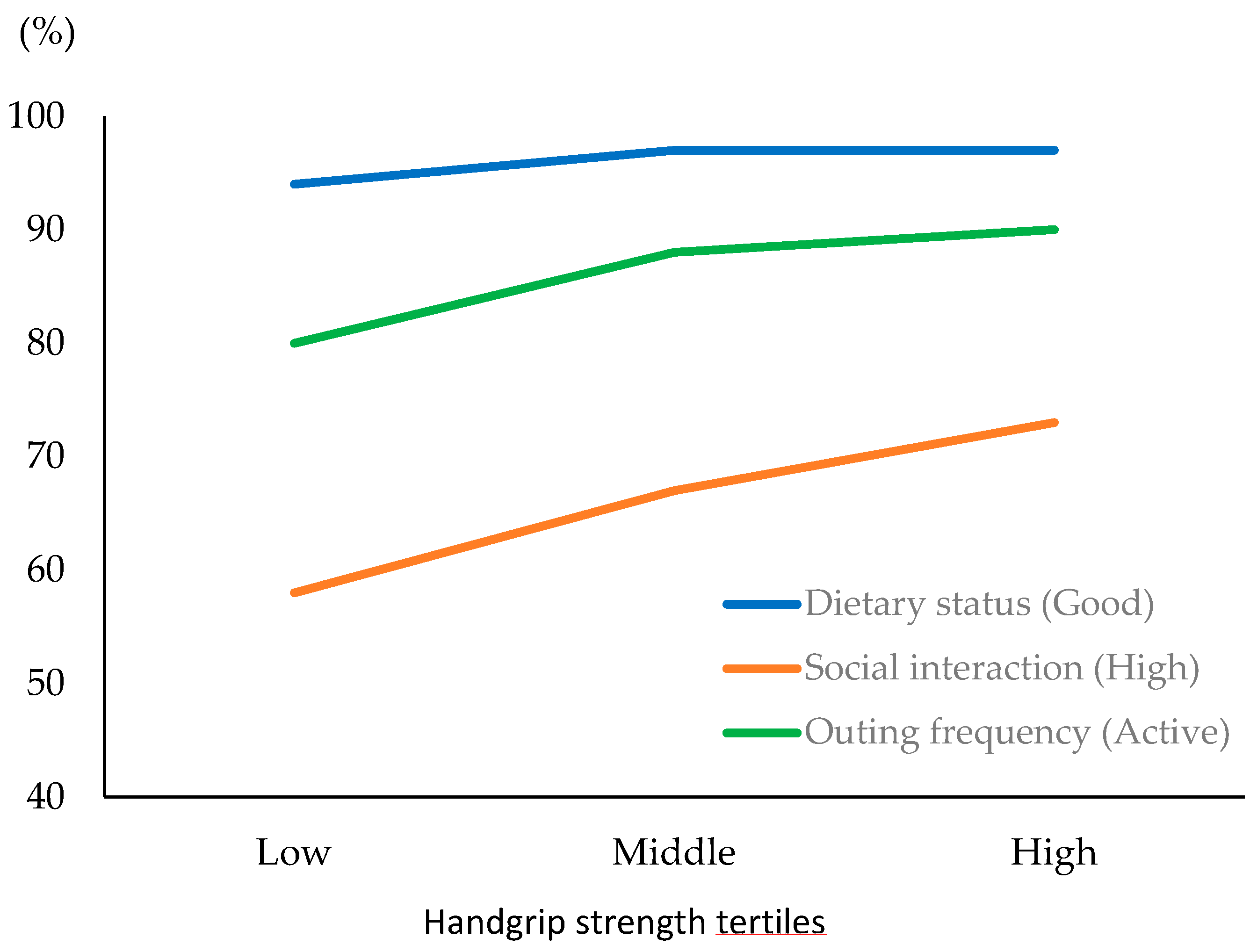
Figure 2.
Distribution of lifestyle scores according to handgrip strength tertiles. Box plots represent the median, interquartile range (IQR), and range of lifestyle scores within each tertile. Higher lifestyle scores were observed in the high handgrip strength tertile.
Figure 2.
Distribution of lifestyle scores according to handgrip strength tertiles. Box plots represent the median, interquartile range (IQR), and range of lifestyle scores within each tertile. Higher lifestyle scores were observed in the high handgrip strength tertile.
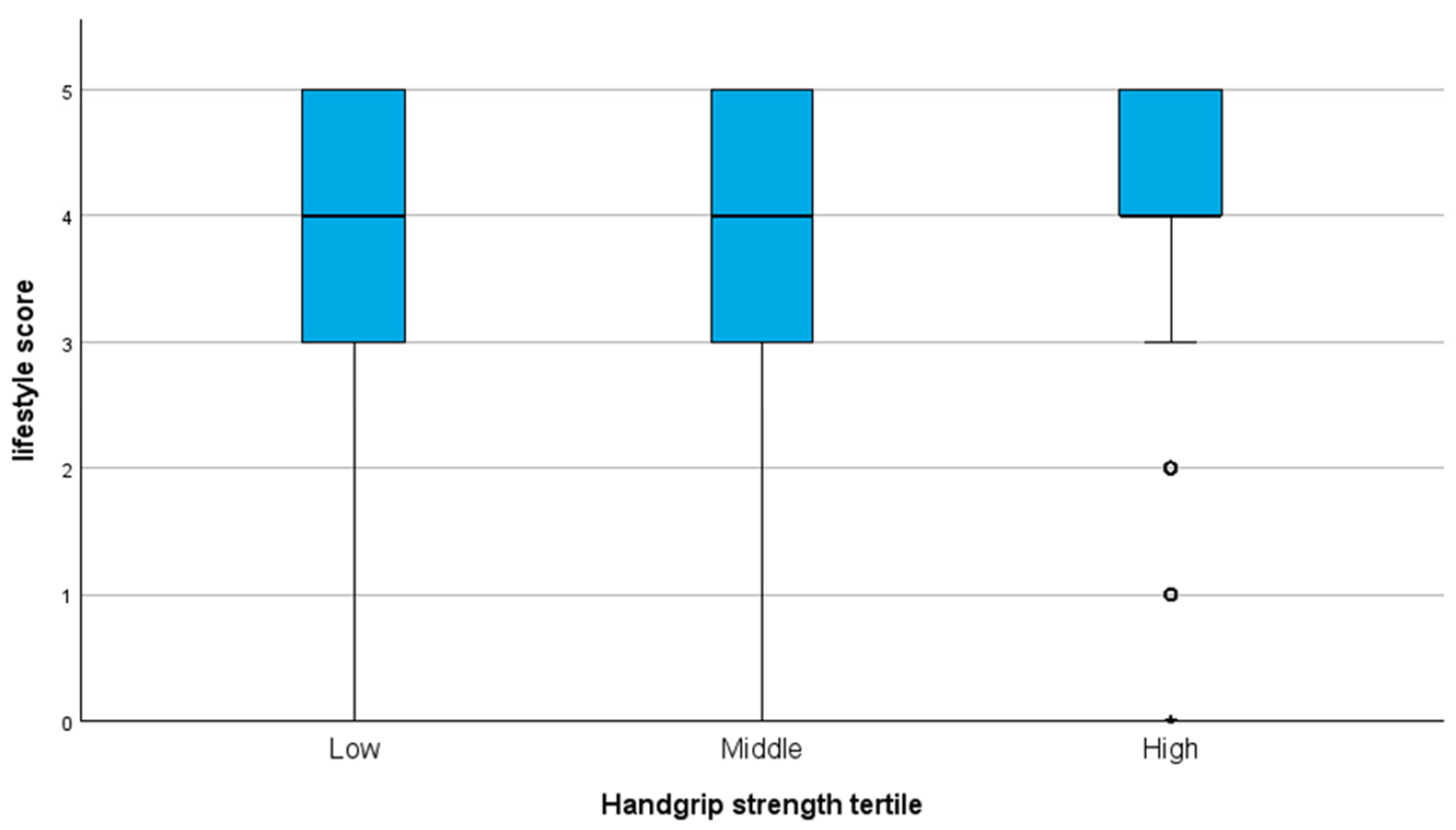
Figure 3.
Trends of the lifestyle scores across handgrip strength tertiles.
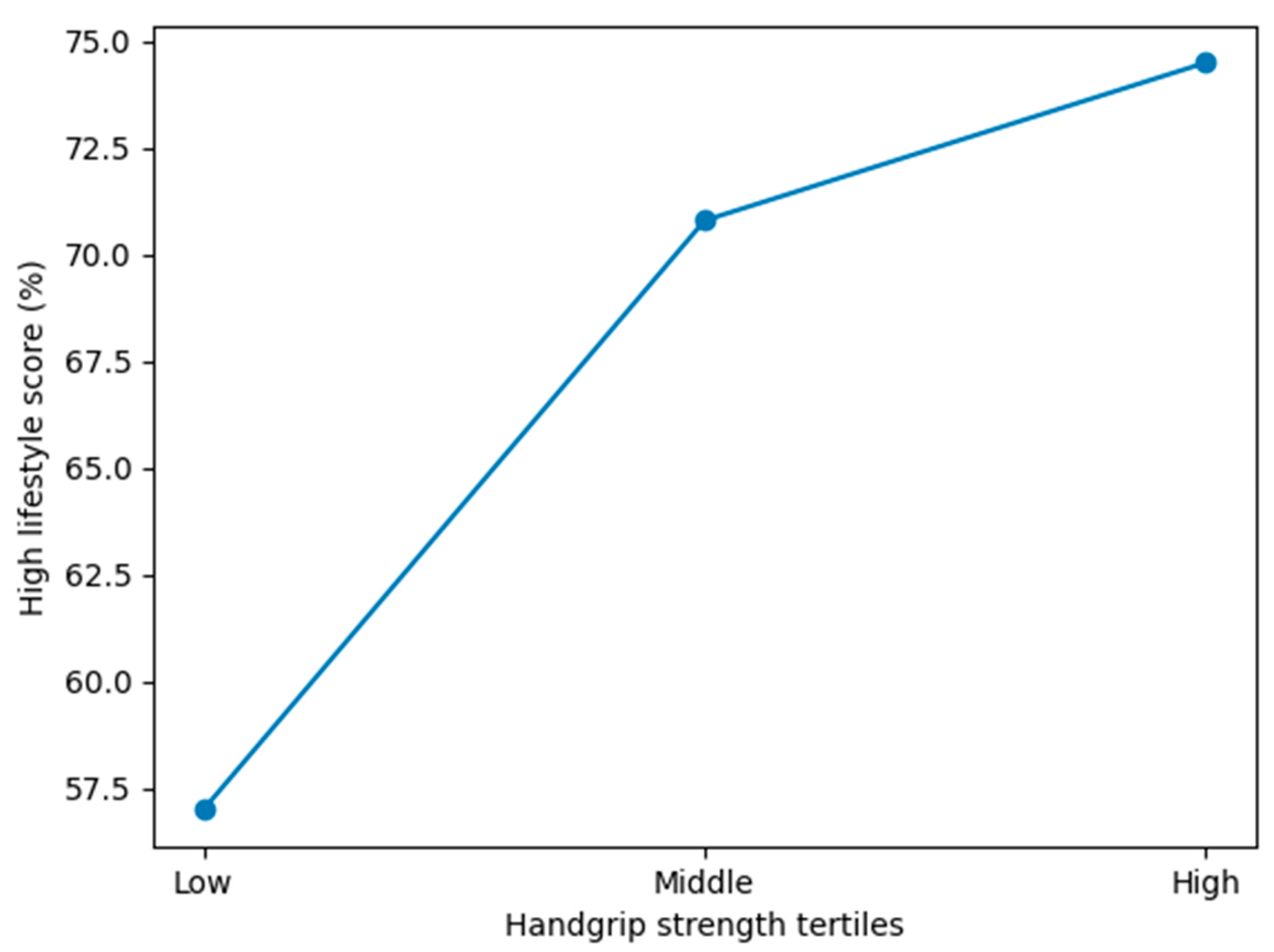

Table 1.
Participant characteristics according to handgrip strength tertiles in older women.
| Variable | Total (n=2206) | Low (n=732) | Middle (n=725) | High (n=748) | p-value |
| Age, years | 78.8 ± 6.6 | 82.4 ± 6.0 | 78.6 ± 5.8 | 75.5 ± 6.0 | |
| Exercise frequency, n (%) | |||||
| High | 1329 (61.5) | 413 (58.3) | 459 (64.2) | 457 (62.1) | 0.065 |
| Low | 831 (38.5) | 296 (41.7) | 256 (35.8) | 279 (37.9) | |
| Sleep quality, n (%) | |||||
| Good | 1719 (79.0) | 552 (76.7) | 561 (78.0) | 736 (82.3) | 0.021 |
| Poor | 456 (21.0) | 168 (23.3) | 158 (22.0) | 130 (17.7) | |
| Dietary status, n (%) | |||||
| Good | 2088 (96.0) | 675 (93.8) | 699 (97.1) | 714 (97.0) | 0.001 |
| Poor | 88 (4.0) | 45 (6.3) | 21 (2.9) | 22 (3.0) | |
| Social interaction, n (%) | |||||
| High | 1431 (66.0) | 420 (58.2) | 476 (66.9) | 535 (72.8) | 0.001 |
| Low | 737 (34.0) | 302 (41.8) | 235 (33.1) | 200 (27.2) | |
| Outing frequency, n (%) | |||||
| Active | 1854 (85.8) | 562 (79.6) | 630 (87.9) | 662 (89.8) | 0.001 |
| Inactive | 306 (14.2) | 144 (20.4) | 87 (12.1) | 75 (10.2) | |
| Values are presented as mean ± standard deviation (SD) or number (percentage). | |||||
| P-values were calculated using one-way ANOVA for continuous variables and the chi-square test for categorical variables. | |||||
| Due to missing data, the number of participants varies across variables. | |||||
Table 2.
Age-adjusted associations between lifestyle factors and handgrip strength tertiles.
| Values are presented as adjusted proportions derived from analysis of covariance (ANCOVA) with age as a covariate. | ||||
| Variables | Low | Middle | High | p-value |
| Dietary status (good) | 94.2 (92.7–95.8) | 97.1 (95.6–98.5) | 96.6 (95.1–98.1) | 0.024 |
| Sleep quality (good) | 77.0 (73.9–80.2) | 78.0 (75.0–81.0) | 82.0 (78.9–85.1) | 0.073 |
| Exercise frequency (high) | 57.9 (54.1–61.7) | 64.2 (60.6–67.8) | 62.4 (58.7–66.1) | 0.060 |
| Social interaction (high) | 60.6 (57.0–64.2) | 66.8 (63.3–70.2) | 70.6 (67.0–74.1) | 0.001 |
| Outing frequency (active) | 82.6 (79.9–85.3) | 87.7 (85.2–90.2) | 87.1 (84.5–89.7) | 0.017 |
Table 3.
Association between lifestyle score and handgrip strength tertiles.
| Lifestyle score | Low grip (n=732) | Middle (n=725) | High (n=748) | p-value |
| Low | 136 (18.6%) | 88 (12.1%) | 73 (9.8%) | |
| Middle | 179 (24.5%) | 124 (17.1%) | 118 (15.8%) | |
| High | 417 (57.0%) | 513 (70.8%) | 557 (74.5%) | <0.001 |
| P-values were calculated using the chi-square test. A linear trend was also observed (p < 0.001). | ||||
Disclaimer/Publisher’s Note: The statements, opinions and data contained in all publications are solely those of the individual author(s) and contributor(s) and not of MDPI and/or the editor(s). MDPI and/or the editor(s) disclaim responsibility for any injury to people or property resulting from any ideas, methods, instructions or products referred to in the content. |
© 2026 by the authors. Licensee MDPI, Basel, Switzerland. This article is an open access article distributed under the terms and conditions of the Creative Commons Attribution (CC BY) license (http://creativecommons.org/licenses/by/4.0/).
Copyright: This open access article is published under a Creative Commons CC BY 4.0 license, which permit the free download, distribution, and reuse, provided that the author and preprint are cited in any reuse.