

Submitted:
28 May 2026
Posted:
29 May 2026
You are already at the latest version
Abstract
In the historical development of various fields of mathematics, significant advances have occurred in areas such as algebra, abstract algebra, group theory, and numerous other mathematical and scientific domains. Contributions from mathematicians such as Dio- phantus, Goldbach, Euler, Girolamo Cardano, Johannes Kepler, Poncelet, Henri Poincaré, George Cantor, Felix Klein, David Hilbert, and Hermann Weyl have been fundamental, particularly in the pursuit of increasingly complex and deeper structures within geometry and topology. In this work, the division operation in the Alpha group is defined by analogy with the Kronecker tensor product. The representation of quaternion theory, based on De Moivre’s theorem, is employed for the construction of the matrices. The Alpha Group di- vision operation is then applied to analyze the various tensor metrics resulting from plane rotations over the interval from 0 to 2π radians. Since the general transformation kernel of the 4 × 4 matrix is defined within the Alpha group, it is possible to observe the variabil- ity associated with the tangent and cotangent functions that constitute the transformation matrix. The Alpha group, defined through a generalized division operation, thus provides a geometric and topological representation of infinity via the kernel transformation of the 4 × 4 matrix. Ultimately, this work seeks to connect the ideas developed by Poncelet and Cantor regarding the formation of imaginary elements in infinite projections with the con- cept of different types of infinity, as interpreted through the application of group theory.
Keywords:
abstract algebra
; group theory
; abstract geometry
MSC: 20N02; 15A66; 22E70; 51M35; 57S20
1. Introduction
In the historical development of various fields of mathematics, numerous attempts have been made to understand the nature of numbers, their magnitudes, relationships, and underlying axioms, contributing to the scientific progress of human knowledge. This development led to advances in areas such as algebra, abstract algebra, group theory, and several other domains of mathematics and science [6].
From this historical perspective, the way numerical spaces were conceptualized and defined enabled the formulation of ideas for points, lines, planes, and solids, including measurements of distance, area, and volume. Advances in linear algebra allowed for the analysis of the structure of orthonormal and metric spaces of arbitrary order. Nevertheless, human reasoning continues to struggle with visualizing metric spaces of dimension higher than three, as well as abstract algebras of order n, and mentally transcending the constraints of Cartesian axes. Although these axes solve numerous three-dimensional problems, they also limit the perception of alternative possibilities. Historically, the evolution of the concept of numbers was gradual, culminating in the discovery of complex numbers, first encountered when solving quadratic equations with negative discriminants. However, their origins are also related to the resolution of cubic equations, in which negative numbers were initially not considered.
Using the ancient Greek ideas of Diophantus [26], numbers could be expressed as the sums of two squares. Following his approach, it became possible to represent any number as the sum of two, three, or four squares, propositions later completed by Fermat, Euler, and Lagrange.
This development in number theory eventually led, in 1742, to Goldbach writing to Euler about one of the most intriguing problems in number theory: the Goldbach Conjecture, stating that every even number greater than two can be expressed as the sum of two prime numbers [44,59].
Analogously, the idea of sums of squares resembles the behavior of the product of complex numbers [29,56]. Regarding cubic equations, the first systematic solution method was published in 1545 in Girolamo Cardano’s Ars Magna, now known as Cardano’s formula [9].
Kepler (1604) was the first to use the principle of continuity, which later influenced many mathematicians in different ways. Kepler introduced the principle of continuity implicitly in De coni sectionibus, included in chapter IV of Ad Vitellionem paralipomena quibus astronomiae pars optica traditur. Although largely independent of algebraic considerations, Kepler’s principle relied on the behavior of certain functions under limiting conditions. Only later were the imaginary and negative roots of the quadratic equations applied to geometry [25].
Poncelet (1862) observed that a conic section equation could be written in the form . When and , the equation reduces to a sum of squares: . The solution corresponds to an isolated point, while produces imaginary straight lines. These new geometric elements intersect the xy plane only at the origin. Poncelet sought to formalize the geometric interpretation of imaginary elements, noting that projections could exist even outside the xy-plane. Chaves [11] discussed 19th-century mathematicians, such as Poncelet and Chasles, who explored the geometric meaning of infinite points and imaginary elements. Poncelet’s principle of continuity, or the permanence of mathematical relations, anticipated the concept of points at infinity and imaginary points, allowing for general intersection properties of lines and circles. Chasles (1837) and Loud (1893) further formalized these concepts, demonstrating that points at infinity cannot be constructed explicitly but can be understood via the continuity principle.
Throughout history, the concept of infinity has been interpreted differently in mathematics, physics, philosophy, and theology [5]. From Plato and Aristotle’s notion of absolute infinity to Cantor’s rigorous set-theoretic treatment, which distinguished countable from uncountable infinities [22,36], the understanding of infinity has evolved significantly.
The theory of hyper-complex quaternions allowed the development of four-dimensional geometries and complex metric spaces [2,28,47,61]. In this context, group theory [12,13,33,45,55] provides a framework for understanding collections of elements that form groups under specific operations, satisfying the closure, identity, inverse, and associativity properties. Elements may be numbers, points, or transformations, while operations may be arithmetic, geometric (e.g., rotations), or other combinatory rules. Mathematicians such as Poncelet and Cantor sought to link infinity with geometric projection, imaginary elements, projective interpretations, or number theory.
Dedekind [23,24,64] expanded the notion of numbers by introducing ideal numbers to preserve the unique factorization in algebraic integer rings. In real numbers, division is straightforward: for numbers and nonzero , there exists a unique such that . In complex numbers, division is similarly well defined, but in non-commutative algebras and curved spaces, new algebraic and topological approaches are required.
Based on group theory and Cantor’s ideas [17,18], the Alpha group was proposed, where two infinite planes interact by a division operation to produce a third element with morphisms that preserve operations in both planes, giving infinity a geometric and topological representation. The Alpha group forms a hypercomplex quaternion:
where is the new imaginary unit of the Alpha group of geometric and topological significance. This suggests a structured non-commutative algebraic framework, and rotations are defined as functions of radians.
Since the classical studies of Hermann Weyl in Space, Time, and Matter [62], it has become evident that the Riemannian geometric continuum exhibited intrinsic limitations in describing the fundamental interactions. In Chapter 2, The Metrical Continuum, Weyl explored these limitations and proposed the gauge theory, anticipating concepts central to modern gauge theories. Subsequent advances, such as Calabi-Yau spaces [4] [31] [40], provided tools capable of modeling extra dimensions and compactification structures, essential for the pursuit of a unification of the forces.
Yet, a gap remained: the need for a mathematical structure capable of generating interactions and symmetries in an emergent manner, integrating geometry, topology, and the internal algebraic structure of the continuum.
The present work proposes an approach that seeks to address this gap, incorporating dynamic topological structures and projective operators, offering a framework that could provide the qualities that Weyl and the subsequent developments of Calabi anticipated as necessary for a more complete unification of the fundamental interactions.
De Moivre established the link between complex numbers and trigonometry, derivable from Euler’s formula [7]. Following this framework, the Alpha group demonstrates specific tensor metrics with asymmetric and mirrored topologies [17,18,19], providing a novel interpretation of metric tensor spaces in hypercomplex quaternion theory. This work analyzes the division operation, the resulting matrix kernel, and the geometric and topological consequences in , highlighting the relationship between Euclidean and Alpha group spaces under rotations of 0 (local) and radians (global).
2. Result
The operations of addition, subtraction, and multiplication in the Alpha group are direct extensions of the classical hypercomplex framework and will be discussed elsewhere. In this work, we focus exclusively on the division operation, which carries the non-trivial topological and geometric consequences of the Alpha group construction. It should be emphasized that the division operation defined in the Alpha group is not a classical division ring operation. Unlike fields or skew-fields, where division is algebraically well defined and satisfies closure and associativity, the Alpha group division is constructed as a geometric–topological operation, inspired by De Moivre’s formulation of complex rotations. This operation captures the interaction between infinite planes and the projective operator , giving rise to non-trivial singularities and compactification phenomena. Thus, division in the Alpha group must be understood as a structural operation with topological consequences, rather than as a purely algebraic field-like division.
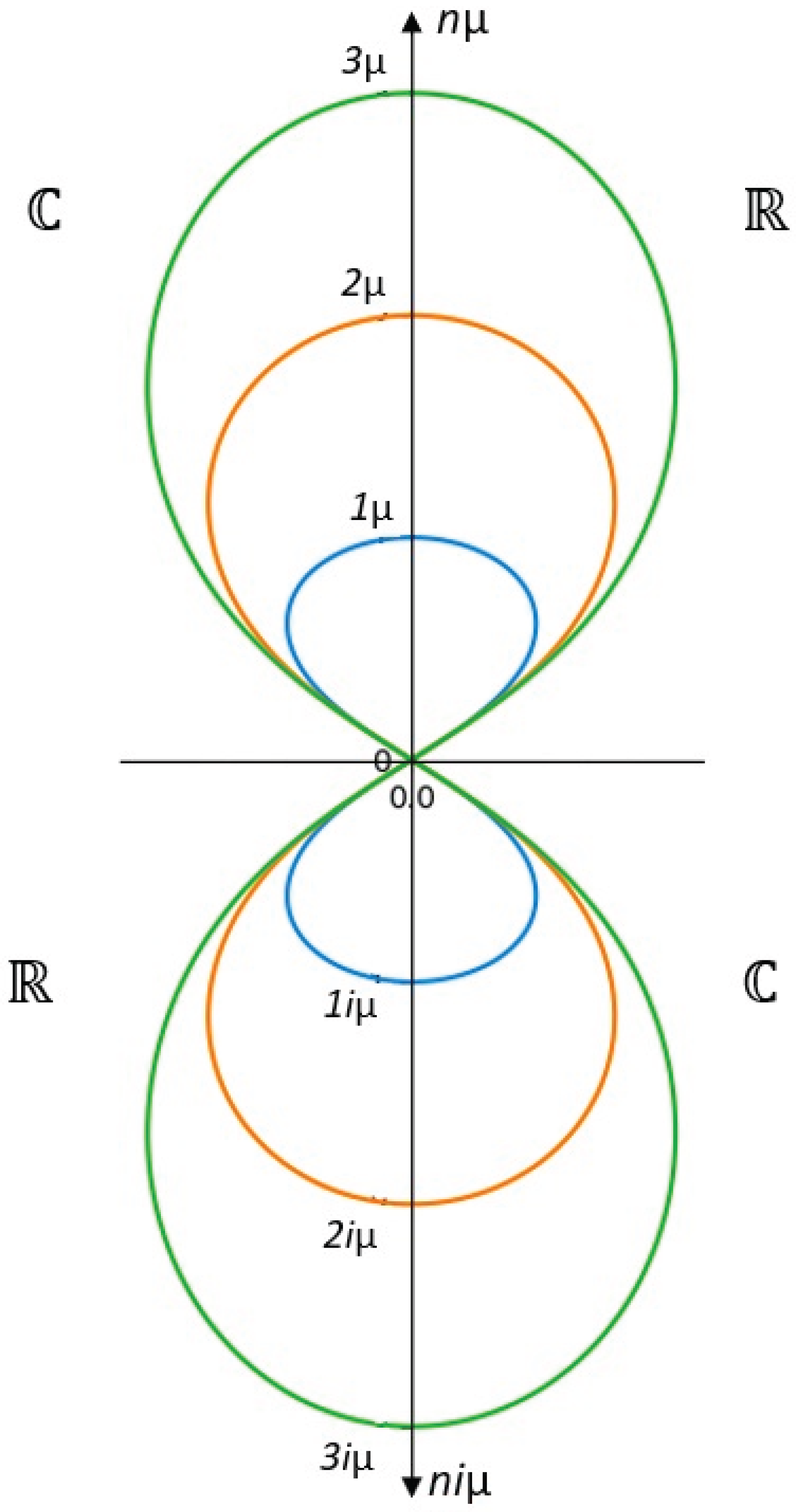
Figure 1 shows the topological structure of the Alpha Group, illustrating the topology of a type of hyperbola in . The asymptotes of the hyperbola close asymptotically through a compactification process, bringing the point at infinity to the boundary of the domain. At maximum deformation, the tangent plane forms a surface that closes at infinity. These deformations are associated with the canonical vector imaginary number , generating a revolving surface and creating a type of attractor in associated with the tangent plane.
The term represents a mixed component, combining the imaginary directions of the planes and , introducing an additional dimension of symmetry and antisymmetry related to the compactification. After closure at , these symmetries and antisymmetries converge into a closed structure equivalent to a sphere (hyperboloid) in four-dimensional space, connecting the real and imaginary dimensions. This structure can be interpreted as a point in four-dimensional space with complex coordinates.
The imaginary number governs both symmetry and asymmetry, becoming central to the geometric organization and topology of the system, directly influencing the properties of the hyperboloid with compactified asymptotes. It presents a dual nature of symmetry and antisymmetry. The product reflects an interaction between the imaginary numbers and . This asymmetry manifests as opposite behaviors between quadrants, suggesting movements corresponding to exchanges between quadrants: 1 to 3 or 3 to 1, and 2 to 4 or 4 to 2. As a result, the dynamics are not uniform but “mirrored” about the central axis, which may be interpreted as inverse rotations or reflections in space, generating alternating motions across the quadrants.
Although the asymptotes are rearranged, the compactified structure remains closed and stable. The curvature and general shape of the hyperboloid are preserved, indicating that this rotation is an isometry within the context of the compactification.
[46] introduced the theory of quaternions based on De Moivre’s theorem. In this context, a complex number can be written as , which can be represented as a square matrix, as shown in Equation 1.
Consequently, De Moivre’s theorem can be expressed in the following form:
The Alpha group number can be constructed through the tensor division operation between two matrices derived from De Moivre’s formula, even though the quaternion in the Alpha group can be composed of two complex planes, as shown in matrix Equation (2). The construction of this division approach is motivated by the Kronecker product, as demonstrated in Equation (3), thereby providing a natural extension of interactions between rotated planes into a higher-dimensional matrix framework [30,64]. The result of Equation (3) arises naturally from the relationship between the operators; however, other possible representations of this operation may also exist. In the Alpha group, the operation is not the usual tensor product, but rather a modified version in which the scalar factors are replaced by functions that capture the ratio between planes:
This substitution is motivated by projective geometry:
which represent projections that can map points to infinity.
2.1. Formal Definition of the Division Operation
Given two rotation matrices and , where B is defined as the same rotational structure as A with a different angle parameter, the division operation ⊘ is defined as:
This operation satisfies the following properties:
- It is not commutative:
- It generalizes complex division to rotated planes.
- Introduces singularities at , where or diverge, corresponding to points at infinity.
Taking into account the trigonometric relationships, the ratio between and defines the tangent (), while the cotangent () is the inverse of the tangent function. The tangent of an angle can also be expressed as the ratio of the length of the side opposite the angle to the length of the adjacent side in a right triangle. This relationship can be used to represent trigonometric operations and potential division operations. The operation does not generalize complex division in the sense of reproducing its algebraic result, but rather as a topological extension, where rotated planes are continuously deformed and projected to infinity. The matrix in Equation (4), resulting from the division of two complex planes, defines a transformation into a hypercomplex space matrix:
Laplace’s method for evaluating determinants enables the computation of the determinant of a matrix without computing its inverse [3]. Applying the Laplace method to the matrix in Equation (4) results in a fourth-degree polynomial with the following structure:
Replacing the terms , , , and , it leads to:
Additionally, Equation (6) can be related to a particular type of conic, allowing us to infer that the division matrix (4) may correspond to a topology associated with a specific conic shape. While a full analysis of the topology associated with matrix (4) is beyond the scope of this paper, its terms have been examined.
In Equation (6), x and y appear with fractional exponents (, ); however, since the square root terms render the equation non-linear, we can analyze the coefficients in terms of the quadratic terms: , , which have equal positive coefficients, indicating an ellipse or circle. The negative coefficient indicates a hyperbola. The linear terms and , with equal positive coefficients, suggest a conic translation in the Cartesian plane but do not determine the specific conic form.
The presence of the term indicates that the conic is not a parabola, as parabolas do not contain a product of x and y in their equations. Therefore, indicating a hyperbolic-type behavior. If no rotation occurs (angles 0 or rad) between the planes in the tensor division operation, the resulting space is Euclidean. In this case, matrix (7) represents only the cotangent function, demonstrating that Euclidean space is embedded within the geometry and topology of the Alpha Group space.
The determinant of the matrix (7) results in a bi-square polynomial (). Replacing , we get a polynomial; solving its roots, there are two zeros and two conjugate complexes , . At the angles with values of rad in the matrix (8), the value of the cotangent is zero. The tangent has the geometric meaning of a geometric point at infinity associated with the imaginary number (). The determinant results in a bi-square polynomial (). Replacing , we get a polynomial; solving its roots, the result was two zeros and two conjugate complex , values.
One way to improve matrix (4) is to insert the number along the main diagonal, characterizing the operation defined within the domain of the Alpha Group. This modification must account for the effects of topological deformation between planes due to rotations in the interval from 0 to , as well as the numerical construction of the Alpha Group. Additionally, placing it, on the main diagonal ensures that the determinant is non-singular (i.e., non-zero) and that the matrix remains asymmetric.
Assuming that matrix (9), a matrix, defines the kernel of general transformations, it produces a general hypercomplex quaternion structure in , incorporating tangent and cotangent functions in conformal coordinates (angle ). This formulation differs from the classical vectorial metric introduced by William Hamilton [35], represented as , in which the angles between the axes are fixed relative to the geometric planes.
The formation of the Alpha group occurs through rotation in the division of the Alpha group between planes at angles of rad. The metric tensor deformations can be altered by selecting different interior angles during the formation of the hypercomplex quaternion. This point has both geometric and topological significance and characterizes the space of the Alpha group [17,18].
In the case of matrix (10), when the rotation is , the determinant is given by: (Equation 11). Using Maple 18 Maplesoft numerical computing software, convergence was verified, yielding the following roots of this polynomial: , , , , in the tangent polynomial, which differs from the polynomial calculated for matrix (8). As two roots diverge to infinity, this represents the desired solution. Two possible combinations of roots are: and , where the complex part lies in the second and fourth quadrants. The numbers forming the Alpha Group and the attractor structure appear in .
When the rotation value is zero, the characteristic polynomial of the determinant becomes: (Equation 12). Numerical verification shows that the roots of this polynomial are , 1, , and in the cotangent polynomial. The signs of the components of the Alpha Group number characterize symmetries, indicating their positions along the axes of and (Figure 1).
Unlike the polynomial calculated for matrix (7), here is considered equal to . However, the roots of the cotangent polynomial in matrix (9) also include as solutions. As a result, the transformation occurs effectively in one dimension. In gauge theory terms, this represents a local Euclidean topology. When considering the tangent, the transformation occurs in the plane, as the term corresponds to the tangent plane in four dimensions.
The deformations are associated with the canonical imaginary vector , generating a revolving surface—a type of attractor in —associated with the tangent plane (Figure 1). The topological structure of the Alpha group exhibits a hyperboloid-like topology in . At maximum deformation, the tangent plane forms a surface that closes at infinity, representing a global geometry and topology within the context of gauge theory.
Let be an imaginary number with a projective representation defined according to Alexandroff [1]:
where is the projective operator associated with Alexandroff topology, [1][16]. Thus, the element should be understood as an idempotent projective element rather than a classical imaginary unit, reflecting its role in the compactification and structural organization of the Alpha Group. In the Alpha group construction, each geometric leaf asymptotically closes at the distinguished element . This compactification resolves the singular behavior at by identifying all asymptotic directions with a projective point. The compactification in the Alpha Group can be understood as the process by which space closes around a point representing infinity. This point , identified with the projective operator, organizes the leaves of the space and acts both as an asymptotic limit and as the invariant axis of the structure. As the rotation angles of approach critical values, the asymptotic directions converge to this special point, characterizing the global topology. The Poincaré sections illustrate this behavior, showing the quadrant asymmetry and the tendency of closure at infinity (Figure 1).
However, the role of is deeper than that of a mere compactification point. The leaves are not independent: they are arranged in a sequential structure and oriented along the invariant vector . In this sense, acts as both:
- the asymptotic closure of each leaf,
- the invariant axis that organizes the foliation into a directed sequence.
Formally, we may express this by
Thus, is simultaneously a projective closure and a structural invariant: it provides both the endpoint for asymptotic convergence and the axis that organizes the global geometry of the Alpha group. This construction unifies the projective viewpoint with the algebraic property of , providing a topologically meaningful resolution of the singularities.
This principle is essential in the Alpha group construction, since the singularities arising at can be resolved by identifying them with this unique projective point.
2.1.1. Comparison with Gauge Theory and Noncommutative Geometry
In 4D topology, following Donaldson & Kronheimer [27] reformulate classical topology through gauge-theoretic analysis, whereas the Alpha group introduces a dynamical structure in which non-commutativity acts as a generative principle, producing both the geometric structure and suggesting possible connections with physical interpretations by an internal geometric vector dynamics with complex eigenvalues with dominant imaginary part. Noncommutative geometry as in Connes [15]. In Connes’ framework, noncommutativity emerges as a structural principle: the algebra replaces the classical notion of space, and dynamics is reconstructed from the Dirac operator that encodes the metric and the spectrum. In contrast, within the Alpha group approach, noncommutativity acquires a deeper significance, as it does not merely substitute for space but is intrinsically bound to its spectral dynamics. The complex eigenvalues with a dominant imaginary component not only reflect the algebraic structure of the group but also give rise to positive and negative curvatures, flows, and energetic coherence. Thus, whereas Connes’ noncommutative geometry provides a categorical reformulation of geometry, the Alpha group proposes a model in which noncommutativity operates likely as a generative dynamic principle, unifying algebra, topology, and suggesting possible connections with physical interpretations.
2.1.2. Asymmetric Matrix Analysis
Analyzing the algebra of matrix (9), we see that it is an asymmetric matrix whose elements are arranged symmetrically for the main diagonal but have opposite signs. Matrix (9) has the following properties: its transpose is different from itself, the elements adjacent to the main diagonal change sign under transposition, the secondary diagonal remains unchanged, and the main diagonal is nonzero. The elements in the upper-left corner are negative, while those in the opposite corner are positive. This structure characterizes a specific type of ring operation. Such an asymmetric matrix can have abstract interpretations in broader mathematical contexts, such as group theory [38,57,60]. Matrix (9) can also be interpreted as an example of a rotation matrix around a specific axis. Some characteristics of four-dimensional rotations may be reflected in the asymmetry of matrix (10). The inclusion of values greater than 1 on the main diagonal indicates a transformation that also involves scaling, which can characterize a more general type of transformation. Its determinant is nonzero and different from 1, indicating that it is not an orthogonal matrix.
Matrix (10) is non-symmetric because it differs from its transpose (). Similarly, matrix (9) is not skew-symmetric, as it differs from the negative of its transpose (), and its main diagonal is not composed of zeros.
An asymmetric matrix can have certain properties, in which it can represent continuous transformations, as in Lie groups, to describe symmetries in physics [34,37], or a transformation that preserves a certain conserved quantity [20,32].
Matrix (9) can be interpreted in the context of Lie algebras, especially when we analyze its decomposition into symmetric and asymmetric parts, or when the matrix is associated with transformations such as rotations or other symmetries in vector spaces. Elements of a Lie algebra can be represented by matrices that obey a specific structure, such as those obtained through matrix decomposition. In Lie algebra, an M square matrix () can be decomposed into symmetric and asymmetric parts: , where S is the symmetric part of the matrix, defined as , and A is the asymmetric (or skew-symmetric) part, defined as [21,34,42,53].
This decomposition is useful because, especially in Lie algebras, asymmetric matrices are associated with rotation operations and other symmetry transformations in vector spaces. The symmetric part may be associated with operations such as scaling or symmetric deformations, depending on the context. To understand the connection with Lie algebra, matrix (10) can be analyzed to verify its asymmetric properties, typical of Lie group generators. Plane rotations and maximal deformations can be described through Lie transformations, where each group element performs a specific rotation or transformation in space.
However, these rotations are unconventional; they present a generating structure of a Lie algebra. This suggests a relation to a Lie-type structure of dimension 2, isomorphic to the vector space , which defines a 2-dimensional subalgebra. This also introduces new topological elements that can be interpreted through compactifications or projections into extended spaces. The imaginary number can be seen as a mathematical artifact encapsulating the transformations at singular points. In Lie algebra terms, this can be understood as the introduction of new generators or modifications to existing ones to accommodate these singularities.
The imaginary number can characterize geometric symmetries, such as rotations determined by the variation of the theta angle. These transformations may be invariant, with a topology that ranges from local Euclidean topology to the global topology of the Alpha group. This provides an example of concepts in Gauge theory [27,54,58,62,63], where an invariant is a quantity preserved under local transformations of the symmetry group, ensuring that the fundamental structure of the system remains consistent regardless of the choice of internal frames. In the context of the Alpha group, this extends to the asymptotic compactification of the hyperboloid, where the division operation defines a conformal metric preserving rotations and the overall structure of space. The presence of , whose property confers an idempotent character, suggests the existence of a foliation invariant under group transformations, establishing an analogue of a gauge connection, but operating within a framework of variable curvature and rotational dynamics between quadrants [52,65].
The matrix , defined on the vector space with the canonical basis , structures a non-commutative algebra fundamental to the internal dynamics of the Alpha group [15]. Its action operates as a generalized rotation operator that couples scalar and pseudoscalar components asymmetrically, changing sign under orientation inversion, reflecting the noncommutativity between the generators and . The vector introduces an internal axis of symmetry and is intrinsically associated with the trace invariance of the curvature generated by , functioning as a conservative axis that maintains the coherence of the internal vector geometry. This structure ensures that, even in non-Hermitian dynamical regimes, evolution preserves deep topological traces, linking local curvature to global energy conservation in the foliated vector space.
When considering 4D rotations in the presence of the imaginary number , the implications become richer and more complex, involving not only linear algebra but also differential topology and geometry. In 4D, rotations can be performed on traditional real planes (e.g., XY, XZ), but the introduction of allows rotations in planes involving complex components. These rotations can be associated with transformations in spaces with complex topologies, where the metric may change. In topology, such transformations may relate to complex or vibrating varieties. The internal dynamics may lead to specific rotations, resulting in resonant couplings characteristic of emergent resonance phenomena, which significantly influence the system’s overall behavior and stability. The presence of suggests that the configuration space may be complex, with points in 4D defined by complex coordinates, such as those found in complex projective spaces. In such spaces, the rotations preserve the complex structure, respecting the relationship between the real and imaginary parts of the coordinates. 4D rotations with introduce additional complexity, where complex topology and geometry are essential. Alpha group geometry considers these new topological and geometric properties, offering a framework for understanding rotations and deformations in higher-dimensional spaces.
The topology characterizing the numerical space of the Alpha group is generated by the variation of the angular ratio () of the hypercomplex quaternion. The definition of an abstract geometric point arises from the existence of the imaginary number at infinity, which, through compactification, lies at the edge of the domain. In the geometric Alpha group space, we may represent this as in the general case. The Alpha group presents a transformation nucleus (matrix (9)) defining a tensor, as well as the presence of the imaginary number , with consequent implications for geometry and topology. A Poincaré section of the Alpha group geometric space is shown in Figure 1, conceptually similar to mirrored hyperbolic surfaces aligned along the canonical imaginary vector . It illustrates the mirroring and rotational asymmetry of rad. The presence of and indicates that operations are not restricted to traditional complex numbers; rather, these elements can be seen as belonging to a broader numerical ring extending hypercomplex numbers.
3. Conclusion
This numerical development of the Alpha group demonstrates how the inherent rotation in the division operation suggests a closed algebraic structure with group-like properties. The variation of geometric angles in the rotation operation of matrix (9) induces both geometric and topological changes. In this regard, the Alpha group bears resemblance to Poncelet’s ideas: the existence of projective imaginary elements, as described by Poncelet, does not exclude the possibility of imaginary points at infinity. Similarly, Cantor’s exploration of different types of infinity suggests geometric and topological implications. The existence of a canonical vector defined by the number determines the structure of the Alpha group. From this perspective, one can propose a topology for each angle in the interval of matrix (9), with each rotation angle being associated with specific geometric outcomes. Trigonometric analysis of these angles reveals a direct correspondence with metric deformations arising from the tensor in the core of the transformation matrix.
In this context, it can be observed that rotation in tensor division, when close to the angles 0 or , exhibits the characteristic topology of Euclidean metric space. Owing to its polynomial form, the transformation reduces to a single dimension. In the interval , the number is not infinite but instead behaves as a polynomial function associated with a hyperbolic asymptote, where the hyperbola geometrically closes at infinity, involving asymptotic compactification in conformal coordinates (via the angle). However, when the rotation occurs at , the transformation involves a topological deformation at infinity, with the imaginary number representing the deformation associated with the tangent plane in four dimensions. In terms of Lie algebras, these rotations are unconventional: they no longer follow the standard structure but introduce new topological elements that can be interpreted through compactifications or projections into extended spaces. The imaginary number may thus be regarded as a mathematical artifact encapsulating the transformations at singular points, effectively introducing new generators or modifying existing ones to account for these singularities. The geometry of the Alpha Group embraces these new topological and geometric features, offering a novel framework for understanding rotations and deformations in higher-dimensional spaces. These rotations act not only on real but also on complex coordinates, thereby preserving the complex structure of space. This connection is deeply rooted in symmetries found in advanced physical theories, such as gauge theories, and may have significant implications for understanding the structure of spacetime in higher dimensions.
The Alpha group, therefore, represents a paradigm shift by positing the existence of a new imaginary number with geometric and topological meaning at infinity. While first anticipated by Poncelet and later complemented by Cantor through the notion of multiple infinities, this perspective opens new possibilities. We may further conjecture that such transformations can be dynamically stable or treated as invariant objects, defining specific numerical spaces in the formation of hypercomplex quaternions, which act as attractors in . Thus, the Alpha group introduces a new generic metric system in conformal coordinates. A definition of tensor division grounded in the Alpha group framework is suggested, representing not only a mathematical construction but also an evolutionary step in abstract thought. The Alpha group offers an alternative perspective on compactification at infinity, where the hyperboloid in assumes new matrix structures, categorized into symmetric and asymmetric components. This reflects the presence of mixed curvatures, where space closes at infinity while retaining a dynamic internal structure. Matrix (5), under endless compactification as the angle approaches , may exhibit specific patterns or oscillations, revealing an internal structure that interacts with the base space rotation, possibly producing resonance effects typical of spectral collapse or shifts in dynamic behavior. Moreover, by systematically allowing rotations between quadrants, the Alpha group discloses a space where dimensions normally treated as separate can interact more profoundly, offering an expanded view of the continuity between curved spaces and projective planes.
The study of division thus naturally leads to the Alpha group, which extends our understanding of geometry and suggests a new interpretation of higher dimensions. With its metric structure and unique algebraic properties, it constitutes a step beyond the Euclidean model, paving the way for theoretical advances and future mathematical applications. The article proposes a novel mathematical structure different from a division ring, in which the property holds and carries topological significance. This structure allows for a well-defined projection from to , effectively enabling the compactification of the parameter space while preserving the essential topological and algebraic features required for the dynamics of the Alpha group.
Preliminary analysis suggests that the homology groups and preserve their structural universality at the critical points and , while does not necessarily collapse completely. Instead, may undergo critical reduction, local degeneration, or explosive growth depending on the angular regime of . This behavior suggests that higher-order topological structures can be traced through emergent connectivity generated by the deformation process induced by the tangent and cotangent operators. Near Euclidean regimes, may approach minimal configurations, whereas near compactification singularities , the same structure may exhibit explosive topological expansion associated with asymptotic closure and projective compactification. This behavior suggests that topological deformations can be traced through a global emergent connectivity generated by the deformation process induced by the tangent and cotangent operators. Future work should extend these results by exploring more general families of induced graphs, investigating whether such universal behavior persists in higher dimensions, and alternative parameterizations of . Such studies could reveal deeper connections between graph analysis and the topological invariants of dynamical algebraic structures.
References
- Alexandroff, P. Über den Mappings von Mengen in Mengen. Mathematische Annalen; 1940. [Google Scholar]
- Altmann, S. L. Rotations, quaternions, and double groups; Courier Corporation, 2005. [Google Scholar]
- Anton, H.; Rorres, C. Álgebra linear com aplicações, 10th ed.; Bookman Editora, 2012. [Google Scholar]
- Aspinwall, P. S.; Greene, B. R.; Morrison, D. R. Calabi-Yau moduli space, mirror manifolds and spacetime topology change in string theory. Nucl. Phys. B 1994, 416(2), 414–480. [Google Scholar] [CrossRef]
- Bertato, F. M. O infinito e o método da diagonal de Cantor – tradução de Über eine elementare Frage der Mannigfaltigkeitslehre (1890–91). Rev. Bras. De História Da Matemática 2023, 23(46), 421–439. [Google Scholar] [CrossRef]
- Boyer, C. B.; Merzbach, U. C. História da matemática; Edgar Blucher, 2019. [Google Scholar]
- Brown, J. W.; Ruel, C. V. Complex variables and applications, 7th ed.; McGraw-Hill Science Engineering, 2003. [Google Scholar]
- Cantor, G. Contributions to the founding of the theory of transfinite numbers (No. 1); Open Court Publishing Company, 1915. [Google Scholar]
- Cardano, G.; Witmer, T. R.; Ore, Ø. The rules of algebra: Ars magna; Courier Corporation, 2007. [Google Scholar]
- Chasles, M. Aperçu historique sur l’origine et le développement des méthodes en géométrie, particulièrement de celles qui se rapportent à la géométrie moderne, suivi d’un mémoire de géométrie sur deux principes généraux de la science, la dualité et l’homographie. In M. Hayez.; 1837. [Google Scholar]
- Chaves, J. A.; Grimberg, G. E. Os pontos imaginários nas obras de Poncelet, Chasles e Lague; Revista de la Sociedad Española de Historia de las Ciencias y de las Técnicas: Llull, 2020; Volume 43, 87, pp. 69–98. [Google Scholar]
- Chen, J. Fundamental theorems from group theory. In 2nd International Conference on Applied Mathematics, Modelling, and Intelligent Computing (CAMMIC 2022); SPIE, 2022; Vol. 12259, pp. 560–565. [Google Scholar] [CrossRef]
- Cohen, T. S.; Geiger, M.; Weiler, M. A general theory of equivariant CNNs on homogeneous spaces. Adv. Neural Inf. Process. Syst. 2019, 32. [Google Scholar]
- Cohn, P. M. Algebra, 2nd ed.; Bedford College, University of London, 1982; Vol. 1. [Google Scholar]
- Connes, A. Noncommutative geometry; Academic Press, 1994. [Google Scholar]
- Corrêa, C. S.; de Melo, T. B. The Alpha Group 4D geometry: Symmetric structures and topological transitions. 2025, hal–05208302. [Google Scholar] [CrossRef]
- Corrêa, C. S.; de Melo, T. B.; Custodio, D. M. Proposing the Alpha Group. Int. J. Res. Eng. Appl. Manag. (IJREAM) 2022, 8(5), hal–05199208. [Google Scholar] [CrossRef]
- Corrêa, C. S.; de Melo, T. B.; Custodio, D. M. The Alpha Group Tensorial Metric. Rev. Bras. De História Da Matemática (RBHM) 2024, 24(48), 78-84, hal-05177754. [Google Scholar] [CrossRef]
- Corrêa, C. S.; de Melo, T. B. N. Division as a radial vector relationship – Alpha group. Stud. Eng. Exact. Sci. 2025, 6(1), e16083, hal-05177760. [Google Scholar] [CrossRef]
- Cozzini, M.; Giorda, P.; Zanardi, P. Quantum phase transitions and quantum fidelity in free fermion graphs. Phys. Rev. B 2007, 75(1), 014439. [Google Scholar] [CrossRef]
- Das, A.; Okubo, S. Lie groups and Lie algebras for physicists; World Scientific, 2014. [Google Scholar]
- De Carvalho, T. F.; D’Ottaviano, I. M. L. Sobre Leibniz, Newton e infinitésimos: das origens do cálculo infinitesimal aos fundamentos do cálculo diferencial paraconsistente. Educ. Matemática Pesqui. 2006, 8(1). [Google Scholar]
- Dedekind, R. Theory of algebraic integers; Cambridge University Press, 1996. [Google Scholar]
- Dedekind, R.; Weber, H. Theory of algebraic functions of one variable; American Mathematical Society, 2012. [Google Scholar]
- Del Centina, A.; Fiocca, A. Boscovich’s geometrical principle of continuity and the “mysteries of infinity. Hist. Math. 2018, 45(2), 131–175. [Google Scholar] [CrossRef]
- de Alexandria, Diofanto. La aritmética y el libro sobre los números poligonales. In Nivola Libros Ediciones; 2007. [Google Scholar]
- Donaldson, S. K. An application of gauge theory to four-dimensional topology. J. Differ. Geom. 1983, 18(2), 279–315. [Google Scholar] [CrossRef]
- Erdogdu, M.; Ozdemir, M. De-Moivre’s and Euler formulas for matrices of split quaternions. arXiv. 2015. Available online: http://arxiv.org/abs/1503.05413.
- Eves, H. Introdução à história da matemática; (Trabalho original publicado em 1990); Domingues, H. H., Ed.; Editora da Unicamp, 2004. [Google Scholar]
- Graham, A. Kronecker products and matrix calculus with applications; Courier Dover Publications, 2018. [Google Scholar]
- Gross, M.; Huybrechts, D.; Joyce, D. Calabi-Yau manifolds and related geometries: lectures at a summer school in Nordfjordeid, Norway, June 2001; Springer Science & Business Media, 2012. [Google Scholar]
- Haber, E.; Ruthotto, L. Stable architectures for deep neural networks. Inverse Probl. 2017, 34(1), 014004. [Google Scholar] [CrossRef]
- Hall, M. The theory of groups; Courier Dover Publications, 2018. [Google Scholar]
- Hall, B. C. Lie groups, Lie algebras, and representations; Springer, 2013. [Google Scholar]
- Hamilton, W. R. On quaternions; or a new system of imaginaries in algebra. Lond. Edinb. Dublin Philos. Mag. J. Sci. 1844, 25(169), 489–495. [Google Scholar] [CrossRef]
- Infinity: New research frontiers; Heller, M., Woodin, W. H., Eds.; Cambridge University Press, 2011. [Google Scholar]
- Isaev, A. P.; Rubakov, V. A. Theory of groups and symmetries: Finite groups, Lie groups, and Lie algebras; World Scientific, 2018. [Google Scholar]
- Jacobson, N. Structure of rings; American Mathematical Society, 1956. [Google Scholar]
- Jacobson, N. Basic algebra, 2nd ed.; Dover Publications, 2009; Vol. 2. [Google Scholar]
- Kollár, J. Deformations of elliptic Calabi-Yau manifolds. Recent Adv. Algebr. Geom. 2015, Vol. 417, 254–290. [Google Scholar]
- Kepler, J. Ad vitellionem paralipomena, quibus astronomiae pars optica traditur: potissimum de artificiosa observatione et aestimatione diametrorum deliquiorumque solis & lunae. Cum exemplis insignium eclipsium.. 1604.
- Lang, S. Linear algebra; Springer Science & Business Media, 1987. [Google Scholar]
- Loud, F. H. A construction for the imaginary points and branches of plane curves. Ann. Math. 1893, 8(1/6), 29–37. [Google Scholar] [CrossRef]
- Maitra, S. A Proof Goldbach’s Strong Conjecture 2019.
- Martin, P. A. Grupos, corpos e teoria de Galois; Editora Livraria da Física, 2010. [Google Scholar]
- Murnaghan, F. D. An elementary presentation of the theory of quaternions. Scr. Math. 1944, 10, 37–49. [Google Scholar]
- Özyurt, G.; Aalagoz, Y. On hyperbolic split quaternions and hyperbolic split quaternion matrices. Adv. Appl. Clifford Algebr. 2018, 28(88). [Google Scholar] [CrossRef]
- Poncelet, J. V. Essai sur les propriétés projectives des sections coniques [Présentation d’un article]. In Académie des Sciences de Paris, France; 1820. [Google Scholar]
- Poncelet, J. V. Applications d’analyse et de géométrie: traité des propriétés projectives des figures; Mallet-Bachelier, 1862. [Google Scholar]
- Poncelet, J. V. Applications d’analyse et de géométrie, qui ont servi, en 1822, de principal fondement au Traité des propriétés projectives des figures... comprenant la matière de sept cahiers manuscrits rédigés à Saratoff... annotés par l’auteur et suivis d’additions par MM. Mannheim et Moutard.. 1864.
- Poncelet, J. V. Traités des propriétés projectives des figures: ouvrage utile à ceux qui s’occupent des applications de la géométrie descriptive et d’opérations géométriques sur le terrain; Gauthier-Villars, 1866; Vol. 2. [Google Scholar]
- Penrose, R. Zero rest-mass fields, including gravitation: asymptotic behaviour. Proceedings of the Royal Society of London. Series A. Mathematical and Physical Sciences 1965, 284(1397), 159–203. [Google Scholar] [CrossRef]
- Riley, K. F.; Hobson, M. P.; Bence, S. J. Mathematical methods for physics and engineering, 3rd ed.; Cambridge University Press, 2006. [Google Scholar]
- Rothe, H. J. Lattice gauge theories: An introduction, 4th ed.; World Scientific Publishing Company, 2012. [Google Scholar]
- Scott, W. R. Group theory; Courier Corporation, 2012. [Google Scholar]
- Stillwell, J. Yearning for the impossible: The surprising truths of mathematics, 2nd ed.; CRC Press, 2018. [Google Scholar]
- Stenström, B. Rings of quotients: An introduction to methods of ring theory; Springer Science & Business Media, 2012. [Google Scholar]
- Taylor, J. C. Gauge theories. Gauge Theor. Twent. Century 2001, 381. [Google Scholar]
- Vaughan, R. C.; Nash, J., Jr. Goldbach’s conjectures: A historical perspective. In Open problems in mathematics; Rassias, M. Th., ., Ed.; Springer, 2016; pp. 479–520. [Google Scholar] [CrossRef]
- Vechtomov, E. M. Rings of continuous functions with values in a topological division ring. J. Math. Sci. 1996, 78(6), 702–753. [Google Scholar] [CrossRef]
- Vince, J. Quaternion algebra. In Mathematics for computer graphics; Springer London, 2022; pp. 233–259. [Google Scholar] [CrossRef]
- Weyl, H. Space, time, matter; Dutton, 1922. [Google Scholar]
- Weyl, H. Electron and gravitation. Z. Für Phys. 1929, 56(5–6), 330–352. [Google Scholar] [CrossRef]
- Weyl, H. Algebraic theory of numbers; Princeton University Press, 1998. [Google Scholar]
- Yang, C. N.; Mills, R. L. Conservation of isotopic spin and isotopic gauge invariance. Phys. Rev. 1954, 96(1), 191–195. [Google Scholar] [CrossRef]
Figure 1.
The geometric space of the Alpha Group in , Poincaré cut, shows a topological structure exhibiting anisotropy.This point , identified with the projective operator, organizes the leaves of the space and acts both as an asymptotic limit and as the invariant axis of the structure. As the rotation angles of approach critical values, the asymptotic directions converge to this special point, characterizing the global topology.
Figure 1.
The geometric space of the Alpha Group in , Poincaré cut, shows a topological structure exhibiting anisotropy.This point , identified with the projective operator, organizes the leaves of the space and acts both as an asymptotic limit and as the invariant axis of the structure. As the rotation angles of approach critical values, the asymptotic directions converge to this special point, characterizing the global topology.
Disclaimer/Publisher’s Note: The statements, opinions and data contained in all publications are solely those of the individual author(s) and contributor(s) and not of MDPI and/or the editor(s). MDPI and/or the editor(s) disclaim responsibility for any injury to people or property resulting from any ideas, methods, instructions or products referred to in the content. |
© 2026 by the authors. Licensee MDPI, Basel, Switzerland. This article is an open access article distributed under the terms and conditions of the Creative Commons Attribution (CC BY) license (http://creativecommons.org/licenses/by/4.0/).
Copyright: This open access article is published under a Creative Commons CC BY 4.0 license, which permit the free download, distribution, and reuse, provided that the author and preprint are cited in any reuse.


