

Submitted:
19 August 2026
Posted:
20 August 2026
You are already at the latest version
Abstract
Objective: To establish whether the published epidemiological record can support or refute the proposition that chronic migraine is a modifiable midlife contributor to Alzheimer’s dementia, and to specify the studies that would settle the question. Background: Migraine is repeatedly reported as a dementia risk factor and has been proposed for addition to the list of modifiable risks. A route from recurrent cortical spreading depolarization through perivascular clearance failure to amyloid aggregation, and onward through pannexin-1–HMGB1–toll-like-receptor transduction to sustained neuroinflammation, is biologically coherent. Whether the epidemiology actually tests that route has not been examined. Methods: Narrative review. PubMed, Google Scholar and CrossRef were searched from January 2020 to August 2026, with hand-searching for seminal earlier work. Following an internal audit, every quantitative claim was re-derived from the source record rather than from an earlier draft, and claims that could not be so derived were removed. Results: The association declines monotonically as control over ascertainment improves. For primary headache the odds ratio is 1.49 (95% CI 1.20–1.85) in case-control studies, 1.35 (1.25–1.45) in retrospective cohorts and 0.82 (0.74–0.92) in prospective cohorts, the last significantly below the null. Heterogeneity falls from I2 85.9% undivided to 9.2%, 61.9% and 26.9% within design strata, and small-study effects appear only in the middle stratum. Attack frequency has never been related to dementia incidence in any cohort; the one study that measured frequency directly reported no direct association with its brain-age gap, alongside a positive indirect path through segmented brain volume in a design with a truncated exposure range. Chronicity has never been stratified against episodic migraine. No adequate aura-stratified evidence exists, so aura supports neither the model nor its negation. Across pain phenotypes migraine ranks fifth of six, below trigeminal neuralgia and fibromyalgia, neither of which involves depolarization, and the source authors attribute their own top-ranked estimate to depression. Risk attenuates with time since the first diagnostic code and remains elevated beyond ten years. Conclusion: These findings share one cause: exposure is recorded as a diagnosis and not measured as disease activity, so the coded date marks clinical contact and not disease onset, and the interval between the two differs systematically across phenotypes and designs. The proposition is untested, not refuted. A falsifiable prediction follows, together with a cross-sectional plasma-biomarker comparison that would substantially weaken the hypothesis if null and open the frequency question if positive, at a fraction of the cost of an imaging program. Plain Language Summary: Migraine has been named as a possible cause of dementia in later life, but no long-term study has asked whether people with more attacks go on to develop it. We reviewed the evidence and found the link weakens, then reverses, in the studies that follow patients most closely. These studies record a diagnosis and not the illness itself, so the question stays open; one blood test study would go a long way toward answering it.
Keywords:
migraine
; chronic migraine
; Alzheimer disease
; dementia
; cortical spreading depolarization
; epidemiologic methods
1. Introduction
Dementia affected approximately 57 million people in 2019 and is projected to reach 153 million by 2050 [1]. The 2024 Lancet Commission identified 14 potentially modifiable risk factors accounting for around 45% of cases [2]. Migraine is not among them, and whether it belongs there has been raised repeatedly without being settled [3,4,5].
This review separates the two halves of that question. The mechanistic half asks whether a biologically coherent route runs from recurrent attacks to Alzheimer pathology. The epidemiological half asks whether the observational and genetic record can tell us if that route is traveled. The answers differ sharply, and saying so precisely — then specifying what would have to be measured instead — is more useful than another restatement of the association.
2. Methods
We searched PubMed, Google Scholar, and CrossRef (January 2020 – August 2026) using combinations of “migraine”, “chronic migraine”, “migraine with aura”, “Alzheimer’s disease”, “dementia”, “cortical spreading depression”, “glymphatic”, “brain insulin resistance”, “TNF-alpha”, “CGRP”, “brain age”, “Mendelian randomization”, and “chronic pain”, restricted to English-language studies in humans or translationally relevant animal models. Seminal work predating 2020 was added by hand-search. Following an internal audit in August 2026, every quantitative claim was re-derived from the source record rather than from an earlier draft; claims that could not be so derived were removed. Two preprints are flagged in the reference list.
Generative artificial intelligence (Claude, Anthropic) was used to assist with literature synthesis, with verification of references and reported values against the source records, and with language editing. No content was incorporated without verification against a primary source. All scientific claims, attributions, interpretations and conclusions were formulated and verified by the author, who takes full responsibility for the accuracy of the content. The tool is not, and could not be, an author.
3. What the Epidemiology Can and Cannot Support
An association is reported consistently: a 2025 meta-analysis of 11 cohort studies comprising 6 964 353 participants gave hazard ratios of 1.26 (95% CI 1.09–1.46) for all-cause dementia and 1.32 (1.26–1.38) for Alzheimer’s dementia [3]. What it cannot support is the more specific claim on which a cumulative-injury model depends.
3.1. Frequency Has Never Been Measured Against Dementia
The largest and most carefully constructed registry study — 44 195 patients risk-set matched to 44 195 controls on a time-dependent propensity score, mean baseline age 55.3 years, followed up to 16 years — reported hazard ratios of 1.30 (1.25–1.35) for all-cause dementia and 1.29 (1.23–1.35) for Alzheimer’s dementia, but defined exposure entirely from diagnostic codes, with no headache diaries, attack counts, or severity measures. Its authors close by stating that future studies need to explore whether characteristics such as severity or frequency affect the development of dementia [13].
One study measured frequency directly. In a clinical cohort with diary-confirmed diagnoses and interictal imaging, chronic migraine showed a brain-age gap of +4.16 years against −0.52 in controls (pairwise p = 0.010, Cohen’s d 0.49), with episodic migraine intermediate and not significant. Two qualifications belong with that figure: the three-group omnibus test did not reach significance (ANCOVA p = 0.053), and the model’s mean absolute error in controls was 6.26 years, larger than the gap itself [19].
The same study found no association between the gap and headache frequency (p = 0.89 in chronic migraine, 0.72 in episodic, 0.30 combined), migraine frequency, migraine duration, or chronic-migraine duration, and its authors state that a damage-accumulation model predicts exactly such a correlation [19]. Three things complicate a simple negative reading, all from the same paper. The mediation analysis was positive: segmented brain volume mediated the relationship between headache frequency and the gap across migraine groups combined. The authors note that frequency is already embedded in the chronic-versus-episodic categorization, truncating within-group variance; high-frequency episodic migraine was excluded by design, truncating it further. And they observe that migraine often ameliorates with age, so the largest structural effects may occur early and be invisible cross-sectionally. A direct null with a positive indirect path, in a cross-sectional dataset with a restricted exposure range, is not a refutation of dose-response; it is an argument that dose-response has not been measured in a design capable of detecting it.
3.2. Chronicity Has Never Been Stratified
The claim that chronic migraine carries risk beyond episodic migraine is untested. The meta-analysis most often cited for it performs no chronic-versus-episodic and no frequency stratification, and reports that other subgroup analyses could not be performed for lack of data [4]. A manuscript about chronic migraine therefore rests on an epidemiology that is almost entirely about migraine undifferentiated.
3.3. Aura Is Unresolved, Not Supportive
Depolarization is the established substrate of aura [22], so a model making it the initiating event predicts that aura carries the larger risk. The evidence shows neither that nor cleanly the reverse. The Mendelian-randomization analysis from which we take the thalamic mediation estimate reports an effect for migraine without aura (odds ratio 1.091, 95% CI 1.059–1.123, p = 6.95 × 10⁻⁹) and no corresponding effect for migraine with aura among its results [20]. The largest clinical cohort found the subtypes similar, but more than half its patients had no aura information recorded, and its authors call for re-investigation with accurate aura assessment [13]. Our position is that aura cannot serve as evidence for depolarization primacy anywhere in this paper — not because the evidence refutes it, but because no adequate aura-stratified evidence exists. If subclinical depolarization is common in migraine without aura, the clinical phenotype is in any case a poor proxy for depolarization burden. We adopt that consistently and do not invoke aura as support.
3.4. Direction Tracks Study Design
The most consequential pattern is methodological, and it can be quantified. The meta-analysis stratifying by design reports, for primary headache, an odds ratio of 1.49 (1.20–1.85) in case-control studies, 1.35 (1.25–1.45) in retrospective cohorts, and 0.82 (0.74–0.92) in prospective cohorts — significantly below the null. For migraine the same ordering holds: 1.59 (1.36–1.85), 1.37, and 0.88 (0.73–1.05), the last not significant [4].
Three features make the gradient hard to dismiss. Heterogeneity falls once studies are grouped by design — I2 of 9.2%, 61.9% and 26.9% respectively, against 85.9% undivided — so the subgroups are internally consistent rather than pooling artefacts. Publication bias runs the same way: Egger’s test was significant among retrospective studies (p = 0.020) and not among case-control or prospective studies (p = 0.219, p = 0.522) [4]. The positive estimates come from the designs most exposed to ascertainment and reporting bias, the inverse estimate from the design least exposed to either. The authors’ own closing sentence is that most included prospective studies do not confirm the association, which might raise the suspicion of confounding [4].
A 2026 prospective cohort with adjudicated, imaging-supported outcomes is consistent with that subgroup rather than an outlier against it, reporting 0.70 (0.51–0.95) for all-cause dementia and 0.58 (0.40–0.85) for Alzheimer’s disease [26]; a 2018 review found no progressive cognitive decline at population level [34]. We previously called that 2026 cohort the central open problem. It is not: it is the newest point on a line already visible in a meta-analysis we cite. We also previously offered three defenses of it and withdraw two. Participants with migraine there had lower all-cause mortality, so competing risk biases their dementia incidence upward, not downward; and misclassification of the kind its instrument produces attenuates toward the null rather than generating a protective estimate. The defensible criticisms are narrower: exposure was lifetime rather than active migraine, probable migraine counted as non-migraine, and event counts did not permit stratification [26].
4. The Specificity Problem
If recurrent depolarization is the initiating and rate-limiting event, migraine should carry a dementia signal that pain conditions without depolarization do not. On the only meta-analysis stratifying by pain phenotype, it does not. Pooled hazard ratios were 4.47 (3.09–6.47) for trigeminal neuralgia, 2.77 (2.61–2.95) for fibromyalgia, 1.43 (1.06–1.92) for widespread pain, 1.31 (1.14–1.52) for osteoarthritis, 1.26 (1.16–1.36) for migraine, and 1.15 (1.09–1.21) for chronic non-cancerous pain, against a pooled chronic-pain estimate of 1.42 (1.23–1.64) [39]. Migraine ranks fifth of six; trigeminal neuralgia, involving no depolarization whatever, carries roughly three and a half times the risk. We treat this as the decisive objection and state plainly that the model cannot be defended on effect size. What we dispute is that the ranking measures what it appears to measure.
First, the source attributes its own top-ranked estimate to a different mechanism: its authors trace the trigeminal-neuralgia signal to depression, note that depression is an established dementia risk factor, and propose that trigeminal neuralgia raises risk by promoting it [39]. Second, the pooling will not support fine ranking — I2 was 97.5%, Begg’s test significant (p = 0.036), and the search closed in September 2022, so none of the 2023–2026 evidence appears. Third, the geography is hard to read biologically: the pooled United States estimate was 1.12 (0.99–1.27) and the French 1.23 (0.88–1.73), neither significant, while the positive signal was carried by Asian claims databases [39]. A biological mechanism does not stop at national borders; one operating through diagnostic contact does. A second literature complicates the ranking from the other side: an increased brain-age gap has been reported in trigeminal neuralgia and osteoarthritis but not in chronic back pain [19].
Fourth, and most consequentially, exposure in every one of these phenotypes is a diagnostic code rather than a measurement of disease activity, and a code marks a moment of clinical contact rather than a period of disease. That moment sits at a different point in each condition’s natural history relative to the dementia observation window. Migraine peaks in the fourth and fifth decades and frequently remits; trigeminal neuralgia has a late onset and persists. A migraine code recorded at 60 will often mark a waning or former exposure, while a trigeminal-neuralgia code in the same person marks an active one. Any cumulative-injury signal is attenuated by that mismatch in migraine specifically, and the ranking inherits the attenuation.
This is not our conjecture. The Korean cohort’s investigators identified the problem in their own data and tested it, observing that a first migraine code in a cohort aged 40 to 79 might indicate an active period of long-standing migraine rather than new onset [13]. The association attenuated with time since diagnosis — 1.42 (1.34–1.51) at 0–5 years, 1.26 (1.14–1.40) at 6–10, 1.16 (1.05–1.28) beyond 10 — which they read as reverse causation or shared cause. But it remained significant beyond ten years, and remained significant when restricted to migraine first coded before age 60. Attenuation and persistence sit in the same dataset, and only the first is usually quoted.
One observation now unifies four difficulties. The design gradient, the cross-phenotype ranking, the attenuation with time since diagnosis, and the inverse prospective estimates are not four independent problems. In every case exposure is recorded as a diagnosis rather than measured as disease activity, and the recording sits at a different distance from the outcome window depending on design and phenotype. Retrospective claims data capture migraine during clinical contact, often while active; prospective cohorts ascertain lifetime history by questionnaire in late life, when migraine has frequently remitted. The missing design is neither: a prospective cohort ascertaining active mid-life migraine with attack counts, followed long enough for dementia to occur. To our knowledge it does not exist, and its absence rather than the presence of contrary findings is what leaves this question open.
The prediction that follows is the seventh test of this model. If the ranking reflects where the coded exposure sits relative to the outcome window rather than mechanism strength, conditioning on disease active within that window should compress it, raising migraine’s estimate relative to trigeminal neuralgia’s. If the ranking survives that conditioning, the mechanistic reading is correct and this model should be abandoned. The data sit in the same claims databases from which the current estimates derive. Two routes remain open meanwhile: either the shared driver is generic to chronic pain, in which case depolarization is not the root node and the model should be restated at the level of chronic nociceptive burden; or migraine’s contribution is mechanistically distinct despite not being numerically larger, which cannot be argued from effect size. We take the first as the default and treat the second as the hypothesis under test.
5. Relation to Prior Work
The components below are not all new. The neuroenergetic and inflammatory levels are substantially a compression of Del Moro and colleagues, whose 2024 synthesis already places tumor necrosis factor α at the pivot between the two diseases and closes by proposing shared prophylactic targets [5]. What it lacks is the glymphatic layer and depolarization as root node. The chain from depolarization through perivascular closure to neuroinflammation has been drawn elsewhere, and the glymphatic system in migraine has a standard review linking it to Alzheimer’s disease [42]. A 2026 systematic review sets the evidentiary ceiling plainly: across ten studies, perivascular-diffusion findings were heterogeneous, and no literature establishes these systems as causative even for migraine, let alone onward to dementia [41]. What we believe unoccupied is narrower: the single depolarization-rooted hierarchy spanning clearance, energetics and inflammation together; the argument that adjusting for sleep, mood and vascular comorbidity is over-adjustment for mediators; and the predictions as a set with refutation conditions attached.
6. The Candidate Mechanism
We propose that repeated depolarization initiates a three-level feed-forward network (Figure 1), offered as a hypothesis to be tested rather than inferred from the epidemiology above.
Level 1 — clearance and aggregation. Experimental depolarization produces near-complete closure of penetrating paravascular spaces, recovering over approximately 30 minutes; the tracer was a fluorescent dextran, amyloid was not measured, group sizes were small, and the animals anesthetized [15]. A 30-minute closure recurring on 15 or more headache days a month is the whole of the quantitative argument. Human evidence is thin and contested: a multimodal MRI study reported a greater brain-age gap in chronic migraine using a coupling measure its authors call an indirect proxy [23], while a perivascular-diffusion study found the index raised rather than lowered, in the right hemisphere only and without surviving correction for multiple comparisons [33]. Separately, a multiscale model calibrated on thioflavin-T assays predicts that depolarization-associated contraction of the extracellular space accelerates amyloid-β 42 aggregation, with recurrent events amplifying oligomer accumulation — a computational result without animal or human validation, whose interest is that it makes attack frequency rather than severity the governing variable [35].
Level 2 — neuroenergetic deficit. Downregulated neuronal and astrocytic insulin receptors, impaired lactate shuttling and reduced glycogen synthesis produce an interictal energy gap exposed whenever cerebral demand rises [5,16]; metabolic-first accounts of Alzheimer’s disease converge on the same substrate [9,10]. The deficit is unlikely to be sex-neutral, given perimenopausal effects on cerebral glucose metabolism and mitochondrial bioenergetics [27,28]. Our contribution here is ordering rather than content, and the ordering is hypothesized.
Level 3 — transduction. This is the best-supported link. Depolarization opens neuronal pannexin-1 megachannels, releasing ATP and HMGB1; pannexin-1 opening activates the neuronal NLRP3 inflammasome, and HMGB1 engages toll-like receptors 2 and 4 on astrocytes and microglia. Inflammasome activation is exclusively neuronal, detectable within 15 minutes, and blockade at each node attenuates trigeminovascular activation [31,32]. The same signal is independently implicated at the Alzheimer end, driving cascades that promote tau hyperphosphorylation and amyloid accumulation [38]. Two literatures describe one mechanism from opposite ends; human confirmation is the open flank. We previously presented genetic evidence as establishing tumor necrosis factor α as the specific mediator. That does not survive contact with the source: migraine was modeled against 35 risk factors in separate adjustments, and the association survived neither adjustment for tumor necrosis factor α (1.2411, 0.8352–1.8443, p = 0.2852) nor for diastolic blood pressure (1.4120, 0.8487–2.3493, p = 0.1840), which the source’s abstract foregrounds equally [7]. No mediation analysis was performed and no mediation fraction is reported.
The levels are proposed to reinforce each other. One tension must be owned: if the loops are strong, removing any single level should be insufficient, yet predictions 4 and 5 test exactly single-level removal. Either the loops are weaker than proposed, or depolarization retains a rate-limiting privilege the other levels lack. We take the second position, and it is a commitment rather than an observation.
7. Comorbidities and the Over-Adjustment Problem
Prevailing practice adjusts for sleep disorders, depression and cardiovascular disease as independent confounders. Each has an independent etiology and each can trigger or chronify migraine [4,12]. But once established they share mechanistic surfaces with levels 1 to 3 (Table 1). If they lie on the causal path, adjusting for them is over-adjustment for mediators and the adjusted estimate is not the quantity of interest. This cuts both ways: published adjusted estimates may understate a true effect, and we cannot claim an independent effect of migraine while arguing that the comorbidities cannot be separated from it. What follows is not an independence claim but a call for mediation analysis with prespecified causal structure, which the literature does not provide.
8. Predictions, with Refutation Conditions
- Clearance. Direct kinetic measurement should show impaired clearance in chronic migraine, scaling with monthly headache days. Refuted if a study of at least 60 patients shows no monotonic relationship, or one in the opposite direction, with a confidence interval excluding a 10% difference between the highest and lowest frequency tertiles. Existing indirect evidence is null, opposite and non-committal [19,23,33]; frequency must be sampled across its full range rather than dichotomized.
- Thalamic trajectory. Longitudinal thalamic atrophy should exceed matched controls and predict cognitive decline. Refuted if a prospective cohort of at least 200 patients followed five years shows a difference whose confidence interval excludes 0.1% per year. The mediation estimate we cite derives from an analysis reporting annual thalamic atrophy of −9.507 cm3, which is not biologically possible given a thalamic volume of roughly 7 to 8 cm3 per hemisphere; the unit appears misstated and the fraction should be treated as provisional [20].
- Inflammatory specificity. Formal mediation analysis with pleiotropy-robust estimators should show tumor necrosis factor α carrying a mediated fraction that blood pressure and body-mass index do not. Refuted if either carries an equal or larger fraction — on the available adjustment pattern, the more likely outcome [7].
- Prophylaxis, legacy agents. Sustained midlife prophylaxis should attenuate later Alzheimer’s incidence at a 10 to 20 year lag. This needs a protocol rather than an aspiration: an active-comparator new-user design with one prophylactic class against another, a negative-control outcome, and a prespecified effect size. Refuted if a hazard ratio confidence interval excludes 0.95 in a cohort with adequate exposure duration.
- Prophylaxis, CGRP-pathway agents. Because these entered large-scale use only from 2018, no dataset supplies the follow-up required; first-decade results should not report before approximately 2038. Claims of neuroprotection resting on one- to two-year follow-up must not be conflated with disease modification.
- Subtype. If clinical aura marks depolarization burden, aura should carry the larger effect; it does not [20]. We therefore treat clinical aura as a poor proxy, and the prediction concerns depolarization measured directly: refuted if a cohort with electrophysiological or imaging quantification shows no relationship to subsequent amyloid or tau accumulation. Aura is also associated with patent foramen ovale [37], so subtype analyses should stratify for shunt status.
9. The Cheapest Decisive Test
No published work reports Alzheimer-type biomarkers in chronic migraine. A cross-sectional comparison of plasma phosphorylated-tau 217 and the amyloid-β 42/40 ratio between people aged 45 to 65 with chronic migraine, with episodic migraine, and without headache, with cumulative attack burden modeled continuously and sleep measured by actigraphy rather than assumed, would cost a fraction of any imaging program. The episodic group is essential: it controls for the diagnosis and isolates attack burden. If a difference of the implied size is excluded, the hypothesis is substantially weakened; if a gradient appears, the frequency question the entire epidemiology has failed to address is finally on the table. Blood biomarkers are validated for cognitively impaired populations in specialist care, not for midlife screening; such a study would measure group differences, not diagnose individuals.
10. The CGRP Question
Two hypotheses compete and the evidence is balanced. On the first, calcitonin gene-related peptide is an endogenous protector whose long-term blockade could leave the aging brain vascularly under-defended: in a rat model of chronic cerebral hypoperfusion, capillary constriction preceded and drove amyloid accumulation, and supplementation prevented that constriction and improved cognition [40]. Post-marketing pharmacovigilance has identified cerebrovascular reporting signals for individual monoclonal antibodies but not gepants [29]; these are disproportionality measures, not incidence. On the second, the peptide drives the proximal inflammatory cascade and blockade aligns with prevention [21,30]. The two predict divergent cognitive trajectories under chronic blockade, testable in linked-claims data as ten-year windows open from 2028. The current evidence favors neither.
11. Limitations
The principal limitation is stated in the body rather than confined here: the best-controlled designs do not support the association on which this model depends, and three features we previously offered as support are untested, untested and unresolved. Beyond that: Mendelian randomization gives direction-of-effect inference, not proof, and horizontal pleiotropy is particularly plausible because migraine-associated variants are enriched in vascular and ion-channel genes that plausibly act on dementia risk independently of attacks. Level 1 rests on rodent work with small groups and a computational model without in-vivo validation; level 2 on imaging and peripheral surrogates; level 3 has strong preclinical support and no human confirmation. The relationship between attacks and depolarization events is assumed rather than demonstrated, and the dose-response argument depends on it. This is a single-author narrative review without primary data; its contribution is the specification of a test, not the result of one.
12. Conclusions
The proposition that chronic migraine contributes causally to Alzheimer’s dementia is not supported by the best-designed evidence, and the reason is not that the question has been answered against it. Attack frequency has never been related to dementia incidence in any cohort. Chronicity has never been stratified. No biomarker study exists. The one study that measured frequency directly found a null direct association and a positive indirect path in a design with a truncated exposure range. Meanwhile the reported association falls monotonically as designs improve and inverts in prospective cohorts — which is what one would expect either if the association is an artefact of diagnostic contact, or if the exposure that matters has been mismeasured in every study so far. Those readings make different predictions and can be separated. A mechanistically coherent route exists and deserves testing, but it should be described as untested.
Funding
No external funding was received for this work.
Institutional Review Board Statement
Not applicable. No primary data were collected; no human subjects and no animal experiments were involved.
Data Availability Statement
No primary data were generated. All cited studies are publicly accessible via the digital object identifiers listed in the reference list.
Acknowledgments
Declared in the Methods section.
Conflicts of Interest
The author declares no competing interests, financial or otherwise.
Version History: This is version 2. It corrects three citation errors present in version 1 (posted 5 May 2026) and restates the argument. The corrections are itemized in the version note accompanying this deposit. Version 1 remains visible and citable.
References
- GBD 2019 Dementia Forecasting Collaborators. Estimation of the global prevalence of dementia in 2019 and forecasted prevalence in 2050: an analysis for the Global Burden of Disease Study 2019. Lancet Public Health 2022, 7(2), e105–25. [Google Scholar] [CrossRef] [PubMed]
- Livingston, G.; Huntley, J.; Liu, K.Y.; et al. Dementia prevention, intervention, and care: 2024 report of the Lancet standing Commission. Lancet 2024, 404(10452), 572–628. [Google Scholar] [CrossRef] [PubMed]
- Zhu, W.; Zhan, Y.; Pei, J.; et al. Migraine is a risk factor for dementia: a systematic review and meta-analysis of cohort studies. J. Headache Pain 2025, 26(1), 136. [Google Scholar] [CrossRef] [PubMed]
- Cermelli, A.; Roveta, F.; Giorgis, L.; et al. Is headache a risk factor for dementia? A systematic review and meta-analysis. Neurol. Sci. 2024, 45(3), 1017–30. [Google Scholar] [CrossRef] [PubMed]
- Del Moro, L.; Pirovano, E.; Rota, E. Mind the metabolic gap: bridging migraine and Alzheimer’s disease through brain insulin resistance. Aging Dis. 2024, 15(6), 2526–53. [Google Scholar] [CrossRef] [PubMed]
- Geng, C.; Chen, C. Migraine association with Alzheimer’s disease risk: evidence from the UK Biobank cohort study and Mendelian randomization. Can. J. Neurol. Sci. 2025, 52(1), 44–52. [Google Scholar] [CrossRef] [PubMed]
- Xu, C.; Wu, W.; Fan, Y.; Zhu, S. Independent causal effect of migraines on Alzheimer’s disease risk: a multivariate Mendelian randomization study. Front Neurol. 2024, 15, 1401880. [Google Scholar] [CrossRef] [PubMed]
- Fernandes, C.; Gil-Gouveia, R. Deciphering the mechanisms: pathophysiology of migraine-related cognitive dysfunction. Cephalalgia 2025, 45(9), 3331024251368328. [Google Scholar] [CrossRef] [PubMed]
- Suswidiantoro, V.; Tang, K.S.; Rahman, K.; et al. Metabolic drivers of Alzheimer’s disease: integrating brain hypometabolism, insulin resistance, and systemic dysregulation. Front Neuroendocrinol. 2026, 81, 101248. [Google Scholar] [CrossRef] [PubMed]
- Christodoulou, R.C.; Eller, D.; Papageorgiou, P.S.; et al. Metabolic dysfunction in Alzheimer’s disease: brain glucose hypometabolism as an early precursor to amyloid and tau pathology. J. Clin. Med. 2026, 15(5), 1884. [Google Scholar] [CrossRef] [PubMed]
- Verma, A.; Sharma, M.; Alam, O.; Anwer, T. Type 3 diabetes: a molecular link between cerebral insulin resistance and neurodegeneration via AGE-RAGE signaling. Eur. J. Neurosci. 2026, 63(1), e70364. [Google Scholar] [CrossRef] [PubMed]
- Ravyts, S.G.; Carnahan, N.; Harte, N.; et al. Depression and anxiety in adults with chronic headache conditions: a systematic review and meta-analysis. J. Pain 2026, 39, 105610. [Google Scholar] [CrossRef] [PubMed]
- Hurh, K.; Jeong, S.H.; Kim, S.H.; Jang, S.Y.; Park, E.C.; Jang, S.I. Increased risk of all-cause, Alzheimer’s, and vascular dementia in adults with migraine in Korea: a population-based cohort study. J. Headache Pain 2022, 23(1), 108. [Google Scholar] [CrossRef] [PubMed]
- Iliff, J.J.; Wang, M.; Liao, Y.; et al. A paravascular pathway facilitates CSF flow through the brain parenchyma and the clearance of interstitial solutes, including amyloid beta. Sci. Transl. Med. 2012, 4(147), 147ra111. [Google Scholar] [CrossRef] [PubMed]
- Schain, A.J.; Melo-Carrillo, A.; Strassman, A.M.; Burstein, R. Cortical spreading depression closes paravascular space and impairs glymphatic flow: implications for migraine headache. J. Neurosci. 2017, 37(11), 2904–15. [Google Scholar] [CrossRef] [PubMed]
- Del Moro, L.; Rota, E.; Pirovano, E.; Rainero, I. Migraine, brain glucose metabolism and the “neuroenergetic” hypothesis: a scoping review. J. Pain 2022, 23(8), 1294–317. [Google Scholar] [CrossRef] [PubMed]
- Heneka, M.T.; Carson, M.J.; El Khoury, J.; et al. Neuroinflammation in Alzheimer’s disease. Lancet Neurol. 2015, 14(4), 388–405. [Google Scholar] [CrossRef] [PubMed]
- Duan, W.; Huang, J.; Huang, Q.; Dong, B. Relationship between pain and dementia: the mediating effect of depression among Chinese elderly. Actas Esp. Psiquiatr 2024, 52(2), 114–21. [Google Scholar] [CrossRef] [PubMed]
- Navarro-González, R.; García-Azorín, D.; Guerrero-Peral, Á.L.; Planchuelo-Gómez, Á.; Aja-Fernández, S.; de Luis-García, R. Increased MRI-based brain age in chronic migraine patients. J. Headache Pain 2023, 24(1), 133. [Google Scholar] [CrossRef] [PubMed]
- Zhao, L.; Tang, Y.; Tu, Y.; Cao, J. Genetic evidence for the causal relationships between migraine, dementia, and longitudinal brain atrophy. J. Headache Pain 2024, 25(1), 93. [Google Scholar] [CrossRef] [PubMed]
- Inhibition of CGRP receptor ameliorates AD pathology by reprogramming lipid metabolism through HDAC11/LXRβ/ABCA1 signalling. bioRxiv, Preprint — not peer-reviewed; author list to be confirmed against the posted version before submission.; 2025. [CrossRef]
- Charles, A. The migraine aura. Continuum (Minneap Minn) 2018, 24(4), 1009–22. [Google Scholar] [CrossRef] [PubMed]
- Dai, C.; Fu, F.; Guo, Y.; et al. Impaired glymphatic function and advanced brain age gap in chronic migraine: a multimodal MRI study. J. Headache Pain 2026, 27(1), 170. [Google Scholar] [CrossRef] [PubMed]
- Gazerani, P. Migraine and menopause as converging factors in brain vulnerability: a hypothesis-driven perspective. J. Headache Pain 2026, 27(1), 152. [Google Scholar] [CrossRef] [PubMed]
- Cuciureanu, D.I.; Bistriceanu, C.E.; Vulpoi, G.A.; et al. New directions in migraine pathophysiology: the glymphatic system and PACAP. Life 2026, 16(5), 767. [Google Scholar] [CrossRef] [PubMed]
- Acarsoy, C.; Bos, D.; Mooldijk, S.S.; Ikram, M.A.; Ikram, M.K. Migraine and the risk of dementia in the general population. Alzheimers Dement 2026, 22(4), e71386. [Google Scholar] [CrossRef] [PubMed]
- Lizcano, F.; Sanabria, D.; Aviles, E. Hormonal modulation, mitochondria and Alzheimer’s prevention: the role of GLP-1 agonists and estrogens. Front Mol. Biosci. 2025, 12, 1622186. [Google Scholar] [CrossRef] [PubMed]
- Austad, S.N.; Ballinger, S.; Buford, T.W.; et al. Targeting whole body metabolism and mitochondrial bioenergetics in the drug development for Alzheimer’s disease. Acta Pharm. Sin. B 2022, 12(2), 511–31. [Google Scholar] [CrossRef] [PubMed]
- Giacon, M.; Terrazzino, S. Post-marketing safety of CGRP monoclonal antibodies and gepants: a systematic review of spontaneous reporting system data. Headache 2026, 66(5), 1128–47. [Google Scholar] [CrossRef] [PubMed]
- Della Pietra, A.; Kuburas, A.; Sevao, M.; et al. Glymphatic function restored by α1-noradrenergic antagonism alleviates headache allodynia in mice. bioRxiv 2026. [Google Scholar] [CrossRef] [PubMed]
- Chen, P.Y.; Yen, J.C.; Liu, T.T.; Chen, S.T.; Wang, S.J.; Chen, S.P. Neuronal NLRP3 inflammasome mediates spreading depolarization-evoked trigeminovascular activation. Brain 2023, 146(7), 2989–3002. [Google Scholar] [CrossRef] [PubMed]
- Uzay, B.; Donmez-Demir, B.; Ozcan, S.Y.; et al. The effect of P2X7 antagonism on subcortical spread of optogenetically-triggered cortical spreading depression and neuroinflammation. J. Headache Pain 2024, 25(1), 120. [Google Scholar] [CrossRef] [PubMed]
- Zhang, X.; Wang, W.; Bai, X.; et al. Increased glymphatic system activity in migraine chronification by diffusion tensor image analysis along the perivascular space. J. Headache Pain 2023, 24(1), 147. [Google Scholar] [CrossRef] [PubMed]
- Vuralli, D.; Ayata, C.; Bolay, H. Cognitive dysfunction and migraine. J. Headache Pain 2018, 19(1), 109. [Google Scholar] [CrossRef] [PubMed]
- De Oliveira, L.F.; Karunarathne, K.; Zona, D.; Muschol, M.; Ullah, G. Shrinking of extracellular space during metabolic stress accelerates amyloid-β aggregation. Biomolecules 2026, 16(7), 1053. [Google Scholar] [CrossRef] [PubMed]
- Mao, W.; Ye, P.; Wang, S.; et al. Brain imaging-wide exploration of site-specific pain: genetic correlation and Mendelian randomization study. Psychol. Med. 2026, 56, e235. [Google Scholar] [CrossRef] [PubMed]
- Li, Z.; Wang, C.; Tang, Y.; et al. Antithrombotic treatment for migraine in patients with patent foramen ovale: multicentre, randomised, active controlled, open label trial. BMJ 2026, 394, e100103. [Google Scholar] [CrossRef] [PubMed]
- Tyagi, P.; Kumari, S.; Sharma, P.; et al. HMGB1 signalling in Alzheimer’s disease: pathogenic roles and therapeutic prospects. Int. Immunopharmacol. 2026, 187, 117204. [Google Scholar] [CrossRef] [PubMed]
- Wang, Z.; Sun, Z.; Zheng, H. Association between chronic pain and dementia: a systematic review and meta-analysis. Eur. J. Ageing 2024, 21(1), 17. [Google Scholar] [CrossRef] [PubMed]
- Tambo, W.; Powell, K.; Wadolowski, S.; et al. Vasoactive neuropeptide dysregulation: a novel mechanism of microvascular dysfunction in vascular cognitive impairment. Alzheimers Dement 2025, 21(11), e70925. [Google Scholar] [CrossRef] [PubMed]
- Bagheri, K.; Sahrai, H.; Safari Dehnavi, N.; et al. The emerging role of the meningeal lymphatic and glymphatic systems in migraine pathophysiology: a systematic review. J. Headache Pain 2026, 27(1). [Google Scholar] [CrossRef] [PubMed]
- Vittorini, M.G.; Sahin, A.; Trojan, A.; et al. The glymphatic system in migraine and other headaches. J. Headache Pain 2024, 25(1), 34. [Google Scholar] [CrossRef] [PubMed]
Figure 1.
Proposed three-level network linking recurrent cortical spreading depolarization to Alzheimer pathology. Level 1: transient closure of perivascular spaces with impaired solute clearance, and contraction of the extracellular space with altered amyloid aggregation kinetics. Level 2: interictal neuroenergetic deficit. Level 3: pannexin-1 opening, neuronal inflammasome activation, HMGB1 release and toll-like-receptor engagement. Arrows between levels denote proposed reinforcement, not demonstrated causal sequence. Every relationship shown is hypothesized and corresponds to a hedged statement in the text.
Figure 1.
Proposed three-level network linking recurrent cortical spreading depolarization to Alzheimer pathology. Level 1: transient closure of perivascular spaces with impaired solute clearance, and contraction of the extracellular space with altered amyloid aggregation kinetics. Level 2: interictal neuroenergetic deficit. Level 3: pannexin-1 opening, neuronal inflammasome activation, HMGB1 release and toll-like-receptor engagement. Arrows between levels denote proposed reinforcement, not demonstrated causal sequence. Every relationship shown is hypothesized and corresponds to a hedged statement in the text.
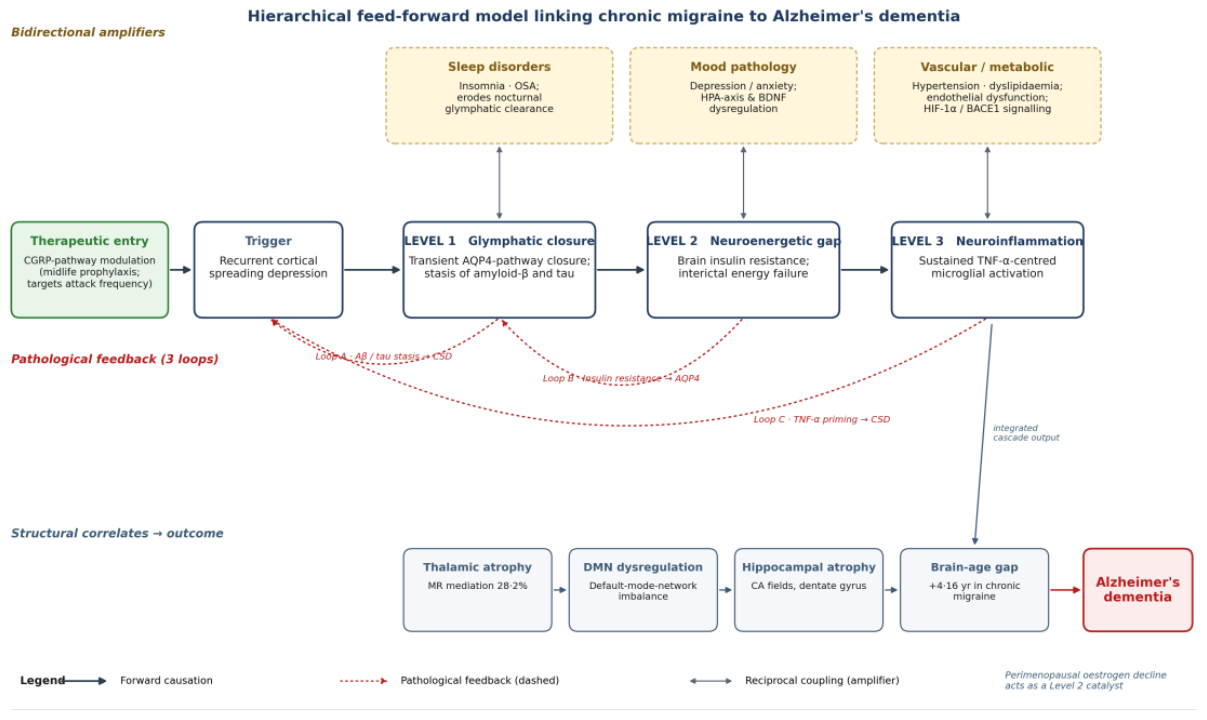

Table 1.
Comorbidities proposed as bidirectional amplifiers.
| Amplifier | Independent etiology | Proposed interaction | Evidence status |
| Chronic insomnia | Circadian, psychosocial or psychiatric | Erodes the nocturnal window in which perivascular exchange is most efficient | Not among the 14 factors of the 2024 Lancet Commission; pathway-specific effect not established |
| Obstructive sleep apnoea | Pharyngeal anatomy, obesity, male sex | Intermittent nocturnal hypoxia proposed to exacerbate neuroinflammation and impair clearance | Not among the 14 factors of the 2024 Lancet Commission; pathway-specific effect not established |
| Depression | Polygenic risk, psychosocial adversity, comorbidity | Shared HPA-axis dysregulation; bidirectional with headache burden | Recognised dementia risk factor [2]. Depressive symptoms mediated 65.3% of a chronic-pain-to-dementia relationship in older Chinese adults — not a migraine cohort [18]. Depression prevalence in chronic headache 43.1%, anxiety 45.9% (separate constructs) [12]. |
| Vascular and metabolic disease | Hypertension, insulin-resistant adiposity, dyslipidaemia | Endothelial dysfunction and white-matter change; overlaps level 2 | Hypertension, obesity, diabetes and high LDL are among the 14 factors [2]. Diastolic blood pressure abolishes the genetic migraine–Alzheimer’s association, as does TNF-α [7]. |
Effect estimates are given where a source could be verified; “not established” indicates that no adequate estimate specific to this pathway was found, which is itself part of the argument.
Disclaimer/Publisher’s Note: The statements, opinions and data contained in all publications are solely those of the individual author(s) and contributor(s) and not of MDPI and/or the editor(s). MDPI and/or the editor(s) disclaim responsibility for any injury to people or property resulting from any ideas, methods, instructions or products referred to in the content. |
© 2026 by the authors. Licensee MDPI, Basel, Switzerland. This article is an open access article distributed under the terms and conditions of the Creative Commons Attribution (CC BY) license (http://creativecommons.org/licenses/by/4.0/).
Copyright: This open access article is published under a Creative Commons CC BY 4.0 license, which permit the free download, distribution, and reuse, provided that the author and preprint are cited in any reuse.