
Submitted:
24 April 2026
Posted:
27 April 2026
You are already at the latest version
Abstract
Background/Objectives: Pediatric tracheotomy has evolved from an emergency procedure for acute infections to a planned intervention for chronic conditions requiring prolonged airway support. This study aims to describe the clinical characteristics, indications, and outcomes of pediatric tracheotomy over a 21-year period at a tertiary care center. Methods: A retrospective observational case series was conducted including 246 pediatric patients (0–18 years) who underwent tracheotomy between 2004 and 2024. Data were collected from medical records and included demographics, indications, procedural details, complications, decannulation, and mortality. Patients were categorized into airway obstruction (AO) and respiratory support (RS) groups. Statistical analyses were performed using the Mann–Whitney U test, Chi-square and Fisher’s exact test. Results: A significant increase in tracheotomy procedures was observed over time. Respiratory support was the predominant indication (75.2%), mainly due to neurological disorders, while airway obstruction accounted for 24.8%. Patients in the AO group were significantly younger and more likely to undergo urgent procedures (p < 0.001). Complication rates were comparable between groups (AO 16.4% vs. RS 21.1%; p = 0.295). Decannulation was significantly more successful in the AO group (16.4% vs. 5.4%; p = 0.012). Mortality did not differ significantly between groups and was associated with underlying comorbidities. Conclusions: Pediatric tracheotomy is increasingly performed for chronic respiratory support. While procedural safety is high, outcomes vary by indication, with better decannulation rates in airway obstruction cases. Multidisciplinary, individualized management is essential for optimizing patient outcomes.
Keywords:
pediatric tracheotomy
; respiratory support
; airway obstruction
; decannulation
; complications
; outcomes
1. Introduction
Tracheotomy is a surgical procedure involving the creation of an opening in the anterior tracheal wall to establish a stable airway and maintain ventilation through a tracheal cannula. The resulting stoma, termed a tracheostoma, provides a secure, temporary or permanent airway when spontaneous breathing is compromised.
Tracheotomy, one of the oldest documented surgical procedures, was first attributed to Asclepiades of Bithynia around 100 BCE and became critically important in the 19th and early 20th centuries for managing life-threatening infections such as diphtheria, epiglottitis, and poliomyelitis [1,2,3,4,5]. With advances in antibiotics, vaccination, and intensive care, pediatric tracheotomy indications have shifted from acute infectious diseases to chronic conditions, including congenital airway anomalies, neurological impairment, and prolonged mechanical ventilation [3,4,5,6,7,8,9].
Modern practice has further benefited from innovations in surgical technique - such as minimally invasive approaches - along with improved prenatal diagnostics, refined anesthetic management, and enhanced pediatric intensive and postoperative care. Additionally, increased neonatal survival with severe perinatal complications now significantly shapes current indications, making prolonged mechanical ventilation and ventilator weaning the leading reasons for pediatric tracheotomy [3,7,8,9,10,11].
Successful decannulation is a central goal of pediatric tracheotomy management. Predictors of decannulation include resolution of the initial indication, absence of significant airway obstruction, and adequate respiratory drive. Standardized protocols - combining endoscopic airway assessment, decannulation trials and careful monitoring - have increased safety and success rates [3,4,6,10].
Although mortality and morbidity associated with pediatric tracheotomy have declined significantly over recent decades, the procedure remains challenging due to the complexity of underlying conditions. Complication rates in children are consistently higher than in adults. Nevertheless, procedure-related mortality has fallen thanks to medical advances and a multidisciplinary approach [3,4,6,9,10]. Serious complications still occur, including granulation tissue, tracheal stenosis and tracheocutaneous fistula.
The quality of life of children with a tracheostoma has improved significantly with better care protocols and rehabilitation strategies, yet the presence of a tracheostomy continues to affect family dynamics. The impact on quality of life is considerable: while tracheostomy ensures airway safety and can improve overall health stability, it imposes significant psychosocial and financial burdens on families. Advances in multidisciplinary care, caregiver training and rehabilitation programs have mitigated some of these challenges, but quality of life remains a major concern [3,4,10].
The diversity of this population, stemming from wide variation in indications and comorbidities [3,4,5,10], makes it difficult to predict outcomes, provide individualized counseling, and adequately prepare families. Outcome data in the literature remain heterogeneous, reflecting differences in study design, follow-up, and time periods [3,4,5,6,10].
This study presents a single-center case series of pediatric patients who underwent tracheotomy over a 21-year period at a tertiary pediatric hospital, aiming to describe their clinical and epidemiological characteristics.
2. Materials and Methods
2.1. Study Design and Population
This observational study presents a single-center case series of pediatric patients who underwent tracheotomy at the Mother and Child Health Care Institute of Serbia “Dr Vukan Čupić” between January 1, 2004, and December 31, 2024. Institutional review board approval was obtained prior to data collection. A total of 264 consecutive patients aged 0–18 years were identified through a comprehensive retrospective review of electronic medical records (Heliant system) and physical archives. Eighteen patients were excluded due to insufficient documentation or loss to follow-up, resulting in a final study sample of 246 patients.
2.2. Data Collection
Data were extracted through a detailed review of operative reports, clinical progress notes, and discharge summaries. The following variables were collected: demographic characteristics (age at tracheotomy, sex); clinical parameters (primary indication, comorbidities); procedural details (urgency status, intraoperative ventilation status); and postoperative outcomes (complications, decannulation success, and mortality). All procedures were performed by attending pediatric otolaryngologists in accordance with a standardized institutional protocol.
2.3. Surgical Technique
Patients were positioned with mild neck extension, and the surgical field was prepared using antiseptic solution. Local anesthesia with 1% lidocaine and 1:100,000 epinephrine was infiltrated at the incision site. A vertical midline incision was made extending from the inferior border of the cricoid cartilage to the sternal notch. After midline dissection through the strap muscles, the anterior tracheal wall was exposed. The tracheostomy was typically created between the second and third or third and fourth tracheal rings. An age-appropriate Tracoe™ tracheostomy tube was inserted under direct visualization and secured with neck ties.
2.4. Indications for Tracheotomy
Indications were categorized into two principal groups:
- Airway obstruction, including laryngotracheal pathologies such as stenosis or malacia, and craniofacial anomalies.
- Respiratory support, including chronic pulmonary insufficiency, cardiopulmonary diseases, neurological disorders, genetic syndromes associated with respiratory compromise, and prolonged ventilator dependence following failed extubation.
2.5. Postoperative Complications and Decannulation
Postoperative complications were classified as early (<14 days postoperatively) or late (≥14 days postoperatively). Early complications included hemorrhage requiring intervention, surgical site infection, pneumomediastinum or pneumothorax, tube obstruction or displacement, and creation of a false passage. Late complications included granulation tissue formation, tracheocutaneous fistula, tracheomalacia, recurrent tube obstruction or displacement, recurrent respiratory tract infections, laryngotracheal stenosis, and swallowing difficulties.
Decannulation was defined as the permanent removal of the tracheostomy tube and was considered the ultimate goal of airway management for many patients. Decisions regarding decannulation were made by multidisciplinary consensus, based on resolution of the primary indication, demonstration of adequate airway patency on endoscopic evaluation, stable spontaneous respiration without ventilatory support, and normal swallowing function. All decannulations were performed during hospitalization with continuous monitoring for a minimum of 48 hours.
2.6. Statistical Analysis
Statistical analysis was performed using IBM SPSS Statistics, version 25.0 (IBM Corp., Armonk, NY, USA). Descriptive statistics were used to summarize patient characteristics, procedural variables, and clinical outcomes. Continuous variables were expressed as medians with ranges, and categorical variables as counts and percentages. Comparative analyses between the airway obstruction (AO) and respiratory support (RS) groups were conducted using the Mann–Whitney U test for continuous variables and the Chi-square or Fisher’s exact test, as appropriate, for categorical variables. A p-value < 0.05 was considered statistically significant.
3. Results
3.1. Temporal Trends
A total of 246 pediatric tracheotomies were performed over the 21-year study period. The annual number of procedures varied, with relatively low and stable counts during the first decade (2004–2013), averaging approximately 4.4 tracheotomies per year. A marked increase in the number of tracheotomies was observed in the second decade (2014–2024), with a peak of 29 procedures in 2018. Specifically, 202 tracheotomies were performed during 2014–2024 compared to 44 during 2004–2013, reflecting a substantial rise in procedural volume over time (Figure 1).
3.2. Patient Characteristics
The study population comprised 137 males (55.7%) and 109 females (44.3%), yielding a male-to-female ratio of 1.26:1. The mean age at the time of tracheotomy was 46 months (3.8 years), ranging from 1 day to 17 years and 10 months. More than half of the patients (54.1%) underwent tracheotomy before the age of 1 year, including 121 infants (29 days to 1 year old; 49.2%) and 12 neonates (0–28 days old; 4.9%). Regarding the nature of the procedure, 225 tracheotomies (91.5%) were elective, while 21 (8.5%) were performed as emergencies (Table 1).
3.3. Indications for Tracheotomy
Regarding primary indications, respiratory support was the most common reason for tracheotomy (n = 185; 75.2%), while airway obstruction accounted for a smaller proportion of cases (n = 61; 24.8%). Among children undergoing tracheotomy for respiratory support, neurological disorders represented the predominant indication, affecting 138 patients (56.1% of the total sample) (Table 2). Within this subgroup, encephalopathies were the leading category, observed in 86 cases (34.9%). Cardiopulmonary diseases were the second most frequent indication, comprising 30 patients (12.2%). The main etiology within this category was complex congenital heart defects (n = 23; 9.3%), followed by chronic lung disease (n = 7; 2.8%).
Among children with airway obstruction, laryngotracheal stenosis was the leading cause, identified in 51 patients (20.7% of the total sample). The majority of these cases were acquired stenoses (n = 17; 6.9%), while congenital stenosis accounted for 11 patients (4.4%). Craniofacial anomalies were responsible for obstruction in 10 patients (4.1%), with Pierre Robin sequence being the most frequent anomaly in this group (n = 8; 3.2%). Other less common causes included head and neck tumors, vocal cord paralysis, and laryngotracheomalacia.
These findings highlight the predominance of chronic and complex conditions in contemporary pediatric tracheotomy practice, reflecting advances in intensive care and improved long-term survival among children with severe comorbidities.
3.4. Comparative Analysis of Pediatric Tracheotomy Outcomes by Indication Group
A detailed comparison between the airway obstruction (AO) group (n = 61; 24.8%) and the respiratory support (RS) group (n = 185; 75.2%) revealed notable differences in demographic characteristics, procedural variables, and clinical outcomes (Table 3).
The median age at the time of tracheotomy was significantly lower in the AO group (27 months; range, 0–201 months) compared to the RS group (53 months; range, 1–216 months; p < 0.001). There was no significant difference in gender distribution between the two groups (p = 0.298).
Significant differences were observed in the urgency of tracheotomy (p < 0.001). Most patients in the RS group (98.4%) underwent elective tracheostomy, whereas the majority of AO patients (70.5%) required urgent tracheostomy. Similarly, intraoperative intubation status differed significantly between groups (p < 0.001), with a higher proportion of non-intubated patients in the AO group (26.2%) compared to the RS group (1.6%).
Complication rates did not differ significantly between the two groups (AO: 16.4 % vs. RS: 21.1%; p = 0.295). However, decannulation success was significantly higher in the AO group (16.4%) than in the RS group (5.4%; p = 0.012). Although not statistically significant, mortality was higher in the RS group (AO: 14.8% vs. RS: 23.8%; p = 0.154).
4. Discussion
This 21-year study (2004–2024) provides insights into shifts in the epidemiology and clinical indications for pediatric tracheotomy. Although our cohort of 246 patients is smaller than those reported in national registries, it represents a significant dataset for understanding the characteristics of children undergoing tracheotomy at our tertiary institution in Serbia.
Single-institution studies and national registries differ in methodology, sample size, and follow-up but provide useful context for interpreting our findings [11,12,13,14,15,16,17,18,19]. While smaller cohorts offer detailed clinical insights, their results may reflect local characteristics. In contrast, large databases, sometimes exceeding 500 patients, allow assessment of long-term trends in incidence, indications, and outcomes at a population level.
Our study showed a marked increase in tracheotomies over the 21-year period, with 82% of procedures performed during the second decade. This rise likely reflects improved survival of critically ill neonates and children with complex congenital anomalies or severe respiratory failure due to advances in intensive care. The predominance of tracheotomy for respiratory support (75.2% of cases) highlights the increasing need for prolonged ventilatory assistance in children with neurological and chronic cardiopulmonary conditions. Technological advances in surgical technique, anesthetic management, and postoperative care have enhanced procedural safety, while evolving disease patterns—including changes in the prevalence and management of congenital airway abnormalities and severe respiratory infections—have influenced contemporary indications and outcomes.
In our cohort, nearly half of the patients were infants, with smaller proportions of newborns, children, and adolescents, and the mean age at tracheotomy was 46 months. Consistent with global data, a bimodal age distribution was observed, with the highest incidence in infants (0–1 year) and a secondary, smaller peak in older children (4–12 years), reflecting the broad age spectrum in which tracheotomy is required [3,4,10,13,15,20,21,22]. There was a slight male predominance, with no significant difference between the airway obstruction and respiratory support groups, aligning with international reports and likely reflecting higher rates of congenital and acquired airway conditions, neurological disorders, and trauma in boys. More than 90% of procedures were performed electively under intraoperative intubation, with respiratory support as the leading indication (75.2%), while airway obstruction accounted for 24.8% of cases.
Our findings also demonstrated that children undergoing tracheotomy for airway obstruction were significantly younger and more likely to require urgent procedures compared with those undergoing tracheotomy for respiratory support. Despite these differences, overall complication rates were similar between groups, whereas decannulation success was significantly higher in the AO group. These results indicate that while airway obstruction often necessitates earlier and more urgent intervention, long-term airway management outcomes remain achievable, whereas children requiring tracheotomy for respiratory support face greater challenges with decannulation.
Procedural characteristics differed markedly between groups. In emergency cases, tracheotomy was performed as the first and only means of securing the airway, whereas nearly all elective procedures (92.3%) were performed under intraoperative intubation, reflecting controlled, planned interventions. In the AO group, 70.5% of tracheotomies were emergencies and a substantial proportion were performed without intraoperative intubation, highlighting the life-threatening nature of acute airway obstruction [13,20,21]. By contrast, tracheotomies in the RS group were overwhelmingly elective (98.4%) and nearly all patients were intubated, reflecting planned management in chronically ventilator-dependent children. These findings underscore the persistent urgency of airway obstruction compared with the predominantly elective nature of respiratory support indications.
Nearly all RS patients (98.4%) were intubated at the time of surgery, while 26.2% of AO patients underwent tracheotomy without intubation. Comparable complication rates between groups (16.4% vs. 21.1%) suggest that procedural safety is largely independent of indication, with the slightly higher rate in the RS group likely reflecting greater baseline medical complexity rather than technical factors.
The overall complication rate was 19.9%, which is within the reported international range (15–77%), with no significant difference between indication groups [4,5,23]. This favorable outcome may reflect our institution’s patient population, technical expertise, and care standards during the study period. Early complications occurred in 7 patients (3%), consisting of three cases of cannula size–related ventilation difficulties and four accidental decannulations within the first postoperative week, one of which resulted in subcutaneous emphysema during recannulation attempts. This rate is favorable compared with global benchmarks, where early complication rates have been reported up to 11% [12,23]. These findings suggest the effectiveness of our immediate postoperative monitoring and management protocols. Late complications were observed in 42 patients (17%), with stomal infections and stomal stenosis being the most frequent. Our late complication rate also falls below the international range (up to 63%) [4,21].
Successful decannulation, a key marker of clinical improvement and quality of life, varies widely in international reports, often exceeding 50% depending on patient selection and underlying pathology [14,15,21,24]. Overall decannulation success was 8.1%, with 16.4% in the AO group and 5.4% in the RS group. This significant difference aligns with global data, as children with surgically correctable or self-limiting obstructive conditions achieve better outcomes than those requiring long-term respiratory support [12,14,15,21,24]. The lower rate in our series likely reflects the predominance of RS indications, chronic neurological and cardiopulmonary comorbidities, and institutional referral patterns. These findings reinforce that patient selection and underlying etiology are the most important determinants of decannulation success, highlighting the need for individualized management strategies.
Post-tracheotomy outcomes in our cohort showed a higher proportion of deaths in the respiratory support group (23.8%) compared with the airway obstruction group (14.8%), although this difference was not statistically significant (p = 0.154). This pattern likely reflects the severity of underlying comorbidities rather than the procedure itself. These findings are consistent with international reports, which indicate low tracheotomy-associated mortality (0–5.9%) but higher overall mortality in patients with complex medical conditions [4,14,15,16,21,23].
Our relatively low procedure-related mortality and moderate overall rates suggest effective perioperative management within our institution, despite the high-risk nature of the underlying diseases.
Long-term respiratory support is currently the predominant indication for pediatric tracheotomy, most commonly in children with neurological disorders, cardiopulmonary conditions, and upper airway anomalies [13,15,21,22]. This shift reflects improved survival of critically ill neonates and children in modern intensive care units [13,15,25,26]. Consistent with these trends, respiratory support accounted for 75.2% of tracheotomies in our cohort, compared with 24.8% for airway obstruction.
Within the airway obstruction group, laryngotracheal stenosis was the most frequent etiology (20.7%), followed by craniofacial anomalies (4.1%). Acquired laryngotracheal stenosis (6.9%) emerged as the leading obstructive cause, while Pierre Robin sequence (3.2%) was the most common craniofacial anomaly.
Age at tracheotomy differed significantly between groups, with the AO group being younger than the RS group. This reflects the early manifestation of congenital airway anomalies, such as laryngomalacia and subglottic stenosis, which often require urgent intervention in infancy, whereas older age in the RS group corresponds to progressive neuromuscular and chronic lung disorders necessitating prolonged ventilatory support [13,15,22,27].
Taken together, these results emphasize that while pediatric tracheotomy carries a low procedure-related risk, overall survival is heavily dependent on the natural history of underlying diseases, particularly neurological and cardiopulmonary disorders.
This study benefits from a long-term 21-year observation period, providing valuable insights into trends in pediatric tracheotomy indications, procedural characteristics, and outcomes. Detailed clinical data, including complications, decannulation success, and deaths, allowed comprehensive evaluation, while subgroup comparisons between airway obstruction and respiratory support patients highlighted meaningful differences in age, urgency, and long-term outcomes. Conducting the study at a single tertiary institution ensured consistency in surgical technique, anesthetic management, and postoperative care. However, the single-center design and relatively modest sample size may limit generalizability, and the retrospective nature restricts control over confounding variables such as comorbidity severity. Additionally, long-term follow-up was incomplete for some patients, and genetic or etiological data were limited, preventing confirmation of factors such as the role of X-linked neuromuscular disorders in the slight male predominance observed.
5. Conclusions
Pediatric tracheotomy has evolved over the past two decades, with a marked increase in procedures primarily driven by the need for long-term respiratory support. Respiratory support remains the leading indication, while airway obstruction is more often associated with younger age and urgent intervention. Procedural safety is high, with low overall complication rates, and decannulation success is higher in children with airway obstruction compared to those requiring prolonged ventilatory support. Mortality is largely determined by the severity of underlying conditions rather than the procedure itself. These findings underscore the importance of individualized management and multidisciplinary care in optimizing outcomes for pediatric tracheotomy patients.
Author Contributions
Conceptualization, K.S. and I.V.; methodology, K.S. and I.V.; software, V.S. and M.V.; validation, I.F., S.V. and J.M.; formal analysis, K.S. and V.S.; investigation, K.S. and V.S. and M.V.; resources, K.S. and S.S.G; data curation, K.S., S.S.G. and I.V.; writing—original draft preparation, K.S., V.S., M.V., I.F. and S.V.; writing—review and editing, S.S.G., J.M. and I.V.; visualization, K.S.; supervision, I.V. All authors have read and agreed to the published version of the manuscript.
Funding
This research received no external funding.
Institutional Review Board Statement
The study was conducted in accordance with the Declaration of Helsinki, and approved by the Ethics Committee of Institute for Health Care of Mother and Child of Serbia "Dr. Vukan Čupić", Belgrade, Serbia (protocol code 8/46 and date of approval 31 March 2026).
Informed Consent Statement
Patient consent was waived due to the retrospective design of the study, in which only anonymized data were analyzed, with no direct patient involvement or effect on clinical management.
Data Availability Statement
The data presented in this study are available on reasonable request from the corresponding author. The data are not publicly available due to ethical and privacy restrictions involving pediatric patients.
Conflicts of Interest
The authors declare no conflicts of interest.
Abbreviations
The following abbreviations are used in this manuscript:
| AO | Airway Obstruction |
| RS | Respiratory Support |
| BPD | Bronchopulmonary Dysplasia |
| ARI | Acute Respiratory Infection |
| CHR | Chronic Respiratory FAilure |
References
- Goodal, E.W. The story of tracheotomy. Br. J. Child. Dis. 1934, 31, 167–253. [Google Scholar]
- Leivaditis, V.; Mulita, F.; Baikoussis, N.G.; Liolis, E.; Antzoulas, A.; Tchabashvili, L.; Tasios, K.; Litsas, D.; Dahm, M. The role of ancient Greek physicians in the development of tracheostomy: Pioneering airway interventions and early thoracic surgery. Clin. Pract. 2025, 15, 93. [Google Scholar] [CrossRef]
- Watters, K.F. Tracheostomy in infants and children. Respir. Care 2017, 62, 799–825. [Google Scholar] [CrossRef]
- Campisi, P.; Forte, V. Pediatric tracheostomy. Semin Pediatr. Surg. 2016, 25, 191–195. [Google Scholar] [CrossRef]
- Wetmore, R.F.; Handler, S.D.; Potsic, W.P. Pediatric tracheostomy: Experience during the past decade. Ann. Otol. Rhinol. Laryngol. 1982, 91 6 Pt 1, 628–632. [Google Scholar] [CrossRef]
- Kenna, M.A.; Reilly, J.S.; Stool, S.E. Tracheotomy in the preterm infant. Ann. Otol. Rhinol. Laryngol. 1987, 96 1 Pt 1, 68–71. [Google Scholar] [CrossRef]
- Carron, J.D.; Derkay, C.S.; Strope, G.L.; Nosonchuk, J.E.; Darrow, D.H. Pediatric tracheotomies: Changing indications and outcomes. Laryngoscope 2000, 110(7), 1099–1104. [Google Scholar] [CrossRef]
- Gergin, O.; Adil, E.A.; Kawai, K.; Watters, K.; Moritz, E.; Rahbar, R. Indications of pediatric tracheostomy over the last 30 years: Has anything changed? Int. J. Pediatr. Otorhinolaryngol. 2016, 87, 144–147. [Google Scholar] [CrossRef]
- Lawrason, A.; Kavanagh, K. Pediatric tracheotomy: Are the indications changing? Int. J. Pediatr. Otorhinolaryngol. 2013, 77, 922–925. [Google Scholar] [CrossRef]
- Seligman, K.L.; Liming, B.J.; Smith, R.J.H. Pediatric tracheostomy decannulation: 11-year experience. Otolaryngol. Head. Neck Surg. 2019, 161, 499–506. [Google Scholar] [CrossRef]
- Bathwal, R.; Dongol, K.; Dutta, H.; Neupane, Y. Tracheostomy among children admitted in the pediatric intensive care unit of a tertiary care centre. JNMA J. Nepal Med. Assoc. 2023, 61, 852–855. [Google Scholar] [CrossRef]
- Pereira, K.D.; MacGregor, A.R.; Mitchell, R.B. Complications of neonatal tracheostomy: A 5-year review. Otolaryngol. Head. Neck Surg. 2004, 131, 810–813. [Google Scholar] [CrossRef]
- Alladi, A.; Rao, S.; Das, K.; Charles, A.R.; D’Cruz, A.J. Pediatric tracheostomy: A 13-year experience. Pediatr. Surg. Int. 2004, 20, 695–698. [Google Scholar] [CrossRef]
- Resen, M.S.; Grønhøj, C.; Hjuler, T. National changes in pediatric tracheotomy epidemiology during 36 years. Eur. Arch. Otorhinolaryngol. 2018, 275, 803–808. [Google Scholar] [CrossRef]
- Kang, K.T.; Lin, Y.S.; Lin, C.Y.; Lee, C.H.; Hsu, W.C. Epidemiology of pediatric tracheotomy: A population-based study using National Health Insurance Research Database in Taiwan. Int. J. Pediatr. Otorhinolaryngol. 2022, 152, 110989. [Google Scholar] [CrossRef]
- Watters, K.; O’Neill, M.; Zhu, H.; Graham, R.J.; Hall, M.; Berry, J. Two-year mortality, complications, and healthcare use in children with Medicaid following tracheostomy. Laryngoscope 2016, 126, 2611–2617. [Google Scholar] [CrossRef]
- Muller, R.G.; Mamidala, M.P.; Smith, S.H.; Smith, A.; Sheyn, A. Incidence, epidemiology, and outcomes of pediatric tracheostomy in the United States from 2000 to 2012. Otolaryngol. Head Neck Surg 2019, 160, 332–338. [Google Scholar] [CrossRef]
- Funamura, J.L.; Yuen, S.; Kawai, K.; Gergin, O.; Adil, E.; Rahbar, R.; et al. Characterizing mortality in pediatric tracheostomy patients. Laryngoscope 2017, 127, 1701–1706. [Google Scholar] [CrossRef]
- Berry, J.G.; Graham, D.A.; Graham, R.J.; Zhou, J.; Putney, H.L.; O’Brien, J.E.; et al. Predictors of clinical outcomes and hospital resource use of children after tracheotomy. Pediatrics 2009, 124, 563–572. [Google Scholar] [CrossRef]
- Roberts, J.; et al. Pediatric tracheostomy: A large single-center experience. Laryngoscope 2020, 130, E375-82. [Google Scholar] [CrossRef]
- Hopkins, C.; et al. The impact of paediatric tracheostomy on both patient and parent. Int. J. Pediatr. Otorhinolaryngol. 2009, 73, 15–20. [Google Scholar] [CrossRef] [PubMed]
- Mitchell, R.B.; et al. Clinical consensus statement: Tracheostomy care. Otolaryngol. Head. Neck Surg. 2013, 148, 6–20. [Google Scholar] [CrossRef]
- Douglas, C.M.; et al. Paediatric tracheostomy: An 11-year experience at a Scottish tertiary referral centre. Int. J. Pediatr. Otorhinolaryngol. 2015, 79, 1673–1676. [Google Scholar] [CrossRef]
- Ozmen, S.; Ozmen, O.A.; Unal, O.F. Pediatric tracheotomies: A 37-year experience in 282 children. Int. J. Pediatr. Otorhinolaryngol. 2009, 73, 959–961. [Google Scholar] [CrossRef]
- Friesen, T.L.; Zamora, S.M.; Rahmanian, R.; Bundogji, N.; Brigger, M.T. Predictors of pediatric tracheostomy outcomes in the United States. Otolaryngol. Head. Neck Surg. 2020, 163, 591–599. [Google Scholar] [CrossRef] [PubMed]
- Dal’Astra, A.P.; et al. Tracheostomy in childhood: Review of the literature on complications and mortality over the last three decades. Braz. J. Otorhinolaryngol. 2017, 83, 207–214. [Google Scholar] [CrossRef]
- Corbett, H.J.; et al. Tracheostomy: A 10-year experience from a UK pediatric surgical center. J. Pediatr. Surg. 2007, 42, 1251–1254. [Google Scholar] [CrossRef]
Figure 1.
Annual number of tracheostomies.
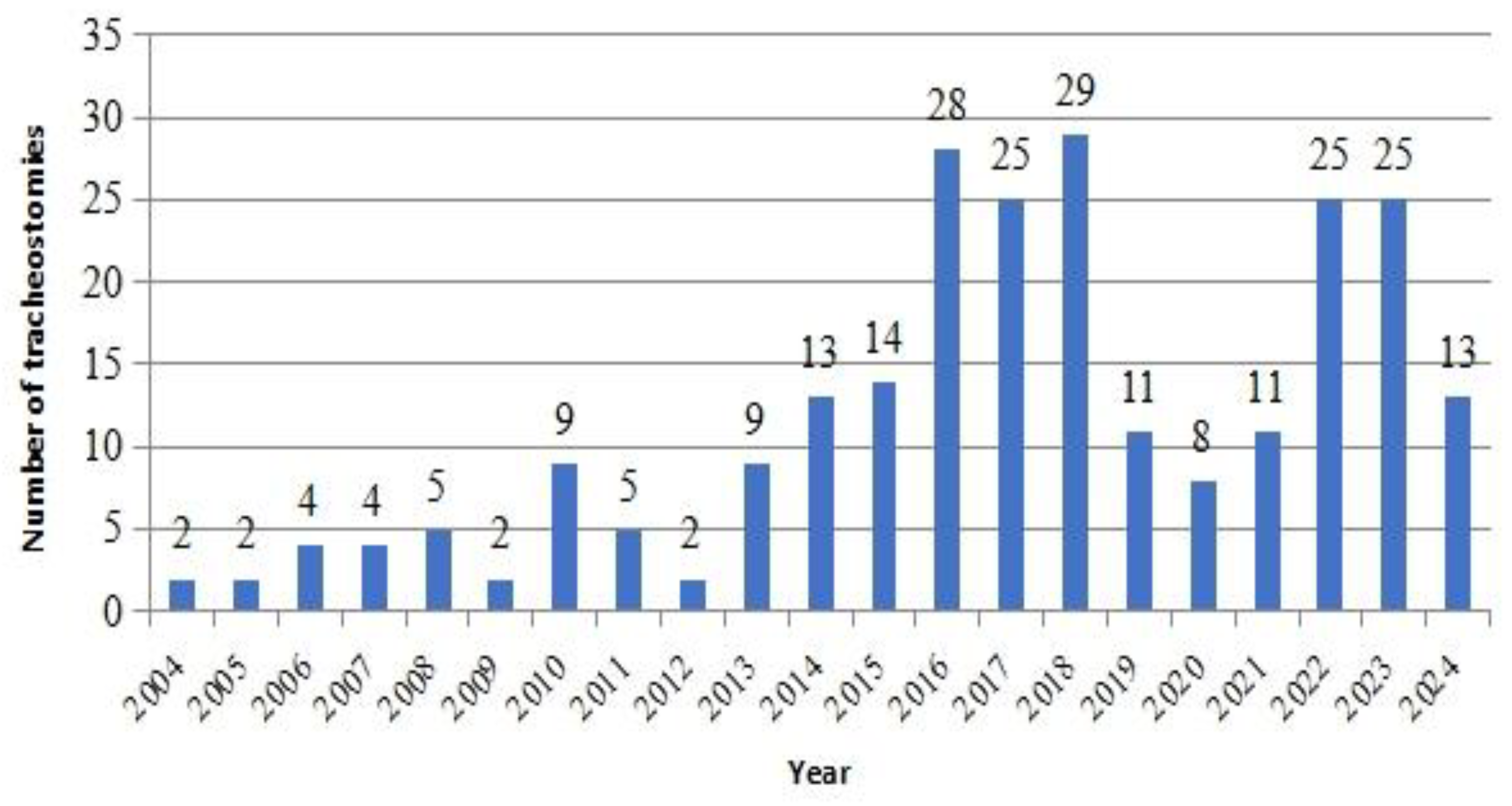

Table 1.
Basic characteristics of the examined groups.
| Variable | N (%) |
|---|---|
| Age | |
| Newborn (0–28 days old) | 12 (4.9%) |
| Infant (29 days–1 year old) | 121 (49.2%) |
| Child (1–3 years) | 43 (17.5%) |
| Child (4–12 years old) | 42 (17.1%) |
| Adolescent (13–18 years old) | 28 (11.4%) |
| Gender | |
| Male | 137 (55.7%) |
| Female | 109 (44.3%) |
| Tracheotomy type | |
| Emergency | 21 (8.5%) |
| Elective | 225 (91.5%) |
| Intraoperative ventilation | |
| Intubated | 227 (92.3%) |
| Non-intubated | 19 (7.7%) |
| Indications for tracheotomy | |
| Airway obstruction | 61 (24.8%) |
| Respiratory support | 185 (75.2%) |
Table 2.
Indications for tracheotomy.
| Airway Obstruction |
N=61; 24.8% | Respiratory Support | N=185; 75.2% |
|---|---|---|---|
|
Laryngotracheal obstruction Congenital laryngotracheal stenosis Acquired laryngotracheal stenosis Head/neck tumor Vocal cord paralysis Laryngotracheomalacia |
51 (20.7) 11 (4.4) 17 (6.9) 13 (5.3) 7 (2.8) 3 (1.2) |
Cardio-pulmonary diseases Congenital heart disease Lung disease Bronchopulmonary dysplasia |
30 (12.2) 23 (9.3) 2 (0.8) 5 (2.0) |
|
Craniofacial anomalies Pierre Robin syndrome Treacher Collins syndrome Goldenhar syndrome |
10 (4.1) 8 (3.2) 1 (0.4) 1 (0.4) |
Neurological diseases Brain tumor Encephalopathy Neuromuscular disease Trauma |
138 (56.1) 10 (4.1) 86 (34.9) 39 (15.8) 3 (1.2) |
|
Genetic conditions and birth defects Larsen syndrome Charge syndrome Cornelia de Lange syndrome Niemann-Pick disease Gaucher disease Multiple malformation syndrome Omphalocele Total colonic aganglionosis |
11 (4.5) 1 (0.4) 4 (1.6) 1 (0.4) 1 (0.4) 1 (0.4) 1 (0.4) 1 (0.4) 1 (0.4) |
||
|
Airway obstruction due to other reasons Acute respiratory infection Chronic respiratory failure Kidney tumor Childhood leukaemia |
6 (2.4) 3 (1.2) 1 (0.4) 1 (0.4) 1 (0.4) |
Table 3.
Patient characteristics and outcomes following tracheotomy by indication.
| Variable | Airway Obstruction (N=61; %) | Respiratory Support (N=185; %) | p- Value |
|---|---|---|---|
| Age at the moment of tracheotomy (in months) |
27 (0-201) | 53 (1-216) | <0.001 |
| Gender Boys |
30 (49.2) |
107 (57.8) |
0.298 |
| Girls | 31 (50.8) | 78 (42.2) | |
| Tracheostomy insertion method | <0.001 | ||
| Elective | 18 (29.5) | 182 (98.4) | |
| Urgent | 43 (70.5) | 3 (1.6) | |
| Intraoperative ventilation status | <0.001 | ||
| Intubated | 45 (73.8) | 182 (98.4) | |
| Non-intubated | 16 (26.2) | 2 (1.6) | |
| Complications | 0.295 | ||
| Yes | 10 (16.4) | 39 (21.1) | |
| No | 51 (83.6) | 146 (78.9) | |
| Successfully decannulated | 0.012 | ||
| Yes | 10 (16.4) | 10 (5.4) | |
| No | 51 (83.6) | 175 (94.6) | |
| Death | 0.154 | ||
| Yes | 9 (14.8) | 44 (23.8) | |
| No | 52 (85.2) | 141 (76.2) |
Disclaimer/Publisher’s Note: The statements, opinions and data contained in all publications are solely those of the individual author(s) and contributor(s) and not of MDPI and/or the editor(s). MDPI and/or the editor(s) disclaim responsibility for any injury to people or property resulting from any ideas, methods, instructions or products referred to in the content. |
© 2026 by the authors. Licensee MDPI, Basel, Switzerland. This article is an open access article distributed under the terms and conditions of the Creative Commons Attribution (CC BY) license.
Copyright: This open access article is published under a Creative Commons CC BY 4.0 license, which permit the free download, distribution, and reuse, provided that the author and preprint are cited in any reuse.


