

Submitted:
22 August 2026
Posted:
24 August 2026
You are already at the latest version
Abstract
Background/Objectives: Children who experience high levels of dental anxiety tend to exhibit poor cooperation during dental visits, which compromises treatment outcomes and leads to a vicious cycle with poor oral health and caries prevention outcomes. The purpose of this study is to analyze the prevalence of dental anxiety in a sample of clinical subjects in children and possible correlations with other factors, as well as the longitudinal nature of anxiety. Methods: This cross-sectional and longitudinal study was conducted on a sample of 150 children aged 12 to 18 years in the city of Zagreb and Zagreb County. The MDAS (Modified Dental Anxiety Scale) was used to collect data related to dental anxiety at three time intervals: before the procedure (T1), after the procedure (T2), and after a peri-od of 3 months (T3). Results: Significant differences between the MDAS before and after the procedure were found, suggesting that that dental anxiety decreased in most children (p< 0.001). The MDAS test results were 9.79 and 8.03 for the T1 and T2 periods, respective-ly, indicating mild anxiety. There are statistically significant differences between individ-ual time points T1, T2, and T3 (p< 0.001), and these differences are significant between T1 and T2 (p=0.045) and between T1 and T3 (p=0.012), while between T2 and T3, the differ-ences are not statistically significant (p=0.616). At T1, children mostly exhibited mild den-tal anxiety (55.3%), followed by moderate (41.3%) and severe dental anxiety (3.3%). At T2, children mostly exhibited mild dental anxiety (77.2%), followed by moderate anxiety (22.8%) and no severe dental anxiety. Financial influence on the use of dental services (p=0.014), the type of dental service/public/private/semi-private (p=0.021), and experience with the dentist (p=0.04) were statistically significant factors. The initial MDAS and cari-ogenic diet scores (p< 0.012) have a negative correlation with the change in the MDAS score; greater fear before the procedure (T1) is associated with a greater reduction in fear after the procedure (T2). A higher cariogenic diet score is associated with a greater reduc-tion in fear after the procedure (T2), while a shorter time since the last visit to the dentist shows negative correlations with the change in the MDAS score, indicating a greater re-duction in fear (p< 0.08). Conclusions: Most of the children in this study had mild to moderate anxiety, which de-creased after a visit to the dentist. Financial influence on the use of dental services, the type of dental service, and experience with the dentist can be associated with dental anxiety. Furthermore, a cariogenic diet and irregular dental check-ups may also be associated with higher dental anxiety. Better oral hygiene and oral status, higher socioeconomic status, and a low cariogenic diet could influence the dental anxiety levels in children.
Keywords:
test anxiety scale
; dental anxiety
; dental fear
; children
; socioeconomic factors
; dietary habits
; oral hygiene
; cross-sectional studies
1. Introduction
Dental anxiety is a state of fear that something terrible will occur in connection with dental treatment and it is usually associated with a feeling of loss of control. In contrast, dental fear is a normal emotional reaction to one or more specific threatening stimuli in a dental situation [1], and dental phobia refers to a severe type of dental anxiety, characterized by marked and persistent anxiety related to clearly identifiable situations or objects such as dental drilling, local anesthetic injections, or the dental environment in general. (1) The differential diagnoses of these different types of dental anxiety are subjective, and no clear demarcation has been presented in the literature. Dental phobia is often associated with vasovagal reactions such as increased heart rate due to sympathetic activation, in contrast to dental anxiety or fear. Blood, injection, and injury phobias are associated with initial tachycardia, followed by bradycardia, hypotension, dizziness, and nausea. (2) In general, dental fear is a normal reaction in children and adults to an unfamiliar situation. Mild fear and anxiety are expected experiences, consistent with normal development, but they can become worrisome and may require treatment when the fear or anxiety is disproportionate to the actual threat. (3) Studies have shown that fear of dental treatment can be transmitted into adolescence, leading to the avoidance of regular dental treatments. Fear can reduce a child’s cooperation and lead to delays in dental treatment. Children who experience high levels of dental anxiety often show poor cooperation during dental visits, which compromises treatment outcomes and increases the stress of dental staff. This can result in more invasive procedures later on, such as deep-caries treatments, tooth extractions, surgical interventions requiring antibiotics, and even hospitalization. As a result, dental caries and abscesses are more likely to occur due to poor and irregular preventive and therapeutic practices, and in turn, such poor oral health leads to increased anxiety and fear, thus creating a vicious cycle. [4,5] This vicious cycle also occurs in adults; it can be considered to have begun in childhood and then to have carried on through subsequent age groups. [6,7,8,9] Numerous factors likely influence the development of dental anxiety, such as past negative dental experiences; the experiences of other patients and their attitudes; comments on social media; pain and other clinical symptoms; the dental office environment, particularly the appearance of the waiting room; the sounds of drills; and the smell of dental materials. [10,11,12] It has also been proven that anxiety is directly transmitted from parents to children and that there are differences in the transmission of anxiety related to the gender of parents and children, as well as in the influence of mothers on the child regarding anxiety. [13,14,15,16] Other possible causes of dental anxiety include the level of oral hygiene, caries, soft tissue diseases, socioeconomic factors, gender, the number of family members present, the presence of brothers or sisters, and cultural factors. [17,18,19,20,21,22] Some studies have shown that girls and younger children generally show higher levels of fear compared with boys and older children. Furthermore, children from families with lower socioeconomic status and education levels tend to have higher levels of dental anxiety. [23] According to published meta-analyses, the prevalence of dental fear and anxiety in children aged 2 to 6 years is 30%, while in preschool, primary school, and adolescent populations, the prevalence of dental anxiety is 36.5%, 25.8%, and 13.3%, respectively. [23,24] Another meta-analysis on the prevalence of dental fear and anxiety in children up to 19 years of age reports data ranging from 13.3% to 29.3%, depending on the method and test used to measure it.[25]
Regarding the prevalence of dental anxiety and possible correlation factors, only a few relevant studies have been published in our country so far. A study on 1,551 respondents in Croatia using an online questionnaire and online data collection showed that about 40% of respondents do not go to the dentist due to fear, and they also have a higher level of measured dental anxiety. Furthermore, about 55% of respondents have an elevated level of dental anxiety, which is above the median. Researchers concluded that dental anxiety depends on demographic, socioeconomic, and oral health factors. There is a clear connection between high dental anxiety scales and avoidance of going to the dentist due to acute pain. [26]
The Modified Dental Anxiety Scale (MDAS) test has been frequently used in the analysis of dental anxiety in children, showing good reliability and criterion validity. [27,28]
Respondents who had a previous bad experience associated with going to the dentist and who had moderate to severe dental anxiety achieved a statistically significantly higher score on the anxiety scale. [6] A previous study showed that active caries in children aged 6 years was statistically associated with maternal age, education, employment, and dental anxiety. [29] In contrast, another study showed that there was no proven correlation between the socioeconomic status of parents and dental anxiety in children. [18] Given that dental anxiety is a complex problem that depends on many factors that are not only of dental origin and that there are differences in dental anxiety levels between different peoples of different regions, additional research is needed to better understand this issue. We can state that dental anxiety also affects the quality of dental and general health, which could lead to public health issues.
The aim of this study is to analyze the prevalence of dental anxiety in a sample of Croatian patients who visit dental clinics, as well as the various factors associated with dental anxiety. The study hypothesis is that there is no difference in dental anxiety levels related to gender or socioeconomic status.
2. Materials and Methods
2.1. Research and Ethical Approval
This cross-sectional and longitudinal study was conducted within the School of Dental Medicine University of Zagreb, Croatia, and ethical approval was obtained under case number 003/01/25-05/04. This study was conducted from 2025 and 2026. Ethical approvals were obtained from private, public, and semi-private dental practices that participated in the study. All dental practices were familiar with the ethical protocol and the informed consent and patient and data protection procedures. Written information was provided for parents with all relevant facts about the study, and the same was explained to the children. Informed consent was signed by the parent or guardian/companion. The parents and the child could withdraw from the study at any time, without any consequences for further treatment as patients of the dental office.
2.2. Study Group
This study was conducted on a sample of 150 children aged 12 to 18 years in the city of Zagreb and Zagreb County. The respondents were regular patients of dental practices in the area. The dental practices were considered public health, semi-private (contractual), and private practices based on their financing. This research was conducted in three time intervals: T1 (before treatment/check-up), T2 (after treatment/check-up), and T3 (after a period of 3 months).
2.3. Inclusion Criteria
The inclusion criteria for children were the following:
- ○
- Aged 12 to 18;
- ○
- Reason for dental treatment: check-up or clinical examination;
- ○
- Signed informed consent;
- ○
- Native language of respondents and parents: Croatian;
- ○
- Ability to understand the research and complete the questionnaire and test;
- ○
- Patients at public health, semi-private (contractual), and private practices.
2.4. Exclusion Criteria
The exclusion criteria for children were the following:
- ○
- Urgent dental procedures/pain.
- ○
- Genetic malformations or some degree of intellectual disability.
- ○
- Special needs.
- ○
- Systemic diseases.
- ○
- High degree of uncooperativeness.
- ○
- Cannot speak and/or understand Croatian (including the parents).
2.5. Sample Analysis
Sample Size
The required minimum sample size was determined via power analysis (G*Power v.3.1.9,7, Heinrich Heine Universität Düsseldorf, Germany). Since patient acceptance for this study requires measurement at all three time points (T1, T2, T3), the required sample size must also consider the dropout of subjects. Therefore, we initially estimated (a priori) and rounded up to the required sample size at 150 children for T1 and T2 (effect size d=0.35; power: 90%; alpha significance level: 0.05; Wilcoxon Mann–Whitey test) measurements and 36 children for T3 measurement (effect size d=0.51; power: 90%; alpha significance level: 0.05: Wilcoxon signed-rank test).
2.6. Data Collection and Questionnaire
Note that apart from the clinical examination/check-up and measurement of dental anxiety through the questionnaire, no other dental procedures were performed that could affect the level of dental anxiety (drilling, anesthesia, endodontic procedures, etc.). In case any dental pathology was observed during the examination, patients were referred for the next available appointment, depending on the urgency of the procedure. The MDAS (Modified Dental Anxiety Scale) is a 5-item Likert-type scale [1,2,3,4,5] test that is summed to produce a total score ranging from 5 (no anxiety) to 25 points (maximum anxiety). Each item in the test is scored as follows: 1—not anxious; 2—slightly anxious; 3—moderately anxious; 4—highly anxious; 5—extremely high anxious. [30]
The total MDAS cut-off scores that we used to categorize patient's anxiety were as follows: 5-10, mild; 10-18, moderate; >19, severely anxious/phobic of dental treatment. Therefore, a score of 19 points is the cut-off value, and higher scores are considered to correspond to dental anxiety and possible dental phobia. Children completed the questionnaire independently in the dental clinic, away from their parents, and parents had no influence on the completion of the general questionnaire, except in cases where there was some ambiguity about complex questions (for example, parents' monthly income). The MDAS questionnaire was completed before the dental examination (T1), as was the general questionnaire. After the dental examination, which lasted approximately 10-15 minutes, the children completed the second MDAS questionnaire (the T2 questionnaire) independently in the dental office. After a period of three months, the children and parents were contacted to return for a regular dental examination, and then the T3 questionnaire was completed identically to before. A three-month period was chosen because it is the standard protocol in Croatia for dental check-ups in children, as well as in clinical practice; therefore, we consider it a sufficient time interval for re-examining anxiety.
The general questionnaire has 31 variables and collects information related to socioeconomic status (education, employment status, income, whether they live in a city or village), oral hygiene, dietary habits, and health satisfaction. Patient responses are scored and categorized into different categories such as low, medium, and high. Oral hygiene (OH) is categorized as low, medium, and high; oral status (OS) as poor, good, and excellent; cariogenic diet (CD) as low, medium, and high; and socioeconomic status (SES) as low, medium, and high. We categorized the responses from the questionnaire into categories so that we could further analyze them statistically. For example, the categories of oral hygiene (OH) are related to the scoring of answers from the questionnaire (frequency of brushing teeth, use of fluoride paste, use of dental floss, use of mouthwash, frequency of changing the brush, time of brushing teeth, etc.). Other groups (SES, CD, OS) were categorized in a similar manner. Additionally, data were collected at the practice where the examination was performed (private, semi-private, or public dental health; Zagreb or the surrounding area).
2.7. Multivariate Models
Questionnaire variables were recoded when necessary to form reasonably sized groups: sex (nominal, male/female), age (ordinal, 3 age groups), marital status (nominal, 3 groups), residence (nominal, urban/rural), health satisfaction (excluded due to low number of proper answers), oral heath satisfaction (nominal, yes/no), hygiene awareness (nominal, yes/no), financial (nominal yes/no), last visit (ordinal, 3 groups), reason for last visit (nominal, regular/urgent), and type of dental service (nominal, 3 groups).
We recoded individual variables according to the low–medium–high scores, i.e., low was given 1 point, medium 2, and high 3, and these were later summed. Thus, numerical scores were obtained for SES, OH, OS, and CD. We used a similar questionnaire model in a previous scientific study. [31] Given that such numerical scores can be interpreted as a total of low, medium, and high, in this study, we chose a pure numerical (higher is better) score in the regression analysis, i.e., we looked at the correlation of the score with the outcome variable (which is MDAS T1 in model A, or the change in MDAS T2-T1 in model B). For example, low family income or lack of oral hygiene beyond modern standards fell under a score of 1, while high family income and frequent and good oral hygiene received a higher score.
Compound variables were created by assigning points to questionnaire variables and adding them: SESn (education, employment, income)—scale ranging from 3 to 9; oral hygiene, OHn (frequency brushing, technique brushing, duration brushing, floss, interdental brush, mouth rinse, fluoride toothpaste, changing toothbrush, toothbrush type)—scale ranging from 11 to 27; oral status, OSn (active caries, inflammation, breath, restored caries)—scale ranging from 4 to 12; cariogenic diet, CGn (sugar, beverages)—scale ranging from 2 to 6. Compound variables were scored based on the quality of the responses, so that the total responses were later categorized into categories such as SESn, OHn, OSn, and CGn to classify respondents into different levels.
Outcome variables:
IMDAS—Initial MDAS score at T1.
FMDAS—Final MDAS score at T2.
RMDAS—Difference between final (T2) and initial direction (T2), a reduction in dental anxiety.
To model the outcome variables, two models were used.
A. Model of association of independent variables with anxiety levels at T1:
Dependent variable: MDAS before the procedure (T1).
Model: sex, parents’ marital status, place of residence, awareness of oral health measures, financial impact on the use of dental services, time of last visit to the dentist, reason for last visit, type of dental service, experiences with the dentist, age of the respondent, SESn, OHn, OSn, CDn.
B. Model of association of independent variables with the change in anxiety level between T1 and T2: The difference between the MDAS score before and after the visit was used as the outcome variable, while the variables listed above were used as predictors. The MDAS difference score was calculated as T2-T1; thus, negative values represent reductions and positive values represent increases. Additionally, the IMDAS, which is the MDAS score at T1, was used as an additional continuous predictor.
Dependent variable: change in MDAS score T2-T1.
Model: (Intercept), sex of respondents, parents’ marital status of the parents, place of residence, awareness of oral health measures, financial impact on use of dental services, time of last visit to the dentist, reason for last visit, type of dental service, experiences with dentist, age of respondents, SESn, OHn, OSn, CDn, MDAS before procedure (T1).
2.8. Statistical Analysis
To compare the levels of dental anxiety for different time intervals, the Wilcoxon test for dependent samples or an appropriate parametric test was used, depending on the distribution of the data. Between-group comparisons were performed using the Mann–Whitney U test, the Kruskal–Wallis test, or analysis of variance, depending on the type and distribution of the variables. To examine the association of MDAS scores with biopsychosocial factors from the questionnaire, multiple regression analysis and/or generalized linear models were applied. A generalized linear model was used in the analysis to adjust for response variables that did not necessarily follow a normal distribution.
Given that we had various factors for each event or outcome, it was necessary to use multivariable analysis to determine the independent contribution of each risk factor. Therefore, we built two multivariate models on the children's data; one is related to predicting the MDAS score at T1, and the other to the change in the MDAS score from T2 to T1.
To determine the internal consistency of the questionnaire variables as summary scales, we used Cronbach’s alpha and tested the reliability the test–retest correlation (Pearson's correlation coefficient) for individual variables and summary scales.
To compare the level of dental anxiety between different time intervals, the Wilcoxon test for dependent samples was used, and to examine the association of MDAS scores with biopsychosocial factors from the questionnaire, two generalized linear models were built: one is related to analysis factors related to the MDAS score at T1, and the other to the change in MDAS score from T2 to T1.
Microsoft Office Excel for Windows (Microsoft Corporation, Redmond, WA, USA) was used for data entry and graph creation. The data were statistically analyzed using SPSS 20.0 for Windows (SPSS Inc., Chicago, IL, USA) with a statistical significance level α of 0.05, i.e., a confidence level of 95%.
3. Results
3.1. Test Analysis
Cronbach’s alpha for the MDAS was 0.816, which is sufficient for scientific work. The correlation between the results at T1 and T2 was statistically significant (r=0.522, Spearman's correlation coefficient, p<0.001). Such a correlation indicates that 27% of the variance of the MDAS variable is stable, i.e., a permanent trait, while the rest of the variance is influenced by other circumstances.
3.2. Demographics
There were 84 female children (56%) and 66 male children (44%). Regarding the age groups, there were 82 (54.6%) children in the 13-14 age group, 27 (18%) in the 15-16 age group, and 41 in the 16-18 (27.4%) age group. No gender-related statistical difference in dental anxiety was confirmed at T1 and T2; therefore, we can accept the original hypothesis. Between children living in the city and rural areas, there was no statistical difference in dental anxiety, although anxiety was slightly higher in children from rural areas (9.84 vs. 10.36).
3.3. Results of MDAS Test at Different Time Intervals
There are statistically significant differences between the MDAS test results before and after the procedure (T1 vs. T2) in the way that dental anxiety decreased in most children (Friedman’s ANOVA, p<0.001). Figure 1 shows the differences at different time periods.
Table 1 shows that the average value of the MDAS test was 9.79 for T1, and 8.03 for T2, which indicates mild anxiety. Before the procedure (T1), children mostly had mild dental anxiety (55.3%), followed by moderate (41.3%) and severe dental anxiety (3.4%). After the procedure (T2), children mostly had mild dental anxiety (77.2%), followed by moderate anxiety (22.8%) and no severe anxiety.
Of the initial N=150 children, N=61 responded at the T3 period (after 3 months), which is 70% more than the minimum number of respondents of N=36 set via a priori analysis. Therefore, the power analysis at the three time points had an effect size of 0.93 and an inter-item correlation of 0.83. For the selected significance level of 0.05, the post hoc power was >0.999. There are statistically significant differences between individual time points T1, T2, and T3 (p<0.001), and these differences are significant between T1 and T2 (p=0.045) and between T1 and T3 (p=0.012). Between T2 and T3, the differences were not statistically significant (p=0.616). The results are shown in Table 2 and Figure 2.
Children with mild dental anxiety before the procedure (T1) have mild dental anxiety after the procedure (T2) in 92% of cases. Children who have moderate dental anxiety before the procedure (T1) have mild or moderate dental anxiety in 61% or 39% of cases, respectively, after the procedure. Severe anxiety in children before the procedure (T1) decreases to mild or moderate levels afterwards (T2) (Figure 3).
3.4. Multivariate Model Analysis of Model A
Due to missing data and categories that needed to be excluded, a total of N=108 respondents were included in Model A. The total MDAS score before and after deviates statistically significantly from the normal distribution (Kolmogorov–Smirnov test, p<0.001, Freedman’s ANOVA by ranks).
The model itself is statistically significant, with p=0.021 in total, and there are significant effects within the model: financial influence on the use of dental services (p=0.014), type of dental service (p=0.021), and experience with the dentist (p=0.04). A negative correlation with the MDAS score before the procedure was found in respondents who reported “Financial impact” on the use of dental services = "YES", type of dental service = "public", and who have “Positive experience with the dentist”. Other variables do not show a statistically significant influence on the model (Table 3). We can conclude that anxiety level before treatment (T1) is influenced by financial impact (54% of responses were “Yes”), the type of dental service (39.8% of the answers were “public dental service”), and previous experiences with the dentist (75.9% of responses were “positive experiences”).
3.5. Multivariate Model Analysis of Model B.
The model is statistically significant, with p<0.001 in total, and the following effects are significant: MDAS score at T1 (p<0.001), CDn (p<0.012), and time of last visit to the dentist (p<0.08). The initial MDAS and CDn scores have a negative correlation with the change in the MDAS score, i.e., greater fear before the procedure (T1) is associated with a greater reduction in fear after the procedure (T2). A higher score for cariogenic diet (CDn) is associated with a greater reduction in fear after the procedure (T2), while a shorter time since the last visit to the dentist shows negative correlations with the change in the MDAS score, i.e., a greater reduction in fear. The results are shown in Table 4.
3.6. Analysis of Responses from Questionnaires Related to Lifestyle Habits
Regarding the details of oral hygiene (OH), 56% of children brush their teeth once a day or less, 62% do not floss, 74% do not use an interdental brush, 66% do not use mouthwash, and 28% of children use the same toothbrush for more than three months. We can conclude that children have poor oral hygiene habits by modern standards, and there is a potential for an increase in the incidence of caries given such oral hygiene results.
Regarding oral status (OS), 49.3% of children have more than one active carious lesion, 44% have gum inflammation, and 38.6% have bad breath, which indicates that oral status is not satisfactory among children of this age.
Regarding cariogenic diet (CD), 44.6% of children frequently consume sweets and sugar, 36.6% drink sweetened beverages, and 22.6% smoke (electronic vape or tobacco). These results also indicate a possible high risk of developing caries.
Regarding socioeconomic status (SES), 40% of respondents come from families where one or both parents have a college degree or a master's/doctorate degree, 93% of them are employed, and 82% live in the city, but only 15% have above-average incomes, i.e., a net salary higher than 2,500 euros in accordance with their higher education.
4. Discussion
The MDAS test has been used for more than thirty years to analyze dental anxiety. Nonetheless, there are some limitations in the interpretation of the test results, as well as in the inconsistency of the research, especially in the cut-off values for dental anxiety. Ideally, researchers should provide adequate descriptions of the research tests used and properly cite references so that the methodology can be standardized and compared with other works.
The total MDAS score should be reported to allow comparison with previous research and to provide an indication of respondents having a particularly high score (above 19 out of a maximum of 25). Subscale statistics can be tabulated to provide additional information on two potentially important and theoretically defined features of dental anxiety: anticipatory and treatment-related features. [32] The report of all published MDAS studies for the period 2014-2023 showed that there are large variations in the methodology itself, and they significantly deviate from the original version of the MDAS test. Many differences were discovered from the original version, and the most significant were using a threshold value that differs from the original, using more than one limit value, modifying the response format or descriptors, and modifying question items, especially the inclusion of additional questions. All these actions would create confusion if the researchers and clinicians tried to compare data across different studies. Therefore, it is recommended for researchers to apply MDAS in its original format without modifications, as done in this study. [28]
Global research on dental anxiety in children shows us that it is a common phenomenon in children, it varies between countries and different cultures, and it depends on many factors. According to a meta-analysis of published papers from 2000 to 2023 on DFA (dental fear and anxiety), 30% of preschool children have this problem. The authors concluded that children who had never been to the dentist had a high DFA, suggesting that regular dental visits may reduce the risk. Children with dental caries were also at risk. The research did not show a significant statistical difference in DFA between boys and girls. [24] Given that these were children of younger age (2-6 years), different tests and cut-offs were used to measure dental anxiety. The studies demonstrated different heterogeneity, and thus, the results must be taken with caution if compared with those of our study. In our study, according to the results of the MDAS test, 3.3% of children have a high level of dental anxiety, while 41.3% of children have moderate anxiety.
Another study analyzed the published scientific literature to quantify the prevalence and mean score of dental fear/anxiety (DFA) in children/adolescents and its variations according to several variables. The prevalence of DFA measured with MDAS tests among the studies varied from 13,3% to 29,3%. The mean score of DFA ranged from 18.1 to 20.81. In the studies employing the CFSS-DS scale, younger and female children had higher DFA values. Northern European children and adolescents had a lower prevalence and lower levels of DFA compared with their peers in other geographical areas. If we look at the MDAS test results of four studies, DFA prevalence in children aged 7 to 16 was 12.2%, and the mean score was 12.5, which is somewhat comparable with our results. We obtained a mean score in children aged 12-18 years of 9.79, at the T1 interval. In general, at least one child out of ten had a level of DFA that hindered their dental treatment. [33]
The association between dental anxiety and dental caries in primary teeth and younger children was established in a systematic review and meta-analysis. A possible explanation is that younger children are less socially developed and dental fear is more obvious in primary teeth than permanent ones, which come in at older ages. [34] Dental fear is associated with a lack of communication between the dentist and the child in the first year, which leads to dental caries and further treatment avoidance [35]. The results of our study show that children aged 12-18 years with high OS exhibit a decrease in the average level of anxiety (T2-T1) from 9.86 to 7.58, which can be explained by their poor oral status impacting the development of dental anxiety. In our study, 49.3% of children have one or more active caries lesions. The questionnaire results show that there were other indicators of poor outcomes related to OH, CD, and OS. Other authors have confirmed an increase in dental anxiety in children aged 7 to 9 years, and the risk factors were new carious lesions (four times higher odds ratio), pain (four times higher odds ratio), and extractions (five times higher odds ratio), which means that dental treatment should focus on the prevention of caries and traumatic experiences [36]. Note that unpleasant experiences in the dental office during childhood remain a lasting and significant factor (21.7 times odds ratio) in avoiding and canceling dental treatments in adulthood.[8] Research on 125 children aged 9 to 12 years showed that dental anxiety was lower in children who underwent orthodontic treatment than in those who underwent tooth extraction or received local anesthesia. The results indicate construct validity for the MDAS according to the treatment received by children who had a history of orthodontic procedures and thus, lower dental anxiety, primarily due to the frequency of orthodontic appointments and a greater number of interventions, which acted as desensitization. [29] Furthermore, a study on 203 children aged 5 to 18 years showed elevated scores in all anxiety-related variables when comparing first dental visit vs. previous visits, as well as differences in anxiety based on age (younger children presented higher levels), gender differences (female children are more anxious), and cultural differences between nations. [37] Therefore, the importance of regular dental visits as a possible factor for the prevalence of dental anxiety is again emphasized, according to our results, where there is a significant difference in children who visited the dentist for more than 6 months.
Regarding the analysis of dental anxiety before and after treatment, there is an insufficient number of published papers on this issue. Only one scientific paper from AlAzmah et al. was similar to our study. In their study on 200 children aged 6 to 9, they measured dental anxiety using the MDAS and STAI tests before and after a dental procedure. Their results showed that the mean MDAS value was 14.54 and 9.4 before and after the procedure, respectively, which is statistically significant. Among the children, 38% experienced “extreme” anxiety; 13%, “mild” anxiety; and 49%, “no anxiety”. [38] A possible explanation for the high level of dental anxiety is the first initial dental appointment, and that they did not measure any association with other causes such as socioeconomic factors. Furthermore, it is important to note that dental anxiety decreased after the procedure. This was also demonstrated in our study, where the mean MDAS value was slightly lower than in the study by AlAzmah et al. The mean MDAS value was 8.17 before the procedure, which decreased to 7.61 after the procedure, a statistically significant decrease. Furthermore, after 3 months, the mean MDAS value was 7.54. We can conclude that dental anxiety does decrease over time and that regular and frequent appointments are important.
A high DMFT index in children was 2.64 times associated with dental fear, as were gingivitis and poor oral hygiene, the association rates of which were as high as 4.95 and 4.93 times, respectively. [21] Given that the prevalence of caries in children in Croatia is also high, we can agree with these results and confirm the association of poor oral status and hygiene with dental anxiety in children.
A study on 400 children aged 6-12 years in India showed that 23% of children had mild anxiety, and as many as 61.5% had severe anxiety, but these levels decreased with age. The average anxiety in children aged 12 was 15.38, and in children aged 13, it was 14.46, which is higher than our result of 10.24. A possible explanation is cultural differences and the fact that there were more female children in the study, who have been shown to have higher levels of dental anxiety. [39]
Regarding the type of dental practice, the results from our study show a significant difference in levels of dental anxiety between public dental service and other types of dental service (p=0.21). Nonetheless, there are possible limitations affecting the final results mentioned here, as the largest number of respondents were from public dental clinics (39.8%), which may affect the interpretation of the results. In contrast, a study on 280 children aged 6 to 12 years showed that dental fear and anxiety were significantly higher in the private dental setting compared with the public dental setting. [40] We can agree that a possible explanation is the fact that families and children that visited a public dental hospital and public dental service have a low socioeconomic status but exhibit a lower prevalence of dental fear because they are less educated and more aware of their oral health [41]. Patients who belong to a higher socioeconomic status are generally more afraid at the dental clinic.[42] Further studies are needed to establish a strong correlation between low socioeconomic status and low dental fear. Given that a lower level of dental anxiety is associated with regular dental examinations/check-ups and the absence of negative dental experiences (pain, emergencies), these conclusions should be considering by clinicians and implemented in preventive dental programs for children. As we additionally used the multivariable explanatory model for analysis, the results show that there is statistical significance in the influence of finances on the choice of dental services, the type of dental service provider in relation to financing, and previous positive experiences with the dentist. Model B of the multivariable analysis, as shown above, demonstrated a decrease in dental anxiety in the T2 interval related to compound variables such as cariogenic diet (CD) and time since the last visit to the dentist. In individuals who had a higher dental anxiety score before the procedure (T1), a greater decrease in dental anxiety score was observed after the procedure (T2). This can potentially be interpreted as visits to the dentist potentially reducing the level of dental anxiety if the children do not experience painful or traumatic dental procedures. We can conclude that positive previous experiences with the dentist, as well as healthy oral hygiene and dietary habits, have an impact on the level of dental anxiety.
In our study, children were only accompanied by their parents due to the legal obligations for minor patients, and the parents were not present during the completion of the questionnaire or the dental examination/check-up. This may mean that there was no parental influence during the analysis of dental anxiety. Studies have confirmed the influence of parents on completing dental anxiety tests, including telephone and at-home questionnaires, which can lead to inaccurate results. [43,44,45] Meta-research has confirmed that the presence of parents does not affect the behavior of children under 12 years of age, nor their fears or anxiety during dental treatment; however, the evidence from the analyzed studies has only provided low levels of certainty. [46] The strength of our study is that a cut-off point of 19 for high dental anxiety was used, as originally proposed for the MDAS test. Furthermore, the children were separated from their parents during the examination to fill out the questionnaire so that they would not be influenced. The sample size was adequate, and this is the first study to analyze DFA in children at three different intervals, enabling future longitudinal studies to be conducted on dental anxiety in children. Even if a study has a large enough number of events per independent variable, the estimates of the association between a risk factor and an outcome may still be inaccurate if the risk factor is rare. In addition, a sufficient sample size does not guarantee that results from a model can be reproduced with new data. [47]
It is important to note several limitations of our study. First, it is a known limitation of cross-sectional studies that causal interference cannot be determined and that confounding variables may influence the results. Here, the MDAS should be considered the first screening tool for trait-focused anxiety assessment, while situational tools such as the STAI-State/VAS-Anxiety should be used to assess periprocedural (state) anxiety as part of the clinical course. Although the advantages of using causal models might not yet be fully appreciated in dental research, they should be considered as essential tools for clarifying complex inter-relationships between variables. [48]
Second, the use of a self-report questionnaire is a potential source of bias. Third, the children’s temperament, the parental style, and the relationship between parents and children were not analyzed. Fourth, given the differences in the number of patients in groups at different clinics, there are possible limitations in the final results, given that most of the children attended public clinics. Additional limitations include participant dropout by T3 and participants from Zagreb and Zagreb County not being representative of the entire population. In multivariable explanatory model analysis, reliability means that a different dataset would likely yield a model with the same variables and similar coefficients. Given the slightly smaller number of respondents in this analysis in our study, we must also interpret the results with caution.
5. Conclusions
The examined children exhibited mild to moderate anxiety according to the MDAS test, which tended to decrease after a dental procedure. Financial impact on dental service is associated with dental anxiety at different time periods, as well as previous experiences with the dentist. Differences in dental anxiety levels were found between public dental services and other types of dental services. Better oral hygiene and oral status, higher socioeconomic status, and a low cariogenic diet influence the level of dental anxiety among children. More frequent dental check-ups within 3 months should be performed to prevent the development of dental anxiety.
Supplementary Materials
The following supporting information can be downloaded from Preprints.org: Figure S1. title; Table S1. title; Video S1. title.
Author Contributions
Conceptualization, W.D., M.L.B., and L.K.Č.; methodology, W.D. and M.L.B.; software, W.D.; validation, W.D. and L.K.Č.; writing—original draft preparation, W.D.; writing—review and editing, W.D. and L.K.Č.; visualization, W.D.; supervision, W.D. All authors have read and agreed to the published version of the manuscript.
Funding
This research received no external funding.
Institutional Review Board Statement
This study was conducted in accordance with the Declaration of Helsinki and approved by the Institutional Review Board (or Ethics Committee) of the School of Dental Medicine, University of Zagreb (003/01/25-05/04, Mart 2025).
Informed Consent Statement
Informed consent was obtained from all subjects involved in the study.
Data Availability Statement
The data presented in this study are available on request from the corresponding author, excluding private data from patients or data that conflict with ethical propositions or patient data protection.
Acknowledgments
In this work, we did not use AI software or tools, and we used a Microsoft Office Word document for spelling and grammar check, as well as online English dictionaries.
Conflicts of Interest
The authors declare no conflicts of interest.
Abbreviations
The following abbreviations are used in this manuscript:
- SD Standard deviation
- T1 Time interval before procedure
- T2 Time interval after procedure
- T3 Time interval after 3 months
- OH Oral hygiene
- OS Oral status
- SES Socioeconomic status
- CD Cariogenic diet
- OHn Oral hygiene in Model A statistical analysis
- OSn Oral status in Model A statistical analysis
- SESn Socioeconomic status in Model A statistical analysis
- CDn Cariogenic diet in Model A statistical analysis
- DFA Dental fear and anxiety
- MDAS Modified Dental Anxiety Scale test
- DMFT Decayed Missed Filled Teeth index
References
- Armfield JM, Heaton LJ. Management of fear and anxiety in the dental clinic: a review. Aust Dent J. 2013;58:390-407. [CrossRef]
- Bürklein S, Brodowski C, Fliegel E, Jöhren HP, Enkling N. Recognizing and differentiating dental anxiety from dental phobia in adults: a systematic review based on the German guideline “Dental anxiety in adults.” Quintessence Int. 2021;0:360-373. [CrossRef]
- Klingberg G, Brober A. Dental fear⁄anxiety and dental behaviour management problems in children and adolescents: a review of prevalence and concomitant psychological factors. Int J Paediatr Dent. 2007; 17: 391-406.
- Klaassen MA, Veerkamp JS, Aartman IH, Hoogstraten J. Stressful situations for toddlers: indications for dental anxiety? ASDC J Dent Child. 2002;69(3):306-9, 235.
- Yamada MK, Tanabe Y, Sano T, Noda T. Cooperation during dental treatment: the Children's Fear Survey Schedule in Japanese children. Int J Paediatr Dent. 2002;12(6):404-409. [CrossRef]
- Surina K, Ruždijić J, Kuzinovska A, Stevanović A, Rončević-Gržeta I. Strah od odlaska stomatologu. Soc Psihijat. 2021;49(2):148-166. [CrossRef]
- Armfield JM, Stewart JF, Spencer AJ. The vicious cycle of dental fear: exploring the interplay between oral health, service utilization and dental fear. BMC Oral Health. 2007;7:1. [CrossRef]
- Åstrøm AN, Agdal ML, Sulo G. Exploring avoidance of dental care due to dental fear and economic burden -A cross-sectional study in a national sample of younger adults in Norway. Int J Dent Hyg. 2024;22(1):148-157.
- Liinavuori A, Tolvanen M, Pohjola V, Lahti S. Changes in dental fear among Finnish adults: a national survey. Community Dent Oral Epidemiol. 2016;44(2):128-134. [CrossRef]
- Dou L, Vanschaayk MM, Zhang Y, Fu X, Ji P, Yang D. The prevalence of dental anxiety and its association with pain and other variables among adult patients with irreversible pulpitis. BMC Oral Health. 2018;7(18):101. [CrossRef]
- Sukumaran I, Taylor S, Thomson WM. The prevalence and impact of dental anxiety among adult New Zealanders. Int Dent J. 2020;71(2):122-126. [CrossRef]
- Sivaramakrishnan G, Makki H, AlDallal S, Alaswad Z, Sultan E, Ahmed S, AlBanna H, Alsobaiei M, AlSalihi L. The variables associated with dental anxiety and their management in primary care dental clinics in Bahrain: a cross-sectional study. BMC Oral Health. 2022; 22(1):137. [CrossRef]
- Humphris G, Spyt J, Herbison AG, Kelsey TW. Adult dental anxiety: recent assessment approaches and psychological management in a dental practice setting. Dent Update. 2016;43:388-399. [CrossRef]
- Leko J, Škrinjarić T, Goršeta K. Reliability and validity of scales for assessing child dental fear and anxiety. Acta Stomatol Croat. 2020;54(1):22–31. [CrossRef]
- Lara A, Crego A, Romero-Maroto M. Emotional contagion of dental fear to children: the fathers' mediating role in parental transfer of fear. Int J Paediatr Dent. 2012;22(5):324-330. [CrossRef]
- Jervøe-Storm PM, Peters LP, Bekes K, Fricke M, Jepsen S. Evaluation of Children's Anxiety Level in Relation to a Dental Visit/Treatment and Their Parents' Dental Fear. J Clin Med. 2023;12(20):6691. [CrossRef]
- Mendoza-Mendoza, A.; Perea, M.B.; Yañez-Vico, R.M.; Iglesias-Linares, A. Dental fear in children: The role of previous negative dental experiences. Clin. Oral Investig. 2015;19:745–751. [CrossRef]
- Petrović D, Cicvarić O, Šimunović-Erpušina M, Ivančić Jokić N, Bakarčić D, Bučević Sojčić P, Jurić H. The Role of Family Factors inthe Development of Dental Anxiety in Children. Medicina (Kaunas). 2024;60(1):180. [CrossRef]
- Grisolia, B.M.; Dos Santos, A.P.P.; Dhyppolito, I.M.; Buchanan, H.; Hill, K.; Oliveira, B.H. Prevalence of dental anxiety in children and adolescents globally: A systematic review with meta-analyses. Int. J. Paediatr. Dent. 2021, 31,168-183. [CrossRef]
- Alshoraim, M.A.; El-Housseiny, A.A.; Farsi, N.M.; Felemban, O.M.; Alamoudi, N.M.; Alandejani, A.A. Effects of child characteris tics and dental history on dental fear: Cross-sectional study. BMC Oral Health 2018;18:33.
- Eric J, Davidovic B, Mladenovic R, Milosavljevic M, Miljevic ID, Bjelovic L, Jankovic S, Dolic O, Davidovic B. Prevalence of Dental Fear and Its Association with Oral Health Status Among School Children in Bosnia and Herzegovina: A Cross-Sectional Study. Medicina (Kaunas). 2025;61(1):55. [CrossRef]
- Gao X. Children's dental fear and anxiety: exploring family related factors. BMC Oral Health. 2018;18(1):100. [CrossRef]
- Dogan,M.C.; Seydaoglu, G.; Uguz, S.; Inanc, B.Y. The effect of age, gender and socio-economic factors on perceived dental anxiety determined by a modified scale in children. Oral Health Prev. Dent. 2006;4:235-241.
- Sun IG, Chu CH, Lo ECM, Duangthip D. Global prevalence of early childhood dental fear and anxiety: A systematic review and meta-analysis. J Dent. 2024;142:104841. [CrossRef]
- Cianetti S, Lombardo G, Lupatelli E, Pagano S, Abraha I, Montedori A, Caruso S, Gatto R, De Giorgio S, Salvato R. Dental fear/anxiety among children and adolescents. A systematic review. Eur J Paediatr Dent. 2017;18(2):121-130. [CrossRef]
- Peric R, Tadin A. Associations between Dental Anxiety Levels, Self-Reported Oral Health, Previous Unpleasant Dental Experiences, and Behavioural Reactions in Dental Settings: An Adult E-Survey. Medicina (Kaunas). 2024;60(8):1303. [CrossRef]
- Lahti S, Kajita M, Pohjola V, Suominen A. Reliability and Validity of the Modified Dental Anxiety Scale Among Children Aged 9 to 12 Years. Dent J (Basel). 2025;13(6):248. [CrossRef]
- Yeung AWK. Exploring the Variations in the Use of Modified Dental Anxiety Scale (MDAS) in Literature: A Survey of Studies Published from 2014 to 2023. Clin Exp Dent Res. 2024;10(6):e70040. [CrossRef]
- Gavic L, Tadin A, Matkovic A, Gorseta K, Sidhu SK. The association of parental dental anxiety and knowledge of caries preventive measures with psychological profiles and children's oral health. Eur J Paediatr Dent. 2022;23(1):33-38. [CrossRef]
- Humphris GM, Morrison T, Lindsay SJ. The Modified Dental Anxiety Scale: validation and United Kingdom norms. Community Dent Health. 1995;12(3):143-50.
- Lešić S. Oral health factors of school children in urban and rural areas. Doctoral Dissertation. School of Dental Medicine, University of Zagreb, Croatia. 2019.
- Humphris GM, Newton JT. Is the Modified Dental Anxiety Scale (MDAS) a Single or Two Construct Measure? A Theoretical and Pragmatic Perspective. Dent J (Basel). 2025;13(2):68. [CrossRef]
- Cianetti S, Lombardo G, Lupatelli E, Pagano S, Abraha I, Montedori A, Caruso S, Gatto R, De Giorgio S, Salvato R. Dental fear/anxiety among children and adolescents. A systematic review. Eur J Paediatr Dent. 2017;18(2):121-130. [CrossRef]
- Amrollahi N, Shahshahan SA, Nilchian F, Tarrahi MJ. Dental Fear and Caries in 6- to 12-Year-Old Children: a Systematic Review and Meta-analysis. Chin J Dent Res. 2024;27(2):151-159. [CrossRef]
- Inglehart MR. Motivational Communication in Dental Practices: Prevention and Management of Caries over the Life Course. Dent Clin North Am. 2019;63(4):607-620.
- Dahlander A, Soares F, Grindefjord M, Dahllöf G. Factors Associated with Dental Fear and Anxiety in Children Aged 7 to 9 Years. Dent J (Basel). 2019;7(3):68. [CrossRef]
- Borrell Garcia C, Boo Gordillo P, Garcia Miralles E, Aura Tormos JI, Guinot Barona C, Marqués Martínez L. Psychological Factors in Paediatric Dentistry: A Cross-Sectional Study. Eur J Paediatr Dent. 2026:1.
- AlAzmah A, Sharanesha RB, Abushanan A, Khojah AB, Dhaafi AA, Almakenzi AA, Alqarni AS, Alagla M, Al Ghwainem A, Alghamdi S. Comparison of Parental and Children's Dental Anxiety Levels Using the Modified Dental Anxiety Scale and Modified Short State-Trait Anxiety Inventory (EMOJI) Scale. Children (Basel). 2024;11(12):1532. [CrossRef]
- Kumar V, Goud EVSS, Turagam N, Mudrakola DP, Ealla KKR, Bhoopathi PH. Prevalence of Dental Anxiety Level in 6- to 12-Year- Old South Indian Children. J Pharm Bioallied Sci. 2019;11(Suppl 2):S321-S324. [CrossRef]
- Mobin T, Khan TZ, Mobin A, Tahir MR, Imran Q, Gardezi SAM, Waqar R, Hanif M, Mohamed Jiffry MZ, Ahmed-Khan MA. Evaluating Dental Fear and Anxiety in Pediatric Patients Visiting a Private and a Public Dental Hospital in Lahore, Pakistan. Cureus. 2023;15(2):e35243.
- Muglali M, Komerik N. Factors related to patients' anxiety before and after oral surgery. J Oral Maxillofac Surg. 2008;66(5):870-7. [CrossRef]
- López-Jornet P, Camacho-Alonso F, Sanchez-Siles M. Assessment of general pre and postoperative anxiety in patients undergoing tooth extraction: a prospective study. Br J Oral Maxillofac Surg. 2014;52(1):18-23. [CrossRef]
- Jervøe-Storm PM, Peters LP, Bekes K, Fricke M, Jepsen S. Evaluation of Children's Anxiety Level in Relation to a Dental Visit/Treatment and Their Parents' Dental Fear. J Clin Med. 2023;12(20):6691. [CrossRef]
- Alsadat FA, El-Housseiny AA, Alamoudi NM, Elderwi DA, Ainosa AM, Dardeer FM. Dental fear in primary school children and its relation to dental caries. Niger J Clin Pract. 2018;21(11):1454-1460. [CrossRef]
- Wogelius P, Poulsen S, Sørensen HT. Prevalence of dental anxiety and behavior management problems among six to eight years old Danish children. Acta Odontol Scand. 2003;61(3):178-83. [CrossRef]
- Passos De Luca M, Massignan C, Bolan M, Butini Oliveira L, Aydinoz S, Dick B, De Luca Canto G. Does the presence of parents in the dental operatory room influence children's behaviour, anxiety and fear during their dental treatment? A systematic review. Int J Paediatr Dent. 2021;31(3):318-336.
- Katz MH. Multivariable analysis: a primer for readers of medical research. Ann Intern Med. 2003;138(8):644-50. [CrossRef]
- Foley M, Akers HF. Does poverty cause dental caries? Aust Dent J. 2019;64(1):96-102. [CrossRef]
Figure 1.
Differences in MDAS at T1 and T2.
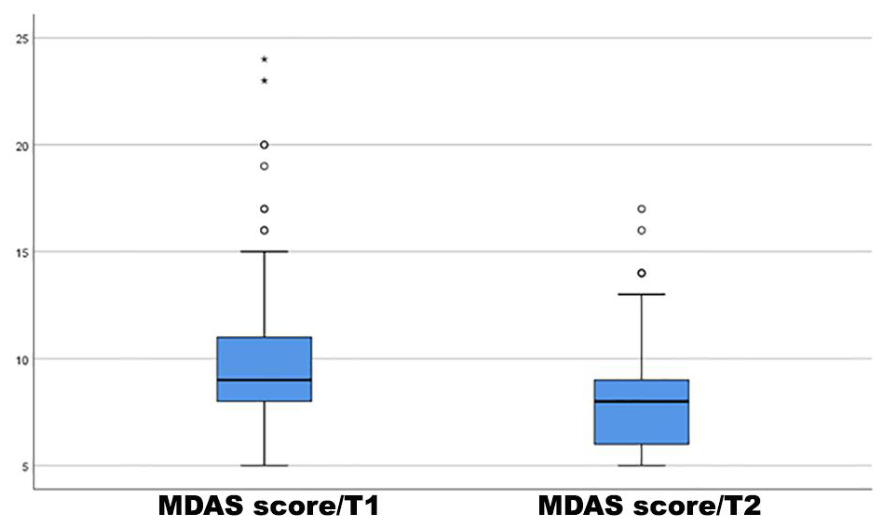
Figure 2.
Differences in MDAS at T1, T2, and T3.
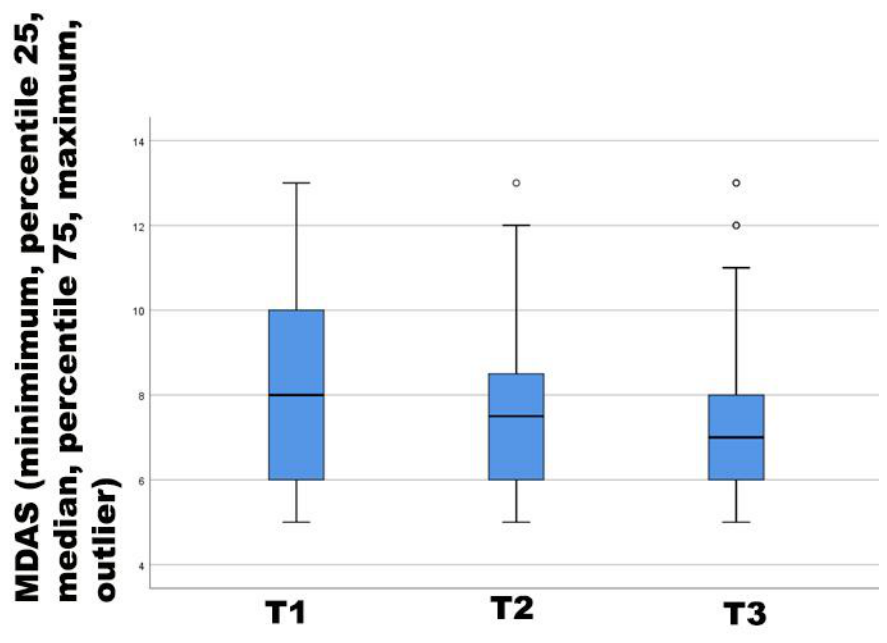
Figure 3.
Grouped scatter plot of MDAS scores after treatment (T2) vs. before treatment (T1) with anxiety level.
Figure 3.
Grouped scatter plot of MDAS scores after treatment (T2) vs. before treatment (T1) with anxiety level.
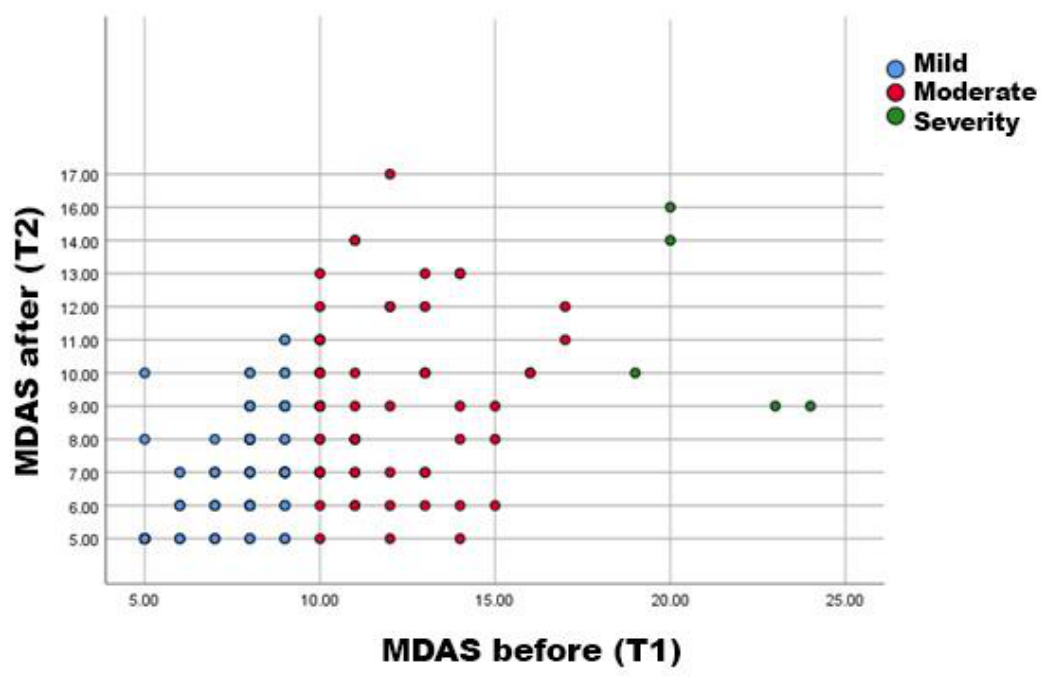

Table 1.
The average values and differences in MDAS values at time intervals T1 and T2 (N=150).
| MDAS T1 | MDAS T2 | |
| Mean | 9.79* | 8.03* |
| Standard Deviation | 3.40 | 2.43 |
| Median | 9.00 | 8.00 |
| Minimum | 5.00 | 5.00 |
| Maximum | 24.00 | 17.00 |
| Percentile 25 | 8.00 | 6.00 |
| Percentile 75 | 11.00 | 9.00 |
| Count | 150 | 150 |
*Statistical significance, p<0.001.
Table 2.
The average values and differences in MDAS values at time intervals T1, T2, and T3 (N=61).
| MDAS T1 | MDAS T2 | MDAS T3 | |
| Mean | 8.17*§† | 7.61*† | 7.54*§† |
| Standard Deviation | 2.32 | 1.98 | 2.05 |
| Median | 8.00 | 8.00 | 7.00 |
| Percentile 25 | 6.00 | 6.00 | 6.00 |
| Percentile 75 | 10.00 | 9.00 | 8.00 |
| Count | 61 | 61 | 61 |
*Statistical significance, p=0.045. §Statistical significance, p=0.012. †Statistical significance, p<0.001.
Table 3.
Multivariate model analysis results for Model A.
| Source | Wald Chi-Square | Df | Sig. |
| (Intercept) | 24.823 | 1 | .000 |
| Sex | .108 | 1 | .743 |
| Parents' marital status | .195 | 2 | .907 |
| Place of residence | 1.027 | 1 | .311 |
| Awareness of oral health measures | 1.326 | 1 | .250 |
| Financial impact on the use of dental services* | 6.041 | 1 | .014 |
| Last visit to the dentist | 4.053 | 2 | .132 |
| Reason for last visit | .149 | 1 | .700 |
| Type of dental service* | 7.720 | 2 | .021 |
| Experiences with the dentist* | 8.305 | 1 | .004 |
| Age | .647 | 1 | .421 |
| SESn | 2.718 | 1 | .099 |
| OHn | .358 | 1 | .550 |
| OSn | 3.001 | 1 | .083 |
| CDn | .182 | 1 | .670 |
*Statistical significance. Oral hygiene (OHn), oral status (OSn), cariogenic diet (CDn), socioeconomic status (SESn).
Table 4.
Multivariate model analysis results for Model B.
| Source | Wald Chi-Square | Df | Sig. | |
| (Intercept) | 16.570 | 1 | .000 | |
| Sex | .139 | 1 | .709 | |
| Parents' marital status | 2.547 | 2 | .280 | |
| Place of residence | 3.300 | 1 | .069 | |
| Awareness of oral health measures | 1.095 | 1 | .295 | |
| Financial impact on the use of dental services | 1.936 | 1 | .164 | |
| Last visit to the dentist* | 9.662 | 2 | .008* | |
| Reason for last visit | .999 | 1 | .318 | |
| Type of dental service | 3.091 | 2 | .213 | |
| Experiences with the dentist | .014 | 1 | .905 | |
| Age | 2.478 | 1 | .115 | |
| SESn | .358 | 1 | .549 | |
| OHn | .000 | 1 | .989 | |
| OSn | .111 | 1 | .739 | |
| CDn* | 6.291 | 1 | .012* | |
| IMDAS (T1)* | 117.562 | 1 | .000 | |
*Statistical significance. Oral hygiene (OHn), oral status (OSn), cariogenic diet (CDn), socioeconomic status (SESn), initial MDAS score at T1 (IMDAS).
Disclaimer/Publisher’s Note: The statements, opinions and data contained in all publications are solely those of the individual author(s) and contributor(s) and not of MDPI and/or the editor(s). MDPI and/or the editor(s) disclaim responsibility for any injury to people or property resulting from any ideas, methods, instructions or products referred to in the content. |
© 2026 by the authors. Licensee MDPI, Basel, Switzerland. This article is an open access article distributed under the terms and conditions of the Creative Commons Attribution (CC BY) license (http://creativecommons.org/licenses/by/4.0/).
Copyright: This open access article is published under a Creative Commons CC BY 4.0 license, which permit the free download, distribution, and reuse, provided that the author and preprint are cited in any reuse.