

Submitted:
05 April 2026
Posted:
06 April 2026
You are already at the latest version
Abstract
Urinary tract infections (UTIs) are among the most common bacterial infections worldwide and are traditionally considered acute and self-limited conditions. However, emerging evidence suggests that recurrent and persistent UTIs may contribute to chronic kidney disease (CKD) progression through complex interactions between uropathogens and host responses. This review examines the pathophysiological mechanisms linking UTIs caused by uropathogenic Escherichia coli, Klebsiella spp., and Enterococcus spp. to CKD development. Distinct pathogen-specific strategies, including intracellular persistence, biofilm formation, and chronic colonization, enable sustained infection and recurrent inflammatory insults. These processes activate key molecular pathways, including innate immune signalling, inflammasome activation, oxidative stress, and fibrotic remodelling. The convergence of these mechanisms leads to tubular injury, nephron loss, and a progressive decline in renal function. A comprehensive mechanistic model integrating pathogen-specific persistence strategies and host-mediated responses, including inflammation, inflammasome activation, oxidative stress, and fibrosis, is illustrated in Figure X, highlighting how recurrent and persistent UTIs may drive CKD progression. In addition, biomarkers reflecting inflammation (IL-6, CRP), tubular injury (NGAL, KIM-1), and fibrosis (TGF-β, fibronectin) provide a translational bridge between molecular mechanisms and clinical practice. Host factors such as diabetes, immune dysfunction, and microbiome alterations further modulate disease trajectory, while antibiotic resistance contributes to persistent infection and increased renal risk. These findings underscore the importance of early detection, pathogen-specific management, and biomarker-guided monitoring. Collectively, this review supports a paradigm shift recognizing UTIs not merely as acute infections but also as potential contributors to CKD progression, with important implications for prevention and therapeutic strategies.
Keywords:
urinary tract infections
; chronic kidney disease
; uropathogenic Escherichia coli
; Klebsiella pneumoniae
; Enterococcus
; biomarkers
; NGAL
; inflammasome
; oxidative stress
; fibrosis
; antibiotic resistance
; microbiome
1. Introduction
The kidney serves not only as a filtration and metabolic organ but also as a site vulnerable to infectious insults that may contribute to progressive injury and remodeling. While classical risk factors such as hypertension, diabetes mellitus, and glomerular diseases dominate the pathogenesis of chronic kidney disease (CKD), accumulating evidence suggests that recurrent or severe urinary tract infections (UTIs) may be underrecognized contributors to long-term renal decline [1,2]. Uropathogens such as Escherichia coli (particularly uropathogenic E. coli, UPEC), Klebsiella spp., and Enterococcus spp. are among the most frequent etiologic agents of UTIs and pyelonephritis, with distinct virulence traits that permit not only urinary colonization but also deeper tissue invasion and persistence [3,4,5].
These pathogens employ a repertoire of determinants, adhesins, fimbrial structures, toxins, iron-acquisition systems, and biofilm-forming capacity that facilitate ascending infection from the bladder to the upper urinary tract, evade host defenses, and confer resistance to antimicrobial therapy [6,7]. In experimental models, repeated renal infection induces local inflammation, tubular injury, and focal scarring, processes that may remain subclinical yet cumulatively predispose to progressive loss of function [8,9,10]. Mechanistically, stimulation of innate immune pattern-recognition receptors (e.g., Toll-like receptor 4 (TLR4) activation by lipopolysaccharide in Gram-negative bacteria) triggers nuclear factor Kappa B (NF-κB) signaling and induction of profibrotic mediators such as transforming growth factor-β (TGF-β), connective tissue growth factor (CTGF), and interleukin-6 (IL-6), which can sustain an inflammatory and fibrotic cascade that can drive tubular atrophy, capillary rarefaction, and irreversible nephron loss [11,12,13].
While the link between acute kidney injury (AKI) and CKD progression is well established, the long-term impact of UTI-derived insults in the absence of overt AKI is less clearly delineated [14,15]. Recurrent subclinical inflammatory stimuli may gradually shift the renal microenvironment toward maladaptive repair, manifesting as chronic interstitial nephritis, reduced glomerular filtration rate (GFR), or new-onset proteinuria. Furthermore, in patients with preexisting CKD, UTIs can accelerate disease progression, particularly when complicated by obstruction or urosepsis [16,17,18]. Cohort studies have shown that recurrent UTIs are associated with faster eGFR decline and increased risk of kidney failure [19]. In one large-scale analysis of CKD patients, repeat UTI episodes independently predicted mortality and renal function deterioration [18,20,21].
An additional challenge arises from the growing burden of antimicrobial resistance (AMR) in UTIs. The spread of extended-spectrum β-lactamase (ESBL)-producing E. coli and Klebsiella strains, as well as vancomycin-resistant Enterococcus (VRE), has led to higher rates of recurrence, treatment failure, and prolonged inflammatory exposure [22,23,24]. In CKD populations, reduced renal reserve, altered pharmacokinetics, and frequent antibiotic exposure create a vicious cycle of infection, inflammation, and nephrotoxicity [25,26]. Recognizing the contribution of specific uropathogens and their virulence or resistance patterns is essential for improving prevention, antimicrobial stewardship, and renal monitoring strategies.
In this review, we examine the evidence linking UTIs caused by Escherichia coli, Klebsiella spp., and Enterococcus spp. to CKD onset and progression, highlighting shared mechanisms, pathogen-specific pathways, and clinical implications.
2. Epidemiology of UTI and CKD Overlap
UTIs are among the most frequent bacterial infections across all age groups, with a lifetime incidence exceeding 50% in women and a substantial burden of recurrence, particularly in vulnerable populations [27,28]. Recurrent UTIs, commonly defined as ≥2 episodes within 6 months or ≥3 within 1 year, affect a significant proportion of patients and are associated with increased healthcare utilization, antibiotic exposure, and a higher risk of complications [27,29].
From an epidemiological perspective, the overlap between UTIs and CKD is increasingly recognized, particularly among older adults and individuals with metabolic comorbidities. CKD affects more than 10% of the global population and is projected to become one of the leading causes of mortality worldwide [30,31]. Patients with CKD exhibit a significantly increased susceptibility to UTIs due to multiple converging factors, including immune dysfunction, uremic toxin accumulation, impaired neutrophil and lymphocyte activity, and frequent exposure to healthcare-associated pathogens [20]. In addition, structural and functional abnormalities of the urinary tract—such as impaired urine concentration, reduced antimicrobial peptide activity, and urinary stasis—further predispose CKD patients to infection [32].
Conversely, UTIs—especially when recurrent or complicated—have been associated with an increased risk of CKD progression. Epidemiological and clinical data suggest that recurrent episodes of upper urinary tract infection (e.g., pyelonephritis) can lead to renal scarring, progressive nephron loss, and long-term decline in GFR [28,33,34].
This association was particularly pronounced in high-risk populations. Patients with diabetes mellitus, for example, exhibit both increased incidence and severity of UTIs and an accelerated trajectory of CKD progression, reflecting the combined effects of immune dysregulation, hyperglycemia-induced bacterial growth, and microvascular damage [35,36,37]. Elderly individuals also represent a key risk group, characterized by immunosenescence, higher rates of catheterization, and increased exposure to multidrug-resistant organisms, all of which contribute to recurrent UTIs and worsening renal function [29,38,39,40,41].
Healthcare-associated UTIs, particularly catheter-associated urinary tract infections (CAUTIs), further complicate this epidemiological landscape. These infections are strongly linked to biofilm-forming pathogens such as Klebsiella spp. and Enterococcus spp., which are associated with persistence, recurrence, and antimicrobial resistance [29,42,43,44,45].
Importantly, recent epidemiological insights emphasize that the burden of UTIs in CKD is not limited to acute episodes but includes subclinical or persistent infections that may contribute to chronic inflammation and progressive renal injury. This paradigm shift, from acute infection models to chronic, low-grade infection frameworks, is a key development in the field [29,42,46,47,48,49].
Taken together, these data support the concept that UTIs and CKD are interconnected conditions sharing common risk factors, overlapping patient populations, and mutually reinforcing pathophysiological mechanisms. Understanding this epidemiological interplay is essential for identifying high-risk patients and developing targeted preventive and therapeutic strategies.
3. Uropathogens of Interest: Microbiological and Virulence Profiles
Uropathogenic Escherichia coli (UPEC) remains the leading cause of urinary tract infections, accounting for the majority of both community-acquired and recurrent cases [50,51,52]. The pathogenic success of UPEC is largely driven by its ability to adhere to urothelial cells via type 1 and P fimbriae, enabling efficient colonization of the urinary tract [53,54]. Following adhesion, UPEC invades bladder epithelial cells and forms intracellular bacterial communities (IBCs), which promote immune evasion and persistence [55,56]. These bacteria can establish quiescent intracellular reservoirs that persist after treatment and serve as sources of recurrent infection [57,58]. UPEC also produces multiple virulence factors, including α-hemolysin and siderophores, which contribute to epithelial injury and inflammatory activation [59,60,61]. Ascending infection to the kidney may result in pyelonephritis, triggering inflammatory pathways that contribute to tubular damage and fibrosis [62,63].
Klebsiella pneumoniae is a significant uropathogen in complicated and healthcare-associated urinary tract infections, particularly among catheterized, hospitalized, and immunocompromised patients. Its clinical relevance is amplified by biofilm formation and frequent multiple drug resistance (MDR) [5,64,65,66]. A central virulence determinant of K. pneumoniae is the polysaccharide capsule, which contributes to immune evasion, while additional virulence-associated traits include fimbriae, siderophores, and factors that support survival on mucosal and abiotic surfaces. Recent reviews emphasize that the virulence profile varies between strains, helping explain differences in pathogenicity and clinical severity [67,68].
From a clinical perspective, Klebsiella UTIs are especially concerning when they involve ESBL-producing or carbapenem-resistant strains, because therapeutic options become narrower and treatment failure becomes more likely. This issue has also been highlighted in kidney-transplant and other high-risk populations [5,27,69]. For review of CKD angle, the key take-home message is that Klebsiella combines three properties directly relevant to the risk of chronic renal injury: persistence, device-associated biofilm formation, and antimicrobial resistance. Together, these traits increase the probability of prolonged infection, recurrent inflammatory injury, and delayed microbiological clearance [66,68,69].
Enterococcus spp. (Enterococcus faecalis and Enterococcus faecium) are well-recognized causes of healthcare-associated UTIs, particularly among patients with urinary catheters, prior antibiotic exposure, urinary tract abnormalities, transplantation, diabetes, or other clinical vulnerabilities [70,71]. A major reason enterococci are difficult uropathogens is that they combine intrinsic antimicrobial tolerance with marked genomic plasticity and an ability to acquire additional resistance determinants. Recent reviews continue to emphasize vancomycin resistance and broader last-resort antibiotic resistance as major clinical threats [70,72,73]. With respect to pathogenesis, enterococci express adhesion- and biofilm-associated factors that support colonization of host tissues and medical devices. Biofilm biology is particularly relevant in CAUTI settings because it promotes persistence and makes eradication more difficult [74].
The clinical importance of this persistence phenotype is that enterococcal UTIs are often not dominated by dramatic acute cytotoxicity, but by ongoing colonization, recurrence, and treatment difficulty. That pattern makes them particularly relevant to a CKD-focused review, where repeated low-grade inflammatory injury may matter as much as overt acute damage [70,71,74]. For the manuscript, the most defensible framing is that enterococci should be discussed as persistence-adapted uropathogens: they are clinically important not because they are always the most aggressive organisms, but because they are well-suited to survive, recur, and resist therapy in fragile hosts [70,72,73].
4. Pathophysiological Links Between UTIs and CKD
The relationship between UTIs and CKD is increasingly understood as a continuum driven by interconnected pathophysiological processes rather than isolated acute events. While most UTIs resolve without long-term consequences, recurrent or persistent infections may initiate a cascade of inflammatory, cellular, and molecular responses that contribute to progressive renal injury.
These mechanisms involve not only bacterial factors, such as pathogen persistence and virulence, but also host-mediated responses, including immune activation, oxidative stress (OS), and maladaptive repair. Together, these processes form a mechanistic framework that links acute infection to chronic structural and functional kidney damage.
4.1. Ascending Infection and Renal Involvement
The pathophysiological connection between UTIs and CKD begins with the ability of lower urinary tract infections to ascend toward the renal pelvis and parenchyma, resulting in acute pyelonephritis and direct tubulointerstitial injury. This mechanism is particularly relevant in recurrent or febrile UTIs, where kidney involvement may result in permanent structural sequelae rather than transient inflammation [20,75].
Clinical and epidemiologic studies further support that pyelonephritis is linked to renal scarring, especially in susceptible hosts, and that recurrence increases the likelihood of long-term kidney damage. In pediatric literature, this relationship is particularly well characterized, but the mechanistic relevance extends beyond children, as recurrent upper-tract inflammation is a biologically plausible route to progressive nephron loss [76,77].
4.2. Inflammation and Immune Activation (NF-κB, Cytokines)
Once uropathogens reach the urothelium and, in more severe cases, the kidney, host defense is initiated through innate immune recognition pathways, including TLR signaling, cytokine release, and neutrophil recruitment. These responses are essential for bacterial clearance, but when intense, repetitive, or poorly resolved, they may amplify tissue damage [78,79].
In UTI, inflammatory mediators such as IL-6 and IL-8 are consistently elevated, and clinical studies indicate that these cytokines are associated with upper-tract involvement and inflammatory burden. In parallel, CKD is now understood as a chronic inflammatory state in which persistent cytokine signaling contributes to endothelial dysfunction, fibrosis, and ongoing loss of renal function [80,81].
Accordingly, the UTI–CKD axis should not be viewed only through the lens of bacterial presence, but also through the quality and persistence of the host inflammatory response. This is one of the main reasons recurrent UTIs can have consequences that extend beyond the acute infectious episode [20,82].
4.3. Inflammasome Activation (NLRP3)
A more recent mechanistic layer involves inflammasome biology, especially the NLR family pyrin domain-containing 3 (NLRP3) inflammasome, which is increasingly recognized as a key amplifier of renal inflammation. In kidney disease, NLRP3 links sterile or infection-associated danger signals to caspase-1 activation and the maturation of IL-1β and IL-18, thereby intensifying tissue injury [20,83,84].
This pathway is particularly relevant to the infection-to-CKD transition because persistent NLRP3 activation has been associated with chronic pathological changes after acute kidney injury and has been proposed as a marker of AKI-to-CKD progression. That concept is useful for your review because recurrent pyelonephritic injury can be framed as repeated inflammatory insults with maladaptive downstream remodeling [83,85].
4.4. Oxidative Stress and Tubular Injury
OS is now recognized as a central mechanism in both acute and chronic kidney injury, with excessive reactive oxygen species (ROS) promoting tubular epithelial damage, mitochondrial dysfunction, inflammatory amplification, and progressive renal decline. This is highly relevant to severe or recurrent UTIs, where infection-driven inflammation can feed directly into redox injury pathways [86,87].
Renal tubular epithelial cells are particularly vulnerable to mitochondrial injury, and recent reviews emphasize that mitochondrial dysfunction is a major driver of tubular cell death and of failed recovery after kidney injury. This matters for the UTI–CKD link because unresolved infection-associated inflammation can sustain ROS generation and thereby shift repair toward maladaptive outcomes [86,88].
Uropathogen-induced inflammation is associated with increased ROS production, contributing to OS and cellular damage. The inflammatory response to uropathogens such as UPEC involves the release of cytokines and chemokines, which can lead to ROS production. These ROS are critical mediators of the inflammatory process, playing roles in immune cell activation, tissue damage, and disease progression. The interplay between inflammation and OS is a significant factor in the pathogenesis of various diseases, including chronic inflammation and atherosclerosis [62,89].
4.5. Fibrosis Pathways: Transforming Growth Factor-β and Maladaptive Epithelial Responses
Fibrosis is the common final pathway in progressive CKD, and transforming growth factor-β (TGF-β)/Smad signaling remains a core molecular regulator. In the injured kidney, this pathway promotes extracellular matrix accumulation, fibroblast activation, and tubulointerstitial remodeling, thereby converting repeated inflammatory insults into permanent structural damage [90,91].
Current fibrosis literature also emphasizes that injured tubular epithelial cells do not simply die or recover; they may enter maladaptive states that promote profibrotic signaling and myofibroblast activation. For your topic, that is the crucial bridge between recurrent UTI-associated injury and CKD progression: repeated infectious injury can leave the kidney in a pro-fibrotic repair program even after microbiological clearance [91,92].
4.6. Integration: From Acute Infection to Chronic Kidney Disease
Taken together, the transition from UTI to CKD can be conceptualized as a sequence of ascending infection, inflammatory activation, oxidative and mitochondrial injury, and maladaptive repair culminating in fibrosis. This integrated model is more useful than treating UTIs as isolated acute events because it explains how recurrence, persistence, or delayed resolution can lead to cumulative renal damage over time [92,93].
In that framework, pathogen persistence, host susceptibility, and the intensity of repair responses jointly determine whether the kidney returns to baseline or progresses toward chronic interstitial fibrosis and nephron loss. This integrated pathophysiological view is the most consistent with the current literature on the AKI-to-CKD transition and with emerging work on kidney involvement during febrile UTI [93,94].
The complex interplay of pathogen-specific mechanisms and host-mediated responses described above can be integrated into a unified pathophysiological framework. This model highlights how ascending infection, immune activation, inflammasome signaling, oxidative stress, and maladaptive repair collectively contribute to progressive renal injury. This integrated sequence of events is summarized in Figure 1.
5. Comparative Role of Uropathogens in CKD Progression
Although UTIs are frequently approached as a homogeneous clinical entity, accumulating evidence indicates that the long-term renal impact of infection is highly dependent on pathogen-specific virulence strategies. In particular, UPEC, Klebsiella spp., and Enterococcus spp. exhibit fundamentally different mechanisms of persistence, immune interaction, and tissue injury, which may differentially influence the risk of CKD progression.
UPEC represents the prototypical uropathogen and is uniquely adapted to establish recurrent infections through intracellular persistence. After adhesion to urothelial cells via type 1 fimbriae, UPEC invade host cells and form intracellular bacterial communities, thereby establishing quiescent intracellular reservoirs. These reservoirs can evade both host immunity and antibiotic therapy, providing a mechanistic explanation for recurrence. From a CKD perspective, this is particularly relevant because repeated cycles of infection and resolution lead to cumulative inflammatory injury and progressive tubular damage over time [3,94].
In contrast, Klebsiella pneumoniae and related species rely less on intracellular invasion and more on extracellular persistence mechanisms, particularly biofilm formation and antimicrobial resistance. The ability of Klebsiella spp. to form structured biofilms on urinary catheters and epithelial surfaces significantly enhances their survival and reduces antibiotic penetration. In addition, the increasing prevalence of ESBL and carbapenem-resistant strains further complicates eradication. These features promote prolonged infection and sustained inflammatory signaling, which may exacerbate renal injury, especially in patients with pre-existing CKD or frequent healthcare exposure [5,67].
Enterococcus spp. represents a distinct pathogenic paradigm characterized by persistence and immune tolerance rather than aggressive virulence. These organisms are intrinsically resistant to multiple antibiotics and are commonly associated with chronic urinary tract colonization, particularly in catheterized or hospitalized patients. Unlike UPEC, Enterococcus-mediated infections are often less acutely destructive, but they induce sustained low-grade inflammation, which may contribute to progressive interstitial fibrosis over time. This chronic inflammatory profile aligns closely with the broader pathophysiological mechanisms illustrated in Figure 1, where persistent immune activation drives maladaptive repair and fibrotic remodeling. In addition to the described pathways, key biomarkers associated with each stage of disease progression are indicated, including inflammatory cytokines (IL-6, IL-8, TNF-α, MCP-1), inflammasome-related mediators (IL-1β, IL-18), oxidative stress markers (ROS, 8-OHdG), tubular injury markers (NGAL, KIM-1), and fibrosis-associated proteins (TGF-β, collagen, fibronectin). These biomarkers provide a translational link between molecular mechanisms and clinical assessment of kidney injury [70,95].
From a mechanistic standpoint, these pathogens converge on common downstream pathways—namely inflammation, inflammasome activation, OS, and fibrosis—but differ in how they initiate and sustain these processes. UPEC primarily drives disease through recurrence and repeated acute inflammatory insults, Klebsiella spp. through biofilm-associated persistence and antimicrobial resistance, and Enterococcus spp. through chronic colonization and continuous low-grade immune activation. The pathogen-specific mechanisms described above can be integrated into a comparative framework that highlights both their distinct persistence strategies and their convergence on shared downstream pathways of kidney injury. This integrated model emphasizes how intracellular persistence (UPEC), biofilm-associated resistance (Klebsiella spp.), and chronic colonization with low-grade inflammation (Enterococcus spp.) differentially initiate but ultimately sustain inflammation, tubular injury, and fibrotic remodeling. A schematic comparative overview of these pathogen-specific and host-mediated processes is presented in Figure 2.
6. Antibiotic Resistance and Its Impact on CKD
Antibiotic resistance represents a critical factor in the transition from acute UTI to persistent or recurrent disease, thereby increasing the risk of chronic kidney injury. Infections caused by multidrug-resistant uropathogens are more difficult to eradicate, often requiring prolonged or repeated courses of antibiotics, which may delay bacterial clearance and sustain inflammatory responses within the kidney. This is particularly relevant in complicated UTIs, where persistent infection can lead to recurrent episodes of pyelonephritis and cumulative tubulointerstitial damage [5,27].
A major clinical consequence of antimicrobial resistance is treatment failure or suboptimal therapy, thereby allowing bacteria to persist in the urinary tract. In this context, pathogens such as ESBL-producing Klebsiella pneumoniae or VRE are associated with prolonged infection duration and increased risk of recurrence. Persistent infection leads to sustained activation of inflammatory pathways, including NF-κB signaling and cytokine production, thereby amplifying renal injury and promoting progression toward CKD [67,70].
In addition to pathogen persistence, antibiotic therapy itself may contribute to renal injury through nephrotoxicity. Aminoglycosides, for example, are well known to induce acute tubular injury via accumulation in proximal tubular cells, leading to OS, mitochondrial dysfunction, and cell death. Although often necessary in severe infections, repeated or prolonged exposure to nephrotoxic agents may contribute to long-term renal impairment, particularly in patients with pre-existing kidney disease [96,97,98,99,100].
Another emerging aspect is the impact of antibiotics on the urinary and gut microbiome. Broad-spectrum antibiotic use can disrupt microbial homeostasis, leading to dysbiosis that favors colonization by resistant or opportunistic pathogens. This altered microbial environment may increase susceptibility to recurrent UTIs and contribute indirectly to chronic inflammation. In turn, microbiome disruption has been linked to systemic immune dysregulation and may influence CKD progression through inflammatory and metabolic pathways [101,102,103,104].
From a pathophysiological perspective, antibiotic resistance and its consequences integrate directly into the mechanisms illustrated in Figure 2. Persistent infection due to ineffective therapy sustains inflammatory signaling, promotes OS, and drives maladaptive repair processes, ultimately leading to fibrosis and nephron loss. Thus, antimicrobial resistance should not be viewed solely as a microbiological problem but as a key contributor to the risk of CKD in patients with recurrent or complicated UTIs.
7. Host Factors Modulating the UTI–CKD Axis
The progression from UTI to CKD is not determined solely by pathogen characteristics, but is strongly influenced by host-related factors that modulate susceptibility, immune response, and repair mechanisms. Among these, metabolic conditions, immune status, and microbiome composition play a central role in determining whether an infection resolves or progresses to chronic renal injury.
One of the most important host-related risk factors is diabetes mellitus, which is consistently associated with both increased susceptibility to UTIs and accelerated CKD progression. Hyperglycemia promotes bacterial growth in the urinary tract, impairs neutrophil function, and disrupts innate immune responses. In addition, diabetic patients exhibit microvascular damage, oxidative stress, and baseline inflammation, all of which amplify renal vulnerability to infection-induced injury. As a result, UTIs in diabetic individuals are more likely to be severe, recurrent, and associated with long-term renal consequences [37,105,106,107].
Beyond diabetes, altered immune function represents a key determinant of the UTI–CKD axis. Both immunosuppressed patients (e.g., transplant recipients) and elderly individuals exhibit impaired pathogen clearance, leading to prolonged infection and increased risk of persistence. Dysregulation of innate and adaptive immune responses may result in either insufficient bacterial elimination or excessive inflammatory activation, both of which contribute to tissue injury. This imbalance is particularly relevant in recurrent infections, where repeated immune activation promotes chronic inflammation and fibrotic remodeling [5,70,107,108,109].
Another emerging factor is the role of the urinary and gut microbiome in modulating susceptibility to infection and inflammation. Disruption of microbial homeostasis, often due to antibiotic exposure or underlying disease, can lead to dysbiosis that favors colonization by uropathogens. In addition, the gut–kidney axis has been increasingly recognized as a contributor to systemic inflammation, with microbial metabolites influencing immune responses and renal function. Alterations in the microbiome may therefore not only predispose to recurrent UTIs but also contribute to CKD progression through inflammatory and metabolic pathways [110,111,112,113,114].
Host structural and functional abnormalities of the urinary tract also play a significant role. Conditions such as urinary obstruction, vesicoureteral reflux, and catheterization facilitate bacterial ascent and persistence, increasing the likelihood of renal involvement. These factors are particularly important in recurrent or complicated UTIs, where mechanical disruption of normal urinary flow promotes sustained infection and repeated renal injury [115,116].
Importantly, these host factors interact with pathogen-specific mechanisms; for example, intracellular persistence of UPEC is more likely to result in recurrence in immunocompromised hosts, while biofilm-associated infections by Klebsiella spp. are particularly problematic in catheterized patients. Similarly, chronic colonization by Enterococcus spp. is favored in dysbiotic environments with impaired immune surveillance.
Taken together, these observations support a multifactorial model in which host susceptibility determines the trajectory of infection. Rather than acting as isolated risk factors, metabolic, immunological, and structural conditions collectively shape the balance between bacterial clearance and persistence. This, in turn, influences whether UTIs remain acute and self-limited or evolve into chronic processes that contribute to CKD progression.
8. Biomarkers Linking UTI to CKD Progression
The identification of reliable biomarkers linking UTIs to CKD progression represents a critical step toward improving early diagnosis, risk stratification, and monitoring of renal injury. Given the complex interplay among infection, inflammation, and fibrosis, no single biomarker is sufficient; rather, a panel reflecting different disease stages is required.
One of the most extensively studied biomarkers of tubular injury is neutrophil gelatinase-associated lipocalin (NGAL), which is rapidly released by damaged tubular epithelial cells in response to infection and inflammation. Elevated NGAL levels have been associated with both AKI and early CKD progression, making it particularly relevant in the context of recurrent UTIs. In patients with upper urinary tract involvement, NGAL may reflect subclinical tubular damage even before significant changes in GFR are observed [117,118,119,120].
In addition to tubular injury markers, systemic inflammatory biomarkers such as CRP play an important role in assessing infection severity and systemic response. Elevated CRP levels are commonly observed in complicated UTIs and have been correlated with increased risk of renal involvement, particularly in pyelonephritis. Persistent elevation of CRP may also reflect ongoing inflammation, which contributes to CKD progression through endothelial dysfunction and fibrotic signaling pathways [121,122].
Cytokines represent another key class of biomarkers that directly reflect activation of inflammatory pathways. Increased levels of IL-6, IL-8, TNF-α, and MCP-1 are frequently detected in UTI and are associated with disease severity, bacterial load, and tissue injury. Importantly, these cytokines are also involved in CKD pathophysiology, linking acute infection to chronic inflammatory states. Their integration into biomarker panels may improve the prediction of disease progression and identify patients at higher risk of long-term renal damage [70,95,123,124,125,126].
Beyond classical inflammatory and injury markers, emerging evidence suggests that novel signaling pathways—including neuroimmune interactions—may contribute to UTI pathophysiology. Neurotransmitters and neuropeptides, such as substance P and catecholamines, have been shown to modulate immune responses and epithelial barrier function. Although still an evolving area of research, these mediators may represent innovative biomarkers linking local infection to systemic and renal outcomes [29,78,127,128].
Importantly, these biomarkers correspond closely to the mechanistic pathways illustrated in Figure 2. Inflammatory cytokines reflect innate immune activation; IL-1β and IL-18 correspond to inflammasome signaling; NGAL and KIM-1 indicate tubular injury; and TGF-β and extracellular matrix proteins reflect fibrotic remodeling. This alignment underscores the translational value of integrating molecular mechanisms with measurable clinical parameters.
Taken together, the use of multimarker approaches combining inflammatory, tubular injury, and fibrosis-related biomarkers may provide a more accurate assessment of disease trajectory. Such strategies could enable earlier identification of patients at risk of CKD progression following recurrent or complicated UTIs and support the development of personalized therapeutic interventions.
An integrated overview of pathogen-specific mechanisms and associated biomarker profiles is presented in Table 1, highlighting how different uropathogens contribute to renal injury through distinct yet converging pathways.
As shown in Table 1, UPEC is primarily associated with recurrent inflammatory injury, Klebsiella spp. with persistent biofilm-mediated infection and systemic inflammation, and Enterococcus spp. with chronic low-grade inflammation and fibrosis. Despite these differences, all pathways ultimately converge on tubular injury and fibrotic remodeling, supporting CKD progression.
9. Clinical Implications
The growing recognition of UTIs as potential contributors to CKD progression has important clinical implications, particularly for early detection, risk stratification, and personalized management. Rather than being considered isolated acute events, recurrent or complicated UTIs should be viewed as part of a broader pathophysiological continuum that may lead to progressive renal injury.
One of the most immediate implications is the need for systematic screening for kidney involvement in patients with recurrent UTIs, especially in high-risk populations such as individuals with diabetes, elderly patients, and those with structural urinary tract abnormalities. Early assessment of renal function, including eGFR and albuminuria, combined with tubular injury biomarkers such as NGAL or KIM-1, may enable detection of subclinical kidney damage before irreversible changes occur. This approach is particularly relevant in patients with recurrent pyelonephritis, where cumulative injury may go unrecognized.
Another key aspect is the shift toward personalized management strategies based on pathogen characteristics and host factors, as highlighted in Table 1, Figure 1, and 2. For example, infections caused by UPEC may require strategies targeting intracellular persistence and recurrence, whereas infections caused by Klebsiella spp. infections necessitate careful antibiotic selection guided by resistance profiles and biofilm considerations. In contrast, Enterococcus spp. infections may benefit from approaches focused on controlling chronic colonization and minimizing unnecessary antibiotic exposure. This pathogen-specific perspective represents a significant departure from traditional one-size-fits-all treatment approaches.
Antibiotic stewardship also plays a central role in mitigating long-term renal risk. The inappropriate or excessive use of antibiotics not only promotes resistance but may also contribute to nephrotoxicity and microbiome disruption, both of which are implicated in CKD progression. Therefore, guided antibiotic therapy, based on culture and susceptibility testing, should be prioritized, particularly in recurrent or complicated cases. In parallel, non-antibiotic strategies—such as catheter management, behavioral interventions, and emerging anti-adhesion therapies—may reduce recurrence and limit cumulative renal injury.
Importantly, integrating biomarker-based monitoring into clinical practice may provide a more refined approach to patient management. Biomarkers reflecting inflammation (e.g., IL-6, CRP), tubular injury (NGAL, KIM-1), and fibrosis (TGF-β, fibronectin) can provide insight into disease activity and progression, enabling clinicians to identify patients at higher risk of CKD and tailor interventions accordingly. This aligns with the mechanistic framework illustrated in Figure 2, where different stages of disease progression are associated with distinct biomarker profiles.
Finally, these insights highlight the need for a preventive approach to CKD in patients with recurrent UTIs. Early intervention aimed at reducing infection frequency, controlling inflammation, and preventing fibrotic remodeling may be essential to preserving renal function. This includes optimizing management of comorbidities such as diabetes, addressing modifiable risk factors, and implementing long-term follow-up strategies in high-risk individuals.
Taken together, the clinical implications of the UTI–CKD axis support a paradigm shift recognizing UTIs not only as infectious diseases but also as potential drivers of chronic renal injury. Integrating pathogen-specific mechanisms, host factors, and biomarker-guided monitoring into clinical practice may significantly improve patient outcomes and reduce the burden of CKD.
10. Future Directions
Despite significant advances in understanding the pathophysiological links between UTIs and CKD, several key areas remain to be explored in order to improve prevention, diagnosis, and treatment strategies. Future research should focus on targeting pathogen persistence, refining biomarker-based approaches, and developing personalized interventions that integrate microbial and host factors.
One of the most promising directions involves the development of anti-biofilm therapies, particularly for pathogens such as Klebsiella spp., where biofilm formation plays a central role in persistence and antibiotic resistance. Novel strategies—including biofilm-disrupting approaches, quorum-sensing-targeted interventions, and bacteriophage therapy—are emerging as promising alternatives or adjuncts for chronic and catheter-associated UTIs, although stronger clinical validation remains needed [129,130,131,132,133].
Another important area is the development of vaccines against uropathogens, especially UPEC, which remains the leading cause of recurrent UTIs. Several vaccine-based strategies for recurrent urinary tract infections, particularly those targeting UPEC, are currently under investigation [134,135,136]. Successful vaccination strategies could reduce recurrence rates and, consequently, limit recurrent renal injury, representing a major step forward in preventing CKD progression.
The modulation of the microbiome represents an emerging and highly relevant field. Advances in understanding the gut–kidney and urinary microbiome axes suggest that restoring microbial balance through probiotics, prebiotics, or microbiota-targeted therapies may reduce susceptibility to infection and dampen chronic inflammation. This approach may be particularly valuable in patients with recurrent UTIs and dysbiosis driven by repeated antibiotic exposure.
In parallel, there is increasing interest in developing predictive biomarker panels that identify patients at high risk of CKD progression following UTIs. Rather than relying on a single marker, future approaches will likely integrate multiple biomarkers—including inflammatory cytokines, tubular injury markers, and fibrosis-related proteins—alongside clinical and microbiological data. The incorporation of machine learning and precision medicine frameworks may further enhance risk prediction and guide individualized management strategies.
Finally, innovative research directions are exploring the role of neuroimmune interactions in UTI pathophysiology. The interplay between the nervous system and immune responses in the urinary tract may influence both susceptibility to infection and the transition to chronic inflammation. Although still in early stages, this field may open new therapeutic avenues targeting neural signaling pathways to modulate inflammation and prevent long-term renal damage.
Overall, future research should move toward an integrated, systems-level understanding of the UTI–CKD axis, combining pathogen biology, host responses, and clinical data. Such an approach will be essential for developing effective strategies to prevent the progression from acute infection to chronic kidney disease.
11. Conclusions
UTIs are traditionally regarded as acute and self-limited conditions; however, accumulating evidence supports their role as potential contributors to CKD progression. This review highlights that the transition from infection to chronic renal injury is driven by a complex interplay between pathogen-specific persistence mechanisms, host susceptibility factors, and maladaptive repair processes. Distinct uropathogens, including UPEC, Klebsiella spp., and Enterococcus spp., employ different strategies to sustain infection, such as intracellular persistence, biofilm formation, and chronic colonization. Despite these differences, their effects converge on common downstream pathways involving inflammation, inflammasome activation, oxidative stress, and fibrosis. These mechanisms, as summarized in Table 1, Figure 1, and 2, ultimately lead to tubular injury, nephron loss, and progressive decline in renal function. Importantly, the host response plays a central role in determining disease trajectory. Conditions such as diabetes, immune dysregulation, and microbiome imbalance not only increase susceptibility to infection but also amplify inflammatory and fibrotic pathways, thereby accelerating CKD progression. In parallel, antibiotic resistance and treatment-related factors further contribute to persistent infection and cumulative renal damage. The integration of biomarker-based approaches offers a promising avenue for early detection and risk stratification. Markers of inflammation, tubular injury, and fibrosis provide a translational bridge between molecular mechanisms and clinical practice, enabling identification of patients at higher risk for long-term renal impairment. Taken together, these findings support a paradigm shift in which UTIs should no longer be viewed solely as isolated infectious episodes, but rather as potential drivers of chronic kidney disease. Early recognition, pathogen-specific management, and biomarker-guided monitoring may be essential to prevent irreversible renal damage and improve patient outcomes. Future efforts should focus on developing targeted therapeutic strategies, improving diagnostic precision, and integrating multidisciplinary approaches to better address the UTI–CKD axis.
Author Contributions
Conceptualization, M.-E.C and D.C.C.; methodology, M.V.B. and M.-Z.A.; software, M.V.B. and M.-Z.A.; validation, L.B. and L.R.; resources, M.-E.C and D.C.C.; data curation, I.S. and L.R.; writing—original draft preparation, M.-E.C and D.C.C.; writing—review and editing, I.S. and M.V.B.; supervision, L.B. and C.C.V.; project administration, C.C.V. All authors have read and agreed to the published version of the manuscript.
Funding
The Article Processing Charges were funded by the University of Medicine and Pharmacy of Craiova, Romania.
Acknowledgments
Mariana-Emilia Caragea and Daniel Cosmin Caragea share equal contributions and status as main/first authors.
Conflicts of Interest
The authors declare no conflicts of interest.
References
- Vacaroiu, I.A.; Cuiban, E.; Geavlete, B.F.; Gheorghita, V.; David, C.; Ene, C.V.; Bulai, C.; Lupusoru, G.E.; Lupusoru, M.; Balcangiu-Stroescu, A.E.; et al. Chronic Kidney Disease—An Underestimated Risk Factor for Antimicrobial Resistance in Patients with Urinary Tract Infections. Biomedicines 2022, 10, 2368. [CrossRef]
- Jha, V., Garcia-Garcia, G., Iseki, K., Li, Z., Naicker, S., Plattner, B., Saran, R., Wang, A. Y., & Yang, C. W. (2013). Chronic kidney disease: global dimension and perspectives. Lancet (London, England), 382(9888), 260–272. [CrossRef]
- Zhou, Y., Zhou, Z., Zheng, L., Gong, Z., Li, Y., Jin, Y., Huang, Y., & Chi, M. (2023). Urinary Tract Infections Caused by Uropathogenic Escherichia coli: Mechanisms of Infection and Treatment Options. International journal of molecular sciences, 24(13), 10537. [CrossRef]
- Dimitrijevic, Z., Paunovic, G., Tasic, D., Mitic, B., & Basic, D. (2021). Risk factors for urosepsis in chronic kidney disease patients with urinary tract infections. Scientific reports, 11(1), 14414. [CrossRef]
- Krawczyk, B., Wysocka, M., Michalik, M., & Gołębiewska, J. Urinary Tract Infections Caused by K. pneumoniae in Kidney Transplant Recipients - Epidemiology, Virulence and Antibiotic Resistance. Front Cell Infect Microbiol 2022, 12, 861374. [CrossRef]
- Al Lawati, H., Blair, B. M., & Larnard, J. Urinary Tract Infections: Core Curriculum 2024. Am J Kidney Dis 2024, 83(1), 90–100. [CrossRef]
- Brune, J. E., Dickenmann, M., Sidler, D., Walti, L. N., Golshayan, D., Manuel, O., Haidar, F., Neofytos, D., Schnyder, A., Boggian, K., Mueller, T. F., Schachtner, T., Khanna, N., Schaub, S., Wehmeier, C., & Swiss Transplant Cohort Study (2024). Frequency and impact on renal transplant outcomes of urinary tract infections due to extended-spectrum beta-lactamase-producing Escherichia coli and Klebsiella species. Frontiers in medicine, 11, 1329778. [CrossRef]
- Bitsori, M., & Galanakis, E. (2019). Treatment of Urinary Tract Infections Caused by ESBL-producing Escherichia coli or Klebsiella pneumoniae. The Pediatric infectious disease journal, 38(12), e332–e335. [CrossRef]
- McWilliam, S. J., Wright, R. D., Welsh, G. I., Tuffin, J., Budge, K. L., Swan, L., Wilm, T., Martinas, I. R., Littlewood, J., & Oni, L. (2020). The complex interplay between kidney injury and inflammation. Clinical kidney journal, 14(3), 780-788. [CrossRef]
- Liu, BC., Tang, TT., Lv, LL. (2019). How Tubular Epithelial Cell Injury Contributes to Renal Fibrosis. In: Liu, BC., Lan, HY., Lv, LL. (eds) Renal Fibrosis: Mechanisms and Therapies. Advances in Experimental Medicine and Biology, vol 1165. Springer, Singapore. [CrossRef]
- Meng, XM. (2019). Inflammatory Mediators and Renal Fibrosis. In: Liu, BC., Lan, HY., Lv, LL. (eds) Renal Fibrosis: Mechanisms and Therapies. Advances in Experimental Medicine and Biology, vol 1165. Springer, Singapore. [CrossRef]
- Huang, R., Fu, P., & Ma, L. Kidney fibrosis: from mechanisms to therapeutic medicines. Signal transduction and targeted therapy, 2023, 8(1), 129. [CrossRef]
- Higgins, C. E., Tang, J., Mian, B. M., Higgins, S. P., Gifford, C. C., Conti, D. J., Meldrum, K. K., Samarakoon, R., & Higgins, P. J. TGF-β1-p53 cooperativity regulates a profibrotic genomic program in the kidney: molecular mechanisms and clinical implications. FASEB J. 2019, 33(10), 10596–10606. [CrossRef]
- Xu, D.; Zhang, X.; Pang, J.; Li, Y.; Peng, Z. Mechanisms of Acute Kidney Injury–Chronic Kidney Disease Transition: Unraveling Maladaptive Repair and Therapeutic Opportunities. Biomolecules 2025, 15, 794. [CrossRef]
- Veltkamp, D. M. J., Porras, C. P., Gant, C. M., Groenestege, W. M. T., Kok, M. B., Verhaar, M. C., van Solinge, W. W., Haitjema, S., & Vernooij, R. W. M. Long-term risks of adverse kidney outcomes after acute kidney injury: a systematic review and meta-analysis. Nephrol Dial Transplant 2025, 40(11), 2143–2158. [CrossRef]
- Gameiro, J., Marques, F., & Lopes, J. A. Long-term consequences of acute kidney injury: a narrative review. Clin Kidney J, 2020, 14(3), 789–804. [CrossRef]
- Mehta R. L. Renal Recovery After Acute Kidney Injury and Long-term Outcomes: Is Time of the Essence? JAMA Netw Open 2020, 3(4), e202676. [CrossRef]
- Zarbock, A., Forni, L., Koyner, J. L., Gómez, H., Pannu, N., Ostermann, M., Bellomo, R., Kellum, J. A., & von Groote, T. Preventing acute kidney injury and its longer-term impact in the critically ill. Intensive Care Med 2025, 51(7), 1331–1347. [CrossRef]
- Yang, D. C., Chao, J. Y., Hsiao, C. Y., Tseng, C. T., Lin, W. H., Kuo, T. H., & Wang, M. C. Impact of urinary tract infection requiring hospital admission on short-term, mid-term and long-term renal outcomes in adult CKD patients - A potentially modifiable factor for CKD progression. J Infect Public Health 2025, 18(5), 102712. [CrossRef]
- Dicu-Andreescu, I.; Penescu, M.N.; Căpușă, C.; Verzan, C. Chronic Kidney Disease, Urinary Tract Infections and Antibiotic Nephrotoxicity: Are There Any Relationships? Medicina 2022, 59(1), 49. [CrossRef]
- Dicu-Andreescu, I., Căpușă, C., Gârneață, L., Ciurea, O. A., Dicu-Andreescu, I. G., Ungureanu, E. A., Vlad, D. V., Vișan, A. C., Ungureanu, V. G., Vlad, V. V., Vasioiu, P. C., Ciutacu, E. M., Neicu, M., Penescu, M., & Verzan, C.The Impact of Infections on the Progression of Chronic Kidney Disease. Medicina 2023, 59(10)aa, 1836. [CrossRef]
- Cabrera, A., Mason, E., Mullins, L. P., & Sadarangani, M. Antimicrobial resistance and vaccines in Enterobacteriaceae including extraintestinal pathogenic Escherichia coli and Klebsiella pneumoniae. NPJ Antimicrob Resist 2025, 3(1), 34. [CrossRef]
- Zhang, S., Yang, J., Abbas, M., Yang, Q., Li, Q., Liu, M., Zhu, D., Wang, M., Tian, B., & Cheng, A. (2025). Threats across boundaries: the spread of ESBL-positive Enterobacteriaceae bacteria and its challenge to the “one health” concept. Front Microbiol 2025, 16, 1496716. [CrossRef]
- Tamma, P. D., Heil, E. L., Justo, J. A., Mathers, A. J., Satlin, M. J., & Bonomo, R. A. Infectious Diseases Society of America 2024 Guidance on the Treatment of Antimicrobial-Resistant Gram-Negative Infections. Clin Infect Dis 2024, ciae403. Advance online publication. [CrossRef]
- Wu, I. W., Wu, Y. L., Yang, H. Y., Hsu, C. K., Chang, L. C., Twu, Y. C., Chang, Y. L., Chung, W. H., Yang, C. W., Hsieh, W. P., & Su, S. C. Deep immune profiling of patients with renal impairment unveils distinct immunotypes associated with disease severity. Clin Kidney J 2022, 16(1), 78–89. [CrossRef]
- Vilay A. M. Antibiotic Dosing in Chronic Kidney Disease and End-Stage Renal Disease: A Focus on Contemporary Challenges. Adv Chronic Kidney Dis. 2019, 26(1), 61–71. [CrossRef]
- Mancuso, G., Midiri, A., Gerace, E., Marra, M., Zummo, S., & Biondo, C. Urinary Tract Infections: The Current Scenario and Future Prospects. Pathogens. 2023, 12(4), 623. [CrossRef]
- Zhou, Y., Zhou, Z., Zheng, L., Gong, Z., Li, Y., Jin, Y., Huang, Y., & Chi, M. Urinary Tract Infections Caused by Uropathogenic Escherichia coli: Mechanisms of Infection and Treatment Options. Int. J. Mol. Sci. 2023, 24(13), 10537. [CrossRef]
- Timm, M. R., Russell, S. K., & Hultgren, S. J. Urinary tract infections: pathogenesis, host susceptibility and emerging therapeutics. Nat Rev Microbiol. 2025, 23(2), 72–86. [CrossRef]
- Kovesdy C. P. Epidemiology of chronic kidney disease: an update 2022. Kidney Int Suppl (2011). 2022, 12(1), 7–11. [CrossRef]
- Bello, A. K., Okpechi, I. G., Levin, A., Ye, F., Damster, S., Arruebo, S., Donner, J. A., Caskey, F. J., Cho, Y., Davids, M. R., Davison, S. N., Htay, H., Jha, V., Lalji, R., Malik, C., Nangaku, M., See, E., Sozio, S. M., Tonelli, M., Wainstein, M., … ISN-GKHA Group. An update on the global disparities in kidney disease burden and care across world countries and regions. Lancet Glob Health 2024, 12(3), e382–e395. [CrossRef]
- Jain, S., & Chen, F. Developmental pathology of congenital kidney and urinary tract anomalies. Clin Kidney J 2018, 12(3), 382–399. [CrossRef]
- Sgarabotto, D.; Andretta, E.; Sgarabotto, C. Recurrent Urinary Tract Infections (UTIs): A Review and Proposal for Clinicians. Antibiotics 2025, 14, 22. [CrossRef]
- Ackerman AL, Bradley M, D’Anci KE, Hickling D, Kim SK, Kirkby E. Updates to Recurrent Uncomplicated Urinary Tract Infections in Women: AUA/CUA/SUFU Guideline (2025). J Urol. 0(0). doi: 10.1097/JU.0000000000004723.
- Jha, R.; Lopez-Trevino, S.; Kankanamalage, H.R.; Jha, J.C. Diabetes and Renal Complications: An Overview on Pathophysiology, Biomarkers and Therapeutic Interventions. Biomedicines 2024, 12, 1098. [CrossRef]
- González-Pérez, A., Saez, M., Vizcaya, D., Lind, M., & Garcia Rodriguez, L. Incidence and risk factors for mortality and end-stage renal disease in people with type 2 diabetes and diabetic kidney disease: a population-based cohort study in the UK. BMJ Open Diabetes Res Care. 2021, 9(1), e002146. [CrossRef]
- Holt, R. I. G., Cockram, C. S., Ma, R. C. W., & Luk, A. O. Y. Diabetes and infection: review of the epidemiology, mechanisms and principles of treatment. Diabetologia, 2024, 67(7), 1168–1180. [CrossRef]
- Kim, NH., Sim, SJ., Han, HG. et al. Immunosenescence and age-related immune cells: causes of age-related diseases. Arch. Pharm. Res. 48, 132–149 (2025). [CrossRef]
- Goyani, P.; Christodoulou, R.; Vassiliou, E. Immunosenescence: Aging and Immune System Decline. Vaccines 2024, 12, 1314. [CrossRef]
- Zhang, X., & Caruso, C. Editorial: Immunity in aging and age-related diseases and dysfunctions. Front Immunol 2025, 16, 1673414. [CrossRef]
- Bulut, O., Kilic, G., Domínguez-Andrés, J., & Netea, M. G. Overcoming immune dysfunction in the elderly: trained immunity as a novel approach. Int Immunol. 2020, 32(12), 741–753. [CrossRef]
- Flores, C., & Rohn, J. L. Bacterial adhesion strategies and countermeasures in urinary tract infection. Nat Microbiol 2025, 10(3), 627–645. [CrossRef]
- https://www.cdc.gov/uti/about/cauti-basics.html.
- https://www.nice.org.uk/guidance/ng113.
- Molina, J. J., & Flores-Mireles, A. L. CAUTIon - not all UTIs are the same. Nat Rev Urol. 2025, 22(12), 799–814. [CrossRef]
- Von Vietinghoff, S., Shevchuk, O., Dobrindt, U., Engel, D. R., Jorch, S. K., Kurts, C., Miethke, T., & Wagenlehner, F. The global burden of antimicrobial resistance - urinary tract infections. Nephrol Dial Transplant 2024, 39(4), 581–588. [CrossRef]
- He, Y., Zhao, J., Wang, L., Han, C., Yan, R., Zhu, P., Qian, T., Yu, S., Zhu, X., & He, W. Epidemiological trends and predictions of urinary tract infections in the global burden of disease study 2021. Sci Rep. 2025, 15(1), 4702. [CrossRef]
- Broughton, E., Bektas, M., Colosia, A., Kuper, K., Fernandez, M. M., Al-Taie, A., & Kotb, R. A Systematic Literature Review of the Epidemiology of Complicated Urinary Tract Infection. Infect Dis Ther 2025, 14(6), 1157–1181. [CrossRef]
- https://www.gov.uk/government/publications/understanding-the-burden-of-uti-hospitalisations-in-england/understanding-the-burden-of-uti-hospitalisations-in-england.
- Whelan, S.; Lucey, B.; Finn, K. Uropathogenic Escherichia coli (UPEC)-Associated Urinary Tract Infections: The Molecular Basis for Challenges to Effective Treatment. Microorganisms 2023, 11, 2169. [CrossRef]
- Maurizi, L., Musleh, L., Brunetti, F., Conte, A. L., Riccioli, A., Sideri, S., Ammendolia, M. G., Uccelletti, D., Schifano, E., De Angelis, M., Ianiro, G., Niro, A., Cutone, A., Conte, M. P., & Longhi, C. Uropathogenic Escherichia coli (UPEC) that hides its identity: features of LC2 and EC73 strains from recurrent urinary tract infections. BMC Microbiol 2025, 25(1), 547. [CrossRef]
- Joyce, S., Belmont, C., Scheffler, A. W., Ravi, K., Kim, H., Rubin-Saika, N., Elises, M., Soto, A., Mahesh, P. A., Chambers, H., & Raphael, E. Trends in Uropathogenic Escherichia coli Genotype and Antimicrobial Resistance From 2019 to 2022 in a San Francisco Public Hospital Network. Open Forum Infect Dis 2025, 12(9), ofaf579. [CrossRef]
- García-García, J.D.; Contreras-Alvarado, L.M.; Cruz-Córdova, A.; Hernández-Castro, R.; Flores-Encarnación, M.; Rivera-Gutiérrez, S.; Arellano-Galindo, J.; A. Ochoa, S.; Xicohténcatl-Cortés, J. Pathogenesis and Immunomodulation of Urinary Tract Infections Caused by Uropathogenic Escherichia coli. Microorganisms 2025, 13, 745. [CrossRef]
- Shah, C., Baral, R., Bartaula, B., & Shrestha, L. B. Virulence factors of uropathogenic Escherichia coli (UPEC) and correlation with antimicrobial resistance. BMC Microbiol 2019, 19(1), 204. [CrossRef]
- Sharma, K., Dhar, N., Thacker, V. V., Simonet, T. M., Signorino-Gelo, F., Knott, G. W., & McKinney, J. D. Dynamic persistence of UPEC intracellular bacterial communities in a human bladder-chip model of urinary tract infection. eLife, 2021, 10, e66481. [CrossRef]
- Dziuba, A., Białek, J., Wawszczak-Kasza, M. et al. The Role of Intracellular Bacterial Communities of Uropathogenic Escherichia Coli in Chronic Urinary Tract Infection and New Therapeutic Ideas. Curr Clin Micro Rpt 2025, 12, 16. [CrossRef]
- Niu, H., Gu, J., & Zhang, Y. Bacterial persisters: molecular mechanisms and therapeutic development. Signal Transduct Target Ther. 2024, 9(1), 174. [CrossRef]
- Sharma, K., Thacker, V. V., Dhar, N., Clapés Cabrer, M., Dubois, A., Signorino-Gelo, F., Mullenders, J., Knott, G. W., Clevers, H., & McKinney, J. D. Early invasion of the bladder wall by solitary bacteria protects UPEC from antibiotics and neutrophil swarms in an organoid model. Cell Rep 2021, 36(3), 109351. [CrossRef]
- Verma, V., Kumar, P., Gupta, S., Yadav, S., Dhanda, R. S., Thorlacius, H., & Yadav, M. α-Hemolysin of uropathogenic E. coli regulates NLRP3 inflammasome activation and mitochondrial dysfunction in THP-1 macrophages. Sci Rep. 2020, 10(1), 12653. [CrossRef]
- Naskar, M., Parekh, V. P., Abraham, M. A., Alibasic, Z., Kim, M. J., Suk, G., Noh, J. H., Ko, K. Y., Lee, J., Kim, C., Yoon, H., Abraham, S. N., & Choi, H. W. α-Hemolysin promotes uropathogenic E. coli persistence in bladder epithelial cells via abrogating bacteria-harboring lysosome acidification. PLoS Pathog. 2023, 19(5), e1011388. [CrossRef]
- Zhang, Z., Wang, M., Zhang, Y., Zhang, Y., Bartkuhn, M., Markmann, M., Hossain, H., Chakraborty, T., Hake, S. B., Jia, Z., Meinhardt, A., & Bhushan, S. Uropathogenic Escherichia coli Virulence Factor α-Hemolysin Reduces Histone Acetylation to Inhibit Expression of Proinflammatory Cytokine Genes. J Infect Dis. 2021, 223(6), 1040–1051. [CrossRef]
- Schwartz, L., de Dios Ruiz-Rosado, J., Stonebrook, E., Becknell, B., & Spencer, J. D. Uropathogen and host responses in pyelonephritis. Nat Rev Nephrol. 2023, 19(10), 658–671. [CrossRef]
- Barnachea S, Qiao JH. Acute pyelonephritis. PathologyOutlines.com website. https://www.pathologyoutlines.com/topic/kidneyacutepyelo.html. (Accessed March 31st, 2026).
- Filev, R.; Lyubomirova, M.; Bogov, B.; Kolevski, A.; Pencheva, V.; Kalinov, K.; Rostaing, L. Urinary Tract Infections Caused by Klebsiella pneumoniae and Prolonged Treatment with Trimethoprim/Sulfamethoxazole. Microorganisms 2025, 13, 422. [CrossRef]
- Rahmat Ullah, S., Jamal, M., Rahman, A., & Andleeb, S. Comprehensive insights into Klebsiella pneumoniae: unravelling clinical impact, epidemiological trends and antibiotic-resistance challenges. J Antimicrob Chemother 2024, 79(7), 1484–1492. [CrossRef]
- Oleksy-Wawrzyniak, M., Junka, A., Brożyna, M., Paweł, M., Kwiek, B., Nowak, M., Mączyńska, B., & Bartoszewicz, M. The In Vitro Ability of Klebsiella pneumoniae to Form Biofilm and the Potential of Various Compounds to Eradicate It from Urinary Catheters. Pathogens 2021, 11(1), 42. [CrossRef]
- Monteiro, A. S. S., Cordeiro, S. M., & Reis, J. N. Virulence Factors in Klebsiella pneumoniae: A Literature Review. Indian J Microbiol 2024, 64(2), 389–401. [CrossRef]
- Clegg, S., & Murphy, C. N. Epidemiology and Virulence of Klebsiella pneumoniae. Microbiol Spectr 2016, 4(1), 10.1128/microbiolspec.UTI-0005-2012. [CrossRef]
- Radu, V.D.; Costache, R.C.; Onofrei, P.; Miron, A.; Bandac, C.-A.; Arseni, D.; Mironescu, M.; Miftode, R.-S.; Boiculese, L.V.; Miftode, I.-L. Urinary Tract Infections with Carbapenem-Resistant Klebsiella pneumoniae in a Urology Clinic—A Case-Control Study. Antibiotics 2024, 13, 583. [CrossRef]
- Codelia-Anjum, A., Lerner, L. B., Elterman, D., Zorn, K. C., Bhojani, N., & Chughtai, B. Enterococcal Urinary Tract Infections: A Review of the Pathogenicity, Epidemiology, and Treatment. Antibiotics (Basel) 2023, 12(4), 778. [CrossRef]
- Giannakopoulos, X., Sakkas, H., Ragos, V., Tsiambas, E., Bozidis, P., M Evangelou, A., Papadopoulou, C., Petrogiannopoulos, L., & Sofikitis, N. Impact of enterococcal urinary tract infections in immunocompromised - neoplastic patients. J BUON 2019, 24(5), 1768–1775.
- Lu, Z., Mclnnes, R. S., Allen, F., Gadar, K., & van Schaik, W. Resistance to last-resort antibiotics in enterococci. FEMS Microbiol Rev. 2025, 49, fuaf057. [CrossRef]
- Almeida-Santos, A. C., Novais, C., Peixe, L., & Freitas, A. R. Vancomycin-resistant Enterococcus faecium: A current perspective on resilience, adaptation, and the urgent need for novel strategies. J Glob Antimicrob Resist 2025, 41, 233–252. [CrossRef]
- Ch’ng, J. H., Chong, K. K. L., Lam, L. N., Wong, J. J., & Kline, K. A. Biofilm-associated infection by enterococci. Nat Rev Microbiol 2019, 17(2), 82–94. [CrossRef]
- Pietropaolo, G., Di Sessa, A., Tirelli, P., Miraglia Del Giudice, E., Guarino, S., & Marzuillo, P. Kidney involvement during the course of febrile urinary tract infection. Pediatr Nephrol 2025, 40(8), 2455–2468. [CrossRef]
- Breinbjerg, A., Jørgensen, C. S., Frøkiær, J., Tullus, K., Kamperis, K., & Rittig, S. Risk factors for kidney scarring and vesicoureteral reflux in 421 children after their first acute pyelonephritis, and appraisal of international guidelines. Pediatr Nephrol 2021, 36(9), 2777–2787. [CrossRef]
- Aboutaleb, H., Abouelgreed, T. A., El-Hagrasi, H., Bakry Eldib, D., Abdelaal, M. A., & El Gohary, M. A. Correlation of Renal Scarring to Urinary Tract Infections and Vesicoureteral Reflux in Children. Adv Urol 2022, 2022, 9697931. [CrossRef]
- Hou, Y., Lv, Z., Hu, Q., Zhu, A., & Niu, H. The immune mechanisms of the urinary tract against infections. Front Cell Infect Microbiol 2025, 15, 1540149. [CrossRef]
- Kadatane, S. P., Satariano, M., Massey, M., Mongan, K., & Raina, R. The Role of Inflammation in CKD. Cells, 2023, 12(12), 1581. [CrossRef]
- Al Rushood, M., Al-Eisa, A., & Al-Attiyah, R. Serum and Urine Interleukin-6 and Interleukin-8 Levels Do Not Differentiate Acute Pyelonephritis from Lower Urinary Tract Infections in Children. J Inflamm Res 2020, 13, 789–797. [CrossRef]
- Mazaheri M. Serum Interleukin-6 and Interleukin-8 are Sensitive Markers for Early Detection of Pyelonephritis and Its Prevention to Progression to Chronic Kidney Disease. Int J Prev Med. 2021, 12, 2. [CrossRef]
- Hou, Y., Lv, Z., Hu, Q., Zhu, A., & Niu, H. The immune mechanisms of the urinary tract against infections. Front Cell Infect Microbiol 2025, 15, 1540149. [CrossRef]
- Huang, G., Zhang, Y., Zhang, Y., & Ma, Y. Chronic kidney disease and NLRP3 inflammasome: Pathogenesis, development and targeted therapeutic strategies. Biochem Biophys Rep 2022, 33, 101417. [CrossRef]
- Luo, Y., Long, M., Wu, X., & Zeng, L. Targeting the NLRP3 inflammasome in kidney disease: molecular mechanisms, pathogenic roles, and emerging small-molecule therapeutics. Front Immunol 2025, 16, 1703560. [CrossRef]
- Zheng, Z., Xu, K., Li, C., Qi, C., Fang, Y., Zhu, N., Bao, J., Zhao, Z., Yu, Q., Wu, H., & Liu, J. (2021). NLRP3 associated with chronic kidney disease progression after ischemia/reperfusion-induced acute kidney injury. Cell death discovery, 7(1), 324. [CrossRef]
- Piko, N., Bevc, S., Hojs, R., & Ekart, R. The Role of Oxidative Stress in Kidney Injury. Antioxidants (Basel) 2023, 12(9), 1772. [CrossRef]
- Kishi, S., Nagasu, H., Kidokoro, K., & Kashihara, N. Oxidative stress and the role of redox signalling in chronic kidney disease. Nat Rev Nephrol. 2024, 20(2), 101–119. [CrossRef]
- Yao, C., Li, Z., Sun, K., Zhang, Y., Shou, S., & Jin, H. Mitochondrial dysfunction in acute kidney injury. Ren Fail 2024, 46(2), 2393262. [CrossRef]
- Qian, X., Wu, W., Hu, H., Yu, X., Wang, S., Zhu, J., & Zhang, J. The role of reactive oxygen species derived from different NADPH oxidase isoforms and mitochondria in oxalate-induced oxidative stress and cell injury. Urolithiasis 2022, 50(2), 149–158. [CrossRef]
- Yu, X. Y., Sun, Q., Zhang, Y. M., Zou, L., & Zhao, Y. Y. TGF-β/Smad Signaling Pathway in Tubulointerstitial Fibrosis. Front Pharmacol 2022, 13, 860588. [CrossRef]
- Yamashita, N., & Kramann, R. Mechanisms of kidney fibrosis and routes towards therapy. Trends Endocrinol Metab 2024, 35(1), 31–48. [CrossRef]
- Rayego-Mateos, S., Márquez-Expósito, L., Rodrigues-Diez, R., Sanz, A. B., Guiteras, R., Doladé, N., Rubio-Soto, I., Manonelles, A., Codina, S., Ortiz, A., Cruzado, J. M., Ruiz-Ortega, M., & Sola, A. Molecular Mechanisms of Kidney Injury and Repair. Int J Mol Sci 2022, 23(3), 1542. [CrossRef]
- Yu, S. M., & Bonventre, J. V. Acute kidney injury and maladaptive tubular repair leading to renal fibrosis. Curr Opin Nephrol Hypertens 2020, 29(3), 310–318. [CrossRef]
- Pietropaolo, G., Di Sessa, A., Tirelli, P., Miraglia Del Giudice, E., Guarino, S., & Marzuillo, P. Kidney involvement during the course of febrile urinary tract infection. Pediatr Nephrol 2025, 40(8), 2455–2468. [CrossRef]
- Thorman, H., Bhatt, N. R., Kapoor, S., & Hawizy, A. Asymptomatic emphysematous pyelitis-a rare clinical entity. BMJ Case Rep 2021, 14(1), e235421. [CrossRef]
- Balaban, N. Q., Helaine, S., Lewis, K., Ackermann, M., Aldridge, B., Andersson, D. I., Brynildsen, M. P., Bumann, D., Camilli, A., Collins, J. J., Dehio, C., Fortune, S., Ghigo, J. M., Hardt, W. D., Harms, A., Heinemann, M., Hung, D. T., Jenal, U., Levin, B. R., Michiels, J., … Zinkernagel, A. Definitions and guidelines for research on antibiotic persistence. Nat Rev Microbiol 2019, 17(7), 441–448. [CrossRef]
- Bollen, C., Louwagie, E., Verstraeten, N., Michiels, J., & Ruelens, P. Environmental, mechanistic and evolutionary landscape of antibiotic persistence. EMBO Rep 2023, 24(8), e57309. [CrossRef]
- Cabral, D.J.; Wurster, J.I.; Belenky, P. Antibiotic Persistence as a Metabolic Adaptation: Stress, Metabolism, the Host, and New Directions. Pharmaceuticals 2018, 11, 14. [CrossRef]
- Westblade, L. F., Errington, J., & Dörr, T. Antibiotic tolerance. PLoS Pathog 2020, 16(10), e1008892. [CrossRef]
- Helaine, S., Conlon, B. P., Davis, K. M., & Russell, D. G. Host stress drives tolerance and persistence: The bane of anti-microbial therapeutics. Cell Host Microbe 2024, 32(6), 852–862. [CrossRef]
- Huemer, M., Mairpady Shambat, S., Brugger, S. D., & Zinkernagel, A. S. Antibiotic resistance and persistence-Implications for human health and treatment perspectives. EMBO Rep. 2020, 21(12), e51034. [CrossRef]
- Fishbein, S. R. S., Mahmud, B., & Dantas, G. Antibiotic perturbations to the gut microbiome. Nat Rev Microbiol 2023, 21(12), 772–788. [CrossRef]
- Patangia, D. V., Anthony Ryan, C., Dempsey, E., Paul Ross, R., & Stanton, C. Impact of antibiotics on the human microbiome and consequences for host health. Microbiologyopen 2022, 11(1), e1260. [CrossRef]
- Konstantinidis, T.; Tsigalou, C.; Karvelas, A.; Stavropoulou, E.; Voidarou, C.; Bezirtzoglou, E. Effects of Antibiotics upon the Gut Microbiome: A Review of the Literature. Biomedicines 2020, 8, 502. [CrossRef]
- Alam, S.; Hasan, M.K.; Neaz, S.; Hussain, N.; Hossain, M.F.; Rahman, T. Diabetes Mellitus: Insights from Epidemiology, Biochemistry, Risk Factors, Diagnosis, Complications and Comprehensive Management. Diabetology 2021, 2, 36-50. [CrossRef]
- Darwitz, B. P., Genito, C. J., & Thurlow, L. R. Triple threat: how diabetes results in worsened bacterial infections. Infect Immun 2024, 92(9), e0050923. [CrossRef]
- Bonacina, F., Baragetti, A., Catapano, A. L., & Norata, G. D. The Interconnection Between Immuno-Metabolism, Diabetes, and CKD. Curr Diab Rep 2019, 19(5), 21. [CrossRef]
- Hu, T., Liu, C. H., Lei, M., Zeng, Q., Li, L., Tang, H., & Zhang, N. Metabolic regulation of the immune system in health and diseases: mechanisms and interventions. Signal Transduct Target Ther 2024, 9(1), 268. [CrossRef]
- Rao, P. P., Mishra, S., Gupta, J., Vyas, M., & Babu, M. R. Inflammation and immune biomarkers: new frontiers in understanding and managing diabetes complications. Inflammopharmacology 2025 33(11), 6507–6534. [CrossRef]
- Brigida, M., Saviano, A., Petruzziello, C., Manetti, L. L., Migneco, A., & Ojetti, V. Gut Microbiome Implication and Modulation in the Management of Recurrent Urinary Tract Infection. Pathogens. 2024, 13(12), 1028. [CrossRef]
- Naji, A., Siskin, D., Woodworth, M. H., Lee, J. R., Kraft, C. S., & Mehta, N. The Role of the Gut, Urine, and Vaginal Microbiomes in the Pathogenesis of Urinary Tract Infection in Women and Consideration of Microbiome Therapeutics. Open Forum Infect Dis 2024, 11(9), ofae471. [CrossRef]
- Choi, J., Thänert, R., Reske, K. A., Nickel, K. B., Olsen, M. A., Hink, T., Thänert, A., Wallace, M. A., Wang, B., Cass, C., Barlet, M. H., Struttmann, E. L., Iqbal, Z. H., Sax, S. R., Fraser, V. J., Baker, A. W., Foy, K. R., Williams, B., Xu, B., Capocci-Tolomeo, P., … CDC Prevention Epicenters Program. Gut microbiome correlates of recurrent urinary tract infection: a longitudinal, multi-center study. EClinicalMedicine, 2024, 71, 102490. [CrossRef]
- Jones-Freeman, B., Chonwerawong, M., Marcelino, V. R., Deshpande, A. V., Forster, S. C., & Starkey, M. R. The microbiome and host mucosal interactions in urinary tract diseases. Mucosal Immunol 2021, 14(4), 779–792. [CrossRef]
- Iqbal, Z.S.; Halkjær, S.I.; Ghathian, K.S.A.; Heintz, J.E.; Petersen, A.M. The Role of the Gut Microbiome in Urinary Tract Infections: A Narrative Review. Nutrients 2024, 16, 3615. [CrossRef]
- Bargagli, M., Scoglio, M., Howles, S. A., & Fuster, D. G. Kidney stone disease: risk factors, pathophysiology and management. Nat Rev Nephrol 2025, 21(11), 794–808. [CrossRef]
- Walawender, L., Becknell, B., & Matsell, D. G. Congenital anomalies of the kidney and urinary tract: defining risk factors of disease progression and determinants of outcomes. Pediatr Nephrol 2023, 38(12), 3963–3973. [CrossRef]
- Virzì, G.M.; Morisi, N.; Oliveira Paulo, C.; Clementi, A.; Ronco, C.; Zanella, M. Neutrophil Gelatinase-Associated Lipocalin: Biological Aspects and Potential Diagnostic Use in Acute Kidney Injury. J. Clin. Med. 2025, 14, 1570. [CrossRef]
- ElNahal, A. S. M., Ibrahim, A., Abdelhalim, E., Essawy, S. H., Behiry, A., Saadoun, M., Nosair, N., Abdelmonsef, H. A., Nabeeh, H., Abdelbaky, T., & Taha, D. E. Serum neutrophil gelatinase associated Lipocalin as a novel biomarker for diagnosing acute pyelonephritis in adults. Sci Rep 2025, 15(1), 19651. [CrossRef]
- Yang, H., Chen, Y., He, J., Li, Y., & Feng, Y. Advances in the diagnosis of early biomarkers for acute kidney injury: a literature review. BMC Nephrol 2025, 26(1), 115. [CrossRef]
- Seibert, F. S., Sitz, M., Passfall, J., Haesner, M., Laschinski, P., Buhl, M., Bauer, F., Rohn, B., Babel, N., & Westhoff, T. H. Urinary calprotectin, NGAL, and KIM-1 in the differentiation of primarily inflammatory vs. non-inflammatory stable chronic kidney diseases. Ren Fail 2021, 43(1), 417–424. [CrossRef]
- Stec-Martyna, E., Wojtczak, K., Nowak, D., & Stawski, R. Battle of the Biomarkers of Systemic Inflammation. Biology, 2025, 14(4), 438. [CrossRef]
- Pritzker K. P. H. Blood-based biomarkers of chronic inflammation. Expert Rev Mol Diagn 2023, 23(6), 495–504. [CrossRef]
- Sato, Y., & Yanagita, M. Immune cells and inflammation in AKI to CKD progression. Am J Physiol Renal Physiol 2018, 315(6), F1501–F1512. [CrossRef]
- Han, L., Ren, R. R., Wan, K. L., Yang, L., & Kang, J. Q. Plasma inflammatory factors in older people predict acute kidney injury: a case-control study. Eur Geriatr Med 2019, 10(6), 905–911. [CrossRef]
- Sanchez-Alamo, B., Shabaka, A., Cachofeiro, V., Cases-Corona, C., Fernandez-Juarez, G., & PRONEDI study investigators. Serum interleukin-6 levels predict kidney disease progression in diabetic nephropathy. Clin Nephrol 2022, 97(1), 1–9. [CrossRef]
- Cantero-Navarro, E., Rayego-Mateos, S., Orejudo, M., Tejedor-Santamaria, L., Tejera-Muñoz, A., Sanz, A. B., Marquez-Exposito, L., Marchant, V., Santos-Sanchez, L., Egido, J., Ortiz, A., Bellon, T., Rodrigues-Diez, R. R., & Ruiz-Ortega, M. Role of Macrophages and Related Cytokines in Kidney Disease. Front Med (Lausanne) 2021, 8, 688060. [CrossRef]
- Gao, Z., Liu, Y., Zhang, L., Yang, Z., Lv, L., Wang, S., Chen, L., Zhou, N., Zhu, Y., Jiang, X., Shi, B., & Li, Y. Nociceptor Neurons are Involved in the Host Response to Escherichia coli Urinary Tract Infections. J Inflamm Res 2022, 15, 3337–3353. [CrossRef]
- Dickson, K.; Zhou, J.; Lehmann, C. Lower Urinary Tract Inflammation and Infection: Key Microbiological and Immunological Aspects. J. Clin. Med. 2024, 13, 315. [CrossRef]
- Mancuso, G., Trinchera, M., Midiri, A., Zummo, S., Vitale, G., & Biondo, C. Novel Antimicrobial Approaches to Combat Bacterial Biofilms Associated with Urinary Tract Infections. Antibiotics (Basel) 2024, 13(2), 154. [CrossRef]
- Mitra A. Combatting biofilm-mediated infections in clinical settings by targeting quorum sensing. Cell Surf 2024, 12, 100133. [CrossRef]
- Henly, E. L., Norris, K., Rawson, K., Zoulias, N., Jaques, L., Chirila, P. G., Parkin, K. L., Kadirvel, M., Whiteoak, C., Lacey, M. M., Smith, T. J., & Forbes, S. Impact of long-term quorum sensing inhibition on uropathogenic Escherichia coli. J Antimicrob Chemother 2021, 76(4), 909–919. [CrossRef]
- Al-Anany, A. M., Hooey, P. B., Cook, J. D., Burrows, L. L., Martyniuk, J., Hynes, A. P., & German, G. J. Phage Therapy in the Management of Urinary Tract Infections: A Comprehensive Systematic Review. Phage (New Rochelle) 2023, 4(3), 112–127. [CrossRef]
- Morgan, C. J., Atkins, H., Wolfe, A. J., Brubaker, L., Aslam, S., Putonti, C., Doud, M. B., & Burnett, L. A. Phage Therapy for Urinary Tract Infections: Progress and Challenges Ahead. Int Urogynecol J 2025, 36(7), 1343–1353. [CrossRef]
- Wang, B., Wang, Y., Liu, H., Yu, M., Wang, S., Liu, L., Wang, H., Zhang, D., & Tan, H. Current Scientific Advances in Vaccines Against UTIs: Challenges and Prospects. Microorganisms, 2025, 13(12), 2714. [CrossRef]
- Mak, Q., Greig, J., Dasgupta, P., Malde, S., & Raison, N. Bacterial Vaccines for the Management of Recurrent Urinary Tract Infections: A Systematic Review and Meta-analysis. Eur Urol Focus 2024, 10(5), 761–769. [CrossRef]
- Chen, Y. C., Lee, W. C., & Chuang, Y. C. Emerging Non-Antibiotic Options Targeting Uropathogenic Mechanisms for Recurrent Uncomplicated Urinary Tract Infection. Int. J. Mol. Sci. 2023, 24(8), 7055. [CrossRef]
Figure 1.
Integrated mechanistic model of pathogen-specific and host-mediated pathways driving UTI-associated CKD (Figure created in Canva, https://www.canva.com). This figure presents an integrated model of the mechanisms linking UTIs to CKD, incorporating both pathogen-specific virulence factors and host-mediated responses. Uropathogenic species, including UPEC, Klebsiella spp., and Enterococcus spp., exhibit distinct pathogenic strategies that influence disease progression. UPEC promotes intracellular persistence and recurrence by forming intracellular bacterial communities, whereas Klebsiella spp. are characterized by strong biofilm formation and antimicrobial resistance, thereby facilitating chronic infection. In contrast, Enterococcus spp. is associated with persistent colonization and sustained low-grade inflammation. Following ascending infection and renal involvement, host innate immune responses are activated via pattern recognition receptors (PRRs), including TLR4 and TLR5, leading to NF-κB–mediated transcription of pro-inflammatory cytokines (IL-6, IL-8, TNF-α, MCP-1). This inflammatory cascade is further amplified by activation of the NLRP3 inflammasome, leading to caspase-1 activation and the release of IL-1β and IL-18. The combined effects of inflammation and infection lead to oxidative stress, mitochondrial dysfunction, lipid peroxidation, and DNA damage in tubular epithelial cells. These processes result in epithelial injury, characterized by apoptosis, necrosis, and disruption of cellular polarity. Subsequently, maladaptive repair mechanisms are initiated, involving transforming growth factor-β (TGF-β)/Smad signaling, myofibroblast activation, and partial epithelial–mesenchymal transition, which drive extracellular matrix deposition and interstitial fibrosis. These events represent the central pathway leading to CKD progression. Additionally, key biomarkers associated with these processes include inflammatory mediators (IL-6, IL-1β, TNF-α), inflammasome components (NLRP3), and markers of tubular injury and fibrosis such as NGAL, kidney injury molecule-1 (KIM-1), and extracellular matrix (ECM) proteins. Together, these pathways highlight the transition from acute infection to chronic renal injury, emphasizing the role of persistent infection and maladaptive host responses in CKD development.
Figure 1.
Integrated mechanistic model of pathogen-specific and host-mediated pathways driving UTI-associated CKD (Figure created in Canva, https://www.canva.com). This figure presents an integrated model of the mechanisms linking UTIs to CKD, incorporating both pathogen-specific virulence factors and host-mediated responses. Uropathogenic species, including UPEC, Klebsiella spp., and Enterococcus spp., exhibit distinct pathogenic strategies that influence disease progression. UPEC promotes intracellular persistence and recurrence by forming intracellular bacterial communities, whereas Klebsiella spp. are characterized by strong biofilm formation and antimicrobial resistance, thereby facilitating chronic infection. In contrast, Enterococcus spp. is associated with persistent colonization and sustained low-grade inflammation. Following ascending infection and renal involvement, host innate immune responses are activated via pattern recognition receptors (PRRs), including TLR4 and TLR5, leading to NF-κB–mediated transcription of pro-inflammatory cytokines (IL-6, IL-8, TNF-α, MCP-1). This inflammatory cascade is further amplified by activation of the NLRP3 inflammasome, leading to caspase-1 activation and the release of IL-1β and IL-18. The combined effects of inflammation and infection lead to oxidative stress, mitochondrial dysfunction, lipid peroxidation, and DNA damage in tubular epithelial cells. These processes result in epithelial injury, characterized by apoptosis, necrosis, and disruption of cellular polarity. Subsequently, maladaptive repair mechanisms are initiated, involving transforming growth factor-β (TGF-β)/Smad signaling, myofibroblast activation, and partial epithelial–mesenchymal transition, which drive extracellular matrix deposition and interstitial fibrosis. These events represent the central pathway leading to CKD progression. Additionally, key biomarkers associated with these processes include inflammatory mediators (IL-6, IL-1β, TNF-α), inflammasome components (NLRP3), and markers of tubular injury and fibrosis such as NGAL, kidney injury molecule-1 (KIM-1), and extracellular matrix (ECM) proteins. Together, these pathways highlight the transition from acute infection to chronic renal injury, emphasizing the role of persistent infection and maladaptive host responses in CKD development.
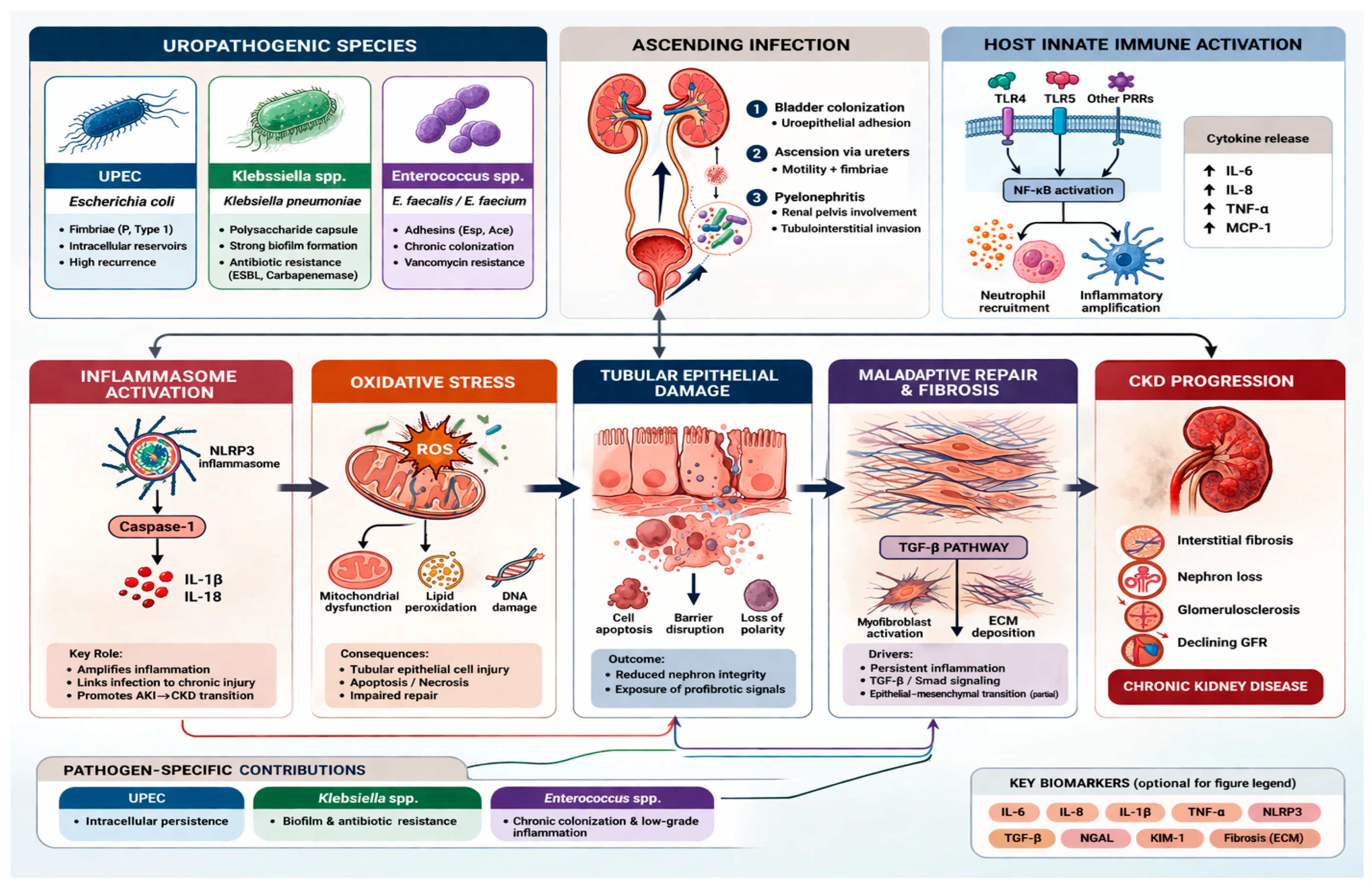
Figure 2.
Figure 2. Integrated pathogen-specific and host-mediated mechanisms linking urinary tract infections (UTI) to chronic kidney disease progression: a hybrid model incorporating persistence strategies and biomarker profiles (Figure created in Canva, https://www.canva.com). This hybrid schematic integrates pathogen-specific virulence mechanisms with host-mediated responses to illustrate the progression from UTI to CKD. The figure combines three major uropathogenic strategies, intracellular persistence, biofilm-associated resistance, and chronic colonization, with downstream molecular pathways and clinically relevant biomarkers. The upper panels depict pathogen-specific mechanisms. Uropathogenic Escherichia coli (UPEC) invades urothelial cells, forming intracellular bacterial communities and quiescent reservoirs, thereby enabling immune evasion and recurrent infection. This process is associated with increased levels of acute inflammatory and tubular injury biomarkers, including IL-6, IL-8, and NGAL, reflecting repeated epithelial damage. Klebsiella spp. are characterized by extracellular persistence through robust biofilm formation and by antimicrobial resistance mechanisms, including extended-spectrum β-lactamases (ESBLs) and carbapenemases. These features promote chronic infection and are associated with elevated systemic and inflammatory biomarkers, such as C-reactive protein (CRP), IL-6, and procalcitonin, indicative of persistent, often severe infection. Enterococcus spp. represents a persistence-adapted phenotype marked by chronic colonization and intrinsic antimicrobial tolerance. Rather than causing acute cytotoxicity, these pathogens induce sustained low-grade inflammation, as reflected by increased levels of IL-1β and profibrotic mediators such as transforming growth factor-β (TGF-β) and fibronectin, thereby supporting progressive tissue remodeling. The central and lower panels illustrate the host response and downstream consequences. Infection triggers innate immune activation via Toll-like receptors (TLRs) and NF-κB signaling, leading to the release of pro-inflammatory cytokines (IL-6, IL-8, TNF-α, MCP-1). This is followed by activation of the NLRP3 inflammasome, resulting in caspase-1–mediated maturation of IL-1β and IL-18, which further amplify inflammation. Persistent inflammatory signaling induces OS, characterized by increased ROS production, mitochondrial dysfunction, and oxidative damage. These processes lead to tubular epithelial injury, reflected by elevated NGAL and kidney injury molecule-1 (KIM-1), and contribute to apoptosis, necrosis, and loss of epithelial integrity. Subsequently, maladaptive repair mechanisms are activated, involving TGF-β signaling, myofibroblast activation, and partial epithelial–mesenchymal transition, resulting in extracellular matrix deposition, including collagen and fibronectin. These changes drive interstitial fibrosis, the final common pathway of CKD progression. Overall, this integrated model highlights how distinct pathogen-specific persistence strategies converge on shared downstream pathways—namely, inflammation, oxidative stress, and fibrosis—thereby leading to nephron loss and progressive decline in renal function. The inclusion of biomarker profiles underscores the translational relevance of these mechanisms for diagnosis, risk stratification, and monitoring of UTI-associated kidney injury.
Figure 2.
Figure 2. Integrated pathogen-specific and host-mediated mechanisms linking urinary tract infections (UTI) to chronic kidney disease progression: a hybrid model incorporating persistence strategies and biomarker profiles (Figure created in Canva, https://www.canva.com). This hybrid schematic integrates pathogen-specific virulence mechanisms with host-mediated responses to illustrate the progression from UTI to CKD. The figure combines three major uropathogenic strategies, intracellular persistence, biofilm-associated resistance, and chronic colonization, with downstream molecular pathways and clinically relevant biomarkers. The upper panels depict pathogen-specific mechanisms. Uropathogenic Escherichia coli (UPEC) invades urothelial cells, forming intracellular bacterial communities and quiescent reservoirs, thereby enabling immune evasion and recurrent infection. This process is associated with increased levels of acute inflammatory and tubular injury biomarkers, including IL-6, IL-8, and NGAL, reflecting repeated epithelial damage. Klebsiella spp. are characterized by extracellular persistence through robust biofilm formation and by antimicrobial resistance mechanisms, including extended-spectrum β-lactamases (ESBLs) and carbapenemases. These features promote chronic infection and are associated with elevated systemic and inflammatory biomarkers, such as C-reactive protein (CRP), IL-6, and procalcitonin, indicative of persistent, often severe infection. Enterococcus spp. represents a persistence-adapted phenotype marked by chronic colonization and intrinsic antimicrobial tolerance. Rather than causing acute cytotoxicity, these pathogens induce sustained low-grade inflammation, as reflected by increased levels of IL-1β and profibrotic mediators such as transforming growth factor-β (TGF-β) and fibronectin, thereby supporting progressive tissue remodeling. The central and lower panels illustrate the host response and downstream consequences. Infection triggers innate immune activation via Toll-like receptors (TLRs) and NF-κB signaling, leading to the release of pro-inflammatory cytokines (IL-6, IL-8, TNF-α, MCP-1). This is followed by activation of the NLRP3 inflammasome, resulting in caspase-1–mediated maturation of IL-1β and IL-18, which further amplify inflammation. Persistent inflammatory signaling induces OS, characterized by increased ROS production, mitochondrial dysfunction, and oxidative damage. These processes lead to tubular epithelial injury, reflected by elevated NGAL and kidney injury molecule-1 (KIM-1), and contribute to apoptosis, necrosis, and loss of epithelial integrity. Subsequently, maladaptive repair mechanisms are activated, involving TGF-β signaling, myofibroblast activation, and partial epithelial–mesenchymal transition, resulting in extracellular matrix deposition, including collagen and fibronectin. These changes drive interstitial fibrosis, the final common pathway of CKD progression. Overall, this integrated model highlights how distinct pathogen-specific persistence strategies converge on shared downstream pathways—namely, inflammation, oxidative stress, and fibrosis—thereby leading to nephron loss and progressive decline in renal function. The inclusion of biomarker profiles underscores the translational relevance of these mechanisms for diagnosis, risk stratification, and monitoring of UTI-associated kidney injury.
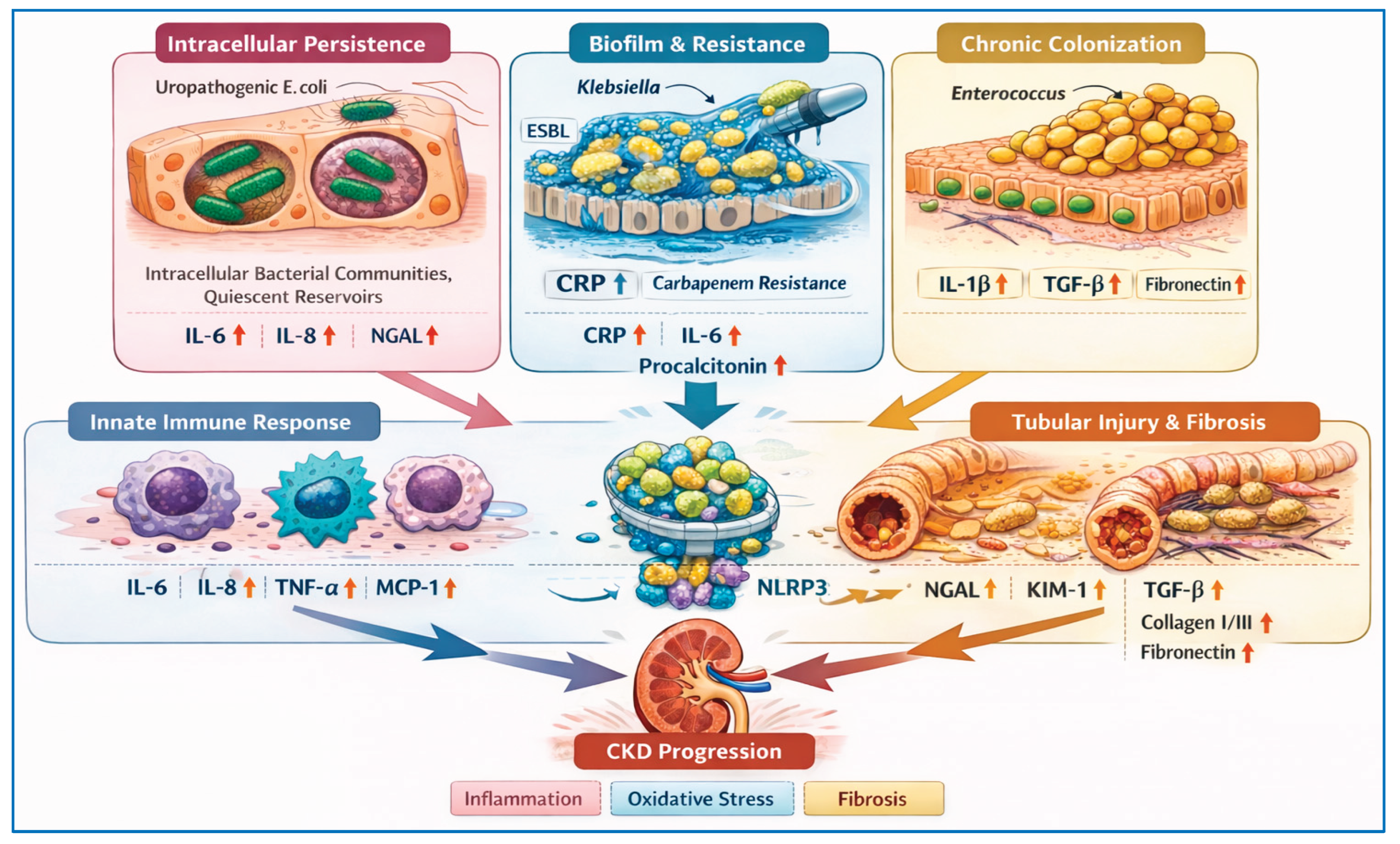

Table 1.
Integrated pathogen-specific mechanisms, biomarker profiles, and therapeutic implications in UTI-associated CKD progression.
Table 1.
Integrated pathogen-specific mechanisms, biomarker profiles, and therapeutic implications in UTI-associated CKD progression.
| Pathogen |
Key Mechanism of Persistence |
Dominant Pathophysiology |
Inflammatory Biomarkers |
Tubular Injury Markers |
Fibrosis Markers | Clinical Interpretation |
CKD Progression Pattern |
Therapeutic Implications |
|
UPEC (E. coli) |
Intracellular bacterial communities, quiescent reservoirs | Recurrent acute inflammation and epithelial injury | IL-6, IL-8, TNF-α, MCP-1 |
NGAL, KIM-1 |
(secondary) TGF-β ↑ | Recurrent UTIs, intracellular persistence | Stepwise cumulative damage → nephron loss | Target intracellular reservoirs; prolonged/targeted antibiotics; anti-adhesion strategies (e.g., FimH inhibitors) |
|
Klebsiella spp. |
Biofilm formation + ntimicrobial resistance (ESBL, carbapenemases) | Persistent infection with sustained inflammation | CRP, IL-6, Procalcitonin |
NGAL ↑ (secondary) | TGF-β ↑ (chronic cases) | Severe/complicated UTI, treatment resistance | Chronic inflammation → fibrosis | Anti-biofilm strategies; guided antibiotic therapy (based on resistance); catheter management/removal |
| Enterococcus spp. | Chronic colonization + intrinsic resistance |
Low-grade persistent inflammation | IL-1β, MCP-1 |
Mild/ gradual injury |
TGF-β, Fibronectin, Collagen I/III |
Chronic colonization, subclinical inflammation | Progressive fibrosis → CKD | Long-term suppression strategies; microbiome modulation; cautious antibiotic use (avoid overtreatment) |
| (Shared pathways) | — | Inflammasome activation, oxidative stress | IL-1β, IL-18 |
NGAL, KIM-1 |
TGF-β, ECM proteins |
Reflects a mechanistic cascade | Common final pathway: fibrosis | Anti-inflammatory therapies; antioxidant approaches; antifibrotic strategies (targeting TGF-β) |
This table outlines the main uropathogens’ persistence mechanisms, pathophysiological pathways, and biomarker profiles in UTI, with a focus on CKD progression. UPEC involves intracellular persistence and epithelial injury; Klebsiella spp. relates to biofilm and resistance; Enterococcus spp. involves colonization and inflammation. These processes are reflected in specific biomarkers, yet all pathways converge on inflammasome activation, oxidative stress, and fibrosis, leading to nephron loss and CKD. The table also suggests therapeutic strategies targeting persistence, inflammation, and fibrosis, integrating microbiological, molecular, and clinical data. UTI: Urinary tract infection, CKD: Chronic kidney disease, UPEC: Uropathogenic Escherichia coli, IL: Interleukin, TNF-α: Tumor necrosis factor alpha, MCP-1: Monocyte chemoattractant protein-1, CRP: C-reactive protein, NGAL: Neutrophil gelatinase-associated lipocalin, KIM-1: Kidney injury molecule-1, TGF-β: Transforming growth factor beta, ECM: Extracellular matrix, ESBL: Extended-spectrum β-lactamase, ROS: Reactive oxygen species.
Disclaimer/Publisher’s Note: The statements, opinions and data contained in all publications are solely those of the individual author(s) and contributor(s) and not of MDPI and/or the editor(s). MDPI and/or the editor(s) disclaim responsibility for any injury to people or property resulting from any ideas, methods, instructions or products referred to in the content. |
© 2026 by the authors. Licensee MDPI, Basel, Switzerland. This article is an open access article distributed under the terms and conditions of the Creative Commons Attribution (CC BY) license (http://creativecommons.org/licenses/by/4.0/).
Copyright: This open access article is published under a Creative Commons CC BY 4.0 license, which permit the free download, distribution, and reuse, provided that the author and preprint are cited in any reuse.


