

Submitted:
01 April 2026
Posted:
02 April 2026
You are already at the latest version
Abstract
As the world embarks on an artificial intelligence revolution, governments and supranational organizations are taking highly divergent approaches to regulation in an effort to regulate the effects of AI. Although there are new educational theories, which propose that AI might precipitate a paradigm shift in how knowledge is produced, which values human-AI co-creation [1], empirical studies on the actual way states will make the transition are in short supply. To fill this gap, this research paper applies a qualitative comparative policy review of 35 representative excerpts extracted from seven authoritative legislative and strategic documents across China, Singapore, and the European Union. We use a six-dimensional framework (inter-coder reliability κ = 1.00) to investigate the extent to which these policies are framed around optimization or restructuring: focusing on infrastructural scale and efficiency versus requiring systemic, pedagogical, and epistemic transformation. As findings indicate, there are radically different policy imaginaries. Relying solely on restructuring-based legal requirements, the EU compensates for high-risk algorithmic harms and implements tight ethical protection. China displays a characterized temporal development, as it alters macroeconomic optimization in 2017 to a hybrid system that requires interactive exploration and multimodal creation in 2025. Singapore, on the other hand, takes the calculated risk of a middle way, with massive reorganization of human-focused pedagogical functions and with optimization safely applied to scale up the infrastructures of the public services. Finally, this research paper proves that there is no single global AI educational governance. We state that negotiating this optimization-restructuring tension is the key to institutions that seek to develop authentic student agency without undermining ethical protection.
Keywords:
AI in education
; comparative policy analysis
; optimization-restructuring framework
; epistemological rupture
; AI governance
1. Introduction
The rapid integration of Artificial Intelligence (AI) into educational systems marks a critical juncture in the evolution of educational technology [2,3]. Going beyond the historical role of digital tools as a channel of information delivery, both generative AI and large language models have the potential to actively produce content, assess multifaceted answers, and mimic a two-sided discussion [4]. This has resulted in a change of the rhetoric on the topic of AI in teaching and learning, where technical concerns of AI feasibility have been replaced by pressing questions of governance, morality, and systemic effects [5,6]. With the imminent risk of AI technologies to shake the established pedagogical frames and assessment paradigms, national governments and supranational organizations are scrambling to craft policies that maximize the technological affordances, and reduce unprecedented algorithmic threats [7,8]. Yet, these policy reactions are not growing out of a vacuum; they are strongly conditioned by unique geopolitical priorities and most importantly, cultural values and state-level policy imaginaries about the final aim of education [8,9].
Despite the proliferation of global AI strategies, there is sufficient empirical gap in the literature on the existing educational technologies [10,11]. Although there has been significant theoretical research on the ethical concerns of AI (e.g., algorithmic bias, data privacy) and more specific studies have reported the practices of classroom-scale interventions, there are still limited systematic and comparative studies that analyze how the systemic introduction of AI is actually managed by the leading powers of the world [12]. Most existing literature considers AI governance as a unified entity, not taking into consideration the idea of how jurisdictions shape the role of the technology [7,13]. The importance of comprehending these divided forms of governance lies in the fact that the policies of the state level determine the acquisition of educational technology, the redesign of teacher professional development, and the scope of student agency [12,14].
In order to frame these conflicting policy imaginaries, this paper uses the theoretical framework that was formulated by Hasan et al. (2025) [1], which suggests a key opposition between two paradigms of Optimization and Restructuring. The Optimization paradigm represents AI as a very productive tool in order to scale the existing educational systems, enhancing the productivity, standardizing the delivery, and speeding up the transmission of the traditional knowledge without questioning the very foundations of the pedagogical status quo. Conversely, Restructuring paradigm holds that AI should cause an epistemological break. The technology in this model requires the fundamental redesign of the role of education with the focus on the shift towards the paradigm of human-AI co-creation, which necessitates significant changes in student agency, teacher identity, and institutional evaluation [15,16].
While Hasan et al. (2025) [1] successfully established this theoretical dichotomy, there are no empirical studies that experiment on how real-life policies operate in this tension [17]. This paper fills this gap by carrying out the first systematic, comparative policy analysis based on the Optimization framework Restructuring framework [18]. By analyzing authoritative legislative and strategic texts, we examine three major, highly distinct governance regimes: the European Union (representing a supranational, rights-based regulatory approach), China (representing a state-led, rapid-scale technological evolution), and Singapore (representing an agile, human-centric, pedagogical "middle way") [4,19,20].
This paper will transform the discussion on the possibilities of AI transition to practice by mapping the way these three global systems determine the AI transition within six main dimensions (Access, Pedagogy, Epistemology, Student Agency, Teacher Role, and Systemic Effects) of education policies. In the end, the research will unveil and demonstrate that divergent state imaginaries empower or limit the future of human-AI co-creation.
To systematically examine these phenomena, this study addresses the research questions outlined in Table 1.
2. Literature Review and Theoretical Framework
2.1. AI Governance and the EdTech Policy Landscape
The process of introducing Artificial Intelligence in education does not only pose as a technical phenomenon, but a very sociotechnical and political one [21,22]. The idea that digital technologies are never neutral has been long held by critical educational technology scholars who argue that they both encode and enforce certain values, economic requirements, and pedagogical assumptions [23]. With the generative AI models reaching new heights and growing abilities, the need to regulate these systems has only intensified, leading to a flurry of AI regulations across the globe [24].
Nevertheless, the present scholarly debate on AI governance in education has largely considered the two distinct domains [25]. The first one is the micro-level effects of AI on classroom processes, academic dishonesty, and mental offloading [26]. The second one is the macro level criticism of data mining, surveillance capitalism and privatization of the infrastructure of government education by large corporations of the Big Tech [27]. Although these criticisms are essential, there is a tangible empirical lack of evidence that exists concerning how the state and supranational actors are actively trying to control the epistemic and pedagogical heart of learning with the use of formal policy [10,24].
The literature has almost uniformly perceived national AI strategies as unified administrative documents. The policy texts are, in fact, as sociotechnical imaginaries, blueprints that help a state to see the future of its people and economy [23]. It is crucial to transcend generalized ethical criticisms, and in order to grasp the international direction of AI in education, we should analyze the explicit positioning of the application, boundaries, and possible of AI in educational policy frameworks across various geopolitical regimes [25].
To further demonstrate this gap in the empirical research, Table 2 consolidates more recent critical scholarship on AI governance in the educational setup. Although these pioneering works have greatly contributed to our comprehension of micro-level ethical risks, scholarly discourses and political economy of educational technology, they largely overlook the situation where the state-level pedagogical policy is under-theorized. In the modern literature, as discussed in the synthesis, there is no comparative and cross-national structure that can rank the policies of infrastructural efficiency and those that lead to a radical epistemological change in a systematic way. This paper directly responds to this shortcoming by leaving tech-geopolitics to general by directly tracing the empirical approach of mapping how divergent geopolitical regimes actively enforce pedagogical and systemic change.
2.2. The Optimization–Restructuring Framework
In order to carefully examine these divergent policy imaginaries, this paper utilizes the theoretical framework created by Hasan et al. (2025). This framework assumes that AI educational policies are habitually managed to go through a deep conflict between two opposing paradigms: Optimization and Restructuring.
2.2.1. The Optimization Paradigm (O)
The Optimization paradigm views AI as a high-end tool that can enhance the efficiency, magnitude, and accuracy of the existing educational systems. In this framing the structure of schooling is unchallenged. AI is applied in automating administrative processes, provision of personalized at-scale content, and improving standardized assessment. Optimization values productivity and economic competitiveness and values knowledge as a commodity to be passed effectively to the student.
2.2.2. The Restructuring Paradigm (R)
In contrast, the paradigm of Restructuring considers AI as an engine of endogenous change and systemic discontinuity. Instead of streamlining the traditional schooling, this paradigm requires new forms of pedagogical approaches, which essentially change the roles of the students and teachers. It questions the education transmission model, and places the student in a much more active role as a human-AI co-creator other than a passive consumer of algorithmic personalization. Moreover, Restructuring is associated with institutional redesign models including the use of rigorous ethical protection or process-based assessment instead of standardized testing.
2.2.3. The Six Dimensions of Analysis
In order to conceptualize this theoretical dichotomy into empirical policy analysis, Hasan et al. (2025) outline six fundamental dimensions of educational impact. This paper uses these dimensions to code and classify discourse of state policy:
- 1.
- Access & Equity: Does the policy frame AI as a tool to scale basic educational access (Optimization), or as a mechanism to structurally dismantle systemic barriers and redefine inclusive design (Restructuring)?
- 2.
- Pedagogical Transformation: Is AI positioned to seamlessly deliver traditional curricula (Optimization), or is it mandated to foster interactive exploration, inquiry, and new pedagogical forms (Restructuring)?
- 3.
- Epistemological Impact: Does the policy assume knowledge is a static entity to be mastered via algorithmic tutoring (Optimization), or does it acknowledge an epistemic rupture where knowledge is dynamically co-constructed with AI (Restructuring)?
- 4.
- Student Agency & Role: Is the student framed as a passive consumer of personalized data pathways (Optimization), or an active, critical co-creator with preserved autonomy (Restructuring)?
- 5.
- Teacher Role & Identity: Is the teacher viewed as a manager of AI platforms and productivity metrics (Optimization), or elevated to an ethical "co-pilot," facilitator, and pedagogical designer (Restructuring)?
- 6.
- Institutional & Systemic Effects: Does the governance structure focus on streamlining product iteration cycles and maintaining global competitiveness (Optimization), or does it force institutional redesign, demanding rigorous risk mitigation, bias auditing, and benefit distribution (Restructuring)?
Using this six-dimensional Optimization-Restructuring framework to analyze authoritative texts on China, Singapore, and the European Union, this paper will attempt to chart the way the world superpowers are busy formulating the future of human-AI interaction in education.
3. Methodology
3.1. Research Design
In the systematic response to the research questions, the deductive, directed qualitative content analysis was used in this study [30]. Such a methodological procedure is most appropriate to analyzing the policy, because it enables researchers to classify textual information in terms of a pre-existing theoretical paradigm, at the same time, taking into consideration contextual specifics. The framework used in the analysis was carefully organized based on the conceptualized framework of Optimization-Restructuring and 6 dimensions like in the case of Hasan et al. (2025) [1].
3.2. Data Collection and Sampling
The approach used to collect data was a purposive sampling strategy of macro-level AI-in-education policy texts. Instead of a generalized search of gray literature, the sample gave emphasis to seven authoritative core documents of a high regulatory, legislative, or strategic impact in three different geopolitical and governance frameworks:
- The European Union: Supranational legislative mandates and strategic action plans (e.g., The AI Act, Digital Education Action Plan).
- Singapore: National strategic blueprints outlining infrastructural and pedagogical integration (e.g., Smart Nation 2.0, EdTech Masterplan 2030).
- China: National development plans and specific educational directives spanning a temporal shift (e.g., the 2017 AI Development Plan versus the 2025 GenAI in Schools Guide).
Based on these seven central texts, a set of final 35 representative passages were sampled to be the main unit of analysis. The excerpts were then chosen in a systematic manner according to their explicit relevancy to the governance of AI in educational setting, namely focusing on the paragraphs that provided clear instructions on the pedagogical practice, systemic infrastructure, ethical guardrail, or student/teacher roles. All these excerpts have been listed in the supplementary materials.
3.3. Coding Framework and Procedure
The unit of analysis was the individual policy excerpt. The coding procedure involved two distinct classifications for each excerpt. First, to determine the overarching governance imaginary, each excerpt was assigned one mutually exclusive dominant code:
- Optimization (O): The policy explicitly aims to improve efficiency, scale, or precision within existing educational structures (e.g., standardization, teacher-as-transmitter, productivity metrics).
- Restructuring (R): The policy demands new pedagogical forms, role shifts, epistemological rupture, human-AI co-creation, or institutional redesign.
- Mixed (M): The policy contains distinctly balanced mandates for both structural efficiency and epistemological transformation (e.g., an excerpt that mandates scaling AI for administrative efficiency while simultaneously enforcing strict ethical guardrails to protect teacher autonomy).
Second, the excerpts were coded on the six thematic dimensions of the framework (Access, Pedagogy, Epistemology, Student Agency, Teacher Role, Systemic Effects). These dimensions did not exclude each other as the dominant code did, and an individual excerpt could be focused on change in pedagogy and systemic impacts.
3.4. Inter-Coder Reliability
The analysis was done by two independent human coders in order to guarantee the analytical rigor that is required in comparative policy research. The initial extraction and coding was done by Coder 1 and a blind pass consisting solely of the pre-existing rubric and raw text of the excerpts was done by Coder 2.
To establish reliability, a stratified random sample of 11 excerpts (30.5% of the total dataset) was double-coded independently. The sample was carefully stratified to include excerpts from all three jurisdictions, both temporal periods in China, and all six dimensions. The inter-coder agreement yielded a Cohen’s Kappa of (Observed Agreement = 100%, Expected Agreement = 37.5%). While perfect agreement is statistically rare and the small double-coded sample limits broader generalizability, this score strongly supports the reliability and clarity of the coding definitions. Furthermore, this high agreement is attributed to the unambiguous, formalized nature of state-level policy discourse, which rarely relies on subtle nuance when issuing directives.
3.5. Data Analysis
The coded data were studied in the consecutive steps in order to respond directly to the research questions:
- 1.
- Descriptive Tabulation (RQ1 and RQ2): All the dominant orientations (O/M/R) and their intersections with the dimensions were tabulated in each area. These descriptive counts were the foundation on which the degree to which each system was pro-optimization as compared to restructuring was compared.
- 2.
- Visual and Temporal Comparison (RQ3): The quantitative tabulations were converted to a comparative visualization, which consisted of regional heatmap and dimensional radar chart. In the case of China, a divergent bar chart was created to precisely map the time change in the policy orientation between 2017 and 2025.
- 3.
- Thematic Synthesis (RQ4): Lastly, the coded passages were synthesized using a qualitative and interpretive synthesis. This step evaluated the semantic meaning of the excerpts to theorize how particular models of governance are either practiced to facilitate or structurally limited the epistemological rupture and human-AI co-creation model put forward by Hasan et al. (2025) [1].
3.6. Trustworthiness and Reflexivity
To ensure transparency and reproducibility, the complete dataset, the coding codebook, and a comprehensive audit trail detailing all analytical decisions have been deposited on the Open Science Framework (OSF) as stated in Supporting Information section.
4. Results
4.1. The Dimensional Framing of AI in Education (RQ1 & RQ2)
The qualitative content analysis of the 35 policy snippets has shown that the three jurisdictions all acknowledge the transformative imperative of AI, but their overall approach to governance varies greatly. The policy imaginaries, as presented in Figure 1, range the spectrum between extreme systemic optimization and radical epistemological restructuring.
A descriptive quantitative summary highlights that restructuring-oriented (R) discourse is the dominant global framework, though it is applied highly unevenly across regions. Of the 34 regional excerpts (excluding the one international ITU excerpt):
- 1.
- The European Union () exhibited an exclusive focus on Restructuring (7 R, 0 M, 0 O). Its discourse is driven entirely by regulatory mandates, lacking any optimization framing.
- 2.
- Singapore () presented a heavily restructuring-leaning hybrid model (10 R, 0 M, 2 O). It prioritizes Restructuring for pedagogical roles while deliberately utilizing Optimization to scale specific public services.
- 3.
- China () exhibited the most diversified policy discourse (8 R, 2 M, 5 O). It contains the highest absolute concentration of Optimization (O) framing, historically utilizing AI as a "new engine of economic development" before transitioning toward pedagogical concerns. China is also the only region to utilize Mixed (M) codes, attempting to balance infrastructural efficiency with emerging ethical governance.
Altogether, the restructuring-oriented (R) discourse is the most prevalent in the dataset. But a short quantitative survey points out that this is not a mono-global view. Among coded passages, the European Union had a singular interest in Restructuring (100% R) that was solely controlled by the regulatory requirements of the AI Act and the Digital Education Action Plan. By comparison, the policy discourse in China was most diversified. It had the greatest concentration of Optimization (O) framing (considering about a third of its excerpts), most codes of Restructuring (R) and only one set had Mixed (M) codes. Such Mixed codes emerged in China at the moments of transition of its policies, trying to strike a balance between the efficiency of the infrastructures and the new ethical governing rules. Singapore offers a strategic hybrid model, which is largely inclined to the Restructuring as the means of distribution of pedagogical roles but intentionally employs Optimization as the means of delivering certain objectives of the public service.
The dimensional focus of these policies is represented in Figure 2. The radar chart shows how the various state imaginaries give priority to different aspects of the educational ecosystem. The policy weight in the EU is enormous on Epistemological Impact (Dimension 3) and Institutional and Systemic Effects (Dimension 6), which is indicative of its risk-based, rights-based legislative process. The policies of Singapore focus on the Student Agency (Dimension 4) and Pedagogical Transformation (Dimension 2) greatly. China has an exceptional concern with Institutional and Systemic Effects (Dimension 6) and this viewpoint has traditionally seen AI as a macro-level force behind educational scale and is now transitioning to pedagogical issues.
4.2. Cross-System Patterns and Divergent Imaginaries (RQ3 & RQ4)
In addition to the sum total quantitative numbers, the qualitative study demonstrates three patterns across systems that govern AI. These trends explicitly feed into RQ4 as they can visualize how various state governance imaginaries actively produce or structurally limit the epistemological break typical of human-AI co-creation.
4.2.1. The European Union: Regulatory Restructuring and Epistemic Safeguards
The attitude of the EU to AI in education is characterized by the reduction of risks and safeguarding of key rights that has to restructure the institutions. The AI Act (2024) does not prioritize the way AI can facilitate classroom efficiency and instead, it legally categorizes systems that serve the purpose of assessing the learning results or establishing the accessibility as being in the high-risk group. Such a classification necessitates a paradigm shift in the way educational procurement and deployment is designed (Dimension 6). Moreover, the EU requires sufficient AI literacy of educators (Dimension 5). This views the teacher not as an end user of technology, but as an ethical interlocutor who has the responsibility of ensuring epistemic transparency in the face of algorithmic black boxes.
4.2.2. Singapore’s Human-Centric "Middle Way"
The model of governance in Singapore successfully avoids the tension between Optimization and Restructuring since each method is clearly defined where it belongs. At the systemic macro-level, policies such as Smart Nation 2.0 employ Optimization to explicitly expand the quantity of digital and AI-related self-paced courses to increase personalization and access (Dimension 1). Nevertheless, within the classroom ecosystem, the EdTech Masterplan 2030 requires radical Restructuring. The policy specifically requires that technology will put pedagogy first to move students into critical active co-creators of knowledge who co-construct and share knowledge. Ensuring that AI serves as a partner and not an automated tutor by setting ethical guardrails to preserve the choice and control of learners, Singapore informally transfers student agency (Dimension 4).
4.2.3. China’s Temporal Evolution: From Economic Engine to Epistemic Inquiry
The most dramatic temporal flow of the data, is the one that takes place in the policy sequence of China, where there is a swift transition between macroeconomic optimization and pedagogical restructuring that can be seen in Figure 3.
The framing of the 2017 AI Development Plan was mostly Optimization-oriented. AI was envisioned as a new source of economic growth that will help to enhance the degree of accuracy in social services and increase lifelong education without significant changes in the traditional teacher-student relationship. Nonetheless, the 2025 GenAI Guide to Primary and Secondary Schools is an epistemological breakthrough. The 2025 guidelines clearly require teachers to apply AI to spur on multimodal creation, interactive exploration, and arousal of the creative potential of students (Dimensions 2 & 4). Moreover, the 2025 policies also have a very clear regulatory line in the affirmation of the role of the teacher, and they forbid using GenAI as an alternative to the teaching process. This development serves as evidence of how China is shifting its perception of educational AI as the means of infrastructural scale to the inquiry-based pedagogies that it can trigger.
Summary: Together, these three patterns demonstrate that while AI’s transformative potential is universally recognized, the governance frameworks shaping its educational integration are profoundly divergent—ranging from protective regulation to strategic hybridity to rapid temporal evolution.
5. Discussion
5.1. Enabling and Constraining Epistemological Rupture (Answering RQ4)
The theoretical basis of Hasan et al. (2025) [1] postulation is that AI in education must not only maximize the current paradigms of knowledge-transfers, but also an epistemological dislocation needs to take place, where human-AI co-creation is the central focus. The results of this policy analysis show that the project of this break hinge on the governance imaginary of the state extensively.
As our analysis shows, the frameworks of strictly optimization-driven (like the one in China in 2017) form a way of how this epistemological break is forced. As positioning AI as a means to increase the scale of education services that can be deployed with precision, the initial policies supported instead of subverting the classical, transmission-based pedagogies. Nevertheless, the shift in China in 2025 toward the requirement of interactive exploration and multimodal production demonstrates a systemic awareness that real innovation means re-organizing the position of the student as a receiver of the epistemic knowledge system and making him or her a co-creator of knowledge.
On the contrary, the regulatory process adopted by the European Union allows epistemological dislocation by providing defensive limitation. The EU also prohibits automating assessment by rendering AI that is involved in assessing learning outcomes as high-risk by law. This compels institutions to maintain a human-in-the-loop, and thus retain the relational, co-creative aspect of learning, and avoid an aesthetic of algorithmic black boxes determining the student paths. Singapore provides the most explicit policy facilitator of the co-creation model; through imposing explicit performance requirements of technology to make pedagogy the first, learners choice and control as second, Singapore formally institutionalises the epistemological breakthrough that Hasan et al. (2025) [1] theorize.
5.2. Implications for Policy and Practice
Although national strategies are determined by the high-level policy imaginaries, the tension of optimization-restructuring has far-reaching and direct consequences on ground-level educational practice. To be effective in developing human-AI co-creation schools, a number of systemic changes would have to be made.
5.2.1. Assessment Reform for Co-Creation
The transition to the restructuring oriented AI model demands the sacrifice of the old, output based assessment paradigms. When the current policy (like the one implemented in Singapore and China) requires students to apply AI instead of study partners in order to co-construct knowledge, a final essay or test becomes inadequate to say the least, and extremely exposed to the risks of plagiarism. Institutions need to switch to the methods of process-based evaluation, assessing the timely engineering of the student, as well as the critical evaluation of the AI products and the process of iterative co-creation of the student.
5.2.2. Redefining Teacher Professional Development (PD)
The requirement of a minimum degree of AI literacy imposed by the EU AI Act demonstrates a very important gap in the current training of teachers. The older paradigm of EdTech PD has historically been concerned with optimization, i.e. how to teach teachers to grade with more speed or allocate content more effectively with the help of software. The new future, which is restructuring oriented, demands that PD should be concerned with ethical facilitation. The educators should be taught to act as co-pilots and ethical custodians capable of correcting the epistemological biases of large language models to the students, a position explicitly safeguarded by the China 2025 ban on the use of GenAI as a teaching replacement.
5.2.3. Operationalizing Ethical Governance Mechanisms
Lastly, the regulation outrage provided by the EU AI Act is an indicator that change in institutional procurement is on its way. The school and university can no longer embrace EdTech platforms either on the basis of costs or efficiency (Optimization) alone. They should formulate institutions algorithmic audit committees to make sure that a student evaluation tool based on AI is properly tested to be devoid of inherent errors and is thoroughly transparent. The Model AI Governance Framework used in Singapore can be seen as an example of a viable blueprint in this case, with commercial vendors being required to provide schools with explainable, transparent, and fair AI tools before gaining access to the classroom ecosystem.
Supplementary Materials
The following supporting information can be downloaded at the website of this paper posted on the Open Science Framework. Reviewers can access the materials via the following view-only link: https://osf.io/z92u3/overview?view_only=0fee8c9e255b4d68aaceeb71fa47a1f9.
Funding
This research did not receive any specific grant from funding agencies in the public, commercial, or not-for-profit sectors.
Conflicts of Interest
The authors declare that they have no known competing financial interests or personal relationships that could have appeared to influence the work reported in this paper.
Appendix A. Full Policy Excerpt Dataset
The following Table A1 presents the 35 representative policy excerpts that formed the primary unit of analysis. Excerpts were purposively selected from seven core authoritative documents (2017–2025) because they contained explicit statements on the purpose, role, governance, or implementation of AI in education.

Table A1.
Complete list of extracted policy excerpts and assigned codes.
| ID | Country | Document & Year | Quote Excerpt | Dim. | Code |
|---|---|---|---|---|---|
| 1 | China | 2017 AI Dev. Plan | “AI has become a new engine of economic development... reconstructing production... [and create a] new powerful engine” | 6 | O |
| 2 | China | 2017 AI Dev. Plan | “widespread use of AI in education... improve the level of precision in public services” | 6, 1 | O |
| 3 | China | 2025 GenAI Guide | “take the multimodal creation… as drivers of innovation… stimulating students’ creative potential” | 3, 4 | R |
| 4 | China | 2025 GenAI Guide | “personalized learning plans in real time… AI study partners… dynamic recommendations” | 2, 4 | R |
| 5 | China | 2025 GenAI Guide | “interactive exploration… critical thinking, and innovative thinking” | 2, 4 | R |
| 6 | China | 2025 GenAI Guide | “Adhere to educational equity… barrier-free services for special needs groups” | 1 | R |
| 7 | China | 2025 GenAI Guide | “bottom-line mindset… data security, ethical review… safe, efficient, fair, and inclusive” | 6 | M |
| 8 | Singapore | EdTech Masterplan | “puts pedagogy first and students at the centre... co-construct and share knowledge” | 2, 4 | R |
| 9 | Singapore | EdTech Masterplan | “Use technology as an enabler to develop and assess 21CC” | 2, 3 | R |
| 10 | Singapore | EdTech Masterplan | “Empower students’ learning through greater customisation and personalisation” | 4, 1 | R |
| 11 | Singapore | AI in Education | “learn about AI, learn to use AI, learn with AI and learn beyond AI” | 4, 3 | R |
| 12 | Singapore | AI in Education | “preserve learners’ choice and control over important decisions” | 4 | R |
| 13 | Singapore | AI in Education | “every child can learn... regardless of background or abilities” | 1 | R |
| 14 | Singapore | PDPC AI Gov. | “human-centric... human agency and oversight + EXPLAINABLE, TRANSPARENT & FAIR” | 3, 5 | R |
| 15 | Singapore | PDPC AI Gov. | “Model AI Governance Framework... explainable, transparent & fair” | 3, 6 | R |
| 16 | EU | Digital Ed. Plan | “facilitate more personalised, flexible and student-centred learning” | 2, 4 | R |
| 17 | EU | Digital Ed. Plan | “collaborative and creative learning... beyond the walls of the lecture hall” | 2, 4 | R |
| 18 | EU | Digital Ed. Plan | “different pedagogical approaches... digital pedagogy” | 2, 5 | R |
| 19 | EU | AI Act | “AI systems used in education... for evaluating learning outcomes... for monitoring and detecting prohibited behaviour of students during tests should be classified as high-risk AI systems...” | 1, 3, 4, 6 | R |
| 20 | EU | AI Act | “Providers and deployers of AI systems shall take measures to ensure... a sufficient level of AI literacy of their staff...” | 5, 3 | R |
| 21 | EU | AI Act | “AI systems intended to be used to determine access or admission... to evaluate learning outcomes... shall be considered high-risk” | 1, 2, 3, 4, 6 | R |
| 22 | China | 2017 AI Dev. Plan | “learner-centered educational environment... precision-deployed education services... intelligent learning” | 4, 2 | R |
| 23 | China | 2017 AI Dev. Plan | “Develop intelligent educational assistants... achieve daily education and lifelong education” | 6, 1 | M |
| 24 | Singapore | AI in Education | “MOE is harnessing AI to help our students learn better and deeper, and teachers to teach and learn better.” | 2 | O |
| 25 | EU | Digital Ed. Plan | “The crisis requires us to rethink how education and training... are designed and provided to meet the demands of a rapidly changing...” | 2, 6 | R |
| 26 | China | 2017 AI Dev. Plan | “Utilize intelligent technology to accelerate and promote a personnel training model and reform to teaching methods; establish new-type education systems...” | 2, 6 | R |
| 27 | Singapore | PDPC AI Gov. | “...helps organisations and employees understand how existing job roles can be redesigned to harness the potential of AI...” | 5, 6 | R |
| 28 | China | CAICT Report | “构建以能力提升为目标的评估...建立“开发-部署-应用-测试”的闭环流程将缩短产品迭代周期。” [Build an assessment aimed at capability enhancement... establishing a closed-loop "development-deployment-application-testing" process will shorten the product iteration cycle.] | 6 | O |
| 29 | China | CAICT Blue Book | “人工智能治理应为人工智能领域发展和安全问题建立有效的风险矫正机制、利益分配机制及机构协调机制...” [AI governance should establish effective risk correction mechanisms, benefit distribution mechanisms, and institutional coordination mechanisms...] | 6, 1 | R |
| 30 | Int’l (ITU) | ITU AI Agent Req. | “The AI agents... are required to have the following four capabilities: perception and cognition, planning, memory and execution capability.” | 6 | O |
| 31 | China | Beyond DeepSeek | “Many Chinese developers are releasing open models that adopt the Mixture of Experts (MoE) architecture... squeezing better performance...” | 6 | O |
| 32 | Singapore | Smart Nation 2.0 | “We must continuously examine the impact of technology on society and direct digital developments toward outcomes that benefit Singaporeans... shared values...” | 6, 3 | R |
| 33 | Singapore | Smart Nation 2.0 | “...increase the number of digital and AI-related self-paced modules... to better customise and personalise learning for every child.” | 1, 2 | O |
| 34 | China | GenAI in Schools | “...encourage schools to use generative AI in ways that complement existing approaches to teaching and administration...” | 2, 6 | O |
| 35 | China | GenAI in Schools | “Teachers shall not use GenAI as a substitute for teaching, and are prohibited from directly using AI to answer students’ questions...” | 5, 2 | R |
Appendix B. Coding Framework Details
Appendix Six-Dimensional Coding Scheme
The qualitative content analysis utilized the foundational framework established by Hasan et al. (2025). Each extracted policy excerpt was evaluated against the following six dimensions to determine the specific locus of governance impact:
- 1.
- Access & Equity: Policies governing infrastructural reach, digital divides, and inclusive design.
- 2.
- Pedagogical Transformation: Directives detailing how AI integrates into teaching methods, curriculum delivery, and classroom interactions.
- 3.
- Epistemological Impact: Assumptions regarding the nature of knowledge (e.g., knowledge as a fixed commodity to be transmitted vs. dynamic information to be co-constructed).
- 4.
- Student Agency & Role: How the learner is positioned relative to the technology (e.g., passive consumer of personalized pathways vs. active co-creator).
- 5.
- Teacher Role & Identity: The reconfiguration of the educator (e.g., technology manager/transmitter vs. ethical facilitator and pedagogical designer).
- 6.
- Institutional & Systemic Effects: Macro-level changes to school administration, procurement, high-stakes assessment, and global competitiveness.
Appendix Governance Orientation Rubric
In addition to the dimensions above, each excerpt was assigned a single dominant code reflecting its overarching sociotechnical imaginary:
- Optimization (O): AI is framed as a tool to improve efficiency, scale, and precision within existing educational structures. It reinforces standardization, productivity metrics, and the traditional teacher-as-transmitter model.
- Restructuring (R): AI is framed as a catalyst demanding systemic change. It mandates new pedagogical forms, role shifts, human-AI co-creation, epistemological rupture, or strict institutional redesign (such as ethical risk mitigation).
- Mixed (M): The policy excerpt contains explicitly balanced, interdependent mandates for both structural efficiency (O) and epistemological/systemic transformation (R).
Appendix Inter-Coder Reliability Sample
Table A2 details the stratified random sample of 11 excerpts (30.5% of the dataset) utilized to establish inter-coder reliability ().
Table A2.
Double-coded sample for inter-coder reliability verification.
| ID | Shortened Policy Excerpt | Dim. | Coder 1 | Coder 2 | Agreement |
|---|---|---|---|---|---|
| 1 | AI has become a new engine... new powerful engine | 6 | O | O | Yes |
| 2 | multimodal creation... stimulating students’ creative potential | 3, 4 | R | R | Yes |
| 3 | puts pedagogy first... co-construct and share knowledge | 2, 4 | R | R | Yes |
| 4 | preserve learners’ choice and control over important decisions | 4 | R | R | Yes |
| 5 | AI systems used in education... high-risk AI systems | 1, 3, 4, 6 | R | R | Yes |
| 6 | sufficient level of AI literacy of their staff | 5, 3 | R | R | Yes |
| 7 | AI systems... evaluate learning outcomes... high-risk | 1, 2, 3, 4, 6 | R | R | Yes |
| 8 | Develop intelligent educational assistants... lifelong education | 6, 1 | M | M | Yes |
| 9 | The crisis requires us to rethink how education... | 2, 3 | R | R | Yes |
| 10 | [Build an assessment... closed-loop process aimed at capability enhancement] | 6 | O | O | Yes |
| 11 | encourage schools to use generative AI... complement existing approaches | 2, 6 | O | O | Yes |
Note. Coder 1 and Coder 2 independently evaluated the excerpts. O = Optimization; R = Restructuring; M = Mixed. The numbers in the Dim. column correspond to the Six-Dimensional Coding Scheme outlined above. Quote 10 translated from original Chinese document.
References
- Hasan, M.S.; Jabe, M.M.N.; Bandaso, T.D.; Iftikhar, A.; Rathore, S.; Akther, M.S. From Standardization to Co-Creation: A Century of Educational Technology and the Epistemological Rupture of AI. Discover Education 2025. [Google Scholar] [CrossRef]
- Ifenthaler, D.; Majumdar, R.; Gorissen, P.; Judge, M.; Mishra, S.; Raffaghelli, J.; Shimada, A. Artificial Intelligence in Education: Implications for Policymakers, Researchers, and Practitioners. Technology, Knowledge and Learning 2024, 29, 1693–1710. [Google Scholar] [CrossRef]
- Alzahrani, A. Unveiling the shadows: Beyond the hype of AI in education. Heliyon 2024, 10. [Google Scholar] [CrossRef]
- Xu, X. AI optimization algorithms enhance higher education management and personalized teaching through empirical analysis. Scientific Reports 2025, 15. [Google Scholar] [CrossRef] [PubMed]
- Schiff, D.S. Education for AI, not AI for Education: The Role of Education and Ethics in National AI Policy Strategies. International Journal of Artificial Intelligence in Education 2021, 32, 527–563. [Google Scholar] [CrossRef]
- Nguyen, A.; Ngo, H.; Hong, Y.; Dang, B.; Nguyen, B.P.T. Ethical principles for artificial intelligence in education. Education and Information Technologies 2022, 28, 4221–4241. [Google Scholar] [CrossRef] [PubMed]
- Zhang, J. Global Education Reform Driven by Intelligent Technology: Integration of Artificial Intelligence, Teaching Reconstruction and Fair Governance. Journal of Education and Educational Research 2025. [Google Scholar] [CrossRef]
- Wang, S.; Zhang, Y.; Xiao, Y.P.; Liang, Z. Artificial intelligence policy frameworks in China, the European Union and the United States: An analysis based on structure topic model. Technological Forecasting and Social Change 2025. [Google Scholar] [CrossRef]
- Li, H.; Davaasuren, M.; Dorjpalam, N. Comparative Analysis of Artificial Intelligence Education Policies in China, the United States and Mongolia. Journal of Educational Research and Policies 2024. [Google Scholar] [CrossRef] [PubMed]
- Chan, C. A comprehensive AI policy education framework for university teaching and learning. International Journal of Educational Technology in Higher Education 2023, 20. [Google Scholar] [CrossRef]
- Mustafa, M.Y.; Tlili, A.; Lampropoulos, G.; Huang, R.; Jandri´c, P.; Zhao, J.; Salha, S.S.; Xu, L.; Panda, S.; Kinshuk.; et al. A systematic review of literature reviews on artificial intelligence in education (AIED): a roadmap to a future research agenda Smart Learning Environments 2024, 11. [CrossRef]
- Alqahtani, N.; Wafula, Z. Artificial Intelligence Integration: Pedagogical Strategies and Policies at Leading Universities. Innovative Higher Education 2024, 50, 665–684. [Google Scholar] [CrossRef]
- Liu, Y.; Tınmaz, H. Navigating AI Regulations in Higher Education: A Comparative Analysis of Mainland China, Hong Kong and Macau. Higher Education Quarterly 2025. [Google Scholar] [CrossRef]
- Ren, X. Policy, Pedagogy, and Technological Disruption: Teacher Agency in AI-Integrated Educational Ecosystems. Business and Social Sciences Proceedings, 2025. [Google Scholar] [CrossRef]
- Humble, N. Higher Education AI Policies—A Document Analysis of University Guidelines. European Journal of Education 2025. [Google Scholar] [CrossRef]
- Jose, B.; Cherian, J.; Verghis, A.M.; Varghise, S.M.; S, M.; Joseph, S. The cognitive paradox of AI in education: between enhancement and erosion. Frontiers in Psychology 2025, 16. [Google Scholar] [CrossRef] [PubMed]
- Parker, L.; Loper, A.; Hayes, J.; Karakas, A.L.; White, S.H.; Hallman, H. Comparative analysis of artificial intelligence policies in universities across five countries. Discover Computing 2025, 28. [Google Scholar] [CrossRef]
- Salha, S.S.; Mousa, A.; Khayat, S. Artificial Intelligence in Education (AIED) Policies in School Context: A Mixed Approach Research. Leadership and Policy in Schools 2024, 24, 27–45. [Google Scholar] [CrossRef]
- Ignjatović, G. AI technologies in education: Regulatory frameworks at the international, regional and national level. Zbornik radova Pravnog fakulteta Nis 2024. [Google Scholar] [CrossRef]
- Kundu, A.; Bej, T. AI policies in school education: a comparative study on China, Singapore, Finland, and the US. Journal of Science and Technology Policy Management 2025. [Google Scholar] [CrossRef]
- Tran, M.; Balasooriya, C.; Jonnagaddala, J.; Leung, G.; Mahboobani, N.; Ramani, S.; Rhee, J.; Schuwirth, L.; Najafzadeh-Tabrizi, N.S.; Semmler, C.; et al. Situating governance and regulatory concerns for generative artificial intelligence and large language models in medical education. NPJ Digital Medicine 2025, 8. [Google Scholar] [CrossRef]
- Bulathwela, S.; Pérez-Ortiz, M.; Holloway, C.; Cukurova, M.; Shawe-Taylor, J. Artificial Intelligence Alone Will Not Democratise Education: On Educational Inequality, Techno-Solutionism and Inclusive Tools. Sustainability 2024. [Google Scholar] [CrossRef]
- Kaya-Kasikci, S.; Glass, C.R.; Camero, E.C.; Minaeva, E. University Positioning in AI Policies: Comparative Insights From National Policies and Non-State Actor Influences in China, the European Union, India, Russia, and the United States. Higher Education Quarterly 2025. [Google Scholar] [CrossRef]
- Dabis, A.; Csáki, C. AI and ethics: Investigating the first policy responses of higher education institutions to the challenge of generative AI. Humanities and Social Sciences Communications 2024, 11. [Google Scholar] [CrossRef]
- Giannakos, M.N.; Azevedo, R.; Brusilovsky, P.; Cukurova, M.; Dimitriadis, Y.; Leo, D.H.; Järvelä, S.; Mavrikis, M.; Rienties, B. The promise and challenges of generative AI in education. Behaviour & Information Technology 2024, 44, 2518–2544. [Google Scholar] [CrossRef]
- Vieriu, A.; Petrea, G. The Impact of Artificial Intelligence (AI) on Students’ Academic Development. Education Sciences 2025. [Google Scholar] [CrossRef]
- Mohamed, S.; Png, M.T.; Isaac, W.S. Decolonial AI: Decolonial Theory as Sociotechnical Foresight in Artificial Intelligence. Philosophy & Technology 2020, 33, 659–684. [Google Scholar] [CrossRef]
- Bearman, M.; Ryan, J.; Ajjawi, R. Discourses of artificial intelligence in higher education: a critical literature review. Higher Education 2022, 86, 369–385. [Google Scholar] [CrossRef]
- Holmes, W.; Tuomi, I. State of the art and practice in AI in education. European Journal of Education 2022. [Google Scholar] [CrossRef]
- Hsieh, H.F.; Shannon, S.E. Three approaches to qualitative content analysis. Qualitative health research 2005, 15, 1277–1288. [Google Scholar] [CrossRef] [PubMed]
Figure 1.
Distribution of AI governance orientations across the 35 extracted policy excerpts. The heatmap illustrates the absolute frequency of Optimization (O), Mixed (M), and Restructuring (R) framings within the authoritative policy discourse of China, Singapore, and the European Union.
Figure 1.
Distribution of AI governance orientations across the 35 extracted policy excerpts. The heatmap illustrates the absolute frequency of Optimization (O), Mixed (M), and Restructuring (R) framings within the authoritative policy discourse of China, Singapore, and the European Union.
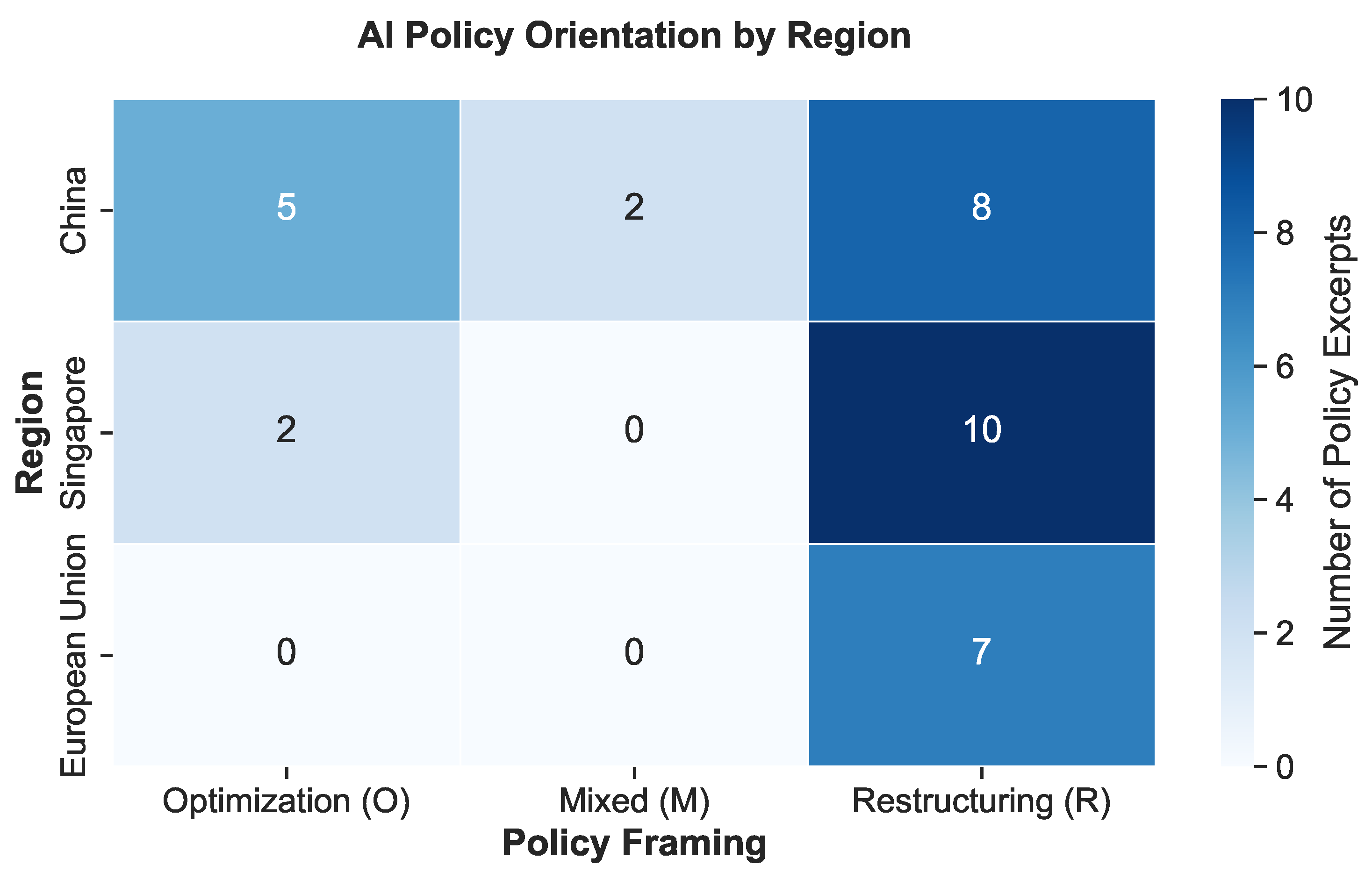
Figure 2.
Dimensional focus of AI educational policies by jurisdiction. The radar chart maps the relative policy weight placed on each of the six theoretical dimensions of the Optimization–Restructuring framework (Access & Equity, Pedagogical Transformation, Epistemological Impact, Student Agency, Teacher Role, and Institutional/Systemic Effects) across the three governance models.
Figure 2.
Dimensional focus of AI educational policies by jurisdiction. The radar chart maps the relative policy weight placed on each of the six theoretical dimensions of the Optimization–Restructuring framework (Access & Equity, Pedagogical Transformation, Epistemological Impact, Student Agency, Teacher Role, and Institutional/Systemic Effects) across the three governance models.
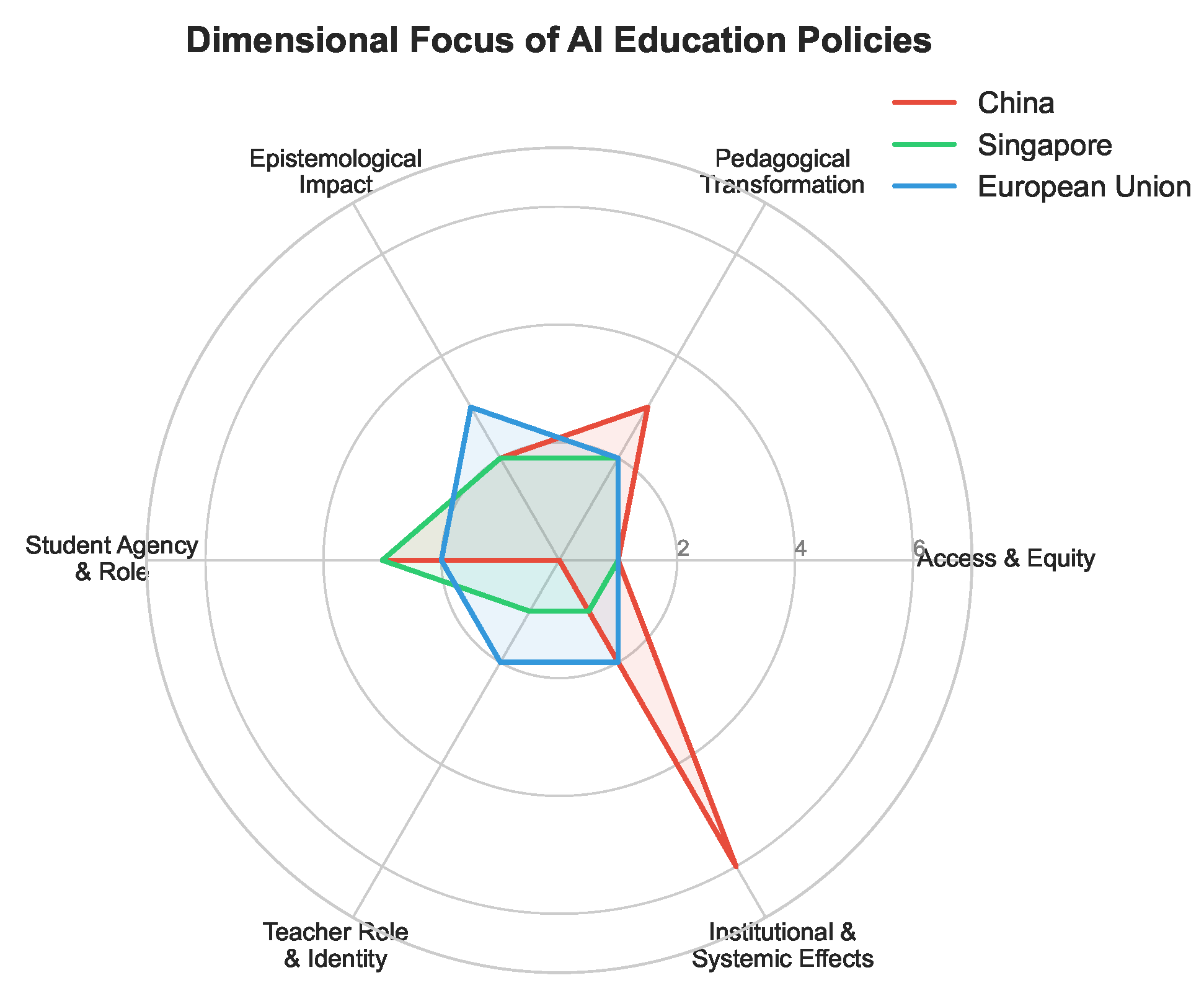
Figure 3.
Temporal evolution of China’s AI education policy orientation. The chart contrasts the predominantly optimization-focused discourse of the macroeconomic 2017 AI Development Plan against the pedagogical, restructuring-focused mandates of the 2025 Generative AI in Schools Guide.
Figure 3.
Temporal evolution of China’s AI education policy orientation. The chart contrasts the predominantly optimization-focused discourse of the macroeconomic 2017 AI Development Plan against the pedagogical, restructuring-focused mandates of the 2025 Generative AI in Schools Guide.
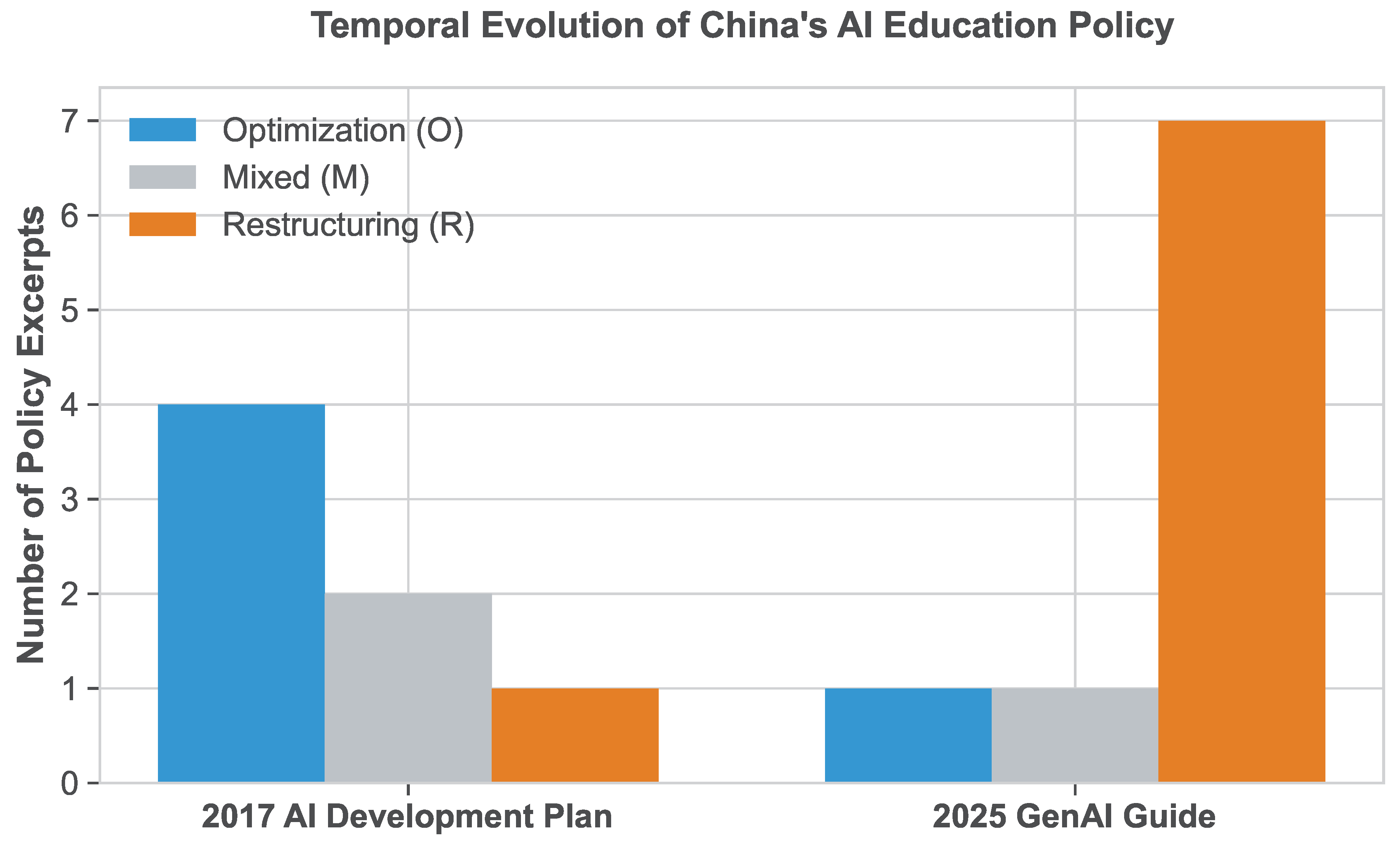
Table 1.
Research questions and their corresponding sections within the manuscript.
| ID | Research Question | Addressed In |
|---|---|---|
| RQ1 | How do national and supranational AI-in-education policies in China, Singapore, and the European Union frame the role of AI across the six dimensions of the Optimization–Restructuring framework? | Section 4.1 |
| RQ2 | To what extent do the policies adopt an optimization-oriented framing versus a restructuring-oriented framing, as defined by the six-dimensional framework? | Section 4.1 |
| RQ3 | What cross-system patterns and temporal evolutions emerge when comparing policy orientations across China (2017–2025), Singapore, and the European Union (2020–2025), particularly regarding shifts in emphasis across the six dimensions? | Section 4.2 |
| RQ4 | In what ways do these policies enable or constrain the epistemological rupture and human-AI co-creation model proposed in the foundational theory? | Section 5.1 |
Note. The Optimization–Restructuring framework and the concept of epistemological rupture build upon the foundational theory established by Hasan et al. (2025) [1].
Table 2.
Synthesis of recent critical literature on AI governance in education and identified research gaps.
Table 2.
Synthesis of recent critical literature on AI governance in education and identified research gaps.
| Study | Scope / Context | Core Analytical Focus | Identified Gap / Limitation |
|---|---|---|---|
| Bearman et al. (2022) [28] | Global / Higher Education | Discourses of imperative change and altering authority; emphasizes ethics and epistemic effects. | Focuses on scholarly discourse rather than state policy; lacks a cross-national framework on how governments reconfigure pedagogy. |
| Holmes & Tuomi (2022) [29] | Global / Systems Overview | Typology of AIED systems, pedagogical assumptions, ethics, and regulatory roadblocks. | Omits how state actors encode educational purposes in AI strategies; lacks comparative empirical analysis of specific policy texts. |
| Wang et al. (2025) [8] | Macro / China, EU, US | Structural topic modelling of national AI policies; maps emphases on social impact and government role. | Treats education as a minor topic; does not unpack pedagogical roles or use a conceptual lens distinguishing optimization from restructuring. |
| Kaya-Kasikci et al. (2025) [23] | Macro / Global Actors | Positions of universities within AI ecosystems, technological statecraft, and public–private power dynamics. | Analyzes higher education as a talent pipeline; does not interrogate how AI policy frameworks envision classroom pedagogy or teacher identity. |
| Liu & Tınmaz (2025) [13] | Regional / Greater China | Conceptual review of AI regulations and multi-level governance models in higher education. | Comparison is intra-national; focuses on implementation rather than how policy reconfigures the epistemic core across divergent global regimes. |
| The Current Study | Macro / China, Singapore, EU | Empirical mapping of state governance using the Optimization–Restructuring framework. | Addresses the empirical gap by systematically comparing how distinct geopolitical regimes mandate epistemic, pedagogical, and systemic change. |
Note. This table highlights how current critical literature predominantly focuses on micro-level ethics, scholarly discourse, or general tech-geopolitics, leaving a distinct empirical gap in comparative, macro-level pedagogical policy analysis.
Disclaimer/Publisher’s Note: The statements, opinions and data contained in all publications are solely those of the individual author(s) and contributor(s) and not of MDPI and/or the editor(s). MDPI and/or the editor(s) disclaim responsibility for any injury to people or property resulting from any ideas, methods, instructions or products referred to in the content. |
© 2026 by the authors. Licensee MDPI, Basel, Switzerland. This article is an open access article distributed under the terms and conditions of the Creative Commons Attribution (CC BY) license.
Copyright: This open access article is published under a Creative Commons CC BY 4.0 license, which permit the free download, distribution, and reuse, provided that the author and preprint are cited in any reuse.