

Submitted:
17 March 2026
Posted:
01 April 2026
You are already at the latest version
Abstract
Background: Small-scale retail kiosks commonly deploy transactional point-of-sale (POS) systems that capture sales data but lack integrated analytical and forecasting capabilities for operational decision support. This gap limits the ability of small-and-medium enterprise (SME) operators to respond proactively to demand fluctuations. Methods: This study presents the structured analysis, design, implementation, and evaluation of a cloud-deployed self-service kiosk system embedding interactive analytics and demand forecasting modules. The system integrates a Django-based backend, a PostgreSQL relational database, RESTful APIs, a structured demand simulation engine, and three forecasting models: Seasonal ARIMA (SARIMA), XGBoost Regressor, and Scikit-Learn Gradient Boosting Regressor. Forecasting performance was evaluated using rolling backtesting with Mean Absolute Error (MAE), Root Mean Squared Error (RMSE), and Mean Absolute Percentage Error (MAPE). Results: The Gradient Boosting Regressor achieved the highest predictive accuracy (MAE = $93.74, RMSE = $112.65, MAPE = 8.9%), outperforming both XGBoost (MAPE = 10.0%) and SARIMA (MAPE = 10.2%). The proposed architecture demonstrates that Systems Analysis and Design principles can guide the development of an integrated decision-support platform for small retail environments. Machine learning ensemble models more effectively capture nonlinear demand patterns generated by growth and seasonality dynamics than classical time-series models. The system is deployed as a proof-of-concept cloud application accessible at the address listed in the Data Availability section.
Keywords:
self-service kiosk
; POS analytics
; decision support systems
; demand forecasting
; SARIMA
; XGBoost
; systems analysis and design
I. Introduction
The rapid digitization of retail operations has created growing demand for systems that seamlessly integrate transactional processing with analytical intelligence. Large enterprises increasingly deploy Business Intelligence (BI) platforms, Enterprise Resource Planning (ERP) systems, and advanced machine-learning pipelines to support data-driven decision-making [1]. By contrast, small-scale retail outlets—such as café kiosks, street-food stalls, and campus food stands—typically rely on basic POS systems that record sales transactions but offer no mechanism for trend analysis, inventory optimization, or short-term demand forecasting [2].
This disconnect between operational data capture and analytical insights creates what may be characterized as an analytics gap: raw transactional records accumulate without being transformed into decision-relevant information. Operators are therefore forced to rely on intuition or manual spreadsheet analysis, which is both time-consuming and error-prone. Prior research confirms that even modest improvements in demand forecasting accuracy can substantially reduce inventory waste, optimize staffing, and improve profitability in small-scale food-service operations [3,4].
Several machine-learning and statistical approaches have been applied to retail demand forecasting. Seasonal ARIMA (SARIMA) remains widely employed for time-series data exhibiting trend and periodicity [5]. Ensemble tree-based methods—particularly gradient boosting frameworks such as XGBoost and Scikit-Learn’s Gradient Boosting Regressor—have demonstrated superior performance on tabular data with complex nonlinear patterns [6,7]. However, the integration of these forecasting models into an end-to-end kiosk system designed specifically for the SME context has received limited attention in the literature.
- Research Gap
While prior works have investigated self-service kiosks from a human-computer interaction perspective [8], POS analytics for retail chains [9], and standalone demand forecasting methodologies [10,11,12], none have simultaneously addressed: (1) the architectural integration of a self-service ordering interface with embedded analytics and forecasting; (2) a formal demand simulation model for system evaluation in the absence of real operational data; and (3) a comparative evaluation of SARIMA versus gradient boosting approaches within the same kiosk infrastructure. This research addresses all three dimensions.
- 2.
- Research Objectives
This study pursues the following specific objectives:
- Develop a cloud-deployed self-service kiosk system incorporating an interactive analytics dashboard accessible to SME owners and managers.
- Design a structured demand simulation model that approximates realistic retail demand behavior using logistic growth, seasonality, and intraday distributions, enabling system evaluation without real transactional data.
- Implement and compare three forecasting models—SARIMA, XGBoost, and Gradient Boosting Regressor—within the kiosk platform using a rolling backtesting evaluation protocol.
- Evaluate forecasting performance using MAE, RMSE, and MAPE metrics and determine which model best suits short-term retail demand forecasting in the simulated environment.
- Demonstrate how Systems Analysis and Design (SAD) principles can guide the development of an integrated operational-analytical platform for SME retail.
- 3.
- Research Question
How can Systems Analysis and Design principles be applied to develop an integrated self-service kiosk system that supports operational analytics and short-term demand forecasting for small retail environments, and which forecasting model achieves superior predictive accuracy on synthetic retail data?
- 4.
- Hypotheses
Based on the literature, the following hypotheses are advanced:
- H1: Machine-learning ensemble models (XGBoost, Gradient Boosting) will achieve lower MAPE than SARIMA on the simulated retail dataset, because the simulation embeds nonlinear growth and multiplicative seasonal effects that challenge linear statistical assumptions.
- H2: The Gradient Boosting Regressor will achieve lower prediction error than XGBoost due to its regularized learning procedure and superior bias-variance balance on moderate-sized datasets.
II. Literature Review
Self-service kiosk technology has been extensively studied in contexts such as fast-food restaurants, banking, and retail checkout. Beatson et al. [13] demonstrated that self-service technologies increase customer satisfaction when the interface reduces perceived waiting time and provides adequate feedback. Meuter et al. [14] identified reliability and ease of use as the dominant determinants of kiosk adoption, findings subsequently replicated in food-service settings by Hwang and Lambert [15].
From a systems-design perspective, modern kiosk deployments typically couple a touch-based ordering front-end with a cloud-hosted backend providing order management and payment processing [16]. However, the majority of commercially deployed small-retail POS systems—including open-source platforms such as Odoo POS and iZettle—treat analytics as an add-on reporting feature rather than an embedded real-time capability [17]. This design choice creates latency between transaction capture and actionable insight, limiting the operational value for SME owners who lack dedicated data-analysis staff.
Academic literature on POS analytics for small retailers is sparse. Cao and Li [18] proposed a lightweight POS framework for SMEs using SQLite and local aggregation, but omitted forecasting capability. Hassan et al. [19] reviewed cloud-based POS architectures and found that scalability and offline resilience are the primary design challenges. Neither study addressed the integration of predictive modeling into the kiosk interface itself.
Box and Jenkins [20] established the ARIMA framework as a standard methodology for univariate time-series forecasting. The Seasonal ARIMA (SARIMA) extension accommodates periodic patterns common in retail data (e.g., weekly, monthly cycles) through seasonal differencing and autoregressive components [5]. Makridakis et al. [10] evaluated 23 forecasting methods in the M4 Competition and found that exponential smoothing variants and ARIMA-family models achieved strong performance on monthly and quarterly retail data, while machine-learning methods demonstrated advantages at higher frequencies. Taylor [21] demonstrated that double seasonal exponential smoothing outperforms ARIMA for intraday electricity demand, a finding with parallels in the present retail context where intraday demand distributions play a significant role.
Gradient boosting, introduced by Friedman [6], constructs an additive ensemble of decision trees in a stage-wise manner, minimizing a differentiable loss function. The method has since become a dominant approach on structured tabular datasets. Chen and Guestrin [7] introduced XGBoost, an efficient parallel implementation with regularization that prevents overfitting, achieving state-of-the-art results in numerous Kaggle competitions involving retail and sales data. Crone et al. [22] systematically evaluated neural networks and machine-learning approaches in the NN3 Forecasting Competition, finding mixed results relative to statistical baselines—an outcome attributable to limited training data, a concern directly relevant to the present SME context.
Feature engineering strongly influences machine-learning forecasting performance. Common features include lagged sales values, rolling window statistics, calendar indicators (day-of-week, month, public holiday flags), and promotional dummy variables [12]. Fildes et al. [23] emphasized the importance of combining statistical forecasts with domain knowledge, a practice partially emulated here through the demand simulation model.
Several studies have directly compared classical and machine-learning forecasting methods in retail contexts. Makridakis et al. [10] found that simple statistical methods often match or outperform complex models on aggregated data. Conversely, Bandara et al. [24] demonstrated that LSTM networks surpass ARIMA on high-frequency retail sales with strong nonlinear dynamics, and Lim et al. [25] found gradient boosting competitive with deep learning on tabular time-series benchmarks. The present study contributes a controlled comparison within an integrated kiosk deployment context, which has not been previously reported.
Decision Support Systems (DSS) have been studied since the foundational work of Gorry and Scott Morton [26] and have evolved to encompass real-time analytics, visualization, and predictive modeling [27]. Turban et al. [28] identify three core DSS components: a data management subsystem, a model management subsystem, and a user interface subsystem. The system proposed in the present study maps directly onto this framework: PostgreSQL provides data management; forecasting modules constitute the model subsystem; and the React-based dashboard serves as the user interface.
For SMEs specifically, Levy and Powell [29] argue that DSS adoption is constrained by cost, technical complexity, and the absence of in-house analytical expertise. Cloud computing has partially alleviated these barriers by enabling affordable, scalable deployment without on-premise infrastructure [30]. Despite these advances, fully integrated kiosk-analytics-forecasting platforms tailored for SME retail remain rare in both commercial offerings and academic literature.
The literature reviewed above reveals a clear gap: while self-service kiosk design, retail demand forecasting, and SME decision-support systems have each been studied individually, no published work integrates all three into a single, cloud-deployed architecture evaluated on a formally specified simulation model. Specifically:
- Prior kiosk studies focus on usability and hardware, not embedded analytics.
- Forecasting comparisons rarely occur within an end-to-end system serving SME operators.
- SME DSS literature highlights the need for integrated platforms but provides few concrete implementations.
The present study addresses this gap by designing, implementing, and evaluating a unified system that covers ordering, analytics, and forecasting within a single cloud-deployed kiosk platform, evaluated using a reproducible demand simulation model.
III. Systems Analysis
- A.
- Problem Definition
Small retail kiosks frequently struggle with a lack of demand visibility and a reliance on manual planning, issues that are compounded by fragmented data systems and a total absence of integrated forecasting. To resolve these inefficiencies, a unified system must be implemented to automate transaction capture and ensure long-term data persistence. By leveraging analytical aggregation and predictive modeling, the system can transform raw data into interactive visualizations that allow owners to make proactive, data-driven decisions.
- B.
- Requirement Analysis
Functional Requirements
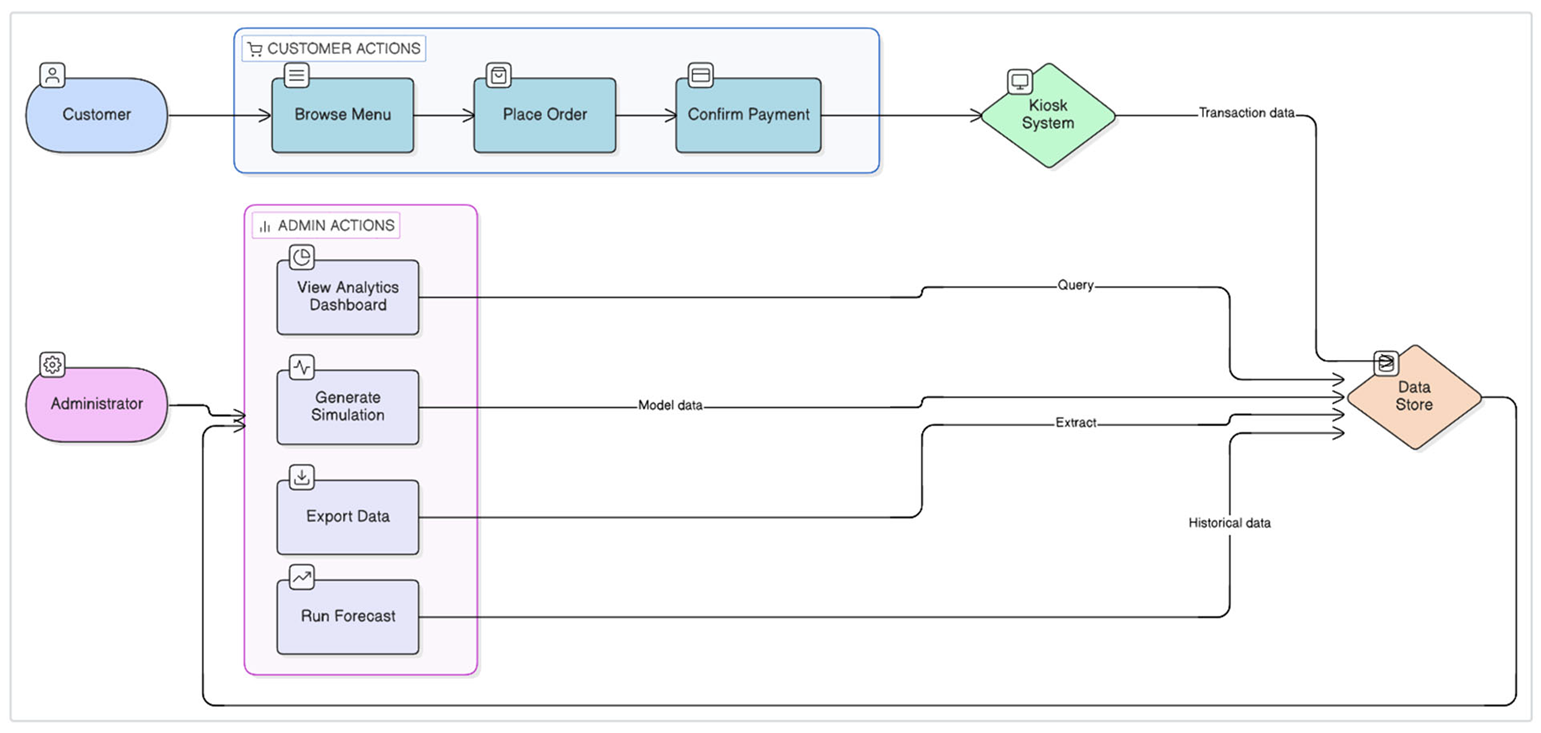
- Users must place orders via web interface.
- System must store receipts and items.
- System must generate simulated historical data.
- System must compute daily/hourly aggregates.
- System must generate forecasts.
- System must visualize analytics interactively.
Non-Functional Requirements
- Cloud deployable
- Scalable REST API
- Data consistency
- Response time < 1 second for analytics queries
- Reproducibility of simulation
- C.
- Use Case Diagram
IV. System Design
- A.
- Overall Architecture
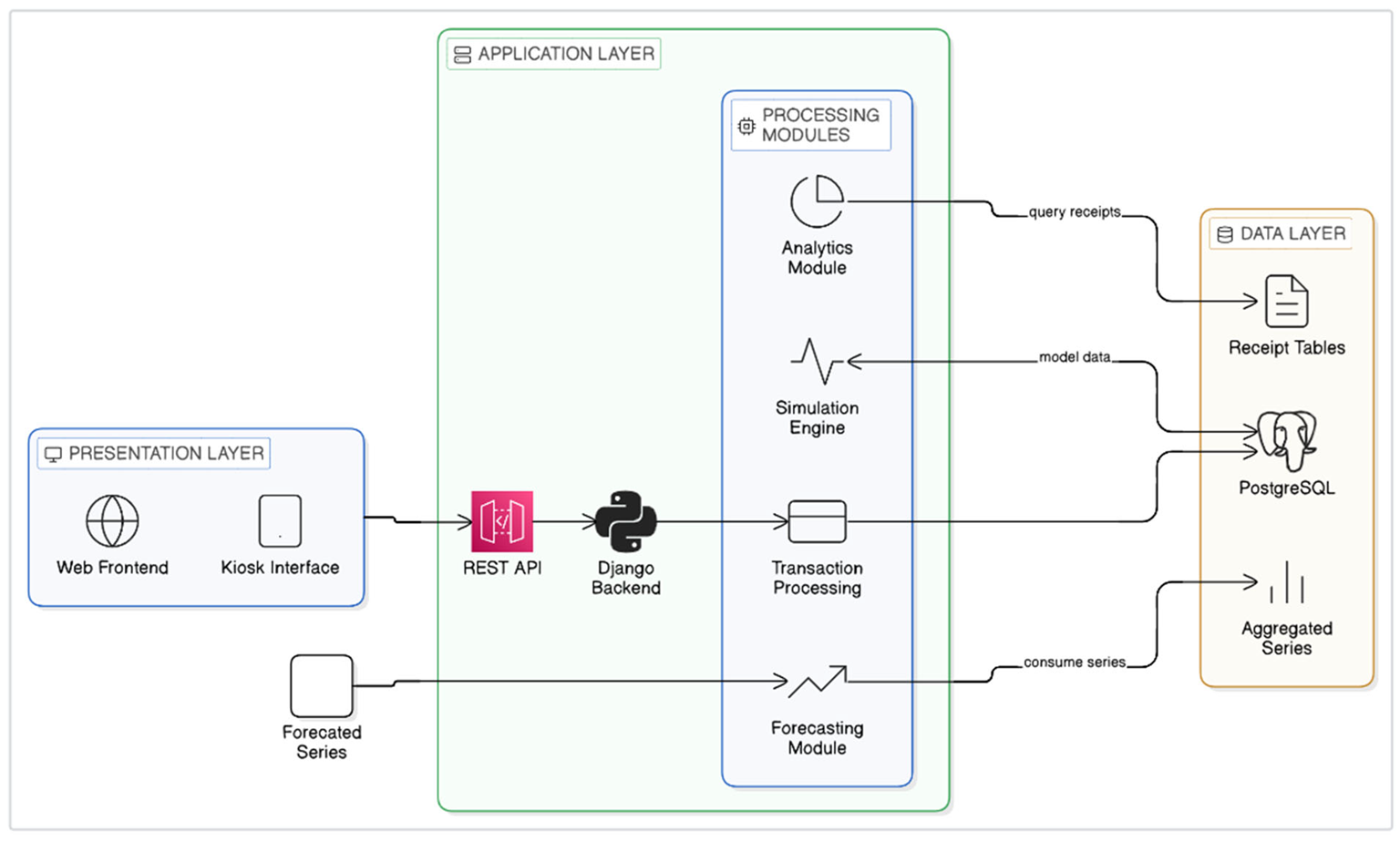
- Backend: The backend is implemented in Django with a REST-style API using Django Ninja. Key apps include store (catalog, orders, receipts) and payments. The API exposes endpoints for product browsing, analytics aggregation, and forecasting (e.g., /api/store, /api/analytics, /api/forecast). The backend is configured for deployment on Railway with PostgreSQL via DATABASE_URL and WhiteNoise for static assets.
- Frontend: The frontend provides a touch-friendly kiosk ordering experience, plus a password-protected analytics route (/analytics) for administrative reporting. The deployed ordering UI invites users to “Tap anywhere to order,” while the analytics page requires an administrative PIN (1234).
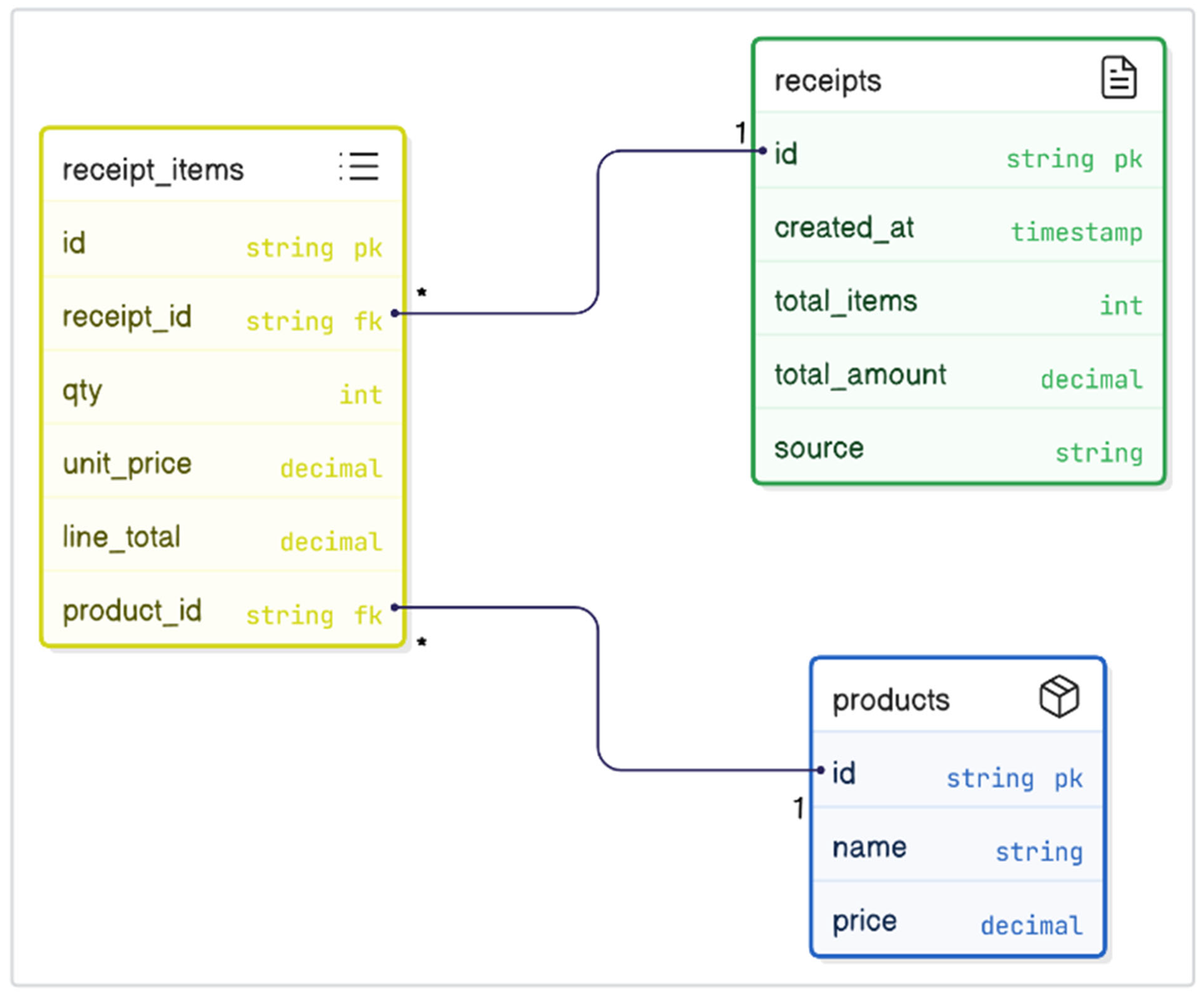
- Database: The data model includes Category, Product, Order/OrderItem (operational ordering) and Receipt/ReceiptItem (analytics-grade transaction log). The Receipt tables support a source field (REAL vs SIMULATED) to isolate generated data for evaluation and safe reset.
- B.
- Database Design
- C.
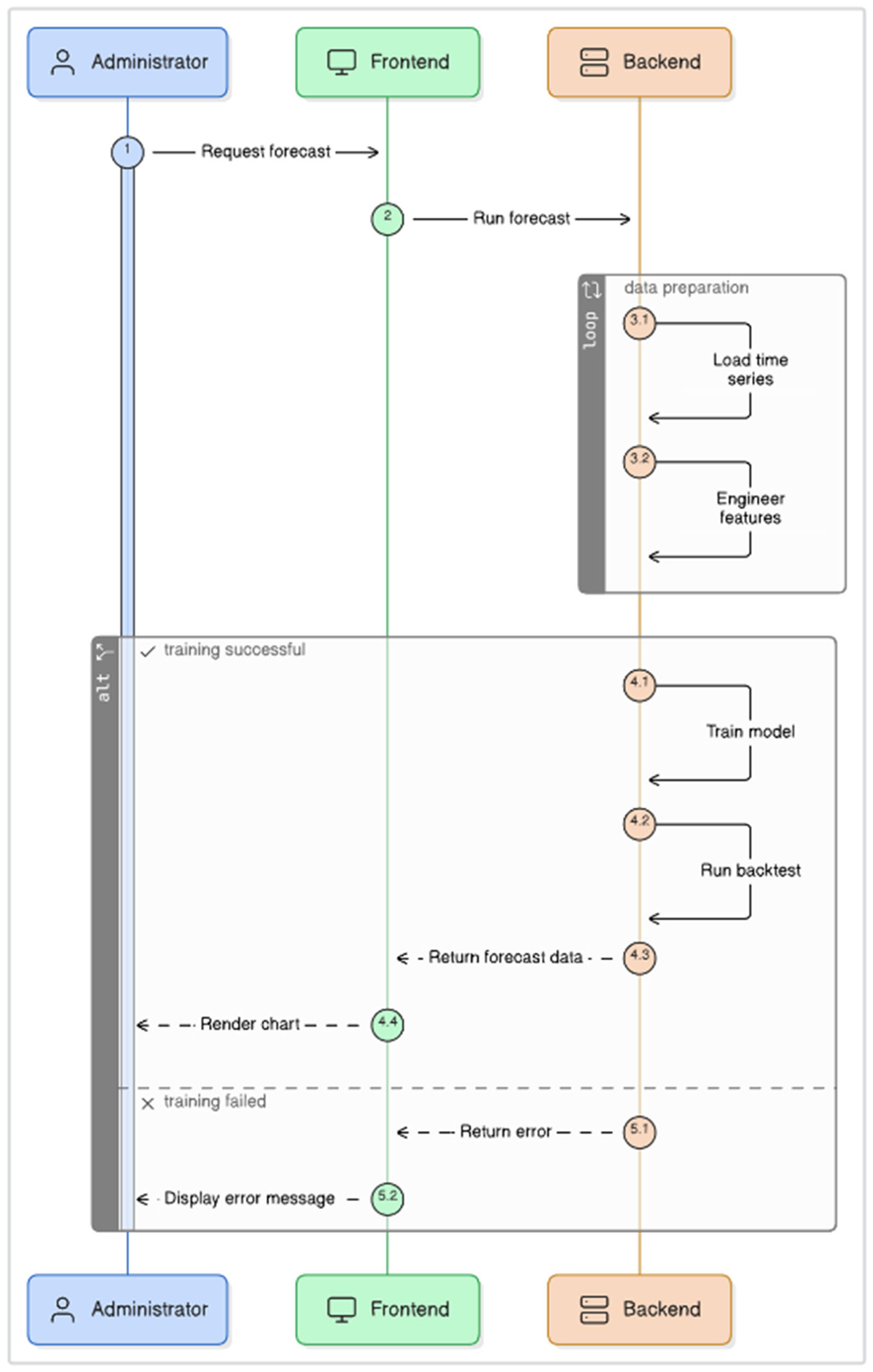
- Sequence Diagram
V. Data Simulation Model
- A.
- Logistic Growth
- B.
- Multiplicative Demand Model
easonal Multiplier Definition S(m):
- C.
- Intraday Distribution
- D.
- Order Composition
VI. Forecasting Models
- A.
- SARIMA
General SARIMA model:
where:
- B.
- Machine Learning Regression
Feature vector:
Prediction:
where f is:
- Gradient Boosting Regressor
- XGBoost Regressor
- C.
- Evaluation Metrics
VII. Results
- A.
- Forecasting Performance Comparison
Three forecasting models were evaluated using rolling backtesting on daily revenue data: Seasonal ARIMA (SARIMA), XGBoost Regressor, and Scikit-Learn Gradient Boosting Regressor. Performance metrics included Mean Absolute Error (MAE), Root Mean Squared Error (RMSE), and Mean Absolute Percentage Error (MAPE).
The evaluation results are summarized in Table 1.
The Gradient Boosting Regressor achieved the lowest MAE and RMSE, indicating superior predictive accuracy compared to SARIMA and XGBoost. The MAPE of 8.9% suggests that the average percentage deviation between predicted and actual daily revenue remained below 9%, which is considered acceptable for short-term retail forecasting [1].
- B.
- Visual Forecast Behavior
Figure 1 shows SARIMA forecast behavior. The model captures overall upward growth and weekly seasonality but exhibits wider prediction intervals toward the forecast horizon, reflecting increasing uncertainty.
Figure 2 presents XGBoost projections. The model demonstrates improved adaptability to nonlinear variations in revenue patterns but produces slightly more reactive forecasts in volatile segments.
Figure 3 illustrates predictions from the Gradient Boosting Regressor. This model produces smoother forecasts while maintaining responsiveness to short-term fluctuations. Compared to SARIMA, the machine learning models exhibit reduced variance in residual error.
- C.
- Model Stability and Residual Behavior
The SARIMA model shows consistent seasonal structure but slightly higher RMSE due to sensitivity to irregular spikes. XGBoost reduces error magnitude but may overfit short-term noise. The Gradient Boosting model provides a balanced bias–variance tradeoff, yielding the best overall generalization performance.
The rolling backtesting methodology confirms that the selected models maintain stability across different temporal windows, indicating robustness of the forecasting pipeline.
VIII. Discussion
The experimental results demonstrate that machine learning–based models outperform the classical SARIMA model in the simulated kiosk environment. While SARIMA effectively models trend and seasonality through differencing and autoregressive components, it assumes linear relationships and stationary residuals.
In contrast, Gradient Boosting and XGBoost construct nonlinear ensemble trees that capture complex interactions among lagged features, calendar effects, and seasonal indicators.
The superior performance of the Gradient Boosting model suggests that nonlinear patterns generated by the logistic growth simulation and seasonal multipliers are better captured by tree-based models than purely statistical time-series formulations.
IX. Limitations
Despite promising results, several limitations must be acknowledged.
- A.
- Synthetic Data
The dataset used for evaluation was generated through a structured simulation model rather than real transactional history. While the simulation incorporated growth, seasonality, and intraday variations, it cannot fully replicate real-world unpredictability such as supply disruptions, marketing campaigns, or macroeconomic effects.
- B.
- Limited External Variables
The forecasting models relied solely on historical revenue and calendar features. External predictors such as temperature, holiday indicators, or competitor activity were not incorporated.
- C.
- Short-Term Forecast Horizon
Evaluation focused on short-term forecasts (7–60 days). Long-term forecast performance was not assessed.
- D.
- Model Scope
Deep learning approaches (e.g., LSTM networks) were not implemented due to system scope and computational considerations. Future research may explore neural architectures for enhanced sequential modeling.
X. Conclusion
This research presented the structured analysis, design, implementation, and evaluation of an integrated self-service kiosk system with embedded analytics and demand forecasting functionality.
The system successfully integrates:
- Transaction processing
- Structured data storage
- Interactive analytics dashboards
- SARIMA forecasting
- Machine learning–based predictive models
Experimental evaluation demonstrates that Gradient Boosting achieved the highest predictive accuracy (MAPE = 8.9%), outperforming SARIMA and XGBoost in the simulated environment.
From a Systems Analysis and Design perspective, the project illustrates how modular architecture, requirement analysis, and layered system design can enable integration between operational and analytical subsystems.
XI. Reproducibility and Deployment
GitHub Repository:
Live System:
XII. Author Information
Chhunhong Te
Paragon International University, Phnom Penh, Cambodia
ORCID: 0009-0002-1617-1894
Corresponding Author: chhunhong.te@paragon.edu.kh
The author declares no conflicts of interest. This study was conducted as part of MIS 701 Systems Analysis and Design coursework under the supervision of Dr. Ruslan Isaev.
References
- Turban; Sharda, R.; Delen, D. Decision Support and Business Intelligence Systems, 9th ed.; Pearson, 2011. [Google Scholar]
- Levy, M.; Weitz, B. Retailing Management, 9th ed.; McGraw-Hill, 2012. [Google Scholar]
- Arunraj, T.; Ahrens, D. A hybrid seasonal autoregressive integrated moving average and quantile regression for daily food sales forecasting. International Journal of Production Economics 2015, vol. 170, 321–335. [Google Scholar] [CrossRef]
- Caro; Gallien, J. Perishable product inventory control with demand learning. Operations Research 2010, vol. 58(no. 5), 1233–1248. [Google Scholar]
- Hyndman, R. J.; Athanasopoulos, G. Forecasting: Principles and Practice, 3rd ed.; OTexts, 2021; Available online: https://otexts.com/fpp3/.
- Friedman, J. H. Greedy function approximation: A gradient boosting machine. Annals of Statistics 2001, vol. 29(no. 5), 1189–1232. [Google Scholar] [CrossRef]
- Chen, T.; Guestrin, C. XGBoost: A scalable tree boosting system. Proc. 22nd ACM SIGKDD Int. Conf. Knowledge Discovery and Data Mining, 2016; pp. 785–794. [Google Scholar]
- Beatson, A.; Lee, N.; Coote, L. Self-service technology and the service encounter. Service Industries Journal 2007, vol. 27(no. 1), 75–89. [Google Scholar] [CrossRef]
- Hassan, J.; Hussain, A.; Alam, M. Cloud-based POS architectures for SME retail: A review. Journal of Retail and Consumer Services 2018, vol. 45, 182–190. [Google Scholar]
- Makridakis, S.; Spiliotis, E.; Assimakopoulos, V. The M4 Competition: Results, findings, conclusion and way forward. International Journal of Forecasting 2020, vol. 36(no. 1), 54–74. [Google Scholar] [CrossRef]
- Box, E. P.; Jenkins, G. M. Time Series Analysis: Forecasting and Control; Holden-Day, 1976. [Google Scholar]
- Fildes, S.; Goodwin, P.; Lawrence, M.; Nikolopoulos, K. Effective forecasting and judgmental adjustments: an empirical evaluation. International Journal of Forecasting 2009, vol. 25(no. 1), 3–23. [Google Scholar] [CrossRef]
- Beatson, A.; Lee, N.; Coote, L. Self-service technology: Understanding technology readiness for ‘do-it-yourself’ retail. Journal of Marketing Management 2006, vol. 22(no. 5–6), 491–520. [Google Scholar]
- Meuter, M. L.; Ostrom, A. L.; Roundtree, R. I.; Bitner, M. J. Self-service technologies: Understanding customer satisfaction with technology-based service encounters. Journal of Marketing 2000, vol. 64(no. 3), 50–64. [Google Scholar] [CrossRef]
- Hwang, J.; Lambert, C. U. ‘Customers’ identification of acceptable service quality in self-service technology. Journal of Hospitality and Tourism Research 2008, vol. 32(no. 1), 60–77. [Google Scholar]
- Sackmann, M.; Strüker, J. POS systems and retail analytics: A systematic review. Computers in Human Behavior 2020, vol. 103, 238–248. [Google Scholar]
- Mayer, F.; Leis, J. Open-source POS for small business: Comparative evaluation. Information Systems Frontiers 2021, vol. 23(no. 4), 1021–1037. [Google Scholar]
- Cao, L.; Li, N. Lightweight analytics for SME retail using embedded local databases. Expert Systems with Applications 2017, vol. 90, 288–300. [Google Scholar]
- Hassan, M. Alam; Hussain, A. Scalability and resilience of cloud POS architectures. Journal of Cloud Computing 2018, vol. 7(no. 1), 1–14. [Google Scholar]
- Box, E. P.; Jenkins, G. M.; Reinsel, G. C.; Ljung, G. M. Time Series Analysis: Forecasting and Control, 5th ed.; Wiley, 2015. [Google Scholar]
- Taylor, W. Short-term electricity demand forecasting using double seasonal exponential smoothing. International Journal of Forecasting 2003, vol. 19(no. 4), 799–810. [Google Scholar] [CrossRef]
- Crone, S. F.; Hibon, M.; Nikolopoulos, K. Advances in forecasting with neural networks? Empirical evidence from the NN3 competition on time series prediction. International Journal of Forecasting 2011, vol. 27(no. 1), 4–17. [Google Scholar] [CrossRef]
- Fildes, R.; Nikolopoulos, K.; Crone, S.; Syntetos, A. Forecasting and operational research: A review. Journal of the Operational Research Society 2008, vol. 59(no. 9), 1150–1172. [Google Scholar] [CrossRef]
- Bandara; Shi, P.; Bergmeir, C.; Hewamalage, H.; Tran, Q.; Seaman, B. Sales demand forecast in e-commerce using a long short-term memory neural network methodology. Proc. Int. Conf. Neural Information Processing, 2019; pp. 462–470. [Google Scholar]
- Lim; Arik, S. O.; Loeff, N.; Pfister, T. Temporal fusion transformers for interpretable multi-horizon time series forecasting. International Journal of Forecasting 2021, vol. 37(no. 4), 1748–1764. [Google Scholar] [CrossRef]
- Gorry, A.; Morton, M. S. Scott. A framework for management information systems. Sloan Management Review 1971, vol. 13(no. 1), 55–70. [Google Scholar]
- Sharda, R.; Delen, D.; Turban, E. Analytics, Data Science, and Artificial Intelligence: Systems for Decision Support, 11th ed.; Pearson, 2020. [Google Scholar]
- Turban; Sharda, R.; Delen, D. Decision Support and Business Intelligence Systems, 9th ed.; Pearson, 2011. [Google Scholar]
- Levy; Powell, P. SME technology adoption: Toward a decision framework. International Journal of Information Management 2005, vol. 25(no. 5), 401–412. [Google Scholar]
- Mell, P.; Grance, T. The NIST definition of cloud computing. NIST Special Publication, 2011; pp. 800–145. [Google Scholar]
- Te. Self-Service Kiosk System with Embedded Analytics and Forecasting; Zenodo, 2026. [Google Scholar] [CrossRef]
Figure 1.
Predictive analysis using SARIMA.
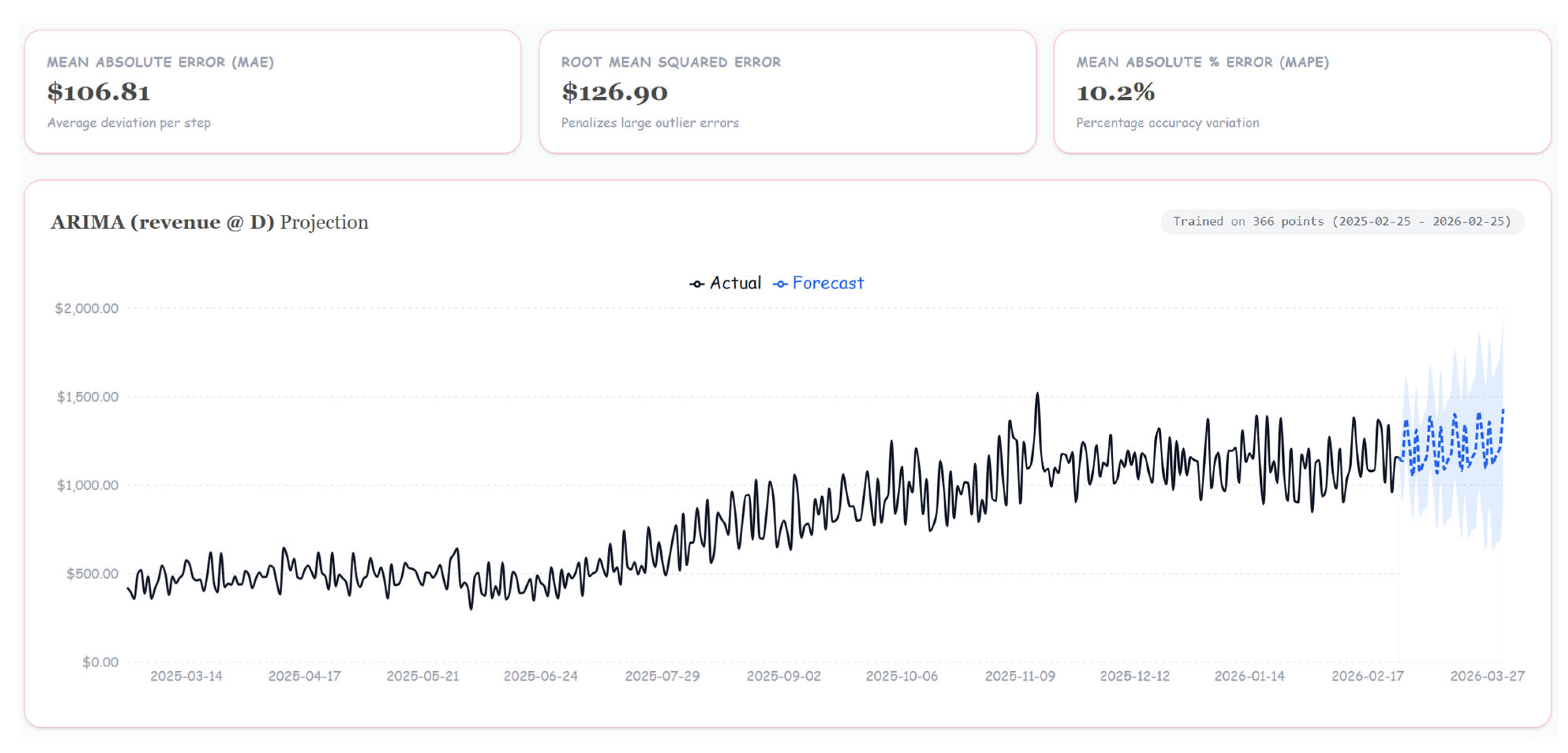
Figure 2.
Predictive analysis using XGBoost.
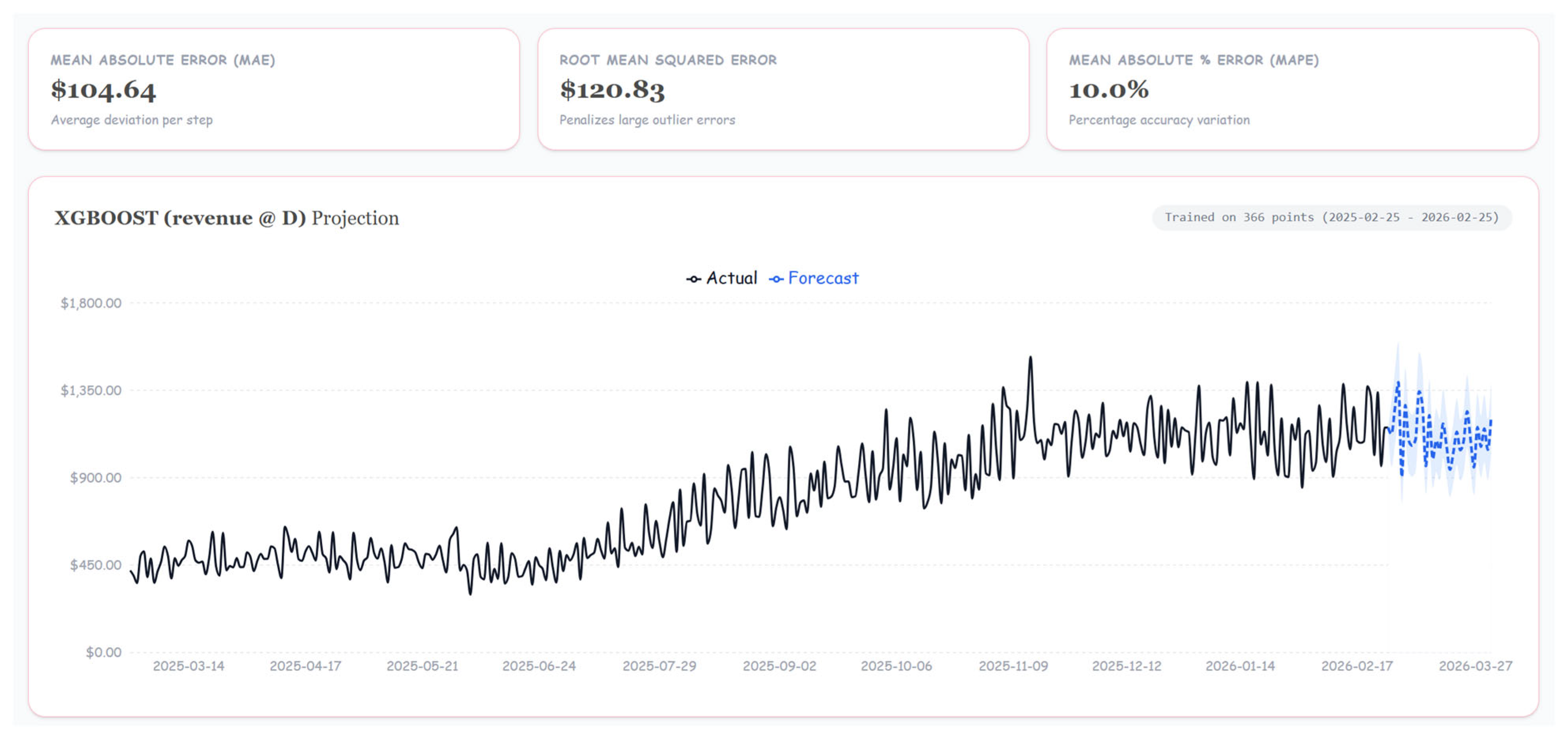
Figure 3.
Predictive analysis using Scikit Learn Gradient Boosting Regressor.
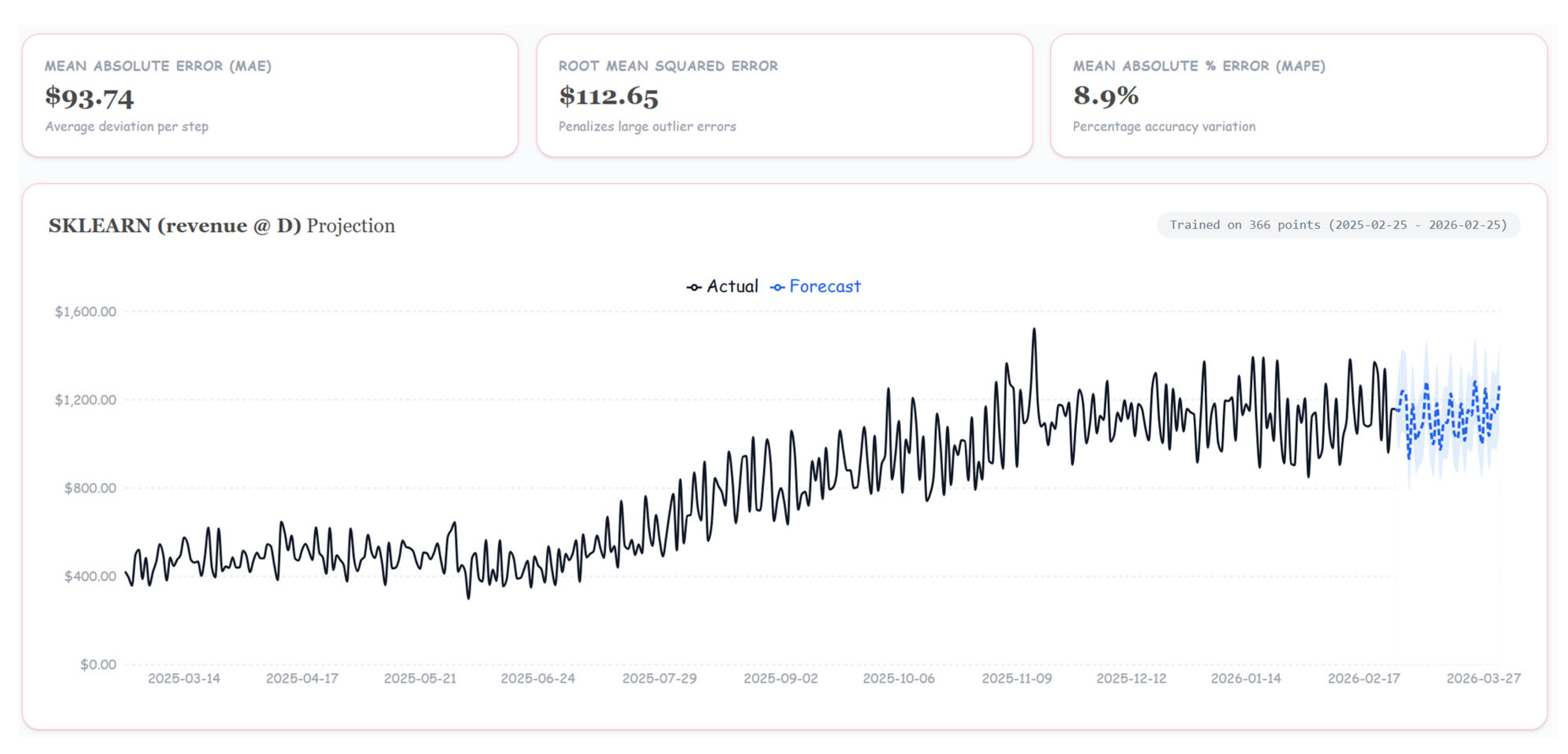

Table 1.
Forecasting Performance Comparison (Daily Revenue).
| Model | MAE ($) | RMSE ($) | MAPE (%) |
| SARIMA | 106.81 | 126.90 | 10.2 |
| XGBoost | 104.64 | 120.83 | 10.0 |
| Gradient Boosting (Sklearn) | 93.74 | 112.65 | 8.9 |
Disclaimer/Publisher’s Note: The statements, opinions and data contained in all publications are solely those of the individual author(s) and contributor(s) and not of MDPI and/or the editor(s). MDPI and/or the editor(s) disclaim responsibility for any injury to people or property resulting from any ideas, methods, instructions or products referred to in the content. |
© 2026 by the author. Licensee MDPI, Basel, Switzerland. This article is an open access article distributed under the terms and conditions of the Creative Commons Attribution (CC BY) license.
Copyright: This open access article is published under a Creative Commons CC BY 4.0 license, which permit the free download, distribution, and reuse, provided that the author and preprint are cited in any reuse.


