

Submitted:
29 March 2026
Posted:
30 March 2026
You are already at the latest version
Abstract
The flow of R&D factors serves as a crucial channel for linking regional collaborative innovation resources and plays a significant role in promoting spatial knowledge spillovers, making it an important engine for the in-depth implementation of innovation-driven development strategies. This study takes the Yangtze River Delta urban agglomeration as its research object, utilizing data from 2003-2023, and employs gravity models and dynamic spatial fixed effects models to analyse the impact of R&D factor flows on regional collaborative innovation, as well as the moderating role of intellectual property protection. The study revealed that both the flow of R&D personnel and R&D capital significantly promote regional collaborative innovation, with the flow of R&D capital playing a more prominent role. The intensity of intellectual property protection positively moderates the relationship between the flow of R&D factors and regional collaborative innovation, but a single threshold effect exists, where the moderating effect weakens after exceeding the threshold. The intensity of inter-city collaborative innovation continues to increase, with core cities such as Shanghai, Hangzhou, and Nanjing playing a significant leading role. The emergence of new central cities such as Nantong, Ningbo, and Jiaxing has driven the evolution of collaborative innovation toward a "star-shaped" structure. The mechanism for the flow of R&D factors should be optimized, the intensity of intellectual property protection should be balanced, collaborative innovation between core cities and emerging central cities should be strengthened, and regional innovation infrastructure construction should be enhanced to promote high-quality innovative development in the Yangtze River Delta region.
Keywords:
regional collaborative innovation
; R&D factor mobility
; intellectual property protection
; Yangtze River Delta urban agglomeration
; spatial econometric model
1. Introduction
Innovation serves as a vital engine for achieving high-quality economic growth and is key to enhancing national competitiveness and comprehensive national strength. Ultimately, national economic development hinges on regional coordinated economic growth. Therefore, thoroughly implementing regional coordination strategies and accelerating the establishment of a collaborative innovation framework characterized by complementary advantages and high-quality development are paramount tasks in serving national strategic objectives. Currently, China’s regional collaborative innovation still faces multiple challenges. At the macro level, innovation supply remains disconnected from industrial demand, with technology transfer rates generally low. Focusing on the Yangtze River Delta (YRD) region—a key spatial vehicle for implementing the “Strengthening Integrated Intellectual Property Protection in the YRD” initiative under China’s 14th Five-Year Plan for National Intellectual Property Protection and Utilization, advancing innovation-driven coordinated development, and optimizing economic layout—the YRD serves as a major hub for innovation resources despite its robust economic strength. However, the efficiency of factor allocation urgently needs improvement. Disconnects persist in the “R&D-to-commercialization” chain across regions. Despite the region’s substantial patent output, many achievements fail to integrate effectively into industrial applications, revealing a clear lack of momentum in actual patent commercialization. Moreover, regional policy and institutional barriers continue to impede the flow of R&D resources. Insufficient policy coordination between regions and disparities in the intensity of intellectual property protection within the region create imbalances that undermine the overall effectiveness of regional collaborative innovation. Inadequate protection in some areas dampens corporate innovation incentives, whereas excessive protection in others may create “knowledge islands,” hindering knowledge spillovers and collaborative efforts. Therefore, precisely determining the “appropriate level” of intellectual property protection has become a critical issue for overcoming bottlenecks in regional collaborative innovation.
Current research on R&D factors and regional collaborative innovation primarily draws on endogenous growth theory, positing that interregional innovation primarily stems from R&D factors and knowledge spillovers. Unlike traditional production factors, R&D factors possess greater knowledge-based added value. They directly influence all stages of innovation activities and generate significant spatial knowledge spillover effects through rapid interregional mobility, thereby promoting coordinated innovation-driven regional economic development. First, the flow of innovation factors accelerates the cross-regional diffusion of intangible resources such as knowledge and technology, strengthening interregional linkages while promoting factor complementarity[1]. This addresses resource deficiencies and drives collaborative innovation[2]. Second, factor mobility helps mitigate imbalances caused by factor agglomeration. Optimizing resource allocation across regions alleviates factor misallocation, enhances resource utilization efficiency, and improves overall resource allocation[3]. Second, factor mobility fosters collaborative networks among regional innovation entities, refining the division of labor and cooperation to enhance collaborative innovation capabilities[4]. Overall, the literature often simplistically categorizes R&D factors as innovation factors, resulting in overly generalized research on the relationship between innovation factor mobility and regional innovation that lacks nuanced consideration of innovation factors. Furthermore, few studies have examined the impact of intellectual property protection policies targeting market entities on this relationship from a specific market perspective. Therefore, for research accuracy and quantitative precision, refining the specific factors of R&D elements and incorporating the role of enhanced intellectual property protection intensity represent crucial breakthroughs for effectively integrating factor resources, fully leveraging the enabling role of intellectual property protection, and accelerating regional collaborative innovation development.
During the flow of R&D factors, a government-led intellectual property protection system serves as a crucial institutional safeguard to correct market failures in regional innovation supply and stimulate endogenous drivers of collaborative innovation. It also offers greater balance in maintaining market fairness and enhancing innovation efficiency. Whether intellectual property protection “empowers” or “crowds out” regional collaborative innovation has become a highly debated focal issue in both academic circles and policy-making circles. Although scholars worldwide have yet to reach a definitive conclusion on the relationship between intellectual property protection and regional innovation capacity, several perspectives exist. First, intellectual property protection can enhance regional innovation capabilities. Research indicates that improved intellectual property protection significantly promotes technological progress[5] and that robust intellectual property protection systems can foster a higher-quality research environment, attract high-tech talent, and stimulate domestic innovation[6]. Second, IP protection may inhibit innovation, with overly stringent systems inducing adverse selection in corporate innovation—the crowding-out effect[7]. However, recent academic discourse increasingly emphasizes the nonlinear effects of IP protection. Multiple studies have examined the relationships between IP protection and technological progress, social welfare, and innovation output. Lü Kun[8] further confirmed the inverted U-shaped relationship between IP protection and innovation, arguing that excessively high IP protection distorts regional innovation flows.
Therefore, this paper takes the Yangtze River Delta (YRD) urban cluster as its study area. By subdividing R&D factors into human capital and physical capital, a spatial econometric model is constructed to validate the impact and spatial evolution characteristics of R&D factor flows on regional innovation development, as well as the moderating role of IP protection intensity in this process. Finally, on the basis of the empirical findings, this study proposes policy recommendations to alleviate barriers to R&D factor mobility in China and promote regional collaborative innovation. The aim is to remove obstacles to R&D factor flows, achieve high-quality regional innovation development, fully leverage the high-quality development driving force of economically advanced areas within the Yangtze River Delta, and thereby optimize the regional economic landscape.
2. Definition and Flow Measurement of R&D Factors
2.1. Definition of R&D Factors
The earliest definition of R&D factors dates back to 1967. Economists such as D. Meita, W. Gruber, and R. Vernon first introduced the concept of “research and development factors” while studying the interactive relationship between the structure of U.S. foreign trade commodities and industrial R&D investment. From a technological perspective, they explained that R&D investment tends to be relatively concentrated, leading to higher technological levels. This partially demonstrates the crucial role of R&D factor inputs in technological innovation and competitive advantage. Since then, scholars have increasingly focused on R&D factor input research, although consensus on its definition has remained elusive. The literature on R&D factors can be broadly categorized into two types. R&D factors encompass resources directly engaged in innovation activities that support innovation and influence outcomes, primarily capital, talent, technology, institutions, and policies[9]. Narrowly defined R&D factors are restricted to R&D personnel, R&D capital, and labor. Compared with broad innovation factors, R&D factors focus more on the elements inherent to R&D activities themselves, placing greater emphasis on specific stages such as technological R&D and product development. They constitute a critical subset of the innovation process and serve as key resource elements for driving regional innovation development and reshaping regional economic structures, playing an indispensable role in regional economic growth. Therefore, this paper adopts a narrow perspective for analysis. R&D personnel are defined as professionals engaged in research and experimental development (R&D) activities, whereas R&D capital refers to capital elements directed toward innovation activities that sustain and advance the innovation process, ensuring its continuity.
2.2. Measuring R&D Factor Mobility
With respect to the measurement of R&D factor mobility, previous studies have predominantly employed Newton’s universal gravitation model. This gravity model represents a successful application of physics’ gravitational laws within the social sciences, which are primarily used to examine spatial interactions in economic and social systems. Its core principle posits that the unidirectional flow of factors between two economies is proportional to their respective levels of economic development and inversely proportional to the distance between them. As early as the 19th century, the British demographer Raventstein pioneered the application of the gravity model to analyse population mobility. Anderson[10], Bergstrand[11], Anderson and Wincoop[12] subsequently explored the microfoundations of the gravity model from diverse perspectives—including the Cobb‒Douglas expenditure system approach, general equilibrium analysis, and the multilateral resistance method—thereby establishing its microeconomic theoretical underpinnings. In contemporary research, scholars such as Bai Junhong[13] have leveraged the gravity model from physics to construct spatial weight matrices on the basis of R&D factor flows when examining the spatial correlation effects of R&D factors. Numerous domestic and international scholars, including Liu Jisheng and Chen Yanguang[14], Niu Xin and Chen Xiangdong[15], and Bui and Chen[16], have similarly employed this methodology to conduct related studies, yielding substantial and fruitful outcomes. Given this, this paper draws upon the research experience of the aforementioned scholars and adopts the gravity model to measure the flow of regional innovation factors. The original gravity model is shown in Equation (1).
In the formula, Kij represents the attractiveness of region i to region j; Fij is the attraction coefficient of region i to region j, typically set to 1; Ni and Nj are measures of specific factors (e.g., population, capital, average wages, housing prices, etc.); αi and αj are the gravitational parameters for regions i and j, respectively, typically set to 1; Rij is the distance from region i to region j; and b is the distance decay index, typically set to 2[17,18].
Referencing the general form of the gravity model above, this paper constructs asymmetric innovation factor flow matrices via the ratio method. This approach fully accounts for the distinct characteristics of R&D personnel mobility and R&D capital mobility, enabling the calculation of gravity models for R&D personnel flow and R&D capital flow in the Yangtze River Delta region. This methodology more accurately captures the directionality and real-world features of factor flows. First, in the R&D personnel flow measurement model, average wage levels (Wage) and average housing prices (House) between regions are selected as gravitational factors for interprovincial R&D personnel flows. The full-time equivalent R&D personnel (rdl) serves as the gravitational coefficient, whereas the distance between the provincial capitals of the two regions replaces the traditional Euclidean geographic distance. The specific formula is shown in Equation (2).
For any region j, the total flow of R&D personnel attracted is defined as PFij. A higher value indicates a greater total flow of R&D personnel, calculated as shown in Equation (3):
When measuring the flow of innovative capital factors, the average profit margin level (rate) of enterprises above the designated size and the financial industry marketization index (Market) are selected as key factors attracting interregional flows of R&D capital factors. The stock of R&D capital (Ca) is treated as the gravitational coefficient, whereas the road distance is set as the distance damping factor. The construction method aligns with the gravitational model for R&D personnel factor flows discussed earlier, aiming to more accurately reflect the flow patterns of R&D capital factors. The specific formula is presented in Equation (4).
For any region j, the total flow of R&D capital factors attracted is defined as CFj. In data processing, drawing on the methodology of Wu Yanbing[19], the perpetual inventory method is employed to convert R&D expenditure data into R&D capital stock data. The calculation formula for the perpetual inventory method is shown in Equation (5), whereas the calculation formula for the base period of R&D capital stock is presented in Equation (6).
In Equations (5) and (6), C_i denotes the capital stock of region i in period t. δ represents the depreciation rate, which is set at 15% in this study on the basis of Wu Yanbing’s research findings. E_i(t-1) signifies the actual R&D expenditure of region i in period t-1, adjusted via the R&D expenditure price index[20] to eliminate price effects. f denotes the geometric growth rate of actual R&D expenditure over the defined time span in this study.
The R&D expenditure price index, which follows the methodology of Bai Junhong et al.[17], is calculated on the basis of the ratio of routine expenditures to capital expenditures within the total R&D expenditure. By calculating the average ratio of these two expenditure categories from 2003--2023, the final formula for the R&D expenditure price index is as follows: R&D expenditure price index = 0.8 × consumer price index + 0.2 × fixed asset investment price index.
On the basis of the calculated R&D capital stock, formula (4) is used to compute the annual R&D capital flow levels between regions. Here, CFij represents the flow of R&D capital from region i to region j. A higher value indicates greater R&D capital flow and stronger spatial connectivity between regions i and j. Aggregating these flows yields the total annual R&D capital flow for a given region, defined as CFj. Evidently, a larger CFj value signifies greater overall R&D capital flow within that province. The specific calculation method is detailed in Equation (7).
3. Theoretical Analysis and Research Hypotheses
In today’s era of economic globalization, the flow of R&D factors holds significant importance for regional collaborative innovation. It serves as the key pathway for innovation entities within a region to acquire knowledge and technology from external sources and transform them into innovative outcomes. Furthermore, it is a crucial prerequisite for breaking down regional barriers and promoting the rational allocation of innovation resources. As a vital component of regional innovation systems, the flow of R&D factors significantly influences regional collaborative innovation capabilities through knowledge spillovers, optimized resource allocation, and network collaboration effects. First, it dynamically optimizes resource allocation. Traditional economic theory posits that the productivity of innovation activities relies on the organic combination of multiple production factors. In practice, inherent geographical limitations result in uneven resource endowments across regions. Cities lacking specific resource elements essential for innovation activities struggle to undertake related production and may even face constraints on their development. Research indicates that distortions in factor markets inevitably reduce innovation efficiency, while the flow of resources between regions can overcome this challenge[21,22,23]. As two of the most critical factors in production activities, human capital and capital are indispensable elements for promoting urban economic development and enhancing innovation efficiency. Therefore, the flow of R&D factors enables rational resource allocation, maximizing benefits within urban clusters. Simultaneously, R&D factors facilitate interaction and collaboration among diverse innovation actors, fostering regional coordinated innovation[24]. The second is the spatial spillover effect of knowledge. Within the theoretical framework of new economic geography, the spatial spillover effects of knowledge and technology yield significant positive impacts on destination regions. As the most critical inputs in innovation activities, R&D personnel and capital carry substantial knowledge information. The aggregation of this knowledge facilitates exchanges and cooperation among factors, promotes the generation of innovative outcomes such as technological knowledge, and thereby drives the diffusion of knowledge and technology spillovers[25,26]. The third is the innovation cooperation network effect. The flow of factors across different regions establishes cooperative networks within broader markets. The construction of these cooperation networks not only strengthens interactions among various entities but also accelerates the refinement of innovation activities. At the micro level, the cross-regional flow of R&D factors across different innovation stages enables complementary technological strengths and weaknesses. This creates more embedded innovation cooperation networks, generating new technological trajectories and avoiding low-end technological lock-in[27]. Therefore, on the basis of the above analysis, this paper proposes Hypothesis 1: The flow of R&D factors significantly promotes regional collaborative innovation development.
From the perspective of intellectual property protection, the current academic consensus holds that IP protection systems empower innovation development[28,29,30] and serve as a key long-term tool for policymakers to regulate market innovation[31]. Its enabling effects on regional innovation manifest specifically as follows: First, IP protection safeguards the legitimate rights and interests of innovation entities over their achievements while rigorously combating illegal market imitation and infringement. Second, IP protection enables innovators to secure monopolistic advantages and profits in relevant technology application fields, thereby stimulating the accumulation of R&D factor inputs in innovation activities.
Concurrently, at the macro level, regional collaborative innovation results in more pronounced externalities and value spillovers than individual innovation does. As IP protection inherently functions as a time-limited monopoly mechanism, it helps regional innovation overcome its public goods attributes, enhances the stability of regional innovation outcomes, and consequently reduces technology transfer risk[32]. Second, a robust intellectual property protection system more effectively facilitates interregional cooperative technology transfer. Innovation entities promote the flow of R&D resources, knowledge sharing, and technology transfer by disclosing and licensing patents, as well as signing technology licensing and cooperation agreements with other regional entities. This fosters a favourable collaborative network innovation environment, ultimately advancing regional collaborative innovation. The inherent dynamism of intellectual property protection effectively compensates for deficiencies in interregional industrial policies, thereby better empowering regional innovation activities[33]. However, some scholars disagree, arguing that overly stringent intellectual property protection systems may lead to counterproductive outcomes for regional innovation[34]. On the one hand, enhanced intellectual property protection may impose higher innovation costs on regional innovators. Small and microenterprises lacking proprietary technologies face substantial patent licensing fees to access advanced patented technologies, thereby increasing operational costs. This pressure reduces R&D investment within limited profit margins, hindering innovation among regional entities. Conversely, regional collaborative innovation yields significant regional benefits. However, the existing IP protection system, which is based primarily on patents, tends to exhibit certain local protectionist tendencies due to geographical factors. This attribute restricts the flow of factors and technological cooperation between regions to some extent, thereby also inhibiting regional collaborative innovation. Therefore, on the basis of the above analysis, this paper proposes Research Hypothesis 2: the impact of R&D factor mobility on regional collaborative innovation capacity is nonlinearly moderated by intellectual property protection.
4. Research Design
4.1. Variable Explanation
Dependent variable, core explanatory variable, moderator variable. The dependent variable in this study is regional collaborative innovation output (innov), measured via jointly filed invention patent data. Data were sourced from the Patent Information Center of the China National Intellectual Property Administration (CNIPA). Detailed information on inventor patents filed jointly from 2003--2023 across 41 cities in the Yangtze River Delta urban cluster was retrieved from CNIPA. On the basis of the address information of patent applicants, invention patents were allocated to the prefecture-level city scale, and a joint patent application database was further constructed. The core explanatory variables in this study are R&D factor flows—specifically, R&D personnel mobility (PF) and R&D capital mobility (CF)—which are calculated via a gravity model. The moderating variable is the level of intellectual property protection (IPP), measured by the number of regional IP cases concluded at the judicial level.
Control variables. Drawing from the literature, this study selects the economic development level, internet penetration rate, marketization level, urbanization level, and industrial structure as control variables. The specific measurement methods are as follows: the economic development level (pgdp) is measured by per capita GDP; the internet penetration rate (internet) is measured by the ratio of broadband internet users to the total population; the marketization level (market) indicators are derived primarily from Fan Gang et al.[35]; the urbanization level (urban) reflects the migration of the population from rural to urban areas, represented by the proportion of the urban population to the total population; and the level of industrial structure upgrading (industry) measures the degree of industrial development progression through the primary, secondary, and tertiary sectors, indicating the complexity of technological innovation in the region. It is represented by the ratio of tertiary to secondary industry output value[36].
4.2. Data Sources
The data for this study were sourced from the China Science and Technology Statistical Yearbook, China Statistical Yearbook, and the EPS Data Statistics Platform covering the period 2003–2023. Owing to partial data gaps, this study also referenced statistical yearbooks and relevant statistical reports from cities within each province to finalize the indicators and data scope. Descriptive statistics for each indicator are presented in Table 1.
4.3. Model Construction
The formation of regional innovation capacity is not only constrained by the spatial spillover effects of innovation activities in neighboring areas but also influenced by value chain transmission effects at different stages of innovation factor flows, reflecting the spatial interdependence characteristic of innovation systems. With respect to model selection, traditional econometric methods, which are based on the assumption of independence among observed variables, fail to incorporate spatiotemporal interdependencies. This leads to model specification errors when the dependent variable exhibits spatial dependence. Therefore, this study employs spatial econometric methods for empirical testing. Spatial econometric models typically include spatial autoregressive (SAR) and spatial error model (SEM) approaches. When spatial dependence among dependent variables is considered, the spatial autoregressive model is generally adopted. Specifically, an SAR model is constructed using R&D personnel and capital flows as explanatory variables to examine the impact of R&D factor mobility on regional collaborative innovation, as expressed in the following formula:
Among these, LnPFit and LnCFit denote the explanatory variables, namely, R&D personnel and capital flows. Innovit denotes the dependent variable, representing regional collaborative innovation capacity. controlkit represents five control variables, corresponding to the number of control variables. where μ is the spatial disturbance term, where W denotes the spatial weight matrix. This study employs both a spatial geographic matrix and a spatial economic distance matrix. βi represents the estimated coefficient for each explanatory variable, λ is the spatial lag coefficient, and ε is the random error term. Equation (9) represents the spatial lag model incorporating the moderating effect of intellectual property protection.
When considering interaction effects among error terms, the spatial error model is employed. The mathematical expression for the SEM accounting for moderation is as follows:
In equation (13), ρ represents the spatial error coefficient, which measures the spatial dependence of sample observations on the random disturbance term ε, which is the random error term. Other variables retain their previous definitions.
To further examine whether the moderating mechanism of intellectual property protection varies across different levels, this study treats the level of intellectual property protection as a threshold variable. Assuming an estimated threshold value γ, the following model is constructed using R&D personnel mobility as an example to test the threshold characteristics of its moderating effect: In equation (14), I denote an indicator function, whereas β3 and β4 represent the coefficients of the moderating variable when IPP ≤ γ and IPP ≥ γ, respectively.
5. Empirical Findings and Analysis
5.1. Spatial Econometric Results Analysis
In spatial correlation analysis, Moran’s I index is commonly employed to examine the spatial dependency of regional collaborative innovation capabilities. A positive value indicates a positive spatial correlation in collaborative innovation levels across regions, meaning that an area’s innovation advantage exerts a spillover effect on surrounding regions. A negative value reflects inverse spatial correlation, where the absolute value of the index is proportional to the strength of spatial autocorrelation. This study constructed geographic distance weight matrices and economic distance weight matrices to test spatial dependency using data from 2003--2023, with the results presented in Table 2. Table 2 indicates that under both spatial weighting matrices, Moran’s I passed the significance test. This confirms that regional collaborative innovation capabilities exhibit significant spatial correlation, meaning that regional innovation activities are not independent. On the basis of this spatial correlation characteristic, employing spatial econometric models for empirical research is necessary.
In selecting spatial econometric models, the choice between the SAR and SEMs is typically determined through Lagrange multiplier (LM) tests and their robust variants. On the basis of the estimation results, if the LM statistic for the spatial lag model is more significant than that for the spatial error model is, the spatial lag model should be preferred; conversely, the spatial error model is recommended. If both are significant, their robust variants should be further compared to follow the same selection principle. Furthermore, to ensure model selection accuracy, the judgement rules for spatial econometric models proposed by Anselin et al.[37] were also referenced, and the Akaike information criterion (AIC) and Bayesian information criterion (BIC) were compared. Testing revealed that under both spatial weight matrix settings, the estimated main and moderating effects of the two R&D factors revealed that the Lagrange multipliers and their robust forms in the spatial error model were greater than those in the spatial lag model. Moreover, the AIC values were smaller, indicating superior significance levels. Simultaneously, the Hausman test significantly rejected the random effects model, supporting the fixed effects model. Therefore, this study adopts the dynamic spatial error fixed-effects model as its analytical framework. As shown in Table 3, under both weighting matrices, Models (1), (3), (5), and (7) examine the impact of R&D factor flows on regional collaborative innovation independently, whereas Models (2), (4), (6), and (8) investigate the moderating role of intellectual property protection.
Table 3 indicates that the coefficients and significance levels of the core variables examined in this study are highly similar under both weighting matrices. For convenience, the subsequent discussion focuses on the results of Models (3), (4), (7), and (8) from the economic distance matrix perspective.
Among the four models, the spatial error autocorrelation coefficient λ derived from the economic distance matrix perspective yielded positive values in all the cases and passed the significance test at the 1% level. This finding indicates that spatial dependency indeed exists in the innovation collaboration capabilities among regions within the Yangtze River Delta urban cluster and that the cluster’s economic synergy also promotes spatial spillovers in regional collaborative innovation. From the perspective of the benchmark regression models, Models (5) and (7) examine the impact of R&D personnel and capital flows on regional collaborative innovation. The coefficient for pf was 0.3485, and the coefficient for cf was 0.2209, both passing the significance test at the 1% level. This finding indicates that the flow of R&D factors between regions has a significant positive effect on regional collaborative innovation. This positive effect manifests primarily through two channels. First, regional collaborative innovation capacity is influenced by the degree of interaction among regional innovation actors—such as interregional university‒enterprise collaboration and government-supported R&D activities. The flow of these R&D factors among universities, research institutions, enterprises, and governments promotes the systematization and networking of regional collaborative innovation. Second, owing to the “profit-seeking” nature of R&D factors, their flow tends toward regions with higher factor allocation efficiency and more robust structures. Factor mobility also fosters interaction among regional innovation capabilities. Thus, beyond enhancing local technological innovation capacity, leveraging knowledge and technology from other regions is crucial for boosting regional innovation capabilities, with R&D factor mobility playing a pivotal role in facilitating knowledge and technology transfer.
Model (6) and Model (8) examine the moderating effect of intellectual property protection intensity on the relationship between R&D factor flows and regional collaborative innovation performance under two weighting matrices. The interaction coefficients between R&D personnel, R&D capital, and intellectual property protection are all positive and pass the 0.1 confidence level test. Notably, the test for R&D personnel and intellectual property protection under the geographic distance matrix even passes the 1% significance level. This finding indicates that the intensity of intellectual property protection positively moderates the relationship between the flow of R&D personnel and R&D capital and regional collaborative innovation performance. Specifically, this study uses intellectual property-related adjudication data from the selected regions as an indicator of protection intensity at the judicial level. First, intellectual property protection manifests in the crackdown on infringement and malicious competition, which can further confer market advantages on innovation entities across regions, strengthen their division of labor positions in market activities, and thereby promote the accumulation of R&D factors in innovation activities.
Second, enhanced protection of intellectual property rights fosters a favourable collaborative network innovation environment, facilitates interregional technology transfer, and ultimately drives coordinated regional innovation development.
With respect to the control variables, the coefficient for the economic development level is negative in Models (1) and (2) but significantly positive in the remaining models. This finding indicates that regional economic development levels influence the development of collaborative innovation infrastructure, innovation environments, and related innovation factors to a certain extent. The coefficient for the internet penetration rate is positive, suggesting that rapid internet development can also accelerate regional innovation collaboration. The marketization level coefficient is significantly positive, meaning that greater marketization facilitates the cultivation of an open, efficient collaborative innovation environment and stimulates the innovative vitality of market entities. The urbanization level coefficient is positive, indicating that the urbanization process influences the flow of R&D factors, thereby affecting regional collaborative innovation capacity. The coefficient of the advanced industrial structure level is positive, suggesting that a higher level reflects a region’s technological innovation capabilities and exerts a greater influence on regional innovation.
5.2. Spatiotemporal Evolution Characteristics of Collaborative Innovation in the Yangtze River Delta Region
Empirical results from the spatial econometric model reveal that the flow of R&D factors has a significant positive effect on collaborative innovation in the Yangtze River Delta region. The statistical pattern identified by the econometric model—that “the flow of R&D factors significantly promotes regional collaborative innovation”—manifests geographically with the continuous deepening and structural optimization of the regional collaborative innovation network. Therefore, this section further utilizes joint patent application data from the aforementioned econometric model to construct a spatiotemporal evolution map of regional collaborative innovation. This approach aims to analyse the spatial patterns and dynamic processes of this influence in detail, providing spatial visualization validation for the prior statistical findings. This reveals, from a geographical dimension, how factor flows reshape the landscape of regional collaborative innovation. Joint patent applications reflect technological exchanges and collaborative relationships among diverse innovation entities, serving as crucial metrics in research on knowledge sharing and technological cooperation[38].
On the basis of the joint patent application data from 2003--2023 in the Yangtze River Delta cities within the aforementioned econometric model, this study uses ArcGIS software to visualize the technological cooperation links across three phases (2003--2023) in the region. The thickness of the connecting lines corresponds to the strength of technological cooperation between cities, thereby depicting the spatiotemporal evolution characteristics of collaborative innovation among cities in the Yangtze River Delta (Figure 1). Overall, inter-city technological cooperation exhibits pronounced spatial unevenness, with structural evolution demonstrating temporal inertia. First, chronologically, the number of joint patent applications among Yangtze River Delta cities has significantly increased over time, reflecting enhanced collaborative innovation outputs and sustained increases in regional cooperation intensity and activity. By 2023, Shanghai, Hangzhou, and Nanjing emerged as core nodes with 5,417, 4,634, and 3,385 inter-city technological innovation collaborations, respectively. These cities continue to play a leading and radiating role in the region, serving as primary initiators and drivers of collaborative innovation. In terms of specific collaboration patterns, the number of collaborative innovation pairs among cities in the Yangtze River Delta increased from 38 in 2003 to 398 in 2023, indicating the continuous strengthening of collaborative innovation ties. Moreover, the scale of cooperation among innovation entities has correspondingly expanded. As evidenced by the number of collaborative innovation city pairs, the total number of technological cooperation projects in the top 10 pairs increased from 60 in 2003 to 7,472 in 2023, reflecting significant growth (Table 4). From a spatial perspective, core cities such as Shanghai, Nanjing, and Hangzhou have consistently served as pivotal forces in regional collaborative innovation, playing leading and radiating roles in innovation resource aggregation, technological R&D, and cooperative promotion. Prior to 2016, collaborative innovation in the Yangtze River Delta primarily formed a “Z”-shaped structure centered on Shanghai, Hangzhou, Nanjing, and Taizhou, with distinct interactions among core nodes and relatively sparse cooperation among noncore cities. From 2017--2023, the radiating influence of core cities became more pronounced. Emerging central cities such as Nantong, Ningbo, and Jiaxing gained prominence, leading to a gradual diffusion of collaborative innovation. Overall, the structure evolved into a “star-like” pattern centered around both established and emerging central cities. Concurrently, the intensity of external technological connections among peripheral noncentral cities has also increased, driven by the influence of these emerging central hubs[39].
Therefore, the analysis of the spatiotemporal evolution characteristics of collaborative innovation in the Yangtze River Delta is not an isolated description but rather a spatial interpretation and dynamic validation of the aforementioned empirical findings. The empirical results indicate that R&D personnel mobility, owing to its greater marginal contribution (β=0.3485), serves as the core vehicle for knowledge spillovers. Its spatial diffusion effect directly drives the formation and expansion of collaborative innovation networks centered around Shanghai, Nanjing, and Hangzhou as core nodes—Talent mobility not only strengthens innovation linkages among core cities but also catalyzes the emergence of new central cities such as Nantong, Ningbo, and Jiaxing through knowledge spillovers. This process gradually integrates peripheral cities into the broader collaborative innovation network, enhancing its overall cohesion. This spatiotemporal evolution from unipolar agglomeration to a polycentric, networked collaborative pattern provides direct geographical validation that the flow of R&D factors—particularly talent mobility—drives regional collaborative innovation toward a networked equilibrium structure by lowering policy barriers and expanding connectivity. Therefore, analysing the spatiotemporal characteristics of collaborative innovation transforms abstract causal relationships from empirical testing into concrete spatial processes and visual evidence demonstrating how factor flows drive regional collaborative innovation. This provides robust support for understanding the intrinsic mechanisms by which factor flows reshape the geography of regional collaborative innovation and lays the foundation for subsequent conclusion extraction.
5.3. Threshold Effect Analysis
The preceding sections established a spatial econometric model and spatiotemporal evolution analysis, empirically verifying that R&D factor flows significantly promote regional collaborative innovation. We also observed that regional collaborative innovation is gradually exhibiting networked and polycentric structural characteristics. However, the driving effect of R&D factor flows on collaborative innovation does not exist in isolation. Its actual efficacy may be profoundly influenced by regional policy and institutional environments, particularly the intensity of intellectual property protection. The implicit assumption in linear regression models—that “higher protection strength stimulates innovation”—may encounter the paradox of “strong protection creating knowledge barriers” in practice. Therefore, to characterize the nonlinear moderating role of intellectual property protection within the “R&D factor mobility–regional collaborative innovation” relationship precisely and identify its optimal threshold intensity, this study further employs Hansen’s panel threshold regression model. Using Stata 18.0 software and a 300-iteration bootstrap self-sampling method, we conduct empirical tests on the threshold effects of intellectual property protection. This approach aims to reveal whether nonlinear regulatory mechanisms exist and, if so, their specific forms, thereby providing a more precise theoretical explanation and empirical basis for understanding the complex relationships among the three variables. The results are presented in Table 5.
On the basis of the p values from the single, double, and triple threshold effect tests, intellectual property protection has a single threshold effect on R&D personnel, with a threshold value of 0.5023, and a single threshold effect on R&D capital, with a threshold value of 0.5034. Therefore, this study employs a single-threshold model to examine the moderating effect of intellectual property protection. The intellectual property protection intensity is divided into two intervals: IPP ≤ 0.5023 and IPP > 0.5023. Simultaneously, R&D capital flows are categorized into two intervals: IPP ≤ 0.5034 and IPP > 0.5034. The threshold regression results are presented in Table 6.
As shown in Figure 2 and Table 6, regarding R&D personnel mobility, in the first interval where intellectual property protection intensity is less than 0.5023, the interaction coefficient reflecting its moderating effect is 0.3559, passing the 5% significance test. However, when this protection intensity exceeds 0.5023, the interaction coefficient decreases to 0.2957, indicating a weakened moderating effect. The positive moderating mechanism of intellectual property protection was explained earlier. The potential reason for the diminished moderating effect when strengthening intellectual property protection lies in the following: enhanced intellectual property protection may increase costs for innovation entities across regions, inadvertently creating an invisible innovation barrier to interregional collaborative innovation. This could impose higher factor input expenditures on entities with weaker intellectual property rights when engaging in innovation cooperation, thereby discouraging interregional collaborative mobility among innovation entities, particularly R&D personnel. Consequently, as the intensity of intellectual property protection increases, the attractiveness of factor-concentrated regions for human factor mobility diminishes, thereby suppressing regional collaborative innovation development to a certain extent.
Regarding R&D capital flows, in the first interval (where IP protection intensity is less than 0.5034), the interaction term coefficient reflecting its moderating effect is 0.2891, passing the 5% significance test. However, when protection intensity exceeds 0.5034, the interaction term coefficient decreases to 0.2059, indicating not only reduced significance but also diminished moderating strength. This outcome arises because intellectual property protection safeguards innovation. Existing IP protection systems, primarily based on patents, exhibit regional protectionism due to geographical factors—both in policy design and in enforcement effectiveness. This attribute partially restricts interregional factor exchange and technological cooperation. In innovation activities, R&D capital is pivotal. Once the intensity of intellectual property protection reaches a certain level, barriers to entry for external capital increase, inhibiting the flow of R&D capital between regions and thereby creating obstacles to interregional collaborative innovation.
6. Research Findings and Policy Recommendations
6.1. Research Findings
This study examines the Yangtze River Delta urban cluster using data from 2003--2023. By employing gravity models and dynamic spatial fixed effects models, this study thoroughly analyses the impact of R&D factor mobility on regional collaborative innovation and the moderating role of intellectual property protection. The key findings include the following:
(1) R&D factor mobility exerts a significant positive influence on regional collaborative innovation. Specifically, both R&D personnel and capital flows exhibit spatial spillover effects that significantly enhance regional collaborative innovation. The regression coefficients indicate that the marginal contribution of R&D personnel mobility (β=0.3485) exceeds that of capital mobility (β=0.2209), highlighting the dominant role of human capital in cross-regional innovation cooperation while underscoring capital flows’ importance in the innovation process. Personnel mobility drives innovation diffusion through knowledge spillovers, whereas capital mobility rapidly integrates R&D resources and accelerates technology transfer. Together, they synergistically deepen regional innovation networks.
(2) Intellectual property protection has a significant nonlinear moderating effect on the relationship between R&D factor mobility and regional collaborative innovation. The intensity of intellectual property protection positively moderates this relationship, but this moderation has a single threshold effect. The threshold regression results reveal that the threshold values for R&D personnel and capital are similar. When IP protection intensity falls below the threshold, it significantly enhances the promotional effect of R&D factor flows on collaborative innovation by protecting the innovation of the principal entity. However, once the threshold is exceeded, excessive IP protection leads to technological monopolies and knowledge barriers, causing the moderating effect to become insignificant or even negative. This finding suggests that policymakers should balance protection intensity when formulating IP policies to avoid hindering interregional innovation cooperation and technology diffusion through excessive protection. Moderate IP protection incentivizes innovation actors to invest in R&D and safeguard their innovations, whereas excessive protection may create innovation barriers that restrict interregional knowledge sharing and collaborative innovation. This inverted U-shaped pattern reveals the inherent contradiction that “strong protection ≠ strong collaboration.”
(3) Spatiotemporal evolution characteristics of collaborative innovation among cities in the Yangtze River Delta region indicate continuously increasing regional innovation synergy. The spatiotemporal evolution of collaborative innovation provides further spatial evidence. Core cities such as Shanghai, Hangzhou, and Nanjing play pivotal roles in aggregating innovation resources and promoting cooperation, serving as key nodes in regional innovation. With the rise of emerging central cities such as Nantong, Ningbo, and Jiaxing, collaborative innovation is gradually evolving into a “star-like” structure. This structural shift reflects the dynamic adjustment of the regional innovation landscape. Under the radiating influence of core cities, emerging central cities are progressively increasing their innovation capabilities and collaborative cooperation levels, forming a multitiered, multicentered innovation network. The optimization of this network structure helps further increase the overall innovation capacity and regional competitiveness of the Yangtze River Delta, driving high-quality regional economic development.
6.2. Policy Recommendations
Therefore, to unlock the collaborative innovation potential of R&D factor mobility and fully leverage the positive role of intellectual property protection in regional collaborative innovation, it is essential to establish a differentiated, dynamic regional policy system with intellectual property protection intensity as the key regulatory mechanism:
(1) Establish a tiered intellectual property protection and dynamic adjustment mechanism to overcome the “inverted U-shaped” adjustment dilemma. For regions with strong intellectual property protection, differentiated policies should be implemented to encourage IP sharing and collaboration among local enterprises, universities, and research institutions. IP sharing platforms should be established, open licensing systems for high-value patents should be promoted, and the licensing of foundational patents to neighboring cities should be mandated to eliminate “island effects” and dismantle IP barriers. Emerging central cities (e.g., Nantong, Ningbo) should maintain moderate protection levels while establishing cross-regional mechanisms for filing scientific achievements to exempt them from lawsuits, thereby reducing inter-city infringement risk. Peripheral cities should increase their baseline IP protection standards, streamline technology import procedures, and accelerate technology circulation. Additionally, a periodic collaborative efficiency assessment system is established to dynamically evaluate regional synergy. When cooperation growth consistently falls below the warning threshold, the protection intensity should be promptly reduced to ensure that the system adapts dynamically. Simultaneously, cross-regional law enforcement cooperation should be strengthened by establishing a cross-regional IP enforcement collaboration mechanism and conducting regular joint enforcement actions to combat cross-regional infringement, thereby safeguarding fair competition in the regional innovation market.
(2) Strengthening the core engine role of talent mobility and optimizing capital synergy efficiency. Given the greater marginal contribution of R&D personnel mobility, talent strategies should be prioritized: establish regional talent-sharing platforms, encourage “dual-location employment,” support industry-academia-research collaboration, and connect R&D and technology transfer between core and intermediate cities. Shared taxation between locations should be implemented to incentivize regional talent mobility, achieving precise talent matching and flow. Collaborative laboratory clusters in emerging hub cities such as Hefei and Nantong should be established to attract talent from core cities to carry out projects and accelerate knowledge spillovers.
With respect to capital flow, focus on precise guidance by establishing regional collaborative innovation funds to provide stable risk compensation for cross-regional projects, thereby lowering barriers to R&D capital mobility and promoting cross-regional R&D collaboration. Simultaneously, financial institutions should be encouraged to develop innovative services such as intellectual property pledge financing and promote cross-city patent pledge financing—for example, allowing enterprises to use Shanghai patents to secure financing for their Jiaxing subsidiaries. Regional capital market connectivity should be strengthened to increase capital allocation efficiency and provide robust financial support for regional collaborative innovation.
Leveraging the network layout of emerging central cities to activate comprehensive regional coordination and increase overall innovation capacity. On the basis of the “star-shaped” spatiotemporal evolution characteristics, a multipoint division-of-labour network is constructed: Core cities with high intellectual property empowerment, such as Shanghai, Nanjing, and Hangzhou, should focus on fundamental R&D. Emerging core cities such as Ningbo, Hefei, and Nantong can undertake technology transfer and commercialization, whereas peripheral cities should strengthen manufacturing activities following commercialization, thereby forming a complete chain-based division of labor encompassing “R&D-transfer-manufacturing.” Simultaneously, tailor innovation policies to promote regional synergy: offering substantial tax incentives for technology transfers from high-protection intellectual property hubs to medium-protection cities, encouraging interregional IP exchange. An intellectual property risk early warning platform should be established to mitigate regional collaboration barriers caused by excessive protectionism. Ultimately, the collaborative goal of enabling full-scale factor mobility while avoiding protectionist traps across the entire region is achieved.
7. Conclusion
Although this paper broadens the research perspective and further clarifies the relationship between R&D factor flows and collaborative innovation in city clusters, the following aspects require refinement: R&D factor flows currently focus only on personnel and capital, yet advanced factors such as technology and information significantly influence collaborative innovation processes—although their actual flows are difficult to quantify. Furthermore, the study is limited to the Yangtze River Delta city cluster, restricting its scope. Therefore, future research should explore whether dynamic models can be constructed through simulation experiments to incorporate additional factors and investigate their impact on urban agglomeration collaborative innovation. This study utilized prefecture-level city intellectual property protection data, which presents challenges in accurately measuring a city’s IP protection level, necessitating the use of proxy variables for some indicators. Obtaining direct prefecture-level city indicator data and expanding the research sample to China’s 19 relatively mature typical urban agglomerations and economic belts would increase the study’s significance.
Author Contributions
Conceptualization, Lifang Gao; methodology, Jian Hu; writing—original draft preparation, Lifang Gao; writing—review and editing, Jian Hu and Rong Tang; funding acquisition, Jian Hu and Jinhua Sun. All authors have read and agreed to the published version of the manuscript.
Funding
This research was funded by the NATIONAL SOCIAL SCIENCE FUND IN CHINA, grant number 21XMZ002, the NATURAL SCIENCE FOUNDATION OF CHONGQING, grant number CSTB2022NSCQ-MSX1294, the HUMANITIES AND SOCIAL SCIENCE RESEARCH PROJECT OF THE MINISTRY OF EDUCATION IN CHINA, grant number 19YJCZH054, the HUMANITIES AND SOCIAL SCIENCES PROJECT OF CHONGQING MUNICIPAL EDUCATION COMMISSION, grant number 24SKGH219 and the GRADUATE INNOVATION PROJECT OF CHONGQING UNIVERSITY OF TECHNOLOGY, grant number gzlcx20253610.
Institutional Review Board Statement
Not applicable.
Data Availability Statement
All data generated or analyzed during this study are included in this manuscript.
Acknowledgments
The authors extend their sincere gratitude to the anonymous reviewers for their insightful recommendations and constructive feedback, which have significantly contributed to the improvement of this manuscript. We also thank the editorial team for their diligent work, guidance, and patience throughout the review process.
Conflicts of Interest
The authors declare no conflicts of interest.
References
- Wang, B.; Xu, X.; Wu, F. Spatio-temporal Characteristics of the R&D Element Flow and Its Impact on the High-quality Development of China’s Economy. Economic Geography 2021, 41, 9–18. [Google Scholar] [CrossRef]
- Liu, B.; Wang, L. The Impact of Spatial Mobility of Innovation Factors on Regional Innovation Capacity: Foreign Attraction and Local Dependence. Seeking Truth 2020, 47, 66–75. [Google Scholar] [CrossRef]
- Li, F.; Wang, X. Efficiency of Factor Allocation and Regional Heterogeneity in China’s Service Sector: Perspectives from Capital, Labor, and Energy Factors. Journal of Shanxi University of Finance and Economics 2020, 42, 71–85. [Google Scholar] [CrossRef]
- Song, W.; Zhou, Y. Innovation Element Flow, Local Protectionism and Spatial Knowledge Spillover: Empirical Evidence from China’s Provincial Levels from 2000 to 2016. Management Review 2021, 33, 107–119. [Google Scholar] [CrossRef]
- Zhou, R. The impact of intellectual property protection and FDI technology spillover on enterprise innovation performance. Statistics and Decision Making 2020, 36, 179–182. [Google Scholar] [CrossRef]
- Naghavi, A.; Strozzi, C. Intellectual Property Rights, Diasporas, and Domestic Innovation. Journal of International Economics 2015, 96, 150–161. [Google Scholar] [CrossRef]
- Xu, P.; Zhang, M.; Gui, M. How R&D Financial Subsidies, Regional R&D Input, and Intellectual Property Protection Affect the Sustainable Patent Output of SMEs: Evidence from China. Sustainability 2020, 12, 1207. [Google Scholar] [CrossRef]
- Lü, K.; Pan, J.; Li, B. Intellectual Property Protection, Government Attention to Ecological Civilization Construction, and Regional Innovation Flows: Evidence from 30 Provincial Regions. Science and Technology Progress and Policy 2023, 40, 44. [Google Scholar] [CrossRef]
- Leitner, K.-H.; Warnke, P.; Rhomberg, W. New Forms of Innovation: Critical Issues for Future Pathways. FS 2016, 18, 224–237. [Google Scholar] [CrossRef]
- Anderson, J. A Theoretical Foundation for the Gravity Equation. American Economic Review 1979, 69, 106–116. [Google Scholar]
- Bergstrand, J.H. The Generalized Gravity Equation, Monopolistic Competition, and the Factor-Proportions Theory in International Trade. The Review of Economics and Statistics 1989, 71, 143. [Google Scholar] [CrossRef]
- Anderson, J.E.; Van Wincoop, E. Gravity with Gravitas: A Solution to the Border Puzzle. American Economic Review 2003, 93, 170–192. [Google Scholar] [CrossRef]
- Bai, J.; Jiang, F. Collaborative Innovation, Spatial Linkages, and Regional Innovation Performance. Economic Research Journal 2015, 50, 174–187. [Google Scholar]
- Liu, J.; Chen, Y. General Form and Application Methods of Fractal Urban Gravity Models: A Discussion on Gravity Theory Regarding Spatial Effects in Urban Systems. Geographical Science 2000, 528–533. [Google Scholar] [CrossRef]
- Niu, X.; Chen, X. Research on Inter-city Innovation Linkages and Spatial Structure of Innovation Networks. Journal of Management Science 2013, 10, 575–582. [Google Scholar] [CrossRef]
- Bui, T.H.H.; Chen, Q. An Analysis of Factors Influencing Rice Export in Vietnam Based on Gravity Model. J Knowl Econ 2017, 8, 830–844. [Google Scholar] [CrossRef]
- Bai, J.; Wang, Y.; Jiang, F.; Li, J. R&D Factor Mobility, Spatial Knowledge Spillovers, and Economic Growth. Economic Research Journal 2017, 52, 109–123. [Google Scholar]
- Bai, J.; Wang, Y. Does Interregional Mobility of R&D Factors Promote Innovation Efficiency? Forum on Science and Technology in China 2015, 27–32. [Google Scholar] [CrossRef]
- Wu, Y. R&D Stock, Knowledge Function, and Production Efficiency. Economics (Quarterly) 2006, 1129–1156. [Google Scholar] [CrossRef]
- Zhu, P.; Xu, W. The Impact of Government Science and Technology Incentive Policies on R&D Investment and Patent Output in Large and Medium-Sized Industrial Enterprises: An Empirical Study in Shanghai. Economic Research Journal 2003, doi, 45–53. Available online: https://kns.cnki.net/KCMS/detail/detail.aspx?dbcode=CJFQ&dbname=CJFD2003&filename=JJYJ200306005.
- Zhao, S.L.; Cacciolatti, L.; Lee, S.H.; Song, W. Regional Collaborations and Indigenous Innovation Capabilities in China: A Multivariate Method for the Analysis of Regional Innovation Systems. Technological Forecasting and Social Change 2015, 94, 202–220. [Google Scholar] [CrossRef]
- Dai, X. Aggregate Productivity Losses from Resource Misallocations:Theory and Evidence. Modern Economic Science 2018, 40, 103–116+128. Available online: https://lib.cqvip.com/Qikan/Article/Detail?id=7000836784.
- Zhang, J.; Zhou, X.; Li, Y. Do Factor Market Distortions Suppress Chinese Firms’ R&D? Economic Research Journal 2011, 46 doi, 78–91. Available online: https://d.wanfangdata.com.cn/periodical/jjyj201108008.
- Bai, J.; Bian, Y. Factor Market Distortions and Efficiency Losses in China’s Innovation Production. China Industrial Economics 2016, 39–55. [Google Scholar] [CrossRef]
- Dai, K.; Liu, Y. Factor Market Distortions and Innovation Efficiency: An Empirical Analysis of China’s High-Tech Industry Development. Economic Research Journal 2016, 51, 72–86. [Google Scholar]
- Zhang, Z.; Zhao, X.; Wang, D. The Impact of Agglomeration and Mobility of Human and Capital Factors on Regional Innovation Efficiency. China Science & Technology Resources Review 2018, 50 doi, 66–70. Available online: https://kns.cnki.net/KCMS/detail/detail.aspx?dbcode=CJFQ&dbname=CJFDLAST2018&filename=XXDB201802012.
- Wang, Y.; Bai, J.; Zhang, Y. Does the Mobility of R&D Personnel Promote Regional Innovation Convergence? Journal of Intelligence 2016, 35, 195–202. [Google Scholar]
- Wang, Y.; Bai, J. Capital Mobility and Dynamic Spatial Convergence of Regional Innovation. Chinese Journal of Management 2016, 13, 1374. [Google Scholar] [CrossRef]
- Xiao, Z.; Li, Y. Evolutionary Analysis of Green Innovation Pathways in High Patent-Density Manufacturing Industries: An Intellectual Property Protection Intensity Perspective. Management Review 2022, 34, 88–98. [Google Scholar] [CrossRef]
- Gu, X.; Xue, P.; Zhu, W. The Technological Innovation Effects of Intellectual Property Protection: Quantitative Change or Qualitative Change. Forum on Science and Technology in China 2021, 31–39. [Google Scholar] [CrossRef]
- Xiao, Z.; Li, Y. Industry-Academia-Research Collaboration, Intellectual Property Protection, and Technological Innovation Performance: An Empirical Analysis Based on Dynamic Panel Threshold Mechanism. Management Review 2023, 35, 72–81. [Google Scholar] [CrossRef]
- Li, X.; Wu, F.; Zhu, L.; Yang, S. Internetization, Intellectual Property Protection, and Regional Innovation Output. Science & Technology Progress and Policy 2021, 38, 46–55. [Google Scholar] [CrossRef]
- Zhuang, Z.; Jia, H.; Li, X. The Impact of Intellectual Property Protection on Corporate Innovation: An Approach Based on Corporate Heterogeneity. Nankai Business Review 2023, 26, 61–73. Available online: https://nbr.nankai.edu.cn/nkglpl/article/abstract/210522913.
- Ang, J.S.; Cheng, Y.; Wu, C. Does Enforcement of Intellectual Property Rights Matter in China? Evidence from Financing and Investment Choices in the High-Tech Industry. The Review of Economics and Statistics 2014, 96, 332–348. [Google Scholar] [CrossRef]
- Wang, X.; Fan, G.; Hu, L. Provincial Marketization Index Report of China, 2018th ed.; Social Sciences Academic Press: BeiJing, 2019. [Google Scholar]
- Feng, S.; Xu, D. Analysis of the Impact Mechanism of Digital Industrialization on Industrial Structure Upgrading: An Empirical Analysis Based on China’s Interprovincial Panel Data from 2010 to 2019. Dongyue Forum 2022, 43, 136–149. [Google Scholar] [CrossRef]
- Advances in Spatial Econometrics: Methodology, Tools and Applications. In Advances in Spatial Science; Anselin, L., Florax, R.J.G.M., Rey, S.J., Eds.; Springer Berlin Heidelberg: Berlin, Heidelberg, 2004; ISBN 978-3-642-07838-5. [Google Scholar]
- Bai, J. Is China’s Government R&D Funding Effective? Empirical Evidence from Large and Medium-Sized Industrial Enterprises. Economics (Quarterly) 2011, 10, 1375–1400. [Google Scholar] [CrossRef]
- Liu, C.; Guan, M. Spatiotemporal Evolution of Intercity Technology Flow in the Yangtze River Delta Urban Agglomeration from a Patent Transfer Network Perspective. Geographical Research 2018, 37, 981–994. Available online: https://www.dlyj.ac.cn/article/2018/1000-0585/1000-0585-37-5-981.shtml.
Figure 1.
Schematic Diagram of Collaborative Innovation Output Among Cities in the Yangtze River Delta Region.
Figure 1.
Schematic Diagram of Collaborative Innovation Output Among Cities in the Yangtze River Delta Region.
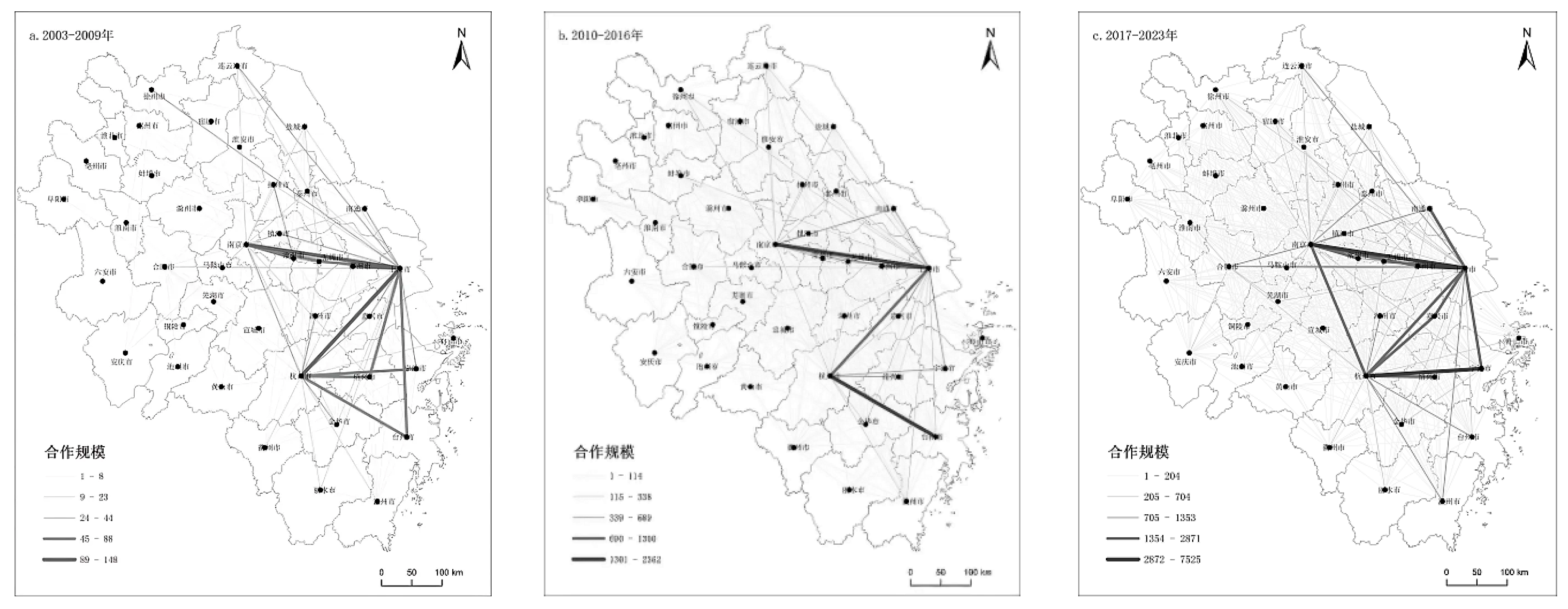
Figure 2.
Single-Threshold Effect of Intellectual Property Protection Levels in the Yangtze River Delta Urban Agglomeration.
Figure 2.
Single-Threshold Effect of Intellectual Property Protection Levels in the Yangtze River Delta Urban Agglomeration.
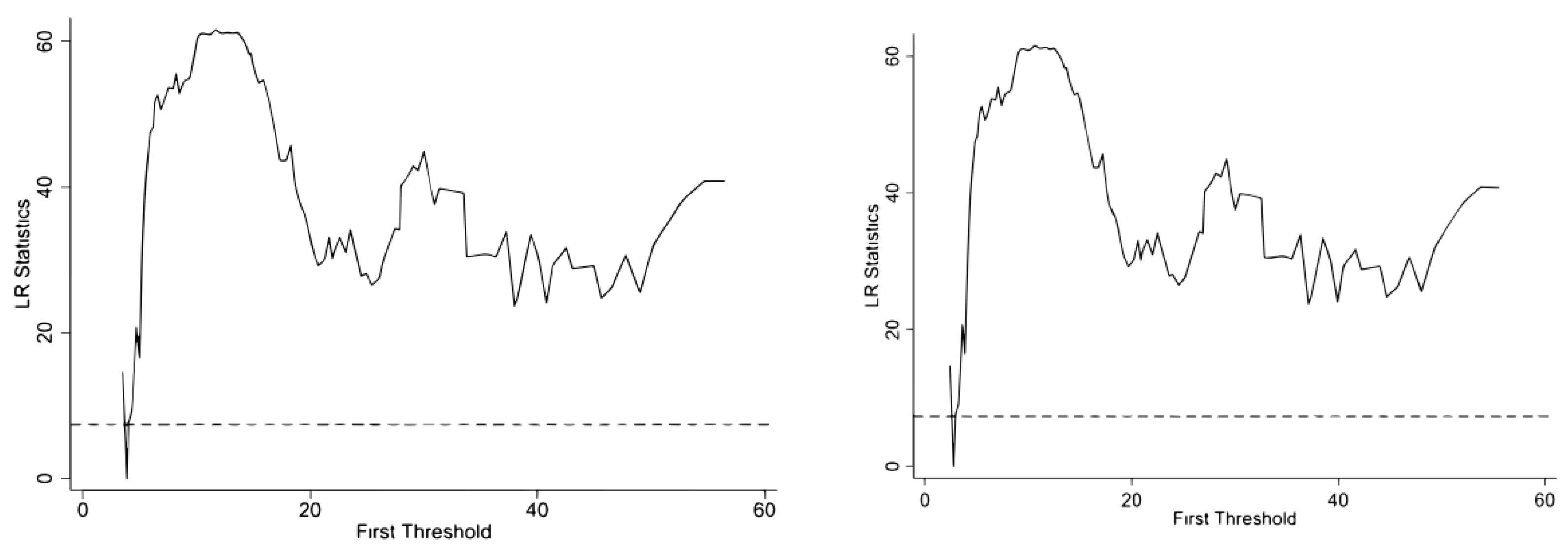

Table 1.
Descriptive Statistics.
| Variable | Observations | Mean | Standard Deviation | Minimum | Maximum |
|---|---|---|---|---|---|
| Innov | 861 | 1.871 | 2.047 | 0 | 8.597 |
| PF | 861 | 8.334 | 1.227 | 5.726 | 12.391 |
| CF | 861 | 13.577 | 1.791 | 8.695 | 17.475 |
| IPP | 861 | 0.291 | 0.438 | 0 | 2.879 |
| pgdp | 861 | 10.782 | 1.185 | 7.847 | 16.793 |
| internet | 861 | 2.843 | 1.123 | 0.27 | 13.623 |
| market | 861 | 9.461 | 1.643 | 5.152 | 13.356 |
| urban | 861 | 0.564 | 0.164 | 0.113 | 0.896 |
| industry | 861 | 0.95 | 0.347 | 0.313 | 3.034 |
Table 2.
Moran’s I Index for Regional Innovation Activities Under Two Weighting Matrices.
| Year | Geographic Distance Matrix | Economic Distance Matrix | ||
|---|---|---|---|---|
| Moran’I | P-Value | Moran’I | P-Value | |
| 2003 | 0.061*** | 0.000 | 0.373*** | 0.005 |
| 2004 | 0.046*** | 0.000 | 0.301** | 0.017 |
| 2005 | 0.049*** | 0.004 | 0.295** | 0.021 |
| 2006 | 0.060*** | 0.001 | 0.282** | 0.031 |
| 2007 | 0.073*** | 0.000 | 0.321** | 0.018 |
| 2008 | 0.080*** | 0.000 | 0.366*** | 0.009 |
| 2009 | 0.067*** | 0.000 | 0.346** | 0.012 |
| 2010 | 0.108*** | 0.000 | 0.391*** | 0.007 |
| 2011 | 0.107*** | 0.000 | 0.393*** | 0.007 |
| 2012 | 0.103*** | 0.000 | 0.444*** | 0.003 |
| 2013 | 0.102*** | 0.000 | 0.394*** | 0.007 |
| 2014 | 0.119*** | 0.000 | 0.410*** | 0.005 |
| 2015 | 0.110*** | 0.000 | 0.458*** | 0.002 |
| 2016 | 0.097*** | 0.000 | 0.356** | 0.012 |
| 2017 | 0.121*** | 0.000 | 0.510*** | 0.001 |
| 2018 | 0.122*** | 0.000 | 0.519*** | 0.001 |
| 2019 | 0.111*** | 0.000 | 0.515*** | 0.001 |
| 2020 | 0.097*** | 0.000 | 0.496*** | 0.001 |
| 2021 | 0.089*** | 0.000 | 0.482*** | 0.001 |
| 2022 | 0.068*** | 0.000 | 0.360** | 0.012 |
| 2023 | 0.076*** | 0.000 | 0.361** | 0.012 |
Standard errors in parentheses:*p<0.10,**p<0.05,***p<0.01.
Table 3.
Spatial Econometric Regression Results.
| Variable | SAR Model | SEM Model | ||||||
|---|---|---|---|---|---|---|---|---|
| Geographic Distance Matrix | Economic Distance Matrix | Geographic Distance Matrix | Economic Distance Matrix | |||||
| Model (1) | Model (2) | Model (3) | Model (4) | Model (5) | Model (6) | Model (7) | Model (8) | |
| Pf | 0.3443*** | 0.2044*** | 0.2370*** | 0.1856** | 0.3485*** | 0.3157*** | 0.3299*** | 0.2886*** |
| Cf | 0.2883*** | 0.1965*** | 0.1805*** | 0.1549*** | 0.2209*** | 0.2072*** | 0.2265*** | 0.2087*** |
| lngdp | -0.1766 | -0.1119 | 0.0285 | 0.0581 | 0.0532 | 0.0583 | 0.0711 | 0.0849 |
| Internet | 0.0876 | 0.0649 | 0.0729 | 0.0722 | 0.0855* | 0.0839* | 0.0822* | 0.0825* |
| Market | 0.1870*** | 0.1672*** | 0.1707*** | 0.1818*** | 0.2163*** | 0.2213*** | 0.2094*** | 0.2165*** |
| Urban | 1.0769* | 0.8658** | 0.8025** | 0.8369** | 0.7692* | 0.7800* | 0.7691* | 0.8054** |
| Industry | 2.0726*** | 1.4943*** | 1.5431*** | 1.4544*** | 1.7618*** | 1.6807*** | 1.7478*** | 1.6733*** |
| IPP | -4.3134** | -3.6182** | -2.4876** | -2.7547*** | ||||
| PF*IPP | 0.2336*** | 0.1911** | 0.1370*** | 0.1520** | ||||
| CF*IPP | 0.1663** | 0.1424* | 0.0995** | 0.1052* | ||||
| rho | 1.2501*** | 1.2582*** | 0.1917*** | 0.1874*** | ||||
| lambda | 2.7369*** | 2.6926*** | 0.1616*** | 0.1536*** | ||||
| sigma2_e | 0.4806*** | 0.4768*** | 0.4568*** | 0.4545*** | 0.4664*** | 0.4651*** | 0.4665*** | 0.4654*** |
| N | 861 | 861 | 861 | 861 | 861 | 861 | 861 | 861 |
| R2 | 0.400 | 0.423 | 0.587 | 0.592 | 0.617 | 0.618 | 0.610 | 0.612 |
Standard errors in parentheses:*p<0.10,**p<0.05,***p<0.01.
Table 4.
Comparison of the Top 10 Cities in Collaborative Innovation Output in the Yangtze River Delta Region.
Table 4.
Comparison of the Top 10 Cities in Collaborative Innovation Output in the Yangtze River Delta Region.
| 2003 | 2016 | 2023 | |||
|---|---|---|---|---|---|
| City Pair | Count | City Pair | Count | City Pair | Count |
| Shanghai City - Hangzhou City | 24 | Hangzhou City - Taizhou City | 255 | Hangzhou City - Ningbo City | 2372 |
| Nanjing City - Suzhou City | 6 | Shanghai City - Ningbo City | 128 | Shanghai City - Suzhou City | 800 |
| Shanghai City - Nanjing City | 5 | Hangzhou City - Shaoxing City | 114 | Shanghai City - Nanjing City | 749 |
| Shanghai City - Wuxi City | 4 | Shanghai City - Yancheng City | 112 | Suzhou City- Hefei City | 731 |
| Nanjing City - Hangzhou City | 4 | Shanghai City - Jinhua City | 107 | Shanghai City - Wuxi City | 610 |
| Hangzhou City - Huzhou City | 4 | Nanjing City - Yancheng City | 89 | Hangzhou City - Jiaxing City | 547 |
| Ningbo City - Zhoushan City | 4 | Hangzhou City - Wenzhou City | 83 | Shanghai City - Hangzhou City | 488 |
| Shanghai City - Nantong City | 3 | Hangzhou City - Ningbo City | 76 | Hangzhou City - Shaoxing City | 405 |
| Nanjing City - Nantong City | 3 | Hangzhou City - Zhoushan City | 66 | Shanghai City - Hefei City | 396 |
Table 5.
Threshold Estimation Test for the Moderating Effect of Intellectual Property Protection.
| Variable | Threshold Type | F-statistic | Critica Values | Bootstrap Repetitions | P-value | ||
|---|---|---|---|---|---|---|---|
| 10% | 5% | 1% | |||||
| R&D Personnel Flow | Single Threshold | 14.022*** | 8.089 | 10.319 | 12.557 | 300 | 0.007 |
| Double Threshold | 3.688 | 7.555 | 9.199 | 11.895 | 300 | 0.537 | |
| Triple Threshold | 3.153 | 9.983 | 11.829 | 17.341 | 300 | 0.733 | |
| R&D Capital Flow | Single Threshold | 12.918*** | 7.572 | 9.189 | 12.835 | 300 | 0.008 |
| Double Threshold | 3.052 | 7.431 | 8.643 | 11.378 | 300 | 0.583 | |
| Triple Threshold | 4.413 | 11.262 | 13.479 | 17.171 | 300 | 0.597 | |
Standard errors in parentheses:*p<0.10,**p<0.05,***p<0.01.
Table 6.
Threshold Regression Results for the Moderating Effect of Intellectual Property Protection.
Table 6.
Threshold Regression Results for the Moderating Effect of Intellectual Property Protection.
| Variable | R&D Personnel Flow | R&D Capital Flow |
|---|---|---|
| Model (9) | Model (10) | |
| Innov | 0.3216** | 0.2779** |
| lngdp | 0.0143 | 0.0305 |
| Internet | 0.0924** | 0.0950** |
| Market | 0.2113*** | 0.2098*** |
| Urban | 0.7533 | 0.7150 |
| Industry | 1.7595*** | 1.7617*** |
| Regime 1 | 0.3559** | 0.2891** |
| Regime 2 | 0.2957** | 0.2059* |
| C | -9.0957*** | -9.1260*** |
| N | 861 | 861 |
| R2 | 0.716 | 0.716 |
Disclaimer/Publisher’s Note: The statements, opinions and data contained in all publications are solely those of the individual author(s) and contributor(s) and not of MDPI and/or the editor(s). MDPI and/or the editor(s) disclaim responsibility for any injury to people or property resulting from any ideas, methods, instructions or products referred to in the content. |
© 2026 by the authors. Licensee MDPI, Basel, Switzerland. This article is an open access article distributed under the terms and conditions of the Creative Commons Attribution (CC BY) license (http://creativecommons.org/licenses/by/4.0/).
Copyright: This open access article is published under a Creative Commons CC BY 4.0 license, which permit the free download, distribution, and reuse, provided that the author and preprint are cited in any reuse.


