

Submitted:
26 March 2026
Posted:
27 March 2026
You are already at the latest version
Abstract
This paper examines the pedagogical and material implications of wax carving in vocational jewellery education through arts practice-led research incorporating arts-based inquiry. The finger ring operates as both material object and conceptual lens, enabling an exploration of sustainability, temporality, and meaning in craft practice. Industry-standard synthetic carving wax—primarily composed of polyethylene—perpetuates environmentally and bodily harmful material cultures when taught as normative technique. Drawing upon six months of studio experimentation, drawing, and reflective practice, Author 1 interrogated what are considered as “ordinary” material use in her practice as a jeweller and jewellery teacher, with Author 2 who is also an artist/educator/researcher working with metals and sustainable practices. Natural alternatives, including beeswax-resin blends and cheese were explored for alternative mould-making. These experiments generated idiosyncratic cast outcomes and expanded creative and pedagogical possibilities. The inquiry reveals a dynamic interrelationship between making, drawing, and teaching, positioning the educator of crafts and metal art as an alchemic mediator who transforms material practice and knowledge transmission. The paper argues for jewellery and sculpture pedagogy that is rooted in practices, fosters material curiosity, ecological responsibility, and reflective engagement, aligning vocational craft and art education with broader sustainability imperatives.
Keywords:
practice-led research
; jewellery education
; sustainability
; wax carving
; drawing
; materiality
; rings
1. Introduction
Lost-wax casting (LWC) remains a foundational process in both jewellery and sculpture manufacture. LWC usually involves modelling an artefact in clay (or other mediums), making a mould around the clay in plaster, silicon rubber or fibreglass . Once this mould is made the clay object is removed. This usually requires splitting open the mould to remove the clay and joining it back up. The empty space where the clay was, is replaced with wax. This becomes a wax replica of the original form. A second mould is usually then made around the wax form that is heat resistant (usually made of plaster or ceramic). The wax is melted out of that mould in a kiln, and the liquified metal is poured into the hollow that was created. Whilst this is labour intensive, it is also quite wasteful of materials.
In many contemporary jewellery workshops, synthetic carving wax, which is often polyethylene-based, has replaced traditional blends of beeswax, resins, and fillers [1,2]. This is due to increased ease of carving this material and compatibility with outsourced casting services. Such materials contribute to microplastic waste and expose makers to petrochemical derivatives [3,4], so are not sustainable.
The two authors of this paper are both artists/crafts practitioners who work with metal and other materials. They also teach and research their practices in different adult education contexts. As a teacher of silversmithing and sustainability within Technical and Further Education (TAFE), Mary (author 1) has conducted this research project inspired by her concern for the polluting practices in jewellery making and increasing trends for jewellery making crafts to be outsourced to casting services. Shelley (author 2) has also observed this as an educator and artist who makes jewellery, mixed media works and relief sculpture. As an advocate of the hand-made she is interested in how metal and other materials can be sourced sustainably, upcycled and how the hand-made generates the qualities of the artefact. As an experienced arts and education researcher she is a critical friend to Mary’s research journey and co-writer.
When teaching in the arts and crafts, students tend to receive material knowledge as authoritative. Jerome Bruner [5] (p. 48) reminds us that learners often accept the “ordinary” as truth; thus, when educators teach unsustainable materials as standard practice, environmentally damaging norms get perpetuated. Mary observes that when students see jewellery makers selling “hand-made” crafted artefacts that are mass produced, or where the making has been outsourced, students can start to accept this as ordinary practice in this craft field. Although jewellery is not the primary driver of global plastic pollution, this paper focuses on Mary’s practice in jewellery making and teaching where she has observed a cumulative impact of millions of wax-carved objects which warrants scrutiny - particularly as Alberghini et al. [6] note, within the broader ecological crisis marked by microplastic contamination.
The two research questions Mary explored in her research were:
- How can wax carving be taught more sustainably and creatively in vocational jewellery education?
- How can educators foster material curiosity within inherited craft traditions?
In addition to rings being one of the forms of jewellery that Mary often teaches in her jewellery workshops, she also creates rings as part of her craft practice. Rings are ubiquitous, symbolically layered, and temporally charged [7,8]. Through arts led research focusing on material experimentation and reflective arts-based inquiry, Mary explored sustainable forms of ring making in both teaching and art practice and as both artefact and metaphor.
- Contextualising this study
We are drowning in a tsunami of plastic that is changing the natural balance of our environment. As Alberghini et al. [6] share, microplastics have been discovered in fish, in our soil and even in our brains. Although not the main culprit of the problem, many jewellers use plastic to make millions of jewellery pieces every day. This research explores the much needed ways to avoid plastic wax used in crafting jewellery. Therefore, the aim of this research project was to explore ways that question what is seen as common practice when teaching jewellery making, to shift towards more sustainable jewellery processes.
When designing this research project, Mary has drawn on multiple experiences, knowledge and practices. She teaches silversmithing and sustainability at TAFE level. Her jewellery and metalsmithing practice spans forty-one years with approximately sixteen years of study. Along with a Degree in Jewellery and Metalsmithing, she has an Advanced Diploma in Jewellery Engineering; a Master of Fine Art; a PhD in Fine Art [9]; and a Diploma of Sustainable Living. Her focus is on making and crafting sustainably with an emphasis on materiality.
As explained earlier, LWC is the jewellery process of pouring molten metal into an investment mould. Usually in jewellery practice, the investment mould is the result of forming plaster or clay around a wax model and burning the wax away. Traditionally, waxes for casting into metals were mixtures of natural waxes, natural resins and fillers such as talcum powder, however, they have been replaced by synthetic waxes [1,2]. Contemporary alternatives to lost wax casting are computer-aided design drawing (CAD). CAD is a computer program that prints and casts three-dimensional (3D) models made from synthetic casting wax, to potentially produce a million-fold multiples of the same piece of jewellery.
Like all chemicals, synthetic casting waxes have their own Safety Data Sheets (SDS) which hold vital information on the safety of hazardous chemicals that are downloaded from providers [10]. The SDS of casting waxes disclose that the main ingredient in the wax used to carve rings is polyethylene wax, which is a common plastic [3]. Plastic is now known to be an insidious synthetic substance that has, among other places, been found in our oceans and in the bodies of our children as discussed by [4].
As a teacher of jewellery and object making for thirteen years, Mary has noticed a reduction in jewellery casting techniques taught. Students are encouraged to carve synthetic wax and send it to a casting service to be cast up in silver without relaying environmental concerns.”
As carving is a reductive process, there is a great deal of waste which can end up in the environment. Carving synthetic wax is also bad for the health of jewellers. However, emerging students are eager to learn how to carve this wax as it is easy to do and clients want to purchase cheap jewellery and bargains. It is therefore seen financially as more lucrative because it allows for multiple castings into metal, while the emerging jeweller feels like they are creating something unique through carving. However, all too often, rows of homogeneous silver jewellery are on view in jewellery galleries and shops that are created using lost wax carving, with the majority crafted from commercial carving wax.
- Sustainability and Jewellery Education
Global policy frameworks increasingly foreground sustainability within education. The Organisation for Economic Co-operation and Development (OECD) and the United Nations Educational, Scientific and Cultural Organization (UNESCO) advocate for environmentally responsive curricula [11,12]. Despite this, Yliniva et al. [13] (p.2) question their values within education, arguing that their personas of ‘OECD’s ‘resilient learner’ and UNESCO’s ‘empathic learner’ may not be as clear cut as one might think.
The main concern for OECD is economic. It claims, on the OECD website, that it seeks ‘to find solutions to social, economic and environmental challenges’, and later states that their core value is to ‘increase the economic and social well-being of our people’ [14,15]. UNESCO [16,17] on the other hand, ‘promotes cooperation in education, science, culture and communication to foster peace worldwide’.
When critiquing the 2025 OECD Education Working Papers, Komatsu et al. [18] suggest that the OECD have improved their portrayal of their environment concerns. According to Komatsu et al. [18], the OECD now see that the environment is central to life, however earlier education papers show that their concerns for the environment were actually about resource depletion [18] (p. 4). The opening paragraph on the Anthropocene in the 2025 OECD Education Working Papers [12], comments on human dominance through technologies. It reveals the prevailing imperialism associated with those over concerned with economic growth rather than care for the environment (p.7).
Critics suggest there are tensions between economic growth imperatives and ecological care [13,18]. The United Nations’ Sustainable Development Goal 12 (Responsible Consumption and Production) is particularly pertinent to jewellery, a field deeply entwined with extraction, resource use, and consumer desire. Within jewellery discourse, some scholars and practitioners argue for ethical and ecological reform [19,20,21]. Organizations such as Ethical Metalsmiths [29] support research into responsible material practices, while university-based initiatives (e.g., Criticalsmiths: Flux at Griffith University) interrogate chemical use in studios.
Australian practitioners have contributed significantly to material re-evaluation. Fiona Hall and Rosalie Gascoigne pioneered sculptural practices using found and recycled materials – a practice that author 2 also engages [22,23]. Contemporary jewellers such as Elizabeth Shaw [24] and Pennie Jagiello [25] engage waste and anthropogenic debris as critical material narratives. Clare Poppi [26] explores sustainability through collaborative recasting of precious metals. These practices collectively challenge dominant paradigms of preciousness and permanence.
- Jewellery education
Despite the developments mentioned above, synthetic wax carving remains largely unquestioned in vocational curricula. CAD and 3D printing are promoted as efficient, low-waste alternatives [27], yet they introduce other ecological considerations, including resin-based printing and digital consumption.
Although making and selling jewellery usually involves an economic transaction, it is the responsibility of jewellery educators to teach a more environmentally conscious practice [19] (p.116); [20,21]; [28] (p.679). Ethical Metalsmiths [29] is an online sustainable jewellery body that teaches responsible jewellery practices. Their goal is for jewellers to become sustainable in their practice for both the environment and humanity. They do this by supporting student research which they host on their website. A committee of jewellery students at Griffith University in Queensland, Australia, run an organisation called Criticalsmiths: Flux. This is based in the Student Committee at Queensland College of Art, 2025 and a project hosted by Ethical Metalsmiths [29]. Their research, undertaken by university students and lecturers, focuses on flux, a compound that is used to keep metals such as silver clean when fabricating in jewellery studios. The students are also supported by Griffith University in their research that is mapping the use of flux with the goal of promoting safer flux use.
As a young jewellery student in the 1980’s, Mary used borax as a flux as it was commonplace. It was bought as a cone and was ground with water in a flattish mortar with the borax cone as the pestle. This was painted it onto work, before soldering. If the cone of creamy liquid was not kept clean, it became harder to solder due to the contaminants. When Mary studied jewellery engineering in the early 21st Century, students were introduced to a commercial flux that was purchased in a plastic jar. Whilst this flux keeps metal cleaner for longer, it was found to be more toxic than borax. Concerningly, this is still used in teaching practice today.
While research at Griffith University involves the safety of chemicals employed in jewellery making, jewellery courses in Kuwait have recently shifted away from noble metals used in jewellery practice. Alayar et al. [30] discuss the move to incorporate what they see as more sustainable materials into jewellery practices. They explore the use of ‘titanium, aluminium, tungsten, and recycled steel’ within the classroom, materials that are commonly utilised in jewellery in America [30] (p. 2). This shift in approach, encourages students in Kuwait to explore existing resources responsibly while expanding creativity [30] (p. 3). Some Australian jewellers and jewellery educators have, and do, explore alternative materials other than traditional metals and stones.
Mary’s own PhD focused on blacksmithing processes and connections to sculpture [9]. She shares: “Australian jewellery researchers such as Elizabeth Shaw [24], Pennie Jagiello [25] and myself, along with my fellow members of Three Bean Mix (a collaboration between myself, Susan Buchanan and Leonie Westbrook) work with alternative materials within our practices. The Three Bean Mix collective uses the vegetable can as a starting point to make jewellery and objects - interrogating societies’ throw-away culture, through the norms associated with jewellery practice”.
Elizabeth Shaw’s PhD [24] drew upon treasured objects that had broken to create new narratives within a jewellery context. The foundation of her work is the idea of the motainai, ‘a regret over waste’ (p.57). Pennie Jagiello [25] works with discarded materials found on the shorelines of Australian beaches or in Australian deserts, incorporating these materials within her work. While both makers explore environmental impacts of human debris, Jagiello’s aim is to reveal the impact on the natural world. Each of these artists discuss how their sustainable arts practice-led research, and artist’s role within their research, offers opportunities to provoke and teach.
Another Australian artist whose practice is concerned with the environment is that of Clare Poppi. Within her Masters, she melted and cast the same pieces of silver and gold repeatedly to create new works for different wearers to explore ideas of collaboration between jewellers and wearers [26]. Poppi used lost wax processes to cast her jewellery objects involving the injection of plastic wax into silicon moulds before making a plaster shell, melting out the wax and pouring the metal into the hollow made by the wax.
2. Materials and Methods
Mary employed an arts practice-led methodology and incorporated arts-based inquiry with Shelley as critical friend in this research project. Schön reminds us that to teach ‘knowing-in-action to someone else’ we ‘must first discover’ what we do ‘when confronted with a situation of a particular kind’ [31] (par. 30). This knowing extends to how we make choices that recognize and judge matter [31] (para. 27). Schön evokes John Dewey’s concept of inquiry stating that it begins with a problem or uncertainty [31] (par. 36). Mary chose this methodology, guided by the expertise of Shelley as an arts-led and practice research scholar. Arts practice-led methodologies were seen as the only way to explore sustainable wax carving as, a practice-led approach to research, is to physically work with the mediums involved. Tacit knowledge is understanding material, as Barbara Bolt [32] explains.
- Drawings
Barberis [33] (p. 78) reminds us that drawing is a ‘cultural conduit for articulating the transformation of meanings and experience, a cultural lens through which to view complexities of human endeavour and the environmental, social, political and economic forces of globalization’. Drawings became an important thinking and reflection tool for Mary. Over the course of six weeks, when researching wax carving for teaching purposes, she drew around her notes using water-colour pencils, paintbrush, paint and pen. She drew into an A5 sketchbook that she had made for this purpose. The point of working in A5 size was so that she could carry the research with her everywhere. Writing over the drawing was encouraged by Shelley, adding layers of tiny thoughts to create drawings that were richer in meaning but also more mind map than drawing.
Mary explains: “An example of this was my drawing (Figure 1) created to understand a ring that I was working on in wax. I painted around this drawing seeking form and colour. It began to take shape as a landscape with a monumental sculpture in the centre. In the drawing I saw water, sand coloured earth and mountainous forms in the background. Jewellers and object makers move their object in their hands so that they can view all sides [9]. When creating something small, I understand that jewellers and object makers see what they are looking at and all else is in peripheral vision. For the jeweller or sculptor of small objects, it is as if the small object they are viewing is monumental. This also occurs when walking and an object catches the eye. All that can be seen is that object: shell, bark, flower, stone. As I layered imagery and words over the drawing (see Figure 2), I found that the mountains became fire, the sculpture was air, there was water and earth. The image became a drawing not only of scale but also about making, historical metal work and its links to magic. I found a multiplicity of meaning within it.”
3. Results
In arts practice-led research findings emerge in and through the process of creating. Mary’s material experimentation included carving commercial blue synthetic wax, carving beeswax, mixing beeswax with pine resin and small quantities of oil, testing natural resins such as river redgum , shellac , and fabricating silver rings from scrap without flux. This process emphasised tacit knowledge [32] and embodied engagement with material behaviour.
Layered drawings and annotated mind maps exposed contradictions in terms of jewellery making, sustainable imperatives as well as crafting jewellery versus mass production. The economic framing of sustainability agendas became clearer. Reworking these maps—scribbling, colouring, redrawing—generated deeper insight for Mary about the field of crafts and contradictions between the value of the hand made and sustainable practices versus cheaper, more polluting practices and outsourcing. Drawing, making, crafting, teaching and researching became interchangeable reflective acts.
Three silver rings fabricated from scrap emerged. Forged and fused without flux, they produced no lemel (filing waste) and required minimal consumables. Their immediacy contrasted sharply with reductive wax carving. The process felt conversational rather than extractive, emphasising responsiveness over mastery. For example, Mary mused on silver itself as being symbolically lunar, associated with wisdom and hope, as Tresidder also noted [34]. Thus, there was a realisation that sustainability extends beyond wax to broader material economies.
- Sustainable practices of using wax
Lost wax casting has been practiced from 3rd Millennium BC on every populated continent except Australia [2] (p.67). The wax used for casting has changed over time from the use of beeswax and resin utilised in the beginning of wax casting to synthetic waxes used today. Further advancement in casting has included CAD design and 3D printing. CAD and 3D printing are argued to be the sustainable alternatives when making jewellery as it is accurate, there is less waste, and it is fast. Zheng and Chang [27] consider that CAD design is the future of jewellery manufacture. They argue that consumer desires are becoming increasingly fast paced and that CAD and 3D printing are the answer by providing fast service with less waste. They further claim that their software, a system that teaches jewellery to enable students and teachers to connect through computer systems, are more efficient ways to teach [27] (pp 47-48).
Whilst carving with commercial carving wax or working in CAD can be efficient, they are uninspiring. The homogeneous blue surface of the waxes used resist sensorial engagement. As the blue polyethylene wax is carved it generates significant plastic waste, much of which enters landfill or leaches into the environment. Experimenting with beeswax alone it was found to be too soft for detailed carving. Kuhtz [36] advises that adding pine resin marginally increased hardness, aligning with historical accounts of natural wax mixtures. The domestic act of melting and mixing wax evoked Renaissance alchemy, recalling descriptions in On Divers Arts and the autobiographical accounts of Benvenuto Cellini.
Mary found that carving natural wax allowed portability and reduced environmental concern. A pocketknife sufficed. Freezing the wax intermittently stabilised the material for carving. Though structurally imperfect in wax, the cast outcomes were distinctive and less predictable than synthetic counterparts. “An accidental carving of parmesan cheese underscored the exploratory ethos of the project. Although not cast, the episode highlighted institutional constraints and risk aversion within outsourced casting services.”
- The Ring as Temporal Object
Mary created rings. As a piece of jewellery on a finger, the ring is never still. It accompanies the hand in conversation and is layered with symbolism [7] (pp 6-7). Traditionally, a ring is a band of precious metal that is worn on the finger. For Williams Shakespeare it was the ring Juliet sends to Romeo as a token of her love: ‘Give this ring to my true knight’ [37] (p.114). Smith noted that Romeo finds it as a memento mori upon hearing of her death [8] (p.86). Although it is difficult to tell if the ring involved was the same one or different, it seems that Shakespeare understood the complexity involved in its meaning.
Although symbolic of eternity [34] (p.414), Smith notes that the ring can be understood in its temporality [8] (p.87). Smith states that rings, and in this case, Romeo and Juliet’s rings, are polychronic [8] (p.77) as they not only evoke the moment of a promise but also of the time to come. An engagement ring, for instance, conjures an upcoming wedding day of pomp and ceremony, the wedding ring heralds time spent together as well as time lost at death or divorce.
For the jeweller, the ring is a staple in their stock-in-trade. There are always weddings, engagements and birthdays to celebrate. There is always an excuse for another ring. Signet, cocktail, friendship and statement rings are amongst other rings that jewellers are requested to make as signals of life lived. The circular band that describes our fingers are an opportunity for cultural exchange. They are a public display of our private life.
The ring was chosen for this project because rings are familiar to almost everyone while layered in meaning and culture. In the past, Mary had made her own platinum wedding ring: “It is the second that I have made myself after I had lost the original one that my husband made and gave me. I always wear it except when I am making jewellery. Alongside my wedding ring, I wear a sapphire in white gold, a swap with an alumnus; and a series of rings on the other hand that are interchangeable but are my best friends for a period. All of these rings rest in one place and I put them on in the morning before I walk out the door, and take them off when I walk in”.
- Materiality
The metal that the ring holds can be felt as weight in the hand. When imagining Juliet’s ring, was it gold? Tradition suggests that it was. Tresidder notes that gold is a noble metal that is heavy and, symbolically, expresses the divinity of the sun [34] (p.209). Silver is also a noble metal that is more accessible due to its price. Silver, symbolically, is the moon, feminine. It is hope and wisdom [34] (p. 441). Silver is also an endangered material as discussed by Sverdrup, Koca and Ragnarsdottir [35].
Mary explains: “Through fabrication, I created three silver rings at the commencement of the research (Figure 8). When I create, I engage with material that is at hand or is needed for a particular application. I fabricate and forge jewellery and objects which are adding and modelling processes [36] (p.69). The three rings have become the baseline to this research. At the time that I fabricated them, I was carving a blue wax ring and craved a respite. Silver pieces were sitting around waiting to be added to scrap including little sections of silver that were splatters from a failed ingot pour. Spatters of molten silver had been poured through steel mesh creating tiny spikes. I bent the silver and heated them until they fused together, adding the silver spikes to the top at the same way. Within half an hour, I had made three unique rings from scrap. There was no waste when I made them, no leftover lemel (tiny pieces of silver left over from filing), no wasted emery paper. No flux was needed to keep the metal clean.
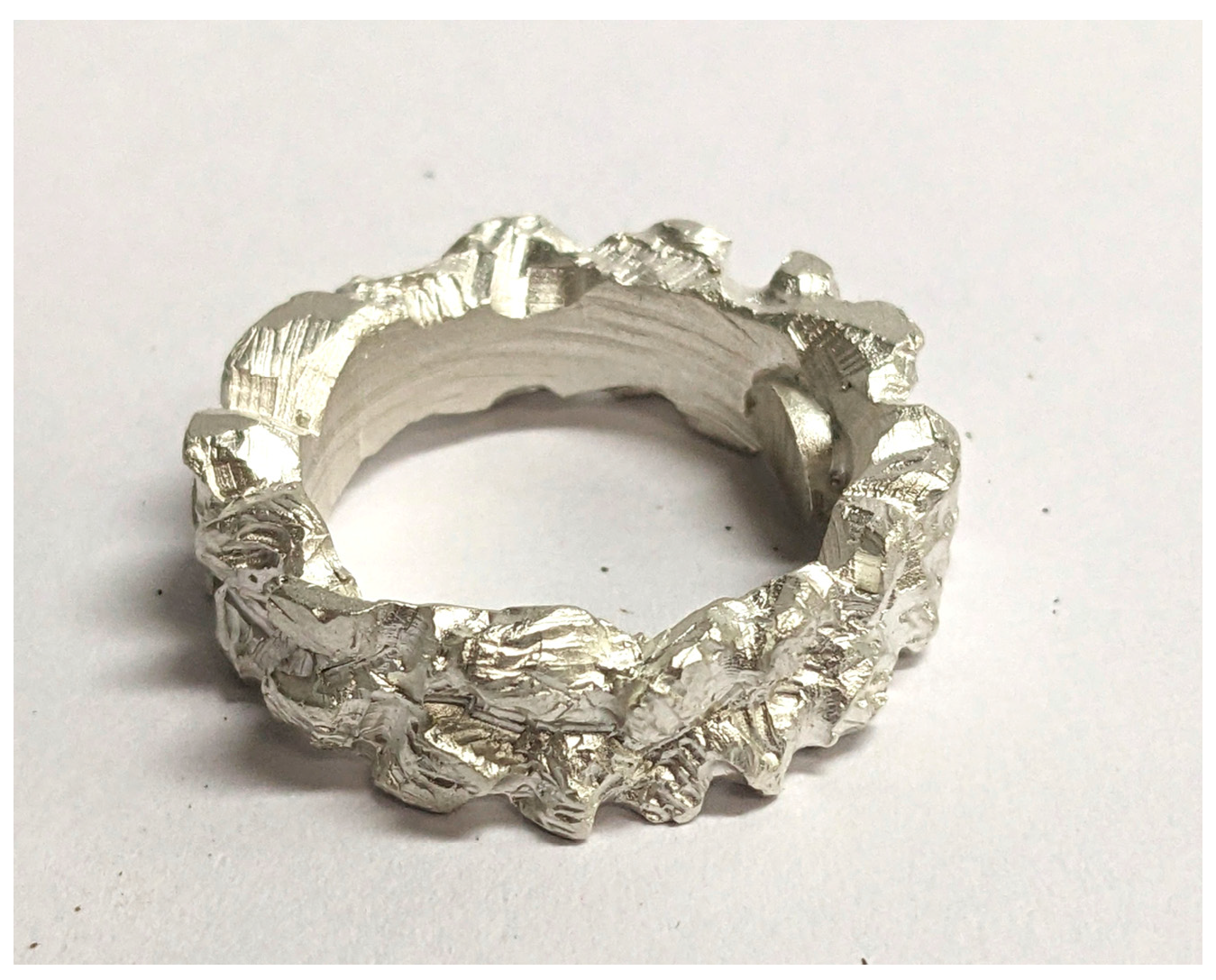
Making the three silver rings (Figure 3) was an immediate sensorial experience. In their creation, I did not feel that I was trying to master the material but rather, I was conversing with the silver, enjoying how it moved when heated. These rings are solidified space for two reasons. They echoed the form of the finger, which is what all rings do, further, their spikes, sharp and dangerous much like Tsunami (Figure 6), were tops inadvertently poured through holes in steel mesh and solidified as they cooled.
- Waxing Lyrical
One way of creating a wax model for lost-wax casting is modelling with soft wax [36] (p 71). In his autobiography, the Sixteenth Century silversmith, Cellini, (1500 –1571) wrote of wax:
I had already made three little figures of gold in the round, about a palm high ……. representing Faith, Hope, and Charity. To these I added in wax what was wanting for the basement of the cross. I carried the whole to the Pope, with the Christ in wax, and many other exquisite decorations which gave him complete satisfaction [36] (p 45)
This is not a complete description of how the figures were made back then; however, it seems that at least some of the modelling made in wax was molten and poured into a plaster cast [36] (p.67). Later Cellini described ‘the waxen model produced so fine an effect, that when the duke saw it and was struck with its beauty’ [38] (p.113) therefore the wax that he used could take on a great deal of detail. This is also borne out in later exchange with the wife of Messer Gismondo who had asked if he could set a stone in a jewel that she showed him. He sketched the jewel and later made a model of it out of wax to show what it would look like with the stone set. Later he discusses making models of buildings from wax or pencil, and portraits including a saltcellar and other objects [36]. According to Kuhtz making models in wax was commonplace, and indeed crucial within the creative process of sculpting objects or jewellery [36] (p. 34). At one point, Cellini’s waxes were mocked with the accusation that wax was easy to work in and that it is harder to work in gold [36] (p. 36).
Wax carving, the process that is of concern here, utilises a reductive method of making (carving or cutting away material) [36] (p.69). It is a process used when carving in wood. As drawing and carving were undertaken within the timeframe of this paper, the silver outcomes resemble the drawings.
- Lost Wax Casting
The book, On Diverse Arts: The Treatise of Theophilus holds the oldest known description of lost wax casting [39]. In his autobiography, Cellini describes his lost wax casting process of a large sculpture. The firepit was built with bricks and the fire itself was stacked. It burned until the wax in the mould burnt out [38] (p. 113). Cellini then lowered the mould of the Perseus sculpture into the pit. After a wait, there was an explosion and the metal spewed out from the furnace. Somehow, the metal had stopped flowing into the mould which caused some solidification to the top section of the pour. Cellini had his men melt his pewter plates and pour it into the mould, causing the metal to flow well again. When he saw that all was well, he shouted:
Oh God! Thou that by Thy immeasurable power didst rise from the dead, and in Thy glory didst ascend to heaven! Even thus in a moment my mould was filled; and seeing my work finished, I fell upon my knees, and with all my heart gave thanks to God [38] (p.114).
In Cellini’s Blood, Cole [40] explains how Cellini likened the molten metal flowing to blood flow. Although Cellini’s descriptions seem metaphoric of life force rather than believing it to be blood, Cole argues that Cellini would be well versed in the philosophies of the time.
- Blue wax
In Untracht’s book, Jewelry concepts and technology, [41] the waxes for casting are described as dental wax. They are made up of natural and chemical waxes as well as other ingredients. Oppi, as the book is affectionately called by jewellers, is the bible of jewellery techniques. As such, it is understandable that jewellers assume the position of synthetic wax being the wax to use.
The wax itself lacks character and has limited use (Figure 4 and Figure 5). It is uninspiring as a material and even though it is easy to carve, it cannot be used for anything else and therefore, does not foster real experimentation.
Mary writes: it is not a material that I like to teach as it not really a material to wax lyrical over”.
Figure 4.
Tsunami, 2025, synthetic wax, burr and waste.
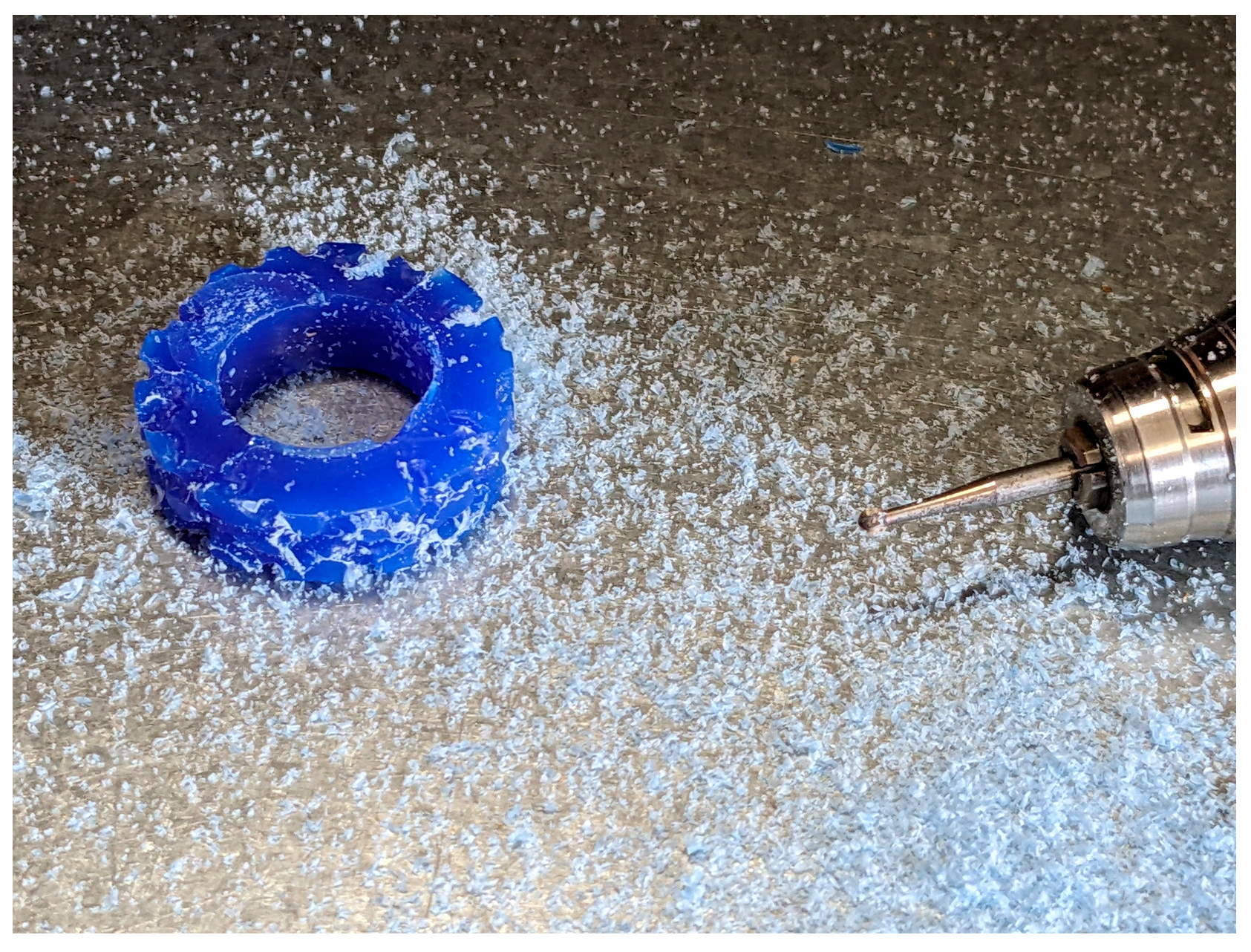
Figure 5.
Tsunami, 2025, synthetic wax.
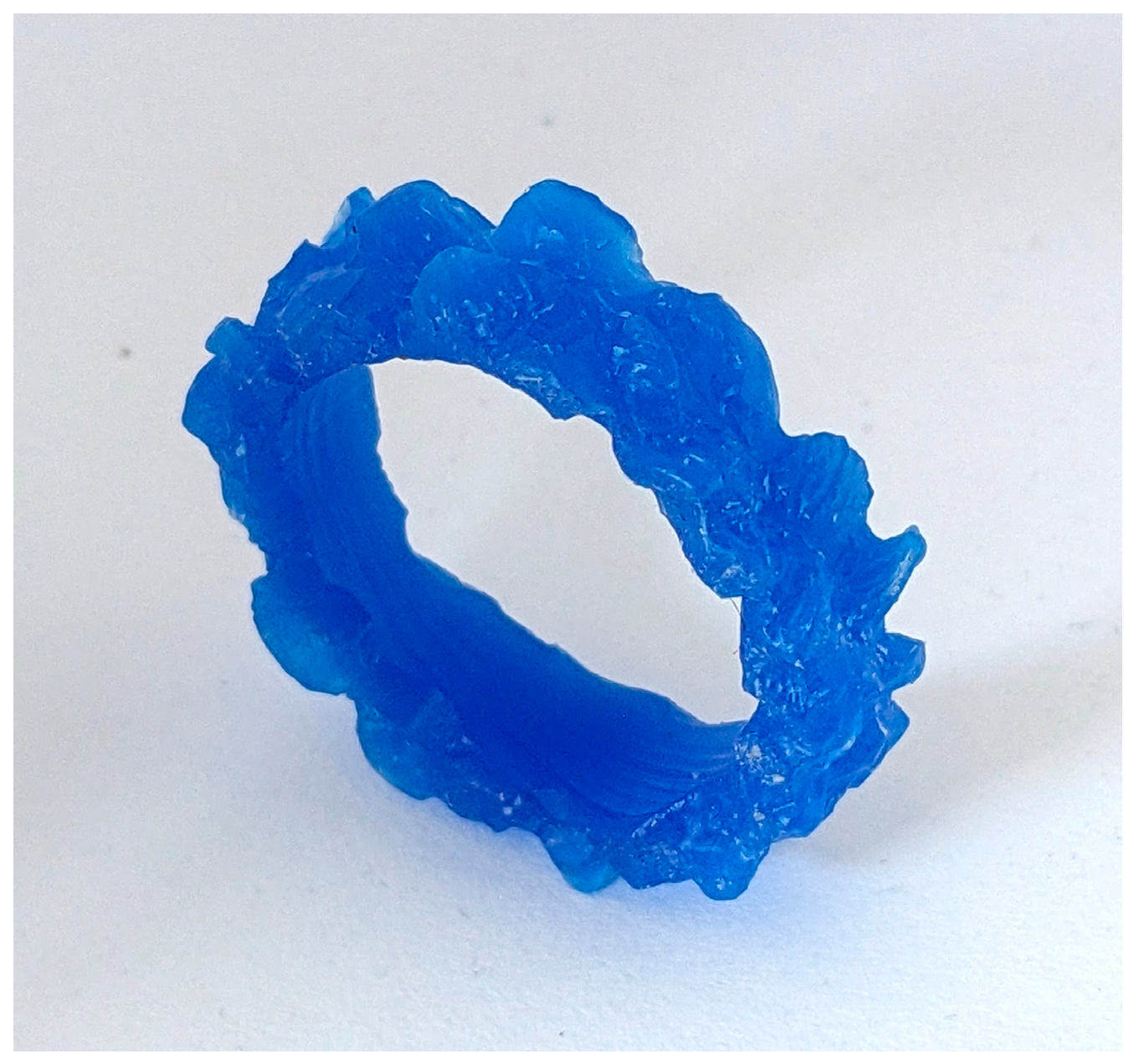
Figure 6.
Tsunami, 2025, sterling silver.
- Recipes
The book On Divers Arts: The Treatise of Theophilus, is the oldest known manuscript that discusses jewellery practices. In this book, Theophilus mentions wax on numerous occasions [39]. He does not, however, mention the wax mix that he uses for processes. Cellini [38] on the other hand formed intricate detail in his work. When he was imprisoned, he was able to work with gold, silver and wax as he ‘took to modelling in wax some little figures of my fancy, for mere recreation’ (p.72). His tools were ‘certain little wooden instruments employed in working wax’, although there is no mention of wax recipes [38] (p. 77).
Mary chose to focus on carving wax, as the residue is a waste generally sent to land fill and she was not convinced that makers always understand the implications for their own health and the health of the environment. Carving differs from modelling or fabrication. With modelling, material is manipulated to shape a form while fabrication builds a form through addition of materials. Carving subtracts material to reveal the intended form [36] (p. 69). To achieve this, a great deal of material is wasted in the process as witnessed in the blue wax carving above (see Figure 4). As wax has been part of the creative process for centuries, it seemed reasonable to Mary to seek out older recipes and try to make her own.
- None of Your Beeswax
Beeswax is used in jewellery making for several reasons but mostly to keep sawblades smooth and drill bits and burrs cool when drilling holes and engraving into metal. Although it is soft and malleable, Mary carved a piece of beeswax into a ring (Figure 7). In the past, she has had beeswax objects cast, however, they were moulded into form.
Figure 7.
Beeswax ring, 2025.
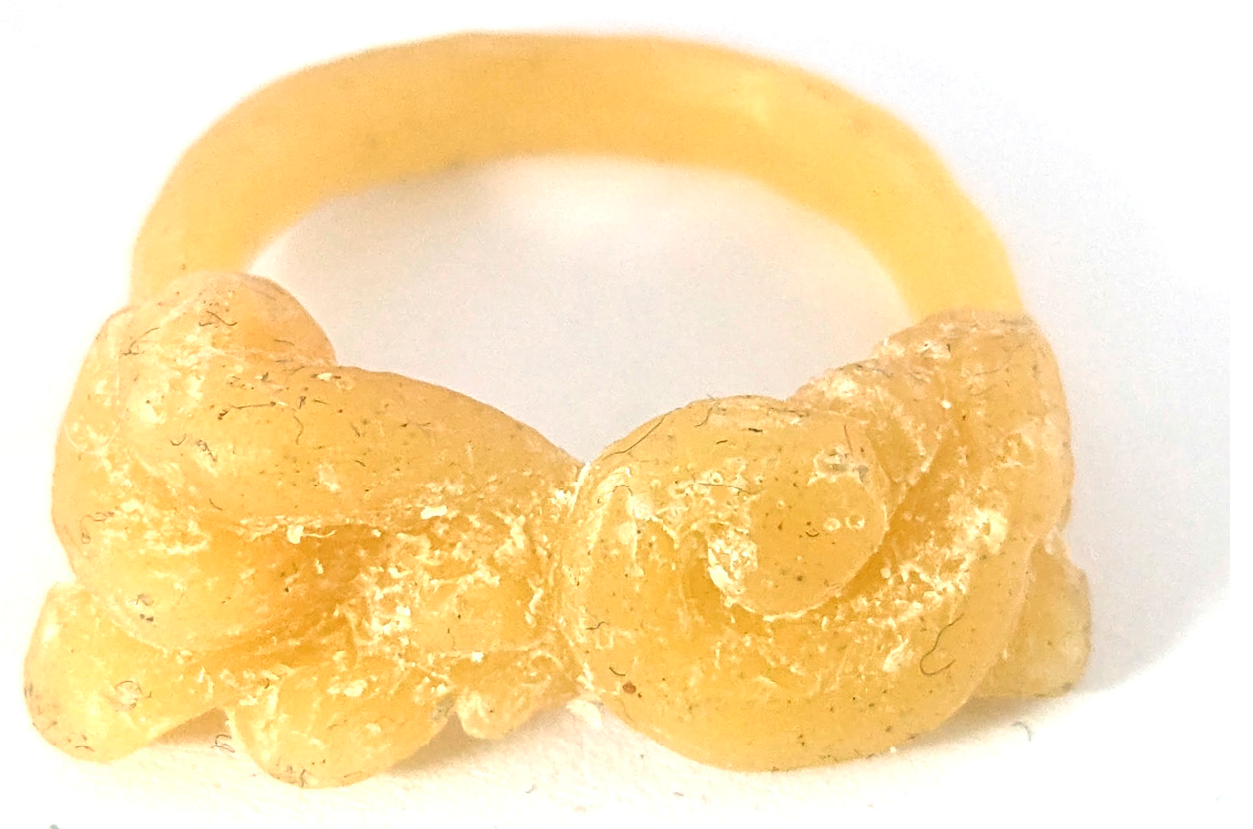
Figure 8.
Beeswax ring, sterling silver, 2025.
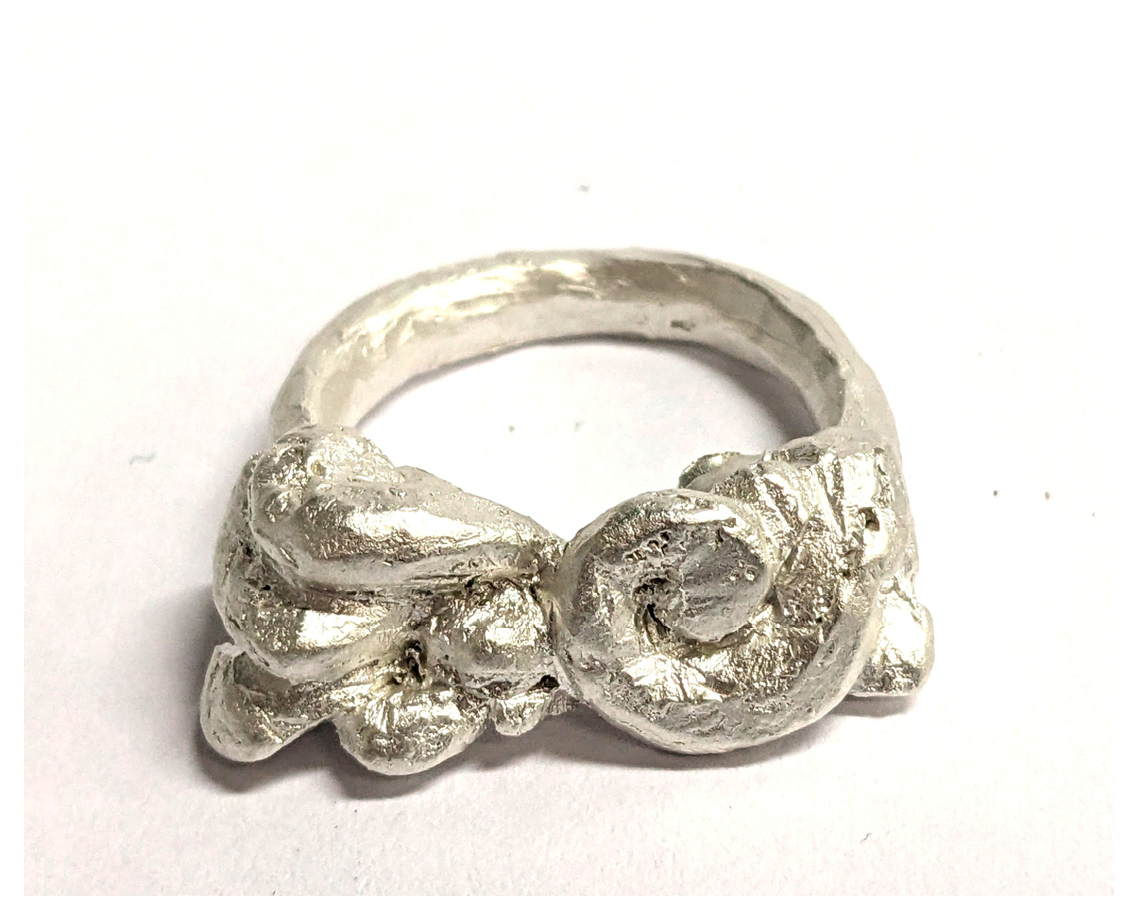
As the beeswax was not so structurally sound for carving, Mary experimented with a recipe of 20g of beeswax to 2g pine resin with just a touch of vegetable oil. The beeswax was heated until molten, then the resin was added while she stirred gently. As it was only a small test, Mary did not use a double boiler which would have been safer. In a larger sample, this would be imperative.
Mary had found that this process felt equally domestic and magic. Writing down the recipe, using scales and cutting wax like butter felt to her like she was baking a cake. Simultaneously, the process was alchemic, and she was transported to the Renaissance where alchemists were the font of knowledge and respected by church and state.
To make what Mary had hoped to be a harder wax, she began mixing batches with incrementally more resin. She also tried to add river redgum tree resin and shellac. Neither the redgum resin nor the shellac mixed with the wax.
- Slivers
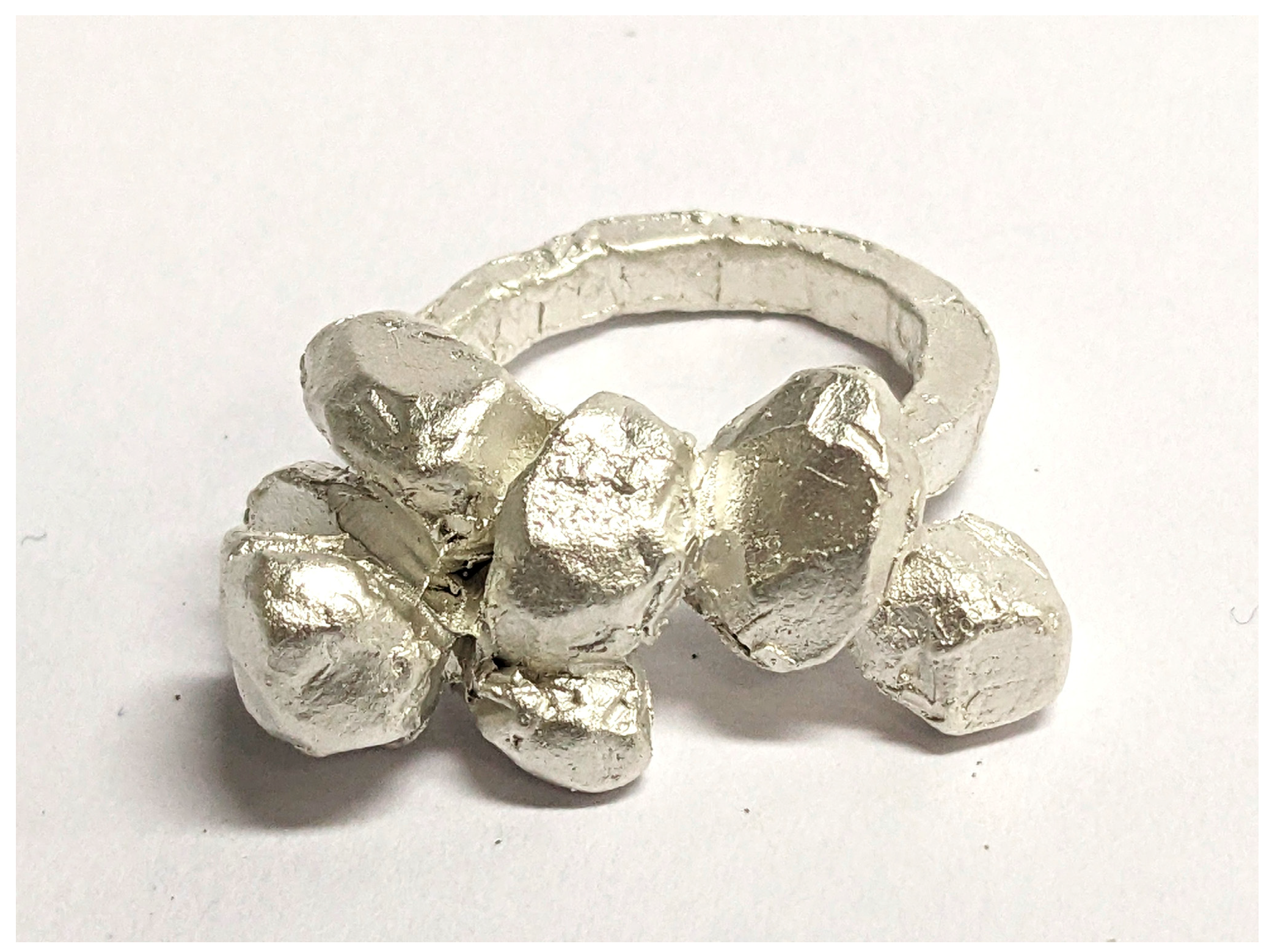
Adding pine resin improved the beeswax only marginally and only when using small quantities (which is concurred by Tarkanian [42] (p 41). Unlike when carving the blue wax, Mary was able to sit at home to carve the natural wax. This process is portable as natural wax is not a danger to soil. A pocketknife, rather than traditional jeweller’s tools, was used to carve the rings and they were brought in and out of the freezer periodically to keep the wax firm. Lessons in teaching showed up in these instances, as learners are not requiring the trappings of high technology, tools or benches prescribed by many in the industry.
The rings that Mary carved were taken from natural forms. They also correlated with her drawings, without overthinking design. Creativity takes charge and work flows from the drawing without prompting. Barberis explains that a ‘drawing carries the artist’s intentions and visual knowledge succinctly’ [33] (p. 79). This allows for insightful understanding that is translated into the work that we make.
Figure 9.
Little Fluffy Clouds, 2025, bees wax and pine resin.
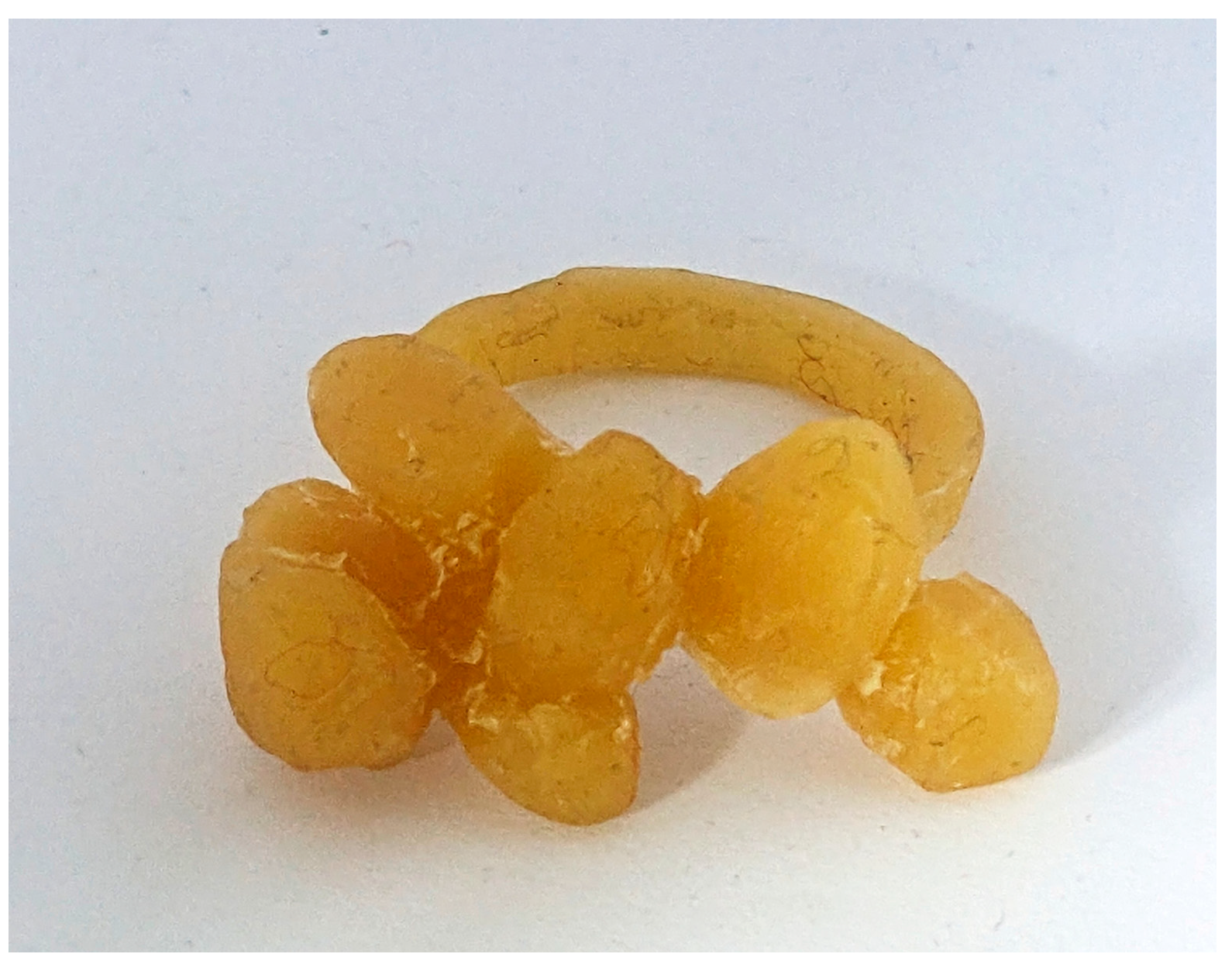
Figure 10.
Little Fluffy Clouds, 2025, sterling silver.
- Parmesan
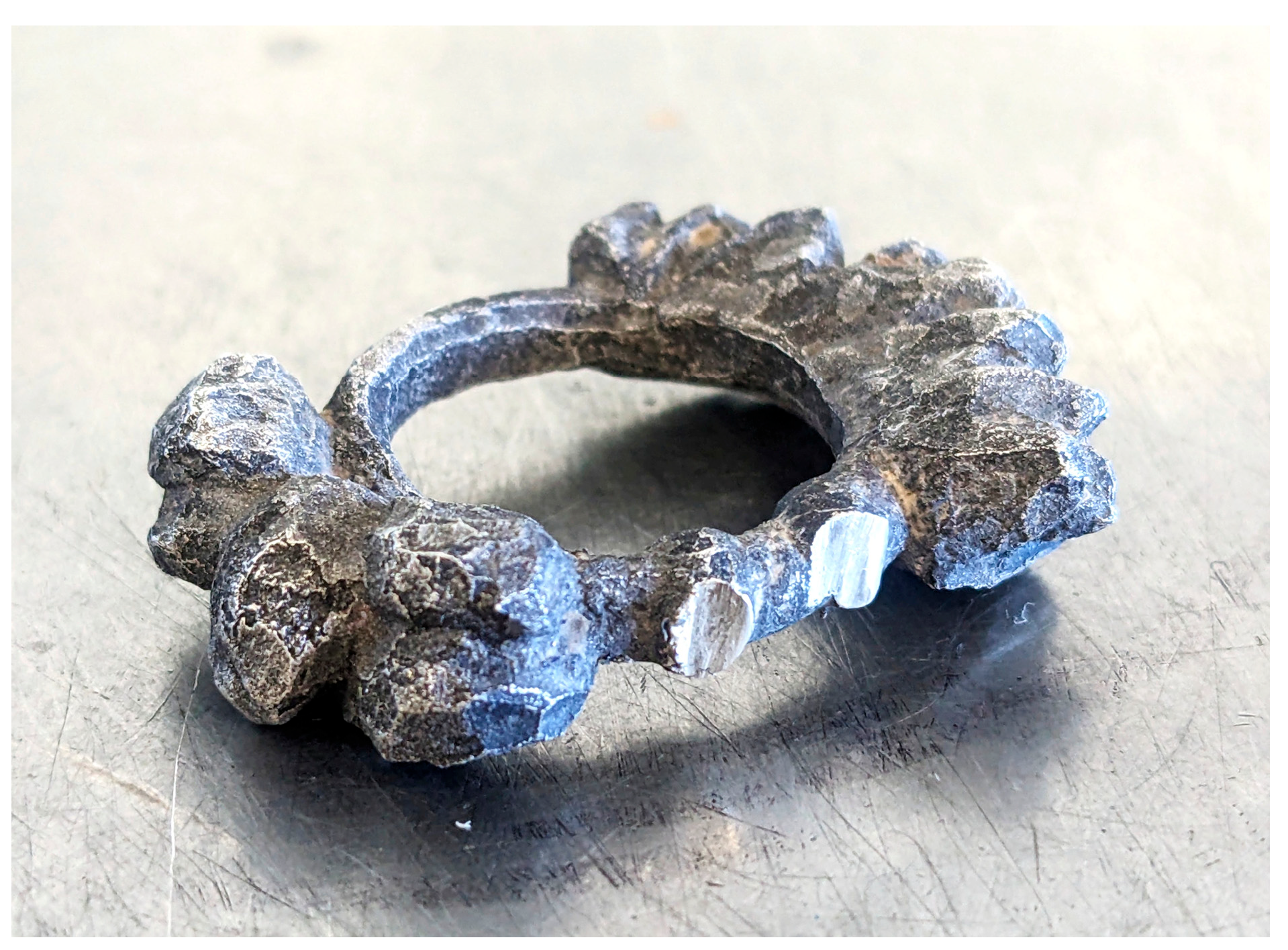
Reaching into the freezer to grab beeswax, Mary accidentally grabbed a piece of parmesan cheese instead and preceded to carve it. It did not take long to discover the mistake that was made. The parmesan cheese was a pleasure to carve, and the completed carving showed a high level of detail. This accidental carving of parmesan cheese underscored the exploratory ethos of the research project and the focus on materials and materiality. The episode highlighted institutional constraints, and risk aversion within outsourced casting services as there was a problem with casting the parmesan cheese ring. The casting company refused to cast it as they had never cast cheese before and questioned whether it would burn out cleanly enough for the metal ring to show the same detail. Casting the ring was undertaken by a teacher who was experienced in casting and adventurous enough to do the work (see Figure 11 & Figure 2).
- Discussion: The Alchemic Teacher
An important addition to the experiments with making through the practice led research, was that Mary was conducting this research whilst teaching jewellery making, each week. Influences and insights from practice into teaching, for many artists and crafts practitioners are common, but also must often be adapted and adjusted to suit the curriculum or levels of ability of student cohorts. This important aspect of practice for artists and craftspeople is important to acknowledge. The sharing of the insights from this study might be of use to other educators who are also teaching and practicing in the various fields of arts, crafts and technology education (textiles, woodwork, metal work etc.). When teachers can engage in the kind of research that Mary has shared in this paper, they may also be able to provide their students with more opportunities for making as inquiry, rather than replication. In doing so, with sustainable knowledge and awareness, alchemical transformation can occur—not just an alchemical transformation such as base metal into gold, but of habit into consciousness.
Thoughts, processes and realisations from arts-practice led research and arts-based inquiry have been shared in this paper. We have shared how the sustainable teacher mediates between inherited technique and emergent ethical consciousness. By questioning the ordinary practices, ordinary materials and ordinary craft processes and artefacts, the art and craft educator can disrupt cycles, of unexamined practice and prescriptive ways of teaching.
Whilst a definitive ecological substitute for synthetic wax did not result, the project yielded enhanced awareness of material agency and expanded creative potential through idiosyncratic wax blends, and even cheese! It was realised that sustainable jewellery practice requires more than material exploration and substitution. It demands fostering curiosity, criticality, and willingness to experiment.
5. Conclusions
In jewellery making, when casting rings, it has become industry standard to use synthetic carving wax as it is easy to carve. It is not the best choice for the health of the planet, nor that of jewellers. Students treat the knowledge that teachers deliver, as truth and there, the problem of ‘ordinary’ [5] (p.48) material use, is perpetuated. The blue synthetic wax is a case in point.
Synthetic carving wax persists as an industry norm due to efficiency and economic logic. Yet uncritical transmission of these kinds of harmful materials perpetuate un-sustainable craft and art practices, and ecological harm. Through arts practice-led and arts-based inquiry, this research has demonstrated that sustainable alternatives—while imperfect—can invigorate creative practice for this craft field and other arts, craft and technology fields. It can also encourage approaches to teaching that are kinder to the planet.
The rings and the drawings emerge as intertwined temporal forms, embodying multiplicity of meaning. In teaching, making, and reflecting through drawing, knowledge can transform. The alchemic teacher as Mary has demonstrated in this study, does not merely transmit technique but catalyses material awareness.
As noted earlier, this study took place over 6 months. Further longitudinal research would be useful to test natural wax formulations in classroom contexts and to evaluate student responses. Nevertheless, this study affirms that sustainable jewellery education begins not with perfect materials, but with reflective practice and the courage to question the ordinary.
Author Contributions
Conceptualization, Mary Hackett; methodology, Mary Hackett and Shelley Hannigan; formal analysis, Mary Hacket; investigation, Mary Hackett; data curation, Mary Hackett; writing—original draft preparation, Mary Hackett; writing—review and editing, Shelley sha and Mary Hackett; visualization, Mary Hackette; supervision, Shelley Hannigan. All authors have read and agreed to the published version of the manuscript.” Please turn to the CRediT taxonomy for the term explanation. Authorship must be limited to those who have contributed substantially to the work reported.
Funding
This research received no external funding.
Institutional Review Board Statement
Not applicable.
Data Availability Statement
As this was practice led based on craft processes, and data is shown and discussed in this paper there is no additional data to provide.
Acknowledgments
The authors have reviewed and edited the output and take full responsibility for the content of this publication.
Conflicts of Interest
The authors declare no conflicts of interest.
Abbreviations
The following abbreviations are used in this manuscript:
| LWC | Lost Wax Casting |
References
- McCreight, T. Practical Casting; Brynmorgen Press: Boylston, MA, 1986. [Google Scholar]
- Krendlinger, E. J.; Wolfmeier, U. H. Natural and Synthetic Waxes: Origin, Production, Technology, and Applications; John Wiley & Sons: Hoboken, NJ, 2022. [Google Scholar]
- Freeman Manufacturing & Supply Company. 2022. “Safety Data Sheet: Ferris File-A-Wax, Blue.” May 30. freemanwax.com.
- Pettoello-Mantovani, M.; Bali, D.; Giardino, I.; Pop, T. L.; Sevketoglu, E.; Konstantinidis, G.; Pastore, M.; Vural, M. The Risk from Widespread Micro- and Nano-Plastic Contamination on a Global Scale and the Threat to Children’s Health. The Journal of Pediatrics 2025, 280, 114512. [Google Scholar] [CrossRef] [PubMed]
- Bruner, Jerome. Acts of Meaning; Harvard University Press: Cambridge, MA, 1990. [Google Scholar]
- Alberghini, L.; Truant, A.; Santonicola, S.; Colavita, G.; Giaccone, V. Microplastics in Fish and Fishery Products and Risks for Human Health: A Review. International Journal of Environmental Research and Public Health 2023, 20(1), 789. [Google Scholar] [CrossRef] [PubMed]
- Ebendorf, R. 2004. “Introduction: 1000 Rings.” In 1000 Rings, edited by M. Le Van. New York: Lark Books/Sterling Publishing Co. 2004.
- Smith, J. S. The Ring as an Object Lesson in Temporality and Genre in Romeo and Juliet. English Literary Renaissance 2019, 49(1), 74–93. [Google Scholar] [CrossRef]
- Hackett, M. 2019. Forge, Fire, Quench: Transposing the Transformative Processes of Traditional Blacksmithing into Contemporary Sculptural Practices. PhD diss., RMIT University. [CrossRef]
- Safe Work Australia. 2025. “Safety Data Sheets.” Australian Government. safeworkaustralia.gov.au.
- UNESCO. 2017. Education for Sustainable Development Goals: Learning Objectives. Paris: United Nations Educational, Scientific and Cultural Organization. [CrossRef]
- White, P. J., N. M. Ardoin, C. Eames, and M. C. Monroe. 2023. Agency in the Anthropocene – Supporting Document to the PISA 2025 Science. OECD Education Working Papers No. 297. [CrossRef]
- Yliniva, K.; Bryan, A.; Brunila, K. ‘The Future We Want’? – The Ideal Twenty-First Century Learner and Education’s Neuro-Affective Turn. Comparative Education 2024. [Google Scholar] [CrossRef]
- OECD. 2025a. “About the OECD.” Accessed September 18, 2025. oecd.org. 2025a.
- OECD. 2025b. “The OECD: Better Policies for Better Lives.” Accessed September 18, 2025. oecd.org.
- UNESCA. 2025. “The 17 Goals.” United Nations, Department of Economic and Social Affairs. Accessed September 21, 2025.
- sdgs.un.org.
- UNESCO. 2025. “UNESCO in Brief.” Accessed September 18, 2025. unesco.org.
- Komatsu, H.; Rappleye, J.; Silova, I. The OECD’s Shift toward Environmental Sustainability: Assessing the Agency in the Anthropocene Report. 2025. [Google Scholar] [CrossRef]
- Mowafi, O.; Al-Hasan, M. Sustainability in Education. In Sustainable Horizons for Business, Education, and Technology; Alshurafat, H., Hamdan, A., Sands, J., Eds.; Springer: Singapore, 2024; pp. 115–134. [Google Scholar] [CrossRef]
- Machado, L.; Goswami, S. Marketing Sustainability within the Jewelry Industry. Journal of Marketing Communications 2024, 30(5), 619–634. [Google Scholar] [CrossRef]
- Brahma, R. Innovations in Teaching and Learning for Environmental Education. Journal of the American Institute 2025, 2(2), 210–224. [Google Scholar]
- Bartier, J.; Hannigan, S.; Gardiner, M.; Mathison, S. Embodiment of Values. IDEA Journal 2020, 17(2), 180–200. [Google Scholar] [CrossRef]
- Hannigan, S. 2025. “The Interplay of Artistic Practice, Academic Identity, and Aesthetic Considerations: A Personal Journey.” In The Making Academic: Practices, Processes and Perspectives on Making and Wellbeing in Higher Education through Multidisciplinary and Transdisciplinary Lenses, edited by N. Lemon, S. McDonough, and M. Selkrig, 215–221. Routledge.
- Shaw, E. Recycled Narratives: Contemporary Jewellery—Material Culture—Praxis. PhD thesis, Griffith University, 2018. Available online: https://research-repository.griffith.edu.au/server/api/core/bitstreams/254cb6bc-5983-5062-9fdd-47d8a5a60b27/content.
- Jagiello, P. Remains to Be Seen, Worn and Heard: An Inquiry into Anthropogenic Debris Investigated through Contemporary Jewellery Objects. Master’s thesis, RMIT University, 2017. [Google Scholar] [CrossRef]
- Poppi, C. E. How Might a Collaborative Approach between Maker and Wearer Yield Sustainable ‘End-User’ Relationships with Jewellery? Master’s thesis, Griffith University, 2018. Available online: https://research-repository.griffith.edu.au/items/1fbae58a-bb54-4d79-97fa-6a91c2475c12.
- Zheng, H.; Chang, J. CAD Method and Model in Teaching of Creative Design for Jewelry. Computer-Aided Design and Applications 2022, 19(S1), 47–58. [Google Scholar] [CrossRef]
- Duobliene, L. Education for People-Yet-to-Come: Imaginary Projects in the Anthropocene. Educational Philosophy and Theory 2024, 56(7), 669–682. [Google Scholar] [CrossRef]
- Ethical Metalsmiths. 2025. “Community of Ethical Jewelry.” Accessed September 18, 2025. ethicaljewelry.org.
- Alayar, M.; Alrashidi, N.; Alrashaidi, E.; Alazmi, K. The Role of Alternative Metals in Enhancing Creativity and Sustainability in Art Education: A Qualitative Study. Social Sciences & Humanities Open 2025, 11, 101547. [Google Scholar] [CrossRef]
- Schön, D. A. The New Scholarship Requires a New Epistemology. Change 1995, 27(6), 26–34. [Google Scholar] [CrossRef]
- Bolt, Barbara, ed. 2007. Practice as Research: Approaches to Creative Arts Enquiry. London: I. B. Tauris. americanjournal.us. Bolt, Barbara (Ed.).
- Barberis, I. 2012. The Good Drawing. Edited by Simon Farthing, Kelly Chorpening, Catherine Wiggins, and Claire Bright. London: CCW Graduate School.
- Tresidder, Jack, ed. 2004. The Complete Dictionary of Symbols in Myth, Art and Literature. London: Duncan Baird Publishers.
- Sverdrup, H.; Koca, D.; Ragnarsdottir, K. V. Investigating the Sustainability of the Global Silver Supply, Reserves, Stocks in Society and Market Price Using Different Approaches. Resources, Conservation and Recycling 2014, 83, 121–140. [Google Scholar] [CrossRef]
- Kuhtz, C. Sculpture: Techniques, Styles, Instruments, and Practice; Britannica Educational Publishing: New York, 2017. [Google Scholar]
- Shakespeare, William, and Burton Raffel. 2004. Romeo and Juliet. New Haven, CT: Yale University Press. Accessed September 22, 2025. research.ebsco.com.
- Cellini, Benvenuto. Autobiography of Benvenuto Cellini; Generic NL Freebook Publisher: Hoboken, NJ, 1999. [Google Scholar]
- Hawthorne, J. G.; Smith, C. S. On Divers Arts: The Treatise of Theophilus; Dover Publications: New York, 1999. [Google Scholar]
- Cole, Michael. Cellini’s Blood. The Art Bulletin 1999, 81(2), 215–235. [Google Scholar] [CrossRef]
- Untracht, O. Jewelry Concepts and Technology; Robert Hale: London, 1982. [Google Scholar]
- Tarkanian, M. T.; Pitses, E. C. An Assessment of Stingless Beeswax as a Pattern Material in Ancient Mesoamerican Lost-Wax Casting; Massachusetts Institute of Technology: Cambridge, MA, 2019. [Google Scholar]
- Aiswarya, G.; Mahalakshmi, K. Turning Lead into Gold: Alchemy as a Metaphor for Personal Transformation in The Alchemist. SMART MOVES Journal IJELLH 2025, 13(2). [Google Scholar]
Figure 1.
Alchemy, the first layer.
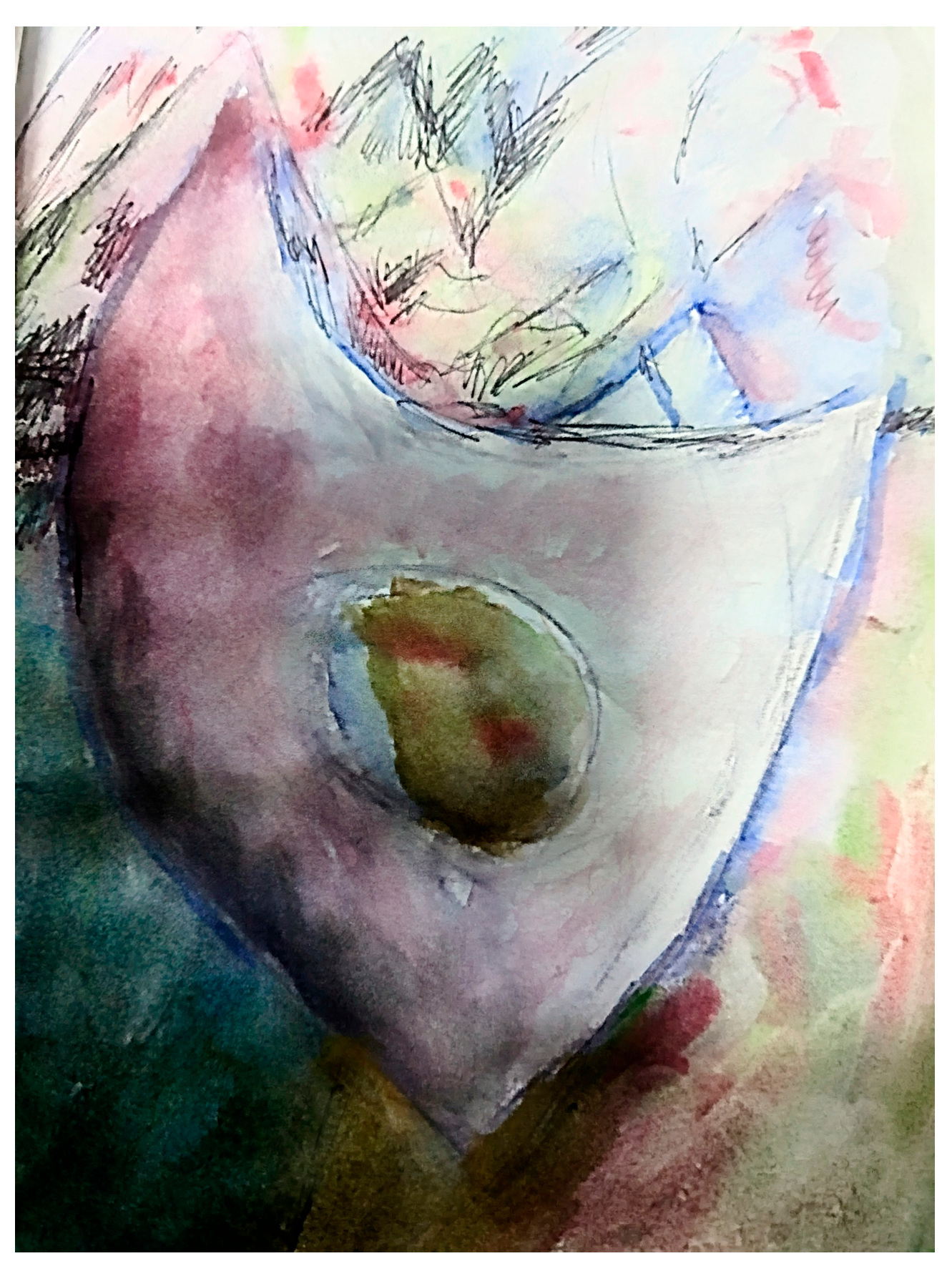
Figure 2.
Alchemy, more layers.
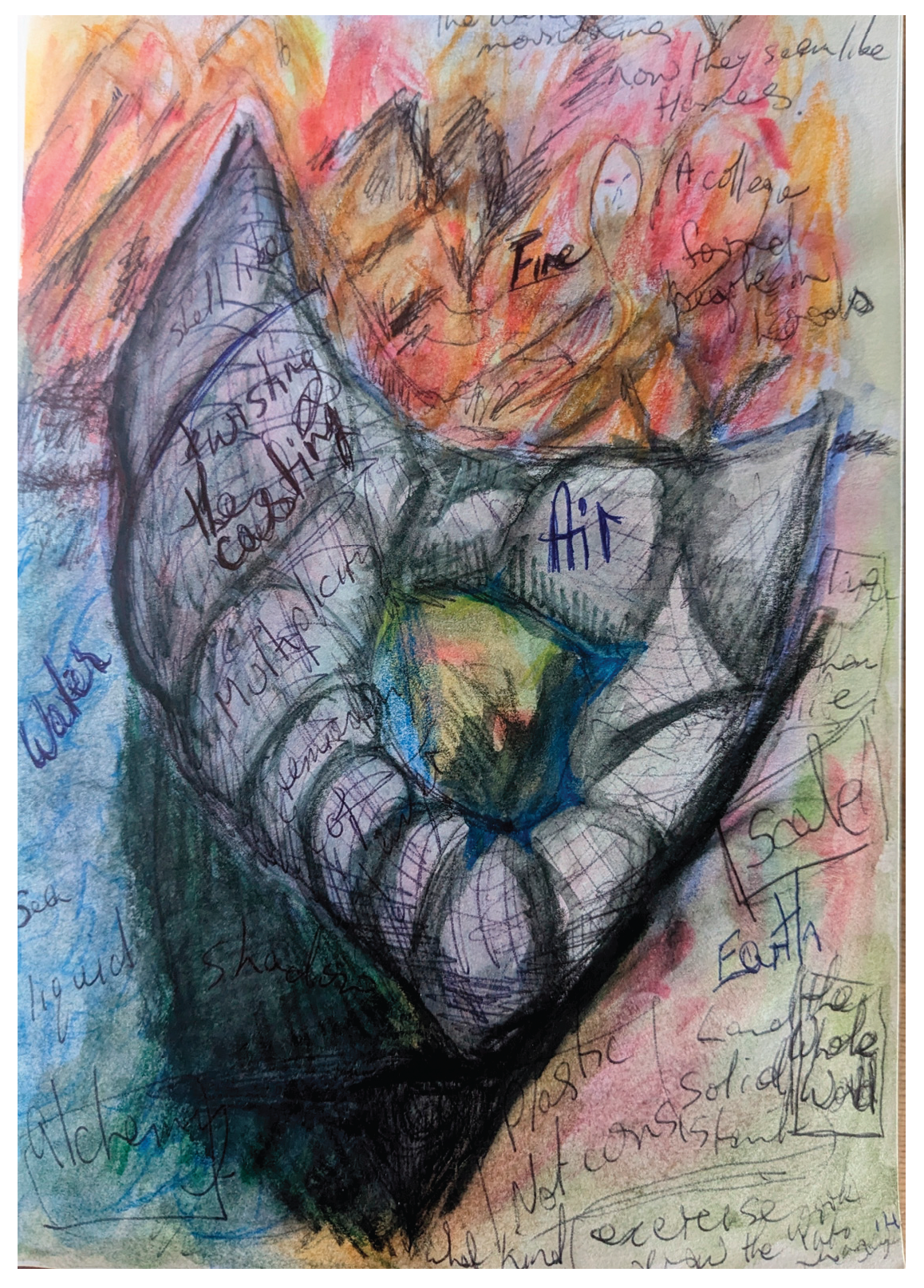
Figure 3.
My Three Rings, 2025, sterling silver.
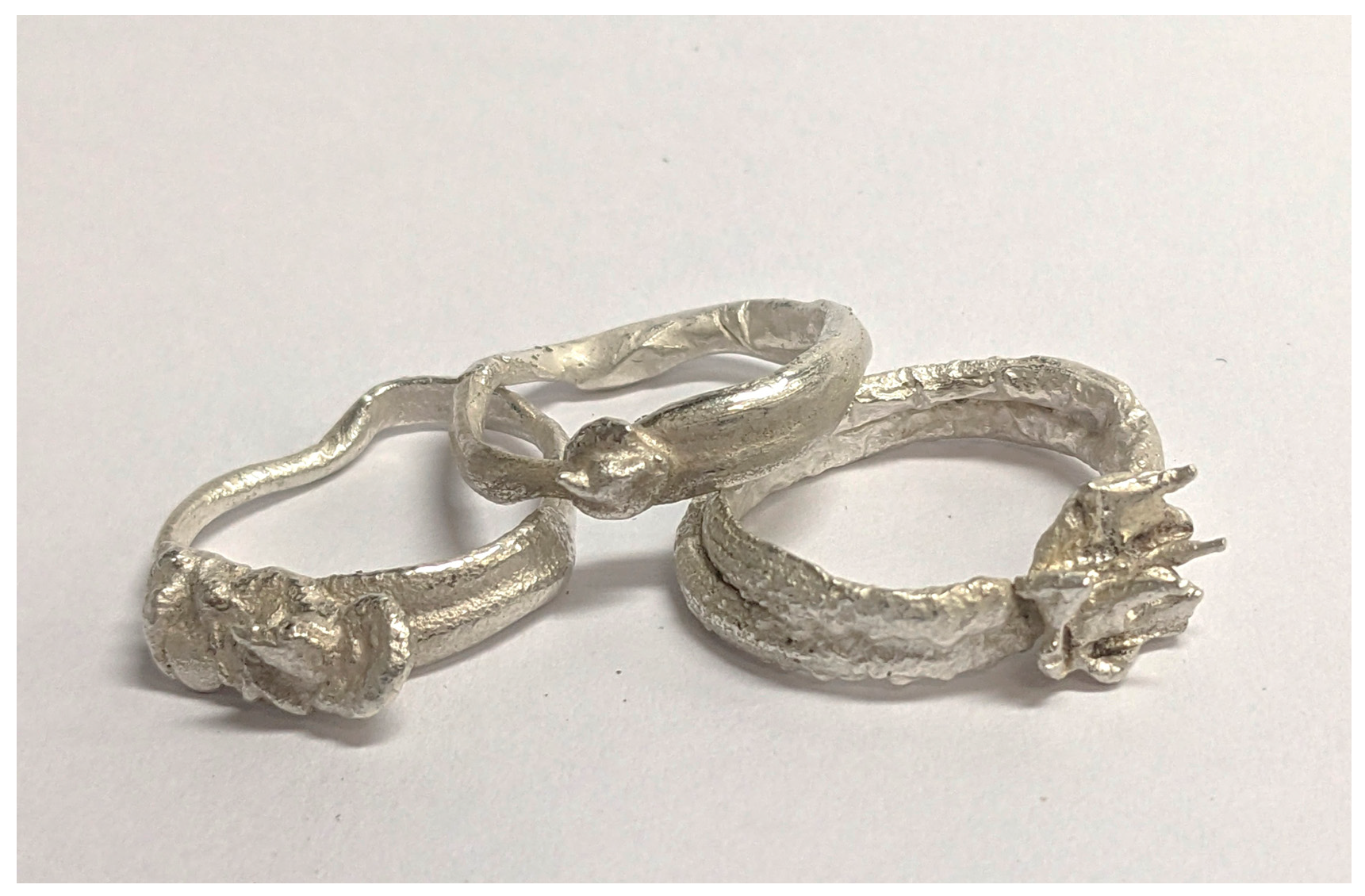
Figure 11.
Parmesan cheese carving and casting.
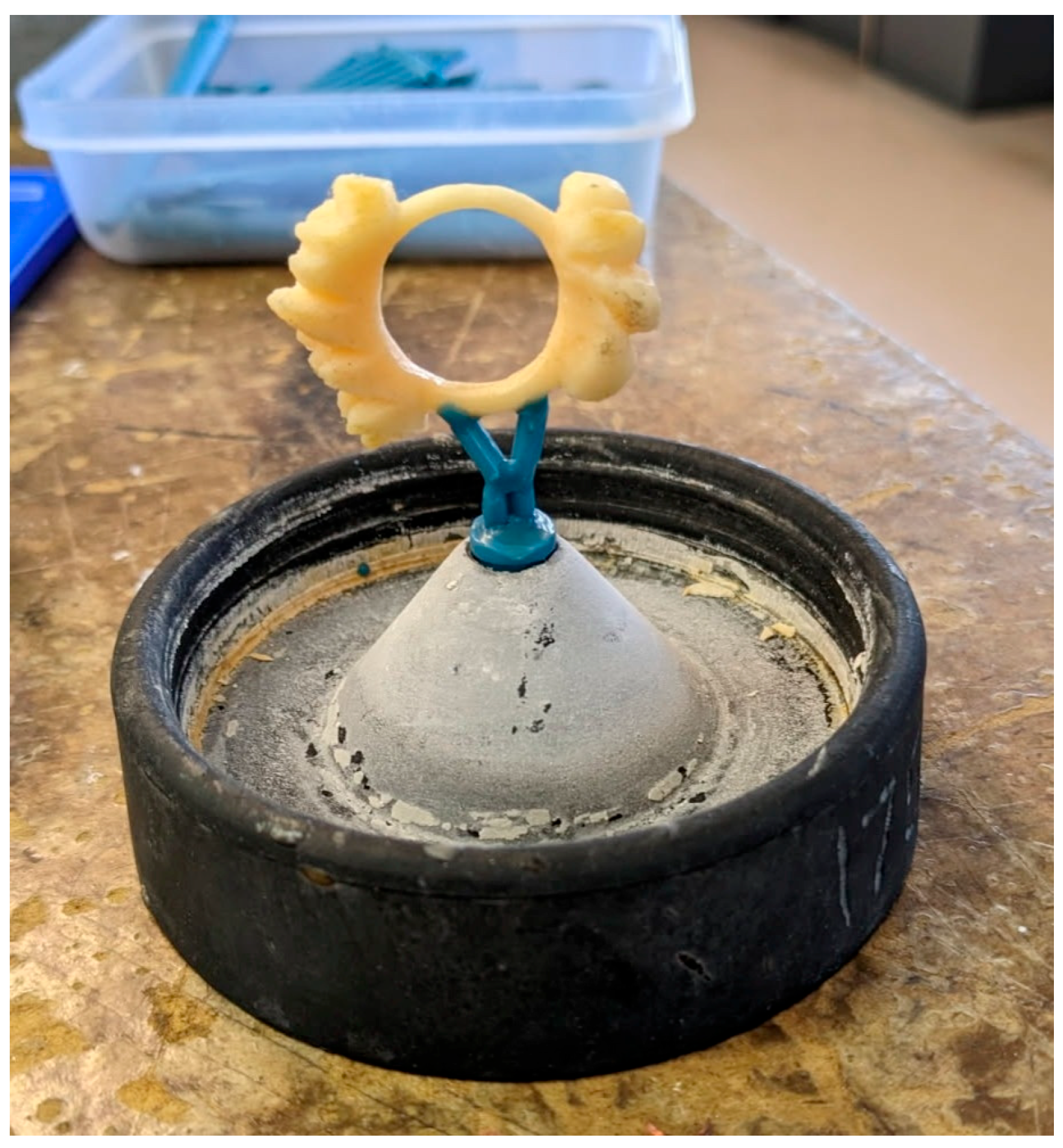
Figure 12.
Parmesan Cheese, Sterling silver, 2025.
Disclaimer/Publisher’s Note: The statements, opinions and data contained in all publications are solely those of the individual author(s) and contributor(s) and not of MDPI and/or the editor(s). MDPI and/or the editor(s) disclaim responsibility for any injury to people or property resulting from any ideas, methods, instructions or products referred to in the content. |
© 2026 by the authors. Licensee MDPI, Basel, Switzerland. This article is an open access article distributed under the terms and conditions of the Creative Commons Attribution (CC BY) license (http://creativecommons.org/licenses/by/4.0/).
Copyright: This open access article is published under a Creative Commons CC BY 4.0 license, which permit the free download, distribution, and reuse, provided that the author and preprint are cited in any reuse.