
Submitted:
24 March 2026
Posted:
25 March 2026
You are already at the latest version
Abstract
Activation of hedgehog (Hh) signaling in the liver is implicated in the progression of chronic liver diseases. Here, we show that increases in the expression of hepatic Indian hedgehog (Ihh), a hepatokine, its transcriptional regulator TAZ, periostin, and lipogenesis-related genes, as well as in plasma Ihh levels, precede weight gain in C57BL6 mice fed a high-fat diet compared with a chow diet. Intake of whey protein isolate, a milk protein, significantly suppressed these high-fat diet-induced changes independently of body weight. In addition, despite increased tryptophan levels, whey protein intake markedly reduced colonic 5-HT levels in high-fat diet-fed mice. Moreover, genetic ablation of tryptophan hydroxylase 1 (Tph1), the enzyme responsible for gut-derived 5-HT synthesis from tryptophan, attenuated increases in hepatic TAZ and Ihh expression, and in plasma Ihh levels independently of body weight. These findings suggest that Tph1-mediated increases in hepatic Ihh expression and plasma Ihh levels occur at an early stage of high-fat diet-induced metabolic dysfunction. Whey protein intake suppresses these changes, potentially by inhibiting gut-derived serotonin.
Keywords:
TAZ
; Ihh
; Shh
; high-fat diet
; whey protein
; tryptophan
; serotonin
; Tph1
1. Introduction
The hedgehog (Hh) pathway is a major signaling system that regulates embryonic morphogenesis in animals [1]. Beyond development, Hh signaling contributes to the maintenance and regeneration of adult tissues, including the regulation of stem cells [1]. Although Hh expression and pathway activity are low in healthy liver, they are increased in chronic liver diseases including metabolic dysfunction-associated steatotic liver disease (MASLD)/metabolic dysfunction-associated steatohepatitis (MASH), liver fibrosis, and hepatocellular carcinoma [2,3,4,5,6,7,8,9].
In mammals, the Hh family comprises three homologs: Sonic hedgehog (Shh), Indian hedgehog (Ihh), and Desert hedgehog (Dhh) [3,4,5]. Among these, Ihh is predominant in the liver of normal mice fed a chow diet [10]. The transcriptional regulator TAZ induces Ihh expression in hepatocytes, leading to hepatic inflammation and fibrosis in both mice and humans [6]. Circulating Ihh levels are elevated in mice with diet-induced MASH and in patients with MASH and fibrosis [7]. Hepatic TAZ silencing prevents or reverses inflammation, cell death, and fibrosis in mice by suppressing Ihh [7]. Therefore, TAZ and Ihh are considered potential therapeutic targets for chronic liver diseases.
Whey protein isolate, a milk-derived protein obtained during cheese production, is reported to have beneficial effects against metabolic dysfunction, including obesity, and glucose and triglyceride metabolism in humans [11]. We previously demonstrated that intake of whey protein isolate reduces insulin resistance and glucose intolerance in association with decreased hepatic fibroblast growth factor 21 (FGF21) production in non-obese mice fed a high-fat diet for 13 days [12]. In addition, whey protein intake suppresses plasma serotonin (5-HT) levels in mice fed either a chow or a high-fat diet [12].
The early-stage changes in hepatic TAZ and Ihh expression and in circulating Ihh levels observed in high-fat diet-induced metabolic dysfunction, as well as the effects of whey protein and tryptophan metabolism on these processes, however, remain unclear. In particular, the role of peripheral 5-HT in regulating hepatic Ihh expression and secretion remains poorly understood.
To investigate these early-stage changes and the role of peripheral 5-HT, we first examined hepatic expression of TAZ, Ihh, and genes involved in lipogenesis and steatosis, as well as plasma Ihh levels in C57BL6 mice fed a chow or high-fat diet for 13 days. We then evaluated the effects of whey protein intake on these parameters and on colonic tryptophan and its metabolites in high-fat diet-fed mice. Finally, to assess the role of peripheral 5-HT, we analyzed the same parameters in Tph1-deficient mice and age-matched wild-type control mice fed a high-fat diet for 13 days.
2. Results
2.1. Expression of Hepatic TAZ, Ihh and Genes Involved in Lipogenesis and Steatosis, and Plasma Ihh Levels in Mice Fed a High-Fat Diet for 13 Days
Expression of hepatic TAZ and Ihh (Figure 1a) significantly increased in mice fed a high-fat diet for 13 days compared with a chow diet. Plasma Ihh levels were significantly increased in mice fed a high-fat diet for 13 days compared with a chow diet (Figure 1b). Expression of hepatic fatty acid synthase (FAS), Sterol regulatory element-binding protein 1c (SREBP1c), and periostin, which involved in lipogenesis and hepatic steatosis, were significantly increased in mice fed a high-fat diet for 13 days compared with a chow diet (Figure 1c). Body weight did not differ between mice fed a high-fat diet and a chow diet for 13 days (Figure 1d). These findings suggest that increases in expression of hepatic TAZ and Ihh, and plasma Ihh levels precede body weight gain in mice fed a high-fat diet.
2.2. Effects of Whey Protein Isolate on Expression of Hepatic TAZ, Ihh and Genes Involved in Lipogenesis and Steatosis, and Plasma Ihh Levels in Mice Fed a High-Fat Diet for 13 Days
Ingestion of whey protein isolate for 3 days significantly decreased hepatic TAZ and Ihh expression (Figure 2a) in mice fed a high-fat diet for 13 days compared with controls. The ingestion of whey protein isolate for 3 days significantly decreased plasma Ihh levels in mice fed a high-fat diet compared with controls (Figure 2b). In addition, the ingestion of whey protein isolate for 3 days significantly decreased hepatic FAS, periostin, SREBP1c, and carbohydrate response element binding protein (ChREB) expression in mice fed a high-fat diet for 13 days compared with controls (Figure 2c). The ingestion of whey protein had no significant effect on body weight gain (Figure 2d). These findings suggest that ingestion of whey protein suppresses expression of hepatic TAZ, Ihh, periostin, and gens involved in lipogenesis without decreasing body weight in mice fed a high-fat diet.
Ingestion of whey protein isolate for 3 days significantly increased total water intake for 3 days compared with controls (controls; 14.3±0.6, vs whey protein; 45±0.8 g). The total intake of whey protein for 3 days was 2.25±0.04 g.
2.3. Tryptophan and Its Metabolites in the Colon of Mice Fed a High-Fat Diet for 13 Days
Ingestion of whey protein isolate for 3 days significantly decreased 5-HT and kynurenine levels in the colon of mice fed the high-fat diet for 13 days in comparison with controls, whereas it significantly increased tryptophan and indoleacetic acid (IAA) levels in the colon (Table 1).
2.4. Expression of Hepatic TAZ, Ihh, and Genes Involved in Lipogenesis and Steatosis, and Plasma Ihh Levels in Tph1-Mutant Mice and Wild-Type Mice Fed a High-Fat Diet for 13 Days
To determine role of peripheral 5-HT in regulation of hepatic Ihh expression and secretion, we examined effects of genetic ablation of Tph1 on hepatic TAZ and Ihh expression and plasma Ihh levels in mice fed a high-fat diet for 13 days. Expression of hepatic TAZ and Ihh was significantly decreased in Tph1 mutant mice fed a high-fat diet for 13 days compared with age-matched wild-type mice (Figure 3a). Plasma Ihh levels were significantly decreased in Tph1-mutants compared with wild-type mice fed a high-fat diet for 13 days (Figure 3b). Expression of hepatic FAS, periostin, ChREB, and SREBP1c was significantly decreased in in Tph1 mutant mice fed a high-fat diet for 13 days compared with age-matched wild-type mice (Figure 3c). Body weight did not differ between Tph1 mutant mice and wild-type mice fed the high-fat diet for 13 days (Figure 3d). These findings suggest that Tph1 upregulates hepatic Ihh expression and secretion as well as hepatic lipogenesis independently of body weight in mice fed a high-fat diet for 13 days.
2.5. Hepatic FGF21, Htr2a, and Sdf2l1 Expression, Blood Glucose Levels, and Plasma FGF21 and Insulin Levels in Tph1-Mutant Mice and Wild-Type Mice Fed a High-Fat Diet for 13 Days
Blood glucose levels, and plasma insulin, and FGF21 levels were significantly lower in Tph1-mutants fed a high-fat diet for 13 days than age-matched wild-type mice fed a high-fat diet (Figure 3d,3e,3f). Hepatic FGF21, 5-HT2A receptor (Htr2a), and Sdf2l1 expression was significantly decreased in Tph1 mutants fed a high-fat diet compared with wild-type mice (Figure 3g,3h,3i). These findings suggest that genetic ablation of Tph1 decreases blood glucose and plasma insulin and FGF21 levels in association with decreased hepatic FGF21, Htr2a, and Sdf2l1 expression in mice fed a high-fat diet for 13 days.
3. Discussion
Our results demonstrate that hepatic expression of TAZ, Ihh, periostin, and lipogenesis-related genes, as well as plasma Ihh levels, are increased in non-obese mice fed a high-fat diet for 13 days. We previously reported that insulin resistance and impaired glucose tolerance occur without weight gain in this model [12]. Together, these findings indicate that upregulation of hepatic TAZ and Ihh, and increased plasma Ihh levels occur in high-fat diet-induced metabolic dysfunction, even in insulin-resistant, non-obese mice.
Increased TAZ induces Ihh in hepatocytes, leading to hepatic inflammation and fibrosis in mice and humans [6]. Circulating Ihh levels are elevated in mice and humans with MASH-associated fibrosis, suggesting that circulating Ihh may serve as a marker of disease progression [7]. Our findings extend these observations by showing that increases in hepatic TAZ and Ihh expression as well as in plasma Ihh levels, occur at an early stage of diet-induced metabolic dysfunction before weight gain.
Although both preclinical and clinical studies have demonstrated that whey protein improves obesity, insulin resistance, and glucose and triglyceride metabolism [11], its effect on liver-specific pathways remains unclear. Our results revealed that whey protein isolate suppresses high-fat diet-induced increases in hepatic TAZ, Ihh, periostin, and lipogenic gene expression, as well as in plasma Ihh levels, independently of body weight. Consistent with our previous findings that whey protein isolate intake improves insulin resistance and glucose intolerance in this model [12], these results suggest that whey protein attenuates hepatic Ihh signaling in association with improved metabolic function. These findings also raise the possibility that Ihh contributes to glucose homeostasis in vivo.
Tryptophan metabolism proceeds through three major pathways, including 5-HT, kynurenine and indole derivatives. Plasma 5-HT and kynurenine levels are elevated in inflammatory bowel disease and metabolic disorders, including obesity, type 2 diabetes, cardiovascular disease, and MASLD, whereas indole derivatives such as indole-3-propionic acid are decreased [13,14,15,16,17,18,19]. In the present study, whey protein intake reduced colonic 5-HT and kynurenine levels while enhancing indole pathway metabolites, suggesting a shift toward a metabolically protective profile in response to the high-fat diet.
5-HT is an endocrine hormone primarily produced from tryptophan in the enterochromaffin cells of the gut via tryptophan hydroxylase 1 (Tph1) [13]. We previously reported that whey protein intake reduces plasma 5-HT levels in high-fat diet-fed mice [12]. Here, despite increased tryptophan levels, whey protein intake markedly reduced colonic 5-HT levels, suggesting inhibition of Tph1-mediated 5-HT synthesis. This reduction in gut-derived 5-HT likely contributes to the observed decrease in plasma 5-HT levels.
Consistent with this mechanism, genetic ablation of Tph1 attenuated high-fat diet-induced increases in hepatic TAZ, Ihh, and lipogenic gene expression, as well as in plasma Ihh levels. These findings suggest that peripheral 5-HT, produced via Tph1, mediates the upregulation of hepatic Ihh expression and secretion. Accordingly, suppression of gut-derived 5-HT might underlie the inhibitory effects of whey protein on hepatic Ihh signaling.
Previous studies demonstrated that plasma 5-HT levels and hepatic expression of 5-HT receptor 2a (htr2a) are increased in both non-obese and obese mice fed a high-fat diet [12,20,21], and that inhibition of gut-derived 5-HT synthesis suppresses hepatic steatosis without affecting energy expenditure [20]. In addition, we previously reported that Tph1-derived 5-HT upregulates hepatic FGF21 expression and secretion, as well as insulin secretion and blood glucose levels in mice [12,22]. The present findings support these earlier reports and further demonstrate that Tph1-derived 5-HT promotes hepatic Ihh expression and secretion.
We also previously reported that whey protein intake suppresses plasma FGF21 levels and hepatic expression of htr2a and Sdf2l1, a mediator of ER stress-associated insulin resistance, in insulin-resistant, non-obese mice fed a high-fat diet [23]. Notably, Tph1 deficiency produced effects similar to those of whey protein on hepatic signaling and liver-derived hormones. These findings suggest that inhibition of gut-derived Tph1-mediated 5-HT production contributes to the beneficial effects of whey protein on hepatic Ihh and FGF21 signaling, as well as on insulin resistance and impaired glucose tolerance.
This study has several limitations that must be considered when interpreting the results. Our findings are restricted to the early stage of high-fat diet-induced metabolic dysfunction and to the acute effects of whey protein and Tph1 deficiency in mice. Further studies are needed to determine the long-term effects of whey protein isolate intake on hepatic Ihh signaling and chronic liver disease progression, as well as to clarify the role of Ihh in glucose metabolism in both preclinical and clinical studies.
In summary, these findings suggest that Tph1-mediated 5-HT production promotes early increases in hepatic TAZ and Ihh expression, as well as in plasma Ihh levels, in high-fat diet-fed mice. Moreover, whey protein isolate intake suppresses these changes, likely by inhibiting gut-derived 5-HT, highlighting a potential therapeutic pathway for early metabolic dysfunction.
4. Materials and Methods
4.1. General Procedures
Male C57BL6J mice (5 weeks old) were purchased from Japan CLEA. The mice were individually housed in cages with free access to water and chow pellets in a light- and temperature-controlled environment (12 h on/12 h off, lights on at 08:00; 20–22 °C).
In the first experiment, 5-week-old C57BL6J mice fed a high-fat diet (High Fat Diet 32, Japan CLEA) or a chow diet (Labo MR Stock, Nosan Co, Japan) for 13 days were decapitated, and blood was obtained for the measurement of blood glucose levels. The liver was dissected for determining mRNA levels.
In the second experiment, 5-week-old C57BL6J mice were fed a high-fat diet for 13 days with or without whey protein isolate (5 g/100ml water) for 3 days (days 10 through 13). Daily water intake and food intake and body weight changes were determined. On day 13, the animals were decapitated and blood was obtained for the measurement of blood glucose levels. The liver and colon were dissected out for determining mRNA levels and tryptophan metabolites.
Finally, body weight and daily food intake were determined in 7-week-old Tph1 mutant mice and wild-type mice fed a high-fat diet for 13 days. The animals were decapitated and blood was obtained for the measurement of blood glucose levels, plasma FGF21 and insulin levels. The liver was dissected out for determining mRNA levels.
The experiments were performed between 14:00-16:00. Whey protein isolate (Provon 190) was obtained from Glanbia Nutritionals (Niseikyoeki Co, Japan).
4.2. Tph1 Mutant Mice
Homozygous mutant males bearing a null mutation of the Tph1 gene (congenic on a C57BL/6N background) and age-matched wild-type mice were used as described previously (12,25). The line has been maintained through mating of females heterozygous for the Tph1 gene with heterozygous males obtained from Cyagen Biosciences Inc. Genomic DNA was extracted from tails of littermates using TaKaRa MiniBEST Universal Genomic DNA Extraction kit (Ver.5.0_Code No.9765). Genotypes were confirmed by PCR-LabChip (PerkinElmer LabChip GX Touch HT) analysis using the forward primer F1: 5′-ACATCAGCCTTCTGCTCTGTTTC-3′ and the reverse primer R1: 5′-TCACTGAGAGCATCAAGCCCAG-3′ and R2: 5′-ATTTCCGGGACTCGATGTGTAAC-3′. Tph1 mutant and wild-type alleles correspond to the 611- and 489-bp fragments, respectively.
Before the experiment, animals were all housed (3–5 mice per cage) with free access to water and chow pellets in a light- (12 h on/12 h off; lights off at 2000 h) and temperature-(20–22 oC) controlled environment. The animal studies were conducted in accordance with the institutional guidelines for animal experiments at Tohoku University Graduate School of Medicine and all experimental protocols were approved by the institutional committee at Tohoku University.
4.3. Blood Chemistry
Whole blood was mixed with EDTA-2Na (2 mg/ml) and aprotinin (500 kIU/ml) to determine the plasma levels of FGF21 and insulin. Plasma levels of Ihh, FGF21, 5-HT, and insulin were measured by enzyme-linked immunosorbent assay (mouse Indian Hedgehog ELISA kit, AssayGenie, Ireland, rat/mouse FGF21 ELISA Kit, R&D Systems, Tokyo, Japan; mouse 5-HT; BA E-5900, Labor Diagnostika Nord, Nordhorn, Germany, and a mouse Insulin ELISA Kit [TMB], AKRIN-011T, Shibayagi, Gunma, Japan, respectively) as described previously [12]. Blood glucose levels were measured using glucose strips (blood glucose monitoring system; Accu-Check, Roche Diagnostics, Tokyo, Japan).
4.4. Real-Time Quantitative Reverse Transcription–Polymerase Chain Reaction (RT–PCR)
Total RNA was isolated from mouse liver using the RNeasy Midi kit (Qiagen, Hilden, Germany) according to the manufacturer’s instructions. cDNA synthesis was performed using a Super Script III First-Strand Synthesis System for RT-PCR Kit (Invitrogen, Rockville, MD) with 1 μg total RNA. cDNA synthesized from total RNA was evaluated in a real-time PCR quantitative system (LightCycler Nano Instrument Roche Diagnostics, Mannheim, Germany). The primers were listed in Table 2.
The relative amount of mRNA was calculated usingβ-actin mRNA as the invariant control. Data are shown as fold-change of the mean value of the control group as described previously [12]
4.5. Tryptophan and Its Metabolites Analysis
Tryptophan and its metabolites were subjected to analysis by LSI Medience Corporation, a contracted laboratory based in Tokyo, Japan as described previously [24,25]. Briefly, brain and plasma were introduced into sample disruptor tubes provided by Yasui Kikai (Osaka, Japan). Subsequently, these tubes were agitated with iron cones that had been pre-cooled in liquid nitrogen. The resulting sample powders were suspended in 500 μL of methanol and vigorously shaken for 15 min, after which centrifugation was carried out at 20,000× g for 3 min. The supernatants, constituting 40 μL, were meticulously transferred to 2 mL microtubes. Internal standards were then introduced and combined with the supernatants, followed by the addition of 1000 μL of a 2% formic acid solution to induce protein precipitation. Afterwards, we purified the analytes from the supernatant using solid-phase extraction (OASIS MCX, Waters, Milford, MA, USA) and analyzed them using liquid chromatography-tandem mass spectrometry (Ultivo, Agilent, Santa Clara, CA, USA) with a reverse-phase LC column (ACQUITY UPLC HSS T3, 1.8 μm, 2.1 mm × 50 mm, Waters, Milford, MA, USA). The data were processed with Mass Hunter software (Agilent, Santa Clara, CA, USA).We normalized the peak areas using internal standards and determined the concentration of each analyte using a standard curve.
4.6. Statistical Methods
Data are presented as mean ± SEM (n= 6). Comparisons between two groups were performed using Student’s t-test. A P value of less than 0.05 was considered statistically significant.
Author Contributions
K.N. designed the study, performed the experiments, interpreted all analyses, generated all figures and tables, and wrote the manuscript. T.K., performed the experiments and interpreted all analyses. T.M., and N.Y. performed the experiments. All authors have read and agreed to the published version of the manuscript.
Funding
This work was supported by a Grant in-Aid for Scientific Research.
Institutional Review Board Statement
The animal study protocol was approved by the institutional ethics committee at Tohoku University (protocol 2025RiA-001, 2024CrA-002,003 (Japanese), 1 April 2024).
Informed Consent Statement
Not applicable.
Data Availability Statement
Some or all datasets generated during and/or analyzed during the current study are not publicly available but are available from the corresponding author on reasonable request.
Conflicts of Interest
The authors declare that they have no conflicts of interest.
References
- Zang, Y.; Beachy, PA. Cellular and molecular mechanisms of Hedgehog signalling. Nat. Rev. Mol. Cell. Biol. 2023, 9, 668–687. [Google Scholar] [CrossRef] [PubMed]
- Seki, E. HEDGEHOG Signal in hepatocytes mediates macrophage recruitment: A new mechanism and potential therapeutic target for fatty liver disease. Hepatology 2016, 4, 1071–3. [Google Scholar] [CrossRef]
- Machado, MV.; Diehl, AM. Hedgehog signalling in liver pathophysiology. J. Hepatol. 2018, 68, 550–562. [Google Scholar] [CrossRef] [PubMed]
- Nair, B.; Kamath, AJ.; Pradeep, G.; Devan, AR.; Sethi, G.; Nath, LR. Unveiling the role of the Hedgehog signaling pathway in chronic liver disease: Therapeutic insights and strategies. Drug Discov. 2024, 8, 104064. [Google Scholar] [CrossRef]
- Ortega-Carballo, KJ.; Vargas-Pozada, EE.; Muriel, P. Involvement of the hedgehog signaling pathway in liver diseases. Ann. Hepatol. 2025, 2, 102148. [Google Scholar] [CrossRef] [PubMed]
- Wang, X.; Zheng, Z.; Caviglia, J.; Corey, K.; Herfel, T.; Cai, B.; Masia, R.; Chung, R.; Lefkowitch, J.; Schwabe, R.; Tabas, I. Hepatocyte TAZ/WWTR1 Promotes Inflammation and Fibrosis in Nonalcoholic Steatohepatitis. Cell Metabolism. 2016, 24, 848–862. [Google Scholar] [CrossRef]
- Moore, M.; Wang, X.; Shi, H.; Meroni, M.; Cherubini, A.; Ronzoni, L.; Parks, E.; Ibdah, J.; Rector, R.; Valenti, L.; Dongiovanni, P.; Tabas, I. Circulating indian hedgehog is a marker of the hepatocyte-TAZ pathway in experimental NASH and is elevated in humans with NASH. JHEP Reports. 2023, 5, 100716. [Google Scholar] [CrossRef]
- Chong, Y.; Lim, T.; Fu, Y.; Shin, E.; Tergaonkar, V.; Han, W. Indian Hedgehog links obesity to development of hepatocellular carcinoma. Oncogene 2019, 38, 2206–2222. [Google Scholar] [CrossRef]
- Kusano, H.; Ogasawara, S.; Omuraya, M.; Okudaira, M.; Mizuochi, S.; Mihara, Y.; Kinjo, Y.; Yano, Y.; Nakayama, M.; Kondo, R.; et al. Sonic hedgehog expression in steatohepatitic hepatocellular carcinoma and its clinicopathological significance. Oncol. Lett. 2024, 28, 442. [Google Scholar] [CrossRef]
- Teperino, R.; Adamová, M.; Aljabali, SM.; Pai, S.; Gerlini, R.; Paez-Perez, I.; Matz-Soja, M.; Heyne, S.; Lempradl, A.; et al. Liver-derived Indian hedgehog (Ihh) couples fast-feed transition to thermogenic and metabolic homeostasis. Mol. Metab. 2026, 106, 102339. [Google Scholar] [CrossRef] [PubMed]
- Milanović, M.; Milošević, N.; Ružić, M.; Abenavoli, L.; Milić, N. Whey Proteins and Metabolic Dysfunction-Associated Steatotic Liver Disease Features: Evolving the Current Knowledge and Future Trends. Metabolites 2025, 15, 516. [Google Scholar] [CrossRef]
- Nonogaki, K.; Kaji, T. Whey protein isolate inhibits hepatic FGF21 production, which precedes weight gain, hyperinsulinemia and hyperglycemia in mice fed a high-fat diet. Sci Rep. 2020, 10, 15784. [Google Scholar] [CrossRef]
- Holeček, M. Serotonin, Kynurenine, and Indole Pathways of Tryptophan Metabolism in Humans in Health and Disease. Nutrients 2026, 18, 507. [Google Scholar] [CrossRef]
- Arto, C.; Rusu, EC.; Clavero-Mestres, H.; Barrientos-Riosalido, A.; Bertran, L.; Mahmoudian, R.; Aguilar, C.; Riesco, D.; Chicote, JU.; Parada, D.; et al. Metabolic profiling of tryptophan pathways: Implications for obesity and metabolic dysfunction-associated steatotic liver disease. Eur J Clin Invest. 2024, 54, e14279. [Google Scholar] [CrossRef]
- Reshetova, M.; Markin, P.; Appolonova, S.; Yunusov, I.; Zolnikova, O.; Bueverova, E.; Dzhakhaya, N.; Zharkova, M.; Poluektova, E.; Maslennikov, R.; et al. Tryptophan Metabolites in the Progression of Liver Diseases. Biomolecules 2024, 14, 1449. [Google Scholar] [CrossRef]
- Ala, M. Tryptophan metabolites modulate inflammatory bowel disease and colorectal cancer by affecting immune system. Int. Rev. Immunol. 2022, 41, 326–345. [Google Scholar] [CrossRef] [PubMed]
- Miyamoto, K.; Sujino, T.; Kanai, T. The tryptophan metabolic pathway of the microbiome and host cells in health and disease. Int Immunol. 2024, 36, 601–616. [Google Scholar] [CrossRef] [PubMed]
- Cussotto, S.; Delgado, I.; Anesi, A.; Dexpert, S.; Aubert, A.; Beau, C.; Forestier, D.; Ledaguenel, P.; Magne, E.; Mattivi, F.; et al. Tryptophan Metabolic Pathways Are Altered in Obesity and Are Associated with Systemic Inflammation. Front. Immunol. 2020, 11, 557. [Google Scholar] [CrossRef]
- Niu, B.; Pan, T.; Xiao, Y.; Wang, H.; Zhu, J.; Tian, F.; Lu, W.; Chen, W. The therapeutic potential of dietary intervention: Based on the mechanism of a tryptophan derivative-indole propionic acid on metabolic disorders. Crit. Rev. Food. Sci. Nutr. 2025, 65, 1729–1748. [Google Scholar] [CrossRef] [PubMed]
- Zeng, G.; Krishnamurthy, S.; Staats Pires, A.; Guller, A.; Chaganti, J.; Tun, N.; Lockart, I.; Montagnese, S.; Brew, B.; Guillemin, G.J.; et al. Activation of the kynurenine pathway identified in individuals with covert hepatic encephalopathy. Hepatol. Commun. 2024, 8, e0559. [Google Scholar] [CrossRef]
- Choi, W.; Namkung, J.; Hwang, I.; Kim, H.; Lim, A.; Park, H.; Lee, H.; Han, K.; Park, S.; Jeong, J.; et al. Serotonin signals through a gut-liver axis to regulate hepatic steatosis. Nat. Communications 2018, 9, 4824. [Google Scholar] [CrossRef] [PubMed]
- Hwang, I.; Nam, JE.; Choi, W.; Choi, WG.; Lee, E.; Kim, H. Serotonin Regulates Lipogenesis and Endoplasmic Reticulum Stress in Alcoholic Liver Disease. Diabetes Metab J. 2025, 49, 798–811. [Google Scholar] [CrossRef] [PubMed]
- Sasako, T.; Ohsugi, M.; Kubota, N.; Itoh, S.; Okazaki, Y.; Terai, A.; Kubota, T.; Yamashita, S.; Nakatsukasa, K.; Kamura, T.; et al. Hepatic Sdf2l1 controls feeding-induced ER stress and regulates metabolism. Nat. Commun. 2019, 10, 947. [Google Scholar] [CrossRef]
- Nonogaki, K.; Kaji, T. The GLP-1 Receptor Agonist Liraglutide Decreases Primary Bile Acids and Serotonin in the Colon Independently of Feeding in Mice. Int. J. Mol. Sci. 2024, 25, 7784. [Google Scholar] [CrossRef]
- Nonogaki, K.; Kaji, T. Tryptophan Hydroxylase 1 Regulates Tryptophan and Its Metabolites. Int. J. Mol. Sci. 2025, 26, 3978. [Google Scholar] [CrossRef] [PubMed]
Figure 1.
Expression of hepatic TAZ and Ihh (a), plasma Ihh levels (b), expression of hepatic FAS, periostin, ChREB, and SREBP1c (c), and body weight (d) in C57BL6J mice fed a high-fat diet (HFD) or a chow diet for 13 days. The relative amount of mRNA is shown as fold-change of the mean value of the control group in mice fed a chow diet (a,c). Data are presented as the mean ± SEM (n = 5/group). * P < 0.05.
Figure 1.
Expression of hepatic TAZ and Ihh (a), plasma Ihh levels (b), expression of hepatic FAS, periostin, ChREB, and SREBP1c (c), and body weight (d) in C57BL6J mice fed a high-fat diet (HFD) or a chow diet for 13 days. The relative amount of mRNA is shown as fold-change of the mean value of the control group in mice fed a chow diet (a,c). Data are presented as the mean ± SEM (n = 5/group). * P < 0.05.
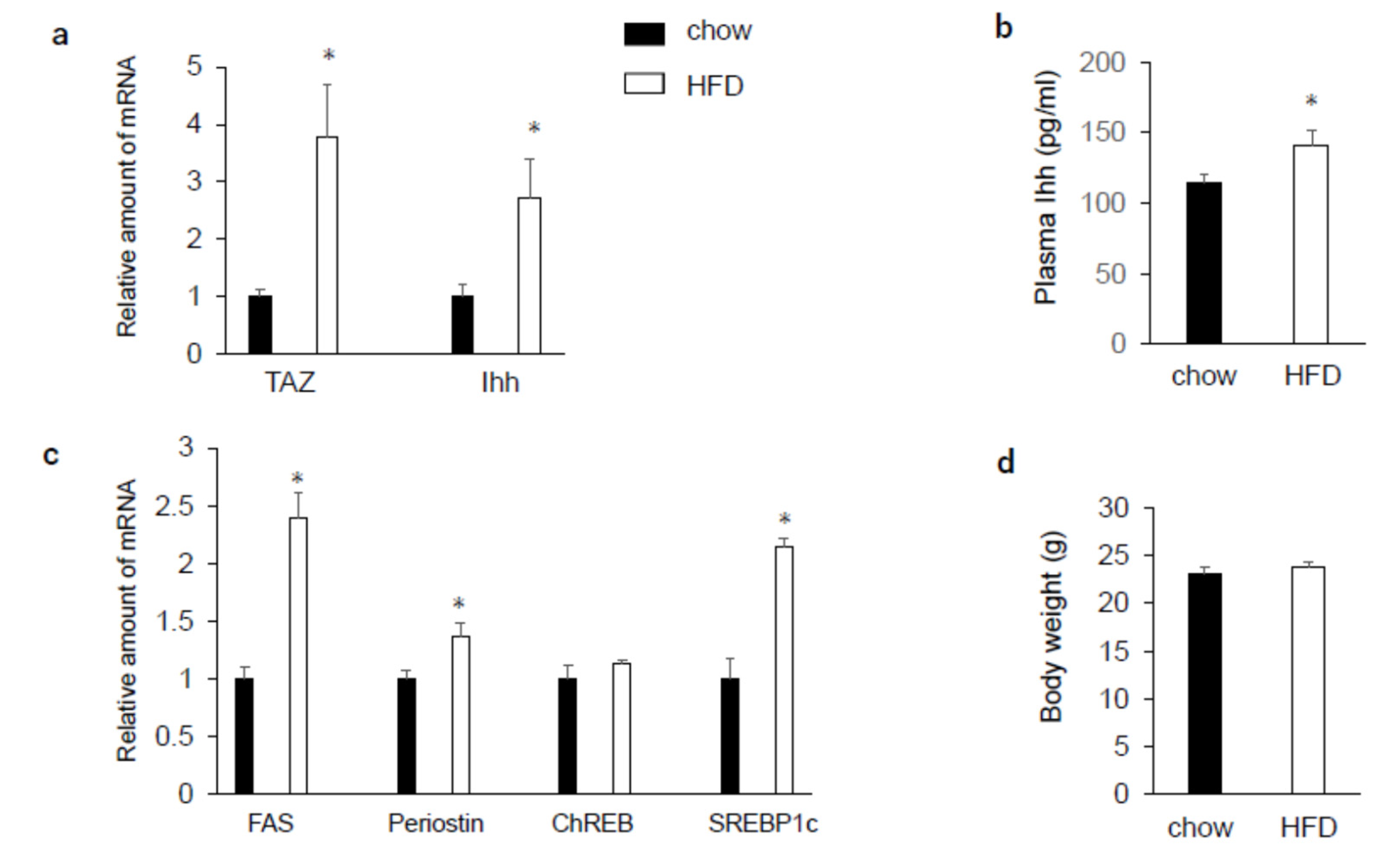
Figure 2.
Effects of intake of whey protein isolate (5 g/100 ml water) on expression of hepatic TAZ and Ihh (a), plasma Ihh levels (b), expression of hepatic FAS, periostin, ChREB, and SREBP1c (c), and body weight (d) in C57BL6J mice fed a high-fat diet for 13 days. The relative amount of mRNA is shown as fold-change of the mean value of the control group in mice fed a high-fat diet (a,c). Data are presented as the mean ± SEM (n = 5/group). * P < 0.05.
Figure 2.
Effects of intake of whey protein isolate (5 g/100 ml water) on expression of hepatic TAZ and Ihh (a), plasma Ihh levels (b), expression of hepatic FAS, periostin, ChREB, and SREBP1c (c), and body weight (d) in C57BL6J mice fed a high-fat diet for 13 days. The relative amount of mRNA is shown as fold-change of the mean value of the control group in mice fed a high-fat diet (a,c). Data are presented as the mean ± SEM (n = 5/group). * P < 0.05.
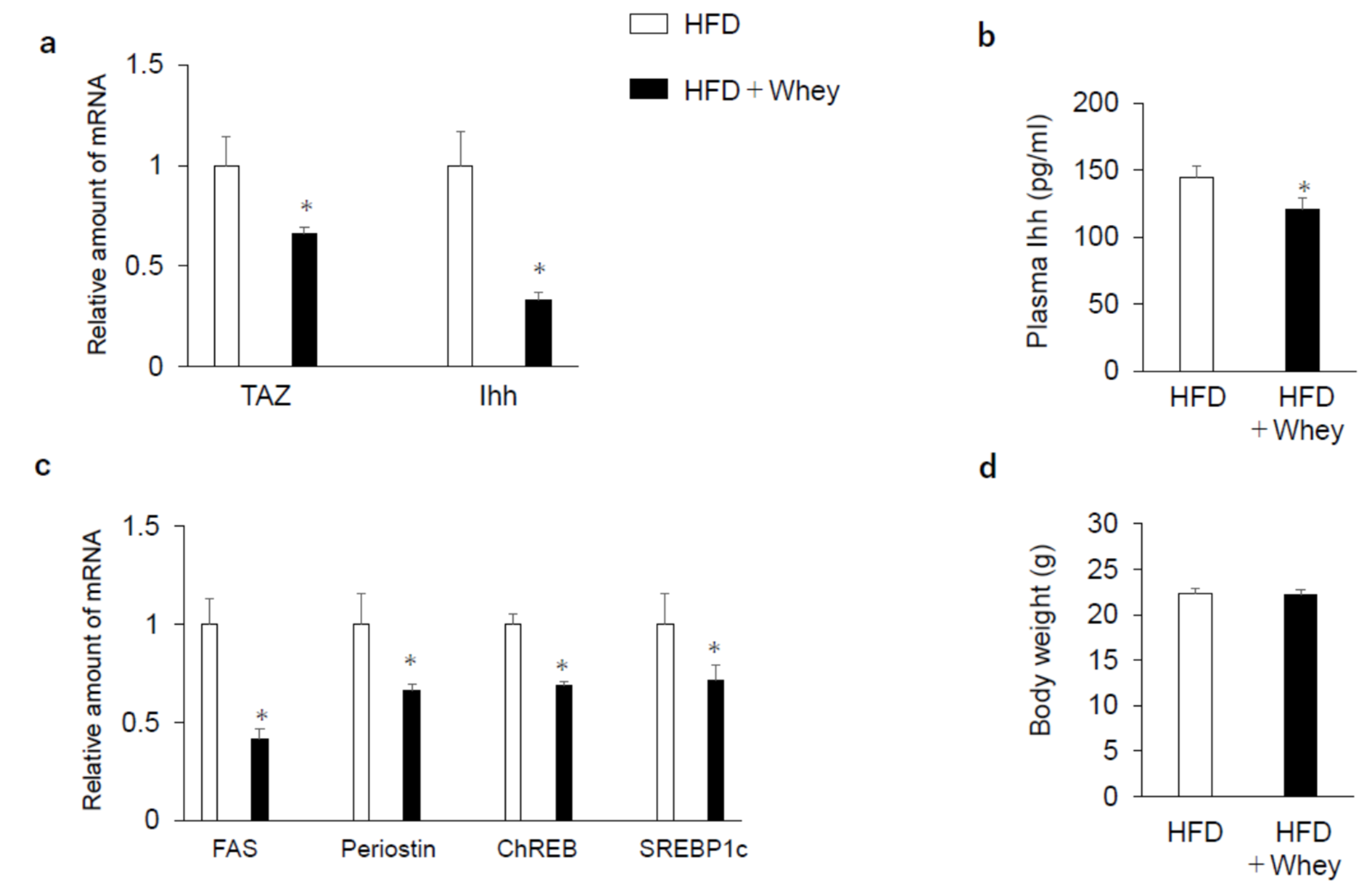
Figure 3.
Expression of hepatic TAZ and Ihh (a), plasma Ihh levels (b), expression of hepatic FAS, periostin, ChREB, and SREBP1c (c), body weight (d), blood glucose levels (e), plasma insulin and FGF21 levels (f,g), expression of hepatic FGF21, Htr2a, and Sdf2l1 (h,i,j) in Tph1 mutant mice (Tph1KO) and wild-type mice (WT) fed a high-fat diet for 13 days. The relative amount of mRNA is shown as fold-change of the mean value of the control group in mice fed a chow diet (a,c,h,I,j). Data are presented as the mean ± SEM (n = 5/group). * P < 0.05.
Figure 3.
Expression of hepatic TAZ and Ihh (a), plasma Ihh levels (b), expression of hepatic FAS, periostin, ChREB, and SREBP1c (c), body weight (d), blood glucose levels (e), plasma insulin and FGF21 levels (f,g), expression of hepatic FGF21, Htr2a, and Sdf2l1 (h,i,j) in Tph1 mutant mice (Tph1KO) and wild-type mice (WT) fed a high-fat diet for 13 days. The relative amount of mRNA is shown as fold-change of the mean value of the control group in mice fed a chow diet (a,c,h,I,j). Data are presented as the mean ± SEM (n = 5/group). * P < 0.05.
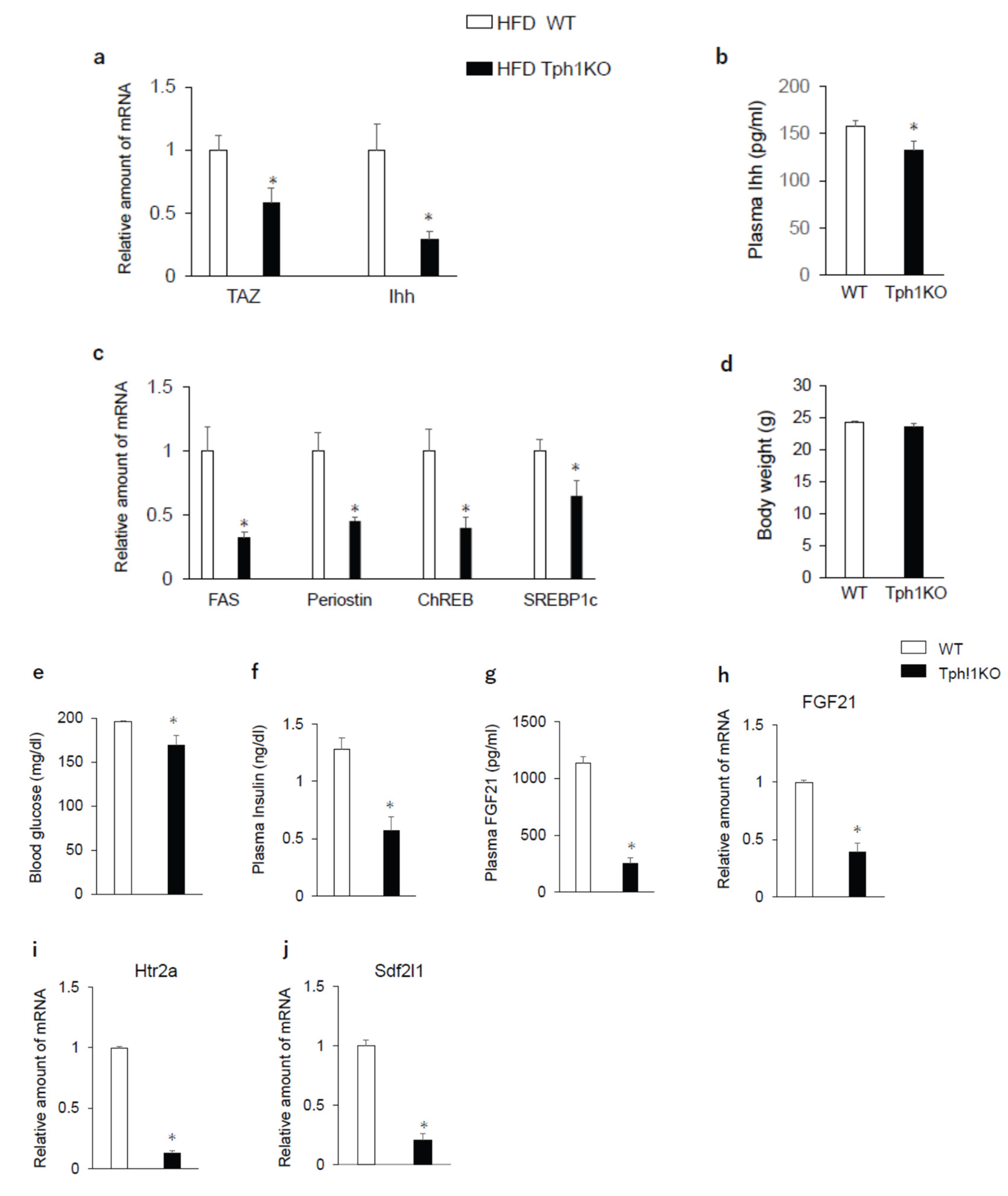

Table 1.
Effects of whey protein on tryptophan metabolites in the colon of mice fed a high-fat diet for 13 days.
Table 1.
Effects of whey protein on tryptophan metabolites in the colon of mice fed a high-fat diet for 13 days.
| colon | control (ng/g) | whey (ng/g) | p value |
| Trp | 1607±18 | 2263±48 | P<0.05 |
| 5-HT | 3753±874.6 | 526±58 | P<0.05 |
| 5-HIAA | 398±32 | 536±109 | NS |
| KYN | 57±3.8 | 43±3.4 | P<0.05 |
| XA | 170±12.3 | 208.6±34.7 | NS |
| IPA | 22.57±4.8 | 29.5±6.0 | NS |
| IAA | 98.34±4.8 | 448.5±113.4 | P<0.05 |
Table 2.
The primers of RT-PCR were listed.
| GENES | SEQUENCE | |
| Ihh | sense | CTCTTGCCTACAAGCAGTTCA |
| antisense | CCGTGTTCTCCTCGTCCTT | |
| TAZ | sense | CATGGCGGAAAAAGATCCTCC |
| antisense | GTCGGTCACGTCATAGGACTG | |
| FAS | sense | AGGTATCCATTCTGGGTTCTAGCC |
| antisense | GCTCGTTGTCACATCAGCCA | |
| SREBP1c | sense | GCCGTGGTGAGAAGCGCACAGCCC |
| antisense | CAAGACAGCAGATTTATTCAGCTTTGC | |
| ChREBP | sense | CAGGGAATACACGCCTACAG |
| antisense | CAGGTGGGATCTTGGTCTTA | |
| Periostin | sense | CCTCTATCCAGCAGATATTCCA |
| antisense | CTGCCACGAACAAACTTGA | |
| FGF21 | sense | CACCGCAGTCCAGAAAGTC |
| antisense | ATCAAAGTGAGGCGATCCA | |
| Htr2a | sense | TTCAGTGCCAGTACAAGGAG |
| antisense | GAGTGTTGGTTCCCTAGTGTAA | |
| Sdf2l1 | sense | CACACGGTCCAATAGCAGTG |
| antisense | GCTCTAGACCTCTGCGCTTC | |
| β-actin | sense | TTGTAACCAACTGGGACGATATGG |
| antisense | GATCTTGATCTTCATGGTGCTAGG |
Disclaimer/Publisher’s Note: The statements, opinions and data contained in all publications are solely those of the individual author(s) and contributor(s) and not of MDPI and/or the editor(s). MDPI and/or the editor(s) disclaim responsibility for any injury to people or property resulting from any ideas, methods, instructions or products referred to in the content. |
© 2026 by the authors. Licensee MDPI, Basel, Switzerland. This article is an open access article distributed under the terms and conditions of the Creative Commons Attribution (CC BY) license.
Copyright: This open access article is published under a Creative Commons CC BY 4.0 license, which permit the free download, distribution, and reuse, provided that the author and preprint are cited in any reuse.


