

Submitted:
24 March 2026
Posted:
25 March 2026
You are already at the latest version
Abstract
Fibromyalgia (FM) is a complex syndrome associated with chronic widespread pain and with various other symptoms, including sleep and mood disturbances. Its under-lying causes are not fully understood, and the lack of diagnostic blood tests and im-aging, along with the absence of definitive treatments, makes management challenging. Recent studies showed that immunoglobulins in the blood of FM patients activate satellite glial cells (SGCs) in mouse dorsal root ganglia (DRG), leading to pain behaviors in mice after passive transfer. Here, we aimed to determine whether serum from FM patients activates mouse SGCs in DRGs and other ganglia that may be involved in FM’s diverse symptoms. Serum from FM patients (N=15) and healthy controls (HC, N=8) was collected. Sera were incubated with different types of mouse sensory ganglia: DRG, trigeminal ganglion (TG), the nodose ganglion (NG), and the superior cervical sympathetic ganglion (Sup-CG). SGC activation was assessed by immunostaining of SGCs for the glial activation marker glial fibrillary acidic protein (GFAP). We compared this response between male and female mice. All the ganglia tested, DRG, TG, NG, and Sup-CG, showed induced upregulation of GFAP labeling in SGCs after incubation with FM serum compared with HC, indicating SGC activation by the se-rum. Similar responses were observed in both male and female mice. We conclude that serum from FM patients contains factor(s) that can activate SGCs across various types of mouse ganglia, which may reflect the diverse symptom profile of FM. These findings provide objective evidence of pathogenic factor(s) that could serve as a foundation for a diagnostic method for FM and require further purification and identification, hopefully paving the way for future targeted FM therapy.
Keywords:
fibromyalgia
; sensory ganglia
; sympathetic ganglia
; satellite glial cells
; glial activation
1. Introduction
Fibromyalgia (FM) is a chronic pain syndrome accompanied by multiple symptoms. 1 Its prevalence is 3-5% in the Western population, mainly affecting females [1,2,3] , and its etiology remains unclear. FM diagnosis is based on a combination of diffuse and chronic widespread pain, along with four categories of disturbance: non-restorative sleep, fatigue, cognitive or memory deficits, and various somatic functional symptoms. The name of this syndrome has changed over the years; it has been called “fibrositis” to suggest inflammation, “myofascial pain syndrome” to highlight the muscles and fascia as the main involved structures, “pain amplification syndrome”, indicating sensitivity to minor triggers, and “central sensitization syndrome” [3,4,5,6,7]. The latter implies that peripheral sensory inputs (e.g., tactile, thermal) provoke abnormal responses in the central nervous system (CNS) [7]. The nociplastic pain in FM is related to hyperactivity in brain regions that process pain signals, along with decreased activity of inhibitory pathways [6]. Additionally, there is evidence of increased sympathetic activity in FM [8,9]. FM is often described as “mysterious” and is surrounded by controversy; even its existence as a syndrome has been questioned by some authors [10,11].
The diagnosis of FM is a major obstacle in patient care due to the numerous associated comorbidities and the absence of biomarkers [10,11,12,13,14]. There is no generally accepted treatment for FM, which is explained by the lack of consensus on its diagnosis and, especially, its etiology.
Most investigators attribute the pain in FM to central sensitization [7,10], but there is also evidence of a peripheral contribution. One piece of supporting evidence for this idea is the loss of small nerve fibers in the skin in 50% of FM patients, which is associated with greater severity and more pronounced CNS changes [15,16,17]. Also, abnormal spontaneous activity was recorded in nociceptive fibers in FM patients [18]. Further evidence for peripheral involvement in FM was obtained from a study reporting that neutrophil-derived mediators sensitized peripheral nerves [19]. A recent publication [20] showed that the intestinal microbiome contributes to FM through peripheral mechanisms.
Sensory ganglia are crucial for transmitting pain signals from the periphery to the CNS, and recent data suggest a role for them in understanding FM [21]. The main sensory ganglia are DRGs, which innervate most body regions, including internal organs, the trigeminal ganglia (TG), which innervate the face, teeth, and part of the scalp, and the nodose ganglia (NG), which innervate internal organs, such as the lungs, heart, and bowel. Abnormal neuronal activity in these ganglia is a major factor in chronic pain [22,23]. Neurons in sensory ganglia are surrounded by satellite glial cells (SGCs), which form functional neuron–SGC units. Animal studies showed that SGCs play an important role in the generation and maintenance of chronic pain [24,25]. Evidence for the possible role of SGCs in FM was obtained in experiments in which immunoglobulins (IgG) were transferred from FM patients into mice, which induced pain behavior in the mice [21,26]. Moreover, the FM IgGs were found to bind to SGCs in the DRGs of both humans and mice and to activate them, as evidenced by glial fibrillary acidic protein (GFAP) upregulation [21]. The severity of FM was correlated with serum levels of FM-related immunoglubulins G (IgGs) [26]. These studies indicate that, as in rodents, SGCs might contribute to pain also in humans. These studies, combined with those mentioned in the paragraph above, lend considerable support to the idea that the peripheral nervous system plays a role in FM pain.
In addition to the pain pathways, the autonomic nervous system, and in particular the sympathetic nervous system (SNS) is also relevant to FM. There is evidence of SNS overactivity in FM [27], which may be related to some FM symptoms, such as aberrant heart rate [28]. Satellite glial cells are also present in sympathetic ganglia [25,29], and can influence neuronal activity [30]. There is no information on the involvement of SGCs of the SNS in FM. In this work, we studied SGCs in the mouse superior cervical ganglion (Sup-CG), which innervates the heart, neck, and face.
The recent studies on the role of SGCs in mediating chronic pain suggest a novel approach to understanding FM pathogenesis and treating pain, and possibly other FM symptoms. Currently, all available information on this topic is limited to the DRGs. In this work, we examined how SGCs in other peripheral ganglia: the TG, the NG, and the Sup-CG are influenced by factors in the serum of FM patients.
2. Materials and Methods
2.1. Patient Selection
Participants were patients from the rheumatology clinic at Hadassah University Hospital in Jerusalem, diagnosed with FM after meeting the modified 2010/2011 American College of Rheumatology diagnostic criteria, and the 2016 revised criteria [31]. Diagnosis of FM was made when levels of the widespread pain index (WPI) and the symptom severity score (SSS) were sufficiently high (WPI ≥ 7 and SSS ≥ 5, or WPI 3–6 and SSS ≥ 9), with a minimum of 12 for the polysymptomatic distress (PSD) scale [32]. The WPI is a 0–19 count of painful non-articular body regions, and the SSS is a 0–12 measure of symptom severity that includes four aspects (scored 0-3): fatigue, sleep, somatic, and cognitive problems. The PSD scale, a 0-31 measure, was calculated by summing the WPI and SSS scores for each patient [32]. PSD Scores over 12, indicating FM, were categorized into 5-score groups: 12-16 as mild , 17-21 as moderate , 22-26 as severe , and 27-31 as very severe . Only FM patients with a high severity score over 24 on the PSD scale were recruited for this study. Patients aged 18 years or older were included in accordance with the Helsinki Committee (Approval No. 0562-23HMO). Only primary FM patients were included. Patients with comorbidities such as rheumatic disease, painful orthopedic or neurological issues, or significant psychiatric conditions were excluded. Fifteen FM patients and eight Healthy controls (HCs) signed informed consent and were recruited for the study. A 10 mL blood sample was taken from each participant for serum separation, divided into 250 µL aliquots, and stored at -80 °C.
2.2. Immunohistochemistry
Balb/c mice 2–5 months old (males: females 1:1), weighing 19–23 g, were used. The procedures were approved by the Animal Care and Use Committee of the Hebrew University and conform to the National Institutes of Health standards for the care and use of laboratory animals. Mice were sacrificed by CO2 inhalation, and ganglia (DRG L4,5; TG, NG, and Sup-CG) were removed from male and female Balb/C mice and placed in ice-cold Krebs solution containing (mM): 120.9 NaCl, 5.9 KCl, 14.4 NaHCO3, 2.5 MgSO4, 2.5 CaCl2, 1.2 NaH2PO4, and 11.5 glucose, pH 7.4. Then they were incubated for 2 h with serum diluted 1:4 in Krebs solution in a CO2 incubator at 37 °C, and then fixed in 4% paraformaldehyde in 0.1 M phosphate buffer (pH 7.4) for 90 min at room temperature, washed in phosphate-buffered saline (PBS), and incubated overnight at 4 °C in PBS with 20% sucrose before freezing in Tissue-Tek embedding medium. Sections were cut 10 μm thick using a cryostat (Leica) and thaw-mounted on glass slides, washed and incubated in a blocking solution containing 3% bovine serum albumin (BSA) in PBS with 0.3% Triton X-100 for 2 h at room temperature, and then incubated for 2 h with antibody against GFAP (Dako, 1:400 in PBS +1% BSA) overnight at 40C. For controls, the serum was omitted. Sections were washed in PBS and incubated with secondary antibody, donkey anti-rabbit conjugated to Alexa Fluor 594 (Abcam, 1:400), 10 μM 4,6-diamidino-2-phenylindole dihydrochloride (DAPI) to stain the nuclei for 2 h at room temperature. Finally, sections were washed, observed under a fluorescence microscope, and photographed with a digital camera. Microscope fields (315 × 235 μm) were selected randomly. All the images were taken under identical conditions and analyzed in a blinded manner. Neuronal profiles, containing the nuclei, which were surrounded by GFAP-positive SGCs by more than 50% of their circumference, were counted and expressed as % of the total number of nucleated neuronal profiles in the field. This criterion was used because the SGC sheath can be partly very thin and invisible under light microscopy. Four fields from different non-adjacent sections were analyzed for each ganglion and then averaged.
2.3. Statistics
Data were analyzed using an unpaired two-tailed t-test. Values are expressed as mean ± SEM. P<0.05 was considered statistically significant.
3. Results
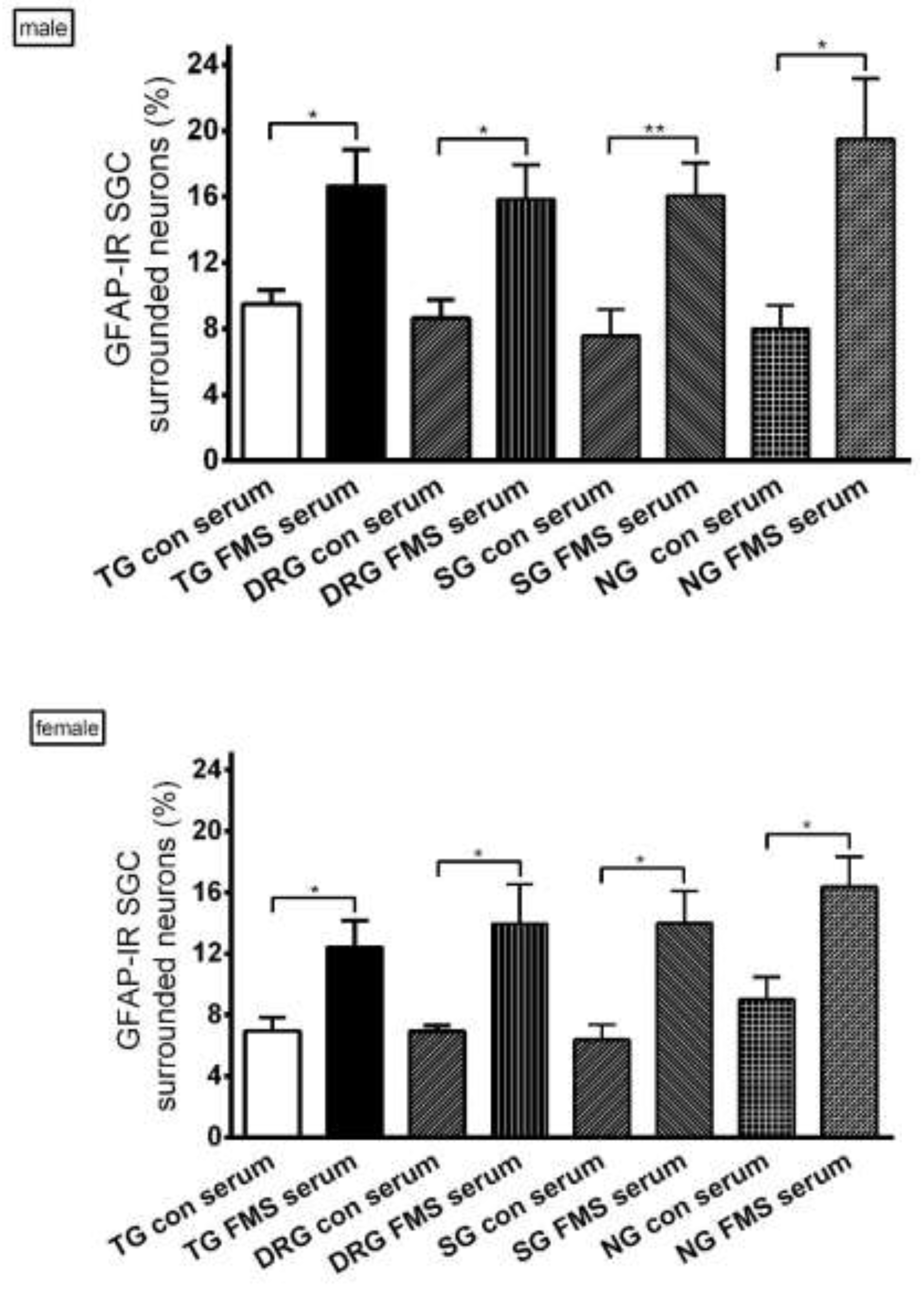
We first asked whether incubating intact DRGs with FM serum would activate SGCs, as previously observed in DRGs removed from mice injected with IgG from FM patients [21]. Freshly isolated DRGs were incubated with sera from FM patients and HC diluted 1:4 in Krebs solution for 2 h, then fixed, sectioned, and immunostained for GFAP. The GFAP immunostaining was mainly located in SGCs, which was verified with DAPI staining; SGC nuclei were small and stained intensely with DAPI, whereas neuronal nuclei were larger and faintly stained. As shown in Figure 1A, B, and Figure 2, the percentage of neurons surrounded by a rim of GFAP-positive cells was approximately doubled in ganglia treated with FM serum compared with HC serum. There was no significant difference between the results obtained with DRGs from male and female mice (Figure 2). This result validated the method and indicated that serum might be a suitable tool for learning about FM pathophysiology, as found recently by other groups [33,34].
Next, we compared the DRG staining results with those from two other sensory ganglia, TG and NG, using the same experimental protocol. From Figure 1 and Figure 2 it seems clear that SGCs in these ganglia were activated by FM serum in a manner very similar to that of SGCs in DRG. Finally, we examined SGCs in a sympathetic ganglion, the Sup-CG, and again found that the FM serum upregulated GFAP in SGCs (Figure 1 and Figure 2). For all ganglion types, the results were similar for ganglia obtained from male and female mice (Figure 2). It can be concluded that for all four ganglion types: DRG, TG, NG, and Sup-CG, the incubation in serum from FM patients induced an upregulation of labeling for GFAP.
4. Discussion
The reports on molecules in the serum of FM patients that induce pain behavior in mice, bind to SGCs in their DRGs, and activate them, have attracted considerable attention because they provide a possible mechanistic explanation for pain in FM patients [21,26]. Still, this left open the question of whether SGCs in other types of peripheral ganglia can bind to, and be activated by factors in the serum of FM patients. We show here that SGCs in two other types of mouse sensory ganglia (TG and NG) and also in a sympathetic ganglion (Sup-CG) are activated by FM serum. The results also show that serum from FM patients induces activation of mouse SGCs in vitro. These findings broaden the scope of potential humoral factors and targets that might contribute to the pathophysiology of FM.
We did not observe differences in the results for ganglia obtained from male and female mice across all four ganglion types. This correlates with the results of Goebel et al. [21] , who found no difference in behavioral responses to IgG injections from FM patients between male and female mice. This suggested that the behavioral findings were unlikely to be due to increased sensitivity of SGCs to IgGs. (In the immunohistochemical results, the sex of mice was not specified.) Instead, it can be proposed that the activation of SGCs in FM patients (who are mostly females) may be due to the higher level of blood factors, such as IgGs, rather than a higher binding affinity of SGCs for these agents.
In most accounts of FM, pain in somatic regions is emphasized, though pain in FM is ‘head to toe”. Severe pain syndromes involving the face and head are well known in the general population, and it is established that many FM patients experience pain mediated by the trigeminal system, such as temporomandibular pain and burning mouth syndrome [35,36]. Sensations from the head and face are transmitted via the trigeminal nerves, but there is no information on SGCs within the TG in FM. Here, we demonstrate that FM serum activates SGCs in the mouse TG, as it does in the DRG, suggesting that head and face pain in FM patients may be linked to SGC activation, as has been proposed for somatic pain [21,37].
The NG contains the cell bodies of neurons that provide sensory innervation to many internal organs, and is essential for reflexes such as swallowing and coughing. It is also important for maintaining the inflammatory reflex, which is mediated by parasympathetic pathways [38]. Evidence suggests that in FM, there is an imbalance between sympathetic and parasympathetic activity, with low vagal tone and high sympathetic one compared with normal subjects [39]. We observed activation of SGCs in the NG after incubation with FM serum. If such activation increases the excitability of nodose ganglion neurons, it would lead to increased activity in vagal pathways and possibly the inflammatory reflex. The role of vagal afferents in pain is complex [39] and it is difficult to predict how the effects mentioned above would manifest in FM, but this topic warrants further study.
The autonomic nervous system (ANS) plays a key role in the symptoms of FM. There is evidence of overactivity of the sympathetic tone in FM, which may contribute to symptoms such as an abnormal heart rate [8,27]. Neurons in sympathetic ganglia release norepinephrine, which can cause pain [40]. The Sup-CG, one of the largest sympathetic ganglia, innervates the heart, pineal gland, and other organs. The pineal gland produces melatonin, a crucial hormone for the sleep-wake cycle, and therefore abnormal activity in Sup-CG might lead to sleep disturbances. Indeed, melatonin level is abnormally high in FM patients [41] Abnormalities in SNS may also cause palpitations and irregular heart[beats, common in FM [42].
Limitations. In this study, we used sera from FM patients and compared their effects on peripheral ganglia with those of HC serum. This is unlike several previous studies in which IgGs isolated from the sera of FM patients or HC were injected into mice, followed by DRG removal and GFAP staining. In addition to IgGs, FM serum contains many other bioactive molecules. Thus, we cannot specify the nature of the factor(s) that induced the observed effects in our experiments. However, recent studies have reported that, in addition to IgGs, other bioactive molecules are upregulated in FM serum, including the immunoregulatory proteins CD40 and CD40L [43]. Moreover, Seefried et al. [34] incubated DRG sections with FM serum and found protein binding to a variety of receptors (e.g., serotonin 5HT1A receptors) in both neurons and SGCs. Likewise, acute application of FM serum onto DRG neurons and SGCs in tissue culture evoked a physiological response in these cells [33]. Thus, using serum can reveal new aspects that might be missed by focusing on isolated IgGs. Future work is needed to identify the full spectrum of changes between HC and FM sera that underlie SGC activation, and possibly other relevant actions of FM serum.
5. Conclusions
Fibromyalgia is a polysymptomatic disorder with multiple manifestations affecting various systems. Ou study shows that serum from FM patients activates mouse SGCs in various peripheral ganglia, including DRGs, via factor(s) in the serum, which are believed to be related to FM’s diverse symptoms. Further research and validation of these results, as well as trials to purify these factors, are strongly warranted.
Author Contributions
Conceptualization, M.H. and S.A.; methodology, R.F-G. and M.H.; validation, R.F-G. and M.H.; formal analysis, R.F-G.; investigation, R.F-G. and M.H.; resources, M.H.; data curation, S.A.; writingoriginal draft preparation, M.H.; writing-review and editing, S.A. and M.H.; visualization, R.F-G.; supervision, M.H.; project administration, M.H.; funding acquisition, M.H. All authors have read and agreed to the published version of the manuscript.
Funding
This research was funded by the Israel Science Foundation, grant number ISF 929/23.
Institutional Review Board Statements
The animal study protocol was approved by the Animal Care and Use Committee of the Hebrew University of Jerusalem (Ethical application MD-23-17220-1, approval date: 2 April 2023). Helsinki Committee (Approval No. 0562-23HMO).
Informed Consent Statement
Obtained from all participants.
Data Availability Statement
The data that support the findings of this study are available from the corresponding authors upon reasonable request.
Acknowledgments
We thank Mrs. Nidal Izhiman-Aamar for technical assistance.
Conflicts of Interest
The authors declare no conflicts of interest.
Abbreviations
The following abbreviations are used in this manuscript:
| ANS | Autonomic nervous system |
| CNS | Central nervous system |
| DAPI | 4,6-diamidino-2-phenylindole dihydrochloride |
| DRG | Dorsal root ganglion |
| GFAP | glial fibrillary acidic protein |
| FM | Fibromyalgia |
| HC | Healthy controls |
| IgG | Immunoglobulin G |
| NG | Nodose ganglion |
| PBS | Phosphate-buffered saline |
| PSD | Polysymptomatic distress |
| SGC | Satellite glial cell HC |
| Sup-CG | Superior cervical sympathetic ganglion |
| SNS | Sympathetic nervous system |
| SSS | Symptom severity score |
| TG | Trigeminal ganglion |
| WPI | Widespread pain index |
References
- Conversano, C.; Ciacchini, R.; Orrù, G.; Bazzichi, M.L.; Gemignani, A.; Miniati, M. Gender differences on psychological factors in fibromyalgia: a systematic review on the male experience. Clin. Exp. Rheumatol. 2021, 39 Suppl 130, 174–185. [Google Scholar] [CrossRef] [PubMed]
- Branco, C.; Bannwarth, B.; Failde, I.; Carbonell, J.A.; Spaeth, M.; Saraiva, F.; Nacci, F.; Thomas, E.; Caubere, J.P.; Le Lay, K.; et al. Prevalence of fibromyalgia: A survey in five European countries. Semin. Arthritis Rheum. 2010, 39, 448–453. [Google Scholar] [CrossRef] [PubMed]
- Jones, G.T.; Atzeni, F.; Beasley, M.; Flüß, E.; Sarzi-Puttini, P.; Macfarlane, G.J. The prevalence of fibromyalgia in the general population: a comparison of the American College of Rheumatology 1990, 2010, and modified 2010 classification criteria. Arthritis Rheumatol. 2015, 67, 568–575. [Google Scholar] [CrossRef]
- Geisser, E.; Donnell, C.S.; Petzke, F.; Gracely, R.H.; Clauw, D.J.; Williams, D.A. Comorbid somatic symptoms and functional status in patients with fibromyalgia and chronic fatigue syndrome: Sensory amplification as a common mechanism. Psychosomatics 2008, 49, 235–242. [Google Scholar] [CrossRef] [PubMed]
- Meeus, M.; Nijs, J. Central sensitization: A biopsychosocial explanation for chronic widespread pain in patients with fibromyalgia and chronic fatigue syndrome. Clin. Rheumatol. 2007, 26, 465–473. [Google Scholar] [CrossRef]
- Geisser, M.E.; Glass, J.M.; Rajcevska, L.D.; Clauw, D.J.; Williams, D.A.; Kileny, P.R.; Gracely, R.H. A psychophysical study of auditory and pressure sensitivity in patients with fibromyalgia and healthy controls. J. Pain 2008, 9, 417–422. [Google Scholar] [CrossRef]
- Clauw, D.J. From fibrositis to fibromyalgia to nociplastic pain: how rheumatology helped get us here and where do we go from here? Ann. Rheum. Dis. 2024, 83, 1421–1427. [Google Scholar] [CrossRef]
- Marinkovic, K.; Woodruff, D.; White, D.R.; Caudle, M.M.; Cronan, T. Neural indices of multimodal sensory and autonomic hyperexcitability in fibromyalgia. Neurobiol. Pain 2023, 14, 100140. [Google Scholar] [CrossRef]
- Martinez-Lavin, M.; Hermosillo, A.G.; Rosas, M.; Soto, M.E. Circadian studies of autonomic nervous balance in patients with fibromyalgia: A heart rate variability analysis. Arthritis Rheum. 1998, 41, 1966–1971. [Google Scholar] [CrossRef]
- Sarzi-Puttini, P.; Giorgi, V.; Marotto, D.; Atzeni, F. Fibromyalgia: an update on clinical characteristics, aetiopathogenesis and treatment. Nat. Rev. Rheumatol. 2020, 16, 645–660. [Google Scholar] [CrossRef]
- Ablin, J.N. Fibromyalgia 2019: Myths and Realities. Isr. Med. Assoc. J. 2019, 21, 426–428. [Google Scholar] [PubMed]
- Coskun Benlidayi, I.; Ornek, C.; Deniz, V.; Sariyildiz, A. Reevaluating fibromyalgia diagnosis: a proposal to integrate deep tendon reflex responses into current criteria. Rheumatol. Int. 2025, 45, 84. [Google Scholar] [CrossRef] [PubMed]
- Magen, E.; Tolkin, L.; Aamar, S.; Magen, I.; Merzon, E.; Green, I.; Golan-Cohen, A.; Vinker, S.; Israel, A. Endocrine Comorbidities in Fibromyalgia. Clin. Endocrinol. (Oxf) 2025. [Google Scholar] [CrossRef] [PubMed]
- Bonomi, S.; Oltra, E.; Alberio, T. In Search of Molecular Correlates of Fibromyalgia: The Quest for Objective Diagnosis and Effective Treatments. Int. J. Mol. Sci. 2025, 26, 9762. [Google Scholar] [CrossRef]
- Galosi, E.; Truini, A.; Di Stefano, G. A Systematic Review and Meta-Analysis of the Prevalence of Small Fibre Impairment in Patients with Fibromyalgia. Diagnostics 2022, 12, 1135. [Google Scholar] [CrossRef]
- Marshall, A.; Rapteas, L.; Burgess, J.; Riley, D.; Anson, M.; Matsumoto, K.; Bennett, A.; Kaye, S.; Marshall, A.; Dunham, J.; et al. Small fibre pathology, small fibre symptoms and pain in fibromyalgia syndrome. Sci. Rep. 2024, 14, 3947. [Google Scholar] [CrossRef]
- Sommer, C.; Üçeyler, N. Small fiber pathology in fibromyalgia syndrome. Pain Rep. 2024, 9, e1220. [Google Scholar] [CrossRef]
- Serra, J.; Collado, A.; Solà, R.; Antonelli, F.; Torres, X.; Salgueiro, M.; Quiles, C.; Bostock, H. Hyperexcitable C nociceptors in fibromyalgia. Ann. Neurol. 2014, 75, 196–208. [Google Scholar] [CrossRef]
- Caxaria, S.; Bharde, S.; Fuller, A.M.; Evans, R.; Thomas, B.; Celik, P.; Dell’Accio, F.; Yona, S.; Gilroy, D.; Voisin, M.B.; et al. Neutrophils infiltrate sensory ganglia and mediate chronic widespread pain in fibromyalgia. Proc. Natl. Acad. Sci. USA 2023, 120, e2211631120. [Google Scholar] [CrossRef]
- Cai, W.; Haddad, M.; Haddad, R.; Kesten, I.; Hoffman, T.; Laan, R.; Westfall, S.; Defaye, M.; Abdullah, N.S.; Wong, C.; et al. The gut microbiota promotes pain in fibromyalgia. Neuron 2025, 113, 2161–2175. [Google Scholar] [CrossRef]
- Goebel, A.; Krock, E.; Gentry, C.; Israel, M.R.; Jurczak, A.; Urbina, C.M.; Sandor, K.; Vastani, N.; Maurer, M.; Cuhadar, U.; et al. Passive transfer of fibromyalgia symptoms from patients to mice. J. Clin. Invest. 2021, 131, e144201. [Google Scholar] [CrossRef] [PubMed]
- Finnerup, N.B.; Kuner, R.; Jensen, T.S. Neuropathic Pain: From Mechanisms to Treatment. Physiol. Rev. 2021, 101, 259–301. [Google Scholar] [CrossRef] [PubMed]
- Raja, S.N.; Ringkamp, M.; Guan, Y.; Campbell, J.N. John J. Bonica Award Lecture: Peripheral neuronal hyperexcitability: the “low-hanging” target for safe therapeutic strategies in neuropathic pain. Pain 2020, 161 Suppl 1, S14–S26. [Google Scholar] [CrossRef] [PubMed]
- Hanani, M.; Spray, D.C. Emerging importance of satellite glia in nervous system function and dysfunction. Nat. Rev. Neurosci. 2020, 21, 485–498. [Google Scholar] [CrossRef]
- Meriau, P.; Kuruvilla, R.; Cavalli, V. Satellite glial cells: Shaping peripheral input into the brain-body axis? Neuron 2025, 113, 3333–3351. [Google Scholar] [CrossRef]
- Krock, E.; Morado-Urbina, C.E.; Menezes, J.; Hunt, M.A.; Sandström, A.; Kadetoff, D.; Tour, J.; Verma, V.; Kultima, K.; Haglund, L.; et al. Fibromyalgia patients with elevated levels of anti-satellite glia cell immunoglobulin G antibodies present with more severe symptoms. Pain 2023, 164, 1828–1840. [Google Scholar] [CrossRef]
- Martinez-Lavin, M. Fibromyalgia as a sympathetically maintained pain syndrome. Curr. Pain Headache Rep. 2004, 8, 385–389. [Google Scholar] [CrossRef]
- Meeus, M.; Goubert, D.; De Backer, F.; Struyf, F.; Hermans, L.; Coppieters, I.; De Wandele, I.; Da Silva, H.; Calders, P. Heart rate variability in patients with fibromyalgia and patients with chronic fatigue syndrome: a systematic review. Semin. Arthritis Rheum. 2013, 43, 279–287. [Google Scholar] [CrossRef]
- Hanani, M. Satellite glial cells in sympathetic and parasympathetic ganglia: in search of function. Brain Res. Rev. 2010, 64, 304–327. [Google Scholar] [CrossRef]
- Xie, A.X.; Lee, J.J.; McCarthy, K.D. Ganglionic GFAP (+) glial Gq-GPCR signaling enhances heart functions in vivo. JCI Insight 2017, 2, e90565. [Google Scholar] [CrossRef]
- Wolfe, F.; Clauw, D.J.; Fitzcharles, M.A.; Goldenberg, D.L.; Hauser, W.; Katz, R.L.; Mease, P.J.; Russell, A.S.; Russe, I.J.; Walitt, B. 2016 Revisions to the 2010/2011 fibromyalgia diagnostic criteria. Semin. Arthritis Rheum. 2016, 46, 319–329. [Google Scholar] [CrossRef] [PubMed]
- Wolfe, F.; Walitt, B.T.; Rasker, J.J.; Katz, R.S.; Häuser, W. The Use of Polysymptomatic Distress Categories in the Evaluation of Fibromyalgia (FM) and FM Severity. J. Rheumatol. 2015, 42, 1494–1501. [Google Scholar] [CrossRef] [PubMed]
- Mercado, F.; Almanza, A.; Segura-Chama, P.; Galindo-Avendaño, V.; Martínez-Martínez, L.A.; Martínez-Lavín, M. Acute activation of rat dorsal root ganglion neurons and their satellite glial cells by the serum of patients suffering from fibromyalgia. Clin. Exp. Rheumatol. 2026. [Google Scholar] [CrossRef]
- Seefried, S.; Barcic, A.; Grijalva Yepez, M.F.; Reinhardt, L.; Appeltshauser, L.; Doppler, K.; Üçeyler, N.; Sommer, C. Autoantibodies in patients with fibromyalgia syndrome. Pain 2025, 166, 1922–1933. [Google Scholar] [CrossRef]
- Costa, Y.M.; Conti, P.C.; de Faria, F.A.; Bonjardim, L.R. Temporomandibular disorders and painful comorbidities: clinical association and underlying mechanisms. Oral Surg. Oral Med. Oral Pathol. Oral Radiol. 2017, 123, 288–297. [Google Scholar] [CrossRef] [PubMed]
- Rhodus, N.L.; Fricton, J.; Carlson, P.; Messner, R. Oral symptoms associated with fibromyalgia syndrome. J. Rheumatol. 2003, 30, 1841–1845. [Google Scholar]
- Tracey, K.J. From human to mouse and back offers hope for patients with fibromyalgia. J. Clin. Invest. 2021, 131, e150382. [Google Scholar] [CrossRef]
- Pavlov, V.A.; Tracey, K.J. The vagus nerve and the inflammatory reflex--linking immunity and metabolism. Nat. Rev. Endocrinol. 2012, 8, 743–754. [Google Scholar] [CrossRef]
- Martins, D.F.; Viseux, F.J.F.; Salm, D.C.; Ribeiro, A.C.A.; da Silva, H.K.L.; Seim, L.A.; Bittencourt, E.B.; Bianco, G.; Moré, A.O.O.; Reed, W.R.; et al. The role of the vagus nerve in fibromyalgia syndrome. Neurosci. Biobehav. Rev. 2021, 131, 1136–1149. [Google Scholar] [CrossRef]
- Cairns, B.E. The contribution of autonomic mechanisms to pain in temporomandibular disorders: A narrative review. J. Oral Rehabil. 2022, 49, 1115–1126. [Google Scholar] [CrossRef]
- Korszun, A.; Sackett-Lundeen, L.; Papadopoulos, E.; Brucksch, C.; Masterson, L.; Engelberg, N.C.; Haus, E.; Demitrack, M.A.; Crofford, L. Melatonin levels in women with fibromyalgia and chronic fatigue syndrome. J. Rheumatol. 1999, 26, 2675–2580. [Google Scholar]
- Günlü, S.; Aktan, A. Evaluation of the Cardiac Conduction System in Fibromyalgia Patients With Complaints of Palpitations. Cureus 2022, 14, e28784. [Google Scholar] [CrossRef]
- Ekenstam, K.A.; Menezes, J.; Jakobsson, J.E.; Silverstein, H.; Krock, E.; Tour, J.; Sandor, K.; Kuliszkiewicz, A.; Hunt, M.; Kultima, K.; et al. Searching for blood biomarkers and treatment targets in Women with fibromyalgia - Protein interaction patterns and anti-satellite glia cell IgG antibodies as promising candidates. Brain Behav. Immun. 2025, 106185. [Google Scholar] [CrossRef]
Figure 1.
Sera from fibromyalgia patients (FM) activate satellite glial cells (SGCs) in mouse dorsal root ganglia (DRG), trigeminal ganglia (TG), nodose ganglia (NG), and superior cervical ganglia (Sup-CG) . Left panels: A, C, E, G, from healthy controls (HC), and right panels: B, D, F, H, from FM patients. Sections were stained for the activation marker glial fibrillary acidic protein (GFAP, red labeling). Labeled SGCs are seen as rings around the unstained neurons. Arrows indicate several GFAP-labeled SGCs. Calibration bars, 20 µm. .
Figure 1.
Sera from fibromyalgia patients (FM) activate satellite glial cells (SGCs) in mouse dorsal root ganglia (DRG), trigeminal ganglia (TG), nodose ganglia (NG), and superior cervical ganglia (Sup-CG) . Left panels: A, C, E, G, from healthy controls (HC), and right panels: B, D, F, H, from FM patients. Sections were stained for the activation marker glial fibrillary acidic protein (GFAP, red labeling). Labeled SGCs are seen as rings around the unstained neurons. Arrows indicate several GFAP-labeled SGCs. Calibration bars, 20 µm. .
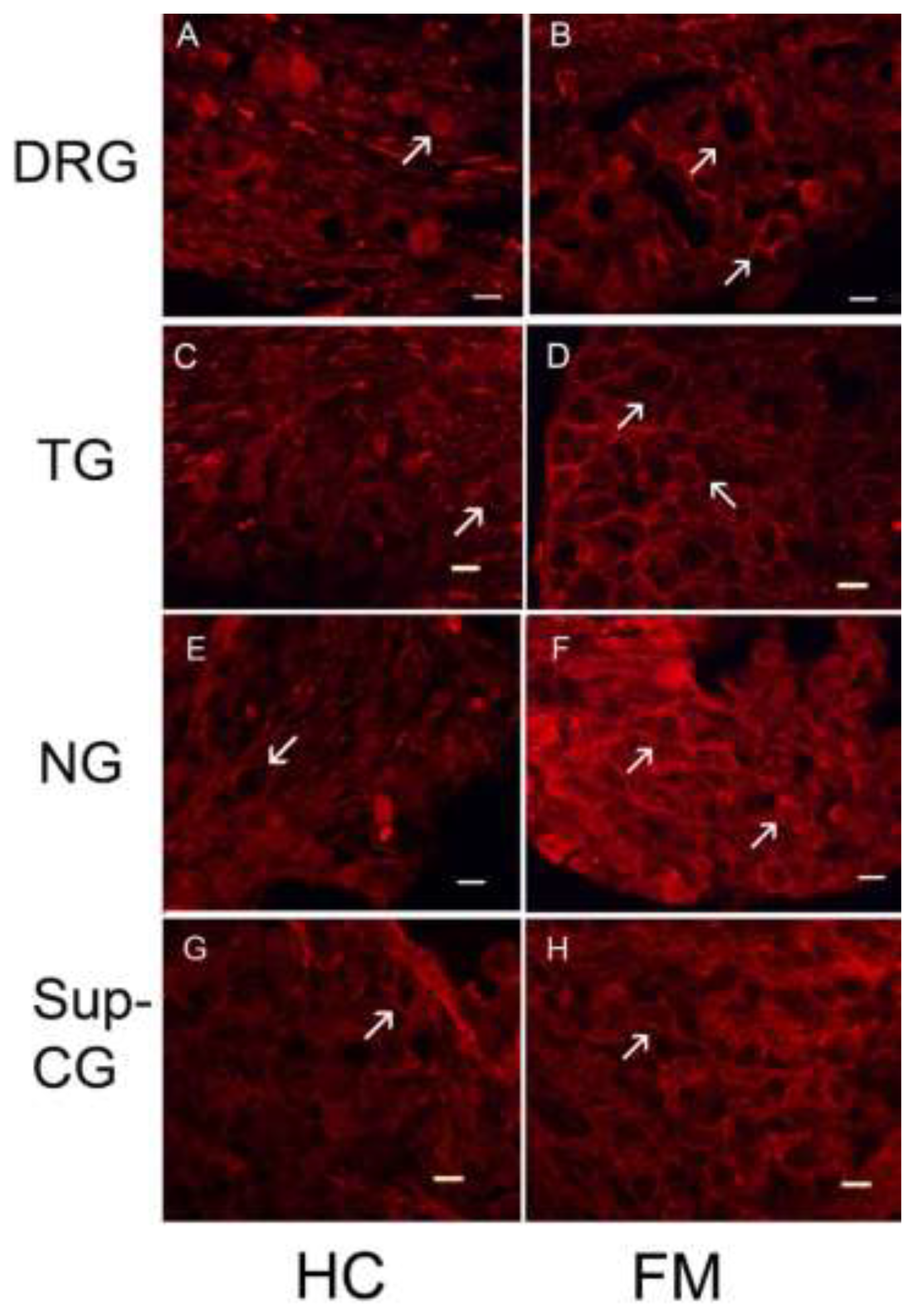
Figure 2.
Quantitation of the GFAP immunostaining under FM and HC sera. Top, results for ganglia from male mice. Bottom, results for female mice. Error bars represent mean± SEM. *indicates P<0.05. The number of ganglia per bar ranges from 4 to 10.
Figure 2.
Quantitation of the GFAP immunostaining under FM and HC sera. Top, results for ganglia from male mice. Bottom, results for female mice. Error bars represent mean± SEM. *indicates P<0.05. The number of ganglia per bar ranges from 4 to 10.
Disclaimer/Publisher’s Note: The statements, opinions and data contained in all publications are solely those of the individual author(s) and contributor(s) and not of MDPI and/or the editor(s). MDPI and/or the editor(s) disclaim responsibility for any injury to people or property resulting from any ideas, methods, instructions or products referred to in the content. |
© 2026 by the authors. Licensee MDPI, Basel, Switzerland. This article is an open access article distributed under the terms and conditions of the Creative Commons Attribution (CC BY) license (http://creativecommons.org/licenses/by/4.0/).
Copyright: This open access article is published under a Creative Commons CC BY 4.0 license, which permit the free download, distribution, and reuse, provided that the author and preprint are cited in any reuse.


