

Submitted:
23 March 2026
Posted:
24 March 2026
You are already at the latest version
Abstract
The transition from relapsing-remitting multiple sclerosis (RRMS) to secondary-progressive multiple sclerosis (SPMS) represents an ambiguous transition period characterized by diagnostic delays and a shifting therapeutic window. While inflammatory relapses are well-managed, the underlying neurodegeneration often remains undetected until substantial disability has accrued. This review evaluated the shift from traditional metrics, such as the Expanded Disability Status Scale (EDSS), toward more sensitive, multimodal monitoring strategies. We described characteristic MRI findings in SPMS and addressed the impact of comorbidities that frequently confound the diagnosis of disease transition. Furthermore, we evaluated the predictive potential of emerging fluid biomarkers and gut microbial signatures in identifying the early RRMS-to-SPMS transition. Finally, we described the current therapeutic landscape and emerging immunomodulatory interventions. Diagnosing SPMS remains a clinical challenge due to comorbidities and the lack of a singular definitive marker. Moving toward high-sensitivity imaging and molecular biomarkers is essential for the early initiation of treatments and improved patient outcomes.
Keywords:
multiple sclerosis
; progressive
; treatment
1. Introduction
Multiple sclerosis (MS) is an autoimmune, demyelinating disease of the central nervous system (CNS). The presence and timeline of acute exacerbations or progressive functional decline vary considerably among MS patients. Lublin et al. were the first to standardize diagnostic terminology in 1996. Relapsing-remitting MS (RRMS) is defined as discrete periods of exacerbation or relapse, with no interim disease progression. As a result, Patients may fully recover from relapse events or may have residual deficits from these exacerbations. Primary-progressive MS (PPMS) is defined as steady disease progression from onset and may include periods of stable disease or transient symptomatic improvement. In contrast, secondary-progressive MS (SPMS) is characterized by a disease course that begins as RRMS but eventually transitions to disease progression 10–25 years after disease onset [1].
While SPMS has long been considered a distinct clinical phenotype with a unique natural history, pathophysiology, and treatment response compared with other MS phenotypes, there remains a relative lack of clinically applicable guidelines for the prompt diagnosis of SPMS as patients transition from RRMS. In the absence of disease-modifying therapies (DMTs), this transition to SPMS occurs within 10 years in 50% and within 25 years in 90% of RRMS patients [2].
2. Clinical Measures of Disability
A variety of clinical disability severity scores have been proposed for the recognition and surveillance of progression in MS. The Expanded Disability Status Scale (EDSS) was developed in the 1950s and has long been the standard for assessing MS progression in clinical trials [3]. The EDSS assesses the following functional systems: pyramidal, cerebellar, brainstem, sensory, bowel and bladder, visual, cerebral, cerebellar, and ambulation. Criticisms of this modality include its emphasis on physical disability, insensitivity to small changes in disease progression as overall disability increases, and its significant interrater variability [4].
In a major 2002 study by Cohen et al., EDSS was inferior to the Multiple Sclerosis Functional Composite (MSFC) in detecting disease progression in patients with SPMS [5]. The MSFC was first outlined in the late 1990s and is considered a more quantitative, psychometrically sound approach to monitoring [6]. It consists of three assessments: a timed 25-foot walk, a 9-hole peg test, and a paced auditory serial addition test. The MSFC assessment of cognition and upper-extremity function provides valuable information not available from the EDSS. Moreover, MSFC scores are strongly correlated with validated measures of quality of life [7]. The major limitation of the MSFC involves the steep learning curve required for patients to perform the various assessments [8].
Additional modalities utilize new composites and technologies to enhance sensitivity. CombiWISE, which combines 58 outcomes from progressive MS trials, is over twice as sensitive as the EDSS for detecting disease progression [9]. While this modality may prove too unwieldy in clinical practice due to the prohibitive time burden of data collection and the computational complexity required to score the composite in a standard patient encounter, its benefits to clinical trials are promising. Similarly, the Multiple Sclerosis Performance Test (MSPT), developed by Rudick and colleagues at the Cleveland Clinic, addresses the standardization issues inherent in modalities such as the EDSS and MSFC by leveraging modern technological advances. Such as a neuroperformance module on a tablet [10].
Another key challenge is distinguishing disease progression from normal aging. The Age-Related Multiple Sclerosis Severity (ARMSS) score addresses this by adjusting a patient’s disability score based on age and ranking it against an extensive database of individuals with MS of the same age [11]. However, because it is based on the EDSS, the ARMSS tool also inherits the parent scale’s weaknesses [12].
These metric modalities are also foundational for defining the transition to SPMS. Lorscheider et al., for example, utilized a large global cohort to evaluate and validate objective SPMS definitions [13]. Their resulting criteria employ a three-stratum algorithm for minimum required progression, a 3-month confirmatory period, and a minimum EDSS score of 4. This objective framework provides a practical tool for clinicians to reduce diagnostic uncertainty in patients regarding SPMS-specific treatments or trials.
Building on these definitions, prognostic tools have been developed to predict the risk of conversion to SPMS [14,15]. The DAAE score is a more recent clinical instrument for predicting a patient’s five-year risk of conversion [16,17]. Subsequent international validation studies have yielded consistent and promising results, demonstrating that higher DAAE scores are proportionally associated with an increased risk of conversion to SPMS across diverse patient datasets. Furthermore, to capture the silent progression that often bypasses standard physical examinations, functional assessments such as the Symbol Digit Modalities Test (SDMT) are increasingly used to detect early cognitive decline associated with disease worsening [18].
Finally, while clinician-administered scales provide objective data, they often fail to capture the subjective burden of disease. Patient-Reported Outcome Measures (PROMs) are indispensable for quantifying patients’ perceptions of health status. Validated tools such as the Multiple Sclerosis Impact Scale (MSIS-29) [19] and the Multiple Sclerosis Quality of Life (MSQOL-54) [20] provide crucial insights into the actual impact of SPMS on daily living that clinical metrics alone may miss [21].
Ultimately, no single metric can capture the nature of SPMS progression. While high-density composites such as CombiWISE and MSPT offer superior sensitivity in research settings, they remain logistically challenging for routine care. In clinical practice, a multimodal approach is recommended. The EDSS remains necessary for regulatory and insurance purposes. Still, it should be supplemented by other testing modalities, such as the Timed 25-Foot Walk, the 9-Hole Peg Test, and the SDMT. Integrating these tools enables comprehensive disease monitoring that is rigorous enough to detect progression and compatible with clinical workflows.
3. Diagnostic Challenges and Clinical Measures Are Insufficient
The clinical landscape of MS has been shifted recently in how disability accumulation is understood, and moving away from purely relapse theory, which recognizes the early, hard-to-detect onset of neurodegeneration. This shift centers on the distinction between two ways disability can accumulate. Relapse-Associated Worsening (RAW) is disability accrual occurring shortly after a clinical relapse. In contrast, regression Independent of Relapse Activity (PIRA) is confirmed worsening in the absence of recent relapse. Both are clinical definitions that do not reflect MRI inflammatory activity, molecular, or pathological changes.
Emerging data suggest that PIRA is not a late-stage phenomenon but a process that begins early in the RRMS phase and evolves throughout the disease course [22]. Kappos et al. identified PIRA as the primary driver of confirmed disability accumulation, accounting for up to 89.1% of events in patients on high-efficacy therapy [23]. However, recent methodological analyses [24] suggest that even these figures may be conservative. Traditional definitions of PIRA, which require broad, relapse-free intervals, tend to be less sensitive when relapse rates are higher, potentially creating a bias that underestimates the true impact of treatment on progression. To address this, researchers advocate for identifying PIRA simply as any confirmed disability that is not a RAW event.
Despite advances in detection methods, the clinical distinction between RRMS and SPMS remains unclear. PIRA often occurs concurrently with acute relapses, creating a transition zone where the primary driver of disability shifts from inflammation to neurodegeneration [23].. Furthermore, because PIRA is a retrospective observation requiring months of confirmation, it often serves as a record of past damage rather than a predictive tool. (Figure 1) If they are done at any time, there will be a mix of PIRA and RAW components. In reality, the two go hand in hand. Even though EDSS is regularly done at scheduled intervals, such as every 3 months, and rebasing after relapse, there will still be overlap, as one could take up to 1 year to 1.5 years to fully recover from a relapse. Recent studies showed that higher efficacy therapy has a stronger effect on relapse and less on PIRA.
Complicating this challenge is the absence of a single definitive biomarker of progression. While MRI atrophy and sNfL composites are informative, they currently lack sufficient specificity to serve as a stand-alone diagnostic for SPMS. Consequently, clinicians face a significant dilemma. On one hand, early recognition of progression is critical for initiating neuroprotective interventions and preserving functional reserve. On the other hand, there is substantial hesitancy among both patients and physicians to formally apply the SPMS label. For patients, the diagnosis carries a heavy psychological burden [25]. For physicians, it means limiting therapeutic options due to insurance restrictions and the scarcity of approved treatments for progressive disease [26].
The diagnostic picture is further clouded by pseudoprogression, in which a transient decline due to infection, comorbidities, persistent symptoms such as fatigue, pain, or spasticity can resemble true disease progression. Clinicians must therefore distinguish between reversible confounders, which require symptomatic management, and actual progression, which warrants a change in disease-modifying therapy.
4. Comorbidities
Just as a variety of non-MS factors can confound the clinical picture in the setting of suspected relapse, a variety of potentially addressable comorbidities can resemble clinical progression due to MS [27]. Comorbid conditions affecting perceived disease progression in MS patients run the gamut from normal aging and sleep disorders to psychiatric illness and chronic diseases.
Primary sleeping disorders and those secondary to other comorbidities are common among general MS patients [28,29]. Changes in sleep quantity and quality directly affect the cyclic regulation of cytokines, leading to immune system dysregulation [30,31]. Notably, low melatonin levels are also associated with immune system dysregulation and may help to explain the relationship between sleep disorders and relapse in MS patients [32,33]. These authors found that the primary driver of variance in sleep problems among MS patients was depression [34].
Psychiatric diagnoses are more common in patients with MS. When compared to matched controls, MS patients had a higher incidence and prevalence of anxiety, depression, bipolar disorder, and schizophrenia [35]. Depression has been associated with relapse severity [36], a relationship exacerbated by concurrent substance use disorder [37]. This complex interplay highlights how psychiatric comorbidities can significantly influence the clinical course and overall burden of MS.
Obesity and its associated comorbidities are associated with increased adiposity, which also affects disease progression and relapses in MS patients. Adipokines secreted by adipose tissue have inflammatory properties that are thought to contribute to immune dysregulation in MS [38]. Moreover, the sequelae of poor diet and obesity are associated with disease progression and relapse. Vascular comorbidities such as diabetes mellitus, hypertension, hypercholesterolemia, and peripheral vascular disease have all been associated with disability progression in MS patients [39]. Furthermore, improved glycemic control through medical management of diabetes has been shown to strengthen MS relapse rates [40].
Beyond metabolic factors, other environmental and lifestyle factors, such as cigarette smoking, could also be a major culprit for the disease progression and relapse [41]. Smoking can activate the innate immune system, leading to widespread inflammation that, in turn, can damage myelin and axons in the central nervous system [42]. Several studies suggested that smoking can facilitate the transformation to a progressive form of multiple sclerosis [43,44,45]. Drug abuse in MS is multifaceted; while cannabis is frequently used for symptomatic relief of spasticity and pain, its chronic misuse has been linked to cognitive decline and psychiatric instability. Furthermore, the misuse of opioids or alcohol can compromise adherence to disease-modifying therapies and potentially accelerate neurodegeneration [46,47].
Finally, aging and MS progression share several overlapping mechanisms, making it challenging to distinguish between natural aging and disease-related decline. The aging process leads to immunosenescence, which reduces immune responsiveness and may alter the course of disease inflammation [48]. Structural white matter degeneration and decreased recovery potential following relapses significantly contribute to this overlap [49,50]. The accumulation of plaque could facilitate the transition from RRMS to the progressive form of MS [51].
The combination of biological aging and MS pathology presents a significant diagnostic challenge, as the clinical presentation of the general aging population frequently mimics the features of progressive MS. Geriatric syndromes such as cognitive decline, gait instability, fatigue, and bladder dysfunction are highly prevalent in the elderly, irrespective of demyelinating disease [52]. For the clinician, distinguishing whether a decline in gait velocity is driven by MS-related spasticity or age-related sarcopenia and osteoarthritis is difficult yet crucial for appropriate management. Similarly, cognitive slowing may be attributed to MS pathology, vascular cognitive impairment, or undiagnosed neurodegenerative comorbidities like Alzheimer’s disease. These presentations overlap, potentially leading to the misattribution of age-related functional decline to MS disease progression [53]. (Figure 2) These comorbidities could make EDSS and other clinical measures appear worse despite the fact that they were not supposed to count in MS-unrelated disability, but practically, EDSS examiners would not be able to tease these out.
5. Imaging
Magnetic resonance imaging (MRI) measures are increasingly used in progressive MS trials as proxies for disease progression. A seminal 1999 study by Stevenson et al. demonstrated a correlation between CNS atrophy and EDSS scores in patients with progressive MS. Brain and spinal cord atrophy have largely replaced lesion load as the primary markers in progressive MS trials [54,55]. Ventricular enlargement, brain volume change, and diffusion tensor imaging (DTI) biomarkers have also been studied and, for various reasons, deemed inferior to atrophy as markers of progression [56]. Challenges to standardizing advanced imaging techniques [57] and controlling for other confounders, including changes in patient weight, lipid levels, and hydration [58].
Complementing MRI, Optical coherence tomography (OCT) is a newer technique that, over time, can capture changes in the ganglion cell and inner plexiform layer of the retina (RNFL) and macular ganglion cell-inner plexiform layer (GCIPL) thicknesses. Retinal layer atrophy documented via OCT is associated with whole-brain atrophy in MS patients, a relationship that is particularly strong in progressive MS compared to RRMS [59]. The baseline thickness and the annualized rate of retinal layer thinning could also be strong predictors of global disability progression [60,61].
In recent years, the concept of “smoldering MS” has emerged to describe patients who experience progressive disease worsening despite stable inflammatory parameters. Smoldering MS is characterized by compartmentalized inflammation within the CNS, making traditional disease-modifying therapies less effective due to the presence of the blood-brain barrier [62,63].
Recent advances in neuroimaging have been instrumental in refining our understanding of smoldering MS. Using conventional MRI, it is possible to identify slowly expanding lesions (SELs), defined as pre-existing T2-hyperintense white matter lesions that demonstrate a slow, constant expansion over serial imaging studies [64]. Although SEL visualization only requires conventional MRI, SEL requires a long observation period and at least 3 scans to measure the lesion’s activity indirectly [65].
The clinical relevance of SELs is significant. Preziosa et al. established that a higher baseline proportion of SELs is an independent predictor of long-term disability worsening. Notably, more severe microstructural tissue damage within these lesions predicts conversion to SPMS [66]. Complementing this metric, paramagnetic rim lesions (PRLs) are another imaging marker that directly visualizes iron accumulation within activated microglia and macrophages at the lesion edge. PRL could be visualized in multiple imaging modalities. While 7T MRI is considered the standard for visualizing PRLs, Susceptibility-Weighted Imaging (SWI) is a widely used, accessible technique that provides precise, quantitative measures of tissue magnetic susceptibility [67].
Although SEL and PRL are distinct imaging markers, they can colocalize. Elliot et al. demonstrated that 39.5% of chronic PRLs also met the criteria for SEL, whereas 17.2% of SELs had PRL [68]. The paramagnetic rim is also not a permanent feature and tends to diminish as lesions age. This process is thought to reflect a decrease in chronic inflammatory activity at the lesion’s edge, which could be explained by microglia becoming less active and losing their iron content over time [69].
Emerging modalities such as Positron emission tomography (PET) that visualizes neuroinflammation by targeting the 18-kDa translocator protein (TSPO), a marker expressed in active microglia [70]. This technique shows promise in differentiating SPMS from RRMS, though its high cost limits routine use [71,72].
Finally, in SPMS, spinal cord lesions remain a critical prognostic indicator. These lesions typically reflect chronic degenerative processes, such as demyelination and axonal loss, rather than acute inflammation and often lack gadolinium enhancement on MRI scans [73]. Studies have identified critical spinal cord lesions in SPMS that are highly predictive of disease progression, located in the lateral columns of the spinal cord and appear as prominent, focal areas of atrophy [74]. Beyond the presence of lesions, spinal cord atrophy, specifically in the upper cervical cord, is detectable on MRI scans up to 4 years before the clinical criteria for SPMS are met. Additionally, it serves as a powerful prognostic marker for the progression to SPMS [75].
6. Biomarkers of Progression
As previously mentioned, numerous patient- and modality-specific factors can affect the specificity of MRI changes in relation to disease progression. Depending on the setting, MRIs can also carry accessibility challenges for MS patients. Thus, recent research has focused on biomarkers of disease activity. While much of the literature focuses on RRMS, there is likely considerable overlap between biomarkers of acute relapses and those of subacute or chronic disease progression observed in SPMS.
Historically, cerebrospinal fluid (CSF) IgG and oligoclonal band levels have been the gold standard for clinically defining MS; however, although diagnostically crucial, they are poor indicators of relapse [76]. While a significant effort has focused on neurofilament light (NF-L) as a potential predictor of disease activity in MS, it is also elevated in other conditions, including Parkinson’s [77,78] and Alzheimer’s [79], and is affected by changes to body mass index [80] and normal aging [81]. Additionally, Neurofilament Light Chain’s (NFL) clinical success has been variable, with a comprehensive review of investigational new drug (INDs) submitted to the U.S. Food and Drug Administration over the past 20 years showing that only approximately 50% of studies found NFL correlated with investigational drug treatment [82]. Thus, more work is needed to develop accurate biomarkers, particularly those that represent patients’ RRMS-to-SPMS transition.
Traditional biomarkers for Multiple Sclerosis (MS), such as NFL and Glial Fibrillary Acidic Protein (GFAP), have provided valuable insights into systemic inflammation. However, their utility is limited by a lack of disease specificity and a detection gap that occurs when a restored blood-brain barrier (BBB) masks compartmentalized CNS inflammation [83,84]. However, not specific to neurodegeneration, the serum and CSF biomarkers, neurofilament light (NF-L) [85,86] and the chemokine CXCL13 [87,88] are elevated during relapse.
Recent proteomic and longitudinal analyses have shown that, while NfL and CXCL13 remain the gold standard for tracking current disease activity and relapses, they are less effective at predicting long-term outcomes. Instead, the researchers found that a combination of several biomarkers, such as CHI3L1, is a superior longitudinal biomarker, as their levels correlate strongly with smoldering inflammation and clinical deterioration [83].
Moreover, soluble CD27 (sCD27) in CSF has been discovered as a robust biomarker of intrathecal T-cell activation and correlates significantly with NfL levels and axonal damage in progressive MS cohorts. sCD27 captures the residual inflammation that persists behind the BBB and reflects long-term disability outcomes [89].
Similarly, increases in serum and CSF GFAP [90] reflect reactive astrogliosis and mechanical injury to the astrocyte cytoskeleton, while decreases in serum RGC-32 have been associated with inflammatory peaks in RRMS patients. Despite these associations, the diagnostic utility of these markers remains unclear due to confounding variables. Consequently, while these traditional markers have laid the groundwork for monitoring neuro-inflammation, there remains a critical need for more refined tools that can accurately distinguish the progression.
The Multiple Sclerosis Disease Activity (MSDA) Test is a commercially available serum-based proteomic assay that quantifies multiple protein markers as currently its utility is limited to relapsing MS. The clinical validation of the MSDA test was performed by correlating its DA score with established radiographic and clinical endpoints of inflammatory disease activity; no markers for progressive disease have been validated [91].
Our previous work also led to the discovery of T cell costimulatory molecule sCD40L as a predictive biomarker for MS disease progression [92].The interaction between CD40, a membrane-bound costimulatory protein expressed on antigen-presenting cells, and CD40L, expressed on activated CD4+ T cells, is a critical co-stimulatory signal required for robust innate and adaptive immune activation [93]. Identification of CD40+ B cells within inflammatory lesions in MS autopsy brain tissue suggests that T cell and B cell interactions mediated by the CD40-CD40L pathway could contribute to MS pathology [94].
Promising advances in the field are focused on alternative markers of disease progression, including microbial signatures, with one pediatric study showing an association between MS and the absence of Fusobacteria [95]. Additional studies have shown that, compared with RRMS, SPMS patients are enriched for Akkermansia and Blautia and depleted of Prevotella and Clostridia, among others [96,97,98,99]. Our recent longitudinal study Montgomery et al. s demonstrated that Akkermansia muciniphila and Prevotella species are elevated in progressive MS patients and correlated with changes to a key microbial metabolite, vitamin K [96]. This study reflected a 5 year longitudinal follow up of progressive MS patients, and identified a decreased prevalence of species that produce anti-inflammatory vitamin K and short-chain fatty acids, including A. muciniphila, Lachnospiracea, and Oscillospiraceae. The authors suggest a selective decrease in these species might promote the acute, damaging inflammation during progressive disease. Later on a 2-year longitudinal follow-up study of patients with progressive MS, Schwerdtfeger et al. found a similar decrease in short-chain fatty acid-producing species, including Akkermansia and Lachnospiraceae [97].. This connection between gastrointestinal colonization and neurodegeneration is an active area of research within the field of multiple sclerosis and has shown potential to improve patient outcomes [100,101].
7. Disease-Modifying Treatments
Two relatively recent advances in disease-modifying therapy (DMT) for MS have been in the anti-CD20 and sphingosine-1-phosphate (S1P) modulator classes. Anti-CD20 medications include the first-generation Rituximab, approved for RRMS [102], and the second-generation humanized anti-CD20 Ocrelizumab, was approved as the first medication for PPMS [103]. These medications primarily target B cells, and Ocrelizumab was designed to enhance cell death in CD20-expressing cells. It was approved for PPMS following a trial that demonstrated reduced confirmed disability progression at 3 and 6 months, slower changes in timed walks, and reduced brain volume loss [103]. Ocrelizumab initiation starts with two 300 mg intravenous infusions given 2 weeks apart, followed by 600 mg doses every 6 months.
For SPMS, the S1P modulators Fingolimod and Siponimod have proven promising. Fingolimod works on S1P receptors 1, 3, 4, and 5, whereas Siponimod targets receptors 1 and 5 [104]. Fingolimod-specific data primarily come from the 2008-2011 INFORMS trial, which showed limited benefit of Fingolimod for progressive disease [105]. The EXPAND trial, conducted from 2013 to 2015, demonstrated that Siponimod reduced the risk of disability progression and brain volume loss in patients with SPMS. Adverse effects of Siponimod in the EXPAND trial included lymphopenia and infection, elevated liver transaminase values, bradycardia, and bradyarrhythmia [106].
Bruton’s tyrosine kinase (BTK) is a critical protein in signaling pathways of immune cells, such as B cells and microglia, implicated in MS pathology. In progressive MS, BTK-expressing immune populations have been observed in and around chronic active lesions, consistent with the concept of “smoldering” compartmentalized inflammation that contributes to ongoing demyelination, axonal injury, and neurodegeneration [107]. Activated B cells release pro-inflammatory cytokines and form damaging follicle-like structures in the central nervous system, while microglia activation also drives disease progression. Therapeutically, BTK inhibitors (BTKi) are attractive because they may modulate both peripheral B-cell activation and CNS-compartmentalized innate immune, thereby potentially impacting both relapses and progression [108].
Recent Phase III studies showed both the promise of BTK inhibition and the importance of defining progressive MS populations most likely to benefit. In non-relapsing SPMS, the HERCULES trial evaluated tolebrutinib versus placebo and reported a statistically significant reduction in 6-month confirmed disability, although effects on brain atrophy were not observed [109]. However, safety concerns regarding drug-induced liver injury were notable, with elevated enzymes occurring in 4% of treated patients. In PPMS, however, trial outcomes have diverged across studies. The PERSEUS study did not meet its primary endpoint, prompting the manufacturer to pause PPMS registration efforts [110]. In contrast, the ENtrepid study met its primary endpoint in PPMS, demonstrating fenebrutinib was non-inferior to ocrelizumab in delaying the onset of 12-week composite confirmed disability progression, with a numerical benefit observed as early as week 24 [111].
These different outcomes likely reflect a combination of patient selection, trial design, and drug-specific properties. The success in SPMS, compared with the mixed results in PPMS, suggests that BTK inhibition may be most effective in subpopulations with specific inflammatory profiles rather than in broad progressive cohorts. Furthermore, differences in trial endpoints (12-week vs. 6-month confirmation) and comparators (placebo vs. ocrelizumab) complicate direct comparisons. Finally, while BTK inhibition remains a compelling therapeutic avenue, future success will depend on refining patient selection through biomarkers and optimizing agents for selectivity, CNS penetrance, and safety profiles.
The CD40-CD40L pathway is a potent therapeutic target because it bridges adaptive and innate immunity; CD40L expressed on pathogenic T cells drives B cell and antigen-presenting cell activation, contributing to both peripheral inflammation and CNS compartmentalized disease [94,112]. We conducted an investigator-initiated phase I study using the first-generation anti-CD40L antibody, toralizumab (IDEC-131), and demonstrated a favorable safety profile. We showed by flow cytometry that there was no depletion of lymphocyte subsets. We further demonstrated an increase in the CD25+/CD3+ and CD25+/CD4+ ratio as well as IL10/IL17 and IL10/MCP1 ratio, indicating a shift toward an anti-inflammatory cytokine response with the [113]
The focus has since shifted to frexalimab, a second-generation antibody engineered to block CD40L without inducing platelet aggregation or thromboembolism. In a Phase 2 trial for relapsing MS, frexalimab met its primary endpoint at Week 12, reducing the number of new gadolinium-enhancing T1 lesions by 89% in the high-dose group compared to placebo (adjusted mean lesions: 0.2 vs. 1.4). Long-term data from the 48-week open-label extension demonstrated that 96% of participants in the high-dose arm remained free of new T1 lesions. The annualized relapse rate was exceedingly low at 0.04. Crucially, the drug was well-tolerated with no thromboembolic events reported [114].
Based on these promising results, frexalimab is now being evaluated in a significant global Phase 3 trial, FREVIVA (NCT06141486), for non-relapsing Secondary Progressive Multiple Sclerosis. This study is designed to determine if frexalimab can effectively delay disability progression compared to a placebo. As the trial is ongoing, efficacy and safety data for frexalimab in the SPMS population are not yet available.
CAR-T cell therapies are emerging therapies that enable T-cell activation and enable targeting of cells with downregulated MHC class I expression. CAR T cell therapies were primarily used in multiple hematologic malignancies; however, some subtypes showed benefits in MS, specifically, CAR-Tregs and anti-CD19 CAR T cells show decreased inflammation and promotion of remyelination in the EAE model [115]. CAR T cells have also been tested in several neuroimmunological diseases, including neuromyelitis optica spectrum disorder [116], and MOGAD [117].
For MS patients, CAR-T cell therapy is still in its early phases of development. However, the first publicly available study on MS showed promising results [118]. The study recruited two patients with progressive MS treated with KYV-101, a CD-19 CAR-T cell therapy. One patient developed cytokine release syndrome and a transient increase in transaminase levels. Her EDSS and MRIs were stable at 8 weeks. The second patient developed a cutaneous lesion post-infusion. Her EDSS and MRI remained stable throughout the course at 48 weeks of follow-up. Further research into different CAR-T cell therapies has emerged from a Phase 1 study of Eque-cel (CT103A), which targets the B-cell maturation antigen (BCMA) on plasma cells. In a cohort of 5 patients (4 SPMS and 1PPMS) followed for an average of 5.1 months, the average EDSS score significantly improved from 6.2 to 5.0, with improvements across all testing modalities and minimal adverse effects [119].
Although CAR-T cell therapies have shown significant benefits in initial studies, their associated toxicities cannot be overlooked. The two major ones are CRS, which can be presented with symptoms ranging from mild fever to severe shock, and immune effector cell-associated neurotoxicity syndrome (ICANS), which manifests as a spectrum of neurologic symptoms, including confusion, aphasia, delirium, seizures, and, in severe cases, cerebral edema [120,121].
Beyond these successes, the field has also witnessed setbacks, most notably with clemastine fumarate. Originally developed as an over-the-counter antihistamine with muscarinic receptor–blocking properties, it attracted attention as a potential therapy for multiple sclerosis because of its ability to promote oligodendrocyte differentiation and remyelination in preclinical studies [122,123,124] and in the ReBUILD Phase II trial (NCT02040298) [125]. In the phase II ReBUILD trial, it reduced visual evoked potential (VEP) P100 latencies by 1.7 ms per eye (P = 0.0048) in patients with relapsing-remitting MS with chronic demyelinating optic neuropathy, suggesting functional recovery through remyelination [125]. These findings provided the rationale for testing clemastine in the TRAP-MS platform trial, which was designed to test a biomarker-guided combination of therapies in patients with progressive MS who were accumulating disability independently of relapses [126].
Contrary to expectations, the clemastine arm of TRAP-MS was terminated early after a third of participants met the prespecified safety-stopping criteria, and most treated patients showed significantly more rapid worsening than at baseline or compared with patients in other TRAP-MS treatment arms. Follow-up analyses revealed that clemastine potentiates purinergic P2RX7 signaling, enhancing inflammasome activation and inducing pyroptotic cell death in macrophages and oligodendrocytes, thereby worsening CNS injury in a pro-inflammatory environment [126].
8. Conclusions
The ambiguity that comes with diagnosing SPMS results in a substantial delay in definitively characterizing patients as having progressive disease, often after they have accumulated substantial disability [127]. Historically, clinicians may have exhibited appropriate hesitancy to label patients as having a condition for which there are limited treatment options, but as new therapies are being developed that may offer neuroprotective benefits for SPMS patients, early identification of those patients who may benefit from existing treatments or participate in clinical trials for new agents becomes increasingly important. This study explored the comorbidities associated with SPMS, metrics for monitoring disability progression, relevant imaging modalities, and promising fluid biomarkers, before then providing a detailed analysis of the current treatment landscape.
Our current understanding of the pathophysiology of multiple sclerosis remains incomplete. Yet the paradigm is shifting from a dichotomous view of relapsing versus progressive disease toward a continuum of immune-mediated injury. We have outlined advances in the field that inform our understanding of comorbidities, the design of high-sensitivity disability metrics, progression-specific biomarkers, advanced imaging, and new DMTs. However, significant hurdles remain. The field must address the diagnostic dilemma posed by the early superimposition of progression on relapses and the current lack of a definitive marker for the transition to SPMS. Future research should prioritize the development of biomarkers that can distinguish actual biological progression from pseudoprogression, therefore, enabling clinicians to overcome diagnostic uncertainty. We hope that bridging these knowledge and clinical management gaps over the next decade will facilitate earlier, more targeted interventions for patients entering the progressive phase of the disease.
Funding
This research received no external funding.
Data Availability Statement
The original contributions presented in this study are included in the article/supplementary material. Further inquiries can be directed to the corresponding author.
Conflicts of interest
Y.M.-D. has served as a consultant and/or received grant support from Acorda, Bayer Pharmaceutical, Biogen Idec, EMD Serono, Sanofi-Genzyme, Roche-Genentech, Janssen, Novartis, Questor, TG Therapeutics, Horizon, and Teva Neuroscience. The remaining authors declare that the research was conducted in the absence of any commercial or financial relationships that could be construed as a potential conflict of interest.
References
- Lublin, F. D.; Reingold, S. C.; Cohen, J. A.; Cutter, G. R.; Sorensen, P. S.; Thompson, A. J.; Wolinsky, J. S.; Balcer, L. J.; Banwell, B.; Barkhof, F.; Bebo, B.; Calabresi, Jr.; Clanet, P. A.; Comi, M.; Fox, G.; Freedman, R. J.; Goodman, M. S.; Inglese, A. D.; Kappos, M.; Kieseier, L.; Lincoln, B. C.; Lubetzki, J. A.; Miller, C.; Montalban, A. E.; O’Connor, X.; Petkau, P. W.; Pozzilli, J.; Rudick, C.; Sormani, R. A.; Stuve, M. P.; Waubant, O.; Polman, E.C.H. Defining the clinical course of multiple sclerosis: the 2013 revisions. Neurology 2014, 83((3)), 278–86. [Google Scholar] [CrossRef] [PubMed]
- Koch, M.; Kingwell, E.; Rieckmann, P.; Tremlett, H.; Neurologists, U. M. C. The natural history of secondary progressive multiple sclerosis. J Neurol Neurosurg Psychiatry 2010, 81((9)), 1039–43. [Google Scholar] [CrossRef] [PubMed]
- Kurtzke, J. F. Rating neurologic impairment in multiple sclerosis: an expanded disability status scale. Neurology 1983, 33((11)), 1444–52. [Google Scholar] [CrossRef]
- Kragt, J. J.; Thompson, A. J.; Montalban, X.; Tintore, M.; Rio, J.; Polman, C. H.; Uitdehaag, B. M. Responsiveness and predictive value of EDSS and MSFC in primary progressive MS. Neurology 2008, 70 (13 Pt 2), 1084–91. [Google Scholar] [CrossRef] [PubMed]
- Cohen, J. A.; Cutter, G. R.; Fischer, J. S.; Goodman, A. D.; Heidenreich, F. R.; Kooijmans, M. F.; Sandrock, A. W.; Rudick, R. A.; Simon, J. H.; Simonian, N. A.; Tsao, E. C.; Whitaker, J. N.; Investigators, I. Benefit of interferon beta-1a on MSFC progression in secondary progressive MS. Neurology 2002, 59((5)), 679–87. [Google Scholar] [CrossRef]
- Cutter, G. R.; Baier, M. L.; Rudick, R. A.; Cookfair, D. L.; Fischer, J. S.; Petkau, J.; Syndulko, K.; Weinshenker, B. G.; Antel, J. P.; Confavreux, C.; Ellison, G. W.; Lublin, F.; Miller, A. E.; Rao, S. M.; Reingold, S.; Thompson, A.; Willoughby, E. Development of a multiple sclerosis functional composite as a clinical trial outcome measure. Brain 1999, 122 Pt 5, 871–82. [Google Scholar] [CrossRef]
- Miller, D. M.; Rudick, R. A.; Cutter, G.; Baier, M.; Fischer, J. S. Clinical significance of the multiple sclerosis functional composite: relationship to patient-reported quality of life. Arch Neurol 2000, 57((9)), 1319–24. [Google Scholar] [CrossRef]
- Meyer-Moock, S.; Feng, Y. S.; Maeurer, M.; Dippel, F. W.; Kohlmann, T. Systematic literature review and validity evaluation of the Expanded Disability Status Scale (EDSS) and the Multiple Sclerosis Functional Composite (MSFC) in patients with multiple sclerosis. BMC Neurol 2014, 14, 58. [Google Scholar] [CrossRef]
- Kosa, P.; Ghazali, D.; Tanigawa, M.; Barbour, C.; Cortese, I.; Kelley, W.; Snyder, B.; Ohayon, J.; Fenton, K.; Lehky, T.; Wu, T.; Greenwood, M.; Nair, G.; Bielekova, B. Development of a Sensitive Outcome for Economical Drug Screening for Progressive Multiple Sclerosis Treatment. Front Neurol 2016, 7, 131. [Google Scholar] [CrossRef]
- Rudick, R. A.; Miller, D.; Bethoux, F.; Rao, S. M.; Lee, J. C.; Stough, D.; Reece, C.; Schindler, D.; Mamone, B.; Alberts, J. The Multiple Sclerosis Performance Test (MSPT): an iPad-based disability assessment tool. J Vis Exp 2014, (88), e51318. [Google Scholar]
- Manouchehrinia, A.; Westerlind, H.; Kingwell, E.; Zhu, F.; Carruthers, R.; Ramanujam, R.; Ban, M.; Glaser, A.; Sawcer, S.; Tremlett, H.; Hillert, J. Age Related Multiple Sclerosis Severity Score: Disability ranked by age. Mult Scler 2017, 23((14)), 1938–1946. [Google Scholar] [CrossRef]
- Bau, L.; Matas, E.; Romero-Pinel, L.; Leon, I.; Munoz-Vendrell, A.; Arroyo-Pereiro, P.; Martinez-Yelamos, A.; Martinez-Yelamos, S. Assessment of the Multiple Sclerosis Severity Score and the Age-Related Multiple Sclerosis Severity Score as health indicators in a population-based cohort. Neurol Sci 2025, 46((1)), 335–342. [Google Scholar] [CrossRef] [PubMed]
- Lorscheider, J.; Buzzard, K.; Jokubaitis, V.; Spelman, T.; Havrdova, E.; Horakova, D.; Trojano, M.; Izquierdo, G.; Girard, M.; Duquette, P.; Prat, A.; Lugaresi, A.; Grand’Maison, F.; Grammond, P.; Hupperts, R.; Alroughani, R.; Sola, P.; Boz, C.; Pucci, E.; Lechner-Scott, J.; Bergamaschi, R.; Oreja-Guevara, C.; Iuliano, G.; Van Pesch, V.; Granella, F.; Ramo-Tello, C.; Spitaleri, D.; Petersen, T.; Slee, M.; Verheul, F.; Ampapa, R.; Amato, M. P.; McCombe, P.; Vucic, S.; Sanchez Menoyo, J. L.; Cristiano, E.; Barnett, M. H.; Hodgkinson, S.; Olascoaga, J.; Saladino, M. L.; Gray, O.; Shaw, C.; Moore, F.; Butzkueven, H.; Kalincik, T.; Group, M. S. S. Defining secondary progressive multiple sclerosis. Brain 2016, 139 (Pt 9), 2395–405. [Google Scholar] [CrossRef] [PubMed]
- Manouchehrinia, A.; Zhu, F.; Piani-Meier, D.; Lange, M.; Silva, D. G.; Carruthers, R.; Glaser, A.; Kingwell, E.; Tremlett, H.; Hillert, J. Predicting risk of secondary progression in multiple sclerosis: A nomogram. Mult Scler 2019, 25((8)), 1102–1112. [Google Scholar] [CrossRef] [PubMed]
- Skoog, B.; Tedeholm, H.; Runmarker, B.; Oden, A.; Andersen, O. Continuous prediction of secondary progression in the individual course of multiple sclerosis. Mult Scler Relat Disord 2014, 3((5)), 584–92. [Google Scholar] [CrossRef]
- Fuchs, T. A.; Ziccardi, S.; Jelgerhuis, J. R.; Killestein, J.; Strijbis, E. M. M.; Zivadinov, R.; Weinstock-Guttman, B.; Schoonheim, M. M.; Calabrese, M. Verona validation of the DAAE score, a tool for estimating risk of clinical disease progression in people with multiple sclerosis. Mult Scler Relat Disord 2025, 101, 106586. [Google Scholar] [CrossRef]
- Jelgerhuis, J. R.; Uher, T.; Havrdova, E. K.; Horakova, D.; Schoonheim, M. M.; Fuchs, T. A. Clinical risk stratification: Prague validation of the DAAE score, a clinical tool for estimating risk of disesase progression in multiple sclerosis. Mult Scler Relat Disord 2025, 98, 106423. [Google Scholar] [CrossRef]
- Gajewski, B.; Karlinska, I.; Stasiolek, M. Symbol Digit Modalities Test in progressive multiple sclerosis. Neurol Neurochir Pol 2024, 58((3)), 221–232. [Google Scholar] [CrossRef]
- Hobart, J.; Lamping, D.; Fitzpatrick, R.; Riazi, A.; Thompson, A. The Multiple Sclerosis Impact Scale (MSIS-29): a new patient-based outcome measure. Brain 2001, 124 (Pt 5), 962–73. [Google Scholar] [CrossRef]
- Vickrey, B. G.; Hays, R. D.; Harooni, R.; Myers, L. W.; Ellison, G. W. A health-related quality of life measure for multiple sclerosis. Qual Life Res 1995, 4((3)), 187–206. [Google Scholar] [CrossRef]
- Hobart, J. C.; Riazi, A.; Lamping, D. L.; Fitzpatrick, R.; Thompson, A. J. Measuring the impact of MS on walking ability: the 12-Item MS Walking Scale (MSWS-12). Neurology 2003, 60((1)), 31–6. [Google Scholar] [CrossRef] [PubMed]
- Lublin, F. D.; Haring, D. A.; Ganjgahi, H.; Ocampo, A.; Hatami, F.; Cuklina, J.; Aarden, P.; Dahlke, F.; Arnold, D. L.; Wiendl, H.; Chitnis, T.; Nichols, T. E.; Kieseier, B. C.; Bermel, R. A. How patients with multiple sclerosis acquire disability. Brain 2022, 145((9)), 3147–3161. [Google Scholar] [CrossRef] [PubMed]
- Kappos, L.; Wolinsky, J. S.; Giovannoni, G.; Arnold, D. L.; Wang, Q.; Bernasconi, C.; Model, F.; Koendgen, H.; Manfrini, M.; Belachew, S.; Hauser, S. L. Contribution of Relapse-Independent Progression vs Relapse-Associated Worsening to Overall Confirmed Disability Accumulation in Typical Relapsing Multiple Sclerosis in a Pooled Analysis of 2 Randomized Clinical Trials. JAMA Neurol 2020, 77((9)), 1132–1140. [Google Scholar] [CrossRef] [PubMed]
- Montobbio, N.; Bovis, F.; Signori, A.; Carmisciano, L.; Schiavetti, I.; Ponzano, M.; Tur, C.; Granziera, C.; Cagol, A.; Arnold, D. L.; Kappos, L.; Sormani, M. P. Uncovering a bias in estimated treatment effects on PIRA in multiple sclerosis clinical trials. EBioMedicine 2025, 117, 105802. [Google Scholar] [CrossRef]
- Bogosian, A.; Morgan, M.; Moss-Morris, R. Multiple challenges for people after transitioning to secondary progressive multiple sclerosis: a qualitative study. BMJ Open 2019, 9((3)), e026421. [Google Scholar] [CrossRef]
- Oh, J.; Alikhani, K.; Bruno, T.; Devonshire, V.; Giacomini, P. S.; Giuliani, F.; Nakhaipour, H. R.; Schecter, R.; Larochelle, C. Diagnosis and management of secondary-progressive multiple sclerosis: time for change. Neurodegener Dis Manag 2019, 9((6)), 301–317. [Google Scholar] [CrossRef]
- Mills, E. A.; Mirza, A.; Mao-Draayer, Y. Emerging Approaches for Validating and Managing Multiple Sclerosis Relapse. Front Neurol 2017, 8, 116. [Google Scholar] [CrossRef]
- Merlino, G.; Fratticci, L.; Lenchig, C.; Valente, M.; Cargnelutti, D.; Picello, M.; Serafini, A.; Dolso, P.; Gigli, G. L. Prevalence of ‘poor sleep’ among patients with multiple sclerosis: an independent predictor of mental and physical status. Sleep Med 2009, 10((1)), 26–34. [Google Scholar] [CrossRef]
- Najafi, M. R.; Toghianifar, N.; Etemadifar, M.; Haghighi, S.; Maghzi, A. H.; Akbari, M. Circadian rhythm sleep disorders in patients with multiple sclerosis and its association with fatigue: A case-control study. J Res Med Sci 2013, 18 (Suppl 1), S71–3. [Google Scholar]
- Irwin, M. R.; Olmstead, R.; Carroll, J. E. Sleep Disturbance, Sleep Duration, and Inflammation: A Systematic Review and Meta-Analysis of Cohort Studies and Experimental Sleep Deprivation. Biol Psychiatry 2016, 80((1)), 40–52. [Google Scholar] [CrossRef]
- Wipfler, P.; Heikkinen, A.; Harrer, A.; Pilz, G.; Kunz, A.; Golaszewski, S. M.; Reuss, R.; Oschmann, P.; Kraus, J. Circadian rhythmicity of inflammatory serum parameters: a neglected issue in the search of biomarkers in multiple sclerosis. J Neurol 2013, 260((1)), 221–7. [Google Scholar] [CrossRef] [PubMed]
- Farez, M. F.; Mascanfroni, I. D.; Mendez-Huergo, S. P.; Yeste, A.; Murugaiyan, G.; Garo, L. P.; Balbuena Aguirre, M. E.; Patel, B.; Ysrraelit, M. C.; Zhu, C.; Kuchroo, V. K.; Rabinovich, G. A.; Quintana, F. J.; Correale, J. Melatonin Contributes to the Seasonality of Multiple Sclerosis Relapses. Cell 2015, 162((6)), 1338–52. [Google Scholar] [CrossRef] [PubMed]
- Damasceno, A.; Moraes, A. S.; Farias, A.; Damasceno, B. P.; dos Santos, L. M.; Cendes, F. Disruption of melatonin circadian rhythm production is related to multiple sclerosis severity: A preliminary study. J Neurol Sci 2015, 353((1-2)), 166–8. [Google Scholar] [CrossRef] [PubMed]
- Bamer, A. M.; Johnson, K. L.; Amtmann, D. A.; Kraft, G. H. Beyond fatigue: Assessing variables associated with sleep problems and use of sleep medications in multiple sclerosis. Clin Epidemiol 2010, 2010, 99–106. [Google Scholar] [CrossRef]
- Marrie, R. A.; Fisk, J. D.; Tremlett, H.; Wolfson, C.; Warren, S.; Tennakoon, A.; Leung, S.; Patten, S. B.; Epidemiology, C. T. i. t. Impact of Comorbidity on Multiple, S., Differences in the burden of psychiatric comorbidity in MS vs the general population. Neurology 2015, 85((22)), 1972–9. [Google Scholar] [CrossRef]
- Sabanagic-Hajric, S.; Suljic, E.; Sulejmanpasic-Arslanagic, G. Depression during multiple sclerosis relapse: relation to disability and relapse severity. Med Glas (Zenica) 2016, 13((1)), 44–9. [Google Scholar]
- Bombardier, C. H.; Blake, K. D.; Ehde, D. M.; Gibbons, L. E.; Moore, D.; Kraft, G. H. Alcohol and drug abuse among persons with multiple sclerosis. Mult Scler 2004, 10((1)), 35–40. [Google Scholar] [CrossRef]
- Guerrero-Garcia, J. J.; Carrera-Quintanar, L.; Lopez-Roa, R. I.; Marquez-Aguirre, A. L.; Rojas-Mayorquin, A. E.; Ortuno-Sahagun, D. Multiple Sclerosis and Obesity: Possible Roles of Adipokines. Mediators Inflamm 2016, 2016, 4036232. [Google Scholar] [CrossRef]
- Marrie, R. A.; Rudick, R.; Horwitz, R.; Cutter, G.; Tyry, T.; Campagnolo, D.; Vollmer, T. Vascular comorbidity is associated with more rapid disability progression in multiple sclerosis. Neurology 2010, 74((13)), 1041–7. [Google Scholar] [CrossRef]
- Negrotto, L.; Farez, M. F.; Correale, J. Immunologic Effects of Metformin and Pioglitazone Treatment on Metabolic Syndrome and Multiple Sclerosis. JAMA Neurol 2016, 73((5)), 520–8. [Google Scholar] [CrossRef]
- Wingerchuk, D. M. Smoking: effects on multiple sclerosis susceptibility and disease progression. Ther Adv Neurol Disord 2012, 5((1)), 13–22. [Google Scholar] [CrossRef]
- Rosso, M.; Chitnis, T. Association Between Cigarette Smoking and Multiple Sclerosis: A Review. JAMA Neurol 2020, 77((2)), 245–253. [Google Scholar] [CrossRef] [PubMed]
- Hernan, M. A.; Jick, S. S.; Logroscino, G.; Olek, M. J.; Ascherio, A.; Jick, H. Cigarette smoking and the progression of multiple sclerosis. Brain 2005, 128 (Pt 6), 1461–5. [Google Scholar] [CrossRef] [PubMed]
- Roudbari, S. A.; Ansar, M. M.; Yousefzad, A. Smoking as a risk factor for development of Secondary Progressive Multiple Sclerosis: A study in IRAN, Guilan. J Neurol Sci 2013, 330((1-2)), 52–5. [Google Scholar] [CrossRef] [PubMed]
- Healy, B. C.; Ali, E. N.; Guttmann, C. R.; Chitnis, T.; Glanz, B. I.; Buckle, G.; Houtchens, M.; Stazzone, L.; Moodie, J.; Berger, A. M.; Duan, Y.; Bakshi, R.; Khoury, S.; Weiner, H.; Ascherio, A. Smoking and disease progression in multiple sclerosis. Arch Neurol 2009, 66((7)), 858–64. [Google Scholar] [CrossRef]
- Honarmand, K.; Tierney, M. C.; O’Connor, P.; Feinstein, A. Effects of cannabis on cognitive function in patients with multiple sclerosis. Neurology 2011, 76((13)), 1153–60. [Google Scholar] [CrossRef]
- McKay, K. A.; Tremlett, H.; Fisk, J. D.; Patten, S. B.; Fiest, K.; Berrigan, L.; Marrie, R. A.; Epidemiology, C. T. i. t. Impact of Comorbidity on Multiple, S., Adverse health behaviours are associated with depression and anxiety in multiple sclerosis: A prospective multisite study. Mult Scler 2016, 22((5)), 685–93. [Google Scholar] [CrossRef]
- Zuo, M.; Ramaglia, V.; Gommerman, J. L. Age-related changes in multiple sclerosis and experimental autoimmune encephalomyelitis. Semin Immunol 2022, 59, 101631. [Google Scholar] [CrossRef]
- Westlye, L. T.; Walhovd, K. B.; Dale, A. M.; Bjornerud, A.; Due-Tonnessen, P.; Engvig, A.; Grydeland, H.; Tamnes, C. K.; Ostby, Y.; Fjell, A. M. Life-span changes of the human brain white matter: diffusion tensor imaging (DTI) and volumetry. Cereb Cortex 2010, 20((9)), 2055–68. [Google Scholar] [CrossRef]
- Conway, B. L.; Zeydan, B.; Uygunoglu, U.; Novotna, M.; Siva, A.; Pittock, S. J.; Atkinson, E. J.; Rodriguez, M.; Kantarci, O. H. Age is a critical determinant in recovery from multiple sclerosis relapses. Mult Scler 2019, 25((13)), 1754–1763. [Google Scholar] [CrossRef]
- Frischer, J. M.; Weigand, S. D.; Guo, Y.; Kale, N.; Parisi, J. E.; Pirko, I.; Mandrekar, J.; Bramow, S.; Metz, I.; Bruck, W.; Lassmann, H.; Lucchinetti, C. F. Clinical and pathological insights into the dynamic nature of the white matter multiple sclerosis plaque. Ann Neurol 2015, 78((5)), 710–21. [Google Scholar] [CrossRef] [PubMed]
- Ostolaza, A.; Corroza, J.; Ayuso, T. Multiple sclerosis and aging: comorbidity and treatment challenges. Mult Scler Relat Disord 2021, 50, 102815. [Google Scholar] [CrossRef] [PubMed]
- Capasso, N.; Virgilio, E.; Covelli, A.; Giovannini, B.; Foschi, M.; Montini, F.; Nasello, M.; Nilo, A.; Prestipino, E.; Schiro, G.; Sperandei, S.; Clerico, M.; Lanzillo, R. Aging in multiple sclerosis: from childhood to old age, etiopathogenesis, and unmet needs: a narrative review. Front Neurol 2023, 14, 1207617. [Google Scholar] [CrossRef] [PubMed]
- Ontaneda, D.; Fox, R. J.; Chataway, J. Clinical trials in progressive multiple sclerosis: lessons learned and future perspectives. Lancet Neurol 2015, 14((2)), 208–23. [Google Scholar] [CrossRef]
- Pardini, M.; Cutter, G.; Sormani, M. P. Clinical trial design for progressive MS trials. Mult Scler 2017, 23((12)), 1642–1648. [Google Scholar] [CrossRef]
- De Stefano, N.; Stromillo, M. L.; Giorgio, A.; Bartolozzi, M. L.; Battaglini, M.; Baldini, M.; Portaccio, E.; Amato, M. P.; Sormani, M. P. Establishing pathological cut-offs of brain atrophy rates in multiple sclerosis. J Neurol Neurosurg Psychiatry 2016, 87((1)), 93–9. [Google Scholar] [CrossRef]
- Jones, D. K.; Cercignani, M. Twenty-five pitfalls in the analysis of diffusion MRI data. NMR Biomed 2010, 23((7)), 803–20. [Google Scholar] [CrossRef]
- Weinberger, D. R.; Radulescu, E. Finding the Elusive Psychiatric “Lesion” With 21st-Century Neuroanatomy: A Note of Caution. Am J Psychiatry 2016, 173((1)), 27–33. [Google Scholar] [CrossRef]
- Saidha, S.; Al-Louzi, O.; Ratchford, J. N.; Bhargava, P.; Oh, J.; Newsome, S. D.; Prince, J. L.; Pham, D.; Roy, S.; van Zijl, P.; Balcer, L. J.; Frohman, E. M.; Reich, D. S.; Crainiceanu, C.; Calabresi, P. A. Optical coherence tomography reflects brain atrophy in multiple sclerosis: A four-year study. Ann Neurol 2015, 78((5)), 801–13. [Google Scholar] [CrossRef]
- Bsteh, G.; Hegen, H.; Altmann, P.; Auer, M.; Berek, K.; Pauli, F. D.; Wurth, S.; Zinganell, A.; Rommer, P.; Deisenhammer, F.; Leutmezer, F.; Berger, T. Retinal layer thinning is reflecting disability progression independent of relapse activity in multiple sclerosis. Mult Scler J Exp Transl Clin 2020, 6((4)), 2055217320966344. [Google Scholar] [CrossRef]
- De Angelis, F.; Cameron, J. R.; Eshaghi, A.; Parker, R.; Connick, P.; Stutters, J.; Plantone, D.; Doshi, A.; John, N.; Williams, T.; Calvi, A.; MacManus, D.; Barkhof, F.; Chandran, S.; Weir, C. J.; Toosy, A.; Chataway, J.; investigators, M.-S. t. Optical coherence tomography in secondary progressive multiple sclerosis: cross-sectional and longitudinal exploratory analysis from the MS-SMART randomised controlled trial. J Neurol Neurosurg Psychiatry 2025, 96((7)), 647–654. [Google Scholar] [CrossRef] [PubMed]
- Giovannoni, G.; Popescu, V.; Wuerfel, J.; Hellwig, K.; Iacobaeus, E.; Jensen, M. B.; Garcia-Dominguez, J. M.; Sousa, L.; De Rossi, N.; Hupperts, R.; Fenu, G.; Bodini, B.; Kuusisto, H. M.; Stankoff, B.; Lycke, J.; Airas, L.; Granziera, C.; Scalfari, A. Smouldering multiple sclerosis: the ‘real MS’. Ther Adv Neurol Disord 2022, 15, 17562864211066751. [Google Scholar] [CrossRef] [PubMed]
- Scalfari, A.; Traboulsee, A.; Oh, J.; Airas, L.; Bittner, S.; Calabrese, M.; Garcia Dominguez, J. M.; Granziera, C.; Greenberg, B.; Hellwig, K.; Illes, Z.; Lycke, J.; Popescu, V.; Bagnato, F.; Giovannoni, G. Smouldering-Associated Worsening in Multiple Sclerosis: An International Consensus Statement on Definition, Biology, Clinical Implications, and Future Directions. Ann Neurol 2024, 96((5)), 826–845. [Google Scholar] [CrossRef] [PubMed]
- Elliott, C.; Wolinsky, J. S.; Hauser, S. L.; Kappos, L.; Barkhof, F.; Bernasconi, C.; Wei, W.; Belachew, S.; Arnold, D. L. Slowly expanding/evolving lesions as a magnetic resonance imaging marker of chronic active multiple sclerosis lesions. Mult Scler 2019, 25((14)), 1915–1925. [Google Scholar] [CrossRef]
- Bagnato, F.; Sati, P.; Hemond, C. C.; Elliott, C.; Gauthier, S. A.; Harrison, D. M.; Mainero, C.; Oh, J.; Pitt, D.; Shinohara, R. T.; Smith, S. A.; Trapp, B.; Azevedo, C. J.; Calabresi, P. A.; Henry, R. G.; Laule, C.; Ontaneda, D.; Rooney, W. D.; Sicotte, N. L.; Reich, D. S.; Absinta, M. Imaging chronic active lesions in multiple sclerosis: a consensus statement. Brain 2024, 147((9)), 2913–2933. [Google Scholar] [CrossRef]
- Preziosa, P.; Pagani, E.; Meani, A.; Moiola, L.; Rodegher, M.; Filippi, M.; Rocca, M. A. Slowly Expanding Lesions Predict 9-Year Multiple Sclerosis Disease Progression. Neurol Neuroimmunol Neuroinflamm 2022, 9. [Google Scholar] [CrossRef]
- Gillen, K. M.; Nguyen, T. D.; Dimov, A.; Kovanlikaya, I.; Luu, H. M.; Demmon, E.; Markowitz, D. M.; Bagnato, F.; Pitt, D.; Gauthier, S. A.; Wang, Y. Quantitative susceptibility mapping is more sensitive and specific than phase imaging in detecting chronic active multiple sclerosis lesion rims: pathological validation. Brain Commun 2025, 7((1)), fcaf011. [Google Scholar] [CrossRef]
- Elliott, C.; Rudko, D. A.; Arnold, D. L.; Fetco, D.; Elkady, A. M.; Araujo, D.; Zhu, B.; Gafson, A.; Tian, Z.; Belachew, S.; Bradley, D. P.; Fisher, E. Lesion-level correspondence and longitudinal properties of paramagnetic rim and slowly expanding lesions in multiple sclerosis. Mult Scler 2023, 29((6)), 680–690. [Google Scholar] [CrossRef]
- Mosher, K. I.; Wyss-Coray, T. Microglial dysfunction in brain aging and Alzheimer’s disease. Biochem Pharmacol 2014, 88((4)), 594–604. [Google Scholar] [CrossRef]
- Guido, G.; Preziosa, P.; Filippi, M.; Rocca, M. A. TSPO PET in multiple sclerosis: Emerging insights into pathophysiology, prognosis, and treatment monitoring. Mult Scler Relat Disord 2025, 100, 106546. [Google Scholar] [CrossRef]
- Marjo, N.; Jussi, L.; Markus, M.; Johan, R.; Saara, W.; Marcus, S.; Tanja, K.; Laura, A. Longitudinal accumulation of glial activation measured by TSPO-PET predicts later brain atrophy in multiple sclerosis. J Neuroinflammation 2025, 22((1)), 200. [Google Scholar]
- Correale, J. The role of microglial activation in disease progression. Mult Scler 2014, 20((10)), 1288–95. [Google Scholar] [CrossRef] [PubMed]
- Anicai, R. C.; Ciubotaru, A.; Grosu, C.; Alexa, D.; Covali, R.; Pavaleanu, I.; Cucu, A. I.; Bobu, A. M.; Ghiciuc, C. M.; Leon, M. M.; Mastaleru, A.; Ignat, E. B. The Role of MRI Lesions in Identifying Secondary Progressive Multiple Sclerosis: A Comprehensive Review. J Clin Med 2025, 14((12)). [Google Scholar] [CrossRef] [PubMed]
- Sechi, E.; Messina, S.; Keegan, B. M.; Buciuc, M.; Pittock, S. J.; Kantarci, O. H.; Weinshenker, B. G.; Flanagan, E. P. Critical spinal cord lesions associate with secondary progressive motor impairment in long-standing MS: A population-based case-control study. Mult Scler 2021, 27((5)), 667–673. [Google Scholar] [CrossRef] [PubMed]
- Bischof, A.; Papinutto, N.; Keshavan, A.; Rajesh, A.; Kirkish, G.; Zhang, X.; Mallott, J. M.; Asteggiano, C.; Sacco, S.; Gundel, T. J.; Zhao, C.; Stern, W. A.; Caverzasi, E.; Zhou, Y.; Gomez, R.; Ragan, N. R.; Santaniello, A.; Zhu, A. H.; Juwono, J.; Bevan, C. J.; Bove, R. M.; Crabtree, E.; Gelfand, J. M.; Goodin, D. S.; Graves, J. S.; Green, A. J.; Oksenberg, J. R.; Waubant, E.; Wilson, M. R.; Zamvil, S. S.; Cree, B. A. C.; Hauser, S. L.; Henry, R. G. Spinal Cord Atrophy Predicts Progressive Disease in Relapsing Multiple Sclerosis. Ann Neurol 2022, 91((2)), 268–281. [Google Scholar] [CrossRef]
- Becker, M.; Latarche, C.; Roman, E.; Debouverie, M.; Malaplate-Armand, C.; Guillemin, F. No prognostic value of routine cerebrospinal fluid biomarkers in a population-based cohort of 407 multiple sclerosis patients. BMC Neurol 2015, 15, 79. [Google Scholar] [CrossRef]
- Backstrom, D.; Linder, J.; Jakobson Mo, S.; Riklund, K.; Zetterberg, H.; Blennow, K.; Forsgren, L.; Lenfeldt, N. NfL as a biomarker for neurodegeneration and survival in Parkinson disease. Neurology 2020, 95((7)), e827–e838. [Google Scholar] [CrossRef]
- Bridel, C.; van Wieringen, W. N.; Zetterberg, H.; Tijms, B. M.; Teunissen, C. E.; the, N. F. L. G.; Alvarez-Cermeno, J. C.; Andreasson, U.; Axelsson, M.; Backstrom, D. C.; Bartos, A.; Bjerke, M.; Blennow, K.; Boxer, A.; Brundin, L.; Burman, J.; Christensen, T.; Fialova, L.; Forsgren, L.; Frederiksen, J. L.; Gisslen, M.; Gray, E.; Gunnarsson, M.; Hall, S.; Hansson, O.; Herbert, M. K.; Jakobsson, J.; Jessen-Krut, J.; Janelidze, S.; Johannsson, G.; Jonsson, M.; Kappos, L.; Khademi, M.; Khalil, M.; Kuhle, J.; Landen, M.; Leinonen, V.; Logroscino, G.; Lu, C. H.; Lycke, J.; Magdalinou, N. K.; Malaspina, A.; Mattsson, N.; Meeter, L. H.; Mehta, S. R.; Modvig, S.; Olsson, T.; Paterson, R. W.; Perez-Santiago, J.; Piehl, F.; Pijnenburg, Y. A. L.; Pyykko, O. T.; Ragnarsson, O.; Rojas, J. C.; Romme Christensen, J.; Sandberg, L.; Scherling, C. S.; Schott, J. M.; Sellebjerg, F. T.; Simone, I. L.; Skillback, T.; Stilund, M.; Sundstrom, P.; Svenningsson, A.; Tortelli, R.; Tortorella, C.; Trentini, A.; Troiano, M.; Turner, M. R.; van Swieten, J. C.; Vagberg, M.; Verbeek, M. M.; Villar.
- Zetterberg, H.; Skillback, T.; Mattsson, N.; Trojanowski, J. Q.; Portelius, E.; Shaw, L. M.; Weiner, M. W.; Blennow, K. Alzheimer’s Disease Neuroimaging, I., Association of Cerebrospinal Fluid Neurofilament Light Concentration With Alzheimer Disease Progression. JAMA Neurol 2016, 73((1)), 60–7. [Google Scholar] [CrossRef]
- Manouchehrinia, A.; Piehl, F.; Hillert, J.; Kuhle, J.; Alfredsson, L.; Olsson, T.; Kockum, I. Confounding effect of blood volume and body mass index on blood neurofilament light chain levels. Ann Clin Transl Neurol 2020, 7((1)), 139–143. [Google Scholar] [CrossRef]
- Khalil, M.; Pirpamer, L.; Hofer, E.; Voortman, M. M.; Barro, C.; Leppert, D.; Benkert, P.; Ropele, S.; Enzinger, C.; Fazekas, F.; Schmidt, R.; Kuhle, J. Serum neurofilament light levels in normal aging and their association with morphologic brain changes. Nat Commun 2020, 11((1)), 812. [Google Scholar] [CrossRef] [PubMed]
- Stern, S.; Jamenis, K.; Sabarinath, S.; Weis, S. L.; Schuck, R.; Pacanowski, M. Trends in clinical studies evaluating neurofilament light chain as a biomarker. Biomark Med 2025, 19((17)), 813–823. [Google Scholar] [PubMed]
- Akesson, J.; Hojjati, S.; Hellberg, S.; Raffetseder, J.; Khademi, M.; Rynkowski, R.; Kockum, I.; Altafini, C.; Lubovac-Pilav, Z.; Mellergard, J.; Jenmalm, M. C.; Piehl, F.; Olsson, T.; Ernerudh, J.; Gustafsson, M. Proteomics reveal biomarkers for diagnosis, disease activity and long-term disability outcomes in multiple sclerosis. Nat Commun 2023, 14((1)), 6903. [Google Scholar] [CrossRef]
- Dekeyser, C.; Hautekeete, M.; Cambron, M.; Van Pesch, V.; Patti, F.; Kuhle, J.; Khoury, S.; Lechner Scott, J.; Gerlach, O.; Lugaresi, A.; et al. Routine CSF parameters as predictors of disease course in multiple sclerosis: an MSBase cohort study. J Neurol Neurosurg Psychiatry 2024, 95((11)), 1021–1031. [Google Scholar] [CrossRef] [PubMed]
- Malmestrom, C.; Haghighi, S.; Rosengren, L.; Andersen, O.; Lycke, J. Neurofilament light protein and glial fibrillary acidic protein as biological markers in MS. Neurology 2003, 61((12)), 1720–5. [Google Scholar] [CrossRef]
- Kuhle, J.; Barro, C.; Disanto, G.; Mathias, A.; Soneson, C.; Bonnier, G.; Yaldizli, O.; Regeniter, A.; Derfuss, T.; Canales, M.; Schluep, M.; Du Pasquier, R.; Krueger, G.; Granziera, C. Serum neurofilament light chain in early relapsing remitting MS is increased and correlates with CSF levels and with MRI measures of disease severity. Mult Scler 2016, 22((12)), 1550–1559. [Google Scholar] [CrossRef]
- Khademi, M.; Kockum, I.; Andersson, M. L.; Iacobaeus, E.; Brundin, L.; Sellebjerg, F.; Hillert, J.; Piehl, F.; Olsson, T. Cerebrospinal fluid CXCL13 in multiple sclerosis: a suggestive prognostic marker for the disease course. Mult Scler 2011, 17((3)), 335–43. [Google Scholar] [CrossRef]
- Festa, E. D.; Hankiewicz, K.; Kim, S.; Skurnick, J.; Wolansky, L. J.; Cook, S. D.; Cadavid, D. Serum levels of CXCL13 are elevated in active multiple sclerosis. Mult Scler 2009, 15((11)), 1271–9. [Google Scholar] [CrossRef]
- Romme Christensen, J.; Komori, M.; von Essen, M. R.; Ratzer, R.; Bornsen, L.; Bielekova, B.; Sellebjerg, F. CSF inflammatory biomarkers responsive to treatment in progressive multiple sclerosis capture residual inflammation associated with axonal damage. Mult Scler 2019, 25((7)), 937–946. [Google Scholar] [CrossRef]
- Axelsson, M.; Malmestrom, C.; Nilsson, S.; Haghighi, S.; Rosengren, L.; Lycke, J. Glial fibrillary acidic protein: a potential biomarker for progression in multiple sclerosis. J Neurol 2011, 258((5)), 882–8. [Google Scholar] [CrossRef]
- Gonyou, T.; Izbicki, P.; Eubanks, J.; Qureshi, F.; Boudouris, W.; Belkin, M.; Rossman, S.; Mao-Draayer, Y. Proteomic Biomarker Panel for Gauging Multiple Sclerosis Disease Activity: A Case Series From Real-World Use. Int J MS Care 2025, 27((Q1)), 90–94. [Google Scholar] [CrossRef]
- Wu, Q.; Wang, Q.; Yang, J.; Martens, J. W.; Mills, E. A.; Saad, A.; Chilukuri, P.; Dowling, C. A.; Mao-Draayer, Y. Elevated sCD40L in Secondary Progressive Multiple Sclerosis in Comparison to Non-progressive Benign and Relapsing Remitting Multiple Sclerosis. J Cent Nerv Syst Dis 2021, 13, 11795735211050712. [Google Scholar] [CrossRef] [PubMed]
- Elgueta, R.; Benson, M. J.; de Vries, V. C.; Wasiuk, A.; Guo, Y.; Noelle, R. J. Molecular mechanism and function of CD40/CD40L engagement in the immune system. Immunol Rev 2009, 229((1)), 152–72. [Google Scholar] [CrossRef] [PubMed]
- Gerritse, K.; Laman, J. D.; Noelle, R. J.; Aruffo, A.; Ledbetter, J. A.; Boersma, W. J.; Claassen, E. CD40-CD40 ligand interactions in experimental allergic encephalomyelitis and multiple sclerosis. Proc Natl Acad Sci U S A 1996, 93((6)), 2499–504. [Google Scholar] [CrossRef] [PubMed]
- Tremlett, H.; Fadrosh, D. W.; Faruqi, A. A.; Hart, J.; Roalstad, S.; Graves, J.; Lynch, S.; Waubant, E.; Centers, U. S. N. o. P. M., Gut microbiota composition and relapse risk in pediatric MS: A pilot study. J Neurol Sci 2016, 363, 153–7. [Google Scholar] [CrossRef]
- Montgomery, T. L.; Wang, Q.; Mirza, A.; Dwyer, D.; Wu, Q.; Dowling, C. A.; Martens, J. W. S.; Yang, J.; Krementsov, D. N.; Mao-Draayer, Y. Identification of commensal gut microbiota signatures as predictors of clinical severity and disease progression in multiple sclerosis. Sci Rep 2024, 14((1)), 15292. [Google Scholar] [CrossRef]
- Schwerdtfeger, L. A.; Montini, F.; Lanser, T. B.; Ekwudo, M. N.; Zurawski, J.; Tauhid, S.; Glanz, B. I.; Chu, R.; Bakshi, R.; Chitnis, T.; Cox, L. M.; Weiner, H. L. Gut microbiota and metabolites are linked to disease progression in multiple sclerosis. Cell Rep Med 2025, 6((4)), 102055. [Google Scholar] [CrossRef]
- Jette, S.; de Schaetzen, C.; Tsai, C. C.; Tremlett, H. The multiple sclerosis gut microbiome and disease activity: A systematic review. Mult Scler Relat Disord 2024, 92, 106151. [Google Scholar] [CrossRef]
- M. C. E. a. s. b. u. e., i; M. C., i. Gut microbiome of multiple sclerosis patients and paired household healthy controls reveal associations with disease risk and course. Cell 2022, 185((19)), 3467–3486 e16. [Google Scholar] [CrossRef]
- Makkawi, S.; Camara-Lemarroy, C.; Metz, L. Fecal microbiota transplantation associated with 10 years of stability in a patient with SPMS. Neurol Neuroimmunol Neuroinflamm 2018, 5((4)), e459. [Google Scholar] [CrossRef]
- Shahi, S. K.; Freedman, S. N.; Murra, A. C.; Zarei, K.; Sompallae, R.; Gibson-Corley, K. N.; Karandikar, N. J.; Murray, J. A.; Mangalam, A. K. Prevotella histicola, A Human Gut Commensal, Is as Potent as COPAXONE(R) in an Animal Model of Multiple Sclerosis. Front Immunol 2019, 10, 462. [Google Scholar] [CrossRef] [PubMed]
- Granqvist, M.; Boremalm, M.; Poorghobad, A.; Svenningsson, A.; Salzer, J.; Frisell, T.; Piehl, F. Comparative Effectiveness of Rituximab and Other Initial Treatment Choices for Multiple Sclerosis. JAMA Neurol 2018, 75((3)), 320–327. [Google Scholar] [CrossRef] [PubMed]
- Montalban, X.; Hauser, S. L.; Kappos, L.; Arnold, D. L.; Bar-Or, A.; Comi, G.; de Seze, J.; Giovannoni, G.; Hartung, H. P.; Hemmer, B.; Lublin, F.; Rammohan, K. W.; Selmaj, K.; Traboulsee, A.; Sauter, A.; Masterman, D.; Fontoura, P.; Belachew, S.; Garren, H.; Mairon, N.; Chin, P.; Wolinsky, J. S.; Investigators, O. C. Ocrelizumab versus Placebo in Primary Progressive Multiple Sclerosis. N Engl J Med 2017, 376((3)), 209–220. [Google Scholar] [CrossRef] [PubMed]
- Mao-Draayer, Y.; Sarazin, J.; Fox, D.; Schiopu, E. The sphingosine-1-phosphate receptor: A novel therapeutic target for multiple sclerosis and other autoimmune diseases. Clin Immunol 2017, 175, 10–15. [Google Scholar] [CrossRef]
- Lublin, F.; Miller, D. H.; Freedman, M. S.; Cree, B. A. C.; Wolinsky, J. S.; Weiner, H.; Lubetzki, C.; Hartung, H. P.; Montalban, X.; Uitdehaag, B. M. J.; Merschhemke, M.; Li, B.; Putzki, N.; Liu, F. C.; Haring, D. A.; Kappos, L.; investigators, I. s. Oral fingolimod in primary progressive multiple sclerosis (INFORMS): a phase 3, randomised, double-blind, placebo-controlled trial. Lancet 2016, 387((10023)), 1075–1084. [Google Scholar] [CrossRef]
- Kappos, L.; Bar-Or, A.; Cree, B. A. C.; Fox, R. J.; Giovannoni, G.; Gold, R.; Vermersch, P.; Arnold, D. L.; Arnould, S.; Scherz, T.; Wolf, C.; Wallstrom, E.; Dahlke, F.; Investigators, E. C. Siponimod versus placebo in secondary progressive multiple sclerosis (EXPAND): a double-blind, randomised, phase 3 study. Lancet 2018, 391((10127)), 1263–1273. [Google Scholar] [CrossRef]
- Carnero Contentti, E.; Correale, J. Bruton’s tyrosine kinase inhibitors: a promising emerging treatment option for multiple sclerosis. Expert Opin Emerg Drugs 2020, 25((4)), 377–381. [Google Scholar] [CrossRef]
- Gruber, R. C.; Wirak, G. S.; Blazier, A. S.; Lee, L.; Dufault, M. R.; Hagan, N.; Chretien, N.; LaMorte, M.; Hammond, T. R.; Cheong, A.; Ryan, S. K.; Macklin, A.; Zhang, M.; Pande, N.; Havari, E.; Turner, T. J.; Chomyk, A.; Christie, E.; Trapp, B. D.; Ofengeim, D. BTK regulates microglial function and neuroinflammation in human stem cell models and mouse models of multiple sclerosis. Nat Commun 2024, 15((1)), 10116. [Google Scholar] [CrossRef]
- Fox, R. J.; Bar-Or, A.; Traboulsee, A.; Oreja-Guevara, C.; Giovannoni, G.; Vermersch, P.; Syed, S.; Li, Y.; Vargas, W. S.; Turner, T. J.; Wallstroem, E.; Reich, D. S.; Group, H. T. Tolebrutinib in Nonrelapsing Secondary Progressive Multiple Sclerosis. N Engl J Med 2025, 392((19)), 1883–1892. [Google Scholar] [CrossRef]
- Sanofi Press Release: Sanofi provides update on tolebrutinib in primary progressive multiple sclerosis. 9 March 2026. Available online: https://www.sanofi.com/en/media-room/press-releases/2025/2025-12-15-06-05-00-3205094.
- Genentech Genentech announces positive Phase III results for fenebrutinib in primary progressive multiple sclerosis. Available online: https://www.gene.com/media/press-releases/.
- Osorio, J. C.; Knorr, D. A.; Weitzenfeld, P.; Yao, N.; Baez, M.; DiLillo, M.; Rahman, J.; Bromberg, J.; Postow, M. A.; Ariyan, C.; Robson, M. E.; Ravetch, J. V. Intratumoral Fc-optimized agonistic CD40 antibody induces tumor rejection and systemic antitumor immunity in patients with metastatic cancer. Res Sq 2024. [Google Scholar]
- Fadul, C. E.; Mao-Draayer, Y.; Ryan, K. A.; Noelle, R. J.; Wishart, H. A.; Channon, J. Y.; Kasper, I. R.; Oliver, B.; Mielcarz, D. W.; Kasper, L. H. Safety and Immune Effects of Blocking CD40 Ligand in Multiple Sclerosis. Neurol Neuroimmunol Neuroinflamm 2021, 8((6)). [Google Scholar] [CrossRef]
- Vermersch, P.; Granziera, C.; Mao-Draayer, Y.; Cutter, G.; Kalbus, O.; Staikov, I.; Dufek, M.; Saubadu, S.; Bejuit, R.; Truffinet, P.; Djukic, B.; Wallstroem, E.; Giovannoni, G. Frexalimab Phase 2 Trial, G., Inhibition of CD40L with Frexalimab in Multiple Sclerosis. N Engl J Med 2024, 390((7)), 589–600. [Google Scholar] [CrossRef] [PubMed]
- De Paula Pohl, A.; Schmidt, A.; Zhang, A. H.; Maldonado, T.; Konigs, C.; Scott, D. W. Engineered regulatory T cells expressing myelin-specific chimeric antigen receptors suppress EAE progression. Cell Immunol 2020, 358, 104222. [Google Scholar] [CrossRef] [PubMed]
- Qin, C.; Tian, D. S.; Zhou, L. Q.; Shang, K.; Huang, L.; Dong, M. H.; You, Y. F.; Xiao, J.; Xiong, Y.; Wang, W.; Pang, H.; Guo, J. J.; Cai, S. B.; Wang, D.; Li, C. R.; Zhang, M.; Bu, B. T.; Wang, W. Anti-BCMA CAR T-cell therapy CT103A in relapsed or refractory AQP4-IgG seropositive neuromyelitis optica spectrum disorders: phase 1 trial interim results. Signal Transduct Target Ther 2023, 8((1)), 5. [Google Scholar] [CrossRef] [PubMed]
- Konitsioti, A. M.; Pruss, H.; Laurent, S.; Fink, G. R.; Heesen, C.; Warnke, C. Chimeric antigen receptor T-cell therapy for autoimmune diseases of the central nervous system: a systematic literature review. J Neurol 2024, 271((10)), 6526–6542. [Google Scholar] [CrossRef]
- Fischbach, F.; Richter, J.; Pfeffer, L. K.; Fehse, B.; Berger, S. C.; Reinhardt, S.; Kuhle, J.; Badbaran, A.; Rathje, K.; Gagelmann, N.; Borie, D.; Seibel, J.; Ayuk, F.; Friese, M. A.; Heesen, C.; Kroger, N. CD19-targeted chimeric antigen receptor T cell therapy in two patients with multiple sclerosis. Med 2024, 5((6)), 550–558 e2. [Google Scholar] [CrossRef]
- Qin, C.; Dong, M. H.; Zhou, L. Q.; Chu, Y. H.; Pang, X. W.; He, J. Y.; Shang, K.; Xiao, J.; Zhu, L.; Ye, H.; Cai, S. B.; Wang, D.; Bu, B. T.; Meyer Zu Horste, G.; Li, C. R.; Tian, D. S.; Wang, W. Anti-BCMA CAR-T therapy in patients with progressive multiple sclerosis. Cell 2025, 188((23)), 6414–6423 e11. [Google Scholar] [CrossRef]
- Chohan, K. L.; Siegler, E. L.; Kenderian, S. S. CAR-T Cell Therapy: the Efficacy and Toxicity Balance. Curr Hematol Malig Rep 2023, 18((2)), 9–18. [Google Scholar] [CrossRef]
- Brudno, J. N.; Kochenderfer, J. N. Current understanding and management of CAR T cell-associated toxicities. Nat Rev Clin Oncol 2024, 21((7)), 501–521. [Google Scholar] [CrossRef]
- Liu, J.; Dupree, J. L.; Gacias, M.; Frawley, R.; Sikder, T.; Naik, P.; Casaccia, P. Clemastine Enhances Myelination in the Prefrontal Cortex and Rescues Behavioral Changes in Socially Isolated Mice. J Neurosci 2016, 36((3)), 957–62. [Google Scholar] [CrossRef]
- Du, W.; Deng, Y.; Jiang, R.; Tong, L.; Li, R.; Jiang, X. Clemastine Enhances Myelination, Delays Axonal Loss and Promotes Functional Recovery in Spinal Cord Injury. Neurochem Res 2022, 47((2)), 503–515. [Google Scholar] [CrossRef]
- Li, Z.; He, Y.; Fan, S.; Sun, B. Clemastine rescues behavioral changes and enhances remyelination in the cuprizone mouse model of demyelination. Neurosci Bull 2015, 31((5)), 617–25. [Google Scholar] [CrossRef]
- Green, A. J.; Gelfand, J. M.; Cree, B. A.; Bevan, C.; Boscardin, W. J.; Mei, F.; Inman, J.; Arnow, S.; Devereux, M.; Abounasr, A.; Nobuta, H.; Zhu, A.; Friessen, M.; Gerona, R.; von Budingen, H. C.; Henry, R. G.; Hauser, S. L.; Chan, J. R. Clemastine fumarate as a remyelinating therapy for multiple sclerosis (ReBUILD): a randomised, controlled, double-blind, crossover trial. Lancet 2017, 390((10111)), 2481–2489. [Google Scholar] [CrossRef]
- Kocot, J.; Kosa, P.; Ashida, S.; Pirjanian, N. A.; Goldbach-Mansky, R.; Peterson, K.; Fossati, V.; Holland, S. M.; Bielekova, B. Clemastine fumarate accelerates accumulation of disability in progressive multiple sclerosis by enhancing pyroptosis. J Clin Invest 2025, 135, 10. [Google Scholar] [CrossRef]
- Katz Sand, I.; Krieger, S.; Farrell, C.; Miller, A. E. Diagnostic uncertainty during the transition to secondary progressive multiple sclerosis. Mult Scler 2014, 20((12)), 1654–7. [Google Scholar] [CrossRef]
Figure 1.
Primary contributors to Disability Accumulation in Multiple Sclerosis. (A) Point 1: Disability accumulation in multiple sclerosis is visualized as a composite of non-mutually exclusive drivers. The EDSS at any cross-sectional evaluation point reflects a mixed component of RAW (blue) and PIRA (orange). Point 2: Standard regulatory confirmation periods of ≥3 months are insufficient to distinguish transient inflammatory fluctuations from true progression. Optimal confirmation of the PIRA signal requires a temporal “washout” of 1.0–1.5 years, depending on the relapse episodes. Point 3: The gradient bar represents continuous pathophysiological progression. The underlying biological damage is a persistent, background process that precedes clinical detection. (B) The visibility of the PIRA signal is dependent on the intensity of the inflammatory process. The use of high-efficacy DMTs leads to a reduction in relapse frequency and severity. By suppressing the relapses, high-efficacy DMTs remove the confounding lingering inflammation from the graph, leading to slow-rising PIRA. Abbreviations: PIRA; Progression Independent of Relapse Activity, RAW; Relapse Associated Worsening, SPMS; Secondary Progressive Multiple Sclerosis.
Figure 1.
Primary contributors to Disability Accumulation in Multiple Sclerosis. (A) Point 1: Disability accumulation in multiple sclerosis is visualized as a composite of non-mutually exclusive drivers. The EDSS at any cross-sectional evaluation point reflects a mixed component of RAW (blue) and PIRA (orange). Point 2: Standard regulatory confirmation periods of ≥3 months are insufficient to distinguish transient inflammatory fluctuations from true progression. Optimal confirmation of the PIRA signal requires a temporal “washout” of 1.0–1.5 years, depending on the relapse episodes. Point 3: The gradient bar represents continuous pathophysiological progression. The underlying biological damage is a persistent, background process that precedes clinical detection. (B) The visibility of the PIRA signal is dependent on the intensity of the inflammatory process. The use of high-efficacy DMTs leads to a reduction in relapse frequency and severity. By suppressing the relapses, high-efficacy DMTs remove the confounding lingering inflammation from the graph, leading to slow-rising PIRA. Abbreviations: PIRA; Progression Independent of Relapse Activity, RAW; Relapse Associated Worsening, SPMS; Secondary Progressive Multiple Sclerosis.
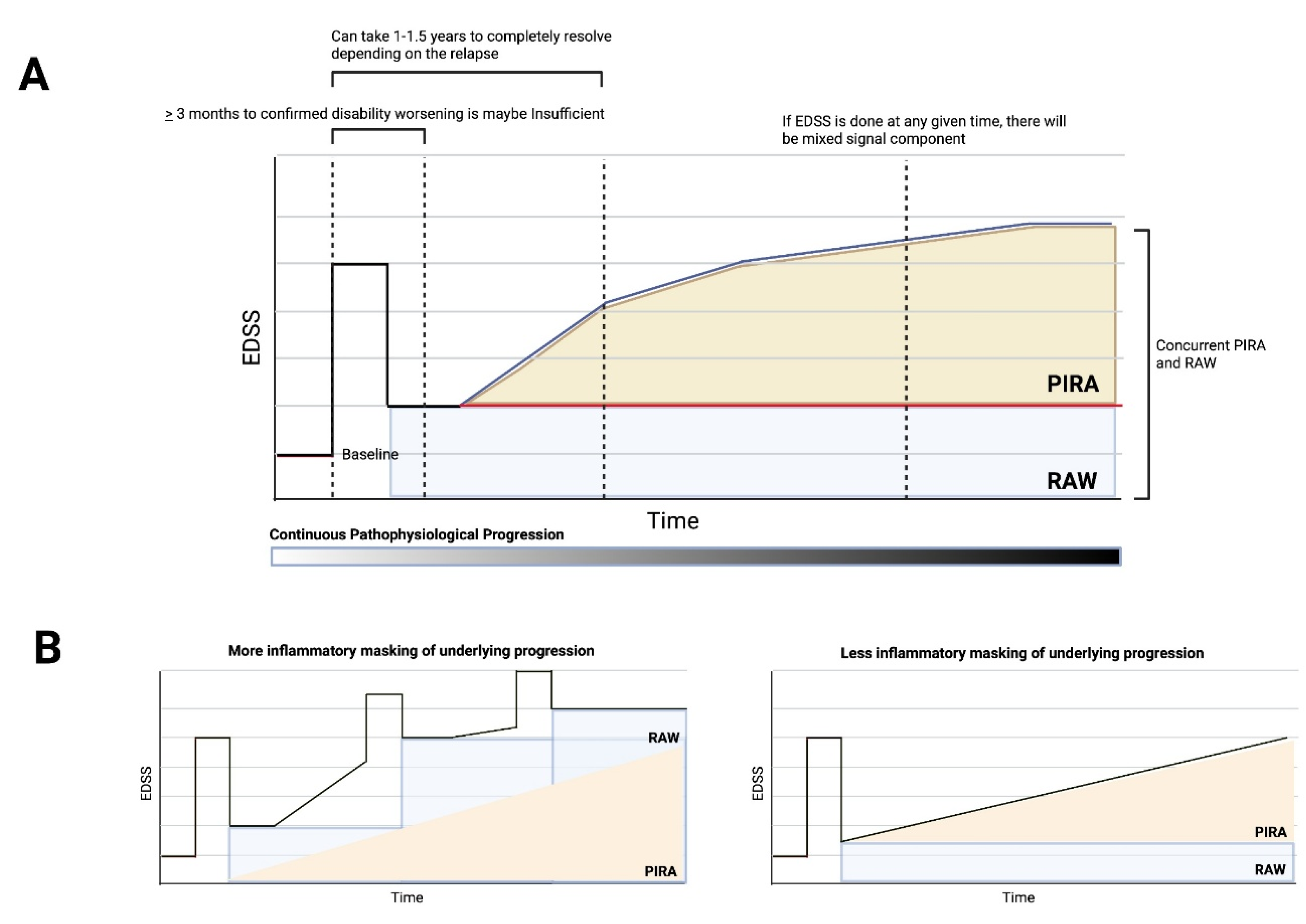
Figure 2.
Integrated Diagnostic Framework for Distinguishing True Progression from Pseudoprogression in SPMS. This flowchart outlines the multi-dimensional assessment required to identify true disease progression. The process begins with the Patient’s Perspective on worsening symptoms, which may be confounded by Aging and Lifestyle factors (geriatric syndromes, smoking) or Comorbidities (e.g., cardiovascular or metabolic disorders). Symptom evolution is categorized as acute changes, intermittent fluctuations that can lead to Residual Symptoms, or a steady decline. To differentiate pseudo-progression from true progression, clinicians integrate objective data from Clinical Measures, Biomarkers, and advanced Imaging. Confirmation of true progression guides the selection of disease-modifying Treatments. Abbreviations: 9HPT; 9-Hole Peg Test, ARMS; Age-Related Multiple Sclerosis Severity, BTK; Bruton’s Tyrosine Kinase, CD40L; Cluster of Differentiation 40 Ligand, CHI3L; Chitinase-3-like Protein, CHIT1; Chitotriosidase-1, CSF; Cerebrospinal Fluid, CXCL13; C-X-C Motif Chemokine Ligand 13, EDSS; Expanded Disability Status Scale, GFAP; Glial Fibrillary Acidic Protein, MRI; Magnetic Resonance Imaging, MSFC; Multiple Sclerosis Functional Composite, NfL; Neurofilament Light Chain, OCT; Optical Coherence Tomography, PET; Positron Emission Tomography, S1P; Sphingosine-1-Phosphate, sCD40L; Soluble Cluster of Differentiation 40 ligand, SDMT; Symbol Digit Modalities Test.
Figure 2.
Integrated Diagnostic Framework for Distinguishing True Progression from Pseudoprogression in SPMS. This flowchart outlines the multi-dimensional assessment required to identify true disease progression. The process begins with the Patient’s Perspective on worsening symptoms, which may be confounded by Aging and Lifestyle factors (geriatric syndromes, smoking) or Comorbidities (e.g., cardiovascular or metabolic disorders). Symptom evolution is categorized as acute changes, intermittent fluctuations that can lead to Residual Symptoms, or a steady decline. To differentiate pseudo-progression from true progression, clinicians integrate objective data from Clinical Measures, Biomarkers, and advanced Imaging. Confirmation of true progression guides the selection of disease-modifying Treatments. Abbreviations: 9HPT; 9-Hole Peg Test, ARMS; Age-Related Multiple Sclerosis Severity, BTK; Bruton’s Tyrosine Kinase, CD40L; Cluster of Differentiation 40 Ligand, CHI3L; Chitinase-3-like Protein, CHIT1; Chitotriosidase-1, CSF; Cerebrospinal Fluid, CXCL13; C-X-C Motif Chemokine Ligand 13, EDSS; Expanded Disability Status Scale, GFAP; Glial Fibrillary Acidic Protein, MRI; Magnetic Resonance Imaging, MSFC; Multiple Sclerosis Functional Composite, NfL; Neurofilament Light Chain, OCT; Optical Coherence Tomography, PET; Positron Emission Tomography, S1P; Sphingosine-1-Phosphate, sCD40L; Soluble Cluster of Differentiation 40 ligand, SDMT; Symbol Digit Modalities Test.
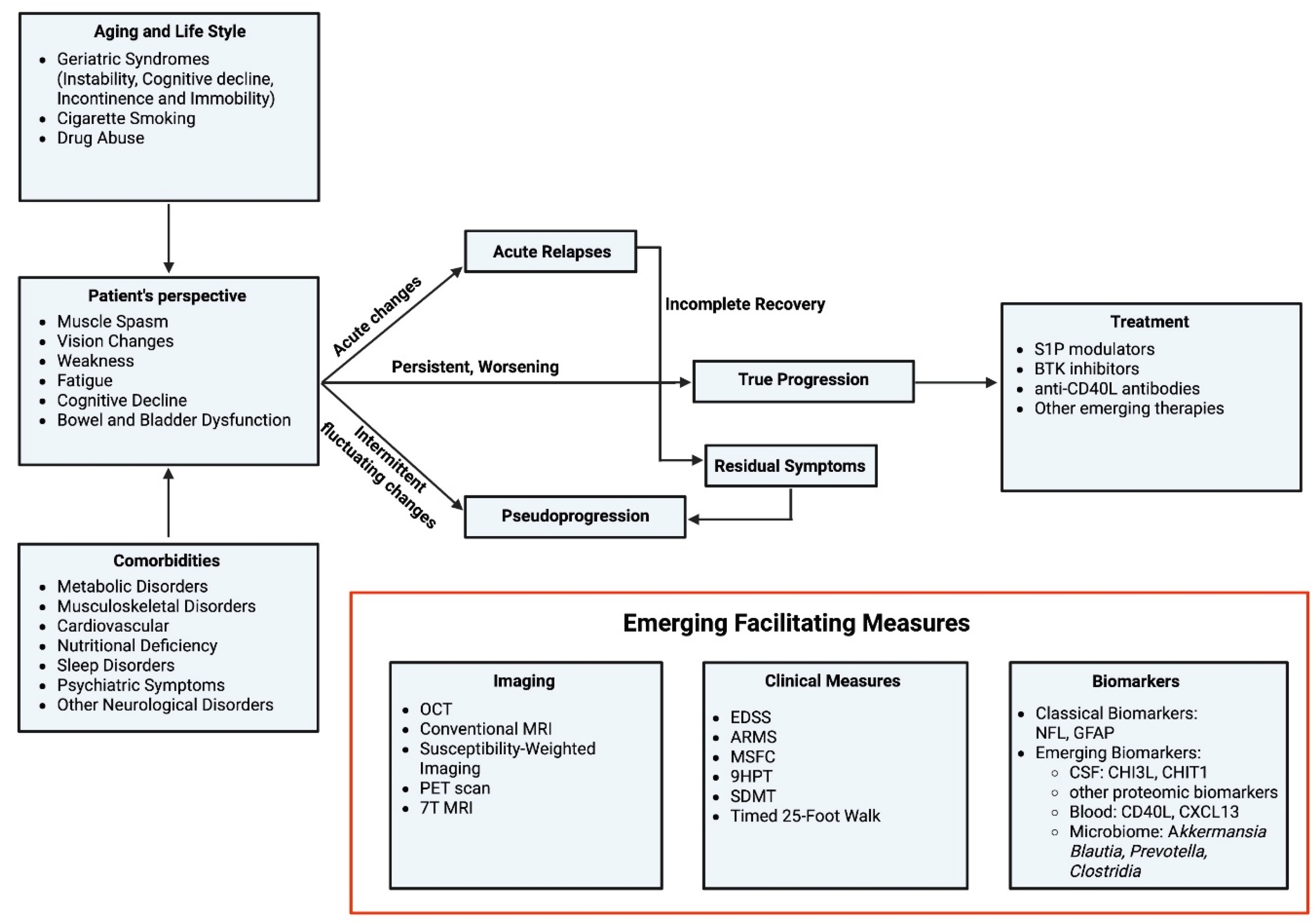
Disclaimer/Publisher’s Note: The statements, opinions and data contained in all publications are solely those of the individual author(s) and contributor(s) and not of MDPI and/or the editor(s). MDPI and/or the editor(s) disclaim responsibility for any injury to people or property resulting from any ideas, methods, instructions or products referred to in the content. |
© 2026 by the authors. Licensee MDPI, Basel, Switzerland. This article is an open access article distributed under the terms and conditions of the Creative Commons Attribution (CC BY) license (http://creativecommons.org/licenses/by/4.0/).
Copyright: This open access article is published under a Creative Commons CC BY 4.0 license, which permit the free download, distribution, and reuse, provided that the author and preprint are cited in any reuse.


