
Submitted:
23 March 2026
Posted:
24 March 2026
You are already at the latest version
Abstract
Pluralistic alignment instils large language models (LLMs) with the capacity to reflect diverse human values and preferences. It offers safe deployment that avoids LLMs collapsing into monolithic perspectives while ensuring that these systems operate in accordance with ethical standards and safety protocols. In this survey, we provide a comprehensive analysis of pluralistic alignment for LLMs based on the different capabilities that models support. We review existing literature covering different methods, datasets, and evaluation metrics, highlighting their strengths, limitations, and open challenges. Finally, we identify and encourage future areas for research to increase the scope and impact of pluralistic modelling in contemporary AI systems.
Keywords:
large language models (LLMs)
; LLM alignment
; pluralistic alignment
1. Introduction
As large language models (LLMs) exert growing influence, ensuring their beneficial and safe use has become increasingly important (Askell et al. 2021; Ji et al. 2023a; Minaee et al. 2024; Shen et al. 2023; Wang et al. 2024c). Accordingly, alignment has become central to responsible AI (Gabriel 2020; Ji et al. 2023a; Ouyang et al. 2022; Shen et al. 2023), which is the process of ensuring that AI model exhibits behaviour consistent with human values and intentions (Ji et al. 2023a; Shen et al. 2023). This has driven widespread adoption of aligned LLMs, mitigating issues such as privacy violations, toxicity, and misinformation observed in earlier systems (Bubeck et al. 2023; Carlini et al. 2023; Ji et al. 2023b; Weidinger et al. 2021). Despite these advances, alignment methods still face fundamental limitations. In particular, they tend to capture monolithic (or average) human values (Feng et al. 2024a; Shetty et al. 2025; Sorensen et al. 2024b), oversimplifying the alignment problem by failing to represent pluralistic human values (Conitzer et al. 2024; Sorensen et al. 2024b; Stanczak et al. 2025). Human values and requirements vary widely, not only across individuals, but also for the same individuals across different contexts (Bilsky et al. 2011).
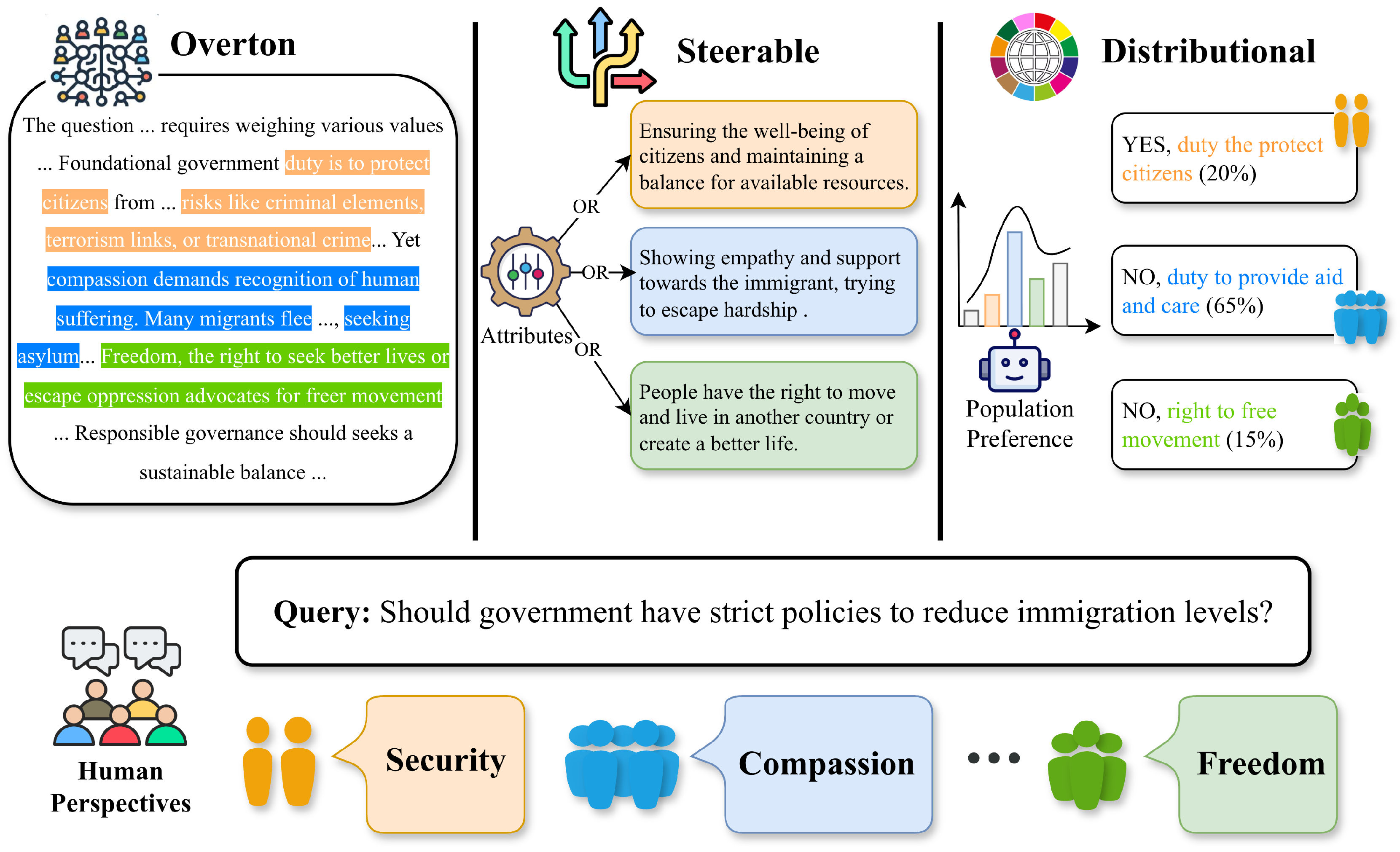
To address this limitation, emerging research in pluralistic alignment (Conitzer et al. 2024; Sorensen et al. 2024b; Stanczak et al. 2025) examined how systems can be designed and deployed to reflect diverse human needs and values. Sorensen et al. (2024b) proposed a theoretical framework defining three modes how models could be pluralistic: Overton, Steerable, and Distributional. As illustrated in fig:plural-align-overview, consider the query: “Should the country drastically reduce immigration levels?” Under the Overton mode, the model presents all reasonable answers, covering a range of perspectives based on political views, moral frameworks, In Steerable mode, the model generates a response conditioned on a specified attribute, for instance, opposing the proposal from a far-left perspective or supporting restrictive immigration policies from a far-right perspective. Finally, in the Distributional mode, responses reflect population-level preferences. If 80% of the population opposes the proposal and 20% supports it, the model should respond “No” 80% of the time and “Yes” 20% of the time.
Figure 1.
An overview of three pluralistic alignment modes (Overton, Steerable, and Distributional) for an example query: “Should government have strict policies to reduce immigrant levels?” Overton covers different perspectives, whereas Steerable responds as per attribute conditioned, and Distributional output match reflecting population preference distribution.
Figure 1.
An overview of three pluralistic alignment modes (Overton, Steerable, and Distributional) for an example query: “Should government have strict policies to reduce immigrant levels?” Overton covers different perspectives, whereas Steerable responds as per attribute conditioned, and Distributional output match reflecting population preference distribution.
Over the past few years, pluralistic alignment has attracted significant attention, including numerous papers (Castricato et al. 2025; Chen et al. 2024a; Feng et al. 2024a; Shetty et al. 2025; Sorensen et al. 2024b, inter alia) and dedicated workshops at major AI and ML conferences (Shen et al. 2025; Terekhov et al. 2024). However, rapid progress has led to limited clarity about the field’s current state, open gaps, and future directions. Existing work has demonstrated the potential for achieving pluralism in constrained settings and modes. Our goal is to provide a systematic and comprehensive guide that helps researchers identify appropriate tools and techniques and contribute to this rapidly evolving area. We are also the first to examine pluralism beyond LLMs. These definitions are generalisable to broader AI systems, and we include other modalities such as images, audio, and agents.
To this end, our survey presents an overview of the current landscape of pluralistic alignment. For each alignment mode (defined in Section 3), we provide a comprehensive overview of existing methods (Section 4) and evaluation approaches (Section 5), together with current shortcomings and directions for future research (Section 6). We aim to provide a clear entry point for researchers and facilitate further work on pluralistic LLM systems. We believe this survey is timely, offering a bird’s-eye view of the literature while supporting continued progress in pluralistic alignment.1
The key contributions of this survey are as follows:
- To the best of our knowledge, this is the first survey dedicated exclusively to pluralistic alignment, providing a bird’s-eye view of three modes—Overton, Steerable, and Distributional—which are often studied in isolation. We consolidate existing research and identify pluralistic methodologies, providing a practical roadmap for researchers.
- We provide a detailed review of pluralistic alignment techniques, together with relevant datasets and evaluation metrics, helping researchers make informed methodological choices. For each category, we synthesise the literature and highlight open challenges and key takeaways.
- We examine understudied aspects of pluralistic alignment and its connections to adjacent fields, outlining promising directions for future work, including multi-turn interactions, agentic AI, temporal and geo-alignment, mechanistic interpretability, and safety risks. This survey aims to advance the development of generalist models that reflect pluralism and enable safe and responsible deployment.
2. Related Surveys and Key Differences
As AI systems are deployed to broader populations, prevailing preference-based alignment methods (Ouyang et al. 2022; Rafailov et al. 2023) that model average opinions risk treating value diversity as noise (Aroyo et al. 2023; Siththaranjan et al. 2024), contributing to bias (Benkler et al. 2023), fairness concerns (Gallegos et al. 2024), and under-representation (Ovalle et al. 2025). Equally concerning is that models may be aligned to reflect the biased preferences of their creators (Bender et al. 2021; Gabriel 2020; Weidinger et al. 2021, ), thereby supporting particular agendas rather than supporting the full spectrum of human values. Pluralistic alignment instead seeks to model this diversity directly. Despite its growing relevance, no prior survey provides a comprehensive overview of pluralistic alignment. Existing reviews focus on general alignment (Cao et al. 2024; Ji et al. 2023a; Shen et al. 2023), multimodal alignment (Shu et al. 2025; Yu et al. 2025), reward design (Ji et al. 2025), cultural alignment (Pawar et al. 2025a), or personalisation (Xie et al. 2025b; Zhang et al. 2024). We address this gap by presenting a systematic overview of alignment through the lens of supporting pluralism: consolidating current methods, clarifying distinctions, and outlining open challenges (shown in blue boxes at the end of each subsection), also connecting pluralistic alignment to broader LLM research.
3. Pluralistic Alignment
A modern democratic society is characterised not simply by a pluralism of comprehensive religious, philosophical, and moral doctrines but by a pluralism of incompatible yet reasonable comprehensive doctrines.
We define a pluralistic model as one that serves different users and adapts to their varied queries across various contexts. It is paramount to have a single foundation model that is pluralistic (Bai et al. 2022b; Gordon et al. 2022; Sorensen et al. 2024b). We study pluralistic behaviour in LLMs using a framework from Sorensen et al. (2024b), which we describe next, along with motivation. Then, we formally define each part of the framework in Section 3.2.
3.1. Sorensen’s Framework
Figure 1 illustrates all three modes for an example query in a pluralistic AI system. The motivation behind these modes are as follows:
- Overton alignment expects the model’s output to cover all feasible responses. Usually, there are many reasonable answers to a question (Min et al. 2020; Scherrer et al. 2023), and outputting a single reasonable answer promotes bias and limits representation. An Overton-pluralistic model instead covers all reasonable answers. The most relevant application of Overton pluralism is advice giving (Jakesch et al. 2023; Krügel et al. 2023), where responses should cover all perspectives and opinions.
- Steerable alignment allows the model to successfully orient itself to a particular attribute (political view, religion, culture, among others). Customisation is key in steerable alignment where users often want to personalise models towards characteristic properties and perspectives (Chen et al. 2024c; Li et al. 2023; Ma et al. 2024).
- Distributional alignment steers the model’s response to match the underlying population distribution. Distributional alignment applies in scenarios where the model must reflect the views of a population. Example applications include social simulations (Park et al. 2022; Törnberg et al. 2023), autonomous vehicles (Cui et al. 2024), and related tasks.
3.2. Problem Formulation
To formalise the definition of pluralistic alignment, throughout we assume an AI system , that receives a query x and generates a response y.
- Overton.
We define the set of reasonable answers for a given query x as those responses that reflect an interpretation or solution that the majority of the population would agree upon. However, additional filters (such as safety, fairness, etc.) are applicable. We denote the set of all such reasonable answers by the Overton window (OED 2026):
A response set is Overton-pluralistic for a given query x if it consists of all reasonable answers (i.e., ). Similarly, a model is Overton-pluralistic if for a given input x,
- Steerable.
This is the case where the model must faithfully align (or steer) a response y to a given query x towards a specified attribute or perspective. Steering attributes 𝒜 denote the set of such attributes, including values, perspectives, populations, frameworks, and others.
We say that a response reflects an attribute 𝒜 if the response y to query x is consistent with a. Accordingly, a model is steerable-pluralistic with respect to attributes 𝒜 if, for every input
- Distributional.
Here, we define a reference population as the set of people that a distributionally-pluralistic model aims to represent. A distributionally aligned model then responds y to a given query x according to the reference population distribution. In other words, is well calibrated over reasonable answers y with respect to the reference population.
4. Pluralistic Alignment Methodologies
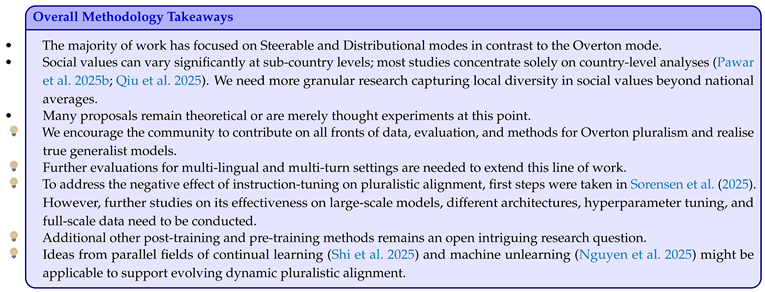
Given Sorensen’s framework, we categorise methodologies introduced in prior work and provide avenues for future research. Figure 2 organises existing literature as per pluralistic alignment modes supported.
4.1. Overton
- Training-Free.
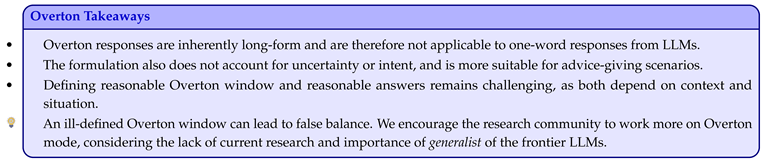
ReConcile (Chen et al. 2024d) is one of the initial works supporting Overton mode. It is an inference-time-based multi-agent method involving collaborative discussion (multiple rounds) among LLMs, leveraging diversity across different models to synthesise a response with a higher Overton window coverage. PICACO (Jiang et al. 2025a) is the most recent in-context alignment (ICA) method for Overton mode (or value coverage) working solely on inference time without any training. At its core, it is a prompting-based technique trying to elicit diverse responses embedded in the LLM (Cheng et al. 2024; Ganguli et al. 2023). However, unlike prior ICA approaches, it does not need multiple LLMs as in OPRO (Yang et al. 2024a) for iterative prompt optimisation, sophisticated time-consuming human-crafted meta-instructions as in URIAL (Lin et al. 2024), or the strong LLM extension of URIAL in URIAL+Sum (Lake et al. 2025). PICACO maximises the total correlation between target values—comprising Helpful and Harmless (Bai et al. 2022a; Weidinger et al. 2021) and the Schwartz Value Theory (Schwartz 2012)—and generated responses using a feedback loop to construct effective prompts. This also combats the instruction bottleneck, LLMs struggle to comprehend multiple values in a single prompt (Chen et al. 2024e; Jiang et al. 2024). Including the well-known prompting issues (Chakraborty et al. 2024; Sahoo et al. 2024; Zhao et al. 2024), this work only evaluates a limited set of values and uses a potentially biased LLM scoring for value coverage.
- Others.
Feng et al. (2025) propose a policy-based work primarily focused on Overton mode. It is grounded in a real-world 15-week observational study of LLM policymaking workshops in an industrial AI lab. They advocate that LLM policy prototyping could be an interesting avenue for pluralistic alignment because policy prototyping encourages discussion with contrasting preferences and opinions. Similarly, Collective Constitutional AI (CCAI) (Huang et al. 2024) proposes a multi-stage process that sources diverse rules from the public and incorporates them in LLM development. This builds on the foundations of Constitutional AI and can be seen as an extension of reinforcement learning from human feedback (RLHF) (Ouyang et al. 2022), promoting that the responsibility of LLM should not rest only with developers.
4.2. Steerable
- Prompting-Based.
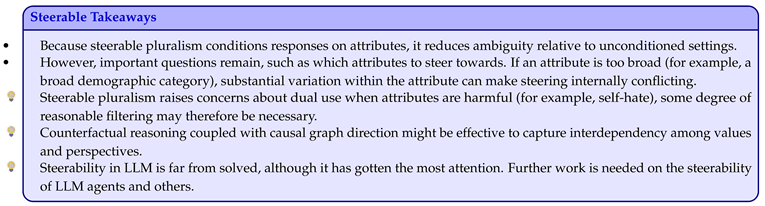
LLMs exhibit a degree of steerable pluralism via prompting (Sorensen et al. 2024b). Initial works achieved steerability by simply setting different contexts in the system roles of LLMs in a zero-shot manner. One simple approach is “role-playing”, where LLMs simulate a person from a particular culture, i.e., CultureDom (Wang et al. 2024d), Culture-Gen (Li et al. 2024d), and HofstedesCAT (Masoud et al. 2025), or demographics, i.e., NormAd (Rao et al. 2025) and SythPersona (Kwok et al. 2024). Similarly, methods that include user history in prompts lead to better steerability, e.g., Persona (Castricato et al. 2025).
The relevance of ICA methods for Overton (and in general) alignment (Section 4.1) has also been studied for steerability. One of the first works showed that a simple few-shot personality prompting () (Jiang et al. 2023) using Big Five traits was effective in inducing personality. Adams et al. (2025) improved ICA for the steerable mode. It proposed ICL-SPM, a few-shot comparative regression-based approach. It uses in-context prompting for improved steerable accuracy, with chain-of-thought reasoning for explainability, and LLM-as-Judge for reducing bias in candidate selection. Overall, as in ICA methods, no fine-tuning or model merging is needed. Expectedly, ICL-SPM is shown to improve on Prompt-SPM (Hu et al. 2024) (a zero-shot prompt-based alignment method) for MIC (Ziems et al. 2022) and HelpSteer2 (Wang et al. 2024e) benchmarks. Spica (Chen et al. 2025) is another in-context alignment technique for the steerable mode. It accounts for group-level differences during example retrieval for in-context prompting, rather than only similarity. They show improved steerability on ValuePrism (Sorensen et al. 2024a) and PRISM (Kirk et al. 2024a) datasets. However, the study is limited to only four demographic groups and lacks strong steerable baselines.
- Training-Based.
The culture and personality sub-dimension of pluralistic alignment (AlKhamissi et al. 2024) has been of interest in the community, especially their adaptability (or steerability). There have been several works (Bose et al. 2025; Li et al. 2024a; Li et al. 2024b; Shi et al. 2024; Xu et al. 2025; Zhu et al. 2025, inter alia) collecting various cultural or personality data (with the hope of more representation) and then fine-tuning LLMs to achieve better steerability. Taking a different route, Guo et al. (2025) proposes COUPLE, an inference-time causal-based method, improving on previous causal-based work ValueCausalGraph (Kang et al. 2025). The paper argues that existing solutions consider all values to be independent and/or equally weighted, failing to capture their causal interdependencies between them. COUPLE builds a causal graph between values and model response using an LLM, then applies counterfactual reasoning to generate outputs aligned with a specific given value. They demonstrate better performance compared to existing prompting and tuning methods, but it is limited to the culture sub-dimension of pluralism and need a strong reasoning model.
- Reinforcement Learning Based.
In need of controllable LLMs, previous work has explored fine-tuning for multi-objective using scalar feedback for user-steerable LLMs as an alternative to RLHF or DPO (single-objective). SteerLM (Dong et al. 2023) was one such prominent supervised fine-tuning method. This method conditions its generation to conform to a set of attributes. The reward model in RLHF is replaced with an attribute prediction model, which predicts the human preference for different attributes. This work was further improved and extended using better multi-attribute datasets, HelpSteer (Wang et al. 2024f) and HelpSteer2 (Wang et al. 2024e). SteerLM has the same limitation of reward mispecification as in RLHF due to the use of reward models. This was rectified in several follow-up works (Guo et al. 2024; Manyika 2024; Wang et al. 2024a; Wang et al. 2024b, inter alia). Similarly, there have been several position works (Harland et al. 2024; Vamplew et al. 2024; Xiong and Singh 2025) sketching out the connection between multi-objective reinforcement learning and steerable pluralistic alignment.
4.3. Distributional
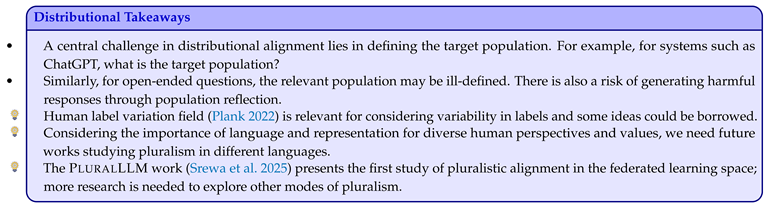
Santurkar et al. (2023) were among the first to study distributional alignment, contributing OpinionQA, an instrumental survey-based benchmark for evaluating pluralistic alignment. Expectedly, they established notable misalignment between the views reflected in LLMs and those of US demographic groups. Meister et al. (2025) empirically study the distributional mode on GlobalOpinionQA, OpinionQA, and their new dataset, NYTBookOpinions, that expands measurements beyond political and cultural values. Results reveal systematic weaknesses in LLMs as demographic simulacra, i.e, describing human distributions better than sampling them. This work also coined the term: “distributional alignment”, laying out the evaluation protocols and datasets.
- Prompting-Based.
Xie et al. (2025a) designs a prompt mixture modelling solution (PromptMixture) for distributional alignment, focusing on social simulation (or distributional mode). It comprises a pool of prompts, each representing a subpopulation, and then learns an optimal mixture for these prompts (Park et al. 2022). Finally, prompts are sampled according to the weights to match the underlying human distribution, simulating the actual population. The method offers improvements over existing similar social simulation techniques PersonaHub (Xu et al. 2025) and OASIS (Yang et al. 2024b). PersonaHub sets a persona as a system prompt sampled from a pool of personas, while OASIS uses demographic-inspired personas from the Big Five dataset. Likewise, Kambhatla et al. (2025) studies distributional calibration of LLMs for different social science surveys. Simple supervised calibration of probabilities generated by LLMs improve distributional alignment. The LLMs tested for different variations of socio-demographic prompts (e.g., SimLLMCultureDist (Cao et al. 2025), SelfAlign (Choenni and Shutova 2024)), showing effective calibration. A core issue is that heavy reliance on demographics and heuristics for persona sampling could lead to oversimplification and under-representation (Beck et al. 2024; Cheng et al. 2023a; Cheng et al. 2023b).
- Training-Based.
PAL (Chen et al. 2024a) is a training-time framework for pluralistic alignment, capturing and preserving heterogeneity, addressing the core limitation of RLHF (single, universal preference). It introduces the lens of the ideal point model and metric learning, using a ground-up mixture modelling approach. It inherently supports distributional and steerable modes in this order. Likewise, MallowsPO (Chen et al. 2024b) leverages dispersion-based modelling, and DPRM (Li et al. 2024c) uses multi-attribute annotations along with optimal-transport-based loss to better align with diverse human preferences. MixDPO (Imai et al. 2026) is a generalisation of DPO, a prominent RLHF technique that optimises models by directly comparing preferred and less-preferred outputs in preference data. In DPO and previous approaches, all human preferences have uniform strength, leading to average (or monolithic) human preference learning. In contrast, MixDPO has variable preference strength (based on individual and context), which is more suitable for pluralistic alignment. They demonstrate that MixDPO leads to improvement compared to DPO. Although it lacks evaluation of the modes of pluralistic alignment specifically, it is most applicable to the distributional mode because it captures heterogeneous preference strength. Halpern et al. (2025) proposes an ensemble of rewards heuristic, FSAM, instead of a single reward model to better represent pluralism. It treats annotator disagreement as soft labels instead of noise. They learn this diverse human preference distribution via pairwise calibration, where the proportion of rewards models preferring one preference captures the fraction of annotators (or population) with that preference. The work demonstrated its effectiveness both theoretically and empirically. However, all these works need further empirical investigation on standard distributional benchmarks.
4.4. All Modes
- Training-Based.
ModPlural (Feng et al. 2024b) was one of the foundational works tackling all three modes of pluralistic alignment. It is a model-collaboration technique where the main LLM works in collaboration with a set of specialised smaller LLMs to achieve pluralism. They show for different types, sizes, and architectures of main LLMs empirically better compared to standard baselines: off-the-shelf model, pluralistic prompting, and mixture of experts (pool of specialised LLMs). As per the mode of alignment, collaboration is conducted. For Overton, the main LLM acts as a summariser for specialised LLM responses and compiles a final representative (higher Overton window coverage) answer. In Steerable, one relevant response from the pool is chosen, and the main LLM is steered to output conditioned on this chosen response. Finally, for distributional, the process is similar, where the main LLM generates conditioned on each pool of responses. The point to note is that instead of focusing solely on text, it aggregates multiple answer probability distributions resembling the underlying population preference distribution. In the paper, they evaluate two sets of specialised LLMs, perspectives-informed across left/centre/right for social media texts and community-based covering different continents. However, the specialised LLMs are basically fine-tuned 7B LLMs on custom datasets. The main selling point of ModPlural was due to the decoding-time collaboration; a new specialised LLM could be consulted or patched as required. Still, the requirement of special datasets and computationally heavy fine-tuning bottlenecks remains a challenge. There have been subsequent works trying to replace the pool of specialised LLMs with training-free alternatives, we discuss cover next.
- Training-Free.
Follow-up work, Ethos (Zhong et al. 2025), replaced this fine-tuned pool of LLMs with a pool of personas appropriate for the query. The core tenet is to elicit different answers from the same secondary LLM. Though scalable and training-free, the known issues of prompting (Chakraborty et al. 2024; Sahoo et al. 2024; Zhao et al. 2024) and its brittleness still persist. A recent work, VISPA (Zheng et al. 2026), improves on Ethos and ModPlural with state-of-the-art performance on Vital (Shetty et al. 2025) and general pluralistic alignment benchmarks (from Feng et al. (2024a). VISPA is inspired by the success of activation steering for capturing different concepts and values, and better-controlled generation compared to prompting. The method is not heavily impacted by the choice of different activation steering instantiations. Therefore, with further improved methods in activation steering, it is a potential scalable and interpretable pathway to pluralistic alignment. This work also takes the first step for combating representation and bias issues by incorporating a comprehensive set of values considered for internal steering, including non-WEIRD (Western, Educated, Industrialised, Rich, and Democratic).
5. Evaluation of Pluralistic Alignment
5.1. Datasets
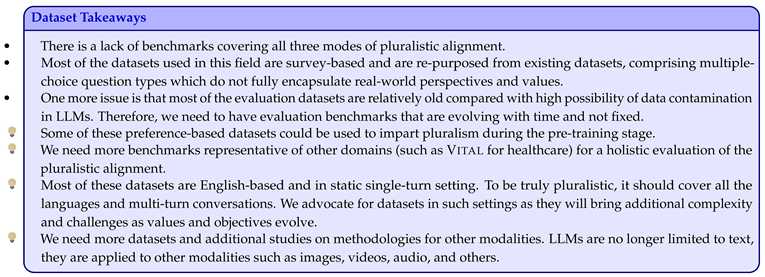
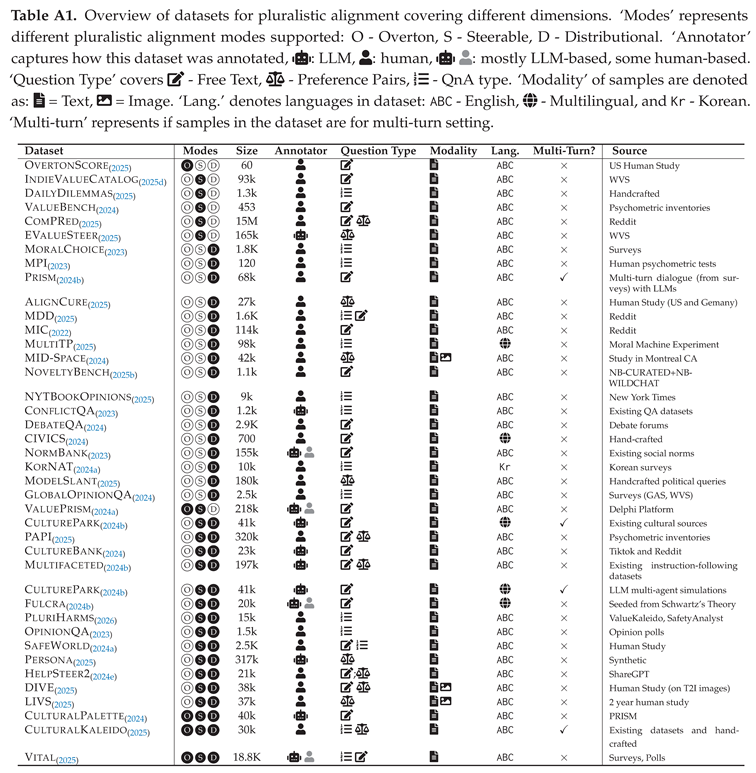
In this section, we cover datasets in the pluralistic alignment literature. We also go beyond and cover relevant potential datasets from related literature. We predominantly cover benchmark datasets across different dimensions, which might be of interest to readers, like modes, languages supported, modalities, turn settings covered, and others. A detailed table Appennndix A1 covers all datasets and metadata, providing a bird’s-eye view. To be consistent with previous discussion on methodologies, we cover benchmarks as per alignment modes.
- Overton.
An Overton benchmark should comprise a scenario/situation and corresponding applicable and reasonable answers as defined in Section 3.2. ValuePrism (Sorensen et al. 2024a) was the first Overton-specific dataset that consists of a scenario and different values applicable to it. These different values applicable to a scenario represent the Overton window. It is a large-scale dataset formed from a human online platform, Delphi (Jiang et al. 2025b), with diligent dataset preparation. However, it only encompasses value pluralism, and this is not conclusive of all aspects of pluralism.
- Steerable.
A steerable benchmark consists of situations that contain a question and a list of responses, where each response is labelled with a set of attributes (this can be values, perspectives, or properties of interest). And, we expect the model to steer towards a specific response for a given attribute and question. Therefore, surveys (Durmus et al. 2024; Inglehart et al. 2000; Santurkar et al. 2023) are relevant because they document different preferred answers (as per demographics, country, culture, and other attributes) for the same question. Similarly, the literature has numerous datasets on moral dilemmas (Chiu et al. 2025; Ren et al. 2024; Scherrer et al. 2023; Sorensen et al. 2024a), conditioning different and often conflicting values, making them suitable as steerable datasets. Recently, chatbot preferred response datasets (Kirk et al. 2024a; Zhang et al. 2025a) with rich user information have been contributed. As in other fields of current research, we have several synthetic datasets contributed. Castricato et al. (2025) introduced a large-scale synthetic dataset Persona to evaluate steerability across diverse user preferences using LLM-as-Judge. Recently, in Jiang et al. (2025c), they propose the IndieValueCatalog dataset, a transformed version of World Values Survey (WVS) to study individual steerability.
- Distributional.
For distributional-pluralistic system evaluation, we need a dataset with a query and a suite of answers along with a target distribution over these answers (usually collected by many annotators). Again, existing survey data is ideal for such an evaluation (Durmus et al. 2024; Jiang et al. 2023; Santurkar et al. 2023). The works here leverage a multiple-choice dataset and try to capture whether the model distribution matches the underlying golden distributions on limited buckets of multiple-choices. GlobalOpinionQA is a prominent cross-national survey capturing opinions on global matters. Whereas the Machine Personality Inventory (MPI) is a collection of 120 questions measuring human personality traits, these are some prominent datasets used for distributional alignment evaluation. Similarly, there are also several training datasets comprising answer preference pairs from traditional alignment literature applicable in distributional alignment (see Appendix Table A1), both for evaluation and training.
- All Modes.
Feng et al. (2024b) proposed first benchmark covering all thee modes pluralistic alignment. They also re-purposed existing datasets, contributing a benchmark using ValueKaleido for Overton and Steerable; OpinionQA for Steerable; MoralChoice and GlobalOpinionQA for Distributional mode evaluation. Vital (Shetty et al. 2025) has taken the first steps, being the first comprehensive pluralistic alignment benchmark. And, subsequent works (Zheng et al. 2026; Zhong et al. 2025) have built on this benchmark and contributed improved pluralistic alignment methods. Similarly, a few culture-focused datasets: CulturalPalette (Yuan et al. 2024) and CulturalKaleido (Banerjee et al. 2025) have been contributed. Although these works do not evaluate all three modes, given the nature of the datasets, there is scope to support all three modes. However, they are limited to cultural aspects. Similarly, Vital is healthcare-focused.
5.2. Evaluation Metrics
Evaluation is important for alignment research, especially for the development of empirical alignment methods. We survey metrics that have been developed and used to evaluate pluralistic alignment. Fundamentally, these metrics are specific to alignment mode being evaluated. Other than standard text generation metrics (such as BertScore) or LLM-as-Judge evaluation, the most prominent and best Overton window coverage evaluation was defined in Feng et al. (2024b). It proposes a metric using natural language inference (NLI) model entailing whether a set of golden values is covered in the response. Auxiliary, they recommend pairwise win-rate evaluation among two responses (which response seems more pluralistic) using human and LLM annotators, though not scalable. The same was adopted in several subsequent works (Zheng et al. 2026; Zhong et al. 2025). Recently, Poole-Dayan et al. (2025) proposed the first framework to measure Overton pluralism, OvertonScore. They formalise it as a set-coverage metric with each value weighted as per the fraction of survey participants in support of it (instead of equal weights). Additionally, they propose a standard benchmark and demonstrate scope for further improvement for Overton coverage in current LLMs (achieving ≈0.4 of the maximum 1.0). More importantly, there is a strong correlation between OvertonScore and human judgement, providing a scalable and reliable metric for Overton evaluation and future system progress. The steerability of models is usually measured by the accuracy of such correct steering in the LLMs. Similarly, for Distributional alignment mode the model distribution with the target human distribution using the Jensen-Shannon distance, where lower values mean higher distribution similarity. This distance is averaged for each sample in the benchmark. Similarly, some works have used Earth-mover distance (or Wasserstein distance) for measuring similarity between distributions.

6. Discussion and Future Directions
While the research community has made substantial strides, pluralistic alignment is far from a solved problem. There are many under-explored and promising research directions in pluralistic alignment. In this section, we outline directions for future research in addition to highlighted points above (denoted by pointers).
- Dataset Challenges.
Most existing work assumes a single-turn setting with static user representations. However, in a practical setup, user representations should evolve across multiple interactions (i.e., multi-turn) (Chakraborty et al. 2024; Durmus et al. 2024; Klassen et al. 2024a). For example, a user’s stance on a topic may shift after exposure to new information, or certain value preferences may change depending on prior interactions (Berinsky 2017; Grimm 2010). As a first step, future work should prepare a dataset for evaluating pluralism in multi-turn settings, followed by methods to handle it. A comprehensive multi-modal benchmark remains challenging, similar to traditional alignment (Wu et al. 2023; Yin et al. 2024b). Moreover, pluralistic alignment must account for diverse perspectives across cultures and languages. However, as shown in Table Appendix Table A1, current datasets are predominantly English and Western-centric. Advancing this field requires focused efforts on better data representation.
- Better Pluralistic Methods.
In addition to the takeaways from Section 4. Current works treat alignment as a static solution; however, human preferences and values evolve over time. We suggest recent approaches evaluating fairness over time could be applied to temporal pluralism (Klassen et al. 2024b). There is also a lack of work ensuring pluralistic alignment in the context of agentic AI. Alamdari et al. (2024) sketches a connection in agents learning policies while being considerate of others in the environment and the future well-being. However, the paper lacks empirical demonstrations, and further work is needed to study the effectiveness of such alignment policies, ensuring collective social welfare while achieving their goals. Considering that AI agents are deployed in the wild, a pluralistic geo-alignment is also important where agents’ actions vary depending on geography, culture, legality, systems, and evolve over time. Such spatio-temporal alignment is advocated in Janowicz et al. (2025), and there is a need for future work on all fronts.
- Advancing Pluralistic Evaluation.
We highlight the need for multi-dimensional benchmarks (e.g., culture, norms, and demographic groups) for evaluating performance across varying contexts. For instance, medical advice might change depending on the culture (AlKhamissi et al. 2024; Shetty et al. 2025). Future work should develop improved pluralistic sensitivity metrics. Similarly, the reasoning integrity of pluralistic models remains under-explored. Evaluations should consider logical consistency, epistemic calibration, and causal understanding (Lanham et al. 2023; Wei et al. 2022). Finally, evaluation should go beyond utility and assess potential alignment taxes (Ouyang et al. 2022; Yuan et al. 2023) introduced by pluralistic alignment, including over-refusal (Cui et al. 2025), increased jailbreak susceptibility (Greenblatt et al. 2024), reduced expressivity (Kirk et al. 2024c; Meister et al. 2025), and related trade-offs (Perez et al. 2023; Wolf et al. 2024). We encourage the use of automated red-teaming (Wang et al. 2023), as well as jury (Bai et al. 2022b; Sorensen et al. 2024b) and debate-based (Michael et al. 2023; Xu et al. 2024) evaluation frameworks for studying value conflicts and their resolution (Kirk et al. 2024b). Improved evaluation also requires reliable auditing; interpretability might help, which we discuss next.
- Mechanistic Interpretability.
As these “black-box’’ LLMs are used for high-stakes decisions, it is crucial to understand their internal workings (or interpretability) (Lipton 2018; Shen et al. 2023; Vilone and Longo 2020). Although interpretability might not seem directly applicable to alignment, techniques in this area could still be beneficial. One particular direction, mechanistic interpretability (Bereska and Gavves 2024; Nanda et al. 2023), is an interesting avenue whose objective is to reverse engineer the reasoning processes of LLMs. It elucidates the internal mechanisms by which LLMs transform inputs into outputs, providing deeper insight into their internal workings. VISPA (Zheng et al. 2026) showed promising results by applying ideas from mechanistic interpretability at inference time to achieve pluralism. They steer models’ internal activations at run time to satisfy different pluralistic objectives depending on the context. We advocate for further research on the interplay between mechanistic interpretability and pluralistic alignment. This work could extend beyond post-hoc applications and also be used to monitor and guide the pre-training process, ensuring that desired objectives (i.e., interpretability evaluation metrics) are met (Naseem 2026; Sharkey et al. 2025).
- Other Framework Extensions.
Although the jury-pluralistic benchmark was briefly touched on in Sorensen et al. (2024b), it is another way of aggregating diverse preferences. In jury learning, the model aims to resolve these disagreements explicitly via a jury, i.e., groups in some proportions defined as per task determine the final prediction label. Other extensions include POPE (Huang et al. 2025), the first framework for offline pluralistic policy alignment in LLMs, which targets diverse rather than averaged preferences; deliberative approaches inspired by social science and law, sketching consensus-seeking in LLMs (Blair et al. 2025); and temporal pluralism to handle evolving values over time, adapting temporal fairness evaluation methods so AI reflects different stakeholders’ values at different periods (Klassen et al. 2024a; Klassen et al. 2024b). In agentic AI, work remains limited despite agents’ growing deployment: Alamdari et al. (2024) proposes that agents learning policies considerate of others’ future well-being can foster pluralistic alignment, though empirical evidence is lacking and further study is needed for collective welfare; Plurals (Ashkinaze et al. 2025) provides a multi-agent deliberation framework with persona-based social ensemble simulations, showing promise in case studies; and geo-alignment (Janowicz et al. 2025) advocates spatio-temporal adaptation to geographic, cultural, and legal contexts for agents in real-world spaces. Related ideas draw from legal theories on democratic legitimacy and deliberation (Caputo 2024), and political pluralism seeking (approximations of) neutrality amid subjectivity (Fisher et al. 2025). These conceptual extensions merit more empirical validation and integration into pluralistic alignment research.
- Misuse of Pluralistically Aligned AI.
There is a risk that AI systems could be used for manipulative purposes, such as influencing people’s political opinions and social behaviours, if they are customised to closely match personal values. Additionally, users’ autonomy may be diminished by hyper-individualised human-AI interaction, endangering independent thought. Safeguards should be in place to guarantee that AI systems empower users rather than manipulate them based on their personal values, preserving diversity and fairness in the process. The current research in this space have only evaluated pure performance, attacks are not evaluated (Ji et al. 2023a). Although there is a need for more datasets for pluralistic alignment, one must be aware of potential privacy infringement. These alignment techniques use data that contains private details, such as individuals’ values and preferences (Jiang et al. 2025d). This is further exacerbated by the anthropomorphisation of LLMs through user tailoring to their values, which increases the risk of further private information leakage. Furthermore, when using real-world data, researchers must obtain consent and be transparent about the data usage to the users.
7. Conclusion
We highlighted the critical role of pluralistically aligned LLMs for improving their overall safety. We analysed pluralistic alignment through a framework in three modes: Overton, Steerable, and Distributional, providing a comprehensive overview of current strategies and their applications. By reviewing the relevant literature, datasets, and evaluation measures, we identified important research gaps and outlined the core limitations of current methodologies. Future research should aim to broaden pluralism, encompassing a wider range of applications and dynamic contexts. By further advancing pluralistic alignment approaches to be more adaptive and context-aware, we can support the development of AI systems that better reflect diverse human perspectives while remaining robust, reliable, and appropriately balanced in terms of user helpfulness.
Appendix A
References
- Oxford English Dictionary, s.v. “Overton window (n.)”.
- Adams, Jadie, Brian Hu, Emily Veenhuis, David Joy, Bharadwaj Ravichandran, Aaron Bray, Anthony Hoogs, and Arslan Basharat. 2025. Steerable pluralism: Pluralistic alignment via few-shot comparative regression. Proceedings of the AAAI/ACM Conference on AI, Ethics, and Society, vol. 8, pp. 15–25. [Google Scholar]
- Alamdari, Parand A., Toryn Q. Klassen, Rodrigo Toro Icarte, and Sheila A. McIlraith. 2024. Being considerate as a pathway towards pluralistic alignment for agentic AI. Pluralistic Alignment Workshop at NeurIPS. [Google Scholar]
- Ali, Dalia, Aysenur Kocak, Dora Zhao, Allison Koenecke, and Orestis Papakyriakopoulos. 2025. A sociotechnical perspective on aligning ai with pluralistic human values. ICLR 2025 Workshop on Bidirectional Human-AI Alignment. [Google Scholar]
- AlKhamissi, Badr, Muhammad ElNokrashy, Mai Alkhamissi, and Mona Diab. 2024. Investigating cultural alignment of large language models. Proceedings of the 62nd Annual Meeting of the Association for Computational Linguistics Volume 1: pages 12404–12422. [Google Scholar]
- Aroyo, Lora, Mark Diaz, Christopher Homan, Vinodkumar Prabhakaran, Alex Taylor, and Ding Wang. 2023. The reasonable effectiveness of diverse evaluation data. arXiv arXiv:2301.09406. [Google Scholar] [CrossRef]
- Ashkinaze, Joshua, Emily Fry, Narendra Edara, Eric Gilbert, and Ceren Budak. 2025. Plurals: A system for guiding llms via simulated social ensembles. Proceedings of the 2025 CHI Conference on Human Factors in Computing Systems; pp. pages 1–21. [Google Scholar]
- Askell, Amanda, Yuntao Bai, Anna Chen, Dawn Drain, Deep Ganguli, Tom Henighan, Andy Jones, Nicholas Joseph, Ben Mann, and Nova DasSarma. 2021. A general language assistant as a laboratory for alignment. arXiv arXiv:2112.00861. [Google Scholar] [CrossRef]
- Bai, Yuntao, Andy Jones, Kamal Ndousse, Amanda Askell, Anna Chen, Nova DasSarma, Dawn Drain, Stanislav Fort, Deep Ganguli, and Tom Henighan. 2022a. Training a helpful and harmless assistant with reinforcement learning from human feedback. arXiv arXiv:2204.05862. [Google Scholar]
- Bai, Yuntao, Saurav Kadavath, Sandipan Kundu, Amanda Askell, Jackson Kernion, Andy Jones, Anna Chen, Anna Goldie, Azalia Mirhoseini, and Cameron McKinnon. 2022b. Constitutional ai: Harmlessness from ai feedback. arXiv arXiv:2212.08073. [Google Scholar]
- Banerjee, Somnath, Sayan Layek, Hari Shrawgi, Rajarshi Mandal, Avik Halder, Shanu Kumar, Sagnik Basu, Parag Agrawal, Rima Hazra, and Animesh Mukherjee. 2025. Navigating the cultural kaleidoscope: A hitchhiker’s guide to sensitivity in large language models. Proceedings of the 2025 Conference of the Nations of the Americas Chapter of the Association for Computational Linguistics: Human Language Technologies Volume 1: pages 7580–7617. [Google Scholar]
- Beck, Tilman, Hendrik Schuff, Anne Lauscher, and Iryna Gurevych. 2024. Sensitivity, performance, robustness: Deconstructing the effect of sociodemographic prompting. Proceedings of the 18th Conference of the European Chapter of the Association for Computational Linguistics, St. Julian’s, Malta; Association for Computational Linguistics, Volume 1, pp. pages 2589–2615. [Google Scholar]
- Bender, Emily M, Timnit Gebru, Angelina McMillan-Major, and Shmargaret Shmitchell. 2021. On the dangers of stochastic parrots: Can language models be too big? Proceedings of the 2021 ACM conference on fairness, accountability, and transparency; pp. pages 610–623. [Google Scholar]
- Benkler, Noam, Drisana Mosaphir, Scott Friedman, Andrew Smart, and Sonja Schmer-Galunder. 2023. Assessing llms for moral value pluralism. arXiv arXiv:2312.10075. [Google Scholar] [CrossRef]
- Bereska, Leonard, and Stratis Gavves. 2024. Mechanistic interpretability for AI safety - a review. Transactions on Machine Learning Research. Survey Certification, Expert Certification. [Google Scholar]
- Berinsky, Adam J. 2017. Measuring public opinion with surveys. Annual review of political science 20: 309–329. [Google Scholar] [CrossRef]
- Bilsky, Wolfgang, Michael Janik, and Shalom H Schwartz. 2011. The structural organization of human values-evidence from three rounds of the european social survey (ess). Journal of cross-cultural psychology 42, 5: 759–776. [Google Scholar] [CrossRef]
- Blair, Carter, Kate Larson, and Edith Law. 2025. Reflective verbal reward design for pluralistic alignment. IJCAI ’25. [Google Scholar]
- Bose, Avinandan, Zhihan Xiong, Yuejie Chi, Simon Shaolei Du, Lin Xiao, and Maryam Fazel. 2025. Lore: Personalizing LLMs via low-rank reward modeling. 2nd Workshop on Models of Human Feedback for AI Alignment. [Google Scholar]
- Bubeck, Sébastien, Varun Chandrasekaran, Ronen Eldan, Johannes Gehrke, Eric Horvitz, Ece Kamar, Peter Lee, Yin Tat Lee, Yuanzhi Li, and Scott Lundberg. 2023. Sparks of artificial general intelligence: Early experiments with gpt-4. arXiv arXiv:2303.12712. [Google Scholar] [CrossRef]
- Cao, Boxi, Keming Lu, Xinyu Lu, Jiawei Chen, Mengjie Ren, Hao Xiang, Peilin Liu, Yaojie Lu, Ben He, and Xianpei Han. 2024. Towards scalable automated alignment of llms: A survey. arXiv arXiv:2406.01252. [Google Scholar] [CrossRef]
- Cao, Yong, Haijiang Liu, Arnav Arora, Isabelle Augenstein, Paul Röttger, and Daniel Hershcovich. 2025. Specializing large language models to simulate survey response distributions for global populations. Proceedings of the 2025 Conference of the Nations of the Americas Chapter of the Association for Computational Linguistics: Human Language Technologies Volume 1: pages 3141–3154. [Google Scholar]
- Caputo, Nicholas A. 2024. Rules, cases, and reasoning: Positivist legal theory as a framework for pluralistic ai alignment. arXiv arXiv:2410.17271. [Google Scholar]
- Carlini, Nicolas, Jamie Hayes, Milad Nasr, Matthew Jagielski, Vikash Sehwag, Florian Tramer, Borja Balle, Daphne Ippolito, and Eric Wallace. 2023. Extracting training data from diffusion models. 32nd USENIX security symposium (USENIX Security 23); pp. pages 5253–5270. [Google Scholar]
- Castricato, Louis, Nathan Lile, Rafael Rafailov, Jan-Philipp Fränken, and Chelsea Finn. 2025. Persona: A reproducible testbed for pluralistic alignment. Proceedings of the 31st International Conference on Computational Linguistics; pp. pages 11348–11368. [Google Scholar]
- Chakraborty, Souradip, Jiahao Qiu, Hui Yuan, Alec Koppel, Dinesh Manocha, Furong Huang, Amrit Singh Bedi, and Mengdi Wang. 2024. Maxmin-rlhf: alignment with diverse human preferences. Proceedings of the 41st International Conference on Machine Learning; pp. pages 6116–6135. [Google Scholar]
- Chen, Daiwei, Yi Chen, Aniket Rege, and Ramya Korlakai Vinayak. 2024a. PAL: Pluralistic alignment framework for learning from heterogeneous preferences. NeurIPS 2024 Workshop on Fine-Tuning in Modern Machine Learning: Principles and Scalability. [Google Scholar]
- Chen, Haoxian, Hanyang Zhao, Henry Lam, David Yao, and Wenpin Tang. 2024b. Mallows-DPO: Fine-tune your LLM with preference dispersions. Pluralistic Alignment Workshop at NeurIPS. [Google Scholar]
- Chen, Jin, Zheng Liu, Xu Huang, Chenwang Wu, Qi Liu, Gangwei Jiang, Yuanhao Pu, Yuxuan Lei, Xiaolong Chen, and Xingmei Wang. 2024c. When large language models meet personalization: Perspectives of challenges and opportunities. World Wide Web 27, 4: 42. [Google Scholar] [CrossRef]
- Chen, Justin, Swarnadeep Saha, and Mohit Bansal. 2024d. Reconcile: Round-table conference improves reasoning via consensus among diverse llms. Proceedings of the 62nd Annual Meeting of the Association for Computational Linguistics Volume 1: pages 7066–7085. [Google Scholar]
- Chen, Quan Ze, Kevin Feng, Chan Young Park, and Amy X Zhang. 2025. Spica: Retrieving scenarios for pluralistic in-context alignment. Findings of the Association for Computational Linguistics: ACL 2025, pages 748–765. [Google Scholar]
- Chen, Xinyi, Baohao Liao, Jirui Qi, Panagiotis Eustratiadis, Christof Monz, Arianna Bisazza, and Maarten Rijke. 2024e. The sifo benchmark: Investigating the sequential instruction following ability of large language models. Findings of the Association for Computational Linguistics: EMNLP 2024, pages 1691–1706. [Google Scholar]
- Cheng, Jiale, Xiao Liu, Kehan Zheng, Pei Ke, Hongning Wang, Yuxiao Dong, Jie Tang, and Minlie Huang. 2024. Black-box prompt optimization: Aligning large language models without model training. Proceedings of the 62nd Annual Meeting of the Association for Computational Linguistics Volume 1: pages 3201–3219. [Google Scholar]
- Cheng, Myra, Esin Durmus, and Dan Jurafsky. 2023a. Marked personas: Using natural language prompts to measure stereotypes in language models. Proceedings of the 61st Annual Meeting of the Association for Computational Linguistics Volume 1: pages 1504–1532. [Google Scholar]
- Cheng, Myra, Tiziano Piccardi, and Diyi Yang. 2023b. Compost: Characterizing and evaluating caricature in llm simulations. Proceedings of the 2023 Conference on Empirical Methods in Natural Language Processing; pp. pages 10853–10875. [Google Scholar]
- Chiu, Yu Ying, Liwei Jiang, and Yejin Choi. 2025. Dailydilemmas: Revealing value preferences of LLMs with quandaries of daily life. The Thirteenth International Conference on Learning Representations. [Google Scholar]
- Choenni, Rochelle, and Ekaterina Shutova. 2024. Self-alignment: Improving alignment of cultural values in llms via in-context learning. arXiv arXiv:2408.16482. [Google Scholar]
- Conitzer, Vincent, Rachel Freedman, Jobst Heitzig, Wesley H Holliday, Bob M Jacobs, Nathan Lambert, Milan Mossé, Eric Pacuit, Stuart Russell, and Hailey Schoelkopf. 2024. Position: social choice should guide ai alignment in dealing with diverse human feedback. Proceedings of the 41st International Conference on Machine Learning; pp. pages 9346–9360. [Google Scholar]
- Cui, Can, Yunsheng Ma, Xu Cao, Wenqian Ye, Yang Zhou, Kaizhao Liang, Jintai Chen, Juanwu Lu, Zichong Yang, and Kuei-Da Liao. 2024. A survey on multimodal large language models for autonomous driving. Proceedings of the IEEE/CVF winter conference on applications of computer vision; pp. pages 958–979. [Google Scholar]
- Cui, Justin, Wei-Lin Chiang, Ion Stoica, and Cho-Jui Hsieh. 2025. OR-bench: An over-refusal benchmark for large language models. Forty-second International Conference on Machine Learning. [Google Scholar]
- Dong, Yi, Zhilin Wang, Makesh Sreedhar, Xianchao Wu, and Oleksii Kuchaiev. 2023. Steerlm: Attribute conditioned sft as an (user-steerable) alternative to rlhf. Findings of the Association for Computational Linguistics: EMNLP, pages 11275–11288. [Google Scholar]
- Durmus, Esin, Karina Nguyen, Thomas Liao, Nicholas Schiefer, Amanda Askell, Anton Bakhtin, Carol Chen, Zac Hatfield-Dodds, Danny Hernandez, Nicholas Joseph, Liane Lovitt, Sam McCandlish, Orowa Sikder, Alex Tamkin, Janel Thamkul, Jared Kaplan, Jack Clark, and Deep Ganguli. 2024. Towards measuring the representation of subjective global opinions in language models. First Conference on Language Modeling. [Google Scholar]
- Farajzadeh, Ali, Danyal Saeed, Syed M Abbas, Rushit N. Shah, Aadirupa Saha, and Brian D Ziebart. 2025. Imitation beyond expectation using pluralistic stochastic dominance. The Thirty-ninth Annual Conference on Neural Information Processing Systems. [Google Scholar]
- Feng, Kevin, Inyoung Cheong, Quan Ze Chen, and Amy X Zhang. 2025. Policy prototyping for LLMs: Pluralistic alignment via interactive and collaborative policymaking. ICLR 2025 Workshop on Bidirectional Human-AI Alignment. [Google Scholar]
- Feng, Shangbin, Taylor Sorensen, Yuhan Liu, Jillian Fisher, Chan Young Park, Yejin Choi, and Yulia Tsvetkov. 2024a. Modular pluralism: Pluralistic alignment via multi-llm collaboration. Proceedings of the 2024 Conference on Empirical Methods in Natural Language Processing; pp. pages 4151–4171. [Google Scholar]
- Feng, Shangbin, Taylor Sorensen, Yuhan Liu, Jillian Fisher, Chan Young Park, Yejin Choi, and Yulia Tsvetkov. 2024b. Modular pluralism: Pluralistic alignment via multi-llm collaboration. Proceedings of the 2024 Conference on Empirical Methods in Natural Language Processing; pp. pages 4151–4171. [Google Scholar]
- Fisher, Jillian, Ruth E Appel, Chan Young Park, Yujin Potter, Liwei Jiang, Taylor Sorensen, Shangbin Feng, Yulia Tsvetkov, Margaret E Roberts, and Jennifer Pan. 2025. Political neutrality in ai is impossible-but here is how to approximate it. arXiv arXiv:2503.05728. [Google Scholar]
- Gabriel, Iason. 2020. Artificial intelligence, values, and alignment. Minds and machines 30, 3: 411–437. [Google Scholar] [CrossRef]
- Gallegos, Isabel O, Ryan A Rossi, Joe Barrow, Md Mehrab Tanjim, Sungchul Kim, Franck Dernoncourt, Tong Yu, Ruiyi Zhang, and Nesreen K Ahmed. 2024. Bias and fairness in large language models: A survey. Computational linguistics 50, 3: 1097–1179. [Google Scholar] [CrossRef]
- Ganguli, Deep, Amanda Askell, Nicholas Schiefer, Thomas I Liao, Kamilė Lukošiūtė, Anna Chen, Anna Goldie, Azalia Mirhoseini, Catherine Olsson, and Danny Hernandez. 2023. The capacity for moral self-correction in large language models. arXiv arXiv:2302.07459. [Google Scholar] [CrossRef]
- Ghate, Kshitish, Andy Liu, Devansh Jain, Taylor Sorensen, Atoosa Kasirzadeh, Aylin Caliskan, Mona T Diab, and Maarten Sap. 2025. Evaluesteer: Measuring reward model steerability towards values and preferences. arXiv arXiv:2510.06370. [Google Scholar] [CrossRef]
- Gordon, Mitchell L, Michelle S Lam, Joon Sung Park, Kayur Patel, Jeff Hancock, Tatsunori Hashimoto, and Michael S Bernstein. 2022. Jury learning: Integrating dissenting voices into machine learning models. Proceedings of the 2022 CHI Conference on Human Factors in Computing Systems; pp. pages 1–19. [Google Scholar]
- Greenblatt, Ryan, Carson Denison, Benjamin Wright, Fabien Roger, Monte MacDiarmid, Sam Marks, Johannes Treutlein, Tim Belonax, Jack Chen, and David Duvenaud. 2024. Alignment faking in large language models. arXiv arXiv:2412.14093. [Google Scholar] [CrossRef]
- Grimm, Pamela. 2010. Social desirability bias. In Wiley international encyclopedia of marketing. [Google Scholar]
- Guo, Hanze, Jing Yao, Xiao Zhou, Xiaoyuan Yi, and Xing Xie. 2025. Counterfactual reasoning for steerable pluralistic value alignment of large language models. The Thirty-ninth Annual Conference on Neural Information Processing Systems. [Google Scholar]
- Guo, Yiju, Ganqu Cui, Lifan Yuan, Ning Ding, Zexu Sun, Bowen Sun, Huimin Chen, Ruobing Xie, Jie Zhou, and Yankai Lin. 2024. Controllable preference optimization: Toward controllable multi-objective alignment. Proceedings of the 2024 Conference on Empirical Methods in Natural Language Processing, 1 others. pp. pages 1437–1454. [Google Scholar]
- Halpern, Daniel, Evi Micha, Ariel D Procaccia, and Itai Shapira. 2025. Pairwise calibrated rewards for pluralistic alignment. arXiv arXiv:2506.06298. [Google Scholar]
- Harland, Hadassah, Richard Dazeley, Peter Vamplew, Hashini Senaratne, Bahareh Nakisa, and Francisco Cruz. 2024. Adaptive alignment: Dynamic preference adjustments via multi-objective reinforcement learning for pluralistic AI. Pluralistic Alignment Workshop at NeurIPS. [Google Scholar]
- Hu, Brian, Bill Ray, Alice Leung, Amy Summerville, David Joy, Christopher Funk, and Arslan Basharat. 2024. Language models are alignable decision-makers: Dataset and application to the medical triage domain. Proceedings of the 2024 Conference of the North American Chapter of the Association for Computational Linguistics: Human Language Technologies Volume 6: pages 213–227. [Google Scholar]
- Huang, Chengkai, Junda Wu, Zhouhang Xie, Yu Xia, Rui Wang, Tong Yu, Subrata Mitra, Julian McAuley, and Lina Yao. 2025. Pluralistic off-policy evaluation and alignment. arXiv arXiv:2509.19333. [Google Scholar]
- Huang, Saffron, Divya Siddarth, Liane Lovitt, Thomas I Liao, Esin Durmus, Alex Tamkin, and Deep Ganguli. 2024. Collective constitutional ai: Aligning a language model with public input. Proceedings of the 2024 ACM Conference on Fairness, Accountability, and Transparency; pp. pages 1395–1417. [Google Scholar]
- Imai, Saki, Pedram Heydari, Anthony Sicilia, Asteria Kaeberlein, Katherine Atwell, and Malihe Alikhani. 2026. Mixdpo: Modeling preference strength for pluralistic alignment. arXiv arXiv:2601.06180. [Google Scholar]
- Inglehart, Ronald, Miguel Basanez, Jaime Diez-Medrano, Loek Halman, and Ruud Luijkx. 2000. World values surveys and european values surveys, 1981-1984, 1990-1993, and 1995-1997. ICPSR version. Ann Arbor-Michigan, Institute for Social Research. [Google Scholar]
- Jakesch, Maurice, Advait Bhat, Daniel Buschek, Lior Zalmanson, and Mor Naaman. 2023. Co-writing with opinionated language models affects users’ views. Proceedings of the 2023 CHI conference on human factors in computing systems; pp. pages 1–15. [Google Scholar]
- Janowicz, Krzysztof, Zilong Liu, Gengchen Mai, Zhangyu Wang, Ivan Majic, Alexandra Fortacz, Grant McKenzie, and Song Gao. 2025. Whose truth? pluralistic geo-alignment for (agentic) ai. Proceedings of the 33rd ACM International Conference on Advances in Geographic Information Systems; pp. pages 799–803. [Google Scholar]
- Ji, Jiaming, Tianyi Qiu, Boyuan Chen, Borong Zhang, Hantao Lou, Kaile Wang, Yawen Duan, Zhonghao He, Jiayi Zhou, and Zhaowei Zhang. 2023a. Ai alignment: A comprehensive survey. arXiv arXiv:2310.19852. [Google Scholar]
- Ji, Miaomiao, Yanqiu Wu, Zhibin Wu, Shoujin Wang, Jian Yang, Mark Dras, and Usman Naseem. 2025. A survey on progress in llm alignment from the perspective of reward design. arXiv arXiv:2505.02666. [Google Scholar] [CrossRef]
- Ji, Ziwei, Nayeon Lee, Rita Frieske, Tiezheng Yu, Dan Su, Yan Xu, Etsuko Ishii, Ye Jin Bang, Andrea Madotto, and Pascale Fung. 2023b. Survey of hallucination in natural language generation. ACM computing surveys 55, 12: 1–38. [Google Scholar] [CrossRef]
- Jiang, Guangyuan, Manjie Xu, Song-Chun Zhu, Wenjuan Han, Chi Zhang, and Yixin Zhu. 2023. Evaluating and inducing personality in pre-trained language models. Advances in Neural Information Processing Systems 36: 10622–10643. [Google Scholar]
- Jiang, Han, Dongyao Zhu, Zhihua Wei, Xiaoyuan Yi, Ziang Xiao, and Xing Xie. 2025a. Picaco: Pluralistic in-context value alignment of llms via total correlation optimization. arXiv arXiv:2507.16679. [Google Scholar]
- Jiang, Liwei, Jena D Hwang, Chandra Bhagavatula, Ronan Le Bras, Jenny T Liang, Sydney Levine, Jesse Dodge, Keisuke Sakaguchi, Maxwell Forbes, and Jack Hessel. 2025b. Investigating machine moral judgement through the delphi experiment. Nature Machine Intelligence 7, 1: 145–160. [Google Scholar] [CrossRef]
- Jiang, Liwei, Taylor Sorensen, Sydney Levine, and Yejin Choi. 2025c. Can language models reason about individualistic human values and preferences? Proceedings of the 63rd Annual Meeting of the Association for Computational Linguistics Volume 1: pages 6757–6794. [Google Scholar]
- Jiang, Liwei, Taylor Sorensen, Sydney Levine, and Yejin Choi. 2025d. Can language models reason about individualistic human values and preferences? Proceedings of the 63rd Annual Meeting of the Association for Computational Linguistics, Vienna, Austria; Association for Computational Linguistics, Volume 1, pp. pages 6757–6794. [Google Scholar]
- Jiang, Yuxin, Yufei Wang, Xingshan Zeng, Wanjun Zhong, Liangyou Li, Fei Mi, Lifeng Shang, Xin Jiang, Qun Liu, and Wei Wang. 2024. FollowBench: A multi-level fine-grained constraints following benchmark for large language models. Proceedings of the 62nd Annual Meeting of the Association for Computational Linguistics, Bangkok, Thailand; Association for Computational Linguistics, Volume 1, pp. pages 4667–4688. [Google Scholar]
- Jin, Zhijing, Max Kleiman-Weiner, Giorgio Piatti, Sydney Levine, Jiarui Liu, Fernando Gonzalez Adauto, Francesco Ortu, András Strausz, Mrinmaya Sachan, Rada Mihalcea, Yejin Choi, and Bernhard Schölkopf. 2025. Language model alignment in multilingual trolley problems. The Thirteenth International Conference on Learning Representations. [Google Scholar]
- Kambhatla, Gauri, Sanjana Gautam, Angela Zhang, Alex Liu, Ravi Srinivasan, Junyi Jessy Li, and Matthew Lease. 2025. Improving the distributional alignment of llms using supervision. Preprint arXiv:2507.00439. [Google Scholar]
- Kang, Dongjun, Joonsuk Park, Yohan Jo, and JinYeong Bak. 2023. From values to opinions: Predicting human behaviors and stances using value-injected large language models. Proceedings of the 2023 Conference on Empirical Methods in Natural Language Processing; pp. pages 15539–15559. [Google Scholar]
- Kang, Yipeng, Junqi Wang, Yexin Li, Mengmeng Wang, Wenming Tu, Quansen Wang, Hengli Li, Tingjun Wu, Xue Feng, Fangwei Zhong, and Zilong Zheng. 2025. Are the values of LLMs structurally aligned with humans? a causal perspective. In Findings of the Association for Computational Linguistics: ACL 2025. Vienna, Austria, Association for Computational Linguistics: pp. pages 23147–23161. [Google Scholar]
- Kirk, Hannah Rose, Alexander Whitefield, Paul Rottger, Andrew M Bean, Katerina Margatina, Rafael Mosquera-Gomez, Juan Ciro, Max Bartolo, Adina Williams, and He He. 2024a. The prism alignment dataset: What participatory, representative and individualised human feedback reveals about the subjective and multicultural alignment of large language models. Advances in Neural Information Processing Systems 37: 105236–105344. [Google Scholar]
- Kirk, Hannah Rose, Alexander Whitefield, Paul Röttger, Andrew Michael Bean, Katerina Margatina, Rafael Mosquera, Juan Manuel Ciro, Max Bartolo, Adina Williams, He He, Bertie Vidgen, and Scott A. Hale. 2024b. The PRISM alignment dataset: What participatory, representative and individualised human feedback reveals about the subjective and multicultural alignment of large language models. The Thirty-eight Conference on Neural Information Processing Systems Datasets and Benchmarks Track. [Google Scholar]
- Kirk, Robert, Ishita Mediratta, Christoforos Nalmpantis, Jelena Luketina, Eric Hambro, Edward Grefenstette, and Roberta Raileanu. 2024c. Understanding the effects of RLHF on LLM generalisation and diversity. The Twelfth International Conference on Learning Representations. [Google Scholar]
- Klassen, Toryn Q., Parand A. Alamdari, and Sheila A. McIlraith. 2024a. Pluralistic alignment over time. Pluralistic Alignment Workshop at NeurIPS. [Google Scholar]
- Klassen, Toryn Q., Parand A. Alamdari, and Sheila A. McIlraith. 2024b. Pluralistic alignment over time. Pluralistic Alignment Workshop at NeurIPS. [Google Scholar]
- Kobalczyk, Kasia, Claudio Fanconi, Hao Sun, and Mihaela van der Schaar. 2025. Few-shot steerable alignment: Adapting rewards and LLM policies with neural processes. 2nd Workshop on Models of Human Feedback for AI Alignment. [Google Scholar]
- Krügel, Sebastian, Andreas Ostermaier, and Matthias Uhl. 2023. Chatgpt’s inconsistent moral advice influences users’ judgment. Scientific Reports 13, 1: 4569. [Google Scholar] [CrossRef]
- Kumar, Sachin, Chan Young Park, Yulia Tsvetkov, Noah A Smith, and Hannaneh Hajishirzi. 2025. Compo: Community preferences for language model personalization. Proceedings of the 2025 Conference of the Nations of the Americas Chapter of the Association for Computational Linguistics: Human Language Technologies Volume 1: pages 8246–8279. [Google Scholar]
- Kwok, Louis, Michal Bravansky, and Lewis Griffin. 2024. Evaluating cultural adaptability of a large language model via simulation of synthetic personas. First Conference on Language Modeling. [Google Scholar]
- Lake, Thom, Eunsol Choi, and Greg Durrett. 2025. From distributional to overton pluralism: Investigating large language model alignment. Proceedings of the 2025 Conference of the Nations of the Americas Chapter of the Association for Computational Linguistics: Human Language Technologies Volume 1: pages 6794–6814. [Google Scholar]
- Lanham, Tamera, Anna Chen, Ansh Radhakrishnan, Benoit Steiner, Carson Denison, Danny Hernandez, Dustin Li, Esin Durmus, Evan Hubinger, and Jackson Kernion. 2023. Measuring faithfulness in chain-of-thought reasoning. arXiv arXiv:2307.13702. [Google Scholar]
- Lee, Jiyoung, Minwoo Kim, Seungho Kim, Junghwan Kim, Seunghyun Won, Hwaran Lee, and Edward Choi. 2024a. Kornat: Llm alignment benchmark for korean social values and common knowledge. Findings of the Association for Computational Linguistics ACL 2024; pp. pages 11177–11213. [Google Scholar]
- Lee, Seongyun, Sue Hyun Park, Seungone Kim, and Minjoon Seo. 2024b. Aligning to thousands of preferences via system message generalization. Advances in Neural Information Processing Systems 37: 73783–73829. [Google Scholar]
- Li, Cheng, Mengzhuo Chen, Jindong Wang, Sunayana Sitaram, and Xing Xie. 2024a. Culturellm: Incorporating cultural differences into large language models. Advances in Neural Information Processing Systems 37: 84799–84838. [Google Scholar]
- Li, Cheng, Damien Teney, Linyi Yang, Qingsong Wen, Xing Xie, and Jindong Wang. 2024b. Culturepark: Boosting cross-cultural understanding in large language models. Advances in Neural Information Processing Systems 37: 65183–65216. [Google Scholar]
- Li, Cheng, Mingyang Zhang, Qiaozhu Mei, Yaqing Wang, Spurthi Amba Hombaiah, Yi Liang, and Michael Bendersky. 2023. Teach llms to personalize–an approach inspired by writing education. arXiv arXiv:2308.07968. [Google Scholar]
- Li, Dexun, Cong Zhang, Kuicai Dong, Derrick Goh Xin Deik, Ruiming Tang, and Yong Liu. 2024c. Aligning crowd feedback via distributional preference reward modeling. ICML 2024 Workshop on Models of Human Feedback for AI Alignment. [Google Scholar]
- Li, Huihan, Liwei Jiang, Nouha Dziri, Xiang Ren, and Yejin Choi. 2024d. CULTURE-GEN: Revealing global cultural perception in language models through natural language prompting. First Conference on Language Modeling. [Google Scholar]
- Li, Jing-Jing, Joel Mire, Eve Fleisig, Valentina Pyatkin, Anne Collins, Maarten Sap, and Sydney Levine. 2026. Pluriharms: Benchmarking the full spectrum of human judgments on ai harm. arXiv arXiv:2601.08951. [Google Scholar] [CrossRef]
- Lin, Bill Yuchen, Abhilasha Ravichander, Ximing Lu, Nouha Dziri, Melanie Sclar, Khyathi Chandu, Chandra Bhagavatula, and Yejin Choi. 2024. The unlocking spell on base LLMs: Rethinking alignment via in-context learning. The Twelfth International Conference on Learning Representations. [Google Scholar]
- Lipton, Zachary C. 2018. The mythos of model interpretability: In machine learning, the concept of interpretability is both important and slippery. Queue 16, 3: 31–57. [Google Scholar] [CrossRef]
- Ma, Xiao, Swaroop Mishra, Ariel Liu, Sophie Ying Su, Jilin Chen, Chinmay Kulkarni, Heng-Tze Cheng, Quoc Le, and Ed Chi. 2024. Beyond chatbots: Explorellm for structured thoughts and personalized model responses. Extended Abstracts of the CHI Conference on Human Factors in Computing Systems; pp. pages 1–12. [Google Scholar]
- Manyika, Julian. 2024. Steerable Alignment with Conditional Multiobjective Preference Optimization. Ph.D. thesis, Massachusetts Institute of Technology. [Google Scholar]
- Masoud, Reem I., Ziquan Liu, Martin Ferianc, Philip Treleaven, and Miguel Rodrigues. 2025. Cultural alignment in large language models: An explanatory analysis based on hofstede’s cultural dimensions. Proceedings of the 31st International Conference on Computational Linguistics, Abu Dhabi, UAE; Association for Computational Linguistics, pp. pages 8474–8503. [Google Scholar]
- Meister, Nicole, Carlos Guestrin, and Tatsunori B Hashimoto. 2025. Benchmarking distributional alignment of large language models. Proceedings of the 2025 Conference of the Nations of the Americas Chapter of the Association for Computational Linguistics: Human Language Technologies Volume 1: pages 24–49. [Google Scholar]
- Michael, Julian, Salsabila Mahdi, David Rein, Jackson Petty, Julien Dirani, Vishakh Padmakumar, and Samuel R Bowman. 2023. Debate helps supervise unreliable experts. arXiv arXiv:2311.08702. [Google Scholar] [CrossRef]
- Min, Sewon, Julian Michael, Hannaneh Hajishirzi, and Luke Zettlemoyer. 2020. Ambigqa: Answering ambiguous open-domain questions. Proceedings of the 2020 Conference on Empirical Methods in Natural Language Processing (EMNLP); pp. pages 5783–5797. [Google Scholar]
- Minaee, Shervin, Tomas Mikolov, Narjes Nikzad, Meysam Chenaghlu, Richard Socher, Xavier Amatriain, and Jianfeng Gao. 2024. Large language models: A survey. arXiv arXiv:2402.06196. [Google Scholar] [PubMed]
- Mujtaba, Dena, Brian Hu, Anthony Hoogs, and Arslan Basharat. 2025. Aligning machiavellian agents: Behavior steering via test-time policy shaping. arXiv arXiv:2511.11551. [Google Scholar] [CrossRef]
- Mushkani, Rashid, Shravan Nayak, Hugo Berard, Allison Cohen, Shin Koseki, and Hadrien Bertrand. 2025. LIVS: A pluralistic alignment dataset for inclusive public spaces. Forty-second International Conference on Machine Learning. [Google Scholar]
- Nanda, Neel, Lawrence Chan, Tom Lieberum, Jess Smith, and Jacob Steinhardt. 2023. Progress measures for grokking via mechanistic interpretability. The Eleventh International Conference on Learning Representations. [Google Scholar]
- Naseem, Usman. 2026. Mechanistic interpretability for large language model alignment: Progress, challenges, and future directions. In Preprints. [Google Scholar]
- Nayak, Shravan, Rashid Mushkani, Hugo Berard, Allison Cohen, Shin Koseki, and Hadrien Bertrand. 2024. MID-space: Aligning diverse communities’ needs to inclusive public spaces. Pluralistic Alignment Workshop at NeurIPS. [Google Scholar]
- Nguyen, Thanh Tam, Thanh Trung Huynh, Zhao Ren, Phi Le Nguyen, Alan Wee-Chung Liew, Hongzhi Yin, and Quoc Viet Hung Nguyen. 2025. A survey of machine unlearning. ACM Trans. Intell. Syst. Technol. 16, 5. [Google Scholar] [CrossRef]
- Ouyang, Long, Jeffrey Wu, Xu Jiang, Diogo Almeida, Carroll Wainwright, Pamela Mishkin, Chong Zhang, Sandhini Agarwal, Katarina Slama, and Alex Ray. 2022. Training language models to follow instructions with human feedback. Advances in neural information processing systems 35: 27730–27744. [Google Scholar]
- Ovalle, Anaelia, Krunoslav Lehman Pavasovic, Louis Martin, Luke Zettlemoyer, Eric Michael Smith, Kai-Wei Chang, Adina Williams, and Levent Sagun. 2025. The root shapes the fruit: on the persistence of gender-exclusive harms in aligned language models. Proceedings of the 2025 ACM Conference on Fairness, Accountability, and Transparency; pp. pages 3094–3105. [Google Scholar]
- Padhi, Inkit, Karthikeyan Natesan Ramamurthy, Prasanna Sattigeri, Manish Nagireddy, Pierre Dognin, and Kush R. Varshney. 2024. Value alignment from unstructured text. Pluralistic Alignment Workshop at NeurIPS. [Google Scholar]
- Park, Joon Sung, Lindsay Popowski, Carrie Cai, Meredith Ringel Morris, Percy Liang, and Michael S Bernstein. 2022. Social simulacra: Creating populated prototypes for social computing systems. Proceedings of the 35th Annual ACM Symposium on User Interface Software and Technology; pp. pages 1–18. [Google Scholar]
- Pawar, Siddhesh, Junyeong Park, Jiho Jin, Arnav Arora, Junho Myung, Srishti Yadav, Faiz Ghifari Haznitrama, Inhwa Song, Alice Oh, and Isabelle Augenstein. 2025a. Survey of cultural awareness in language models: Text and beyond. Computational Linguistics, pages 1–96. [Google Scholar] [CrossRef]
- Pawar, Siddhesh, Junyeong Park, Jiho Jin, Arnav Arora, Junho Myung, Srishti Yadav, Faiz Ghifari Haznitrama, Inhwa Song, Alice Oh, and Isabelle Augenstein. 2025b. Survey of cultural awareness in language models: Text and beyond. Computational Linguistics, pages 1–96. [Google Scholar] [CrossRef]
- Perez, Ethan, Sam Ringer, Kamile Lukosiute, Karina Nguyen, Edwin Chen, Scott Heiner, Craig Pettit, Catherine Olsson, Sandipan Kundu, Saurav Kadavath, Andy Jones, Anna Chen, Benjamin Mann, Brian Israel, Bryan Seethor, Cameron McKinnon, Christopher Olah, Da Yan, and Daniela Amodei. 2023. Discovering language model behaviors with model-written evaluations. In Findings of the Association for Computational Linguistics: ACL 2023. Toronto, Canada: Association for Computational Linguistics, pp. pages 13387–13434. [Google Scholar]
- Pistilli, Giada, Alina Leidinger, Yacine Jernite, Atoosa Kasirzadeh, Alexandra Sasha Luccioni, and Margaret Mitchell. 2024. Civics: Building a dataset for examining culturally-informed values in large language models. Proceedings of the AAAI/ACM Conference on AI, Ethics, and Society, vol. 7, pp. 1132–1144. [Google Scholar]
- Plank, Barbara. 2022. The “problem” of human label variation: On ground truth in data, modeling and evaluation. Proceedings of the 2022 Conference on Empirical Methods in Natural Language Processing, Abu Dhabi, United Arab Emirates; Association for Computational Linguistics, pp. pages 10671–10682. [Google Scholar]
- Poole-Dayan, Elinor, Jiayi Wu, Jiaxin Pei, and Michiel A. Bakker. 2025. Benchmarking overton pluralism in LLMs. NeurIPS 2025 Workshop on Evaluating the Evolving LLM Lifecycle: Benchmarks, Emergent Abilities, and Scaling. [Google Scholar]
- Qiu, Haoyi, Alexander Richard Fabbri, Divyansh Agarwal, Kung-Hsiang Huang, Sarah Tan, Nanyun Peng, and Chien-Sheng Wu. 2025. Evaluating cultural and social awareness of llm web agents. Findings of the Association for Computational Linguistics: NAACL 2025, pages 3978–4005. [Google Scholar]
- Rafailov, Rafael, Archit Sharma, Eric Mitchell, Christopher D Manning, Stefano Ermon, and Chelsea Finn. 2023. Direct preference optimization: Your language model is secretly a reward model. Advances in neural information processing systems 36: 53728–53741. [Google Scholar]
- Ramesh, Shyam Sundhar, Yifan Hu, Iason Chaimalas, Viraj Mehta, Pier Giuseppe Sessa, Haitham Bou Ammar, and Ilija Bogunovic. 2024. Group robust preference optimization in reward-free rlhf. Advances in Neural Information Processing Systems 37: 37100–37137. [Google Scholar]
- Rao, Abhinav Sukumar, Akhila Yerukola, Vishwa Shah, Katharina Reinecke, and Maarten Sap. 2025. Normad: A framework for measuring the cultural adaptability of large language models. Proceedings of the 2025 Conference of the Nations of the Americas Chapter of the Association for Computational Linguistics: Human Language Technologies Volume 1: pages 2373–2403. [Google Scholar]
- Rastogi, Charvi, Tian Huey Teh, Pushkar Mishra, Roma Patel, Ding Wang, Mark Diaz, Alicia Parrish, Aida Mostafazadeh Davani, Zoe Ashwood, Michela Paganini, Vinodkumar Prabhakaran, Verena Rieser, and Lora Aroyo. 2025. Whose view of safety? a deep DIVE dataset for pluralistic alignment of text-to-image models. The Thirty-ninth Annual Conference on Neural Information Processing Systems Datasets and Benchmarks Track. [Google Scholar]
- Rawls, John. 1971. A theory of justice. [Google Scholar]
- Ren, Yuanyi, Haoran Ye, Hanjun Fang, Xin Zhang, and Guojie Song. 2024. Valuebench: Towards comprehensively evaluating value orientations and understanding of large language models. Proceedings of the 62nd Annual Meeting of the Association for Computational Linguistics Volume 1: pages 2015–2040. [Google Scholar]
- Russo, Giuseppe, Debora Nozza, Paul Röttger, and Dirk Hovy. 2025. The pluralistic moral gap: Understanding judgment and value differences between humans and large language models. arXiv arXiv:2507.17216. [Google Scholar] [CrossRef]
- Sahoo, Pranab, Ayush Kumar Singh, Sriparna Saha, Vinija Jain, Samrat Mondal, and Aman Chadha. 2024. A systematic survey of prompt engineering in large language models: Techniques and applications. arXiv arXiv:2402.07927. [Google Scholar] [CrossRef]
- Santurkar, Shibani, Esin Durmus, Faisal Ladhak, Cinoo Lee, Percy Liang, and Tatsunori Hashimoto. 2023. Whose opinions do language models reflect? International Conference on Machine Learning; PMLR, pp. pages 29971–30004. [Google Scholar]
- Scherrer, Nino, Claudia Shi, Amir Feder, and David Blei. 2023. Evaluating the moral beliefs encoded in llms. Advances in Neural Information Processing Systems 36: 51778–51809. [Google Scholar]
- Schwartz, Shalom H. 2012. An overview of the schwartz theory of basic values. Online readings in Psychology and Culture 2, 1: 11. [Google Scholar] [CrossRef]
- Sharkey, Lee, Bilal Chughtai, Joshua Batson, Jack Lindsey, Jeffrey Wu, Lucius Bushnaq, Nicholas Goldowsky-Dill, Stefan Heimersheim, Alejandro Ortega, Joseph Isaac Bloom, Stella Biderman, Adrià Garriga-Alonso, Arthur Conmy, Neel Nanda, Jessica Mary Rumbelow, Martin Wattenberg, Nandi Schoots, Joseph Miller, and William Saunders. 2025. Open problems in mechanistic interpretability. Transactions on Machine Learning Research. Survey Certification. [Google Scholar]
- Shen, Hua, Ziqiao Ma, Reshmi Ghosh, Tiffany Knearem, Michael Xieyang Liu, Sherry Wu, Andrés Monroy-Hernández, Diyi Yang, Antoine Bosselut, Furong Huang, Tanu Mitra, Joyce Chai, Marti Hearst, Dawn Song, and Yang Li. 2025. Iclr 2025 workshop on bidirectional human-ai alignment. Workshop at the Thirteenth International Conference on Learning Representations (ICLR 2025), Singapore. [Google Scholar]
- Shen, Tianhao, Renren Jin, Yufei Huang, Chuang Liu, Weilong Dong, Zishan Guo, Xinwei Wu, Yan Liu, and Deyi Xiong. 2023. Large language model alignment: A survey. arXiv arXiv:2309.15025. [Google Scholar] [CrossRef]
- Shetty, Anudeex, Amin Beheshti, Mark Dras, and Usman Naseem. 2025. VITAL: A new dataset for benchmarking pluralistic alignment in healthcare. Proceedings of the 63rd Annual Meeting of the Association for Computational Linguistics, Vienna, Austria; Association for Computational Linguistics, Volume 1, pp. pages 22954–22974. [Google Scholar]
- Shi, Haizhou, Zihao Xu, Hengyi Wang, Weiyi Qin, Wenyuan Wang, Yibin Wang, Zifeng Wang, Sayna Ebrahimi, and Hao Wang. 2025. Continual learning of large language models: A comprehensive survey. ACM Comput. Surv. 58, 5. [Google Scholar] [CrossRef]
- Shi, Weiyan, Ryan Li, Yutong Zhang, Caleb Ziems, Sunny Yu, Raya Horesh, Rogério Abreu De Paula, and Diyi Yang. 2024. Culturebank: An online community-driven knowledge base towards culturally aware language technologies. Findings of the Association for Computational Linguistics: EMNLP 2024, pages 4996–5025. [Google Scholar]
- Shu, Dong, Haiyan Zhao, Jingyu Hu, Weiru Liu, Ali Payani, Lu Cheng, and Mengnan Du. 2025. Large vision-language model alignment and misalignment: A survey through the lens of explainability. In Findings of the Association for Computational Linguistics: EMNLP 2025. Suzhou, China, Association for Computational Linguistics: pp. pages 1713–1735. [Google Scholar]
- Siththaranjan, Anand, Cassidy Laidlaw, and Dylan Hadfield-Menell. 2024. Distributional preference learning: Understanding and accounting for hidden context in RLHF. The Twelfth International Conference on Learning Representations. [Google Scholar]
- Son, Seongho, William Bankes, Sangwoong Yoon, Shyam Sundhar Ramesh, Xiaohang Tang, and Ilija Bogunovic. 2025. Robust multi-objective controlled decoding of large language models. 2nd Workshop on Models of Human Feedback for AI Alignment. [Google Scholar]
- Sorensen, Taylor, Liwei Jiang, Jena D Hwang, Sydney Levine, Valentina Pyatkin, Peter West, Nouha Dziri, Ximing Lu, Kavel Rao, and Chandra Bhagavatula. 2024a. Value kaleidoscope: Engaging ai with pluralistic human values, rights, and duties. Proceedings of the AAAI Conference on Artificial Intelligence volume 38-18: pages 19937–19947. [Google Scholar] [CrossRef]
- Sorensen, Taylor, Jared Moore, Jillian Fisher, Mitchell Gordon, Niloofar Mireshghallah, Christopher Michael Rytting, Andre Ye, Liwei Jiang, Ximing Lu, and Nouha Dziri. 2024b. Position: a roadmap to pluralistic alignment. Proceedings of the 41st International Conference on Machine Learning; pp. pages 46280–46302. [Google Scholar]
- Sorensen, Taylor, Benjamin Newman, Jared Moore, Chan Park, Jillian Fisher, Niloofar Mireshghallah, Liwei Jiang, and Yejin Choi. 2025. Spectrum tuning: Post-training for distributional coverage and in-context steerability. arXiv arXiv:2510.06084. [Google Scholar]
- Srewa, Mahmoud, Tianyu Zhao, and Salma Elmalaki. 2025. Pluralllm: pluralistic alignment in llms via federated learning. Proceedings of the 3rd International Workshop on Human-Centered Sensing, Modeling, and Intelligent Systems; pp. pages 64–69. [Google Scholar]
- Stanczak, Karolina, Nicholas Meade, Mehar Bhatia, Hattie Zhou, Konstantin Böttinger, Jeremy Barnes, Jason Stanley, Jessica Montgomery, Richard Zemel, Nicolas Papernot, Nicolas Chapados, Denis Therien, Timothy P Lillicrap, Ana Marasovic, Sylvie Delacroix, Gillian K Hadfield, and Siva Reddy. 2025. Societal alignment frameworks can improve LLM alignment. ICLR 2025 Workshop on Bidirectional Human-AI Alignment. [Google Scholar]
- Suh, Joseph, Erfan Jahanparast, Suhong Moon, Minwoo Kang, and Serina Chang. 2025. Language model fine-tuning on scaled survey data for predicting distributions of public opinions. 80th Annual AAPOR Conference; AAPOR. [Google Scholar]
- Terekhov, Mikhail, Moksh Jain, Ruyuan Wan, Maarten Sap, Mitchell Gordon, Dongyeop Kang, Caglar Gulcehre, Amy Zhang, and He He. 2024. Pluralistic alignment workshop at neurips 2024. Workshop at the Thirty-eighth Conference on Neural Information Processing Systems (NeurIPS 2024), Vancouver, Canada. [Google Scholar]
- Törnberg, Petter, Diliara Valeeva, Justus Uitermark, and Christopher Bail. 2023. Simulating social media using large language models to evaluate alternative news feed algorithms. arXiv arXiv:2310.05984. [Google Scholar] [CrossRef]
- Vamplew, Peter, Conor F. Hayes, Cameron Foale, Richard Dazeley, and Hadassah Harland. 2024. Multi-objective reinforcement learning: A tool for pluralistic alignment. Pluralistic Alignment Workshop at NeurIPS. [Google Scholar]
- Vilone, Giulia, and Luca Longo. 2020. Explainable artificial intelligence: a systematic review. arXiv arXiv:2006.00093. [Google Scholar] [CrossRef]
- Wang, Haoxiang, Yong Lin, Wei Xiong, Rui Yang, Shizhe Diao, Shuang Qiu, Han Zhao, and Tong Zhang. 2024a. Arithmetic control of llms for diverse user preferences: Directional preference alignment with multi-objective rewards. Proceedings of the 62nd Annual Meeting of the Association for Computational Linguistics Volume 1: pages 8642–8655. [Google Scholar]
- Wang, Haoxiang, Wei Xiong, Tengyang Xie, Han Zhao, and Tong Zhang. 2024b. Interpretable preferences via multi-objective reward modeling and mixture-of-experts. Findings of the Association for Computational Linguistics: EMNLP 2024, pages 10582–10592. [Google Scholar]
- Wang, Shen, Tianlong Xu, Hang Li, Chaoli Zhang, Joleen Liang, Jiliang Tang, Philip S Yu, and Qingsong Wen. 2024c. Large language models for education: A survey and outlook. arXiv arXiv:2403.18105. [Google Scholar] [CrossRef]
- Wang, Wenxuan, Wenxiang Jiao, Jingyuan Huang, Ruyi Dai, Jen-tse Huang, Zhaopeng Tu, and Michael Lyu. 2024d. Not all countries celebrate thanksgiving: On the cultural dominance in large language models. Proceedings of the 62nd Annual Meeting of the Association for Computational Linguistics, Bangkok, Thailand; Association for Computational Linguistics, Volume 1, pp. pages 6349–6384. [Google Scholar]
- Wang, Yufei, Wanjun Zhong, Liangyou Li, Fei Mi, Xingshan Zeng, Wenyong Huang, Lifeng Shang, Xin Jiang, and Qun Liu. 2023. Aligning large language models with human: A survey. arXiv arXiv:2307.12966. [Google Scholar] [CrossRef]
- Wang, Zhilin, Yi Dong, Olivier Delalleau, Jiaqi Zeng, Gerald Shen, Daniel Egert, Jimmy Zhang, Makesh Narsimhan Sreedhar, and Oleksii Kuchaiev. 2024e. Helpsteer 2: Open-source dataset for training top-performing reward models. Advances in Neural Information Processing Systems 37: 1474–1501. [Google Scholar]
- Wang, Zhilin, Yi Dong, Jiaqi Zeng, Virginia Adams, Makesh Narsimhan Sreedhar, Daniel Egert, Olivier Delalleau, Jane Scowcroft, Neel Kant, and Aidan Swope. 2024f. Helpsteer: Multi-attribute helpfulness dataset for steerlm. Proceedings of the 2024 Conference of the North American Chapter of the Association for Computational Linguistics: Human Language Technologies Volume 1: pages 3371–3384. [Google Scholar]
- Wei, Jason, Yi Tay, Rishi Bommasani, Colin Raffel, Barret Zoph, Sebastian Borgeaud, Dani Yogatama, Maarten Bosma, Denny Zhou, Donald Metzler, Ed H. Chi, Tatsunori Hashimoto, Oriol Vinyals, Percy Liang, Jeff Dean, and William Fedus. 2022. Emergent abilities of large language models. Transactions on Machine Learning Research. Survey Certification. [Google Scholar]
- Weidinger, Laura, John Mellor, Maribeth Rauh, Conor Griffin, Jonathan Uesato, Po-Sen Huang, Myra Cheng, Mia Glaese, Borja Balle, and Atoosa Kasirzadeh. 2021. Ethical and social risks of harm from language models. arXiv arXiv:2112.04359. [Google Scholar] [CrossRef]
- Westwood, Sean J, Justin Grimmer, and Andrew B Hall. 2025. Measuring perceived slant in large language models through user evaluations. modelslant.com.
- Wolf, Yotam, Noam Wies, Oshri Avnery, Yoav Levine, and Amnon Shashua. 2024. Fundamental limitations of alignment in large language models. Forty-first International Conference on Machine Learning. [Google Scholar]
- Wu, Jiayang, Wensheng Gan, Zefeng Chen, Shicheng Wan, and Philip S Yu. 2023. Multimodal large language models: A survey. 2023 IEEE International Conference on Big Data (BigData); IEEE, pp. 2247–2256. [Google Scholar]
- Xie, Jian, Kai Zhang, Jiangjie Chen, Renze Lou, and Yu Su. 2023. Adaptive chameleon or stubborn sloth: Revealing the behavior of large language models in knowledge conflicts. The Twelfth International Conference on Learning Representations. [Google Scholar]
- Xie, Yutong, Ruoyi Gao, and Qiaozhu Mei. 2025a. Distributional alignment for social simulation with LLMs: A prompt mixture modeling approach. First Workshop on Social Simulation with LLMs. [Google Scholar]
- Xie, Zhouhang, Junda Wu, Yiran Shen, Yu Xia, Xintong Li, Aaron Chang, Ryan Rossi, Sachin Kumar, Bodhisattwa Prasad Majumder, and Jingbo Shang. 2025b. A survey on personalized and pluralistic preference alignment in large language models. arXiv arXiv:2504.07070. [Google Scholar]
- Xiong, Nuoya, and Aarti Singh. 2025. Projection optimization: A general framework for multi-objective and multi-group RLHF. Forty-second International Conference on Machine Learning. [Google Scholar]
- Xu, Rongwu, Xuan Qi, Zehan Qi, Wei Xu, and Zhijiang Guo. 2024. Debateqa: Evaluating question answering on debatable knowledge. arXiv arXiv:2408.01419. [Google Scholar] [CrossRef]
- Xu, Shaoyang, Yongqi Leng, Linhao Yu, and Deyi Xiong. 2025. Self-pluralising culture alignment for large language models. Proceedings of the 2025 Conference of the Nations of the Americas Chapter of the Association for Computational Linguistics: Human Language Technologies Volume 1: pages 6859–6877. [Google Scholar]
- Yang, Chengrun, Xuezhi Wang, Yifeng Lu, Hanxiao Liu, Quoc V Le, Denny Zhou, and Xinyun Chen. 2024a. Large language models as optimizers. The Twelfth International Conference on Learning Representations. [Google Scholar]
- Yang, Ziyi, Zaibin Zhang, Zirui Zheng, Yuxian Jiang, Ziyue Gan, Zhiyu Wang, Zijian Ling, Jinsong Chen, Martz Ma, and Bowen Dong. 2024b. Oasis: Open agent social interaction simulations with one million agents. arXiv arXiv:2411.11581. [Google Scholar]
- Yao, Jing, Xiaoyuan Yi, Yifan Gong, Xiting Wang, and Xing Xie. 2024a. Value FULCRA: Mapping large language models to the multidimensional spectrum of basic human value. Proceedings of the 2024 Conference of the North American Chapter of the Association for Computational Linguistics: Human Language Technologies, Mexico City, Mexico; Association for Computational Linguistics, Volume 1, pp. pages 8762–8785. [Google Scholar]
- Yao, Jing, Xiaoyuan Yi, Yifan Gong, Xiting Wang, and Xing Xie. 2024b. Value fulcra: Mapping large language models to the multidimensional spectrum of basic human value. Proceedings of the 2024 Conference of the North American Chapter of the Association for Computational Linguistics: Human Language Technologies Volume 1: pages 8762–8785. [Google Scholar]
- Yin, Da, Haoyi Qiu, Kung-Hsiang Huang, Kai-Wei Chang, and Nanyun Peng. 2024a. Safeworld: Geo-diverse safety alignment. Advances in Neural Information Processing Systems 37: 128734–128768. [Google Scholar]
- Yin, Shukang, Chaoyou Fu, Sirui Zhao, Ke Li, Xing Sun, Tong Xu, and Enhong Chen. 2024b. A survey on multimodal large language models. National Science Review 11, 12: nwae403. [Google Scholar] [CrossRef]
- Yoon, Sangwoong, William Bankes, Seongho Son, Anja Petrovic, Shyam Sundhar Ramesh, Xiaohang Tang, and Ilija Bogunovic. 2024. Group robust best-of-k decoding of language models for pluralistic alignment. Pluralistic Alignment Workshop at NeurIPS. [Google Scholar]
- Yu, Tao, Yi-Fan Zhang, Chaoyou Fu, Junkang Wu, Jinda Lu, Kun Wang, Xingyu Lu, Yunhang Shen, Guibin Zhang, and Dingjie Song. 2025. Aligning multimodal llm with human preference: A survey. arXiv arXiv:2503.14504. [Google Scholar] [CrossRef]
- Yuan, Hongyi, Zheng Yuan, Chuanqi Tan, Wei Wang, Songfang Huang, and Fei Huang. 2023. Rrhf: Rank responses to align language models with human feedback. Advances in Neural Information Processing Systems 36: 10935–10950. [Google Scholar]
- Yuan, Jiahao, Zixiang Di, Shangzixin Zhao, Zhiqing Cui, Hanqing Wang, Guisong Yang, and Usman Naseem. 2024. Cultural palette: Pluralising culture alignment via multi-agent palette. arXiv arXiv:2412.11167. [Google Scholar] [CrossRef]
- Zhang, Lily Hong, Smitha Milli, Karen Jusko, Jonathan Smith, Brandon Amos, Wassim Bouaziz, Manon Revel, Jack Kussman, Yasha Sheynin, and Lisa Titus. 2025a. Cultivating pluralism in algorithmic monoculture: The community alignment dataset. arXiv arXiv:2507.09650. [Google Scholar]
- Zhang, Yiming, Harshita Diddee, Susan Holm, Hanchen Liu, Xinyue Liu, Vinay Samuel, Barry Wang, and Daphne Ippolito. 2025b. Noveltybench: Evaluating language models for humanlike diversity. arXiv arXiv:2504.05228. [Google Scholar]
- Zhang, Yunfan, Kathleen McKeown, and Smaranda Muresan. 2025c. Exploring chain-of-thought reasoning for steerable pluralistic alignment. Proceedings of the 2025 Conference on Empirical Methods in Natural Language Processing; pp. pages 25647–25660. [Google Scholar]
- Zhang, Zhehao, Ryan A Rossi, Branislav Kveton, Yijia Shao, Diyi Yang, Hamed Zamani, Franck Dernoncourt, Joe Barrow, Tong Yu, and Sungchul Kim. 2024. Personalization of large language models: A survey. arXiv arXiv:2412.02142. [Google Scholar] [CrossRef]
- Zhao, Siyan, John Dang, and Aditya Grover. 2024. Group preference optimization: Few-shot alignment of large language models. The Twelfth International Conference on Learning Representations. [Google Scholar]
- Zheng, Shenyan, Jiayou Zhong, Anudeex Shetty, Heng Ji, Preslav Nakov, and Usman Naseem. 2026. Vispa: Pluralistic alignment via automatic value selection and activation. arXiv arXiv:2601.12758. [Google Scholar] [CrossRef]
- Zhong, Jiayou, Anudeex Shetty, Chao Jia, Xuanrui Lin, and Usman Naseem. 2025. Pluralistic alignment for healthcare: A role-driven framework. Proceedings of the 2025 Conference on Empirical Methods in Natural Language Processing; pp. pages 31308–31331. [Google Scholar]
- Zhu, Minjun, Yixuan Weng, Linyi Yang, and Yue Zhang. 2025. Personality alignment of large language models. The Thirteenth International Conference on Learning Representations. [Google Scholar]
- Ziems, Caleb, Jane Dwivedi-Yu, Yi-Chia Wang, Alon Halevy, and Diyi Yang. 2023. Normbank: A knowledge bank of situational social norms. The 61st Annual Meeting Of The Association For Computational Linguistics. [Google Scholar]
- Ziems, Caleb, Jane Yu, Yi-Chia Wang, Alon Halevy, and Diyi Yang. 2022. The moral integrity corpus: A benchmark for ethical dialogue systems. Proceedings of the 60th Annual Meeting of the Association for Computational Linguistics Volume 1: pages 3755–3773. [Google Scholar]
| 1 | We additionally organise the papers covered by this survey at https://github.com/anudeex/Awesome-Pluralistic-Alignment . |
Figure 2.
An overview of prior work in pluralistic alignment through the lens of the different modes supported. The leafs are hyperlinked to corresponding subsection.
Figure 2.
An overview of prior work in pluralistic alignment through the lens of the different modes supported. The leafs are hyperlinked to corresponding subsection.
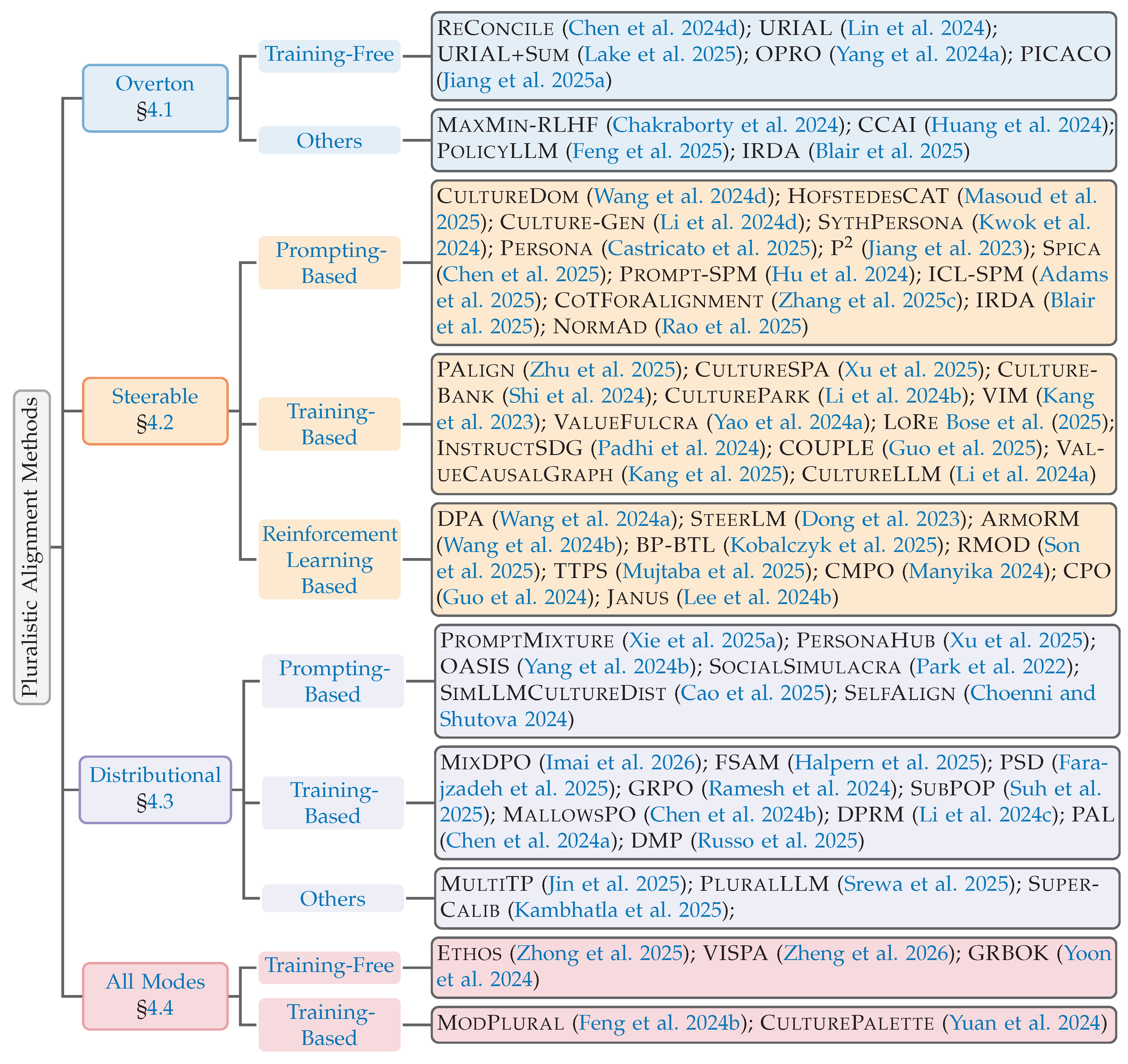
Disclaimer/Publisher’s Note: The statements, opinions and data contained in all publications are solely those of the individual author(s) and contributor(s) and not of MDPI and/or the editor(s). MDPI and/or the editor(s) disclaim responsibility for any injury to people or property resulting from any ideas, methods, instructions or products referred to in the content. |
© 2026 by the authors. Licensee MDPI, Basel, Switzerland. This article is an open access article distributed under the terms and conditions of the Creative Commons Attribution (CC BY) license (http://creativecommons.org/licenses/by/4.0/).
Copyright: This open access article is published under a Creative Commons CC BY 4.0 license, which permit the free download, distribution, and reuse, provided that the author and preprint are cited in any reuse.