

Submitted:
28 June 2026
Posted:
29 June 2026
You are already at the latest version
Abstract
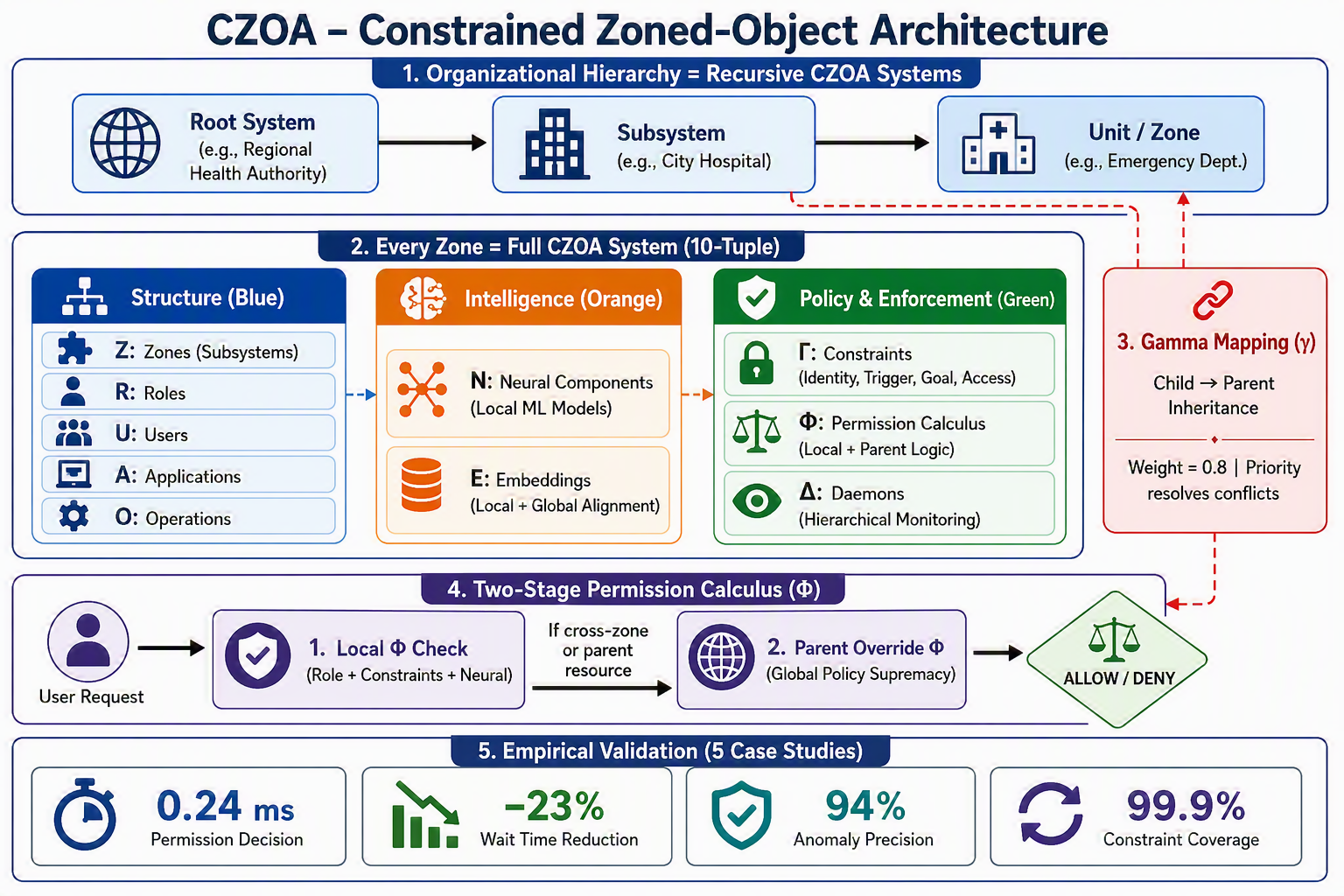
Modern enterprise systems must be both secure and adaptive—able to enforce strict access policies while responding intelligently to changing conditions. Yet the theories that explain intelligent behaviour and the engineering methodologies that build reliable systems have evolved separately, leaving a gap that forces designers to choose between formal guarantees and adaptive intelligence. This paper introduces the Constrained Zoned‑Object Architecture (CZOA), a unified formalism that bridges this gap. CZOA integrates the mathematical rigour of Constrained Object Hierarchies (COH) with the practical, validated structure of the Zoned Role‑Based (ZRB) framework. We show that enterprise systems are a natural species of intelligent systems, and that the combined framework preserves minimality while enabling new capabilities: neural‑enhanced permission mining, semantic embeddings for cross‑zone understanding, adaptive access control, and continuous daemon‑based enforcement. A complete Python implementation (CZOI toolkit) and a logic language (UniLang) make the formalism accessible to engineers. Five case studies across healthcare, finance, traffic, education, and supply chain demonstrate that CZOA delivers sub‑millisecond permission checks, up to 23% improvement in operational metrics, and high‑accuracy anomaly detection (94% precision) while maintaining rigorous security constraints. The paper concludes with a discussion of limitations, threats to validity, and future research directions.
Keywords:
intelligent enterprise systems
; access control
; adaptive systems
; formal methods
; constrained object hierarchies
; role‐based architecture
; integrated organizational systems
; system of systems
Copyright: This open access article is published under a Creative Commons CC BY 4.0 license, which permit the free download, distribution, and reuse, provided that the author and preprint are cited in any reuse.


