

Submitted:
18 March 2026
Posted:
19 March 2026
You are already at the latest version
Abstract
Strengthening healthcare systems requires evidence-based health education strategies that promote preventive behaviours and civic engagement. This study aimed to enhance healthcare awareness and reinforce university–school partnerships between Spain and Brazil through a collaborative project with the Blood Donors’ Brotherhood, focused on promoting voluntary blood donation as a public health priority. Implemented via the Research and Excellence High School's Program, the initiative utilised Service-Learning (SL) and Project-Based Learning (PBL) methodologies to create an impactful health educational intervention. The effectiveness of the intervention was evaluated through a quasi-experimental study involving 228 responses from individuals aged 17 to 51 years (M = 24.12, SD = 7.75). Participants were divided into experimental and control groups, including high school and university students in health and education programmes. The intervention was assessed pre- and post-implementation using a survey based on the Blood Donation Knowledge Questionnaire (BDKQ-Brazil), whose Spanish translation (BDKQ24-Spain) was validated through Factor Analysis. The two-factor BDKQ22-Spain model showed strong reliability (KR-20 = 0.85), supporting its suitability for measuring this construct. The study revealed that minors, future teachers, and therapists had less knowledge about blood donation compared to nursing students. However, post-intervention results showed significant knowledge improvements, reaching levels comparable to those of nursing students. This innovative project demonstrates that university–school partnerships strengthen health education outcomes related to blood donation and promote health promotion, contributing to sustainable healthcare systems, social responsibility, and the overall well-being of diverse student populations.
Keywords:
blood donation
; healthcare
; health education
; interinstitutional relations
; validation
1. Introduction
Blood donation is an altruistic and voluntary act that sustains healthcare systems worldwide by saving lives through transfusions (Wittock et al., 2021). Despite its critical role, shortages of safe and adequate blood persist in many countries (Haw et al., 2023). From 2008 to 2018, voluntary unpaid blood donations worldwide rose by 10.7 million units; however, fewer than 1% of the global population donates on a regular basis (WHO, 2021). The WHO recommends that at least 3% of the population should donate blood to ensure both safety (through haemovigilance programmes) and an adequate supply by blood group within health systems (Abdullah, 2022; WHO, 2021). Inadequate availability directly affects patients with chronic conditions, surgical needs, and those in emergencies, placing health systems under strain (Chand et al., 2023).
Donation rates are strongly influenced by national wealth and health infrastructures. In high-income countries, the rate stands at 31.5 donations per 1000 people, compared with only 5 in low-income countries (WHO, 2022). Income levels also affect plasma medicine production (Checkley et al., 2019), underscoring the need for policies that ensure equitable blood access across all socioeconomic contexts (Abdullah, 2022; Kaconco et al., 2023). Countries differ in their approaches, spanning legal and non-legal policy and practice for instance, to addressing matters pertaining to blood donation (Goncalez et al., 2008; Kaconco et al., 2023; Moreno et al., 2016). The decision to donate blood is strongly influenced by public awareness about donation, especially in countries where donation is voluntary (Bednall et al., 2013; Kumari & Raina, 2015). Conversely, a lack of knowledge about eligibility criteria, the blood donation process, and widespread misconceptions contributes to the global dearth of voluntary donors (Kumari & Raina, 2015; WHO, 2021). Individuals with limited knowledge about blood donation often assume they are ineligible to donate, which reinforces this misconception and reduces donor rates (Kumari & Raina, 2015). Recognising these factors underscores the importance of developing awareness interventions and globally reliable measurement scales to assess knowledge of blood donation, as increased knowledge, and, consequently, greater awareness is closely associated with higher donation rates (Zucoloto & Martinez, 2018; Zucoloto et al., 2020). It is therefore essential to design instruments that are appropriately tailored to this issue.
Literature Review
Blood Donation Knowledge Questionnaire (BDKQ)
The incidence of blood transfusions in Brazil is rising by around 6% each year, while the proportion of voluntary blood donors has stagnated at roughly 1.8% of the population, well below of the WHO´s recommended target of 3%. The multifaceted causes of donor shortages in low- and middle-income countries, particularly Brazil, remain poorly understood despite ongoing efforts to investigate the perceptions, motivations, and barriers surrounding voluntary blood donation (Goncalez et al., 2008; Moreno et al., 2016). One such initiative is the Blood Donation Knowledge Questionnaire (BDKQ-Brazil, Zucoloto & Martinez, 2018), designed to measure understanding and awareness related to blood donation.
While its application in Brazil has provided valuable insights, showing, for example, that women, donors, and health professionals generally achieved higher levels of knowledge than other groups (Zucoloto & Martinez, 2018; Zucoloto et al., 2020). However, the instrument has not yet undergone full psychometric validation, including exploratory factor analysis (EFA) and confirmatory factor analysis (CFA) factor analysis (Zucoloto et al., 2020). Furthermore, no validated equivalent exists in Spanish, as existing measures assess attitudes towards blood donation rather than knowledge (Fernández de-la-Iglesia et al., 2020; Martínez-Santos et al., 2021, 2022). In this context, adapting and validating the BDKQ for Spanish-speaking populations represents a critical step towards strengthening educational strategies and awareness campaigns in different cultural settings (Fernández de-la-Iglesia et al., 2020; Martínez-Santos et al., 2022). Such validation is not a mere translation exercise, but rather a process that must consider cultural, historical, political, economic, legislative, educational, and personal experiences factors to guarantee its adequacy and validity in Spanish-speaking contexts (Ferrando et al., 2022; Lorenzo-Seva & Ferrando, 2021). Cultural nuances can influence how scale items are interpreted, reflecting national differences in knowledge, values, traditions, and practices surrounding blood donation (Cheung & Rensvold, 2002). By addressing these nuances, the BDKQ-Spain can contribute meaningfully to research, intervention, and policy development aimed at improving voluntary blood donation rates.
Blood Donation in Spain: Knowledge, Awareness, and Challenges
In Spain, legislation stipulates that the donation of blood and blood components must be a voluntary and altruistic act, undertaken by individuals of legal age (Order SCO/322/2007; Royal Decree 1088/2005; Royal Decree 1343/2007). According to the Spanish Government (2020), 2.3% of Spaniards donated, below the WHO target of over 3% (2021). Nevertheless, Spain surpasses the global average, with 38 donors per million, showing a marked difference compared with neighbouring countries such as Portugal and France, which report 24.8 and 23.2 donors per million, respectively (Martínez-Santos et al., 2021; Statista, 2020). Therefore, in Spain, the interplay between public policies, initiatives, and awareness campaigns aimed at enhancing knowledge is crucial in influencing positively participation in blood donation (Martínez-Santos et al., 2022).
Previous studies highlight that health education is an essential tool for enhancing social welfare and reducing inequalities, playing a pivotal role in the education of young people and the prevention of health problems (Bray et al., 2023; Fernández de-la-Iglesia et al., 2020; WHO, 2021). Furthermore, awareness of the donation process and eligibility criteria increases the likelihood of participation, whereas misconceptions can act as barriers (Lownik et al., 2012; Kumari & Raina, 2017). The perception of being medically unfit frequently deters potential donors unnecessarily (Martínez-Santos et al., 2021).
Predispositions towards blood donation are generally positive in Spain; however, several concerns and barriers to participation have been identified (Fernández de-la-Iglesia et al., 2020). These include fear of needles or the blood collection process, limited information about the procedure, low awareness, perceived side effects or associated risks, lack of time or availability, and insufficient motivation to donate (Fernández de-la-Iglesia et al., 2020; Haw et al., 2023). Such barriers may vary across individuals and contexts and are important to address in order to encourage blood donation (Ackfeld et al., 2022). While these obstacles have been widely documented, there is limited understanding in Spain of how they present in younger populations or among individuals training to become educators (Martínez-Santos et al., 2022).
The Role of Young People and Future Teachers: Implementing Active Methodologies in Educational Interventions
Blood donation is a critical public health activity, and young people and future teachers represent two key groups in its promotion in Spain (Fernández de-la-Iglesia et al., 2020; Martínez-Santos et al., 2021, 2022). Minors are a significant group of potential donors, and research indicates that early education on blood donation fosters greater long-term commitment (Checkley et al., 2019). Similarly, future teachers hold the potential to influence blood donation awareness in children and adolescents, shaping attitudes and behaviours from an early age (De la Hoz et al., 2021; Martínez-Santos et al., 2021). Nevertheless, studies report considerable variation in knowledge and attitudes about blood donation among these groups (Fernández de-la-Iglesia et al., 2020; Getie et al., 2021; Zucoloto & Martinez, 2018), highlighting the need for targeted interventions.
To address this, structured training and awareness programmes for future teachers are necessary, equipping them with the skills required to promote blood donation effectively within their future classrooms (Getie et al., 2021). In addition, partnerships between educational institutions and blood donation organisations are also critical, supporting school-based initiatives and facilitating experiential learning (Martínez-Santos et al., 2021). Empowering teachers and students with both knowledge and practical skills promotes blood donation as a life-saving and altruistic act (Martínez-Santos et al., 2022). This approach also aligns with the Sustainable Development Goals, contributing to the development of responsible, health-literate citizens (Yuan, 2022).
The integration of active methodologies in education is essential to increase knowledge about blood donation among students (Fernández de-la-Iglesia et al., 2020). Approaches such as project-based learning (PBL) and servicewhich have been shown to increase prosocial behaviours, including the willingness to donate blood (Fernández de-la-Iglesia et al., 2020; Guo et al. 2020; Sáiz et al., 2022). Institutional support through partnerships with non-profit organisations allows educators and students to address disparities in donation and actively contribute to improving -learning (SL) foster collaboration, digital literacy, scientific skills, and effective problem-solving, all of blood supply (Getie et al., 2021).
Research Gap
Knowledge about blood donation is a key factor in increasing the number of donors, as understanding donation processes, procedures, and facts enables informed decisions and fosters sustained commitment (Alfieri et al., 2020; Getie et al 2021; Kowalsky et al., 2014). Despite this, there is a notable lack of validated Spanish instruments specifically assessing blood donation knowledge (Getie et al 2021; Martínez-Santos et al., 2021,2022; Zucoloto & Martinez, 2018; Zucoloto et al., 2020). Existing scales primarily focus on attitudes, fears, and willingness to donate, overlooking the critical role of knowledge in raising awareness and promoting active participation (Braz et al., 2014; Checkley et al., 2019; Fernández de-la-Iglesia et al 2020; France et al 2008; Kosowski, 2023).
This gap underscores the need to develop and validate tools that measure knowledge to support educational interventions and enhance donor recruitment among teachers and young people.Young people and future teachers play a central role in cultivating a society of informed, committed donors (Getie et al 2021; Fernández de-la-Iglesia et al 2020; Martínez-Santos et al., 2021,2022). Empirical evidence indicates that early training can strengthen long-term donation behaviours, while teachers can act as multiplier by shaping awareness, attitudes and knowledges from an early age (Checkley et al., 2019; De la Hoz et al., 2021). Active, project- and service-based learning methodologies offer practical approaches to foster understanding, involvement, and behavioural change (Fernández de-la-Iglesia et al 2020; Sáiz et al., 2022). However, few studies have explored these active interventions targeting these groups, and there is limited evidence on the effectiveness of programmes designed to increase knowledge in blood donation (Ackfeld, et al., 2022; Getie et al 2021; Zucoloto & Martinez, 2018; Zucoloto et al., 2020). Addressing these research gaps is essential to develop and implement effective strategies that equip young people and educators with the knowledge needed to promote blood donation, thereby contributing to increased donor participation in society (De la Hoz et al., 2021; Martínez-Santos et al., 2022). In addition, this study is based in a transnational collaboration between Brazilian and Spanish researchers. The questionnaire was originally developed by the Brazilian team, and the present research aims to validate it in Spain. This partnership is particularly meaningful because both countries have culturally distinct blood donation systems, making Spain an ideal context in which to examine the instrument’s transferability. The collaboration ensures methodological rigor, appropriate cultural adaptation, and fidelity to the original design, contributing to a broader global understanding of blood donation behaviours.
Objective
This study aims to develop and validate the Blood Donation Knowledge Questionnaire in Spanish (BDKQ-Spain) to provide a reliable measure of blood donation knowledge. It also seeks to evaluate the effectiveness of an active educational intervention, collaboratively designed by Brazilian and Spanish experts, Spanish cross-national and local associations, the university, the high school, and the Brotherhood of Blood Donors, in improving blood donation knowledge. The intervention is expected to enable high school students and future teachers to attain knowledge levels comparable to those of health students, fostering a culture of community engagement and social responsibility. The study also aims to identify baseline differences in knowledge by sex, age, educational course and prior donation experience in line with findings from previous research on blood donation knowledge.
2. Method
Research Design
A quasi-experimental study was conducted to validate the BDKQ-Spain and to improve knowledge about blood donation through an educational intervention. The independent variable was the delivery of the educational intervention, and the dependent variable was the improvement of knowledge about blood donation. Other criterion variables included were gender, age, previous donation experience, educational level, university degree/master's degree, teacher's master's degree chosen and opinions.
Participants
The study sample consisted of 228 responses from individuals aged 17 to 51 years (M= 24.12, SD= 7.75), of whom 156 identified as female and 72 as male, see Table 1. The control group consisted of 62 students, 40 from the Nursing Degree (M= 23.08, SD= 7.02), 22 from the Occupational Therapy Degree (M= 22.29, SD= 4.66), of whom 45.16% were donors. The quasi-experimental group consisted of 166 responses, 61 from the Bachelor's degree (M= 17.05, SD= 0.20) and 105 from the Master's degree in Teaching (M= 29, SD= 7.31), of which 36.14% were donors. Regarding the quasi-experimental group, 36 participants from the Bachelor's degree group and 57 from the Master's degree in Teaching completed the pre-test prior to the intervention. However, during the interventions, 11 participants from the Bachelor's degree group and 12 from the Master's degree in Teaching did not attend. Consequently, only 25 Bachelor's students and 45 teacher training participants completed both the pre-test and post-test and took part in the intervention. In addition, three students from the Master's degree in Teaching joined the interventions, but only completed the post-test. Furthermore, Figure 1 has been added to illustrate the flow diagram of participant selection and the testing process. To evaluate potential attrition bias, we examined whether missingness at post-test was associated with baseline characteristics. First, gender distribution was compared by course and pretest/post-test status. Chi-square tests showed no significant differences in attrition by gender in either the high school group (χ² = 36, p = 0.42) or the Master of Teaching group (χ² = 45.24, p = .46). Age differences were assessed by course level at pretest and post-test. Independent-samples t-tests indicated no significant differences in age between completers and non-completers in the high school group (t = 0.27, p = 0.40) or the Master of Teaching group (t = 0.85, p = 0.40). Finally, pretest performance was compared between completers and non-completers within each course. ANOVA results showed no significant differences in pretest scores between completers and non-completers in either the high school group (F = 0.33, p = .90) or the Master of Teaching group (F = 0.30, p = 0.99). Overall, these findings indicate that attrition was likely missing at random and is unlikely to bias the study’s main comparisons.
A total of 228 responses to the questionnaire were obtained between the experimental and control groups. Inclusion criteria were established based on the selected educational levels and those participants who did not sign the informed consent form were excluded. See Table 1 for more sociodemographic data analysed in the study.
Instrument
A questionnaire was created via Microsoft Forms and mailed to participants and legal guardians containing informed consent and questions with personal and socio-demographic data, as well as a standardised scale (BDKQ24-Spain) and open-ended questions for additional comments.
The BDKQ-Brazil (Zucoloto & Martinez, 2018) assesses knowledge about blood donation through 24 items with three, four or five response options that address the requirements, process and frequently asked questions based on Brazilian blood donation regulations (Zucoloto et al., 2020). The calculation of the scores consists of a summation of the items after having assigned a value of 1 for correct answers and 0 for incorrect answers. The cut-off points established for knowledge about donation were 0-13 (low), 13-19 (medium) and 19-24 (high). The scores between the brackets are not exactly equal due to variation in the difficulty of the questions in the questionnaire. Higher scores on the BDKQ-Brazil indicate greater knowledge of blood donation (Zucoloto et al., 2020). In this study, a mean BDKQ24-Spain score of 14.88 (N=228, Min=2, Max=24 and SD=5.26) was obtained.
To establish content validity, the BDKQ24-Spain was adapted to Spanish through the translation and retranslation of the BDKQ- Brazil validated in Portuguese following the guidelines of the University of Michigan (2023). This process included a double translation carried out by experts in the field, as well as a piloting phase to ensure its adequacy and comprehension in the Spanish context. The questionnaire was further reviewed by Brotherhood of Blood Donors associations and by five experts in blood donation and education, three from Spain and two from Brazil, as well as through group sessions with high school and university students to evaluate comprehension and usability. As a result of this process, several modifications were made. Specifically, in items 5, 8, 10, and 16, the term “Brazil” was replaced with “Spain”. In addition, in items 3, 12 and 14, the Spanish Health System was added, and in item 20, millilitres were added to understand the measure of capacity of a cup to facilitate the answers. Therefore, following the validation process, the BDKQ-24, established through content validity, and the final BDKQ-22 Spain, obtained from the factorial analysis, are provided in the supplementary materials, which also include guidance on their use and interpretation.
Procedure and Intervention
After obtaining approval from the Ethics Committee. Prior to implementation, permission was first obtained from the school and university administration. Subsequently, the teachers then obtained consent from parents or legal guardians, and consent was also obtained from the students themselves, ensuring three levels of authorization. In the case of adult students, their individual informed consent was required. All procedures complied with institutional and national ethical standards, ensuring participant confidentiality and data protection throughout the study. The intervention was developed following PBL and SL methodologies and implemented in the Research Project subject in the Sixth Form over 80 hours of tutoring. In response to the needs identified by the participating educational centres, students, teachers, and university tutors collaborated with the Blood Donor Association and Brazilian experts to promote awareness of blood donation.
The educational programme used in this intervention was designed following the guidelines of the Spanish Brotherhood of Blood Donors (Blood drops that save lives), the Brazilian and Spanish Government's Donor Management Manual and the WHO. The contents of the intervention focused on highlighting the relevance of blood donation as a lifesaver, backed up by data on the need for donors. Requirements, including age, weight and health, were reported, and the procedure, quantity, time involved, and safety measures employed were detailed. Advantages for recipients and donors were discussed, as well as possible side effects, and advice was given on how to encourage donation in close circles and organise school campaigns, emphasising the responsibility of donating blood when coming of age. At the end, a gamification activity created by the researchers entitled "Donation Case Cards according to Personal Background" was developed, where groups of 4 participants chose suitable donors for fictitious patients.
The procedure followed during the intervention consisted of several stages. Firstly, all experimental groups completed the questionnaire (pretest) to assess prior knowledge and then the intervention was carried out with the Master's Degree in Teaching and High School groups. The intervention included presentations, gamification activities and lasted three sessions of 2 hours per session. At the end, the questionnaire (post-test) was applied to the experimental and control groups. The questionnaires were answered in the subjects of the participating teachers and lectures, through links sent to the institutional mail or posted on the platform of their subjects. In addition, the teachers and lectures communicated the results to the students during their classes, in order to increase knowledge about blood donation.
Data Analysis
The BDKQ-Spain was validated, and its factor structure was confirmed through both EFA and CFA (construct validity). This analysis was conducted using the JASP 0.16.4 X64 software. A promax oblique rotation was applied, and estimation was carried out through the Maximum Likelihood method (Marsh et al., 2020). For indices constructed from dichotomous (yes/no) scales, polychoric/tetrachoric correlations were employed to ensure appropriate validation. For dichotomous items (e.g., yes/no responses), reliability is best assessed using the Kuder–Richardson (KR) formula. KR-20 when item difficulty varies and KR-21 when items are assumed to have equal difficulty. A KR value above 0.70 indicates good reliability, as the formula is specifically designed for binary data and offers a more accurate estimate of internal consistency than Cronbach’s alpha (Alonso et al., 2025).
It is important to note the adequacy of the sample size for this analysis, since the number of responses was 10 times greater than the number of items (Marsh et al., 2020). Internal consistency was assessed through correlations, covariances, Cronbach's Alpha (α) of the deleted items and Omega de McDonald's (ω) of the deleted items. External and criterion validity were examined by relating sociodemographic variables to questionnaire scores (Field, 2018). The internal structure was first examined using EFA to explore the underlying dimensions, and the results were subsequently confirmed through CFA (Marsh et al., 2020). We established 0.30 as the minimum factor loading cutoff and selected items with higher loadings. These analyses are adequate to establish differences in the structure of the BDKQ and the identification of underlying scales. According to Putnick and Bornstein's (2016) criteria, invariance is considered adequate if the differences in ΔCFI are ≤ 0.01, ΔRMSEA are ≤ 0.015, and ΔSRMR are ≤ 0.015 The associations with background variables of the BDKQ-Spain will be determined by comparing it with the sociodemographic variables (Marsh et al., 2020). These analyses are suitable for establishing differences in the structure of the BDKQ-Spain and the identification of underlying scales.
In the study, descriptive and inferential analyses were conducted using IBM SPSS-27 to evaluate the intervention and further support construct validation. In order to address the main objective, Student's t-tests and ANOVA followed by Bonferroni's post hoc test were used to compare independent samples. In addition, Pearson's correlation was used to analyse relationships between BDKQ-Spain scores and age. A significance level of p < 0.05 was established (Field, 2018), and effect size was calculated using Cohen's d statistic, considering d = 0.20 (small), d = 0.50 (medium) and d = 0.80 (large). To calculate the effect size of the ANOVA test, the partial eta squared statistic (ηp2) was used, with ηp2= 0.01 (small), ηp2= 0.06 (medium) and ηp2= 0.14 (large). Correlations are considered small/medium/strong with r of 0.10/0.30/0.50, respectively.
3. Results
Reliability Analysis of BDKQ24-Spain
Table 2 shows the internal consistency of the BDKQ24-Spain, the means, the variances of its 24 items, the item-total correlation coefficients and the αs of the deleted item. The correlations between each item and the corrected scale score were mostly above 0.30, except for items 12, 14 and 22. In addition, item 22 was not significantly correlated with the total score. However, following the recommendations of Zyl and Klooster (2022) in the item selection process, items that differentiate extreme groups and whose α values are appropriate should not be removed, indicating that it was not necessary to remove any of these items (Marsh et al., 2020). In this study, the BDKQ24-Spain demonstrated good reliability, with a KR-20 coefficient of 0.85 and a KR-21 coefficient of 0.83. The mean questionnaire score was 14.88 (N = 228, Min = 2, Max = 24, SD = 5.26, σ² = 27.65). Finally, the BDKQ24-Spain also obtained high reliability (α = 0.87 and ω = 0.86) and a small inter-item correlation of 0.22.
Table 3 presents the difficulty and discrimination indices of the BDKQ24-Spain items in the study sample. Most items fell within the acceptable range for both difficulty and discrimination, which is considered optimal. However, items 3 and 12 were classified as easy and non-discriminatory, as they did not exceed the threshold of 0.26 (Alonso et al., 2025). It is therefore recommended that these items be removed from further analysis. Accordingly, they will not be included in subsequent factor analyses to evaluate their structural relevance.
EFA of BDKQ22-Spain
After analysing these data, the appropriateness of conducting a factor analysis (Marsh et al., 2020) was assessed and showed an adequate Kaiser, Meyer and Olkin test (KMO) value of 0.86 and a significant Bartlett's test of sphericity (χ2=17155.40, gl= 231, p <.001), indicating significant relationships between items and the appropriateness of conducting these factor analyses.
A EFA was performed by applying a promax oblique rotation, based on polychoric/tetrachoric correlations, and Maximum Likelihood estimation was used to maximize the probability of observing the given data (Ferrando et al., 2022). Following the AFE, two factors were identified in the factorial solution, see Table 4. The first factor explains 26.4% of the total variance and the second factor explains 21.8%.
The parallel analysis suggested that the two factors should be retained. All the items load above 0.40. The results of this study suggest that this structure should be tested through a CFA, comparing both one-factor and two-factor models.
CFA of BDKQ22-Spain
This analysis confirmed the results previously identified in the EFA (Ferrando Piera et al., 2022; Marsh et al., 2020). Using a Maximum Likelihood approach in JASP, we obtained standardised estimates, direct and indirect effects, and covariance values (Alonso et al., 2025). A confirmatory factor analysis is considered to show good model fit when the CFI, NNFI, RNI, and TLI exceed the recommended threshold of 0.90, the SRMR and RMSEA fall below 0.08, and the CMIN/DF value is less than the accepted cut-off of 3 (Alonso et al., 2025; Marsh et al., 2020). Table 5 displays the CFA indices for two models of the BDKQ-22. The 1-factor models exhibited inferior fit compared to the 2-factor model.
In the original version, it was theoretically considered appropriate to retain the questionnaire as unifactorial. However, in this study, the 2-factor model was deemed more suitable than the 1-factor model, although the modest CFA indices indicate the need for further analysis. In this study, the Subscale-1 (Blood Donation Criteria and Conditions) of the BDKQ22-Spain demonstrated high reliability, with a KR-20 coefficient of 0.80, a KR-21 coefficient of 0.76, the α was 0.80 and the ω = 0.80. The mean score was 5.86 (N = 228, Min = 0, Max = 10, SD = 2.77, σ² = 7.66). The Subscale-2 (Blood Donation Process and Regulations) of the BDKQ22-Spain also demonstrated high reliability, with a KR-20 coefficient of 0.82, a KR-21 coefficient of 0.76, the α was 0.79 and the ω = 0.80. The mean score was 7.17 (N = 228, Min = 0, Max = 12, SD = 3.10, σ² = 9.56). Overall, the BDKQ22-Spain demonstrated high reliability, with a KR-20 coefficient of 0.85, a KR-21 coefficient of 0.84, the α was 0.86 and the ω = 0.85. The mean questionnaire score was 13.03 (N = 228, Min = 0, Max = 22, SD = 5.14, σ² = 26.38).
Invariance of the BDKQ-22 Across Gender
In this case, measurement invariance refers to the consistency of the BDKQ22-Spain measurements across gender. Initially, the configural invariance model was tested, revealing a unifactorial structure between groups with satisfactory fit indices (CFI = 0.75; RMSEA = 0.08; SRMR = 0.08). Next, the metric invariance model was examined, indicating adequate fit (CFI = 0.75; RMSEA = 0.08; SRMR = 0.09) with minimal differences from the configural model. Scalar invariance, which incorporates equal intercepts, showed a good fit (CFI = 0.69, RMSEA = 0.09, SRMR = 0.10), although there were unexpected changes in the CFI compared to metric invariance because the ΔCFI was > 0.01. The strict invariance model, which incorporates restricted error variances, fit well (CFI = 0.69, RMSEA = 0.09, SRMR = 0.10). Comparisons between models were based on established criteria (Putnick & Bornstein, 2016). Given the moderate fit of the baseline models, the evidence for configural and scalar invariance should be interpreted with caution. Rather than claiming full invariance, we present these BDKQ-22 findings as exploratory, indicating only approximate equivalence between men and women.
Analysis of the BDKQ22-Spain Scores in Relation to Intervention and Sociodemographic Variables
The performance of the BDKQ22-Spain was evaluated in terms of hits and misses. Questions with low hit rates related to donation barriers and myths such as 13 (Blood expiry) with a 53.10% hit rate, and questions 8 (Menstruation), 9 (Age of donation), 14 (Acquiring diseases) and 20 (Volume of blood donated) with less than 50% hit rate. In addition, questions 10 (Lactation), 11 (Volume donated per donation), 15 (Period between donations) and 24 (Clotted or diluted blood) scored less than 40% correct. The rest of the questions had hit rates between 60% and 89%. The intervention implemented had a positive impact on increasing knowledge about donation, as reflected in the scores obtained in the BDKQ22-Spain and in the comments made by the participants in the sessions. A linear mixed-effects model was used to examine the intervention influence of course (High School, Master’s in Teacher Education, Occupational Therapy and Nursing) and time (pre-test versus post-test) on knowledge about blood donation (BDKQ-22). The analysis revealed a significant main effect of course, F(1,228) = 27.48, p < 0.001, with students in Nursing and the Master’s programs scoring higher overall than those in High School and Occupational Therapy. There was also a significant main effect of time, F(1,228) = 223.23, p < 0.001, showing that knowledge scores improved from pre-test to post-test across all groups. The interaction of course and time was not significant, F(1, 228) = 2.82, p = 0.09, suggesting that the extent of improvement over time was similar across courses.
Statistically significant differences were also observed between the average scores of the pretest and post-test, as well as between the control and quasi-experimental groups. Factors such as previous donation experience, knowledge of blood group, higher educational level and older age were correlated with greater knowledge in this area. Science and Health Science students initially showed greater knowledge than their peers in other disciplines. A slight positive correlation (r = 0.19, p < 0.003) between the BDKQ22-Spain score and age stands out, indicating that the older the age, the more correct answers are obtained. These results are explored in detail in Table 6 and Table 7, which present the differences in the BDKQ22-Spain with respect to the criterion variables assessed.
4. Discussion
This study successfully achieved its objectives by developing and validating the Blood Donation Knowledge Questionnaire in Spanish (BDKQ-Spain), which exhibited strong reliability and validity. In addition, the educational intervention effectively increased knowledge about blood donation among high school students and future teachers. After the intervention, participants’ knowledge levels appeared broadly comparable to those of nursing students, indicating that active, contextually grounded educational programs may help reduce knowledge gaps across different educational groups.
The BDKQ22-Spain version, adapted from the BDKQ-Brazil (Zucoloto & Martínez, 2018), performed well psychometrically. In adapting the questionnaire, two items from the BDKQ-Brazil were removed because they were too easy and reflected principles already well known in Spain’s public health system. These items were the only ones referencing Spain, so their removal aids broader applicability in other Spanish-speaking countries. Their exclusion also helped avoid ceiling effects and improved the tool’s ability to discriminate between different levels of knowledge (Alonso et al., 2025). The EFA and CFA results aligned more closely with a two-factor model than with a unifactorial structure. These findings cannot be directly compared with those of the original study by Zucoloto and Martínez (2018), as they did not carry out factor analyses, although they did theoretically suggest that the scale functions best as a unidimensional measure. Given the modest indices reported, the existence of distinct subscales still requires further confirmation, and additional analyses are therefore recommended (Ferrando et al., 2022).
Our findings indicate that previous experience of blood donation was a strong predictor of higher knowledge, with 36.70% of participants having donated blood. This reflects a positive attitude towards altruistic behaviour, consistent with findings from other Spanish studies (Fernández de la Iglesia et al., 2020; Martínez-Santos et al., 2021, 2022). This altruistic mentality may have been reinforced by donation campaigns within the university environment, organised in collaboration with local associations such as the Brotherhood of Blood Donors, which also took part in this study. These campaigns enhance knowledge about blood donation, which primarily motivated participants to support the blood bank and help maintain its reserves (Chand et al., 2023; Haw et al., 2023; Martínez-Santos et al., 2021, 2022).
Nonetheless, several areas of limited knowledge linked to barriers to blood donation were also identified. These included fears of disease transmission, fear of needles and blood, concerns about possible negative health effects, as well as discomfort and weight-related issues, consistent with findings reported by Chand et al. (2023) and Haw et al. (2023). The persistence of these concerns within our sample is particularly striking given the high level of awareness of blood donation safety measures (with over 90% answering correctly). More concerning still is that fewer than half of participants correctly recognised that, under haemovigilance protocols, disease transmission through blood donation is unlikely within the Spanish health system, reflecting knowledge barriers described in other studies (Chand et al., 2023; Getie et al., 2021).
When compared to prior research, blood donation knowledge in our quasi-experimental pretest group was lower that reported in the original version validated by Zucoloto and Martinez (2018) among Brazilian health centre users, whose mean score was 15.35 (SD = 3.25, N = 1055). In our study, however, knowledge levels improved after the intervention, ultimately surpassing those of the Brazilian participants. Similarly, when compared with the study by Zucoloto et al. (2020), conducted among health science students (M= 13.67; SD = 7.96, N = 340, 81.50% female) of a comparable age and sample to ours, our pre-test scores across most groups indicated lower levels of blood donation knowledge. Post-test results, however, showed higher levels of knowledge than those reported by Zucoloto et al. (2020), with Occupational Therapy students in our study achieving mean scores comparable to those in their research. Consistent with previous research (Martínez-Santos et al., 2021, 2022), which suggests that nursing students have greater knowledge due to their involvement in different stages of the blood donation process. The research by Zucoloto et al. (2020) also indicated that health science students possessed the strongest background knowledge overall. However, it also showed that students of occupational therapy, nutrition, physiotherapy, and speech therapy had less knowledge than their peers in medicine and nursing, reflecting differences in the content covered within their respective disciplines.
As in the studies by Zucoloto and Martínez (2018) and Zucoloto et al. (2020), our study also identified demographic differences in blood donation knowledge, with women, older participants, and previous donors demonstrating higher knowledges. These differences in knowledge are attributed to several factors including accumulated experience over time, repeated exposure to the donation process, greater interest and awareness in sex-role-related health, culturally influenced prosocial behaviours, and greater accessibility to information and educational programmes (Abdullah et al., 2022; Chand et al., 2023; Checkley et al., 2019; Wittock et al., 2021). The relationship between these factors and willingness to donate may vary and be influenced by other sociocultural and individual factors (Zucoloto et al., 2020). Nevertheless, in line with our findings and previous research, the most notable factor appears to be the level of education received (Wittock et al., 2021; Zucoloto & Martínez, 2018).
Therefore, the present intervention has demonstrated that health education, applying active methodologies, is associated with the acquisition of knowledge about blood donation as these methodologies engage students, promoting deeper understanding and long-term learning, consistent with previous studies (Bray et al., 2023; Gil et al., 2021; Sáiz, et al., 2022). This positive outcome is also aligned with findings from other studies emphasising the benefits of integrating hands-on experiences, and discussions related to donation, which connect theory with practice, enhance intrinsic motivation to learn, and foster critical reflection (Fernández de la Iglesia et al., 2020; Getie et al., 2021).
Our study, consistent with previous research, underscores the importance of educating adolescents, future teachers, and health professionals about blood donation to foster awareness and a culture of solidarity from an early age (Zucoloto et al., 2020). Addressing donation among minors promotes altruistic values, encourages family involvement, and supports the development of a sustainable donor culture (Martínez-Santos et al., 2022). The participation of these groups in this research contributes to fostering a caring society that supports blood banks in maintaining an adequate supply of blood for those in need (Ackfeld et al., 2022; Martínez-Santos et al., 2021; Zucoloto et al., 2020). Moreover, as highlighted in this study and previous research, equipping health and education professionals with knowledge about blood donation is essential for patient safety, demystifying myths, recognising eligibility criteria, and managing potential complications (Martínez-Santos et al., 2021, 2022).
Strengths and Limitations
The strengths of the study are that the BDKQ22-Spain questionnaire demonstrated strong psychometric properties supported by reliable analyses, EFA and CFA, thereby confirming its validity and reliability for assessing blood donation knowledge in Spanish-speaking populations. BDKQ22-Spain provides a standardised tool for future evaluations. The intervention effectively enhanced knowledge about blood donation among high school students and future teachers. By incorporating innovative pedagogical approaches, such as SL and PBL, the study fostered active student engagement and meaningful, context-based learning in both secondary and higher education settings. Conducted in real educational settings, the research enhanced the practical relevance of its findings, while active methodologies supported the acquisition of practical knowledge about blood donation and encouraged informed health-related decision-making. Moreover, the quasi-experimental design, involving 228 responses from diverse educational and health-related backgrounds, provided a broad understanding of the intervention’s impact.
Despite the valuable findings obtained in this study, several limitations should be considered. The validation of the BDKQ-22 Spain did not include comparisons with other validated instruments, and the CFA indices supporting the two-subscale structure were modest. The two items removed during the EFA were specific to Spain, while the remaining items are broadly applicable across Spanish-speaking countries, nevertheless, it is recommended that the questionnaire be tested in other Spanish-speaking countries. The quasi-experimental design and sample diversity limited the ability to draw generalize findings broadly. Future research should carry out factor analysis in additional samples to confirm the structure of the questionnaire. It should also adopt more robust designs, including larger samples, and randomized cluster approaches to evaluate long-term effects and strengthen evidence. Additionally, expanding participant diversity across educational contexts would further enhance generalizability.
5. Conclusion And Implications
The objectives of this study have been successfully achieved, confirming the reliability, validity and relevance of the BDKQ22-Spain among high school students as well as educational and healthcare professionals. The educational intervention, conducted in collaboration with Brazilian and Spanish experts and the Brotherhood of Blood Donors, had a positive impact on participants, as evidenced by an increased in their knowledge about blood donation. High school students, prospective teachers, and Occupational Therapy students were found to have lower levels of knowledge compared with Nursing students. However, following the intervention, high school students and future teachers achieved knowledge levels comparable to those of Nursing students. These findings underscored the effectiveness of active learning methodologies and highlight the importance of Health Education in enhancing knowledge about blood donation within this population. The study also showed the value of partnerships between universities and schools in enhancing the quality of health education. Educational interventions of this kind are therefore essential for fostering awareness and knowledge of blood donation among high school students and future professionals in both health and education sectors.
Supplementary Materials
The following supporting information can be downloaded at the website of this paper posted on Preprints.org.
Author Contributions
Conceptualization, LAM., DSG, LSG, APO, LTS, RSSM, EZM and MLZ; methodology, LAM., DSG, LSG, APO, LTS and RSSM.; software, LAM.; validation, LAM, EZM and MLZ; formal analysis, LAM, LSG, APO and LTS ; investigation, LAM., DSG, LSG, APO, LTS, RSSM, EZM and MLZ; resources, LAM., DSG, LSG, APO, LTS and RSSM; data curation, LAM., LSG, APO, and LTS; writing—original draft preparation, LAM., DSG, LSG, APO, LTS and RSSM..; writing—review and editing, LAM., DSG, LSG, APO, LTS, RSSM, EZM and MLZ; visualization, LAM.; supervision, LAM.; project administration, LAM.; funding acquisition, LAM. All authors have read and agreed to the published version of the manuscript
Funding
This research was fully or partially funded by the call for research projects of the Spanish Association of Deans of Nursing Faculties (CNDE), grant number PINV_12CNDE23).
Institutional Review Board Statement
The study was conducted in accordance with the Declaration of Helsinki, and approved by the Institutional Review Board (or Ethics Committee) of University of Burgos (approval number IR13/2022) for studies involving humans.
Informed Consent Statement
Informed consent was obtained from all subjects involved in the study.
Data Availability Statement
The data reported in this manuscript can be approached through contacting the corresponding authors and it is deposited in a digital repository that can be accessed from the following link, https://doi.org/10.5281/zenodo.12701610.
Acknowledgments
We must thank all the students who decided to participate voluntarily for this project and all the teachers, high school, universities, deans, lecturers and professors who contributed to helping us spread the word about the study.
Conflicts of Interest
The authors declare no conflicts of interest.
References
- Abdullah, S. Blood Products Management and Safety During COVID-19: a Public Health Challenge. Clin. Lab. 2022, 68, 1553–1560. [Google Scholar] [CrossRef] [PubMed]
- Ackfeld, T.; Schmutz, T.; Guechi, Y.; Le Terrier, C. Blood Transfusion Reactions—A Comprehensive Review of the Literature including a Swiss Perspective. J. Clin. Med. 2022, 11, 2859. [Google Scholar] [CrossRef] [PubMed]
- Alfieri, S.; Pozzi, M.; Pistoni, C. The blood donation function inventory: Adaptation of the voluntary function inventory for a psychological approach to blood donors. J. Civ. Soc. 2020, 16, 61–76. [Google Scholar] [CrossRef]
- Martínez, L.A.; Alcaraz, J.P.; Medina, M.J.S.; Cámara, R.S.; Junco, L.A. Sexuality Knowledge Assessment Questionnaire (SEKAQ): Importance of the School Setting in Health Education. Psychol. Sch. 2025, 62, 4903–4916. [Google Scholar] [CrossRef]
- Bednall, T.C.; Bove, L.L.; Cheetham, A.; Murray, A.L. A systematic review and meta-analysis of antecedents of blood donation behavior and intentions. Soc. Sci. Med. 2013, 96, 86–94. [Google Scholar] [CrossRef]
- Bray, L.; Antoniou, P.; Nikolaidou, M.; Fides-Valero, Á.; Roberts, T.; Ahonen, O.; Häyrinen, S.; Campos-Díaz, E.; Bamidis, P.D. Evaluation of the effectiveness of educational escape rooms within health professions education: A systematic review protocol. Int. J. Educ. Res. 2023, 117, 102123. [Google Scholar] [CrossRef]
- Braz, A.C.G.; Almeida, R.G.d.S.; Martinez, E.Z. Translation into Portuguese and validation of the Blood Donation Reactions Inventory. Rev. Bras. de Hematol. e Hemoter. 2014, 36, 139–146. [Google Scholar] [CrossRef]
- Chand, S.; Amita, R.; Gupta, D. Addressing concerns and suggestions of blood donors. Asian J. Transfus. Sci. 2023, 17, 103–107. [Google Scholar] [CrossRef]
- Checkley, L.; Motwani, G.; Wange, I.C.; Nwanna-Nzewunwa, O.; Kirya, F.; Ajiko, M.M.; Juillard, C.; Dicker, R.A. Assessment of Blood Donation and Transfusion in Eastern Uganda: A Mixed-Methods Study. Ann. Glob. Heal. 2019, 85, 59. [Google Scholar] [CrossRef]
- Cheung, G.W.; Rensvold, R.B. Evaluating Goodness-of-Fit Indexes for Testing Measurement Invariance. Struct. Equ. Model. Multidiscip. J. 2002, 9, 233–255. [Google Scholar] [CrossRef]
- De la Hoz, A.; Cubero, J.; Melo, L.; Durán-Vinagre, M.A.; Sánchez, S. Analysis of Digital Literacy in Health through Active University Teaching. Int. J. Environ. Res. Public Heal. 2021, 18, 6674. [Google Scholar] [CrossRef] [PubMed]
- Fernández de-la-Iglesia, J. del C.; Martínez, A.-E.; Rodríguez-González, R.; Cebreiro, B.; Fernández- Morante, C.; Casal-Otero, L. Service-learning to improve attitudes towards blood donation among university students. Health Education Journal 2020, 79(7), 812–825. [Google Scholar] [CrossRef]
- Ferrando, P.; Lorenzo-Seva, U.; Hernández-Dorado, A.; Muñiz, J. Decalogue for the Factor Analysis of Test Items. Psicothema 2022, 1, 7–17. [Google Scholar] [CrossRef] [PubMed]
- Field, A. Discovering statistics using IBM SPSS statistics; Sage, 2018. [Google Scholar]
- France, C.R.; Ditto, B.; France, J.L.; Himawan, L.K. Psychometric properties of the Blood Donation Reactions Inventory: a subjective measure of presyncopal reactions to blood donation. Transfusion 2008, 48, 1820–1826. [Google Scholar] [CrossRef]
- Getie, A.; Wondmieneh, A.; Bimerew, M.; Gedefaw, G.; Demis, A. Knowledge of blood donation and associated factors in Ethiopia: a systematic review and meta-analysis. BMJ Open 2021, 11, e044343. [Google Scholar] [CrossRef]
- Goncalez, T.T.; Sabino, E.C.; Chen, S.; Salles, N.A.; Chamone, D.A.F.; McFarland, W.; Murphy, E.L. Knowledge, Attitudes and Motivations Among Blood Donors in São Paulo, Brazil. AIDS Behav. 2008, 12, 39–47. [Google Scholar] [CrossRef]
- Guo, P.; Saab, N.; Post, L.S.; Admiraal, W. A review of project-based learning in higher education: Student outcomes and measures. Int. J. Educ. Res. 2020, 102, 101586. [Google Scholar] [CrossRef]
- Haw, J.; Walrond, J.; Jayachandran, J.; Dordunoo, D.; Eche-Ameh, H.; Muwhen, U.; Phiri, P.; Rastogi, J.; Tinga, B. Sickle cell disease and the need for blood: Barriers to donation for African, Caribbean, and Black young adults in Canada. Transfusion 2023, 63, 1324–1332. [Google Scholar] [CrossRef]
- Kaconco, J.; Nabuuma, B.; Mugarura, J.T.; Kirabira, J.B. Investigating relationship of master production scheduling on blood transfusion sustainability in Uganda. Soc. Sci. Humanit. Open 2023, 8, 100514. [Google Scholar] [CrossRef]
- Kosowski, P. The Polish adaptation of the blood donation fears inventory. Transfus. Apher. Sci. 2023, 63, 103865. [Google Scholar] [CrossRef]
- Kowalsky, J.M.; France, C.R.; France, J.L.; Whitehouse, E.A.; Himawan, L.K. Blood donation fears inventory: development and validation of a measure of fear specific to the blood donation setting. Transfus. Apher. Sci. 2014, 51, 146–151. [Google Scholar] [CrossRef]
- Kumari, S.; Raina, T. Knowledge, attitude and practices (KAP) regarding voluntary non-remunerated blood donation (VNRBD) among the students of colleges of Jammu, India. Int. J. Community Med. Public Heal. 2017, 2, 45–50. [Google Scholar] [CrossRef]
- Lorenzo-Seva, U.; Ferrando, P.J. Not Positive Definite Correlation Matrices in Exploratory Item Factor Analysis: Causes, Consequences and a Proposed Solution. Struct. Equ. Model. A Multidiscip. J. 2021, 28, 138–147. [Google Scholar] [CrossRef]
- Lownik, E.; Riley, E.; Konstenius, T.; Riley, W.; McCullough, J. Knowledge, attitudes and practices surveys of blood donation in developing countries. Vox Sang. 2012, 103, 64–74. [Google Scholar] [CrossRef] [PubMed]
- Marsh, H.W.; Guo, J.; Dicke, T.; Parker, P.D.; Craven, R.G. Confirmatory Factor Analysis (CFA), Exploratory Structural Equation Modeling (ESEM), and Set-ESEM: Optimal Balance Between Goodness of Fit and Parsimony. Multivar. Behav. Res. 2020, 55, 102–119. [Google Scholar] [CrossRef]
- Martínez-Santos, A.-E.; Fernández-De-La-Iglesia, J.-D.; Casal-Otero, L.; Pazos-Couselo, M.; Rodríguez-González, R. Blood donation attitudes and knowledge in Spanish undergraduates with roles in health-education. Transfus. Apher. Sci. 2022, 61, 103416. [Google Scholar] [CrossRef]
- Martínez-Santos, A.-E.; Fernández-De-La-Iglesia, J.-D.; Pazos-Couselo, M.; Marques, E.; Veríssimo, C.; Rodríguez-González, R. Attitudes and knowledge in blood donation among nursing students: A cross-sectional study in Spain and Portugal. Nurse Educ. Today 2021, 106, 105100. [Google Scholar] [CrossRef]
- Moreno, E.C.; Bolina-Santos, E.; Mendes-Oliveira, F.; Miranda, C.; Sabino, E.C.; Cioffi, J.G.M.; Camargos, V.; Caiaffa, W.; Xavier, C.C.; Proietti, F.A.; et al. Blood donation in a large urban centre of southeast Brazil: a population-based study. Transfus. Med. 2016, 26, 39–48. [Google Scholar] [CrossRef] [PubMed]
- Order SCO/322/2007, de 9 de febrero, por la que se establecen los requisitos de trazabilidad y de notificación de reacciones y efectos adversos graves de la sangre y de los componentes sanguíneos; Boletín Oficial del Estado. 2007; 42. Available online: https://www.boe.es/buscar/doc.php?id=BOE-A-2007-3383.
- Putnick, D.L.; Bornstein, M.H. Measurement invariance conventions and reporting: The state of the art and future directions for psychological research. Dev. Rev. 2016, 41, 71–90. [Google Scholar] [CrossRef]
- Royal Decree 1088/2005, de 16 de septiembre, por el que se establecen los requisitos técnicos y condiciones mínimas de la hemodonación y de los centros y servicios de transfusión; Boletín Oficial del Estado. 2005; 225. Available online: https://www.boe.es/buscar/doc.php?id=BOE-A-2005-15514.
- Royal Decree 1343/2007, de 11 de octubre, por el que se establecen normas y especificaciones relativas al sistema de calidad de los centros y servicios de transfusión. Boletín Oficial del Estado. 2007, 262. Available online: https://www.boe.es/buscar/doc.php?id=BOE-A-2007-18918.
- Sáiz-Manzanares, M.C.; Alonso-Martínez, L.; Rodríguez, A.C.; Martin, C. Project-Based Learning Guidelines for Health Sciences Students: An Analysis with Data Mining and Qualitative Techniques. J. Vis. Exp. 2022. [Google Scholar] [CrossRef]
- Spanish Goverment. El Ministerio de Sanidad anima a la población donar con motivo de la conmemoración del Dia Mundial del Donante de Sangre. Gob.es, 2023. Available online: https://www.lamoncloa.gob.es/serviciosdeprensa/notasprensa/sanidad14/Paginas/2021/140621-dia_mundial_donante.aspx.
- Statista. Donors: Donor rate per European Union country in 2020. 2020. Available online: https://es.statista.com/estadisticas/595657/paises-del-mundo-con-mayor-numero-de-donantes-por-.
- University of Michigan. Cross-Cultural Survey Guidelines. 2023. Available online: https://ccsg.isr.umich.edu/.
- van Zyl, L.E.; Klooster, P.M.T. Exploratory Structural Equation Modeling: Practical Guidelines and Tutorial With a Convenient Online Tool for Mplus. Front. Psychiatry 2022, 12, 795672. [Google Scholar] [CrossRef]
- Wittock, N.; Monforte, P.; Hustinx, L. “Missing minorities” in blood donation: Rethinking blood procurement in Europe as a citizenship regime. Heal. Interdiscip. J. Soc. Study Heal. Illn. Med. 2021, 25, 535–554. [Google Scholar] [CrossRef] [PubMed]
- World Health Organization. Global status report on blood safety and availability 2021. 2021. Available online: https://apps.who.int/iris/rest/bitstreams/1433729/retrieve.
- World Health Organization. Blood availability and safety. 2022. Available online: https://www.who.int/es/news-.
- Yuan, T. Higher education beyond SDG 4: China’s scholarship provision in the Global South. Int. J. Chin. Educ. 2022, 11. [Google Scholar] [CrossRef]
- Zucoloto, M.L.; Martinez, E.Z. Blood Donation Knowledge Questionnaire (BDKQ-Brazil): analysis of items and application in primary healthcare users. 2018, 40, 368–376. [Google Scholar] [CrossRef] [PubMed]
- Zucoloto, M.L.; Bueno-Silva, C.C.; Ribeiro-Pizzo, L.B.; Martinez, E.Z. Knowledge, attitude and practice of blood donation and the role of religious beliefs among health sciences undergraduate students. Transfus. Apher. Sci. 2020, 59, 102822. [Google Scholar] [CrossRef]
Figure 1.
Flow Diagram of participant selection and testing process.
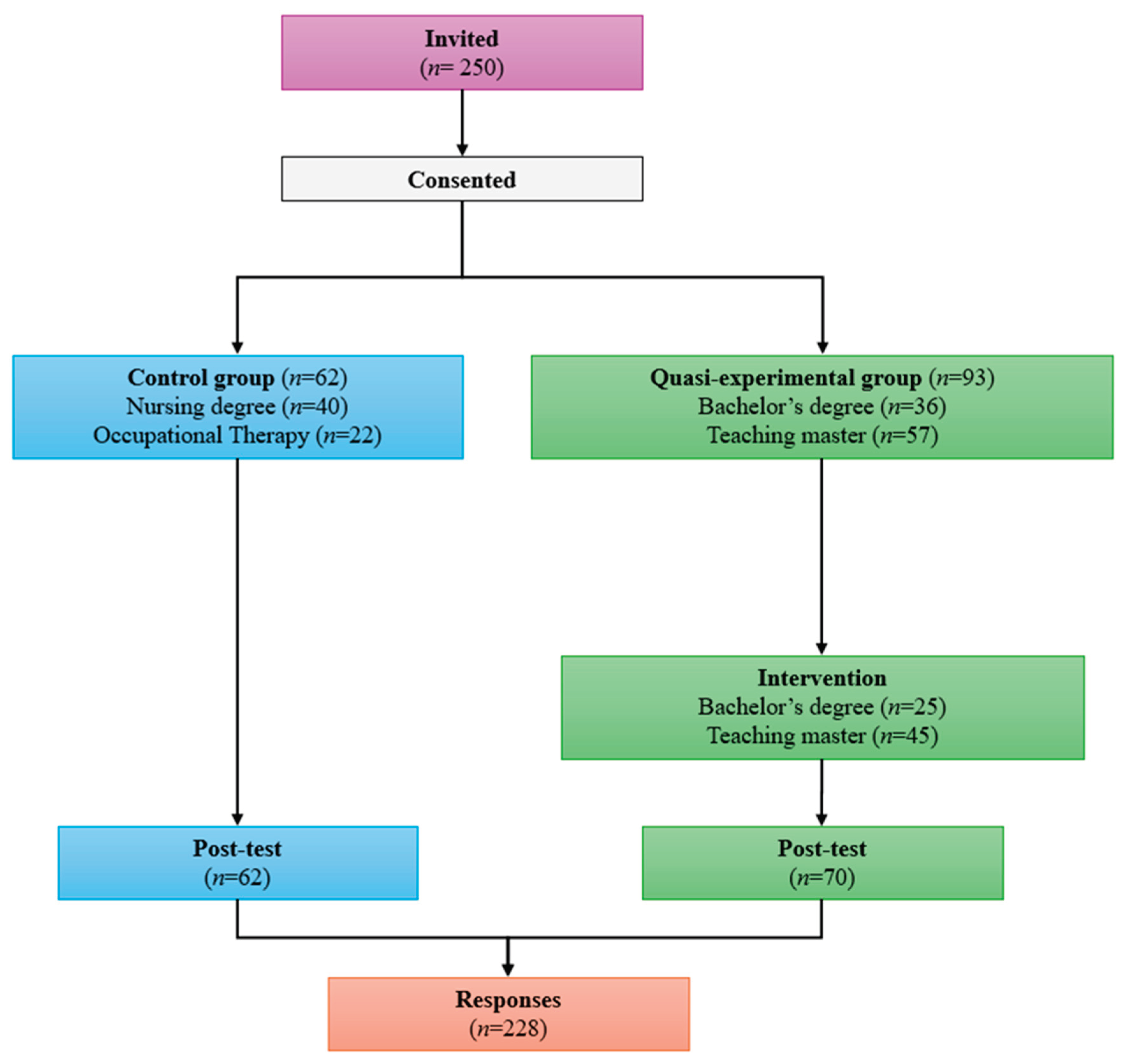

Table 1.
Sociodemographic characteristics of the study population.
| Variables | Total |
| Gender | |
| Woman | 156 (68.40%) |
| Man | 72 (31.60%) |
| Education | |
| Master's Degree in Teaching | 105 (46.10%) |
| Second Baccalaureate | 61 (26.75%) |
| Nursing Degree | 40 (17.50%) |
| Degree in Occupational Therapy | 22 (9.60%) |
| Previous experiences related to donation (Donor, health care provider, donor family members, transfused or health care provider and receiving transfusion) | |
| Donation history | 181 (79.40%) |
| No history | 47 (20.60%) |
| Blood group | |
| A | 66 (28.90%) |
| B | 20 (8.80%) |
| 0 | 48 (21.10%) |
| AB | 9 (3.90%) |
| I do not know | 85 (37.30%) |
| Total | 228 (100%) |
| Specialty of the Master's Degree in Teaching | |
| History | 12 (11.40%) |
| Language | 11 (10.50%) |
| English | 10 (9.50%) |
| Biology | 17 (16.20%) |
| Physics | 15 (14.30%) |
| Mathematics | 16 (15.20%) |
| Technology | 6 (5.70%) |
| Job training | 6 (5.70%) |
| Educational guidance | 10 (9.50%) |
| Socio-community intervention | 2 (1.90%) |
| Total | 105 (100%) |
Table 2.
Reliability of the BDKQ24-Spain.
| Item | M | DT | M1 | Var.2 | CI-T3 | α4 | ω5 | ||
| BDKQ1 | 1.36 | 0.48 | 47.91 | 71.07 | 0.35 | 0.86 | 0.86 | ||
| BDKQ2 | 2.32 | 0.80 | 46.96 | 66.04 | 0.58 | 0.86 | 0.85 | ||
| BDKQ3 | 1.13 | 0.46 | 48.14 | 71.53 | 0.31 | 0.86 | 0.86 | ||
| BDKQ4 | 2.13 | 0.43 | 47.14 | 71.38 | 0.36 | 0.86 | 0.85 | ||
| BDKQ5 | 2.17 | 0.53 | 47.10 | 69.70 | 0.48 | 0.86 | 0.85 | ||
| BDKQ6 | 2.07 | 0.58 | 47.20 | 69.55 | 0.44 | 0.86 | 0.86 | ||
| BDKQ7 | 2.23 | 0.57 | 47.04 | 69.25 | 0.49 | 0.86 | 0.85 | ||
| BDKQ8 | 1.79 | 0.80 | 47.48 | 67.26 | 0.48 | 0.86 | 0.86 | ||
| BDKQ9 | 1.79 | 0.84 | 47.48 | 67.38 | 0.44 | 0.86 | 0.85 | ||
| BDKQ10 | 2.04 | 0.81 | 47.23 | 67.60 | 0.45 | 0.86 | 0.85 | ||
| BDKQ11 | 1.98 | 0.81 | 47.29 | 66.50 | 0.53 | 0.86 | 0.85 | ||
| BDKQ12 | 2.02 | 0.26 | 47.25 | 72.94 | 0.26 | 0.87 | 0.86 | ||
| BDKQ13 | 2.11 | 0.68 | 47.16 | 67.97 | 0.51 | 0.86 | 0.85 | ||
| BDKQ14 | 1.59 | 0.66 | 47.68 | 70.92 | 0.25 | 0.86 | 0.85 | ||
| BDKQ15 | 1.98 | 0.85 | 47.29 | 65.24 | 0.60 | 0.86 | 0.85 | ||
| BDKQ16 | 2.17 | 0.40 | 47.10 | 70.77 | 0.48 | 0.86 | 0.85 | ||
| BDKQ17 | 1.48 | 0.81 | 47.80 | 66.54 | 0.53 | 0.86 | 0.85 | ||
| BDKQ18 | 2.16 | 0.46 | 47.12 | 70.18 | 0.49 | 0.86 | 0.84 | ||
| BDKQ19 | 3.00 | 0.69 | 46.27 | 70.359 | 0.29 | 0.87 | 0.85 | ||
| BDKQ20 | 3.31 | 1.250 | 45.96 | 62.293 | 0.52 | 0.86 | 0.85 | ||
| BDKQ21 | 1.87 | 1.256 | 47.40 | 60.929 | 0.60 | 0.86 | 0.85 | ||
| BDKQ22 | 1.81 | 0.58 | 47.46 | 73.884 | -0.01 | 0.87 | 0.84 | ||
| BDKQ23 | 1.39 | 0.76 | 47.88 | 66.201 | 0.60 | 0.86 | 0.85 | ||
| BDKQ24 | 3.39 | 0.71 | 45.88 | 68.701 | 0.43 | 0.86 | 0.86 | ||
1 M= scale mean (if item is removed). 2 Var.= variance of the scale (if the item is removed). 3 IQ-T= Item-total correlation. 4 α= Cronbach's Alpha (if item is removed). 5 ω = McDonald's Omega (if item is removed).
Table 3.
Item difficulty and discrimination indices of BDKQ24-Spain in the sample.
| Item | Item difficulty index | Interpretation | Item discrimination index | Interpretation | Interpretation |
| BDKQ1 | 0.64 | Average | 0.47 | Very good | Retain |
| BDKQ2 | 0.77 | Easy | 0.56 | Very good | Retain |
| BDKQ3 | 0.92 | Easy | 0.18 | Nondiscriminatory | Dismiss |
| BDKQ4 | 0.80 | Easy | 0.45 | Very good | Retain |
| BDKQ5 | 0.69 | Average | 0.71 | Very good | Retain |
| BDKQ6 | 0.66 | Average | 0.39 | Good | Retain |
| BDKQ7 | 0.63 | Average | 0.70 | Very good | Retain |
| BDKQ8 | 0.45 | Average | 0.29 | Good | Retain |
| BDKQ9 | 0.47 | Average | 0.56 | Very good | Retain |
| BDKQ10 | 0.35 | Average | 0.56 | Very good | Retain |
| BDKQ11 | 0.33 | Average | 0.71 | Very good | Retain |
| BDKQ12 | 0.93 | Easy | 0.15 | Nondiscriminatory | Dismiss |
| BDKQ13 | 0.53 | Average | 0.48 | Very good | Retain |
| BDKQ14 | 0.40 | Average | 0.63 | Very good | Retain |
| BDKQ15 | 0.38 | Average | 0.52 | Very good | Retain |
| BDKQ16 | 0.82 | Easy | 0.52 | Very good | Retain |
| BDKQ17 | 0.72 | Average | 0.55 | Very good | Retain |
| BDKQ18 | 0.76 | Easy | 0.26 | Good | Retain |
| BDKQ19 | 0.75 | Average | 0.51 | Very good | Retain |
| BDKQ20 | 0.46 | Average | 0.70 | Very good | Retain |
| BDKQ21 | 0.62 | Average | 0.56 | Very good | Retain |
| BDKQ22 | 0.63 | Average | 0.87 | Very good | Retain |
| BDKQ23 | 0.78 | Easy | 0.61 | Very good | Retain |
| BDKQ24 | 0.39 | Average | 0.42 | Very good | Retain |
Table 4.
Factor matrix of the final BDKQ22-Spain.
| Item | Factors | One factor | |
| 1 | 2 | ||
| BDKQ1 | 0.57 | 0.73 | |
| BDKQ2 | 0.45 | 0.46 | |
| BDKQ4 | 0.55 | 0.59 | |
| BDKQ5 | 0.79 | 0.33 | |
| BDKQ6 | 0.68 | 0.66 | |
| BDKQ7 | 0.64 | 0.44 | |
| BDKQ8 | 0.68 | 0.67 | |
| BDKQ9 | 0.60 | 0.66 | |
| BDKQ10 | 0.94 | 0.28 | |
| BDKQ11 | 0.74 | 0.43 | |
| BDKQ13 | 0.61 | 0.64 | |
| BDKQ14 | 0.75 | 0.51 | |
| BDKQ15 | 0.68 | 0.58 | |
| BDKQ16 | 0.48 | 0.52 | |
| BDKQ17 | 0.48 | 0.62 | |
| BDKQ18 | 0.53 | 0.20 | |
| BDKQ19 | 0.47 | 0.60 | |
| BDKQ20 | 0.57 | 0.50 | |
| BDKQ21 | 0.65 | 0.61 | |
| BDKQ22 | 0.54 | 0.24 | |
| BDKQ23 | 0.68 | 0.29 | |
| BDKQ24 | 0.41 | 0.84 | |
Table 5.
CFA fit indices in the BDKQ-22.
| Model | χ2 | df | CMIN/DF | CFI | IFI | TLI | RNI | SRMR | RMSEA | Δχ2 | Δdf |
| 1-Factor | 451.56 | 209 | 2.16 | 0.80 | 0.80 | 0.78 | 0.80 | 0.07 | 0.07 | ||
| 2-Factor | 355.88 | 188 | 1.89 | 0.86 | 0.86 | 0.84 | 0.86 | 0.06 | 0.06 | 1F - 2F = 95.68** | 21 |
** p ≤ 0.01.
Table 6.
Differences in BDKQ22-Spain score in relation to experimental group, research design, gender and previous donation experiences.
Table 6.
Differences in BDKQ22-Spain score in relation to experimental group, research design, gender and previous donation experiences.
| Variables | t | df | Sig. | Cohen'sd | ||
| d | 95% CI | |||||
| Experimental group, M(SD) | ||||||
| Quasi-experimental Group 12.67(5.64) n=166 |
Control Group 13.98(3.26) n=62 |
-2.18 |
226 |
0.03* |
0.28 |
-0.55, 0.04 |
| Experimental group Post-test, M(SD) | ||||||
| Quasi-experimental Group 17.23(2.74) n=73 |
Control Group 13.98(3.32) n=62 |
6.21 |
133 |
0.001** |
1.07 |
0.72, 1.44 |
| Experiment Pre/post-test design, M(SD) | ||||||
| Group Pretest 9.09(4.67) n=93 | Post-test Group 17.23(2.74) n=73 |
-13.22 |
164 |
0.001** |
2.13 |
-2.44, -1.69 |
| Previous study pretest, M(SD) | ||||||
| Master in Teaching 10.51(4.94) n=57 |
High School 6.83(3.14) n=36 |
3.98 |
91 |
0.001** |
0.89 |
0.41, 1.28 |
| Previous study post-test, M(SD) | ||||||
| Master in Teaching 17.85(2.42) n=48 |
High School 16.04(2.94) n=25 |
2.65 |
71 |
0.01* |
0.67 |
0.20, 1.18 |
| Gender, M(SD) | ||||||
| Woman 13.44(4.75) n=156 |
Man 12.13(5.82)n=72 |
-1.81 |
226 |
0.07 |
0.25 |
-0.54, 0.02 |
| Experiences with donation, M(SD) | ||||||
| Background 13.46(4.99) n=181 |
No previous history 11.36(5.41) n=47 |
2.52 |
226 |
0.01* |
0.40 |
0.09, 0.74 |
* p<.05 and ** p<.001.
Table 7.
Differences in BDKQ22-Spain scores according to previous study, Master's speciality and blood group.
Table 7.
Differences in BDKQ22-Spain scores according to previous study, Master's speciality and blood group.
| Variables | F | df | Sig. | ηp2 | |||||||||||||||
| Previous study,M(SD) | |||||||||||||||||||
|
Master in Teachinga 13.87(5.41)b n=105 |
High Schoolb 10.61(5.48)a,d n=61 |
Nursingc 15.55(2.05) b,d n=40 |
Occupational Therapyd 11.14(3.15)c n=22 |
10.9 | 3, 228 |
0.001** | 0.13 | ||||||||||||
| Previous study postest, M(SD) | |||||||||||||||||||
| Master in Teachinga 17.85 (2.43)b,c,d n=48 |
High Schoolb 16.04 (2.94)a,d n=25 |
Nursingc 15.55 (2.05)a,d n=40 |
Occupational Therapyd 11.14 (3.15)a,b,c n=22 |
34.8 | 3, 135 |
0.001** | 0.44 | ||||||||||||
| Speciality of the Master's Degree in Teaching, M(SD) | |||||||||||||||||||
| Historya 9.58 (6.71)d n=12 |
Spanishb 12.45 (5.47) n=11 |
Englishc 12.7 (5.98) n=10 |
Biologyd 16.82 (2.63)a n=17 |
Physicse 14.53 (4.41) n=15 |
Mathsf 13.75 (5.60) n=16 |
Technologyg 11.83 (6.82) n=6 |
Vocational trainingg 14.33(5.78) n=6 |
Counselinge 16.80 (3.91) n=10 |
Interventione 14 (4.24) n=2 |
2.19 | 9, 105 |
0.029* | 0.17 | ||||||
| Blood group, M(SD) | |||||||||||||||||||
| Aa 14.26 (4.31)e n=66 |
Bb 14.95 (4.21)e n=20 |
Oc 14.21 (4.33)e n=48 |
ABd 16.33 (3.87)e n=9 |
Not knowing blood groupe 10.43 (5.53)a,b,c,d n=83 |
9.82 | 4, 226 |
0.001** | 0.15 | |||||||||||
* p <.05 and ** p<.001.
Disclaimer/Publisher’s Note: The statements, opinions and data contained in all publications are solely those of the individual author(s) and contributor(s) and not of MDPI and/or the editor(s). MDPI and/or the editor(s) disclaim responsibility for any injury to people or property resulting from any ideas, methods, instructions or products referred to in the content. |
© 2026 by the authors. Licensee MDPI, Basel, Switzerland. This article is an open access article distributed under the terms and conditions of the Creative Commons Attribution (CC BY) license (http://creativecommons.org/licenses/by/4.0/).
Copyright: This open access article is published under a Creative Commons CC BY 4.0 license, which permit the free download, distribution, and reuse, provided that the author and preprint are cited in any reuse.