

Submitted:
17 March 2026
Posted:
23 March 2026
You are already at the latest version
Abstract
Background: Traditional Chinese Medicine (TCM) heat is clinically important but cannot be reduced to a thermometer reading or a single biomedical pathway. Attempts to translate heat directly into “sympathetic discharge” risk both overstatement and loss of syndrome differentiation.Objective: To examine whether selected, rigorously differentiated heat-pattern presentations may involve a measurable autonomic layer, with emphasis on body acupuncture, auricular acupressure, and selected warm modalities.Evidence considered: This focused narrative review synthesizes literature on heart rate variability (HRV) and related autonomic measures in acupuncture research, neuroanatomical and clinical literature on auricular stimulation, and selected studies on heat or moxibustion relevant to conditional warm-modality use.Synthesis: The strongest empirical support lies in body acupuncture studies showing parasympathetic shift on HRV and related autonomic measures, while the clearest anatomy-linked test case lies in auricular stimulation because the auricle includes vagally innervated territory. Evidence for warm modalities is more conditional and is most relevant to mixed, constrained, or deficiency-associated presentations rather than heat as a whole.Conclusions and clinical implications: Selected, rigorously differentiated heat-pattern subgroups may involve autonomic dysregulation, including features compatible with heightened autonomic arousal and reduced parasympathetic recovery. This adjunct autonomic layer may help structure mechanism-oriented documentation, clinical observation, and future research.
Keywords:
traditional Chinese medicine
; heat syndrome
; shanghuo
; acupuncture
; auricular acupressure
; ear seeds
; autonomic nervous system
; parasympathetic regulation
; heart rate variability
; moxibustion
1. Introduction
Heat is among the most common and recognizable pattern labels in East Asian medicine, yet it remains difficult to translate into modern physiology without flattening the classical framework. In conventional TCM usage, heat refers to a pattern of speed, redness, irritability, upward movement, dryness, inflammatory quality, and disturbed regulation rather than a literal tissue temperature alone [1,10,13,16]. It may arise in excess or deficiency forms and may appear in organ, channel, emotional, external, or mixed presentations [10,11,13,16].
A modern bridge is still worthwhile because clinicians often recognize a recurring cluster within heat presentations that includes agitation, sleep disruption, palpitations, rapid pulse, upper-body congestion, dryness, bowel irregularity, and stress-linked worsening. Those features overlap with autonomic dysregulation, especially heightened autonomic arousal, reduced parasympathetic recovery, or impaired regulatory flexibility, but they do not justify a simple identity claim that “heat equals sympathetic discharge” [1,10,11,12].
The article therefore advances a deliberately narrow translational claim. It asks whether autonomic dysregulation may represent one measurable physiological layer in selected, rigorously differentiated heat-pattern presentations, especially those marked by agitation, sleep disruption, palpitations, rapid pulse, upper-body congestion, breath irregularity, stress reactivity, or bowel disturbance.
2. Review Approach
This article was prepared as a focused narrative review with a translational practice-and-research perspective. Literature was assembled through targeted searching of biomedical databases and citation trails, with primary emphasis on PubMed/MEDLINE, Scopus, and Google Scholar. Search terms were combined around acupuncture, auricular stimulation, ear seeds, heart rate variability, autonomic regulation, parasympathetic activity, moxibustion, warmth, and selected Traditional Chinese Medicine heat-pattern subgroups or presentations. Searches were conducted through March 2026. No formal systematic-review workflow or exhaustive date restriction was applied; instead, priority was given to English-language human studies, mechanistic reviews, and clinically relevant acupuncture literature most applicable to heat-pattern differentiation and autonomic interpretation, while classical TCM sources were used selectively to preserve syndrome-differentiation boundaries. The evidence is therefore synthesized interpretively to support a focused translational review argument rather than a systematic evidence map.
3. Scope of the Review and Evidence Hierarchy
The central translational claim is intentionally modest: selected, rigorously differentiated heat-pattern subgroups in TCM may be associated with autonomic dysregulation, including heightened autonomic arousal, reduced parasympathetic recovery, or impaired regulatory flexibility. This autonomic layer is adjunctive, the bridge is selective rather than universal, and autonomic findings should be interpreted within standard syndrome differentiation.
Most compatible presentations include constraint transforming into heat, heart- or shen-disturbance heat patterns with insomnia or palpitations, and mixed excess-heat states with marked agitation, rapid pulse, upward disturbance, or stress-linked fluctuation. Less compatible presentations include yin-deficiency heat without clear hyperarousal, toxic heat, blood-level heat, and fluid-injury dominant presentations. The bridge is therefore best treated as a selective translational model rather than a single explanation for all heat categories in TCM.
Conventional TCM patterning remains primary in this model. The autonomic layer is proposed only as a measurable physiological stratum within selected presentations, not as a replacement for tongue, pulse, channel pattern, fluid status, or broader syndrome differentiation.
Evidence for this bridge is not uniform across modalities. Body acupuncture currently provides the strongest overall empirical support because heart rate variability studies and meta-analyses repeatedly report a shift toward parasympathetic regulation after treatment [2,3]. Auricular methods provide the clearest anatomy-linked test case because the external ear includes vagal territory and because recent auricular acupressure and ear-seed studies have reported autonomic effects on heart rate variability and related outcomes [4,5,6,7,17]. Warm modalities are retained only as a restricted boundary-condition domain because their relevance is greatest in mixed, constrained, or deficiency-associated presentations rather than heat as a whole.
This hierarchy shapes the organization of the article. The discussion begins with the broadest clinical-autonomic evidence for body acupuncture, moves to the most direct anatomical bridge in auricular stimulation, and then addresses the apparent paradox of warm practice.
Herbal medicine remains central to clinical heat management in TCM, but it is not the focus here because the present article aims to test the narrowest mechanistic bridge with the clearest near-term physiological readouts.
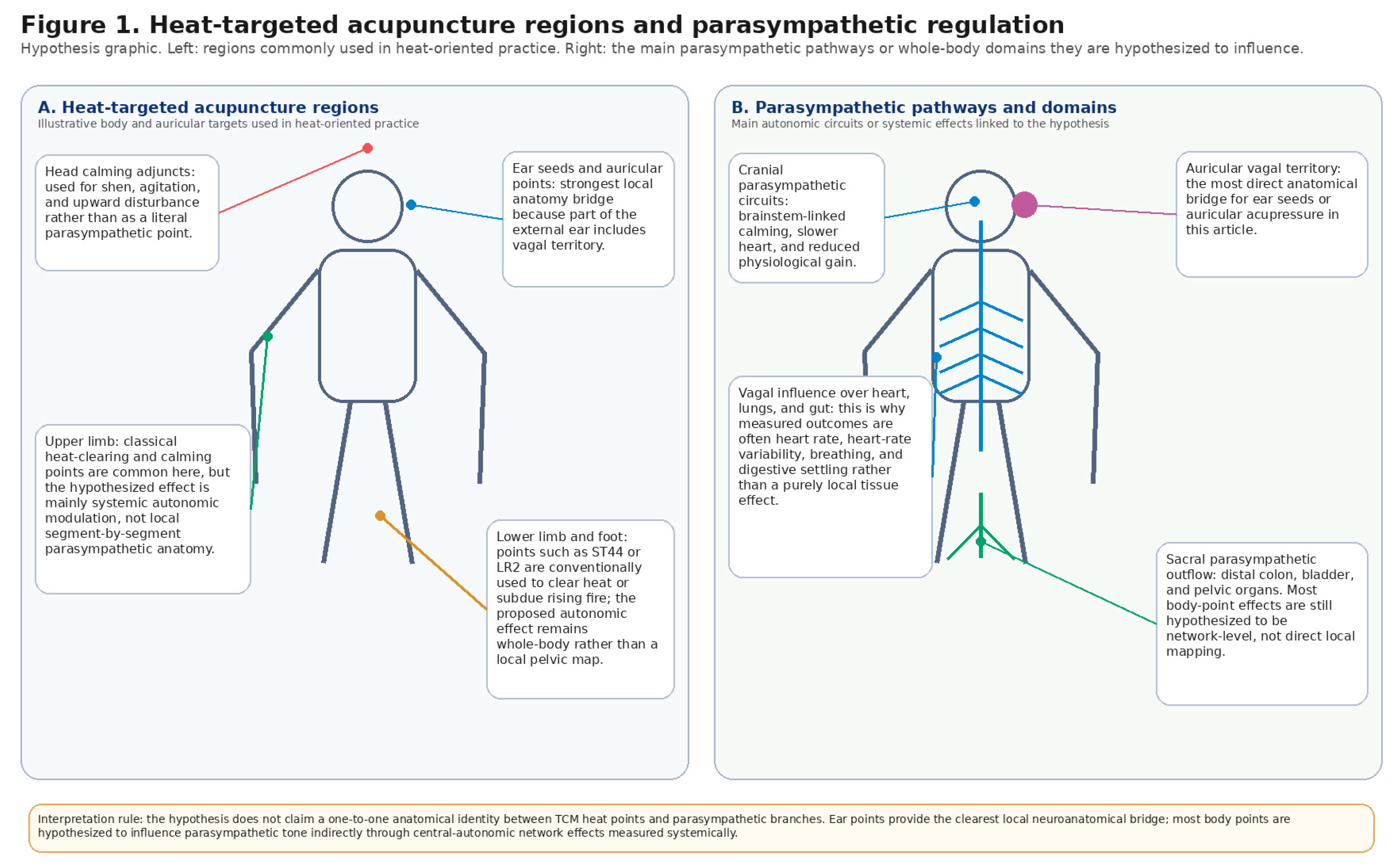
Figure 1 illustrates the conceptual bridge between heat-targeted acupuncture regions and parasympathetic regulation.
Illustrative figure only. The left panel shows body regions or auricular targets commonly used in heat-oriented practice; the right panel shows the principal parasympathetic pathways or whole-body domains they are hypothesized to influence. The figure does not claim a one-to-one anatomical identity between TCM point functions and parasympathetic branches.
4. Evidence Domain I: Body Acupuncture and Systemic Autonomic Regulation
The strongest general evidence for the proposed bridge comes from heart rate variability research. HRV is used here as a practical window onto autonomic regulation rather than a complete account of it. In a systematic review and meta-analysis, Hamvas et al. found that real acupuncture tended to increase parasympathetic tone and improve HRV indices relative to baseline or control conditions. Earlier reviews likewise reported autonomic effects while also emphasizing heterogeneity in diagnosis, protocol, and readout.
This evidence matters for heat-oriented practice because many heat presentations include signs that, in biomedical terms, may reflect heightened autonomic arousal: tachycardia, irritability, insomnia, chest or head congestion, hypervigilance, and impaired digestive settling. Most acupuncture HRV trials, however, were not designed around rigorously defined heat-pattern subgroups, so the translational step remains indirect rather than heat-specific. Even so, when acupuncture downshifts autonomic arousal in such presentations, part of its clinical effect may be visible as improved parasympathetic recovery, even while the traditional rationale remains 'clear heat,' 'calm shen,' 'descend yang,' or 'harmonize the qi dynamic' [13,14,15,16].
Conventional TCM references therefore remain essential. Standard point-function texts describe heat-oriented prescriptions in terms of channel excess, organ heat, fire, agitation, or upward disturbance rather than autonomic language [14,15]. The present model simply proposes that part of the measurable downstream response in some cases may be autonomic. It is a translational bridge, not a relabeling of classical doctrine.
5. Evidence Domain II: Auricular Acupressure and Ear Seeds as the Clearest Anatomy-Linked Test Case
Auricular methods provide the clearest anatomy-linked test case for the review rather than the strongest proof of the whole model. They are useful because the auricle includes territory innervated by the auricular branch of the vagus nerve, but this anatomy-linked advantage should not be confused with a one-to-one replacement for classical channel doctrine.
Clinical and pilot studies strengthen this argument. Auricular acupressure and ear-seed protocols targeting points such as the sympathetic point or Point Zero have been associated with changes in heart rate variability consistent with greater vagal tone or autonomic rebalancing [5,6]. Meta-analytic review of auricular stimulation has also reported cardiovascular and autonomic effects, though study quality remains variable [7]. Among the modalities considered in this paper, auricular stimulation therefore offers the most direct anatomical explanation for why an intervention used in TCM-style practice might alter parasympathetic regulation.
This section is also where conventional TCM and modern anatomy must be handled carefully. Modern auricular maps are partly systematized in contemporary practice rather than simply reproduced from the earliest classics [17]. A publishable bridge therefore avoids stronger claims than the evidence allows. The prudent formulation is that auricular acupressure and ear seeds are especially suitable for testing the heat–autonomic hypothesis because they combine a recognizable TCM intervention with a relatively clear anatomical route into autonomic circuitry.
6. Evidence Domain III: Warm Modalities and the Conditional Role of Warmth in Heat-Oriented Care
Warm modalities are the most conditional part of the review. Their inclusion here is not as standard therapy for heat, but as a boundary-testing category for mixed or deficiency-associated presentations in which warmth may reduce tension without aggravating classical heat signs. If some heat presentations overlap with arousal or inflammatory excess, why might warmth ever help? The most defensible answer is narrow: some clinically heat-marked states are mixed, constrained, or deficiency-associated rather than purely exuberant.
This domain is best treated as a boundary condition rather than as a parallel evidence stream. Classical and modern TCM sources do not present moxibustion as a generic treatment for heat states, and the evidence considered here is clearly thinner than for body acupuncture or auricular methods. In this review, warmth is relevant only when used selectively in mixed, constrained, or deficiency-associated presentations and only when it reduces tension or autonomic overactivation without aggravating classical heat signs.
Warm modalities therefore remain useful mainly because they define the limits of the bridge. Improvement accompanied by reduced autonomic arousal can remain compatible with the model in carefully differentiated cases; consistent aggravation of classical heat signs or autonomic markers would instead favor a narrower translational interpretation.
7. Translational Framework for Practice and Research
The framework that emerges from this review is layered and sequence-sensitive. First, the patient is differentiated conventionally according to TCM pattern logic, including the distinction between excess heat, deficiency heat, mixed cold-heat, constraint transforming into heat, channel heat, and shen disturbance [10,13,14,15,16]. Second, within the diagnosed heat-pattern subgroup, the clinician asks whether the presentation also shows signs consistent with autonomic dysregulation, such as agitation, rapid pulse, palpitations, sleep disruption, breath-holding or sighing, bowel irregularity, upper-body flushing or pressure, and stress-linked fluctuation. Third, treatment is chosen conventionally but interpreted through a modern adjunct lens: body acupuncture offers the broadest evidence for systemic autonomic shift; auricular methods offer the clearest testable vagal bridge; warm modalities remain a restricted option for mixed, constrained, or deficiency-associated presentations in which warmth reduces rather than intensifies activation or tension.
In this framework, autonomic physiology is an optional measurement layer that may clarify part of treatment response. Herbal medicine remains central to TCM treatment of heat in practice. It is treated as secondary in this article not because of lesser clinical importance, but because its mechanisms are more heterogeneous and less suited to a narrow first-pass autonomic bridge.

Table 1.
Translational framework for interpreting selected heat-oriented interventions in autonomic research.
Table 1.
Translational framework for interpreting selected heat-oriented interventions in autonomic research.
| Domain | What the evidence most strongly supports | What remains uncertain | Research/practice implication |
|---|---|---|---|
| Body acupuncture | Best overall clinical evidence for parasympathetic shift on heart rate variability measures [2,3]. | Most studies are not designed around rigorously defined TCM heat subtypes. | Use autonomic outcomes as adjunct markers when treating heat-pattern presentations. |
| Auricular acupressure / ear seeds | Best local neuroanatomical bridge because the auricle includes vagal territory, with supportive clinical HRV findings [4,5,6,7,17]. | Auricular maps are partly modern systematizations, and trial quality is mixed. | Prioritize auricular methods in prospective tests of the heat–autonomic bridge. |
| Warm modalities | Conditional support when warmth reduces tension or autonomic arousal [8,9]. | Not appropriate as a universal intervention for exuberant heat; classical indications remain pattern-specific [15,18]. | Use selectively and document whether warmth objectively calms or aggravates the pattern. |
Table 2.
Heat-pattern subgroup guide for clinical interpretation and future study design.
| Pattern presentation | Typical clinical features | Possible autonomic layer | Most relevant modality | Important caution |
|---|---|---|---|---|
| Constraint transforming into heat | Irritability, chest tension, stress-linked fluctuation, upward agitation | Autonomic arousal with reduced flexibility | Body acupuncture; adjunct auricular support | Do not interpret autonomic findings apart from constraint patterning. |
| Heart/Shen-disturbance heat | Insomnia, palpitations, restlessness, rapid pulse | Autonomic arousal with poor recovery | Body acupuncture plus auricular protocols | Differentiate from deficiency or non-heat insomnia patterns. |
| Mixed excess-heat states | Upper-body congestion, agitation, bowel irregularity, stress-reactive worsening | Elevated autonomic activation with variable recovery | Body acupuncture first-line | Exclude dominant toxic, infectious, or non-TCM drivers. |
| Mixed/deficiency-associated heat | Heat signs with depletion, guarding, or cold-overlay features | May be indirect or secondary | Selected warm modalities in carefully chosen cases | Do not generalize warmth to exuberant heat states. |
8. Research Implications and Ways to Test the Model
Because this is a focused translational review, the model should remain open to refinement or narrowing as evidence accumulates. Future studies could clarify whether rigorously differentiated heat-pattern groups show enrichment for autonomic signatures compared with non-heat comparison groups, whether heat-oriented acupuncture yields consistent parasympathetic shifts versus credible controls, and whether auricular heat-oriented protocols alter autonomic markers in line with their stronger anatomical rationale [2,3,4,5,6,7].
The translational interpretation would be better supported if prospective studies combine conventional TCM diagnosis with predefined autonomic outcomes such as pulse rate, respiratory rate, sleep metrics, bowel regularity, or heart rate variability [2,3,10]. If clinically helpful warm modalities repeatedly show no reproducible autonomic change, the bridge would likely need further narrowing and other dominant mechanisms should be considered, such as tissue mechanics, local circulation, inflammatory chemistry, or expectation effects.
A practical research design would therefore begin with explicit syndrome differentiation, prespecified heat subtypes, and intervention protocols reported according to accepted acupuncture standards. HRV may serve as one practical autonomic proxy, but it should be paired with other outcomes such as resting heart rate, respiratory rhythm, sleep measures, bowel pattern, and symptom-triggered stress reactivity in order to avoid over-reliance on a single index.
A simple staged pathway follows from this proposal: Stage 1, prospectively differentiate heat-pattern subtypes before intervention; Stage 2, collect simple autonomic markers such as HRV and related measures, resting heart rate, sleep, and symptom-linked stress reactivity before and after treatment; Stage 3, compare body acupuncture, auricular protocols, and selected warm interventions across predefined subtypes using transparent reporting standards.
9. Clinical Implications for Acupuncture Practice
For practicing acupuncturists, the principal value of this framework is to sharpen observation and documentation alongside standard syndrome differentiation. When a patient presents with an agitation-dominant or stress-reactive heat subgroup, the clinician may reasonably infer that autonomic dysregulation could be contributing to the presentation and may choose points or adjunct auricular methods that align with both the TCM pattern and a calming autonomic strategy.
A second practical implication is to track simple autonomic outcomes as adjunct indicators of response when that autonomic layer appears clinically relevant. Pulse rate, sleep quality, palpitations, subjective agitation, and—when available—HRV trends may be followed before and after treatment, not as substitutes for TCM diagnosis, but as additional documentation that helps the clinician see whether a heat-oriented intervention is also calming the physiological arousal state.
A third implication concerns modality choice. Body acupuncture remains the broadest evidence-based option for autonomic modulation; auricular acupressure or ear seeds may be especially useful when a low-intensity, sustained, or testable autonomic adjunct is desired; warm practice should be reserved for carefully differentiated cases in which warmth clearly reduces tension or constraint rather than intensifying classical heat signs [4,5,6,7,8,9,15]. Framed this way, the model gives acupuncturists a practical translational vocabulary.
10. Limitations
The evidence base remains uneven. Acupuncture and auricular studies vary in sham design, point selection, stimulation intensity, follow-up duration, and outcome reporting. HRV is the most practical recurring marker in the current literature, but it does not by itself capture the full complexity of autonomic regulation; related measures should therefore be interpreted alongside clinical and physiological context.
There is also a conceptual limit. Even if autonomic signatures are reproducibly linked to some heat-pattern subgroups, that would not justify reducing TCM heat to a biomedical surrogate variable. Heat remains a pattern construct that includes tongue, pulse, symptom texture, temporal behavior, and differential context. The present review therefore supports only a focused translational bridge linking selected, rigorously differentiated heat-pattern subgroups with selected autonomic correlates.
11. Conclusions
A clinically useful conclusion from this review is that selected, rigorously differentiated heat-pattern subgroups may include an autonomic component reflected in heightened autonomic arousal, reduced parasympathetic recovery, or impaired regulatory flexibility.
Within that formulation, body acupuncture currently offers the strongest broad clinical evidence for systemic autonomic shift, auricular methods provide the clearest anatomy-linked test case for prospective work, and warm modalities remain conditional and pattern-dependent rather than universally indicated for heat.
Funding
None.
Ethics approval and consent to participate
Not applicable. This article is a focused narrative review and translational perspective and reports no human participants, animal experiments, or identifiable patient data.
Consent for publication
Not applicable.
Data availability
No new data were generated or analyzed in support of this review.
Competing interests
The author declares no competing interests.
Author contributions
MM AbdAlhamid conceived the article, developed the hypothesis and integrative framework, performed the literature synthesis, and wrote and revised the manuscript.
Declaration of generative AI
During preparation of this manuscript, the author used ChatGPT (OpenAI) for language editing, structural refinement, and formatting assistance. All scientific interpretation, argumentation, source selection, and final editorial decisions were made by the author, who takes full responsibility for the manuscript. This statement may be retained in the manuscript or moved to the journal submission form, according to journal policy.
References
- Pan, MH; Gao, XF; Wang, S; et al. “Shanghuo” increases disease susceptibility: modern significance of an old TCM theory. J Ethnopharmacol. 2020, 250, 112491. [Google Scholar] [CrossRef] [PubMed]
- Hamvas, S; Juhasz, B; Csabai, M; et al. Acupuncture increases parasympathetic tone, modulating heart rate variability: systematic review and meta-analysis. Complement Ther Clin Pract. 2023, 50, 101693. [Google Scholar] [CrossRef]
- Chung, JWY; Yan, VCM; Zhang, H. Effect of acupuncture on heart rate variability: a systematic review. Evid Based Complement Alternat Med. 2014, 2014, 819871. [Google Scholar] [CrossRef] [PubMed]
- He, W; Wang, X; Shi, H; et al. Auricular acupuncture and vagal regulation. Evid Based Complement Alternat Med. 2012, 2012, 786839. [Google Scholar] [CrossRef] [PubMed]
- Trinh, DTT; Nguyen, DQ; Nguyen, HQ; et al. Heart rate variability during auricular acupressure at the left sympathetic point in healthy volunteers: a pilot study. Front Neurosci. 2023, 17, 1270395. [Google Scholar] [CrossRef] [PubMed]
- Trinh, DTT; Nguyen, DQ; Nguyen, HQ; et al. Enhancing vagal tone and modulating heart rate variability with auricular acupressure at Point Zero: a randomized controlled trial. Med Acupunct. 2024, 36(4), 245–254. [Google Scholar] [CrossRef] [PubMed]
- Hua, K; Dias, A; Tobaldini, E; et al. Cardiovascular effects of auricular stimulation: a systematic review and meta-analysis of randomized controlled trials. Front Neurosci. 2023, 17, 1277538. [Google Scholar] [CrossRef] [PubMed]
- Lee, YH; Park, BN; Kim, SH. The effects of heat and massage application on autonomic nervous system. Yonsei Med J. 2011, 52(6), 982–989. [Google Scholar] [CrossRef] [PubMed]
- Nakahara, H; Kawai, E; Miyamoto, T. Acute effects of regional heat stimulation by indirect moxibustion on cardiovascular responses. J Physiol Sci. 2022, 72(1), 30. [Google Scholar] [CrossRef] [PubMed]
- Jiang, M; Lu, C; Zhang, C; et al. Syndrome differentiation in modern research of traditional Chinese medicine. J Ethnopharmacol. 2012, 140(3), 634–642. [Google Scholar] [CrossRef] [PubMed]
- Jiang, TT; Wang, MJ; Li, ZY; et al. Review on the systems biology research of yin-deficiency-heat syndrome in traditional Chinese medicine. Anat Rec. 2020, 303(9), 2252–2260. [Google Scholar] [CrossRef] [PubMed]
- Kim, Y; Lee, JY; Lee, J; Lee, S. A modern interpretation of cold-heat pattern in traditional medicine with a focus on thermo-regulation. Perspect Integr Med. 2024, 3(1), 18–28. [Google Scholar] [CrossRef]
- World Health Organization. WHO International Standard Terminologies on Traditional Medicine in the Western Pacific Region; WHO Regional Office for the Western Pacific: Manila, 2007. [Google Scholar]
- World Health Organization. WHO Standard Acupuncture Point Locations in the Western Pacific Region; WHO Regional Office for the Western Pacific: Manila, 2008. [Google Scholar]
- Chinese Acupuncture and Moxibustion; Cheng, X, Ed.; Foreign Languages Press: Beijing, 2010. [Google Scholar]
- Unschuld, PU. Huang Di Nei Jing Su Wen: Nature, Knowledge, Imagery in an Ancient Chinese Medical Text; University of California Press: Berkeley, 2003. [Google Scholar]
- Hou, PW; Hsu, HC; Lin, YW; et al. Auricular therapy: history, mechanism, and clinical application. Evid Based Complement Alternat Med. 2015, 2015, 495684. [Google Scholar] [CrossRef] [PubMed]
- Huang, C; Li, M; Chen, C; et al. Moxibustion in early Chinese medicine and its relation to the origin of meridians: a study on unearthed literatures. Evid Based Complement Alternat Med. 2017, 2017, 8242136. [Google Scholar] [CrossRef] [PubMed]
Figure 1.
Conceptual bridge between heat-targeted acupuncture regions and parasympathetic regulation. Panel A summarizes body regions commonly used in selected heat-oriented acupuncture practice and their plausibly relevant autonomic pathways. Panel B highlights the auricle as the clearest anatomy-linked test case because vagal territory is present on the ear, while noting that auricular maps remain partly modern clinical systematizations. The figure is illustrative and not an anatomy scale map.
Figure 1.
Conceptual bridge between heat-targeted acupuncture regions and parasympathetic regulation. Panel A summarizes body regions commonly used in selected heat-oriented acupuncture practice and their plausibly relevant autonomic pathways. Panel B highlights the auricle as the clearest anatomy-linked test case because vagal territory is present on the ear, while noting that auricular maps remain partly modern clinical systematizations. The figure is illustrative and not an anatomy scale map.
Disclaimer/Publisher’s Note: The statements, opinions and data contained in all publications are solely those of the individual author(s) and contributor(s) and not of MDPI and/or the editor(s). MDPI and/or the editor(s) disclaim responsibility for any injury to people or property resulting from any ideas, methods, instructions or products referred to in the content. |
© 2026 by the authors. Licensee MDPI, Basel, Switzerland. This article is an open access article distributed under the terms and conditions of the Creative Commons Attribution (CC BY) license (http://creativecommons.org/licenses/by/4.0/).
Copyright: This open access article is published under a Creative Commons CC BY 4.0 license, which permit the free download, distribution, and reuse, provided that the author and preprint are cited in any reuse.