

Submitted:
17 March 2026
Posted:
18 March 2026
You are already at the latest version
Abstract
Employee well-being has become a central concern in organizational research due to its strong implications for performance, job satisfaction, and organizational sustainability (Bakker & Demerouti, 2007; Schaufeli & Taris, 2014). In high-pressure sectors such as banking and microfinance, managers operate under strict regulatory requirements, demanding performance targets, and continuous monitoring, which may significantly affect their psychological well-being (Giorgi et al., 2017; Lee & Kim, 2023). Managerial well-being is particularly important because managers are responsible not only for achieving organizational objectives but also for supervising employees and maintaining operational stability. These challenges are especially relevant in emerging financial systems such as Albania’s, where the financial sector is largely lending-oriented and dominated by commercial banks, with microfinance institutions playing a complementary role in expanding access to finance (Bank of Albania, 2025; World Bank, 2020). Managers in these institutions face pressures related to regulatory compliance, performance expectations, and the responsibility of supporting credit access for households and SMEs. This study investigates the determinants of managers’ well-being in Albanian lending institutions using the Job Demands–Resources (JD-R) model (Bakker & Demerouti, 2007). It examines how job demands (e.g., workload, performance pressure), job resources (e.g., organizational support, autonomy), and work–family conflict influence managerial well-being. The study also explores whether significant differences in well-being exist across demographic characteristics such as gender, age, type of institution, position, years of service, and number of supervised employees.
Keywords:
managers’ well-being
; Job Demands–Resources (JD-R) model
; organizational support
; job autonomy
; work–family conflict
; banking sector
; microfinance institutions
; Albania
1. Introduction
Employee well-being has increasingly become a central concern in organizational and management research due to its strong implications for employee performance, job satisfaction, and organizational sustainability (Bakker & Demerouti, 2007; Schaufeli & Taris, 2014). In high-pressure sectors such as banking and microfinance, managers frequently operate under strict regulatory requirements, demanding performance targets, and continuous monitoring, which may significantly influence their psychological well-being (Giorgi et al., 2017; Lee & Kim, 2023). The well-being of managers is particularly important because they are responsible not only for achieving organizational goals but also for supervising employees and maintaining operational stability within financial institutions.
These challenges are particularly relevant in emerging financial systems such as Albania’s, where the financial sector remains highly lending-oriented and dominated by commercial banks, while microfinance institutions play an important complementary role in providing access to finance for underserved segments of the population (Bank of Albania Supervision Annual Report 2024, 2025; World Bank, 2020). Managers in these institutions face significant professional pressures stemming from regulatory compliance, institutional performance expectations, and the responsibility of ensuring credit access for households and small and medium-sized enterprises (Konomi, 2025; Dushku, 2025). Such conditions may intensify job demands and increase the risk of work-related stress, making the study of managerial well-being particularly relevant in the context of the Albanian lending sector.
This study examines the determinants of managers’ well-being in Albanian lending institutions using the Job Demands–Resources (JD-R) model as its theoretical framework (Bakker & Demerouti, 2007; Demerouti et al., 2001). The model suggests that job demands, such as workload and performance pressure, may negatively affect well-being, while job resources, including organizational support and job autonomy, can enhance employees’ ability to cope with work-related stress and improve psychological outcomes (Humphrey et al., 2007; Kurtessis et al., 2017). In addition, work–family conflict is considered a key factor influencing managerial well-being in demanding professional environments (Awwad et al., 2022; French et al., 2018). In this context, the study addresses the following research questions:
• What are the potential determinants impacting managers’ well-being?
• Are there any significant differences in managers’ well-being based on demographic factors, such as gender, age, type of institution, current position, years of service, and number of employees?
2. Literature Review
2.1. Determinants of Managers’ Well-Being in Financial Institutions
Employee and managerial well-being has become a critical issue in financial services, particularly in environments characterized by high performance pressure, strict monitoring, and strong social responsibility (Giorgi et al., 2017; Lee & Kim, 2023). Well-being has usually been conceptualized as a multidimensional construct encompassing psychological functioning, vitality, job satisfaction, as well as the absence of continuous stress and burnout (Boriçi Begani et al., 2024). According to Ryff & Keyes, 1995, it represents the optimal psychological state of a person, enabling him/her to reach his/her full potential. Well-being is frequently modeled according to occupational stress frameworks, such as the Job Demands–Resources (JD-R) model (Bakker & Demerouti, 2007, p. 160; Demerouti et al., 2001). In organizational research, it is increasingly being treated not only as an individual outcome but also as a determinant of performance, retention, and organizational sustainability (Bakker & Demerouti, 2007; Schaufeli & Taris, 2014).
Within microfinance institutions (MFIs), the well-being of managers and frontline staff is especially significant, due to the dual mission of financial performance and social outreach. Microfinance roles often involve intense workload, performance expectations, and close monitoring; while serving financially weak clients, conditions linked with emotional anxiety and ethical tension (Czura et al., 2022). Although much of the microfinance employment literature focuses on loan officers, these typical stressors are valuable tool for the case of high-level managers, who are responsible for branch outcomes and staff supervision (Czura et al., 2022). Similar dynamics are present as well within banking institutions. Their employees and managers operate most of the time under strong supervision, committed to performance-driven systems based on sales or budget targets, compliance requirements, and continuous evaluation, conditions causing elevated occupational stress, anxiety, depression symptoms, and burnout among them (Dursun & Aytac, 2014; Giorgi et al., 2017; Vinod & Ambatipudi, 2024)
2.1.1. Job Demands, Workload, and Performance Pressure
Job demands refer to aspects of work that require persistent physical or psychological effort and are therefore associated with physiological and psychological costs (Bakker & Demerouti, 2007; Demerouti et al., 2001). In financial and microfinance contexts, workload intensity and performance pressure are among the most prominent job demands. The banking and finance sector is recognized as a high-stress occupation where high workload and financial responsibilities lead directly to burnout and emotional exhaustion (Giorgi et al., 2017; Vinod & Ambatipudi, 2024). Evidence from this sector shows that high stress and burnout are common and associated with demanding work conditions (Vinod & Ambatipudi, 2024). Managers and officers who work more than eight hours a day have significantly higher chances of getting burnout compared to those with shorter working hours. Furthermore, excessive job demands, such as quantitative workload, requiring continuous effort, act as a major energy drain, directly impacting the physiological and psychological state of employees (Khan et al., 2020; Schaufeli & Taris, 2014). The transition to remote work, or the management of debt moratoria during the pandemic crisis, was found too to significantly impact the level of workload and perceived stress among loan officers in microfinance institutions in India. Forced to adapt to new and often technically constrained tasks, these employees experienced high levels of stress which then impacted their performance and productivity (Czura et al., 2022). Awwad et al. (2022) and Tabassum et al. (2017) also provide empirical evidence that work overload and time pressure are significantly associated with higher job exhaustion and lower job satisfaction among employees in banking institutions.
Performance pressure is also an essential characteristic of the financial industry and a major source of stress for employees, directly associated with unpleasant mental health outcomes (Lee & Kim, 2023). In microfinance settings, job stress has been empirically tied to turnover intention among middle managers, supporting the idea that workload and pressure are structural risks for well-being deterioration (Bhayo et al., 2017). Finance managers operate in a "performance-oriented culture" where real-time indicators like sales volume and contract amounts are explicit, creating a constant concern that current performance is insufficient. Furthermore, when such indicators are the foundation for rewards and punishments, managers, to achieve results, may engage in illegal activities, which further intensifies psychological strain (Lee & Kim, 2023).
2.1.2. Job Sources, Organizational Support, and Autonomy
Job resources are defined as the physical, social, or organizational aspects of work that help the achievement of work goals, reduce job demands, or stimulate personal growth (Bakker & Demerouti, 2007; Demerouti et al., 2001). Two of the most consistently validated resources in the literature are perceived organizational support (POS) and job autonomy.
POS reflects employees’ perceptions that their institution values their contributions and cares about their well-being (Eisenberger et al., 2020; Saputra et al., 2023). High POS has a positive and significant effect on employee well-being and work engagement (Rahmi & Cucuani, 2021; Saputra et al., 2023). It also acts as a catalyst that speeds up and strengthens the positive effects of supportive environments, reducing the emotional and mental load of stressful jobs (Eisenberger et al., 2020; Wang, 2024). Based on meta-analytical assessments, (Kurtessis et al., 2017; Rhoades & Eisenberger, 2002), show as well that POS is positively related to desirable employee states, such as, satisfaction and affective commitment, but negatively associated with stress-related effects. Furthermore, (KOSSEK et al., 2011), support resources are critical too in reducing work–family conflict, especially in high stress environments. Eisenberger et al. (1986) and Eisenberger et al. (2020) on the other hand, argue that managers who perceive a high level of organizational support feel an obligation to reciprocate with increased commitment and are more likely to trust the organization.
Job autonomy, defined as the degree of independence in deciding how and when to conduct tasks, is also an important predictor of well-being for managers (Khawand & Zargar, 2022; Zakhem et al., 2022a). Managers with greater autonomy are better able to adjust their work pace and disconnect when needed, therefore reducing their emotional exhaustion (Renk & Sutter, 2026). Humphrey et al. (2007), using a large scale meta-analysis of work design theory, revealed that autonomy is a key work characteristic positively impacting psychological outcomes. High levels of autonomy during crises allow managers to better manage cognitive and emotional resources, which reduces the impact of work-family conflict on their overall performance. (Zakhem et al., 2022a), examining well-being of employees in Lebanon SMEs during Covid 19, came to the conclusion that high levels of autonomy during crises allow managers to better manage cognitive and emotional resources, which reduces the impact of work-family conflict on their overall performance by improving their well-being. Similar links among autonomy and psychological well-being, or among autonomy and performance outcomes, are emphasized as well by (Lee & Kim (2023). Autonomy is particularly important for managerial roles, since it enables the adjustment of operational decisions and can reduce the strain of strict monitoring systems (Bakker & Demerouti, 2007; Humphrey et al., 2007).
2.1.3. Work Family Conflict and Managerial Well-Being
Work family conflict (WFC) arises when work demands interfere with family or personal life, creating role overload and conflict, which then produces additional psychological stress (Awwad et al., 2022; French et al., 2018; Renk & Sutter, 2026). Research identifies two distinct directions of this conflict: a) when work interferes with family (WIF) and, b) when family interferes with work (FIW). The former seems to prevail over the second due to a higher level of penetrability among family boundaries as compared to work boundaries (Chen & Tsai, 2025; Renk & Sutter, 2026). Research on JD-R model suggests that high work demands, which intervene in family roles, are often associated with high levels of burnout and emotional exhaustion (Awwad et al., 2022; Bakker & Demerouti, 2007; Schaufeli & Taris, 2014). Furthermore, the presence of WFC causes significant decrease in job satisfaction and performance, since the psychological burden of managing incompatible roles impedes professional effectiveness (Awwad et al., 2022; Zakhem et al., 2022a). Managers experiencing WFC report as well higher levels of anxiety, depression, and/or sleeping troubles (Giorgi et al., 2017). Working mothers in management in particular are more susceptible to these impacts. They are often faced with higher levels of burnout and physical stress compared to men due to the combination of overload professional duties with housework and childcare responsibilities (Rahmi & Cucuani, 2021). However, support resources, specifically supervisor and organizational support, or job autonomy, are consistently associated with lower work family conflict (Eisenberger et al., 2020; KOSSEK et al., 2011; Rahmi & Cucuani, 2021).
Managers in financial institutions operate in a unique, high-stress environment characterized by intense competition, financial responsibility, and strict performance measures. In this sector, the intersection of WFC and professional pressure is particularly high (Vinod & Ambatipudi, 2024). The banking sector operates based on a performance-oriented culture. Therefore, managers facing high performance pressure alongside work-life imbalance, demonstrate clearly higher risks for depression, and severe anxiety (Lee & Kim, 2023). In addition, in many financial institutions, managers are faced with monotonous tasks, repeated without growth opportunities, which, when combined with work interfering with personal life, significantly escalate organizational role stress (Giorgi et al., 2017). In regions like sub-Saharan Africa, social factors such as gender and marital status further complicate the WFC experience for financial managers. Married female managers in Zambian microfinance, for example, report that the job's requirement for late-night fieldwork creates excessive accountability stress to their husbands and family role conflicts that their male counterparts do not experience (Siwale, 2016)
Overall, while WFC is a general challenge for all managers, those in financial institutions face intensified consequences, due to a sector-wide culture of constant connectivity and high-powered incentives, that often leave little room for role separation(KOSSEK et al., 2011; Lee & Kim, 2023; Renk & Sutter, 2026).
2.2. The Albanian Lending Sector
The financial sector, also known as the financial services sector, refers to a category of the economy that encompasses various institutions, businesses, and activities involved in the management, facilitation, and intermediation of financial transactions, as well as the provision of financial products and services (International Monetary Fund, 2019; Krugman et al., 2016). By the end of 2024, Albania’s financial system continued to be dominated by the banking sector, accounting for almost 90% of the total Albanian financial system’s assets (Bank of Albania Financial Stability Report 2024, 2025), while non-bank financial institutions, including microfinance institutions, play a complementary but smaller role. According to the Bank of Albania’s Supervision Annual Report (2024), the Albanian structure of the financial system comprises 11 commercial banks, 37 non-banking institutions (NBFIs), 16 Savings and Loans Associations (SLAs), 1 Union of SLAs and 642 foreign exchange bureaus (Bank of Albania Supervision Annual Report 2024, 2025).
The Albanian financial model is highly lending-oriented, with underdeveloped capital markets and minimal use of equity-based financing. The domestic capital market is tight, characterized by low liquidity, limited participation, and a narrow range of financial instruments (Konomi, 2025). As a result, companies, small and medium-sized enterprises (SMEs), as well as households, depend almost merely on bank credit and microfinance loans to meet their financing needs (Dushku, 2025)
The system operates under a centralized regulatory and supervisory framework, exerted by the Albanian Central Bank (Bank of Albania), which is responsible for the monetary policy, banking supervision, and financial stability. Regulatory standards have been gradually aligned with the EU and Basel principles, so contributing to assuring the system’s stability. However, the need to comply with the requirements has imposed significant procedural and reporting obligations on financial institutions and their managers (Bank of Albania Annual Report 2024, 2025).
In addition, the Albanian lending sector is characterized by strong competition, moderate market concentration, and exposure to certain macroeconomic vulnerabilities, such as, income volatility, informality, and labor emigration (Bank of Albania Trends in Lending, 2025; EBRD, 2024). These characteristics contribute to further increase financial managers’ accountability and workload, so emphasizing job demands that are strongly associated with stress, burnout, and reduced well-being among them (Bakker & Demerouti, 2007; Giorgi et al., 2017).
2.2.1. Characteristics of the Albanian Banking System
As mentioned above, in the Albanian banking sector operate 11 commercial banks. Foreign ownership continues to dominate the system (EBRD, 2024), which accounts for 70.4 % of paid-in capital as of late 2024, mainly through subsidiaries of EU-based banking groups (Bank of Albania Annual Report 2024, 2025; Bank of Albania Supervision Annual Report 2024, 2025). However, Albanian ownership has been increasing in the recent years. The system operates under a two-tiered structure, consisting of the Bank of Albania as the central governing authority and the commercial banks acting as pure financial intermediaries (Petanaj & Muharremi, 2025). Market power is highly concentrated, with the five largest banks controlling an estimated 75% of the domestic financial market (Konomi, 2025). The sector is quite liquid, with a ratio of liquid assets to short-term liabilities amounting to 41.76% by the late of 2024, exceeding the regulatory requirement (Bank of Albania Supervision Annual Report 2024, 2025). Capital adequacy ratio (CAR), at a level of 19.8-20%, reflects a strong financial soundness of the system as well. Furthermore, a significant credit quality improvement has been characterizing the sector, with the non-performing loans rate falling to a level of 4.17% by the end of 2024 (Bank of Albania Annual Report 2024, 2025).
While bank loans have continuously been the major source of funding for the Albanian private sector, banks in Albania, have historically been reluctant to provide financing to micro, small, and medium size enterprises (MSMEs). The reason relies on their high perceived level of risks and the narrow secondary market for collateral (Petanaj & Muharremi, 2025; World Bank, 2020). However, overall private sector lending grew a rate of 15.7% in 2024, mainly due to increased demand in the construction, trade, and tourism sectors (Bank of Albania Annual Report 2024, 2025). The high level of euroization of loans’ portfolio, has also been a typical characteristic of the Albanian banking sector for many years. However, recently, due to de-euroization policies, the balance has moved in favor of lek-dominated loans, reaching 57% of total lending portfolio in 2024 (Bank of Albania Annual Report 2024, 2025; Bank of Albania Financial Stability Report 2024, 2025; Petanaj & Muharremi, 2025). Digitalization transformation has also been a significant trend among banks in recent years. 93% of them have established dedicated digital transformation departments to incorporate technologies such as mobile banking, APIs, and biometric verification (Topalli & Molishti, 2026).
2.2.2. Characteristics of the Albanian Microfinance Institutions
Albanian microfinance institutions, included in the Non-Bank Financial Institutions (NBFIs) category, represent a crucial component of the country's financial system. They provide financing to households and companies not served by the traditional credit channels (Angjeli et al., 2025; Bank of Albania Supervision Annual Report 2024, 2025; World Bank, 2020). By the late of 2024, there were 37 licensed NBFIs operating in the Albanian market, nevertheless the latter was dominated by three major players: Fondi Besa (accounting for 26% of total assets), NOA (22%), and Iutecredit Albania (11%) (Bank of Albania Supervision Annual Report 2024, 2025). Their role is particularly important in rural areas, where they act as the second-largest providers of finance after commercial banks (World Bank, 2020).
The sector has experienced a remarkable expansion, with the number of borrowers increasing from 21,000 in 2013 to over 224,000 in 2023, while total disbursements rising from €0.3 million to €23 million over the same period (Angjeli et al., 2025). As mentioned above, they serve primarily to low-income households and small enterprises not served by the banking sector. The most financed sectors during 2024 include trade and vehicle repair (23%), agriculture, forestry, and fishery (16%), and service activities (13%). The majority of loans are denominated in domestic currency (68%) and belong medium-term maturities (73%) (Bank of Albania Supervision Annual Report 2024, 2025). The sector is highly profitable and have been showing a a notable improvement in credit quality (Bank of Albania Supervision Annual Report 2024, 2025).
Despite their success, these institutions are faced with growth restrictions. They have difficulties accessing affordable wholesale funding. Moreover, while they offer high accessibility, some also charge high interest rates, so strengthening their customers’ indebtedness and occasionally leading them to bankruptcy (Boriçi et al., 2016; World Bank, 2020). However, in order to avoid that, the Bank of Albania recently introduced debt service caps and stricter financial analysis requirements for individual borrowers, ensuring they can meet essential needs while repaying loans (Bank of Albania Supervision Annual Report 2024, 2025).
2.3. Conceptual Framework and Hypotheses Development
This paper uses the Job Demands–Resources (JD-R) model (Bakker & Demerouti, 2007; Demerouti et al., 2001) as a base framework for examining the determinants of managers’ well-being in the Albanian lending institutions. This model is particularly appropriate for regional and institutional analyses, since it allows job-related stress and well-being to be interpreted based on structural and institutional conditions, rather than on just employees’ individual traits. In the Albanian financial system, characterized by a limited capital market, highly lending oriented, and uneven territorial development, managers in banks and microfinance institutions play a critical role in ensuring local credit access, institutional stability, and SMEs financing, taking into account as well the fact that SMEs represent nearly 90% of business activities in Albania (Dushku, 2025; Konomi, 2025). Such conditions put them under a high level of pressure that directly influences their psychological well-being (Lee & Kim, 2023; Vinod & Ambatipudi, 2024).
The banking sector is globally recognized as a high-stress industry due to continuous public interaction, complex interpersonal relationships, and heavy financial responsibilities (Vinod & Ambatipudi, 2024). In Albania, as in other emerging markets, bank managers are faced with intense performance pressure to meet key indicators and achieve organizational goals, which can lead to stress, anxiety, and depression (Lee & Kim, 2023). They are also particularly vulnerable to stress because they face pressures from both, authorities and regulatory framework on one hand, and top-level management or headquarters on the other, often dealing with a lack of control over the broader work environment (Giorgi et al., 2017; World Bank, 2020)
Managers of microfinance institutions on the other hand face the added complexity of managing hybrid organizations (Battilana & Dorado, 2010). These institutions must accomplish two potentially conflicting goals: 1) achieve institutions’ profit objectives, necessary to assure continuity of the activity and fulfillment of fiduciary obligations, and 2) the development goal, focusing on poverty alleviation by serving to the marginalized categories of the societies they operate in. In Albania, where microfinance institutions are significant finance providers in rural areas, managers are responsible to achieve a delicate balance among these goals, while operating in severe field conditions with limited risk-sharing mechanisms. Therefore, the constant tension of fulfilling social goals while ensuring financial sustainability makes the study of microfinance institutions managers’ well-being essential too (Battilana & Dorado, 2010; World Bank, 2020).
Based on the above evidence, suggesting that managers in the Albanian lending institutions operate under substantial workload and performance target pressure (the major components of job demands within the financial sector context), coupled with the specific complexity and constraints of the Albanian context, as well as in line with the JD-R model, the following research questions are raised:
What are the potential determinants impacting managers’ well-being?
Are there any significant differences in managers’ well-being based on demographic factors, such as gender, age, type of institution, current position, years of service, and number of employees?
Consistent with the research questions raised, the following hypotheses are derived:
H1a
: Workload has a negative and significant effect on the Albanian lending institutions managers’ well-being.
H1b
: Performance target pressure has a negative and significant effect on the Albanian lending institutions managers’ well-being.
According to the JD-R model, job resources on the other hand are expected to positively impact managerial well-being, by directly supporting managers’ coping ability and by indirectly reducing the negative impact of job demands. Perceived organizational support (POS), one of the main components of job resources, reflects the extent to which managers believe their institution values their contribution and cares about their well-being. Empirical studies show that higher levels of POS are associated with increased job satisfaction, reduced stress, and improved psychological well-being, particularly in high-pressure environments (Kurtessis et al., 2017; Saputra et al., 2023).
In addition, job autonomy, the other job resources component, defined as the degree of independence over tasks’ execution and scheduling, enables managers to regulate workload intensity and manage work–life boundaries more effectively. Autonomy is especially relevant in managerial roles within decentralized regional operations, where local decision-making is required under centralized constraints (Humphrey et al., 2007; Zakhem et al., 2022a), the typical situation faced by managers in the Albanian lending sector (World Bank, 2020). Based on these arguments, the following hypotheses are raised regarding the role of job resources on banks’ and microfinance institutions’ managers well-being:
H1c
: Organizational support has a positive and significant effect on microfinance managers’ well-being.
H1d
: Job autonomy has a positive and significant effect on microfinance managers’ well-being.
Work–family conflict is also mentioned as a critical factor impacting managers’ well-being. It arises when job demands interfere with family or personal responsibilities, generating role tension and psychological stress (Awwad et al., 2022; French et al., 2018; Renk & Sutter, 2026). In financial institutions, extended working hours, constant availability, and performance-based incentives have been shown to increase WFC, which in turn negatively affects well-being (French et al., 2018; Awwad et al., 2022). In accordance with this the next hypothesis is suggested:
H1e
: Work–family conflict has a negative and significant effect on microfinance managers’ well-being.
Previous research suggests that demographic characteristics such as gender and age may influence managers’ well-being. Studies indicate that differences in work–family demands, leadership expectations, and coping strategies can lead to variations in well-being between male and female managers. For example, (Wilks & Neto (2013) found significant differences in workplace well-being across gender and age groups, with age often associated with higher levels of emotional stability and job-related well-being.
In addition, organizational and career-related characteristics may shape managerial well-being. Factors such as the type of institution, years of service, managerial position, and the number of employees supervised influence workload, responsibility, and access to organizational resources. Research suggests that differences in sector context, leadership level, and team size can significantly affect stress levels and overall well-being among managers (Asselmann & Specht, 2023; Hagerman et al., 2016; Lahat & Ofek, 2020).
H2a
: There are significant differences in managers’ well-being based on gender.
H2b
: There are significant differences in managers’ well-being based on age.
H2c
: There are significant differences in managers’ well-being based on the type of institution.
H2d
: There are significant differences in managers’ well-being based on years of service.
H2e
: There are significant differences in managers’ well-being based on current position.
H2f
: There are significant differences in managers’ well-being based on the number of employees.
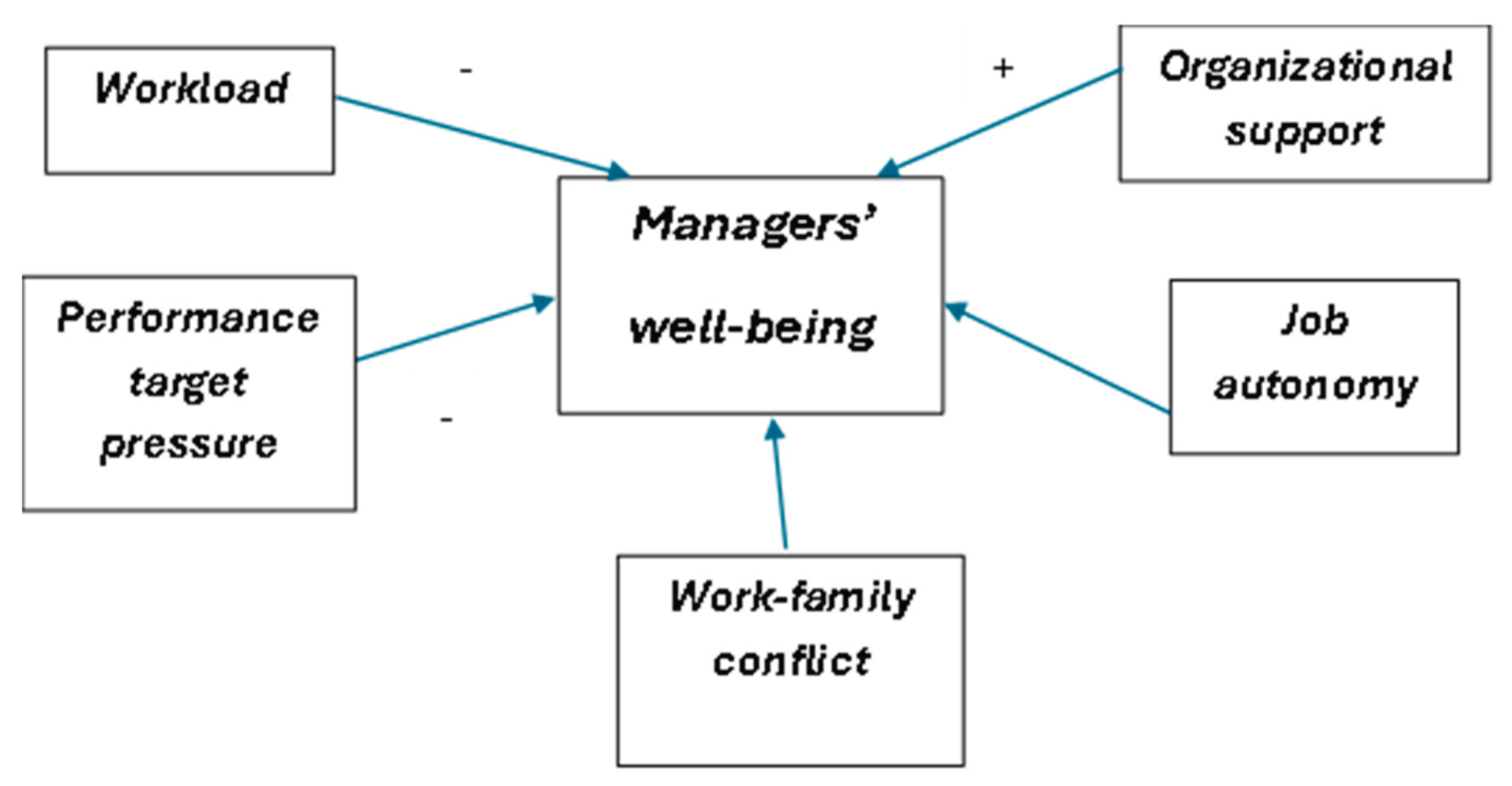
Following is also presented the conceptual model referring to the proposed hypotheses, encompassing the above-mentioned determinants and their respective impact on the well-being of managers in the Albanian lending institutions.
Figure 1.
The conceptual model.
3. Methodology
3.1. Research Design
This study adopts a quantitative research design to examine the determinants of managers’ well-being in Albanian lending institutions. The research follows a cross-sectional survey approach, collecting primary data through a structured questionnaire administered to managers working in selected commercial banks and microfinance institutions. The conceptual framework of the study is grounded in the Job Demands–Resources (JD–R) model, which suggests that job demands (such as workload and performance pressure) negatively affect employee well-being, while job resources (such as organizational support and job autonomy) enhance well-being and mitigate stress. In addition, work–family conflict is considered an important factor influencing managers’ well-being.
3.2. Data Collection and Sample
Primary data were collected using a structured questionnaire distributed to managers employed in Albanian lending (commercial banks and microfinance institutions) institutions. The target population includes branch managers, senior officers, and operational managers responsible for financial services, and institutional performance.
The questionnaire was administered through online and direct distribution methods, ensuring confidentiality and voluntary participation of respondents. The study focuses on managers because they are directly exposed to performance targets, operational workload, and organizational pressures, which may influence their psychological well-being and work–life balance.
Data were collected from the authors over the period of October, November, and December 2025. Potential respondents were asked whether they would be willing to participate in a survey dealing with their well-being. In total, 149 questionnaires were distributed. Four incomplete questionnaires were eliminated from the analysis, leaving 145 valid questionnaires for further analysis.
3.3. Measurement of Variables
The questionnaire was developed using validated scales widely used in the management and organizational behavior literature. All items were measured using a five-point Likert scale, ranging from 1 = strongly disagree to 5 = strongly agree.
Managers’ well-being was measured using the WHO-5 Well-Being Index (Topp et al., 2015), a widely validated scale used to assess psychological well-being. Workload, target pressure, organizational support, job autonomy and work–family conflict were measured using constructs derived from the Job Demands–Resources model (Awwad et al., 2022; Bakker & Demerouti, 2007; Demerouti et al., 2001; Zakhem et al., 2022).
3.4. Demographic Profile
Most of the respondents (56.6 per cent) were male. Related to the type of institution, 69 per cent worked in commercial banks and 31 per cent in microfinance institutions. In terms of age, 7.6 per cent of respondents were under the age of 30 years, 21.4 per cent in the age group 30-39 years, 45.5 per cent in the group 40-49 years (majority of the respondents), and 25.5 per cent were above 50 years old. Concerning years of service within their respective institutions, nearly half of the respondents (49.7 per cent) reported having more than 10 years of experience, 19.3 per cent 1-3 years, 10.3 per cent 4-6 years, and 20.7 per cent 7-10 years. As per the number of employees supervised, 50.3 per cent of respondents supervised 5-10 employees. Moreover, 49 per cent of the respondents were branch managers, 23.4 per cent were senior officers, and 27.6 per cent were operational managers. The data was coded and processed using SPSS.
3.5. Factor Analysis & Reliability
Factor analysis is a statistical technique used to identify underlying relationships between measured variables by grouping them into latent constructs or factors (Meyers et al., 2013). This method provides a means to consolidate scattered information from multiple variables into a smaller, more manageable number of factors. The constructs were assessed using principal component factor analysis with Varimax rotation. All retained items showed satisfactory factor loadings above 0.70. For most variables (WL, OS, AU, and WFC), all questionnaire items were retained in the analysis. However, for the Managers’ Well-Being (WB) and Performance Target Pressure (TP) constructs, one item from each scale was excluded due to lower factor loadings. Specifically, item WB2 (loading = 0.632) and item TP3 (loading = 0.636) were removed, after which the re-estimated models showed clear factor structures. The final WB scale included four items with loadings ranging from 0.707 to 0.819 (Cronbach’s α = 0.756), while the TP construct retained two items with strong loadings (0.930) and a reliability coefficient of α = 0.842. The final results of the factor analysis are summarized in Table 4 below.
To assess internal consistency reliability, Cronbach’s alpha coefficients were calculated for all constructs. The results indicate acceptable reliability levels across the measures. The highest reliability was observed for work–family conflict (α = 0.865), followed by organizational support (α = 0.822), well-being (α = 0.756), and workload (α = 0.726). The autonomy construct reported a Cronbach’s alpha of 0.679, which is slightly below the commonly recommended threshold of 0.70 but still considered acceptable for exploratory research. Overall, the reliability coefficients meet the acceptable standards suggested by (Hair et al., 2019).
4. Results
4.1. Regression Results
To explore the potential factors influencing managers' well-being, we performed multiple regression analyses, using respectively well-being (WB) as the dependent variables. The five variables: ‘Workload’ (WL), ‘Performance Target Pressure’ (TP), ‘Organizational Support’ (OS), ‘Job Autonomy’(AU) and ‘Work Family Conflict’(WFC) were used as independent variables. Table 5 presents the results of the multiple regression analysis examining the effects of workload (WL), performance target pressure (TP), organizational support (OS), autonomy (AU), and work–family conflict (WFC) on managers’ well-being (WB).
The regression results indicate that organizational support (β = 0.471, p < 0.001) has the strongest positive and statistically significant effect on managers’ well-being. This suggests that higher levels of perceived support from the organization significantly enhance managers’ psychological well-being. Similarly, autonomy (β = 0.194, p = 0.010) shows a positive and statistically significant relationship with well-being, indicating that managers who experience greater decision-making freedom and control over their work tend to report higher levels of well-being. In contrast, work–family conflict (β = −0.173, p = 0.023) has a negative and statistically significant impact on managers’ well-being, suggesting that increased conflict between work responsibilities and family life reduces overall well-being. However, workload (β = 0.134, p = 0.082) and performance target pressure (β = 0.144, p = 0.087) do not show statistically significant effects at the conventional 5% significance level, although both variables approach significance at the 10% level, indicating a weak positive association with well-being. The positive coefficients suggest a positive relationship among these variables and well-being, which is in contrast to the theoretical arguments mentioned in the literature review. However, the relatively limited sample size or the low variability in respondents’ perceptions of workload and performance target pressure may have both, reduced the statistical power of the analysis and influenced the direction of the relationship among these variables and managers’ well-being.
The coefficient of determination (R² = 0.457) indicates that approximately 45.7% of the variance in managers’ well-being is explained by the model. After adjusting for the number of predictors, the adjusted R² equals 0.437, meaning that the explanatory variables collectively account for 43.7% of the variance in well-being.
The hypothesis testing results are summarized in Table 6.
4.2. Differences in Managers’ Well-being Across Demographic and Organizational Characteristics
To examine whether managers’ well-being differs across demographic and organizational characteristics, independent sample t-tests and one-way ANOVA tests were conducted. First, to test whether there is a significant difference in mean managers’ well-being based on gender, an independent samples t-test was performed. The results indicate a statistically significant difference in well-being between female and male managers. Specifically, the mean level of well-being for female managers (M = 4.007, SD = 0.588) was higher than that for male managers (M = 3.753, SD = 0.587). The difference was statistically significant (t(143) = 2.588, p = 0.011). Therefore, hypothesis H2a was supported. Second, to test whether managers’ well-being differs across age groups, a one-way ANOVA was conducted. The results indicate a statistically significant difference in well-being across different age categories (F(3, 141) = 3.681, p = 0.014). Consequently, hypothesis H2b was supported.
In orerder to examine differences in well-being based on type of institution, an independent samples t-test was performed. The results reveal a statistically significant difference between managers working in commercial banks (M = 3.935, SD = 0.606) and those working in microfinance institutions (M = 3.705, SD = 0.557). The results indicate that managers in commercial banks report higher levels of well-being (t(143) = 2.159, p = 0.033). Thus, hypothesis H2c was supported. To test whether managers’ well-being differs according to current position (branch manager, senior officer, operational manager), a one-way ANOVA was conducted. The results indicate that there was no statistically significant difference in well-being across these positions (F(2, 142) = 2.128, p = 0.123). Therefore, hypothesis H2d was not supported.
Moreover, to examine whether managers’ well-being differs based on years of service, a one-way ANOVA was performed. The results indicate a statistically significant difference across years of service categories (F(3, 141) = 5.799, p = 0.001). Consequently, hypothesis H2e was supported. Finally, to test whether managers’ well-being differs according to the number of employees managed, a one-way ANOVA was conducted. The results reveal a statistically significant difference in well-being across the different employee-size categories (F (3, 141) = 2.919, p = 0.036). Therefore, hypothesis H2f was supported.

Table 7.
Differences in Managers’ Well-being Across Demographic and Organizational Characteristics.
| Hypothesis | Variable | Test | Group Comparison | Test Statistic | Sig. | Result |
|---|---|---|---|---|---|---|
| H2a | Gender | t-test | Female (M = 4.007, SD = 0.588) vs Male (M = 3.753, SD = 0.587) | t(143) = 2.588 | 0.011 | Supported |
| H2b | Age | ANOVA | Differences across age groups | F(3,141) = 3.681 | 0.014 | Supported |
| H2c | Type of institution | t-test | Commercial banks (M = 3.935, SD = 0.606) vs Microfinance institutions (M = 3.705, SD = 0.557) | t(143) = 2.159 | 0.033 | Supported |
| H2d | Current position | ANOVA | Branch manager, Senior officer, Operational manager | F(2,142) = 2.128 | 0.123 | Not supported |
| H2e | Years of service | ANOVA | Differences across experience groups | F(3,141) = 5.799 | 0.001 | Supported |
| H2f | Number of employees | ANOVA | Differences across firm size categories | F(3,141) = 2.919 | 0.036 | Supported |
5. Discussion
This study examined the determinants of managers’ well-being in Albanian lending institutions by applying the Job Demands–Resources (JD-R) framework. The findings provide important insights into how job demands, job resources, and work–family conflict influence managerial well-being within the specific institutional and economic context of Albania’s banking and microfinance sectors. Overall, the results suggest that job resources play a more decisive role in shaping managers’ well-being than job demands, highlighting the importance of supportive organizational environments in high-pressure financial institutions.
The results indicate that organizational support has the strongest positive and statistically significant effect on managers’ well-being. This finding supports hypothesis H1c and aligns with organizational support theory, which suggests that employees who perceive their organization as valuing their contributions and caring about their well-being are more likely to experience higher levels of job satisfaction and psychological well-being. Prior studies have similarly demonstrated that organizational support strengthens employee engagement and reduces stress-related outcomes (Kurtessis et al., 2017; Eisenberger et al., 2020). Within the JD-R framework, perceived organizational support functions as a critical job resource that helps employees cope with demanding work environments. In the context of Albanian financial institutions, where managers operate under strong regulatory requirements and performance expectations, supportive organizational practices appear to play a key role in maintaining psychological well-being. These findings suggest that institutional practices such as supportive leadership, professional development opportunities, and managerial recognition can significantly enhance the well-being of financial managers.
Job autonomy also shows a positive and statistically significant relationship with managers’ well-being, supporting hypothesis H1d. This result is consistent with work design theory, which identifies autonomy as one of the most important motivational job characteristics influencing psychological outcomes (Humphrey et al., 2007). Autonomy allows managers to regulate their work pace, prioritize tasks, and adapt operational decisions to local conditions. In the Albanian lending sector, where branch managers often operate within centralized institutional structures while responding to local market dynamics, autonomy appears to be an important resource enabling managers to cope with professional pressures. This finding is also consistent with previous research suggesting that autonomy improves employees’ ability to manage work–life boundaries and reduces emotional exhaustion. Therefore, granting managers greater decision-making flexibility may contribute significantly to improving well-being in financial institutions.
The analysis further reveals that work–family conflict has a negative and statistically significant effect on managers’ well-being, confirming hypothesis H1e. This result supports the predictions of the JD-R model and is consistent with extensive literature showing that conflicts between professional and personal roles negatively influence psychological well-being (French et al., 2018; Awwad et al., 2022). Managers in financial institutions frequently face extended working hours, strict performance targets, and continuous monitoring, conditions that can blur the boundaries between work and personal life. When professional responsibilities interfere with family or personal roles, the resulting role conflict generates psychological strain and reduces overall well-being. The findings therefore highlight the importance of work–life balance policies and flexible work arrangements in promoting sustainable managerial well-being in the financial sector.
Interestingly, the study finds that workload and performance target pressure do not have statistically significant effects on managers’ well-being at the conventional 5% significance level, although both variables approach significance at the 10% level. These results do not support hypotheses H1a and H1b and therefore diverge from the theoretical expectations derived from the JD-R model, which typically predicts a negative relationship between job demands and well-being. Several explanations may account for this outcome. One possible interpretation is that managers in financial institutions may perceive workload and performance pressure as intrinsic elements of their professional role rather than purely negative stressors. In highly performance-oriented sectors such as banking and microfinance, moderate levels of workload and target pressure may be interpreted as indicators of professional responsibility and career advancement. Another explanation relates to methodological factors. The relatively modest sample size and the limited variability in respondents’ perceptions of workload and performance pressure may have reduced the statistical power of the regression analysis, affecting the detection of significant relationships.
Beyond the regression analysis, the study also examined differences in managerial well-being across demographic and organizational characteristics. The findings reveal significant differences in well-being based on gender, age, type of institution, years of service, and number of employees supervised, while no statistically significant differences were observed across managerial positions. The higher well-being reported by female managers compared to male managers may reflect differences in coping strategies, leadership styles, or perceptions of organizational support. Similarly, age-related differences in well-being may be associated with greater professional experience and emotional stability among older managers. In addition, the finding that managers in commercial banks report higher levels of well-being than those in microfinance institutions may reflect structural differences between these sectors, including variations in organizational resources, operational pressures, and financial performance expectations.
Overall, the results emphasize the critical role of job resources and work–life balance in shaping managerial well-being in financial institutions. While job demands are inherent to the banking and microfinance sectors, supportive organizational environments and managerial autonomy appear to mitigate their potential negative effects. These findings highlight the importance for financial institutions of investing in organizational practices that support managers, enhance autonomy, and reduce work–family conflict.
Despite these contributions, several limitations should be acknowledged. First, the sample size of 145 respondents, although adequate for regression analysis, remains relatively modest and may limit the statistical power of the results. Second, the study focuses exclusively on managers working in Albanian commercial banks and microfinance institutions, which may restrict the generalizability of the findings to other sectors or national contexts. Third, the research relies on self-reported survey data, which may be subject to response bias or social desirability bias. Finally, although the JD-R model provides a robust theoretical framework, the study examined only a limited number of job demands and job resources.
Future research could extend this study in several ways. Expanding the sample size and including managers from additional sectors or countries would improve the generalizability of the findings and allow comparative analysis across different institutional contexts. Future studies could also incorporate additional variables within the JD-R framework, such as leadership style, organizational culture, digital transformation pressures, psychological resilience, and emotional intelligence. In addition, integrating qualitative research methods such as interviews or case studies could provide deeper insights into managers’ lived experiences and help identify contextual factors not captured through structured questionnaires. Finally, further research could explore the organizational outcomes of managerial well-being, including leadership effectiveness, employee engagement, team performance, and institutional stability, thereby highlighting the strategic importance of promoting well-being within financial institutions
6. Conclusions
This study examined the determinants of managers’ well-being in Albanian lending institutions by applying the Job Demands–Resources (JD-R) framework to the context of commercial banks and microfinance institutions. Using survey data collected from managers working in these institutions, the research analyzed how job demands (workload and performance target pressure), job resources (organizational support and job autonomy), and work–family conflict influence managerial well-being, while also exploring differences across demographic and organizational characteristics.
From a theoretical perspective, the study contributes to the literature on employee well-being by extending the application of the JD-R model to the underexplored context of emerging financial systems. The findings demonstrate that job resources—particularly perceived organizational support and job autonomy—play a central role in enhancing managerial well-being. These results reinforce the JD-R proposition that organizational resources can buffer the negative effects of demanding work environments and help employees maintain psychological resilience. At the same time, the study highlights the significant negative impact of work–family conflict on managers’ well-being, confirming the importance of work–life balance in high-pressure professional contexts. Interestingly, workload and performance target pressure did not show statistically significant negative effects, suggesting that managers in performance-driven sectors may perceive moderate levels of job demands as inherent elements of their professional role rather than purely harmful stressors.
From a managerial perspective, the findings underline the importance of creating supportive organizational environments within financial institutions. Strengthening perceived organizational support through effective leadership, training opportunities, and recognition systems can significantly improve managers’ psychological well-being. In addition, increasing managerial autonomy in decision-making processes may help managers better regulate workload and adapt to local operational challenges. Financial institutions should also consider implementing policies aimed at reducing work–family conflict, such as flexible work arrangements and improved workload distribution, in order to promote sustainable managerial performance.
Finally, the results carry broader policy implications for financial systems in emerging economies. Managers in lending institutions play a crucial role in maintaining financial stability, ensuring credit access, and supervising employees. Promoting managerial well-being therefore represents not only an organizational priority but also a systemic concern. Policymakers and financial regulators should recognize the importance of organizational well-being practices as part of a broader strategy for strengthening institutional resilience and sustainable development within the financial sector.
Author Contributions
Conceptualization, Albana Boriçi and Ardita Borici; methodology, Albana Boriçi and Ardita Borici; formal analysis, Ardita Borici; investigation, Albana Boriçi, Ardita Borici, Arjola Halluni, and Jetmir Muja; data curation, Albana Boriçi, Ardita Borici, Arjola Halluni, and Jetmir Muja; writing—original draft preparation, Albana Boriçi, Ardita Borici, Arjola Halluni, and Jetmir Muja; writing—review and editing, Arjola Halluni and Jetmir Muja; visualization, Arjola Halluni and Jetmir Muja.
Funding
Publication fee might be covered by the affiliation institution, University of Shkodra “Luigj Gurakuqi”, Shkoder, Albania.
Institutional Review Board Statement
The study was conducted in accordance with the Declaration of Helsinki.
Informed Consent Statement
Informed consent was obtained from all subjects involved in the study.
Data Availability Statement
The original contributions presented in this study are included in the article/supplementary material. Further inquiries can be directed to the corresponding author(s).
Conflicts of Interest
The authors declare no conflicts of interest.
Abbreviations
The following abbreviations are used in this manuscript:
| JD-R model | Job Demands–Resources |
| WHO-5 Well-being Index | World Health Organization-5 Well-being Index |
References
- Angjeli, E.; Civici, A.; Bombaj, F. The impact of microcredit on the economic growth of developing countries: Evidence and perspectives from Albania. Economics of Development 2025, 24, 68–76. [Google Scholar] [CrossRef]
- Asselmann, E.; Specht, J. Climbing the Career Ladder Does Not Make You Happy: Well-being Changes in the Years Before and After Becoming a Leader. Journal of Happiness Studies 2023, 24, 1037–1058. [Google Scholar] [CrossRef]
- Awwad, R.I.; Aljuhmani, H.Y.; Hamdan, S. Examining the Relationships Between Frontline Bank Employees’ Job Demands and Job Satisfaction: A Mediated Moderation Model. Sage Open 2022, 12, 21582440221079880. [Google Scholar] [CrossRef]
- Bakker, A.B.; Demerouti, E. The Job Demands-Resources model: State of the art. Journal of Managerial Psychology 2007, 22, 309–328. [Google Scholar] [CrossRef]
- Bank of Albania Annual Report 2024 Bank of Albania. 2025. Available online: https://www.bankofalbania.org/rc/doc/RV_2024_anglisht_ok_31880.pdf.
- Bank of Albania Financial Stability Report 2024. Bank of Albania, 2025. Available online: https://www.bankofalbania.org/rc/doc/FSR_6M1_2024_English_web_29473.pdf.
- Bank of Albania Supervision Annual Report 2024. Bank of Albania, 2025. Available online: https://www.bankofalbania.org/rc/doc/Supervision_Annual_Report_2024_English_WEB_31463.pdf.
- Bank of Albania Trends in Lending Bank of Albania. 2025. Available online: https://www.bankofalbania.org/rc/doc/Tendencat_ne_kreditim_2025_july_eng_WEB_31556.pdf.
- Battilana, J.; Dorado, S. Building Sustainable Hybrid Organizations: The Case of Commercial Microfinance Organizations. The Academy of Management Journal 2010, 53, 1419–1440. Available online: https://www.jstor.org/stable/29780265. [CrossRef]
- Bhayo, A.R.; Shah, P.D.N.; Chachar, A.A. The Impact of Interpersonal Conflict and Job Stress on Employees Turnover Intention. International Research Journal of Arts & Humanities (IRJAH) 2017, 45. Available online: https://sujo.usindh.edu.pk/index.php/IRJAH/article/view/885.
- Boriçi Begani, A.; Boriçi, A.; Halluni, A.; Muja, J. Understanding the Psychological Well-Being of Expatriates in Times of Natural Crisis, the case of Albania & Montenegro (p. 159). 2024. [Google Scholar] [CrossRef]
- Boriçi; Dergjini; Begani, & Boriçi. Microfinance, social and financial performance-case of Albania. XII International May Conference on Strategic Management; 2016; pp. 80–88. Available online: https://media.sjm06.com/2016/03/Proceedings_IMKSM16.pdf.
- Chen, N.; Tsai, C.L. Work–Family Interference as a Mediator Between Job Characteristics and Employee Well-Being During COVID-19 in China: A Job Demands–Resources Model. Social Sciences 2025, 14. [Google Scholar] [CrossRef]
- Czura, K.; Englmaier, F.; Ho, H.; Spantig, L. Microfinance loan officers before and during Covid-19: Evidence from India. World Development 2022, 152, 105812. [Google Scholar] [CrossRef]
- Demerouti, E.; Bakker, A.B.; Nachreiner, F.; Schaufeli, W.B. The job demands a resource model of burnout. Journal of Applied Psychology 2001, 86, 499–512. [Google Scholar] [CrossRef]
- Dursun, S.; Aytac, S. The Effect of Customer Aggression on Burnout. Academic Journal of Interdisciplinary Studies 2014, 3, 369. Available online: https://www.richtmann.org/journal/index.php/ajis/article/view/3113. [CrossRef]
- Dushku, E. Access to finance for SMEs in Albania under monetary tightening (Working Paper Nos. HEIDWP09-2025). In Graduate Institute of International and Development Studies Working Paper; 2025; Available online: https://www.econstor.eu/handle/10419/324256.
- EBRD. European Bank for Reconstruction and Development (EBRD). 2024. Available online: https://www.ebrd.com/content/dam/ebrd_dxp/assets/pdfs/country-strategies/albania/Albania%20diagnostic%202024-web.pdf.
- Eisenberger, R.; Huntington, R.; Hutchison, S.; Sowa, D. Perceived Organizational Support. Journal of Applied Psychology 1986, 71, 500–507. [Google Scholar] [CrossRef]
- Eisenberger, R.; Shanock, L.; Wen, X. Perceived Organizational Support: Why Caring About Employees Counts. Annual Review of Organizational Psychology and Organizational Behavior 2020, 7. [Google Scholar] [CrossRef]
- French, K.A.; Dumani, S.; Allen, T.D.; Shockley, K.M. A meta-analysis of work-family conflict and social support. Psychological Bulletin 2018, 144, 284–314. [Google Scholar] [CrossRef]
- Giorgi, G.; Arcangeli, G.; Perminiene, M.; Lorini, C.; Ariza-Montes, A.; Fiz-Perez, J.; Di Fabio, A.; Mucci, N. Work-Related Stress in the Banking Sector: A Review of Incidence, Correlated Factors, and Major Consequences. Frontiers in Psychology 2017, 8, 2166. [Google Scholar] [CrossRef]
- Hagerman, H.; Skytt, B.; Wadensten, B.; Högberg, H.; Engström, M. A longitudinal study of working life among first-line managers in the care of older adults. Applied Nursing Research 2016, 32, 7–13. [Google Scholar] [CrossRef]
- Hair, J.F.; Black, W.C.; Babin, B.J.; Anderson, R.E. Multivariate data analysis, Eighth edition; Cengage, 2019. [Google Scholar]
- Humphrey, S.; Nahrgang, J.; Morgeson, F. Integrating Motivational, Social, and Contextual Work Design Features: A Meta-Analytic Summary and Theoretical Extension of the Work Design Literature. Journal of Applied Psychology 2007, 92, 1332–1356. [Google Scholar] [CrossRef] [PubMed]
- International Monetary Fund. Financial Soundness Indicators Compilation Guide 2019; International Monetary Fund, 2019. [Google Scholar] [CrossRef]
- Khan, F.; Sufyan, M.; Malik, M.F. Job demands, Emotional Exhaustion and Ill Health among Academicians. Global Educational Studies Review V(III) 2020, 253–262. [CrossRef]
- Khawand, S.; Zargar, P. Job autonomy and work-life conflict: A conceptual analysis of teachers’ wellbeing during the COVID-19 pandemic. Frontiers in Psychology 2022, 13. [Google Scholar] [CrossRef] [PubMed]
- Konomi, I. Corporate financing and the structure of the financial system in Albania: A macroeconomic perspective and implications for economic growth. Acta Scientiarum Polonorum. Oeconomia 2025, 24, 5–13. [Google Scholar] [CrossRef]
- KOSSEK, E.E.; PICHLER, S.; BODNER, T.; HAMMER, L.B. WORKPLACE SOCIAL SUPPORT AND WORK–FAMILY CONFLICT: A META-ANALYSIS CLARIFYING THE INFLUENCE OF GENERAL AND WORK–FAMILY-SPECIFIC SUPERVISOR AND ORGANIZATIONAL SUPPORT. Personnel Psychology 2011, 64, 289–313. [Google Scholar] [CrossRef]
- Krugman, P.; Wells, R.; Graddy, K. Essentials of Economics; Macmillan Learning, 2016. [Google Scholar]
- Kurtessis, J.N.; Eisenberger, R.; Ford, M.T.; Buffardi, L.C.; Stewart, K.A.; Adis, C.S. Perceived Organizational Support: A Meta-Analytic Evaluation of Organizational Support Theory. Journal of Management 2017, 43, 1854–1884. [Google Scholar] [CrossRef]
- Lahat, L.; Ofek, D. Emotional Well-being Among Public Employees: A Comparative Perspective. Review of Public Personnel Administration 2020, 42, 0734371X2093964. [Google Scholar] [CrossRef]
- Lee, Y.M.; Kim, H.-R. Performance pressure and mental health among finance workers in Korea: A cross-sectional study. Epidemiology and Health 2023, 45, e2023099. [Google Scholar] [CrossRef] [PubMed]
- Meyers, L.S.; Gamst, G.; Guarino, A.J. Applied multivariate research: Design and interpretation, 2nd ed; Sage Publications, Inc, 2013; p. pp. xx, 1078. [Google Scholar]
- Petanaj, M.; Muharremi, O. ASSESSMENT OF THE ALBANIAN BANKING SYSTEM’S MAIN ECONOMIC AND FINANCIAL INDICATORS, AS WELL AS THE PORTFOLIO OF BUSINESS LOANS. 13. 2025. Available online: https://ijecm.co.uk/wp-content/uploads/2025/06/1361.pdf.
- Rahmi, T.; Cucuani, H. Perceived Organizational Support, Well-being and Work Engagement of Working Mother during Covid-19 Pandemic: Proceedings of the International Conference of Mental Health 2021, 12–20. [CrossRef]
- Renk, S.; Sutter, C. Always available? A systematic review on extended work-related availability, health outcomes, and work-family conflict. Frontiers in Psychology 2026, 16. [Google Scholar] [CrossRef]
- Rhoades, L.; Eisenberger, R. Perceived Organizational Support: A Review of Literature. Journal of Applied Psychology 2002, 87, 698–714. [Google Scholar] [CrossRef] [PubMed]
- Ryff, C.D.; Keyes, C.L.M. The structure of psychological well-being was revisited. Journal of Personality and Social Psychology 1995, 69, 719–727. [Google Scholar] [CrossRef]
- Saputra, J.M.D.; Riana, I.G.; Putra, M.S.; Surya, I.B.K. Perceived organizational support, work engagement, and employee well-Being. World Journal of Advanced Research and Reviews 2023, 19, 1154–1164. [Google Scholar] [CrossRef]
- Schaufeli, W.B.; Taris, T.W.; Bauer, G. F.; Hämmig, O. A Critical Review of the Job Demands-Resources Model: Implications for Improving Work and Health. In Bridging Occupational, Organizational and Public Health; Springer Netherlands, 2014; pp. 43–68. [Google Scholar] [CrossRef]
- Siwale, J. Microfinance and Loan Officers’ Work Experiences: Perspectives from Zambia. The Journal of Development Studies 2016, 52, 1289–1305. [Google Scholar] [CrossRef]
- Tabassum, H.; Farooq, Z.; Fatima, I. Work family conflict, perceived work overload and work exhaustion in employees of banking sector. 2017. Available online: https://www.semanticscholar.org/paper/Work-family-conflict%2C-perceived-work-overload-and-Tabassum-Farooq/95cedf5dd8d42da34e69aa32ae61d317ed10d1bd.
- Topalli; Molishti. Digital transformation of the Albanian banking system: The results of the Albanian banking sector digitalization survey 2024. Bank of Albania; 2026; Available online: https://www.bankofalbania.org/rc/doc/DIGITAL_TRANSFORMATION_OF_THE_ALBANIAN_BANKING_SYSTEM_THE_RESULTS_OF_THE_ALBANIAN_BANKING_SECTOR_DIGITALIZATION_SURVEY_2024_32597.pdf.
- Topp, C.W.; Østergaard, S.D.; Søndergaard, S.; Bech, P. The WHO-5 Well-Being Index: A systematic review of the literature. Psychotherapy and Psychosomatics 2015, 84, 167–176. [Google Scholar] [CrossRef]
- Vinod, G.; Ambatipudi, S. Burnout, stress, and their correlates among bank employees of South India: A cross-sectional study. Annals of Occupational and Environmental Medicine 2024, 36, e22. [Google Scholar] [CrossRef] [PubMed]
- Wang, Y. Exploring the impact of workload, organizational support, and work engagement on teachers’ psychological wellbeing: A structural equation modeling approach. Frontiers in Psychology 2024, 14. [Google Scholar] [CrossRef] [PubMed]
- Wilks, D.; Neto, F. Workplace Well-being, Gender and Age: Examining the ‘Double Jeopardy’ Effect. Social Indicators Research 2013, 114. [Google Scholar] [CrossRef]
- World Bank. World Bank. 2020. Available online: https://www.rfilc.org/wp-content/uploads/2021/01/Albania-Credit-Guarantee-Scheme-Assessment.pdf.
- Zakhem, N.B.; Farmanesh, P.; Zargar, P.; Kassar, A. Wellbeing during a pandemic: Empirical research examining autonomy, work-family conflict, and informational support among SME employees. Frontiers in Psychology 2022, 13. [Google Scholar] [CrossRef]
- Zakhem, N.B.; Farmanesh, P.; Zargar, P.; Kassar, A. Wellbeing during a pandemic: Empirical research examining autonomy, work-family conflict and informational support among SME employees. Frontiers in Psychology 2022, 13. [Google Scholar] [CrossRef]
Table 1.
Measurement of Variables and Survey Items.
| Variable | Code | Item Statement |
|---|---|---|
| Managers’ Well-Being (WB) | WB1 | I felt cheerful and in good spirits |
| WB2 | I felt calm and relaxed | |
| WB3 | I felt active and vigorous | |
| WB4 | I woke up feeling fresh and rested | |
| WB5 | My daily work has been interesting to me | |
| Workload (WL) | WL1 | I have too much work to do in the time available |
| WL2 | My workload has increased over the past year | |
| WL3 | I often work beyond normal working hours | |
| Performance Target Pressure (TP) | TP1 | Performance targets in my institution are difficult to achieve |
| TP2 | I feel constant pressure to meet performance indicators | |
| TP3 | Failure to meet targets has negative consequences for managers | |
| Organizational Support (OS) | OS1 | My institution cares about my well-being |
| OS2 | I receive support from senior management when needed | |
| OS3 | Training opportunities help me cope with job demands | |
| Job Autonomy (AU) | AU1 | I have autonomy in organizing my daily work |
| AU2 | I can make decisions without excessive supervision | |
| AU3 | I have flexibility in managing branch operations | |
| Work–Family Conflict (WFC) | WFC1 | My job interferes with my family or personal life |
| WFC2 | I find it difficult to balance work and private responsibilities | |
| WFC3 | Work stress negatively affects my life outside work |
Note: All items measured using a 5-point Likert scale (1 = Strongly disagree; 5 = Strongly agree).
Table 2.
Variable Coding for Econometric Analysis.
| Variable | Symbol | Measurement | Expected Effect |
|---|---|---|---|
| Managers’ Well-Being | WB | Mean (WB1–WB5) | Dependent variable |
| Workload | WL | Mean (WL1–WL3) | − |
| Target Pressure | TP | Mean (TP1–TP3) | − |
| Organizational Support | OS | Mean (OS1–OS3) | + |
| Job Autonomy | AU | Mean (AU1–AU3) | + |
| Work–Family Conflict | WFC | Mean (WFC1–WFC3) | − |
Table 4.
Summary of measurement scales.
| Constructs | Items | α | Factor loading |
|---|---|---|---|
| Managers’ Well-Being (WB) | WB1, I felt cheerful and in good spirits WB3, I felt active and vigorous WB4, I woke up feeling fresh and rested WB5, My daily work has been interesting to me |
0.756 | 0.764 0.819 0.777 0.707 |
| Workload (WL) | WL1, I have too much work to do in the time available WL2, My workload has increased over the past year WL3, I often work beyond normal working hours |
0.726 | 0.840 0.811 0.778 |
| Performance Target Pressure (TP) | TP1, Performance targets in my institution are difficult to achieve TP2, I feel constant pressure to meet performance indicators |
0.842 | 0.930 0.930 |
| Organizational Support (OS) |
OS1, My institution cares about my well-being OS2, I receive support from senior management when needed OS3, Training opportunities help me cope with job demands |
0.822 | 0.891 0.896 0.818 |
| Job Autonomy (AU) |
AU1, I have autonomy in organizing my daily work AU2, I can make decisions without excessive supervision AU3, I have flexibility in managing branch operations |
0.690 | 0.723 0.793 0.858 |
| Work–Family Conflict (WFC) |
WFC1, My job interferes with my family or personal life WFC2, I find it difficult to balance work and private responsibilities WFC3, Work stress negatively affects my life outside work |
0.865 | 0.874 0.893 0.897 |
Source: Own processing.
Table 5.
Regression Results: Determinants of Managers’ Well-being.
| Variable | B | Std. Error | Beta (β) | t | Sig. |
|---|---|---|---|---|---|
| Constant | 1.527 | 0.288 | – | 5.296 | 0.000 |
| Workload (WL) | 0.106 | 0.061 | 0.134 | 1.754 | 0.082 |
| Performance Target Pressure (TP) | 0.095 | 0.055 | 0.144 | 1.724 | 0.087 |
| Organizational Support (OS) | 0.323 | 0.050 | 0.471 | 6.449 | 0.000 |
| Autonomy (AU) | 0.181 | 0.070 | 0.194 | 2.602 | 0.010 |
| Work–Family Conflict (WFC) R² = 0.457 Adjusted R² = 0.437 |
−0.109 | 0.048 | −0.173 | −2.301 | 0.023 |
Table 6.
Hypotheses testing results.
| Hypothesis | Relationship | Expected Effect | Beta (β) | Sig. | Result |
|---|---|---|---|---|---|
| H1a | Workload → Managers’ Well-being | + | 0.134 | 0.082 | Not supported |
| H1b | Performance Target Pressure → Managers’ Well-being | + | 0.144 | 0.087 | Not supported |
| H1c | Organizational Support → Managers’ Well-being | + | 0.471 | 0.000 | Supported |
| H1d | Autonomy → Managers’ Well-being | + | 0.194 | 0.010 | Supported |
| H1e | Work–Family Conflict → Managers’ Well-being | − | −0.173 | 0.023 | Supported |
Disclaimer/Publisher’s Note: The statements, opinions and data contained in all publications are solely those of the individual author(s) and contributor(s) and not of MDPI and/or the editor(s). MDPI and/or the editor(s) disclaim responsibility for any injury to people or property resulting from any ideas, methods, instructions or products referred to in the content. |
© 2026 by the authors. Licensee MDPI, Basel, Switzerland. This article is an open access article distributed under the terms and conditions of the Creative Commons Attribution (CC BY) license (http://creativecommons.org/licenses/by/4.0/).
Copyright: This open access article is published under a Creative Commons CC BY 4.0 license, which permit the free download, distribution, and reuse, provided that the author and preprint are cited in any reuse.


