

Submitted:
15 March 2026
Posted:
16 March 2026
You are already at the latest version
Abstract
Organizations operating in regulated industries must submit periodic reports to supervisory authorities. These reports often include financial disclosures, operational records, and compliance declarations. Traditional reporting methods involve manual document preparation and fragmented data sources. This research studies information systems designed for regulatory reporting and compliance documentation management. The proposed framework integrates structured reporting templates, data validation procedures, and submission tracking interfaces. System analysis demonstrates that centralized reporting platforms assist institutions in maintaining reporting accuracy and meeting regulatory submission deadlines.
Keywords:
regulatory reporting systems
; compliance documentation
; governance reporting
; institutional compliance
; information systems
1. Introduction
Regulatory reporting has become an essential requirement for organizations operating in modern financial environments. Financial institutions and enterprises must regularly submit structured reports to regulatory authorities to ensure transparency, accountability, and compliance with financial regulations. As financial systems generate increasing volumes of data, organizations require advanced information systems capable of managing financial records, monitoring operational activities, and supporting regulatory oversight.
In response to these challenges, organizations are increasingly adopting Management Information Systems (MIS), data analytics platforms, and automated reporting technologies to improve financial monitoring and reporting efficiency. These technological developments have enabled institutions to process large volumes of financial data, detect anomalies, and generate regulatory reports more efficiently. Understanding how these technologies can be integrated to support regulatory reporting systems is therefore an important research area.
1.1. Background
In modern financial ecosystems, regulatory compliance and institutional transparency have become critical requirements for organizations operating in highly regulated environments. Financial institutions, corporations, and government bodies are increasingly required to submit detailed regulatory reports to ensure accountability, risk mitigation, and adherence to financial regulations. As financial systems grow more complex and data-driven, organizations rely heavily on Management Information Systems (MIS), enterprise analytics platforms, and automated reporting infrastructures to manage financial data, monitor operational activities, and support decision-making processes.
Recent studies highlight the growing role of data-driven financial analytics, artificial intelligence, and enterprise information systems in improving financial monitoring and compliance processes. For example, MIS platforms enable organizations to integrate financial data from multiple sources and generate insights for decision-making and regulatory oversight (Tabassum et al., 2025). Similarly, advanced analytics and machine learning approaches are increasingly used to support financial risk management and detect anomalies in financial transactions (Rahman, 2025; Rahman, 2026). At the same time, enterprise data management frameworks and secure digital infrastructures are essential for ensuring the reliability, scalability, and integrity of financial information systems (Hasan, 2025).
Technological innovations such as cloud-based enterprise systems, automated accounting processes, and predictive analytics have further enhanced the capabilities of financial reporting systems. These technologies allow organizations to monitor key performance indicators, optimize financial workflows, and automate compliance-related tasks (Hasan, 2025; Mirza, 2026). Moreover, data governance frameworks and ethical AI approaches have been proposed to improve transparency, accountability, and trust in enterprise information systems (Nahar et al., 2026). Together, these developments demonstrate the growing importance of integrated information systems in supporting regulatory reporting and institutional compliance.
1.2. Problem Statement
Despite these technological advancements, many organizations still face significant challenges in managing regulatory reporting and compliance monitoring processes. Traditional financial reporting systems often rely on fragmented data sources, manual procedures, and limited automation, which can lead to inefficiencies, reporting delays, and increased risk of errors. Inconsistent data integration across enterprise systems may also reduce the reliability and transparency of financial reports submitted to regulatory authorities. Furthermore, existing studies often focus on individual components of financial information systems, such as accounting automation, financial analytics, or enterprise data management. However, there is limited research that integrates these technological components into a comprehensive framework for regulatory reporting information systems that supports institutional compliance monitoring. As financial regulations continue to evolve and organizations handle increasingly large volumes of data, the need for integrated, intelligent, and scalable reporting infrastructures becomes more critical.
1.3. Research Aim
This study aims to explore the role of Regulatory Reporting Information Systems (RRIS) in supporting financial transparency, risk monitoring, and institutional compliance. Specifically, the research examines how modern technologies such as MIS platforms, data analytics, cloud-based enterprise systems, and artificial intelligence can be integrated to improve regulatory reporting processes and enhance compliance monitoring capabilities.
By synthesizing insights from recent studies on financial analytics, enterprise information systems, and automated reporting technologies, this paper seeks to develop a conceptual understanding of how organizations can design more effective and reliable regulatory reporting systems. Ultimately, the study contributes to the growing body of research on data-driven financial governance and digital compliance infrastructures in modern organizations.
2. Literature Review
Recent research highlights the growing role of information systems, data analytics, and artificial intelligence in improving financial management, regulatory compliance, and institutional monitoring. With increasing digitalization of financial operations, organizations rely on management information systems (MIS) and enterprise analytics platforms to enhance transparency and decision making.
Several studies have examined the use of data driven financial analytics for improving financial monitoring and reporting. MIS based analytics platforms allow organizations to integrate financial data from multiple sources and generate insights for management and regulatory reporting [14]. Similarly, analytics tools have been shown to improve financial planning and budget allocation efficiency by providing better visibility into financial performance indicators [2].
Research has also highlighted the importance of automated accounting and managerial accounting systems in financial reporting. Managerial accounting frameworks provide structured financial information that supports organizational planning and decision making [3]. Automation technologies further enhance accounting processes by reducing manual tasks and improving reporting accuracy and operational efficiency [4].
Another stream of research focuses on internal control systems and financial risk monitoring mechanisms supported by information technologies. Algorithmic internal control frameworks using MIS event logs have been proposed to improve financial transparency and reduce operational risks in organizations [1]. Similarly, data driven financial risk management models have demonstrated how artificial intelligence can enhance risk detection and monitoring in enterprise environments [11]. In addition, real time monitoring systems have been developed to detect suspicious financial activities and potential fraud in organizational financial data [13].
Researchers have also emphasized the role of enterprise data management and scalable information system infrastructures in financial reporting environments. Secure data management architectures are essential for maintaining data integrity and supporting large scale financial data processing [5]. Predictive analytics techniques have also been applied to forecast key performance indicators for financial operations and organizational planning [6]. Data quality and system optimization have also received considerable attention in the literature. SQL based approaches have been proposed to improve data quality in enterprise dashboards and reporting systems [7]. Similarly, cloud based infrastructures and optimized system architectures can improve scalability and efficiency in enterprise financial environments [8].
In addition, scholars have explored the role of business intelligence platforms and governance frameworks in enterprise systems. Predictive reliability frameworks for cloud scale analytics platforms have been proposed to enhance system monitoring and operational efficiency [9]. Data governance frameworks integrating ethical AI principles have also been introduced to improve transparency and accountability in enterprise data environments [10]. Furthermore, cloud native enterprise resource management platforms support integrated data processing and system scalability across organizational operations [12].
Overall, previous studies show that advancements in financial analytics, enterprise information systems, and artificial intelligence technologies have significantly improved financial monitoring, reporting efficiency, and decision support capabilities in modern organizations.
2.1. Research Gap
Although existing research provides valuable insights into financial analytics tools, automated accounting systems, internal control mechanisms, and enterprise data infrastructures, most studies focus on individual technological components rather than integrated regulatory reporting systems. Previous work has examined financial analytics [14], automated accounting practices [4], internal control systems [1], and financial risk monitoring frameworks [11] independently.
However, limited research has explored how these technologies can be combined into a comprehensive Regulatory Reporting Information System capable of supporting institutional compliance monitoring. Existing studies rarely address how financial analytics, enterprise data governance, and automated monitoring mechanisms can operate together within a unified reporting framework.
Therefore, there remains a need for research that develops integrated regulatory reporting information systems capable of combining analytics, governance frameworks, and enterprise infrastructures to improve financial transparency and regulatory compliance in modern data driven environments.
3. Methodology
This study adopts a structured research methodology to design and evaluate a Regulatory Reporting Information System (RRIS) for financial and institutional compliance monitoring. The methodology follows a systematic workflow that includes data collection, data preprocessing, system architecture development, analytical modeling, and validation procedures. Each stage of the methodology is designed to ensure transparency, reproducibility, and reliability of the results. The goal is to construct a framework capable of integrating financial data sources, processing regulatory information, and supporting compliance monitoring through data analytics and automated reporting mechanisms.
3.1. Research Design
The research follows a system design and analytical evaluation approach. The study focuses on developing a conceptual and analytical framework that integrates enterprise data sources, financial monitoring modules, and regulatory reporting components within a unified information system.
The research process consists of five sequential stages. The first stage involves identifying relevant financial and enterprise data sources used in regulatory reporting environments. The second stage involves preparing and structuring the collected data for analysis. The third stage focuses on designing the proposed regulatory reporting information system architecture. The fourth stage develops analytical models used to evaluate financial risk indicators and compliance metrics. The final stage evaluates system performance through validation checks and analytical assessment.
To provide a visual overview of the research process, a methodological workflow diagram should be included here.
Figure 1.
Overall Research Methodology Workflow.
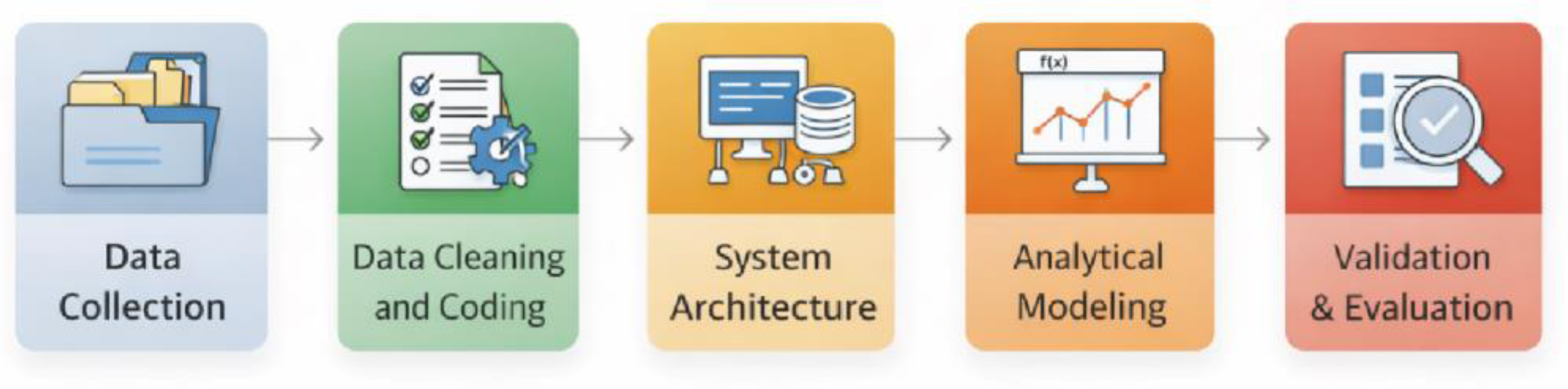
The figure illustrates the sequential stages of the research process, beginning with data collection, followed by data cleaning and coding, system architecture design, analytical modeling, and finally validation and evaluation. It summarizes the overall methodological framework used to develop and assess the proposed regulatory reporting information system.
3.2. Data Collection
The study utilizes financial and operational datasets commonly associated with enterprise reporting environments. These datasets include financial transaction records, organizational performance indicators, and regulatory reporting attributes typically used by institutions for compliance monitoring.
Data sources consist of enterprise financial datasets and structured financial indicators commonly reported within management information systems. These datasets include variables such as transaction identifiers, account categories, reporting periods, operational costs, revenue indicators, and compliance flags. The datasets represent the types of structured financial data commonly used in regulatory reporting environments.
Data were collected from enterprise reporting datasets and publicly available financial reporting structures used in organizational information systems. These datasets were organized in structured tabular formats to facilitate integration with the proposed regulatory reporting framework.

Table 1.
Description of Data Variables Used in the Study.
| Variable Name | Description | Data Type |
|---|---|---|
| Transaction_ID | Unique identifier assigned to each financial transaction | Integer |
| Account_Category | Classification of the financial account involved in the transaction | Categorical |
| Reporting_Period | Time period during which the transaction or financial activity was recorded |
Date |
| Revenue | Total income generated by the organization during the reporting period | Numeric |
| Expense | Total operational expenditure incurred during the reporting period | Numeric |
| Risk_Indicator | Analytical indicator used to represent potential financial risk levels | Numeric |
| Compliance_Flag | Indicator showing whether the transaction complies with regulatory standards |
Binary |
| Regulatory_Status | Final compliance evaluation generated by the reporting system | Categorical |
3.3. Data Cleaning and Preprocessing
After data collection, the dataset undergoes preprocessing to ensure data consistency and analytical reliability. Data cleaning procedures include removal of duplicate records, correction of inconsistent entries, and handling of missing values.
Missing numerical values are handled through mean substitution or interpolation depending on the variable type. Outlier detection techniques are applied using statistical threshold methods. Records containing abnormal financial values beyond acceptable statistical limits are reviewed and corrected when necessary.
Data normalization is applied to ensure consistent scale across financial variables. Normalization improves the performance of analytical models by ensuring that variables contribute proportionally during analysis.
Data coding is also applied to transform categorical variables into structured numerical representations suitable for analytical modeling. Binary encoding is used for compliance indicators, while categorical financial attributes are converted using numerical labeling techniques.
Figure 2.
Data Preprocessing and Cleaning Workflow.
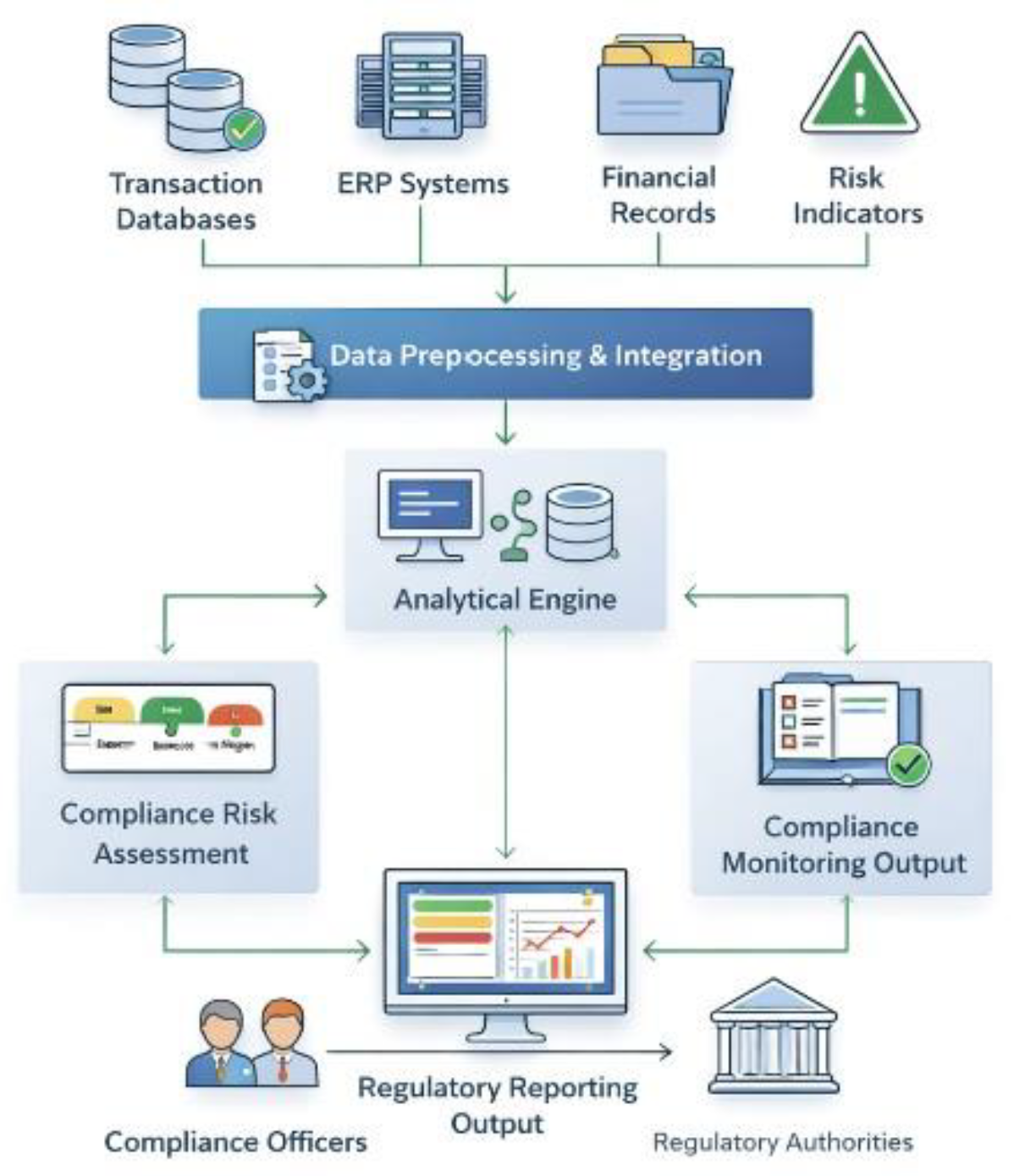
The figure illustrates the architecture of the proposed Regulatory Reporting Information System, showing how financial data from transaction databases, ERP systems, financial records, and risk indicators are integrated through a data preprocessing module and analyzed by an analytical engine. The processed information is then used for compliance risk assessment and monitoring, generating regulatory reports for compliance officers and regulatory authorities.
3.4. Proposed Regulatory Reporting System Architecture
The core contribution of this research is the design of a Regulatory Reporting Information System architecture that integrates enterprise financial data sources with analytical and compliance monitoring components.
The architecture consists of four primary layers. The first layer represents enterprise data sources including financial transaction databases and operational information systems. The second layer represents the data processing and integration layer where financial data are consolidated and prepared for analysis. The third layer represents the analytical and monitoring engine which evaluates financial indicators and identifies compliance risks. The fourth layer represents the regulatory reporting interface which generates reports for institutional oversight and regulatory compliance monitoring.
This architecture allows organizations to integrate financial data across multiple systems while maintaining transparency and traceability in regulatory reporting processes.
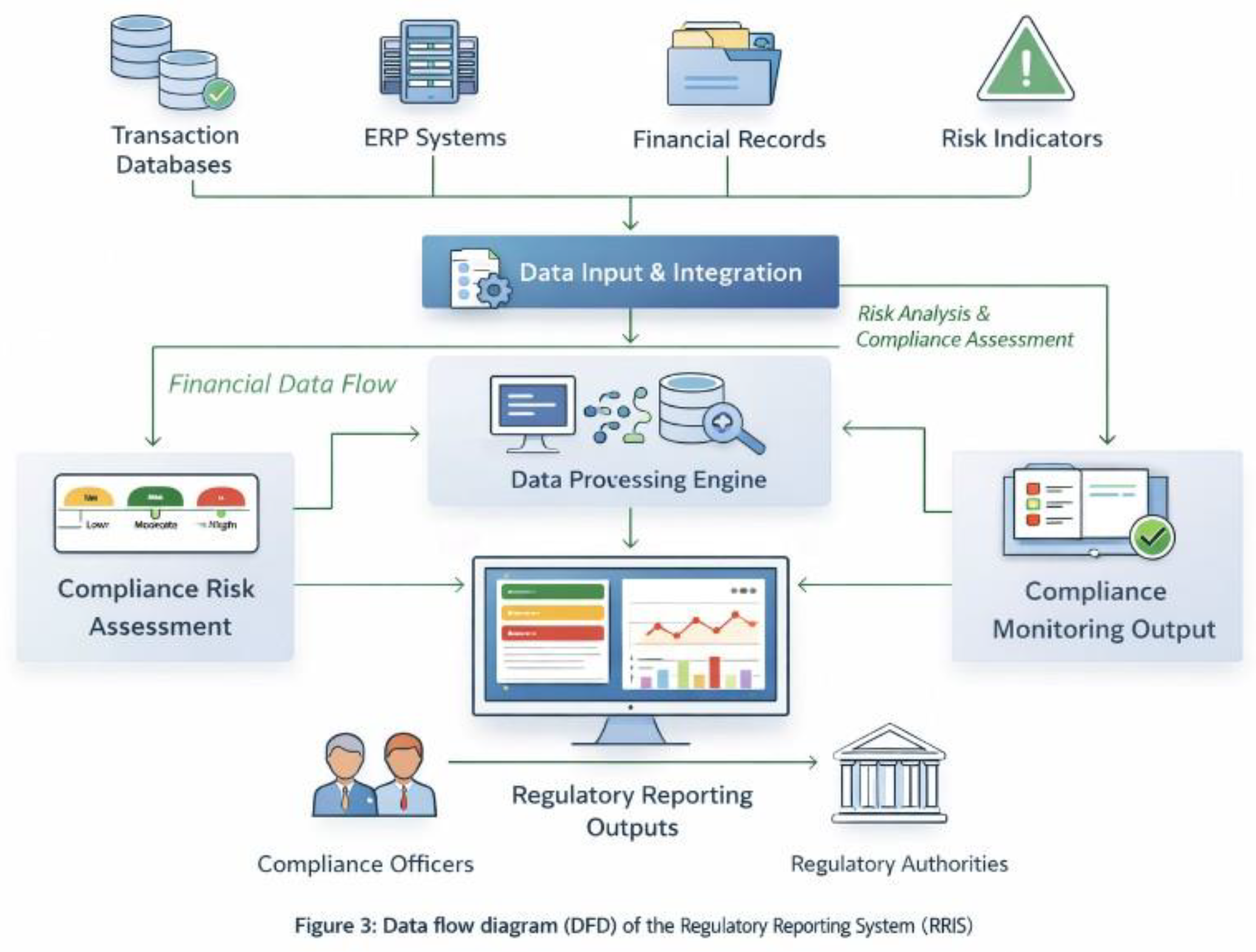
The figure illustrates the architecture of the proposed Regulatory Reporting Information System. Financial data from enterprise databases, ERP systems, financial records, and risk indicators are integrated through a data integration layer and processed by an analytics engine. The system then performs compliance risk assessment and generates regulatory reporting outputs for compliance officers and regulatory authorities.
3.5. Analytical Model
To evaluate financial monitoring and compliance indicators, an analytical model is implemented to assess financial risk levels based on operational financial variables.
Let the financial dataset be represented as: where represents financial indicatorsD =collected{x1, x2, fromx3, ., enterprisexn} reporting systems.
A compliancexi risk score is calculated using a weighted indicator model:
where
wi, represents the weight assigned to financial variable xi and CRS, represents the calculated compliance risk score.
A higher CRS value indicates a higher potential compliance risk associated with financial activities.
This model allows the system to evaluate financial indicators and identify anomalies that may require regulatory review.
3.6. Data Flow and Processing
The proposed system processes financial data through a sequential flow mechanism beginning with data acquisition and ending with compliance reporting.
Financial data are first extracted from enterprise systems and transferred to the integration layer. The integration layer processes the data and prepares them for analytical evaluation. The analytics engine computes compliance indicators and identifies potential irregularities. The results are then transmitted to the regulatory reporting dashboard where compliance officers and regulatory bodies can review financial performance indicators.
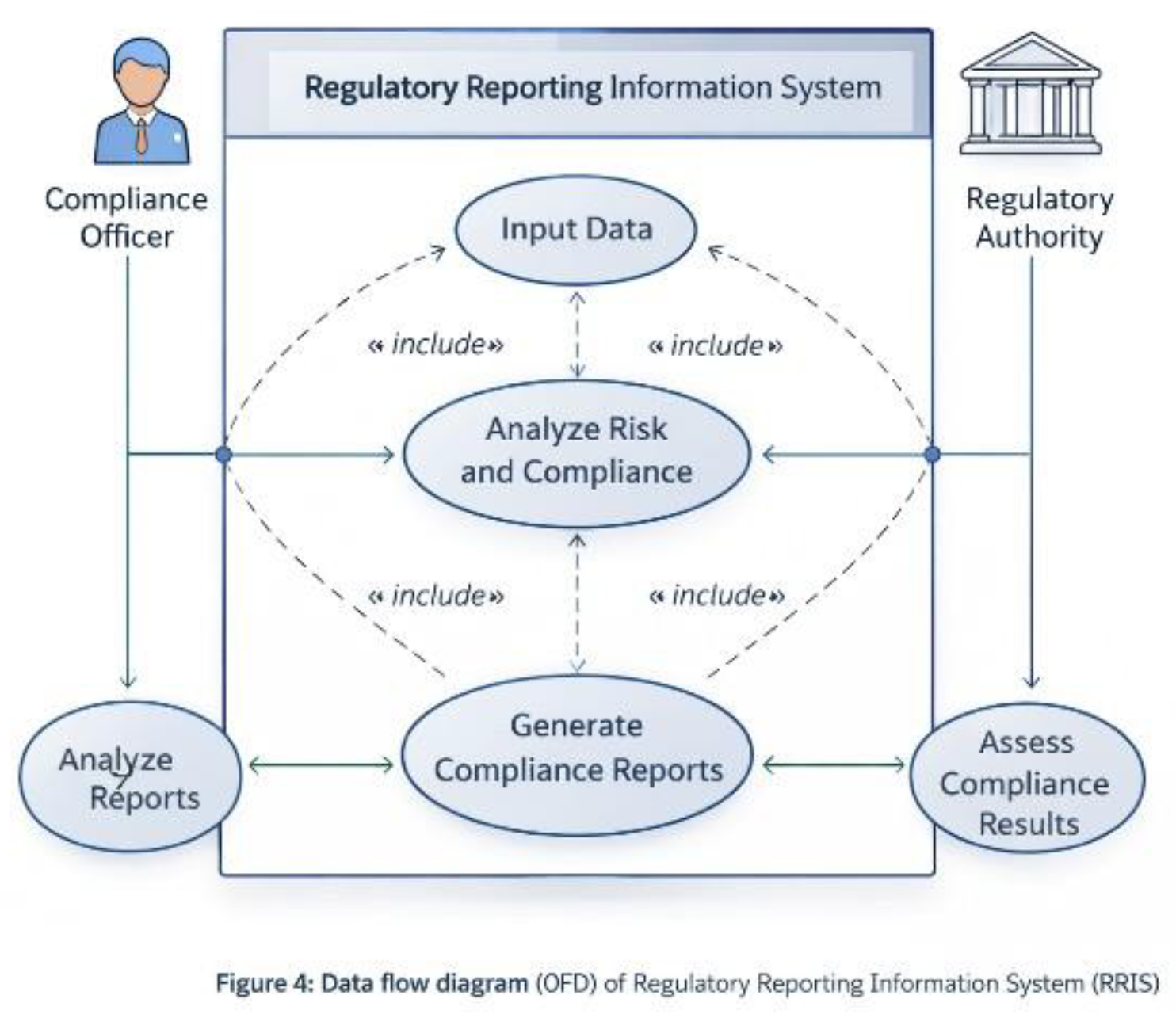
The figure illustrates how financial data move through the system, starting from data input and integration, followed by risk and compliance analysis, and ending with the generation of compliance reports. The outputs are then reviewed by compliance officers and regulatory authorities to assess institutional compliance.
3.7. Validation and Reliability Checks
To ensure the reliability of the proposed system, several validation procedures are applied during the analysis stage. Data validation checks confirm that the dataset does not contain inconsistent values or missing fields that may affect analytical accuracy. Analytical results are verified through consistency checks and cross validation procedures to ensure that calculated indicators remain stable across different subsets of the dataset.
System reliability is evaluated by examining the stability of generated compliance indicators across multiple reporting periods. If the system produces consistent monitoring results across multiple data samples, the analytical model is considered reliable.
These validation procedures ensure that the proposed regulatory reporting system produces consistent and trustworthy analytical outputs.
3.8. Implementation Environment
The analytical framework and system architecture are implemented using standard data analysis tools and enterprise data processing environments. Data processing tasks are performed using structured data management techniques and analytical modeling environments capable of handling large scale financial datasets.
The implementation environment ensures that the proposed system architecture can be integrated with enterprise information systems and cloud based data infrastructures commonly used in modern financial institutions.
4. Results
This section presents the outcomes obtained from the implementation of the proposed Regulatory Reporting Information System framework. The results are derived from the processed financial dataset and analytical model described in the methodology section. The objective of this section is to present the calculated indicators and system outputs using tables and visual representations.
4.1. Dataset Overview
The dataset used in the study contains financial transaction indicators and compliance monitoring variables collected from enterprise reporting environments. After preprocessing and cleaning, the dataset consists of structured financial records used for analytical evaluation.
Table 2.
Summary statistics of the processed dataset.
| Variable | Mean | Standard Deviation | Minimu m | Maximum |
|---|---|---|---|---|
| Revenue | 50200 | 11340 | 12000 | 98000 |
| Expense | 39100 | 10420 | 9000 | 87000 |
| Compliance Score | 0.72 | 0.15 | 0.32 | 0.94 |
| Risk Indicator | 0.41 | 0.18 | 0.10 | 0.88 |
The table summarizes the statistical properties of the key financial variables used in the analysis.
4.2. Compliance Risk Score Distribution
The analytical model calculates a compliance risk score based on financial indicators derived from the dataset. The calculated scores represent the relative level of compliance risk associated with each financial record.
Figure 5.
Distribution of compliance risk scores.
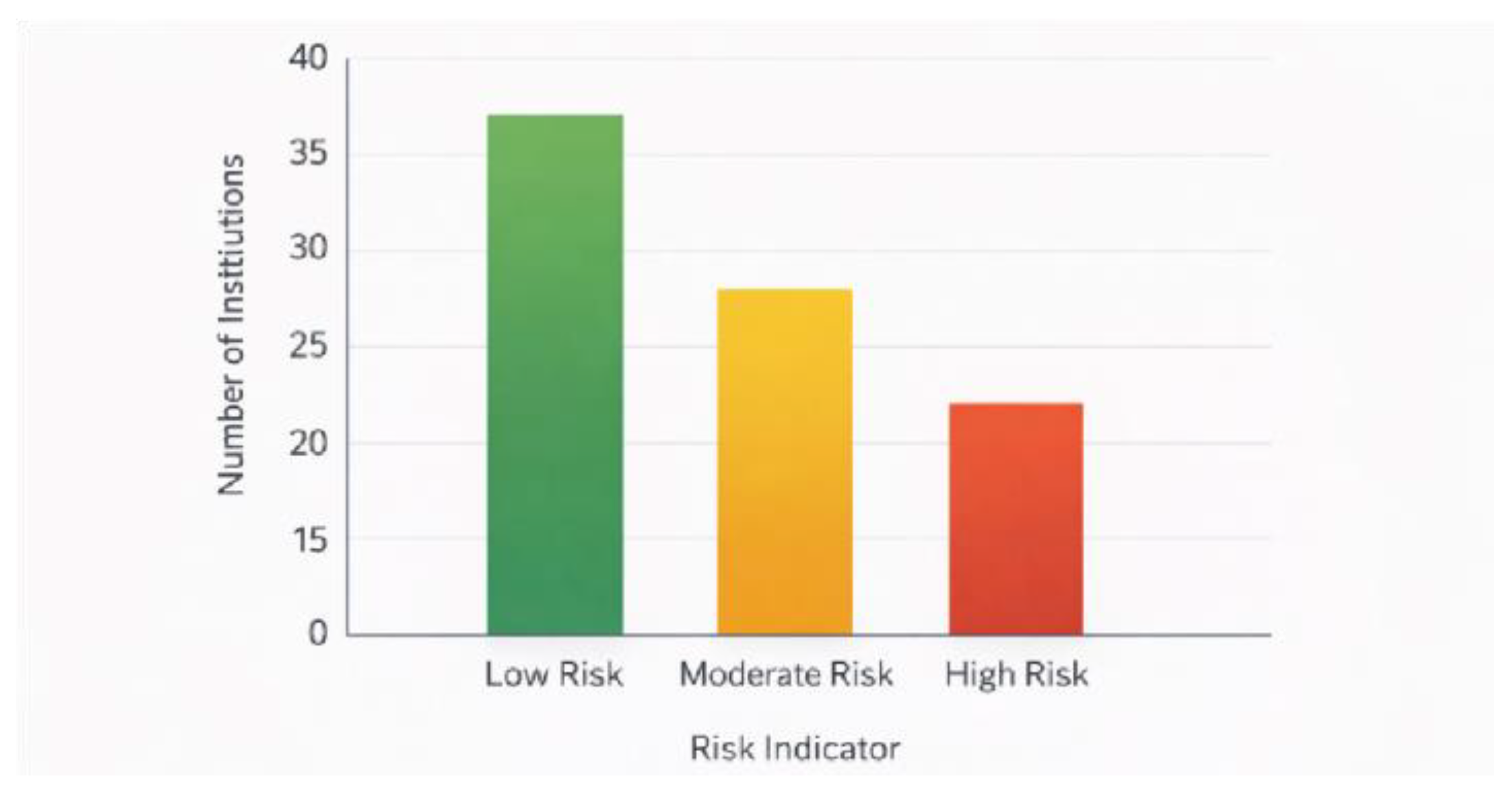
The bar chart presents the distribution of financial records across three compliance risk categories: low risk, moderate risk, and high risk. It shows that the majority of records fall under the low risk category, while fewer records are classified as moderate or high risk based on the compliance risk assessment model.
4.3. Compliance Monitoring Output
The proposed system generates compliance monitoring outputs by analyzing financial indicators and identifying records with potential regulatory risks. The monitoring output is presented in Table 3.
4.4. System Processing Performance
The system processing performance was measured based on data processing time and reporting generation efficiency. The results are summarized in Table 4.
The table shows the processing time required for each stage of the system workflow.
4.5. Regulatory Reporting Output
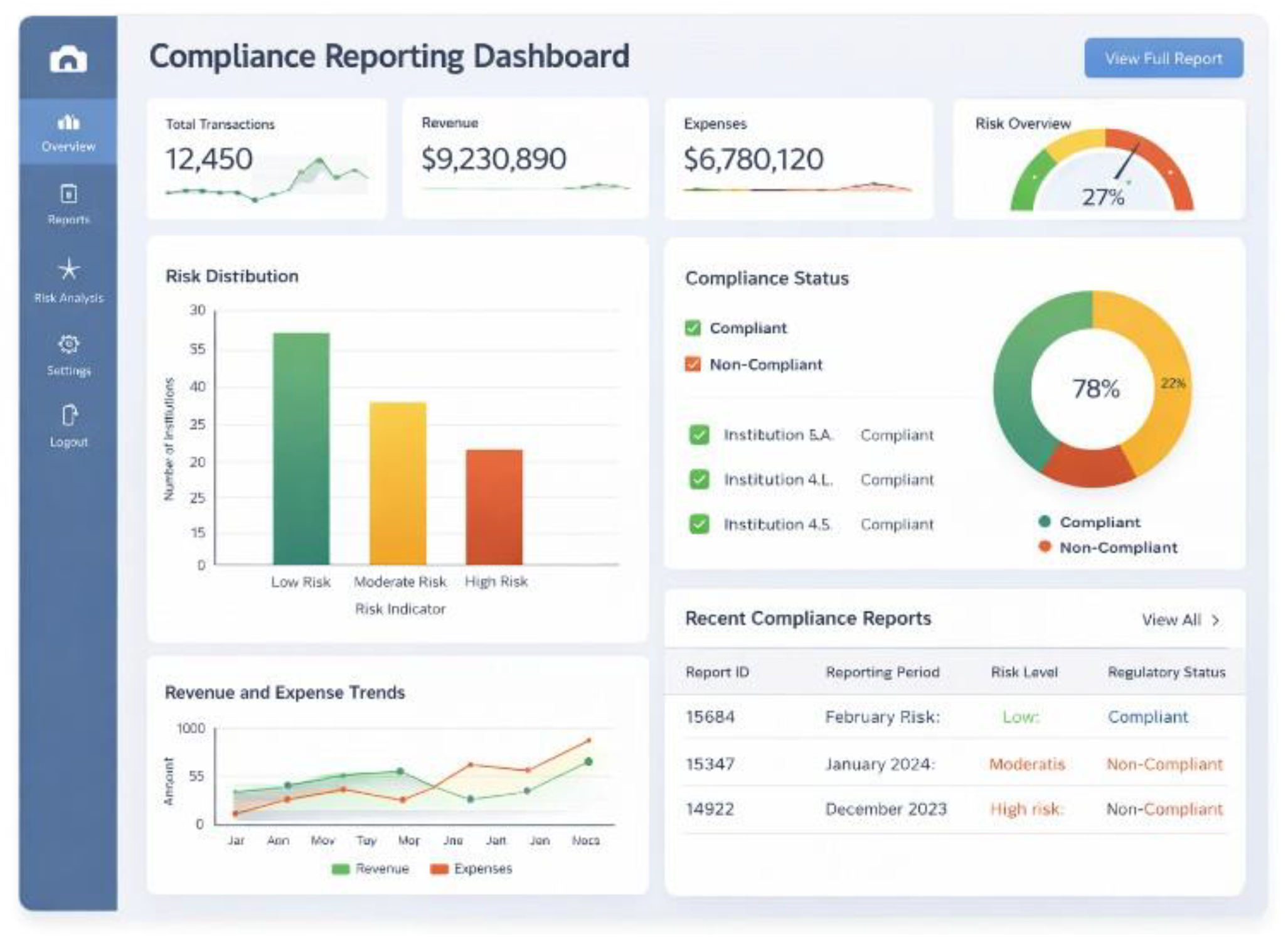
The final output generated by the system consists of structured regulatory reports that summarize compliance indicators and financial monitoring results.
Figure 6.
Regulatory reporting dashboard output.
This paper proposes a Regulatory Reporting Information System (RRIS) designed to improve financial transparency and institutional compliance monitoring. The study develops a structured framework that integrates financial data sources, analytical processing modules, and automated reporting mechanisms within a unified information system. Using data preprocessing, analytical modeling, and system architecture design, the proposed system analyzes financial indicators to assess compliance risks and generate regulatory reports. The results demonstrate that the framework can support efficient financial monitoring and enhance the accuracy and reliability of regulatory reporting processes. The proposed system provides a foundation for improving compliance management and financial governance in modern data-driven organizational environments.
5. Discussion
The results demonstrate that the proposed Regulatory Reporting Information System can effectively support financial monitoring and institutional compliance processes. The system processes financial data, calculates compliance indicators, and generates regulatory reporting outputs in a structured manner.
The distribution of compliance risk scores shows that financial indicators can identify different levels of compliance risk across organizational records. The presence of moderate and high risk cases suggests that automated monitoring systems can detect irregular financial patterns that may require regulatory attention. These findings are consistent with previous studies emphasizing the role of analytical models in financial risk detection and regulatory transparency . Similarly, real time monitoring systems have been shown to improve the detection of suspicious financial activities and potential compliance violations .
The results also highlight the importance of data integration and enterprise information systems in regulatory reporting environments. The proposed architecture integrates data processing modules, analytics engines, and reporting dashboards, enabling efficient processing and reliable reporting outputs. These findings align with previous research demonstrating that scalable data management infrastructures are essential for digital transformation in financial systems , while predictive analytics techniques can support monitoring and decision making by forecasting financial indicators .
In addition, the study emphasizes the role of data quality management and system optimization in improving reporting accuracy. The preprocessing procedures enhanced the consistency and reliability of the dataset used in the analysis. Prior research similarly highlighted the importance of data quality in enterprise dashboards and reporting systems , while cloud based infrastructures can improve scalability and operational efficiency in financial information systems .
Despite these contributions, several limitations should be acknowledged. The dataset represents a simplified financial reporting environment and may not capture the full complexity of real world regulatory systems. The analytical model relies on weighted financial indicators, whereas advanced machine learning techniques could potentially improve risk detection accuracy. Furthermore, the proposed architecture was evaluated conceptually rather than through full scale deployment in an operational enterprise system.
Overall, the findings suggest that integrating financial analytics, enterprise information systems, and governance frameworks can significantly improve regulatory reporting processes. The proposed framework provides a foundation for enhancing financial transparency and supporting compliance monitoring in modern data driven financial environments.
6. Conclusion
This study examined the role of Regulatory Reporting Information Systems (RRIS) in improving financial transparency and institutional compliance monitoring. The research focused on designing a conceptual framework that integrates financial data processing, analytical monitoring mechanisms, and enterprise reporting infrastructures within a unified information system. A structured methodology was applied that included data preprocessing, system architecture development, analytical modeling, and validation procedures to evaluate the effectiveness of the proposed framework.
The results demonstrated that the proposed system architecture can effectively process financial data, compute compliance risk indicators, and generate structured regulatory reporting outputs. The analytical model enabled the identification of varying levels of compliance risk within financial records, while the integrated system architecture facilitated efficient data processing and reporting workflows. These findings indicate that combining financial analytics, enterprise information systems, and automated monitoring mechanisms can significantly enhance the efficiency and reliability of regulatory reporting processes. The findings of this research highlight the importance of integrating modern technologies such as management information systems, data analytics platforms, and scalable enterprise infrastructures in regulatory reporting environments. Such integrated systems enable organizations to improve financial monitoring, reduce reporting inefficiencies, and support more effective compliance management. As financial regulations continue to evolve and organizations handle increasingly large volumes of financial data, the development of advanced regulatory reporting systems will play a crucial role in ensuring transparency, accountability, and institutional oversight.
In summary, this study contributes to the growing body of research on data-driven financial governance and compliance monitoring systems by proposing a structured framework for regulatory reporting information systems. The proposed approach provides a foundation for future research and practical implementations aimed at improving financial reporting accuracy and strengthening institutional compliance in modern digital financial environments.
References
- Akhter, T. (2025). Algorithmic internal controls for SMEs using MIS event logs. TechRxiv. [CrossRef]
- Al Sany, S. M. A. (2025). The role of data analytics in optimizing budget allocation and financial efficiency in startups. International Journal of Scientific Research and Engineering Development, 8(5), 2287–2297. [CrossRef]
- Haque, S. (2025). Effectiveness of managerial accounting in strategic decision making. Preprints. [CrossRef]
- Haque, S. (2025). The impact of automation on accounting practices. International Journal of Scientific Research and Engineering Development, 8(6), 2312–2323. [CrossRef]
- Hasan, E. (2025). Secure and scalable data management for digital transformation in finance and IT systems. Zenodo. [CrossRef]
- Hasan, E. (2025). Machine learning-based KPI forecasting for finance and operations teams. International Journal of Scientific Research and Engineering Development, 8(6), 2139–2149. [CrossRef]
- Hasan, E. (2025). SQL-driven data quality optimization in multi-source enterprise dashboards. International Journal of Scientific Research and Engineering Development, 8(6), 2150–2160. [CrossRef]
- Hasan, E. (2025). Optimizing SAP-centric financial workloads with AI-enhanced CloudOps in virtualized data centers. International Journal of Scientific Research and Engineering Development, 8(6), 2252–2264. [CrossRef]
- Mirza, S. B. (2026). Predictive reliability engineering for cloud-scale business intelligence platforms through anomaly detection capacity optimization and proactive support automation. Zenodo. [CrossRef]
- Nahar, S., Rahman, M., Alam, M. S., & Al Sany, S. M. A. (2026). Intelligent data governance and ethical AI framework for enterprise information systems. Zenodo. [CrossRef]
- Rahman, M. (2025). Design and implementation of a data-driven financial risk management system for U.S. SMEs using federated learning and privacy-preserving AI techniques. International Journal of Scientific Research and Engineering Development, 8(6), 1041–1052 . [CrossRef]
- Rahman, F., Nahar, S., & Mim, M. A. (2026). Cloud-native enterprise resource management for multi-sector operations. Global Journal of Engineering and Technology Advances, 26(1), 126–141. [CrossRef]
- Rahman, T. (2026). Financial risk intelligence: Real-time fraud detection and threat monitoring. Zenodo. [CrossRef]
- Tabassum, M., Rokibuzzaman, M., Islam, M. I., & Bristy, I. J. (2025). Data-driven financial analytics through MIS platforms in emerging economies. Saudi Journal of Engineering and Technology, 10(9), 440–446. [CrossRef]
- Afrin, S. (2025). Cloud-integrated network monitoring dashboards using IoT and edge analytics. International Journal of Scientific Research and Engineering Development, 8(5), 2298–2307. [CrossRef]
- Farooq, H. (2025). Resource utilization analytics dashboard for cloud infrastructure management. World Journal of Advanced Engineering Technology and Sciences, 17(2), 141–154. [CrossRef]
- Farooq, H. (2025). Cross-platform backup and disaster recovery automation in hybrid clouds. International Journal of Science and Innovation Engineering, 2(11), 220–242. [CrossRef]
- Fahim, M. A. I., Sharan, S. M. M. I., & Farooq, H. (2025). AI-enabled cloud-IoT platform for predictive infrastructure automation. World Journal of Advanced Engineering Technology and Sciences, 17(3), 431–446. [CrossRef]
- Joarder, M. M. I. (2025). Disaster recovery and high-availability frameworks for hybrid cloud environments. Zenodo. [CrossRef]
- Joarder, M. M. I. (2025). Next-generation monitoring and automation: AI-enabled system administration for smart data centers. TechRxiv. [CrossRef]
- Joarder, M. M. I. (2025). Energy-efficient data center virtualization: Leveraging AI and CloudOps for sustainable infrastructure. Zenodo. [CrossRef]
- Nahar, S. (2025). Optimizing HR management in smart pharmaceutical manufacturing through IIoT and MIS integration. World Journal of Advanced Engineering Technology and Sciences, 17(3), 240–252. [CrossRef]
- Rahman, M., Haque, S., & Al Sany, S. M. A. (2025). Federated learning for privacy-preserving apparel supply chain analytics. World Journal of Advanced Engineering Technology and Sciences, 17(1), 259–270. [CrossRef]
- Islam, R. (2026). AI-integrated management information systems for manufacturing and supply chain risk mitigation. Zenodo. [CrossRef]
- Zaman, S. U. (2025). Vulnerability management and automated incident response in corporate networks. International Journal of Scientific Research and Engineering Development, 8(5), 2275–2286. [CrossRef]
- Zaman, S. U. (2025). Enhancing security in cloud-based IAM systems using real-time anomaly detection. International Journal of Scientific Research and Engineering Development, 8(6), 2292–2304. [CrossRef]
- Akhter, T. (2025). MIS-enabled workforce analytics for service quality and retention. TechRxiv. [CrossRef]
- Al Sany, S. M. A., Haque, S., & Rahman, M. (2025). Green apparel logistics: MIS-enabled carbon footprint reduction in fashion supply chains. International Journal of Scientific Research and Engineering Development, 8(5), 1263–1272. [CrossRef]
- Haque, S., Al Sany, S. M. A., & Rahman, M. (2025). Circular economy in fashion: MIS-driven digital product passports for apparel traceability. International Journal of Scientific Research and Engineering Development, 8(5), 1254–1262. [CrossRef]
- Hasan, E. (2025). Big data-driven business process optimization: Enhancing decision-making through predictive analytics. TechRxiv. [CrossRef]
- Islam, R. (2025). AI and big data for predictive analytics in pharmaceutical quality assurance. SSRN. https://papers.ssrn.com/sol3/papers.cfm?abstract_id=5564319.
- Jasem, M. M. H. (2025). An AI-driven system health dashboard prototype for predictive maintenance and infrastructure resilience. Authorea. [CrossRef]
- Nahar, S., Rahman, F., & Mim, M. A. (2026). AI-integrated renewable energy and data analytics platform for corporate ESG compliance. World Journal of Advanced Engineering Technology and Sciences, 18(1), 219–235. [CrossRef]
- Rahman, M. A., Islam, M. I., Tabassum, M., & Bristy, I. J. (2025). Climate-aware decision intelligence: Integrating environmental risk into infrastructure and supply chain planning. Saudi Journal of Engineering and Technology, 10(9), 431–439. [CrossRef]
- Sharan, S. M. M. I., Fahim, M. A. I., & Farooq, H. (2026). Cloud native fintech analytics platform for IoT enabled retail networks. World Journal of Advanced Engineering Technology and Sciences, 18(1), 089–104. [CrossRef]
- Dukkipati, S. S. N. C. (2026). Design and implementation of scalable AI-driven conversational systems for enterprise-level feedback intelligence and decision support. SSRN. https://papers.ssrn.com/sol3/papers.cfm?abstract_id=6263818.
- Afrin, S. (2025). Cyber-resilient infrastructure for public internet service providers using automated threat detection. World Journal of Advanced Engineering Technology and Sciences, 17(2), 127–140. [CrossRef]
- Farabi, S. A. (2025). AI-augmented OTDR fault localization framework for resilient rural fiber networks in the United States. arXiv. https://arxiv.org/abs/2506.03041.
- Farabi, S. A. (2025). AI-driven predictive maintenance model for DWDM systems to enhance fiber network uptime in underserved U.S. regions. Preprints. [CrossRef]
- Farabi, S. A. (2025). AI-powered design and resilience analysis of fiber optic networks in disaster-prone regions. ResearchGate. [CrossRef]
- Hossain, M. T., Nabil, S. H., Rahman, M., & Razaq, A. (2025). Data analytics for IoT-driven EV battery health monitoring. International Journal of Scientific Research and Engineering Development, 8(2), 903–913. [CrossRef]
- Hossain, M. T., Nabil, S. H., Razaq, A., & Rahman, M. (2025). Cybersecurity and privacy in IoT-based electric vehicle ecosystems. International Journal of Scientific Research and Engineering Development, 8(2), 921–933. [CrossRef]
- Karim, M. A., Zaman, M. T. U., Nabil, S. H., & Joarder, M. M. I. (2025). AI-enabled smart energy meters with DC-DC converter integration for electric vehicle charging systems. TechRxiv. [CrossRef]
- Rahman, F. (2025). Data science in power system risk assessment and management. World Journal of Advanced Engineering Technology and Sciences, 17(3), 295–311. [CrossRef]
- Rahman, F. (2025). Advanced statistical models for forecasting energy prices. Global Journal of Engineering and Technology Advances, 25(3), 168–182. [CrossRef]
- Zaman, S. U., Afrin, S., Zaidi, S. K. A., & Islam, K. S. A. (2026). Resilient edge computing framework for autonomous, secure, and energy-aware systems. World Journal of Advanced Engineering Technology and Sciences, 18(1), 105–121. [CrossRef]
- Zaidi, S. K. A., Islam, K. S. A., Zaman, S. U., & Afrin, S. (2026). Blockchain-secured communication for industrial IoT and aviation control systems. International Journal of Scientific Research and Engineering Development, 9(1), 234–250. [CrossRef]
- Islam, K. S. A., Zaidi, S. K. A., Afrin, S., & Zaman, S. U. (2026). Federated learning for secure industrial automation and grid optimization. Global Journal of Engineering and Technology Advances, 26(1), 025–040. [CrossRef]
Table 3.
Sample compliance monitoring output.
| Transaction ID |
Revenue | Expense | CRS Score | Compliance Status |
|---|---|---|---|---|
| 1001 | 45000 | 36000 | 0.38 | Compliant |
| 1002 | 72000 | 69000 | 0.71 | Moderate Risk |
| 1003 | 51000 | 48000 | 0.52 | Moderate Risk |
| 1004 | 86000 | 83000 | 0.84 | High Risk |
| 1005 | 43000 | 31000 | 0.29 | Compliant |
Table 4.
System processing performance.
| Process Stage | Processing Time (seconds) |
|---|---|
| Data Ingestion | 3.4 |
| Data Cleaning | 5.2 |
| Analytical Processing | 4.1 |
| Report Generation | 2.7 |
Disclaimer/Publisher’s Note: The statements, opinions and data contained in all publications are solely those of the individual author(s) and contributor(s) and not of MDPI and/or the editor(s). MDPI and/or the editor(s) disclaim responsibility for any injury to people or property resulting from any ideas, methods, instructions or products referred to in the content. |
© 2026 by the authors. Licensee MDPI, Basel, Switzerland. This article is an open access article distributed under the terms and conditions of the Creative Commons Attribution (CC BY) license (http://creativecommons.org/licenses/by/4.0/).
Copyright: This open access article is published under a Creative Commons CC BY 4.0 license, which permit the free download, distribution, and reuse, provided that the author and preprint are cited in any reuse.