

Submitted:
07 May 2026
Posted:
07 May 2026
You are already at the latest version
Abstract
The heel-strike (HS) paradigm of human gait originates from 19th-century chronophotographic studies conducted on Georges Demeny, a gymnasium instructor whose performed, exaggerated gait was never representative of natural locomotion. A compounding martial bias further normalised HS through military marching drill. A multi-disciplinary convergent argument analysis is conducted, integrating philological, zoological, anatomical, biomechanical, neurological and socioeconomic lines of evidence. All seven lines of argument support a forefoot-first model in which the centre of mass (CoM) leads the movement, stabilisers control equilibrium proactively, and the Triceps surae works in continuous eccentric mode---its natural functional state. Heel-strike generates impact forces up to 700 N with an ascending braking vector, under-recruits Gluteus maximus, progressively impoverishes plantar mechanoreceptors, and transmits repeated microtraumatic impulses up to the brain. Natural human gait is organised around forefoot contact, progressive CoM advance, and continuous eccentric stabiliser activity. The proposed model rediscovers lightness: a dance with gravity rather than a war against it. The HS paradigm is a culturally conditioned artefact with measurable pathological consequences.
Keywords:
human gait
; forefoot strike
; heel strike
; centre of mass
; Triceps surae
; eccentric contraction
; biomechanics
; physiotherapy
; osteoarthritis prevention
; plantar mechanoreceptors
1. Introduction
At the turn of the twentieth century, the Station Physiologique in the Bois de Boulogne became the world’s first instrumental laboratory of human movement analysis. Étienne-Jules Marey developed chronophotography there, and his collaborator Georges Demeny served as the principal experimental subject [31,32]. The resulting imagery formed an implicit reference for the dominant heel-strike (HS) paradigm of human gait.
A fundamental methodological limitation has been largely overlooked: Demeny was a gymnasium instructor, fully aware that he was being filmed. Such a subject invariably produces a gait exaggerated in its amplitudes—not representative of natural locomotion. This gymnast bias is compounded by a martial bias: HS was institutionalised by infantry battalions for collective synchronisation, not on biomechanical grounds.
The present article proposes a reassessment of the HS paradigm through seven convergent lines of argument. The central thesis: natural human gait is organised around forefoot contact, progressive CoM advance, and continuous eccentric stabiliser activity. This model does not oppose gravity—it plays with it.
2. Heel-Strike in the Canonical Literature
2.1. The Perry–Burnfield Framework
The dominant gait paradigm in clinical and biomechanical reference works codifies heel-strike as the defining event of stance. In Perry and Burnfield’s Gait Analysis: Normal and Pathological Function [4]—the international clinical reference issued by the Rancho Los Amigos National Rehabilitation Center–the gait cycle is partitioned into eight phases beginning with Initial Contact, defined as the moment when “floor contact is made with the heel”. The subsequent Loading Response is structured around what the authors term “the heel as a rocker”. The taxonomy is internally coherent but epistemologically closed: the question how does walking begin? receives the answer with heel contact not as observation but as definition.
In the chapter on gait deviations, forefoot contact is consequently classified as a pathological deviation whose listed causes are exclusively dysfunctional: pretibial weakness or contracture in plantar flexion, combined ankle equinus and knee flexion, compensation for heel pain or compensation for limb-length discrepancy. The hypothesis that forefoot contact may correspond to physiological gait is structurally absent from the framework. The asymmetry is revealing: nowhere does the work consider heel contact as a possible source of pathology because heel contact is, ontologically within this system, the norm against which deviation is measured.
2.2. The Whittle Paradox
Whittle [3], in the equivalent British reference, reproduces the same convention: Initial Contact is identified with “heel strike”, described as “a distinct impact between the heel and the ground”, the so-called heelstrike transient. However, three observations made by Whittle himself are difficult to reconcile with the heel-strike norm.
First, the energy of the heelstrike is acknowledged as dissipated—“lost to the environment as sound and heat”—and not recovered later in the stance phase. The impact transient is therefore biomechanically wasted, not stored, and returned. The Achilles tendon’s elastic energy storage and return function [22] is, according to Whittle’s own account, bypassed at heel contact.
Second, “small children do not have a heel strike, the initial contact being made with the flat foot”. The locomotor developmental pattern of the human child is not heel-strike. The ankle is plantarflexed at initial contact and remains so in early stance, in direct contrast to the so-called adult pattern. The mature heel-strike pattern is therefore acquired, not innate.
Third, of all muscles involved in walking, the Triceps surae is the last to adopt the so-called adult activation pattern: above 60% of children below age 2 retain the prolonged “infant” pattern, and the proportion only falls below 30% by age 7 [3]. The single muscle whose function is propulsion in forefoot loading is precisely the one whose “infant” activation persists longest, a coherence the canonical reading does not acknowledge.
2.3. The Inversion of Norm and Deviation
Both works codify the empirical pattern observed in habitually shod adults of industrialised populations as the species norm. The developmental locomotor pattern of the child, the energetic dissipation of the impact transient, and the prolonged “infant” activation of the triceps surae are consigned to the status of immature features to be outgrown. The present article proposes an alternative reading: these are not deviations from the norm but expressions of it.
The same paradigm is reproduced in the contemporary French-language reference literature with internal tensions of its own. Dedieu [30], in the EMC-Podologie reference chapter on the anatomy and physiology of human gait, explicitly rejects a strictly topographical decomposition of the stance phase (taligrade → plantigrade → digitigrade) on the grounds that it depends on “walking speed and anatomo-physiological factors” and cannot be directly tied to functional needs. The same reference acknowledges that initial contact can occur at the forefoot in trained contexts (classical dance) and describes the soleus as active in synergy from the moment of initial contact, contributing to calcaneal stabilisation through eccentric tibial control –a regulatory role consistent with the present model.
In the recent French-language reference manual [29], the editorial allocation is itself revealing. Heel-strike (attaque taligrade) is treated across three sub-sections (rocker analysis, sub-classification into universal, pronator and supinator runners), while forefoot strike (attaque digitigrade) is dispatched in two lines and reduced to a 1–2% prevalence in elite distance runners. However, the same manual acknowledges, in the chapter on footwear, that barefoot walking in children reduces both the centre-of-mass vertical excursion and the energetic cost compared to shod walking [27], and that barefoot walking induces lower vertical impact force, more homogeneous plantar pressure distribution, and flatter foot placement [26], recommending that “barefoot walking phases be introduced into daily practice as far as possible”. The structural under-representation of the forefoot pattern in the manual coexists with explicit empirical acknowledgements of its biomechanical advantages.
The same reference [29] reproduces, in graphical form, three superposed vertical ground reaction force curves that compare the bare foot rear foot strike, the shod rear foot strike with cushioned footwear and the forefoot strike. The passive impact peak (pic d’impact passif, impact transitoire) of the first 50 ms is present in both rearfoot conditions and is abolished in the forefoot condition—reproducing the canonical finding of Lieberman et al. [5] for habitually unshod runners and confirmed in randomised gait retraining trials [25]. Modern cushioned footwear reduces the impact transient by approximately 10% relative to the barefoot rearfoot condition, while the change in strike pattern eliminates it. The verbatim recording of “forefoot strike permits a reduction of the impact force is not the case in heel strike, whether shod or unshod”, and provides an explicit description of the ascending propagation of the impact wave: “the shock wave propagates from the heel to the top of the skull, and each bony or soft tissue structure absorbs part of this shock wave; the cumulative absorption of this repeated shock wave can lead to numerous pathologies: stress fractures, premature wear of joint surfaces, soft tissue pathologies”. The dominant biomechanical paradigm therefore contains within itself, in 2018, the empirical and mechanistic recognition of a phenomenon that it continues to classify as a deviation.
3. Theoretical Framework and Lines of Argument
3.1. Biomechanical Vector Analysis
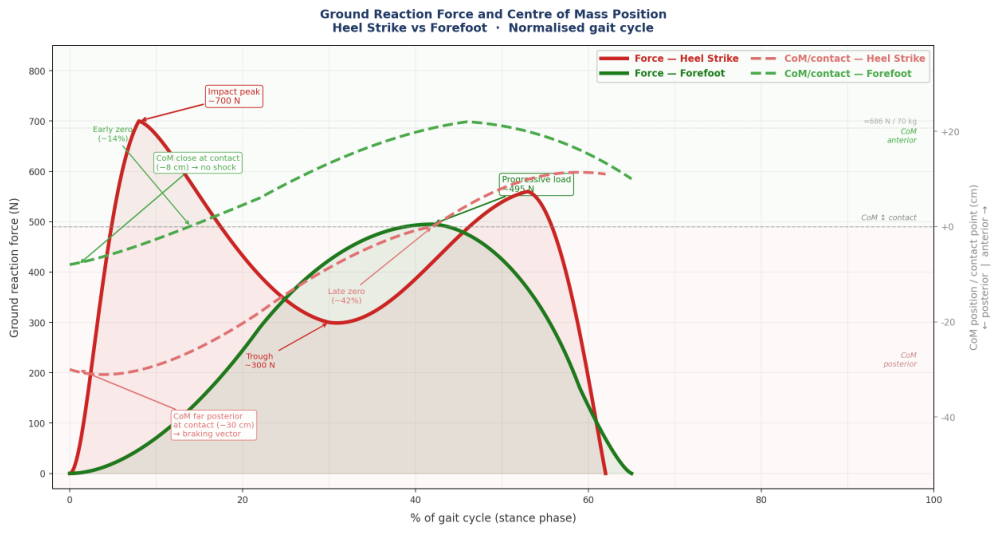
The ground reaction force (GRF) analysis provides an objective comparison of the two models [2]. In HS, initial contact generates a braking force peak approaching 700 N. The foot is placed far anterior to the vertical projection of the CoM, while the heel–always posterior to the ankle–absorbs the impact. This configuration generates a posterior (braking) horizontal force component. This discontinuous vector propagates through the ascending articular chain: ankle, knee, hip, lumbar spine, and–accumulated over millions of cycles–brain [1,2].
In the forefoot model, the GRF is initially near zero and increases progressively as the CoM advances. The resultant vector is propulsive [5]. No impulse peak. Energy is absorbed and returned by the plantar arch, the musculotendinous complex, and the Achilles tendon. The model significantly reduces vertical CoM excursion [22]: a near-uniform translation rather than a costly vertical sinusoid.
The modelling work of Kuo [23] provides direct quantitative support for this asymmetry. In the simplest powered walking model, an impulse applied along the trailing leg immediately before heel strike is approximately four times less energetically costly than the equivalent energy supplied through a hip torque on the stance leg. The reason is mechanical: toe-off actuation reduces the collision loss at heel strike, whereas hip actuation increases it. The heel strike is treated in this model as an inelastic collision dissipating mechanical energy – an explicit formalisation of the energetic penalty incurred by the HS paradigm and a quantitative complement to the dissipation observation made by Whittle himself [3].
3.2. Philological Argument
From Old French marchier, "to strike or press the ground downward," the concept of walking was originally understood as a vertical, active downward thrust, not a heel-to-toe roll. Horizontal progression is the mechanical resultant, not the conceptual origin. Pre-industrial cultures conceptualised walking as active downward loading, consistent with forefoot contact.
Figure 1.
Ground reaction force (solid lines, left axis) and centre of mass position relative to the contact point (dashed lines, right axis) during the stance phase, expressed as a % of the gait cycle. Under heel strike, the CoM is far posterior at peak impact (≈700 N, cm): the resultant vector is braking. Under forefoot gait, force and CoM advance are in phase (≈495 N, zero crossing at ≈14 %): the resultant vector is propulsive. Curves are schematic, drawn with Bézier functions from normative literature data.
Figure 1.
Ground reaction force (solid lines, left axis) and centre of mass position relative to the contact point (dashed lines, right axis) during the stance phase, expressed as a % of the gait cycle. Under heel strike, the CoM is far posterior at peak impact (≈700 N, cm): the resultant vector is braking. Under forefoot gait, force and CoM advance are in phase (≈495 N, zero crossing at ≈14 %): the resultant vector is propulsive. Curves are schematic, drawn with Bézier functions from normative literature data.
3.3. Zoological Argument
No high-performance mammal strikes the heel during active locomotion. Digitigrade species (Felidae, Canidae, Equidae) and plantigrade primates in active bipedal posture contact the ground via the forefoot or midfoot [1]. The classification of Homo sapiens as plantigrade indicates that the full plantar surface can contact the ground, not that heel initiation is the functional norm.
3.4. Anatomical Argument
The distal insertions of the primary ankle stabilisers all converge in the forefoot and midfoot, not in the calcaneus (Table 1). These tendons pass behind the malleoli, acting as pulley systems. Their mechanical efficiency is maximal with the heel raised. Under heel strike, this pulley system is neutralised: stabilisers arrive in reactive catch-up mode, out of phase with their natural activation sequence.
Under heel strike, Gluteus maximus – the primary hip extensor and frontal-plane pelvic stabiliser –is sub-optimally recruited: the impact phase desynchronises its activation relative to the CoM progression cycle. Under forefoot gait, it is recruited early and coordinately. Its chronic under-recruitment under HS provides a direct mechanistic explanation for the high prevalence of lumbar pain: the lumbar spine assumes stabilising loads that Gluteus maximus should absorb.
The Achilles tendon functions as an elastic energy storage and return spring [22], a mechanism optimal under forefoot loading. Under heel strike, it is mechanically bypassed in its propulsive function.
3.5. Physical Argument — Ascending Constraint Chain
At 6,000–8,000 steps per day, even a modest mechanical excess per step accumulates into millions of microtraumatic events [2].
Ascending constraint chain under heel strike: (1) tibiotalar joint—partial absorption by ligamentous and capsular complex; (2) femorotibial compartment—compression amplified by quadriceps contraction; (3) coxofemoral joint—axial compression and shear, with under-recruitment of Gluteus maximus; (4) lumbosacral segment L4–L5, L5–S1—residual absorption by intervertebral discs and facet joints; (5) thoracic and cervical spine—attenuated propagation through vertebral curvatures; (6) brain—repeated accelerations of the cerebral mass, cumulative microtrauma over millions of cycles. This pattern is entirely absent from the forefoot gait.

Table 1.
Distal insertions of ankle and foot stabilising muscles
| Muscle | Insertion at foot | Malleolar passage | Forefoot |
|---|---|---|---|
| Tibialis anterior | 1st cuneiform + base 1st metatarsal | Anterior to ankle | |
| Tibialis posterior | Navicular + cuneiforms | Behind medial malleolus | |
| Fibularis longus | Base 1st metatarsal (plantar) | Behind lateral malleolus | |
| Fibularis brevis | Base 5th metatarsal | Behind lateral malleolus | |
| Flexor hallucis longus | Distal phalanx hallux | Behind medial malleolus | |
| Flexor digitorum longus | Distal phalanges 2nd–5th | Behind medial malleolus | |
| Extensor hallucis longus | Distal phalanx hallux (dorsal) | Anterior to ankle | |
| Extensor digitorum longus | Phalanges 2nd–5th (dorsal) | Anterior to ankle | |
| Triceps surae | Calcaneus | Direct — no pulley | — |
8 of 9 muscles achieve maximal mechanical efficiency with the heel raised. The Triceps surae, inserting solely on the calcaneus, is optimised in forefoot loading for its role as eccentric brake on tibial advance—not as a simple propulsive actuator.
This ascending chain is not a speculative construct: it is recognised in identical terms by the contemporary reference literature on human locomotion [29] (cf. §2.3 for the verbatim quotation). The vertical loading rate—the slope between initial contact and the passive impact peak—has been independently identified as a risk factor for repetitive stress injury [25]. The point of disagreement with the dominant paradigm is therefore not the existence of the chain but its categorisation as physiological rather than pathological.
3.6. Empirical Validations
Classical dance and martial arts universally adopt the forefoot guard: the only configuration that allows instant multidirectional response.
Tightrope walking: heel contact on a cable is mechanically impossible. The forefoot system with eccentric Triceps suprae is the only one available and sufficient to cross a cable at height [1].
Backward walking: heel strike is mechanically excluded. The CNS retrieves the forefoot pattern instantly and without conscious instruction—direct evidence that the natural motor programme is intact, merely inhibited. A first-line rehabilitative tool.
Descent in unstable terrain: heel strike generates a horizontal component that destabilises stones. The forefoot creates an essentially vertical force that locks the stone. The same physics as ski carving.
Ontogenesis: the child learning to walk spontaneously adopts the forefoot pattern, without instruction [3,5]. This programme is progressively inhibited by rigid-soled footwear. Comparative evidence shows that children growing up habitually barefoot retain forefoot or midfoot strike patterns significantly more often than their habitually shod peers [10].
Unshod populations: significantly lower rates of lower-limb osteoarthritis and foot deformities are observed in habitually unshod populations compared to shod Western populations [5,9,12]. In a survey of 1,846 skeletally mature individuals in southern India, those who never wore foot shoes before age 16 had approximately half the prevalence of flat foot of those who grew up shod [12].
High-heeled shoes: forced forefoot load in captive mode – documented increased valgus moment at the knee [24]. Confirms that the free forefoot is the prerequisite for biomechanical efficiency.
The child on the kerb: walks in perfect forefoot balance along the edge of a pavement. The parent warns: “careful, you will fall”—thereby revealing that the parent has lost this very capacity. Cultural transmission of motor pattern degradation enacted in commonplace exchange.
3.7. Comparative Biomechanical and Epidemiological Evidence
The empirical literature comparing forefoot and rearfoot patterns has expanded considerably since the seminal work of Lieberman et al [5]. Three convergent lines of evidence are particularly relevant.
Walking biomechanics in habitually unshod populations. Wallace et al. [7] compared ground reaction forces during walking in Tarahumara subsistence farmers of Mexico, who habitually wear minimal sandals (huaraches), and in urban Americans equipped with comparable minimal sandals. Even with minimal footwear, vertical impact peaks were significantly higher in magnitude, slower in loading rate, and larger in vertical impulse than during barefoot walking in both populations. The authors conclude that humans tread more lightly when walking barefoot than in any footwear, however minimal. This finding extends to walking the conclusions previously established for running.
Acute kinematic and kinetic effects of footwear in habitually shod adults. A systematic review of the literature comparing barefoot and shod walking [26] synthesises the consistent acute effects of footwear removal in habitually shod populations: reduced step and stride length, increased cadence, flatter foot placement, increased knee flexion at initial contact, reduced peak vertical ground reaction force at initial contact, lower peak plantar pressures and lower pressure impulses. The same review documents that habitually barefoot populations exhibit anatomically wider feet with greater forefoot spreading under load. The acute biomechanical signature of barefoot walking is therefore a regression of the habitually shod gait pattern toward a configuration converging with the model proposed here.
Foot morphology and integrity in habitually unshod populations. A multicenter cross-sectional study of 810 children and adolescents documented that those growing up habitually barefoot have significantly higher static and dynamic arch heights, wider feet in the forefoot region, and reduced hallux abduction angles compared to habitually shod peers with the same age, sex, and ethnicity [9]. In adults, comparing habitually minimally-shod populations with conventionally shod controls reveals greater foot strength, greater longitudinal arch stiffness, and a reduced prevalence of pes planus and hallux valgus [11,12]. The energetic counterpart of these morphological differences has been documented in children: At a self-selected pace, barefoot walking generates a lower oxygen uptake and a smaller vertical excursion into the centre of mass than shod walking, the difference being attributable to the added mass of the footwear, the constrained vertical CoM displacement, and a different motor pattern in which barefoot walkers depend more on the ankle and generate greater plantar-flexor energy [27].
Foot strike pattern and injury rates in running. In a retrospective study of 52 collegiate cross-country runners, Daoud et al. [6] reported that habitual rearfoot strikers experienced approximately twice the rate of repetitive stress injuries compared to habitual forefoot strikers. The injury distribution differed by pattern: the rearfoot strikers had higher rates of knee and hip injuries, the forefoot strikers higher rates of Achilles tendinopathy and ankle injuries. Meta-analyses of running biomechanics confirm that the forefoot strike is associated with significantly lower maximum impact force, lower average and peak loading rates, and reduced knee extensor work, at the cost of increased ankle plantar-flexor and Achilles loading [13].
The absence of evidence for protective effects of cushioned running shoes. A Cochrane systematic review of 12 trials totalling more than 11,000 adult runners found no significant reduction in lower-limb injury rates from any category of running shoe, including motion-control shoes prescribed based on foot type [16]. This conclusion is consistent with previous critical reviews [15] and with the fact that, despite five decades of cushion innovation, running-related injury rates have not declined.
4. The Conceptual Reversal: CoM, Stabilisers, Forefoot
The proposed model is based on a three-phase mechanical sequence:
Phase 1 — Forefoot contact: the forefoot contacts lightly, without impact, while the CoM remains posterior. Exploratory, adaptive contact. No shock force transmitted to the proximal structures.
Phase 2 — CoM advance: progressive loading, increasing ankle dorsiflexion. Triceps surae resist tibial advance in eccentric mode—eccentric contraction by definition.
Phase 3 — Continuous regulation: stabilisers act proactively and anticipatorily. Triceps surae is a CoM progression regulator—not merely a propulsive actuator.
This model inverts the classical causal logic: the foot does not initiate movement—the CoM organises it. The foot is its distal expression.
5. Trunk and Upper Limbs: Three-Dimensional Co-regulation
Human gait is not a purely sagittal lower-limb phenomenon—it is a three-dimensional co-regulation involving the pelvis, spine, and arms.
Upper limb swing, in counter-phase with the lower limbs, generates segmental counter-rotation that reduces global angular momentum around the vertical axis and unloads the stance limb through temporal offset.
Smartphone use during walking constitutes a clinically significant disruption: arms immobilised, three-dimensional co-regulation suppressed, lumbar loading increased. An underestimated contemporary risk factor.
6. The Triceps Surae in Eccentric Mode
Eccentric Triceps surae strengthening is a well-established therapeutic recommendation in Achilles tendinopathy (Stanish–Curwin protocol [20]; Alfredson heavy-load protocol [21]), chronic ankle instability, and plantar fasciitis.
The proposed model provides the direct explanation: as the CoM advances over the forefoot, the ankle enters progressive dorsiflexion. Triceps surae resists tibial advance by braking—eccentric contraction by definition. It is fundamentally a CoM progression regulator, not a simple propulsive actuator. Eccentric protocols retrain the muscle in this natural role that the heel-strike gait has progressively withdrawn from it.
Kuo’s energetic analysis [23] converges with this view from a different direction. In the simplest powered walking model, the toe-off impulse–identified as the mechanical approximation of ankle and knee extension driven by soleus and gastrocnemius activity immediately before toe-off–is the single most efficient channel of energy input to gait. The Triceps surae thus emerges as the central energetic actuator of locomotion, consistent with its role here as eccentric regulator of CoM progression: the same muscle that brakes the CoM during loading then returns the stored elastic energy at the trailing-leg push, in a continuous eccentric–concentric cycle whose efficiency is structurally lost under heel strike.
7. Neurological Dimension
7.1. Plantar Sensory Impoverishment Through Footwear
The plantar surface concentrates four classes of cutaneous mechanoreceptors—Meissner’s corpuscles, Pacinian corpuscles, Ruffini endings and Merkel’s discs—whose afferent signals jointly contribute with ankle muscle proprioception to the regulation of erect posture and the perception of body orientation in space [17,18,19]. The plantar mechanoreceptor population is not a redundant sensory channel but a primary postural input: targeted vibratory stimulation of the foot sole alone is sufficient to elicit measurable postural reactions in standing humans [17].
Footwear progressively deprives these mechanoreceptors of stimulation. By activity-dependent plasticity, plantar discriminative sensitivity is reduced and nociception becomes the dominant signal [5]. Children walk painlessly on gravel; adults who have worn shoes since childhood experience immediate pain. The clinical consequence is twofold: postural control is degraded and the sensory map on which the central nervous system relies for adaptive locomotion is impoverished.
7.2. The Orthotic Paradox
Foot orthoses add a further layer between the foot and the ground, aggravated by the plantar sensory impoverishment they are intended to compensate. They do not address the primary cause: the loading pattern.
7.3. Toe-Walking Labelled Pathological
A child spontaneously walking on the forefoot manifests the species’ natural motor programme. Correcting towards HS means imposing a cultural norm over a natural one—a clinically and ethically significant reversal.
8. Rehabilitation and Prevention Implications
8.1. Plantar Sensory Re-education
Barefoot walking on varied surfaces, progressive gravel exposure, textured ground stimulation. Goal: restoration of plantar sensory richness—a prerequisite for postural re-organisation.
8.2. Backward Walking
A first-line rehabilitative tool: compels the CNS to retrieve the forefoot pattern automatically. Progressive integration—flat ground, then gentle slope—for effective motor reprogramming.
8.3. Proprioceptive Training
Balance boards should be used in forefoot loading position with CoM slightly anterior–not in flat-foot stance as currently practised. This distinction activates the primary stabilising system rather than the compensatory one.
8.4. Eccentric Triceps Surae Strengthening
8.5. Progressive Jump Protocol
The jump constitutes the most complete expression of the natural forefoot loading pattern. The correct technique rests on a single principle: propulsion from the rear leg, landing on the forefoot. At take-off, the rear leg extends the hip and ankle, fully engaging Gluteus maximus and Triceps surae concentrically. At landing, the forefoot receives the CoM as it continues to advance: Triceps surae immediately enter eccentric mode to brake tibial advance, the plantar arch flattens as a spring, and the ankle stabilisers activate in real time to orient the CoM.
This propulsion–flight–landing pattern is identical across all three planes: antero-posterior, lateral, and diagonal. Recommended progression: in place → antero-posterior → lateral → diagonal → combined multidirectional. Each direction engages a different combination of stabilisers and calibrates plantar mechanoreceptors throughout the full spatial range.
9. Socioeconomic Dimension
Walking is the most widely practiced physical activity. The World Health Organisation and national public health agencies recommend a minimum of 30 minutes of brisk walking per day, or approximately ten thousand steps, as a determinant of cardiovascular, metabolic, and musculoskeletal health; 15 minutes of brisk walking per day are reported to reduce all-cause mortality in older adults by approximately 15% [28]. The locomotor pattern with which this activity is performed is therefore not a technical detail of biomechanics, but a determinant of public health at population scale.
In France, approximately 113,000 total knee arthroplasties and 165,000 total hip arthroplasties (∼115,000 for coxarthrosis) are performed annually. The mean TKA cost is approximately EUR 7,000. Chronic low back pain is the leading cause of long-term work incapacity in Europe.
If even a modest fraction of these pathologies is related to a mechanically pathogenic gait pattern, the economic implications of gait-correction-based prevention are considerable. The cost-effectiveness ratio of preventive intervention is incomparable to that of arthroplasty.
10. Discussion
The present analysis does not deny that heel-strike exists as a locomotor pattern; it questions its status as a biological norm. A pattern can be common without being optimal; widespread without being harmless. The HS paradigm has been naturalised through a combination of methodological artefact, cultural bias, and confirmation momentum in the literature.
A further methodological caveat reinforces this reassessment. Kuo [23] notes that conventional measures of external mechanical work, calculated from the combined ground reaction forces acting on the feet, are likely to underestimate the positive work performed during gait: in double support, one foot may perform positive work while the other performs negative work, and the negative component is unlikely to regenerate. The energetic accounting on which the heel-strike paradigm has rested is therefore itself open to revision—a point that compounds the dissipation issue acknowledged by Whittle [3] and the asymmetry quantified by Kuo himself.
10.1. Walking, Not Just Running
The bulk of the comparative biomechanical literature on foot strike pattern concerns running, not walking. This reflects the historical priority of sports medicine in the field rather than a biomechanical limitation of the question. The arguments developed here apply a fortiori to walking: at 6,000–8,000 cycles per day for a typical adult, even a modest mechanical excess per step accumulates into a load far greater than that imposed by any running mileage. Wallace et al. [7] provide direct evidence that the impact-attenuating advantage of barefoot loading observed in running extends to walking. The framework proposed here therefore positions the existing running-focused evidence as a particular case of a more general pattern: forefoot loading is a property of natural human bipedalism, not a technique restricted to athletic performance.
10.2. Distinction Between the Species Norm and the Conversion of Adult Runners
A recurring objection in the recent literature [14] is that converting habitually rearfoot-strike runners to a forefoot pattern has not consistently demonstrated reduced injury rates or improved running economy. This objection addresses a question distinct from that raised here. The conversion of an adult runner whose neuromuscular and tendinous architecture has been shaped by decades of heel-strike loading is a complex transition that may indeed produce transient overload of the calf–Achilles complex if it is undertaken without progressive adaptation. Demonstrating that conversion is difficult is not equivalent to demonstrating that the converted-to pattern is non-optimal: it may equally well demonstrate that the system has lost the capacity to express it. The thesis defended here concerns the species-level physiological norm, supported by developmental, comparative-anatomical, zoological, and population-level evidence; it does not, in itself, prescribe an algorithm for adult conversion. Various prospective intervention studies, with adequate progressive transition protocols of adequate duration, remain to be conducted.
10.3. The Lightness Argument
The philosophical dimension deserves emphasis. The HS paradigm is military in its origin–strike, impact, attack. Our model rediscovers lightness: a partnership with gravity rather than a war against it. The CoM glides. The stabilisers play.
Deep motor re-education requires time, patience, and above all–play. Not performance: play. The child on the kerb is not optimising. She is playing. And in playing, she does exactly what biomechanics recommends.
Let’s be children again.
Limitations: theoretical and argumentative analysis; no original experimental data. The article constitutes a convergent argument framework calling for targeted empirical investigation in walking–a domain where, despite considerable evidence in running, controlled comparative studies remain scarce.
11. Conclusions
The reviewed evidence supports the hypothesis that natural human gait is organised around forefoot contact, progressive CoM advance, and continuous eccentric stabiliser activity. The heel is a rest support and emergency damper, not a locomotor initiator. This conceptual reversal has direct implications for ankle proprioceptive rehabilitation protocols, lower limb osteoarthritis prevention strategies, and the integration of gait pattern assessment in the follow-up of patients at articular risk. Controlled studies are needed to validate these clinical hypotheses.
Author Contributions
Conceptualization, B.D.; investigation, B.D.; writing—original draft preparation, B.D.; writing—review and editing, B.D.; visualization, B.D.; All authors have read and agreed to the published version of the manuscript.
Conflicts of Interest
The authors declare no conflict of interest.
Declaration of Generative AI and AI-Assisted Technologies in the Writing Process
During the preparation of this manuscript, the author used Claude (Anthropic) as a writing and research assistant for literature search support, structural and stylistic editing, LATEX formatting, and bibliographic compilation. The conceptual framework, the central thesis, the anatomical, biomechanical, neurological and clinical arguments, and the final wording were defined and validated by the author, who takes full responsibility for the content of the publication.
References
- Viel, É. La marche humaine, la course et le saut; Masson: Paris, 2000. [Google Scholar]
- Winter, D.A. Biomechanics and Motor Control of Human Movement, 4th ed.; Wiley: Hoboken, 2009. [Google Scholar]
- Whittle, M.W. Gait Analysis: An Introduction, 4th ed.; Butterworth-Heinemann: Edinburgh, 2007. [Google Scholar]
- Perry, J.; Burnfield, J.M. Gait Analysis: Normal and Pathological Function, 2nd ed.; SLACK Incorporated: Thorofare, NJ, 2010. [Google Scholar]
- Lieberman, D.E.; Venkadesan, M.; Werbel, W.A.; Daoud, A.I.; D’Andrea, S.; Davis, I.S.; Mang’eni, R.O.; Pitsiladis, Y. Foot strike patterns and collision forces in habitually barefoot versus shod runners. Nature 2010, 463, 531–535. [Google Scholar] [CrossRef]
- Daoud, A.I.; Geissler, G.J.; Wang, F.; Saretsky, J.; Daoud, Y.A.; Lieberman, D.E. Foot strike and injury rates in endurance runners: a retrospective study. Med. Sci. Sports Exerc. 2012, 44, 1325–1334. [Google Scholar] [CrossRef]
- Wallace, I.J.; Koch, E.; Holowka, N.B.; Lieberman, D.E. Heel impact forces during barefoot versus minimally shod walking among Tarahumara subsistence farmers and urban Americans. R. Soc. Open Sci. 2018, 5, 180044. [Google Scholar] [CrossRef]
- Hatala, K.G.; Dingwall, H.L.; Wunderlich, R.E.; Richmond, B.G. Variation in foot strike patterns during running among habitually barefoot populations. PLoS ONE 2013, 8, e52548. [Google Scholar] [CrossRef]
- Hollander, K.; de Villiers, J.E.; Sehner, S.; Wegscheider, K.; Braumann, K.M.; Venter, R.; Zech, A. Growing-up (habitually) barefoot influences the development of foot and arch morphology in children and adolescents. Sci. Rep. 2017, 7, 8079. [Google Scholar] [CrossRef]
- Hollander, K.; de Villiers, J.E.; Venter, R.; Zech, A.; Sehner, S.; Wegscheider, K.; Braumann, K.M. Foot strike patterns differ between children and adolescents growing up barefoot vs. shod. Int. J. Sports Med. 2018, 39, 97–103. [Google Scholar] [CrossRef]
- Holowka, N.B.; Wallace, I.J.; Lieberman, D.E. Foot strength and stiffness are related to footwear use in a comparison of minimally- vs. conventionally-shod populations. Sci. Rep. 2018, 8, 3679. [Google Scholar] [CrossRef]
- Sachithanandam, V.; Joseph, B. The influence of footwear on the prevalence of flat foot. A survey of 1,846 skeletally mature persons. J. Bone Jt. Surg. Br. 1995, 77, 254–257. [Google Scholar] [CrossRef]
- Almeida, M.O.; Davis, I.S.; Lopes, A.D. Biomechanical differences of foot-strike patterns during running: a systematic review with meta-analysis. J. Orthop. Sports Phys. Ther. 2015, 45, 738–755. [Google Scholar] [CrossRef]
- Hamill, J.; Gruber, A.H. Is changing footstrike pattern beneficial to runners? J. Sport Health Sci. 2017, 6, 146–153. [Google Scholar] [CrossRef] [PubMed]
- Richards, C.E.; Magin, P.J.; Callister, R. Is your prescription of distance running shoes evidence-based? Br. J. Sports Med. 2009, 43, 159–162. [Google Scholar] [CrossRef]
- Relph, N.; Greaves, H.; Armstrong, R.; Prior, T.D.; Spencer, S.; Griffiths, I.B.; Dey, P.; Langley, B. Running shoes for preventing lower limb running injuries in adults. Cochrane Database Syst. Rev. 2022, 8, CD013368. [Google Scholar] [CrossRef]
- Kavounoudias, A.; Roll, R.; Roll, J.P. Foot sole and ankle muscle inputs contribute jointly to human erect posture regulation. J. Physiol. 2001, 532, 869–878. [Google Scholar] [CrossRef] [PubMed]
- Roll, R.; Kavounoudias, A.; Roll, J.P. Cutaneous afferents from human plantar sole contribute to body posture awareness. Neuroreport 2002, 13, 1957–1961. [Google Scholar] [CrossRef]
- Inglis, J.T.; Kennedy, P.M.; Wells, C.; Chua, R. The role of cutaneous receptors in the foot. Adv. Exp. Med. Biol. 2002, 508, 111–117. [Google Scholar] [CrossRef]
- Stanish, W.D.; Rubinovich, R.M.; Curwin, S. Eccentric exercise in chronic tendinitis. Clin. Orthop. 1986, 208, 65–68. [Google Scholar] [CrossRef]
- Alfredson, H.; Pietilä, T.; Jonsson, P.; Lorentzon, R. Heavy-load eccentric calf muscle training for chronic Achilles tendinosis. Am. J. Sports Med. 1998, 26, 360–366. [Google Scholar] [CrossRef] [PubMed]
- Cavagna, G.A.; Thys, H.; Zamboni, A. The sources of external work in level walking and running. J. Physiol. 1976, 262, 639–657. [Google Scholar] [CrossRef]
- Kuo, A.D. Energetics of actively powered locomotion using the simplest walking model. J. Biomech. Eng. 2002, 124, 113–120. [Google Scholar] [CrossRef] [PubMed]
- Kerrigan, D.C.; Todd, M.K.; Riley, P.O. Knee osteoarthritis and high-heeled shoes. Lancet 1998, 351, 1399–1401. [Google Scholar] [CrossRef]
- Roper, J.L.; Harding, E.M.; Doerfler, D.; Dexter, J.G.; Kravitz, L.; Dufek, J.S.; Mermier, C.M. The effects of gait retraining in runners with patellofemoral pain: a randomized trial. Clin. Biomech. 2016, 35, 14–22. [Google Scholar] [CrossRef]
- Franklin, S.; Grey, M.J.; Heneghan, N.; Bowen, L.; Li, F.X. Barefoot vs common footwear: a systematic review of the kinematic, kinetic and muscle activity differences during walking. Gait Posture 2015, 42, 230–239. [Google Scholar] [CrossRef] [PubMed]
- Shultz, S.P.; Houltham, S.D.; Kung, S.M.; Hume, P.; Fink, P.W. Metabolic differences between shod and barefoot walking in children. Int. J. Sports Med. 2016, 37, 401–404. [Google Scholar] [CrossRef]
- Watelain, E. La marche humaine: de l’analyse quantifiée à l’aide au diagnostic. Mov. Sport Sci./Sci. Mot. 2017, 98, 1–4. [Google Scholar] [CrossRef]
- Delafontaine, A. Locomotion humaine: maine: marche, course. Bases fondamentales, évaluation clinique et applications thérapeutiques de l’enfant à l’adulte, 1st ed.; Elsevier-Masson: Issy-les-Moulineaux, 2018; ISBN 978-2-294-75504-0. [Google Scholar]
- Dedieu, P. Anatomie et physiologie de la marche humaine. EMC – Podol. 2020, 22, 1–14. [Google Scholar] [CrossRef]
- Marey, É.J. Le mouvement; Masson: Paris, 1894. [Google Scholar]
- Demeny, G. Les bases scientifiques de l’éducation physique; Alcan: Paris, 1902. [Google Scholar]
Disclaimer/Publisher’s Note: The statements, opinions and data contained in all publications are solely those of the individual author(s) and contributor(s) and not of MDPI and/or the editor(s). MDPI and/or the editor(s) disclaim responsibility for any injury to people or property resulting from any ideas, methods, instructions or products referred to in the content. |
© 2026 by the authors. Licensee MDPI, Basel, Switzerland. This article is an open access article distributed under the terms and conditions of the Creative Commons Attribution (CC BY) license (http://creativecommons.org/licenses/by/4.0/).
Copyright: This open access article is published under a Creative Commons CC BY 4.0 license, which permit the free download, distribution, and reuse, provided that the author and preprint are cited in any reuse.