

Submitted:
09 March 2026
Posted:
10 March 2026
You are already at the latest version
Abstract
To address the high computational complexity and insufficient real-time performance of traditional multi-radar trajectory planning methods in complex electromagnetic interference environments, this paper proposes an imitation learning-based trajectory planning method for multi-radar systems. This method designs a trajectory policy neural network architecture based on multiple semantic information. It proposes a training data construction method with coverage rate as the optimization objective. Then the trajectory policy neural network is trained by using an imitation learning algorithm with an auxiliary target. Simulation results show that the proposed method achieves an average coverage rate of 93.95%, and improves the single-step decision efficiency by a factor of 6.7 compared with heuristic-based trajectory optimization methods.
Keywords:
multi-radar
; trajectory planning
; imitation learning
; coverage modeling
; electronic countermeasures
1. Introduction
With the continuous evolution of informatized warfare and intelligent combat forms, electromagnetic space has become another key operational domain in modern warfare following land, sea, air, and space [1]. Radar has been playing a more and more important role in the target tracking field[2]. As important sensors for acquiring battlefield situational information, radar systems face severe challenges to their survivability and mission effectiveness in complex and highly adversarial electronic warfare environments. The traditional operational mode relies on a single large early warning aircraft or centralized radar platform. Due to its prominent target characteristics and concentrated system structure, traditional mode is highly vulnerable to system failure or even complete paralysis once subjected to electronic jamming, anti-radiation strikes, or saturation attacks. These countermeasures make it difficult to meet the operational requirements for sustained and stable perception in high-threat environments.
In recent years, with the rapid development of unmanned aerial vehicle (UAV) technology, communication technology, and distributed cooperative control theory, distributed multi-radar systems have gradually become a research hotspot. Recent information battlefield scenarios urge modern radars function as a radar network to overcome the information uncertainties and limitations[3]. By distributing sensing, processing, and decision-making capabilities across multiple low-cost, cooperative unmanned platforms, multi-radar systems offer significant advantages such as target dispersion, high redundancy, and strong system survivability[4]. They show greater survivability, flexibility, and environmental adaptability in complex electromagnetic adversarial environments. However, the operational effectiveness of multi-radar systems depends on a large extent on the trajectory planning and cooperative maneuvering capabilities of multi-radar members in dynamic threat environments. One of the important challenges in this field is how to achieve effective evasion of enemy threats while satisfying radar detection performance constraints.
To address the problem of efficient online trajectory planning for multi-radar systems in jamming environments, this paper proposes an imitation learning-based trajectory planning method for multi-radar systems. First, a trajectory policy representation neural network architecture based on multi-semantic information fusion is designed. This architecture unifies the encoding of regional coverage status, target motion information, and radar own maneuvering state. Second, a training data construction method with coverage rate as the optimization objective is proposed. By establishing a mathematical optimization model for trajectory planning and solving it offline, an expert demonstration dataset in the form of state-action pairs is constructed. Finally, an imitation learning algorithm oriented toward coverage tasks is proposed to train the trajectory policy neural network. The network enables the policy model to rapidly infer and output heading control commands during the online phase, and significantly improves the real-time performance of trajectory planning while maintaining coverage performance. Simulation results demonstrate that the proposed method achieves an average coverage rate of 93.95%, and archives a 6.7-fold improvement in single-step decision efficiency compared with heuristic-based trajectory optimization methods.
2. Current Research Status
Regarding the trajectory planning problem of multi-radar systems, many scholars have conducted extensive research. In terms of mathematical model construction, most existing studies on multi-radar system trajectory planning focus on mathematical modeling for optimal detection capability in non-jamming environments. However, research addressing toward electronic warfare, particularly active jamming environments, remains relatively limited. For example, Yan et al. designed a UAV path planning approach considering attenuated regional coverage[5]; Lu et al. improved the multi-target tracking capability of airborne radar systems through path planning [6]; Duan et al. solved the path planning problem for multiple reconnaissance-strike integrated UAVs [7]; Zhang et al. investigated path planning for UAV area coverage reconnaissance missions in interference-free conditions [8].
In terms of trajectory planning model solving algorithms, existing research mostly adopt heuristic algorithms [9] or deep reinforcement learning algorithms. Heuristic methods have the advantages of intuitive modeling and ease of implementation, enabling the acquisition of feasible solutions or even near-optimal solutions to a certain extent. However, these algorithms generally suffer from high computational complexity, insufficient real-time performance, and limited adaptability to environmental changes. Especially in high-dimensional, highly adversarial, and dynamically evolving electronic warfare scenarios, they struggle to meet the demands for rapid online decision-making. Among these, Zhang et al. proposed the NSBOA algorithm to optimize UAV paths [10]; Jiang et al. adopted the kite algorithm to design UAV obstacle avoidance path strategies in 3D space [11]; Wei et al. used the sparrow search algorithm to study trajectory planning in 3D space [12]; Liu et al. adopted the particle swarm optimization algorithm to plan routes for maneuvering reconnaissance platforms [13]; Besada-Portas et al. applied genetic algorithms to multi-UAV path planning [14]; Shi et al. used particle swarm optimization and cyclic minimization methods to optimize routes under multi-target tracking [15]; Zhang et al. used a hybrid stochastic simulation and genetic algorithm to optimize the airborne radar network problem [16]; Yuan et al. used diffusion model to solve radar selection problem[17].
In recent years, reinforcement learning is able to learn optimal strategies through interaction with the environment without requiring precise modeling. It has become an important method for multi-UAV trajectory planning [18]. For instance, Tang et al. did a research on UAV autonomous trajectory planning based on prediction information in crowded unknown dynamic environments[19]; Li et al. did a research on trajectory planning of autonomous vehicles in constrained spaces[20]; Xu et al. used the DQN method to study trajectory planning in a dynamic environment with complex 3D low-altitude terrain [21]; Gao et al. used the DDPG method to provide a trajectory planning method that avoids actual terrain [22]; Xu et al. used PPO to solve the path planning problem for UAV swarms in GPS and communication denial environments [23]; Wang et al. used MADDPG to study the UAV swarm pursuit decision-making problem in air combat environments [24]. Although reinforcement learning methods have strong potential in complex environmental perception and autonomous strategy learning, their training process typically relies on extensive online interaction. This leads to problems such as high sample acquisition costs, long training cycles, and insufficient stability. Consequently, it limits their engineering application in multi-radar trajectory planning tasks with high adversarial and strong real-time requirements. Therefore, how to improve the training efficiency of trajectory policy networks has become an urgent problem to be solved.
Based on the current research, this paper's key innovations include: 1) the influence of active electronic jamming on the detection capability of multi-radar systems is taken into consideration. This makes the proposed trajectory planning method more suitable for complex confrontation environments; 2) this paper designs a trajectory policy representation neural network architecture based on multi-semantic information fusion. The architecture uses the powerful nonlinear mapping capability and fast online inference characteristics of deep neural networks to solve the problem of insufficient real-time solving efficiency of traditional heuristic algorithms; 3) this paper proposes a supervised training approach that uses the trajectory planning method of traditional heuristic algorithms as the imitation target to train the trajectory policy neural network and enhance its fast convergence capability.
3. System Modeling and Problem Formulation
Consider a cooperative detection scenario of a multi-radar system in a two-dimensional plane. The multi-radar system consists of UAV radars that are spatially distributed over a wide area and capable of free maneuvering. The scenario also includes target nodes and fixed- interval support jammers with noise suppression jamming. The key coverage area is a rectangle with side lengths of , where and are the region side length along the -axis and -axis directions, respectively. The key coverage area is discretized into sampling points in the two-dimensional e, where and are the numbers of discrete sampling points along the -axis and -axis directions of the two-dimensional region, respectively. This point set is denoted as
Each UAV radar maneuvers within the restricted safe airspace . The radars adjust its trajectory to achieve continuous coverage of the key area and effective detection of targets. The multi-radar system starts from time 0 and makes heading offset angle decisions at intervals of to accomplish the tasks of key area coverage and target detection. For convenience, any discrete time instant is referred to simply as time .
Let denote the position matrix of UAV radars in the horizontal plane at time , where denotes the position of the -th UAV radar; denotes the heading vector of UAV radars at time , where denotes the heading of the -th UAV radar; denotes the position matrix of targets in the horizontal plane at time , where denotes the position of the -th target; denotes the position matrix of stand-off jammers in the horizontal plane, and denotes the position of the -th jammer.
The trajectory decision problem of the multi-radar system can be described as computing the radar heading offset angle .This problem is based on the positions of UAV radars, targets, and jammers at time , so as to compute the position of the UAV radar at time , i.e.,
where is the speed of the UAV, is the time interval from time to , denotes the heading offset angle of the -th UAV radar at time , and denotes the maximum offset angle within the time interval .
4. Trajectory Planning Method Based on Imitation Learning
4.1. Trajectory Policy Representation Neural Network Architecture Based on Multi-Semantic Information Fusion
In the multi-radar trajectory planning task under jamming environments, the multi-radar system needs to rapidly output multi-radar heading control commands based on the system state at time . This state not only contains the maneuvering information of the radar itself, but is also constrained by multiple factors such as regional coverage distribution, target motion trends, and jamming effects at the same time. It shows significant polysemy and heterogeneity. There are significant differences among different types of information in terms of spatial structure, temporal correlation, and physical meaning. If taking a unified encoding approach, it will be difficult to fully extract the key features highly relevant to trajectory decision-making. To this end, this paper designs a trajectory policy neural network architecture based on multi-semantic information fusion. The mathematical model of the trajectory policy network is expressed as
where is the neural network parameter, is the heading offset angle output by the neural network, and is the multi-semantic information at time , where denotes the multi-radar coverage information, denotes the single-radar coverage information, denotes the instantaneous state information of the multi-radar system, and denotes the target perception information of the multi-radar system over the preceding time instants, i.e.,
4.1.1. Computation of Multi-Semantic Information
At each time instant , the multi-semantic information serving as input to the neural network needs to be dynamically computed. Among these, and are related to the radar's own motion state information and target detection results. They are relatively straightforward to obtain. The following focuses on the construction methods for and .
Let denote the detection probability of the -th UAV radar for a target at spatial position . Computed according to CFAR detection theory, can be expressed as
where is the false alarm rate, and is the complementary error function, i.e.,
and denotes the signal-to-interference-plus-noise ratio of the target echo at position received by radar , i.e.,
where is the noise power, is the target echo power at position received by radar , and is the jamming power from the -th stand-off support jammer received by radar .
The coverage of the -th UAV radar at spatial position is expressed as
Assuming the multi-radar system adopts a multi-radar cooperative detection mechanism, the joint detection probability for a target at sampling point can be expressed as
and the coverage of the multi-radar system at spatial position is expressed as
4.1.2. Multi-Semantic Information Feature Fusion
The policy network architecture is shown in Figure 1. The trajectory policy neural network consists of a coverage information fusion module, a motion and temporal information fusion module, and a feature fusion module. The coverage information fusion module and the motion and temporal information fusion module perform fusion on different types of state information respectively. After fusion, the results are uniformly input into the feature fusion module, which ultimately outputs the heading offset angle control commands for the multi-radar system.
The roles of the different modules of the policy network are as follows:
Coverage information fusion module : produces output by performing convolutional operations on and
- .
Motion and temporal information fusion module : produces output by performing embedding and LSTM operations on and
- .
Feature fusion module : fuses the outputs and of the preceding two modules to obtain the fused feature vector
- .
Action generation module : subsequently applies fully connected layer computation to , and uses the tanh activation function to constrain the output values to the interval . Then it is multiplied by the preset maximum offset angle . So the generated -dimensional action vector is constrained within the permissible range. Thus, the final heading deflection angle
- assigned to each radar is determined.
4.2. Trajectory Policy Network Training Based on Imitation Learning
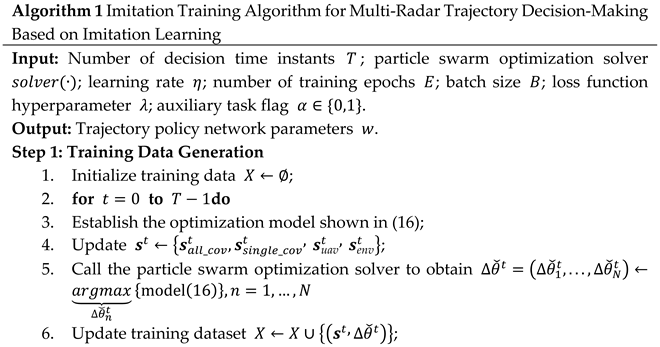
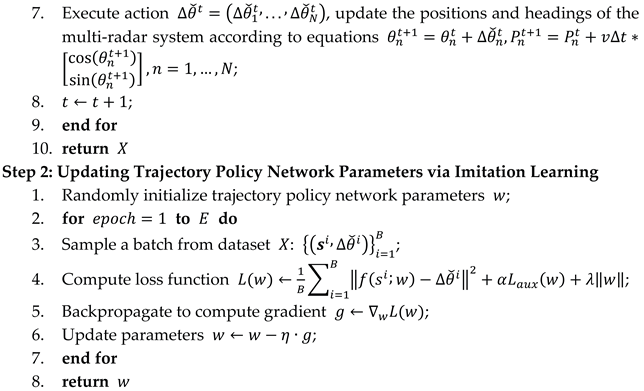
To address the problem of fast training of the trajectory policy network, this paper proposes using the trajectory planning method of traditional heuristic algorithms as the imitation target. And it employs a supervised approach to train the trajectory policy neural network.
The trajectory planning method of traditional heuristic algorithms generally solves the following mathematical model, i.e.,
where denotes the effective coverage rate of the key area at time , i.e.,
where is the indicator function. Let be the optimal solution of the above mathematical model. The imitation learning training dataset is then defined as , where is a discrete sampling time point.
Based on the above dataset, the training of the policy network parameters is achieved by optimizing the following loss function:
where denotes the heading offset angle output by the network, and is the corresponding optimal heading offset angle obtained from the optimization model. The full primary task training objective, incorporating an regularization term, is:
where is a regularization hyperparameter.
To further improve the convergence speed and generalization performance of the trajectory policy network, an auxiliary task is introduced only during the training phase. Specifically, an additional prediction head is appended after the feature fusion module output . This module takes as input and outputs the predicted target positions at the time . To decrease the influence of positional scale differences on the loss magnitude, the coordinates of the predicted and ground-truth target positions are normalized by the maximum side length of the key coverage area. The auxiliary task loss is then defined as:
When the auxiliary task is enabled, the overall training loss becomes:
where is an auxiliary task flag that enables the auxiliary tasks. It is important that the auxiliary prediction head and its associated loss serve solely as a training-phase regularization to guide feature representation learning. During inference, the auxiliary head is removed, and the network outputs only the heading offset angles. To ensure a fair comparison between the configurations with and without the auxiliary task, the primary task loss defined in Equation (19) is used as the unified evaluation metric in all experiments, regardless of whether the auxiliary task is incorporated during training.
The overall procedure of the imitation training algorithm is presented as follows:
|
5. Simulation Experiments
5.1. Experimental Scenario Description
As shown in Figure 2, yellow represents targets, red represents radars, and purple represents jammers. The targets attempt to penetrate the radar network along the blue arc trajectory. The radar nodes are each equipped with a three-face radar and move within the movable area bounded by the dashed rectangle. They attempt to maximize the coverage of the entire rectangular area to be covered and to track and detect the targets. The experimental hardware configuration consists of an AMD R5-7500F CPU and an Nvidia RTX 3090 GPU, and the experimental environment is Python version 3.12.
In the simulation scenario, the target movement trajectory is arc-shaped, and the variation of target position with time can be expressed by the following equation:
where and are the radius and angular velocity of the arc trajectory, taking values of 81.25 km and 4.49°/s, respectively.
The simulation experiment parameters are presented in Table 1. The initial radar information, initial target information, and jammer information in the simulation scenario are provided in Table 2, Table 3, and Table 4, respectively.
5.2. Training Performance Experiment
In this paper, the particle swarm optimization algorithm is used to solve the single-step trajectory optimization mathematical model. The solutions obtained by this algorithm are used as the training data for the trajectory policy network. Figure 3 illustrates the variation of the primary task loss function during the training process under the configurations with and without the auxiliary task. As shown in the figure, both curves exhibit an overall downward trend, decreasing from 0.19 to 0.14. The key difference is that the configuration with the auxiliary task converges more rapidly during the first 400 epochs compared to the configuration without it. The two curves gradually converge after 600 epochs. This shows that incorporating the auxiliary task can accelerate the convergence of the primary task during training.
Figure 4 presents the variation of the auxiliary task loss during the training process. The auxiliary task loss exhibits a consistent downward trend, decreasing from 0.35 to 0.13 over 1000 epochs. This indicates that the auxiliary task converges stably and achieves satisfactory performance in target position prediction.
Figure 5 shows the similarity between the output of the trajectory policy network and the particle swarm method on random samples. The average similarity across 100 samples can reach 81.1%, as indicated by the gray dashed line in the figure. The lowest similarity of 75.2% appears at the 91st sample, while the highest similarity of 88.0% is achieved at the 53rd sample. It shows good imitation performance of the policy network.
5.3. Inference Capability Experiment
Figure 6 describes the experimental results of the trajectory policy network proposed in this paper and the particle swarm algorithm in terms of coverage capability. In the figure, the gray dashed line represents the variation of the coverage rate of the particle swarm algorithm, and the red solid line represents the variation of the coverage rate of the imitation learning method. During the time period , the coverage rate of both methods decreases from 95.86% to 92.63%. This is because at the initial moment, the radars, targets, and jamming sources are all in a uniformly distributed state. As the radars and targets move forward, their motion is constrained by the radar's own motion constraints and boundary constraints. The overall system coverage rate experiences a phased decline. Subsequently, during the time period , the radars gradually adjust their positions and form an effective deployment. The coverage rate of both methods shows an upward trend, rising from 92.63% to 95.09%. During the time period , the coverage rate stabilizes and fluctuates around 95.00%. After , the coverage rate of both methods oscillates slightly around 93.77%.
From the overall trend, the trajectory policy network is basically consistent with the particle swarm algorithm in terms of coverage rate variation characteristics. The policy network effectively reproduces the decision-making behavior of the particle swarm algorithm. However, in terms of quantitative indicators, the trajectory policy network achieves an average coverage rate of 93.95% across all decision points throughout the entire process. This is lower than the particle swarm algorithm's 94.02%. This difference mainly stems from the inevitable error accumulation effect of imitation learning in sequential decision-making processes.
Figure 7 presents a comparison of the coverage rate between the policy network trained with the auxiliary task and that trained without it. From the overall trend, the policy network trained with the auxiliary task consistently achieves a higher coverage rate than that trained without it throughout the entire decision-making process. Regarding the temporal performance, the coverage rate of the configuration with the auxiliary task is described in Figure 6. The configuration without auxiliary tasks experiences a sharp drop in coverage from 95.86% to 91.03% at , followed by a steady increase reaching 94.42% at . From to , the coverage rate fluctuates around 94%. It then begins to decline, reaching its lowest point of 89.27% at . Coverage subsequently recovers to 92.31% in the subsequent steps. The policy network trained with the auxiliary task demonstrates superior coverage performance compared to that trained without it. This indicates that the auxiliary task yields a significant beneficial effect during the training of the trajectory policy network.
Figure 8 describes the experimental results of the trajectory policy network proposed in this paper and the particle swarm algorithm in terms of computational efficiency. The average computation time of the particle swarm algorithm is 449.19 s, while the trajectory policy network requires only 66.58 s. This result represents an improvement in computation speed of approximately 6.7 times that of the particle swarm algorithm.
6. Discussion
This paper proposes an imitation learning-based trajectory planning method to solve the problem of insufficient real-time performance of multi-radar trajectory planning in complex electromagnetic jamming environments. This paper introduces an effective coverage rate metric for key areas based on detection probability. It constructs a performance evaluation model that comprehensively reflects the effects of radar deployment, trajectory maneuvering, and jamming. On this basis, a trajectory decision model targeting coverage rate improvement is designed. Expert demonstration data are generated using heuristic trajectory planning methods. The paper employed imitation learning to perform supervised training of the neural network, achieving effective approximation of the expert trajectory decision strategy.
Simulation experimental results demonstrate that the proposed method can significantly reduce the computational complexity of online trajectory decision-making while maintaining high coverage performance. It achieves fast and stable heading control output that satisfies the real-time trajectory planning requirements of multi-radar systems in complex electromagnetic environments. This method avoids the drawbacks of traditional methods such as high computational complexity and long computation time. It also avoids the problems of long training time and difficulty in convergence associated with training neural networks for decision-making from scratch. This method achieves a combination of the two approaches.
Author Contributions
Conceptualization, M.L. and J.G.; methodology, X.G. and M.L.; software, X.G.; validation, X.G.; formal analysis, X.G.; investigation, M.L. and J.G.; resources, K.G.; data curation, K.G.; writing—original draft preparation, X.G.; writing—review and editing, M.L.; visualization, X.G.; supervision, M.L.; project administration, J.G. All authors have read and agreed to the published version of the manuscript.
Funding
This work was funded by National Key R&D Program of China (2021YFA1000401)、National Natural Science Foundation of China under Grant U22B2049 and Grant U23B2012.
Data Availability Statement
The data supporting the findings of this study are not publicly available due to confidentiality restrictions.
Acknowledgments
In addition, we would like to thank the anonymous reviewers who have helped to improve the paper.
Abbreviations
The following abbreviations are used in this manuscript:
| UAV | Unmanned Aerial Vehicle |
| PSO | Particle Swarm Optimization |
| CFAR | Constant False Alarm Rate |
| SNR | Signal-to-Noise Ratio |
| SINR | Signal-to-Interference-plus-Noise Ratio |
| DQN | Deep Q-Network |
| DDPG | Deep Deterministic Policy Gradient |
| PPO | Proximal Policy Optimization |
| MADDPG | Multi-Agent Deep Deterministic Policy Gradient |
| CNN | Convolutional Neural Network |
| LSTM | Long Short-Term Memory |
| BC | Behavioral Cloning |
References
- LING, H.; LI, R.; BAI, L.; HE, W. Research on Russian Electronic Warfare Equipment and Its Application in the Russia–Ukraine Conflict. Aero Weaponry 2023, 30, 32–36. [Google Scholar]
- Li, X.; Zhang, T.; Yi, W.; Kong, L.; Yang, X. Radar Selection Based on the Measurement Information and the Measurement Compensation for Target Tracking in Radar Network. IEEE Sensors J. 2019, 19, 7923–7935. [Google Scholar] [CrossRef]
- Tian, T.; Zhang, T.; Kong, L. Timeliness Constrained Task Scheduling for Multifunction Radar Network. IEEE Sensors J. 2019, 19, 525–534. [Google Scholar] [CrossRef]
- Jiang, W.; Qi, Z.; Ye, Z.; Wan, Y.; Li, L. Research on Cooperative Detection Technology of Networked Radar Based on Data Fusion. In Proceedings of the 2021 2nd China International SAR Symposium (CISS), November 3 2021; IEEE: Shanghai, China; pp. 1–5. [Google Scholar]
- YAN, J.; BAI, G.; HUANG, J.; DU, L.; SONG, T.; LIU, H. Dynamic Coverage Track Optimization Method for Multi-Radar Cooperative Area. Journal of Radars 2023, 12, 541–549. [Google Scholar]
- Lu, X.; Yi, W.; Kong, L. Joint Online Route Planning and Resource Optimization for Multitarget Tracking in Airborne Radar Systems. IEEE Systems Journal 2022, 16, 4198–4209. [Google Scholar] [CrossRef]
- Duan, H.; Zhao, J.; Deng, Y.; Shi, Y.; Ding, X. Dynamic Discrete Pigeon-Inspired Optimization for Multi-UAV Cooperative Search-Attack Mission Planning. IEEE Trans. Aerospace. Electron. Syst. 2021, 57, 706–720. [Google Scholar] [CrossRef]
- ZHANG, X.; HU, Y.; LI, W.; ZHANG, S.; PANG, Q. An Improved Multi-UAV Coverage Path Planning Method. Journal of Ordnance Equipment Engineering 2020, 41, 215–221. [Google Scholar]
- YANG, X.; WANG, R.; ZHANG, T. Intelligent Optimization Algorithms for UAV Swarm Path Planning: A Review. Journal of Control Theory and Applications 2020, 37, 2291–2302. [Google Scholar] [CrossRef]
- Zhang, H.; Cheng, H.; Wang, X.; Zhu, L.; Jiao, D.; Qiu, Z. Improved Secretary Bird Optimization Algorithm for UAV Path Planning. Algorithms 2026, 19, 64. [Google Scholar] [CrossRef]
- Jiang, S.; Yu, T.; Cui, S. Improved Black-Winged Kite Algorithm and Its Application in Unmanned Aerial Vehicle Path Planning. Journal of Supercomputing 2026, 82, 99. [Google Scholar] [CrossRef]
- Wei, J.; Zhu, W.; Xu, Q.; Li, Y.; Zhao, Y.; Li, Z.; Zhang, R.; Gu, Y.; Song, J.; Wang, Y.; et al. GeoSSA: Geometric Sparrow Search Algorithm for UAV Path Planning and Engineering Design Optimization 2026.
- LIU, R.; WANG, B.; LI, P. Joint Reconnaissance Mission Planning Based on PSO-SAS. Telecommunication Engineering 2020, 60, 1336–1341. [Google Scholar]
- Besada-Portas, E.; De La Torre, L.; De La Cruz, J.M.; De Andrés-Toro, B. Evolutionary Trajectory Planner for Multiple UAVs in Realistic Scenarios. IEEE Trans. Robot. 2010, 26, 619–634. [Google Scholar] [CrossRef]
- Shi, C.; Dai, X.; Wang, Y.; Zhou, J.; Salous, S. Joint Route Optimization and Multidimensional Resource Management Scheme for Airborne Radar Network in Target Tracking Application. IEEE Systems Journal 2022, 16, 6669–6680. [Google Scholar] [CrossRef]
- Zhang, Y.; Pan, M.; Han, Q.; Long, W.; Yang, S. Joint Power Allocation and Route Planning Scheme for Multitarget Tracking in Airborne Radar Network Under Multiuncertainty. IEEE Sensors J. 2023, 23, 7705–7718. [Google Scholar] [CrossRef]
- Yuan, M.; Lian, M.; Zhang, Y.; Li, C.; Shi, J.; Zhang, T. RadarImputationNet: An Enhanced Long-Term Diffusion Model for Automotive Radar Interference Suppression and Signal Recovery. IEEE Sensors J. 2025, 25, 24693–24711. [Google Scholar] [CrossRef]
- XIONG, S.; LI, Y.; OUYANG, Q.; WANG, Z. Review of UAV Swarm Trajectory Planning Based on Reinforcement Learning. Space Electronic Technology 2025, 22, 1–8+123. [Google Scholar] [CrossRef]
- Tang, J.; Yang, S.; Chen, S.; Li, Q.; Yin, Q.; Zhou, S. Research on UAV Autonomous Trajectory Planning Based on Prediction Information in Crowded Unknown Dynamic Environments. Sensors 2025, 25, 7343. [Google Scholar] [CrossRef] [PubMed]
- Li, Y.; Li, G.; Wang, X. Research on Trajectory Planning of Autonomous Vehicles in Constrained Spaces. Sensors 2024, 24, 5746. [Google Scholar] [CrossRef] [PubMed]
- XU, Z.; CHEN, M.; HAN, Z.; SHAO, S. Dynamic Route Planning for Low-Altitude Aircraft Based on TCP-DQN in Complex Environments. Robot 2025, 47, 383–393. [Google Scholar] [CrossRef]
- GAO, J.; HU, X.; JIANG, Z. Improved DDPG Algorithm for UAV Path Planning. Computer Engineering and Applications 2022, 58, 264–272. [Google Scholar]
- Xu, Y.; Wei, Y.; Wang, D.; Jiang, K.; Deng, H. Multi-UAV Path Planning in GPS and Communication Denial Environment. Sensors 2023, 23, 2997. [Google Scholar] [CrossRef] [PubMed]
- WANG, Y.; GUAN, Z.; LI, Y. Warm Pursuit Decision-Making Based on Trajectory Prediction and Distributed MADDPG. Journal of Computer Applications 2024, 44, 3623–3628. [Google Scholar] [CrossRef]
Figure 1.
policy network architecture.
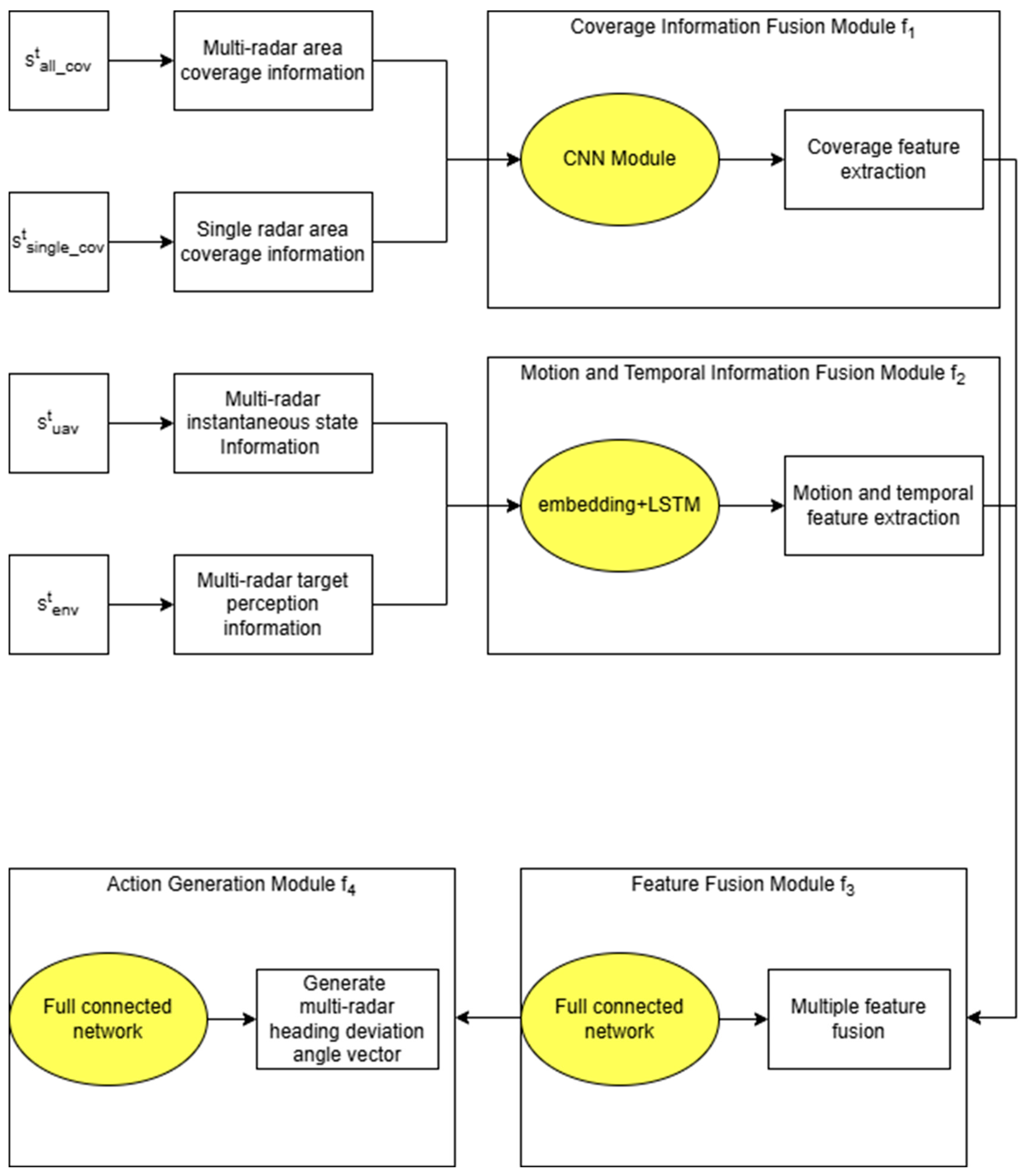
Figure 2.
scene diagram.
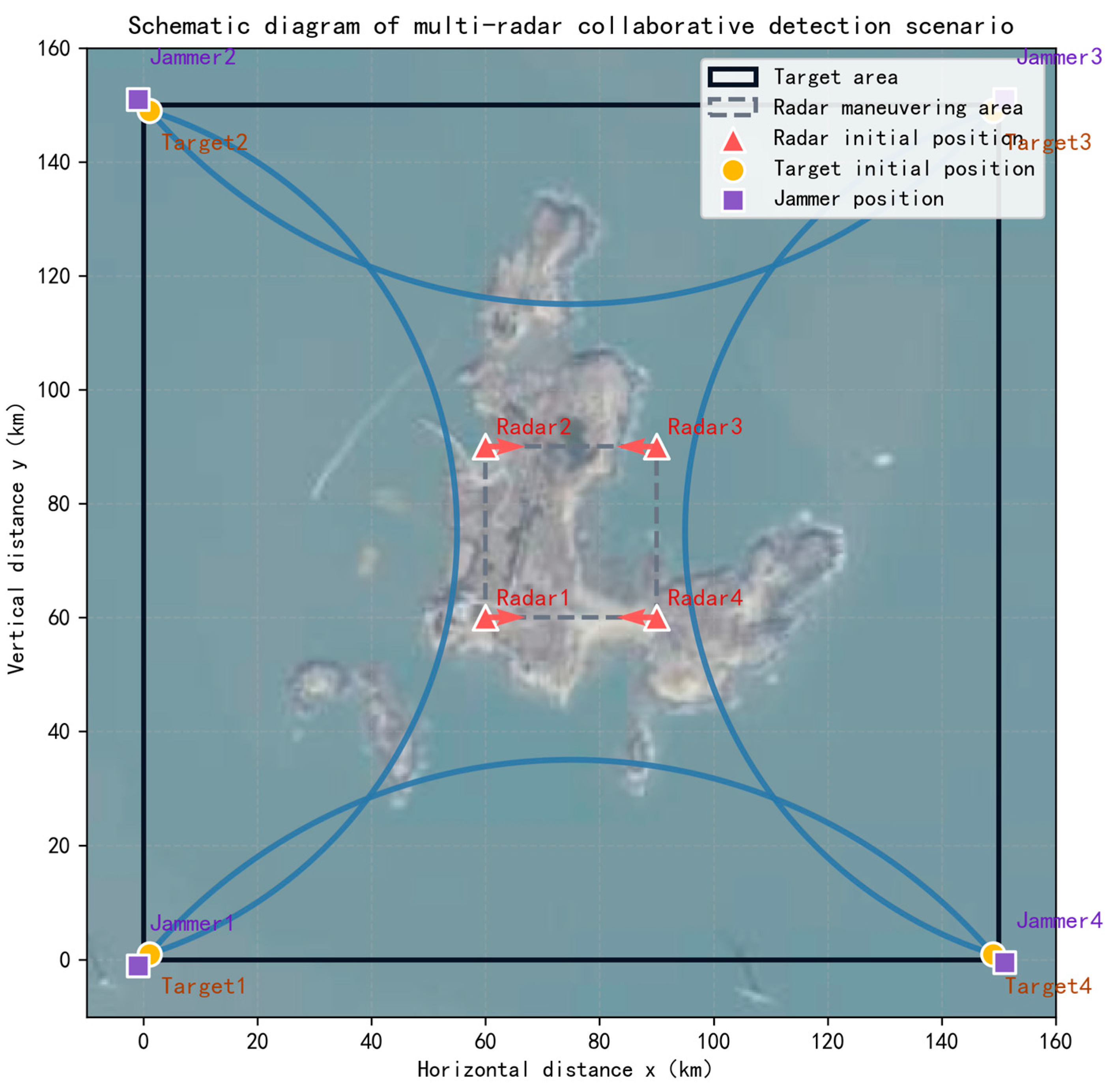
Figure 3.
policy network loss function variation chart.
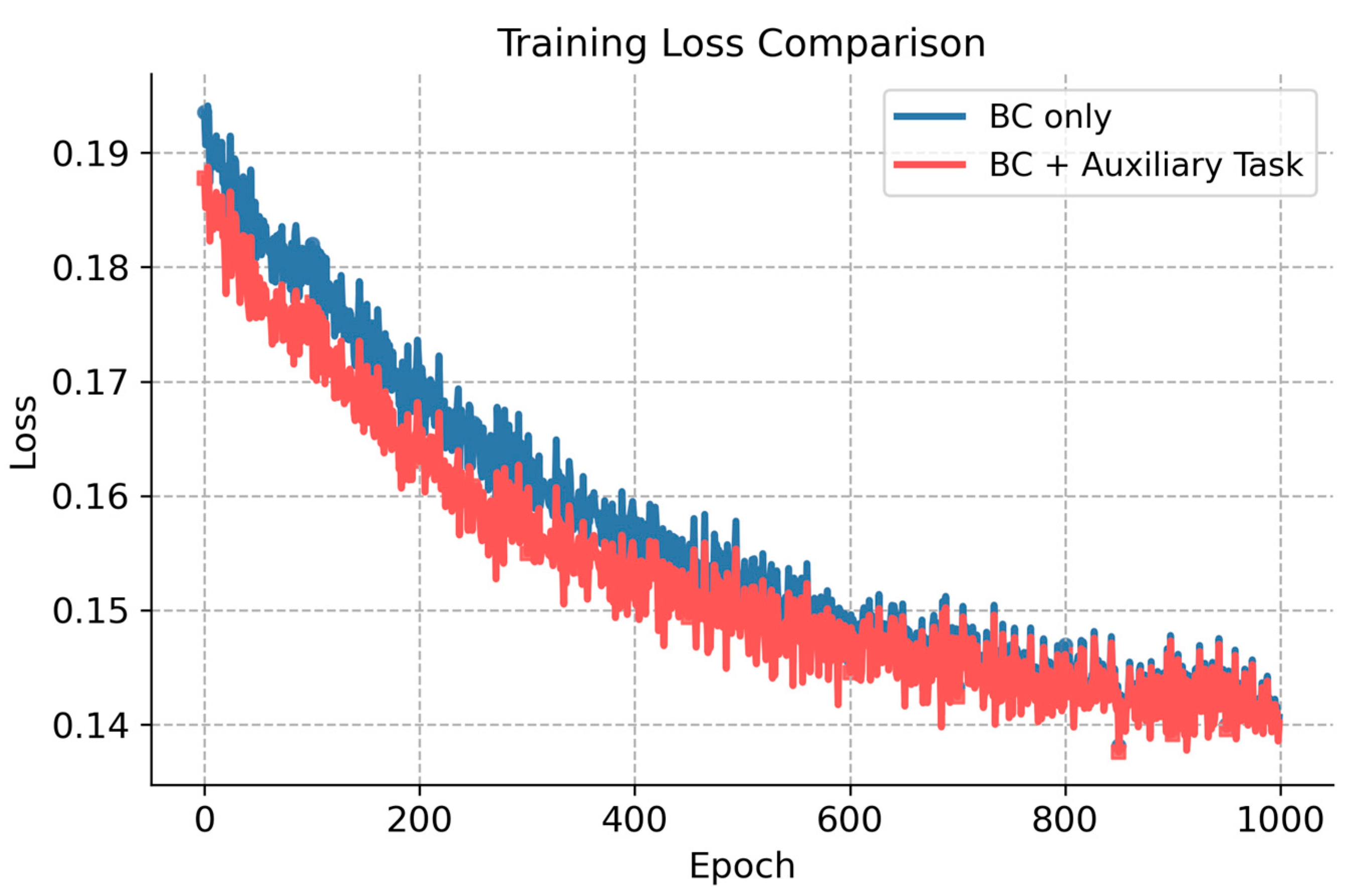
Figure 4.
auxiliary task training loss.
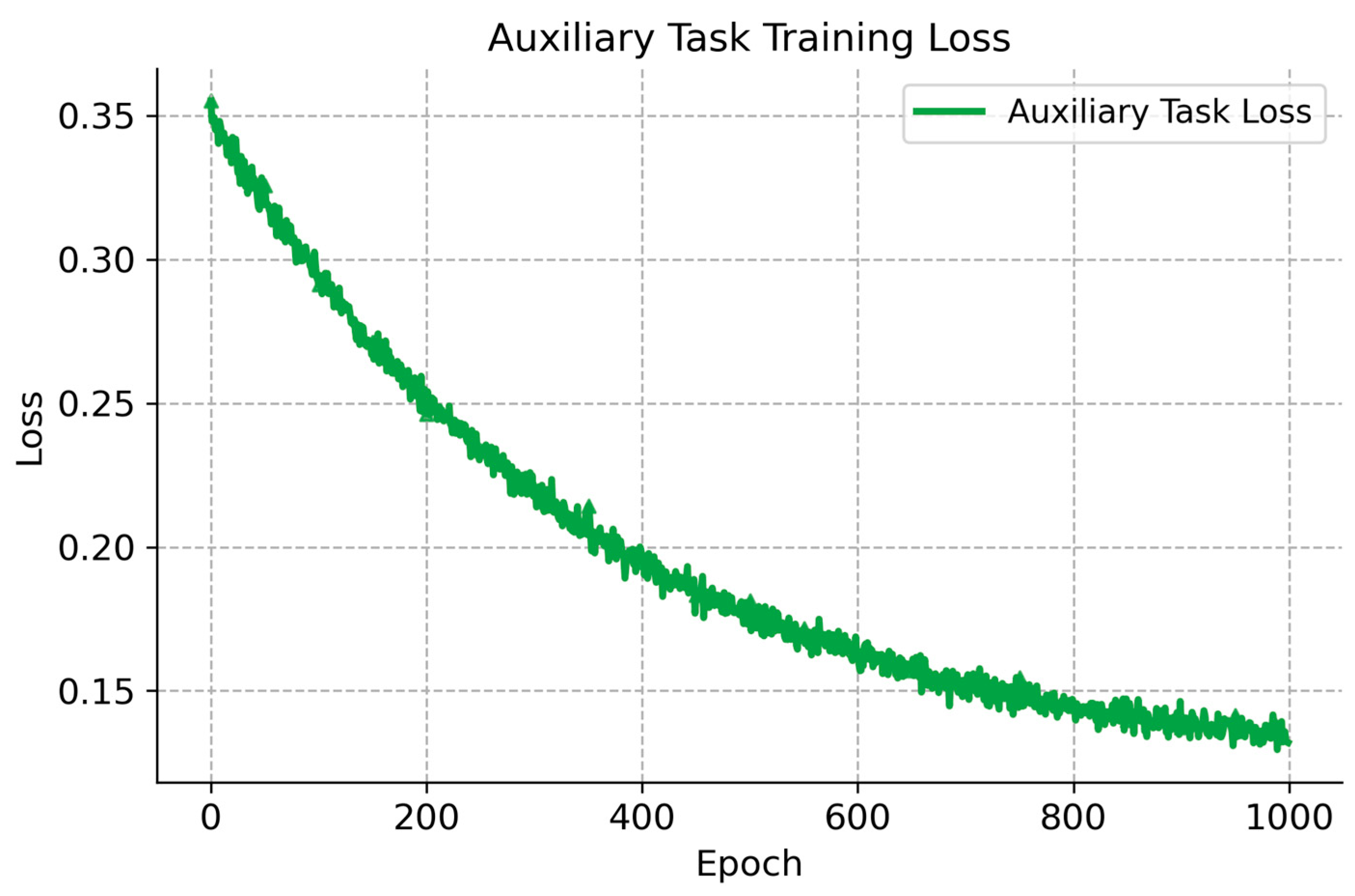
Figure 5.
similarity of actions output by trajectory policy network on random samples.
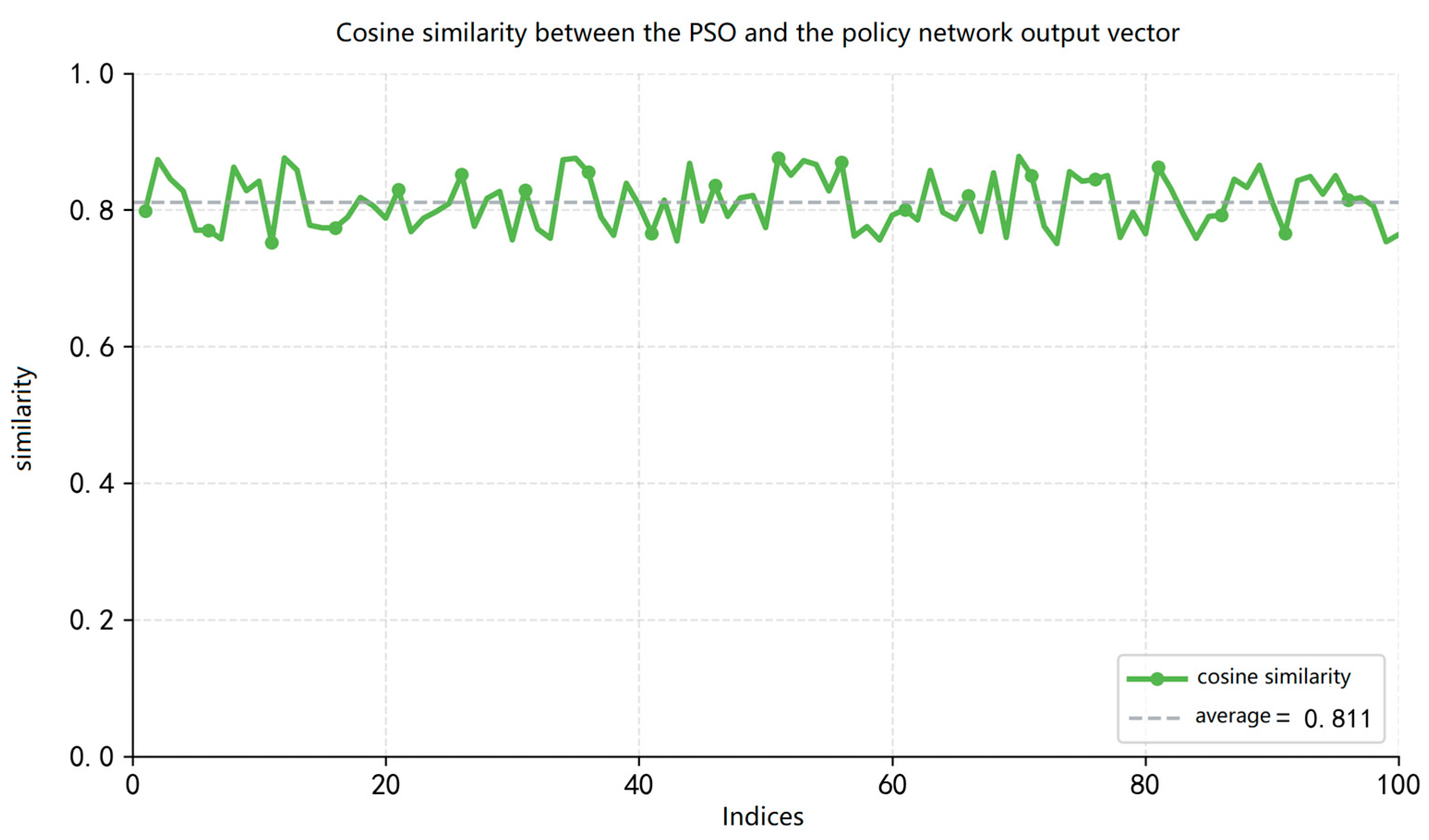
Figure 6.
comparison of coverage between trajectory policy network and PSO.
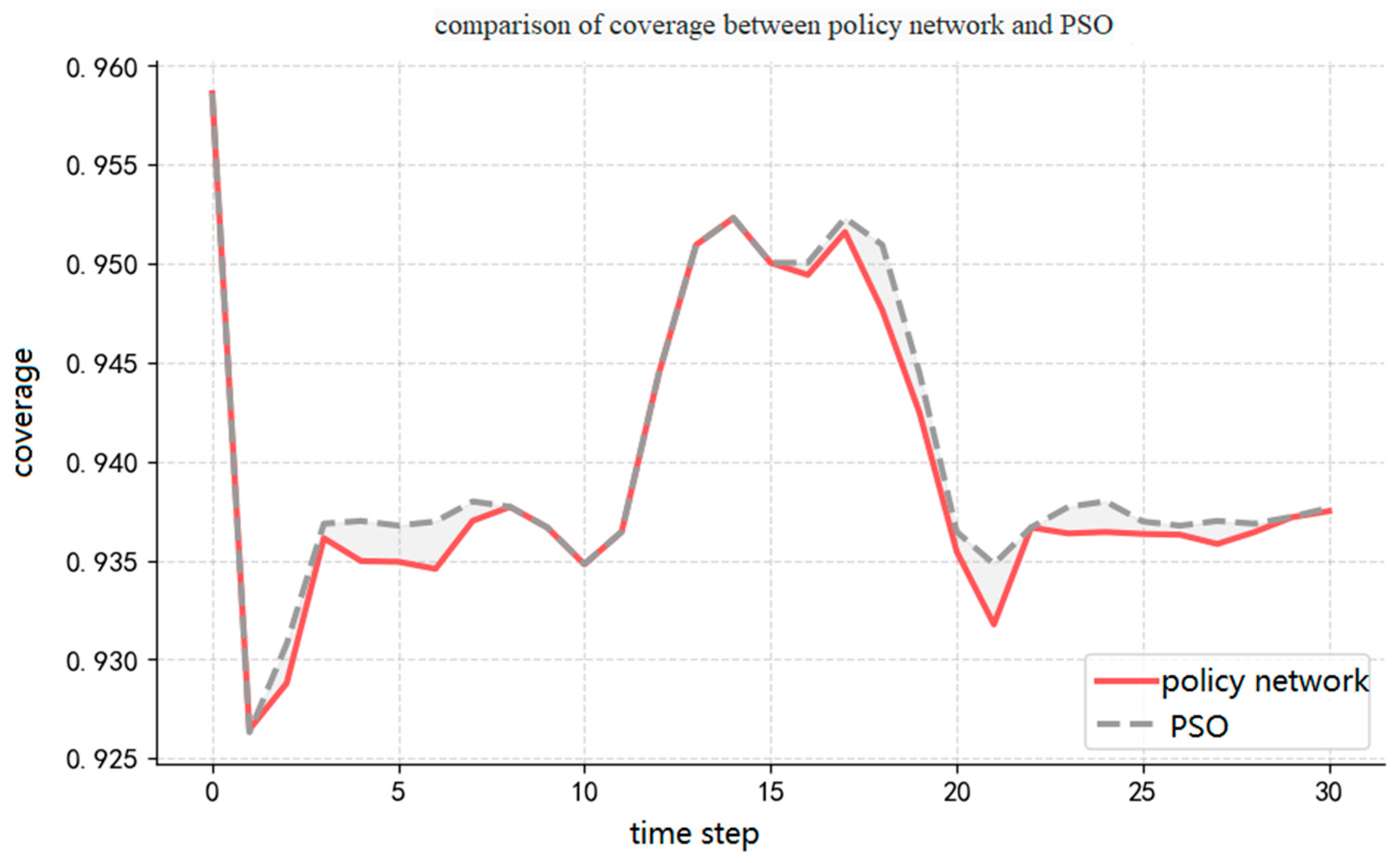
Figure 7.
with & without auxiliary task comparison.
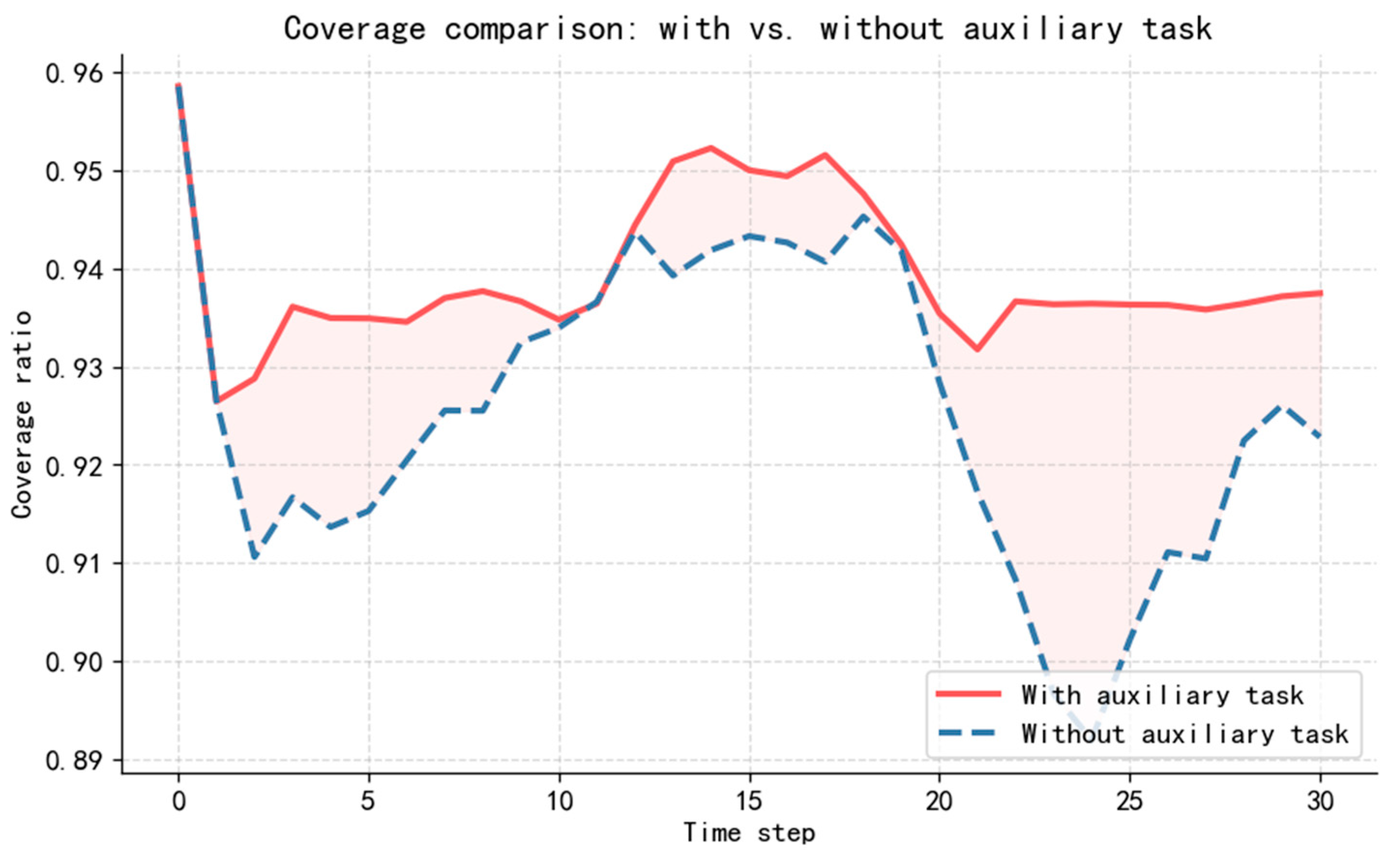
Figure 8.
computing time comparation.
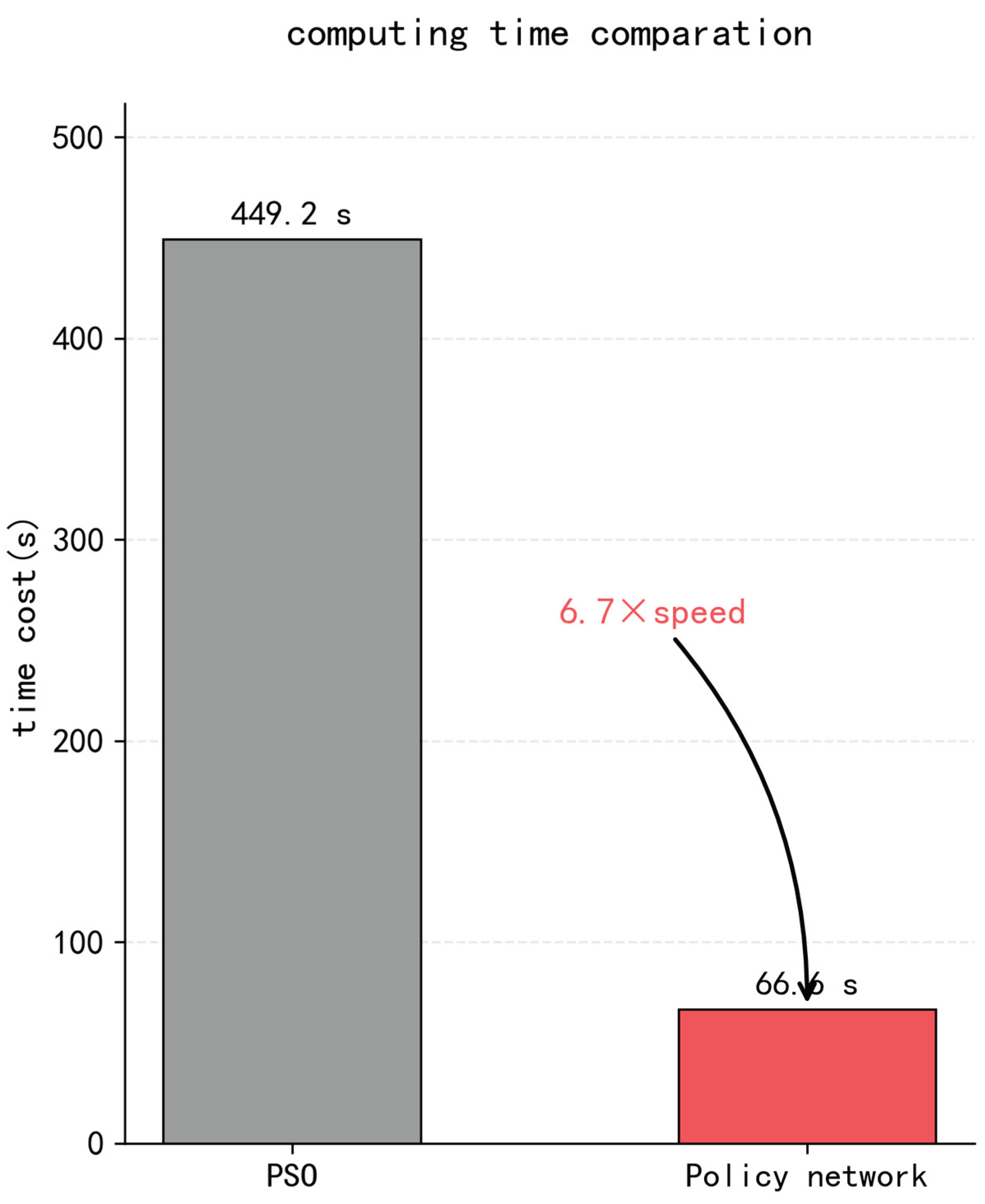

Table 1.
experiment parameters.
| Parameters | Value |
| 4 | |
| 4 | |
| 4 | |
| 30 | |
| Coverage area range | (150km,150km) |
| Radar antenna gain | 30dB |
| Jammer antenna gain | 30dB |
| Radar flight speed | 200m/s |
| Target radar cross section | 16m2 |
| Movable area range | (30km,30km) |
| 5 | |
| Radar transmit power | 4500W |
| Stand-off support jammer transmit power | 1000W |
| Maximum radar heading deflection angle | 30° |
Table 2.
radar initial information.
| Radar initial position and heading | |||
| Radar 1 (60km,60km,0°) |
Radar 2 (60km,90km,0°) |
Radar 3 (90km,90km,180°) |
Radar 4 (90km,60km,180°) |
Table 3.
target initial information.
| Targetinitial position | |||
| Target 1 (0km,0km) |
Target 2 (0km,150km) |
Target 3 (150km,150km) |
Target 4 (150km,0km) |
Table 4.
jammer information.
| Jammerposition | |||
| Jammer 1 (0km,0km) |
Jammer 2 (0km,150km) |
Jammer 3 (150km,150km) |
Jammer 4 (150km,0km) |
Disclaimer/Publisher’s Note: The statements, opinions and data contained in all publications are solely those of the individual author(s) and contributor(s) and not of MDPI and/or the editor(s). MDPI and/or the editor(s) disclaim responsibility for any injury to people or property resulting from any ideas, methods, instructions or products referred to in the content. |
© 2026 by the authors. Licensee MDPI, Basel, Switzerland. This article is an open access article distributed under the terms and conditions of the Creative Commons Attribution (CC BY) license (http://creativecommons.org/licenses/by/4.0/).
Copyright: This open access article is published under a Creative Commons CC BY 4.0 license, which permit the free download, distribution, and reuse, provided that the author and preprint are cited in any reuse.