
Submitted:
06 March 2026
Posted:
06 March 2026
You are already at the latest version
Abstract
Organizations increasingly confront persistent tensions that require leaders to pursue competing demands simultaneously. Although prior research highlights paradox mindset as an orientation toward embracing tensions, less is known about the capability-based microfoundations that enable leaders to enact paradoxical leadership behaviors in practice. Addressing this gap, this study develops a cognitive–emotional capability framework that focuses on two developable resources: integrative complexity (IC)—a cognitive capacity for differentiating and integrating competing demands—and emotion regulation (ER)—an affective capacity for sustaining engagement under tension. Using survey data from 264 Japanese managers, we examine the independent and joint effects of IC and ER strategies on paradoxical leader behaviors (PLB). Results show that IC and cognitive reappraisal are positively associated with PLB. Polynomial regression and response surface analyses further reveal that PLB increases as IC and cognitive reappraisal rise together. However, when the two capabilities are imbalanced, PLB tends to be higher in profiles where IC exceeds reappraisal than in the opposite configuration.These findings suggest an asymmetric form of complementarity in which integrative complexity functions as a foundational capability while reappraisal provides supportive leverage. Overall, the study shifts attention from trait-like mindsets to trainable leadership capabilities and clarifies how cognitive–emotional capability configurations enable the enactment of paradoxical leadership.
Keywords:
paradoxical leadership
; integrative complexity
; emotion regulation
; cognitive reappraisal
; expressive suppression
; response surface analysis
; microfoundations
1. Introduction
The contemporary business environment is frequently described as VUCA—volatility, uncertainty, complexity, and ambiguity. Driven by deepening globalization and rapid technological advancement, organizations increasingly face situations characterized by multiple and often conflicting demands. Leaders are required to pursue short-term profitability while ensuring long-term growth, invest in new ventures while sustaining existing businesses, and balance efficiency with flexibility as well as discipline with creativity (Schad, Lewis, Raisch, & Smith, 2016; Smith & Lewis, 2011). Although these tensions may appear to represent simple trade-offs, they often reflect interdependent paradoxical structures in which opposing elements coexist and reinforce one another. Consequently, such tensions cannot be effectively addressed through a straightforward logic of choosing one alternative over the other.
Paradox theory conceptualizes these contradictions not as dilemmas that require selecting one pole at the expense of the other but as persistent tensions that must be navigated through dynamic equilibrium, where competing elements coexist over time (Lewis, 2000; Smith & Lewis, 2011; Schad et al., 2016). From this perspective, effective leadership requires embracing a both/and approach rather than an either/or logic. Paradoxical leader behaviors (PLB) represent a micro-level response to this demand. PLB refers to leadership behaviors that simultaneously integrate competing yet interdependent requirements, such as discipline and flexibility, control and autonomy, and fairness and individualized consideration. A growing body of research demonstrates that PLB is associated with a range of positive outcomes, including subordinate creativity, innovative behavior, and team innovation (Zhang et al., 2015; Shao et al., 2019; Jung et al., 2022; Zhang et al., 2022; Lee et al., 2023). By enabling leaders to accommodate competing demands simultaneously, PLB helps organizations respond more effectively to complex and uncertain environments.
Despite these advances, an important question remains insufficiently addressed: what psychological resources enable leaders to translate paradoxical tensions into stable both/and behaviors in practice? In particular, the microfoundations of PLB—especially the malleable capability resources that allow leaders to convert paradoxical intentions into enacted behaviors—remain insufficiently understood. Recent research has attempted to address this issue by focusing on paradox mindset (PM), defined as the tendency to accept and embrace contradictions as valuable tensions (Miron-Spektor et al., 2018). While paradox mindset explains why individuals may embrace tensions, capability-based mechanisms explain how leaders actually enact paradoxical behaviors in practice. This perspective advances our understanding of how individuals cognitively approach paradox; however, PM primarily captures individuals’ orientation or motivation toward engaging with contradictions rather than explaining how leaders enact paradoxical behaviors. Specifically, it does not directly account for how leaders differentiate and integrate competing demands while simultaneously regulating the emotional responses that arise in paradoxical situations.
The Japanese organizational context provides a particularly relevant setting for examining paradoxical leadership. Japanese firms often emphasize the coexistence of seemingly contradictory practices, such as stability and flexibility, collective harmony and individual initiative, and long-term employment alongside continuous innovation. These characteristics create organizational environments in which leaders frequently confront persistent and interdependent tensions. Therefore, the Japanese managerial context offers a meaningful empirical setting for examining how leaders cognitively and emotionally navigate paradoxical demands.
Paradox theory suggests that effectively managing contradictions requires the interplay of two interrelated processes. The first is a cognitive process through which individuals differentiate opposing perspectives or interests and integrate them within a higher-order framework. The second is an emotional process that enables individuals to maintain tension and anxiety at a “tolerable level” rather than eliminating them altogether (Smith & Lewis, 2011; Schad et al., 2016). Supporting this view, Lüscher and Lewis (2008) showed that in organizational change contexts, the process of “working through paradox” involves the intertwined development of sensemaking and anxiety containment. Thus, leveraging paradox as a resource requires not choosing between cognition and emotion but rather integrating both processes. In this sense, managing paradox requires leaders not only to think through contradictions but also to hold the emotional tension they generate.
However, existing quantitative studies of PLB rarely incorporate these dual processes within a unified empirical framework. Most empirical work has focused primarily on cognitive antecedents, leaving the emotional processes underlying paradoxical leadership comparatively underexamined. As a result, we still know relatively little about how leaders develop the capability to both think through contradictions and sustain engagement under paradoxical tension.
To address this limitation, the present study focuses on two developable capabilities that enable leaders to both “think through” paradox and “hold” paradox over time. The first capability is integrative complexity (IC), a cognitive style characterized by the ability to differentiate competing perspectives while integrating them within a higher-order framework (Suedfeld & Tetlock, 1977; Zhang et al., 2015). Leaders with high IC are more likely to recognize the legitimacy of both poles—for instance, discipline and flexibility—and translate these tensions into both/and strategies and behaviors.
The second capability is emotion regulation (ER), defined as the psychological processes through which individuals influence how they experience and express emotions under conditions of tension (Gross, 1998). Among emotion regulation strategies, cognitive reappraisal (CR) operates by reconstructing the meaning of a situation and thereby shaping the trajectory of emotional responses, potentially expanding the range of behavioral options available to individuals. In contrast, expressive suppression (ES) focuses on controlling the outward expression of emotion and does not necessarily facilitate reinterpretation of the situation or cognitive integration. Accordingly, this study distinguishes between CR and ES rather than treating emotion regulation as a single undifferentiated construct.
Prior research provides important insights into the relevance of these strategies. A meta-analysis by Webb, Miles, and Sheeran (2012) shows that CR is generally associated with more adaptive emotional outcomes than suppression. In the context of organizational change, emotional balancing—the juxtaposition of opposing emotional modes— can facilitate adaptation under conditions of tension (Huy, 2002). Moreover, research in strategic contexts highlights that emotions and emotion regulation play important roles in shaping organizational action (Huy, 2012; Huy & Zott, 2019). Together, these findings suggest that beyond cognitive complexity, CR may help sustain engagement under paradoxical tension and thereby support paradoxical leadership behaviors.
A review of the empirical literature reveals an additional gap. Numerous studies have examined cognitive characteristics—such as paradoxical framing, holistic thinking, and integrative complexity—in predicting creativity, PLB, and related outcomes (Miron-Spektor et al., 2011; Leung et al., 2018; Zhang et al., 2015; Shao et al., 2019; Zhang et al., 2022). In contrast, the emotional dimension of paradox, particularly the regulation of emotional strain associated with paradoxical situations, has received comparatively less attention in quantitative research despite its theoretical importance (Huy, 2002, 2012; Huy & Zott, 2019). More importantly, prior research rarely examines cognitive resources and emotion regulation resources within the same analytical framework. Consequently, we know little about how different combinations of these capabilities—for example, situations in which both capabilities are high or situations in which one capability compensates for the other—shape the enactment of PLB. The absence of such a capability configuration perspective leaves an important gap in our understanding of the microfoundations of paradoxical leadership.
Building on this gap, the present study conceptualizes IC and ER as malleable capabilities that enable leaders to manage paradox effectively in practice. Specifically, we focus on CR as a central strategy that supports engagement under tension through meaning reconstruction, while also examining ES as a contrasting strategy with distinct functional characteristics. We examine (a) the independent effects of IC and CR/ES on PLB, (b) whether PLB is highest when both IC and CR are simultaneously high, and (c) whether, under conditions of imbalance, profiles characterized by relatively higher IC are more strongly associated with PLB. We further apply the same analytical framework to ES to examine whether the IC × ES configuration produces patterns similar to or different from those associated with IC × CR, thereby clarifying functional differences among emotion regulation strategies.
By integrating cognitive and emotional capabilities into a single framework, this study links the dual processes emphasized in paradox theory—cognitive differentiation/integration and emotional containment—to the behavioral enactment of paradoxical leadership. In doing so, it complements mindset-based explanations by highlighting the role of trainable capability configurations in enabling leaders to enact PLB in practice.
This study makes three contributions to the literature. First, whereas prior research has primarily focused on orientation constructs such as PM, this study shifts attention to trainable capabilities, namely IC and ER, thereby identifying the execution resources that translate paradoxical intentions into enacted leadership behaviors. Second, the study reconceptualizes PLB not as the reflection of a single capability but as the result of the levels and combinations of cognitive and emotional resources, advancing a capability configuration perspective on the microfoundations of paradoxical leadership. Third, the study proposes that the relationship between IC and CR reflects an asymmetric complementarity, in which IC functions as the foundational capability and CR plays a supportive role. This insight refines the concept of complementarity and provides theoretical guidance for leadership development interventions by suggesting that strengthening IC may constitute a primary developmental priority, followed by the enhancement of CR. In doing so, the study complements existing paradox mindset research by shifting attention from individuals’ willingness to embrace tensions to the capability configurations that enable leaders to enact paradoxical leadership behaviors in practice.
2. Theoretical Background and Hypotheses
Paradox theory conceptualizes organizational tensions—such as efficiency versus exploration and control versus autonomy—as persistent and interdependent contradictions that cannot be resolved through simple trade-offs (Lewis, 2000; Smith & Lewis, 2011; Schad et al., 2016). Rather than choosing between competing alternatives, effective responses to paradox require leaders to construct interpretations and actions that enable both poles to coexist. Accordingly, paradox management involves two interrelated processes: a cognitive process through which individuals differentiate and subsequently integrate competing demands, and an emotional process that enables individuals to sustain engagement while experiencing tension and uncertainty (Smith & Lewis, 2011).
A variety of psychological characteristics have been proposed as potential foundations for such integrative responses. Prior research highlights cognitive traits such as actively open-minded thinking (Stanovich & West, 1997), cognitive flexibility (Dennis & Vander Wal, 2010), and tolerance for ambiguity (Budner, 1962), as well as emotional characteristics such as emotional intelligence (Salovey & Mayer, 1990). These constructs capture broad adaptive tendencies, including openness to information, belief updating, tolerance for uncertainty, and the ability to perceive and understand emotions. Although these perspectives offer valuable insights, they primarily describe general adaptive dispositions rather than the specific mechanisms through which individuals cognitively structure and emotionally sustain paradox engagement.
Paradox theory places particular emphasis on the structural cognitive operation of differentiating and integrating opposing demands while simultaneously maintaining engagement under emotional tension. In this regard, IC provides a particularly relevant cognitive capability because it directly captures the structural processes of differentiation and integration in measurable form. Likewise, ER provides a theoretical framework for understanding how individuals evaluate and manage emotional responses arising under tension, thereby sustaining engagement in paradoxical situations.
Taken together, these arguments suggest that understanding paradoxical leadership requires integrating cognitive capabilities that structure competing demands with emotional capabilities that manage the affective strain associated with those demands. IC refers to the ability to differentiate opposing perspectives and integrate them into a higher-order conceptual framework (Suedfeld & Tetlock, 1977; Zhang et al., 2015). These processes align closely with the cognitive mechanisms underlying paradox management, which require individuals to recognize and reconcile competing yet interdependent demands (Smith & Lewis, 2011; Schad et al., 2016). In paradoxical contexts, leaders must avoid reducing competing demands to a single dominant pole and instead construct cognitive frameworks capable of simultaneously accommodating both elements. IC therefore represents a cognitive capability that directly supports the core assumptions of paradox theory.
Importantly, paradoxical situations are not merely cognitive challenges but also emotionally charged experiences characterized by tension, uncertainty, and conflict. Research on organizational change highlights the critical role of emotional processes in such contexts. For example, Huy (2002) showed that when strong emotions such as anxiety, anger, or frustration are not effectively managed, groups may fall into confusion or inertia, undermining the simultaneous pursuit of change and continuity. Similarly, Huy and Zott (2019) demonstrated that managers’ emotion-regulation behaviors help maintain psychological resources and facilitate resource mobilization through stakeholders’ legitimacy judgments, thereby supporting strategic change implementation. These findings suggest that effective paradox management depends not only on cognitive structuring but also on the ability to regulate emotional responses under tension.
Gross’s (1998) process model of emotion regulation provides a useful framework for conceptualizing such emotional processes. The model distinguishes between strategies that intervene at different stages of emotional generation, most notably CR and ES. CR modifies emotional responses by reinterpreting the meaning of a situation, whereas ES regulates emotional expression after emotions have already arisen. Importantly, emotion regulation is not a single homogeneous capability; different strategies may produce different behavioral consequences. In paradoxical contexts, the ability to reconstruct the meaning of tension and the ability to suppress emotional expression represent distinct mechanisms that may differentially influence leaders’ responses to competing demands. Accordingly, this study treats ER not as a single construct but distinguishes between CR and ES.
Another important consideration is that both IC and ER are conceptualized not as fixed personality traits but as capabilities that can vary through interactions with situational experiences. For example, multicultural experiences and acculturation pressures have been shown to influence individuals’ levels of integrative complexity (Tadmor et al., 2012; Tadmor, Tetlock, & Peng, 2009). Similarly, experimental research demonstrates that ER strategies such as reappraisal and suppression can be manipulated through instructional interventions and can significantly influence emotional responses (Webb et al., 2012). These findings support the view that IC and ER can be conceptualized as malleable capability resources that develop through experience and situational interaction. Such a perspective is consistent with the present study’s interest in understanding paradoxical leadership not as a fixed disposition but as a potentially developable capability.
Although IC and ER both support adaptive self-regulation, they differ in their underlying mechanisms. IC represents a cognitive-structural capability concerned with how individuals differentiate and integrate competing perspectives, interests, and values. ER, by contrast, represents an affective-process capability concerned with how emotional states arising under tension are evaluated and regulated through specific strategies. Although the two constructs may be correlated, they are theoretically distinct. Accordingly, the present study conceptualizes IC and ER as independent latent constructs operating at the same conceptual level.
2.1. Integrative Complexity and Paradoxical Leader Behaviors
IC refers to a cognitive capability that enables individuals to differentiate multiple potentially conflicting perspectives and integrate them within a higher-order conceptual framework (Suedfeld & Tetlock, 1977; Baker-Brown et al., 1992; Zhang et al., 2015). Individuals high in IC tend to recognize the legitimacy embedded in competing viewpoints, articulate their interdependence and trade-offs, and construct interpretive frameworks that accommodate multiple demands simultaneously (Suedfeld & Tetlock, 1977). Research on paradoxical framing similarly suggests that such integrative cognitive framing can facilitate creative problem solving by allowing individuals to transcend zero-sum interpretations of competing demands (Miron-Spektor et al., 2011).
Prior research also suggests that IC varies in response to contextual cues and task demands. In situations involving evaluative pressure or value conflict, individuals differ in the extent to which they actively engage with opposing perspectives and integrate them into coherent judgments (Tetlock et al., 1993; Wong, Ormiston, & Tetlock, 2011). Individuals high in IC tend to examine both confirmatory and disconfirmatory information and carefully evaluate trade-offs among competing interests, whereas those low in IC rely more heavily on dichotomous reasoning and exhibit lower tolerance for ambiguity (Tetlock et al., 1993).
These differences are particularly consequential in paradoxical leadership contexts. PLB require leaders to maintain and enact competing demands simultaneously, such as balancing discipline with flexibility or control with autonomy. Leaders with higher IC are more likely to maintain both poles of such tensions rather than privileging one side. By cognitively structuring competing demands within an integrative framework, they are better able to translate paradoxical tensions into actionable both/and leadership behaviors.
Consistent with this reasoning, empirical evidence suggests that leaders’ IC is positively associated with followers’ perceptions of paradoxical leadership (Zhang et al., 2015). Building on this theoretical logic, we expect leaders with higher IC to be more capable of enacting paradoxical leader behaviors.
Hypothesis 1.
Integrative complexity is positively associated with paradoxical leader behaviors.
2.2. Emotion Regulation Strategies and Paradoxical Leader Behaviors
ER refers to the processes through which individuals influence which emotions they experience, when they experience them, and how they express them in response to situational demands (Gross, 1998). Organizational contexts often involve uncertainty and ambiguity, conditions under which emotional reactions can shape both cognitive processing and behavioral responses (Huy, 2012). Paradoxical situations in particular tend to evoke negative emotions such as anxiety, frustration, and conflict because individuals must simultaneously confront competing demands. Consequently, how these emotional responses are regulated may influence how leaders interpret paradoxical tensions and respond behaviorally.
If emotional responses are poorly regulated, leaders may attempt to reduce cognitive strain by simplifying the situation and prioritizing one pole of a paradoxical tension. Such simplification may undermine the enactment of stable both/and leadership behaviors, thereby reducing the likelihood that leaders engage in PLB.
Research based on Gross’s (1998) process model conceptualizes ER as a set of distinct regulatory strategies. Two of the most widely studied strategies are CR and ES. CR is an antecedent-focused strategy that modifies emotional responses by reinterpreting the meaning of a situation before emotional reactions fully develop. ES, in contrast, is a response-focused strategy that regulates the outward expression of emotions after they arise.
Meta-analytic evidence suggests that CR tends to produce stronger modifications in emotional outcomes than ES (Webb et al., 2012). By reframing the meaning of events, reappraisal can reduce negative emotional responses and broaden cognitive perspectives. In paradoxical contexts, this reinterpretation may allow leaders to view competing demands as mutually reinforcing rather than mutually exclusive, thereby facilitating integrative action.
Accordingly, leaders who frequently employ CR may be better able to reinterpret paradoxical tensions in ways that sustain engagement and enable both/and responses.
Hypothesis 2-1.
Cognitive reappraisal is positively associated with paradoxical leader behaviors.
In contrast, ES regulates emotional expression without fundamentally altering the meaning of the underlying situation (Gross, 1998). As a result, suppression may exert weaker effects on how leaders cognitively interpret paradoxical tensions. Moreover, suppression can impose interpersonal and cognitive costs. Experimental studies show that suppression may impair communication during social interactions, increase physiological stress responses in both the suppressor and interaction partners, and weaken relationship formation (Butler et al., 2003; Gross, 2002). Because suppression requires continuous monitoring and inhibition of emotional expressions, it also consumes attentional resources and can reduce memory performance (Richards & Gross, 2000; Gross, 2002).
Although cultural norms may moderate some of these effects (Butler et al., 2007), suppression is less likely than reappraisal to support integrative responses to paradoxical tensions. Unlike reappraisal, which expands behavioral options by reconstructing the meaning of competing demands, suppression primarily controls emotional expression without facilitating deeper cognitive integration. Therefore, suppression may be less strongly associated with the enactment of paradoxical leadership behaviors.
Hypothesis 2-2.
Expressive suppression has a weaker association with paradoxical leader behaviors than cognitive reappraisal.
2.3. Joint Effects of Integrative Complexity and Emotion Regulation Strategies: Capability Configurations as Complementary Resources
The dynamic equilibrium perspective in paradox theory suggests that responses to competing demands emerge through the interaction of cognitive and emotional processes (Smith & Lewis, 2011; Schad et al., 2016). Effectively addressing paradox therefore requires both the ability to cognitively structure competing demands (“thinking”) and the ability to maintain engagement under emotional tension (“holding”). These processes are unlikely to operate independently; instead, they may jointly shape leaders’ capacity to enact paradoxical leadership behaviors.
This perspective implies that IC and ER may influence PLB not only through their independent effects but also through their capability configuration, that is, the particular combination of cognitive and emotional capabilities possessed by leaders. Research on complementarity suggests that the effectiveness of one capability may depend on the level of another capability rather than simply adding to it (Milgrom & Roberts, 1995). Importantly, such complementarities need not be symmetrical.
In the context of paradoxical leadership, the cognitive work of restructuring competing demands into an integrative framework represents the core mechanism underlying both/and leadership behaviors. IC therefore functions as a foundational cognitive capability that enables leaders to conceptualize paradoxical tensions in integrative ways. By contrast, CR may function as a supportive emotional capability that reshapes the meaning of tension and reduces threat or avoidance responses. In doing so, CR helps maintain the psychological conditions under which IC-based integrative judgments can be enacted behaviorally.
Consequently, the highest levels of PLB are expected when both IC and CR are simultaneously high. However, when these capabilities are imbalanced, relative advantages in IC may play a more decisive role because integrative cognition provides the structural basis for paradoxical leadership behaviors. Importantly, this perspective implies an asymmetric complementarity in which integrative complexity provides the cognitive foundation for paradoxical leadership, whereas cognitive reappraisal primarily functions as a supportive mechanism that sustains engagement under tension.
Hypothesis 3-1.
Profiles characterized by high integrative complexity and high cognitive reappraisal will predict higher levels of paradoxical leader behaviors than other profiles.
Hypothesis 3-2.
When integrative complexity and CR are imbalanced, profiles with relatively higher integrative complexity will be associated with higher levels of paradoxical leader behaviors than profiles with relatively higher CR.
3. Materials and Methods
3.1. Sample and Data Collection
Data were collected through an online survey administered by a professional research panel company in Japan. The target population consisted of managers and team leaders employed in Japanese firms. To capture respondents likely to experience paradoxical demands in their leadership roles, the sample focused on line and middle managers who bridge upper management and frontline employees, as well as project or team leaders responsible for coordinating members on an ongoing basis (cf. Zhang et al., 2015, 2022; Jung et al., 2022).
Panel members were first screened to identify full-time employees working in Japanese organizations who met the study’s participation criteria. Respondents were eligible if they (a) held a formal supervisory position at the section-manager level or higher, or (b) served as a project or team leader responsible for directing and coordinating members. In addition, respondents were required to regularly provide task instructions or feedback to at least three direct subordinates or project members. No restrictions were placed on industry in order to capture a wide range of organizational contexts. As a result, the sample included respondents from diverse sectors, including manufacturing, information and communication technology, finance, and service industries.
After removing responses with substantial missing data or inattentive response patterns (e.g., repeated selection of identical response options), the final sample consisted of 264 respondents. The average age was 52.71 years, and 93.9% were male. Regarding education, 71.6% held at least a university degree, including 8.7% with graduate-level education. The average tenure in the current organization was 21.39 years, and the average total work experience was 29.76 years. In terms of organizational position, section managers constituted the largest group (43.6%), whereas project leaders represented the smallest proportion (2.7%). Respondents supervised an average of 10.24 direct subordinates.
3.2. Measures
All focal variables were measured using self-reported survey scales completed by the leaders themselves. Each measure was based on previously validated scales and adapted for the organizational context of this study. The survey items were translated into Japanese using a translation and back-translation procedure to ensure conceptual equivalence with the original instruments.
Unless otherwise noted, responses were recorded on a seven-point Likert scale ranging from 1 (strongly disagree) to 7 (strongly agree). Scale scores were calculated as the mean of the corresponding items. To assess the validity of the measurement model, including factor structure, convergent validity, and discriminant validity, confirmatory factor analysis (CFA) was conducted. The CFA results are reported in the Results section.
3.2.1. Integrative Complexity
IC refers to the cognitive capability through which individuals differentiate competing perspectives and integrate them into higher-order conceptual frameworks during decision making and problem solving. IC was measured using an 11-item self-report scale based on the conceptualization proposed by Zhang et al. (2015).
The scale consists of two subdimensions: differentiation (six items), which captures the ability to distinguish among multiple perspectives and stakeholder interests, and integration (five items), which assesses the ability to synthesize these perspectives into a comprehensive understanding. Responses were measured on a seven-point Likert scale, and scale scores were computed as the average of the corresponding items.
The internal consistency of the scale was high, with Cronbach’s α = .947 for overall IC, α = .921 for differentiation, and α = .904 for integration.
3.2.2. Emotion Regulation
ER refers to the psychological processes through which individuals influence the generation and expression of emotional responses (Gross, 1998). ER was measured using the Emotion Regulation Questionnaire (ERQ) developed by Gross and John (2003), which assesses two commonly studied emotion regulation strategies: CR and ES.
CR was measured using six items that assess the tendency to regulate emotions by reinterpreting the meaning of situations. ES was measured using four items capturing the tendency to inhibit emotional expression.
Responses were recorded on a seven-point Likert scale, and scale scores were calculated as the mean of the corresponding items. Internal consistency was satisfactory, with Cronbach’s α = .899 for CR and α = .873 for ES. Because the two strategies represent conceptually distinct forms of emotion regulation, they were treated as separate predictors in the subsequent analyses.
3.2.3. Paradoxical Leader Behaviors
PLB were measured using the 22-item scale developed by Zhang et al. (2015). To align the scale with the present study’s focus on leaders’ cognitive and emotional capabilities, the item wording was adapted into first-person statements, allowing respondents to report their self-perceived paradoxical leadership behaviors. Self-reported measures are appropriate because paradoxical leadership involves leaders’ cognitive and behavioral integration of competing demands, which may not always be fully observable to external raters.
The scale consists of five dimensions: uniformity and individualization (five items), self-centeredness and other-centeredness (five items), decision control and autonomy (four items), work requirements and flexibility (four items), and distance and closeness (four items). Responses were recorded on a seven-point Likert scale, and scale scores were computed as the mean of the corresponding items.
Internal consistency was excellent, with Cronbach’s α = .956 for the overall PLB scale, and reliability for the five dimensions ranging from α = .801 to α = .909.
3.2.4. Control Variables
Following prior research (e.g., Zhang et al., 2015), several demographic and job-related characteristics were included as control variables because they may influence paradoxical leadership behaviors. These variables included gender (male = 1), age, educational attainment, organizational tenure, total work experience, firm size, hierarchical position, and the number of direct subordinates or supervised team members. Including these variables helps reduce potential confounding effects when estimating the relationships between IC, ER, and PLB.
3.2.5. Common Method Bias
Because all focal variables were collected using self-report surveys, we assessed the potential influence of common method bias. First, procedural remedies were implemented during the survey design. Respondents were assured of anonymity and confidentiality, and the questionnaire items were arranged in separate sections to reduce respondents’ evaluation apprehension. Second, we conducted Harman’s single-factor test using exploratory factor analysis. The results indicated that the first factor did not account for the majority of the variance, suggesting that common method bias is unlikely to pose a serious threat to the validity of the findings. In addition, confirmatory factor analysis comparing the single-factor model with the hypothesized multi-factor model showed that the single-factor model exhibited substantially poorer fit. These results further suggest that common method variance is unlikely to fully explain the observed relationships.
3.3. Analysis Strategy
To test the hypotheses, this study employed polynomial regression analysis combined with response surface analysis (RSA) (Edwards, 2002; Edwards & Parry, 1993). RSA allows researchers to examine how combinations of two predictor variables relate to an outcome variable by visualizing the predicted relationships in three-dimensional space (Shanock et al., 2010).
Although polynomial regression is often used as an alternative to difference-score approaches when examining congruence effects, such analyses typically involve commensurate variables, such as ratings of the same construct from different sources or comparisons between ideal and actual levels (Edwards, 2007). The present study, however, does not focus on congruence between identical constructs. Instead, RSA is used to examine the structural effects of capability configurations, that is, how different combinations of integrative complexity and emotion regulation relate to paradoxical leader behaviors.
This approach enables us to assess whether capability combinations exert symmetrical or asymmetrical effects and how imbalances between capabilities influence leadership behavior—patterns that cannot be adequately captured using simple interaction terms or difference scores. In particular, RSA allows us to capture asymmetric patterns and directional imbalance effects between capabilities that cannot be identified using conventional interaction models. RSA visualizes the predicted response surface derived from polynomial regression and evaluates theoretically meaningful directions on that surface, such as the line of congruence (LOC) and the line of incongruence (LOIC).
Specifically, three-dimensional response surfaces were estimated for integrative complexity (X), emotion regulation strategies—CR or ES (Y), and paradoxical leader behaviors (Z). The following polynomial regression model was estimated:
To examine capability congruence and incongruence patterns, slopes and curvatures along the line of congruence (LOC; X = Y) and line of incongruence (LOIC; X = −Y) were calculated as linear combinations of the regression coefficients following Edwards (2002, 2007). Specifically, the slope along the LOC (a1) was estimated as (b1 + b2) and the curvature as (b3 + b4 + b5). The slope along the LOIC (a3) was estimated as (b1 − b2) and the curvature as (b3 − b4 + b5).
These estimates allow us to examine (a) how PLB changes when both IC and ER increase simultaneously and (b) how differences between the two capabilities influence PLB.
To further clarify conditional effects, conditional simple slopes were estimated at theoretically meaningful values (±3) following Edwards (2002, 2007). By substituting these values into the partial derivatives of the regression equation, we estimated the slopes of the response surface under representative capability configurations, such as high IC–low ER, high ER–low IC, and high IC–high ER.
Finally, because ER consists of two distinct strategies, separate RSA models were estimated for CR and ES in combination with IC. This approach allows us to compare whether the effectiveness of capability configurations differs depending on the type of emotion regulation strategy.
4. Results
4.1. Reliability and Validity
Prior to hypothesis testing, confirmatory factor analysis (CFA) was conducted to assess the measurement validity and discriminant validity of the study’s focal constructs. The measurement model included integrative complexity (IC; differentiation and integration), emotion regulation strategies (ER), and paradoxical leader behaviors (PLB; five dimensions). Because ER theoretically comprises two distinct strategies—CR and ES—two CFA models were estimated separately: IC × CR → PLB and IC × ES → PLB.
To evaluate discriminant validity and measurement structure, several competing models (M1–M5) were compared. Model 1 (M1) was a single-factor model in which all observed items loaded onto one latent factor. Model 2 (M2) specified a three-factor structure, with PLB, IC, and ER each treated as a single factor. Model 3 (M3) separated IC into its two subdimensions—differentiation and integration—resulting in a four-factor model. Model 4 (M4) specified PLB as a five-factor construct, while IC and ER were modeled as single factors, yielding a seven-factor model. The theoretical model (M5) specified an eight-factor first-order structure, consisting of the five PLB factors, the two IC factors, and one ER factor.
As reported in Table 1, the theoretical model (M5) demonstrated acceptable model fit for the CR version (χ2(671) = 1317.24, CFI = .920, TLI = .912, RMSEA = .060, SRMR = .047). In contrast, the single-factor model (M1) exhibited poor fit (χ2(702) = 2709.05, CFI = .752, TLI = .738, RMSEA = .104, SRMR = .071). The theoretical model showed significantly better fit than M1 (Δχ2(31) = 1391.82, p < .001), with substantial improvements in fit indices (ΔCFI = +.168, ΔRMSEA = −.044, ΔSRMR = −.024).
A similar pattern emerged for the ES version. The theoretical model (M5) again demonstrated good model fit (χ2(599) = 1135.34, CFI = .928, TLI = .920, RMSEA = .058, SRMR = .045), whereas the single-factor model (M1) showed poor fit (χ2(629) = 2649.44, CFI = .729, TLI = .713, RMSEA = .110, SRMR = .081). The theoretical model significantly improved model fit relative to M1 (Δχ2(30) = 1514.10, p < .001; ΔCFI = +.199, ΔRMSEA = −.052, ΔSRMR = −.037).
These results indicate that the covariance among observed variables is unlikely to be explained by a single common factor. As an additional diagnostic test, Harman’s single-factor test was conducted to assess potential common method variance (CMV) (Podsakoff et al., 2003). The first factor accounted for 50.28% of the variance in the CR model and 47.72% in the ES model. Although the CR value approached the commonly referenced 50% threshold, Harman’s test has limited sensitivity for detecting method bias and cannot conclusively determine the presence of CMV based solely on variance explained. Taken together with the CFA model comparisons, these results suggest that the focal constructs are empirically distinguishable and consistent with the theorized measurement structure.
Although IC and CR are conceptually distinct constructs, their relatively high correlation may reflect that individuals capable of integrative thinking are also more likely to reinterpret emotionally challenging situations through cognitive reframing. This pattern is theoretically consistent with the notion that cognitive differentiation–integration and meaning reconstruction may co-occur in complex problem-solving contexts. Although the correlation between IC and CR is relatively high, the CFA results demonstrate that the two constructs remain empirically distinguishable.
4.2. Tests of Hypotheses
Table 2 reports the means, standard deviations, and correlations among the study variables. The correlation analysis showed that IC was positively associated with PLB. CR was also positively correlated with PLB, consistent with the hypothesized relationships. In contrast, the association between ES and PLB was relatively weak and less consistent compared with CR. Overall, these correlation patterns provide preliminary support for the hypothesized relationships and justify proceeding with the polynomial regression and response surface analyses.
To examine the independent and joint effects of IC and ER (CR and ES) on PLB, polynomial regression and response surface analysis (RSA) were conducted. The regression results are reported in Table 3, and the overall response surfaces and predicted values at the four corners are illustrated in Figure 1. Figure 2, Figure 3, Figure 4, Figure 5, Figure 6 and Figure 7 further visualize the slope tests and response surface patterns reported in Table 3.
First, we examined the relationship between IC and CR. Model 1, which included only control variables, explained 2.7% of the variance in PLB (R2 = .027). Adding the linear terms of IC and CR in Model 2 significantly increased the explained variance (ΔR2 = .628, p < .001). Model 3, which included quadratic and interaction terms, did not significantly increase explanatory power relative to Model 2 (ΔR2 = .002, p = .715), although it explained significantly more variance than Model 1 (ΔR2 = .630, p < .001).
In Model 3, the linear effect of IC was positive and significant (b = .679, p < .001), and the linear effect of CR was also positive and significant (b = .203, p < .05). These findings support Hypothesis 1 and Hypothesis 2-1.
The absence of additional explanatory power from the quadratic and interaction terms suggests that the relationships between IC, CR, and PLB are primarily linear, rather than driven by strong curvature or interaction effects.
Response surface analysis provided further insight into the joint effects of IC and CR. The slope along the line of congruence (LOC; IC = CR) was positive and significant (b1 + b2 = .882, p < .001). As illustrated in Figure 1 (CR panel), PLB reached its highest level when both IC and CR were high (+3, +3) and its lowest level when both were low (−3, −3). Figure 2 further illustrates the monotonic upward trend along the LOC. These findings support Hypothesis 3-1, which predicts that profiles characterized by high IC and high CR will exhibit the highest levels of PLB.
The slope along the line of incongruence (LOIC; IC = −CR) was also significant (b1 − b2 = .476, p < .05). Simple slope analysis showed that when CR was fixed at a low level (CR = −3), the slope of IC was positive and significant (b = .756, p < .05). In contrast, when IC was fixed at a low level (IC = −3), the slope of CR was not significant. As illustrated in Figure 3, increases in CR did not improve PLB when IC was low. Conversely, Figure 4 shows that increases in IC substantially improved PLB even when CR was low. These results indicate that IC functions as the dominant capability under conditions of imbalance, supporting Hypothesis 3-2.
Next, we examined the relationship between IC and ES. Compared with Model 1, Model 4—which added the linear terms of IC and ES—significantly increased the explained variance (ΔR2 = .613, p < .001). Model 5, which added quadratic and interaction terms, did not significantly improve explanatory power relative to Model 4 (ΔR2 = .004, p = .480), although it explained significantly more variance than Model 1 (ΔR2 = .617, p < .001).
However, the significant explanatory power of Model 5 was driven primarily by the main effect of IC. In Model 5, the linear effect of IC remained positive and significant (b = .836, p < .001), whereas the linear effect of ES was not significant. Thus, ES did not independently predict PLB after controlling for IC, indicating that its effect was limited.
The response surface analysis yielded similar conclusions. The slope along the line of congruence (IC = ES) was positive and significant (b1 + b2 = .843, p < .001), but this pattern was largely driven by increases in IC. In addition, the slope along the line of incongruence (IC = −ES) was also positive and significant (b1 − b2 = .829, p < .001), indicating that PLB increased when IC was higher relative to ES.
As shown in Figure 5, PLB tended to be highest when both IC and ES were high; however, simple slope analysis revealed a clear asymmetry. When IC was fixed at a low level (Figure 6), increases in ES did not improve PLB and even showed a slight downward trend (although not statistically significant). In contrast, when ES was fixed at a low level (Figure 7), increases in IC significantly increased PLB. Specifically, simple slope analysis showed that when ES was fixed at a low level (ES = −3), the slope of IC was positive and significant (b = .722, p < .001). These findings further suggest that the relationship between IC, ES, and PLB was primarily driven by IC rather than ES.
Taken together, these results indicate that IC plays a decisive role in predicting PLB, whereas ES has a weaker and more limited effect compared with CR. Accordingly, Hypothesis 2-2 was supported.
5. Discussion
5.1. Theoretical Implications
This study offers several theoretical contributions to research on the microfoundations of paradoxical leader behaviors.
First, whereas prior research has primarily focused on PM as a dispositional orientation toward tensions (Miron-Spektor et al., 2018), this study shifts attention to trainable capability resources, specifically IC and ER. Rather than examining only whether leaders accept paradoxical tensions, the present study investigates how leaders cognitively process and emotionally sustain such tensions. By showing that IC and ER are systematically associated with PLB, our findings extend microfoundations research beyond mindset-oriented explanations and highlight the importance of capability-based mechanisms underlying paradoxical leadership.
Second, this study reconceptualizes PLB not as the outcome of a single psychological attribute but as the result of a configuration of cognitive and emotional capabilities. Both IC and CR were positively related to PLB; however, quadratic and interaction terms were not supported. This pattern suggests that the relationship between these capabilities and PLB is closer to an additive accumulation model centered on IC rather than a multiplicative synergy. Although PLB was highest when IC and CR were both high, this pattern appears to reflect the cumulative contribution of their main effects rather than a strong interaction. This finding suggests that complementarity in paradox research may not always manifest as strong interaction effects, but may also take the form of additive capability configurations.
Third, the study reveals that complementarity between capabilities may be asymmetric rather than symmetrical. Analyses along the incongruence line and simple slope tests showed that when IC and CR were imbalanced, PLB tended to be higher in profiles where IC exceeded CR. Notably, increases in IC significantly enhanced PLB even when CR was low, whereas increases in CR did not substantially increase PLB when IC was low. This asymmetry suggests that IC functions as a foundational capability, while CR plays a supportive role that facilitates the enactment of integrative judgments under tension.
This asymmetry may reflect a hierarchical relationship between meaning construction and affective stamina (Lüscher & Lewis, 2008; Smith & Lewis, 2011). Generating integrative action requires first constructing a cognitive framework that renders conflicting demands simultaneously meaningful. IC provides such a cognitive architecture by enabling leaders to differentiate competing demands and integrate them into a higher-order understanding (Suedfeld & Tetlock, 1977; Zhang et al., 2015). In contrast, CR operates by reinterpreting situational meaning to mitigate negative emotional reactions and maintain psychological engagement under tension (Gross, 1998; Webb et al., 2012). Although CR can sustain engagement and reduce avoidance responses, it does not itself substitute for the complex cognitive processes required to differentiate and integrate competing demands. Consequently, when IC is insufficient, CR may help maintain engagement but may not enable leaders to generate truly integrative solutions. Under such conditions, leaders may remain engaged with the tension but ultimately default to compromise or superficial balance rather than genuine paradoxical integration.
Further insight emerges from comparing emotion regulation strategies. While the capability configuration involving IC and CR produced relatively clear patterns, the same was not observed for IC and ES. ES showed no significant main effect, and increasing ES did not improve PLB when IC was low. This pattern suggests that CR aligns more closely with the differentiation–integration process underlying paradoxical cognition, whereas ES focuses primarily on regulating emotional expression rather than facilitating cognitive integration of conflicting demands. Overall, these findings support a capability hierarchy model in which IC plays a central role in enabling paradoxical leadership.
Finally, this study also contributes to the interpretation of existing quantitative findings on leadership capabilities. Prior studies often estimate regression models including multiple psychological variables and draw developmental implications from the significance of individual main effects. However, leadership behaviors such as PLB are complex and resource-intensive to develop, and organizations rarely have unlimited training resources. In such contexts, understanding how capabilities combine and which capabilities are more foundational becomes theoretically and practically important. By employing polynomial regression and response surface analysis, this study moves beyond isolated main effects and examines the structure and relative importance of capability configurations. The results suggest that IC consistently exhibits a strong relationship with PLB, while CR functions as a supportive resource that helps leaders enact integrative judgments under tension. ES, in contrast, showed a weaker and less systematic relationship. These findings highlight that even when a capability appears effective in isolation, its importance may diminish relative to more foundational capabilities when examined within a configuration. Thus, this study contributes theoretically by clarifying the relative priority and hierarchical importance of capabilities underlying PLB development.
5.2. Practical Implications
This study also offers several implications for leadership development.
First, developing PLB should be viewed not as the cultivation of a single skill but as the design of capability configurations that integrate cognitive and emotional resources. In paradoxical situations, IC guides leaders in constructing integrative frameworks that reconcile competing demands. CR, in turn, helps maintain engagement with tensions by reframing situational meaning and mitigating threat perceptions. Accordingly, leadership development programs may benefit from combining cognitive training—such as case discussions, dialectical reasoning exercises, and competing-value mapping—with interventions designed to strengthen reappraisal repertoires, including reflective practice, reframing exercises, and after-action reviews. Importantly, CR should not be treated as a substitute for IC but rather as a complementary resource that enables the effective enactment of integrative thinking.
Second, a capability configuration perspective offers useful insights for selection, placement, and developmental diagnostics. Because IC and CR operate on different psychological processes, assessing only one capability may provide an incomplete understanding of a leader’s potential to enact PLB. In practice, organizations may benefit from evaluating both capabilities simultaneously and tailoring interventions to individual profiles. For example, leaders with relatively high IC but low CR may benefit from coaching that focuses on reframing and managing emotional strain in tension-laden situations. Conversely, leaders with strong CR but lower IC may benefit more from training designed to enhance the structuring and integration of competing demands.
Third, the findings suggest that ES should not be assumed to function equivalently to CR. Although suppression may be useful in certain contexts, it did not appear to systematically strengthen PLB in combination with IC. Consequently, interventions aimed at fostering paradoxical leadership may be more effective when they focus on expanding leaders’ reappraisal repertoire and promoting flexible emotion regulation strategies rather than emphasizing suppression.
Finally, these insights are particularly relevant for leadership development in Japanese organizations, where competing demands—such as work-style reforms, diversity and inclusion initiatives, and the promotion of employee autonomy—are increasingly prevalent. While the importance of PLB has been widely recognized, practical guidance on how such leadership can be developed remains limited. By conceptualizing PLB as the outcome of trainable cognitive and emotional capability configurations, this study offers a more concrete foundation for leadership development. Specifically, leadership programs may benefit from incorporating systematic training in both integrative thinking for structuring competing values and reappraisal-based strategies for maintaining engagement under tension. In doing so, organizations can move beyond viewing PLB as an abstract ideal and instead approach it as a developable leadership capability.
5.3. Limitations and Future Research
This study has several limitations.
First, IC, ER, and PLB were all measured through leader self-reports. Thus, the study captures leaders’ self-perceived capabilities and behaviors, which may not perfectly correspond to externally observed leadership behavior. Although CFA results and the poor fit of the single-factor model suggest that common method variance is unlikely to fully account for the findings (Podsakoff et al., 2003), self-enhancement bias and same-source inflation cannot be entirely ruled out. Future research should incorporate multi-source data, such as subordinate ratings of PLB, peer evaluations, or 360-degree feedback. Although the sample is drawn from Japanese managers, the underlying cognitive and emotional mechanisms examined in this study are theoretically generalizable to leadership contexts characterized by persistent organizational tensions.
Second, the study employed a cross-sectional design, which limits causal inference. Although IC and CR may promote PLB, it is also possible that repeatedly engaging in paradoxical leadership behaviors shapes leaders’ cognitive frameworks and emotion regulation tendencies. Longitudinal or intervention-based designs would help clarify potential developmental processes linking mindset, capability formation, and behavioral enactment.
Third, the IC measure used in this study captures self-perceived cognitive complexity rather than the classical integrative complexity index derived from content analysis (Suedfeld & Tetlock, 1977). As such, it may not fully reflect the differentiation–integration processes occurring in real decision-making contexts. Future studies could combine self-report measures with behavioral or text-based indicators of IC, such as linguistic analysis or decision-making tasks.
Fourth, although the study found main effects of IC and CR, their multiplicative interaction was not supported. This suggests that capability complementarity may not always manifest as strong interaction effects. However, the present study did not directly measure contextual conditions such as social support, information access, or resource availability, which may moderate the relationship between capabilities and leadership behavior. CR is often particularly effective under conditions of high threat or uncertainty (Gross, 1998), which aligns with paradox theory’s emphasis on sustained engagement with tensions (Smith & Lewis, 2011). It is therefore possible that under conditions of limited structural support or resource constraints, CR may more strongly reinforce the function of IC, making their complementarity more pronounced. Future research could examine three-way interaction models (IC × CR × contextual factors) or conduct context-specific response surface analyses to identify the conditions under which capability configurations most strongly influence paradoxical leadership.
References
- Baker-Brown, G.; Ballard, E.J.; Bluck, S.; de Vries, B.; Suedfeld, P.; Tetlock, P.E. The conceptual/integrative complexity scoring manual. In Motivation and Personality: Handbook of Thematic Content Analysis; Smith, C.P., Ed.; Cambridge University Press: Cambridge, UK, 1992; pp. 401–418. [Google Scholar] [CrossRef]
- Budner, S. Intolerance of ambiguity as a personality variable. Journal of Personality 1962, 30, 29–50. [Google Scholar] [CrossRef]
- Butler, E.A.; Egloff, B.; Wilhelm, F.H.; Smith, N.C.; Erickson, E.A.; Gross, J.J. The social consequences of expressive suppression. Emotion 2003, 3, 48–67. [Google Scholar] [CrossRef] [PubMed]
- Butler, E.A.; Lee, T.L.; Gross, J.J. Emotion regulation and culture: Are the social consequences of emotion suppression culture-specific? Emotion 2007, 7, 30–48. [Google Scholar] [CrossRef] [PubMed]
- Dennis, J.P.; Vander Wal, J.S. The cognitive flexibility inventory: Instrument development and estimates of reliability and validity. Cognitive Therapy and Research 2010, 34, 241–253. [Google Scholar] [CrossRef]
- Edwards, J.R.; Parry, M.E. On the use of polynomial regression equations as an alternative to difference scores in organizational research. Academy of Management Journal 1993, 36, 1577–1613. [Google Scholar] [CrossRef]
- Edwards, J.R. Alternatives to difference scores: Polynomial regression analysis and response surface methodology. In Measuring and Analyzing Behavior in Organizations: Advances in Measurement and Data Analysis; Drasgow, F., Schmitt, N., Eds.; Jossey-Bass: San Francisco, CA, USA, 2002; pp. 350–400. [Google Scholar]
- Edwards, J.R. Polynomial regression and response surface methodology. In Perspectives on Organizational Fit; Ostroff, C., Judge, T.A., Eds.; Psychology Press: New York, NY, USA, 2007; pp. 361–371. [Google Scholar]
- Gross, J.J. The emerging field of emotion regulation: An integrative review. Review of General Psychology 1998, 2, 271–299. [Google Scholar] [CrossRef]
- Gross, J.J. Emotion regulation: Affective, cognitive, and social consequences. Psychophysiology 2002, 39, 281–291. [Google Scholar] [CrossRef]
- Gross, J.J.; John, O.P. Individual differences in two emotion regulation processes: Implications for affect, relationships, and well-being. Journal of Personality and Social Psychology 2003, 85, 348–362. [Google Scholar] [CrossRef]
- Huertas-Valdivia, I.; Llorens-Montes, F.J.; Ruiz-Moreno, A. Effects of different leadership styles on hospitality workers. Tourism Management 2019, 71, 402–420. [Google Scholar] [CrossRef]
- Huy, Q.N. Emotional balancing of organizational continuity and radical change: The contribution of middle managers. Administrative Science Quarterly 2002, 47, 31–69. [Google Scholar] [CrossRef]
- Huy, Q.N. Emotions in strategic organization: Opportunities for impactful research. Strategic Organization 2012, 10, 240–247. [Google Scholar] [CrossRef]
- Huy, Q.; Zott, C. Exploring the affective underpinnings of dynamic managerial capabilities: How managers’ emotion regulation behaviors mobilize resources for their firms. Strategic Management Journal 2019, 40, 28–54. [Google Scholar] [CrossRef]
- Jung, K.B.; Kang, S.-W.; Choi, S.B. Paradoxical leadership and involvement in creative task via creative self-efficacy: A moderated mediation role of task complexity. Behavioral Sciences 2022, 12, 377. [Google Scholar] [CrossRef] [PubMed]
- Lee, A.; Lyubovnikova, J.; Zheng, Y.; Li, Z.F. Paradoxical leadership: A meta-analytical review. Frontiers in Organizational Psychology 2023, 1, 1229543. [Google Scholar] [CrossRef]
- Leung, A.K.-Y.; Liou, S.; Miron-Spektor, E.; Koh, B.; Chan, D.; Eisenberg, R.; Schneider, I.K. Middle ground approach to paradox: Within- and between-culture examination of the creative benefits of paradoxical frames. Journal of Personality and Social Psychology 2018, 114, 443–464. [Google Scholar] [CrossRef]
- Lewis, M.W. Exploring paradox: Toward a more comprehensive guide. Academy of Management Review 2000, 25, 760–776. [Google Scholar] [CrossRef]
- Lüscher, L.S.; Lewis, M.W. Organizational change and managerial sensemaking: Working through paradox. Academy of Management Journal 2008, 51, 221–240. [Google Scholar] [CrossRef]
- Milgrom, P.; Roberts, J. Complementarities and fit: Strategy, structure, and organizational change in manufacturing. Journal of Accounting and Economics 1995, 19, 179–208. [Google Scholar] [CrossRef]
- Miron-Spektor, E.; Gino, F.; Argote, L. Paradoxical frames and creative sparks: Enhancing individual creativity through conflict and integration. Organizational Behavior and Human Decision Processes 2011, 116, 229–240. [Google Scholar] [CrossRef]
- Miron-Spektor, E.; Ingram, A.; Keller, J.; Smith, W.K.; Lewis, M.W. Microfoundations of organizational paradox: The problem is how we think about the problem. Academy of Management Journal 2018, 61, 26–45. [Google Scholar] [CrossRef]
- Podsakoff, P.M.; MacKenzie, S.B.; Lee, J.-Y.; Podsakoff, N.P. Common method biases in behavioral research: A critical review of the literature and recommended remedies. Journal of Applied Psychology 2003, 88, 879–903. [Google Scholar] [CrossRef] [PubMed]
- Richards, J.M.; Gross, J.J. Emotion regulation and memory: The cognitive costs of keeping one’s cool. Journal of Personality and Social Psychology 2000, 79, 410–424. [Google Scholar] [CrossRef] [PubMed]
- Salovey, P.; Mayer, J.D. Emotional intelligence. Imagination, Cognition and Personality 1990, 9, 185–211. [Google Scholar] [CrossRef]
- Schad, J.; Lewis, M.W.; Raisch, S.; Smith, W.K. Paradox research in management science: Looking back to move forward. Academy of Management Annals 2016, 10, 5–64. [Google Scholar] [CrossRef]
- Shanock, L.R.; Baran, B.E.; Gentry, W.A.; Pattison, S.C.; Heggestad, E.D. Polynomial regression with response surface analysis: A powerful approach for examining moderation and overcoming limitations of difference scores. Journal of Business and Psychology 2010, 25, 543–554. [Google Scholar] [CrossRef]
- Shao, Y.; Nijstad, B.A.; Täuber, S. Creativity under workload pressure and integrative complexity: The double-edged sword of paradoxical leadership. Organizational Behavior and Human Decision Processes 2019, 155, 7–19. [Google Scholar] [CrossRef]
- Smith, W.K.; Lewis, M.W. Toward a theory of paradox: A dynamic equilibrium model of organizing. Academy of Management Review 2011, 36, 381–403. [Google Scholar] [CrossRef]
- Stanovich, K.E.; West, R.F. Reasoning independently of prior belief and individual differences in actively open-minded thinking. Journal of Educational Psychology 1997, 89, 342–357. [Google Scholar] [CrossRef]
- Suedfeld, P.; Tetlock, P.E. Integrative complexity of communications in international crises. Journal of Conflict Resolution 1977, 21, 169–184. [Google Scholar] [CrossRef]
- Tadmor, C.T.; Tetlock, P.E.; Peng, K. Acculturation strategies and integrative complexity: The cognitive implications of biculturalism. Journal of Cross-Cultural Psychology 2009, 40, 105–139. [Google Scholar] [CrossRef]
- Tadmor, C.T.; Galinsky, A.D.; Maddux, W.W. Getting the most out of living abroad: Biculturalism and integrative complexity as key drivers of creative and professional success. Journal of Personality and Social Psychology 2012, 103, 520–542. [Google Scholar] [CrossRef]
- Tetlock, P.E.; Peterson, R.S.; Berry, J.M. Flattering and unflattering personality portraits of integratively simple and complex managers. Journal of Personality and Social Psychology 1993, 64, 500–511. [Google Scholar] [CrossRef]
- Webb, T.L.; Miles, E.; Sheeran, P. Dealing with feeling: A meta-analysis of the effectiveness of strategies derived from the process model of emotion regulation. Psychological Bulletin 2012, 138, 775–808. [Google Scholar] [CrossRef]
- Wong, E.M.; Ormiston, M.E.; Tetlock, P.E. The effects of top management team integrative complexity and decentralized decision making on corporate social performance. Academy of Management Journal 2011, 54, 1207–1229. [Google Scholar] [CrossRef]
- Zhang, Y.; Waldman, D.A.; Han, Y.-L.; Li, X.-B. Paradoxical leader behaviors in people management: Antecedents and consequences. Academy of Management Journal 2015, 58, 538–566. [Google Scholar] [CrossRef]
- Zhang, Y.; Zhang, Y.; Law, K.S.; Zhou, J. Paradoxical leadership, subjective ambivalence, and employee creativity: Effects of employee holistic thinking. Journal of Management Studies 2022, 59, 695–723. [Google Scholar] [CrossRef]
Figure 1.
Response surface plots predicting paradoxical leader behaviors.
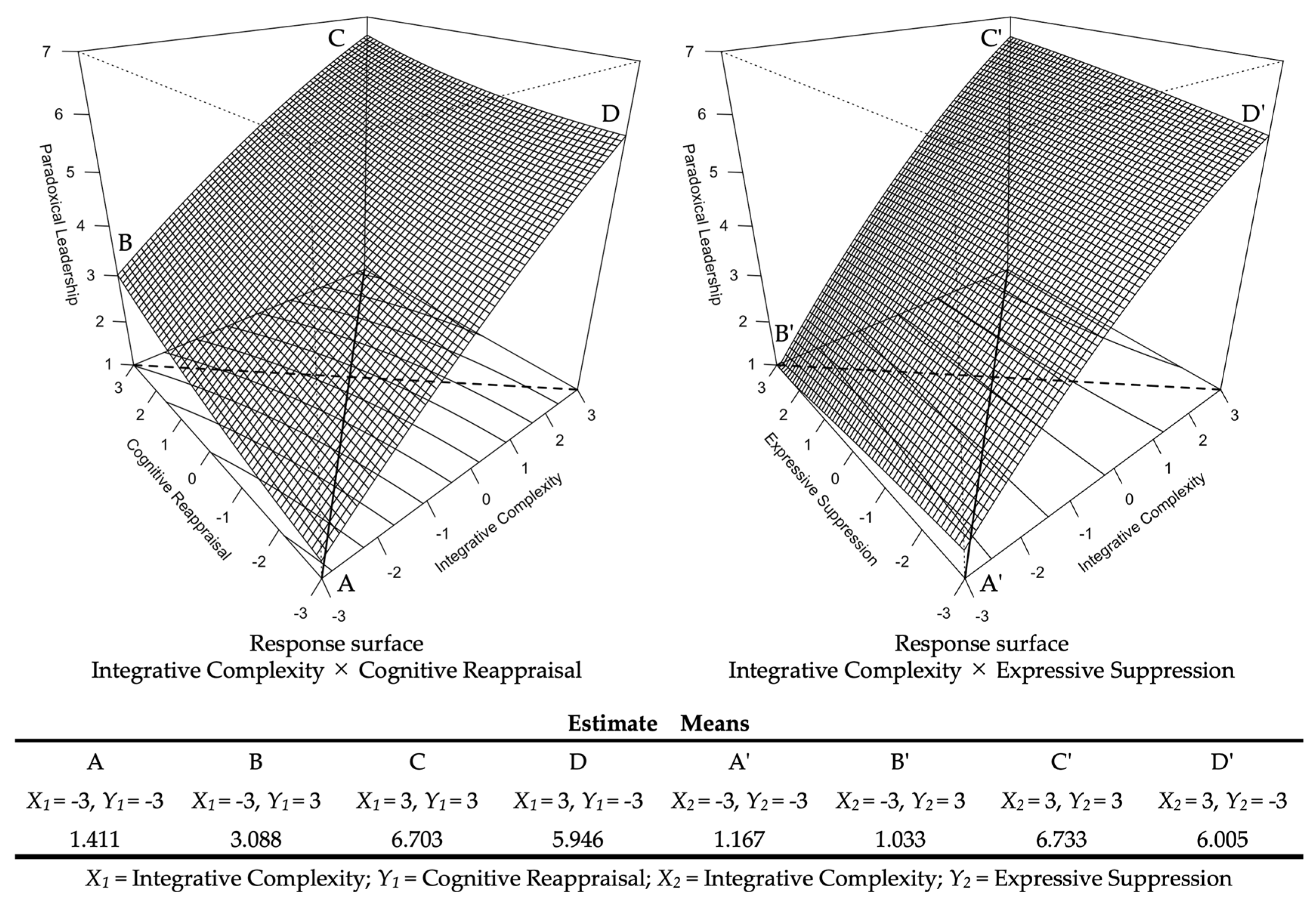
Figure 2.
Surface change along the axis of Integrative Complexity = Cognitive Reappraisal.
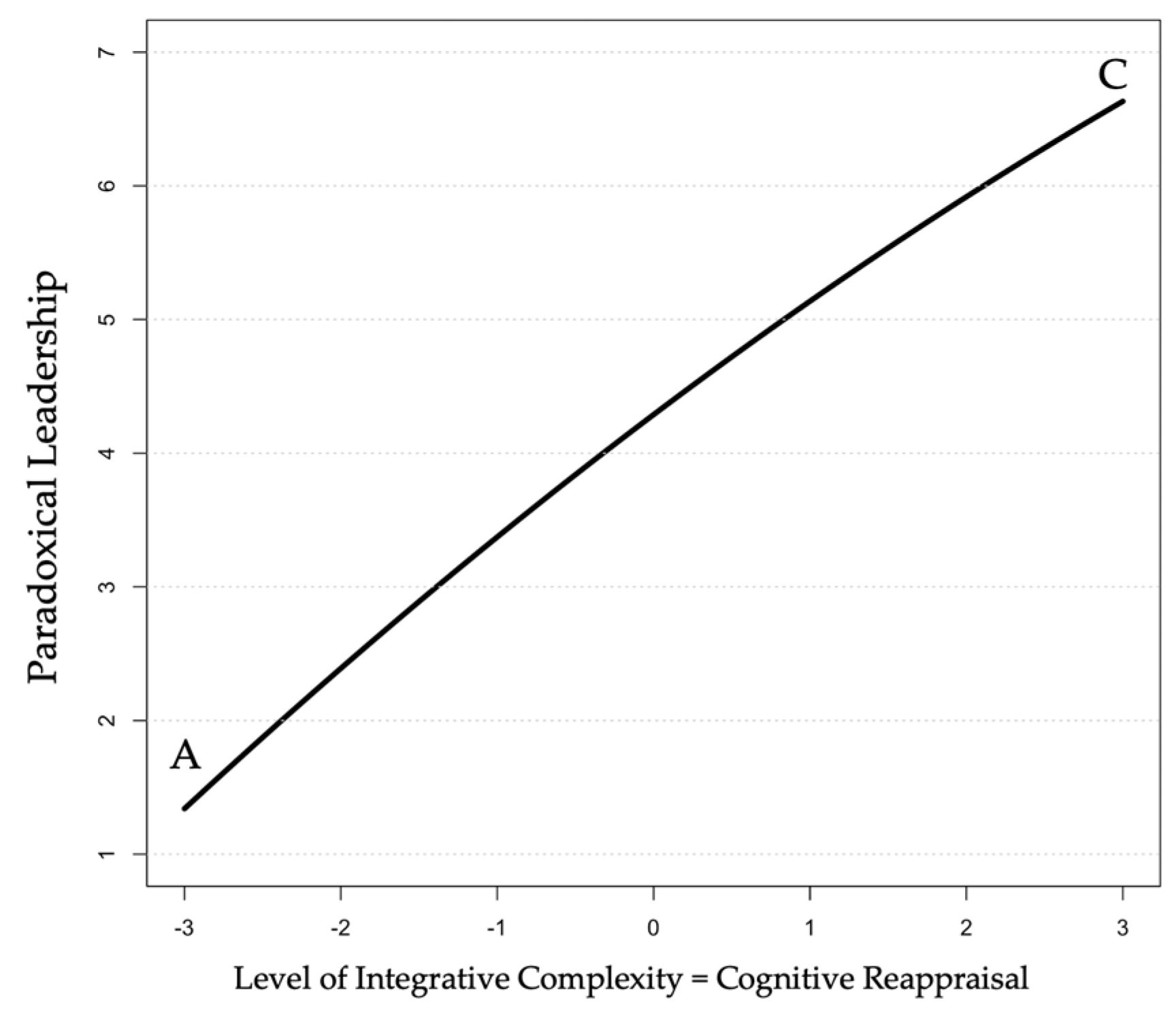
Figure 3.
Surface change along the axis of Cognitive Reappraisal (along Integrative Complexity = -3).
Figure 3.
Surface change along the axis of Cognitive Reappraisal (along Integrative Complexity = -3).
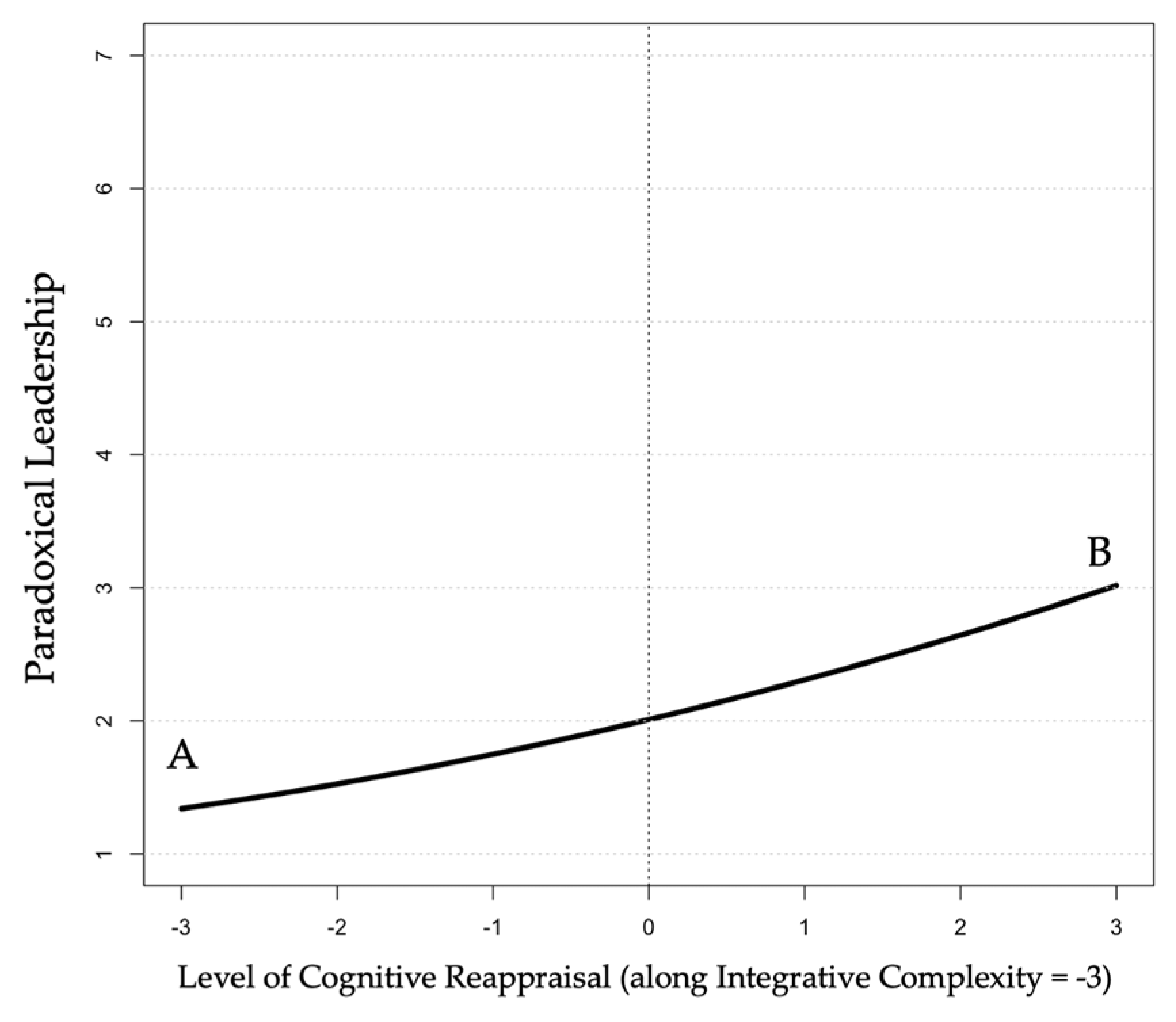
Figure 4.
Surface change along the axis of Integrative Complexity (along Cognitive Reappraisal = -3).
Figure 4.
Surface change along the axis of Integrative Complexity (along Cognitive Reappraisal = -3).
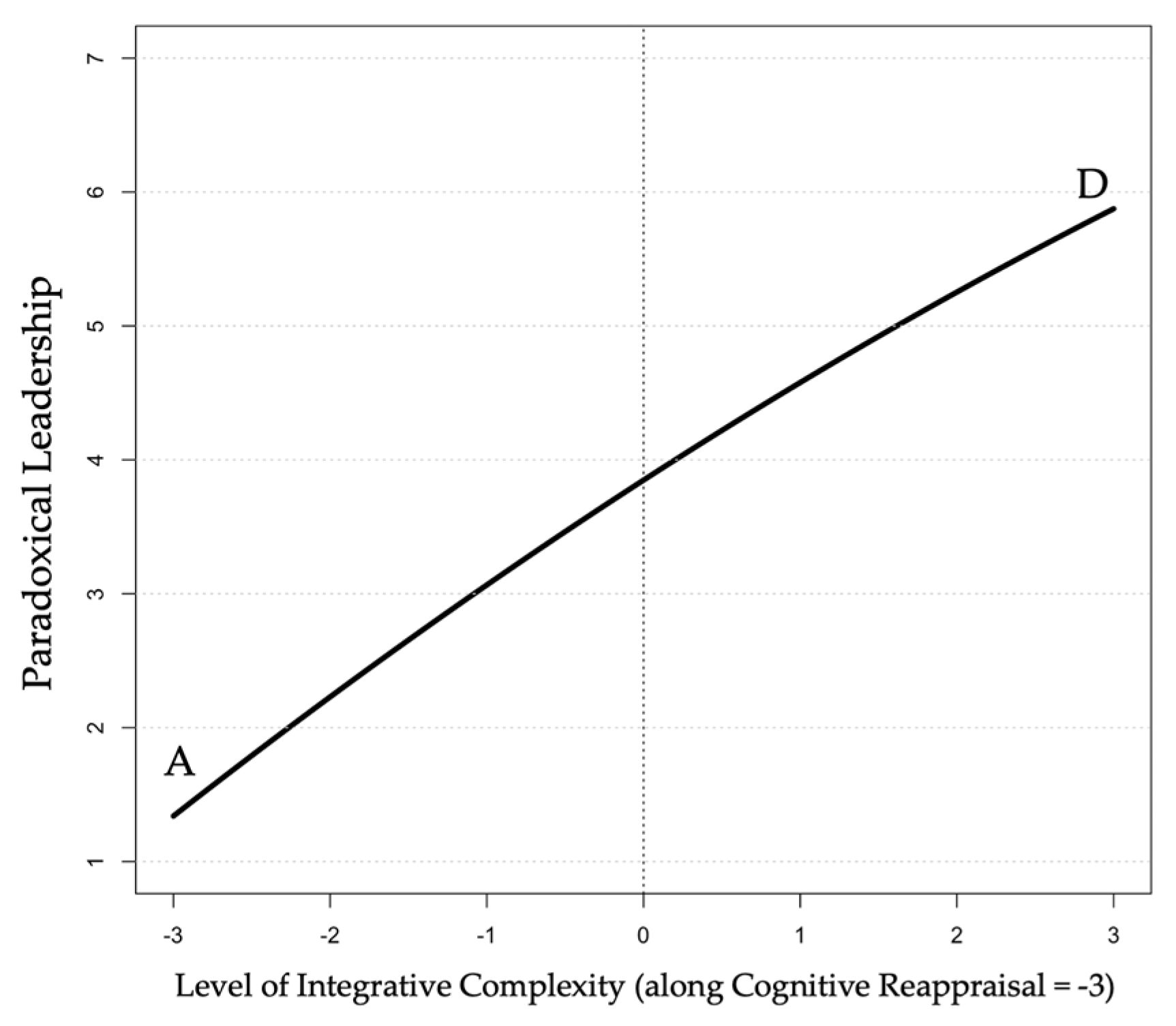
Figure 5.
Surface change along the axis of Integrative Complexity = Expressive Suppression.
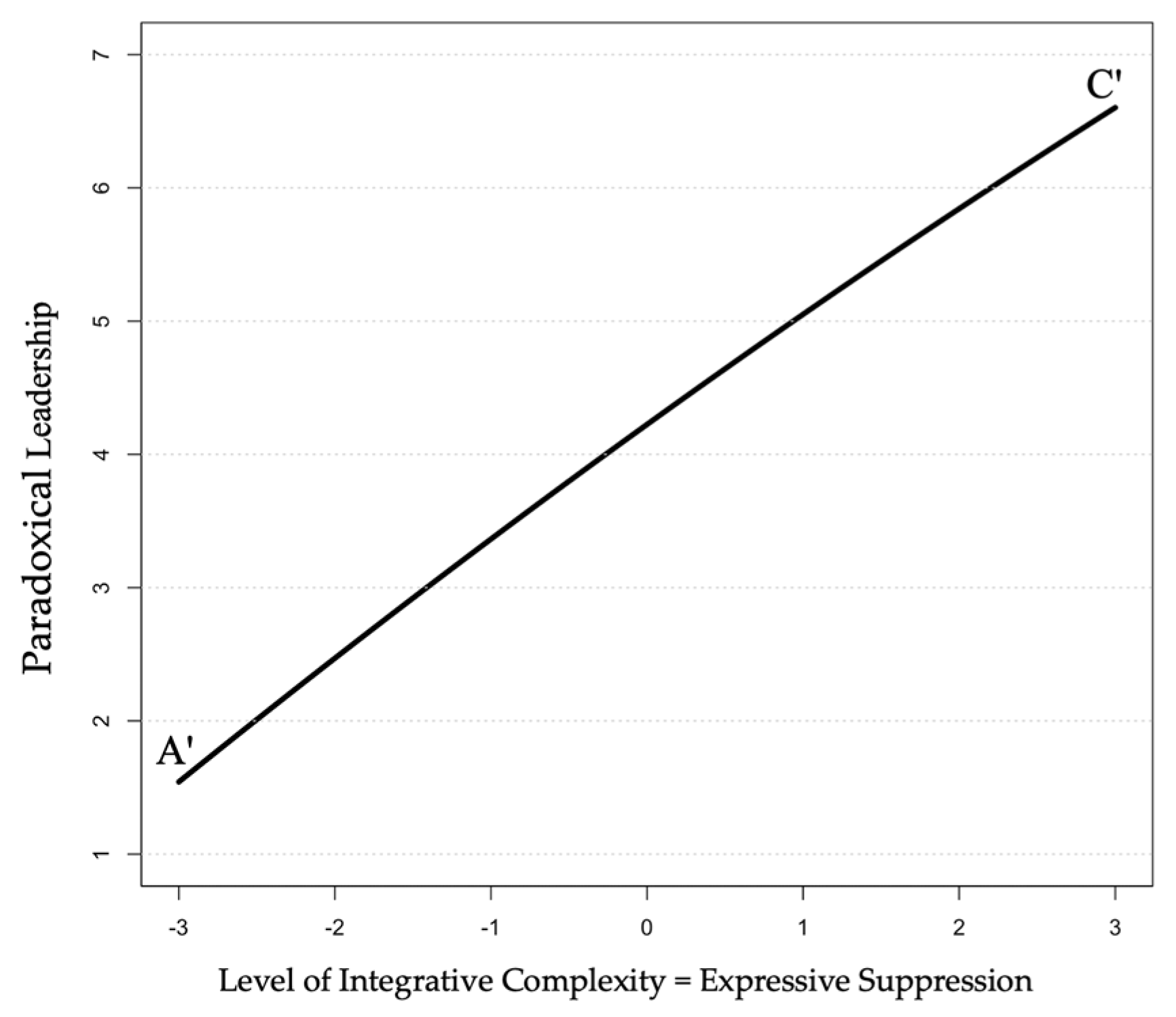
Figure 6.
Surface change along the axis of Expressive Suppression (along Integrative Complexity = -3).
Figure 6.
Surface change along the axis of Expressive Suppression (along Integrative Complexity = -3).
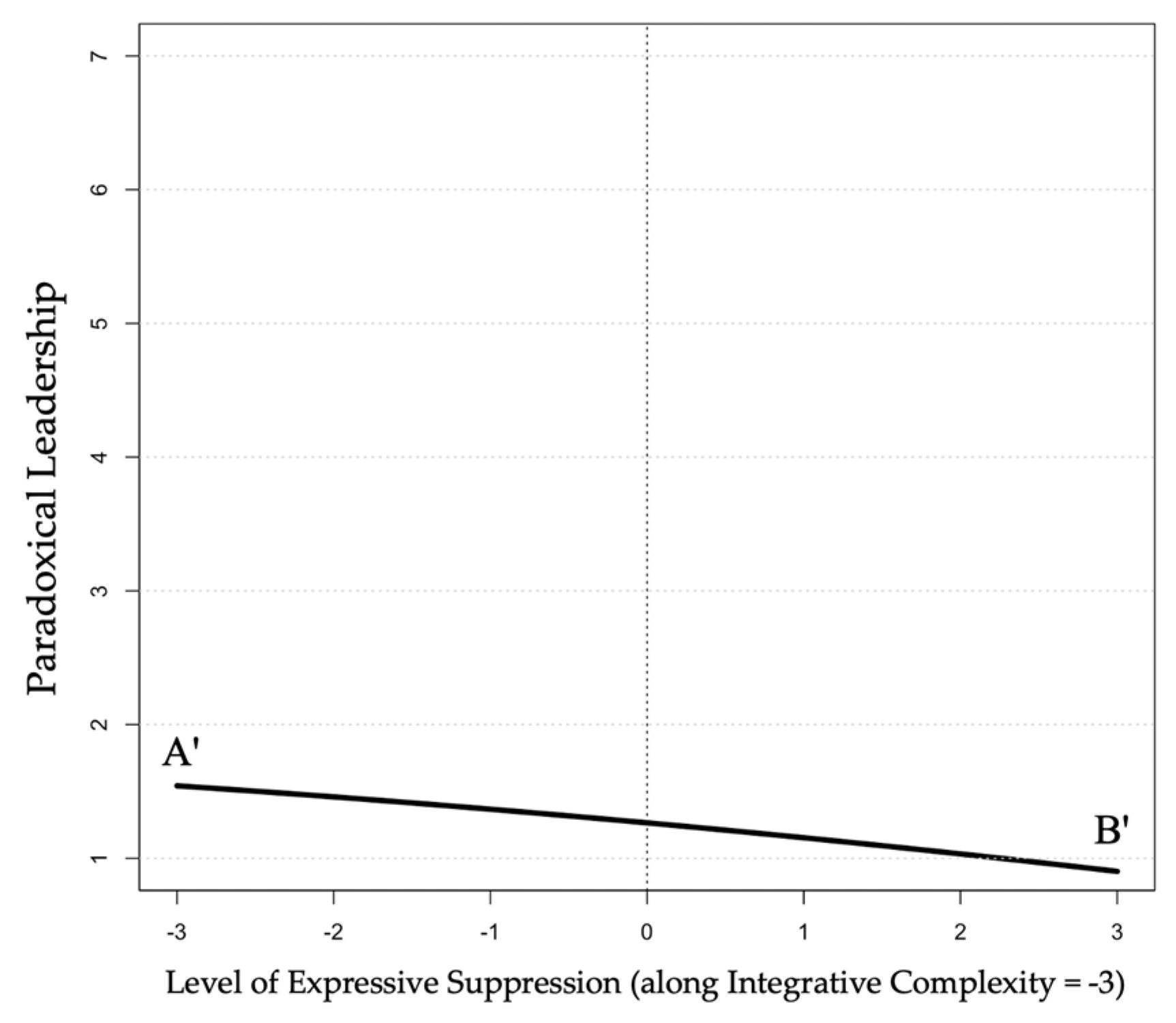
Figure 7.
Surface change along the axis of Integrative Complexity (along Expressive Suppression = -3).
Figure 7.
Surface change along the axis of Integrative Complexity (along Expressive Suppression = -3).
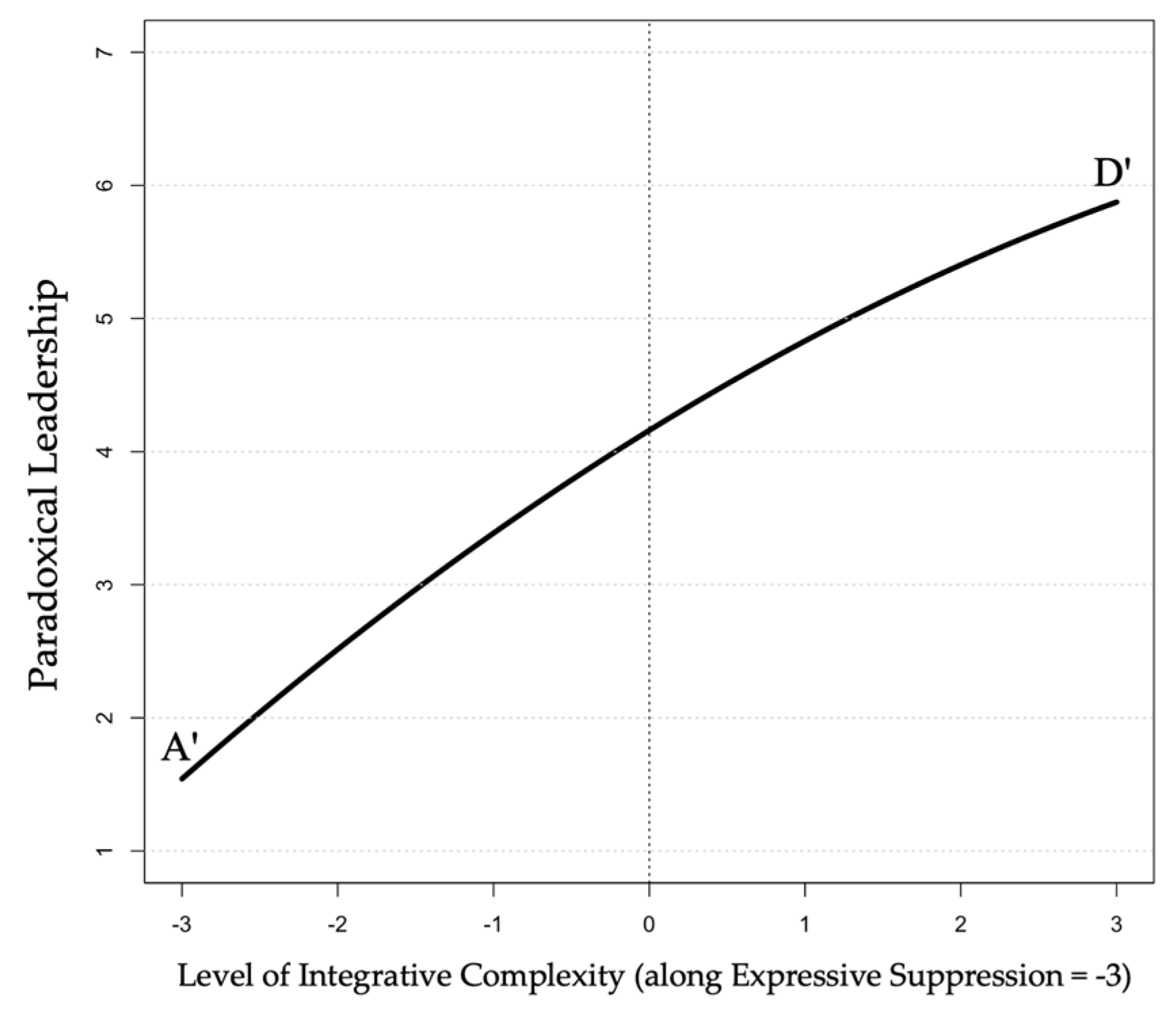

Table 1.
Confirmatory factor analysis model fit indices.
| IC × CR → PLB | IC × ES → PLB | |||||||||||
|---|---|---|---|---|---|---|---|---|---|---|---|---|
| Model | χ2 | df | CFI | TLI | RMSEA | SRMR | χ2 | df | CFI | TLI | RMSEA | SRMR |
| M1 1-factor |
2709.054 | 702 | 0.752 | 0.738 | 0.104 | 0.071 | 2649.443 | 629 | 0.729 | 0.713 | 0.110 | 0.081 |
| M2 3-factor |
1826.604 | 696 | 0.860 | 0.851 | 0.078 | 0.055 | 1645.345 | 624 | 0.863 | 0.854 | 0.079 | 0.055 |
| M3 4-factor |
1724.476 | 693 | 0.873 | 0.864 | 0.075 | 0.053 | 1557.136 | 621 | 0.874 | 0.865 | 0.076 | 0.054 |
| M4 7-factor |
1421.823 | 678 | 0.908 | 0.900 | 0.064 | 0.050 | 1228.180 | 606 | 0.916 | 0.908 | 0.062 | 0.046 |
| M5 8-factor |
1317.238 | 671 | 0.920 | 0.912 | 0.060 | 0.047 | 1135.344 | 599 | 0.928 | 0.920 | 0.058 | 0.045 |
Note. N = 264 leaders. χ2 = chi-square statistic; df = degrees of freedom; CFI = comparative fit index; TLI = Tucker–Lewis index; RMSEA = root mean square error of approximation; SRMR = standardized root mean square residual.
Table 2.
Descriptive Statistics and Correlations.
| Variables | M | SD | 1 | 2 | 3 | 4 | 5 | 6 | 7 | 8 | 9 | 10 | 11 | ||||||||||||
|---|---|---|---|---|---|---|---|---|---|---|---|---|---|---|---|---|---|---|---|---|---|---|---|---|---|
| 1 | Gender (Male) | 0.939 | 0.239 | ||||||||||||||||||||||
| 2 | Age | 52.710 | 8.010 | 0.370 | *** | ||||||||||||||||||||
| 3 | Education | 2.630 | 0.866 | -0.053 | -0.079 | ||||||||||||||||||||
| 4 | Job Years (OrgTenure) | 21.390 | 11.061 | 0.170 | ** | 0.431 | *** | -0.080 | |||||||||||||||||
| 5 | Job Years (TotalExperience) | 29.760 | 8.402 | 0.341 | *** | 0.938 | *** | -0.250 | *** | 0.433 | *** | ||||||||||||||
| 6 | Company Size | 2.630 | 1.254 | 0.078 | 0.021 | 0.257 | *** | 0.193 | ** | -0.027 | |||||||||||||||
| 7 | Position | 2.070 | 0.820 | 0.041 | 0.109 | 0.025 | 0.020 | 0.096 | -0.127 | * | |||||||||||||||
| 8 | Num Direct Reports | 10.240 | 18.985 | 0.028 | 0.080 | 0.060 | 0.096 | 0.053 | 0.180 | ** | 0.099 | ||||||||||||||
| 9 | Integrative Complexity | 5.085 | 0.823 | 0.028 | 0.075 | 0.084 | 0.014 | 0.043 | 0.022 | 0.098 | 0.070 | ||||||||||||||
| 10 | Cognitive Reappraisal | 4.852 | 0.886 | -0.039 | 0.066 | 0.089 | -0.001 | 0.045 | -0.008 | 0.095 | 0.097 | 0.758 | *** | ||||||||||||
| 11 | Expressive Suppression | 4.720 | 1.036 | -0.011 | -0.033 | -0.003 | -0.035 | -0.057 | -0.097 | -0.018 | 0.069 | 0.394 | *** | 0.449 | *** | ||||||||||
| 12 | Paradoxical leadership | 5.210 | 0.799 | -0.011 | 0.103 | 0.092 | 0.029 | 0.069 | 0.061 | 0.040 | 0.035 | 0.790 | *** | 0.695 | *** | 0.373 | *** | ||||||||
Notes. Education: high school or technical college = 1, junior college or vocational school = 2, undergraduate degree = 3, graduate degree (master’s or doctoral) = 4. Position: senior staff/assistant manager level = 1, section manager level = 2, department manager level = 3, project leader = 4. Job Years (OrgTenure): years of tenure in the current organization. Job Years (TotalExperience): total years of full-time work experience. † p < 0.1, * p < 0.05, ** p < 0.01, *** p < 0.001.
Table 3.
Results of polynomial regression and response surface analysis.
| Control | IC ×CR | IC ×ES | ||||||||||||||
| Model 1 | Model 2 | Model 3 | Model 4 | Model 5 | ||||||||||||
| Estimate | SE | Estimate | SE | Estimate | SE | Estimate | SE | Estimate | SE | |||||||
| Control | ||||||||||||||||
| Constant | 4.198 | *** | 0.516 | 4.101 | *** | 0.308 | 4.065 | *** | 0.311 | 4.090 | *** | 0.316 | 4.047 | *** | 0.318 | |
| Gender (Male) | -0.198 | 0.223 | -0.148 | 0.134 | -0.151 | 0.135 | -0.203 | 0.136 | -0.187 | 0.137 | ||||||
| Age | 0.023 | 0.020 | 0.010 | 0.012 | 0.010 | 0.012 | 0.007 | 0.012 | 0.008 | 0.013 | ||||||
| Education | 0.061 | 0.068 | 0.007 | 0.041 | 0.009 | 0.041 | 0.021 | 0.042 | 0.026 | 0.042 | ||||||
| Job Years (OrgTenure) | -0.002 | 0.005 | 0.000 | 0.003 | 0.000 | 0.003 | -0.001 | 0.003 | 0.000 | 0.003 | ||||||
| Job Years (TotalExperience) | -0.010 | 0.020 | -0.003 | 0.012 | -0.003 | 0.012 | 0.001 | 0.012 | 0.000 | 0.012 | ||||||
| Company Size | 0.030 | 0.043 | 0.033 | 0.026 | 0.035 | 0.026 | 0.035 | 0.027 | 0.038 | 0.027 | ||||||
| Position | 0.030 | 0.062 | -0.037 | 0.037 | -0.038 | 0.037 | -0.029 | 0.038 | -0.034 | 0.038 | ||||||
| Num Direct Reports | 0.000 | 0.003 | -0.002 | 0.002 | -0.002 | 0.002 | -0.001 | 0.002 | -0.001 | 0.002 | ||||||
| Polynomial terms | ||||||||||||||||
| b1 (IC) | 0.601 | *** | 0.055 | 0.679 | *** | 0.115 | 0.733 | *** | 0.041 | 0.836 | *** | 0.087 | ||||
| b2 (CR or ES) | 0.204 | *** | 0.052 | 0.203 | * | 0.096 | 0.066 | * | 0.032 | 0.007 | 0.063 | |||||
| b3 (IC2) | -0.027 | 0.069 | -0.050 | 0.038 | ||||||||||||
| b4 (IC × CR or IC × ES) | -0.026 | 0.111 | 0.038 | 0.034 | ||||||||||||
| b5 (CR2 or ES2) | 0.019 | 0.061 | -0.005 | 0.020 | ||||||||||||
| R2 ( IC ×CR) | 0.027 | 0.656 | 0.657 | |||||||||||||
| ΔR2 (IC × CR) | 0.628 | *** | 0.002 | |||||||||||||
| ΔR2 ( IC × CR: M3–M1) | 0.630 | *** | ||||||||||||||
| R2 ( IC ×ES) | 0.027 | 0.640 | 0.644 | |||||||||||||
| ΔR2 (IC × ES) | 0.613 | *** | 0.004 | |||||||||||||
| ΔR2 ( IC × ES: M5–M1) | 0.617 | *** | ||||||||||||||
| Response Surface Parameter | ||||||||||||||||
| LOC (X = Y) | ||||||||||||||||
| Slope (b1 + b2) | 0.882 | *** | 0.080 | 0.843 | *** | 0.086 | ||||||||||
| Curvature (b3 + b4 + b5) | -0.034 | 0.034 | -0.017 | 0.038 | ||||||||||||
| LOIC (X = −Y) | ||||||||||||||||
| Slope (b1 − b2) | 0.476 | * | 0.197 | 0.829 | *** | 0.125 | ||||||||||
| Curvature (b3 − b4 + b5) | 0.018 | 0.220 | -0.092 | 0.060 | ||||||||||||
| Simple Slopes | ||||||||||||||||
| CR slope: along IC = −3 | 0.279 | 0.397 | ||||||||||||||
| IC slope: along CR = −3 | 0.756 | * | 0.297 | |||||||||||||
| ES slope: along IC = −3 | -0.107 | 0.157 | ||||||||||||||
| IC slope: along ES = −3 | 0.722 | *** | 0.114 | |||||||||||||
Notes. N = 264 leaders. Unstandardized coefficients are reported. Education: high school or technical college = 1, junior college or vocational school = 2, undergraduate degree = 3, graduate degree (master’s or doctoral) = 4. Position: senior staff/assistant manager level = 1, section manager level = 2, department manager level = 3, project leader = 4. Job Years (OrgTenure): years of tenure in the current organization. Job Years (TotalExperience): total years of full-time work experience. IC = Integrative Complexity; ER = Emotion Regulation; CR = Cognitive Reappraisal; ES = Expressive Suppression; LOC = line of congruence; LOIC = line of incongruence. † p < .10, * p < .05, ** p < .01, *** p < .001.
Disclaimer/Publisher’s Note: The statements, opinions and data contained in all publications are solely those of the individual author(s) and contributor(s) and not of MDPI and/or the editor(s). MDPI and/or the editor(s) disclaim responsibility for any injury to people or property resulting from any ideas, methods, instructions or products referred to in the content. |
© 2026 by the authors. Licensee MDPI, Basel, Switzerland. This article is an open access article distributed under the terms and conditions of the Creative Commons Attribution (CC BY) license.
Copyright: This open access article is published under a Creative Commons CC BY 4.0 license, which permit the free download, distribution, and reuse, provided that the author and preprint are cited in any reuse.


