
Submitted:
04 March 2026
Posted:
05 March 2026
You are already at the latest version
Abstract
In volatile environments, work teams operate as complex adaptive systems that reconfigure internal processes in response to internal and external tensions. Team adaptability—a systemic outcome—is influenced by paradoxical leadership (PL), but the motivational pathways translating PL into adaptive behavior remain underexplored. Grounded in Conservation of Resources theory, this multi‑wave, supervisor–subordinate dyadic study of 114 high‑tech teams adopts a systems perspective and treats goal orientations as collective resource‑allocation rules. PL most strongly fosters systemic adaptability by cultivating a team performance‑approach orientation—an agentic, short‑term resource‑mobilization strategy that drives visible competence demonstration. Although team learning orientation predicts adaptability when tested alone, its mediating effect is suppressed once performance‑approach orientation is included, consistent with competitive resource‑allocation dynamics in specialist teams. PL also reduces performance‑avoidance orientation, but this reduction does not yield a significant indirect effect on adaptability, indicating that removing dysfunction is not equivalent to activating adaptive capacity. By comparing three competing motivational pathways, the study identifies a dominant leadership leverage point for configuring resource flows to produce emergent adaptation and offers implications for designing systemic interventions and models to enhance team resilience.
Keywords:
paradoxical leadership
; team learning goal orientation
; team performance approach goal orientation
; team performance avoidance goal orientation
; conservation of resources theory
1. Introduction
In volatile environments, work teams function as complex adaptive systems that must continually reconfigure internal processes in response to internal and external tensions—stability versus change, discipline versus autonomy, and uniformity versus diversity (Smith & Lewis, 2011; Zhang et al., 2015). These persistent paradoxical states shape emergent behavior and make team adaptability a central organizational outcome. Complexity leadership theory provides a macro-level framework for understanding this challenge, highlighting the need for leaders to configure interactions and resource flows to enable adaptation rather than rely on hierarchical control (Uhl-Bien et al., 2007; Uhl-Bien & Arena, 2018). Within this broad systemic framing, paradoxical leadership (PL)—a leadership style that enacts and integrates contradictory demands—offers a concrete behavioral manifestation of such configurational leadership. However, the internal motivational mechanisms through which PL shapes system-level adaptability remain undertheorized. To address this gap, we draw on Conservation of Resources (COR) theory as our core explanatory framework, examining how PL, as a systemic input, alters the team's collective resource-allocation rules—crystallized as team goal orientations—which in turn govern adaptive trajectories (Meadows, 1999; Sweeney & Sterman, 2000).
Despite mounting evidence linking PL to outcomes like creativity and information processing (Wei et al., 2025; Zhang et al., 2022), the internal, system-level motivational policies through which PL translates into emergent adaptability remain underexplored. We propose that team goal orientations function as collective resource-allocation rules—systemic policies that determine how teams mobilize, invest, and conserve resources under tension (Hobfoll et al., 2018). Framing orientations this way shifts focus from discrete team processes to the allocation logics that steer system dynamics: a learning orientation channels resources into capability accumulation and experimentation (Edmondson, 1999); a performance-approach orientation directs agentic effort toward competence demonstration and short-term gains (VandeWalle, 1997); and performance-avoidance orientation withdraws engagement and constrains resource flows.
Grounded in Conservation of Resources (COR) theory and taking a systems view, we test these three allocation pathways using a multi-wave, supervisor–subordinate dyadic sample of 114 high-tech teams. We argue that paradoxical leadership reshapes a team’s resource calculus by setting simultaneous demands while providing integrative support. This can push teams toward a performance-approach posture that quickly mobilizes resources for visible outcomes, toward a learning posture that channels resources into longer-term capability building, or away from performance-avoidance tendencies that drain engagement. In specialist teams—where deep expertise creates knowledge boundaries and translation costs—these policies will compete, so strategies that deliver quick resource returns can crowd out longer-term investments (Carlile, 2004; Gardner et al., 2012).
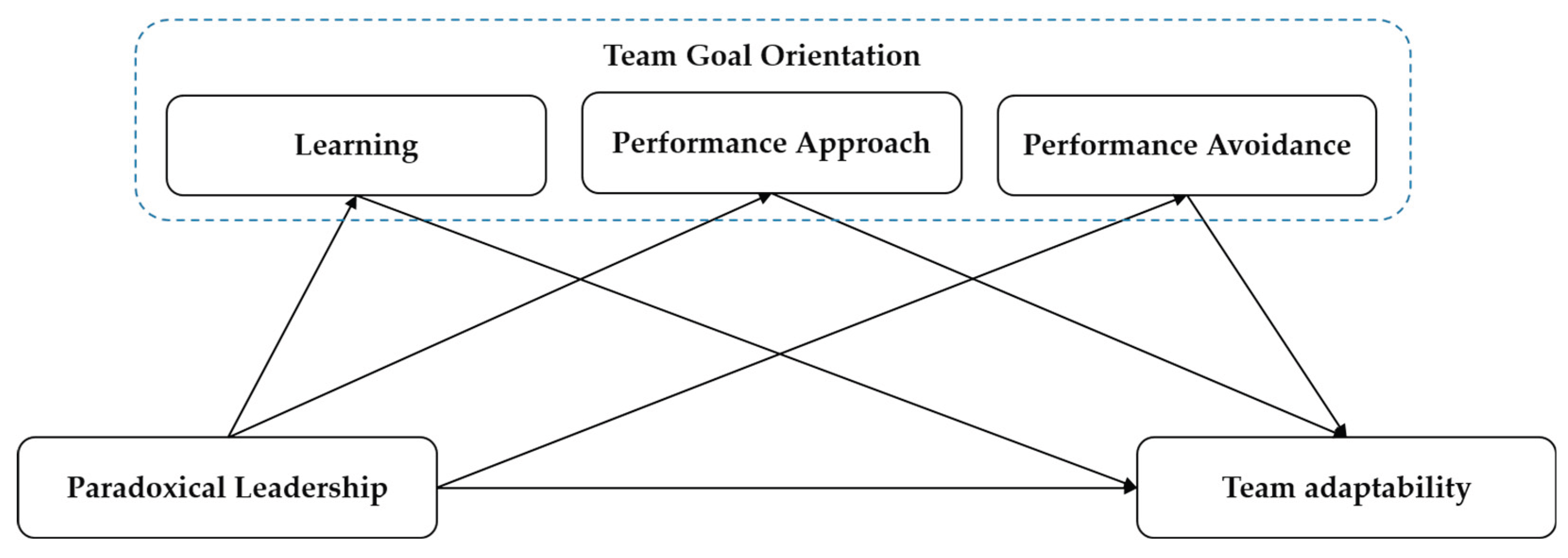
By comparing these competing mechanisms, the study pinpoints the primary leadership leverage point for shaping resource flows and producing emergent adaptation (Meadows, 1999; Sweeney & Sterman, 2000). In doing so, we shift attention from external team processes to the internal rules that govern resource allocation, clarify when each pathway matters in specialist contexts, and suggest practical leverage points for interventions and models aimed at improving team resilience and adaptive performance (Holland, 1995; Uhl-Bien & Arena, 2018). The theoretical model is shown in Figure 1.
Figure 1.
The Integrated Model of Paradoxical Leadership, Team Goal Orientation, and Team Adaptability.
Figure 1.
The Integrated Model of Paradoxical Leadership, Team Goal Orientation, and Team Adaptability.
2. Theory and Hypotheses Development
2.1. Conservation of Resources Theory
This study is grounded in Conservation of Resources (COR) theory as its core theoretical framework. The theory posits that individuals and organizations are fundamentally motivated to acquire, retain, and accumulate valued resources to meet environmental demands and thrive in dynamic settings (Hobfoll, 1989, 2011). According to this theory, “resources” are broadly defined as anything valued by an individual or collective, primarily categorized into four types: objects (e.g., tools), conditions (e.g., job security, psychological safety), personal characteristics (e.g., self-efficacy), and energies (e.g., time, attention), which together form the foundation for responding to challenges (Hobfoll, 2011) .
The theory is governed by several key principles: First, the primacy of resource loss holds that the threat or actual loss of resources is psychologically more salient and motivating than resource gain (Hobfoll, 1989). Second, the resource investment principle states that people must invest resources to protect against loss, recover from loss, and gain new resources (Halbesleben et al., 2014; Hobfoll, 1989). Third, resources tend to aggregate in “resource caravans” and their dynamics can lead to gain spirals (where resource acquisition fosters further acquisition) or loss spirals (where resource scarcity exacerbates depletion) (Hobfoll, 1989, 2001). Viewed systemically, these caravans represent resource flows and feedback loops that drive emergent team dynamics and stability or change (Meadows, 1999; Sterman, 2002).
Building on this integrated theoretical base, we conceptualize paradoxical leadership as a critical resource-enabling force for teams. By integrating contradictory demands (e.g., granting autonomy while maintaining control), leaders create a unique resource context for the team. This context not only directly provides or activates critical condition resources (e.g., psychological safety) and personal resources (e.g., cognitive flexibility), but also, through its “both/and” integrative logic, conveys vital signals to the team about how to value and strategically invest resources.
According to Conservation of Resources (COR) theory, teams are primarily driven by the primacy of loss principle, meaning the threat of failure looms larger than the potential for gain (Hobfoll, 1989). Consequently, teams naturally default to a performance-avoidance orientation to conserve their existing resources. Paradoxical leadership intervenes in this defensive cycle. By embracing the 'both/and' logic—offering support and tolerance for errors alongside high demands—these leaders first mitigate the perceived threat of resource depletion. This signals that setbacks are not fatal losses, thereby reducing the team's avoidance tendencies. Once this fear is managed, the resource investment principle comes into play(Halbesleben et al., 2014). Paradoxical leaders actively require teams to invest their freed-up resources to meet high standards and navigate complexity. This pushes the team toward proactive learning (investing to develop resources) and performance-approach (investing to validate resources) orientations. Ultimately, this shift triggers a resource gain spiral (Hobfoll, 2001): by shifting the strategy from conservation to active investment, the team builds the collective capacity needed to adapt to change. Thus, from a systems perspective, paradoxical leadership shapes the team's internal allocation rules and feedback structure, altering system trajectories toward gain-spirals of adaptive capacity. We therefore argue that paradoxical leadership enhances team adaptability by reshaping the team’s shared goal orientation—its collective focus on learning, demonstrating competence, or avoiding failure.
2.2. Paradoxical Leadership and Team Goal Orientation
Paradoxical leadership refers to leaders who simultaneously balance structural and behavioral contradictions, integrating competing demands such as maintaining control while allowing autonomy, or enforcing discipline while showing flexibility (Zhang et al., 2015).From a COR perspective, such leaders act as architects of the team’s resource context: they shape the availability and perceived value of condition resources (e.g., psychological safety), personal resources (e.g., cognitive autonomy), and energy resources (e.g., time for mastery) (Halbesleben et al., 2014). By signaling which investments are legitimate and safe, paradoxical leadership alters the team’s shared strategy for allocating cognitive, emotional, and effort resources—that is, its goal orientation.
We treat team goal orientation as the team’s collective allocation logic (Bunderson & Sutcliffe, 2003; Chen & Kanfer, 2006). This logic takes three forms: learning orientation (investing in capability development and experimentation), performance-approach orientation (investing to demonstrate competence and obtain favorable judgments), and performance-avoidance orientation (conserving resources to avoid displays of incompetence and loss of esteem) (Dragoni, 2005; Porter, 2005). Framed systemically, these orientations operate as distinct policy rules that bias the team toward gain-oriented feedback loops (learning, performance-approach) or loss-protective loops (performance-avoidance), influencing the team’s trajectory under changing conditions.
Paradoxical leaders promote a learning orientation by combining high standards with tolerance for experimentation, pairing decision control with operational autonomy, and creating psychological safety—actions that lower the perceived cost of risk and legitimize resource investments in mastery (Edmondson, 1999; Zhang et al., 2015). They promote a performance-approach orientation by by creating clear expectations, ceding social spotlight when appropriate, and allowing flexible pathways to achieve demanding goals—structural signals that increase the immediate payoff of demonstrating competence and thus mobilize short-term, agentic resource investments (Hirst et al., 2015). At the same time, paradoxical behaviors reduce performance-avoidance tendencies by lowering perceived threat: building closeness while maintaining distance and reframing setbacks as learning opportunities diminishes fear of loss and the defensive resource-locking that inhibits engagement (Elliot & Thrash, 2002; Hobfoll, 2001)
In summary, by constructing a resource-rich context that supports growth, legitimizes demonstration, and buffers against loss, paradoxical leadership channels the team’s collective resource investments toward adaptive strategies. From a systems standpoint, paradoxical leadership therefore functions as a leverage mechanism that reconfigures resource flows and feedback loops, shaping whether teams adopt growth-oriented or loss-protective policies. We thus propose:
Hypothesis 1a:
Paradoxical leadership is positively related to team learning goal orientation.
Hypothesis 1b:
Paradoxical leadership is positively related to team performance-approach goal orientation.
Hypothesis 1c:
Paradoxical leadership is negatively related to team performance-avoidance goal orientation.
2.3. Team Goal Orientation and Team Adaptability
Team adaptability is defined as a team’s capacity to adjust its actions, internal processes, and structural configurations in response to anticipated or actual changes in the work environment (Christian et al., 2017; Maynard et al., 2015). From a COR perspective, adaptability is an active resource-management process: the team dynamically reconfigures cognitive, behavioral, and relational resources to meet shifting demands—a process essential for sustaining performance under uncertainty (Baard et al., 2014; Burke et al., 2006). Systemically, adaptability reflects how resource flows and feedback loops are re-tuned under tension, so we argue that the team’s shared motivational stance, or goal orientation, is a key antecedent because it governs the team’s allocation rules—deciding whether collective resources are invested to enable flexible reconfiguration or conserved in ways that constrain change (Chen & Kanfer, 2006; DeShon et al., 2004).
Teams with a high learning goal orientation prioritize the investment of cognitive and effort-based resources into mastery and competence development. This focus fosters a resource-gain spiral (Hobfoll, 2001): novel situations are appraised as opportunities to acquire skills and knowledge rather than as threats, which fuels open information exchange, proactive experimentation, and iterative feedback-seeking(Button et al., 1996; Edmondson, 1999). These behaviors directly build the cognitive flexibility, creative capacity, and behavioral repertoire necessary for effective adaptation (Gong et al., 2013; Hirst et al., 2009; LePine, 2005). In systems terms, learning orientation strengthens positive feedback loops that accumulate adaptive capacity and increase the system’s plasticity (Bunderson & Sutcliffe, 2003).
Similarly, teams characterized by a performance-approach orientation strategically invest resources to demonstrate competence and attain favorable judgments (VandeWalle, 1997). While distinct from the mastery focus of learning orientation, this drive creates a strong impetus for adaptation in dynamic contexts. The desire to prove capability motivates teams to remain hyper-vigilant to shifting performance benchmarks and responsive to clear challenges. In the face of environmental change, this orientation channels collective energy toward efficiently realigning existing resources to meet explicit new standards or seize visible opportunities (Dietz et al., 2015). This yields tactical adaptability—efficient adjustments that preserve or enhance perceived effectiveness—even if it favors short-term returns over deep exploratory learning (Halbesleben et al., 2014; Janssen & Van Yperen, 2004). Viewed as a system policy, performance-approach biases resource flows toward quick payoff loops that can accelerate adaptive action in specialist settings (Mehta et al., 2009; Porter, 2005).
Teams with a performance-avoidance orientation invest resources primarily in preventing displays of incompetence and avoiding negative evaluations. This defensive, "loss-prevention" strategy (Elliot & Thrash, 2002) depletes cognitive and emotional reserves and promotes rigidity and risk aversion, leaving little capacity for processing novel information or exploring alternatives (Halbesleben et al., 2014; Murayama & Elliot, 2012). In system terms, performance-avoidance strengthens negative feedback and buffering that lock the team into stable but nonadaptive equilibria, producing inertia and resistance to change (Cury et al., 2006; Porath & Bateman, 2006).
Based on this reasoning, we hypothesize:
Hypothesis 2a:
Team learning goal orientation is positively related to team adaptability.
Hypothesis 2b:
Team performance-approach goal orientation is positively related to team adaptability.
Hypothesis 2c:
Team performance-avoidance goal orientation is negatively related to team adaptability.
2.4. The Mediating Role of Team Goal Orientation
Guided by Conservation of Resources (COR) theory, we propose a sequential motivational model in which team goal orientation constitutes the core mechanism linking paradoxical leadership to team adaptability. Our investigation focuses on teams of specialists (e.g., in high-tech innovation), where deep individual expertise can heighten adaptive challenges by creating knowledge boundaries (Carlile, 2004; Gardner et al., 2012). This context informs our theorizing about the relative salience of the motivational pathways.
The core logic unfolds as follows: paradoxical leadership first architects a resource-rich context that supports complex demands (Zhang et al., 2015). This context shapes the team’s collective strategy for investing its cognitive, emotional, and effort-based resources—a strategy crystallized as its dominant goal orientation (Chen & Kanfer, 2006), which in turn channels resources toward the exploratory, integrative, and reconfigurative actions that constitute adaptability (Burke et al., 2006; Dragoni, 2005; Gong et al., 2013). From a systems perspective, these shifts amount to reconfiguring resource flows and feedback structures, thereby changing the team’s trajectory under tension (Meadows, 1999; Sterman, 2002).
Within the specialist-team context, the resource calculus (Hobfoll, 2001) may favor certain pathways. Pursuing a learning goal orientation requires deconstructing specialized knowledge and co-creating understanding—a process involving short-term resource risk and delayed gains (Edmondson, 1999; Van Der Vegt & Bunderson, 2005). Conversely, a performance-approach orientation allows experts to leverage validated expertise to demonstrate competence and secure more immediate rewards (Dragoni, 2005; Hirst et al., 2015). Thus, in specialist teams, allocation rules that produce quicker returns can crowd out longer-term investment logics, making the performance-approach pathway a more direct and potent route.
We expect paradoxical leadership to strengthen team adaptability through two proactive, resource-investment pathways. By fostering psychological safety, clear-yet-flexible standards, and integrative cognitive frameworks, paradoxical leadership makes it viable and valuable for teams to (a) invest in mastering new challenges (learning goal orientation) and (b) invest resources in demonstrating competence (performance-approach orientation). These orientations fuel the exploration, deep processing, and proactive adjustments central to adaptation (LePine, 2005). From a systems standpoint, they activate positive feedback loops that accumulate adaptive capacity.
The performance-avoidance orientation pathway warrants cautious consideration. Paradoxical leadership—through integrative support and reframing setbacks—reduces perceived threat of resource loss that drives avoidance (Cury et al., 2006; Elliot & Thrash, 2002), , thereby loosening defensive “resource-locking” and potentially freeing resources for adaptation. However, this pathway’s effect likely depends on baseline threat levels and team climate, so it may operate as a conditional or weaker indirect route.
Accordingly, we hypothesize the following indirect effects:
Hypothesis 3a:
Team learning goal orientation mediates the positive relationship between paradoxical leadership and team adaptability.
Hypothesis 3b:
Team performance-approach goal orientation mediates the positive relationship between paradoxical leadership and team adaptability.
Hypothesis 3c:
Team performance-avoidance goal orientation may act as a suppressor in the relationship between paradoxical leadership and team adaptability. That is, paradoxical leadership could enhance adaptability indirectly by reducing a team’s focus on avoiding failure.
3. Method
3.1. Participants and Procedures
This study used a multi-wave, multi-source survey design, involving matched supervisor–team member pairs, to reduce common method bias and establish the temporal sequence of variables. Data were collected at three time points (T1, T2, and T3), with a two-week interval between each wave. This temporal separation was chosen to be sufficiently long to reduce transient mood effects yet short enough to prevent significant changes in the team’s structural environment (Ployhart & Vandenberg, 2010). Data collection began on December 10, 2025 and lasted approximately 9 weeks in total.
The invited participants were all employed in high-technology sectors, including biomedicine, artificial intelligence, integrated circuits, semiconductors, information technology, cloud computing, mechanical equipment, machinery manufacturing, intelligent technology, and related fields.
To enable accurate matching of responses across waves and within teams, we confirmed and collected the team supervisor’s initials (e.g., ZS for Zhang, San), team size, and all team members’ initials in advance with HR assistance. To balance budget constraints with the need for reliable team-level estimates, we used a stratified invitation approach: for teams with 5 or fewer members, 4 members were invited; for teams with 6–10 members, 6 were invited; and for teams with 11 or more members, 7 were invited. Invited members were randomly selected from HR-provided team rosters. Participating members reported their own initials and their supervisor’s initials when completing the T1 and T2 surveys, ensuring reliable cross-wave and within-team linkage.
In T1, team members provided their organization name, personal initials, supervisor’s initials, and demographic information (age, gender, education, years working in the organization, and years working with the current supervisor). They also rated paradoxical leadership behaviors.
In T2, team members again reported their organization name, personal initials, and supervisor’s initials for matching purposes. They then rated team learning goal orientation, team performance-approach goal orientation, and team performance-avoidance goal orientation.
In T3, supervisors provided their demographic and job-related information (team type, age, gender, education, years in current position) and rated team adaptability.
At baseline (T1), valid responses were obtained from 129 work teams. In the second wave (T2), 119 teams were successfully tracked (retention rate = 92.25%). By the third wave (T3), 114 teams remained, yielding an overall retention rate of 88.37% relative to the baseline sample. Attention-check items and a minimum response time were employed to ensure data quality. All participants provided informed consent, were assured of confidentiality, and could withdraw at any time.
3.2. Sample Characteristics
Finally, the analysis included a total of 114 team supervisors and 921 team members. In terms of gender distribution, the majority of participants were male (supervisors: 68.4%; members: 64.7%). The average age of supervisors was 37.00 years (SD = 3.92), which was higher than that of team members (M = 32.40, SD = 3.45). Educationally, most participants held a bachelor’s degree or above (supervisors: 98.2%; members: 90.5%), with a notable proportion of supervisors holding a postgraduate degree (22.8%). Regarding team size, half of the teams (50.0%) consisted of 6–10 members, followed by teams with 11–15 members (21.9%), ≤5 members (20.2%), and ≥15 members (7.9%). Supervisors had an average tenure in their leadership role of 6.42 years (SD = 1.96), while team members reported an average organizational tenure of 4.13 years (SD = 1.81) and had worked with their current supervisor for an average of 3.20 years (SD = 1.45). In terms of team function, the sample was predominantly composed of R&D teams (44.7%), followed by engineering teams (26.3%), sales teams (14.9%), and administrative teams (14.0%).
3.3. Measures
All constructs in this study were measured using established scales and variables were assessed on a 7-point Likert scale (1 = “Strongly Disagree” to 7 = “Strongly Agree”). With the exception of team adaptability, which was rated by supervisors, all core constructs were initially assessed at the individual level by team members and subsequently aggregated to the team level for analysis.
Paradoxical leadership was assessed at Time 1 by individual team members evaluating their direct supervisor's behavior, using the 22-item scale developed by Zhang et al. (2015). The scale encompasses five dimensions: treating subordinates uniformly while allowing individuality (5 items, e.g., “My team leader treats all subordinates uniformly with fairness, but also acknowledges their individual personalities”), combining self-centeredness with other-centeredness (5 items), maintaining decision control while allowing autonomy (4 items), enforcing work requirements while allowing flexibility (4 items), and maintaining distance while being approachable (4 items). The overall scale demonstrated good reliability in this study (Cronbach’s α = 0.914).
Team goal orientations were measured at Time 2 by individual team members regarding their team's collective focus.
Regarding Team Learning Goal Orientation, we used the 5-item scale adapted by Bunderson and Sutcliffe (2003) from their earlier work (2002) and VandeWalle (1997). This scale focuses on the team's collective desire for learning and development (e.g., "The team seeks opportunities to develop new skills and knowledge").
Regarding Team Performance-Approach Goal Orientation, we used a 4-item scale adapted from VandeWalle (1997). The items were modified to reflect the team referent rather than the individual (e.g., "The team values proving that its performance is better than other teams").
Regarding Team Performance-Avoidance Goal Orientation, we used a 4-item scale also adapted from VandeWalle (1997), with items modified for the team level (e.g., "The team would avoid taking on a new task if it might make the team look incompetent").
Cronbach’s alphas for these three dimensions were 0.712, 0.758, and 0.829, respectively.
Team adaptability was directly assessed at Time 3 by the team's direct supervisor using the 14-item scale developed by Han and Williams (2008) (e.g., “When dealing with an unexpected event, the team understands the key roles and critical paths”). The scale demonstrated high reliability (Cronbach’s α = 0.874).
To address potential confounding influences, we controlled for several key variables at multiple levels. At the team level, we included team size and team type. At the supervisor level, we controlled for supervisor leadership tenure. These variables were selected because they may systematically affect team processes and outcomes; specifically, they may influence the team's motivational structure or adaptive performance.
3.4. Measurement Validation
Prior to hypothesis testing, we conducted two sets of analyses to ensure the psychometric quality and aggregation appropriateness of our measures.
We calculated within-group agreement (Rwg) and intraclass correlation coefficients (ICCs) to justify aggregating individual responses to the team level. For paradoxical leadership, the average Rwg was 0.750, ICC(1) was 0.400, and ICC(2) was 0.798. For team learning goal orientation, the average Rwg was 0.774, ICC(1) was 0.400, and ICC(2) was 0.798. For team performance approach orientation, the average Rwg was 0.743, ICC(1) was 0.398, and ICC(2) was 0.797. For team performance avoidance orientation, the average Rwg was 0.749, ICC(1) was 0.406, and ICC(2) was 0.802. All Rwg values exceeded the conventional 0.70 threshold (James et al., 1984). The ICC(1) values indicated substantial between-team variance, exceeding the median value of 0.12 reported in organizational research (James, 1982). The ICC(2) values were all above the acceptable 0.70 cutoff, indicating reliable team-level means (Bliese, 2000). These results fully satisfy established criteria, justifying data aggregation.
To validate the measurement model, we conducted a series of confirmatory factor analyses (CFAs) using Mplus 8.3 with robust maximum likelihood (MLR) estimation. Given the nested nature of the data (individuals within teams), we first performed a multilevel CFA on the individual-level data to examine the factor structure while accounting for non-independence. The results indicated acceptable fit at the individual level: χ²/df = 1.86, RMSEA = 0.036, CFI = 0.891, TLI = 0.882, SRMR within = 0.048, SRMR between = 0.075. Although CFI and TLI were slightly below the conventional 0.90 threshold, the excellent RMSEA and SRMR values supported the tenability of the factor structure at the individual level.
Second, we aggregated individual responses to the team level and conducted a conventional CFA on the aggregated data. Due to the reduced sample size at the team level (N = 114 teams) and the increased model complexity, the CFA on the aggregated items showed acceptable but suboptimal fit: χ²/df = 1.65, RMSEA = 0.075, CFI = 0.714, TLI = 0.699, SRMR = 0.088. This decline in fit was expected, as conventional CFA with a large number of indicators is often unstable with modest sample sizes (Marsh et al., 1998).
We used item parceling to improve estimation stability at the team level (Little et al., 2002; Matsunaga, 2008), grouping items by content within each dimension. The parceled nine-factor model (five PL dimensions, three goal-orientation dimensions, and AD) showed good fit: χ2(194)=291.02, χ2/df=1.50, CFI=0.929, TLI=0.916, RMSEA=0.066 (90% CI [.050, .081]), SRMR=0.080. Fit indices meet recommended thresholds, supporting the parceled measurement model’s construct validity for subsequent hypothesis testing.

Table 1.
Confirmatory Factor Analysis Results for the Parceled Measurement Model.
| Fit Indices | Values | Recommended Criteria | Assessment |
|---|---|---|---|
| χ²/df | 291.02/194 = 1.50 | <3.0 | Good |
| CFI | 0.929 | >0.90 | Good |
| TLI | 0.916 | >0.90 | Good |
| RMSEA | 0.066 | <0.80 | Acceptable |
| SRMR | 0.080 | <0.08 | Acceptable |
Construct reliability and convergent validity were evaluated at the team level using parceled data (N = 114). Paradoxical leadership (second-order) showed excellent reliability and convergent validity (CR = .931, AVE = .739). For team goal orientation, AP (CR = .747, AVE = .597) and AV (CR = .831, AVE = .551) met criteria; LGO was slightly lower (CR = .659, AVE = .492) but acceptable given the sample size and exploratory status. Team adaptability also demonstrated good reliability and validity (CR = .865, AVE = .617). Overall, the measures are adequate for hypothesis testing.
Table 2.
Construct Reliability and Convergent Validity of Measures.
| Construct | # Items | CR | AVE |
|---|---|---|---|
| Paradoxical Leadership | 10 | 0.931 | 0.739 |
| Learning Goal Orientation | 2 | 0.659 | 0.492 |
| Performance-Approach Orientation | 2 | 0.747 | 0.597 |
| Performance-Avoidance Orientation | 4 | 0.831 | 0.551 |
| Team Adaptability | 4 | 0.865 | 0.617 |
To prepare the variables for subsequent hypothesis testing in SPSS, paradoxical leadership (PL) was modeled as a second-order construct with five first-order dimensions. Given the varying contributions of these dimensions to the overall construct, as reflected by their CFA loadings (PLUI = 0.973, PLSO = 0.949, PLCA = 0.408, PLRF = 0.627, PLDC = 0.882), we computed a weighted average of the dimension means using these loadings as weights. Specifically, PL was calculated as (0.973 × PLUI + 0.949 × PLSO + 0.408 × PLCA + 0.627 × PLRF + 0.882 × PLDC) divided by the sum of the loadings. For the remaining unidimensional constructs (LGO, AP, AV, AD, FU), we used the arithmetic mean of their respective indicators.
4. Results
We first conducted preliminary analyses using SPSS 24.0. Table 3 presents the means, standard deviations, and bivariate correlations among all study variables. The correlation patterns provided strong initial support for our hypotheses. As predicted, paradoxical leadership (PL) was significantly and positively correlated with team adaptability (AD) (r = 0.523, p < .01). PL was also positively correlated with team learning goal orientation (LGO) (r = 0.381, p < .01) and team performance-approach orientation (AP) (r = 0.420, p < .01), while negatively correlated with team performance-avoidance orientation (AV) (r = -0.325, p < .05). These results offer preliminary evidence in favor of Hypotheses 1a, 1b, and 1c. Furthermore, LGO (r = 0.543, p < .01) and AP (r = 0.650, p < .01) were positively related to AD, while AV was negatively related to AD (r = -0.451, p < .01), providing initial support for Hypotheses 2a, 2b, and 2c. The magnitudes of these correlations were in the small to large range, indicating meaningful relationships without suggesting severe multicollinearity. Most of the control variables were not significantly correlated with the core theoretical variables.
Table 3.
Means, standard deviations and correlations among study variables.
| Variable | M | SD | 1 | 2 | 3 | 4 | 5 | 6 | 7 | 8 |
|---|---|---|---|---|---|---|---|---|---|---|
| Paradoxical Leadership | 5.451 | 0.506 | (0.914) | |||||||
| Team-Learning Goal Orientation | 5.401 | 0.549 | .381** | (0.712) | ||||||
| Team-Performance-Approach-Orientation | 5.349 | 0.697 | .420** | .654** | (0.758) | |||||
| Team-Performance-Avoidance-Orientation | 2.505 | 0.665 | -.325** | -.632** | -.662** | (0.829) | ||||
| Team-Adaptability | 5.559 | 0.776 | .523** | .543** | .650** | -.451** | (0.874) | |||
| Supervisor Leadership Tenure | 6.421 | 1.964 | .007 | -.188* | -.063 | .042 | .046 | — | ||
| Team Size | 2.175 | 0.844 | .068 | .061 | .018 | .033 | -.001 | .094 | — | |
| Team Type | 2.219 | 1.267 | -.095 | -.160 | -.064 | .194* | -.111 | .115 | .080 | — |
Note. N = 114. M and SD are used to represent mean and standard deviation, respectively. Reliability coefficients (Cronbach's α) for the multi-item scales are shown in bold parentheses on the diagonal. Single-item and demographic variables did not have calculable reliability coefficients and are indicated by "—". * p < .05, ** p < .01 (two-tailed).
To test the proposed hypotheses, this study employed the PROCESS macro (Hayes, 2018) for bootstrap mediation analysis. First, Model 4 (with 5,000 bias-corrected bootstrap samples) was used to examine the individual mediating roles of the three goal orientation dimensions separately. Subsequently, we conducted a parallel multiple mediation analysis (using Model 4 with all mediators entered simultaneously) to assess the relative independence and robustness of the pathways. All analyses controlled for supervisor leadership tenure, team size, and team type.
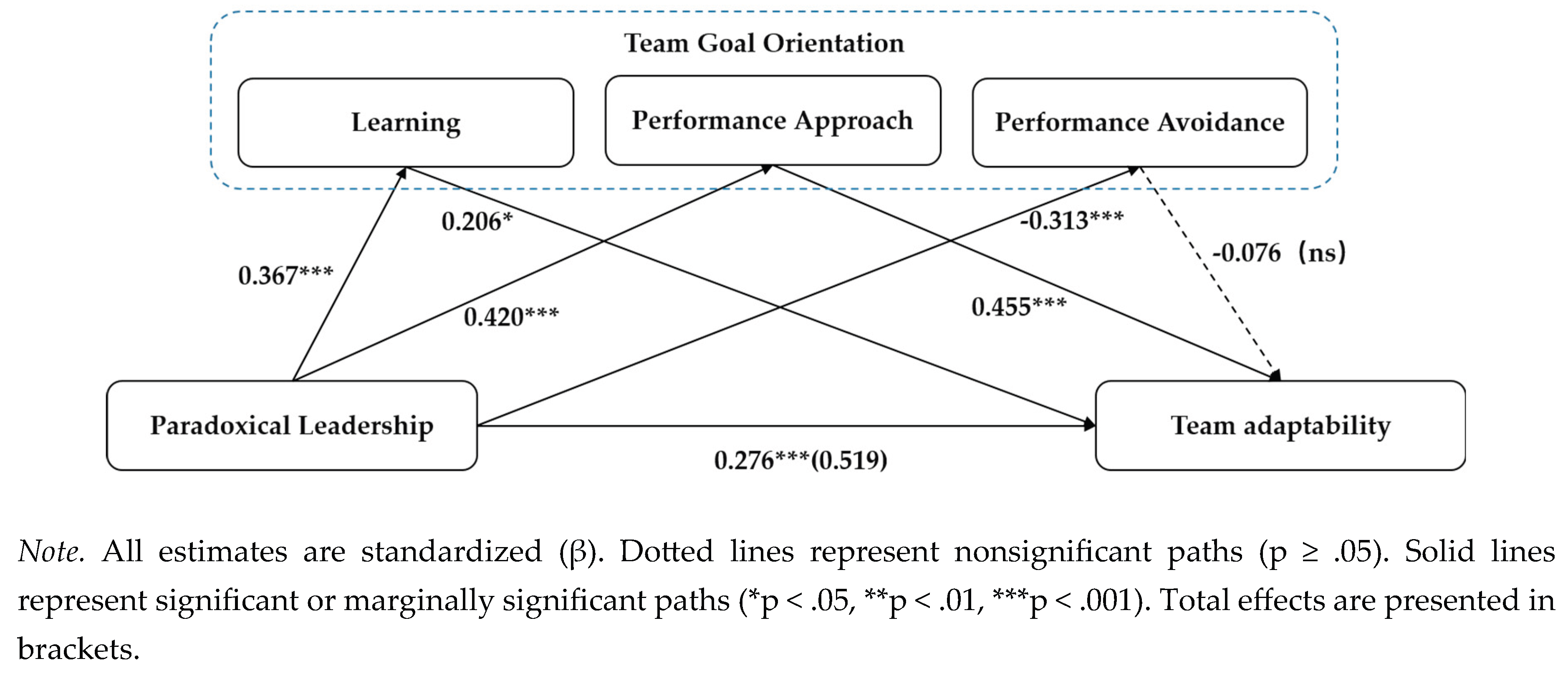
Hypothesis 1 predicted the relationships between paradoxical leadership (PL) and team goal orientations. The results from the simple mediation models showed that paradoxical leadership had a significant positive effect on team learning goal orientation (LGO; b = 0.399, p < .001) and on team performance-approach orientation (AP; b = 0.578, p < .001), and a significant negative effect on team performance-avoidance orientation (AV; b = -0.411, p < .001). Thus, Hypotheses 1a, 1b, and 1c were fully supported.
Hypothesis 2 predicted the relationships between team goal orientations and team adaptability (AD). The results from the second stage of the simple mediation models indicated that, when controlling for paradoxical leadership, both team learning goal orientation (b = 0.610, p < .001) and team performance-approach orientation (b = 0.588, p < .001) were significant positive predictors of team adaptability, whereas team performance-avoidance orientation was a significant negative predictor (b = -0.365, p < .001). Therefore, Hypotheses 2a, 2b, and 2c were also fully supported.
Table 4.
Simple Mediation Results: Indirect Effects of Individual Goal Orientations.
| Mediator | Direct Effect c‘ (unstd b) |
Direct Effect c' (standardized β) | Indirect Effect (a × b) | 95% Boot CI | Total R² |
|---|---|---|---|---|---|
| LGO | 0.552*** | 0.360 | 0.243 | [0.024, 0.662] | 0.431 |
| AP | 0.456*** | 0.297 | 0.340 | [0.041, 0.846] | 0.509 |
| AV | 0.646*** | 0.421 | 0.150 | [0.004, 0.622] | 0.365 |
Note. N = 114. The table reports unstandardized coefficients (b) and standardized coefficients (β). The direct effect (c‘) is the effect of paradoxical leadership (PL) on team adaptability (AD) when controlling for the mediator. Bootstrap sample size = 5,000 for bias-corrected confidence intervals (CI). All analyses control for supervisor leadership tenure, team size, and team type. Total R² values are for the full mediation model (Outcome: AD). *** p < .001 (based on unstandardized coefficients).
Hypothesis 3 proposed that team goal orientations mediate the relationship between paradoxical leadership and team adaptability. Results from the simple mediation models (Model 4) revealed a differentiated pattern. The indirect effect of paradoxical leadership on team adaptability via team performance-approach orientation was significant (indirect effect = 0.340, 95% BootCI [0.041, 0.846]), supporting Hypothesis 3b. The indirect effect via team learning goal orientation was also significant in the simple model (indirect effect = 0.243, 95% BootCI [0.024, 0.662]), providing initial support for Hypothesis 3a. Moreover, the indirect effect via team performance-avoidance orientation was also significant (indirect effect = 0.150, 95% BootCI [0.004, 0.622]), initially supporting Hypothesis 3c.
To further clarify the independent contributions of the three mediating pathways, a parallel multiple mediation analysis including all three mediators simultaneously was conducted. The total indirect effect was significant (effect = 0.373, 95% BootCI [0.059, 0.854]). However, an examination of the specific indirect effects within this parallel model showed that only the indirect effect via team performance-approach orientation (AP) remained significant (effect = 0.293, 95% BootCI [0.041, 0.720]); the indirect effect via team learning goal orientation (LGO) became non-significant (effect = 0.116, 95% BootCI [-0.081, 0.410]); the indirect effect via team performance-avoidance orientation (AV) remained non-significant (effect = -0.037, 95% BootCI [-0.434, 0.106]).
Table 5.
Parallel Multiple Mediation Results: Indirect Effects through Three Goal Orientations.
| Mediator | Indirect Effect (unstd b) |
Boot SE | 95% Boot CI | Indirect Effect (standardized β) |
|---|---|---|---|---|
| LGO | 0.116 | 0.131 | [-0.071, 0.415] | 0.076 |
| AP | 0.293 | 0.175 | [ 0.031, 0.721] | 0.191 |
| AV | -0.037 | 0.116 | [-0.553, 0.097] | -0.024 |
Note. N = 114. Table 5 reports unstandardized indirect effects (b) and completely standardized indirect effects (β). Bootstrap sample size = 5,000. All analyses control for supervisor leadership tenure, team size, and team type. A significant indirect effect is indicated by a confidence interval that does not contain zero.
In summary, results from the multiple mediation model provided robust support for Hypothesis 3b (mediation via AP). Support for Hypothesis 3a (mediation via LGO) was contingent on model specification, as its effect became non-significant when its shared variance with AP was accounted for. Hypothesis 3c (mediation via AV) received initial support in the simple mediation model but was not upheld in the parallel multiple mediation model. Paradoxical leadership also maintained a significant direct effect on team adaptability in the final model (b = 0.423, p < .001, 95% CI [0.195, 0.651]), indicating partial mediation.
Figure 2.
Results of mediation model.
5. Discussion
This study aimed to uncover the motivational mechanisms linking paradoxical leadership to team adaptability—a key emergent property of team systems. Drawing on Conservation of Resources (COR) theory (Hobfoll, 1989, 2001), we proposed that paradoxical leadership, by shaping teams' resource-management strategies (reflected in their goal orientations), enhances team adaptability. Our findings largely support the proposed model, though with nuanced distinctions. First, paradoxical leadership was found to be a significant antecedent of all three team goal orientations—promoting learning and performance-approach orientations while mitigating performance-avoidance orientation. This aligns with recent assertions that paradoxical leaders effectively manage tensions to signal diverse behavioral expectations (Smith & Lewis, 2011; Zhang et al., 2015), effectively guiding teams on how to invest and protect their resources—a critical function for maintaining system viability in dynamic environments. Second, while both learning and performance-approach orientations predicted team adaptability, performance-avoidance orientation negatively predicted it, consistent with prior research linking avoidance motivation to maladaptive team outcomes(Elliot, 1999; Mehta et al., 2009).
Most notably, the parallel mediation analysis revealed that team performance-approach orientation is the primary, robust mechanism transmitting the effect of paradoxical leadership to team adaptability—the dominant pathway through which systemic inputs shape adaptive outputs. While team learning goal orientation also served as a significant mediator in isolation, its effect became non-significant when competing with performance-approach orientation. Similarly, team performance-avoidance orientation demonstrated a significant indirect effect in simple mediation, but this effect disappeared in the parallel model. This nuanced outcome can be attributed to two primary factors: First, in the high-pressure, fast-paced context of high-tech enterprises, the imperative to demonstrate competence and achieve tangible results (performance-approach) may become a more salient and immediately rewarding strategy for gaining and securing resources (Hobfoll, 2001) compared to the longer-term process of developing capabilities (learning orientation). Second, given the inherent positive correlation between learning and performance-approach orientations, team performance-approach orientation likely explained a substantial portion of the shared variance between paradoxical leadership and team adaptability in the parallel model, thereby diminishing the unique mediating contribution of learning goal orientation (Payne et al., 2007). From a COR perspective, paradoxical leaders, by balancing high demands with strong support, create a context where proactive resource investment (i.e., demonstrating competence and achieving success through performance-approach goals) is perceived as a viable and rewarding strategy for gaining new resources and protecting existing ones (Halbesleben et al., 2014). The fact that performance-avoidance orientation's indirect effect became non-significant in the parallel model suggests that while paradoxical leaders reduce the threat of resource loss (fear of failure), this reduction alone is insufficient to drive proactive adaptability when other, more active motivational orientations are accounted for. Adaptability inherently requires active resource engagement and investment (Elliot & Thrash, 2002), which is better captured by approach-oriented motivations—a distinction that illuminates how different motivational logics operate within team systems.
5.1. Theoretical Contributions
This study offers three primary theoretical contributions.
First, we identify team goal orientation as the intrinsic motivational mechanism linking paradoxical leadership to team adaptability—a key system-level emergent outcome. Prior research has predominantly focused on external, information-processing pathways such as team learning behavior or knowledge sharing (Wei et al., 2025). By shifting the explanatory focus to internal resource and motivation dynamics, we demonstrate that paradoxical leadership not only shapes what teams do, but fundamentally reshapes why they do it—their collective orientation toward resource investment. This responds directly to calls for a deeper understanding of the psychological microfoundations of paradoxical leadership effectiveness (Waldman & Bowen, 2016; Zhang et al., 2015) and extends COR theory to the team level by showing that leaders function as resource caravan passageways, simultaneously signaling resource availability and legitimate performance demands—a critical systemic input shaping team trajectories.
Second, we dissect the differential mediating roles of the three goal orientation dimensions. While prior research has often treated goal orientation as a unitary construct or examined its dimensions in isolation, our parallel mediation design reveals a more nuanced picture: not all goal orientations are created equal as conduits of adaptation. The finding that performance-approach orientation—not learning orientation—is the only robust and unique mediator challenges a deeply held assumption in the leadership and teams literature. Learning orientation has long been romanticized as the quintessential adaptive mindset (Bunderson & Sutcliffe, 2003; Edmondson, 1999). Yet our results suggest that, in contexts characterized by competing demands and performance pressure, the motivational energy generated by paradoxical leadership may be more effectively channeled into achievement-striving than into knowledge-exploration per se. This does not render learning orientation irrelevant; rather, it suggests that its adaptive benefits may be realized through or overlapped with performance-approach strivings, revealing how competing motivational pathways interact within team systems. This interpretation aligns with recent work suggesting that learning and performance goals are not opposing forces but can be productively integrated (Hirst et al., 2015). Paradoxical leaders may be uniquely positioned to facilitate such integration.
Third, we provide a resource-based explanation for the non-significance of performance-avoidance as a mediator. While paradoxical leadership significantly reduced teams’ avoidance focus—a valuable finding in itself—this reduction did not translate into enhanced adaptability. This finding makes an important theoretical distinction: reducing the negative is not equivalent to activating the positive. From a COR perspective, resource conservation (avoiding loss) and resource investment (pursuing gain) are distinct motivational systems (Hobfoll et al., 2018). Paradoxical leaders successfully mitigate the threat appraisal that triggers avoidance orientation, thereby freeing teams from resource-depleting fear. However, adaptability—a proactive, change-oriented behavior—requires not merely the absence of threat but the presence of gain-based motivational pull. The fact that performance-avoidance orientation's indirect effect was significant only when considered in isolation, but disappeared when learning and performance-approach orientations were included, suggests that avoidance reduction alone is insufficient to drive proactive adaptability. This finding refines COR theory by demonstrating that resource protection and resource acquisition operate through separate mechanisms and that leadership interventions must target both to fully elicit adaptive behavior—reducing threats while simultaneously cultivating approach-oriented motivations that actively direct teams toward resource investment and growth, thereby enhancing system-level adaptive capacity.
5.2. Practical Implications
Our findings offer actionable insights for organizations and leaders operating in dynamic environments.
Leaders should not shy away from the tensions of "both/and" management (e.g., maintaining control while granting autonomy). Our results show that these paradoxical behaviors act as a catalyst for teams to adopt a "performance-approach" mindset. Leaders should explicitly communicate that navigating these contradictions is an opportunity for the team to demonstrate their excellence and competence (Lewis et al., 2014). By framing paradoxes as challenges to be mastered rather than problems to be solved, leaders can foster a strong drive for achievement—a critical system-level motivational state that enhances adaptive capacity.
Despite the long-standing and intuitively appealing belief that fostering learning orientation is the most direct route to team adaptability (Edmondson, 1999; Senge, 1990), our results suggest this assumption is incomplete—and, if pursued exclusively, potentially misleading. Leaders who prioritize learning goals to the exclusion of performance-approach goals risk engaging their teams in exploration without clear direction or accountability, a dynamic that can delay adaptive action and diffuse collective effort (Bunderson & Sutcliffe, 2003; Levinthal & March, 1993). We therefore recommend that paradoxical leaders deliberately and explicitly cultivate a performance-approach orientation as the more direct and robust motivational pathway to adaptability—not by abandoning learning goals, but by reframing learning as a means to performance achievement rather than an end in itself (Hirst et al., 2009; Seijts & Latham, 2012). For example, leaders can set clear, challenging performance targets while simultaneously providing the autonomy and psychological safety necessary to experiment, fail, and learn in pursuit of those targets (Edmondson, 1999; Zhang et al., 2015). This integration of high standards with strong support is the signature strength of paradoxical leadership (Waldman & Bowen, 2016; Zhang et al., 2015), and our findings suggest it is precisely this combination that activates the performance-approach pathway to adaptability, shaping how teams as complex systems allocate collective resources.
The study shows that while paradoxical leadership helps reduce the team's fear of failure (avoidance orientation), simply reducing fear is not enough to generate adaptability. Leaders must go a step further: after alleviating anxiety through supportive behaviors (Edmondson, 1999), they must actively channel that energy into goal-directed pursuits. Interventions should not just focus on "psychological safety" (reducing avoidance) but also on "strategic ambition" (increasing approach) to ensure teams can effectively pivot and adapt—a dual focus that addresses both system constraints and system drivers.
5.3. Limitations and Future Directions
Despite its strengths, this study has several limitations that point to avenues for future research.
First, our team-level sample size (N = 114) was relatively modest considering the complexity of the measurement model. Despite the strengths of our multi-wave, multi-source design, one measurement limitation should be noted. The average variance extracted (AVE) for team learning goal orientation (LGO) was 0.492, slightly below the recommended .50 threshold (Fornell & Larcker, 1981), suggesting that some variance in its indicators may be due to measurement error. This likely reflects the inherent complexity of capturing learning orientation at the team level. However, our temporally lagged and multi-source design mitigates common method bias concerns (Podsakoff et al., 2003). Future research with larger team-level samples should re-examine the factor structure of LGO using item-level indicators to further validate its measurement.
In addition, our data were collected exclusively from teams in Chinese organizations, limiting cross-cultural generalizability. While the Chinese dialectical worldview may facilitate the acceptance of paradoxical leadership, cultural values such as ‘Face’ (Mianzi) and high power distance likely amplified the dominance of performance-approach orientation observed in our results. In this context, employees are often culturally conditioned to prioritize demonstrating competence and outperforming others to secure status. This cultural pressure may explain why learning goal orientation became non-significant in our model: within high-pressure, high-tech environments, the immediate imperative to deliver visible results often overshadows the longer-term benefits of learning. Consequently, these motivational pathways might differ in Western, individualistic settings where learning is less subordinated to status competition. Future research should conduct cross-cultural comparisons and explore boundary conditions—such as task uncertainty, knowledge heterogeneity, time pressure, psychological safety—that might reactivate the learning orientation pathway as a critical mediator, thereby enriching our understanding of how contextual factors shape motivational dynamics within team systems (Bunderson & Sutcliffe, 2003; Cellar et al., 2011).
6. Conclusions
This study aimed to investigate the motivational pathways through which paradoxical leadership influences team adaptability—a key emergent property of team systems—via team goal orientations. Our findings suggest that paradoxical leadership primarily enhances team adaptability by fostering team performance-approach orientation, with team learning goal orientation playing a more nuanced mediating role. While paradoxical leadership also reduced team performance-avoidance orientation, this path did not significantly mediate adaptability. We hope these insights deepen the understanding of how paradoxical leadership impacts team motivation and system-level adaptive capacity, prompting further research into optimizing leadership strategies for dynamic environments.
Author Contributions
Conceptualization, Y.Z. and W.W.; methodology, Y.Z.; software, Y.Z. and Z.Q.; validation, Y.Z. and W.W.; formal analysis, Y.Z.; investigation, Y.Z., Z.Q. and W.Z.; resources, Y.Z.; data curation, Y.Z.; writing—original draft preparation, Y.Z., Z.Q. and W.Z.; writing—review and editing, Y.Z. and W.W.; visualization, Y.Z.; supervision, W.W.; project administration, Y.Z. and W.W.; funding acquisition, W.W. All authors have read and agreed to the published version of the manuscript.
Funding
This research received no external funding.
Institutional Review Board Statement
The studies involving human participants were reviewed and approved by the Ethical Review Board of Beijing Jiaotong University. Written informed consent for participation was not required for this study in accordance with the national legislation and the institutional requirements.
Informed Consent Statement
Informed consent was obtained from all subjects involved in the study.
Data Availability Statement
The data presented in this study are not publicly available due to privacy or ethical restrictions but are available on request from the corresponding author.
Conflicts of Interest
The authors declare no conflicts of interest.
Abbreviations
The following abbreviations are used in this manuscript:
| PL | Paradoxical Leadership |
| PLUI | PL - Treating subordinates uniformly while allowing individualization(UI) |
| PLSO | PL - Combining self-centeredness with other-centeredness (SO) |
| PLCA | PL - Maintaining decision control while allowing autonomy (CA) |
| PLRF | PL - Enforcing work requirements while allowing flexibility (RF) |
| PLDC | PL - Maintaining both distance and closeness (DC) |
| LGO | Team Learning Goal Orientation |
| AP | Team Performance Approach Goal Orientation |
| AV | Team Performance Avoidance Goal Orientation |
| AD | Team Adaptability |
References
- Baard, S. K.; Rench, T. A.; Kozlowski, S. W. J. Performance adaptation: A theoretical integration and review. Journal of Management 2014, 40(1), 48–99. [Google Scholar] [CrossRef]
- Bliese, P. D. Within-group agreement, non-independence, and reliability: Implications for data aggregation and analysis. In Multilevel theory, research, and methods in organizations: Foundations, extensions, and new directions; Kozlowski, K. J. K. S., Ed.; Jossey-Bass, 2000; pp. 349–381. [Google Scholar]
- Bunderson, J. S.; Sutcliffe, K. M. Management team learning orientation and business unit performance. Journal of Applied Psychology 2003, 88(3), 552–560. [Google Scholar] [CrossRef]
- Burke, C. S.; Stagl, K. C.; Salas, E.; Pierce, L.; Kendall, D. Understanding team adaptation: a conceptual analysis and model. Journal of Applied Psychology 2006, 91(6), 1189–1207. [Google Scholar] [CrossRef]
- Button, S. B.; Mathieu, J. E.; Zajac, D. M. Goal orientation in organizational research: A conceptual and empirical foundation. Organizational Behavior and Human Decision Processes 1996, 67(1), 26–48. [Google Scholar] [CrossRef]
- Carlile, P. R. Transferring, translating, and transforming: An integrative framework for managing knowledge across boundaries. Organization Science 2004, 15(5), 555–568. [Google Scholar] [CrossRef]
- Cellar, D. F.; Stuhlmacher, A. F.; Young, S. K.; Fisher, D. M.; Adair, C. K.; Haynes, S.; Twichell, E.; Arnold, K. A.; Royer, K.; Denning, B. L. Trait goal orientation, self-regulation, and performance: A meta-analysis. Journal of Business and Psychology 2011, 26, 467–483. [Google Scholar] [CrossRef]
- Chen, G.; Kanfer, R. Toward a systems theory of motivated behavior in work teams. Research in Organizational Behavior 2006, 27, 223–267. [Google Scholar] [CrossRef]
- Christian, J. S.; Christian, M. S.; Pearsall, M. J.; Long, E. C. Team adaptation in context: An integrated conceptual model and meta-analytic review. Organizational Behavior and Human Decision Processes 2017, 140, 62–89. [Google Scholar] [CrossRef]
- Cury, F.; Elliot, A. J.; Da Fonseca, D.; Moller, A. C. The social-cognitive model of achievement motivation and the 2× 2 achievement goal framework. Journal of Personality and Social Psychology 2006, 90(4), 666–679. [Google Scholar] [CrossRef]
- DeShon, R. P.; Kozlowski, S. W.; Schmidt, A. M.; Milner, K. R.; Wiechmann, D. A multiple-goal, multilevel model of feedback effects on the regulation of individual and team performance. Journal of Applied Psychology 2004, 89(6), 1035–1056. [Google Scholar] [CrossRef]
- Dietz, B.; Van Knippenberg, D.; Hirst, G.; Restubog, S. L. D. Outperforming whom? A multilevel study of performance-prove goal orientation, performance, and the moderating role of shared team identification. Journal of Applied Psychology 2015, 100(6), 1811–1824. [Google Scholar] [CrossRef]
- Dragoni, L. Understanding the emergence of state goal orientation in organizational work groups: the role of leadership and multilevel climate perceptions. Journal of Applied Psychology 2005, 90(6), 1084–1095. [Google Scholar] [CrossRef]
- Edmondson, A. Psychological safety and learning behavior in work teams. Administrative Science Quarterly 1999, 44(2), 350–383. [Google Scholar] [CrossRef]
- Elliot, A. J. Approach and avoidance motivation and achievement goals. Educational Psychologist 1999, 34(3), 169–189. [Google Scholar] [CrossRef]
- Elliot, A. J.; Thrash, T. M. Approach-avoidance motivation in personality: approach and avoidance temperaments and goals. Journal of Personality and Social Psychology 2002, 82(5), 804–818. [Google Scholar] [CrossRef] [PubMed]
- Fornell, C.; Larcker, D. F. Evaluating structural equation models with unobservable variables and measurement error. Journal of Marketing Research 1981, 18(1), 39–50. [Google Scholar] [CrossRef]
- Gardner, H. K.; Gino, F.; Staats, B. R. Dynamically integrating knowledge in teams: Transforming resources into performance. Academy of Management Journal 2012, 55(4), 998–1022. [Google Scholar] [CrossRef]
- Gong, Y.; Kim, T.; Lee, D.; Zhu, J. A multilevel model of team goal orientation, information exchange, and creativity. Academy of Management Journal 2013, 56(3), 827–851. [Google Scholar] [CrossRef]
- Halbesleben, J. R. B.; Neveu, J. P.; Paustian-Underdahl, S. C.; Westman, M. Getting to the "COR": Understanding the Role of Resources in Conservation of Resources Theory. Journal of Management 2014, 40(5), 1334–1364. [Google Scholar] [CrossRef]
- Hayes, A. F. Introduction to mediation, moderation, and conditional process analysis: A regression-based approach, 2nd ed.; Guilford publications, 2018. [Google Scholar]
- Hirst, G.; Van Knippenberg, D.; Zhou, Q.; Zhu, C. J.; Tsai, P. C. Exploitation and exploration climates’ influence on performance and creativity: Diminishing returns as function of self-efficacy. Journal of Management 2015, 44(3), 870–891. [Google Scholar] [CrossRef]
- Hirst, G.; Van Knippenberg, D.; Zhou, J. A cross-level perspective on employee creativity: Goal orientation, team learning behavior, and individual creativity. Academy of Management Journal 2009, 52(2), 280–293. [Google Scholar] [CrossRef]
- Hobfoll, S. E. Conservation of resources: a new attempt at conceptualizing stress. American Psychologist 1989, 44(3), 513–524. [Google Scholar] [CrossRef]
- Hobfoll, S. E. The influence of culture, community, and the nested-self in the stress process: Advancing conservation of resources theory. Applied Psychology 2001, 50(3), 337–421. [Google Scholar] [CrossRef]
- Hobfoll, S. E. Conservation of resource caravans and engaged settings. Journal of Occupational and Organizational Psychology 2011, 84, 116–122. [Google Scholar] [CrossRef]
- Hobfoll, S. E.; Halbesleben, J.; Neveu, J.; Westman, M. Conservation of resources in the organizational context: The reality of resources and their consequences. Annual Review of Organizational Psychology and Organizational 2018, Behavior(5), 103–128. [Google Scholar] [CrossRef]
- Holland, J. H. Hidden Order: How Adaptation Builds Complexity; Addison-Wesley, 1995. [Google Scholar]
- James, L. R. Aggregation bias in estimates of perceptual agreement. Journal of Applied Psychology 1982, 67(2), 219–229. [Google Scholar] [CrossRef]
- James, L. R.; Demaree, R. G.; Wolf, G. Estimating within-group interrater reliability with and without response bias. Journal of Applied Psychology 1984, 69(1), 85–98. [Google Scholar] [CrossRef]
- Janssen, O.; Van Yperen, N. W. Employees' goal orientations, the quality of leader-member exchange, and the outcomes of job performance and job satisfaction. Academy of Management Journal 2004, 47(3), 368–384. [Google Scholar] [CrossRef]
- LePine, J. A. Adaptation of teams in response to unforeseen change: effects of goal difficulty and team composition in terms of cognitive ability and goal orientation. Journal of Applied Psychology 2005, 90(6), 1153–1167. [Google Scholar] [CrossRef]
- Levinthal, D. A.; March, J. G. The myopia of learning. Strategic Management Journal 1993, 14(S2), 95–112. [Google Scholar] [CrossRef]
- Lewis, M. W.; Andriopoulos, C.; Smith, W. K. Paradoxical leadership to enable strategic agility. California Management Review 2014, 56(3), 58–77. [Google Scholar] [CrossRef]
- Little, T. D.; Cunningham, W. A.; Shahar, G.; Widaman, K. F. To parcel or not to parcel: Exploring the question, weighing the merits. Structural Equation Modeling-a Multidisciplinary Journal 2002, 9(2), 151–173. [Google Scholar] [CrossRef]
- Marsh, H. W.; Hau, K.; Balla, J. R.; Grayson, D. Is more ever too much? The number of indicators per factor in confirmatory factor analysis. Multivariate Behavioral Research 1998, 33(2), 181–220. [Google Scholar] [CrossRef]
- Matsunaga, M. Item parceling in structural equation modeling: A primer. Communication Methods and Measures 2008, 2(4), 260–293. [Google Scholar] [CrossRef]
- Maynard, M. T.; Kennedy, D. M.; Sommer, S. A. Team adaptation: A fifteen-year synthesis (1998–2013) and framework for how this literature needs to “adapt” going forward. European Journal of Work and Organizational Psychology 2015, 24(5), 652–677. [Google Scholar] [CrossRef]
- Meadows, D. Leverage points-places to intervene in a system; The Sustainability Institute, 1999. [Google Scholar]
- Mehta, A.; Feild, H.; Armenakis, A.; Mehta, N. Team goal orientation and team performance: The mediating role of team planning. Journal of Management 2009, 35(4), 1026–1046. [Google Scholar] [CrossRef]
- Murayama, K.; Elliot, A. J. The competition–performance relation: A meta-analytic review and test of the opposing processes model of competition and performance. Psychological Bulletin 2012, 138(6), 1035–1070. [Google Scholar] [CrossRef]
- Payne, S. C.; Youngcourt, S. S.; Beaubien, J. M. A meta-analytic examination of the goal orientation nomological net. Journal of Applied Psychology 2007, 92(1), 128–150. [Google Scholar] [CrossRef] [PubMed]
- Ployhart, R. E.; Vandenberg, R. J. Longitudinal research: The theory, design, and analysis of change. Journal of Management 2010, 36(1), 94–120. [Google Scholar] [CrossRef]
- Podsakoff, P. M.; MacKenzie, S. B.; Lee, J.; Podsakoff, N. P. Common method biases in behavioral research: a critical review of the literature and recommended remedies. Journal of Applied Psychology 2003, 88(5), 879–903. [Google Scholar] [CrossRef]
- Porath, C. L.; Bateman, T. S. Self-regulation: from goal orientation to job performance. Journal of Applied Psychology 2006, 91(1), 185–192. [Google Scholar] [CrossRef]
- Porter, C. O. Goal orientation: effects on backing up behavior, performance, efficacy, and commitment in teams. Journal of Applied Psychology 2005, 90(4), 811–818. [Google Scholar] [CrossRef] [PubMed]
- Seijts, G. H.; Latham, G. P. Knowing when to set learning versus performance goals. Organizational Dynamics 2012, 41(1), 1–6. [Google Scholar] [CrossRef]
- Senge, P. M. The fifth discipline: The art and practice of the learning organization; Doubleday/Currency, 1990. [Google Scholar]
- Smith, W. K.; Lewis, M. W. Toward a theory of paradox: A dynamic equilibrium model of organizing. Academy of Management Review 2011, 36(2), 381–403. [Google Scholar] [CrossRef]
- Sterman, J. System Dynamics: systems thinking and modeling for a complex world. 2002. [Google Scholar]
- Sweeney, L. B.; Sterman, J. D. Bathtub dynamics: initial results of a systems thinking inventory. System Dynamics Review 2000, 16(4), 249–286. [Google Scholar] [CrossRef]
- Uhl-Bien, M.; Marion, R.; McKelvey, B. Complexity leadership theory: Shifting leadership from the industrial age to the knowledge era. Leadership Quarterly 2007, 18(4), 298–318. [Google Scholar] [CrossRef]
- Uhl-Bien, M.; Arena, M. Leadership for organizational adaptability: A theoretical synthesis and integrative framework. Leadership Quarterly 2018, 29(1), 89–104. [Google Scholar] [CrossRef]
- Van Der Vegt, G. S.; Bunderson, J. S. Learning and performance in multidisciplinary teams: The importance of collective team identification. Academy of Management Journal 2005, 48(3), 532–547. [Google Scholar] [CrossRef]
- VandeWalle, D. Development and validation of a work domain goal orientation instrument. Educational and Psychological Measurement 1997, 57(6), 995–1015. [Google Scholar] [CrossRef]
- Waldman, D. A.; Bowen, D. E. Learning to be a paradox-savvy leader. Academy of Management Perspectives 2016, 30(3), 316–327. [Google Scholar] [CrossRef]
- Wei, W.; Zhou, Y.; Zhang, Y. Fostering team adaptivity under uncertain environment: comprehensive decision-making under paradoxical leadership. Asia Pacific Journal of Management 2025, 42, 2427–2458. [Google Scholar] [CrossRef]
- Zhang, M. J.; Zhang, Y.; Law, K. S. Paradoxical leadership and innovation in work teams: The multilevel mediating role of ambidexterity and leader vision as a boundary condition. Academy of Management Journal 2022, 65(5), 1652–1679. [Google Scholar] [CrossRef]
- Zhang, Y.; Waldman, D. A.; Han, Y. L.; Li, X. B. Paradoxical Leader Behaviors in People Management: Antecedents and Consequences. Academy of Management Journal 2015, 58(2), 538–566. [Google Scholar] [CrossRef]
Disclaimer/Publisher’s Note: The statements, opinions and data contained in all publications are solely those of the individual author(s) and contributor(s) and not of MDPI and/or the editor(s). MDPI and/or the editor(s) disclaim responsibility for any injury to people or property resulting from any ideas, methods, instructions or products referred to in the content. |
© 2026 by the authors. Licensee MDPI, Basel, Switzerland. This article is an open access article distributed under the terms and conditions of the Creative Commons Attribution (CC BY) license (http://creativecommons.org/licenses/by/4.0/).
Copyright: This open access article is published under a Creative Commons CC BY 4.0 license, which permit the free download, distribution, and reuse, provided that the author and preprint are cited in any reuse.


