

Submitted:
23 February 2026
Posted:
02 March 2026
You are already at the latest version
Abstract
Small and medium-sized enterprises (SMEs) increasingly operate within digital ecosystems where decision-making is mediated by external platforms, data infrastructures, and algorithmic tools. Under these conditions, managerial choice is shaped not only by internal capabilities, but also by ecosystem-level governance, information thresholds, and feedback mechanisms. This paper develops a theory-building analysis of decision-making under digital ecosystem conditions, using professional football clubs as a paradigmatic case of decision-intensive SMEs operating in data-rich, platform-mediated environments. Through a structured synthesis of the scientific literature, the study introduces the concept of Ecosystem-Mediated Decision Control (EMDC), which conceptualizes decision-making as a closed loop linking data inputs, algorithmic mediation, managerial judgment, and organizational feedback. The analysis demonstrates that artificial intelligence does not replace managerial agency, but restructures decision control by redistributing informational authority within the ecosystem. By articulating four decision dynamics—decision mode variability, information threshold effects, oscillatory human–algorithm control, and feedback-based decision stabilization—the paper offers a transferable explanatory framework for SMEs operating in digital ecosystems. The findings contribute to the literature on digital ecosystem economics by clarifying how decision authority, adaptability, and learning emerge under platform-mediated conditions.
Keywords:
SMEs
; digital ecosystems
; platform governance
; data analytics
; artificial intelligence
; decision‐making
; professional football clubs
Introduction
Small and medium-sized enterprises (SMEs) increasingly operate in economic environments characterized by digital ecosystems rather than isolated markets. In such contexts, decision-making unfolds under conditions of heightened uncertainty, asymmetric information, and strong dependence on external digital infrastructures. Platforms, data providers, analytics vendors, and regulatory actors collectively shape how information is generated, filtered, and transformed into actionable signals. As a result, managerial decision-making in SMEs is no longer confined to organizational boundaries, but becomes ecosystem-mediated (Jacobides et al., 2018; Adner, 2017; de Reuver et al., 2018; Cenamor et al., 2019; Snyder, 2019).
Under these conditions, marginal differences in decision quality may produce disproportionate economic outcomes. For SMEs, decisions regarding investment, resource allocation, hiring, and strategic positioning are often irreversible and subject to tight financial constraints. The growing integration of data analytics and artificial intelligence (AI) into these decisions promises improved rationality and efficiency, yet also introduces new forms of dependence, opacity, and control. Importantly, these analytical capabilities are rarely developed internally by SMEs; instead, they are embedded within digital ecosystems governed by external actors (Davenport and Harris, 2007; Jarrahi, 2018; Pasquale, 2015; Paré et al., 2015; Mănescu, 2025; Shrestha et al., 2019).
Professional football clubs represent a paradigmatic case of SMEs operating under such digital ecosystem conditions. Despite their visibility, most professional clubs face budgetary constraints, high sunk costs, and strong exposure to competitive and regulatory pressures. Their decision-making processes—ranging from recruitment and wage allocation to performance management and long-term investment—are increasingly mediated by data analytics platforms, algorithmic models, and ecosystem-level governance structures. As such, football clubs offer an analytically rich setting for examining how decision-making is reorganized in SMEs embedded in digital ecosystems (Dobson and Goddard, 2001; Storm and Nielsen, 2012; UEFA, 2022; Caglio et al., 2023; Torraco, 2005; Rein and Memmert, 2016).
While the literature on digital ecosystems and SMEs has expanded rapidly, existing research remains fragmented. Studies often focus either on technological adoption or on performance outcomes, implicitly assuming a linear relationship between data use and improved decision-making. Less attention has been paid to the decision-making process itself: how information becomes authoritative, how managerial judgment interacts with algorithmic mediation, and how feedback stabilizes or destabilizes decision routines over time (Vial, 2019; de Reuver et al., 2018; Cenamor et al., 2019; Wamba et al., 2017; Raisch and Krakowski, 2021).
This paper addresses this gap by developing a theory-building analysis of decision-making under digital ecosystem conditions. Drawing on a structured synthesis of the scientific literature, it introduces the concept of Ecosystem-Mediated Decision Control (EMDC) to explain how decision authority is structured, distributed, and recalibrated in SMEs operating within platform-mediated environments. Using professional football clubs as an illustrative case, the study articulates four decision dynamics that clarify how SMEs navigate uncertainty, maintain agency, and learn under conditions of digital ecosystem dependence.
The analysis is structured around four theory-driven decision dynamics. First, decision effectiveness depends on the organization’s ability to alternate between intuition-based managerial reasoning and AI-supported analytical evaluation (D1: Decision Mode Variability). Second, the influence of analytics on organizational choice becomes consequential only once data relevance, quality, and contextual fit exceed ecosystem-specific thresholds (D2: Information Threshold Effects). Third, sustained decision quality emerges from a dynamic balance between algorithmic recommendation and human judgment, whereby decision authority oscillates to prevent cognitive rigidity and algorithmic overreach (D3: Oscillatory Human–Algorithm Control). Finally, decision processes stabilize over time through recursive feedback between organizational outcomes, analytical systems, and managerial trust, forming a closed-loop control structure (D4: Feedback-Based Decision Stabilization).
Together, these interrelated dynamics provide an explanatory lens for understanding how professional football clubs navigate uncertainty, distribute decision authority, and maintain decision performance in data-intensive, ecosystem-mediated environments.
1. Decision-Making under Digital Ecosystem Conditions: Reframing the Literature
1.1. SMEs as decision-intensive organizations in digital ecosystems
From an economic and organizational perspective, professional football clubs are best understood as decision-intensive entities operating under persistent uncertainty. Strategic and operational choices—ranging from player recruitment and contract negotiations to squad rotation and long-term investment—are characterized by high sunk costs, limited reversibility, and strong path dependence. Unlike many conventional firms, football clubs compete in environments where relative performance differences generate non-linear returns, amplifying the consequences of marginal decision errors (Hammerschmidt et al., 2021; Alabi and Urquhart, 2023; Evans, 2024; Garcia-del-Barrio and Reade, 2024).
The literature has long acknowledged these characteristics, emphasizing the centrality of managerial judgment in navigating competitive, institutional, and reputational constraints. However, decision-making in football clubs has traditionally been conceptualized as an internally bounded process, anchored in human expertise, experiential knowledge, and hierarchical authority. This view implicitly assumes that decision control resides primarily within the organization (Parnell et al., 2022; Bertheussen, 2023; Fan-Led Review of Football Governance, 2021; CIES Football Observatory, 2023).
Such an assumption becomes increasingly problematic under contemporary digital conditions. As clubs integrate external data sources, analytics platforms, and algorithmic tools into their routines, decision-making extends beyond organizational boundaries. Decision authority is no longer exercised solely through internal deliberation but is increasingly shaped by externally governed information infrastructures. This shift fundamentally alters the locus and structure of decision control, a transformation that existing economic models of the football club only partially capture (Gawer, 2021; Toma and Campobasso, 2023; Oxera, 2024; UEFA, 2023).
1.2. What the Literature Explains: Data, AI, and Performance Optimization
A rapidly expanding body of research examines the application of data analytics and artificial intelligence in professional football. This literature documents the use of advanced metrics in scouting and recruitment, performance monitoring, injury prevention, and tactical analysis. Empirical studies and applied contributions consistently report improvements in information availability, predictive accuracy, and operational efficiency (Lolli et al., 2024; Altmann et al., 2024; Tsilimigkras et al., 2024; Goes et al., 2021).
While these findings are valuable, they share two implicit assumptions. First, they tend to equate increased analytical sophistication with improved decision outcomes, suggesting a largely linear relationship between data use and performance enhancement. Second, they frequently treat AI as either a neutral decision-support tool or a functional substitute for human evaluation, without interrogating how analytical mediation reshapes decision processes (Raisch and Krakowski, 2021; Haesevoets et al., 2021; Marabelli et al., 2021; Krakowski et al., 2023).
As a result, the literature privileges outputs—such as performance indicators, efficiency gains, or injury reduction—over the processes through which analytical insights are interpreted, contested, and enacted. Decision-making itself remains a black box: analytics are shown to matter, but how they matter organizationally is rarely specified. This limitation becomes particularly evident when considering situations in which similar analytical tools produce divergent outcomes across clubs (Lebovitz et al., 2022; Ning et al., 2024; Karusala et al., 2024; Trautwein et al., 2025).
1.3. Unresolved Tensions: Decision Authority, Thresholds, and Human–Algorithm Interaction
Despite its breadth, existing research struggles to address several unresolved tensions that are central to decision-making under digital ecosystem conditions.
First, the literature provides limited insight into decision mode variability (D1). While studies acknowledge the coexistence of human expertise and analytical tools, they rarely explain how organizations alternate between intuition-based reasoning and algorithmic evaluation over time, or how rigid dependence on either mode may undermine decision adaptability (Shepherd et al., 2024; Raisch and Krakowski, 2021; Sturm et al., 2023).
Second, the notion that analytics influence decisions only after certain information thresholds (D2) are met remains under-theorized. Data quality, relevance, and contextual fit are often assumed rather than problematized, obscuring why analytics sometimes fail to shape strategic choices despite technical availability (Hjelle et al., 2024; Gawer, 2022; Ofe and Sandberg, 2023; Ning et al., 2024).
Third, the interaction between human judgment and algorithmic recommendation is typically framed as either complementarity or substitution. This binary view overlooks the possibility of oscillatory human–algorithm control (D3), whereby decision authority shifts dynamically to prevent cognitive lock-in or algorithmic overreach (Haesevoets et al., 2021; Donahue et al., 2022; Lehmann et al., 2022; Beverungen et al., 2022).
Finally, existing research pays insufficient attention to feedback-based decision stabilization (D4). While performance feedback is widely studied, its recursive effects on both analytical systems and managerial trust are seldom integrated into a coherent explanation of how decision processes evolve and stabilize over time (Afroogh et al., 2024; Ning et al., 2024; Thomas et al., 2022; Hu et al., 2024; Tomprou and Lee, 2022).
Taken together, these gaps suggest that current literature lacks an explanatory framework capable of accounting for decision-making when analytical capabilities are externalized, algorithmically mediated, and embedded in ecosystem-level governance structures
1.4. Toward an Ecosystem-Mediated Perspective on Decision Control
The limitations identified above point to a fundamental conceptual shortcoming. Much of the existing literature treats data analytics and AI as attributes of the organization, overlooking the fact that these capabilities are increasingly ecosystem-mediated (Gawer, 2022; Chen et al., 2022; Hanisch et al., 2023). In professional football, access to data, analytical models, and benchmarking standards is often governed by leagues, federations, and platform providers, reshaping both informational asymmetries and decision authority (Lolli et al., 2024; FIFPRO, 2022; UEFA, 2022).
Under such conditions, decision-making cannot be adequately explained as either human-driven or algorithm-driven (Hanisch et al., 2023; Costabile, 2024). Instead, it must be understood as a control process emerging from the interaction between organizational actors, algorithmic mediation, and feedback embedded in digital ecosystems (Volz et al., 2025; Thomas et al., 2022). This realization motivates the need for a conceptual framework that explicitly captures how decision control is structured, distributed, and stabilized under ecosystem-mediated digital conditions.
2. Methodological Approach
2.1. Research Design and Epistemological Positioning
This study adopts a theory-building research design grounded in structured conceptual synthesis of the scientific literature. The objective is not empirical testing or statistical generalization, but the development of an explanatory framework capable of clarifying how decision-making is reorganized in professional football clubs operating under digital ecosystem conditions.
Epistemologically, the paper is positioned within interpretive organizational research, drawing on economic and management theory to explain processes rather than outcomes. Decision-making is treated as a dynamic organizational phenomenon shaped by information structures, governance arrangements, and feedback mechanisms. This positioning is particularly suitable for emerging contexts—such as AI-mediated decision environments—where empirical evidence is fragmented and existing theories provide only partial explanations.
2.2. Literature Identification Strategy
A structured literature identification process was conducted using Web of Science and Scopus, selected for their comprehensive coverage of peer-reviewed research in economics, management, and sport-related organizational studies. The search focused on publications released between 2010 and 2025, a period corresponding to the rapid diffusion of data analytics, artificial intelligence, and platform-based infrastructures in professional football.
Search strings combined keywords related to professional football and organizational decision-making (e.g., professional football clubs, sport organizations, decision-making, governance) with terms associated with digital technologies and ecosystems (e.g., data analytics, artificial intelligence, algorithms, platforms, digital ecosystems). To ensure conceptual completeness, backward and forward citation tracking was applied to influential articles identified during the initial search.
2.3. Inclusion and Exclusion Logic
The selection of literature followed explicit inclusion and exclusion criteria designed to preserve analytical relevance and conceptual coherence.
Studies were included if they:
- examined professional football clubs or comparable professional sport organizations as economic or managerial entities;
- addressed decision-making, organizational governance, or strategic control;
- analyzed the role of data analytics, artificial intelligence, or digital platforms with implications for organizational choice.
Studies were excluded if they:
- focused exclusively on physiological, biomechanical, or tactical performance without organizational relevance;
- addressed amateur or recreational sport contexts;
- presented purely technical algorithmic developments without connection to decision-making processes.
This logic ensured that the reviewed literature contributed directly to understanding how decisions are shaped, mediated, and stabilized within professional football organizations.
2.4. Conceptual Synthesis Procedure
Rather than summarizing studies descriptively, the analysis employed a conceptual synthesis procedure aimed at identifying recurring decision-related mechanisms across heterogeneous research streams. Selected studies were examined for how they conceptualized information flows, analytical mediation, managerial agency, and performance feedback.
The synthesis progressed through three analytical stages. First, decision-relevant elements were extracted from the literature and grouped into preliminary conceptual categories. Second, relationships among these categories were examined to identify patterns of mediation, dependence, and feedback. Third, these relationships were integrated into a coherent explanatory structure, resulting in the Ecosystem-Mediated Decision Control (EMDC) framework.
This procedure allowed the literature to be reorganized around the decision-making process itself, rather than around technologies or performance outcomes.
2.5. Analytical Deduction and Alignment with Theory-Driven Dynamics
The EMDC framework was developed through analytical deduction, guided by the four theory-driven decision dynamics introduced in the Introduction (D1–D4). Each dynamic served as a deductive lens through which the synthesized literature was interpreted.
- Decision Mode Variability (D1) informed the identification of alternating patterns between intuition-based and algorithm-supported decision routines.
- Information Threshold Effects (D2) guided the examination of conditions under which analytical outputs gain decision authority.
- Oscillatory Human–Algorithm Control (D3) structured the interpretation of shifting decision dominance between human judgment and algorithmic recommendation.
- Feedback-Based Decision Stabilization (D4) oriented the analysis toward recursive learning and trust recalibration processes.
The alignment between EMDC and these dynamics ensures internal coherence between the conceptual framework and the analytical orientation of the study.
2.6. Methodological Boundaries and Limitations
As a theory-building study, this paper does not provide empirical validation of the proposed framework. Instead, its contribution lies in explanatory integration, offering a structured lens through which future empirical research can be designed.
The reliance on secondary sources introduces an inherent limitation related to selection and interpretation. This limitation is mitigated through transparent selection criteria, explicit analytical logic, and consistent grounding in peer-reviewed research. Moreover, by focusing on professional football clubs, the framework prioritizes analytical depth over immediate generalizability.
Nevertheless, the EMDC framework is intended to be transferable to other decision-intensive organizations operating within digital ecosystems, subject to contextual adaptation and empirical testing.
3. Results of Conceptual Synthesis: Ecosystem-Mediated Decision Control (EMDC)
The conceptual synthesis of the literature reveals that decision-making in professional football clubs operating in digital ecosystems cannot be adequately explained by existing models that assume either human-centered judgment or data-driven rationality. Instead, decision-making emerges as a control process shaped by ecosystem-mediated information flows, algorithmic filtering, managerial interpretation, and recursive feedback. This section presents the Ecosystem-Mediated Decision Control (EMDC) framework as the central result of the study.
3.1. Core Assumption of EMDC
The EMDC framework is grounded in a single core assumption: decision control in professional football clubs is mediated by digital ecosystems rather than exercised exclusively within organizational boundaries. Clubs do not simply “use data” or “apply AI”; they operate within externally governed infrastructures that define what data is accessible, how it is processed, and which analytical logics are privileged.
Under these conditions, decision-making authority is distributed across organizational actors, algorithmic systems, and ecosystem-level governance arrangements. AI does not eliminate uncertainty or replace managerial agency; instead, it restructures the decision environment by shaping information visibility, salience, and timing. Decision outcomes thus reflect not only internal preferences or competencies, but also the club’s position within the broader digital ecosystem.
Figure 1 visualizes the ecosystem mediation layer and the main external actors shaping decision control in football clubs.
3.2. Structural Components of EMDC
The EMDC framework conceptualizes decision-making as a closed loop composed of four interdependent components.
Decision Inputs represent the heterogeneous data streams that inform organizational choice. These include performance metrics, medical and workload indicators, financial data, market valuations, and contextual information such as scheduling density or regulatory constraints. Importantly, a substantial share of these inputs is generated, standardized, or curated by ecosystem-level actors rather than by the club itself.
Algorithmic Mediation refers to the analytical and AI-based systems that transform raw data into decision-relevant signals. Through processes of filtering, ranking, prediction, and recommendation, algorithms structure the decision space by determining which information is emphasized, which patterns are deemed salient, and which options appear viable. Algorithmic mediation thus performs a gatekeeping function, reducing informational complexity while simultaneously introducing new forms of dependence and opacity.
Managerial Judgment encompasses the interpretive and evaluative activities through which decision-makers assess algorithmic outputs in light of strategic objectives, contextual knowledge, and risk considerations. Rather than disappearing under AI-supported decision-making, managerial agency is reconfigured: judgment shifts from direct evaluation of raw information to critical interpretation of algorithmically mediated signals.
Organizational Feedback captures the outcomes of decisions in both sporting and economic terms. Match results, player performance, injury incidence, financial performance, and reputational effects feed back into the decision system. This feedback recalibrates analytical models, reshapes managerial trust in algorithmic tools, and influences future decision routines.
To clarify the managerial logic of EMDC, Table 1 summarizes the four structural components of the decision control loop and their roles in ecosystem-mediated decision-making.
3.3. The Decision Control Loop
Taken together, these components form a closed decision control loop. Figure 2 visualizes this closed-loop structure and the sequential transformation of inputs into actionable decisions and feedback.
Decision inputs are transformed through algorithmic mediation, interpreted through managerial judgment, enacted through organizational choice, and evaluated through feedback from outcomes. Crucially, this loop is not static. Each iteration modifies both the analytical systems and the cognitive orientation of decision-makers.
This dynamic explains why decision-making effectiveness depends on decision mode variability (D1). Clubs that rely rigidly on either intuition or algorithms risk decision stagnation. EMDC predicts that decision quality improves when organizations alternate between analytical and experiential modes, using each to compensate for the limitations of the other.
The framework also clarifies information threshold effects (D2). Algorithmic mediation influences decisions only when data quality, relevance, and contextual alignment exceed ecosystem-specific thresholds. Below these thresholds, managerial judgment dominates; above them, analytical signals gain decision authority.
Furthermore, EMDC captures oscillatory human–algorithm control (D3). Decision authority shifts dynamically between human judgment and algorithmic recommendation, preventing cognitive lock-in and algorithmic overreach. This oscillation sustains adaptability in volatile competitive environments.
Finally, the recursive nature of the decision loop underpins feedback-based decision stabilization (D4). Over time, repeated feedback calibrates both analytical models and managerial trust, stabilizing decision performance without eliminating uncertainty. Decision systems learn not by converging toward optimality, but by refining the balance between control and flexibility.
3.4. Implications of EMDC as a Conceptual Result
As a conceptual result, EMDC reframes decision-making in professional football clubs as an emergent property of ecosystem-mediated control rather than a function of individual rationality or technological sophistication. The framework explains why similar analytical tools may produce divergent outcomes across clubs and why data abundance alone does not guarantee superior decisions.
Figure 3 summarizes EMDC by mapping the four decision dynamics (D1–D4) onto the closed decision control loop.
By positioning AI as a mediating rather than determining force, EMDC provides a coherent explanation for the persistence of managerial agency under digital conditions and for the structural dependencies introduced by platform-based ecosystems. These insights form the basis for the interpretive analysis developed in the Discussion section.
4. Discussion
This study set out to explain how decision-making in professional football clubs is reshaped when data analytics and artificial intelligence are embedded within digital sport ecosystems. The Ecosystem-Mediated Decision Control (EMDC) framework provides an integrative explanation by shifting the analytical focus from technologies or performance outputs to the structure and dynamics of decision control (Raisch and Krakowski, 2021; Gawer, 2022; Chen et al., 2022; Costabile, 2024). In this section, the discussion is explicitly organized around the four theory-driven decision dynamics (D1–D4), demonstrating how EMDC clarifies unresolved issues in the literature and generates economically meaningful implications.
4.1. Decision Mode Variability and the Limits of Data-Driven Rationality (D1)
The first contribution of EMDC lies in its clarification of decision mode variability. Existing literature often assumes that decision-making quality improves monotonically with increased analytical sophistication (Sturm et al., 2023; Raisch and Krakowski, 2021). EMDC challenges this assumption by showing that decision effectiveness depends on the organization’s capacity to alternate between intuition-based managerial reasoning and AI-supported analytical evaluation (Haesevoets et al., 2021).
In professional football clubs, intuition and experience remain indispensable due to contextual complexity, time pressure, and incomplete information (Shepherd et al., 2024). At the same time, exclusive reliance on intuition exposes organizations to cognitive bias and path dependence. EMDC explains how oscillation between decision modes preserves adaptability by allowing each mode to compensate for the limitations of the other. From an economic perspective, this finding reframes rationality not as optimization through data accumulation, but as dynamic calibration of decision modes under uncertainty.
4.2. Information Threshold Effects and Ecosystem-Dependent Decision Authority (D2)
The second dynamic addressed by EMDC concerns information threshold effects. While the availability of data and analytics is often treated as a binary condition—present or absent—EMDC highlights that analytical influence on decisions emerges only once data relevance, quality, and contextual fit exceed ecosystem-specific thresholds.
Figure 4 illustrates how analytical influence remains limited below an ecosystem-specific threshold and increases once relevance/quality and contextual fit make analytics actionable.
These thresholds are not purely technical; they are shaped by governance arrangements, data ownership, standardization practices, and trust in platform providers (Costabile, 2024; Ofe and Sandberg, 2023). As a result, similar analytical tools may exert different levels of decision authority across clubs, depending on their position within the digital ecosystem (Ning et al., 2024; Lehmann et al., 2022). This insight helps explain why data-driven initiatives frequently underperform expectations and why decision-making outcomes diverge despite apparent technological parity.
Economically, D2 underscores the role of ecosystems in structuring informational asymmetries and redistributing decision power. Decision authority shifts not simply toward those who adopt AI, but toward those who control or effectively navigate the ecosystem conditions under which analytics become actionable (Chen et al., 2022).
4.3. Oscillatory Human–Algorithm Control as a Source of Decision Resilience (D3)
The third contribution of EMDC lies in conceptualizing oscillatory human–algorithm control. Prior research often frames human–AI interaction as either complementarity or substitution (Raisch and Krakowski, 2021; Donahue et al., 2022). EMDC moves beyond this binary by demonstrating that sustained decision quality arises from dynamic oscillation between algorithmic recommendation and human judgment (Haesevoets et al., 2021; Lehmann et al., 2022).
Figure 5 visualizes this oscillatory pattern of decision authority, highlighting why dynamic switching prevents both cognitive lock-in and algorithmic overreach.
In volatile competitive environments such as professional football, static reliance on algorithms risks overfitting, rigidity, and loss of contextual sensitivity. Conversely, persistent human dominance limits scalability and learning. EMDC explains how oscillation between control modes enhances decision resilience by preventing cognitive lock-in and algorithmic overreach (Donahue et al., 2022; Raisch and Krakowski, 2021). Over time, this oscillatory balance allows clubs to maintain responsiveness to changing conditions while benefiting from analytical consistency (Sturm et al., 2023; Ning et al., 2024).
This dynamic has broader implications for organizational theory, suggesting that effective human–AI integration is less about optimal task allocation and more about temporal structuring of decision authority.
4.4. Feedback-Based Decision Stabilization and Organizational Learning (D4)
The fourth dynamic addressed by EMDC concerns feedback-based decision stabilization. Unlike static models of decision-making, EMDC emphasizes the recursive effects of outcomes on both analytical systems and managerial trust. Sporting results, financial performance, and reputational consequences feed back into the decision loop, reshaping model calibration, risk tolerance, and interpretive routines (Daschner and Obermaier, 2024; Afroogh et al., 2024; Ning et al., 2024).
This recursive feedback explains how decision systems evolve toward relative stability without converging to fixed optimal solutions. Instead, stabilization emerges through iterative recalibration of both human and algorithmic components. From an economic standpoint, D4 highlights decision-making as a learning process embedded in organizational routines rather than as isolated choice events.
Importantly, EMDC clarifies that feedback does not merely validate or invalidate past decisions; it actively restructures future decision authority. Trust in analytics, thresholds of acceptance, and reliance on intuition are all endogenous to prior outcomes (Ning et al., 2024; Lebovitz et al., 2022).
4.5. Managerial, Economic, and Governance Implications
Taken together, the four dynamics articulated by EMDC have significant implications beyond professional football. Managerially, the framework cautions against rigid adoption of data-driven paradigms and emphasizes the importance of designing decision routines that preserve variability, oscillation, and feedback sensitivity (Raisch and Krakowski, 2021; Haesevoets et al., 2021).
Economically, EMDC reveals how digital ecosystems reshape competitive balance by redistributing decision control through data governance, platform dependence, and threshold effects (Gawer, 2022; Chen et al., 2022). Clubs embedded in favorable ecosystem positions may achieve disproportionate advantages, not through superior performance alone, but through enhanced decision authority (Toma and Campobasso, 2023; Costabile, 2024).
From a governance perspective, the framework raises critical questions regarding accountability, transparency, and strategic autonomy (Ofe and Sandberg, 2023; Hu et al., 2024). When decision control is ecosystem-mediated, responsibility becomes distributed across organizational actors and external platforms, complicating traditional notions of managerial accountability.
To translate the EMDC framework into actionable insights, Table 2 summarizes its managerial, economic, and governance implications for professional football clubs operating within digital ecosystems.
.4.6. Contribution to Theory and Future Research Directions
As a theory-building contribution, EMDC advances the literature by offering a coherent explanation of decision-making under digital ecosystem conditions. Rather than adding another application-focused study, the framework integrates dispersed insights into a structured model that can guide empirical investigation.
Future research may empirically test the dynamics proposed here by examining how different governance arrangements, ecosystem positions, and feedback mechanisms affect decision outcomes over time. Comparative studies across leagues or organizational contexts could further refine the generalizability of EMDC beyond professional football.
Conclusions
This paper developed a theory-building explanation of how decision-making in professional football clubs is reshaped under conditions of digital ecosystem integration. By shifting the analytical focus from technological adoption and performance outputs to the structure of decision control, the study addressed a critical gap in the literature on data analytics and artificial intelligence in professional sport.
The central contribution of the paper is the Ecosystem-Mediated Decision Control (EMDC) framework, which conceptualizes decision-making as a closed loop linking data inputs, algorithmic mediation, managerial judgment, and organizational feedback. EMDC demonstrates that artificial intelligence does not replace managerial agency, nor does data availability automatically improve decision quality. Instead, decision control emerges from the interaction between human and algorithmic elements embedded within ecosystem-level governance structures.
By articulating four theory-driven decision dynamics—decision mode variability (D1), information threshold effects (D2), oscillatory human–algorithm control (D3), and feedback-based decision stabilization (D4)—the framework explains why decision outcomes differ across clubs with similar technological resources. These dynamics highlight that effective decision-making depends not on the volume of data or the sophistication of algorithms alone, but on how decision authority is distributed, alternated, and stabilized over time.
From a managerial perspective, the findings caution against rigid data-driven paradigms and emphasize the need for decision routines that preserve interpretive flexibility, threshold awareness, and feedback sensitivity. Economically, the analysis shows that digital sport ecosystems can amplify competitive asymmetries by reallocating decision control through platform governance and data access. From a governance standpoint, EMDC raises important questions regarding accountability, transparency, and strategic autonomy in data-intensive organizational environments.
Beyond professional football, the framework offers a transferable lens for understanding decision-making in other decision-intensive organizations embedded in digital ecosystems. As artificial intelligence continues to mediate organizational choice across sectors, the need for explanatory models that account for control, feedback, and governance becomes increasingly urgent.
Future research should empirically examine the dynamics proposed by EMDC across different institutional contexts, ecosystem configurations, and time horizons. Such work would not only test the framework’s propositions, but also contribute to a more nuanced understanding of how organizations learn, adapt, and retain agency in algorithmically mediated environments.
References
- Adner, R. ‘Ecosystem as structure: an actionable construct for strategy’. Journal of Management 2017, 43(1), 39–58. [Google Scholar] [CrossRef]
- Afroogh, S.; Akbari, A.; Malone, E.; Kargar, M.; Alambeigi, H. ‘Trust in AI: progress, challenges, and future directions’. Humanities & Social Sciences Communications 2024, 11. [Google Scholar] [CrossRef]
- Alabi, M.; Urquhart, A. ‘Football finance and Covid-19’. Sports Economics Review 2023, 4, 100021. [Google Scholar] [CrossRef]
- Altmann, S.; Ruf, L.; Thiem, S.; Beckmann, T.; Wohak, O.; Romeike, C.; Härtel, S. ‘Prediction of talent selection in elite male youth soccer across 7 seasons: A machine-learning approach’. Journal of Sports Sciences 2024, 42(24), 2481–2494. [Google Scholar] [CrossRef]
- Baldacchino, L.; Ucbasaran, D.; Cabantous, L. ‘Linking Experience to Intuition and Cognitive Versatility in New Venture Ideation: A Dual-Process Perspective’. Journal of Management Studies 2023, 60(5), 1105–1146. [Google Scholar] [CrossRef]
- Bertheussen, B.A. ‘Hard talk, costly walk: The evolution of a soft budget constraint syndrome in a football club at the periphery of Europe’. Frontiers in Sports and Active Living 2023, 5, 1107988. [Google Scholar] [CrossRef]
- Caglio, A.; Laffitte, S.; Masciandaro, D.; Ottaviano, G. ‘Has financial fair play changed European football?’. Sports Economics Review 2023, 3, 100018. [Google Scholar] [CrossRef]
- Cenamor, J.; Parida, V.; Wincent, J. ‘How entrepreneurial SMEs compete through digital platforms: the roles of digital platform capability, network capability and ambidexterity’. Journal of Business Research 2019, 100, 196–206. [Google Scholar] [CrossRef]
- Chen, L.; Tong, T.W.; Tang, S.; Han, N. ‘Governance and design of digital platforms: a review and future research directions on a meta-organization’. Journal of Management 2022, 48(1), 147–184. [Google Scholar] [CrossRef]
- Costabile, C. ‘Digital platform ecosystem governance of private companies: Building blocks and a research agenda based on a multidisciplinary, systematic literature review’. Data and Information Management 2024, 8(1), 100053. [Google Scholar] [CrossRef]
- CIES Football Observatory. Governance Structures of Football Leagues; (CIES Sports Intelligence), 2023. [Google Scholar]
- Daschner, S.; Obermaier, R. ‘Algorithm aversion? On the influence of advice accuracy on trust in algorithmic advice’. Journal of Decision Systems 2022. [Google Scholar] [CrossRef]
- Daschner, S.; Obermaier, R. ‘Do We Use Relatively Bad (Algorithmic) Advice? The Effects of Performance Feedback and Advice Representation on Advice Usage’. Journal of Behavioral Decision Making 2024, 37(5), e70001. [Google Scholar] [CrossRef]
- Davenport, T.H.; Harris, J.G. Competing on Analytics: The New Science of Winning; Boston, MA; Harvard Business Review Press, 2007. [Google Scholar]
- Dobson, S.; Goddard, J. The Economics of Football; Cambridge; Cambridge University Press, 2001. [Google Scholar]
- Donahue, K.; Chouldechova, A.; Kenthapadi, K. ‘Human-Algorithm Collaboration: Achieving Complementarity and Avoiding Unfairness’. In in Proceedings of the 2022 ACM Conference on Fairness, Accountability, and Transparency (FAccT ’22); New York; ACM, 2022. [Google Scholar] [CrossRef]
- de Reuver, M.; Sørensen, C.; Basole, R.C. ‘The digital platform: a research agenda’. Journal of Information Technology 2018, 33(2), 124–135. [Google Scholar] [CrossRef]
- Evans, R. ‘The S-Score of Financial Sustainability for Professional Football Clubs’. Journal of Sports Economics 2024, 25(3), 322–345. [Google Scholar] [CrossRef]
- Fan-Led Review of Football Governance (2021) Fan-Led Review of Football Governance (UK Government report).
- FIFPRO. Charter of Player Data Rights, 2022.
- Garcia-del-Barrio, P.; Reade, J.J. ‘Talent allocation in European football leagues: why competitive imbalance may be optimal?’. Jahrbücher für Nationalökonomie und Statistik 2024, 244(5), 631–670. [Google Scholar] [CrossRef]
- Gawer, A. ‘Digital platforms and ecosystems: remarks on the dominant organizational forms of the digital age’; Innovation: Organization & Management, 2021. [Google Scholar] [CrossRef]
- Goes, F.R.; Kempe, M.; van Norel, J.; Lemmink, K.A.P.M. ‘Modelling team performance in soccer using tactical features derived from position tracking data’. IMA Journal of Management Mathematics 2021, 32(4), 519–533. [Google Scholar] [CrossRef]
- Haesevoets, T.; De Cremer, D.; Dierckx, K.; Van Hiel, A. ‘Human-machine collaboration in managerial decision making’. Computers in Human Behavior 2021, 119, 106730. [Google Scholar] [CrossRef]
- Hanisch, M.; Goldsby, C.; Fabian, N.E.; Oehmichen, J. ‘Digital governance: A conceptual framework and research agenda’. Journal of Business Research 2023, 162, 113777. [Google Scholar] [CrossRef]
- Hammerschmidt, J.; Durst, S.; Kraus, S.; Puumalainen, K. ‘Professional football clubs and empirical evidence from the COVID-19 crisis: Time for sport entrepreneurship?’. Technological Forecasting and Social Change 2021, 165, 120572. [Google Scholar] [CrossRef]
- Hu, P.; Zeng, Y.; Wang, D.; Teng, H. ‘Too much light blinds: The transparency-resistance paradox in algorithmic management’. Computers in Human Behavior 2024, 161, 108403. [Google Scholar] [CrossRef]
- Jacobides, M.G.; Cennamo, C.; Gawer, A. ‘Towards a theory of ecosystems’. Strategic Management Journal 2018, 39(8), 2255–2276. [Google Scholar] [CrossRef]
- Jarrahi, M.H. ‘Artificial intelligence and the future of work: human-AI symbiosis in organizational decision making’. Business Horizons 2018, 61(4), 577–586. [Google Scholar] [CrossRef]
- Karusala, N.; Upadhyay, S.; Veeraraghavan, R.; Gajos, K. ‘Understanding Contestability on the Margins: Implications for the Design of Algorithmic Decision-making in Public Services’. In Proceedings of the CHI Conference on Human Factors in Computing Systems (CHI ’24); New York; ACM, 2024; pp. 1–16. [Google Scholar] [CrossRef]
- Krakowski, S.; Luger, J.; Raisch, S. ‘Artificial intelligence and the changing sources of competitive advantage’. Strategic Management Journal 2023, 44(6), 1425–1452. [Google Scholar] [CrossRef]
- Lebovitz, S.; Lifshitz-Assaf, H.; Levina, N. ‘To Engage or Not to Engage with AI for Critical Judgments: How Professionals Deal with Opacity When Using AI for Medical Diagnosis’. Organization Science 2022, 33(1), 126–148. [Google Scholar] [CrossRef]
- Lehmann, C.A.; Haubitz, C.B.; Fügener, A.; Thonemann, U.W. ‘The risk of algorithm transparency: How algorithm complexity drives the effects on the use of advice’. Production and Operations Management 2022, 31(9), 3419–3434. [Google Scholar] [CrossRef]
- Lolli, L.; Bauer, P.; Irving, C.; Bonanno, D.; Höner, O.; Gregson, W.; Di Salvo, V. ‘Data analytics in the football industry: a survey investigating operational frameworks and practices in professional clubs and national federations from around the world’. Science and Medicine in Football 2024. published online. [Google Scholar] [CrossRef]
- Marabelli, M.; Newell, S.; Handunge, V. ‘The lifecycle of algorithmic decision-making systems: Organizational choices and ethical challenges’. The Journal of Strategic Information Systems 2021, 30(3), 101683. [Google Scholar] [CrossRef]
- Mănescu, D. C. Big Data Analytics Framework for Decision-Making in Sports Performance Optimization‘. Data 2025, 10(7), 116–150. [Google Scholar] [CrossRef]
- Mănescu, D.C. Elements of the specific conditioning in football at university level’. Marathon 2015, 7(1), 107–111. [Google Scholar]
- Mănescu, D.C. Alimentaţia în fitness şi bodybuilding’; Editura ASE; Bucharest, Romania, 2010. [Google Scholar]
- Manescu, D.C. Nutritional tips for muscular mass hypertrophy’. Marathon 2016, 8(1), 79–83. [Google Scholar]
- Mănescu, D.C. Fundamente teoretice ale activității fizice’; Editura ASE, 2013. [Google Scholar]
- Manescu, D.C. Solutions to fight against overtraining in bodybuilding routine’. Marathon 2013, 5(2), 182–186. [Google Scholar]
- Ning, X.; Lu, Y.; Li, W.; Gupta, S. ‘How transparency affects algorithmic advice utilization: The mediating roles of trusting beliefs’. Decision Support Systems 2024, 183, 114273. [Google Scholar] [CrossRef]
- Ofe, H.A.; Sandberg, J. ‘The emergence of digital ecosystem governance: An investigation of responses to disrupted resource control in the Swedish public transport sector’. Information Systems Journal 2023, 33(2), 350–384. [Google Scholar] [CrossRef]
- Oxera. Assessing the financial regulation of European football clubs; (report), 2024. [Google Scholar]
- Parnell, D.; Easton, B.; Bond, A.; Kelly, S. ‘Perceptions of role ambiguity for Sporting Directors in professional football’. Soccer & Society 2022, 23(4–5), 451–465. [Google Scholar] [CrossRef]
- Paré, G.; Trudel, M.-C.; Jaana, M.; Kitsiou, S. ‘Synthesizing information systems knowledge: a typology of literature reviews’. Information & Management 2015, 52(2), 183–199. [Google Scholar] [CrossRef]
- Pasquale, F. The Black Box Society: The Secret Algorithms That Control Money and Information; Cambridge, MA; Harvard University Press, 2015. [Google Scholar] [CrossRef]
- Raisch, S.; Krakowski, S. ‘Artificial intelligence and management: the automation–augmentation paradox’. Academy of Management Review 2021, 46(1), 192–210. [Google Scholar] [CrossRef]
- Rein, R.; Memmert, D. ‘Big data and tactical analysis in elite soccer: future challenges and opportunities for sports science’. SpringerPlus 2016, 5, 1410. [Google Scholar] [CrossRef]
- Shepherd, N.G.; Lou, B.; Rudd, J.M. ‘Going with the gut: Exploring top management team intuition in strategic decision-making’. Journal of Business Research 2024, 181, 114740. [Google Scholar] [CrossRef]
- Shrestha, Y.R.; Ben-Menahem, S.M.; von Krogh, G. ‘Organizational decision-making structures in the age of artificial intelligence’. California Management Review 2019, 61(4), 66–83. [Google Scholar] [CrossRef]
- Snyder, H. ‘Literature review as a research methodology: an overview and guidelines’. Journal of Business Research 2019, 104, 333–339. [Google Scholar] [CrossRef]
- Storm, R.K.; Nielsen, K. ‘Soft budget constraints in professional football’. European Sport Management Quarterly 2012, 12(2), 183–201. [Google Scholar] [CrossRef]
- Sturm, T.; Pumplun, L.; Gerlach, J.P.; Kowalczyk, M.; Buxmann, P. ‘Machine learning advice in managerial decision-making: The overlooked role of decision makers’ advice utilization’. The Journal of Strategic Information Systems 2023, 32(4), 101790. [Google Scholar] [CrossRef]
- Thomas, L.D.W.; Autio, E.; Gann, D.M. ‘Processes of ecosystem emergence’. Technovation 2022, 115, 102441. [Google Scholar] [CrossRef]
- Toma, P.; Campobasso, F. ‘Using data analytics to capture the strategic and financial decision-making of Europe’s top football club’. Technological Forecasting and Social Change 2023, 186(A), 122116. [Google Scholar] [CrossRef]
- Torraco, R.J. ‘Writing integrative literature reviews: guidelines and examples’. Human Resource Development Review 2005, 4(3), 356–367. [Google Scholar] [CrossRef]
- Trautwein, Y.; Zechiel, F.; Coussement, K.; Meire, M.; Büttgen, M. ‘Opening the “black box” of HRM algorithmic biases – How hiring practices induce discrimination on freelancing platforms’. Journal of Business Research 2025, 192, 115298. [Google Scholar] [CrossRef]
- Tsilimigkras, T.; Kakkos, I.; Matsopoulos, G.K.; Bogdanis, G.C. ‘Enhancing Sports Injury Risk Assessment in Soccer Through Machine Learning and Training Load Analysis’. Journal of Sports Science and Medicine 2024, 23, 537–547. [Google Scholar] [CrossRef]
- Țifrea, C; Cristian, V; Mănescu, D. ‘Improving fitness through bodybuilding workouts’. Social Sciences 2015, 4(1), 177–182. [Google Scholar] [CrossRef]
- UEFA. The European Club Footballing Landscape: Club Licensing Benchmarking Report (report, PDF), 2022.
- UEFA. UEFA Club Licensing and Financial Sustainability Regulations: Edition 2022; Nyon; UEFA, 2022. [Google Scholar]
- UEFA. ‘Financial sustainability’ (UEFA overview of financial sustainability regulations and governance process), 2023.
- Vial, G. ‘Understanding digital transformation: a review and a research agenda’. The Journal of Strategic Information Systems 2019, 28(2), 118–144. [Google Scholar] [CrossRef]
- Volz, F.; Münch, C.; Lohmüller, M.; Küffner, C. ‘From data jungle to data governance in digital ecosystems: Empirical evidence from a multiple holistic case study’. Journal of Business Research 2025, 201, 115747. [Google Scholar] [CrossRef]
- Wamba, S.F.; Gunasekaran, A.; Akter, S.; Ren, S.J.-f.; Dubey, R.; Childe, S.J. ‘Big data analytics and firm performance: effects of dynamic capabilities’. Journal of Business Research 2017, 70, 356–365. [Google Scholar] [CrossRef]
Figure 1.
Ecosystem-mediated decision context.
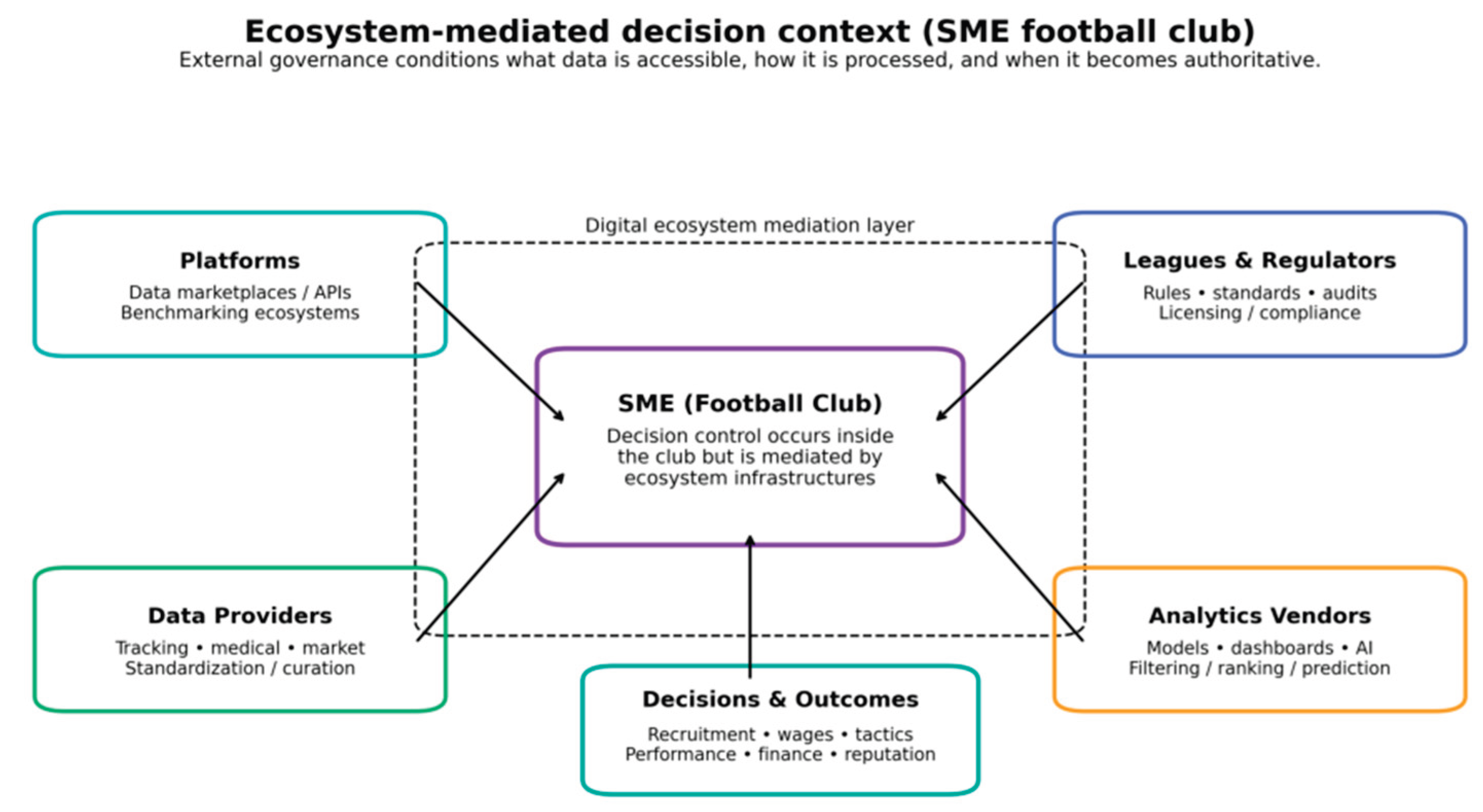
Figure 2.
Ecosystem-mediated decision context.
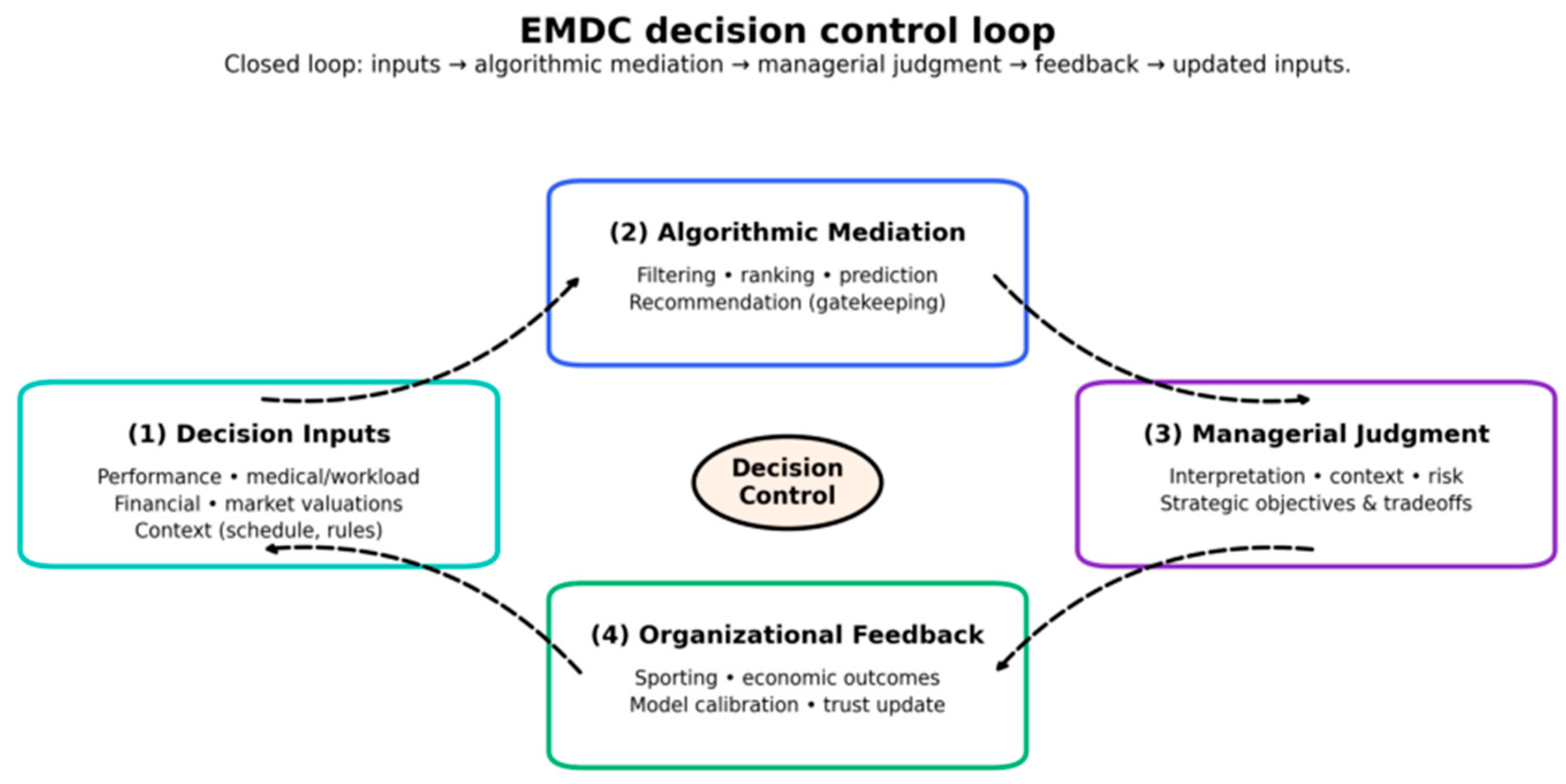
Figure 3.
EMDC framework.
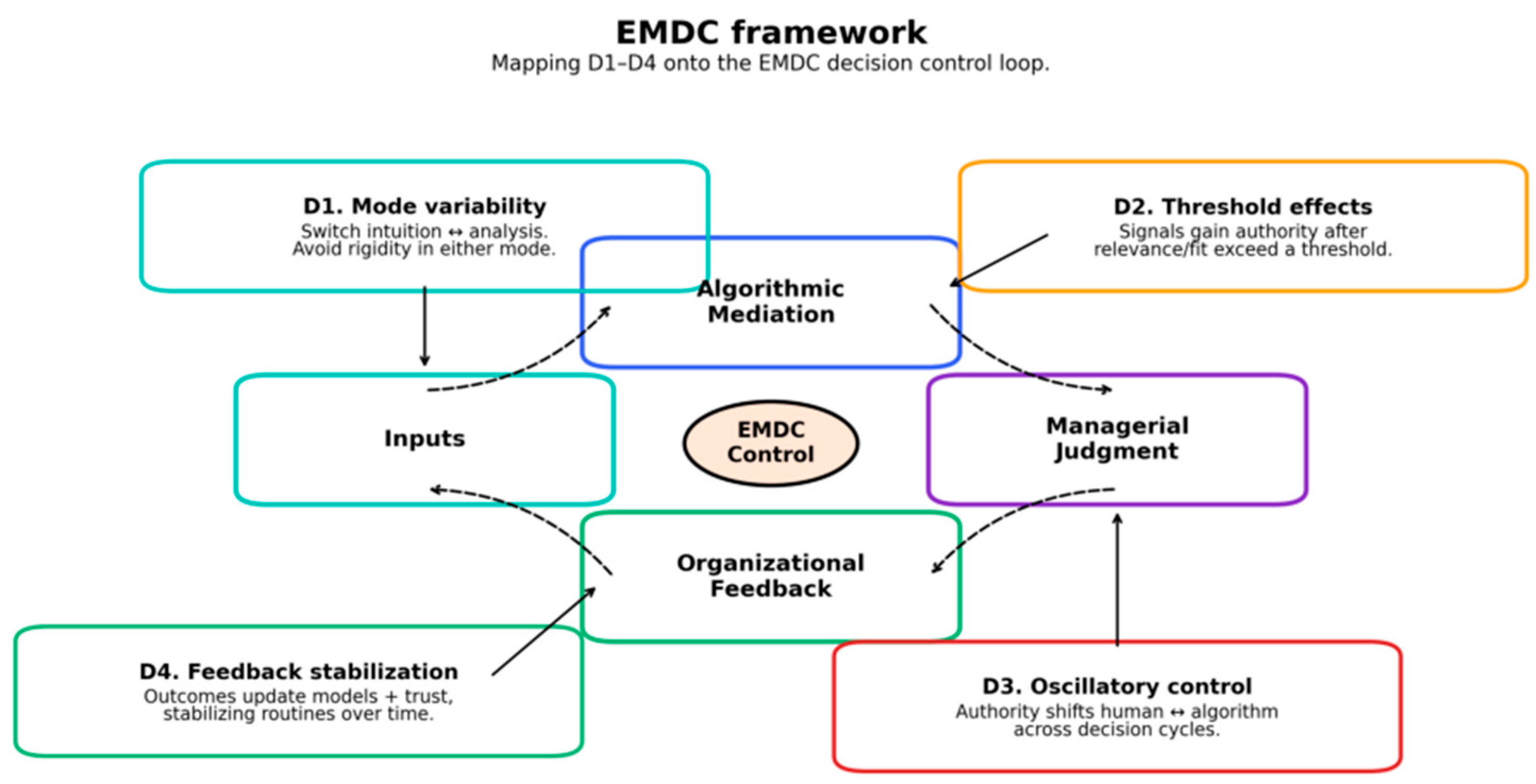
Figure 4.
Information threshold effects.
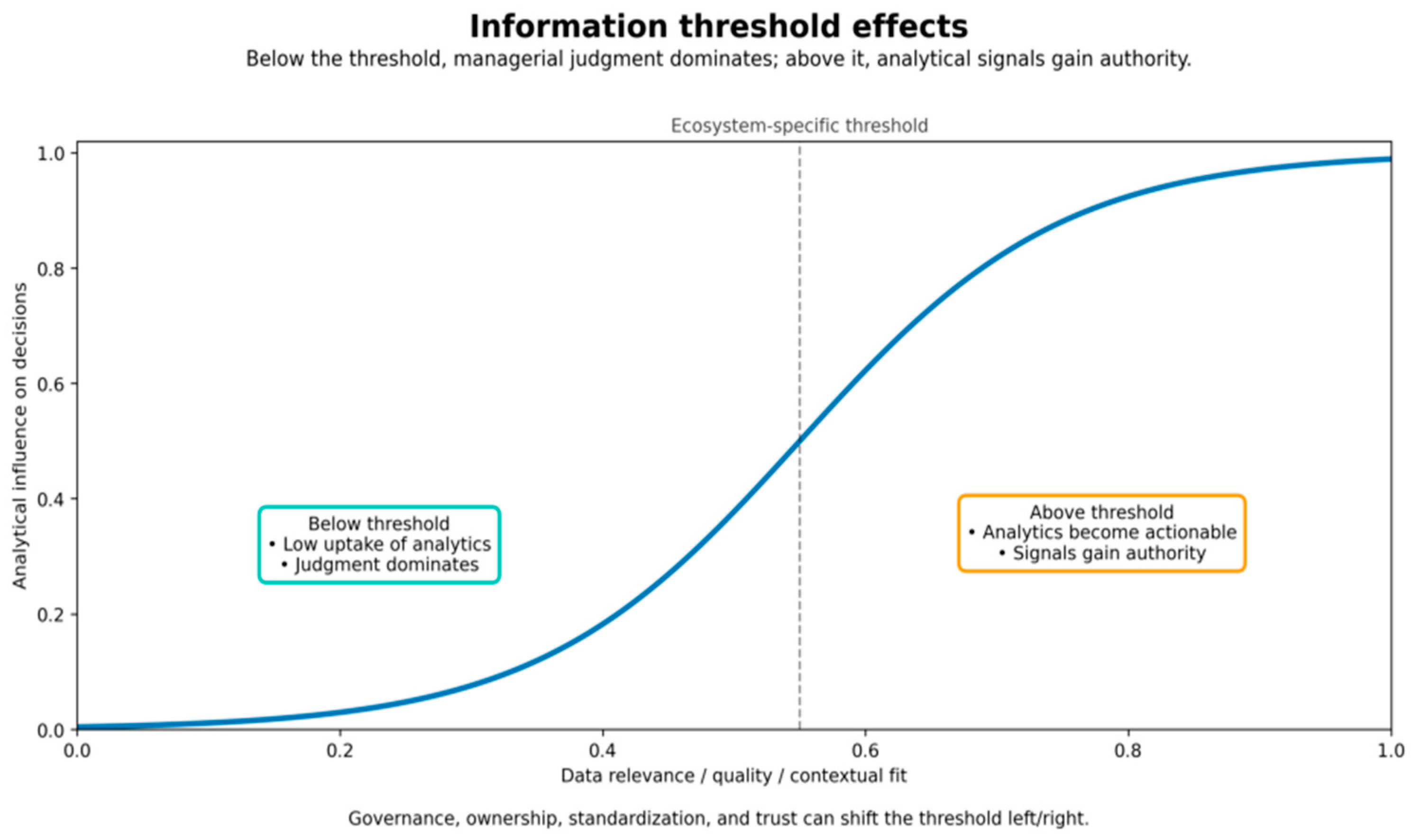
Figure 5.
Oscillatory human–algorithm control.
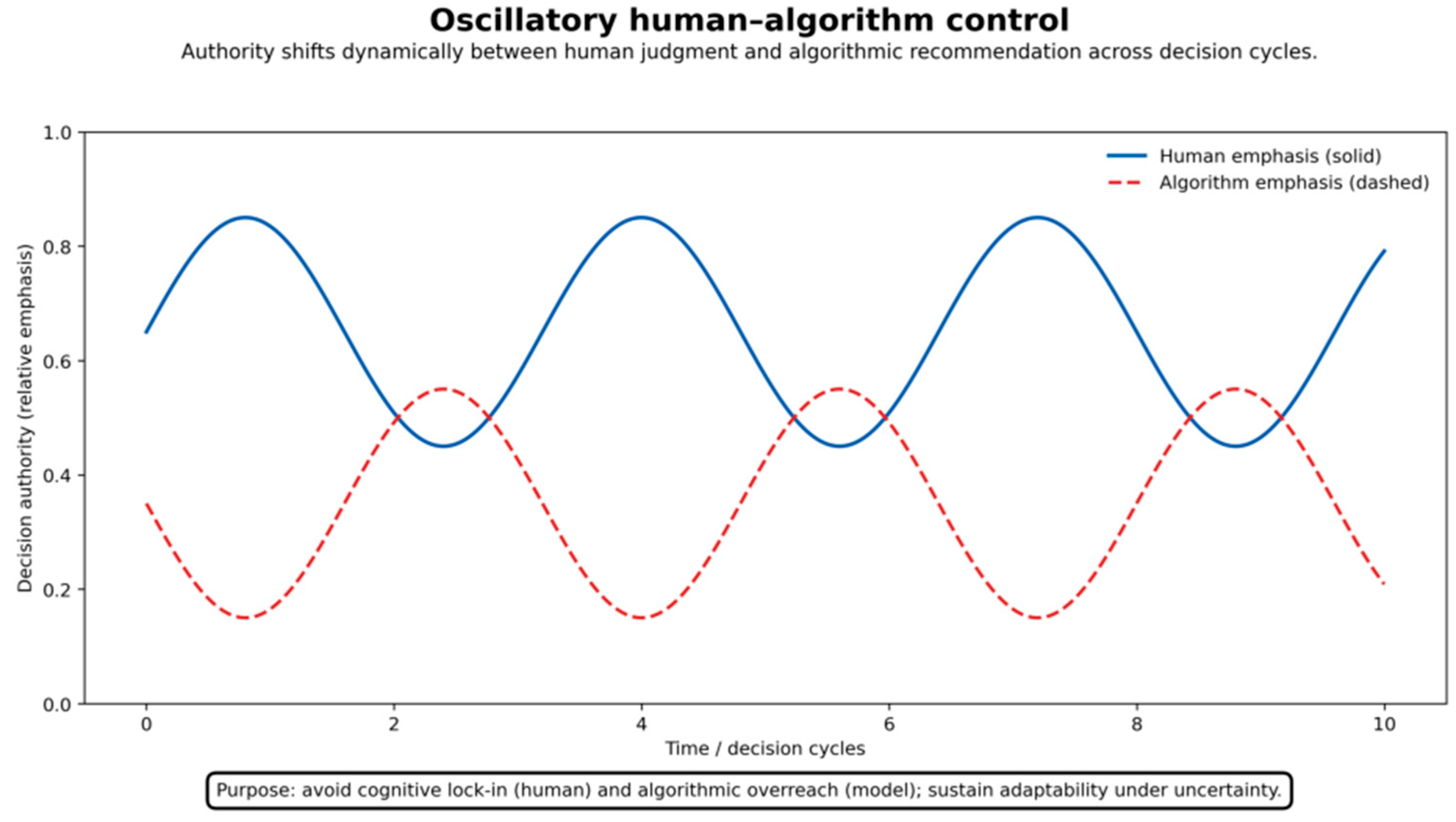

Table 1.
Managerial structure of the EMDC decision control loop.
| EMDC Component | Managerial Function | How the Ecosystem Mediates Control | Operational Indicators (Club Level) | Key Managerial Decisions |
| Decision Inputs | Define the information base on which decisions are possible | Data availability, format, and comparability are shaped by leagues, platforms, and data providers | Performance KPIs; medical/workload reports; financial constraints; market benchmarks; regulatory limits | Recruitment scope; wage ceilings; tactical options; risk exposure |
| Algorithmic Mediation | Prioritizes options and structures managerial attention | Algorithms filter, rank, and recommend options, acting as decision gatekeepers | Rankings, scores, predictions, shortlists, scenario simulations | Shortlisting players; contract valuation; tactical scenarios; load optimization |
| Managerial Judgment | Exercises strategic discretion over algorithmic signals | Judgment shifts from raw evaluation to interpretation and selective override | Override frequency; contextual exceptions; risk adjustments; justification narratives | Final approval; strategic trade-offs; negotiation timing |
| Organizational Feedback | Stabilizes or revises future decision routines | Outcomes recalibrate model trust and managerial reliance on analytics | Performance outcomes; injury rates; financial results; reputational effects | Model recalibration; trust thresholds; routinization of decision processes |
Table 2.
Managerial, economic, and governance implications of EMDC.
| Domain | Core Implication | What Changes Under EMDC | Design or Policy Focus | Primary Actors |
|---|---|---|---|---|
| Managerial | Decision quality depends on dynamic control, not on maximizing data use | Managers shift from evaluating raw information to governing when and how analytics are used | Decision routines with explicit switching rules; override governance; feedback review cycles | Sporting directors; executives; analytics leads |
| Economic | Digital ecosystems redistribute decision control and value capture | Competitive advantage depends on ecosystem position rather than standalone analytical capability | Data access rights; standardization strategies; reduction of informational asymmetries | Clubs; platform providers; league organizers |
| Governance | Accountability becomes distributed across organizations and platforms | Responsibility for decisions is shared between clubs, vendors, and regulatory bodies | Transparency thresholds; audit trails; compliance protocols; model accountability | Leagues; regulators; analytics vendors; club governance bodies |
Disclaimer/Publisher’s Note: The statements, opinions and data contained in all publications are solely those of the individual author(s) and contributor(s) and not of MDPI and/or the editor(s). MDPI and/or the editor(s) disclaim responsibility for any injury to people or property resulting from any ideas, methods, instructions or products referred to in the content. |
© 2026 by the authors. Licensee MDPI, Basel, Switzerland. This article is an open access article distributed under the terms and conditions of the Creative Commons Attribution (CC BY) license (http://creativecommons.org/licenses/by/4.0/).
Copyright: This open access article is published under a Creative Commons CC BY 4.0 license, which permit the free download, distribution, and reuse, provided that the author and preprint are cited in any reuse.