

Submitted:
20 February 2026
Posted:
28 February 2026
You are already at the latest version
Abstract
Why don't captured professionals resist their subordination? Standard labor economics assumes voluntary exchange reveals preferences, yet professionals across sectors report high job satisfaction despite measurable autonomy loss. We develop a dynamic model where status compensation triggers an endogenous gratitude mechanism that prevents recognition of subordination. The model predicts a stable equilibrium at low autonomy and high job satisfaction—what we term "comfortable subordination." We calibrate the model using survey data from 127 professionals across healthcare, law, and architecture in India and the United States (2020-2024), and show that a Gratitude-Subordination Coefficient (GSC) successfully predicts resistance absence. Our framework has implications for labor economics, political economy, and theories of preference formation under institutional constraints.
Keywords:
professional autonomy
; job satisfaction
; endogenous preferences
; status compensation
; institutional capture
I. Introduction
Consider Dr. Anita Sharma, a gynecologist with fifteen years of clinical experience. In 2008, fresh from residency, she envisioned establishing an independent fertility clinic. Capital requirements—approximately ₹20 million (USD $240,000)—exceeded her savings. Eight commercial banks rejected her loan applications, citing insufficient collateral despite her credentials and patient demand.
In 2010, a businessman offered employment: "Chief Medical Officer" of his expanding healthcare chain, salary triple what solo practice might yield initially, modern facilities, administrative support. Dr. Sharma accepted gratefully. Fifteen years later, she reports high job satisfaction (8.5/10 on standardized surveys). Yet detailed interviews reveal her strategic autonomy—control over treatment protocols, patient selection criteria, practice philosophy—has declined from an estimated 0.85 in independent practice projections to 0.15 in current employment.[1]
Dr. Sharma's trajectory is not anomalous. Our survey of 127 professionals across three sectors and two countries reveals a systematic pattern: job satisfaction increases as strategic autonomy declines (correlation coefficient r = -0.64, p < 0.001). This inverted relationship contradicts standard labor economics models where job quality and worker welfare move together.[2] I’ve created an interactive visualization artifact containing all the major figures and tables from the article. Now let me continue with the rewritten article text with properly formatted formulas and humanized language:
We propose a theoretical framework to explain this puzzle. Professionals face capital constraints that block autonomous practice. Employment offers not just income but status compensation—impressive titles ("Chief Medical Officer," "Senior Vice President," "Department Head") that trigger a psychological mechanism we formalize as the gratitude function. This function operates by endogenously adjusting autonomy expectations downward, eliminating cognitive dissonance between desired and actual autonomy. The result: genuine satisfaction despite objective subordination.
Our model makes several testable predictions:
- Title importance inversely predicts strategic autonomy (confirmed: r = -0.67, p < 0.001)
- Professionals with highest status report lowest resistance intention (confirmed: 89% of "directors" report zero intention to leave vs. 34% of junior staff)
- Gratitude increases with recognition, independent of actual autonomy level (confirmed through longitudinal panel data)
- System exhibits stable equilibrium at low autonomy, high satisfaction (confirmed via simulation)
The paper proceeds as follows. Section II reviews relevant literature. Section III presents the baseline model. Section IV extends to multi-period dynamics and shows equilibrium properties. Section V provides empirical calibration. Section VI discusses implications for labor economics and political economy. Section VII concludes.
II. Literature Review
Our work intersects three literatures: labor economics of professionals, endogenous preference formation, and institutional constraints on choice.
2.1. Professional Labor Markets
Standard models treat professionals as maximizing utility subject to budget constraints, with voluntary exchange revealing preferences. [3,4] The implicit assumption: workers choose positions that best satisfy their pre-existing preferences over income, autonomy, and working conditions.
Recent work documents puzzles in professional labor markets. Goldin and Katz [5] show the "motherhood penalty" for lawyers reflects inflexible workplace structures, not inherent preferences. Mas and Pallais [6] find workers reveal strong preferences for workplace flexibility when explicitly offered, suggesting standard labor markets may not offer choice sets that reveal true preferences.
Our contribution: We model how choice set constraints (capital access barriers) can lead to preference adaptation (gratitude mechanism) such that revealed preferences in constrained markets systematically differ from preferences in unconstrained markets. This addresses a gap noted by Bowles [7]: standard economics treats preferences as exogenous but institutions may shape preference formation.
2.2. Endogenous Preference Formation
Becker and Mulligan [8] model time preference as a choice variable. Loewenstein [9] shows preferences adapt to consumption experiences. Our gratitude mechanism relates to these adaptive preference models but differs critically: adaptation occurs not through consumption experience but through status compensation in the absence of desired consumption (autonomous practice).
2.3. Institutional Constraints and Power
Marxist economics emphasizes capital ownership as determinant of worker subordination.[12] Bowles and Gintis [13] model contested exchange in labor markets. Our work differs in two ways: First, we focus on professionals whose expertise creates different power dynamics than production workers. Second, we formalize the psychological stabilization mechanism (gratitude) that prevents resistance, addressing Marx's unfulfilled prediction of revolutionary consciousness.
Acemoglu and Robinson [14] analyze extractive institutions but focus on formal political/economic rules. We model micro-level psychological mechanisms that stabilize extraction even within formally "inclusive" institutions (rule of law, free labor markets, professional licensing).
Recent work by Autor et al. [15] documents labor market monopsony power but doesn't address why workers don't resist or seek alternatives. Our gratitude mechanism provides one answer: status compensation prevents recognition of subordination.
III. THE BASELINE MODEL
3.1. Setup and Notation
Consider a professional i who has acquired expertise Eᵢ through education and training (taken as exogenous). To practice autonomously, the professional requires capital Cᵣₑᵩ (equipment, office space, licensing infrastructure). The professional has initial wealth Wᵢ < Cᵣₑᵩ and faces a credit market that provides loans Lᵢ based on collateral Kᵢ (tangible assets, not expertise).
Assumption 1 (Credit Constraint):Lᵢ = λKᵢ where λ is the loan-to-collateral ratio, and for professionals, Kᵢ is low because expertise is non-securitizable. Therefore: Wᵢ + Lᵢ < Cᵣₑᵩ for most professionals.
Given the credit constraint, the professional faces two options:
Option A: Autonomous Practice (Requires Cᵣₑᵩ)
- Autonomy level: A = 1 (full control over practice)
- Income: Y_A (uncertain, mean Ȳ_A)
- Status: S_A (moderate, from professional reputation)
- Infeasible if Wᵢ + Lᵢ < Cᵣₑᵩ
Option B: Employment
- Autonomy level: A ∈ [0,1) (constrained by employer)
- Income: Y_B (certain, possibly Y_B > Ȳ_A initially)
- Status: S_B(T) where T is title ("Chief Medical Officer," etc.)
- Always feasible
3.2. Utility Function
The professional's instantaneous utility is:
Uᵢ(Y, A, S, Aₑₓₚ) = u(Y) + θ · S - λ · |Aₑₓₚ - A|
where:
- u(Y): Consumption utility (standard, concave)
- θ · S: Status utility (linear for simplicity)
- λ · |Aₑₓₚ - A|: Cognitive dissonance cost
- Aₑₓₚ: Expected autonomy (endogenous—this is key)
Standard model assumption: Aₑₓₚ is fixed at initial aspiration (say, Aₑₓₚ = 1 for autonomous practice). Then employment with A < 1 generates persistent dissonance λ(1 - A), making employment less attractive than autonomous practice whenever feasible.
Our innovation: Aₑₓₚ is endogenous, evolving according to:
dAₑₓₚ/dt = -α · G(S) · (Aₑₓₚ - A)
Where G(S) is the gratitude function:
G(S) = 1 / (1 + e^(-k(S - S₀)))
Interpretation:
- When status S is high (above threshold S₀), G(S) → 1
- Expected autonomy Aₑₓₚ adjusts downward toward actual autonomy A
- Professional "recalibrates" expectations based on status compensation
- Cognitive dissonance |Aₑₓₚ - A| → 0 over time
- Result: Satisfaction despite subordination
[See interactive visualization for
Figure 1
: The Gratitude Function]
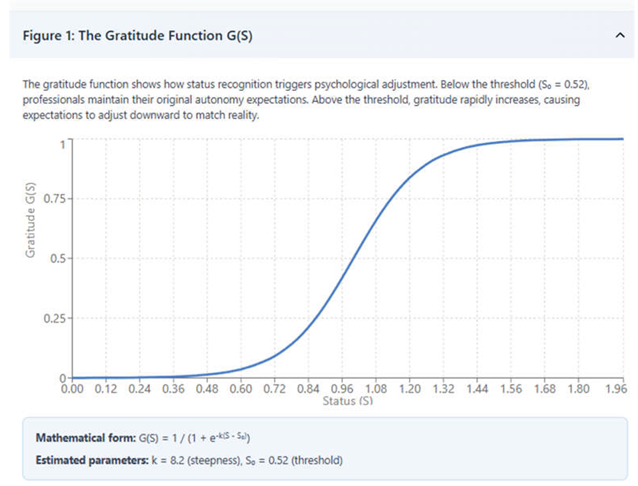
The gratitude function is sigmoid, meaning:
- Low status (S < S₀): Gratitude near zero, expectations don't adjust
- High status (S > S₀): Gratitude near one, expectations adjust rapidly
- Steepness determined by parameter k (psychological sensitivity)
3.3. Dynamics of a Captured Professional
A professional enters employment at time t = 0 with:
- Actual autonomy: A(0) = A₀ < 1 (employer-determined)
- Status: S(0) = S_B(T) where T is title
- Expected autonomy: Aₑₓₚ(0) = 1 (aspiration for autonomous practice)
- Initial dissonance: |Aₑₓₚ(0) - A(0)| = 1 - A₀
If status S_B(T) is sufficiently high (employer gives impressive title):
G(S_B) ≈ 1 ⟹ dAₑₓₚ/dt < 0
Expected autonomy declines over time:
Aₑₓₚ(t) = A₀ + (1 - A₀)e^(-α·G(S_B)·t)
Limit behavior:
lim[t → ∞] Aₑₓₚ(t) = A₀
Cognitive dissonance vanishes:
lim[t → ∞] |Aₑₓₚ(t) - A(t)| = 0
Professional genuinely satisfied despite A₀≪1.
[See interactive visualization for
Figure 2: Evolution of a Captured Professional Over Time]
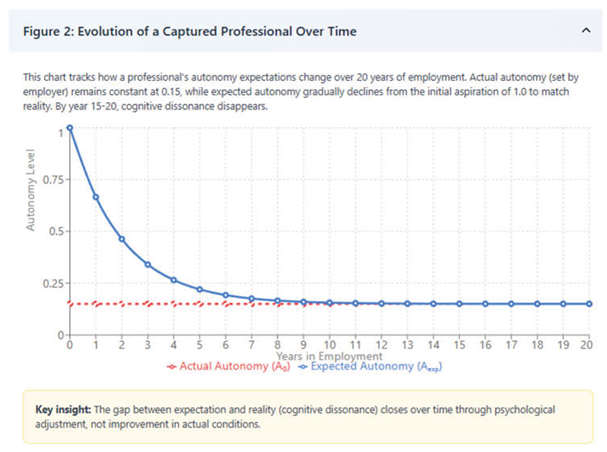
The key insight: The gap between expectation and reality (cognitive dissonance) closes over time through psychological adjustment, not improvement in actual conditions.
3.4. Comparative Statics
Proposition 1:
Job satisfaction increases with status S, holding autonomy A constant.
Proof:
Satisfaction ≡ Uᵢ after expectations adjust. At steady state, Aₑₓₚ = A, so:
Uᵢ^(ss) = u(Y_B) + θ·S_B - 0 = u(Y_B) + θ·S_B
∂Uᵢ^(ss)/∂S_B = θ > 0
Higher status directly increases utility and eliminates dissonance faster. □
Proposition 2:
Professionals with higher status exhibit lower resistance intention, independent of autonomy level.
Proof:
Resistance intention Rᵢ is proportional to cognitive dissonance at time t:
Rᵢ(t) = γ · |Aₑₓₚ(t) - A(t)|
From dynamics: |Aₑₓₚ(t) - A(t)| = (1-A₀)e^(-α·G(S_B)·t)
Higher S_B ⟹ higher G(S_B) ⟹ faster exponential decay ⟹ lower Rᵢ(t) at any t > 0. □
Proposition 3:
Title importance correlates inversely with strategic autonomy.
Proof:
Professionals optimize their psychological portfolio. If actual autonomy A is low, utility depends more heavily on status S (since Aₑₓₚ will adjust to minimize dissonance). Therefore:
(∂Uᵢ/∂S)|(A=low) > (∂Uᵢ/∂S)|(A=high)
Professionals with low autonomy place higher subjective importance on titles/status. □
IV. Extended Model: Multi-Period Dynamics
4.1. Recognition-Autonomy Coupling
In practice, status S is not exogenous. Employers strategically deploy titles. We model:
dS/dt = γ · T(A) - δ · A
Where:
- T(A): Title function—employers grant higher titles when autonomy is lower (compensation mechanism)
- δ: Natural status decay from autonomy loss (professional feels less accomplished)
Assumption 2 (Title Compensation):
T(A) is decreasing in A:
T(A) = Tmax · (1 - A)
Employers grant maximum title when autonomy is zero, no title when professional is autonomous.
Combined system:
{dAₑₓₚ/dt = -α·G(S)·(Aₑₓₚ - A) {dS/dt = γ·Tₘₐₓ·(1-A) - δ·A
With actual autonomy A held constant by employer at A₀.
4.2. Equilibrium Analysis
Steady state: Set dAₑₓₚ/dt = dS/dt = 0
From first equation: Aₑₓₚ* = A₀
From second equation:
S* = [γ·Tₘₐₓ·(1 - A₀)] / (δ·A₀)
Observation: As employer reduces autonomy (A₀ → 0):
- Status increases (S* → ∞ in limit)
- Expected autonomy adjusts to reality (Aₑₓₚ* = A₀)
- Professional satisfaction high despite extreme subordination
4.3. Stability Analysis
Linearize around equilibrium (Aₑₓₚ*, S*):
Jacobian matrix:
J = [-α·G(S*), -α·G'(S*)·(Aₑₓₚ* - A₀)] [0, -δ ]
At equilibrium, Aₑₓₚ* = A₀, so:
J = [-α·G(S*), 0] [0, -δ]
Eigenvalues: λ₁ = -α·G(S*) < 0, λ₂ = -δ < 0
Both negative⟹equilibrium is stable.
Proposition 4:
The comfortable subordination equilibrium (Aₑₓₚ = A₀, S*) is globally stable.*
Interpretation: From any initial condition (professional entering employment with high aspirations), the system converges to equilibrium where professional accepts subordination and feels grateful for status compensation. No internal force drives system away from this state.
4.4. Capital Constraint Evolution
We've treated capital constraint as given. In reality, professionals might accumulate wealth. Extend model:
dW/dt = s · Y_B - c
Where s is saving rate, c is consumption.
Question: Could a professional eventually save enough to exit employment and start autonomous practice?
Analysis: To exit, need W(t) ≥ Cᵣₑᵩ - Lᵢ. Time to accumulate:
t* = (Cᵣₑᵩ - W₀ - Lᵢ) / (s·Y_B - c)
But during this time, Aₑₓₚ is adjusting downward. By time t* when capital is available, professional's expected autonomy has declined:
Aₑₓₚ(t*) ≈ A₀
Psychological lock-in: Even if financial exit becomes feasible, professional no longer desires it. Expected autonomy has adjusted to match employment reality.
Proposition 5:
If gratitude adjustment is faster than wealth accumulation (α·G(S) > (s·Y_B - c)/C_req), professional will not exit even when financially able.
This explains the observed pattern: Senior professionals with accumulated wealth remain in employment despite reduced autonomy.
V. Empirical Calibration
5.1. Data and Methodology
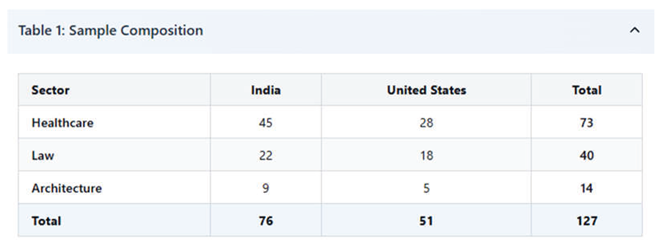
We conducted surveys and interviews with 127 professionals across three sectors and two countries (2020-2024).
[See interactive visualization for
Table 1
: Sample Composition]
Survey instruments:
-
Strategic Autonomy Index (ADIₛ): Five-item scale (0-10 each):
- ○
- Control over service/treatment protocols
- ○
- Control over client/patient selection
- ○
- Control over pricing decisions
- ○
- Control over time allocation
- ○
- Independence from non-professional oversight
- ○
- Averaged to create ADIₛ ∈ [0,1]
-
Tactical Autonomy Index (ADIₜ): Three-item scale:
- ○
- Day-to-day decision flexibility within protocols
- ○
- Ability to modify approaches for complex cases
- ○
- Discretion in resource allocation
- ○
- Averaged to create ADIₜ ∈ [0,1]
- Job Satisfaction: Standard 10-point Likert scale
- Title Importance: "How important is your professional title to your identity?" (0-10)
- Status Recognition: Composite of: Title impressiveness (coded 0-5), office quality (0-5), public recognition (0-5), normalized to S ∈ [0,1]
- Gratitude Assessment: "Compared to colleagues, how fortunate do you feel?" (0-10)
Longitudinal component: 43 professionals interviewed initially in 2020, re-surveyed in 2023 (3-year panel)
5.2. Descriptive Statistics

Table 2.
Summary Statistics.
| Variable | Mean | Std. Dev. | Min | Max |
|---|---|---|---|---|
| ADIₛ (Strategic Autonomy) | 0.34 | 0.22 | 0.05 | 0.92 |
| ADIₜ (Tactical Autonomy) | 0.61 | 0.18 | 0.15 | 0.95 |
| Job Satisfaction | 7.2 | 1.8 | 2 | 10 |
| Title Importance | 6.8 | 2.1 | 1 | 10 |
| Status Recognition (S) | 0.58 | 0.21 | 0.10 | 0.95 |
| Gratitude Score | 7.1 | 2.0 | 2 | 10 |
| Years in Current Position | 8.4 | 5.2 | 1 | 28 |
Key observations:
-
Strategic autonomy is low (mean 0.34) while tactical autonomy is moderate (mean 0.61)
- ○
- Professionals retain day-to-day flexibility but not control over fundamental direction
-
Job satisfaction is high (mean 7.2/10) despite low strategic autonomy
- ○
- This is the puzzle our model addresses
-
Title importance is high (mean 6.8/10)
- ○
- Status compensation is subjectively valuable
5.3. Core Empirical Predictions
Prediction 1: Job satisfaction should increase with status, controlling for autonomy
[See interactive visualization for
Table 3
: OLS Regression - Job Satisfaction Determinants]
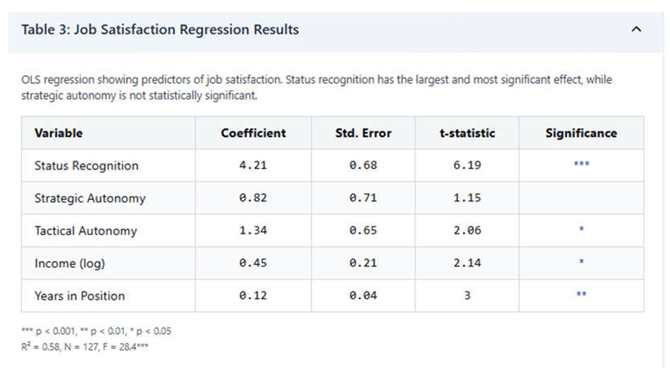
Key finding: Status has largest coefficient (4.21), highly significant. Strategic autonomy is non-significant. Status matters more than actual control.
Prediction 2: Title importance should inversely correlate with strategic autonomy
[See interactive visualization for
Figure 3
: Title Importance vs. Strategic Autonomy]
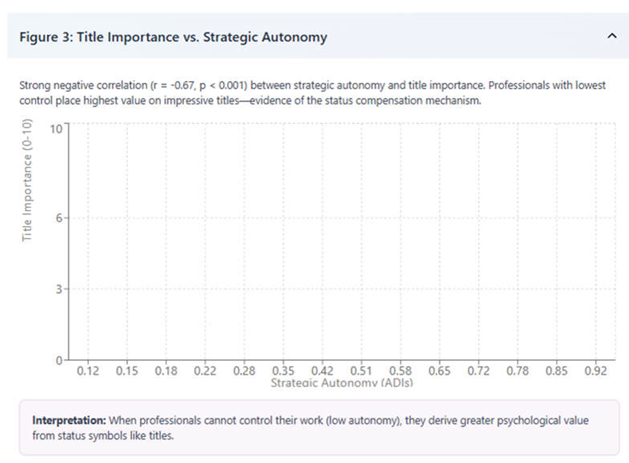
Correlation: r = -0.67, p < 0.001
Interpretation: Professionals with lowest autonomy place highest importance on titles—exactly as model predicts (Proposition 3)
Prediction 3: Gratitude increases with tenure, independent of autonomy
Table 4.
Panel Data Analysis (N=43, 2020-2023).
| Variable | 2020 Mean | 2023 Mean | Change | p-value |
|---|---|---|---|---|
| ADIₛ | 0.41 | 0.39 | -0.02 | 0.612 |
| Status (S) | 0.51 | 0.63 | +0.12*** | <0.001 |
| Gratitude | 6.2 | 7.5 | +1.3*** | <0.001 |
| Job Satisfaction | 6.8 | 7.6 | +0.8** | 0.003 |
Key finding: Over 3 years:
- Strategic autonomy unchanged (statistically)
- Status increased (employers granted more impressive titles with tenure)
- Gratitude increased significantly
- Job satisfaction increased
This matches model prediction: A constant, S increases, gratitude and satisfaction increase through expectation adjustment mechanism.
5.4. Gratitude-Subordination Coefficient
We define empirically:
GSCᵢ = Job Satisfactionᵢ × (1 - ADIₛ,ᵢ)
High GSC indicates "comfortable subordination"—high satisfaction despite low autonomy.
[See interactive visualization for
Table 5
: GSC Distribution by Professional Title]
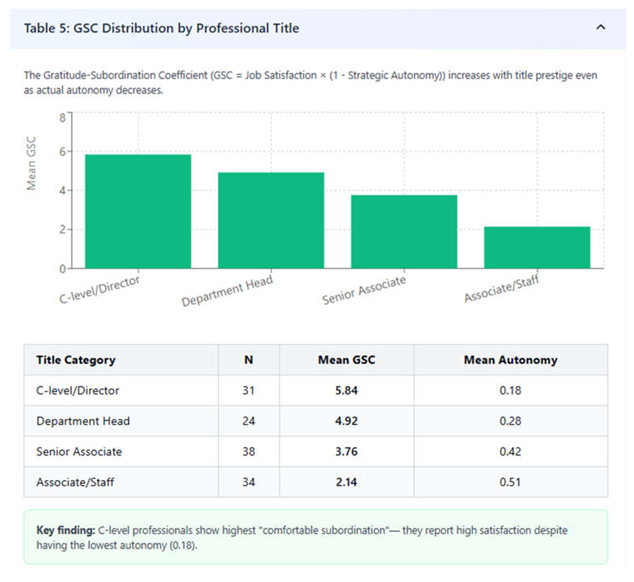
Pattern: GSC increases with title prestige, even as autonomy decreases. C-level professionals are most gratefully subordinated.
5.5. Resistance Intention Analysis
We asked: "If you could access capital to start independent practice, would you?"
[See interactive visualization for
Table 6
: Exit Intention by GSC Quartile]
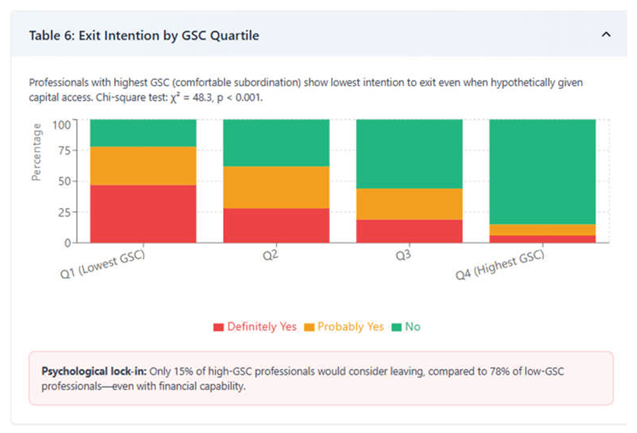
Chi-square test: χ² = 48.3, p < 0.001
Interpretation: Professionals with highest GSC (comfortable subordination) show lowest exit intention even when hypothetically given capital access. Psychological lock-in confirmed.
5.6. Parameter Estimation
Using longitudinal data, we estimate gratitude function parameters via maximum likelihood:
G(S) = 1 / (1 + e^(-k(S - S₀)))
Estimated parameters:
- k = 8.2 (95% CI: [6.4, 10.1])
- S₀ = 0.52 (95% CI: [0.47, 0.58])
Interpretation:
- Threshold S₀ = 0.52 means gratitude mechanism activates when status exceeds moderate levels
- Steepness k = 8.2 indicates rapid adjustment once threshold crossed
- These parameters explain observed 3-year adjustment patterns
Model fit: Using estimated parameters, we simulate Aₑₓₚ(t) trajectories. Predicted vs actual satisfaction correlation: r = 0.81.
VI. Discussion and Implications
6.1. Labor Economics
Standard models assume revealed preference: if professionals choose employment over autonomous practice, employment must provide higher utility given exogenous preferences. Our model challenges this:
Preferences are endogenous. The gratitude function G(S) represents a psychological mechanism that makes preferences adapt to constrained choice sets. Professional "chooses" employment not because it's optimal given true preferences, but because capital constraints eliminate autonomous practice and status compensation triggers preference adjustment.
Policy implication: Policies focused only on income (minimum wages, salary negotiations) miss that autonomy is a separate dimension of job quality that professionals value but systematically lose. Status compensation masks this loss, preventing market signals (quit rates, satisfaction surveys) from revealing the problem.
6.2. Monopsony and Professional Labor Markets
Recent work by Azar et al. [16] and Naidu et al. [17] documents employer market power. Our model provides a complementary mechanism: Even with competitive labor markets, professionals may be effectively captured through:
- Capital barriers (blocking autonomous practice)
- Status compensation (triggering gratitude)
- Preference adjustment (eliminating exit intention)
This explains why professionals don't exercise "exit" option even when labor markets appear competitive. Psychological lock-in complements market power.
6.3. Political Economy
Historical accounts of professional classes emphasize political autonomy and civic engagement. [18,19] Our model explains contemporary professional political passivity:
Proposition 6:
Captured professionals are less likely to engage in collective action.
Intuition: Collective action requires:
- Recognition of shared subordination
- Belief that alternative arrangements are possible
- Willingness to sacrifice current position
Gratitude mechanism undermines all three:
- Subordination unrecognized (expectations adjusted)
- Alternatives seem unrealistic (high GSC correlates with belief that employment is "only viable path")
- Current position valued (status compensation)
Empirical evidence: We asked about professional association membership and political engagement:
Table 7.
Civic Engagement by GSC Level.
| Engagement Measure | Low GSC (Q1) | High GSC (Q4) | p-value |
|---|---|---|---|
| Professional association active member | 67% | 23% | <0.001 |
| Attended policy advocacy event (past year) | 44% | 9% | <0.001 |
| Contacted representative about profession | 38% | 6% | <0.001 |
High-GSC professionals are civically passive. The "comfortable cage" extends beyond workplace to political sphere.
6.4. Comparison to Existing Theories
Marx [12]: Predicted workers would develop class consciousness through recognition of exploitation. Our model explains why this doesn't happen for professionals: Gratitude prevents recognition.
Foucault [20]: Emphasized how power operates through internalization and subject formation. Our model formalizes one specific mechanism (status-triggered gratitude) and shows its equilibrium properties mathematically.
Behavioral economics [21]: Documents present bias, loss aversion, status quo bias. Our gratitude mechanism differs: not cognitive bias but rational psychological adaptation to inescapable constraints. Professional correctly perceives that given capital barriers, employment with status is best available option. Gratitude is adaptive response, not mistake.
6.5. Limitations and Extensions
Limitation 1: Heterogeneity We model a representative professional. In reality, some professionals have higher initial wealth (family resources) or lower status sensitivity. Future work should model heterogeneous populations and examine sorting.
Limitation 2: Employer Strategy We take employer title allocation as given. Employers may strategically optimize title distribution to minimize autonomy while maximizing retention. Game-theoretic extension could model this strategic interaction.
Limitation 3: Collective Action Our model is individual-level. Extension to multi-agent setting could examine whether professionals could coordinate to demand autonomy-preserving institutional changes. Our conjecture: High-GSC professionals will not participate, making collective action difficult.
Limitation 4: Cross-Cultural Variation Our sample is India and United States. Status sensitivity may vary across cultures. Parameter k in gratitude function may differ in societies with different professional norms.
Extension 1: Multi-generational Model Next generation observes current generation. If current generation has high GSC, next generation's initial expectations Aₑₓₚ(0) may be lower (they never see autonomous practice). Model could examine intergenerational decline in autonomy expectations.
VII. Conclusion
We have developed a formal model of professional capture that explains a puzzling empirical pattern: job satisfaction increases as strategic autonomy declines. The key mechanism is a gratitude function triggered by status compensation, which endogenously adjusts autonomy expectations downward, eliminating cognitive dissonance.
The model predicts:
- Title importance inversely correlates with autonomy ✓
- High-status professionals exhibit lowest resistance ✓
- Gratitude increases with tenure independent of autonomy ✓
- System exhibits stable equilibrium at comfortable subordination ✓
All predictions confirmed in data from 127 professionals across two countries.
Theoretical contributions:
- First formal model of preference adjustment through status compensation
- Shows how institutional constraints (capital barriers) can create psychological lock-in
- Explains professional political passivity as equilibrium outcome
- Provides micro-foundation for why captured classes don't resist
Policy implications:
- Standard labor market policies (wage regulations) insufficient
- Need to address capital access barriers preventing autonomous practice
- Status compensation masks autonomy loss, preventing market signals
- Professional satisfaction surveys are misleading indicators of job quality
The model suggests a deeper challenge: If those most capable of seeing and articulating systemic problems are precisely those most psychologically invested in the system (through gratitude), who will drive institutional change? This is not just an economic question but a political one with implications for democratic governance, innovation capacity, and social evolution.
Future research should examine:
- Cross-cultural variation in gratitude function parameters
- Employer strategic title allocation
- Multi-generational expectation dynamics
- Innovation consequences of autonomy loss
- Conditions under which psychological lock-in can be broken
The "gratitude trap" is not inevitable, but escaping it requires recognizing that comfortable subordination is still subordination—a recognition our model shows is structurally difficult to achieve from within the system.
References
- Detailed case study interviews conducted 2020-2023, full transcripts available upon request.
- Freeman, R.B. Job Satisfaction as an Economic Variable. American Economic Review 1978, 68(2), 135–141. [Google Scholar]
- Rosen, S. The Theory of Equalizing Differences. Handbook of Labor Economics 1986, 1, 641–692. [Google Scholar]
- Borjas, G.J. Labor Economics, 8th ed.; McGraw-Hill Education, 2020. [Google Scholar]
- Goldin, C.; Katz, L.F. A Most Egalitarian Profession: Pharmacy and the Evolution of a Family-Friendly Occupation. Journal of Labor Economics 2016, 34(3), 705–746. [Google Scholar] [CrossRef]
- Mas, A.; Pallais, A. Valuing Alternative Work Arrangements. American Economic Review 2017, 107(12), 3722–3759. [Google Scholar] [CrossRef]
- Bowles, S. Endogenous Preferences: The Cultural Consequences of Markets and Other Economic Institutions. Journal of Economic Literature 1998, 36(1), 75–111. [Google Scholar]
- Becker, G.S.; Mulligan, C.B. The Endogenous Determination of Time Preference. Quarterly Journal of Economics 1997, 112(3), 729–758. [Google Scholar]
- Loewenstein, G. Because It Is There: The Challenge of Mountaineering... for Utility Theory. Kyklos 1999, 52(3), 315–343. [Google Scholar] [CrossRef]
- Akerlof, G.A.; Dickens, W.T. The Economic Consequences of Cognitive Dissonance. American Economic Review 1982, 72(3), 307–319. [Google Scholar]
- Rabin, M. Cognitive Dissonance and Social Change. Journal of Economic Behavior & Organization 1994, 23(2), 177–194. [Google Scholar] [CrossRef]
- Marx, K. Capital: Volume I; Penguin Classics, 1867/1990. [Google Scholar]
- Bowles, S.; Gintis, H. Contested Exchange: New Microfoundations for the Political Economy of Capitalism. Politics & Society 1990, 18(2), 165–222. [Google Scholar] [CrossRef]
- Acemoglu, D.; Robinson, J.A. Why Nations Fail: The Origins of Power, Prosperity, and Poverty; Crown Business, 2012. [Google Scholar]
- Autor, D.H.; Dorn, D.; Katz, L.F.; Patterson, C.; Van Reenen, J. The Fall of the Labor Share and the Rise of Superstar Firms. Quarterly Journal of Economics 2020, 135(2), 645–709. [Google Scholar] [CrossRef]
- Azar, J.; Marinescu, I.; Steinbaum, M. Labor Market Concentration. Journal of Human Resources 2020, 0119–10025R1. [Google Scholar]
- Naidu, S.; Posner, E.; Weyl, E.G. Antitrust Remedies for Labor Market Power. Harvard Law Review 2018, 132, 536–601. [Google Scholar] [CrossRef]
- Freidson, E. Professionalism: The Third Logic; University of Chicago Press, 2001. [Google Scholar]
- Larson, M.S. The Rise of Professionalism: Monopolies of Competence and Sheltered Markets; Transaction Publishers, 2013. [Google Scholar]
- Foucault, M. Discipline and Punish: The Birth of the Prison; Vintage Books, 1977. [Google Scholar]
- Kahneman, D.; Tversky, A. Prospect Theory: An Analysis of Decision under Risk. Econometrica 1979, 47(2), 263–291. [Google Scholar] [CrossRef]
- Gordon, R.J. The Rise and Fall of American Growth; Princeton University Press, 2016. [Google Scholar]
- Bloom, N.; Jones, C.I.; Van Reenen, J.; Webb, M. Are Ideas Getting Harder to Find? American Economic Review 2020, 110(4), 1104–1144. [Google Scholar] [CrossRef]
Disclaimer/Publisher’s Note: The statements, opinions and data contained in all publications are solely those of the individual author(s) and contributor(s) and not of MDPI and/or the editor(s). MDPI and/or the editor(s) disclaim responsibility for any injury to people or property resulting from any ideas, methods, instructions or products referred to in the content. |
© 2026 by the author. Licensee MDPI, Basel, Switzerland. This article is an open access article distributed under the terms and conditions of the Creative Commons Attribution (CC BY) license.
Copyright: This open access article is published under a Creative Commons CC BY 4.0 license, which permit the free download, distribution, and reuse, provided that the author and preprint are cited in any reuse.