

Submitted:
17 February 2026
Posted:
25 February 2026
You are already at the latest version
Abstract
The article explores the current state of circular economy adoption in Romanian small and medium-sized companies and their conceptualization regarding organizational excellence through the lens of environmental concerns. A survey of 52 companies from diverse sectors is conducted by means of a questionnaire and the results obtained are analyzed using descriptive and inferential statistics (correlation analysis, ANOVA, and variance testing). The results obtained indicate a growing body of knowledge and best practices that at company level are starting to evolve past the material and pro-cess efficiency preoccupations and towards an incipient understanding of environ-mental excellence, with positive interest ranging between 40% and 86%. Also, re-spondents recognize strong complementarities between circularity, sustainability, and organizational excellence. The need for an advanced systemic strategy, support policies, resource management, and stakeholder engagement is highlighted as the path towards achieving sustainability goals in conjunction with market success and not in spite of it.
Keywords:
circular economy
; organizational excellence
; environmental excellence
1. Introduction
The transition towards a circular economy in Romania and in other economies is still largely at the discussion stage in most companies. Within this context, the current study is motivated by the need to provide an improved rationale for companies to invest time and resources in implementing environmental approaches. The main objective of the research is to establish a potential operational benefits derived from an increase in circularity of their products and processes in line with current literature that reports on the link between sustainability and excellence with mediating factors [1] or without [2].
A major issue faced by Romanian firms relates to the level of public awareness, which is still at am incipient level. Nevertheless, in recent years, an improvement in this regard can be observed, with visible progress being made both at policy level and within the business environment. This is supported by the complex mechanisms developed by the European Union (EU) to steer the economy of its member states along the prescriptions of the European Green Deal, an ambitious plan from 2019 to make the continent carbon neutral by 2050. By providing know-how, funding opportunities and incentives for the EU countries and their respective companies, this complete renovation of all economic sectors, from agriculture to high-tech manufacturing, requires the large-scale implementation of circular economy (CE) practices, alongside other environmentally oriented methodologies. Romanian companies are working towards these goals with varying speeds mostly depending on the characteristics of the sector to which they belong (e.g., packaging recycling and food waste reduction are very successful, while freight transport is mostly dependent on the use of fossil fuels due to high transition costs).
The research questions addressed in this framework are related to the level of performance of current circular practices in Romanian companies and, respectively, to their improved adoption in light of the business excellence advancement based on these. Thus, the contributions proposed are both conceptual, for the development of the mentioned connection and practical, through the analysis of insights collected from companies, that can be compared to similar studies such as [3] that assess the advantages of integrated management systems in Romanian industry.
For the purpose of this study, the concept of excellence is envisioned as the coordinated and synergistic adoption and implementation of complex environmental initiatives (e.g., product-process circularity, environmental management systems, carbon emission accounting, eco-labelling, etc.) that deliver emergent and tangible benefits simultaneously for companies and their stakeholders. This aspect is important in supporting the increase of companies’ competitiveness at national and international levels, enabling faster adaptation to market requirements and emerging regulations, as well as fostering organizational modernization, which in turn reinforces innovation capability.
By adopting various strategies and policies, companies can be considered to be gradually complying with the required standards and taking small steps toward integrating the circular economy approach into their strategic direction, closely linked to resource management, organizational excellence [4], and long-term sustainability [5]. The present paper aims to analyze the impact of the circular economy approach and the potential benefits of its implementation in Romanian companies for stimulating exceptional corporate performance. The study directly addresses two important gaps: building a comparative baseline for reports on circularity implementation success and challenges and studying the deeper implications of this conversion on the long-term success of businesses.
The results of the industry survey conducted by the authors are integrated within the general trend of European Union companies becoming resilient actors in the socio-economic environment. The firms are expected to be both successful on the market, and part of integrated ecosystems that deliver social value such as jobs and community consolidation initiatives for a more cohesive society in the face of complex internal and external disturbances.
2. Literature Review
As the first step of the undertaking, a literature review has been conducted using the MEAL (Main idea, Evidence, Analysis and Link) approach, focused on the strategic and tactical levels of management and operations.
The recent literature on the transition to the circular economy shows increasingly clearly that success depends not only on isolated operational measures, but on a broad strategic approach that combines leadership, managerial skills, technology, and ecosystem support [6,7,8]. Especially in the European Union, this is part of a larger transformation to align business practices to the continental efforts to bring about a competitive economy that does not negatively affect the environment while providing a strong social safety-net.
Studies [6] conducted in various countries, such as Brazil and Scotland, highlight that proactive organizations, led by managers who are well-trained in sustainability, manage CE critical success factors much more effectively and avoid the operational tensions faced by reactive companies. This underscores the need to integrate these elements into corporate strategy, but also the role of the institutional context in accelerating the transition to a circular economy. Organizational excellence is an important element related to the circular economy and sustainability, as it involves the development of proactive relationships among processes and other determining factors (e.g., infrastructure, products, personnel). If managers succeed in keeping the situation under control and are sufficiently well prepared, they will be able to develop and implement clear strategies, thereby shaping a well-defined vision for the company [9]. These connections represent the foundation on which the current study was also build, with a focus on Romanian companies.
The authors of [10] show that circular transformation can begin even in the absence of a formal strategy, through the optimization of internal processes (Lean management) and investments in Industry 4.0 technologies (the previous, now changing industrial paradigm that was focused on digitalization)—aspects that, over time, become the foundation for the adoption of circular economy practices. The paper [11] also shows that the concept of modularity, analyzed in Southeast Asian industries, is reinterpreted as a strategic tool, not just an operational one. It allows the transition from traditional modular architecture oriented toward maintenance and extending product life to the integration of circularity into organizational governance and internal routines. In this process, collaboration with partners becomes essential to overcome limitations in resources and expertise. Similar practices in the area of product design or process improvement can also contribute to a better circularity of materials: Design for X, Design thinking, industrial symbiosis, Six Sigma, etc.
In a domain relevant for the area studied in the present research also, the electrical and electronic equipment sector [7,12], circularity in supply chains is based on a holistic vision that combines government regulations, technological innovations (in accordance with the Industry 5.0 industrial paradigm that combines human-centric approach and artificial intelligence for manufacturing processes), and the redesign of material flows, generating economic, social, and environmental benefits. Supply chain excellence [13] and their green transition also achieve the transition from the company strategic level to the practical issue encountered in processes.
A CE success barrier frequently mentioned in literature [14,15,16] is the lack of internal expertise, especially among small and medium-sized enterprises (SMEs) in emerging economies. However, studies [14,15] show that Inbound Open Innovation, integrating external knowledge and co-creating with customers and suppliers—is an effective solution for filling these gaps. At the same time, implementing eco-processes is proving to be more accessible than developing eco-products, which require significant resources. Similarly, studies [17,18] highlight the crucial role of education, both tertiary and continuing, in supporting the circular transition, with an emphasis on integrating CE into academic curricula and developing the skills required by the labor market. Thus, a well-trained and motivated workforce can be a contributing force to both sustainability and excellence.
Paper [19] shows that the Industry 5.0 approach can have a positive impact on sustainability performance due to the enhanced focus on human creativity and social connections of the enterprises as a complement to emerging digital technologies that continue the trend established by the Industry 4.0. Circular practices act as key linking factors between technology and sustainability [20] and the use of smart contracts and coordination mechanisms in IoT-connected supply chains helps align stakeholders and reduce the risk of failures caused by decentralized structures [21].
The authors of [8,15,17] consider that government support and stakeholder engagement are essential drivers of transition, especially in emerging economies, where institutional barriers, weak infrastructure, and limited access to capital complicates CE implementation. Examples from Thailand [15] and Ghana [17] show that integrated public policies, educational programs, and financial incentives are critical for overcoming linear economic models and for adopting eco-processes in SMEs. In addition, active collaboration with partners and local ecosystems reduces the risks of circular innovation and amplifies the economic benefits, transforming circularity into a sustainable competitive advantage [22,23]. Although the influence of external stakeholders is beyond the scope of the current study, the importance of these relations is acknowledged in the context of country level studies.
Recent evidence reported in [24] shows that the circular transition cannot be supported exclusively through traditional fiscal measures – be they general green taxes or penalties on use of materials. Circular performance depends on systemic mechanisms, from investments in advanced waste-to-energy technologies to robust economic instruments such as extended producer responsibility and production cost adjustments [25]. In the absence of these integrated policies, organizations remain trapped in a cost-efficient linear system, exactly as reported by the companies in our study. For these reasons, the effort to establish a functional CE must be undertaken by policy-making bodies, companies and consumers together.
Another fundamental aspect is measuring advancement. Tools such as the Circular Economy Maturity Framework (CEMAF) or the Circular Economy Index (CEI) help companies and countries monitor progress, set priorities, and identify the stages of transition— especially for SMEs and emerging economies, including Romania [16,26,27]. This explains why many local companies continue to focus on optimizing internal processes and pilot projects, while infrastructure and incentives for product innovation toward enhanced circularity performance remain limited [8,14,26].
In conclusion, the literature [6,7,8,12] shows that the transition to a circular economy is a gradual, complex, and context-dependent process. The success of this demarche can depend on many intrinsic and extrinsic factors [14,15,18,27], without any general solution being available. Rather, the organizational transformation necessary can be co-created through the diligent and proactive involvement of all parties involved in an economic field. In the medium and long term, the economic, social, and environmental benefits validated by studies confirm circularity as a strategy for sustainable and competitive development [20,22]. The present investigation in Romania takes into account these factors both for formulating the questionnaire items and for the response analysis.
3. Materials and Methods
The research methodology used for the current study consists of two stages: development and application of questionnaire based and the analysis and interpretation of data using descriptive and inferential statistics. The questionnaire consists of 13 questions addressing operational aspects (3 items), circular economy implementation initiatives (7 items) and organizational excellence (3 items).
- Q1: operational imperatives for competitiveness and sustainability;
- Q2: possible sources of instability and pressures;
- Q3: supplier relations in the context of sustainability;
- Q4: the understanding of circular economy for the specific domain;
- Q5: processes which can be considered circular;
- Q6: energy efficiency measures that have been adopted;
- Q7: involvement in carbon emissions reduction;
- Q8: resources and know-how needs for circularity;
- Q9: immediate investment plans for sustainability;
- Q10: challenges for adopting circular approaches;
- Q11: importance of achieving organizational excellence;
- Q12: types of activities that contribute to organizational excellence;
- Q13: supporting relationships between sustainability and excellence.
The structure is intended to identify both the level of complexity of the industrial approaches to environmental pressures and the interconnections between circularity and excellence. Questions marked with italics in the list above (number 5, 7, and 11) are screening questions that are not assessed directly, but are factored in the Discussion section, to describe the overall veracity of the results.
A cross-sectoral sample of 52 SME companies from Romania have been selected using the snowball sampling technique, centered upon the manufacturing sector. The actual responders in each company have responsibilities related to administering the environmental footprint of each organization and a detailed knowledge of each company’s operations. This approach is an exploratory one, with the present study intended as a feasibility analysis for determining the interest of SMEs (especially small companies, in a variety of economic sectors) in adopting correlated sustainability-excellence approaches, which will be described in future research endeavors through case studies and surveys with large samples.
Data collection occurred through an online Google Form questionnaire disseminated via email and messaging services in the period January 2025 – July 2025. Once the information was aggregated, it was analyzed statistically using the descriptors of the central tendencies for each question, as well as the ANOVA technique to understand variance and linear regression to estimate the overlapping and reciprocal support of the two investigated topics. In order to carry out the analysis, the authors have used Microsoft Excel’s Data Analysis ToolPack functions.
3. Results
The first question refers to the activities that companies take into consideration within their operations to ensure survivability and competitiveness. A considerable proportion of companies emphasize the continuous optimization of processes (39 responses), the efficient utilization of resources (37 responses), as well as clearly defined work procedures and effective interdepartmental communication (32 responses). The companies primarily focus on technological investments, the continuous development of internal structures, and increased attention to the proper allocation of organizational resources. The importance given to human capital highlights a strong dependence on employee competencies: firms acknowledge that without sufficiently well-trained personnel, the practical implementation of circular economic strategies is not feasible. The emphasis on procedural clarity and optimization also indicates a firm orientation toward efficiency and quality—required elements of organizational excellence.
In order to achieve an operational profile for the investigated companies (as presented in Figure 1 which combines the answers to questions Q1-Q3), beside the main activities, the study identified the most consequential sources of instability and pressures (question 2), and the maturity of supplier relationships in the context of sustainability (question 3). For the former topic, the issues reported are mainly concentrated on frequent legislation changes (41 responses), staff turnover (37 responses), and legislative gaps and miscorrelations (34 responses), with a continuing list of more mild complaints. In the case of the latter topic, two answers stand out significantly over the rest: service or product quality issues (45 responses), and cost and price issues (43 responses).
While the socio-economic environment experiences instability and volatility, the surveyed companies can be assessed to have a thorough understanding of operational aspects and constraints, which increases their chances for success, although long-term orientation and strategic intent are still lagging, as the scores for social and environmental issues, certifications or business model transformations register significantly lower scores, usually in the single-digit area.
Next, the questions pertaining to circular economy involvement have been analyzed (Q4, Q8, Q10) and are presented in Figure 2. In this area, question Q4 aims to highlight how the circular economy is conceptualized by the companies surveyed. A large portion of respondents identify the circular economy primarily with the efficient use of available resources (22 responses). Others associate it with reducing waste through innovative production processes (9 responses), while others with environmental protection reinforced by updated internal procedures aligned to market and legislative evolutions (8 responses). The data obtained suggest varying levels of complexity and maturity. Many Romanian firms interpret the circular economy predominantly from an ecological perspective, highlighting an emerging yet growing organizational commitment to sustainability. Nevertheless, the emergence of uneven perspectives—ranging from efficiency-oriented views to those focused on circular-economy principles—indicates that the levels of comprehension and adherence remain unbalanced across firms.
For question Q8, the responses illustrate the resources that companies consider essential for strengthening circular economic initiatives. The most frequently mentioned are qualified human resources (31 responses), intelligent resource management (30 responses), and financial capital (26 responses). Romania is facing a structural deficit of qualified labor, exacerbated by emigration and the increasing fiscal burden. Without trained personnel and adequate managerial instruments, firms cannot effectively monitor progress, which makes implementation difficult. Intelligent resource management emerges as a fundamental benchmark, closely linked to the need for continued financial resources. In many companies, the ability to invest is limited, and insufficient access to credible data further restricts strategic development. The principal limitation that can be inferred therefore stems more from the lack of expertise and monitoring tools, rather than from the absence of intention to implement circular initiatives.
The main barriers identified through question Q10 include human resources/lack of qualified personnel (28 responses), lack of understanding of the concept (26 responses), and lack of knowledge about the economic and financial impacts (23 responses). These constraints suggest that firms require external support mechanisms — training programs, non-reimbursable funding, and incentives. The obstacles do not arise from a lack of willingness, but from insufficient resources and the limited dissemination of information regarding the specific topics of circular economy.
The next combination of questions (Q6 and Q9) describes the overarching sustainability issues that form the context in which circularity measures are envisaged and implemented by the responding companies, as is presented in Figure 3. This section is designed to identify the main support structures on which companies have constructed their circular approach. As such, the first topic (Q6) relates to the most pressing issue on a European level, the implementation of energy efficiency and energy diversification strategies, with the main answers reporting the installation of low transfer heat insulation (34 responses), intelligent lighting and temperature control (34 responses), and energy efficient doors and windows (29 responses). There can be little doubt that these measures are connected to the rising costs of energy in the past few years, while the orientation towards renewable sources to protect the environment remains a secondary concern (installation of photovoltaic panels received 25 responses). Next, question Q9, studied the investment for sustainability strategies and discovered that most companies will invest in the upskilling of staff (28 responses), product or service innovation for sustainability (22 responses) and the acquisition of sustainable/environmentally friendly technologies (21 responses).
Finally, the survey investigated the connection between circularity, sustainability and organizational excellence (questions Q12 and Q13), as presented in Figure 4. In relation to organizational excellence, the first of these questions aims to evaluate which elements or key activities are considered essential for companies as part of it. Thus, according to the chart, the most important elements are those referring to the quality of products and services (36 responses), efficient resource management (34 responses), and innovation (29 responses). This can be interpreted as a mix of people, processes, innovation, and quality, a mix that respondents correctly associate with organizational excellence as described in literature. Companies understand that they cannot perform without any of these elements, as they work together in close interconnection.
The benefits of the excellence approach through environmental sustainability are highlighted also in Figure 4 below. It can be observed that these benefits are mainly related to adaptation to market conditions and to new sustainable technologies (32 responses), as well as to the continuous improvement of activities and human resources (31 responses). This is a notable aspect and highlights the growing awareness among Romanian companies regarding the circular economy and its implications, with a particular emphasis placed on its contribution to organizational excellence. Innovation, economic growth, and ensuring the company’s longevity are perceived as important advantages that are reinforced by the adoption of circular economy and other sustainability practices.
While this awareness is incipient, it is detectable (see the Discussion section for a detailed analysis) and the authors posit that it can be further supported through adequate measure and policies that can be implemented with government support. By contrast, direct competitive advantages and access to new markets are considered less significant benefits in this context, as they are opposed in strategic intent to becoming a top market player in synchronicity with the requirements of the stakeholders.. Overall, companies view excellence as a factor that both supports and benefits from sustainable development and organizational modernization.
It is also important to mention that compared to the three previous analysis sections, which had clear front runners among the answers received, in this case there is a significantly more balanced output among the responses. This is believed to be the result of the developing understanding mentioned before.
4. Discussion
As positive interest presented above ranges between 40% and 86%, depending on the question, for a detailed understanding of the collected responses two tasks are performed, a qualitative analysis of the 3 screening questions that describe the overall commitment of the companies to circular economy based organizational excellence, and a statistical analysis of the answers previously presented in the Results section.
Question Q5 aims to determine and highlight the specific organizational activities that fall within the scope of the circular economy. According to the data collected: 28 respondents evaluate their services as the main activity associated with circularity, followed by waste management (25 respondents), production (20 respondents), procurement (19 respondents), logistics (16 respondents), administration (16 respondents), storage (15), and others (3 respondents).The results show that firms currently associate circularity less with core operational areas (48 responses for production and services from the multiple selection) and more with support activities (94 responses for the other 6 categories from the multiple selection). Although some progress is observed in innovative production or product design, most organizations remain in an exploratory phase, hesitating to implement deep structural changes, which brings about an important lens through which their answers to the technical questions must be viewed – as early commitments that have yet to mature. Thus, circular economy practices are applied with caution and remain largely tangential rather than central to business models.
In the case of question Q7, companies were asked whether they implement measures aimed at reducing carbon emissions. A majority (31 responses) indicates that their companies have adopted such measures, while 21 report the absence of these initiatives. Firms that have adopted such approaches demonstrate a proactive environmental initiative; however, the intensity and scale of these actions remain under debate. On the other hand, companies that report the absence of such measures indicate either limited awareness, insufficient resources, or a lack of technical expertise. Overall, the current landscape reflects a transitional stage: the direction is positive, yet the level of adoption is not sufficiently developed to generate system-wide influence and make a central theme of the companies’ sustainability efforts.
According to question Q11 almost all companies state the importance of organizational excellence in the context of the circular economy (49 responses for “important” and 2 for “slightly important”), demonstrating an understanding of its relevance for long-term competitiveness. For this reason, it is important to focus the improvement efforts in the field on capitalizing on the existing goodwill through support measures and projects, to which the current study contributes.
By including these spaced-out questions, the interest of the respondents is both strengthened across the questionnaire and monitored to ensure consistency and proper selection of the responding companies. This is implemented as a countermeasure to the non-random convenience type sampling of the population that was done based on previous collaboration with the firms.
In the next stage, the four main question clusters presented in the chapter Results have been investigated in detail using correlation analysis, the ANOVA methodology and the F-test for variance.
For the Q1-Q3 - operational profile group, correlations among answers (Table 1) show no or low interdependence, thus describing a large diversity of strategies used by companies to pursue competitiveness. It can be inferred that this is due to the heterogeneity of the sample and the varied socio-economic conditions and pressures in which they carry out their core functions.
However, by performing the ANOVA single factor analysis (Table 2) on the same group of answers, the results obtained with p>0,05 and F<F-crit by a large margin, point to the failure to reject the null hypothesis. This means that even if the companies follow the constraints of their sector and insertion medium, they ultimately have a similar approach that is defined by the need to deliver financial, staff and customer results on the same market within the same country, under the same regulatory framework.
In the case of the Q4-Q8-Q10 – circularity approach group, correlations (Table 3) have values in the weak correlation range. By factoring in the diversity of answers to the screening questions Q5 and Q7, the analysis shows an important but recent and unfocused interest in circular economy practices. This points out to a possible domain of intervention to hasten the transition process.
The ANOVA single factor results (Table 4) of the group yield a p<0,05 and F>F-crit by a significant margin, leading to the rejection of the null hypothesis. As such, it can be deduced that this variance stems from an increased but underdeveloped preoccupation with the topic, and disparate measures that are tested for results. As it matures, it is expected to coalesce more at sector, company size or operational area level and lead to more commonalities under a coherent framework.
Questions Q6 and Q9 – sustainability approach group have a correlation coefficient of -0,30087, also a low strength relationship. The possible interpretation that can be given to this result is similar to the previous cluster – an incompletely defined or unfinished effort, but the negative value also signals that investments in energy measures and the ones in technology are not possible at the same time.
The ANOVA single factor results (Table 5) are p>0,05 and F<F-crit so the null hypothesis must be accepted. Since sustainability approaches, including energy efficiency and renewable energy measures have been implemented for decades, it is possible for the convergence of answers to show an emerging consensus at the level of the Romanian economy in terms of implementation directions and resource commitment that companies are accepting as typical.
Questions Q12 and Q13 – organizational excellence adoption group also have negative correlation coefficient with a value of -0,63055. This value shows a significant strength, close to the strong correlation range. Since the first question deals with typical activities leading to excellence (mostly operational ones) and the second one deals with supporting relationships with sustainability issues, this can be interpreted as a desirable association that is hindered by limited resources. Thus, it also directs the analysis towards more possible government support measures intended to foster this process within companies for extended economic benefits.
In this case, the ANOVA single factor results (Table 6) are p>0,05 and F<F-crit by a large margin, so the null hypothesis must be accepted. This means that companies have developed a common tacit understanding of the mechanisms through which sustainability and circularity can support the achievement of organizational excellence. Basically, even if they perceive the end state differently, depending on their context, the companies appear to agree on the notion that circularity efforts and costs are not wasted and can actually lead to a better competitive position. When also considering the overwhelming positive response to screen question Q11, this conclusion becomes much more plausible.
Finally, in order to assess the connection between these managerial approaches, the F-Test with Two-Sample for Variances has been applied across two different clusters, comparing the answers to questions Q8 – needs for circular activities and Q12 – activities that contribute to organizational excellence (Table 7).
The results of the test show that p>0,05, but also that F>F-crit, which means that the null hypothesis can only be partially accepted. Moreso than ANOVA, this test looks for similarities in the variances of the two answer sets, arriving at a mixed result that can be interpreted as a parallelism between the perceived inputs and outputs of the two organizational transformation frameworks. As p-value does not point to rejection, the null hypothesis has a dominant position in the interpretation, which reinforces the idea that government intervention could prove positive and influential. However, since F-value does not fall below the critical threshold, it is recommendable to further expand the study by increasing the number of answers and focusing on particular economic sectors.
5. Conclusions
This research investigated the current state of circular economy implementation and organizational excellence within companies in Romania, placing emphasis on the advantages, obstacles, and factors that support the transition toward environmentally sustainable practices. The findings highlight that the circular economy in Romania is mainly approached at an introductory level and is not yet fully integrated into core business models. The empirical analysis indicates that Romanian firms are positioned at an early to intermediate stage of circular economy development. Although there is a decided willingness to adopt circular principles, implementation is hindered by structural challenges, particularly the lack of qualified personnel, insufficient financial resources, limited understanding of the circular economy concept and its benefits, as well as a lack of knowledge regarding implementation methods and the effects of adoption on economic and financial performance. These limitations do not signal a lack of commitment, but rather a deficit in skills, data, and institutional support required for the effective scaling of circular initiatives. Notably, the study has yielded that:
- SMEs have a similar concept of operational competitiveness, although they use different routes towards, it in line with similar studies [28];
- circular approaches are still crystalizing in Romania, but they are of interest across sectors, which complements previous results in the country [29];
- sustainability preoccupations are already at a mature stage, a finding aligned with recently published results [30];
- organizational excellence is an appealing prospect that can be supported by the circular and sustainable initiatives, which concurs with recently published results in [31].
A notable contribution of this paper is the emphasis on the link between circular economic practices and organizational excellence. Survey respondents perceived product and service quality, efficient resource management, and innovation as key elements of organizational excellence and as foundational drivers of its development. These aspects form an integrated model in which people, processes, and innovation interact synergistically, enhancing both circular performance and long-term competitiveness.
Furthermore, the analysis suggests that companies perceive environmental sustainability as a key enabler of organizational excellence, but fail to completely internalize this commitment in terms of operational structures and processes (the F-test linking these domains only partially accepts the null hypotheses), in accordance with published results such as [32]. Benefits such as adaptation to market dynamics, the adoption of sustainable technologies, continuous improvement through management systems and models, innovation towards net-zero and less pollution and waste, resilient economic growth, and organizational longevity are considered more essential than short-term competitive advantage or immediate access to new business markets. This perspective indicates a strategic orientation toward enhanced adaptability and the creation of significant added value, which can contribute to the companies’ successful navigation of a quadruple-helix framework in which they interact with research actors, local governments and civic organization to deliver durable results and best practices for the communities they serve.
The conclusions support the recommendation that the transition toward a circular economy in Romania requires a systemic strategy that integrates organizational excellence, strategic leadership, resource management, and stakeholder engagement. Government support programs (providing funding and incentives) and dedicated awareness and consumer policies, educational programs, and specific financial instruments coming from the private sector are essential to accelerate this process, particularly for small and medium-sized enterprises. By embedding circular economy principles into their strategies and operations, Romanian companies can strengthen sustainability performance while simultaneously reinforcing competitiveness and organizational modernization, especially in tandem with digitalization [33]. Among the limitations of the approach presented it is worth mentioning that the respondents form a limited sample and have participated voluntarily and from a wide range of backgrounds and industries, which might affect the generalization potential of the results. Also, they are navigating a complex economic environment at the moment, which also can skew their efforts more towards survival rather than development. Further research is envisioned by expanding the studied population and by tailoring the questionnaire to the specific of large economic sectors (e.g., manufacturing or waste management).
Author Contributions
Conceptualization, M.D.; methodology, E.B.N. and D.A.S.; software, D.A.I. and S.C.V.; validation, D.A.S., D.A.I. and S.C.V..; formal analysis, E.B.N. and D.A.S.; investigation, E.B.N.; resources, E.B.N.; data curation, D.A.I. and S.C.V..; writing—original draft preparation, E.B.N. and D.A.S.; writing—review and editing, E.B.N. and D.A.S.; visualization, D.A.I. and S.C.V.; supervision, M.D.. All authors have read and agreed to the published version of the manuscript.
Funding
This research received no external funding.
Data Availability Statement
The original contributions presented in this study are included in the article material. Further inquiries can be directed to the corresponding author(s).
Conflicts of Interest
The authors declare no conflicts of interest.
References
- C. E. Barrantes-Briceño, F. C. A. Santos and M. S. Nagano, "Bridging excellence, knowledge management and sustainability: Introducing the ‘Knowledge Management Excellence Model 21′, a model for sustainable development goals alignment," Journal of Cleaner Production, vol. 455, p. 142326, 2024. [CrossRef]
- M. Z. Arshad and C. Liu, "Promoting pro-green behavior towards sustainable excellence: Unveiling the path from strategic Green HRM practices and green innovation to sustainable performance," Acta Psychologica, vol. 261, p. 105859, 2025. [CrossRef]
- L. Ispas, C. Mironeasa and A. Silvestri, "A Study on the Emergence and Resilience of Integrated Management Systems in Organizations with an Industrial Profile in Romania," Sustainability, vol. 17, no. 6, p. 2401, 2025. [CrossRef]
- N. K. Dev, R. Shankar and F. H. Qaiser, "Industry 4.0 and circular economy: Operational excellence for sustainable reverse supply chain performance," Resources, Conservation and Recycling, vol. 153, p. 104583, 2020. [CrossRef]
- I. Chomiak-Orsa and J. Martusewicz, "Creating good practice in effective sustainability management by implementing the EFQM model," Procedia Computer Science, vol. 225, pp. 3517-3526, 2023. [CrossRef]
- S. Sehnem, C. J. C. Jabbour, S. C. F. Pereira and A. B. L. d. S. Jabbour, "Improving sustainable supply chains performance through operational excellence: circular economy approach," Resources, Conservation and Recycling, vol. 149, pp. 236-248, 2019. [CrossRef]
- S. Sehgal, S. Bali, A. Gunasekaran, M. H. Roy and R. Gugnani, "Leveraging Circular Economy Transition to Achieve Resilient and Sustainable Supply Chains of the Future: A study of EEE Industry," Sustainable Futures, vol. 10, p. 101053, 2025. [CrossRef]
- E. Ndoka, G. Alimehmeti, K. Shulla and B. V. Friedrich, "Transitioning to circular business models in developing countries: a systematic literature review of barriers, enablers, and future directions," Discover Sustainability, vol. 6, 2025. [CrossRef]
- J. J. Dahlgaard and L. N. Anninos, "Quality, resilience, sustainability and excellence: understanding LEGO’s journey towards organisational excellence," International Journal of Quality and Service Sciences, vol. 14, no. 3, pp. 465-485, 2022. [CrossRef]
- V. G. Cannas, R. Pozzi, N. Saporiti and A. Urbinati, "Unveiling the interaction among circular economy, industry 4.0, and lean production: A multiple case study analysis and an empirically based framework," International Journal of Production Economics, vol. 282, p. 109537, 2025. [CrossRef]
- D. Panda, S. Haque, J. Frishammar and V. Parida, "Modularity for circular economy: Four circularity pathways for industrial firms," Journal of Cleaner Production, vol. 519, p. 146001, 2025. [CrossRef]
- M. Shafique, A. Umar and R. Ammar, "The Synergy Between Industry 5.0 and Circular Economy for Sustainable Performance in the Chinese Manufacturing Industry," Sustainability, p. 9952, 2024. [CrossRef]
- N. H. Manchidi, "Operational excellence and supply chain leadership in a circular economy," Progress in Industrial Ecology, an International Journal, vol. 17, no. 3, pp. 268-308, 2025. [CrossRef]
- J. I. Dorrego-Viera, A. Urbinati and V. Lazzarotti, "Transition towards circular economy: Exploiting open innovation for circular product development," Journal of Innovation & Knowledge, vol. 10, no. 2, p. 100668, 2025. [CrossRef]
- W. Worakittikul, W. A. Srisathan, K. Rattanpon, A. Kulkaew and J. Groves, "Cultivating sustainability: Harnessing open innovation and circular economy practices for eco-innovation in agricultural SMEs," Journal of Open Innovation: Technology, Market, and Complexity, vol. 11, no. 1, p. 100494, 2025. [CrossRef]
- P. P. Chowdhury, M. M. A. Khan, A. Sayem, M. A. R. Asif and A. Roy, "Assessment of organizations’ maturity towards circular economy practice in manufacturing industries: Evidence from a developing economy," Cleaner Logistics and Supply Chain, vol. 17, p. 100286, 2025. [CrossRef]
- A. Ahenkan, E. Boon, E. Nordjo and S. Akalibey, "Advancing the transition to circular economy in Ghana: Prospects and challenges," Environmental Development, vol. 55, p. 101229, 2025. [CrossRef]
- S. M. Renfors, "Education for the circular economy in higher education: an overview of the current state," International Journal of Sustainability in Higher Education, vol. 25, no. 9, pp. 111-127, 2024. [CrossRef]
- J. Guo, L. Guo, A. Waheed and Y. Jianhua, "Impact of Industry 5.0 Technologies and Circular Economy on Sustainable Performance: An Evaluation From Stakeholder Theory Perspective," Sustainable Development, vol. 33, no. 6, pp. 8190-8202, 2025. [CrossRef]
- A. Oktrivina, S. Effendi and Hendryadi, "How and when circular economy practices drive financial performance: The role of organizational agility, operational efficiency, and digital technology adoption," Journal of Open Innovation: Technology, Market, and Complexity, vol. 11, no. 3, p. 100613, 2025. [CrossRef]
- K. Dharmendra, S. Agrawal, R. K. Singh and R. K. Singh, "IoT-enabled coordination for recommerce circular supply chain in the industry 4.0 era," Internet of Things, vol. 26, p. 101140, 2024. [CrossRef]
- B. Esposito, D. Sica, S. Supino and O. Malandrino, "Measuring the impact of circular economy performance on financial performance: The moderating role of stakeholder engagement," Business Strategy and the Environment, vol. 33, no. 6, pp. 5109-5126, 2024. [CrossRef]
- M. Howard, S. Böhm and D. Eatherley, "Systems resilience and SME multilevel challenges: A place-based conceptualization of the circular economy," Journal of Business Research, vol. 145, pp. 757-768, 2022. [CrossRef]
- S. Yosthongngam, S. Plaiphum and R. Tansuchat, "Towards a circular economy: Identifying key driving factors for waste-to-energy across EESG dimensions," Resources, Conservation & Recycling Advances, vol. 27, p. 200267, 2025. [CrossRef]
- A. Rani, S. Negi, C. Fan, S. S. Lam, H. Kim and S.-Y. Pan, "Revitalizing plastic wastes employing bio-circular-green economy principles for carbon neutrality," Journal of Hazardous Materials, vol. 472, p. 134394, 2024. [CrossRef]
- G. Claudio and C. Poza, "Measuring the circular economy in Europe: Big differences among countries, great opportunities to converge," Sustainable Development, vol. 32, no. 5, pp. 4707-4725, 2024. [CrossRef]
- G. L. Bandeira, M. Ferasso and U. Tortato, "Circular economy maturity framework for SMEs," Resources, Conservation & Recycling Advances, vol. 27, p. 200275, 2024. [CrossRef]
- H. Fazal, J. Muhammad and U. H. Zahoor, "Operational perspective of SMEs performance and competitive priorities practices: Path analytic approach.," Studies in Business and Economics, vol. 15, no. 1, p. 55.67, 2020. [CrossRef]
- M. Ghenţa and A. Matei, "SMEs and the Circular Economy: From Policy to Difficulties Encountered During Implementation," Amfiteatru Economic, vol. 20, no. 48, pp. 204-309, 2018. [CrossRef]
- M. Dragomir, D. A. Blagu, S. Popescu, M. Fulea and C. Neamțu, "How Well Are Manufacturing Companies in Transylvania, Romania Adapting to the Low-Carbon Economy in Order to Become Sustainable?," International Journal of Environmental Research and Public Health, vol. 19, no. 4, p. 2118, 2022. [CrossRef]
- M. Jankalová and R. Jankal, "How to Characterize Business Excellence and Determine the Relation between Business Excellence and Sustainability," Sustainability, vol. 12, no. 15, p. 6198, 2020. [CrossRef]
- K. Brendzel-Skowera, "Circular Economy Business Models in the SME Sector," Sustainability, vol. 13, no. 13, p. 7059, 2021. [CrossRef]
- L.-I. Cioca and A. Milea (Pârvu), "The Role of Digitalization in the Circular Economy," in Digital Transformation. Intelligent Systems Reference Library, vol 257, L. Ivascu, L. Cioca, D. Banciu and F. Filip, Eds., Cham, Springer, 2024, pp. 205-221.
Figure 1.
Questions Q1 to Q3 reflect the operational portrait of the respondents.
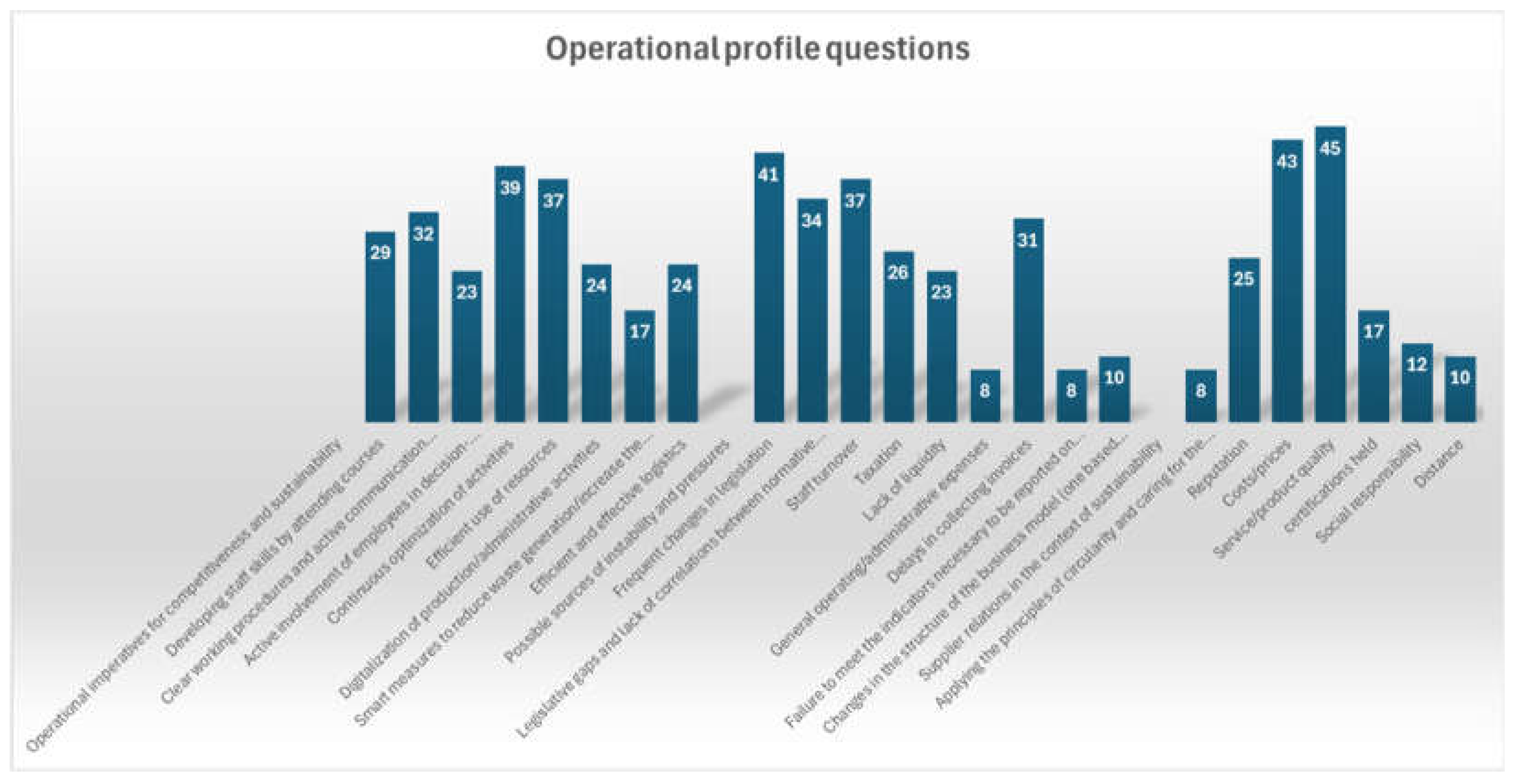
Figure 2.
Questions Q4, Q8, Q10 describe the circular economy involvement.
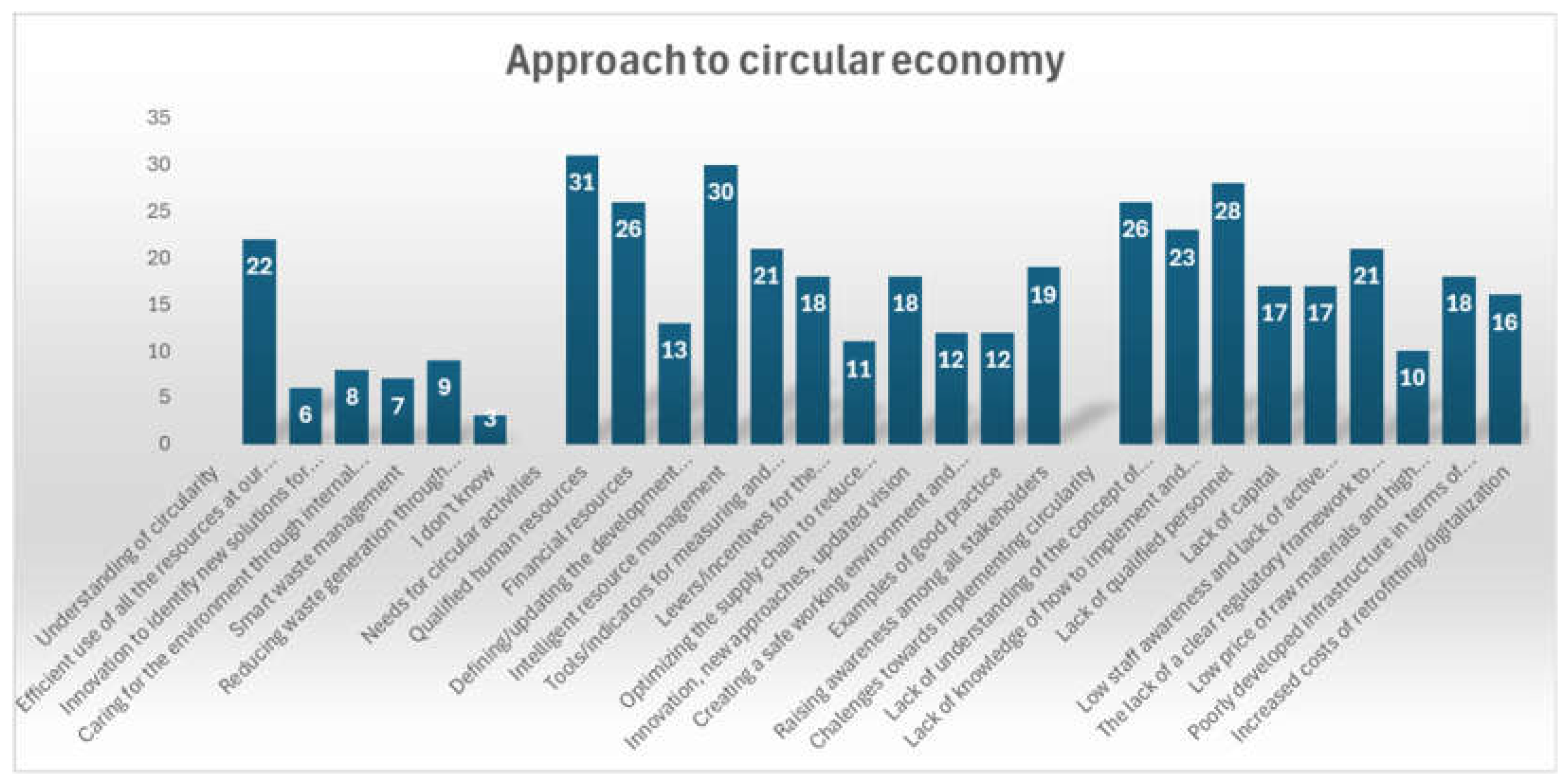
Figure 3.
Questions Q6 and Q9 reveal the sustainability framework.
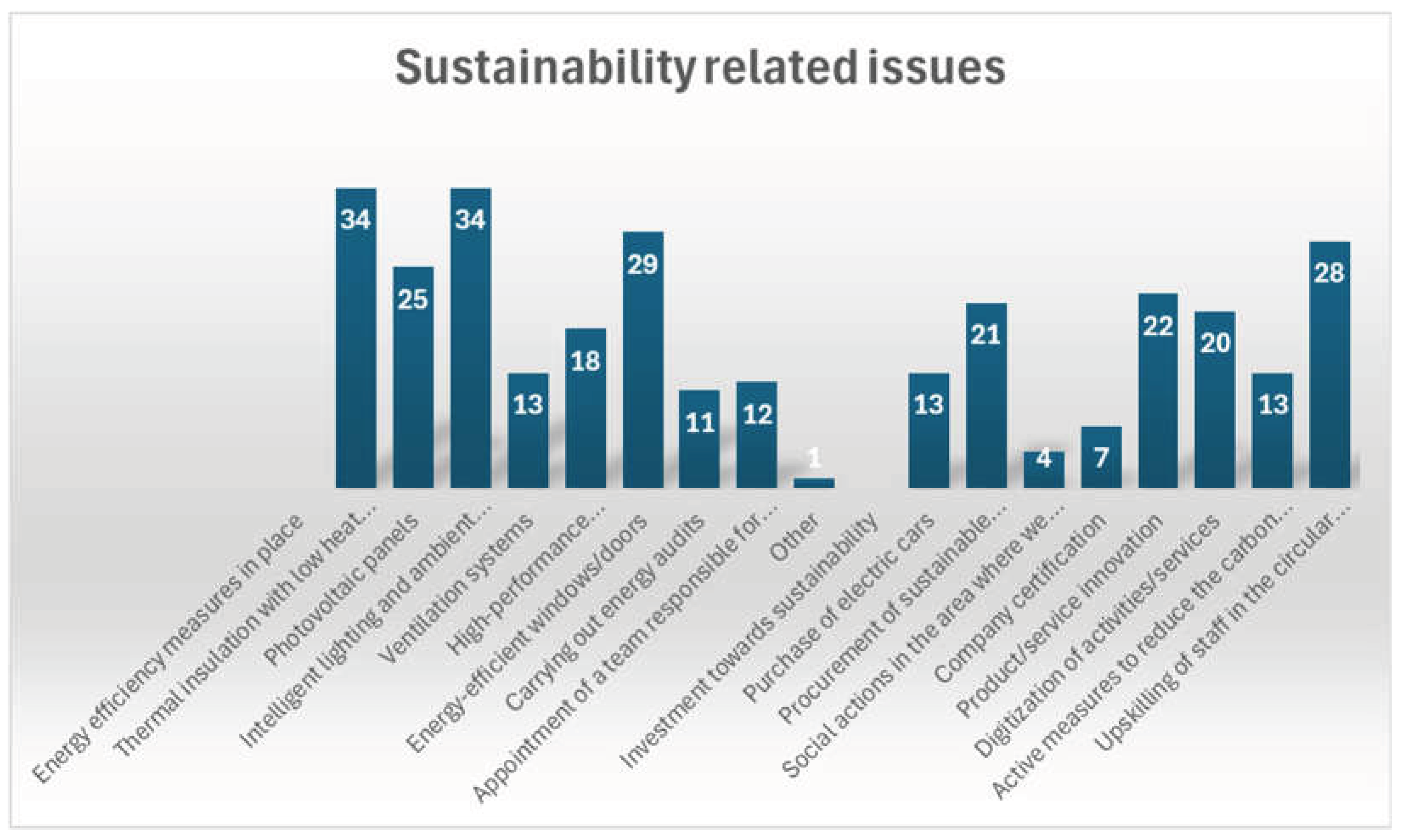
Figure 4.
Questions Q12 and Q13 depict the organizational excellence orientation.
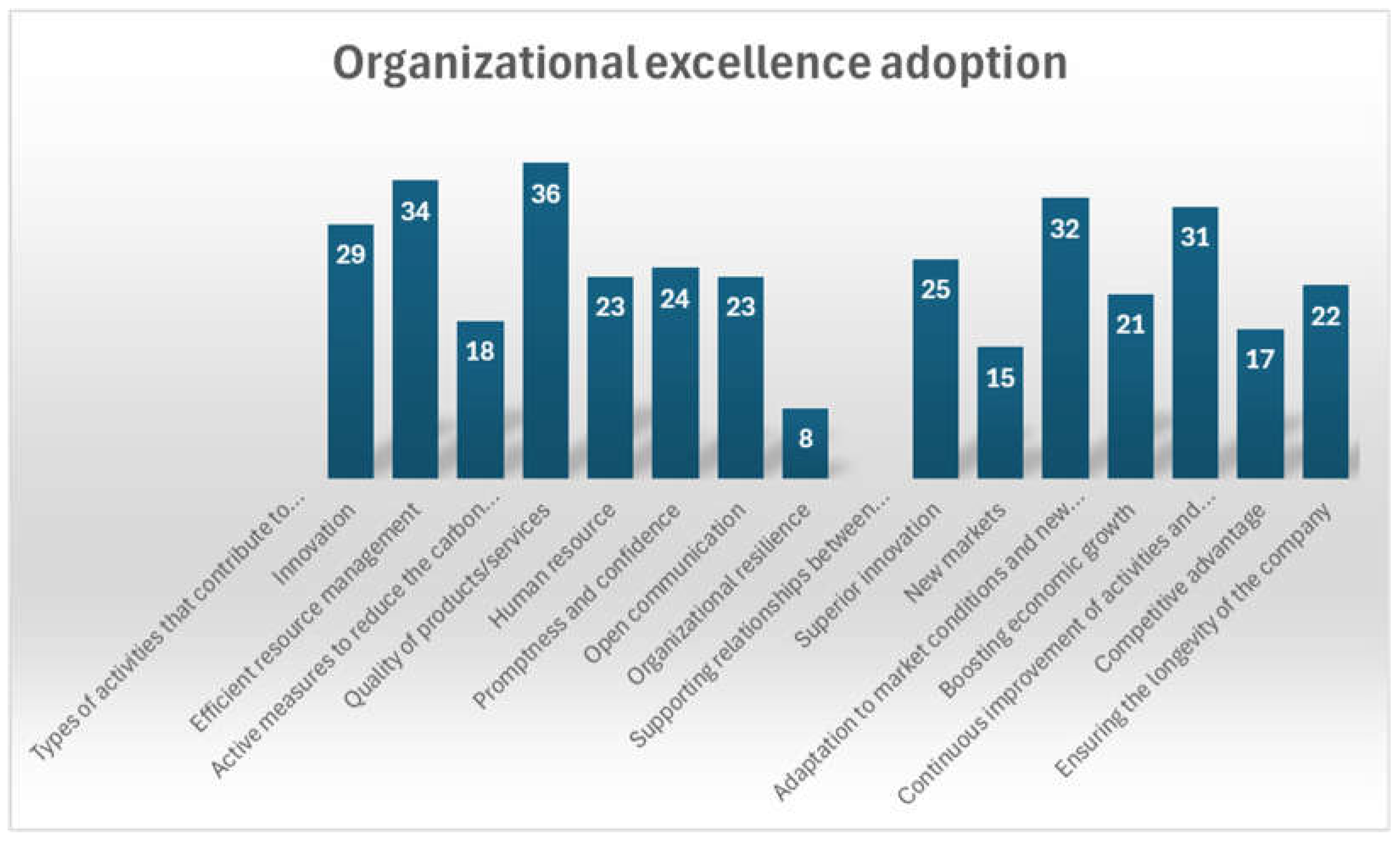

Table 1.
Correlation analysis for the Q1-Q3 group.
| Q1 | Q2 | Q3 | |
| Q1 | 1 | ||
| Q2 | 0,082027 | 1 | |
| Q3 | 0,36464 | 0,161496 | 1 |
Table 2.
ANOVA for the Q1-Q3 group.
| ANOVA | ||||||
| Source of Variation | SS | df | MS | F | P-value | F crit |
| Between Groups | 115,3373 | 2 | 57,66865 | 0,383813 | 0,68594 | 3,4668 |
| Within Groups | 3155,288 | 21 | 150,2518 | |||
| Total | 3270,625 | 23 |
Table 3.
Correlation analysis for the Q4-Q8-Q10 group.
| Q4 | Q8 | Q10 | |
| Q4 | 1 | ||
| Q8 | 0,515748 | 1 | |
| Q10 | 0,391092 | 0,353594 | 1 |
Table 4.
ANOVA for the Q4-Q8-Q10 group.
| ANOVA | ||||||
| Source of Variation | SS | df | MS | F | P-value | F crit |
| Between Groups | 479,308081 | 2 | 239,654 | 5,609126 | 0,010373 | 3,422132 |
| Within Groups | 982,691919 | 23 | 42,72574 | |||
| Total | 1462 | 25 |
Table 5.
ANOVA for the Q6-Q9 group.
| ANOVA | ||||||
| Source of Variation | SS | df | MS | F | P-value | F crit |
| Between Groups | 56,94118 | 1 | 56,94118 | 0,56192 | 0,465083 | 4,543077 |
| Within Groups | 1520 | 15 | 101,3333 | |||
| Total | 1576,941 | 16 |
Table 6.
ANOVA for the Q12-Q13 group.
| ANOVA | ||||||
| Source of Variation | SS | df | MS | F | P-value | F crit |
| Between Groups | 4,429762 | 1 | 4,429762 | 0,070632 | 0,794586 | 4,667193 |
| Within Groups | 815,3036 | 13 | 62,71566 | |||
| Total | 819,7333 | 14 |
Table 7.
F-Test applied for assessing circularity – excellence cross-linkage.
| F-Test Two-Sample for Variances | ||
| Q8 | Q12 | |
| Mean | 19,18181818 | 24,375 |
| Variance | 51,76363636 | 80,26785714 |
| Observations | 11 | 8 |
| df | 10 | 7 |
| F | 0,644886237 | |
| P(F<=f) one-tail | 0,255234403 | |
| F Critical one-tail | 0,318931981 | |
Disclaimer/Publisher’s Note: The statements, opinions and data contained in all publications are solely those of the individual author(s) and contributor(s) and not of MDPI and/or the editor(s). MDPI and/or the editor(s) disclaim responsibility for any injury to people or property resulting from any ideas, methods, instructions or products referred to in the content. |
© 2026 by the authors. Licensee MDPI, Basel, Switzerland. This article is an open access article distributed under the terms and conditions of the Creative Commons Attribution (CC BY) license.
Copyright: This open access article is published under a Creative Commons CC BY 4.0 license, which permit the free download, distribution, and reuse, provided that the author and preprint are cited in any reuse.