
Submitted:
07 February 2026
Posted:
09 February 2026
You are already at the latest version
Abstract
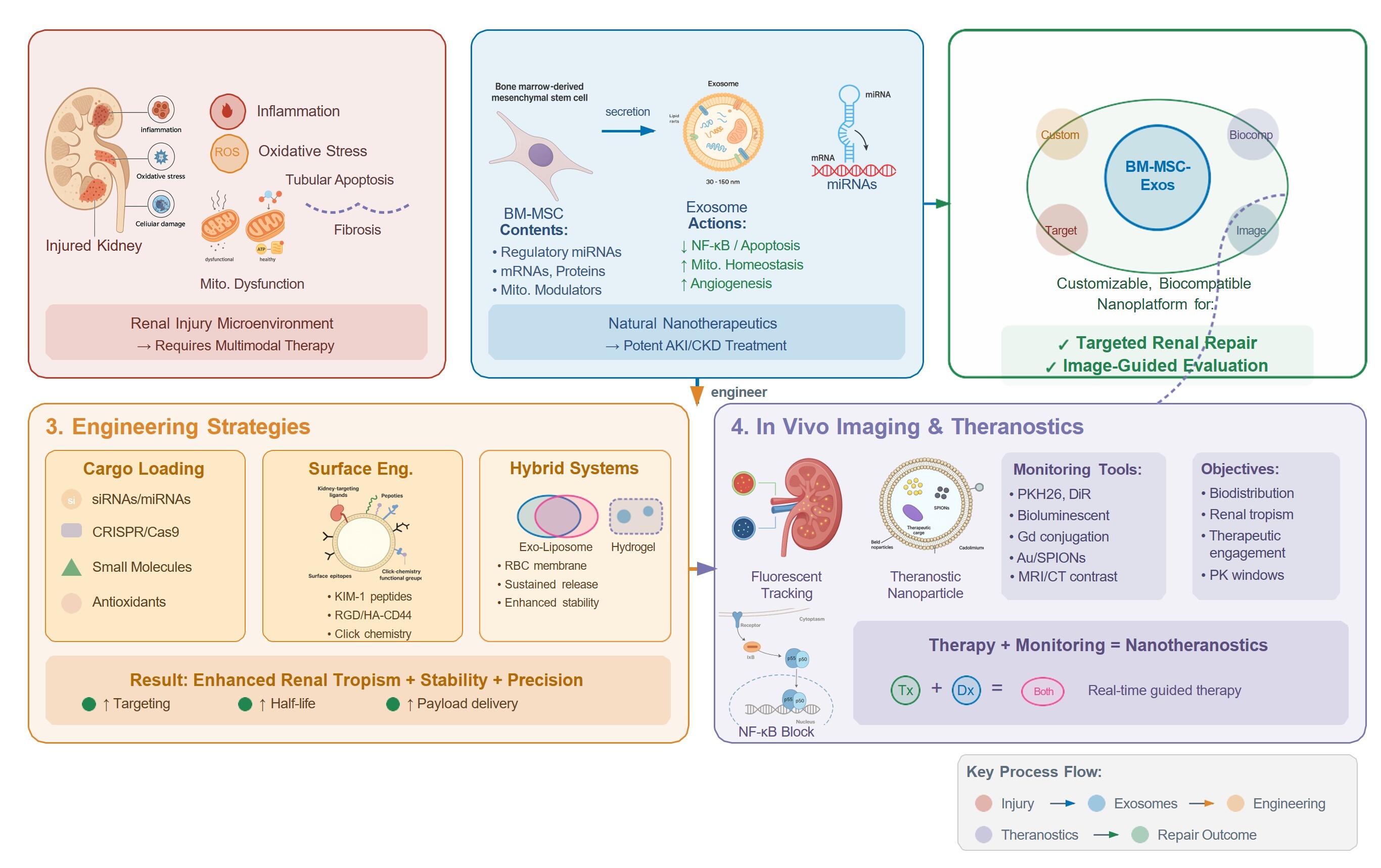
Acute and chronic kidney diseases remain significant challenges in regenerative medi-cine, with few therapies capable of reversing tissue injury or preventing progression. Bone marrow mesenchymal stem cell–derived exosomes (BM-MSC-Exos), nanosized vesicles measuring 30–150 nm, have emerged as multifunctional nanotheranostic platforms that integrate targeted therapeutic activity with imaging-enabled monitor-ing. In renal pathophysiology, BM-MSC-Exos exert anti-inflammatory, antifibrotic, angiogenic, and pro-regenerative effects mediated by microRNAs, messenger RNAs, mitochondrial regulators, and bioactive proteins that modulate epithelial repair and immune responses. Advances in bioengineering now allow precise modification of BM-MSC-Exos, including enrichment with synthetic RNAs or gene-editing compo-nents and membrane functionalization to enhance kidney-specific tropism. Parallel developments in fluorescent, bioluminescent, and nanoparticle-based imaging enable real-time visualization of biodistribution and tubular uptake, providing essential in-sights into therapeutic engagement. This review synthesizes current knowledge on BM-MSC-Exos in renal repair, describes contemporary strategies for cargo and surface engineering, examines imaging methodologies for in vivo tracking, and discusses how administration route influences renal targeting. An updated overview of clinical trials applying exosomes as therapeutic agents or biomarkers in nephrology is also present-ed. Collectively, engineered BM-MSC-Exos represent a promising and increasingly so-phisticated nanotheranostic platform for precision-guided treatment of kidney disease, supported by imaging tools that facilitate preclinical evaluation of biodistribution and efficacy.
Keywords:
bone marrow mesenchymal stem cell–derived exosomes
; engineered exosomes
; nanotheranostics
Copyright: This open access article is published under a Creative Commons CC BY 4.0 license, which permit the free download, distribution, and reuse, provided that the author and preprint are cited in any reuse.


