

Submitted:
05 February 2026
Posted:
06 February 2026
You are already at the latest version
Abstract
EEG-based automated classification pipelines for identifying mental disorders increasingly rely on deep learning architectures that are computationally intensive and difficult to interpret, limiting reproducibility and clinical deployment in resource-constrained or cross-site settings. There is a need for algorithmically transparent frameworks that balance accuracy, generalization, and computational efficiency. We propose an interpretable EEG classification framework that integrates multiscale spectrotemporal feature extraction with ensemble machine learning. The pipeline combines standardized preprocessing with extraction of time-domain, spectral power, and entropy-based features, followed by minimum redundancy–maximum relevance feature selection. Classification is performed using voting and stacking ensembles of heterogeneous base learners. The proposed algorithm achieved 98.06% accuracy on a primary open EEG dataset (Warsaw IPN; 19 channels, 250 Hz) and 91.47% accuracy on an independent external dataset (Moscow adolescent cohort; 16 channels, 128 Hz) without retraining or dataset-specific tuning. The framework exhibited low computational overhead and stable cross-dataset performance. The results demonstrate a generalizable, computationally efficient, and interpretable EEG classification framework that favors feature-level transparency and ensemble diversity over deep architectures, supporting scalable and reproducible biomedical signal processing applications.
Keywords:
schizophrenia
; electroencephalography (EEG)
; ensemble learning
1. Introduction
Schizophrenia (SZ or SCZ) is a severe and heterogeneous neuropsychiatric disorder affecting approximately 0.3 0.7% of the global population [1]. It is characterized by positive symptoms (e.g., hallucinations and delusions), negative symptoms (e.g., avolition and blunted affect), and persistent cognitive impairments that disrupt daily functioning. Beyond core psychotic symptoms, individuals with SZ exhibit robust deficits in language and social recognition [2], including impaired recognition of facial and vocal emotions [3,4,5,6,7]. Although the behavioral markers are clinically informative, their subjective nature introduces inter-rater variability, limits sensitivity to early and subclinical disease stages, and lacks mechanistic grounding in neural processes. This motivates the need for objective, biologically grounded measures to support scalable diagnosis and monitoring.
Electroencephalography (EEG) has emerged as a promising modality due to its millisecond temporal resolution, non-invasiveness, portability, and sensitivity to neural oscillatory dynamics [8,9]. EEG captures abnormalities in brain rhythms, functional connectivity, and signal complexity that are consistently reported in SZ (e.g., [10,11,12,13]) and reflect dysregulation of large-scale neural networks. However, the high dimensionality, multiscale structure, and noise characteristics of EEG limit the effectiveness of conventional statistical approaches. Machine learning (ML) methods are therefore well-suited to learn latent patterns that distinguish schizophrenia-related neural dysfunction. Recent years have seen rapid growth in EEG-based ML for automated SZ detection, mechanistic interpretation, and clinical outcome prediction (see [14] for a systematic review).
1.1. Methodological Frameworks in EEG-Based SZ Classification
Most EEG-based SZ classification studies follow a three-stage pipeline: preprocessing, feature extraction, and classification [15,16,17,18]. Preprocessing is essential for reducing contamination from ocular, muscular, and environmental artifacts. Standard procedures include band-pass filtering (commonly 0.5–50 Hz or 1–40 Hz) [17,19,20], re-referencing (e.g., average reference), artifact correction or rejection using Independent Component Analysis (ICA) or related algorithms, and segmentation into epochs for resting-state or event-related analysis [17,18]. Signal normalization (e.g., z-scoring) is often applied to mitigate inter-subject variability (e.g., [21]), although preprocessing choices remain a major source of between-study inconsistency.
EEG abnormalities in SZ manifest across multiple temporal and spatial scales, necessitating complementary feature representations. Feature extraction aims to capture the multiscale neural abnormalities associated with SZ and typically spans several complementary domains: (1) Time-domain features, including statistical descriptors and event-related potentials (ERPs) [22] such as reduced P300 and N100 amplitudes and delayed latencies, reflecting impairments in attention and sensory processing [23,24]. (2) Frequency-domain features, such as power spectral density (PSD) across canonical frequency bands [25], with reduced resting-state alpha power and elevated theta activity, particularly in frontal regions [9,26,27]. (3) Time–frequency features, derived from wavelet or short-time Fourier transforms, capturing transient, non-stationary dynamics that are not visible in static spectral measures [28,29]. (4) Functional connectivity and network features, such as coherence, phase-locking value (PLV), and graph-theoretic metrics, showing widespread dysconnectivity, especially within fronto-temporal and fronto-parietal networks, supporting the dysconnection hypothesis of SZ [30,31,32]. (5) Nonlinear and complexity features, including entropy measures, fractal dimension, and detrended fluctuation analysis (DFA), consistently indicating reduced neural complexity and diminished adaptive flexibility in SZ [33,34]. (6) Emerging representations, such as EEG microstates, model quasi-stable scalp topographies, showing altered temporal dynamics in SZ, particularly in microstates associated with salience and cognitive control networks [35,36,37].
Classification models range from traditional supervised ML to deep learning (DL) and hybrid or ensemble approaches. Traditional classifiers such as Support Vector Machines (SVM) [31,36,38,39,40,41,42], Random Forests (RF) [43,44,45], k-Nearest Neighbors (k-NN or KNN) [46], and Logistic Regression are widely used due to their interpretability, computational efficiency, and suitability for small datasets. These models rely on handcrafted features and often incorporate feature selection methods to reduce dimensionality (e.g., [39,47,48,49]). In contrast, DL architectures, including Convolutional Neural Networks (CNNs) [50,51,52] and Recurrent Neural Networks (RNNs), automatically learn hierarchical spatiotemporal representations directly from raw or minimally processed EEG. For example, hybrid CNN-LSTM (Long Short-Term Memory) architectures have shown state-of-the-art performance in tasks like classification and anomaly detection [53,54,55,56]. While DL models have achieved state-of-the-art performance, they require large labeled datasets, substantial computational resources, and often lack interpretability, posing barriers to clinical adoption [14,57]. Hybrid and ensemble methods attempt to balance these trade-offs by combining complementary feature sets or classifiers and employing techniques such as voting, bagging, or stacking to improve robustness [14,58].
1.2. Key Limitations in Existing EEG–ML Studies
A primary source of heterogeneity across EEG-based schizophrenia (SZ) classification studies lies in feature learning strategies (Table 1). Traditional machine learning approaches rely on hand-crafted, domain-informed features, including spectral representations (e.g., FFT-based features), signal decomposition methods (e.g., ICA, RVMD, wavelet transforms), and statistical or texture-based descriptors such as Statistical Local Binary Patterns (SLBP) [17,59,60,61,62,63]. These features are typically classified using conventional algorithms such as SVM, KNN, Linear Discriminant Analysis (LDA), decision trees, and ensemble methods, which remain prevalent across both public (e.g., IPN, Kaggle SCZ) and private datasets [62,64,65]. In contrast, deep learning (DL) models, including Deep ResNets, GoogleNet, and RNN-LSTM architectures, aim to learn hierarchical feature representations directly from minimally processed EEG signals (e.g., [54,66,67,68,69]). Hybrid approaches that combine deep feature extraction with classical classifiers have also been explored to balance representational capacity with limited dataset sizes [66,67]. However, the reported performance gains of DL-based models are often closely tied to data availability and computational resources rather than intrinsic methodological advantages [70].
Substantial variability also arises from differences in EEG preprocessing pipelines. Common practices include bandpass filtering (e.g., Butterworth and FIR filters), artifact removal via ICA, and more advanced decomposition techniques such as RVMD and flexible tunable Q wavelet transform (F-TQWT) [60,61,71,72,73]. These preprocessing choices directly influence feature distributions and learned decision boundaries [74], making reported performance difficult to disentangle from signal conditioning methods and complicating cross-study comparison.
Experimental paradigms further contribute to inconsistency. Task-based EEG paradigms (e.g., auditory oddball or working memory tasks) target specific cognitive processes and event-related potentials such as P300 and N100 [12,75,76,77,78,79], offering mechanistic interpretability but requiring task compliance. Resting-state EEG, which dominates many studies in Table 1, captures intrinsic brain dynamics without task demands [80], improving clinical feasibility but increasing inter-subject variability. These paradigm differences substantially affect both feature representations and neurobiological interpretations.
Validation protocols represent another major limitation. Most studies rely on k-fold cross-validation to estimate internal robustness (e.g., [60,68]), whereas more stringent approaches such as leave-one-subject-out (LOSO) or leave-one-out (LOO) validation are less frequently adopted. All within-dataset validation strategies are susceptible to optimistic bias, particularly in small, high-dimensional EEG datasets. External validation on independent cohorts remains rare [14], limiting confidence in cross-site generalizability and real-world applicability.
Despite these methodological differences, many EEG–ML studies report high classification performance, often exceeding 80–90% accuracy (Table 1). Rather than indicating a universally superior approach, these results reflect convergent neurophysiological findings in SZ, including reduced alpha-band power, increased theta activity, disrupted fronto-temporal and fronto-parietal connectivity, and decreased signal complexity [8,9,12]. These abnormalities are consistently exploited across diverse modeling frameworks, either explicitly through hand-crafted features or implicitly through learned representations. Emerging work also suggests that EEG-based ML may extend beyond binary classification to cognitive profiling, subtype identification, and symptom prediction [70].
However, significant barriers continue to limit clinical translation. Most studies rely on small, single-site datasets, often private cohorts, reducing robustness and population-level generalizability. Inter-subject variability related to age, medication status, illness duration, and symptom severity further complicates model learning. Combined with high-dimensional feature spaces, limited sample sizes increase the risk of overfitting and inflated performance estimates that fail to replicate across datasets. Furthermore, the lack of standardization in preprocessing, feature extraction, validation protocols, and evaluation metrics undermines reproducibility. Model interpretability remains a critical concern: while DL-based methods capture complex patterns, their black-box nature limits neurobiological insight and clinician trust. Moreover, the predominant focus on binary classification reduces ecological validity, as clinical diagnosis requires discrimination among multiple psychiatric conditions.
Taken together, although EEG-based machine learning approaches show strong potential for SZ classification, their performance remains highly sensitive to methodological choices and dataset characteristics. Ensemble learning offers a principled strategy to mitigate these limitations by integrating multiple classifiers or complementary feature views, thereby reducing bias and variance and improving robustness in small-to-moderate sample size regimes typical of EEG studies. Despite these advantages, ensemble methods remain underexplored in EEG-based schizophrenia classification (e.g., [59,81]). Advancing toward clinical deployment will therefore require standardized pipelines, rigorous external validation, systematic evaluation of ensemble frameworks, improved interpretability, and clinically realistic multi-class diagnostic settings.
1.3. The Present Study
Motivated by persistent challenges in EEG-based schizophrenia classification—particularly limited cross-dataset generalizability and the practical constraints of data-intensive deep learning models—we propose a generalizable and interpretable machine learning framework for schizophrenia detection from EEG. The framework emphasizes robust multiscale feature extraction from resting-state EEG, integrating time-domain, spectral, connectivity, entropy-based, and fractal measures, including detrended fluctuation analysis (DFA). To improve robustness while preserving interpretability and computational efficiency, ensemble learning is employed within a feature-based machine learning paradigm.
Crucially, the proposed framework is evaluated using a stringent cross-dataset validation strategy: models are trained and optimized on one open-source EEG dataset and tested without retraining or parameter tuning on an independent cohort. This evaluation protocol prioritizes generalization over inflated within-dataset performance and provides a realistic assessment of clinical applicability. By delivering a reproducible, plug-and-play pipeline compatible with standard EEG recordings, this work aims to advance EEG-based computational psychiatry from proof-of-concept demonstrations toward scalable and objective tools for schizophrenia detection and neurophysiological analysis.
The remainder of the paper is organized as follows. Section 2 describes the datasets, preprocessing procedures, multidomain feature extraction, feature selection, and classification models, including baseline and ensemble approaches, along with the evaluation protocol. Section 3 presents performance results on both the primary and independent validation datasets, reporting accuracy, F1-score, and ROC–AUC metrics. Section 4 discusses the methodological advantages, clinical implications, and limitations of the proposed framework, and Section 5 concludes the paper.
2. Materials and Methods
2.1. EEG Data-Sets and Preprocessing
The primary dataset used in this study was obtained from the public repository of Olejarczyk and Jernajczyk at the Institute of Psychiatry and Neurology in Warsaw [32,80]. This dataset consists of resting-state EEG recordings from 14 healthy controls and 14 patients diagnosed with paranoid schizophrenia (ICD-10: F20.0), with an average recording duration of 1028.7 seconds per subject. Signals were sampled at 250 Hz from 19 scalp channels: Fp2, F8, T4, T6, O2, Fp1, F7, T3, T5, O1, F4, C4, P4, F3, C3, P3, Fz, Cz, and Pz. The data were stored in EDF format and loaded using the MNE Python library (originally based on the Minimum Norm Estimate method for MEG/EEG analysis) [90]. For preprocessing, the EEG recordings were segmented into 6-second epochs with 2-second overlap, resulting in 7191 epochs, each containing 19 channels with 1500 time points. A bandpass filter (0.5–50 Hz) was applied to remove slow drifts and high-frequency noise, followed by artifact removal using Independent Component Analysis (ICA) via MNE and the Automatic and Tunable Artifact Removal (ATAR) algorithm from the SpKit Python library.
To evaluate the generalizability of the proposed framework, an independent validation dataset was also used. This dataset was obtained from Moscow University (http://brain.bio.msu.ru/eeg_schizophrenia.htm) and includes resting-state EEG recordings from adolescents, clinically screened and categorized as healthy controls (n = 39) or adolescents exhibiting schizophrenia symptoms (n = 45). EEG signals were acquired with 16 scalp electrodes (F7, F3, F4, F8, T3, C3, Cz, C4, T4, T5, P3, Pz, P4, T6, O1, O2) at a sampling rate of 128 Hz, with each recording lasting approximately one minute per subject (7680 samples per channel). The raw EEG data were stored as text files with sequentially concatenated channels. All preprocessing steps, feature extraction procedures, and classification models developed for the primary dataset were directly applied to this independent dataset to assess the robustness and cross-dataset generalization of the proposed approach.
2.1.1. ICA and ATAR
Independent Component Analysis ICA is a Blind Source Separation (BSS) method used in signal processing and artifact removal [91] and has been used extensively in the literature surrounding EEG machine learning classification due to its availability in several well established software libraries (e.g., EEGLAB [92], FieldTrip [93], and MNE-Python [94]). This algorithm decomposes EEG signals with multiple channels into independent source signals which can be visually excluded through scalp topography, with newer techniques [95] able to automatically do so when manual selection is unrealistic in large datasets. Despite its popularity, ICA can sometimes be overly aggressive, introducing spurious frequency components or distorting neural signals, which may negatively impact downstream predictive models [96].
A more novel approach that is seldom used is ATAR (Automatic and Tunable Artifact Removal Algorithm) (Figure 1), which uses Wavelet Packet Decomposition to capture temporal patterns in EEG signals [97]. Unlike ICA, ATAR provides a tunable parameter (β) that allows the user to control the aggressiveness of artifact removal, balancing the elimination of ocular and muscle artifacts with the preservation of essential neural signals. In our experiments, ATAR outperformed ICA in improving machine learning model performance, likely due to the controlled artifact removal enabled by setting β = 0.1, which preserved critical EEG features while efficiently mitigating noise. Our experiments revealed that ATAR provided better results in the machine learning process compared to ICA in efficiently removing ocular and muscle artifacts.. This is likely due to the tunability of the (β) parameter (which was set to 0.1), which enabled a more balanced approach to artifact removal and signal preservation.
2.2. Feature Extraction
To effectively capture the complex and high-dimensional nature of EEG signals, features were extracted from the time domain, frequency domain, and entropy measures, providing a comprehensive representation of neural dynamics [98,99]. Time-domain features included standard statistical metrics such as sum of absolute differences, mean, variance, standard deviation, minimum and maximum signal values, root mean square (RMS), as well as Hjorth parameters—activity (HA), mobility (HM), and complexity (HC)—which characterize signal amplitude, spectral content, and waveform irregularity [100]. Additionally, higher-order statistics such as skewness and kurtosis were computed to capture asymmetry and peakedness of the signal distribution. Entropy features, including Shannon entropy, Wavelet entropy, and Fuzzy entropy, were extracted to quantify the unpredictability and complexity of EEG time series, which have been shown to reflect underlying neurological states [101]. Frequency-domain features were derived from the power spectral density (PSD) and included band powers within the delta (δ, 0.5–4 Hz), theta (θ, 4–8 Hz), alpha (α, 8–13 Hz), and beta (β, 13–30 Hz) bands, as well as additional statistical measures and spectral entropy to capture the distribution and complexity of spectral content [102]. Together, these multidomain features provide a rich representation for machine learning models to distinguish between healthy and pathological EEG patterns.
2.2.1. Time Domain Features
Statistical feature extraction from the time domain of the signal have proven to yield promising results when used as features in the task of EEG machine learning classification [103]. The following features were extracted from the signal from every channel:
- a)
- Sum of Absolute Differences (SAD):
- b)
- Root Mean Square (RMS):
RMS captures the overall amplitude and energy contained within a signal, which is correlated with the intensity of neural activity.
- c)
- Hjorth Parameters (Activity, Mobility, and Complexity):
Hjorth parameters are used almost exclusively and developed specifically for characterizing EEG signals and can give us a glimpse of the spectral qualities of a signal without needing computationally expensive methods like Fast Fourier Transform.
Hjorth Activity is able to describe the power of an EEG signal through the variance of the time function.
where are the signal values, is the mean of the signal, and N is the number of samples.
Hjorth Mobility describes the movement and variation of the spectral components of a signal, and describes the mean frequency of the signal as well the proportion of the standard deviation of the power spectrum.
where is the first derivative of the signal with respect to time, i.e., , is the variance of the derivative signal , and is the variance of the original signal .
Hjorth Complexity computes the similarity between an EEG signal and a pure sine wave which is a measure of complexity and irregularity.
where are the values of the second derivative of the signal, is the mean of the second derivative, and N is the number of samples.
2.2.2. Frequency Domain Features
Frequency-domain feature extraction plays a crucial role in EEG signal analysis, as it provides insight into how signal power is distributed across different frequency bands, which can be associated with specific cognitive states or neurological conditions [97]. To characterize these frequency-domain properties, the power spectral density (PSD) of each EEG channel was computed using Welch’s method. This approach estimates the PSD by dividing the signal into overlapping segments, applying a window function to each segment, performing a Fast Fourier Transform (FFT) on each window, and averaging the resulting spectra across all segments. Welch’s method is particularly well suited for EEG analysis because it reduces variance in the spectral estimate and is effective for handling the non-stationary nature of EEG signals.
Formally, given a signal of length , the signal is divided into overlapping segments, each of length . For each segment, a periodogram is computed as
where k = 1, 2, . . . , K. represents the total length of the signal, denotes the number of segments, is the length of each segment, and corresponds to the frequency variable.
The final PSD estimate is then obtained by averaging the individual periodograms across all segments:
Once the PSD was estimated, band power features were computed by calculating the area under the PSD curve within specific frequency ranges. In particular, power values were extracted for the Delta (δ), Theta (θ), Alpha (α), and Beta (β) frequency bands. In addition to band powers, spectral entropy and other statistical measures were derived from the PSD of each EEG channel to capture the complexity and distribution of spectral content. Finally, additional statistical features listed in Table 1, including the mean, skewness, and kurtosis of the frequency-domain representation, were also extracted to further characterize the spectral properties of the EEG signals.
2.2.3. Entropy Features
Entropy in EEG signals measures the complexity and unpredictability of the brain’s electrical activity. These entropic measures have been successfully used in the classification of Parkinson’s Disorder as well as human emotion due to their ability to capture complex characteristics in the signals that are symptomatic of neurological states [104]. For feature extraction we extracted Shannon, Wavelet, Permutation, and Fuzzy Entropy from every channel.
2.3. Feature Selection
To reduce the high dimensionality of the feature space and mitigate overfitting in machine learning models, multiple feature selection strategies were systematically evaluated [105]. Initially, low-variance filtering was applied to remove features with minimal variability across samples, as these features are unlikely to contribute meaningful discriminative information. Next, univariate feature selection using mutual information (MI) was employed, quantifying the dependency between each feature and the class label as:
where X denotes the feature and Y the class label and represents specific values that the variables X and Y can take.
Mutual information effectively identifies features that provide the most information about class distinctions, capturing both linear and nonlinear relationships [106].
Following MI-based selection, Recursive Feature Elimination (RFE) was applied using tree-based models to iteratively remove the least informative features, retaining only those that contribute most to model performance [107]. RFE leverages the inherent feature importance scores of tree ensembles, providing a robust and model-aware approach to dimensionality reduction. In parallel, an external tool-based approach using the Featurewiz library was evaluated, implementing a Minimum Redundancy Maximum Relevance (MRMR) criterion [108]. MRMR selects features that are highly relevant to the target variable while minimizing redundancy across the feature set, ensuring a compact yet informative representation. Across multiple experiments, MRMR consistently outperformed alternative strategies and was therefore adopted for all subsequent analyses, reducing the feature set to 50 features per epoch, which balanced model complexity with predictive performance.
2.4. Classification Models and Evaluation Protocol
2.4.1. Baseline Models and Conditional Hyperparameter Optimization
To identify optimal features and classifiers, we initially evaluated the following models: Support Vector Machine (SVM), K Nearest Neighbors (KNN), Gradient Boosting, Extra Trees, Random Forest, Decision Trees, Logistic Regression, AdaBoost, Naive Bayes, and a Multilayer Perceptron (MLP). Hyperparameters were not tuned initially, and evaluation was conducted using various sets of feature arrays. A 50-50 random training-testing split was used to evaluate the accuracy of of every model on the features array.
2.4.2. Ensemble Learning via Voting and Stacking
Voting and Stacking Ensemble methods have a rich history of usage in machine learning [81], as they enable the aggregation of predictions from multiple models to leverage their individual strengths while mitigating their weaknesses. In this study, Support Vector Machines (SVM), k-Nearest Neighbors (KNN), Gradient Boosting, and Extremely Randomized Trees were employed as base learners within both voting and stacking ensemble frameworks. These ensemble approaches integrate predictions from the individual models using different strategies to improve overall predictive performance. Specifically, the voting classifier combines model outputs either through a hard majority voting scheme or through a soft voting mechanism that averages the predicted class probabilities across all classifiers. In addition, a stacking approach was implemented, in which a logistic regression meta-classifier learns to capture more complex patterns in the data by using the predictions of the base models as input features.
2.4.3. Feature Bagging and Data Resampling Ensembles
To improve robustness to feature selection variability and sample heterogeneity, two additional ensemble strategies were implemented.
- a)
- Diverse Feature Bagging
Random subsets of features were generated from the selected feature pool (Figure 2). For each subset, classifiers were trained independently and evaluated on a validation set. Only models achieving validation accuracy above a predefined threshold were retained. Predictions from the retained models were combined using soft voting. For low-confidence predictions (posterior probability < 0.9), a secondary ensemble decision was applied to refine the final classification.
- b)
- Segmented Data Bagging
In the segmented data bagging approach, the training dataset was partitioned into multiple segments treated as independent training sets. Bootstrap resampling was applied within each segment, and multiple classifiers were trained on these resampled subsets. Final predictions were obtained by aggregating segment-level predictions using majority voting and meta-classification.
2.4.4. Evaluation Protocol
Data were split into training and testing sets using a 50/50 split. Model performance was evaluated using accuracy, precision, recall, F1-score, and confusion matrices [109]. For ensemble models, both predictive accuracy and confidence calibration were examined [110]. Final performance metrics were reported on held-out test data only.
Classification was performed using multiple machine learning models, including Support Vector Machines (SVM), k-Nearest Neighbors (KNN), Gradient Boosting, Random Forests, and Extremely Randomized Trees. For SVM, a radial basis function (RBF) kernel was used:
where and represent the feature vectors of the -th and -th samples, respectively, denotes the Euclidean distance between the two feature vectors, and is a kernel parameter that controls the width of the Gaussian function, determining how far the influence of a single training example reaches. The RBF kernel measures the similarity between two samples: the closer and are in feature space, the higher the kernel value, with a maximum of 1 when they are identical.
Ensemble strategies were further explored, including hard voting, soft voting, and stacked generalization [111]. In the stacking framework, logistic regression was used as a meta-classifier, modeling the posterior probability as
where represents the feature vector of a sample, is the class label for the sample (with indicating the positive class), is the vector of model parameters (weights) learned during training, denotes the dot product between the weights and the feature vector, and is the sigmoid function, which maps the input to a probability between 0 and 1. This equation models the posterior probability that a given sample belongs to the positive class, based on its features and the learned model parameters.
Data were split into training and testing sets using a 50/50 split. Within the training set, five-fold cross-validation was used for hyperparameter tuning, and all model performance metrics were evaluated on held-out test data, including accuracy, precision, recall, F1-score, and ROC-AUC for binary classification [109]. These procedures ensured robust evaluation and fair comparison across models while mitigating the risk of overfitting.
3. Results
3.1. Performance on Dataset 1 (Primary Dataset)
The proposed ensemble-based classification framework achieved strong performance on Dataset 1 (see Table 2 for detailed metrics), with a test accuracy of 98.06%. Both macro-averaged and weighted F1-scores were approximately 0.98, indicating balanced performance across classes. Out of 7,206 test epochs, only 140 were misclassified, reflecting robust prediction at the epoch level.
Class-wise evaluation further highlights the model’s reliability. For the healthy control group, recall was 99.24% and precision 96.60%, indicating that nearly all true control epochs were correctly identified, with a small proportion of false positives. The SZ group achieved a recall of 97.06% and precision of 99.35%, demonstrating accurate detection with relatively few false negatives. These results suggest the model effectively distinguishes between SZ and control epochs, although the use of epoch-level evaluation means some caution is warranted in extrapolating performance to independent subjects.
Comparative analysis across classifiers showed that ensemble and tree-based models performed best on this dataset (see Table 3). Extremely Randomized Trees achieved the highest single-model accuracy (98.75%), closely followed by Random Forests (98.68%). The ensemble voting classifier delivered comparably strong performance (98.06%), supporting the benefit of combining complementary classifiers. In contrast, Naive Bayes performed substantially worse (65.09% accuracy), suggesting that its strong distributional assumptions are poorly matched to the underlying EEG feature space. Overall, these findings indicate that ensemble and tree-based approaches provide near-optimal performance on Dataset 1.
We used the Receiver Operating Characteristic (ROC) curve, a standard method for evaluating the diagnostic performance of a binary classifier by illustrating the trade-off between the True Positive Rate (sensitivity) and the False Positive Rate (1 – specificity) across varying decision thresholds. Figure 3a presents the ROC curve for the proposed model on Dataset 1, showing an Area Under the Curve (AUC) of 0.998—indicative of near-perfect discrimination between schizophrenia and healthy control groups. The curve’s sharp rise toward the top-left corner highlights high sensitivity achieved at very low false positive rates. Figure 3b complements this by plotting precision, recall, and F1-score as functions of the classification threshold, revealing an optimal threshold of 0.434 where the model balances these metrics to maximize the F1-score. Such threshold tuning is critical in clinical settings, enabling customization of the decision boundary to appropriately manage the trade-off between false positives and false negatives. Together, these figures demonstrate both the model’s strong predictive capability and its adaptability to optimize classification performance through threshold adjustment.
These findings indicate that tree-based and ensemble frameworks are well-suited to EEG-based SZ classification, providing robust and balanced performance at the epoch level. However, generalization to new subjects and independent datasets should be interpreted cautiously, motivating further validation across external cohorts.
3.2. Performance on Dataset 2 (Independent Validation Dataset)
When evaluated on Dataset 2, the proposed framework maintained strong performance (see Table 4 for performance metrics), achieving a test accuracy of 91.47%. Macro-averaged and weighted F1-scores were both approximately 0.91, indicating balanced classification across classes despite the smaller sample size and increased dataset heterogeneity. Compared to Dataset 1, the modest reduction in performance reflects the greater difficulty of this dataset rather than model instability.
At the class level, the model demonstrated a well-balanced trade-off between sensitivity and specificity. The healthy group achieved a precision of 92.02% and a recall of 88.29%, while the SZ group showed a higher recall (93.97%) and a precision of 91.07%. The confusion matrix revealed 43 mis-classifications out of 504 samples, with errors distributed relatively symmetrically across classes.
Consistent with the results on Dataset 1, ensemble learning delivered the strongest overall performance on Dataset 2 (see Table 5). The ensemble voting classifier achieved the highest accuracy at 91.47%, outperforming all individual models. Among single classifiers, Extremely Randomized Trees performed best with 88.12% accuracy, followed by Random Forests at 85.89%. Baseline implementations of SVM, k-Nearest Neighbors (kNN), Naive Bayes, Decision Trees, and AdaBoost showed substantially lower accuracies, ranging from approximately 71% to 79%, underscoring the critical role of feature selection and ensemble strategies in achieving robust EEG-based schizophrenia classification.
Importantly, all preprocessing, feature extraction, and model parameters were transferred directly from Dataset 1 without additional tuning, reflecting a conservative and realistic evaluation of the framework’s cross-dataset generalization. This demonstrates the model’s robustness to dataset variability and highlights the advantage of ensemble approaches in improving stability and accuracy across diverse EEG data sources.
To assess the model’s generalizability, we applied the Receiver Operating Characteristic (ROC) curve analysis to the independent validation Dataset 2. Figure 4a shows the ROC curve for this dataset, with an Area Under the Curve (AUC) of 0.962, indicating excellent discrimination between schizophrenia and healthy control groups despite the increased heterogeneity and smaller sample size relative to Dataset 1. The curve demonstrates consistently high sensitivity while maintaining low false positive rates across thresholds. Figure 4b further characterizes model performance by plotting precision, recall, and F1-score as functions of the classification threshold, identifying an optimal threshold of 0.502 where the model achieves a balanced trade-off and maximal F1-score of approximately 0.82. At this threshold, precision reaches about 0.85 and recall approximately 0.79, reflecting an effective balance between minimizing false positives and capturing true positives. These results confirm that the model generalizes robustly to independent data, maintaining strong predictive accuracy and offering a validated threshold for clinical application that balances detection sensitivity and specificity.
4. Discussion
This study presents a computationally efficient and interpretable EEG classification framework for schizophrenia that integrates tunable artifact suppression, multidomain feature intelligence, and advanced ensemble learning. Evaluated under a stringent cross-dataset protocol, our proposed approach achieved strong and stable performance on two independent datasets, reaching 98.06% accuracy on the primary dataset and 91.47% accuracy on an unseen validation cohort. These results approach the performance levels reported by deep learning models while offering substantially improved transparency, data efficiency, and deployability, which are key requirements for clinical neurocomputing applications.
4.1. Algorithmic Contributions: Tunable Preprocessing, Feature Intelligence, and Ensemble Design
A key novelty of this work lies in the algorithmic integration of controllable signal conditioning, optimized feature-space learning, and ensemble intelligence, rather than reliance on end-to-end deep architectures. Unlike conventional pipelines that depend solely on fixed preprocessing such as ICA, the proposed framework incorporates Automatic and Tunable Artifact Removal (ATAR), introducing an explicit control parameter (β) that enables adaptive suppression of ocular and muscle artifacts while preserving diagnostically relevant neural signals. This tunable preprocessing mechanism represents a form of computational intelligence at the signal-conditioning level, allowing robustness to be explicitly controlled rather than implicitly learned. Our results indicate that ATAR improves signal quality and downstream classification performance, particularly in datasets with substantial inter-subject variability, distinguishing this approach from standard ICA-based pipelines commonly used in prior studies [59,61,85].
Beyond preprocessing, the framework advances multi-domain feature intelligence by integrating complementary views of EEG dynamics across time, frequency, and complexity domains. In contrast to prior studies that focus on narrow feature subsets such as spectral power or band ratios [60,66,67,68], our model integrates time-domain statistics (mean, variance, kurtosis), frequency-domain features (power spectral density, band ratios), and entropy-based measures (sample entropy, permutation entropy). This multidimensional representation includes higher-order statistics and multiple entropy measures, capturing non-Gaussian, nonlinear, and non-stationary properties of neural signals. This richer representation enables the model to exploit subtle alterations in oscillatory structure and neural complexity known to characterize schizophrenia.
To manage the resulting high-dimensional feature space, we conducted a systematic evaluation of feature selection strategies, demonstrating that the Minimum Redundancy–Maximum Relevance (MRMR) criterion is particularly effective in retaining discriminative information while minimizing redundancy. This feature-space optimization is critical for stabilizing decision boundaries in small-to-moderate EEG datasets and constitutes an important methodological contribution beyond ad hoc feature pruning.
At the decision level, the framework extends ensemble learning beyond standard majority voting. Feature bagging, segmented data bagging, and confidence-aware prediction mechanisms were employed to improve robustness to feature variability, subject heterogeneity, and low-certainty predictions. These ensemble strategies explicitly address variance and reliability—two central challenges in EEG-based learning—and remain underexplored in schizophrenia EEG studies ([59,81]). From a neurocomputing perspective, this system-level ensemble design enhances generalization while maintaining interpretability and computational efficiency.
4.2. Stable Classification Under Data and Resource Constraints
A defining advantage of the proposed framework is its data efficiency. EEG datasets for schizophrenia are typically small, heterogeneous, and noisy, conditions under which deep learning models are prone to overfitting and unstable generalization. By combining noise-resilient preprocessing, discriminative feature selection, and ensemble learning, the proposed approach achieves high accuracy even under limited sample sizes. The strong cross-dataset performance observed here demonstrates that carefully engineered feature-based models can generalize reliably without requiring large-scale labeled data.
From a computational standpoint, the framework offers a favorable performance–cost trade-off. Unlike deep learning approaches that require GPUs, extensive training time, and high energy consumption [66,67], the pipeline in our approach shifts computational effort to one-time preprocessing and evidence-based feature extraction. Downstream classifiers operate efficiently on standard CPU hardware, enabling training and inference in minutes rather than hours. This efficiency supports real-time or near-real-time deployment and facilitates integration into existing hospital and clinical workflows, including resource-constrained environments.
Importantly, the ensemble framework contributed substantially to performance stability across datasets. While individual classifiers (e.g., Random Forest, Extremely Randomized Trees) performed well on both Dataset 1 and Dataset 2, the soft-voting ensemble consistently outperformed single models, reducing variance and mitigating overfitting—a strategy not systematically explored in prior schizophrenia EEG studies [59,61,85]. This robustness is particularly valuable for clinical neurocomputing applications, where EEG quality and acquisition conditions vary widely.
4.3. Interpretability, Reliability, and Translational Neurocomputing Impact
Interpretability is a critical requirement for clinical decision-support systems and a key limitation of deep learning-based EEG analysis. While CNNs and RNNs can achieve high accuracy [66,67], their latent representations are difficult to map to neurophysiological mechanisms, limiting clinician trust and translational potential. In contrast, our framework maintains transparency across all processing stages, from artifact suppression to feature extraction and ensemble decision-making.
By relying on physiologically meaningful features such as spectral power, entropy, and fractal dynamics, the framework enables direct interpretation of classification outcomes in terms of known neural biomarkers. Feature importance analysis revealed consistent contributions from band-power alterations over central regions and elevated entropy measures, aligning with established findings of disrupted oscillatory activity, altered sensorimotor processing, and reduced neural complexity in schizophrenia [59,61,85]. This convergence between computational outcomes and neurophysiological theory enhances both scientific validity and clinical trust.
The confidence-aware ensemble mechanism further improves reliability by mitigating low-certainty predictions, an important consideration for clinical deployment. Unlike opaque end-to-end models, the modular and controllable nature of the proposed framework allows practitioners to adjust preprocessing strength, feature dimensionality, and decision thresholds to accommodate variable EEG quality. Such controllability is essential for handling real-world data variability and supports regulatory and translational requirements for explainable AI systems.
Importantly, interpretable features also support biomarker discovery and clinical translation. By identifying EEG patterns consistently associated with schizophrenia, the framework can inform patient stratification, monitoring of disease progression, and targeted interventions, such as neurofeedback or neuromodulation protocols aimed at normalizing oscillatory activity in affected cortical regions. Unlike purely predictive deep learning models, our approach provides actionable insights that bridge computational performance with clinical relevance.
Our proposed framework demonstrates that high classification accuracy, cross-dataset generalization, and computational efficiency can be achieved without sacrificing interpretability. By integrating noise-resilient preprocessing, multidomain feature learning, and ensemble intelligence, the approach matches or exceeds the performance of prior machine learning and deep learning methods [59,61,66,67,85] while maintaining transparent and physiologically grounded decision mechanisms. These properties are critical for advancing EEG-based schizophrenia analysis toward practical clinical neurocomputing applications.
4.4. Limitations and Future Directions
Despite the strong performance and generalizability demonstrated by the proposed framework, several limitations should be considered. First, the primary dataset consisted of only 14 patients with schizophrenia and 14 healthy controls, which may limit statistical power and the generalizability of the results. Although the model maintained robust performance on an independent validation dataset, larger and more diverse cohorts are necessary to fully establish clinical reliability. From a neurocomputing perspective, such datasets are essential for stress-testing model stability and ensemble diversity across heterogeneous acquisition conditions. Second, the Automatic and Tunable Artifact Removal (ATAR) algorithm, while effective in enhancing signal quality, has not been systematically optimized across different EEG populations or recording protocols. Systematic sensitivity analyses and standardized parameter selection strategies will be important to improve reproducibility and facilitate broader adoption. The tunable nature of ATAR, however, offers a clear pathway toward adaptive signal conditioning tailored to variable EEG quality, an advantage over fixed, one-size-fits-all preprocessing pipelines. Third, ensemble classifiers improved accuracy over single classifiers but introduce greater computational overhead, which may limit real-time or resource-constrained clinical applications. While the overall framework remains substantially more efficient than deep learning models, future work should investigate lightweight ensemble designs, model pruning, or dynamic ensemble selection to further reduce inference time and support real-time or near-real-time deployment in constrained clinical environments.
Beyond these framework-specific considerations, EEG-based schizophrenia classification continues to face systemic challenges. Public datasets remain limited in size and heterogeneous in electrode layouts, recording protocols, and participant characteristics, complicating cross-study comparison and algorithm benchmarking [59,61,66,85]. Additionally, symptom heterogeneity and class imbalance remain major obstacles to developing universally applicable classifiers.
Future research should explore multimodal neurocomputing frameworks that integrate EEG with behavioral and cognitive performance measures (e.g., [4,5]). Hybrid learning strategies, including graph-based models, attention mechanisms, or transformer-based architectures, could exploit complementary information across modalities while preserving interpretability through structured feature representations [112,113]. Such approaches could improve diagnostic precision, enable symptom profiling, and support individualized monitoring and intervention, particularly in disorders where neural dysfunction and observable behavior are tightly coupled. Key challenges will include temporal alignment, heterogeneous feature fusion, and explainability; however, ongoing advances in sensor fusion and explainable artificial intelligence offer promising directions [114].
Furthermore, progress toward clinical translation will require coordinated efforts in open data sharing, standardized preprocessing, rigorous external validation, and systematic evaluation of ensemble and hybrid learning strategies. By prioritizing controllability, interpretability, and data efficiency, future neurocomputing systems can move beyond proof-of-concept classification toward reliable, clinically actionable decision-support tools that complement traditional behavioral assessment in schizophrenia.
5. Conclusions
This study demonstrates that accurate and generalizable schizophrenia classification can be achieved from resting-state EEG using a computationally efficient and interpretable framework that integrates robust preprocessing, multidomain feature extraction, and ensemble machine learning. The proposed approach attains high accuracy on both primary and independent validation datasets, highlighting strong discriminative capability and cross-dataset robustness. By emphasizing controllable artifact removal, explicit feature representations, and ensemble intelligence rather than deep architectures, the framework delivers competitive performance with substantially lower computational cost and improved transparency. Accordingly, this method should be viewed as a complementary and practical alternative to deep learning–based neural network approaches, particularly suited for data-limited, resource-constrained, and clinically interpretable neurocomputing applications.
Author Contributions
Conceptualization, Y.Z.; methodology, Y.E., X.H., and Y.Z.; software, Y.E., Y.Z.; validation, X.H., A.Z., and Y.L.; formal analysis, Y.E., X.H.; investigation, Y.E, X.H.; resources, Y.Z.; data curation, Y.Z.; writing—original draft preparation, Y.E., X.H., Y.Z.; writing—review and editing, X.H., A.Z., Y.L, Y.Z.; visualization, Y.E, X.H.; supervision, Y.Z.; project administration, Y.Z.; funding acquisition, Y.Z.. All authors have read and agreed to the published version of the manuscript.
Funding
This research was funded by University of Minnesota’s Grant-in-Aid (GIA) of Research, Artistry, and Scholarship program and Brain Imaging Grant. Y.L. was additionally supported by the youth program of National Social Science Foundation of China (23CYY051).
Data Availability Statement
The code used for EEG preprocessing, feature extraction, and machine learning analyses in this study is publicly available on GitHub at https://https://github.com/yossefemara7/eeg_ml_pipeline. The two EEG datasets analyzed in this study are publicly available from their original sources and are cited in the manuscript.
Acknowledgments
The authors acknowledge the Minnesota Supercomputing Institute (MSI) at the University of Minnesota for providing resources that contributed to the research results reported within this paper. During the preparation of this manuscript/study, the authors used ChatGPT (version GPT-4o) for improving grammar and text clarity. The authors have reviewed and edited the output and take full responsibility for the content of this publication.
Conflicts of Interest
The authors declare no conflicts of interest.
Abbreviations
The following abbreviations are used in this manuscript:
| ADHD | Attention-Deficit/Hyperactivity Disorder |
| AdaBoost | Adaptive Boosting |
| ANN | Artificial Neural Network |
| ATAR | Automatic and Tunable Artifact Removal |
| AUC | Area Under the Curve |
| BH | Black Hole (optimization algorithm) |
| BSS | Blind Source Separation |
| BT | Boosted Tree |
| CGP17Pat | Cartesian Genetic Programming 17 Pattern |
| CNN | Convolutional Neural Network |
| CV | Cross-Validation |
| DFA | Detrended Fluctuation Analysis |
| DL | Deep Learning |
| DT | Decision Tree |
| EDF | European Data Format |
| EEG | Electroencephalography |
| ERP | Event-Related Potential |
| FFT | Fast Fourier Transform |
| FIR | Finite Impulse Response |
| F-LSSVM | Flexible Least Squares Support Vector Machine |
| F-TQWT | Flexible Tunable Q Wavelet Transform |
| GWO | Grey Wolf Optimization |
| HA | Hjorth Activity |
| HC | Hjorth Complexity |
| HM | Hjorth Mobility |
| ICA | Independent Component Analysis |
| ICD-10 | International Classification of Diseases, 10th Revision |
| INCA | Iterative Neighborhood Component Analysis |
| IPN | Institute of Psychiatry and Neurology |
| KNN | k-Nearest Neighbors |
| LDA | Linear Discriminant Analysis |
| LNNCI | Laboratory for Neurophysiology and Neuro-Computer Interfaces |
| LOO | Leave-One-Out |
| LOSO | Leave-One-Subject-Out |
| LSTM | Long Short-Term Memory |
| MI | Mutual Information |
| ML | Machine Learning |
| MLP | Multilayer Perceptron |
| MHRC | Mental Health Research Center |
| MNE | Minimum Norm Estimation (Python library) |
| MRMR | Minimum Redundancy Maximum Relevance |
| NB | Naive Bayes |
| PLV | Phase-Locking Value |
| PNN | Probabilistic Neural Network |
| PSD | Power Spectral Density |
| RBF | Radial Basis Function |
| RF | Random Forest |
| RFE | Recursive Feature Elimination |
| RMS | Root Mean Square |
| RNN | Recurrent Neural Network |
| ROC | Receiver Operating Characteristic |
| RVMD | Robust Variational Mode Decomposition |
| SAMME.R | Stagewise Additive Modeling using a Multiclass Exponential Loss Function |
| SLBP | Symmetrically Weighted Local Binary Patterns |
| SpKit | Signal Processing Toolkit |
| SVM | Support Vector Machine |
| SZ (SCZ) | Schizophrenia |
| θ | Theta Frequency Band |
| α | Alpha Frequency Band |
| β | Beta Frequency Band |
| δ | Delta Frequency Band |
References
- Van Os, J.; Kapur, S. Schizophrenia. The Lancet 2009, 374, 635–645. [Google Scholar] [CrossRef]
- Teixeira, F.L.; Costa, M.R.E.; Abreu, J.P.; Cabral, M.; Soares, S.P.; Teixeira, J.P. A Narrative Review of Speech and EEG Features for Schizophrenia Detection: Progress and Challenges. Bioeng. Basel Switz. 2023, 10. [Google Scholar] [CrossRef]
- Mangelinckx, C.; Belge, J.B.; Maurage, P.; Constant, E. Impaired Facial and Vocal Emotion Decoding in Schizophrenia Is Underpinned by Basic Perceptivo-Motor Deficits. Cognit. Neuropsychiatry 2017, 22, 461–467. [Google Scholar] [CrossRef]
- Lin, Y.; Li, C.; Hu, R.; Zhou, L.; Ding, H.; Fan, Q.; Zhang, Y. Impaired Emotion Perception in Schizophrenia Shows Sex Differences with Channel- and Category-Specific Effects: A Pilot Study. J. Psychiatr. Res. 2023, 161, 150–157. [Google Scholar] [CrossRef] [PubMed]
- Lin, Y.; Li, C.; Wang, X.; Song, Y.; Ding, H.; Fan, Q.; Zhang, Y. Channel- and Category-Specific Emotion Recognition Deficits and Their Associations with Symptomatology and Cognition in Individuals with Schizophrenia. Schizophr. Res. 2023, 254, 37–39. [Google Scholar] [CrossRef]
- Ding, H.; Zhang, Y. Speech Prosody in Mental Disorders. Annu. Rev. Linguist. 2023, 9, 335–355. [Google Scholar] [CrossRef]
- Lin, Y.; Ding, H.; Zhang, Y. Emotional Prosody Processing in Schizophrenic Patients: A Selective Review and Meta-Analysis. J. Clin. Med. 2018, 7, 363. [Google Scholar] [CrossRef] [PubMed]
- Murashko, A.A.; Shmukler, A. EEG Correlates of Face Recognition in Patients with Schizophrenia Spectrum Disorders: A Systematic Review. Clin. Neurophysiol. 2019, 130, 986–996. [Google Scholar] [CrossRef]
- Boutros, N.N.; Arfken, C.; Galderisi, S.; Warrick, J.; Pratt, G.; Iacono, W. The Status of Spectral EEG Abnormality as a Diagnostic Test for Schizophrenia. Schizophr. Res. 2008, 99, 225–237. [Google Scholar] [CrossRef]
- Domingos, C.; Więcławski, W.; Frycz, S.; Wojcik, M.; Jáni, M.; Dudzińska, O.; Adamczyk, P.; Ros, T. Functional Connectivity in Chronic Schizophrenia: An EEG Resting-State Study with Corrected Imaginary Phase-Locking. Brain Behav. 2025, 15, e70370. [Google Scholar] [CrossRef]
- Chen, H.; Lei, Y.; Li, R.; Xia, X.; Cui, N.; Chen, X.; Liu, J.; Tang, H.; Zhou, J.; Huang, Y.; et al. Resting-State EEG Dynamic Functional Connectivity Distinguishes Non-Psychotic Major Depression, Psychotic Major Depression and Schizophrenia. Mol. Psychiatry 2024. [Google Scholar] [CrossRef] [PubMed]
- van der Stelt, O.; Belger, A. Application of Electroencephalography to the Study of Cognitive and Brain Functions in Schizophrenia. Schizophr. Bull. 2007, 33, 955–970. [Google Scholar] [CrossRef]
- Sengoku, A.; Takagi, S. Electroencephalographic Findings in Functional Psychoses: State or Trait Indicators? Psychiatry Clin. Neurosci. 1998, 52, 375–381. [Google Scholar] [CrossRef] [PubMed]
- Rahul, J.; Sharma, D.; Sharma, L.D.; Nanda, U.; Sarkar, A.K. A Systematic Review of EEG Based Automated Schizophrenia Classification through Machine Learning and Deep Learning. Front. Hum. Neurosci. 2024, 18, 1347082. [Google Scholar] [CrossRef]
- Ravan, M.; Noroozi, A.; Sanchez, M.M.; Borden, L.; Alam, N.; Flor-Henry, P.; Colic, S.; Khodayari-Rostamabad, A.; Minuzzi, L.; Hasey, G. Diagnostic Deep Learning Algorithms That Use Resting EEG to Distinguish Major Depressive Disorder, Bipolar Disorder, and Schizophrenia from Each Other and from Healthy Volunteers. J. Affect. Disord. 2024, 346, 285–298. [Google Scholar] [CrossRef]
- Guo, Z.; Wang, J.; Jing, T.; Fu, L. Investigating the Interpretability of Schizophrenia EEG Mechanism through a 3DCNN-Based Hidden Layer Features Aggregation Framework. Comput. Methods Programs Biomed. 2024, 247, 108105. [Google Scholar] [CrossRef]
- Parsa, M.; Rad, H.Y.; Vaezi, H.; Hossein-Zadeh, G.-A.; Setarehdan, S.K.; Rostami, R.; Rostami, H.; Vahabie, A.-H. EEG-Based Classification of Individuals with Neuropsychiatric Disorders Using Deep Neural Networks: A Systematic Review of Current Status and Future Directions. Comput. Methods Programs Biomed. 2023, 240, 107683. [Google Scholar] [CrossRef] [PubMed]
- Kose, M.R.; Ahirwal, M.K.; Atulkar, M. Weighted Ordinal Connection Based Functional Network Classification for Schizophrenia Disease Detection Using EEG Signal. Phys. Eng. Sci. Med. 2023, 46, 1055–1070. [Google Scholar] [CrossRef]
- Lin, P.; Zhu, G.; Xu, X.; Wang, Z.; Li, X.; Li, B. Brain Network Analysis of Working Memory in Schizophrenia Based on Multi Graph Attention Network. Brain Res. 2024, 1831, 148816. [Google Scholar] [CrossRef]
- Li, F.; Wang, G.; Jiang, L.; Yao, D.; Xu, P.; Ma, X.; Dong, D.; He, B. Disease-Specific Resting-State EEG Network Variations in Schizophrenia Revealed by the Contrastive Machine Learning. Brain Res. Bull. 2023, 202, 110744. [Google Scholar] [CrossRef]
- Baygin, M.; Barua, P.D.; Chakraborty, S.; Tuncer, I.; Dogan, S.; Palmer, E.; Tuncer, T.; Kamath, A.P.; Ciaccio, E.J.; Acharya, U.R. CCPNet136: Automated Detection of Schizophrenia Using Carbon Chain Pattern and Iterative TQWT Technique with EEG Signals. Physiol. Meas. 2023, 44. [Google Scholar] [CrossRef] [PubMed]
- Diykh, M.; Li, Y.; Wen, P. EEG Sleep Stages Classification Based on Time Domain Features and Structural Graph Similarity. IEEE Trans. Neural Syst. Rehabil. Eng. 2016, 24, 1159–1168. [Google Scholar] [CrossRef]
- Wang, B.; Otten, L.J.; Schulze, K.; Afrah, H.; Varney, L.; Cotic, M.; Saadullah Khani, N.; Linden, J.F.; Kuchenbaecker, K.; McQuillin, A.; et al. Is Auditory Processing Measured by the N100 an Endophenotype for Psychosis? A Family Study and a Meta-Analysis. Psychol. Med. 2024, 54, 1559–1572. [Google Scholar] [CrossRef] [PubMed]
- Hamilton, H.K.; Mathalon, D.H.; Ford, J.M. P300 in Schizophrenia: Then and Now. Biol. Psychol. 2024, 187, 108757. [Google Scholar] [CrossRef] [PubMed]
- Faust, O.; Acharya, U.R.; Min, L.C.; Sputh, B.H.C. AUTOMATIC IDENTIFICATION OF EPILEPTIC AND BACKGROUND EEG SIGNALS USING FREQUENCY DOMAIN PARAMETERS. Int. J. Neural Syst. 2010, 20, 159–176. [Google Scholar] [CrossRef]
- Jia, Y.; Jariwala, N.; Hinkley, L.B.N.; Nagarajan, S.; Subramaniam, K. Abnormal Resting-State Functional Connectivity Underlies Cognitive and Clinical Symptoms in Patients with Schizophrenia. Front. Hum. Neurosci. 2023, 17, 1077923. [Google Scholar] [CrossRef]
- Cao, Y.; Han, C.; Peng, X.; Su, Z.; Liu, G.; Xie, Y.; Zhang, Y.; Liu, J.; Zhang, P.; Dong, W.; et al. Correlation Between Resting Theta Power and Cognitive Performance in Patients With Schizophrenia. Front. Hum. Neurosci. 2022, 16, 853994. [Google Scholar] [CrossRef]
- Madhavan, S.; Tripathy, R.K.; Pachori, R.B. Time-Frequency Domain Deep Convolutional Neural Network for the Classification of Focal and Non-Focal EEG Signals. IEEE Sens. J. 2020, 20, 3078–3086. [Google Scholar] [CrossRef]
- Khare, S.K.; Bajaj, V.; Acharya, U.R. SchizoNET: A Robust and Accurate Margenau–Hill Time-Frequency Distribution Based Deep Neural Network Model for Schizophrenia Detection Using EEG Signals. Physiol. Meas. 2023, 44, 035005. [Google Scholar] [CrossRef]
- Xu, X.; Zhu, G.; Li, B.; Lin, P.; Li, X.; Wang, Z. Automated Diagnosis of Schizophrenia Based on Spatial–Temporal Residual Graph Convolutional Network. Biomed. Eng. OnLine 2024, 23, 55. [Google Scholar] [CrossRef]
- Zhao, Z.; Li, J.; Niu, Y.; Wang, C.; Zhao, J.; Yuan, Q.; Ren, Q.; Xu, Y.; Yu, Y. Classification of Schizophrenia by Combination of Brain Effective and Functional Connectivity. Front. Neurosci. 2021, 15, 651439. [Google Scholar] [CrossRef]
- Olejarczyk, E.; Jernajczyk, W. Graph-Based Analysis of Brain Connectivity in Schizophrenia. PLOS ONE 2017, 12, e0188629. [Google Scholar] [CrossRef]
- Gajic, D.; Djurovic, Z.; Gligorijevic, J.; Di Gennaro, S.; Savic-Gajic, I. Detection of Epileptiform Activity in EEG Signals Based on Time-Frequency and Non-Linear Analysis. Front. Comput. Neurosci. 2015, 9. [Google Scholar] [CrossRef]
- Shoeibi, A.; Sadeghi, D.; Moridian, P.; Ghassemi, N.; Heras, J.; Alizadehsani, R.; Khadem, A.; Kong, Y.; Nahavandi, S.; Zhang, Y.-D.; et al. Automatic Diagnosis of Schizophrenia in EEG Signals Using CNN-LSTM Models. Front. Neuroinformatics 2021, 15, 777977. [Google Scholar] [CrossRef]
- Keihani, A.; Sajadi, S.S.; Hasani, M.; Ferrarelli, F. Bayesian Optimization of Machine Learning Classification of Resting-State EEG Microstates in Schizophrenia: A Proof-of-Concept Preliminary Study Based on Secondary Analysis. Brain Sci. 2022, 12, 1497. [Google Scholar] [CrossRef]
- Baradits, M.; Bitter, I.; Czobor, P. Multivariate Patterns of EEG Microstate Parameters and Their Role in the Discrimination of Patients with Schizophrenia from Healthy Controls. Psychiatry Res. 2020, 288, 112938. [Google Scholar] [CrossRef]
- Kim, K.; Duc, N.T.; Choi, M.; Lee, B. EEG Microstate Features for Schizophrenia Classification. PloS One 2021, 16, e0251842. [Google Scholar] [CrossRef] [PubMed]
- Thilakvathi, B.; Shenbaga, D.S.; Bhanu, K.; Malaippan, M. EEG Signal Complexity Analysis for Schizophrenia during Rest and Mental Activity. Biomed. Res. 2017, 28. [Google Scholar]
- Jahmunah, V.; Lih Oh, S.; Rajinikanth, V.; Ciaccio, E.J.; Hao Cheong, K.; Arunkumar, N.; Acharya, U.R. Automated Detection of Schizophrenia Using Nonlinear Signal Processing Methods. Artif. Intell. Med. 2019, 100, 101698. [Google Scholar] [CrossRef]
- Li, F.; Wang, J.; Liao, Y.; Yi, C.; Jiang, Y.; Si, Y.; Peng, W.; Yao, D.; Zhang, Y.; Dong, W.; et al. Differentiation of Schizophrenia by Combining the Spatial EEG Brain Network Patterns of Rest and Task P300. IEEE Trans. Neural Syst. Rehabil. Eng. 2019, 27, 594–602. [Google Scholar] [CrossRef] [PubMed]
- Chang, Q.; Li, C.; Tian, Q.; Bo, Q.; Zhang, J.; Xiong, Y.; Wang, C. Classification of First-Episode Schizophrenia, Chronic Schizophrenia and Healthy Control Based on Brain Network of Mismatch Negativity by Graph Neural Network. IEEE Trans. Neural Syst. Rehabil. Eng. Publ. IEEE Eng. Med. Biol. Soc. 2021, 29, 1784–1794. [Google Scholar] [CrossRef]
- Tikka, S.K.; Singh, B.K.; Nizamie, S.H.; Garg, S.; Mandal, S.; Thakur, K.; Singh, L.K. Artificial Intelligence-Based Classification of Schizophrenia: A High Density Electroencephalographic and Support Vector Machine Study. Indian J. Psychiatry 2020, 62, 273–282. [Google Scholar] [CrossRef]
- Racz, F.S.; Stylianou, O.; Mukli, P.; Eke, A. Multifractal and Entropy-Based Analysis of Delta Band Neural Activity Reveals Altered Functional Connectivity Dynamics in Schizophrenia. Front. Syst. Neurosci. 2020, 14, 49. [Google Scholar] [CrossRef]
- Tian, Q.; Yang, N.-B.; Fan, Y.; Dong, F.; Bo, Q.-J.; Zhou, F.-C.; Zhang, J.-C.; Li, L.; Yin, G.-Z.; Wang, C.-Y.; et al. Detection of Schizophrenia Cases From Healthy Controls With Combination of Neurocognitive and Electrophysiological Features. Front. Psychiatry 2022, 13, 810362. [Google Scholar] [CrossRef]
- Park, S.M.; Jeong, B.; Oh, D.Y.; Choi, C.-H.; Jung, H.Y.; Lee, J.-Y.; Lee, D.; Choi, J.-S. Identification of Major Psychiatric Disorders From Resting-State Electroencephalography Using a Machine Learning Approach. Front. Psychiatry 2021, 12, 707581. [Google Scholar] [CrossRef] [PubMed]
- Sharma, M.; Acharya, U.R. Automated Detection of Schizophrenia Using Optimal Wavelet-Based L1 Norm Features Extracted from Single-Channel EEG. Cogn. Neurodyn. 2021, 15, 661–674. [Google Scholar] [CrossRef]
- Siuly, S.; Khare, S.K.; Bajaj, V.; Wang, H.; Zhang, Y. A Computerized Method for Automatic Detection of Schizophrenia Using EEG Signals. IEEE Trans. Neural Syst. Rehabil. Eng. Publ. IEEE Eng. Med. Biol. Soc. 2020, 28, 2390–2400. [Google Scholar] [CrossRef] [PubMed]
- Prabhakar, S.K.; Rajaguru, H.; Kim, S.-H. Schizophrenia EEG Signal Classification Based on Swarm Intelligence Computing. Comput. Intell. Neurosci. 2020, 2020, 8853835. [Google Scholar] [CrossRef]
- Aksoy, G.; Cattan, G.; Chakraborty, S.; Karabatak, M. Quantum Machine-Based Decision Support System for the Detection of Schizophrenia from EEG Records. J. Med. Syst. 2024, 48, 29. [Google Scholar] [CrossRef] [PubMed]
- Oh, S.L.; Vicnesh, J.; Ciaccio, E.J.; Yuvaraj, R.; Acharya, U.R. Deep Convolutional Neural Network Model for Automated Diagnosis of Schizophrenia Using EEG Signals. Appl. Sci. 2019, 9, 2870. [Google Scholar] [CrossRef]
- Korda, A.I.; Ventouras, E.; Asvestas, P.; Toumaian, M.; Matsopoulos, G.K.; Smyrnis, N. Convolutional Neural Network Propagation on Electroencephalographic Scalograms for Detection of Schizophrenia. Clin. Neurophysiol. Off. J. Int. Fed. Clin. Neurophysiol. 2022, 139, 90–105. [Google Scholar] [CrossRef]
- Phang, C.-R.; Noman, F.; Hussain, H.; Ting, C.-M.; Ombao, H. A Multi-Domain Connectome Convolutional Neural Network for Identifying Schizophrenia From EEG Connectivity Patterns. IEEE J. Biomed. Health Inform. 2020, 24, 1333–1343. [Google Scholar] [CrossRef]
- Singh, K.; Singh, S.; Malhotra, J. Spectral Features Based Convolutional Neural Network for Accurate and Prompt Identification of Schizophrenic Patients. Proc. Inst. Mech. Eng. [H] 2021, 235, 167–184. [Google Scholar] [CrossRef]
- Sun, J.; Cao, R.; Zhou, M.; Hussain, W.; Wang, B.; Xue, J.; Xiang, J. A Hybrid Deep Neural Network for Classification of Schizophrenia Using EEG Data. Sci. Rep. 2021, 11, 4706. [Google Scholar] [CrossRef]
- Ahmedt-Aristizabal, D.; Fernando, T.; Denman, S.; Robinson, J.E.; Sridharan, S.; Johnston, P.J.; Laurens, K.R.; Fookes, C. Identification of Children at Risk of Schizophrenia via Deep Learning and EEG Responses. IEEE J. Biomed. Health Inform. 2021, 25, 69–76. [Google Scholar] [CrossRef]
- Shah, S.J.H.; Albishri, A.; Kang, S.S.; Lee, Y.; Sponheim, S.R.; Shim, M. ETSNet: A Deep Neural Network for EEG-Based Temporal-Spatial Pattern Recognition in Psychiatric Disorder and Emotional Distress Classification. Comput. Biol. Med. 2023, 158, 106857. [Google Scholar] [CrossRef]
- Almadhor, A.; Ojo, S.; Nathaniel, T.I.; Alsubai, S.; Alharthi, A.; Hejaili, A.A.; Sampedro, G.A. An Interpretable XAI Deep EEG Model for Schizophrenia Diagnosis Using Feature Selection and Attention Mechanisms. Front. Oncol. 2025, 15. [Google Scholar] [CrossRef] [PubMed]
- Ranjan, R.; Sahana, B.C. Multiresolution Feature Fusion for Smart Diagnosis of Schizophrenia in Adolescents Using EEG Signals. Cogn. Neurodyn. 2024, 18, 2779–2807. [Google Scholar] [CrossRef] [PubMed]
- Agarwal, M.; Singhal, A. Fusion of Pattern-Based and Statistical Features for Schizophrenia Detection from EEG Signals. Med. Eng. Phys. 2023, 112, 103949. [Google Scholar] [CrossRef] [PubMed]
- Khare, S.K.; Bajaj, V. A Hybrid Decision Support System for Automatic Detection of Schizophrenia Using EEG Signals. Comput. Biol. Med. 2022, 141, 105028. [Google Scholar] [CrossRef]
- Zandbagleh, A.; Mirzakuchaki, S.; Daliri, M.R.; Premkumar, P.; Sanei, S. Classification of Low and High Schizotypy Levels via Evaluation of Brain Connectivity. Int. J. Neural Syst. 2022, 32, 2250013. [Google Scholar] [CrossRef] [PubMed]
- Azizi, S.; Hier, D.B.; Wunsch, D.C. Schizophrenia Classification Using Resting State EEG Functional Connectivity: Source Level Outperforms Sensor Level. Annu. Int. Conf. IEEE Eng. Med. Biol. Soc. IEEE Eng. Med. Biol. Soc. Annu. Int. Conf. 2021, 2021, 1770–1773. [Google Scholar] [CrossRef]
- Ciprian, C.; Masychev, K.; Ravan, M.; Manimaran, A.; Deshmukh, A. Diagnosing Schizophrenia Using Effective Connectivity of Resting-State EEG Data. Algorithms 2021, 14, 139. [Google Scholar] [CrossRef]
- Shim, M.; Hwang, H.-J.; Kim, D.-W.; Lee, S.-H.; Im, C.-H. Machine-Learning-Based Diagnosis of Schizophrenia Using Combined Sensor-Level and Source-Level EEG Features. Schizophr. Res. 2016, 176, 314–319. [Google Scholar] [CrossRef]
- Aydemir, E.; Dogan, S.; Baygin, M.; Ooi, C.P.; Barua, P.D.; Tuncer, T.; Acharya, U.R. CGP17Pat: Automated Schizophrenia Detection Based on a Cyclic Group of Prime Order Patterns Using EEG Signals. Healthc. Basel Switz. 2022, 10. [Google Scholar] [CrossRef]
- Siuly, S.; Guo, Y.; Alcin, O.F.; Li, Y.; Wen, P.; Wang, H. Exploring Deep Residual Network Based Features for Automatic Schizophrenia Detection from EEG. Phys. Eng. Sci. Med. 2023, 46, 561–574. [Google Scholar] [CrossRef]
- Siuly, S.; Li, Y.; Wen, P.; Alcin, O.F. SchizoGoogLeNet: The GoogLeNet-Based Deep Feature Extraction Design for Automatic Detection of Schizophrenia. Comput. Intell. Neurosci. 2022, 2022, 1992596. [Google Scholar] [CrossRef]
- Supakar, R.; Satvaya, P.; Chakrabarti, P. A Deep Learning Based Model Using RNN-LSTM for the Detection of Schizophrenia from EEG Data. Comput. Biol. Med. 2022, 151, 106225. [Google Scholar] [CrossRef]
- Polat, H. Brain Functional Connectivity Based on Phase Lag Index of Electroencephalography for Automated Diagnosis of Schizophrenia Using Residual Neural Networks. J. Appl. Clin. Med. Phys. 2023, 24, e14039. [Google Scholar] [CrossRef]
- Ferrara, M.; Franchini, G.; Funaro, M.; Cutroni, M.; Valier, B.; Toffanin, T.; Palagini, L.; Zerbinati, L.; Folesani, F.; Murri, M.B.; et al. Machine Learning and Non-Affective Psychosis: Identification, Differential Diagnosis, and Treatment. Curr. Psychiatry Rep. 2022, 24, 925–936. [Google Scholar] [CrossRef] [PubMed]
- Balasubramanian, K.; Ramya, K.; Gayathri Devi, K. Optimized Adaptive Neuro-Fuzzy Inference System Based on Hybrid Grey Wolf-Bat Algorithm for Schizophrenia Recognition from EEG Signals. Cogn. Neurodyn. 2023, 17, 133–151. [Google Scholar] [CrossRef]
- Najafzadeh, H.; Esmaeili, M.; Farhang, S.; Sarbaz, Y.; Rasta, S.H. Automatic Classification of Schizophrenia Patients Using Resting-State EEG Signals. Phys. Eng. Sci. Med. 2021, 44, 855–870. [Google Scholar] [CrossRef] [PubMed]
- Yu, X.; Aziz, M.Z.; Sadiq, M.T.; Jia, K.; Fan, Z.; Xiao, G. Computerized Multidomain EEG Classification System: A New Paradigm. IEEE J. Biomed. Health Inform. 2022, 26, 3626–3637. [Google Scholar] [CrossRef]
- Zhu, Y.; Zhu, G.; Li, B.; Yang, Y.; Zheng, X.; Xu, Q.; Li, X. Abnormality of Functional Connections in the Resting State Brains of Schizophrenics. Front. Hum. Neurosci. 2022, 16, 799881. [Google Scholar] [CrossRef]
- Ferreira-Santos, F.; Silveira, C.; Almeida, P.R.; Palha, A.; Barbosa, F.; Marques-Teixeira, J. The Auditory P200 Is Both Increased and Reduced in Schizophrenia? A Meta-Analytic Dissociation of the Effect for Standard and Target Stimuli in the Oddball Task. Clin. Neurophysiol. Off. J. Int. Fed. Clin. Neurophysiol. 2012, 123, 1300–1308. [Google Scholar] [CrossRef]
- Jang, K.-I.; Kim, S.; Kim, S.Y.; Lee, C.; Chae, J.-H. Machine Learning-Based Electroencephalographic Phenotypes of Schizophrenia and Major Depressive Disorder. Front. Psychiatry 2021, 12, 745458. [Google Scholar] [CrossRef]
- Barros, C.; Roach, B.; Ford, J.M.; Pinheiro, A.P.; Silva, C.A. From Sound Perception to Automatic Detection of Schizophrenia: An EEG-Based Deep Learning Approach. Front. Psychiatry 2021, 12, 813460. [Google Scholar] [CrossRef]
- Taylor, J.A.; Larsen, K.M.; Dzafic, I.; Garrido, M.I. Predicting Subclinical Psychotic-like Experiences on a Continuum Using Machine Learning. NeuroImage 2021, 241, 118329. [Google Scholar] [CrossRef] [PubMed]
- Liang, S.; Chen, S.; Zhao, L.; Miao, D. Categorization of Emotional Faces in Schizophrenia Patients: An ERP Study. Neurosci. Lett. 2019, 713, 134493. [Google Scholar] [CrossRef] [PubMed]
- Olejarczyk, E.; Jernajczyk, W. EEG in Schizophrenia 2017.
- Sagi, O.; Rokach, L. Ensemble Learning: A Survey. WIREs Data Min. Knowl. Discov. 2018, 8, e1249. [Google Scholar] [CrossRef]
- Keihani, A.; Sajadi, S.S.; Hasani, M.; Ferrarelli, F. Bayesian Optimization of Machine Learning Classification of Resting-State EEG Microstates in Schizophrenia: A Proof-of-Concept Preliminary Study Based on Secondary Analysis. Brain Sci. 2022, 12. [Google Scholar] [CrossRef]
- Shishkin, S.L.; Ganin, I.P.; Kaplan, A.Ya. Event-Related Potentials in a Moving Matrix Modification of the P300 Brain–Computer Interface Paradigm. Neurosci. Lett. 2011, 496, 95–99. [Google Scholar] [CrossRef] [PubMed]
- Rajesh, K.N.V.P.S.; Sunil Kumar, T. Schizophrenia Detection in Adolescents from EEG Signals Using Symmetrically Weighted Local Binary Patterns. Annu. Int. Conf. IEEE Eng. Med. Biol. Soc. IEEE Eng. Med. Biol. Soc. Annu. Int. Conf. 2021, 2021, 963–966. [Google Scholar] [CrossRef]
- Aksöz, A.; Akyüz, D.; Bayir, F.; Yildiz, N.C.; Orhanbulucu, F.; Lati̇Foğlu, F. Olayla İlgili Potansiyel Sinyalleri Kullanarak Şizofreninin Analizi ve Sınıflandırılması. Comput. Sci. 2022. [Google Scholar] [CrossRef]
- Devia, C.; Mayol-Troncoso, R.; Parrini, J.; Orellana, G.; Ruiz, A.; Maldonado, P.E.; Egana, J.I. EEG Classification During Scene Free-Viewing for Schizophrenia Detection. IEEE Trans. Neural Syst. Rehabil. Eng. Publ. IEEE Eng. Med. Biol. Soc. 2019, 27, 1193–1199. [Google Scholar] [CrossRef]
- Neuhaus, A.H.; Popescu, F.C.; Bates, J.A.; Goldberg, T.E.; Malhotra, A.K. Single-Subject Classification of Schizophrenia Using Event-Related Potentials Obtained during Auditory and Visual Oddball Paradigms. Eur. Arch. Psychiatry Clin. Neurosci. 2013, 263, 241–247. [Google Scholar] [CrossRef]
- Luján, M.Á.; Mateo Sotos, J.; Torres, A.; Santos, J.L.; Quevedo, O.; Borja, A.L. Mental Disorder Diagnosis from EEG Signals Employing Automated Leaning Procedures Based on Radial Basis Functions. J. Med. Biol. Eng. 2022, 42, 853–859. [Google Scholar] [CrossRef]
- Khare, S.K.; Bajaj, V. A Self-Learned Decomposition and Classification Model for Schizophrenia Diagnosis. Comput. Methods Programs Biomed. 2021, 211, 106450. [Google Scholar] [CrossRef]
- Gramfort, A.; Luessi, M.; Larson, E.; Engemann, D.A.; Strohmeier, D.; Brodbeck, C.; Goj, R.; Jas, M.; Brooks, T.; Parkkonen, L.; et al. MEG and EEG Data Analysis with MNE-Python. Front. Neurosci. 2013, 7. [Google Scholar] [CrossRef]
- Comon, P.; Jutten, C. Handbook of Blind Source Separation; Academic Press: Oxford UK, 2010; ISBN 978-0-12-374726-6. [Google Scholar]
- Delorme, A.; Makeig, S. EEGLAB: An Open Source Toolbox for Analysis of Single-Trial EEG Dynamics Including Independent Component Analysis. J. Neurosci. Methods 2004, 134, 9–21. [Google Scholar] [CrossRef]
- Oostenveld, R.; Fries, P.; Maris, E.; Schoffelen, J.-M. FieldTrip: Open Source Software for Advanced Analysis of MEG, EEG, and Invasive Electrophysiological Data. Comput. Intell. Neurosci. 2011, 2011, 156869. [Google Scholar] [CrossRef] [PubMed]
- Gramfort, A.; Luessi, M.; Larson, E.; Engemann, D.A.; Strohmeier, D.; Brodbeck, C.; Goj, R.; Jas, M.; Brooks, T.; Parkkonen, L.; et al. MEG and EEG Data Analysis with MNE-Python. Front. Neurosci. 2013, 7, 267. [Google Scholar] [CrossRef] [PubMed]
- Tamburro, G.; Fiedler, P.; Stone, D.; Haueisen, J.; Comani, S. A New ICA-Based Fingerprint Method for the Automatic Removal of Physiological Artifacts from EEG Recordings. PeerJ 2018, 6, e4380. [Google Scholar] [CrossRef]
- Pontifex, M.B.; Gwizdala, K.L.; Parks, A.C.; Billinger, M.; Brunner, C. Variability of ICA Decomposition May Impact EEG Signals When Used to Remove Eyeblink Artifacts. Psychophysiology 2017, 54, 386–398. [Google Scholar] [CrossRef]
- Khosla, A.; Khandnor, P.; Chand, T. A Comparative Analysis of Signal Processing and Classification Methods for Different Applications Based on EEG Signals. Biocybern. Biomed. Eng. 2020, 40, 649–690. [Google Scholar] [CrossRef]
- Singh, A.K.; Krishnan, S. Trends in EEG Signal Feature Extraction Applications. Front. Artif. Intell. 2023, 5, 1072801. [Google Scholar] [CrossRef]
- Dastgoshadeh, M.; Rabiei, Z. Detection of Epileptic Seizures through EEG Signals Using Entropy Features and Ensemble Learning. Front. Hum. Neurosci. 2023, 16, 1084061. [Google Scholar] [CrossRef] [PubMed]
- Motamedi-Fakhr, S.; Moshrefi-Torbati, M.; Hill, M.; Hill, C.M.; White, P.R. Signal Processing Techniques Applied to Human Sleep EEG Signals—A Review. Biomed. Signal Process. Control 2014, 10, 21–33. [Google Scholar] [CrossRef]
- Cacciotti, A.; Pappalettera, C.; Miraglia, F.; Rossini, P.M.; Vecchio, F. EEG Entropy Insights in the Context of Physiological Aging and Alzheimer’s and Parkinson’s Diseases: A Comprehensive Review. GeroScience 2024, 46, 5537–5557. [Google Scholar] [CrossRef]
- Redwan, S.M.; Uddin, M.P.; Ulhaq, A.; Sharif, M.I.; Krishnamoorthy, G. Power Spectral Density-Based Resting-State EEG Classification of First-Episode Psychosis. Sci. Rep. 2024, 14, 15154. [Google Scholar] [CrossRef]
- García-Ponsoda, S.; García-Carrasco, J.; Teruel, M.A.; Maté, A.; Trujillo, J. Feature Engineering of EEG Applied to Mental Disorders: A Systematic Mapping Study. Appl. Intell. 2023, 53, 23203–23243. [Google Scholar] [CrossRef]
- Pappalettera, C.; Miraglia, F.; Cotelli, M.; Rossini, P.M.; Vecchio, F. Analysis of Complexity in the EEG Activity of Parkinson’s Disease Patients by Means of Approximate Entropy. GeroScience 2022, 44, 1599–1607. [Google Scholar] [CrossRef]
- Pudjihartono, N.; Fadason, T.; Kempa-Liehr, A.W.; O’Sullivan, J.M. A Review of Feature Selection Methods for Machine Learning-Based Disease Risk Prediction. Front. Bioinforma. 2022, 2, 927312. [Google Scholar] [CrossRef]
- Pudjihartono, N.; Fadason, T.; Kempa-Liehr, A.W.; O’Sullivan, J.M. A Review of Feature Selection Methods for Machine Learning-Based Disease Risk Prediction. Front. Bioinforma. 2022, 2. [Google Scholar] [CrossRef]
- Bulut, O.; Tan, B.; Mazzullo, E.; Syed, A. Benchmarking Variants of Recursive Feature Elimination: Insights from Predictive Tasks in Education and Healthcare. Information 2025, 16. [Google Scholar] [CrossRef]
- Hanchuan Peng; Fuhui Long; Ding, C. Feature Selection Based on Mutual Information Criteria of Max-Dependency, Max-Relevance, and Min-Redundancy. IEEE Trans. Pattern Anal. Mach. Intell. 2005, 27, 1226–1238. [CrossRef] [PubMed]
- Rainio, O.; Teuho, J.; Klén, R. Evaluation Metrics and Statistical Tests for Machine Learning. Sci. Rep. 2024, 14, 6086. [Google Scholar] [CrossRef]
- Huang, Y.; Li, W.; Macheret, F.; Gabriel, R.A.; Ohno-Machado, L. A Tutorial on Calibration Measurements and Calibration Models for Clinical Prediction Models. J. Am. Med. Inform. Assoc. JAMIA 2020, 27, 621–633. [Google Scholar] [CrossRef] [PubMed]
- Sherazi, S.W.A.; Bae, J.-W.; Lee, J.Y. A Soft Voting Ensemble Classifier for Early Prediction and Diagnosis of Occurrences of Major Adverse Cardiovascular Events for STEMI and NSTEMI during 2-Year Follow-up in Patients with Acute Coronary Syndrome. PLOS ONE 2021, 16, e0249338. [Google Scholar] [CrossRef]
- Manickam, N.; Ponnusamy, V.; Saravanan, A. Diagnosis of Schizophrenia Using Multimodal Data and Classification Using the EEGNet Framework. Diagnostics 2025, 15, 3081. [Google Scholar] [CrossRef] [PubMed]
- Demrozi, F.; Farmanbar, M.; Engan, K. Multimodal AI (MMAI) for next-Generation Healthcare: Data Domains, Algorithms, Challenges, and Future Perspectives. Curr. Opin. Biomed. Eng. 2026, 37, 100632. [Google Scholar] [CrossRef]
- Huang, W.; Shu, N. AI-Powered Integration of Multimodal Imaging in Precision Medicine for Neuropsychiatric Disorders. Cell Rep. Med. 2025, 6, 102132. [Google Scholar] [CrossRef] [PubMed]
Figure 1.
ATAR Algorithm Block Diagram.
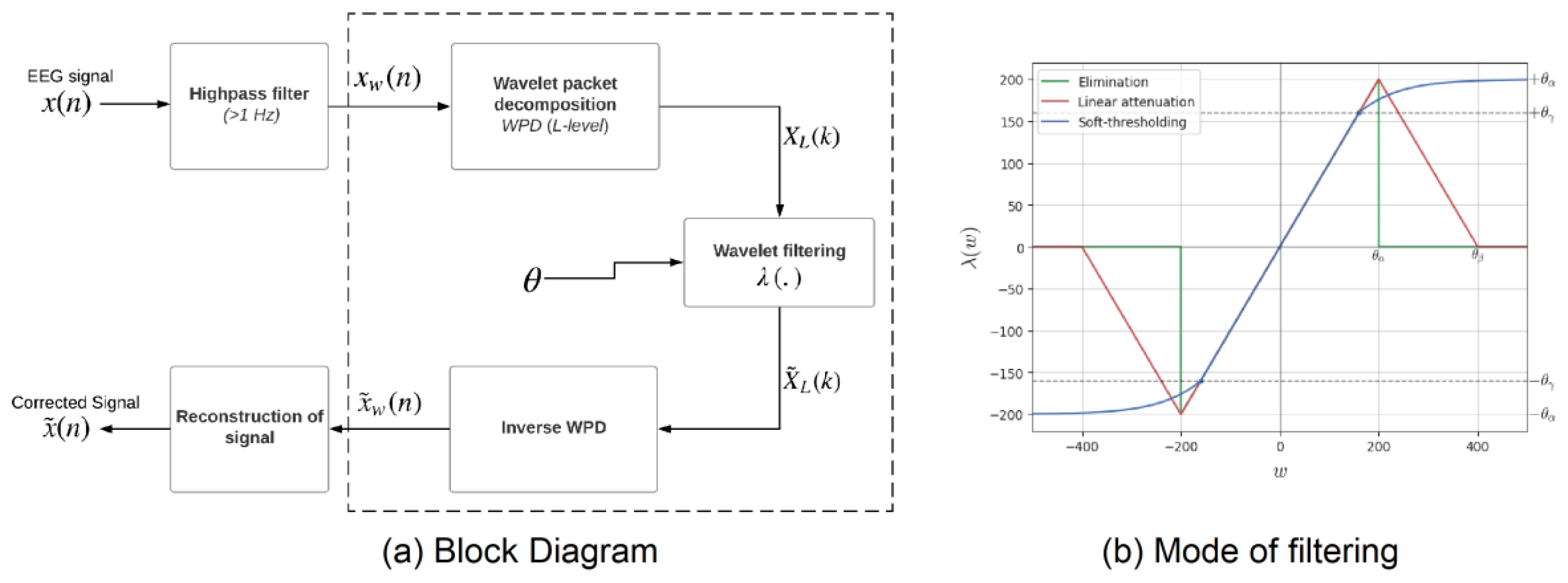
Figure 2.
Diverse Feature Bagging Classifier.
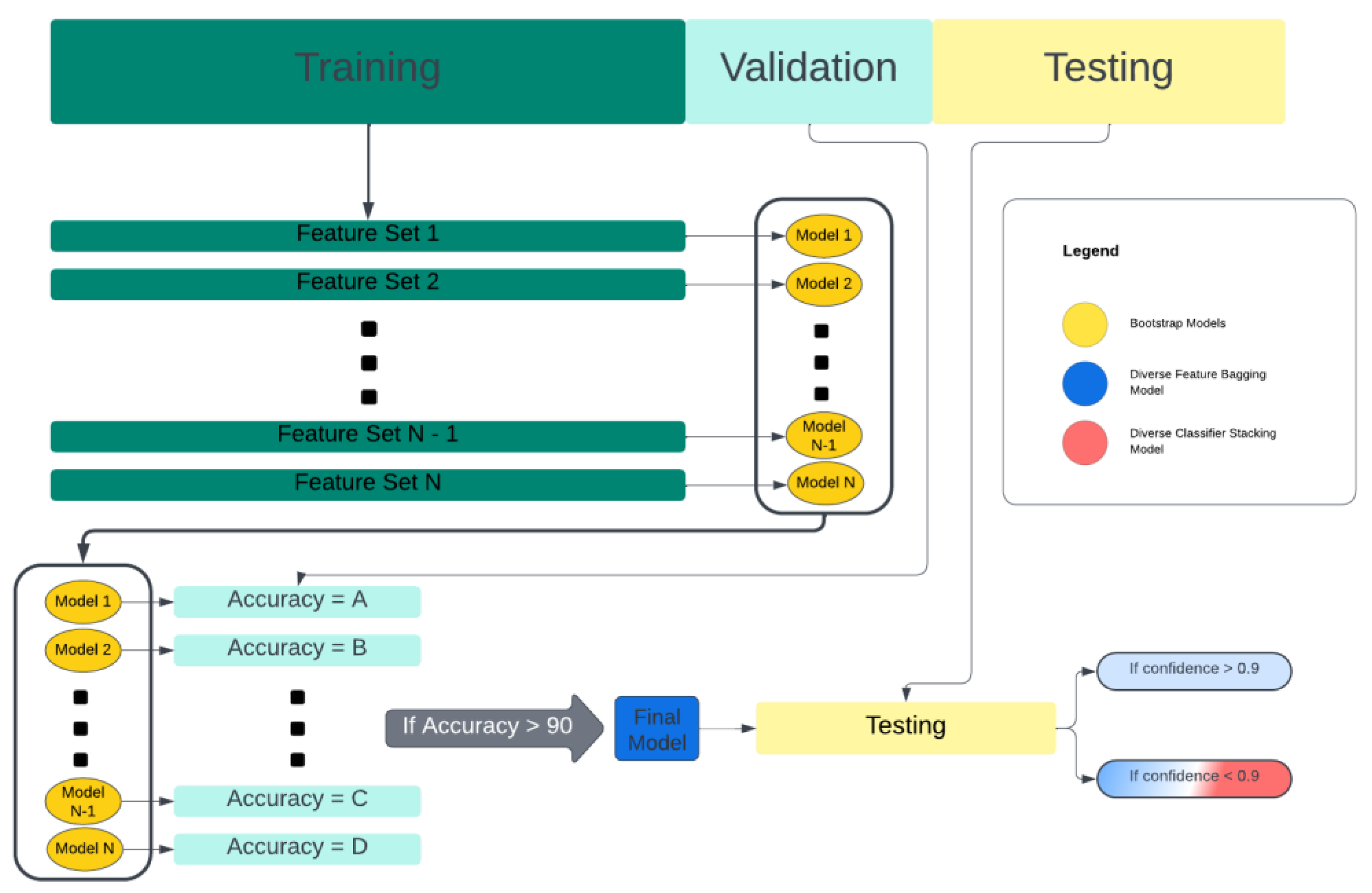
Figure 3.
(a) ROC curve for Dataset 1 showing the trade-off between sensitivity (True Positive Rate) and 1-specificity (False Positive Rate) for the classifier. The curve demonstrates excellent performance with an Area Under the Curve (AUC) of 0.998, indicating high discriminative ability. (b) Precision, Recall, and F1-Score plotted against different classification thresholds for Dataset 1. The plot identifies the optimal threshold at 0.434, where the F1-Score is maximized, balancing precision and recall effectively.
Figure 3.
(a) ROC curve for Dataset 1 showing the trade-off between sensitivity (True Positive Rate) and 1-specificity (False Positive Rate) for the classifier. The curve demonstrates excellent performance with an Area Under the Curve (AUC) of 0.998, indicating high discriminative ability. (b) Precision, Recall, and F1-Score plotted against different classification thresholds for Dataset 1. The plot identifies the optimal threshold at 0.434, where the F1-Score is maximized, balancing precision and recall effectively.
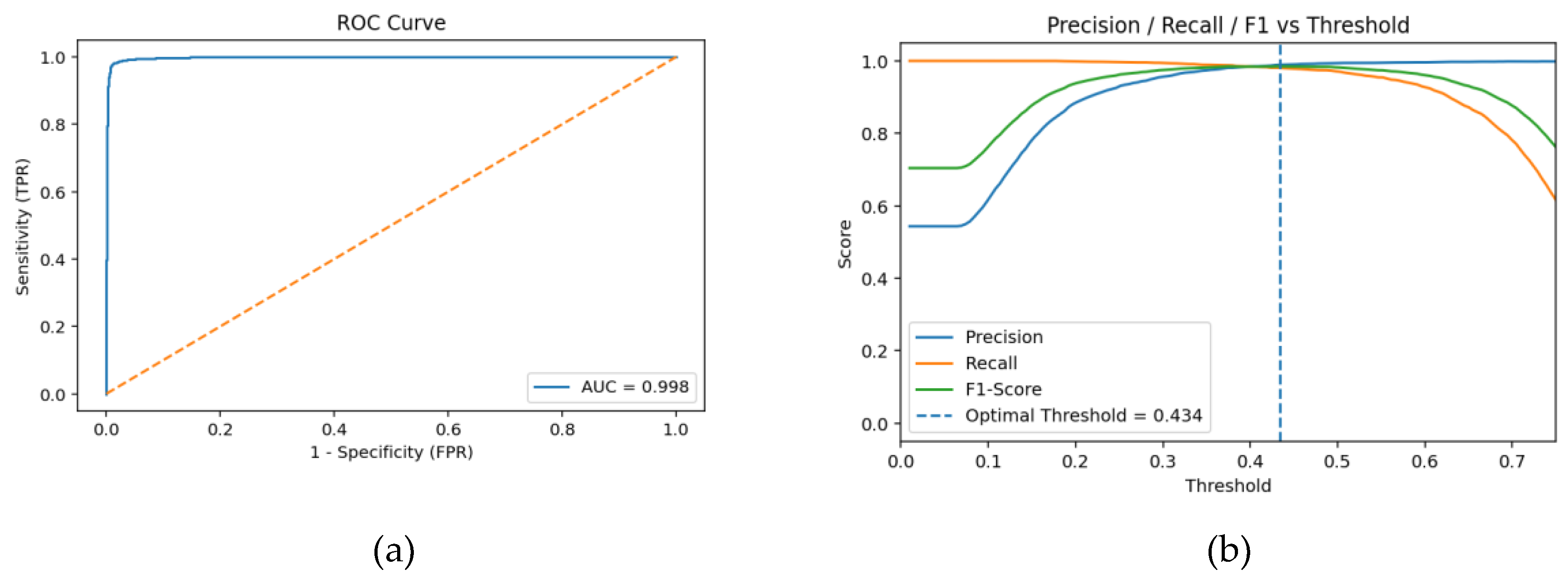
Figure 4.
(a) Receiver Operating Characteristic (ROC) curve for the proposed classification model evaluated on Dataset 2. (b) Precision, recall, and F1-score plotted against classification thresholds for the proposed model on Dataset 2.
Figure 4.
(a) Receiver Operating Characteristic (ROC) curve for the proposed classification model evaluated on Dataset 2. (b) Precision, recall, and F1-score plotted against classification thresholds for the proposed model on Dataset 2.
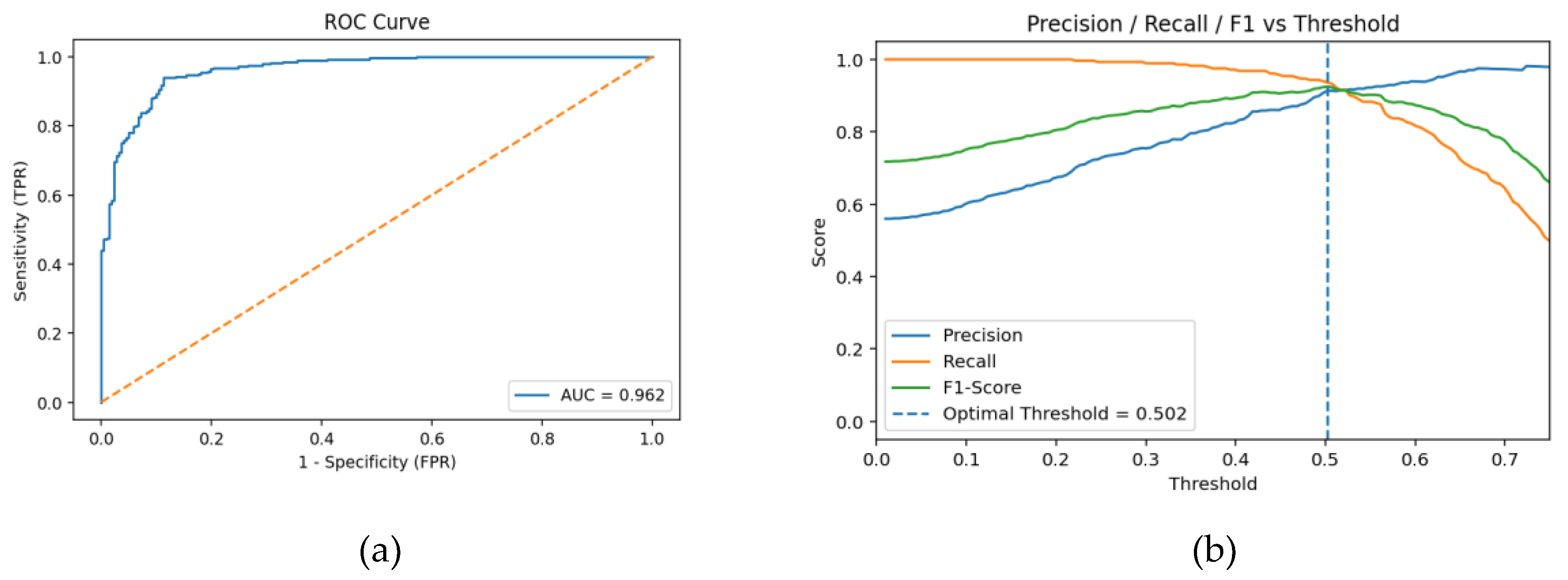

Table 1.
Summary of schizophrenia classification studies with EEG signals.
| Study | Accuracy (%) | Preprocessing Method | Model Used | Database |
|---|---|---|---|---|
| [59] | 99.25 | Fast Fourier transform (FFT) and statistical feature | SVM, KNN, Boosted Tree (BT), and Decision Tree (DT) | IPN and Kaggle SCZ dataset |
| [66] | 99.23 | Average filtering | Deep ResNets, softmax layer and deep features with SVM | Kaggle SCZ dataset |
| [67] | 98.84 | Average filtering | GoogleNet and deep features, SVM | Kaggle SCZ dataset |
| [61] | 89.21 | EEGLAB and ICA | KNN, LDA, and SVM | Private |
| [60] | 92.93 | Robust variational mode decomposition (RVMD) | Optimized extreme machine classifier | Kaggle SCZ dataset |
| [82] | 90.93 | Bandpass filter | SVM and Bayesian optimization | IPN |
| [68] | 98 | Dimensionality reduction algorithm | RNN-LSTM | LNNCI [83] |
| [48] | 92.17 | ICA | Black Hole (BH) optimization and SVM | IPN |
| [84] | 91.66 | Symmetrically Weighted local binary patterns (SLBP) and correlation | Logit Boost classifier | LNNCI, MHRC |
| [85] | 93.9 | Finite impulse response (FIR) filter | KNN, Artificial Neural Network (ANN), and SVM | Kaggle SCZ dataset |
| [65] | 99.91 | CGP17Pat and Iterative neighborhood component analysis (INCA) | KNN | IPN |
| [39] | 92.91 | Butterworth filter and Segmentation | DT, Linear-Discriminant Analysis (LDA), KNN, Probabilistic-Neural-Network (PNN), and SVM | IPN |
| [86] | 71 | Butterworth filter and Independent component analysis (ICA) | LDA, and Rule-based classifier | Private |
| [87] | 72.4 | Digital filters and ICA | KNN, LDA, SVM | Private |
| [88] | 93.4 | Spatial filters and Bandpass filter | SVM, Bayesian LDA, Gaussian NB, KNN, Adaboost, and Radial basis function (RBF) | Private |
| [89] | 91.39 | Flexible tunable Q wavelet transform (F-TQWT) | Flexible least square support vector machine (F-LSSVM) classifier and grey wolf optimization (GWO) algorithm | Kaggle SCZ dataset |
Table 2.
Performance Metrics of Dataset 1.
| Class | Precision | Recall | F1-score | Support |
|---|---|---|---|---|
| Control | 0.966 | 0.9924 | 0.979 | 3292 |
| SZ | 0.9935 | 0.9706 | 0.9819 | 3914 |
| Macro Avg | 0.9797 | 0.9815 | 0.9805 | 7206 |
| Weighted Avg | 0.9809 | 0.9806 | 0.9806 | 7206 |
Table 3.
Performance of Different Classification Methods on Dataset 1.
| Classification Method | Accuracy (%) | Notes |
|---|---|---|
| Support Vector Machine (SVM) | 94.52 | RBF kernel, tuned via 4-fold CV |
| K-Nearest Neighbors (KNN) | 87.37 | Tuned neighbors & weighting |
| Extremely Randomized Trees | 98.75 | Best single model |
| Random Forest | 98.68 | Tuned depth & estimators |
| Decision Tree | 95.21 | Single-tree baseline |
| AdaBoost | 95.56 | SAMME.R (deprecated warning noted) |
| Naive Bayes | 65.09 | Poor fit to feature distribution |
| ML Ensemble (Voting) | 98.06 | Best overall (test set) |
Table 4.
Performance Metrics of Dataset 2.
| Class | Precision | Recall | F1-score | Support |
|---|---|---|---|---|
| Control | 0.9202 | 0.8829 | 0.9011 | 222 |
| SZ | 0.9107 | 0.9397 | 0.925 | 282 |
| Macro Avg | 0.9154 | 0.9113 | 0.9131 | 504 |
| Weighted Avg | 0.9149 | 0.9147 | 0.9145 | 504 |
Table 5.
Performance of Different Classification Methods on Dataset 2.
| Classification Method | Accuracy (%) | Notes |
|---|---|---|
| Support Vector Machine (SVM) | 71.04 | Baseline only (below tuning threshold) |
| K-Nearest Neighbors (KNN) | 75.5 | Baseline only (below tuning threshold) |
| Extremely Randomized Trees | 88.12 | Tuned via 4-fold CV |
| Random Forest | 85.89 | Tuned via 4-fold CV |
| Decision Tree | 77.23 | Baseline only |
| AdaBoost | 79.46 | Baseline only |
| Naive Bayes | 71.29 | Baseline only |
| ML Ensemble (Voting) | 91.47 | Best overall (test set) |
Disclaimer/Publisher’s Note: The statements, opinions and data contained in all publications are solely those of the individual author(s) and contributor(s) and not of MDPI and/or the editor(s). MDPI and/or the editor(s) disclaim responsibility for any injury to people or property resulting from any ideas, methods, instructions or products referred to in the content. |
© 2026 by the authors. Licensee MDPI, Basel, Switzerland. This article is an open access article distributed under the terms and conditions of the Creative Commons Attribution (CC BY) license (http://creativecommons.org/licenses/by/4.0/).
Copyright: This open access article is published under a Creative Commons CC BY 4.0 license, which permit the free download, distribution, and reuse, provided that the author and preprint are cited in any reuse.


