

Submitted:
13 November 2026
Posted:
17 November 2026
You are already at the latest version
Abstract
The Hodge conjecture holds on all powers of every K3 surface of Picard number at least seventeen and on a dense union of curves in every family of K3 surfaces of transcendental rank at least eight with real quadratic multiplication. Weil classes are algebraic on every abelian sixfold of Weil type with complex multiplication and on a dense union of special subvarieties of every family of non-split Weil sixfolds.
Keywords:
Hodge conjecture
; Weil classes
; K3 surfaces
MSC: 14C30 (primary); 14J28; 14K20; 11E12
1. Introduction
The Hodge conjecture asks that every rational cohomology class of type on a smooth complex projective variety be a rational combination of classes of algebraic subvarieties. Hodge raised it in 1950 [54]; Lefschetz had proved it for divisors [70]. It is known in a scattered family of cases and open in general. This paper proves it on new classes of varieties built from K3 surfaces and abelian sixfolds, inside a reduction of the conjecture to two statements (F2) and (F3′) about abelian varieties, whose known loci have the same shape in every family: dense, and either everything or meagre. On the side of (F3′) we prove the Hodge conjecture for all powers and Hilbert schemes of points of every K3 surface of Picard number at least seventeen, determine exactly which K3 surfaces of Picard number sixteen Floccari’s theorem reaches, and make real multiplication algebraic by , by the cyclic cubic fields and on the surfaces of Mumford type, by every real quadratic field in transcendental rank six, and on a dense union of curves in every family of transcendental rank at least eight with real multiplication of degree two; the conjecture holds on every power of the Fricke K3 surfaces of levels 5 and 7. On the side of (F2) we prove the Weil classes of every abelian sixfold of Weil type with complex multiplication algebraic, and the conjecture for every abelian sixfold with complex multiplication by a CM field of degree twelve containing an imaginary quadratic field; in every family of non-split Weil sixfolds the Weil classes are algebraic on a dense union of six-dimensional loci with quaternionic multiplication, while Markman’s construction produces only split families; for a Mumford fourfold we attach an abelian sixfold whose real multiplication is algebraic, show that a single link class decides the conjecture for all products of their powers, that one algebraic class through an elliptic curve with complex multiplication suffices, and that divisor classes, Weil classes of every field and homomorphisms cannot produce it; at the point we exclude every twisted complex of line bundles and distinct threefolds with at most seven line bundles, and all but two arrangements of eight; and at and no convolution of the line bundles that realise a Weil class meets the polarised criterion, with or without a group action. For real multiplication of degree two on a product of two K3 surfaces the Hodge locus of the relevant class is a Hecke graph, algebraic at a dense set of its points. Figure 1 draws the plan, and Table 1 lists the main results.
1.1. The Two Statements
Write for the Hodge conjecture for all smooth complex projective varieties and for its restriction to abelian varieties. For a smooth projective variety X and an integer p let be the Hodge classes of degree , and let be the span of the classes , where B runs over the complex abelian varieties (the point included), over the Hodge classes on B, and over the algebraic correspondences from B to X. The two statements are
- (F2)
- every Hodge class on every complex abelian variety is algebraic, in the form in which it first appears in the closure computation of Appendix A.8: the Hodge classes of the smallest known instance, the exceptional classes on the square of a Mumford fourfold, are algebraic together with everything that can be built from them;
- (F3′)
- for every X and every p: every Hodge class is algebraic modulo the images, under algebraic correspondences, of Hodge classes of abelian varieties.
Theorem 1
(Reduction). holds if and only if (F2) and (F3′) both hold; (F2) is equivalent to , and (F3′) holds on every abelian variety, on every variety dominated by a product of curves or by an abelian variety, and on every variety in degrees with .
The content of the theorem is in the second sentence: (F2) is not a special case of the conjecture for abelian varieties but the whole of it, carried by its hardest classes, and (F3′) is exactly what the conjecture asks of the part of the cohomology of X that no abelian variety reaches. Section 3 proves it and places the two statements in the closure graph of the known reductions, with the Lefschetz standard conjecture, André’s motivated classes and the variational Hodge conjecture as the other nodes (Figure 2).
1.2. The Shape of the Known Locus
For a smooth projective family and a flat Hodge class let be the set of points at which is algebraic.
Theorem 2
(Dichotomy and propagation).
- (i)
- is a countable union of Zariski closed subsets of S, and either or is meagre.
- (ii)
- (F2) holds if and only if, for every polarised abelian scheme and every flat Hodge class ξ, algebraicity of ξ at one point of complex multiplication forces .
- (iii)
- For the Weil classes of every CM field, every and every discriminant, contains an explicit point of complex multiplication and is dense.
- (iv)
- (F3′)holds for X in degree if and only if a Hodge complement of the abelian part of carries no nonzero Hodge class.
So both statements have the same form. There is a dense set of points, the points of complex multiplication, at which the class is known to be algebraic by explicit cycles; the locus of algebraicity is a countable union of closed strata; and the conjecture is the statement that this union is not meagre. Figure 3 draws it. Section 4 proves the theorem, with the results on Weil type of Appendix A.2.
1.3. Constructions at the First Class
The rest of the paper is constructive. At each statement we go to the first class that is not known and build the object that would make it algebraic.
At (F3′) the first class lives on powers of a K3 surface S with real multiplication: the transcendental lattice is a vector space over a totally real field , and the elements of E are Hodge classes on . Section 5 proves:
Theorem 3
(Chains of symplectic quotients). Let S be a projective K3 surface and with . If there is a chain of projective K3 surfaces joined by dominant rational maps or rational Hodge isometries whose degrees multiply to n modulo squares, then e is algebraic on . In particular, for every projective K3 surface S with whose transcendental space embeds in the invariant lattice of a symplectic automorphism of order three, the real multiplication by is algebraic, the Hodge conjecture holds for and , and such surfaces form two-dimensional families whose very general member has exactly.
Varesco [115] proved the case of a single quotient by a symplectic automorphism of prime order, which gives and ; van Geemen and Schütt [121] reach through rational self-maps and the dihedral families. The chain adds , the first composite value, with the lattice condition made explicit.
A second construction starts from the universal elliptic curve over the modular curves and : the Fricke involution lifts to an isogeny of degree 5 or 7 between the elliptic K3 surface over the base and the one over its image, and on the quadratic twists of the two surfaces by the same pair of parameters it becomes a rational map of that degree between two K3 surfaces of the same family. Lemma 9 determines the sign of its square: on the twists at a pair exchanged by the involution the map acts on the transcendental lattice with square , a complex multiplication by or , while at the fixed points of the involution, the surfaces of [121], its square is N. Theorem 13 shows that every member of the two families has that complex multiplication, algebraic because it is the pullback of the isogeny, and that the Hodge conjecture and (F3′) hold for every power and every Hilbert scheme of points of every member. Proposition 9 shows why the method stops: every correspondence component of geometric genus at most one acts on the transcendental lattice as a similarity, and these span only the multiquadratic subfield of E.
The third construction reaches every real quadratic field at once. Floccari proved that a K3 surface whose rational transcendental space embeds isometrically in for some integer has an algebraic Kuga–Satake correspondence and satisfies the Hodge conjecture on all its powers [42,43]. Section 5.8 determines which spaces embed (Lemma 11): all of rank at most five, none of rank at least seven, and in rank six exactly those of Witt index two. For real multiplication of degree two the Witt index is a sum of local invariants of a quaternion algebra over the field of multiplication (Theorem 17), and we obtain:
Theorem 4
(K3 surfaces through Floccari’s theorem).
- (i)
- Every projective K3 surface of Picard number at least 17 has an algebraic Kuga–Satake correspondence, and the Hodge conjecture and (F3′) hold on every power and every Hilbert scheme of points of it.
- (ii)
- A projective K3 surface S of Picard number 16 satisfies the hypothesis of Floccari’s theorem if and only if has Witt index two, if and only if its even Clifford algebra is , ; then the conclusions of (i) hold for S.
- (iii)
- For every squarefree integer there is a one-dimensional family of projective K3 surfaces, of Picard number 16 at the very general member, whose endomorphism field is exactly there, and on every power and every Hilbert scheme of points of every member the Hodge conjecture holds. For every real quadratic field there are also such families of Witt index one, which Floccari’s theorem does not reach.
- (iv)
- In every family of K3 surfaces of transcendental rank with real multiplication by a real quadratic field E, the members with algebraic real multiplication by E on which the Hodge conjecture holds for all powers and Hilbert schemes of points contain a dense union of curves. For and the real multiplication is algebraic, and the Hodge conjecture holds on and , at every member (Theorem 12).
For the cubic field of a Mumford fourfold the multiquadratic subfield is , so neither quotient chains nor Fricke maps see it. For the two cyclic cubic fields and the quaternion algebra over F ramified at exactly two real places is the even Clifford algebra of a two-dimensional dihedral family of K3 surfaces of Picard number ten, and Theorem 14 makes the real multiplication by F algebraic there, through Buskin’s theorem; Proposition 11 says exactly what the mechanism cannot reach.
At (F2) the first class is a Weil class of a very general abelian -fold of Weil type with , or an exceptional class of a Mumford fourfold. For the Weil classes the tool is the polarised semiregularity criterion (Theorem 20, proved in Appendix A.3): a perfect complex whose Chern character is a nonzero multiple of a Weil class plus a polynomial in the polarisation, with equal to the lower bound , makes the Weil classes algebraic on every member with full Hodge group. Section 6 proves:
Theorem 5
(The product object). Let A, be very general polarised abelian varieties of Weil type for the same imaginary quadratic field, of dimensions , , with algebraic Weil classes, and let . There is a perfect complex on , a direct sum with shifts of exterior products of secant sheaves and powers of the polarisations, whose Chern character has the polarised shape with Hankel rank , so that , and whose first-order Hodge locus is the whole tangent space of the polarised Weil family. Every such direct sum has , and its semiregularity map is not injective. The criterion can therefore be met at a product point only by a convolution of these pieces with nonzero differentials.
At the point of complex multiplication the Ext groups are computable (Lemma 15), and Section 6 excludes, for every polarisation, every convolution of distinct threefolds and at most five line bundles (Theorem 23); a sharper Maurer–Cartan rule (Lemma 23) and an enumeration extend this to seven line bundles and to all but two arrangements of eight (Remark 9), and Section 6.8 reads the support of an object meeting the criterion off its localised obstruction.
For sixfolds the polarisation is a free parameter: Markman proved the Weil classes algebraic on every abelian sixfold of split Weil type [78], and the discriminant belongs to the polarisation, not to the abelian variety with its action of K. Section 6.9 uses this freedom.
Theorem 6
(Weil sixfolds). Let K be an imaginary quadratic field.
- (i)
- If the Weil classes are algebraic on every polarised abelian -fold of split Weil type for K, they are algebraic on every abelian -fold of Weil type for K.
- (ii)
- The Weil classes of an abelian sixfold of Weil type for K are algebraic if it has complex multiplication, or a K-stable sub-Hodge structure of odd K-dimension in ; in every period domain of Weil sixfolds for K the latter form a dense union of six-dimensional subdomains, and in every non-split one so do the sixfolds with quaternionic multiplication, on which the Weil classes are products of divisor classes.
- (iii)
- The Hodge conjecture holds for every abelian sixfold with complex multiplication by a CM field of degree twelve that contains an imaginary quadratic field.
For the exceptional classes of a Mumford fourfold X we replace the K3 surface that carries their transcendental part by an abelian sixfold over the same Shimura curve, so that the whole problem stays inside abelian varieties.
Theorem 7
(The sixfold link). Let X be a Mumford fourfold with cubic field F whose Hodge group is the group of Mumford’s construction, as it is outside a countable subset of its Shimura curve C, let be a CM extension inside the quaternion algebra, and let be the abelian sixfold of Shimura type attached to K over C. The Hodge classes in that identify the two copies of the nine-dimensional representation T form a line over F, spanned by a class ξ.
- (i)
- The real multiplication by F on the copy of T in is algebraic.
- (ii)
- If ξ is algebraic, the exceptional classes of are algebraic, and so is every Hodge class on every power of X.
- (iii)
- At a very general point of C, ξ is algebraic if and only if the Hodge conjecture holds for every ; otherwise the algebraic classes on are exactly the sums of products of algebraic classes on and Hodge classes on .
- (iv)
- If with k imaginary quadratic, then is algebraic at every point t of a countable dense subset of C, and so is every Hodge class on every product of powers of and .
Parts (i)–(iii) are Theorems 37 and 38; the proof of (iii) runs through the motivic Galois groups of X and . Part (iv) is Theorem 41: at those points is isogenous to and to , with E a CM elliptic curve and A a CM threefold, the Hodge ring of every is generated by divisors and pull-backs of the Weil plane of the fourfold , and that fourfold carries a polarisation of discriminant one, so that Markman’s theorem [76, Thm. 1.5] applies. By the dichotomy the algebraic locus of is then either countable and dense or all of C; which one holds is open.
1.4. What Is Proved and What Is Not
Table 8 in Section 7 lists every statement of the paper with its status. The reduction, the dichotomy, the theorems on K3 surfaces, on real multiplication and on the Fricke families, the theorems on Weil sixfolds, the sixfold link and its dichotomy, the link at the points of complex multiplication, the exclusions at and , the Hecke graph and the no-go theorem for the link are proved; the semiregularity count on a product of two K3 surfaces and the conjectures of Bouchet, Hanselman, Pieper and Schiavone are proved under named inputs. The Hodge conjecture, (F2) and (F3′) remain open. The value of the constructions lies in the precision of the question each one leaves.
Appendix A proves the results on Weil classes, on the polarised criterion, on convolutions of line bundles and of pieces of any kind, on the closure graph and on Mumford fourfolds that the body uses, so that the paper depends only on published work. Appendix D describes the machine checks: a Lean 4 file that verifies the closure graph and the finite combinatorics of Section 6, and programs in Python and Julia that recompute every finite quantity used in the proofs. No proved statement of the paper rests on a computation; the statements that do are marked as such.
2. Conventions
Varieties are smooth, projective and connected over unless said otherwise. Cohomology is singular cohomology with rational coefficients, , with its Hodge structure. A Hodge class of degree is an element of ; their space is . A class is algebraic if it is a rational combination of fundamental classes of subvarieties of codimension p; by Fulton [44], intersection products, pull-backs and push-forwards along morphisms preserve algebraic classes. An algebraic correspondence from Y to X is an algebraic class on , acting by . The Hodge group of a rational Hodge structure V is the smallest algebraic subgroup of defined over whose real points contain the circle ; for a polarisable V it is reductive, the Hodge classes in every tensor construction on V are its invariants, and the Hodge group of a variety is that of its total cohomology [35]. The Hodge conjecture for X is the statement that every Hodge class on X is algebraic; is the conjecture for all varieties and for all abelian varieties.
For an abelian variety A of dimension g with , the cohomology ring is . An abelian -fold A is of Weil type for the imaginary quadratic field K if K acts on A up to isogeny with V a K-vector space of dimension on which the two complex embeddings have equal multiplicity n in . The Weil classes are the elements of , a two-dimensional rational space of Hodge classes of degree [125]; acts on it by , and , for the class of a K-hermitian polarisation, carries . For a general CM field we use the setting of Appendix A (Setting 8): a family of Weil type for a CM field F of degree with and discriminant has a connected polarised period domain of dimension (Proposition A1), and its very general member has Hodge group for the F-hermitian form H of the polarisation.
A Mumford fourfold is a simple abelian fourfold X whose Hodge group is the -form of given by the norm-one group of a quaternion algebra D over a totally real cubic field F, split at one real place and definite at the other two [87]. Its own Hodge ring is generated by the polarisation, and carries exceptional Hodge classes of degree four that are not products of divisor classes and are not Weil classes of any quotient [90] (Proposition A20). We write for the trace-zero part, a nine-dimensional F-line on which acts by conjugation; is a Hodge structure of K3 type with Hodge numbers , and the exceptional classes of are the real multiplication by F on the copy of inside .
For a K3 surface S the transcendental lattice is the orthogonal complement of in ; is an irreducible Hodge structure, and is a totally real field or a CM field, acting by self-adjoint endomorphisms in the first case [126]. The K3 lattice is , and . For a rational quadratic space W we use the discriminant and the Hasse invariants of a diagonalisation , with the Hilbert symbol; the classification of rational quadratic forms by rank, signature, discriminant and Hasse invariants, and the existence theorem for prescribed local invariants, are Serre’s [108, Chap. IV].
Perfect complexes on A are objects of the bounded derived category of coherent sheaves; is the Chern character, additive on triangles, multiplicative on exterior products, with . The semiregularity map is that of Buchweitz and Flenner [11], after Bloch [20]; its injectivity implies that the Hodge locus of coincides, near the given point, with the locus where deforms [11,102].
Throughout, an assertion attributed to a reference is cited and not reproved; everything else is proved in the text. The phrase “very general” means outside a countable union of proper closed analytic subsets of the parameter space.
3. The Reduction to Abelian Varieties
3.1. The Statement (F3′) and the Class
Definition 1.
For a variety X and let be the span of the classes of degree , where B runs over the complex abelian varieties, the point included, γ over , and Γ over the algebraic cycles on with rational coefficients. The statement(F3′) is: for every X and every p.
Each is a Hodge class, since cup product with an algebraic class and push-forward along a projection are morphisms of Hodge structures of the right bidegree; so . Taking B a point shows that contains every algebraic class, and taking X abelian, and the diagonal shows that (F3′) holds on every abelian variety.
Proposition 1.
holds if and only if and (F3′) both hold.
Proof.
If holds then holds, and every Hodge class is algebraic, hence in . Conversely let . By (F3′), with a Hodge class on an abelian variety , algebraic by ; then is algebraic on and so is its push-forward to X. □
Proposition 2.
Let be the class of varieties X such that is spanned by classes with B abelian, Γ an algebraic cycle on and .
- (i)
- Every satisfies (F3′).
- (ii)
- contains the abelian varieties and the curves, and is closed under products and under images of surjective morphisms. It contains every product of curves, every symmetric product of a curve, and every variety dominated by a product of curves or by an abelian variety.
- (iii)
- Every X of dimension d satisfies (F3′) in the degrees with . In particular every variety of dimension at most three satisfies it in every degree.
Proof.
(i) Let and write with . After replacing by its component in the degree that sends to , each is a morphism of rational Hodge structures for a suitable Tate twist, and the sum is a morphism
A correspondence shifts degrees by an even number, so every is even and W is pure of weight . Polarisable rational Hodge structures form a semisimple abelian category, so with an isomorphism of Hodge structures. The Hodge class of is therefore for a Hodge class of , and each component is a Hodge class on , since the projections of W onto its summands are morphisms of Hodge structures. Hence .
(ii) The point, abelian varieties and curves are in : for a curve C, and come from the point and by the Abel–Jacobi map. If then is spanned by exterior products of classes with abelian. If is surjective, then on after cutting X by hyperplanes to the dimension of if needed, so every class of is of a class of X, and with the graph of f. The listed varieties follow: a symmetric product is the image of a product of curves, and a variety dominated by a product of curves or an abelian variety is such an image.
(iii) Degrees 0 and are spanned by the class of X and the class of a point. In degree 2 every Hodge class is a divisor class by Lefschetz [70]. In degree , let be a hyperplane class; the hard Lefschetz theorem makes an isomorphism of Hodge structures, so every Hodge class of degree is with a Hodge class of degree 2, algebraic by Lefschetz; a product of algebraic classes is algebraic. □
Part (iii) covers every variety of dimension at most three whatever its Hodge numbers, the Calabi–Yau threefolds included, for which the Hodge numbers of the toric hypersurface families are tabulated in [14]; the first open degree is the middle degree of a fourfold.
Proposition 3
(Fourfolds with few zero-cycles). Let X be a smooth projective fourfold whose group of zero-cycles is supported on a threefold: is surjective for some closed of dimension at most three. Every uniruled fourfold is such: a general point lies on a rational curve, which meets an ample divisor D, so the point is rationally equivalent to a point of D, and the points of a dense open set generate . Then the Hodge conjecture holds for X in degree four, and X satisfies (F3′) in every degree.
Proof.
Bloch and Srinivas prove, by the decomposition of the diagonal that the hypothesis provides, that a fourfold whose zero-cycles are supported on a threefold satisfies the Hodge conjecture for cycles of codimension two [24, Thm. 1]. So , the class of a cycle Z being for the point and ; the other degrees are Proposition 2(iii). □
For uniruled fourfolds the conclusion in degree four is the theorem of Conte and Murre [30]; the proposition isolates the hypothesis on zero-cycles behind it.
3.2. The Statement (F2)
For an abelian variety Y let be the -subalgebra generated by the divisor classes of Y and by the pull-backs of Weil classes w of abelian varieties B of Weil type along homomorphisms . Every element of is a Hodge class, and every Hodge class on an abelian variety of dimension at most five lies in [91].
Definition 2.
The statement (F2) is: for every complex abelian variety Y, every Hodge class on Y that does not lie in is algebraic.
The classes in are the ones the known theorems reach when they reach anything: divisor classes by Lefschetz, Weil classes by Markman on fourfolds of Weil type of discriminant one [76], and on all abelian fourfolds of Weil type and on abelian sixfolds of split Weil type by Markman’s secant-sheaf construction [78,79], and by the propagation results of Appendix A (Theorem A3) wherever they propagate. So (F2) is the conjecture for abelian varieties with the known classes struck out. The next proposition says that striking them out removes nothing.
Setting 1.
Lemma 1.
Let Y be an abelian variety. Let be the largest abelian subvariety isogenous to a power of X and the identity component of the intersection of the kernels of the homomorphisms . Then is an isogeny, , and
the first summand embedded by . Let act on through the factor V. Then every class of is invariant under , and for the invariants of in are polynomials in divisor classes.
Proof.
Poincaré reducibility gives with and no factor X in ; since X is simple, , and since , Q has dimension k and the displayed map is an isomorphism. A homomorphism of abelian varieties decomposes up to isogeny as , and acts on as , which commutes with the action of on the factor V. So pull-backs along homomorphisms, cup products and exterior products are -equivariant, and the classes invariant under form a subalgebra stable under pull-back. It remains to check the generators of .
A divisor class on Y has Künneth components in , and , each a Hodge class. The middle one is a homomorphism from to the dual of , which is zero. The first is a Hodge class on , hence a G-invariant of . Since G contains the Hodge group of a simple abelian fourfold whose only Hodge classes of degree two are the divisor classes, and ; so the component lies in , which fixes. The third component is fixed because acts trivially on .
For a Weil class, let B be of Weil type for K and . The field K acts on through , because ; so it acts on and on , and the eigenspace of for an embedding of K is . A Weil class lies in the sum over of the top exterior powers of these eigenspaces, and , on which acts trivially. Pulling back along f preserves invariance.
For , , and the invariants of in the tensor algebra of V are spanned by complete contractions with by the first fundamental theorem for the symplectic group [51, Chap. 5]; a contraction of two factors of is the pull-back of the class along the projection to those factors, a divisor class, and a contraction within one factor is . So the invariants are polynomials in divisor classes. □
Theorem 8.
(F2) implies , and is therefore equivalent to it.
Proof.
contains (F2). Assume (F2), let A be an abelian variety and . If it is algebraic by (F2), so suppose .
The line is not stable under : a stable line would be a one-dimensional representation of the connected semisimple group , hence trivial, and , which is not a polynomial in divisor classes, would be invariant, against Lemma 1. The stabiliser of the line is therefore a proper Zariski closed subgroup, and since is Zariski dense in [22, Cor. 18.3] there is with .
Put , , and let b be an ample class on B. The decomposition of Lemma 1 for Y is the sum of those for A and B, so acts on by , and by the lemma it fixes pointwise. If were in , then with , which forces ; so . On the other hand , because the pull-back of a generator of or along a projection is a generator of and is an algebra. Hence also
The classes and are Hodge classes of degree on Y outside , so (F2) makes both algebraic, and their difference is algebraic. Then
a push-forward of a product of algebraic classes, is algebraic, and because b is ample on the eightfold B. So is algebraic. □
Theorem 1 is Propositions 1, 2 and Theorem 8 together.
3.3. The Closure Graph
Appendix A.8 records the implications between the conjecture and the statements that have been used to approach it: the Lefschetz standard conjecture (L) for all varieties, the conjecture (M) that every Hodge class is motivated in André’s sense [6], the variational Hodge conjecture (V), the statement (F3) that the conjecture holds for all varieties that are not abelian, and the two statements of this paper.2 The rules are listed in Table 2, each with the place where it is proved; the first two rows are Propositions 1 and Theorem 8.
Proposition 4.
Under the rules of Table 2 the closure of a set of statements contains if and only if the set contains one of
and these six sets are the minimal ones with this property.
Proof.
Each listed set derives : by the second row; by the sixth; the other four through , which (F2), (L) and (V) each give, and the fifth row. For the converse, call a set closed if it is stable under the rules. A closed set without contains no (F3), does not contain (L) and (M) together, and, if it contains (F3′), contains none of , (F2), (L), (V), since each of these yields and then . The maximal closed sets without are therefore
each of which is closed by inspection of the table. The closure of a set contains exactly when lies in none of the . If contains (F3) this holds. Otherwise needs an element outside , that is (F3′) or (M); one outside , that is (F3′) or (L); and one outside , that is one of (F2), , (L), (V). The minimal choices are (F3′) with one of (F2), , (L), (V), and (M) with (L). This gives the six sets, and each is minimal because removing any element lands in some . The same computation is carried out mechanically from the rule list in the Lean file of Appendix D, which returns these six sets and no others. □
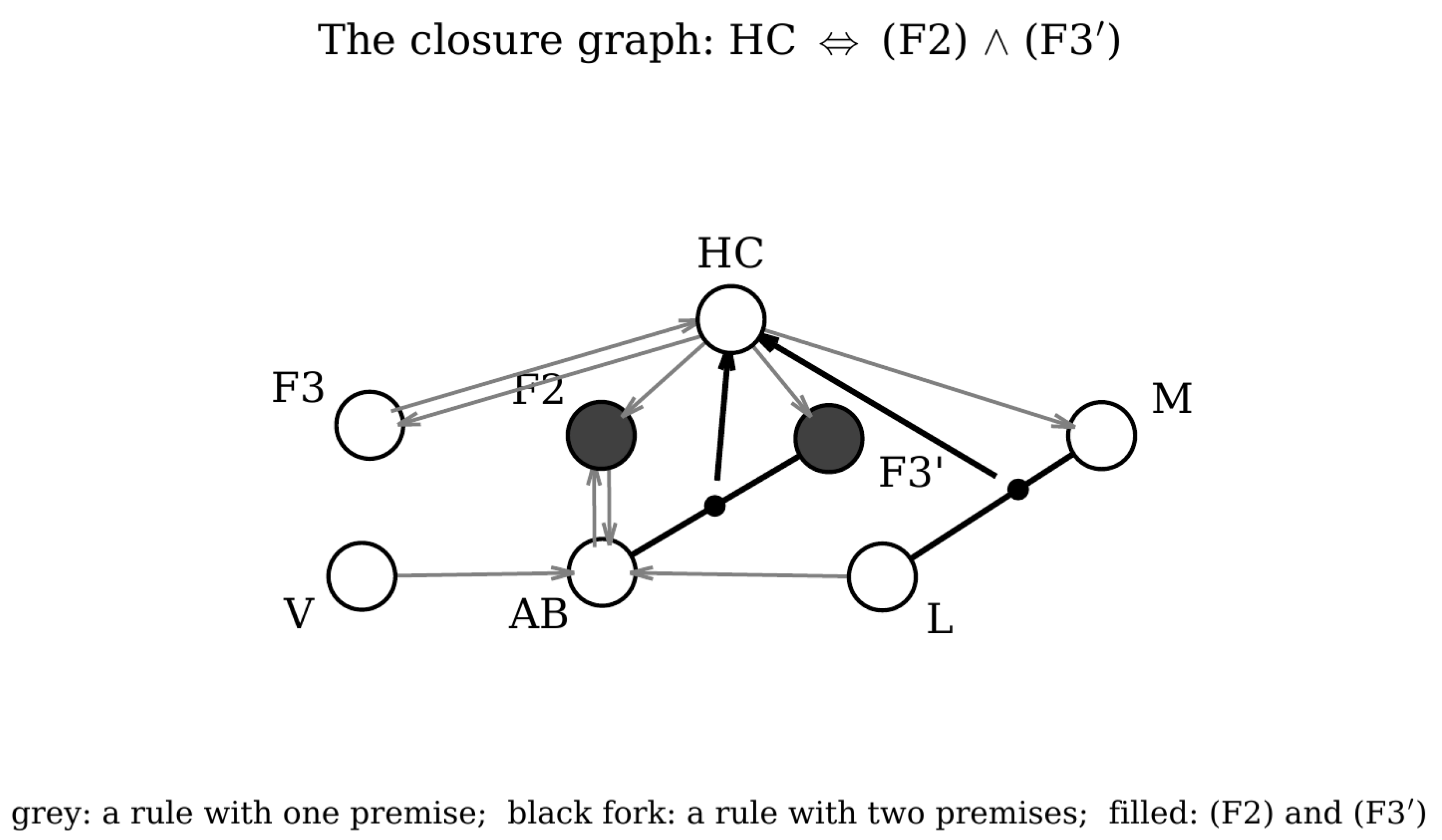
Figure 2 draws the graph. The two statements of this paper are the filled nodes; every route to other than (F3), which is itself, and (L)+(M) passes through (F3′).
Figure 2.
The closure graph of Table 2. Grey arrows are rules with one premise; a black fork joins the two premises of a rule that needs both. The filled nodes are (F2) and (F3′).
Figure 2.
The closure graph of Table 2. Grey arrows are rules with one premise; a black fork joins the two premises of a rule that needs both. The filled nodes are (F2) and (F3′).
4. The Algebraic Locus in a Family
Definition 3.
Let be a smooth projective morphism to a smooth connected complex quasi-projective variety, and let ξ be a global section of that is a Hodge class at one point. The algebraic locus of ξ is the set of at which is algebraic.
By the theorem of the fixed part [4,33], the flat sections of a polarisable variation form a sub-Hodge structure, constant along S; so is a Hodge class at every point once it is one somewhere.3
Lemma 2
(Dichotomy).
- (i)
- is a countable union of Zariski closed subsets of S.
- (ii)
- Either or is meagre in .
- (iii)
- The following are equivalent: ; has an interior point; is not meagre; is algebraic for the very general s. If is dense they are equivalent to being closed.
Proof.
(i) Fix a relatively ample line bundle on . For a Hilbert polynomial P the relative Hilbert scheme is projective over S [49], and the class of the fibre of the universal family in is locally constant on each connected component of it, since a flat family of subschemes over a connected base has locally constant cycle class. A rational combination equal to is a point of a fibre product , projective over S and with countably many connected components; on each component the condition is either empty or holds throughout, because both sides are flat sections. So is the union, over the countably many tuples and components, of images of proper morphisms to S, each Zariski closed.
(ii) A countable union of proper Zariski closed subsets of an irreducible S has empty interior in , and each is closed, so the union is meagre; if one of the closed sets is S itself, .
(iii) By the Baire category theorem4 is not meagre in itself, so excludes meagreness, and a set with an interior point is not meagre; by (ii) not meagre forces . The complement of a countable union of proper closed subvarieties is the very general locus, so algebraicity at the very general point means that one of the closed sets is all of S. A dense set that is also closed is S. □
Lemma 3
(Points of CM type are dense). Let G be a connected reductive group over , a homomorphism and the orbit of under conjugation by . The points for which lies in the real points of a maximal torus of G defined over are dense in .
Proof.
Let and W a neighbourhood of . A maximal torus of contains , since the centraliser of that compact torus is reductive and connected. Pick a regular element in the Lie algebra of . The map from to is submersive at because , so the image of a small neighbourhood , with and made of regular elements, contains an open set of , hence a rational point . The identity component T of the centraliser of the rational regular semisimple Y is a maximal torus over with , and has . □
When and u is the Hodge cocharacter of an abelian variety A, the condition of the lemma says that lies in a -torus, and then A is of CM type: a maximal -torus of containing it is the unit group of a commutative semisimple algebra L of dimension commuting with , and the commutant of is .
Proposition 5
(A family with a CM member through every Hodge class). Let be an abelian variety and γ a Hodge class on it. There are a polarised abelian scheme over a smooth connected quasi-projective base, a flat section ξ of , a point with and , and a point c with of CM type; the points of CM type are dense in S.
Proof.
Let , let be the Hodge cocharacter of and its -orbit. Every defines a polarisable Hodge structure of weight one on with Hodge group contained in G, so an abelian variety up to isogeny; fixing the lattice , the polarisation of and a level structure of level , the quotient by a neat congruence subgroup is a smooth quasi-projective variety carrying a polarised abelian scheme with these fibres [33,87]. The class is invariant under G, so it is a flat section of , and at the image of . By Lemma 3 the points of CM type are dense in , hence in S. □
Theorem 9
(F2) is propagation from CM points). The following are equivalent.
- (i)
- (F2).
- (ii)
- .
- (iii)
- For every polarised abelian scheme and every flat Hodge class ξ, algebraicity of at one point s forces .
- (iv)
- The same for the points s of CM type.
- (v)
- For every π, ξ with algebraic at a point c of CM type, has an interior point.
Proof.
(i) and (ii) are Theorem 8. If (ii) holds, is a Hodge class at every t by the theorem of the fixed part and algebraic by (ii), so (iii) holds; (iv) is a case of (iii), and (iv) and (v) are equivalent by Lemma 2(iii).
Assume (iv). Let F be a CM field and . The family of abelian varieties of split Weil type for F over its Shimura variety is a polarised abelian scheme on which the Weil classes are flat sections, and by Theorem A2 they are algebraic at a member isogenous to a product of abelian varieties with complex multiplication by F, a member of CM type; so by (iv) they are algebraic on every member, and by pull-back along an F-linear isogeny on every abelian variety of split Weil type for F. By André’s theorem [5], every Hodge class on an abelian variety of CM type is a sum of pull-backs, along homomorphisms, of Weil classes of abelian varieties of split Weil type; so holds for every abelian variety of CM type. Now let be any abelian variety and a Hodge class on it, and take , , , c from Proposition 5. Then is algebraic, (iv) gives , and is algebraic. This is (ii). □
Proposition 6
(The Weil classes). For every CM field F, every and every discriminant, the algebraic locus of the Weil classes in the polarised period domain contains an explicit point of CM type and is dense, and it is either or meagre.
Proof.
This is Theorem A1, items (i) to (iii). The density is the Hecke orbit of the base point: the group of the unitary group of the hermitian form acts on through F-linear isogenies that preserve the polarisation up to a scalar, hence preserve the algebraicity of the Weil classes, and its closure contains , which acts transitively. The dichotomy is Lemma 2. □
Proposition 7
((F3′) and the abelian part). Let be the sum of the images of all maps with B abelian and Γ an algebraic cycle on . Then is a sub-Hodge structure, , and (F3′) holds for X in degree if and only if a Hodge complement of carries no nonzero Hodge class.
Proof.
Each is a morphism of Hodge structures, so its image and the sum of finitely many images, which is all of by dimension, are sub-Hodge structures. A Hodge class in is , and the argument of Proposition 2(i) replaces each by a Hodge class; so . A Hodge complement exists because the Hodge group is reductive, and the Hodge classes of are the direct sum of those of the two summands, which gives the last assertion. □
Theorem 2 is Lemma 2, Theorem 9, Proposition 6 and Proposition 7. Figure 3 draws the locus of Proposition 6.
Figure 3.
The period domain of a Weil family as a surface. The star is the CM base point, the dots and curves are strata of the algebraic locus, dense by the Hecke orbit. The locus is a countable union of closed strata; it is either the whole surface or meagre.
Figure 3.
The period domain of a Weil family as a surface. The star is the CM base point, the dots and curves are strata of the algebraic locus, dense by the Hecke orbit. The locus is a countable union of closed strata; it is either the whole surface or meagre.
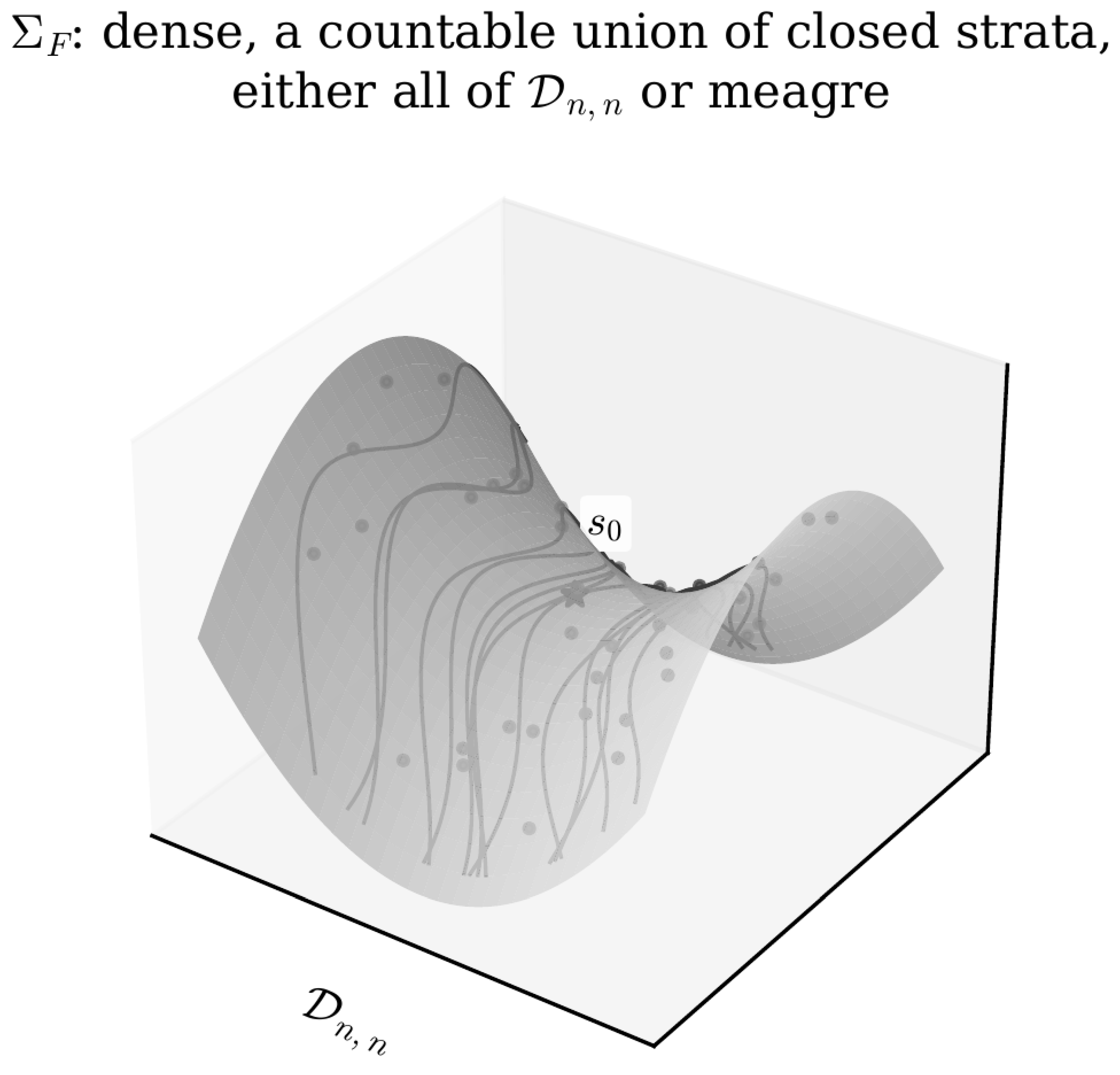
Both statements are now of one shape. There is a dense set of points at which the class is algebraic by an explicit cycle; the locus is a countable union of closed strata; the statement is that this union is not meagre, that is, that algebraicity propagates from the dense set. The rest of the paper goes to the first point where the propagation is not known and builds the object that would carry it.
5. Constructions at (F3′): Real Multiplication on K3 Surfaces
5.1. Where the First Class Is
Let S be a projective K3 surface, and . The Hodge classes of are , and , since T is irreducible with no class of type and . The first two pieces and are spanned by products of divisor classes. So the Hodge conjecture for is the algebraicity of E, and by Proposition 7 the same classes decide (F3′) for once T is not reached from abelian varieties. When E is a CM field it is spanned by its elements of norm one, which are Hodge isometries of T and algebraic by Buskin’s theorem [26]; see [115, Rem. 2.16]. When E is totally real, the Rosati involution is the identity on it [126], every is self-adjoint for the intersection form q, and . The first class is a real multiplication.
5.2. Chains of Correspondences
Lemma 4.
Let be a dominant rational map of K3 surfaces of degree d and the closure of its graph. Then and are morphisms of Hodge structures, maps isomorphically onto with , and on .
Proof.
The graph is an algebraic cycle, so both maps are induced by algebraic classes and are morphisms of Hodge structures. Pull-back of a nowhere vanishing 2-form is a nonzero 2-form, so is a sub-Hodge structure of that meets ; the smallest sub-Hodge structure of containing is , so , and since is irreducible and is injective on it (), equality of dimensions gives . The projection formula gives and . □
Lemma 5.
A Hodge isometry is induced by an algebraic class on .
Proof.
The spaces and are the orthogonal complements of and in the two copies of , isometric to each other through ; by Witt’s cancellation theorem the complements are isometric, so extends to a Hodge isometry , which is algebraic by Buskin’s theorem [26] (see [59, Thm. 0.1]). The projector of onto along is algebraic, being 1 minus the projector onto , which is a sum over a basis of divisor classes with the inverse Gram matrix; composing gives on T and zero on . □
Theorem 10
(Chains). Let S be a projective K3 surface with E totally real and with . Suppose there are projective K3 surfaces and, for each i, either a dominant rational map of degree , a dominant rational map of degree , or a Hodge isometry (and then ), such that
the sign being + for maps leaving and − for maps arriving at it. Then e is algebraic on .
Proof.
Composing along the chain the maps for maps leaving , for maps arriving, and the classes of Lemma 5 for the isometries, gives an algebraic isomorphism of Hodge structures with , where by Lemma 4 (a map leaving contributes , of multiplier ; a map arriving contributes , of multiplier in the other direction, that is for the composite in the direction of ). Write with . Since e is self-adjoint with , it is a Hodge similarity of of multiplier n. So is a Hodge isometry, algebraic by Lemma 5, and is a composite of algebraic correspondences, hence algebraic on . □
The case with the quotient by a symplectic automorphism of prime order p is Varesco’s theorem [115, Thm. 2.1], which gives and is used for . What a chain adds is a composite multiplier.
5.3. Real Multiplication by
A symplectic automorphism of finite order on a K3 surface acts trivially on , its quotient has a K3 resolution Y [94], and by Lemma 4. The invariant lattice of a symplectic involution is , and a K3 surface has a symplectic involution exactly when embeds primitively in its Néron–Severi lattice [81,120]. The invariant lattice of a symplectic automorphism of order three is , and such an automorphism exists exactly when the Coxeter–Todd lattice embeds primitively in the Néron–Severi lattice [50, Thm. 4.1]. Put
of ranks 14 and 10 and signatures and ; over , and . Varesco [115, Props. 2.5 and 2.11] shows that a projective K3 surface whose transcendental space embeds isometrically in (resp. ) is Hodge isometric to one with a symplectic involution (resp. a symplectic automorphism of order three).
Lemma 6
(Embedding criterion). Let W and V be rational quadratic spaces with . Then W embeds isometrically in V if and only if the signature of V dominates that of W in both signs. In that case a complement exists with .
Proof.
Necessity is clear. For sufficiency put and let be the difference of signatures, . A quadratic space of rank k and signature with prescribed discriminant and prescribed Hasse invariants exists provided the equal 1 for almost all p, , and , match the signature [108, Chap. IV, Prop. 7], with no further condition when . Take , the value forced by the formula . The product formula for these holds because it holds for V, for W and for the Hilbert symbol. Then and V have the same rank, signature, discriminant and Hasse invariants at every place, so they are isometric by the Hasse–Minkowski theorem [108, Chap. IV, Thm. 9], and W embeds in V. □
Theorem 11
(Two-dimensional families with algebraic real multiplication by ). Let S be a projective K3 surface with whose transcendental space embeds isometrically in .
- (i)
- is algebraic on .
- (ii)
- The Hodge conjecture, and (F3′) , hold for and for the Hilbert square .
- (iii)
- Such surfaces exist in two-dimensional families, whose very general member has and exactly. One such family is the one whose transcendental space is with the trace form of over .
Proof.
(i) By [115, Prop. 2.11] S is Hodge isometric to a K3 surface with a symplectic automorphism of order three, and by Lemma 5 the isometry is algebraic, so we may replace S by . Let Y be the minimal resolution of and the quotient map, of degree three, so that , of rank and signature : the rank is at most 8 because T embeds in of rank 10 and signature with a complement that must contain the remaining positive direction, so the complement has rank at least two. Now has rank at most 8 and signature dominated by , and , so by Lemma 6 it embeds in . By [115, Prop. 2.5] Y is Hodge isometric to a K3 surface with a symplectic involution ; let Z be the resolution of and the quotient, of degree two. The chain has multiplier , and Theorem 10 applies to (Figure 4).
(ii) By the first paragraph of this section it remains to make E algebraic. E contains , and either or E is a CM field: a totally real E has , because the complex line lies in one eigenspace and in the same one, so that has signature and follows from q being negative definite on the other eigenspaces together with having exactly two positive directions; and then forces . If , (i) suffices. If E is CM, it is spanned by its norm-one elements, Hodge isometries, algebraic by Buskin’s theorem. So every Hodge class on is algebraic, and (F3′) follows. For the Chow motive is a direct summand of twists of , and [32], so every Hodge class on is the image under an algebraic correspondence of a Hodge class on or S, and both statements follow.
(iii) Let with real embeddings , (), and let with negative at both places and positive at , negative at . The -space with the form has rank 8 and signature , and multiplication by is self-adjoint of square 6. For one computes , , , and otherwise, while has , , , ; and has the invariants of at every place, so by Hasse–Minkowski, with a complement containing a positive vector (Table 3; the Hilbert symbols are recomputed in the programs of Appendix D). Embed in as the invariant lattice of an order-three symplectic action, with orthogonal complement , and let be the primitive sublattice with ; it contains primitively and a positive class. The Hodge structures of K3 type on T for which is a Hodge endomorphism are the periods with , , where is the -eigenspace, of signature ; this is a domain of dimension two [115, Prop. 2.3]. For each such the surjectivity of the period map gives a K3 surface with , projective because N contains a positive class, carrying an order-three symplectic automorphism because primitively. For outside a countable union of proper closed analytic subsets, and , by the argument of Theorem A23, which needs only . □
In Varesco’s families E is or [115, Thms. 2.9, 2.15]; van Geemen and Schütt obtain , , from rational self-maps of elliptic K3 surfaces [121, §§6–7]. The lattice condition of Theorem 11 is a genuine restriction: among the 165 sign-admissible diagonal forms with small coefficients, 98 embed in and 67 do not (Appendix D).
For the lattice condition is empty in low rank, and a single Nikulin quotient settles every surface of transcendental rank at most ten.
Theorem 12
(Real multiplication by in transcendental rank at most ten). Let S be a projective K3 surface with and .
- (i)
- is algebraic on .
- (ii)
- The Hodge conjecture, and (F3′) , hold for and for .
- (iii)
- For and , the real multiplication is algebraic at every member of every family of Theorem 18, the very general one included, and (ii) holds there.
Proof.
(i) has rank and signature , and has rank 14 and signature . Since , Lemma 6 embeds T in . By [115, Prop. 2.5]S is Hodge isometric to a K3 surface with a symplectic involution, and [115, Thm. 2.1] with makes algebraic; this is Theorem 10 for the chain formed by the Hodge isometry and the quotient by the involution.
(ii) As in the proof of Theorem 11(ii): a totally real E has , so , and is even because , so and (i) applies; a CM field E is spanned by its norm-one elements, which are algebraic by Buskin’s theorem [26]. So every Hodge class on is algebraic, (F3′) follows, and follows by [32].
(iii) For the surface is projective and is preserved by , as in the proof of Theorem 18; its rank is at most , so (i) and (ii) apply. □
Corollary 1
(Transcendental rank six for ). Let S be a projective K3 surface with and for some . Then is algebraic on , and the Hodge conjecture and (F3′) hold for and . This holds at every member of the families of Witt index one of Corollary 6 for , which Floccari’s theorem does not reach, in particular for the first, second and fourth rows of Table 4.
Proof.
The space has rank at most 6 and signature , so it embeds in , of rank 10 and signature , by Lemma 6. For apply Theorem 12, for [115, Prop. 2.11, Thm. 2.1], and for Theorem 11. A totally real E has , so or E is a CM field, and the rest is the proof of Theorem 11(ii). □
In transcendental rank at least eight the quotients by finite symplectic groups stop at a lattice condition, which we determine.
Proposition 8
(The reach of symplectic quotients). Let S be a projective K3 surface with and , and put .
- (i)
- Some chain as in Theorem 10 whose rational maps are quotients by finite groups of symplectic automorphisms makes algebraic if and only if either and T embeds in , or , and T embeds in .
- (ii)
- For the embedding exists for , never for , and for exactly when at every prime p at which is a square in . For and it exists exactly when at every such prime, and never for .
- (iii)
- If , no dominant rational map of degree at least two from S to a K3 surface is birational to the quotient by a finite group.
Proof.
(ii) and have discriminant (Table 3). For , resp. , the codimension is at least 3 and Lemma 6 applies. A complement of T must contain the third positive direction, so the codimension is at least 1, and at least 2 because both ranks are even; this excludes in and in . In codimension two the complement Y is binary of signature , with and, by the formula in the proof of Lemma 6, . A binary form with these local invariants exists at p unless , that is is a square in , and [108, Chap. IV, Prop. 6]; at the real place both V and T have , so as signature requires. The global form exists by [108, Chap. IV, Prop. 7], and by the Hasse–Minkowski theorem.
(i) If the condition holds, is algebraic by Theorem 12(i) and its proof, by [115, Prop. 2.11, Thm. 2.1], and by Theorem 11(i). Conversely, let a chain make algebraic. By Proposition 20 every degree is of the form , and the multiplier is e modulo squares. For some degree is even, and for some degree is divisible by 3; the group of that quotient then contains a symplectic involution, resp. a symplectic automorphism of order three, on a surface X of the chain, and lies in its rational invariant lattice, resp. . By Lemmas 4 and 5, for some . For a rational quadratic space of rank and discriminant d one has and , since the exponents of and of in the expansion of are even and odd. So at the primes where d is a square, and T have the same Hasse invariants. By (ii), embeds in only for , where , and in only for , where the criterion for , with , does not see k; for there is nothing to prove. So T embeds, which is the condition.
(iii) If is birational to with finite, G acts trivially on , since the resolution of has ; so G is symplectic and contains an element of prime order, whose coinvariant lattice has rank at least 8 [94, § 5]. It is negative definite and lies in , which also contains an ample class orthogonal to it, so . □
For and both cases occur: for one finds and the criterion holds, and for one finds , a square in , with . So the Hecke family of Section 5.9 remains the only route at the very general member for with outside the criterion, for and with , and for every other real quadratic field with ; by (iii), when every rational map realising the real multiplication is non-Galois.
5.4. Isogenies of Elliptic Surfaces
Varesco’s quotients and the chains of Theorem 10 produce the square roots of the orders of symplectic automorphisms, 2 and 3, and their products. A different source of similarities is a rational self-map of a K3 surface, and the self-maps that exist in families come from isogenies of elliptic fibrations: van Geemen and Schütt obtain and from isogenies of degree 2 and 3 in this way, and for degrees 5 and 7 they give one surface each [121, §§6–7]. We show that the degrees 5 and 7 come in one-dimensional families, that in the families the isogeny is a complex multiplication by or and not a real one, the sign of its square being decided by how the twisting function behaves under the Fricke involution, and that the families satisfy the Hodge conjecture on all their powers.
Let and write for 125 when and 49 when . The modular curve is rational, with Fricke’s coordinate t in which the involution is [121, §7.6].5 The universal curve with a cyclic subgroup of order N over is
with, for ,
and for ,
The discriminant is for and for , of degree 5 and 7. So the relatively minimal model of (2) over is a rational elliptic surface with fibres of type at , at , and at the two roots of the quadratic factor, where vanishes, of type for and for ; the Euler numbers add up to and . The roots satisfy , so w exchanges them and exchanges 0 with ∞.
Lemma 7
(The Fricke isogeny over the function field). over .
Proof.
The two curves have the same j-invariant, because w is the Fricke involution of . Two elliptic curves over with the same non-constant j-invariant differ by a quadratic twist , and a twist ramified at a point of changes the Kodaira type of the fibre there, exchanging with , with and with . So it suffices to show that has the same fibre types as , which are at 0, at ∞ and or at : then is unramified on , hence constant, hence trivial over .
At the fibre of is , the Tate curve over , whose only cyclic subgroup of order N rational over is ; the quotient is . At the local monodromy of has order 6 or 4 and irreducible characteristic polynomial; the isogeny is given on the period lattices by a matrix with , and the monodromy of the quotient is . The -classes with this characteristic polynomial are those of M and , which are the types and , or and . If with , then conjugates M to . All rational matrices doing so form the coset , where for has determinant and the elements of the imaginary quadratic field have positive norm; so , against . Hence the quotient has the type of M at . At ∞ the j-invariant of the quotient has a simple pole, so the fibre is or , and the Euler numbers of the other fibres add up to 11; since the total is 12 the fibre is . □
For in let , and let be the elliptic K3 surface whose generic fibre is the quadratic twist : the twist multiplies by and by , giving Weierstrass coefficients of degrees 8 and 12, and adds two fibres of type at p and q when these are not among , by Tate’s algorithm; the same bookkeeping of Weierstrass coefficients, fibre types and their resolutions in higher dimension is carried out in [15]. For a double cover let be the relatively minimal model of .
Lemma 8.
- (i)
- has Picard number at least 16: its Néron–Severi lattice contains for and for . The same bound holds for , whose fibres , together with four fibres of type when , and the pulled-back Mordell–Weil group of , of rank 2, give rank at least 16 by the Shioda–Tate formula.
- (ii)
- The fibrewise isogeny by is a dominant rational map of degree N
- (iii)
- The deck involution of ψ times on the fibres is a symplectic involution ι of , and the minimal resolution of is with the branch locus of ψ. Hence as in Lemma 4, and the two surfaces have the same Picard number.
Proof.
(i) Shioda–Tate with the fibres listed, and for the Mordell–Weil rank of . (ii) By Lemma 7 the quotient of the generic fibre is , and
a constant times a square times . So , which is the pull-back along the automorphism w of the base of the generic fibre of ; pulling back along an automorphism of the base gives an isomorphic surface. For , . (iii) The quadratic twist by the function defining the double cover is the quotient of the base change by the deck involution composed with on the fibres; the involution is symplectic with eight fixed points, the 2-torsion of the two fibres over the ramification points, and the quotient’s resolution is the twist. □
Lemma 9
(The sign of the Fricke isogeny). Let be an isogeny over with kernel , which exists by Lemma 7 and is unique up to sign, and let in the models (2).
- (i)
- on , and .
- (ii)
-
Let satisfy with , let X be the elliptic K3 surface with generic fibre , and let be the fibrewise isogeny by followed by the isomorphism from to , the fibre of X over . Then acts on by a constant Λ withFor one has and ; for one has and .
Proof.
(i) The composite is an endomorphism of over of degree . Since j is not constant, , so the composite is or , and changing to does not change it. We read off the sign on the upper half plane . Let be the quotient map . By the moduli interpretation of the pair is , analytically in , and the Fricke involution lifts to . The map carries into , so it is an isogeny , and its kernel is . Its composite with the map of the same form at is . On the set of with the automorphisms of are , so with ; is continuous because is, hence constant on , which is minus a discrete set and connected. So on , hence identically. Pulling back along the composite gives on one side and on the other.
(ii) Over the twist by u is the same change of coordinates on and on , which multiplies by on both, so the twisted isogeny pulls back to . The isomorphism pulls back to , and the holomorphic two-form of X, which is on the Weierstrass model, restricts to the fibre over as . Hence with . The pull-back of a holomorphic two-form along a dominant rational map of K3 surfaces is holomorphic off the finitely many points of indeterminacy, hence everywhere, so preserves the line and is a constant. Then , where and by (i). For equation (3) with gives , so for a fixed square root , and . For , , so and . □
The repository [9] computes itself: the kernel polynomial of is the factor of degree of the N-th division polynomial over , Vélu’s formulas give the quotient curve, and the isomorphism to (2) at has for and for , so that and on the pair twists directly; the program julia/frickesign.jl certifies the kernel polynomial (it divides the division polynomial, and it and its cofactor are irreducible modulo a prime) and carries out the rest, and the Lean file checks the polynomial identity it reduces to.
Theorem 13
(Fricke families). Let and . Let be the family of surfaces for , and the family of surfaces with ψ branched over a pair .
- (i)
- Every member X has a dominant rational self-map f of degree N with , , and . So , with algebraic on , and E is a CM field.
- (ii)
- The families are not isotrivial, and every member has . At all but countably many members and the Hodge group of is the unitary group of the K-hermitian form h on with ; at the others is of CM type.
- (iii)
- For every member X and every the Hodge conjecture holds for and for the Hilbert scheme , and (F3′) holds there.
Van Geemen and Schütt state that the Fricke parametrisations give one-dimensional families with complex multiplication by and , and give the details for the two surfaces at the fixed points of w only [121, §7.6]; (i) and (ii) make their statement explicit, and (iii) is what the complex multiplication gives.
Proof.
(i) w exchanges p and , so Lemma 8(ii) gives , the map of Lemma 9(ii) for ; for , has the same branch locus as , so for a Möbius transformation and . The correspondence of a dominant rational map preserves and its transpose does too, so it preserves and acts there as a morphism of Hodge structures, nonzero since with ; on a resolution S of the graph with birational and of degree N, both and are irreducible sub-Hodge structures of containing its unique -line, so they coincide, and on T. The field E acts faithfully on the line , and acts there by with by Lemma 9(ii); so in E, and . For the generic fibre is over , f is the fibrewise isogeny over , and is an involution: in the coordinate s with one computes , so with ; the argument of Lemma 9(ii) with and in place of w gives . The adjoint of for is , so the involution of E induced by is not the identity; by Zarhin’s theorem E is totally real or a CM field [126, Thm. 1.5.1], so it is a CM field, and . The class of the graph of f is algebraic, its action on is on T and an endomorphism of , which is a sum of algebraic classes of ; so , extended by zero on , is an algebraic class on .
(ii) The elliptic fibration of has labelled singular fibres at 0, at ∞, or at and at p and . An isomorphism of elliptic fibrations induces a Möbius transformation preserving this configuration; the transformations preserving and are and with , and since and they are the identity and w, which preserve . So and have isomorphic fibrations only when . A K3 surface has finitely many elliptic fibrations up to automorphisms [112], so the map to the moduli space has finite fibres and the family is not isotrivial; by local Torelli its period map has uncountable image. By (i) is a K-vector space, so its rank is even, and it is at most 6 by Lemma 8(i). It is also an E-vector space, so divides ; if then , and is of CM type. A Hodge structure of CM type on a sublattice of is determined by its endomorphism field, a subfield of the endomorphism algebra of the sublattice, and by an eigenline of that field, so the periods of such members form a countable subset of the period domain of ; the period map of the family is a non-constant holomorphic map from a connected curve, its fibres over a countable set are countable, so all but countably many members have . There the Hodge group of is the unitary group of the K-hermitian form h with by Zarhin’s theorem for CM fields [126, Thm. 2.3.1]. The same holds for by Lemma 8(iii).
(iii) By (i) E is a CM field containing K. If then is algebraic. Otherwise every element of E of norm one to its maximal real subfield is a Hodge isometry of T, extended by the identity on to a Hodge isometry of , algebraic by Buskin’s theorem [26]. The algebraic classes form a -subalgebra containing these elements; for with and in it contains , hence their quotient , hence ; so . In both cases is algebraic, and since , so the Hodge conjecture holds for . For a K3 surface whose endomorphism field is a CM field the Hodge classes in the tensor algebra of T are generated by those of , and the Hodge conjecture holds for every power [116, Thm. 2.2, Cor. 2.3], [104, Prop. 5.2, Thm. 5.4]. It passes to the Hilbert schemes , whose motives are direct summands of motives of powers of X [32], and (F3′) on a variety follows from the Hodge conjecture on it. □
Figure 5.
The family of Theorem 13. Over the Fricke coordinate t of the involution exchanges the cusps 0, ∞ and the elliptic points , ; the twist at a pair exchanged by w is carried to itself by the fibrewise isogeny f of degree N, and is the complex multiplication by on the transcendental lattice.
Figure 5.
The family of Theorem 13. Over the Fricke coordinate t of the involution exchanges the cusps 0, ∞ and the elliptic points , ; the twist at a pair exchanged by w is carried to itself by the fibrewise isogeny f of degree N, and is the complex multiplication by on the transcendental lattice.
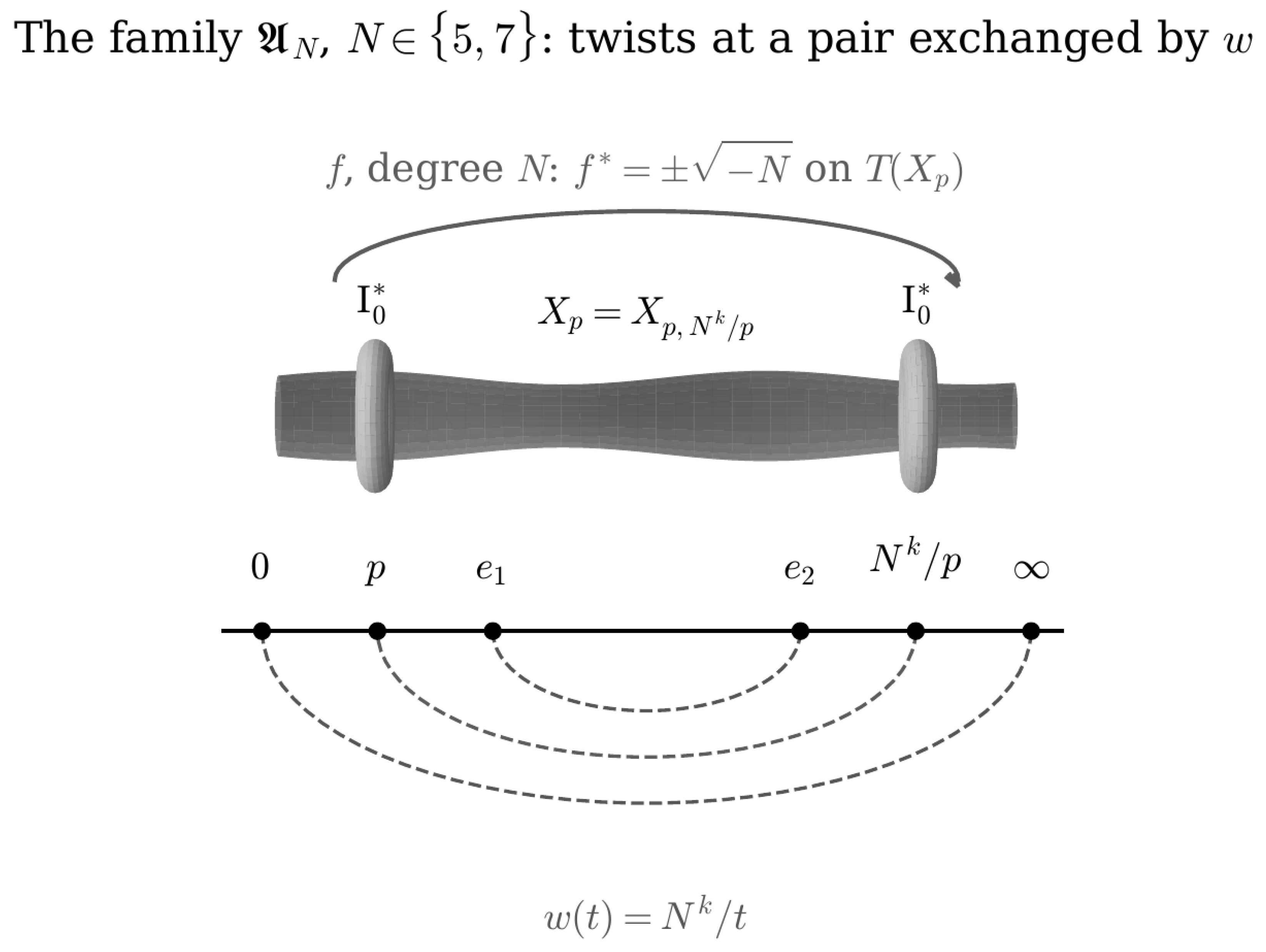
The surface of [121, §7.6] with real multiplication by is the twist at , the two fixed points of w, and the surface of [121, Prop. 7.7] is the twist at the fixed points for , which has Picard number 18 and complex multiplication as well: there , and by Lemma 9(ii), so is the real multiplication by . The families are the twists at the pairs exchanged by w, where and ; the two signs are the two values of the constant by which the twisting function changes under w once the square factor is removed. The chains of Theorem 10 apply to every member, and a member whose field E contained , or would have that element algebraic as well; by Theorem 13(ii) such a member is of CM type, and we know none.
Remark 1
(The Picard number). Theorem 13 does not say which of the three ranks the very general member has. The programs of the repository decide it by counting points. The surface , the twist at , has a Weierstrass model over with good reduction at for and at for , primes split in K; the program julia/frickepicard.jl counts its points over , , fibre by fibre, subtracts the trace of Frobenius on the trivial lattice, and completes the characteristic polynomial of Frobenius on the rank-six complement of the trivial lattice by the functional equation, whose sign is fixed by the nonzero middle coefficient. The polynomials are for and for ; in the variable neither has a root of unity among its roots, each is irreducible over and splits over K into a cubic and its conjugate, as the action of requires. By the Tate conjecture for K3 surfaces over finite fields, used in the same way in [121, §7], , so the very general member of and of has , , with , and its Hodge group is the unitary group of a hermitian form of signature on . At the primes inert in K, for and for , the odd traces vanish, as they must when Frobenius exchanges the two eigenspaces of . No statement of this section rests on this computation.
5.5. The Reach of Similarities
Every correspondence used so far acts on transcendental spaces as a Hodge similarity. The next proposition says that this is not an accident of the examples but a property of every correspondence whose components are small, and it measures what a correspondence must look like to act otherwise.
Proposition 9
(Structure of the transcendental action). Let X, be projective K3 surfaces, , and the map induced on transcendental spaces by composing the action of Γ with the orthogonal projections.
- (i)
- is zero or an isomorphism of Hodge structures.
- (ii)
- If then lies in the maximal totally real subfield of and is totally positive, and is a similarity exactly when .
- (iii)
- Let Γ be irreducible, S a resolution of its normalisation with projections of degrees to X, . If inside , then is a similarity of multiplier . This holds whenever .
- (iv)
- If Γ is irreducible and is not a similarity, then , so and the transcendental rank of S is at least twice that of X.
- (v)
- The -algebra generated by the actions on of all correspondences from X to itself whose irreducible components either fail to dominate a factor or have is the multiquadratic subfield generated by the square roots of the products that occur. When is odd it is .
Proof.
(i) is an irreducible Hodge structure [126], and the image of is a sub-Hodge structure of ; if nonzero it contains the -part, hence , and is injective by irreducibility. (ii) a is a Hodge endomorphism of , so , and it is self-adjoint, so it lies in the fixed field of the adjoint involution, the maximal totally real subfield. The form is a polarisation of the Hodge structure up to sign on each real eigenspace of E, and comparison with q gives at every real place. A similarity of multiplier has . (iii) Both are irreducible sub-Hodge structures of with a -part; if they share the unique -line, so they meet and coincide. When they coincide, on T, so ; since and , this gives , that is . (iv) If the two subspaces met they would coincide by irreducibility and (iii) would apply; so they are independent, their -lines are distinct, and their sum has rank inside the transcendental part of . (v) A component that does not dominate a factor acts through or through and , hence by zero on T. The others act by similarities by (iii), a composite of similarities returning to X is an element with , and for totally real E this is ; such elements generate . For a CM field E the elements with are the -multiples of the norm-one elements, which generate E, so the statement is about the totally real case, which is the one that matters for (F3′). An odd-degree field has . □
The correspondences of Lemmas 4 and 5, the Fourier–Mukai kernels between a K3 surface and its moduli spaces of sheaves, the rational Hodge isometries of hyper-Kähler varieties of K3[n] type [77], the Fricke isogenies of Theorem 13 and all their composites fall under (iii) or (v). A correspondence that realises an element of a cubic field must therefore have a component whose resolution has and transcendental rank at least twice that of the surface. Such correspondences exist, and the only ones we know come from finite groups.
Proposition 10
(Hecke correspondences). Let Z be a smooth projective surface with an action of a finite group G, a subgroup, and X a smooth projective surface with birational to ; write .
- (i)
- For the correspondence acts on as the Hecke operator of the double coset , and these operators span a -algebra isomorphic to a quotient of acting by Hodge endomorphisms.
- (ii)
- Exactly one simple factor of this algebra acts nontrivially on ; it is a field, it preserves , and it embeds into E by algebraic correspondences. If this factor is not the one on which G acts trivially.
- (iii)
- Every field obtained in this way is abelian over . In particular a totally real cubic field F whose Galois closure has group is realised by no correspondence built from a finite group acting on a cover of X.
Proof.
(i) Let be an equivariant resolution and the quotient by H followed by the resolution; then and for , so acts as on , the Hecke operator of . The Hecke operators of span , a semisimple algebra, and the action on factors through it. (ii) The idempotents of the simple factors are rational combinations of Hecke operators, so they are Hodge endomorphisms of ; they sum to 1 and act on the line by 0 or 1, so exactly one of them, , acts as 1. A simple factor with nonzero image in the commutative ring through a ring homomorphism to a field is commutative, hence a field . For , is a sub-Hodge structure of the transcendental part of ; if it contains , hence , and if it has no -part and lies in . So is a homomorphism from a field, injective. The factor on which G acts trivially fixes , which is zero by hypothesis, so it is not . (iii) The centres of the simple factors of are the character fields of the irreducible constituents of , generated by sums of roots of unity, so each lies in and is abelian; a commutative simple factor is its centre. A non-abelian cubic field is not a subfield of an abelian field. □
For the dihedral group with n odd, of order two and Z the elliptic surfaces of [121, §4.7], the algebra is , and the factor acting on is ; this is the content of [121, §4.8], where the cycle induces . The components of these correspondences are birational to , which has , as Proposition 9(iv) requires.
Corollary 2
(Squares of the dihedral families). Let X be an elliptic K3 surface of one of the families of [121, Thm. 1.1], with real multiplication by for , and suppose or E is a CM field; the very general member has . Then the Hodge conjecture holds for , and (F3′) holds for and . This covers the cubic fields and on families of dimensions 3 and 2.
Proof.
If , E is algebraic by Proposition 10(ii) and [121, §4.8]; if E is CM, by Buskin’s theorem as in Theorem 13(iii). The rest is as there. □
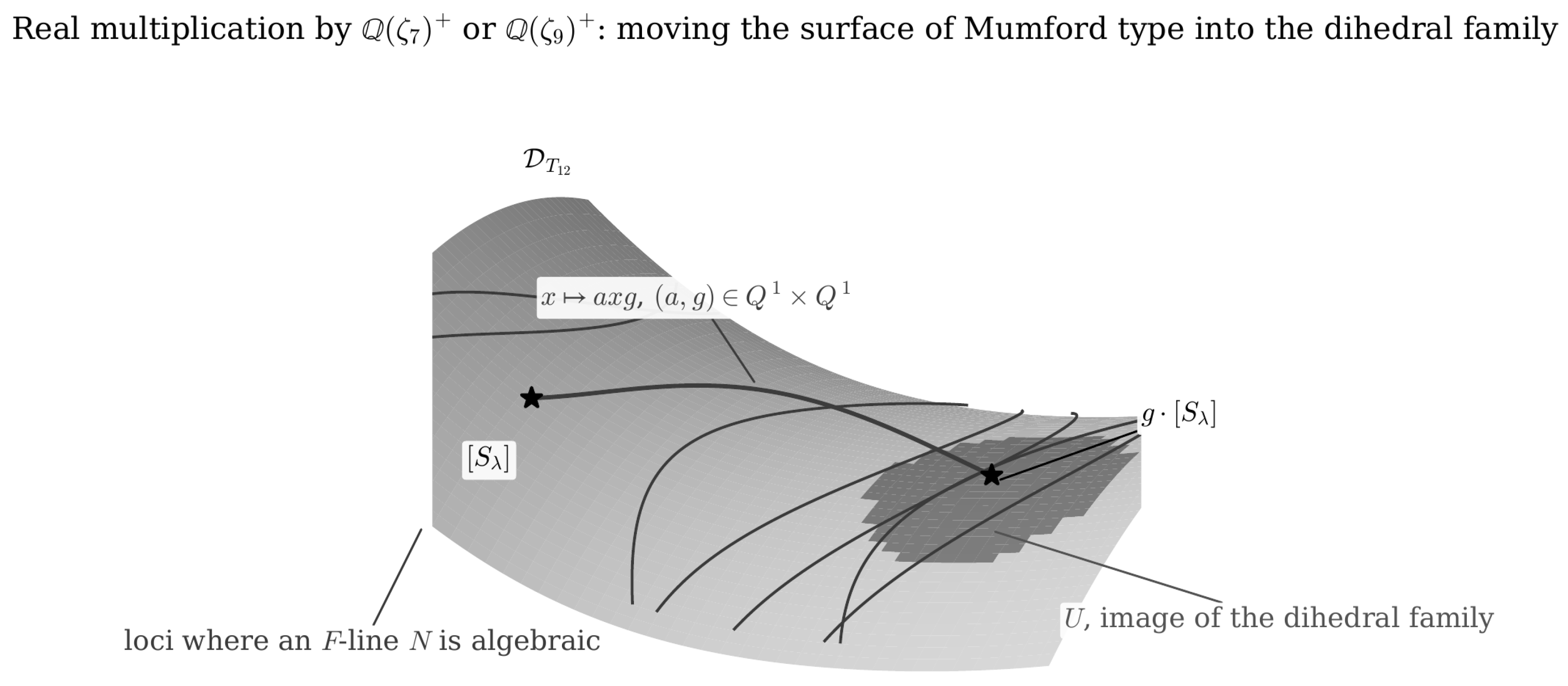
Figure 6.
The proof of Theorem 14. The surface is the two-dimensional period domain of the twelve-dimensional space with real multiplication by or ; the shaded patch is the image of the two-dimensional dihedral family, on which the multiplication is algebraic. The curves are the loci on which an F-line N becomes algebraic, and the surface of Mumford type is a point on one of them. The rational isometries of the quaternion algebra are dense in the real group, so one of them moves the point into the patch; Buskin’s theorem turns that isometry into a cycle.
5.6. The Cyclic Cubic Fields and
The dihedral families reach the cyclic cubic fields only on their own members. For each of the two cubic fields they contain, with , there is a two-dimensional family on a transcendental lattice of rank twelve: for the family of [121, §5.6], and for the Dickson deformation of the one-parameter family of Artebani, Sarti and Taki with Picard lattice [7, Ex. 6.1], which [121] do not use, their family for being the three-dimensional one of Picard number four. Two is the largest dimension a family with this real multiplication on a transcendental space of rank twelve can have, and this maximality lets the cycle travel: every K3 surface of Mumford type for F and for the quaternion algebra ramified only at infinity is a Hodge isometric image of a member of the family, and Buskin’s theorem carries the cycle along the isometry. The result settles the frontier case of Section 5.10 for these two fields and this algebra.
Write , so that , with , and is totally positive. For one has and the three real embeddings send to , and ; for one has and the embeddings send to , and . Let be the prime dividing n; it is totally ramified in K, so it lies under a single place of F, and is unramified outside . The prime 2 has order three in , so it is inert in F. Let be the quaternion algebra over F ramified exactly at two real places and at no finite place. Put for and for ; then is a unit positive at exactly one real place, and : the symbol is ramified at the two real places where , split at every odd finite place because both entries are units there, and split at the one place above 2 by the parity of the number of ramified places. Its corestriction to is unramified everywhere and split at infinity, hence is , so is one of Mumford’s algebras and the fourfolds of [87] exist for it. For totally positive let be the quadratic form on the nine-dimensional -space of elements of reduced trace zero, of signature ; the surfaces of Theorem A23 for the fourfolds of have .
Theorem 14
(Real multiplication by and on the surfaces of Mumford type). Let , and as above. Let S be a projective K3 surface such that with its intersection form is isometric to for some totally positive , by an isometry under which the multiplication by F on acts on by Hodge endomorphisms. Then , the real multiplication by F is induced by algebraic cycles on , and the Hodge conjecture and (F3′) hold for and . This applies to every surface of a Mumford fourfold of , at every point of its Shimura curve.
Proof.
Step 1, the family for . Let be the two-dimensional family of [121, §5.6]: elliptic K3 surfaces with very general Picard lattice ,6 deformations of the surfaces with a non-symplectic automorphism of order nine, obtained by replacing by the Dickson polynomial . The transcendental lattice of a very general member has rank twelve and discriminant group , is a -module of rank two through , and carries the flat action of F through , which on every member of the family is induced by the cycle of [121, §4.8] on a dihedral cover, as in Proposition 10. The period map of B has two-dimensional image [121, §5.6].
Step 1, the family for . The surfaces are the K3 surfaces of [7] with there: is a non-symplectic automorphism of order seven, the fibration has a fibre of type at and fourteen fibres of type , and for very general b the Picard lattice is the invariant lattice of , with [7, Table 3]. Replacing by the Dickson polynomial gives the surfaces7
where is the Dickson polynomial with ;8 these are the deformations (4.4) of [121, Prop. 4.6] with , and ; by that proposition each is a K3 surface on whose transcendental space F acts by Hodge endomorphisms, induced by the cycle on the -cover as before. The polynomial has degree seven, so at the coefficients of the Weierstrass equation vanish to orders 8 and 5 and the fibre of type survives; hence contains the unimodular lattice of rank ten, and since the Picard number of a very general member of a family is at most that of a very general member of any subfamily, here the locus , it equals , with , unimodular of rank twelve. The parameters modulo the scalings , which send a to , leave two, and the image of the period map is two-dimensional: otherwise it is the closure of the one-dimensional image of the locus , and a very general is isomorphic by the Torelli theorem to some , so carries a non-symplectic automorphism of order seven. Such a has no invariant vector in , so its invariant lattice is ; it fixes the class of a fibre and the class of the zero section O, hence preserves the fibration and O, the only effective curve in its class, and it acts on the base with order seven, since an automorphism over the identity of the base that fixes O is a group automorphism of the fibres, of order dividing six. It fixes , the only reducible fibre, so it acts by with a primitive seventh root of unity, and since the Weierstrass equation of a fibration with a chosen section is unique up to , the polynomial satisfies . The coefficients of , and give , and , so . Thus the direction a is not isotrivial and the image is two-dimensional. If then E has degree six or twelve and , which allows at most one modulus by the count of [121, §5.4]; so on the very general member.
In both cases the family is maximal: for , the period domain of Hodge structures of K3 type on with F acting by Hodge endomorphisms has dimension , and the period map has two-dimensional image in its quotient by the arithmetic group, so by the open mapping theorem the image contains a nonempty open set U of one of the two components of that domain.
Step 2, the quadratic structure. Since the intersection form q of is -invariant there is a unique hermitian form h on the two-dimensional K-space with , and a unique F-bilinear form with . Diagonalise with . For one has , so
and is the reduced norm form of the quaternion algebra ; thus as F-quadratic spaces. The signature of q is and splits over the three real places of F as at the place whose eigenspace carries and at the two others. From (5), signature at forces there, and at forces there; so Q is split at and ramified at and , and after exchanging and we may take at and at the other two places.
Step 3, . The lattice is unimodular at every prime , and is ramified only at , so for a place v of F not above the ring is a product of unramified extensions whose trace forms are perfect, and the hermitian -lattice is unimodular for h; its determinant is therefore a unit of times a norm from . Units are norms from an unramified extension, so at every finite , including the place above 2. The ramification set of Q has even cardinality, contains and is otherwise contained in the single place above ; so that place is unramified as well, and . As a check independent of this argument, the rational invariants of , computed from the Picard lattice by Witt cancellation in the K3 lattice, and those of agree for both n: signature , discriminant 1, Hasse invariant at 2 and at every odd prime, while the trace forms of the algebras over F with the same real ramification and ramification at finite places differ from them at 7 or 43 for and at 3 or 19 for .
Step 4, the surfaces of Mumford type inside . For the F-line has , and its orthogonal complement is , with for ; so with , and N is negative definite exactly when is totally positive. By the Hasse–Schilling norm theorem [103, Thm. 33.15] the reduced norms of are the elements of positive at and , and is negative at and positive at the other two places, so every totally positive occurs. Given S as in the statement, choose with and an F-linear isometry ; the period of S becomes a point of the period domain of at which is algebraic and F acts by Hodge endomorphisms, because lies in the -eigenspace. Replacing S by its complex conjugate, whose period is and for which the conclusion is equivalent, we may take on the component containing U.
Step 5, moving the point. The group at the place is acting on by , and it acts transitively on each component of the two-dimensional period domain. The group of pairs of elements of reduced norm one is simply connected, so by weak approximation [101, Thm. 7.8] its rational points are dense in its real points; hence there are with carrying into U. This map is an F-linear isometry of , it carries onto with , and it carries the Hodge structure of to the Hodge structure on determined by the image point, which is the period of a member of the family. The rational classes of type in at that period are exactly , since a rational class orthogonal to the period decomposes into a component in the line and a component in that is a rational class of type in a copy of , which has none. So with the restricted action of F, and is a Hodge isometry that commutes with F.
Step 6, the cycle. and are both isometric to , so by Witt cancellation , and extends to a rational Hodge isometry , which is algebraic by Buskin’s theorem [26]. The action of on is induced by the cycle of Step 1, so on is induced by a cycle on . Since has rank nine and , E is F or a totally real field of degree nine with , which [118] excludes; so is algebraic, and the Hodge conjecture for and the rest follow as in Theorem 13(iii). □
The next proposition says exactly which pairs the mechanism reaches and where it stops.
Proposition 11
(What the dihedral mechanism reaches). Let and .
- (i)
- Let X be a K3 surface with a purely non-symplectic automorphism of order whose transcendental lattice has rank twelve and is unimodular at every prime other than . Then is isometric to for some , and every surface of Mumford type obtained from X or from a rational isometric image of X as in Step 4 has the algebra . The Mumford algebras over F ramified at two finite places are reached by no family of rank twelve with such an automorphism.
- (ii)
- Let and let be the transcendental lattice of the three-dimensional family of [121, §5.4], with its F-bilinear form of dimension six. For every Mumford algebra D over F and every totally positive λ the space embeds F-isometrically into , so the four-dimensional period domain of this family contains the Shimura curve of the surfaces of every pair . The image of the family is a threefold in it, and Step 5 would need a rational isometry carrying the period of into that threefold.
- (iii)
- A finite group acting on the base of an elliptic surface is cyclic, dihedral, tetrahedral, octahedral or icosahedral, and the centres of the simple factors of its rational group algebra are the fields , , , and . The only cubic fields among them are and , so the base change of elliptic surfaces along covers of reaches no cyclic cubic field of conductor at least 13.
Proof.
(i) Steps 2 and 3 of the theorem use only the order of the automorphism, the rank, the signature and the unimodularity away from , so they apply to X and give . A rational isometry preserves up to the F-similarity class, which determines the algebra, and Step 4 exhibits the orthogonal complement of every negative definite F-line as ; an algebra has for all , since the even Clifford algebra of the ternary form is D.
(ii) is a three-dimensional hermitian K-space and has signature at and at , by the same count as in Step 2. The form on has signature at , where D is split, and at the two ramified places. The Witt class of is represented at every real place by a negative definite ternary form and at every finite place by a ternary form, because a class of odd dimension has an anisotropic representative of dimension one or three; these local ternary forms have the global discriminant , Hasse invariants at almost every place and satisfying the product formula, since they are products of the invariants of and and of Hilbert symbols of their discriminants; so by [95, Thm. 72:1] there is a global ternary form with these localisations, and by the Hasse–Minkowski theorem. The image N of is a negative definite F-subspace of dimension three with , and the Hodge structures of K3 type on with F acting form the Shimura curve of the of . The family has three moduli [121, §5.4] in a domain of dimension .
(iii) The list of finite subgroups of is Klein’s. The simple factors of have centres the fields generated by the values of the irreducible characters: for the cyclic group of order m, for the dihedral group of order (its two-dimensional characters take the values ), and for , for , and and for . By Proposition 10(iii) the correspondences cut out of the action act through these fields; is never cubic, and is cubic exactly for , where it is or . □
Part (ii) leaves open whether the threefold meets the Shimura curves of the other algebras. The next two results turn this into a question about subfamilies of the rank-eighteen family, and show where such a subfamily would have to be special.
Lemm 10
(Unimodular places split the algebra). Let F be a totally real cubic field with , and let T be a lattice of rank nine whose form is for an F-bilinear form φ on , with θ self-adjoint. Let . If p is odd, θ preserves and is unimodular, then D is split at every place of F above p.
Proof.
The idempotents of are polynomials in , hence self-adjoint, so is an orthogonal sum, with free of rank three over and on it. Since is an -module, x lies in the b-dual of exactly when , the local different; so unimodularity gives , and , with a generator of , is a unimodular ternary form over . Its reduction is a nondegenerate ternary form over a finite field of odd characteristic, which has a nonzero zero by the Chevalley–Warning theorem; the zero is nonsingular because the gradient of the form there is twice a nonzero linear form, so by Hensel’s lemma is isotropic, . Then , and since the even Clifford algebra of a ternary form does not change under scaling, is split. □
Proposition 12
(Transport within a family). Let be an irreducible family of projective K3 surfaces with a totally real cubic field F acting on the transcendental spaces by Hodge endomorphisms induced by a flat family of algebraic cycles. Let be an F-quadratic space of dimension three with of signature , let Ω be a component of , let be the set of periods for which V contains a rational class of type , and let be the set of ω for which is F-linearly Hodge isometric to for some .
- (i)
- Either R is countable or . In the second case, every projective K3 surface S with F-linearly Hodge isometric to for some has its multiplication by F induced by algebraic cycles on .
- (ii)
- The second case holds for some with even Clifford algebra D if and only if contains a non-isotrivial analytic subfamily of positive dimension whose very general member has transcendental rank nine and algebra D.
- (iii)
Proof.
(i) is the union over the countably many nonzero rational of , each a proper analytic subset, so it is a countable union of nowhere dense sets. Cover B by countably many simply connected open sets U with marked period maps to , and for each of the countably many F-linear isometric embeddings compatible with the action of F on the transcendental spaces let be the analytic set of with and . If has rank nine then for such a j, so with . On each of the countably many irreducible components of the the map is constant or, by the open mapping theorem, has image containing a nonempty open set. In the first case for all components R is countable. In the second, R contains a nonempty open set . The group of elements of reduced norm one acts on by conjugation, through F-linear isometries, so R and are stable under . It is simply connected, so by weak approximation [101, Thm. 7.8] is dense in and its image is dense in , which acts transitively on . For choose with ; then . For the last statement, compose the given isometry with one onto to get an F-linear Hodge isometry ; by Witt cancellation it extends to a Hodge isometry of , which is algebraic by Buskin’s theorem [26], and t induces on for each .
(ii) If the second case holds, some component of some has nonconstant ; it is a positive-dimensional analytic subfamily on which , with equality off the preimage of , which is a countable union of proper analytic subsets, and it is non-isotrivial because its periods vary. Conversely, on such a subfamily runs through the countably many F-isometry classes of three-dimensional spaces with algebra D, so one class is attained on an uncountable set, on which the periods are not constant by the Torelli theorem; so some for this V is nonconstant and R is uncountable.
(iii) In the construction of [121, §4.8] the multiplication by is , where is a double cover and an automorphism of order n upstairs: the integral cycle acts as , and since and acts as on , it acts on as . Hence preserves for every odd p, and for both fields. If were unimodular at every odd p, Lemma 10 would make D split at every finite place not above 2. As in Step 2 of the proof of Theorem 14, the signature makes D ramified exactly at the real places ; the prime 2 is inert in F, since 2 has order 3 modulo 7 and generates ; and the number of ramified places is even. So D would be split above 2 as well, and . Hence some odd p has non-unimodular, and Lemma 10 shows that every place where D ramifies away from 2 and ∞ lies over such a p; for these places lie over p. □
So the rank-eighteen family reaches the surfaces of , , if and only if it has a non-isotrivial subfamily of transcendental rank nine with that algebra, and along such a subfamily the transcendental lattice is non-unimodular above the ramified primes of D. We do not know such a subfamily; this is where part (ii) stops.
For the fourfolds X of the theorem leaves (F2) where it was: by the argument of Step 2 of the proof of Theorem 38, with replaced by , on which the real multiplication is now algebraic, their exceptional classes are algebraic as soon as one algebraic cycle on acts nontrivially on , and the real multiplication supplies no such cycle.
5.7. Powers of K3 Surfaces and Kummer Type
The theorems of this section decide and . On the higher powers the Hodge classes are described by Varesco [116, Thm. 2.16]. Let E be totally real, , and for each real embedding of E let , so that . The line is spanned by a class of type , and the span of the over all is defined over : it is , a space of Hodge classes of dimension in , the exceptional classes. Varesco’s theorem is that every Hodge class in the tensor algebra of T is obtained from the Hodge classes of , which are the elements of E, and from the exceptional classes by tensor products, permutations of the factors, linear combinations and contractions with . Each of these operations carries algebraic classes on powers of S to algebraic classes: a tensor product is an exterior product, a permutation is the pull-back along an automorphism of , and the contraction of two factors is the push-forward along the projection after cupping with the pull-back of the class of the diagonal of , since .
Proposition 13
(Hodge classes on the powers). Let S be a projective K3 surface with E totally real and , so that as in the proof of Theorem 11(ii).
- (i)
- The Hodge conjecture holds for every power if and only if the elements of E are algebraic on and the exceptional classes are algebraic. When , and the exceptional class is the determinant , which spans .
- (ii)
- For a surface of Theorems 11, 14 or Corollary 2 with E totally real, E is algebraic, and the Hodge conjecture for all powers of S is equivalent to the algebraicity of , : for the surfaces of Theorem 14, with ; for the very general members of the two-dimensional family of Theorem 14, with .
Proof.
(i) If the Hodge conjecture holds on all powers, both kinds of classes are algebraic, being Hodge classes on and on . Conversely, , and , and are spanned by algebraic classes and are Tate twists of trivial Hodge structures. So a Hodge class of is a sum of exterior products of algebraic classes with Hodge classes of the tensor powers , , pulled back along the projections of onto k of its factors. By Varesco’s theorem and the remark preceding the proposition, the Hodge classes of are algebraic as soon as E and the exceptional classes are. When there is one embedding, and .
(ii) The theorems cited prove that E is algebraic; since T is an E-vector space. The ranks are those of the nine-dimensional space and of the lattice in Step 1 of the proof of Theorem 14. □
Proposition 14
(K3 surfaces of Kummer type over ). Let S be a projective K3 surface, , let be a diagonalisation of on T, its discriminant and its Hasse invariant at the prime p. The following are equivalent.
- (a)
- T embeds isometrically in , the quadratic space of an abelian surface.
- (b)
- There is a dominant rational map from S to a Kummer surface.
- (c)
- ; or and at every prime p at which is a square in ; or and at every prime p.
Here for p odd and , so (c) asks for at the odd primes concerned and . If (a)–(c) hold, then S lies in the class of Proposition 2, (F3′) holds for every power , and the Hodge conjecture holds for every and every Hilbert scheme .
The equivalence of (a) and (b) is Ma’s theorem [74, Prop. 3.2], where (a) is also shown equivalent to an embedding of lattices , and for a Kummer surface itself the Hodge conjecture on all powers follows from that on the powers of the abelian surface [116, §0.2]. What is added here is the form (c) of the condition, which reads it off the invariants of T, and the passage from Ma’s rational map to the class .
Proof.
(a)⇔(c). The space has signature , discriminant and Hasse invariants . By Witt’s theorem T embeds in V if and only if there is a quadratic space W over with , and by the Hasse–Minkowski theorem [108, Ch. IV, Thm. 9] this is a condition on invariants: W must have dimension , signature , discriminant and, from with , Hasse invariants . The signature forces . A quadratic space over with prescribed dimension k, signature, discriminant and Hasse invariants exists if and only if the invariants satisfy the product formula, the real invariants are those of the signature, and at every prime the local existence condition holds [108, Ch. IV, §2.3, Prop. 6, and §3.3, Prop. 7]; the first two conditions hold here because they hold for T and for V and , and the local condition is empty for , is at every p at which in for , and is at every p for . With , and these are the three cases of (c).
(b) and the class . Let be dominant. By Lemma 4, maps onto T. Let be the blow-up of the sixteen points of order two and the quotient by the involution; is an algebraic cycle on with , and with the exceptional curves. Hence , and is spanned by this image and by divisor classes, while and are spanned by the class of S and the class of a point. So , the point being the abelian variety of dimension zero, and (F3′) holds on by Proposition 2. For the Hodge conjecture, the proof of Proposition 2(i) writes a Hodge class of as with a Hodge class on one of the abelian varieties spanning , here the powers with . The Hodge conjecture holds for every product of surfaces with and [104], in particular for , so every , and with it every Hodge class of , is algebraic. The Chow motive of is a direct summand of a sum of Tate twists of the motives , [32], so every Hodge class of is the image under an algebraic correspondence of a Hodge class of some . □
Remark 2
(The powers left open). (i) At the condition (c) is empty and S has a Shioda–Inose structure [81]. At or 18 it is a condition on the Hasse invariants, met by , by and by , and failed at and by , by and by , the primes of failure coming in pairs by the product formula; all six are transcendental lattices of K3 surfaces of Picard number 18 or 17 by [93] and the surjectivity of the period map. The Kummer condition is not needed for the Hodge conjecture on the powers: by Corollary 3 it holds for all powers and Hilbert schemes of every projective K3 surface of Picard number at least 17, the last three included, which embed in . For no surface is of Kummer type, and at Corollary 4 decides the surfaces whose transcendental space has Witt index two.
(ii) The Fricke surfaces have complex multiplication by at every member, and Theorem 13(iii) settles the Hodge conjecture on all their powers. Their transcendental spaces (Proposition 15) have discriminant N, so they are neither of Kummer type nor in the two families of Picard number 16 for which Varesco proves the Hodge conjecture on all powers from the algebraicity of the Kuga–Satake correspondence [116, Thm. 4.3, Exs. 4.4, 4.5], whose transcendental spaces and have discriminants 1 and 3 modulo squares; they are settled by the complex multiplication instead. For each surface of Proposition 13(ii) the exceptional classes are Hodge classes of degree on reached by no correspondence of this section, all of which act on ; whether they are algebraic, and with it whether (F3′) and the Hodge conjecture hold on , is open. The one construction known to produce such classes is the Kuga–Satake correspondence, through which Varesco proves [116, Thm. 4.3].
Proposition 15
(The transcendental lattice and the Kuga–Satake variety of the Fricke surfaces). Let , , let M be the trivial lattice or of the elliptic fibration of the members of , and let , which is when .
- (i)
- as a quadratic space over , so and the centre of the even Clifford algebra is K.
- (ii)
- The Kuga–Satake variety of T is isogenous to for an abelian fourfold B of K-Weil type with discriminant one. If and , then B is isogenous to , where is an elliptic curve with complex multiplication by K and is a simple abelian threefold with ; in particular B is not simple.
Proof.
(i) The root lattices are rationally diagonal: has index two in , so , and with index two gives ; is the orthogonal complement of the vector of norm , so ; and by the vectors and of . Hence, with all forms taken positive definite, and over . The K3 lattice is , so , while by the two isometries just written. Thus , and Witt’s cancellation theorem gives . Its discriminant is , and the centre of is . The program julia/frickelattice.jl recomputes these isometries by the invariants of Hasse–Minkowski.
(ii) By Lombardo’s theorem [73, Thms. 6.2, 6.4], in the form of [116, Thm. 4.1], the Kuga–Satake variety of a polarised Hodge structure of K3 type on with is isogenous to for an abelian fourfold B of -Weil type with discriminant one; here , and . Suppose and . By Zarhin’s theorem [126, Thm. 2.3.1] the Hodge group of T is , the unitary group of the hermitian form h on the three-dimensional K-space with . Over the two eigenspaces , of K on have dimension three and are isotropic for q, since , so and acting on by the dual representation. The Kuga–Satake Hodge structure on is the lift of that of T along [118, §5], so the Hodge group of B is the preimage of G in , and is the sum of the two half-spin representations of , on which the two eigenspaces of the centre K of are and . For the isotropic decomposition the spin representation is , with the even and the odd part. Restricted to , is the sum of the character and of the irreducible representation of dimension three, and is the sum of and of . The four summands are pairwise non-isomorphic, the two characters being distinct and the two three-dimensional representations having different weights, so they are the isotypic components of under the connected group . An automorphism of over carries an isotypic component to one of the same dimension, since the representation is defined over ; so and minus it are stable under all of them and are the complexifications of -subspaces U, V with . Both are stable under , hence sub-Hodge structures, and under K, which acts by scalars on and on . By Poincaré reducibility B is isogenous to with and . The algebra has dimension two and contains K, so ; likewise has dimension two, so , a field, and is simple; and since U and V share no isotypic component. □
Remark 3
(Real multiplication at the fixed points). Theorem 13(iii) decides every power of every Fricke surface, so the Kuga–Satake variety of Proposition 15(ii) is not needed for them; the proposition records what the splitting of T into the two eigenspaces of K does to the Kuga–Satake construction. For a very general Hodge structure of K3 type on , with endomorphism field , the fourfold B is simple with a definite quaternion algebra as endomorphism algebra [118, Prop. 5.7]; the Fricke families lie in the locus of the four-dimensional period domain where the endomorphism field is K, and there B splits. Real multiplication by appears on the two twists at the fixed points of w, the surfaces of [121, §7.6, Prop. 7.7], where by Lemma 9(ii). The fixed points of w are two, so the fixed-point twists are two surfaces; one-dimensional families of transcendental rank six with algebraic real multiplication by , and every other real quadratic field are given by Theorem 16, through a correspondence that is not a chain.
5.8. Floccari’s Theorem and Real Multiplication of Degree Two
Floccari attached to every hyper-Kähler variety of generalised Kummer type a K3 surface and proved that its Kuga–Satake correspondence is algebraic [42,43]. The statement depends only on the rational transcendental space. Write for the second cohomology lattice of a variety of generalised Kummer type of dimension , and for a positive integer m put
a quadratic space of rank 7, signature and discriminant m, which depends only on the class of m modulo squares; . We also write ; it is , since by the basis and .
Theorem 15
(Floccari [43, Thm. 5.11]). Let S be a projective K3 surface such that embeds isometrically in for some positive integer m. Then the Kuga–Satake correspondence of S is algebraic, and the Hodge conjecture holds for for every .
The theorem numbers are those of the version arXiv:2501.02315 of [43]; the case is [42, Thm. 1.3, Cor. 5.8]. Which transcendental spaces it reaches is decided by the following lemma. For a rational quadratic space T of even rank, denotes its even Clifford algebra, a central simple algebra over the quadratic étale algebra [68, Ch. V, §2].
Lemma 11
(Transcendental spaces that embed in some ). Let T be a rational quadratic space of signature with , and .
- (i)
- If , then T embeds isometrically in for some positive integer m.
- (ii)
-
If , then ; let . The following are equivalent.
- (a)
- T embeds isometrically in for some positive integer m.
- (b)
- T has Witt index two: for some .
- (c)
- for some ; then (a) holds with modulo squares.
- (d)
- for every prime p such that .
- (e)
- .
- (iii)
- If , then T embeds in no .
Proof.
(i) Let . An indefinite rational quadratic space of rank at least five is isotropic [108, Ch. IV, §3.2], so with of signature ; order the entries so that and . Then
because a binary form represents zero and is a hyperbolic plane, and for the positive integer with s a common denominator. If , then has signature and the case applies.
(ii) The discriminant of a space of signature has the sign , so . (a)⇒(b): contains a totally isotropic subspace N of dimension three, and T has codimension one in , so and the Witt index of T is at least two; by the signature it is at most two. Hence with and , that is modulo squares. (b)⇒(c): , so . (c)⇒(a): with .
(b)⇔(d). By (i) applied to a rank-five subspace, or directly by [108, Ch. IV, §3.2], T is isotropic, so with of signature and . By Witt cancellation T has Witt index two if and only if is isotropic, and by the Hasse–Minkowski theorem this holds if and only if is isotropic over and over every . Over it is indefinite. Over with it is isotropic, because an anisotropic quaternary form over has square discriminant [108, Ch. IV, §2.2, Thm. 6]. Over with the form has discriminant one; if it is isotropic it is with B binary of discriminant , hence ; so is isotropic if and only if it is , if and only if .
(d)⇔(e). Let be the class of the Clifford algebra , central simple over since the rank is even. The centre of is K, and [68, Ch. V, §2], so in . As has dimension 16 over K, (e) says that this class vanishes. The class has order at most two; restriction to a place w of K over a place v of multiplies local invariants by , so if and only if at every prime p that splits in K, the real place being complex in K. A prime p splits in K exactly when ; then , and two quadratic spaces over of the same rank and discriminant are isometric if and only if their Clifford invariants agree; . So (e) holds if and only if at every such p.
(iii) has three positive and four negative directions, and T has negative ones. □
Corollary 3
(Floccari’s theorem at Picard number at least seventeen). Let S be a projective K3 surface with . Then the Kuga–Satake correspondence of S is algebraic, and the Hodge conjecture and (F3′) hold for every power and every Hilbert scheme .
Proof.
has signature and rank , so it embeds in some by Lemma 11(i), and Theorem 15 gives the Kuga–Satake correspondence and the Hodge conjecture for every . The Chow motive of is a sum of Tate twists of motives of symmetric products of S [32], so the Hodge conjecture for follows. When every Hodge class is algebraic, (F3′) holds, since the algebraic classes are the images of the class of a point under correspondences. □
For the embedding in alone needs a condition on Hasse invariants, at every prime p at which is a square, and the theorem removes it. For instance , of discriminant , has , so it does not embed in ; with , in the proof of Lemma 11(i) it embeds in . Figure 8 summarises the K3 surfaces that Floccari’s theorem reaches.
Corollary 4
(Floccari’s theorem at Picard number sixteen). Let S be a projective K3 surface with , , and . If T satisfies the equivalent conditions of Lemma 11(ii), the Kuga–Satake correspondence of S is algebraic and the Hodge conjecture and (F3′) hold for every and every . If T has Witt index one, T embeds in no , and Theorem 15does not apply to S.
Proof.
The first statement is Theorem 15 with Lemma 11(ii) and [32], as in Corollary 3; the second is (a)⇒(b) of the lemma. □
The spaces , and have Witt index two, with , and in Lemma 11(ii)(c); the first does not embed in , since that would force by Witt cancellation and 7 is not a sum of two rational squares. The spaces and have Witt index one. Each of these spaces contains an even lattice of rank six with a discriminant group on at most six generators, which embeds primitively in the K3 lattice by [93, Cor. 1.12.3], so each is for the very general member of a four-dimensional family of K3 surfaces. Of the 1980 diagonal forms with and in , 1484 have Witt index two and 496 have Witt index one (Appendix C).
Lemma 12
(The space ). Let be squarefree, with real embeddings , , let W be the three-dimensional E-quadratic space , and let , the -vector space W with the form .
- (i)
- ; it has signature and discriminant d.
- (ii)
- Multiplication M by is self-adjoint for the form of and ; the -eigenspace has signature and the -eigenspace is negative definite of rank 3.
- (iii)
- ; in particular embeds isometrically in .
- (iv)
- The even lattice satisfies and admits a primitive embedding in the K3 lattice Λ, whose orthogonal complement has signature .
Proof.
(i) For the binary form on E has, in the basis , the Gram matrix
For it is , a hyperbolic plane, and for it is . The signature and the discriminant follow.
(ii) is E-bilinear, so for . Over , orthogonally, with the forms , of signatures and .
(iii) , since it represents zero; so .
(iv) Over , . The lattice is even of signature with discriminant group , generated by two elements. Since , , and , it embeds primitively in the even unimodular lattice of signature by Nikulin’s criterion [93, Cor. 1.12.3]. □
Theorem 16
(Real multiplication by every real quadratic field). Let be squarefree and keep the notation of Lemma 12. Fix a marking and let
the complement of the real points in a smooth conic, a union of two discs.
- (i)
- For every there is a projective K3 surface with , and ; each isomorphism class occurs for at most countably many ω, so the surfaces form a one-dimensional family.
- (ii)
- is an E-subspace of , and M restricts to a Hodge endomorphism of it. Outside a countable subset of one has , and exactly; at the other points the transcendental rank is 2 or 4 and the endomorphism field is a CM field.
- (iii)
- For every the Hodge conjecture holds for and for the Hilbert schemes , for every . In particular the real multiplication by is algebraic on , and the classes of Proposition 13on are algebraic.
- (iv)
- A rational quadratic space T of signature embeds in if and only if , if and only if for every prime p.
Proof.
(i) The point is a period of , so the surjectivity of the period map [58, Ch. 7, Thm. 4.1] gives a marked K3 surface with . Its Néron–Severi group contains , which contains a class of positive square, so is projective [17, Thm. IV.6.2], and . Two markings of one surface differ by an element of the countable group .
(ii) The space is the smallest -subspace of whose complexification contains . As , the complexification of contains too, so and : V is an E-subspace of E-dimension 1, 2 or 3. The real operator M is self-adjoint with eigenvectors , , so it preserves , and their orthogonal complement in , and is a Hodge endomorphism. There are countably many proper E-subspaces , and each is a proper linear subspace of the plane , which meets the smooth conic in at most two points; outside these points . Then , and the endomorphism field contains and is totally real or CM by Zarhin’s theorem [126, Thm. 1.6], of degree dividing 6. If is totally real then by the first paragraph of the proof of Proposition 20, so . If were CM, of degree 2 it would equal the real field , and of degree 6 its cubic totally real subfield would contain ; both are impossible. At a special point ; a totally real field would need over itself, so the endomorphism field is CM.
(iii) embeds in by Lemma 12(iii), so Theorem 15 applies. The classes named are Hodge classes on and . For the Hilbert schemes, the motive of is a sum of Tate twists of motives of symmetric products of S [32], so the Hodge conjecture for follows from that for the powers of S, as in Theorem 11. The real multiplication also has a second proof that uses only the Kuga–Satake part of Theorem 15: , so M is a Hodge similarity, and a Hodge similarity between K3 surfaces satisfying the Kuga–Satake Hodge conjecture is algebraic by Varesco’s theorem [115, Thm. 4.5, Cor. 4.6], the Lefschetz standard conjecture in degree two being trivial for surfaces.
(iv) If then with modulo squares, and comparing signatures . Since also , Witt cancellation gives ; the converse is Lemma 12(iii) with d replaced by c. By the Hasse–Minkowski theorem two rational quadratic spaces with the same rank, discriminant and signature are isometric if and only if their Hasse invariants agree at every prime [108, Ch. IV, Thm. 9], and , using . Comparing with Lemma 11(ii)(c), these are the spaces in which can be taken to be 1; the spaces of Witt index two in which it cannot embed in and not in . □
The surfaces of Theorem 16 are one family for each real quadratic field. Lemma 11 decides every family of transcendental rank six with real multiplication by a real quadratic field, through the quaternion algebra .
Setting 2
(Real multiplication of degree two in rank six). Let be squarefree, with real embeddings , , and let W be a three-dimensional quadratic space over E of signature at and at , with discriminant and even Clifford algebra , a quaternion algebra over E. Put , of signature , and let , , be the union of two discs cut out by , . If is a primitive even sublattice with , every is the period of a projective K3 surface with an E-subspace on which acts as a Hodge endomorphism, and outside a countable subset of one has , and ; the proof of Theorem 16(i), (ii) applies word for word with replaced by T. Such a lattice exists for every W: a lattice in T scaled by 2 is even, of rank 6, with a discriminant group on at most six generators, and in Nikulin’s criterion [93, Cor. 1.12.3].
Theorem 17
(Witt index of a trace form). In Setting 2, modulo squares, , and T has Witt index two if and only if
In that case every surface , , has an algebraic Kuga–Satake correspondence, the Hodge conjecture and (F3′) hold for all its powers and Hilbert schemes of points, and the real multiplication by is algebraic on .
Proof.
For the binary form has, in the basis , the Gram matrix
Diagonalising gives . The sign of is , so . By Lemma 11(ii), T has Witt index two if and only if is hyperbolic at every prime p with ; fix such a p. Then with , and .
p splits in E. Then and with ternary over . From we get . Since is hyperbolic, Witt cancellation shows that is hyperbolic if and only if . Ternary forms over of the same discriminant are isometric if and only if their even Clifford algebras are isomorphic, and because the rank is odd. So is hyperbolic if and only if , that is, if and only if their sum vanishes.
p does not split in E and is isotropic. Then is the only place over p, is split at , and with H a hyperbolic plane over . The trace of an isotropic -line is a totally isotropic -plane, so ; and is a binary form of discriminant , hence hyperbolic. So , in accordance with .
p does not split in E and is anisotropic. Then and we show that is not hyperbolic. Let D be the quaternion division algebra over and its reduced norm form. The form is ternary, anisotropic and of discriminant one; over a local field there is exactly one such form up to isometry, the restriction of to the pure quaternions, so , the last because the reduced norm of D is surjective onto . In the Witt group the transfer is additive and is hyperbolic, its discriminant being ; so in , and it suffices to show . The norm group has index two in , which contains with index at least four; choose , with , and with . By the projection formula , so the quaternion algebra over is D and . By Frobenius reciprocity for the transfer [106, Ch. 2, §5], with , a quaternary form of discriminant ; so modulo and modulo . Over a p-adic field : is additively generated by the three-fold Pfister forms, of dimension eight; every form of dimension at least five is isotropic [108, Ch. IV, §2.2, Thm. 6] and an isotropic Pfister form is hyperbolic [68, Ch. X, §1]; so equals the Pfister form in , the norm form of the quaternion algebra , which is a division algebra; that form is anisotropic and nonzero in .
In all three cases is hyperbolic if and only if ; no case uses . The rest follows from Lemma 11(ii), Theorem 15 and [32] as in Corollary 3, the class of being a Hodge class on . □
Corollary 5
(Families of Witt index two for every real quadratic field). In Setting 2let with and totally negative. Then has Witt index two, and the conclusions of Theorem 17hold on the whole family .
Proof.
The signatures are as required, and the Gram matrix of is , a hyperbolic plane. Apply Lemma 11(ii)(b). □
Lemma 12 is the case , ; the families of Corollary 5 with c ranging over the totally negative elements up to squares give infinitely many pairwise non-isometric transcendental spaces for every E, since .
Corollary 6
(Families of Witt index one for every real quadratic field). For every real quadratic field E there are spaces W as in Setting 2for which T has Witt index one; for them Theorem 15applies to no surface of whose transcendental space is T, and in particular to no very general member.Table 4 gives one for , with written .
Proof.
Let be a prime that splits in E, with places over it, and let Q be the quaternion algebra over E ramified exactly at and ; it exists because the set of ramified places is finite of even cardinality [103, §32]. If , the restriction of the reduced norm to the pure quaternions is , of discriminant one and with even Clifford algebra , since [68, Ch. V, §2]. At , where Q is split, this form is the determinant on trace-zero real matrices, of signature ; at it is positive definite. By weak approximation choose negative at and , in and in . Then has signature at and at , because scaling a ternary form does not change its even Clifford algebra, and . In one has , so is a square in , while . By Theorem 17, T has Witt index one, and Lemma 11(ii) says it embeds in no . For the table, the signatures, d and the Hasse invariants of T at every prime are computed in Appendix C; at the prime listed . □

Table 4.
Spaces over as in Corollary 6: has Witt index one, and at the prime p listed, where is a square.
Table 4.
Spaces over as in Corollary 6: has Witt index one, and at the prime p listed, where is a square.
| e | p | ||||
| 2 | 14 | 3 | |||
| 3 | 11 | 3 | |||
| 5 | 55 | 2 | |||
| 6 | 15 | 2 | |||
| 7 | 6 | 7 |
Families of higher dimension are reached on a dense set of curves.
Theorem 18
(Dense curves in every family with real multiplication of degree two). Let be real quadratic, , and W an m-dimensional quadratic space over E of signature at and negative definite at ; let be a primitive sublattice with , and let be the period domain of dimension cut out by , . There are countably many three-dimensional E-subspaces such that
- (i)
- is a nonempty curve, whose very general member has , and ;
- (ii)
- for every the Kuga–Satake correspondence of is algebraic, the Hodge conjecture and (F3′) hold for all powers and Hilbert schemes of points of , and the real multiplication by E is algebraic on ;
- (iii)
- the union of the curves is dense in .
Proof.
Write q for the E-form of W, for the real form on , and for the rational form of , so that with . Since for , the rational isotropic vectors of are the v with ; for such write , so that exactly when , and then is a hyperbolic plane. If is an E-subspace of signature at , , and negative definite at , with , then is indefinite of rank at least six, hence isotropic over [108, Ch. IV, §3.2]; its projective quadric is smooth with a rational point, hence rational over , so its rational points are dense in its real points. The real isotropic cone of is , and as is negative definite its projection to is . Hence: for every with there are rational with whose -components are arbitrarily close to positive multiples of .
Let and , so that are orthogonal with ; choose orthogonal to both with . Apply the last sentence with to get v with , , close to a multiple of x; then with , of dimension and signature at , to get with , , close to a multiple of the projection of y to . The space is negative definite at both real places, since has only two positive directions; choose a rational in it with close to a multiple of the projection of z. Then is totally negative, and has the diagonal form of Corollary 5: has Witt index two. The three-space , of signature , is close to , so the conic contains points close to ; this proves (iii), and ranges over the countably many E-subspaces of W.
For the surface is projective, since has signature and contains a class of positive square, and , the smallest rational subspace whose complexification contains , lies in . So it embeds in some by Lemma 11(ii), and (ii) follows from Theorem 15 and [32] as in Corollary 3; the multiplication by preserves because is an eigenvector, as in the proof of Theorem 16(ii). Statement (i) is that proof with replaced by . □
The union of the curves of Theorem 18 is a countable union of proper closed analytic subsets of , hence meagre; whether the real multiplication is algebraic at a very general member of is not decided by it, and by Lemma 2 its algebraic locus is either all of or meagre. Figure 9 draws the curves. Such families exist for by Bayer-Fluckiger, van Geemen and Schütt [27], who construct families of dimension with real multiplication by a totally real field E whenever .
Table 5.
Families of projective K3 surfaces with real multiplication by on which it is known to be algebraic.
Table 5.
Families of projective K3 surfaces with real multiplication by on which it is known to be algebraic.
| d | source | dimension | all powers | |
| 2 | [115]; [121, Prop. 6.2] | 4 | 12 | open |
| 2, every family | Theorem 12 | 2; 3 | 8; 10 | open |
| 2, 3, 6 in rank six | Corollary 1 | 1 | 6 | open |
| 3 | [115]; [121, Prop. 7.2] | 2; 3 | 8; 12 | open |
| 5 | [121, Thm. 1.1] | 7 | 20 | open |
| 6 | Theorem 11 | 2 | 8 | open |
| sums of two squares | [105], with [118] | 1 | 6 | proved [116] |
| every squarefree | Theorem 16 | 1 | 6 | proved |
| every d, T of Witt index two | Theorem 17 | 1 | 6 | proved |
| every d, curves dense in each family | Theorem 18 | 1 | proved |
For the space is exactly the transcendental space of the Fricke families of Proposition 15(i). So the families , with complex multiplication by , and the curve of Theorem 16, with real multiplication by , lie in the same four-dimensional period domain, and every K3 surface whose transcendental space lies in satisfies the Hodge conjecture on all its powers by Theorem 15. The correspondences realising in this subsection are built from the Kuga–Satake cycle, not from chains of symplectic quotients or fibrewise isogenies, so Proposition 20 is not contradicted, and Proposition 9 is consistent with them, since multiplication by is a similarity of multiplier d. What they do not give is a family of dimension at least two on which the real multiplication is algebraic at every member: Theorem 15 needs an embedding in a space of rank seven, so the transcendental rank is at most six, a totally real field of degree f acting on a space of rank six needs , and in rank six Lemma 11(ii) requires Witt index two.
5.9. The Hecke Graph of a Family with Real Multiplication
The very general member of a family of Theorem 18 is reached by a class that lives on pairs of different surfaces. Its Hodge locus is the graph of a Hecke correspondence, the class is algebraic on a dense set of that graph, and the semiregularity count on a product of two K3 surfaces says what an object at one point of the graph has to achieve.
Setting 3
(The Hecke family). Let with squarefree, , W and as in Theorem 18 (such L exist by [27]), and , of rank and signature . Let be multiplication by on and 0 on ; it is self-adjoint, and on . Put , of dimension ; it contains , of dimension . For also , since and ; so is an automorphism of , the action of a similitude of multiplier e. Fix with orthogonal to no -vector of N, a neat subgroup of finite index fixing N pointwise and preserving L, and let be the subgroup of finite index of those g for which on , extended by the identity on , lies in Γ. Let be the complement of the images of the hyperplanes and , , , ; they form a locally finite family, so is open and dense, and Zariski open by Borel’s extension theorem [21]. The two maps and from to the moduli space of N-polarised K3 surfaces with level-Γ structure are holomorphic, hence algebraic [21], and pulling back the universal family along them gives a smooth projective family of pairs over with markings , h ample on both, and . Let be the class corresponding under Poincaré duality on to . The monodromy acts through , so is a flat global section; it is of Hodge type at every point, as is every element of theadmissible span
where N stands for . We write as and call c itsRM coefficient.
On a K3 surface S with period w the group acts on by contraction. The action is a derivation of the cup product killing and , so on it is skew for q; with it is
and is the isomorphism under which a is the derivative of the period.
Theorem 19
(The Hodge locus is the Hecke graph). In Setting 3, let be marked K3 surfaces with periods and Φ the class of in .
- (i)
- Φ is a Hodge class if and only if and .
- (ii)
- At such a point the first-order Hodge locus of Φ in has dimension and is the tangent space of the graph of . The Hodge locus of Φ in the forty-dimensional germ is the germ of the graph of , smooth of codimension .
- (iii)
- is the fixed locus of . At the map is a rational Hodge isometry, algebraic by Buskin’s theorem [26], and its composite with Φ differs from the real multiplication by on by an element of .
- (iv)
- If is algebraic on a nonempty open subset of a connected component of , it is algebraic on every fibre of , and the real multiplication by is algebraic on for every K3 surface S with period in the image of in , which is the complement of a locally finite union of hyperplane sections of .
Proof.
(i) By Künneth and Poincaré duality, as Hodge structures up to a Tate twist, so is Hodge if and only if maps into and into ; as is self-adjoint the second condition is . If then , which is impossible because and span a positive plane and has one positive direction. So , and , where ; this is proportional to only if . The converse holds because .
(ii) Normalise , so , , and maps onto . With dual bases, , where is a basis of and its q-dual basis. For with , (6) and give
the two terms lying in and . It vanishes if and only if and , that is and : a space of dimension , which is the tangent space at of the graph of , the derivative of the period being a. The Hodge locus is an analytic germ containing the smooth -dimensional germ of the graph and with Zariski tangent space of the same dimension, so it is that germ; has dimension 40, since .
(iii) If then by the argument of (i), , , and w lies in an eigenspace; the -eigenspace is negative definite, so and , and conversely. Then and have the same period line, so is a Hodge isometry, algebraic by [26, Thm. 1.1]. Its composite with is the class of , which is on and maps to itself; the real multiplication is on T and 0 on , and the difference is a Hodge class in , a combination of products of divisors.
(iv) The connected components of are smooth and quasi-projective and the family is smooth and projective, so by Lemma 2 the algebraic locus of the flat class is all of the component as soon as it has an interior point. The two components of are exchanged by complex conjugation, which carries a marked K3 surface with period w to its conjugate variety with period and algebraic classes to algebraic classes, and fixes because is rational; so is algebraic on every fibre of . At a point of in we have , and (iii) gives the real multiplication. A hyperplane with and contains only if the L-component x of is orthogonal to , that is ; then with x and rational, so and , which the choice of h excludes. The hyperplane contains only if is orthogonal to , which again forces . □
So real multiplication on the -dimensional family follows from the algebraicity of the multiplier-e Hecke correspondence on the -dimensional family of N-polarised K3 surfaces; for the latter have Picard number two and transcendental rank twenty. On a dense set of the Hecke family the class is algebraic.
Corollary 7
(Algebraic points of the Hecke family, after Buskin). The set of such that is a positive definite rational plane of discriminant e modulo squares is dense in , and at each such point is algebraic on .
Proof.
Density. is indefinite of rank , of signature . Let be an orthonormal basis of a positive plane of . Rational positive vectors are dense among the positive directions, so choose with close to a multiple of . The space is indefinite of rank , hence isotropic [108, Ch. IV, §3.2] and universal, so the quadric has a rational point; projection from it makes the quadric rational over , so its rational points are dense in its real points, which meet every positive direction of . Choose x on it close to a multiple of the projection of . Then is positive definite with Gram matrix , of discriminant , close to ; one of the isotropic lines of is a point close to , and because the rational lines of P are anisotropic.
Algebraicity. has rank two, so , and . The element acts on as a similitude of multiplier , so is a rational Hodge isometry. The complements of P and in are isometric by Witt cancellation, so extends to a Hodge isometry , algebraic by [26]. The field K is algebraic on by the argument in the proof of Theorem 13(iii), the projector onto is algebraic, so is algebraic, and the rest of is a Hodge class in . □
The surfaces of Corollary 7 are singular K3 surfaces, and the class has a representative built from Shioda–Inose structures.
Corollary 8
(An explicit representative, after Morrison and Shioda–Mitani). At a point of Corollary 7, let . Each has a Shioda–Inose structure [81, Thm. 6.3, Cor. 6.4]: a rational map of degree two and the quotient , with Hodge isometries and [81, Thm. 5.7]. The abelian surface is a product of elliptic curves with complex multiplication by orders of K [111]. For an isogeny and , the correspondence
acts on as a Hodge similitude onto of multiplier , and for suitable λ it equals with . Then
where is the Künneth component in ; so is a rational combination of graphs of rational maps, their transposes and products of divisors, obtained without Buskin’s theorem or the Kuga–Satake construction.
Proof.
Singular K3 surfaces have Shioda–Inose structures by [81, Cor. 6.4]. has Picard number four, so it is isomorphic to a product of two isogenous elliptic curves with complex multiplication [111], by orders of the field of ; this field is K for , since has discriminant . Elliptic curves with complex multiplication by orders of the same field are isogenous, which gives f. On transcendental lattices , , and have multiplier 2, has multiplier , and acts on through , with multiplier ; each is a morphism of Hodge structures, which gives the multiplier. The Hodge maps form a one-dimensional K-vector space containing , with acting by precomposition. Transported to by the Hodge isomorphism , this action is that of up to complex conjugation, both K-structures on the rank-two space being determined by their action on . So with , and for some ; choosing in the order and in , or in , gives . The Künneth projectors of a K3 surface are algebraic, so is algebraic; as a Hodge map it maps T to T and to , because is irreducible with and contains no rational class of type . Its part and that of are Hodge classes in , hence products of divisors. □
No Fourier–Mukai kernel produces .
Corollary 9
(Kernels of equivalences, after Mukai). At a point of :
- (i)
- no kernel P of an equivalence has with RM coefficient ;
- (ii)
- if with kernels of equivalences, then .
Proof.
(i) The cohomological transform of P is a Hodge isometry of Mukai lattices [85], given by the Mukai vector ; its restriction to is that of . For the transform preserves , on which it is , a similitude of multiplier since e is not a rational square. (ii) has dimension for each i. □
The semiregularity count on differs from the abelian one of Theorem 20 (Remark 5). Write with the Mukai pairing and , so that at every point of . For a perfect complex on Y let , , and the map obtained by contracting the first factor of v with the Mukai pairing. If with RM coefficient c, then preserves the decomposition, its L-block is and its -block is a map M; let be its Mukai adjoint, and . In the basis of U write v’s coefficients as (of ), a, b (of , ) and (of ); so , , , .
Setting 4
(Hochschild input). For a perfect complex on a smooth projective variety Y let , , and let be the boundary–bulk map, with [29, Sect. 6, Prop. 11]. Let and be the Hochschild–Kostant–Rosenberg isomorphisms twisted by . We say that Y satisfies (HH) if for every perfect complex
- (a)
- for every , and
- (b)
- for the obstruction to deforming to first order along κ equals ,
and that Y satisfies (HH′) if moreover agrees on with the semiregularity map of Buchweitz and Flenner up to an isomorphism of the target. The ingredients of (a) are the module identity , which follows from the definitions of [29]; the compatibility , conjectured by Căldăraru and proved by Calaque, Rossi and Van den Bergh [31]; and [28]. The same compatibility is used in [56, proof of Lemma 4.2]. Part (b) uses , so that has no term of degree two. We have not checked (HH′) in the literature, and we use (HH) and (HH′) only as stated hypotheses.
Proposition 16
(The semiregularity count on a product of two K3 surfaces). Let be a perfect complex on at a point of with and RM coefficient , and . Let be the rank of , , on the forty-four-dimensional space , and its rank on .
- (a)
- and . Hence , , and the first-order Hodge locus of v in has dimension . If and , the eigenvalues of on U are , and , , unless μ is one of them; for , , one has , , and for , one has .
- (b)
- If Y satisfies (HH), then .
- (c)
- If Y satisfies (HH) and , then is injective on and extends to first order along every first-order deformation of Y tangent to the Hodge locus of v, in particular along . If moreover Y satisfies (HH′), then is semiregular, is algebraic on every fibre of , and the real multiplication by is algebraic on for every S as in Theorem 19(iv).
- (d)
- For the structure sheaf of the diagonal of , where is an isometry, and ; the bivector part of is needed already for Fourier–Mukai kernels.
Proof.
(a) By Künneth, , because , acting by . On a K3 surface with period s, for put
Then is contraction with the bivector dual to s (it maps and and kills 1, and ); for , is (6); and , , is cup product with . So , the map is bijective, and every is skew for the Mukai pairing. For skew operators, if and only if , . Normalise ; then and for , and
Equality for all x says . The vector is orthogonal to while , so both sides vanish: and . Conversely these give equality, with . Since on L and is block diagonal, the kernel is , of dimension , and . Removing the bivectors means that and have no component along 1, that is ; for this is , automatic on the L-part, which gives r. The commutative part is , that is , which on the -part means and . As , ; two linear conditions cut in codimension at most two, so . In the basic shape and , and on U is , with the stated eigenvalues, while on N; for , , the eigenspace is , inside because ; for , , , and .
(b) By (HH)(a), , of dimension at most .
(c) Equality makes of rank , so is injective on . By (HH)(b) the obstruction along is , and , which vanishes when is tangent to the Hodge locus of v; so . The tangent space of lies in that locus by (a). Under (HH′), is injective, and by [11, Thm. 5.1] and [102] deforms over the germ of the Hodge locus of , which contains the germ of ; the nearby fibres are projective, so the deformed complexes are algebraic, and is algebraic near the point, the Künneth projectors being algebraic. Theorem 19(iv) finishes.
(d) For the map is an isometry of preserving (the cohomological transform of is the identity [85]), and the computation of (a) with on all of gives the kernel , of dimension 22, and of dimension 21 on ; so and . By Hochschild–Kostant–Rosenberg, has dimension . □
So the target on is , which is for the generic admissible shape: 26 for the maximal families , 38 for . Contracting into instead of v, as on an abelian variety, gives a different number for some admissible shapes (Appendix C.6). The smallest possible target, 22, is attained exactly when M is a similitude, and such shapes exist.
Proposition 17
(Similitude kernels).
- (i)
- There is a rational similitude of of multiplier e. The map is a Hodge similitude of multiplier e at every point of , flat over , and its dual class divided by lies in with .
- (ii)
- If on , then , , or 21 when , and the commutative first-order Hodge locus of v is , where are the N-components of and ; it has dimension 18 when are independent.
Proof.
(i) . The plane is isometric to U (basis , ). by Hasse–Minkowski: same rank, discriminant and signature, both unimodular at odd primes, and the product formula fixes the invariant at 2. The form is a two-fold Pfister form, hence round [68, Ch. X], and represents e by Lagrange’s four-square theorem, so . Hence , and also via ; by Witt cancellation , and an isometry between them is . The classes of are of type in the Mukai Hodge structure on both factors at every point, maps to , and the monodromy fixes U and N pointwise; so is a flat Hodge similitude. Multiplication by preserves , which is written in Mukai form.
(ii) This is (a) of Proposition 16 with : then , the two conditions are independent unless is proportional to , and on the commutative part the L-component of is free and the N-component is subject to the two conditions, which gives . □
A semiregular similitude kernel would therefore make a multiplier-e Hodge similitude algebraic on an eighteen-dimensional family of K3 surfaces of transcendental rank twenty containing ; the target 22 solves the Hecke problem of Theorem 19 in its largest form and is no shortcut. The Euler form constrains every candidate.
Lemma 13
(The RM coefficient is an integer). For a perfect complex at a point of with and , ; so .
Proof.
is integral, since the Künneth components of are , , which are even, and . Its component in is , an integral class, hence by unimodularity an integral map . On L it is , as kills L, with values in ; it is injective and multiplies the form by , so and . So the rational number is an integer, and with e squarefree forces . □
Proposition 18
(Euler-form constraints). Let be as in Lemma 13.
- (i)
- with .
- (ii)
- If , then ; if moreover , then . For a similitude kernel with this gives , so is not simple.
- (iii)
- If is a simple pure sheaf of dimension two with , then with , and forces : for , for , for , and never for .
Proof.
(i) Hirzebruch–Riemann–Roch on Y gives , as is self-dual. On a K3 surface , and is multiplicative for the Künneth decomposition, so the signs cancel and (for both sides are 4). Writing , , which is on the -dimensional L-block plus ; expanding gives the formula: the coefficients of , , , in v are , those of and are and , those of and are and , and . (ii) , so Serre duality gives and . For a similitude kernel , and Lemma 13 gives . (iii) For a pure sheaf of dimension two , so , , , , , and with and surfaces . Then , and likewise , the degree being 0 for a non-dominant projection. If a projection of is not dominant, the transpose of kills : either pulls back to 0 on , which then maps to a curve, or its push-forward to is a class of type supported on a curve. The transpose of maps to , so some dominates both factors and . With , (ii) and give the bound, and with gives . □
Proposition 19
(The graph of a Kummer isogeny). Let be an isogeny of degree e of abelian surfaces. It induces a rational map of degree e, whose indeterminacy consists of the images of the points of ; its graph is , embedded in , acting on the image of through , a similitude of multiplier e. Moreover and .
Proof.
Near a point with the map is locally , which lifts to the minimal resolution after one blow-up of the origin, the exceptional curve mapping isomorphically onto the -curve; near , g is a local isomorphism commuting with and lifts. So , with b the blow-up, is injective and immersive, a closed embedding. Then with , (the degrees of the two projections are 1 and e), and , so . By Grothendieck–Riemann–Roch only survives in , and , so Proposition 18(ii) gives the last formula. □
Whether such a graph is admissible for some is not decided here; for the target exceeds for , so Proposition 18 does not exclude it.
5.10. Where This Stops
The frontier case of (F3′) in Theorem A23 and Remark A6 is a K3 surface of Picard number 13 with , the nine-dimensional representation of a Mumford fourfold, and a totally real cubic field, which may have Galois group . Theorem 14 settles it for the two cyclic fields and with the algebra ; the frontier is for every other pair : for these two fields with the algebras ramified at two finite places, for the cyclic cubic fields of conductor at least 13, and for every field that is not cyclic. There, by Proposition 9(v), no composite of similarities reaches F,9 so Theorem 10, the Fricke isogenies and every correspondence of the kinds listed are blind to it; by Proposition 9(iv) a correspondence that does reach it has an irreducible component whose resolution has , transcendental rank at least 18 and ; and by Proposition 10(iii) that component is not the graph of an element of a finite group acting on a cover of when F is not cyclic. When F is cyclic the dihedral families are the natural source, as van Geemen observed for [118, Rem. 7.9]; Theorem 14 is the statement that for the two fields of conductor 7 and 9 and the algebra the source actually reaches , and Proposition 11 says that it reaches nothing else. The only correspondences of this size that we know to act on a transcendental space of K3 type are the dihedral ones, which give abelian fields, and the Kuga–Satake correspondence into the cohomology of an abelian variety of dimension , whose algebraicity is open [34,117]; in Section 6 we replace its abelian variety by a sixfold and show what the replacement does and does not give. Within quadratic fields the method reaches for in families, on every surface of transcendental rank at most ten (Theorem 12), with Proposition 8 marking where it stops in higher rank, and the Fricke isogenies give complex multiplication by and on one-dimensional families, where Theorem 13 settles the Hodge conjecture on every power; real multiplication by and is algebraic on the two surfaces of [121] and on no family known to us (Remark 3); for , and the other composite discriminants no family is known on which the chain of Theorem 10 can be started. On the powers beyond the square, Proposition 13 reduces the Hodge conjecture for every surface of this section with totally real endomorphism field to its exceptional classes, Proposition 14 settles it with (F3′) for the surfaces of Kummer type over , Theorem 13 settles it for every member of the Fricke families, and Remark 2 records what is left.
Proposition 20
(Chains of symplectic quotients reach exactly , , ). Let S be a projective K3 surface whose endomorphism field E is totally real and different from , and let be a chain as in Theorem 10 in which every rational map is the quotient by a finite group of symplectic automorphisms. Then no degree is divisible by 5 or by 7, every divides a power of 24, and the multiplier lies in modulo squares. In particular no such chain makes , , or algebraic, and the surfaces with real multiplication by these fields are not reached by Theorem 10 in this form.
Proof.
Along the chain the transcendental spaces are isomorphic up to scaling of the form, by Lemma 4 and Lemma 5, so every has the same transcendental rank t and the same endomorphism field E as S. By Zarhin [126, Thms. 2.2.1 and 2.3.1] the Hodge group of is the group of E-linear special isometries of the E-quadratic space W with , of dimension over E. If this group is commutative (trivial for , a torus of dimension for ). Then every commutes with the Hodge group and is an endomorphism of the Hodge structure, so . The elements of the totally real field E are self-adjoint for the form on and g is an isometry, so and . As -points are Zariski dense in a connected linear algebraic group over , the Hodge group would be trivial, which is impossible because . So and .
Let G be a finite group of symplectic automorphisms of a K3 surface X and its coinvariant lattice, negative definite because G fixes the transcendental lattice and an ample class. If 5 divides , then G contains an element of order five, whose coinvariant lattice has rank 16 [94, § 5] and lies in , so ; if 7 divides the same argument with the rank 18 of an element of order seven gives . The transcendental lattice lies in , which has rank and signature , and has signature ; so when 5 divides and when 7 does. Every symplectic automorphism of finite order has order at most eight [94], so if some is not of the form then 5 or 7 divides it, the source of that quotient has transcendental rank at most five, and so has S; this contradicts . Hence every is of the form , and the multiplier is modulo squares, that is 1, 2, 3 or 6. A multiplier n makes only e with algebraic, which gives the list. □
Remark 4.
The proposition settles the lattice question of whether a chain through a symplectic involution and a symplectic automorphism of order five, of multiplier , can start on a surface with real multiplication by : it cannot, since would have transcendental rank at most five and real multiplication by a real quadratic field needs rank at least six. The same bound shows that the surfaces of transcendental rank at most five with a symplectic automorphism of order five or seven have endomorphism field or a CM field; in the CM case the Hodge group is a torus and the chain closes only through the complex multiplication itself. Real multiplication by , or any field outside therefore needs, in transcendental rank at least eight, a correspondence that is not a composite of symplectic quotients, Hodge isometries and fibrewise isogenies (Corollary 10 below), fibrewise isogenies of degree five or seven requiring Picard number at least sixteen (Proposition 21); in transcendental rank six with Witt index two the Kuga–Satake correspondence of Theorems 16 and 17 is one, and in higher rank one is known only on the curves of Theorem 18.
Fibrewise isogenies do not enlarge the list of fields of Proposition 8. By a fibrewise isogeny of degree N we mean a dominant rational map of K3 surfaces commuting with genus-one fibrations over and inducing on generic fibres a morphism of genus-one curves of degree N.
Proposition 21
(Fibrewise isogenies). Let S be a projective K3 surface whose endomorphism field is totally real, with , and let or be a fibrewise isogeny of prime degree ℓ. Then , and if , if , and if .
Proof.
By Lemma 4 and are similar, so we may take the map to leave S. The relative Jacobian J of the fibration of S has [58, Ch. 11, Cor. 4.7], hence the same Picard number, and a morphism of torsors of degree ℓ induces an isogeny of the Jacobians of degree ℓ; so we may assume that the fibration has a section and that its generic fibre over has a K-rational subgroup C of order ℓ.
If is constant, becomes constant, equal to , after a finite Galois base change with group G, and is a sub-Hodge structure of . If has complex multiplication by , then acts on this space by Hodge endomorphisms commuting with G and preserves , the smallest sub-Hodge structure containing , so the endomorphism field contains a CM field and is not totally real [126]. Otherwise G acts on through , and forces the part of on which G acts through the same sign to have dimension 2, so . So j is not constant, defines a non-constant map of some degree k with , and has genus 0, which for a prime ℓ means .
For , C is a section of order two, translation by it is a symplectic involution and the isogeny is the quotient by it [120, §4]; so and [81]. Let ℓ be odd. By the Shioda–Tate formula [109, Cor. 6.13], , where and a are the numbers of multiplicative and additive fibres. The poles of j, of total order , lie over the two cusps of ; there are of them, with fibres or , and we let s be the number of the latter. Every other singular fibre is additive. It has Euler number at least 6 unless it is of type , or , which requires with order prime to 3 or with odd order, that is, a preimage under g of an elliptic point of of order 3 or 2, since is ramified to order 3, resp. 2, at the other points over 0, resp. 1728. has one elliptic point of order 3, two of order 2, two of order 3 and two of each order. The Euler numbers add up to 24, so the additive fibres off the poles have Euler numbers summing to , and
For given , is largest when the cheapest fibres are used: type (Euler number 2) or (Euler number 3) at most k times per elliptic point, then . Raising s by one lowers B by 6 and the bound for by at least 2, so is the worst case. With and this gives: for , , () and ; for , and ; for , and ; for , and . The two cases with bound 14 have four fibres of type , resp. , and multiplicative fibres; no fibre is starred, so the surface is the pull-back by g, without twist, of the rational elliptic surface over with fibres , resp. , whose Mordell–Weil rank is 2, and pull-back multiplies the height pairing by k [109, Prop. 11.14]; so there too. □
Corollary 10
(Chains of symplectic quotients and fibrewise isogenies). Let S be a projective K3 surface with endomorphism field , e squarefree, and . Suppose a chain as in Theorem 10, whose rational maps are quotients by finite groups of symplectic automorphisms and fibrewise isogenies, makes algebraic. Then and , and if and , then embeds in for or .
Proof.
Along the chain every has the same endomorphism field and transcendental rank as S. A fibrewise isogeny factors over K into multiplication by an integer and isogenies of prime degree, and the intermediate surfaces are K3 surfaces, since a dominant rational map and its dual preserve and q; a finite group of symplectic automorphisms of order divisible by a prime p contains one of order p, which requires and for and for [94]. So by Proposition 21 and , no step has degree divisible to an odd power by a prime , and forces . A prime factor 2 of e needs a step of degree 2 up to squares, hence a symplectic involution on some (for a fibrewise 2-isogeny by [120, §4]), so , embeds in and ; a prime factor 3 needs , so again . For , with modulo squares, and because is a similitude of multiplier 2. □
So the composites of symplectic quotients, fibrewise isogenies and Hodge isometries reach no real quadratic field other than , , in transcendental rank at least eight, and nothing in rank at least fourteen; what they leave for these three fields is rank twelve for through the embedding of , and ranks ten and twelve, and rank eight outside , for and through fibrewise isogenies of degree three, which need .
For real multiplication of degree two the frontier has two parts. (a) Transcendental rank six with Witt index one: the families of Corollary 6, which exist for every real quadratic field; for the real multiplication is algebraic on them by Corollary 1, so this part concerns the other fields, such as in Table 4. There with D a quaternion division algebra over K by Lemma 11(ii)(e); right multiplication by on of the Kuga–Satake variety commutes with its Hodge structure [117], so that variety is isogenous to for an abelian eightfold B on which acts, outside every case in which the Kuga–Satake Hodge conjecture is known, and Markman’s theorems on Weil classes [78,79] give cycles on the Kuga–Satake variety but no cycle on that would transport them to S. (b) Transcendental rank at least seven: the very general member of every family of Theorem 18 outside the cases of Proposition 8, so from rank twelve on, and from rank eight on outside the lattice condition, and every other real quadratic field, and every family with real multiplication by a field of degree at least three; by Corollary 10 adding fibrewise isogenies to the symplectic quotients reaches no other real quadratic field and nothing from rank fourteen on. Theorem 18 puts a dense countable union of curves into the algebraic locus, and by Lemma 2 the locus is then all of or meagre; which one holds is open. By Theorem 19 it is all of as soon as is algebraic on one open subset of the Hecke family , on which it is algebraic at a dense set of points (Corollaries 7 and 8). The open step is an object at one point of with , RM coefficient and , which is for the generic shape (26 for ) and 22 for similitude kernels; under the Hochschild inputs (HH) and (HH′) such an object suffices (Proposition 16(c)). By Corollary 9 and Proposition 18 it is not a kernel of an equivalence or a sum of two, not a simple similitude kernel, and, when , not a simple pure sheaf of dimension two with . In both parts the obstacle is the same: the Kuga–Satake Hodge conjecture is known for K3 surfaces only through varieties of generalised Kummer type, whose second Betti number is seven, and the hyper-Kähler sixfolds of OG6 type used by Floccari and Fu [39], with , and of K3[3] type used by van Geemen and Rapagnetta [119] are attached to abelian fourfolds of Weil type of discriminant one and give no Kuga–Satake statement for K3 surfaces of transcendental rank seven.
6. Constructions at (F2)
The first classes (F2) has to reach are the Weil classes of a very general abelian -fold of Weil type with , and the exceptional classes of a Mumford fourfold. We build an object at each.
6.1. The Polarised Semiregularity Criterion
Let A be a very general member of the polarised family of abelian -folds of Weil type for an imaginary quadratic field K, with polarisation class and Weil plane . Then and Theorem A1. A class has the polarised shape if
Its Hankel rank is the rank of the Hankel matrix , (Setting 10); it is the number of distinct exponentials needed to write the polynomial part when that number is at most two, and 3 otherwise.10
Theorem 20
(The polarised criterion). Let and let be a perfect complex on A with of polarised shape and Hankel rank ρ. Then
and if equality holds the semiregularity map11 of is injective, deforms with A along the whole of , and the Weil classes are algebraic on every member of the family with full Hodge group. If some with , the first-order Hodge locus of in is the tangent space of , of dimension . A perfect complex whose Chern character is a nonzero multiple of a Weil class plus classes in degrees 0 and never has injective semiregularity map (Theorem A7), so the polynomial part is forced.
The number is the rank of the contraction , , on the Hochschild cohomology , of dimension ; its kernel is the annihilator , which meets in the first-order Hodge locus. The semiregularity map of a perfect complex composes with the characteristic map , , to the contraction into ; this is how the lower bound arises, and it is the form in which the criterion is used below. Figure 10 shows ; the two values that matter below are at , and at , . On the products and of copies of the elliptic curve no convolution of the line bundles of Proposition A4 meets the criterion, in any order, with any shifts and any placement of the multiples of the polarisation: (Theorem A9), and at (Theorem A12).
Remark 5
(The Todd class). The identity behind Theorem 20 holds as stated because the Todd class of an abelian variety is 1. On a general smooth projective variety Y the Hochschild–Kostant–Rosenberg comparison has to be twisted by , and the boundary–bulk map of a perfect complex sends to the contraction of the twisted polyvector field ξ into the Mukai vector [29, Sect. 6], [28,31]. On a product of two K3 surfaces this changes the count (Proposition 16).
The criterion has an equivariant form. A finite subgroup G of acts on by up to the central extension of Mukai [84]; if G is isotropic for its commutator pairing, the restricted extension of G by is abelian and splits because is divisible, so G acts genuinely. Perry calls G-semiregular if it carries a G-equivariant structure and is injective on , and proves that this suffices for the conclusions of semiregularity on abelian varieties [98, Thm. 1.2, Lemma 2.7].
Corollary 11
(Equivariant criterion). Let be a family of polarised abelian -folds of Weil type over a connected base along which θ and the Weil plane stay of Hodge type, , and a finite group acting on . Let be a G-equivariant perfect complex on with and of polarised shape, and the rank of , . Then , and if equality holds the Weil classes are algebraic on every member of the family. At a member with Hodge group , .
Proof.
For the Atiyah class satisfies , since translations commute with the formation of Atiyah classes and the Atiyah class of is ; translations act trivially on , which consists of translation-invariant polyvector fields. Transporting along the equivariant structure therefore fixes , so lies in . By (A4), is the image of the contraction with , of dimension , so , and equality makes injective on : is G-semiregular. By [98, Lemma 2.7] every equivariant lift of is semiregular in the invariant category, and [98, Thm. 1.2], applied with and , which stays of Hodge type along S, shows that stays algebraic along S; so is algebraic at every member, and is algebraic because K acts by algebraic correspondences. The last statement is Theorem A6. □
For the line bundles of Proposition A4 on the largest such group is , when all are odd, and it divides the off-diagonal groups between pieces by (Proposition A14); the bounds of the appendix that rest on those groups therefore say nothing about . The exclusion of Theorem A9 rests on the diagonal and holds for as well: no G-equivariant convolution of these pieces meets the equivariant criterion.
6.2. The Weil Plane of a Product
Lemma 14.
Let A, be of Weil type for the same field K, of dimensions , , with the diagonal K-action on . Then is a two-dimensional rational subspace of the four-dimensional space , , and every rational is with for rational bases , of , .
Proof.
Over , splits into eigenspaces of K, and of the sum is spanned by and ; these lie in the span of the four products of the eigenvectors of and . Both and are defined over , so the inclusion holds over . The explicit formula is (A3): for . □
6.3. An Object with the Polarised Chern Character
Theorem 21
(The product object). Let A, be very general in their polarised Weil families, with ample classes , , , and suppose that and are algebraic. Then there is a perfect complex on , a finite direct sum with shifts of exterior products
with , coherent sheaves on A, and L, the ample bundles, such that
has the polarised shape with Hankel rank , so that , and the first-order Hodge locus of in is the tangent space of .
The hypotheses hold in the two open cases nearest to the known ones: A, very general Weil fourfolds of trivial discriminant, where the Weil classes are algebraic by Markman’s theorem for discriminant one [76] and the specialisation of algebraic classes, so that is an eightfold with ; and A such a fourfold and a Weil surface of any discriminant d, whose Weil plane is of type and algebraic by Lefschetz, so that is a sixfold of discriminant d with . For every d the Weil classes of itself are algebraic by Lemma 14, and for those of every member of its family are, by Markman’s secant-sheaf theorem [78]. For in the very general member of the family of discriminant d is open; on the six-dimensional subdomains of Proposition 34 and at every point of complex multiplication (Corollary 15) the Weil classes are algebraic.
Proof.
Since , algebraic classes on A are rational combinations of Chern characters of coherent sheaves, and the Chern character of a coherent sheaf is a Hodge class, the algebraicity of gives coherent sheaves , with , , for a basis of ; likewise , on with . Fix rational, by Lemma 14, and a common denominator M of the numbers , so that these are integers. Negative multiplicities are realised by the shift , which changes the sign of .
Step 1. has, by multiplicativity,
with , polynomials and .
Step 2. The classes , , form a basis of : the matrix has determinant times the Vandermonde determinant of , which is nonzero. Write and add , after enlarging M to clear denominators; this removes and adds only terms , which lie in . Symmetrically remove with summands .
Step 3. The classes form a basis of by the same determinant, so the remaining part in is cancelled by line bundles with integer multiplicities and shifts. Finally add , , with generic nonzero multiplicities . The result is
a polarised shape whose polynomial part is a sum of three distinct exponentials with nonzero coefficients. Three exponentials are not one of the shapes of Hankel rank at most two, so ; and some with is nonzero, so the first-order Hodge locus is the tangent space of by Theorem 20. □
The construction was carried out in the exterior-algebra model of for and : the cross terms of vanish, nothing is left outside after Steps 2 and 3, the Hankel rank is 3, and the first-order Hodge locus has dimension 9, resp. 16, equal to (Appendix D).
6.4. What a Direct Sum Cannot Do
The tangent space of at a product point contains the tangent space of the product locus , of dimension , and mixed directions. In the same model, each exterior product of sheaves of polarised shape has first-order Hodge locus inside equal to the tangent space of the product locus: all mixed directions obstruct it, four for and eight for (Figure 11). The object of Theorem 21 has the whole tangent space as its first-order locus because its Chern character is a single polarised class and not a product. Semiregularity is a different matter.
Proposition 22
(Direct sums are never semiregular).
- (i)
- Let be a direct sum of at least two nonzero complexes. Then the semiregularity map vanishes on . So is injective only if for all .
- (ii)
- For every direct-sum realisation of Theorem 21, is not injective and .
Proof.
(i) The semiregularity map of Buchweitz and Flenner is built from the traces of compositions with powers of the Atiyah class [11, Sect. 4]. The Atiyah class of a direct sum is block diagonal, so for in an off-diagonal block the composition is off-diagonal, and the trace of an off-diagonal block is zero.
(ii) The summands of include and for two exponents , because Step 2 of the proof uses every power with (the exponentials form a basis and is a nonzero polynomial of positive degree for a sheaf of polarised shape, which has of positive degree by Theorem 20). By the Künneth formula
and by Theorem 20 on the fourfold A (, ), while of an ample bundle is nonzero. So an off-diagonal block is nonzero, has a kernel by (i), and because equality would force injectivity. □
Proposition 23
(Convolutions). Let be a one-sided twisted complex on pieces with shifts , ordered so that the differential , , is strictly upper triangular; let .
- (i)
- The semiregularity map vanishes on every class of represented by a strictly upper triangular cocycle. So the criterion holds for only if every strictly upper triangular cocycle of degree two is a coboundary.
- (ii)
- Suppose no term of the twisted differential carries a class of degree one into a diagonal block . Let have a nonzero mixed component. If some piece has , then and : the criterion fails.
- (iii)
- Suppose the pieces split into two nonempty groups with in both directions for a, b in different groups. Then is the direct sum of the convolutions of the groups, and the criterion holds for only if every annihilates and separately.
Proof.
(i) The components of are the traces [11, Sect. 4]. In the harmonic model of a twisted complex the Atiyah class is represented by with ∇ the direct sum of the Chern connections of the pieces; it is block upper triangular with diagonal blocks and off-diagonal blocks . The homotopy transfer that produces the chain-level representative of raises or preserves the block position , so a strictly upper triangular cocycle has a strictly upper triangular representative. The product of an upper triangular block matrix with a strictly upper triangular one is strictly upper triangular, and its trace, the sum of the traces of its diagonal blocks, is zero. The trace is a chain map for by cyclicity, so the vanishing holds in cohomology. Since is contraction into , of rank , the kernel of contains the image of the strictly upper triangular classes and .
(ii) The Atiyah class of is , so the diagonal component of at P is , with trace . Write with , , , , , . Since v kills and , we have , nonzero when because is nondegenerate and is injective on ; the case , is symmetric. On a very general member and are multiples of the polarisations, so under the hypothesis on P. Under the assumption on the differential, the diagonal components of a class in are well defined, so , while because v is tangent to the Hodge locus of .
(iii) With no Ext groups between the groups there are no components of between them, so the twisted complex is block diagonal,
with ; the inequality holds because for each summand the contraction into its Chern character factors through and , so that is at least the rank of , and likewise for . Here with . Equality forces the common annihilator to be all of . □
For the pieces of Theorem 21 the splitting in (iii) that one would like to use separates the pieces carrying a secant sheaf on A from the pieces . Two statements settle what that splitting gives. The first computes the annihilator of the secant pieces by hand; the second shows that the splitting is never available.
Theorem 22
(The annihilator of the secant pieces). Let be the sum, with the multiplicities and shifts of Theorem 21, of the pieces and . Then
where is the matrix of w in the bases , and is invertible, and the annihilator of in is the tangent space of the product locus, of dimension . If for every power among the pieces, every convolution of the pieces has , which is 61 at and 120 at .
Proof.
Steps 1 and 2 of Theorem 21 add and subtract, for each i, the classes
where ; the difference is , and summing over i with gives (11), the terms adding up to by the definition of a. By Lemma 14 with , a tensor of rank two, so a is invertible and , form a basis of the Weil plane of .
Write for the eigenspaces of K, , and , for their analogues on . A tangent vector acts on cohomology as a derivation and decomposes as with , its analogue on , and the mixed parts , . Let . The three Künneth components of vanish separately: , and . Contraction into a nondegenerate form is an isomorphism from onto , so and are injective into , and exactly when . Next, . The term has no component in , because that component is the trace of on and sends into and kills ; it lies in , while the other three terms lie in , in and in , four distinct weight spaces for . Hence , and in the same way and . A vector of with vanishing mixed part therefore lies in , and conversely every such sum kills and the Weil plane; the dimension is that of the two Weil families [125].
Now let have . It kills ; kills and kills ; so , where and . Write and . The contraction of against is , of Künneth bidegree , and against it is , of bidegree . These bidegrees are pairwise distinct over all k and both types, so every term vanishes on its own. Some is nonzero, since , are not both zero and , are a basis. For with the map is injective on , because and lie in independent weight spaces and vanish only with ; dually is injective on . If the nonzero has , hard Lefschetz makes injective on , since , so the -term vanishes only if , that is , and then . If the -term is , which vanishes only if . Either way the mixed part is zero, against the assumption.
The bound is Proposition 23(iii): the common annihilator of and in lies in that of , so , and . □
Proposition 24
(Secant and line-bundle pieces are never orthogonal). For every realisation of Theorem 21 there are an index i and a power among the pieces with . Hence and , and the hypothesis of the last sentence of Theorem 22 fails.
Proof.
The Todd class of A is 1, and , so Riemann–Roch gives with
a nonzero polynomial because . Expand , , modulo , which is possible since the five exponentials span , and call the set of l with the support of . Then . If vanished on all of with , the vector would lie in the kernel of the symmetric matrix . That matrix is nonsingular: for two elements its determinant is , for three it is , for the five four-element subsets of it is 29952, 1032192, 6054912, 1032192, 29952, and for the whole set it is 7962624. So a support with at least two elements contains some l with .
Step 2 of Theorem 21 uses the pieces for every l in the support of , and the last step uses for three values of k whose net multiplicities are nonzero. If and are independent, and span the same plane because a is invertible, so the union of their supports is ; if is a multiple of , both are multiples of , not both zero, with the same support. In either case every gives a piece . If or we are done. Otherwise with . If then is a piece and . If the residue of Steps 1 to 3 lies in , so at least two of the three final exponents k differ from l, and . The vanishing of would force ; Serre duality gives as well. □
Theorem 22 is therefore a conditional statement whose condition never holds: Proposition 23(iii) cannot be applied to the splitting between secant pieces and line-bundle pieces, and no bound on of a convolution follows from the Chern characters alone. The hypothesis of part (ii) can fail with line bundles only. The cone of a section of , viewed as a map with , is a twisted complex of two pieces in which the Serre dual of the section, a class of degree one, enters the diagonal block of the piece ; the only terms that can enter a diagonal block of a line-bundle piece are of this form, with the same power on A. Part (ii) applies to every piece with whose block receives no such term, which is how Step 3 of Theorem 21 uses it.
6.5. Where the Product Object Stops
Every test that depends on alone is passed: polarised shape, , Hankel rank 3, first-order Hodge locus equal to , lower bound 57 or 104. The criterion then asks for , Proposition 22 shows that no direct sum achieves it, and Proposition 23 says what a convolution of the same pieces must do: kill every strictly upper triangular class of degree two, carry classes of degree one from the lower triangle into the diagonal blocks of every piece with mismatched slopes, and, since by Proposition 24 the secant pieces and the line-bundle pieces are never orthogonal, carry classes between the two groups in a way that cancels the mixed directions, which by Theorem 22 the secant pieces alone leave uncancelled. All three demands are statements about the groups , , and their analogues on . Those groups are not computed in [78,79,80], where the only object with known Ext groups on a very general Weil fourfold of trivial discriminant is the twisted transform with , whose Brauer class is half the Poincaré class and which therefore cannot be mixed with untwisted line bundles; and we have not computed them. Riemann–Roch fixes and the Künneth formula fixes everything on the line-bundle side, so the unknown is exactly the thirteen graded groups and . This is the exact stopping point: the polarised criterion at a product point is a finite question about the Ext algebra of the secant sheaves, and Proposition 23 lists what the answer must contain for the route to stay open. The analogous question on , for line bundles, closed negatively with Theorem A12; that is an analogy and not a proof of the answer here.
At a point of complex multiplication the thirteen groups are known. We record them, since they turn the stopping point into a statement about one explicit variety.
Lemma 15
(The Ext groups at a point of complex multiplication). Let , , and let carry the K-action by i on three factors and by on the other three; it is a member of for every discriminant, since the K-hermitian forms with are polarisations of every discriminant class. Let L be ample on with class θ, let be abelian subvarieties of dimension three with finite, and put , a positive integer.
- (i)
- Every Hodge class on is a polynomial in divisor classes, and every product of three divisor classes is a rational combination of classes of abelian threefolds. The Weil classes are such combinations, and no Weil class is a multiple of a single . For every Z, and .
- (ii)
- for , and , for all .
- (iii)
- The groups are given by (13) below, with . For it has dimension and the characteristic map is onto; for it lives in degrees 0 to 3, of dimension ; for in degrees 3 to 6, of dimension .
- (iv)
- For , is concentrated in degree 3 and in degree 0, both of dimension ; for the first is concentrated in degree 6 and the second in degree 3, both of dimension ; for the dimensions are and .
- (v)
- For , is concentrated in degree 0, of dimension ; for in degree 6; for it is , of dimension .
Proof.
(i) The Hodge group of is the norm-one torus acting by z on and on , so over the Hodge classes of degree are , which is spanned by the products of k elements of ; since by Lefschetz, the -span of the products of k divisor classes has full dimension . The classes , , are the rank-one hermitian forms and span . For independent over K the map is a surjective homomorphism, hence flat, and is a positive multiple of the class of the abelian threefold ; for dependent the product is zero. A Weil class w satisfies , while because . Since Z is a translate of a subgroup, is trivial and , so Grothendieck–Riemann–Roch gives and .
(ii) Since and the tangent spaces are translation invariant, at every point of , so Z and are locally transverse complete intersections and is reduced. In local coordinates with and , the Koszul resolution of gives as the cohomology of the Koszul complex of on , a regular sequence there; so for and . The local-to-global spectral sequence has one row, , and twisting by line bundles does not change a sheaf on a finite reduced scheme; the intersection number equals by transversality.
(iii) Let be the quotient. The normal bundle is the restriction of the trivial bundle , so it extends to all of , and by the theorem of Arinkin and Căldăraru [1] the derived restriction is formal, . Hence
For the dimension is ; for the cohomology of on the abelian threefold Z sits in degree 0 or 3 according to the sign of , with dimension by Riemann–Roch, which gives the two ranges of degrees and their dimensions. The characteristic map sends onto by restriction, onto through the quotient , and onto ; all three are surjective, the first because is onto for an abelian subvariety.
(iv) By Grothendieck duality for the regular embedding, whose relative dualising sheaf is trivial, and by adjunction,
On Z the cohomology of an ample bundle is concentrated in degree 0 and that of an anti-ample one in degree 3, of dimension by Riemann–Roch, and ; for one gets .
(v) is the same statement on , with . □
Lemma 16
(Threefolds that meet along a positive-dimensional set). Let be distinct abelian threefolds, let , of dimension , and put and .
- (i)
- , and for , zero otherwise.
- (ii)
- unless when , when , and when . In particular the group vanishes in degrees when , and only when and , where .
- (iii)
- For the threefolds , of Appendix B, d is the number of indices j with , W is the product of the shared curves with points, and for and , , l being the index at which they differ.
Proof.
(i) W is a closed subgroup scheme of , reduced in characteristic zero, so a disjoint union of translates of an abelian variety of dimension d, and it is nonempty since Z and contain the origin. At a point of W choose translation-invariant linear coordinates in which . The restrictions of to are linear forms cutting out W, of codimension c in ; after a linear change restrict to a regular sequence on with zero locus W and restrict to zero. The Koszul resolution of computes as the cohomology of the Koszul complex of these restrictions on , the tensor product of the Koszul complex of the regular sequence, with cohomology in degree c, and of d complexes ; so . Since , .
(ii) The local-to-global spectral sequence has with and . On each component of W the bundle is ample for , with cohomology in degree 0 only, anti-ample for , with cohomology in degree d only, and trivial for . This gives the three ranges. For the only possible term is , nonzero only when and , and it survives to because .
(iii) In the coordinates of Appendix B, ; a shared index gives a form vanishing on , and an index with gives the form on , whose zero locus in has points by Lemma A28(ii). So W is as stated, and has dimension the number of components of W. □
Theorem 20 applies at with the same number : the rank of the contraction of into is invariant under , which fixes the Weil classes and and acts transitively on , so it is the rank computed at a very general point, and the argument of Buchweitz and Flenner is local on the base. An object with at would therefore deform along all of and prove the Weil classes algebraic on every member with full Hodge group. By (i) every Chern character of polarised shape is realised at by a convolution of pieces and , with at least two subvariety pieces, since w is not a multiple of one , and at least three powers of L, since the Hankel rank is three; by (ii) to (v) every group between two pieces is known. Appendix B writes the classes, the intersection numbers and every dimension of the lemma in coordinates for the threefolds that are products of elliptic curves of the three Weil surfaces, and exhibits the signed sum of thirty-two of them equal to . What the lemma decides is how the diagonal classes can disappear.
Proposition 25
(No cancellation in two steps). Let be a convolution of pieces of the types of Lemma 15, whose threefolds meet pairwise in finite sets, and no two of which are isomorphic sheaves placed at shifts differing by at most one. A class of is cancelled in the spectral sequence of the convolution only through a closed chain of pieces with and , and no such chain has . The chains with are exactly those through three twists of one threefold, , with degrees . Hence every cancellation among the diagonal classes of degree two is a Massey product of length at least three.
Proof.
The Maurer–Cartan components of the twisted complex and the class whose differential is computed all have total degree one, that is, a component in has . A product of m such components along a closed chain lands in , since the shifts cancel around the chain and the m-fold product lowers the degree by ; so it reaches degree two exactly when . For both components have degree at most two. Between two pieces that are not isomorphic sheaves, Lemma 15 gives the degrees: 3 and 3 between and ; 0 to 3 one way and 3 to 6 the other between two twists of one ; 3 and 3 between and with , 6 and 0 with , and 3 to 6 against 0 to 3 for ; 0 and 6 between two powers of L. In every case the two degrees add up to at least three. Between two copies of one sheaf at shifts s, the two degrees are and , which are both at most two only when , the case excluded. For the edges of degree at most two are, by the same list, the edges that raise the twist and the edges ; a closed chain cannot consist of them alone, so one edge has degree at least three and the other two have degree zero. Two edges of degree zero from a line bundle lead to a power of L or to a subvariety piece of strictly larger twist, from which every edge back to the line bundle has degree six; from they lead only to with through an intermediate twist , and the edge back has degree three, through . These are the chains displayed, and their three groups are nonzero.
□
For line-bundle pieces alone the same bookkeeping holds on , and there the Massey products of length four are the ones that act, with the result Theorem A12. With subvariety pieces and three powers of L no closed chain of any length exists, and the criterion fails for a reason that involves no product at all.
Proposition 26
(Convolutions with three line bundles fail). Let be a convolution at of pieces and in which no sheaf occurs twice, the threefolds are pairwise distinct, there are at most three line bundles, and whenever . Suppose has the polarised shape. Then no term of the twisted differential carries a class of total degree one into a diagonal block, and
the criterion fails for . The hypothesis on holds when the threefolds meet pairwise in finite sets, and for the thirty-two threefolds of Appendix B placed at one twist with shifts of the parity of .
Proof.
Step 1, no closed chain. As in the proof of Proposition 25, a term of the differential landing in a diagonal block runs along a closed chain of pieces with a nonzero component in , , so that ; the pieces of the chain are distinct, because the differential is strictly upper triangular in the one-sided order. We show that no such chain exists. Between two distinct threefold pieces by Lemma 16(i), and a component of degree one needs , which the hypothesis excludes; so every edge between two threefold pieces has degree at least two. By Lemma 15(iv) and (v), an edge has degree 0 when , 3 when and 0 to 3 when , so a degree at most one forces ; an edge has degree 3 when , 6 when and 3 to 6 when , so a degree at most four forces ; and an edge between two line bundles has degree 0 when it raises the twist and 6 when it lowers it. A chain of threefold pieces alone has . Otherwise the chain visits line-bundle pieces; between consecutive visits it either passes directly, by an edge that raises the twist (u such edges in all) or lowers it (w in all), or runs through threefold pieces, entered with degree e and left with degree x; let R be the number of runs. Then , , a run contributes at least to , and so
where each bracket is at least . If then and the right side is at least . If then and the right side is at least , so ; is a cycle of edges that all raise the twist, which cannot close; and for the single bracket must equal u, so and , that is for and for . In both cases the run enters the first threefold, of twist k, from with , leaves the last one, of twist , for with , and returns from to by edges that raise the twist, so and . For this reads . For the internal edge goes from the twist k to the strictly smaller twist and has degree two, which Lemma 16(ii) forbids. So there is no closed chain.
Step 2, the class . By Step 1 the diagonal components of a class in are well defined, as in Proposition 23(ii), and for the diagonal components of are the classes of the pieces, the Atiyah class of the twisted complex being block upper triangular with diagonal blocks . For a piece the semiregularity map sends to , whose component of lowest degree is . There is at least one threefold piece, since the Weil component of is nonzero and powers of L contribute none. Step 3 gives with for such a piece, so ; and , because annihilates and the Weil plane. So has a nonzero kernel, while its rank is at least the rank of ; hence .
Step 3, no is annihilated by . The tangent space consists of the K-linear maps that are skew for the polarisation; it is the part of the Lie algebra of in the Hodge structure that induces on it, and the contraction v⌟ on is the derivation by which acts. Suppose for all . Since is real it is annihilated by the conjugate space as well, and , the off-diagonal blocks of , generates ; so is invariant under the connected group , in particular under its rational points. Every is a quasi-isogeny of , because has complex multiplication by K; for an integer n with an isogeny, gives , so the class of the abelian threefold , whose tangent space is , is a positive multiple of . The group acts transitively on the three-dimensional subspaces of , which determine the K-subspaces of V, the condition is Zariski open and nonempty in g, and is Zariski dense in the connected group [22, Cor. 18.3]. So some g makes finite; it contains the origin, and by Lemma 15(ii). But is a positive multiple of , and is a multiple of for the map of Lemma 15(i), since on . This contradiction proves the claim, and the proposition.
For the last sentence of the statement: when the threefolds meet in finite sets every group between two of them sits in degree three by Lemma 15(ii); and two of the at the same shift have the same value of , hence differ in at least two coordinates, so and by Lemma 16(ii). □
Proposition 26 settles the configuration that Appendix B writes down, the thirty-two threefolds at one twist with three powers of L: no convolution of these thirty-five pieces meets the criterion. By Lemma 15(i) every object meeting the criterion at is a convolution of pieces and , so what remains are the convolutions with four or more line bundles, with a sheaf at two shifts, with a threefold at several twists, or with two threefold pieces at the same shift meeting along an abelian surface, as two of the with two equal coordinates do. Closed chains exist among them. With the threefolds at twist 0 and the line bundles of positive twist, every edge from a line bundle into a threefold piece and every edge out of one has degree three, so the shortest closed chain through a threefold piece runs through five line bundles at five consecutive shifts, with and degrees ; one threefold at three twists carries the chain of Proposition 25; and two pieces , with two equal coordinates carry the chain of length two with degrees , through the groups of Lemma 16(iii). The question at the stopping point is whether the diagonal components , , lie in the image of the products along such chains; the Hodge locus of the obstruction, the only other way the criterion could fail, is settled by Theorem 20 itself. The next subsection answers the question twice without computing a product: by counting the blocks that no chain reaches, and by observing that one threefold piece outside every closed chain decides it.
6.6. Counting the Remaining Configurations at
The four kinds of convolution left open by Proposition 26 can be tested by a bound that uses no product at all. Fix pieces with shifts and a minimal -model of their full subcategory, so that for a convolution of the is the direct sum of the blocks placed in total degree , with the differential built from the twisting cochain , whose components lie in the blocks of total degree one. Call a block of total degree two isolated when no block of total degree one maps to it and it maps to no block of total degree three along such a term: that is, there is no chain and of pieces with every step a nonzero block of total degree one and carrying a block of total degree one, and no such chain , with carrying a block of total degree three.
Lemma 17
(Isolated blocks). For every twisting cochain δ on the pieces , the isolated blocks of total degree two inject into ; so is at least the sum of their dimensions.
Proof.
An element of an isolated block is a cycle, since every term of its differential lands in a block of total degree three reached from it along a chain of components of , and there is none; and it is not a boundary, since every term of the differential of a class of total degree one lands in a block reached from that class along such a chain, and none reaches an isolated block. The blocks are direct summands, so the cycles of the isolated blocks meet the boundaries only in zero. □
The bound depends only on the Ext groups of Lemmas 15 and 16 and on the shifts, not on , so it can be computed over all configurations of a family at once. We did this for the configurations of the four kinds within a window of twists 1 to 4 and shifts to 3 around the thirty-five pieces, keeping those whose Chern character has the polarised shape, and recorded for each the sums of the block dimensions in total degrees one to three, the Euler characteristic and the isolated blocks (Table 6). The programs are in the repository named in the Data availability section.
Proposition 27
(What counting decides). At , with the pieces of Appendix B:
- (i)
- For the thirty-five pieces of Proposition 26 with the three line bundles at any shifts in the window, for every twisting cochain, by isolated blocks alone.
- (ii)
- Adding to them a threefold meeting along an abelian surface, at the shift of and at a neighbouring shift so that the Chern character keeps the polarised shape, gives : the configuration of two threefold pieces at the same shift meeting along a surface fails for every twisting cochain.
- (iii)
- Adding one further copy of a threefold at a second shift within the window never gives the polarised shape.
- (iv)
- For four line bundles and for one threefold at three twists the isolated blocks are 0 at the configurations of Table 6 and the Euler characteristic is negative throughout the window: the bound decides nothing there.
Proof.
(i), (ii) and (iv) are Lemma 17 applied to the block dimensions of Lemmas 15 and 16, enumerated over the window; (iii) is the enumeration of Chern characters, since a second copy of at a shift of the other parity changes the Weil component by , which no choice of line bundles compensates. □
Proposition 27 closes the configuration (d) of two threefolds at one shift and every placement of the thirty-five pieces. For the configurations (a) and (c) the bound is silent, and a different argument decides them: it suffices that one threefold piece lies outside every closed chain. The configuration (a) with more line bundles is decided in Section 6.7, by hand up to five and by the enumeration in the repository up to seven.
Let be the directed graph whose vertices are the pieces and which has an edge , for , when the block of total degree one, , is nonzero. The chains of Lemma 17 are its paths, a closed chain in the sense of Proposition 25 is one of its directed cycles, and the components of every twisting cochain sit on its edges. Call a piece chain-free when it lies on no directed cycle of ; this is a property of the pieces and their shifts alone.
Proposition 28
(A piece outside every closed chain). Let be a convolution at of pieces and whose Chern character has the polarised shape, and suppose that some threefold piece is chain-free. Then, for every twisting cochain δ,
and the criterion fails for .
Proof.
Let have components in the blocks of total degree one, and consider the component of its differential in the block . It is a sum of terms with , and such a term is nonzero only if its arguments are composable and run from back to : the p components of on one side of along edges of from a to b, the q components on the other side along edges from c to a, and . If , the components of form a closed walk of positive length, which is impossible because is strictly upper triangular in the one-sided order. If , then is an edge of , and is a closed walk through a with at least two edges, whose consecutive vertices are distinct; its first return to a, with repeated vertices shortcut, is a directed cycle of through a. Since is chain-free, no term survives: the differential of every element of total degree one has zero component in . Hence the map that reads off the component of a cocycle in that block is well defined on cohomology.
As in the proof of Proposition 23(ii), the Atiyah class of the twisted complex is block upper triangular with diagonal blocks , and the homotopy transfer to the minimal model only raises the block position, so it preserves the diagonal blocks of an upper triangular element; hence for the class satisfies . By Step 3 of the proof of Proposition 26 there is with , and then , because the semiregularity map of sends it to , whose component of lowest degree is . So , while , since annihilates and the Weil plane. The kernel of is nonzero and its rank is at least , the rank of ; the bound follows, and equality in Theorem 20 is excluded. □
Corollary 12
(Configurations with a chain-free piece). Let be a convolution at whose Chern character has the polarised shape and whose pieces are the thirty-two threefolds of Appendix B at twist 0, at the shifts s and of the parity of , together with further pieces, line bundles and threefolds , all of positive twist. The criterion fails for , for every twisting cochain, in each of the following cases.
- (i)
- The further pieces are at most four line bundles, of pairwise distinct twists: then Γ has no directed cycle.
- (ii)
- Every further piece sits at a shift at most : then no edge of Γ ends at a piece of shift , and the sixteen pieces there are chain-free.
- (iii)
- The further pieces are at most five line bundles, at any shifts: then a cycle through a piece at shift σ needs five line bundles at the shifts , and the sixteen pieces at one of the two shifts are chain-free.
Both bounds are sharp: enters every piece at shift , and six line bundles with put each of the thirty-two pieces on a cycle of length six.
Proof.
Along a directed cycle of write for the degree of the block on the edge ; the shifts cancel around the cycle, so . The degrees available on the edges are read off from Lemmas 15 and 16. Two of the thirty-two pieces at one shift have the same value of , hence differ in at least two coordinates, so and the degrees between them are 2 and 3; as between distinct threefolds and a degree one would need equal shifts, every edge between two of the thirty-two has degree at least 2. An edge from a line bundle of positive twist into a piece of twist 0 has degree 3, and so has an edge from a piece of twist 0 into a line bundle of positive twist; an edge into a piece of twist 0 from a threefold piece of positive twist has degree at least 3; an edge between two line bundles has degree 0 when it raises the twist, 6 when it lowers it, and between two copies of one line bundle at shifts t and . Parts (i) and (iii) use of the thirty-two pieces only that they have one twist, pairwise distinct threefolds and no at equal shifts, as in Proposition 26.
(i) A cycle among pieces of twist 0 alone has , so a cycle visits line-bundle pieces, . Between two consecutive visits it either runs through pieces of twist 0, entered and left with degree 3 and with internal edges of degree at least 2, which contributes at least to and r to m, or it passes directly along an edge that raises the twist, u such edges in all, or lowers it, w in all. With R runs, and
If this gives and . If it gives , and a cycle whose edges all raise the twist does not close. So has no cycle; every threefold piece is chain-free, there is one, and Proposition 28 applies.
(ii) An edge into a piece v at shift has degree , at most 2 when . No line bundle and no threefold piece of positive twist has an edge of degree at most 2 into a piece of twist 0, and an edge into v from one of the thirty-two would have degree 0 or 1, which do not occur. So no edge ends at v.
(iii) Let a cycle pass through a piece v of twist 0 at shift , and let q count its direct edges between two copies of one line bundle, so that and, the q edges contributing at least 0, as in (i). Since , this forces , , , and equality throughout: the only run is v itself, and the four direct edges have degree 0, so each raises the shift by one, while the two edges of degree 3 at v lower it by two. The five line-bundle pieces therefore sit at the shifts , one at each, with twists that do not decrease along the shifts. Five line bundles occupy at most five shifts, and the five shifts around s differ from the five around ; so the pieces at one of the two shifts are chain-free.
For the sharpness, is the edge ; and the six line bundles carry the cycle through every piece at shift s and the cycle through every piece at shift , each edge being one of the nonzero groups listed. □
Remark 6
(The configurations of Table 6). Corollary 12(i) covers the configuration (a) of the table, (ii) covers (c), whose further twists sit at shifts at most , and (iii) covers every configuration of the thirty-two pieces with at most five line bundles. The programs of the repository rebuild Γ from the dimensions of Lemmas 15 and 16 and find, in the window of the table, no cycle in any of the 2401 configurations of (a); at least fifteen chain-free threefold pieces in each of the 3024 configurations of (c) with further twists , twenty-two at the configuration of the table; no edge into the sixteen pieces at shift 1 from the thirty-two or from the 1560 pieces of positive twist at shifts to 2, while and do enter; in each of the configurations of four or five line bundles of twists 1 to 5 at shifts to 3 one class of sixteen pieces chain-free, the other class, when it lies on cycles, having line bundles at its five shifts; and with every piece on a cycle. The Lean file checks the counts 32 and 22 of chain-free pieces at the configurations (a) and (c) of the table, the absence of entering edges from the line bundles to and the twists 1 to 3 of the sixty-four threefolds at shifts to 2, the entering edges at shift 3 and the six-cycles. No statement above rests on these computations.
6.7. Chains Through Line Bundles
Corollary 12 needs the threefolds at one twist and the further pieces of positive twist, and it stops at five line bundles because six of them put every threefold piece on a cycle. This subsection removes both restrictions. It allows the threefolds any twists and any shifts, it works for every polarisation of and hence at every discriminant, and in place of the absence of cycles it uses a property of the cycles that the Maurer–Cartan equation of the twisted complex forces. By hand this excludes every convolution of distinct threefolds and at most five line bundles; the enumeration of Remark 9, a computation in the repository, extends the exclusion to six and seven line bundles and to all but two arrangements of eight. The next subsection turns from counting pieces to the support of any object meeting the criterion.
Setting 5
(Threefolds and line bundles at ). Throughout this subsection is a convolution at , in the sense of Proposition 23, of threefold pieces , , and line-bundle pieces , where L now denotes a line bundle of class (defined below), such that (S1) each threefold occurs in at most one piece, (S2) the exponents are pairwise distinct, and (S3) two threefold pieces at one shift differ in at least two coordinates of ζ, so that between them by Lemma 16(ii) and (iii). The twists , and the shifts are arbitrary integers. For let be the class of the hermitian form of Lemma 15 with coefficients h, so that is the class of L, let be the family of the discriminant of , which contains , and suppose that has the polarised shape with respect to : with and . The Weil plane W of (A10) does not depend on h. The class is that of a positive hermitian form, so a line bundle L of class is ample, and for it is the line bundle of Lemma 15. The proofs of Lemmas 15 and 16 use only that L is ample and Serre duality, so their statements on vanishing and nonvanishing hold for L of class word for word.
Remark 7
(Why the twist follows the polarisation). If the pieces were twisted by powers of the bundle of class θ while the polarised shape is taken with respect to with h not constant, the shape would force . Indeed, by Lemma 20 the part of weight zero of in is with rational , ( for ), and it must equal . In the basis of squarefree monomials in one has , , and , with the number of three-element subsets of S meeting each pair once. Suppose . For all are equal, so h is constant. For the sets have , so does not depend on , and h is constant. For the three sets have , so ; the sets with from the two other pairs have , so is independent of the choice, which gives for all l and then . For every S has , so , , is independent of x. Then , the contraction has rank at most 48 and the first-order Hodge locus is larger than . With L of class the same weight-zero parts read , and the shape no longer forces : it asks , and then with the constant of proportionality λ. For the condition is , because the coefficient of is 0 in and in . The program julia/chernh.jl of Appendix D checks both statements for and computes the ranks 57, 48, 39, 30 of the contraction for γ of polarised shape, for , and with in addition and .
Remark 8
(The discriminant of ). The hermitian form of is up to a rational scalar, so the discriminant of is in . When is a sum of two rational squares, in particular for , is the family of abelian sixfolds of Weil type for of discriminant , on which Koike proved the Weil classes algebraic [64, Cor. 2.1]; an object at meeting the criterion would then give a new proof of a known case. Discriminant is exactly the split Weil type for sixfolds, so Markman’s theorem for abelian sixfolds of split Weil type [78,79] covers the same families as a theorem on polarised families; as a theorem on abelian varieties with an action of it covers every member that carries some split -compatible polarisation (Proposition 34(a)). For not a sum of two squares, for instance , the Weil classes are algebraic on the six-dimensional subdomains of Proposition 34(c) and at every point of complex multiplication of (Corollary 15), among them; at the very general member of they are open. Every exclusion of this subsection holds for every h.
Theorem 20 applies at with for every h, by the argument given before Proposition 25 with in place of : the group fixes W and and acts transitively on . The tangent space consists of the K-linear maps skew for ; it annihilates and W, and Step 3 of the proof of Proposition 26 holds for it word for word, being again a group of quasi-isogenies of Zariski dense in : for every abelian threefold Z there is with . Suppose now that the criterion holds for , that is ; for of Hankel rank three, . Then is injective, and for every the class , which sends to , vanishes. Everything below draws consequences from this vanishing.
Let be the graph of Section 6.6 on the pieces of , and let be the subgraph of the edges on which the component is nonzero. Since is strictly upper triangular in the one-sided order, has no directed cycle, and its walks are paths. The twisted complex lives over the minimal -model of the pieces, whose underlying graded space is with the block in total degree . The cochain satisfies the Maurer–Cartan equation , and the differential of the twisted complex is with p components of before and q after it. A term of either sum is nonzero only if its arguments are composable: along a path of for the Maurer–Cartan equation, and, for a term of with the argument , along a path of from a to b, the edge of , and a path of from c to d.
Lemma 18
(The cocycle of a tangent vector). For the class is represented in the minimal model by a cocycle whose component in the diagonal block is and whose component in a block with is a sum of terms each of which is a composite along a path of from a to c. In particular when has no path from a to c.
Proof.
As in the proof of Proposition 23(i), the Atiyah class of the twisted complex is represented in the harmonic model by , block upper triangular with diagonal blocks and off-diagonal blocks , which vanish off the edges of ; so has diagonal blocks and off-diagonal blocks on the edges of only. The homotopy transfer to the minimal model composes each block of with components of on either side, the homotopy h acting block by block; so every term of the component of the transferred cocycle is a composite of one block of , sitting on a vertex or an edge of , with components of along edges of leading from a to it and from it to c. For only the term with occurs, since a composite of components of from a back to a would be a cycle of . □
Call a directed cycle of effective for when exactly one of its edges lies outside .
Proposition 29
(Every threefold piece lies on an effective cycle). Suppose meets the criterion. Then for every there is η of total degree one with , and for every piece
the sum running over the effective cycles of Γ through a, with the edge outside and p, q the numbers of edges before and after it. In particular every threefold piece lies on an effective cycle whose edge outside carries a nonzero component of η.
Proof.
The class vanishes, so its representative of Lemma 18 is a coboundary . The diagonal component is the sum of the terms whose arguments are composable from a to a: a path of from a to b, the edge with , and a path of from c to a. If the term is when , and otherwise its components of form a cycle of ; so . The two paths are increasing in the one-sided order, so they meet only in a; the edge is not in , as otherwise would contain a cycle; and the walk is a directed cycle of with exactly one edge outside . By Lemma 18 the left side is . For a threefold piece choose with ; then , as in the proof of Proposition 28, so some term of the sum is nonzero. □
Lemma 19
(Two rules). Let , and be line-bundle pieces of with , so that is a path of Γ whose edges carry sections, and .
- (i)
- The path is not the only path of from a to c: either δ vanishes on one of its two edges, or has another path from a to c.
- (ii)
- Suppose is the only path of Γ from a to c, let and let η satisfy . If then , and if then .
Proof.
(i) The component of the Maurer–Cartan equation is the sum, over the paths of from a to c, of the products along them. If were the only such path it would read , and on sections is their product, which is nonzero for two nonzero sections of line bundles on the integral variety .
(ii) A term of runs along a walk of from a to c made of a path of , one edge carrying and a path of . If the walk repeats a vertex, the repetition is a vertex common to the two paths of , and shortcutting it leaves a path of from a to c; under the hypothesis this path is with both components nonzero, which is excluded in either case. So every term runs along a path of from a to c, that is along , and . The right side vanishes by Lemma 18, since has no path from a to c. When this gives , the product of the nonzero section with , so ; the other case is the same with the roles exchanged. □
Lemma 20
(Both parities occur). Grade by , giving and the weight and , the weight . Then , , θ and every have weight 0, has weight , has weight , W lies in the weights , and the weight-zero part of is for every ζ. Consequently over the threefold pieces of : there are threefold pieces at even shifts and at odd shifts.
Proof.
The weights are read off from (A7), (A8) and (A10), and in a product of one term from each factor has weight zero only if it takes or from every factor, the being independent. The part of in is with , by Lemma 15(i) for L of class , and it equals . Taking the parts of weight zero, with ,
The squarefree cubic monomials in are linearly independent. The coefficient of is 0 in and in , so . The coefficient of is 1 in and in , so . Hence . There is a threefold piece, since and the line bundles contribute nothing to the Weil component; so there are pieces of both parities. □
The edges of between line-bundle pieces are of two kinds, by Lemma 15(v): an up edge with , of degree 0, and a down edge with , of degree 6; in general an edge of degree k joins the shifts s and . By Lemma 15(iv) an edge has degree 0 when , 3 when and 0 to 3 when , an edge has degree 3 when , 6 when and 3 to 6 when , and by Lemma 16(ii) and (S3) an edge between two threefold pieces has degree at least 2, and at least 3 when it lowers the twist. A run is a maximal path of through threefold pieces from a line-bundle piece to a line-bundle piece ; its excess is , and it is decreasing when .
Lemma 21
(The shape of a cycle). Let C be a directed cycle of Γ through a threefold piece, with ℓ line-bundle pieces, runs, u up edges and w down edges, so that .
- (i)
- A run through r threefold pieces has excess at least r, with equality only when the twists do not decrease along it. A decreasing run has excess at least 3, with equality only for with and degrees , whose two threefold pieces have the parity of shift of .
- (ii)
- . If then , exactly one run is decreasing, and .
- (iii)
- If then : the line-bundle pieces of C sit at ℓ consecutive shifts, joined by up edges in the order of their exponents, and the run leads from the highest back to the lowest. If the run is the one of (i) with excess 3, and both its threefold pieces have the parity of the lowest shift.
Proof.
(i) An edge of degree k lowers the shift by . Along a run the entering edge has degree , the internal edges have degree at least 2 and the leaving edge has degree , so the excess is at least , with equality only for , internal degrees 2 and , that is for the twists. Let . With the excess is at least 4: forces , hence ; gives ; and forces , hence . With and degrees the excess equals 3 only for : forces , and then either , so , or , so and , with exactly when ; gives at least ; forces , and then gives while gives , each at least 7; gives at least . With the excess is at least . Along the run with from at shift s the shifts are , and .
(ii) The shifts return to their value around C: each up edge adds 1, each down edge subtracts 5 and each run subtracts its excess. Each run has excess at least 1, so , and forces . Let . The exponents also return to their value, and the up edges raise them, so some run is decreasing. With decreasing runs, of excess at least 3, ; so forces , and .
(iii) gives by (ii), and : the line-bundle pieces form a chain of up edges, each raising the shift by one and the exponent, closed by one run from the last to the first, which is decreasing. For the run has excess , so it is the run of (i), and the parity of its threefold pieces is that of its exit, the lowest line bundle. □
Theorem 23
(Convolutions with at most five line bundles fail). In the Setting 5, if has at most five line-bundle pieces then : the criterion fails for , for every twisting cochain, for every twist of the threefolds and for every polarisation .
Proof.
Suppose the criterion holds. By Lemma 20 there are threefold pieces of both parities of shift, and by Proposition 29 each lies on an effective cycle carrying a nonzero component of , in particular on a directed cycle of . A cycle through a threefold piece has at least four line-bundle pieces by Lemma 21(ii), so with at most three there is none. Let there be four or five, in the order of their exponents.
With four, every cycle through a threefold piece uses all four, at consecutive shifts in the order of the exponents, and its threefold pieces have the parity of the lowest shift, by Lemma 21(iii); so the threefold pieces on cycles have one parity, and a threefold piece of the other parity lies on no cycle.
With five, a cycle through a threefold piece has four or five line bundles, at consecutive shifts in the order of the exponents. If the five are not at five consecutive shifts in that order, no cycle uses all five, and two cycles of four, omitting and with , have the same lowest shift: the three line bundles common to both occupy three of four consecutive shifts in each; if these are consecutive, , the omitted bundles sit at or at , and at the same one of the two, since at and at would put the five at five consecutive shifts in the order of the exponents; and if they leave a gap, both omitted bundles fill it. So again the threefold pieces on cycles have one parity, and a threefold piece of the other parity lies on no cycle.
It remains to treat at the shift , . The cycles through threefold pieces are through all five, and , each a chain of up edges followed by one run. The only path of from to is : a path leaving the chain of up edges enters a run, which ends at least three shifts below its start, at or , and from there the up edges lead only through line bundles already visited. By Lemma 19(i) applied to the three triples, vanishes on one of the edges , , on one of , , and on one of , . An effective cycle has exactly one edge outside . So , with two such edges, is not effective; is effective only when its edge outside is , and then , so that by Lemma 19(ii); and is effective only when that edge is , with , so that . No effective cycle carries a nonzero component of on its edge outside .
Each case contradicts Proposition 29. So the criterion fails, and since Theorem 20 gives with equality excluded, . □
Lemma 22
(The shifts along a cycle form an interval). The shifts of the line-bundle pieces along a directed cycle of Γ, or along a path of Γ between two line-bundle pieces the second of which is at the higher shift, take every value between their least and their greatest. Hence, if the shifts of the line-bundle pieces of do not form an interval of integers, the line bundles split along a gap into two groups such that every cycle of Γ through a threefold piece, and every path of Lemma 19, has its line bundles in one group.
Proof.
Between consecutive line-bundle pieces of a cycle or a path the shift rises by exactly 1, along an up edge, or falls, along a down edge or a run; from the least shift to the greatest it therefore passes through every intermediate value. The three line bundles of Lemma 19 are at three consecutive shifts. □
Lemma 23
(A sharper second rule). Let , , be line-bundle pieces with , suppose that exactly one of , vanishes, and let N be a set of edges of Γ on which every η with , , vanishes. Suppose that(H1) has no path from a to c, and(H2)every path of Γ from a to c other than has at least two edges outside , or exactly one, lying in N. Then η vanishes on the edge of outside .
Proof.
By (H1) and Lemma 18, , so . A term of runs along a path of from a to x, the component , and a path of from y to c. If , or lies in , or the walk repeats a vertex, the walk contains a path of from a to c, which (H1) excludes; is acyclic, so a repeated vertex shortcuts to such a path. So every nonzero term runs along a path of from a to c with exactly one edge outside , carrying , and by (H2) the terms along paths other than vanish. What is left is if , or if , a product of two sections of line bundles on the integral variety one of which is nonzero; so the other vanishes. □
Lemma 19(ii) is the case in which is the only path of . Edges found by Lemma 23 may be added to N and the lemma applied again.
Remark 9
(Six, seven and eight line bundles). The rules used in the proof of Theorem 23 depend on the shifts of the line bundles and the order of their exponents alone. The program of the repository described in Appendix D runs through every arrangement of line bundles whose shifts form an interval, builds the graph of up edges, down edges and runs, admitting every excess and every parity of threefold shift that the degrees of Lemmas 15 and 16 allow for a run, and, for every set of up edges on which δ is taken to vanish that Lemma 19(i) admits, records the parities of the threefold pieces on the cycles with at most one edge in that set whose edge in the set is not forced to carry by Lemma 19(ii). Runs and down edges are taken to carry nonzero components, and the condition that the edge outside point downwards in the one-sided order is dropped; both choices enlarge the set of cycles counted, so an arrangement for which no choice reaches both parities is one for which Proposition 29 and Lemma 20 exclude every twisting cochain. The counts are: 75 arrangements of four line bundles and 541 of five, none reaching a parity; 4683 of six and of seven, of which 4 and 140 reach one parity and none both; and of eight, of which 31 reach both. By Lemma 22 an arrangement whose shifts do not form an interval splits into arrangements of fewer line bundles, each contributing the parities it reaches, and with at most eight line bundles at most one part has six or more, so at most one parity is reached. Hence, in the Setting 5, every convolution with at most seven line-bundle pieces fails the criterion for every polarisation , and so does every convolution with eight line bundles outside the thirty-one arrangements; those have their eight line bundles at four to seven consecutive shifts with at most three at one shift, the simplest being with . These two statements are the output of the enumeration and rest on it; Theorem 23 rests on nothing computed.
A finer enumeration reduces the thirty-one to two. It replaces Lemma 19(ii) by Lemma 23 and treats the support of δ on runs as a variable. Call an up edge, down edge or run between two line bundleslivewhen δ is nonzero on it, on every edge of the run in the last case, and let G be the set of live edges. If meets the criterion then: (C1) G has no directed cycle, because has none; (C2) for line bundles a, c two shifts apart the paths of G from a to c are not exactly one path of up edges, by Lemma 19(i); (C3) the least set of dead up edges closed under Lemma 23, read on G, carries ; and (C4) for each parity of shift some cycle through a run admitting that parity has exactly one edge outside G, and that edge is not in , by Lemma 20 and Proposition 29. Each condition follows from the lemma cited, since paths of between line bundles project to paths of G and paths of G lift to walks of . Running through all sets G, , for each of the thirty-one arrangements, twenty-nine admit no G satisfying (C1) to (C4), and two remain:
, with 165 and 269 admissible sets G. Both have rank , so the eight arrangements of rank , where Proposition 32 below leaves only the products, are excluded, and so is the arrangement displayed above. The same procedure for nine line bundles, over arrangements whose shifts form an interval, leaves 101, each one of the two above with a ninth line bundle added; by Lemma 22 a non-interval arrangement of nine leaves only one of the two with a ninth bundle across a gap. So the rules of this subsection cannot bound the number of line bundles: in both remaining arrangements every two line bundles two shifts apart are joined by two or more paths of up edges, Lemma 23 never applies, and a typical admissible G is a complex of sections with the threefold pieces on runs and , each with one dead edge carrying η. Deciding them needs the products and the higher products along these runs. Two independent implementations in julia/linebundlefine.jl, sharing only the table of runs, give the same counts.
6.8. The Support of an Object Meeting the Criterion
The results of this subsection do not count pieces. They start from one consequence of the criterion and read off where an object meeting it can be supported. Let be a perfect complex on whose Chern character has the polarised shape with respect to and which meets the criterion, , so that is injective. For the obstruction to deforming along v is sent by to [11], which vanishes because annihilates and W; so
Everything below is drawn from (14). The open subsets are Zariski open; inside the proofs we pass to the analytic spaces, which changes no Ext group and no Atiyah class on the projective [107], and the cohomology with supports and the Chern characters with supports are those of the analytic spaces. For a closed subset Z of an open U we write and for the cohomology and the local cohomology sheaves with supports in Z [52]. Two facts are used throughout: if Z is a submanifold of codimension c and F is locally free then for (depth below c, the Čech complex of c local equations above c), so that ; and if is closed of codimension at least then , because this sheaf embeds into , which vanishes. So a section of that vanishes outside C vanishes.
For the threefolds we use the coordinates of Appendix B. Fix and . The linear forms on the universal cover cut out the lift of T; their differentials , and the for , are translation-invariant forms on and together a frame of . On a tubular neighbourhood N of T the themselves are single-valued, and retracts N onto T with ; the pair identifies N with , and a holomorphic function on , for open and the punctured disc, is a Laurent series in whose coefficients are holomorphic on V. The local cohomology is computed by the Čech complex of the cover of by the three open sets , all of whose intersections are Stein; so on T the sheaf is the sheaf of Laurent tails with , and for F locally free. The part of annihilated by the ideal is . We write for the map sending the class of to , a morphism of sheaves of vector spaces on T with for g holomorphic near T, extended coefficientwise to in the frame above. For a coherent sheaf G on U supported in T its multiplicity is the length of G at the generic point of T, the sum over of the ranks of the -modules ; and when every is supported in T.
Lemma 24
(The Chern character with supports). Let U be open, closed, and a perfect complex on U whose cohomology sheaves are supported in Z.
- (i)
- The trace factors through a unique morphism . Setting defines classes that forget to , are compatible with restriction to open subsets and with enlarging Z, are additive in exact triangles, and satisfyfor , where . In particular implies for every k.
- (ii)
- For and every open U meeting T the class in iswith one constant , the same for all sixty-four threefolds.
- (iii)
- If the cohomology sheaves of are supported in then . If they are supported in a union Z of threefolds of the sixty-four, any two meeting in dimension at most two, then , where is the image of in .
Proof.
(i) Let . In the triangle the third term receives no nonzero morphism from a complex K whose cohomology sheaves are supported in Z, since ; so is bijective. The complex has cohomology supported in Z, which gives and its uniqueness; the same bijection applied to the sources transports every identity of the trace to : its compatibility with restriction to open subsets, with the morphism for , its additivity in triangles, and its graded cyclicity. The Atiyah class is compatible with restriction and with triangles, so the classes have the listed properties, and cyclicity applied to the factors of gives , which is the displayed identity.
(ii) The trace is -linear and is a morphism between -modules, so is annihilated by on every open subset and is a section of . By the compatibility with restriction it suffices to take , where the coefficients are holomorphic functions on the compact connected T, hence constants: with and running through the wedge products of three elements of the frame . For the map is a biholomorphism of N onto a smaller tubular neighbourhood of T, fixes T pointwise, and satisfies , and . The Atiyah class, the trace and the local cohomology are natural under biholomorphisms onto open subsets, and a section of is determined by its restriction to any neighbourhood of T; so . If contains a of the , then multiplies by ; so unless , and . The automorphisms of permute the sixty-four threefolds transitively and carry the forms , of one to those of another, so c does not depend on . Forgetting supports sends to , which is the class of T by the Riemann–Roch theorem for the embedding of T [44, Ch. 15] (the Chern character defined by the Atiyah class is the usual one on the projective [11]); and by Lemma A28, so .
(iii) Both identities are between sections of a sheaf, so they may be checked locally on U and, by the second fact recalled above, off a closed subset of codimension at least four. For the first, is additive and is an iterated extension of its shifted cohomology sheaves, so let G be a coherent sheaf supported in T; near a point of T some vanishes, and G is an iterated extension of the -modules , of ranks with . Each is locally free of rank off a proper closed analytic subset of T, where it is locally and by additivity and (ii). For the second, let C be the union of the pairwise intersections of the , of codimension at least four. On the are disjoint, by the Mayer–Vietoris triangle for supports, and , a sum of perfect complexes with cohomology supported in the , whose multiplicities along are those of ; so there by additivity and the first identity. □
Theorem 24
(Locality). Let be as above, let , and let be open with , every cohomology sheaf of supported in T, and . Then the union S of the components of of codimension one in T is a nonempty ample divisor on T. In particular, if T is an irreducible component of the support of along which has nonzero multiplicity, then the other components of the support cut T in a set whose divisorial part is a nonempty ample divisor.
The case of a shifted line bundle on is the case with one cohomology sheaf.
Proof.
Let . Since T is a subgroup, its normal bundle is with , and we write for the image of v under , and for its image under ; on a cover of by open sets with v represented by vector fields , the class is represented by the functions . By (14) and Lemma 24(i), (iii),
in . The right-hand side is represented by the cocycle with , and sends it to restricted to . As , every restricts to zero on ; the are a basis of , so lies in the kernel of the restriction , for every .
We compute that kernel. Let C be the union of the components of of codimension at least two in T, so that . Since T is smooth, has depth at least two along C, the local cohomology vanishes, and is injective; so the kernel is that of , which is zero when . Let , let be the connected component of the stabiliser , an abelian subvariety, and let . Each component of S is H-invariant, H being connected, so for the divisor of , whose stabiliser is the finite group of components of the stabiliser of S; hence is ample [88, §6, Application 1] and is affine. By Poincaré reducibility there is an abelian subvariety with an isogeny, and the composite is the projection to followed by the isogeny . So the preimage of in is with the preimage of the affine under a finite map, which is affine. Pullback along the finite étale map is injective on , since composed with the trace it is multiplication by the degree, and by the Künneth formula and ,
The composite factors through , an isomorphism for the isogeny, followed by the restriction to , which is injective on the first summand and zero on the second. So the kernel is the second summand, which is : the classes of the invariant -forms on T vanishing on the tangent space of H. Hence for every and every , where when .
Finally we compute in the coordinates of Appendix B. Write , so that v replaces by . The K-linear maps have only when one of is at most 3 and the other at least 4, and
vanishes exactly when for all ; so is the nine-dimensional space of the v with and for , Y any complex matrix, and the other entries zero. The threefold is , with tangent space spanned by and normal space with basis , so that . The class is that of the invariant form , and on , where and ,
Let with , choose , and let Y have the entry and all others 0. Then
So : S is nonempty, H is trivial, has finite stabiliser, and S is ample. □
Theorem 24 says where the rest of the support must cut a threefold of nonzero multiplicity; the next results say where it can lie. Fix with , let , fix with , and let be with the sign of the j-th coordinate changed, . On the j-th factor the curves and meet in the set of the four points of order two of ( by Lemma A28), so
is a disjoint union of four surfaces, and is cut out near S by , where is the j-th linear form of . For let and ; each meets S in the four points . On one has , so is a coordinate vanishing at the four points and is a nonzero invariant form; on likewise and .
Lemma 25
(The curves through the four points). Let with for and for , which excludes finitely many values of each coordinate. The threefolds , , meeting or are those with and ; among the thirty-two with they are T and alone.
Proof.
; the first factor contains the origin, and for only for the finitely many . The same holds for . The condition , , leaves . □
Theorem 25
(Two threefolds meeting along a surface). Let be as above and let be open such that every cohomology sheaf of is supported in and for general . Then .
Proof.
Let and , so that by Lemma 24(iii)
Let be the vector whose matrix Y, in the notation of the proof of Theorem 24, is , the matrix with the single entry . By (14) and Lemma 24(i) the class vanishes in . The Mayer–Vietoris sequence for supports
is exact, so some maps to the pair
Near S the forms are a frame of , the functions are transverse coordinates to S, and the coordinates of T restrict to coordinates on each component of S; as S is smooth of codimension four, , and s is a Laurent tail
in each coefficient of the frame of , the holomorphic functions on . The map forgets the support: since it is the connecting map of , which sends the tail s, read as a section over of whose coefficients have poles along S, to its class. Applying to that class gives the class in of the principal parts along S, and symmetrically for with .
We compare the coefficients of . In this coefficient is zero, because contains no ; in it is , and sends to . Let be the coefficients of in s. Restricting to the curve , y general, the side gives that the class of the principal parts at the four points vanishes in ; by Serre duality its pairing with the holomorphic form , the sum of the residues , is zero. Restricting to , the T side gives that the class of the principal parts equals in . Pair both with . With the normalisation in which a class represented by a Dolbeault form pairs with to , a class given by principal parts pairs to up to a sign independent of the class; so the left side pairs to . The class is represented by the invariant form , since , and kills the other ; on only and survive, and the entries of v for are and among those that occur, so
Hence . The coefficients of give in the same way, with the roles of T and exchanged: there has coefficient zero, the restriction to paired with gives for the coefficients of that component, and on , where , the class pairs with to a nonzero number. □
Proposition 30
(Where the rest of the support lies). Let be as above, let , and suppose that lies in the support of with , where is the complement of the components of the support other than T. Then for each there is an irreducible component of the support of of dimension at least three, not one of the thirty-two threefolds with , which meets for every ; and has an irreducible component that maps onto .
Proof.
Let R be the union of the components of the support not contained in and . Then every cohomology sheaf of is supported in and , so by Theorem 25 the curves are not contained in U for general y: the closed set projects onto a dense, hence the whole, subset of under the proper projection . Some irreducible component of R then has projecting onto , so one of its components does, and meets every . If then , which is excluded; so . By Lemma 25 no with other than T and meets or for general y. □
Corollary 13
(Objects supported on the thirty-two threefolds). No perfect complex on whose support lies in the union of the thirty-two threefolds , , has a Chern character of polarised shape with respect to some and meets the criterion. In particular no convolution of pieces over these threefolds, at any twists and shifts, does so; the same holds for the thirty-two threefolds with .
Proof.
Suppose has polarised shape and meets the criterion. For each with and each j, let U be the complement of the thirty threefolds other than and . Every cohomology sheaf of is supported in , and for general y by Lemma 25; so by Theorem 25. Two distinct threefolds meet in dimension at most two, so Lemma 24(iii) with and Z the union of the thirty-two gives , and forgetting supports, . But with , and and are linearly independent, W having the weights and weight zero (Lemma 20). A convolution of pieces over the threefolds is supported in their union. The automorphism of preserves , every and W, and exchanges the two families of thirty-two threefolds. □
Corollary 13 treats one family at a time; the threefolds of both families together need one more relation, read off from a line of four of them. Fix with and . For let with , , ; two of the four lie in each family. Let , let , a divisor on , and let , a surface, so that and
Two of the meet in , a union of surfaces, so Lemma 24(iii) applies to Z. The divisor Q is ample: the connected component H of its stabiliser is an abelian subvariety which, being connected, leaves each invariant, so , a finite set, and Q has finite stabiliser [88, §6, Application 1]. Hence is affine.
Lemma 26
(The four threefolds through a surface). Let be as above and let be open such that every cohomology sheaf of is supported in Z and for general . Then the multiplicities satisfy
that is, for one integer m: . In particular, if one of the four threefolds carries no cohomology sheaf of , none of them has nonzero multiplicity.
Proof.
Let , , and , so that near Z the set Z is cut out by , a regular sequence, in and in . As for one threefold, the pair and the retraction along identify a tubular neighbourhood of in with , and the local cohomology of a locally free sheaf F, computed by the Čech complex of the cover of the complement of Z by , , , is the sheaf on Z of Laurent tails whose coefficients are sections of : over , with and open and Stein, a coefficient is a section of F on modulo the sections on . In particular , and has the single tail with coefficient , where is the class of the form with a pole along .
Let have the matrix , as in the proof of Theorem 25: then v replaces by and by and kills the other , so , and . By (14) and Lemma 24(i), (iii),
in , the classes of the invariant -forms , in acting by cup product. The decomposition into locally free summands splits the local cohomology; lies in the third summand and in the second, so the second summand of the identity reads
in . Reading off the coefficient of in the frame of is a morphism of sheaves of vector spaces on Z, linear over the functions pulled back from ; restricting to for general y, where the -form restricts to the same form on , gives
in . Since is affine, , and the exact sequence shows that forgetting the support is injective on ; it is compatible with the cup product by . The argument of Lemma 24(ii) in codimension one, with the scaling of , which fixes , multiplies by and preserves , shows that in with a constant , the same for the four curves since permutes them and carries to , and since forgetting the support gives . So the image of in is , and
By Lemma A28(i) with , , so
and the invariant forms and are linearly independent in . Their coefficients and vanish. Separating real and imaginary parts of the second relation gives and , and the first then gives ; so , and if some vanishes all do. □
Theorem 26
(Objects supported on the sixty-four threefolds). No perfect complex on whose support lies in the union of the sixty-four threefolds , , has a Chern character of polarised shape with respect to some and meets the criterion. In particular no convolution of pieces over threefolds of both families, at any twists and shifts, does so.
Proof.
Suppose has polarised shape and meets the criterion, and write . Fix j and as above and let U be the complement of the sixty threefolds with . Every cohomology sheaf of is supported in , and for , the generic point of lying in U. For with for and for , which excludes finitely many values of each coordinate, is empty unless ; so for general y, and Lemma 26 gives that does not depend on when are fixed. This holds for , so is independent of each coordinate of x separately, hence constant: for one integer m. Two distinct threefolds meet in dimension at most two, so Lemma 24(iii) with and Z the union of the sixty-four, followed by forgetting supports and (A11) with there, gives
But , as in the proof of Corollary 13. A convolution of pieces over the threefolds is supported in their union. □
The theorem contains Corollary 13, since a complex supported on one family has on the other, hence ; the corollary is kept for its proof, which localises to two threefolds and is what Proposition 30 uses. The relations of Lemma 26 hold along every line of four threefolds in the support, whatever else the support contains, as long as the rest of the support misses for general y.
Theorem 26 removes every convolution built from threefold pieces alone, of one family or of both, at any twists and shifts; it leaves the convolutions whose support reaches outside the sixty-four threefolds. For these the next two results say what the rest of the support can be. By (A10) the Weil class is with ; for let and . The fibres of c are the eight orbits of the group acting on by sign changes; , so the four orbits with make up the family and the other four the family .
Lemma 27
(The four orbits). Let satisfy modulo . Then for every
So if each orbit of the family carries an x with , and if each orbit of the family does.
Proof.
For let , of weight ; spans the part of of that weight, has no class of weight , and has weight zero, so the component of weight of is zero and , . In the coefficient of is , as . Writing , the coefficient of in is with , and the are the eight characters of . The hypothesis says that this coefficient is for , for and 0 otherwise. Fourier inversion gives , which is the claim. □
Proposition 31
(A smooth complete intersection cannot carry the rest). Let be as above and suppose that its support lies in , where is a smooth complete intersection of dimension of divisors in the linear systems of powers of the polarisation . Then:
- (i)
- , and every orbit of the family contains a threefold along which has nonzero multiplicity.
- (ii)
- If Y meets every in dimension at most one, then does not exist: no such complex has polarised shape and meets the criterion.
Proof.
(i) Let be the divisors, . Each is affine and smooth, as is every intersection of them, so has vanishing homology above degree six [2]; the Mayer–Vietoris spectral sequence of the cover of by these c open sets gives for , and Lefschetz duality gives for . So is onto, as . For the projection formula gives , so . Now let , I the set of x with and , . By the Riemann–Roch theorem for singular varieties [44, Ch. 18], applied to the cohomology sheaves of , which are coherent sheaves on infinitesimal neighbourhoods of , the class is the image of a class (the Todd class of being 1). The localisation sequence is exact, is free on the classes of the three-dimensional components , , and the component of there is , the top-dimensional part of the Riemann–Roch class of a sheaf being its cycle. Hence
and with . Lemma 27 applies to for and otherwise: since vanishes on the family , , so as , and each orbit of the family contains with .
(ii) Take x from (i), . The multiplicity of along T on the complement of the other components equals , so Proposition 30 gives a component of the support, of dimension at least three and not among the thirty-two threefolds, hence contained in Y, such that contains a surface. But has dimension at most one. □
The hypotheses of Proposition 31(ii) hold, for instance, when the rest of the support is a smooth curve or a smooth surface cut out by divisors of the polarisation and meeting the threefolds in finitely many points; the smooth divisors Y meet every in a surface and are only constrained by (i) and by Theorem 24. When the support is large the localised obstruction says nothing at all:
Proposition 32
(Where the localised obstruction stops). Let be as above and suppose that its support contains an ample effective divisor Y. Then for every , every , every open and every closed containing the support of . In particular a convolution of line-bundle pieces and threefold pieces with has support , and the criterion for it is decided by its products alone.
Proof.
Let be the support of and , an affine variety, so that and for . The restriction of v to X vanishes, so the image of under , which is , vanishes; by the exact sequence
the class comes from a class . The sequence
shows that b is determined by its image in , which is . So , and its restriction to U, followed by the enlargement of supports from to Z, is . A complex of rank has a cohomology sheaf of positive rank, whose support is . □
What remains at . By Theorem 26 every convolution of threefold pieces fails, of one family or of both, at any twists and shifts, which covers the threefolds at several twists of Setting 5; Theorem 23 and Remark 9 cover the convolutions with at most seven line bundles, eight line bundles outside two arrangements, and nine outside the arrangements containing one of the two. Left are the convolutions in those arrangements and with ten or more line bundles, with or without threefold pieces at any twists. Both remaining eight-bundle arrangements have rank zero, so the support is a proper closed subset containing every threefold piece; Theorem 24 and Propositions 30 and 31 constrain it, and the products decide the rest. The products along the chains of Proposition 25 and along the cycles through the line bundles are computable in the theta-function model of Section A.4, where the fourfold products of line-bundle pieces at distance at least two were found to give ; we have not computed them, and (F2) at stands or falls with them.
6.9. Weil Sixfolds with a Split Polarisation
Markman proved that the Weil classes of every polarised abelian sixfold of split Weil type are algebraic [78,79], for every imaginary quadratic field. The discriminant is an invariant of the polarisation, not of the abelian variety with its action of K, and the Weil classes depend only on the latter. This subsection uses that freedom. Throughout, is imaginary quadratic and . For an abelian -fold of Weil type for K, a polarisation h is K-compatible if ; it defines a K-hermitian form on of signature , whose determinant is the discriminant of and has the sign . By Landherr’s theorem [69] hermitian forms over K are classified by dimension, signature and determinant, so is of split Weil type, having an isotropic K-subspace of dimension n, if and only if . The Weil plane depends on only. Every of Weil type has K-compatible polarisations: if E is a Riemann form and , then is a Riemann form, since a commutes with the complex structure, and it satisfies .
The split condition is a condition on the trace form. For a K-hermitian form H write , a quadratic form over of dimension , and .
Theorem 27
(Discriminant and trace form). Let H be a K-hermitian form of K-dimension and signature , and . The following are equivalent: (a) H is split; (b) in ; (c) the quaternion algebra is split; (d) is hyperbolic. The algebra contains K and is the Clifford invariant . If H is not split, its Witt index is : with the hyperbolic plane and binary, anisotropic, of signature , with .
Proof.
Hermitian forms over K are diagonalisable with entries in ; if , then , since . A binary form is isotropic if and only if has a nonzero solution, that is, if and only if . A hermitian form is isotropic exactly when its trace form is. While the anisotropic part has signature with , its trace form is indefinite of dimension , hence isotropic by Meyer’s theorem, and a hyperbolic plane splits off; so with binary of signature , and . By the binary criterion is isotropic if and only if modulo norms, and by Witt cancellation the Witt index is n in that case and otherwise. This proves (a)⇔(b) and the statement on the Witt index. The equivalence (b)⇔(c) is the norm residue property: splits if and only if . In the Witt ring an even-dimensional form of dimension is congruent modulo to , [68, Ch. II]; for this gives modulo , and since vanishes on and [68, Ch. V], ; the element generates K inside . For (c)⇔(d): lies in and has signature 0, so it is hyperbolic over ; over a form in with trivial Clifford invariant lies in and is hyperbolic. By the Hasse–Minkowski theorem is hyperbolic if and only if is locally trivial everywhere, and by the local–global principle for if and only if is split. The last statement follows by applying the formula for to , with . □
Corollary 14
(Constructions with a rational Lagrangian are split). A K-hermitian form whose trace form has a Lagrangian subspace defined over is split. In particular, for an abelian variety X, with its duality pairing and with , the hermitian forms of Markman’s construction [79, Lemma 7.1(3)] are split, for every X and every t.
Proof.
A quadratic form with a rational Lagrangian is hyperbolic; apply Theorem 27(d)⇒(a). For , is antisymmetric [79, Lemma 7.1(2)], so with , and is a Lagrangian subspace of . □
So every family reached by the secant-sheaf construction is split, whatever X, , q and t; a non-split family needs a source of the action of K whose hermitian form is not a multiple of the pairing of . By the Witt index of Theorem 27 the -rank of drops from n to in the non-split case, which matches Brosnan’s observation that maximal unipotent degenerations exist only for split forms [23].
Remark 10
(Half-spin representations). Since , the even Clifford algebra is with A central simple of dimension in the Brauer class [68, Ch. V]; for , , whose simple modules are , of -dimension 64, when is a division algebra and when it splits. So the half-spin representations of are defined over exactly in the split case, and the spinor formalism of [78,79], in which the even cohomology of an abelian variety is a rational half-spin representation, has no rational model for a non-split form.
Proposition 33
(Split -folds give all -folds). Fix K and . If the Weil classes are algebraic on every polarised abelian -fold of split Weil type for K, they are algebraic on every abelian -fold of Weil type for K, of every discriminant. In particular, split eightfolds for K give all sixfolds for K.
Proof.
Let have dimension and discriminant , and put . Let be an elliptic curve with complex multiplication by K, and with K acting by and the polarisation ; it is an abelian surface of Weil type with hermitian form . The product with the diagonal action and has determinant , the split class, so is algebraic. In the notation of Proposition A2, spans and . On the surface , since , so and , while spans ; so . The classes are rational of type , hence algebraic. By (A3),
and the left-hand sides are algebraic. So is algebraic. □
By Proposition 33 the non-split sixfolds for , the families through of Remark 8 among them, would follow from the split family of eightfolds through of Section 6.10. For a discriminant let be the nine-dimensional period domain of Setting 8 for , and discriminant , with group , and the algebraic locus of the Weil classes.
Proposition 34
(Odd pieces). Let be an abelian sixfold of Weil type for K.
- (a)
- If A carries one K-compatible polarisation with , then is algebraic.
- (b)
- If contains a K-stable sub-Hodge structure of odd K-dimension, then A carries K-compatible polarisations of every discriminant, and is algebraic. This applies to with an elliptic curve with complex multiplication by K, and to with K-stable threefolds of signatures and .
- (c)
- For every δ and every with , the subdomain of the points at which is a sub-Hodge structure has dimension six and lies in , and the union of the is dense in .
Proof.
(a) depends only on , and is of split Weil type, so Markman’s theorem [78, Thm. 1.5.1] applies.
(b) Take a K-compatible polarisation h, let be the given piece and its -orthogonal complement, a K-stable sub-Hodge structure; both have odd K-dimension. Write accordingly. For the corresponding Riemann form is positive on each summand, so is, after multiplication by a positive integer, the hermitian form of a K-compatible polarisation of A, of signature and determinant modulo , as . Since , the choice , positive for every , gives the discriminant , and gives a split polarisation; apply (a). On the piece has K-dimension one, and on the piece has K-dimension three.
(c) At a point of , is a K-stable sub-Hodge structure of K-dimension one, so (b) applies. The points of are the Hodge structures of Weil type on , of signature or , together with a choice of type on , so . For , , and every -orbit in is dense by Theorem A3(ii). □
The loci of products of a Weil fourfold and a Weil surface, of dimension five, are not reached in this way, since rescaling a piece of even K-dimension does not move the discriminant; there the Weil classes are algebraic by Lemma 14. A member of with Hodge group has Néron–Severi rank one and no second K-compatible polarisation, so Proposition 34 ends exactly at the very general member. At the points of complex multiplication the discriminant can always be chosen (Figure 12).
Quaternionic multiplication gives a second dense union of six-dimensional loci in every non-split component, on which the Weil classes are products of divisor classes. Let , , be an indefinite quaternion algebra containing , , with basis , , , canonical involution , and the positive involution . An abelian variety A of dimension with and a polarisation E whose Rosati involution restricts to on B is of type II in Shimura’s classification [110], [19, Ch. 9].
Theorem 28
(Weil classes on quaternionic loci). Let be as above.
- (i)
- is a polarised abelian -fold of Weil type for K.
- (ii)
- If B is a division algebra, in ; for odd m the algebra of Theorem 27 is , and is not split.
- (iii)
- The Weil plane lies in the -span of products of m divisor classes. In particular the Weil classes of A are algebraic.
- (iv)
- Let and let be a non-split discriminant, . Then is an indefinite division algebra, the sixfolds of (i) with form six-dimensional special subvarieties of the nine-dimensional domain , the union of their translates by is dense in , and the Weil classes are algebraic on all of them.
- (v)
- The very general member of each of these subvarieties is simple, with and with the rational multiples of E as its only K-compatible polarisations; Proposition 34 does not apply to it.
Proof.
(i) acts on , which is therefore with ; so has the eigenvalues on , each with multiplicity m. Since , , so E is K-compatible.
(ii) By the classification of type II forms [110, Sect. 4], [19, Sect. 9.2], with B acting by left multiplication and for a matrix hermitian for the canonical involution; one checks from . Hermitian matrices over a division algebra with involution are diagonalisable, with diagonal entries in the symmetric elements, which are ; so is an orthogonal sum of m lines B with , . On one line take the K-basis and . Then , , and , both being reduced traces of pure quaternions. So , of signature and determinant . Summing over the lines, modulo squares, and for odd m, , which is not split; apply Theorem 27.
(iii) Over , with and acting on the first factor. Let a be the standard alternating form on , so that , and ; then , and s is symmetric because . Every form with is for a unique form e on U, alternating and nondegenerate because E is. The centraliser of B in is a -group with , and the Hodge group of A, which commutes with and preserves E, lies in . Let be eigenvectors of on ; the eigenspaces of K on are , of dimension , and is spanned by generators of and . For a symplectic basis of U put . It is invariant under , and
generates . The -invariants of are the complexification of , which is fixed by the Hodge group and so consists of rational classes of type , that is, divisor classes. Let R be the -span of products of m elements of N. Then , and since is defined over , .
(iv) is indefinite because , and it is a division algebra because is not a norm from K. Take and . The complex structures on commuting with , preserving and positive for it are with J in the Siegel space of , s being definite on ; this is a nonempty domain of dimension 6, and each point, with a lattice stable under an order of , is a polarised abelian sixfold as in (i). By (ii) its hermitian form has signature and determinant , so it is isometric to by Landherr’s theorem [69], and the domain embeds in as the set of points commuting with an embedded copy of , a special subvariety. For the translate by g is the locus of , which contains K and on which the Rosati involution of E is again of the form ; the union of the translates contains a -orbit, which is dense by Theorem A3(ii). By (iii) the Weil classes are algebraic at every point of these loci.
(v) A proper reductive -subgroup through which the Hodge cocharacter of the point J factors cuts out an analytic subset of the Siegel space; it is proper, since otherwise would contain the normal subgroup of generated by the conjugates of the Hodge cocharacter, which is all of , the group being simple. There are countably many such H, so at a very general point the Hodge group is , and is its commutant in , which is since acts irreducibly on U. An abelian variety whose endomorphism algebra is a division algebra is simple. Rational classes in correspond to the Rosati-symmetric elements of ; for , means , which holds if and only if , a three-dimensional space. The polarisation is K-compatible if and only if , that is, , so . A simple non-CM A has no K-stable sub-Hodge structure of odd K-dimension and no second K-compatible polarisation, so neither part of Proposition 34 applies. □
The generic endomorphism algebra of the type II families is that of [110, Sect. 4]; the Hodge classes of abelian varieties with quaternionic multiplication are studied by Murty [89]. For the argument of (iii) recovers the algebraicity of the Weil classes of fourfolds with quaternionic multiplication. The identity is checked mechanically for in lean/HodgeClosure.lean, and the discriminants of (ii) by julia/qmdisc.jl.
Lemma 28
(A split polarisation on a sextic CM field). Let L be a totally real field of degree six with real embeddings , , and with exactly three entries . For let on the six-dimensional K-vector space M. There is with for all i and split.
Proof.
, and multiplication by a has K-determinant , so , with because is positive definite. Over , is the sum of the , of signature . By Landherr’s theorem we need a with the signs and
A rational number r is a norm from K if and only if at every place v of , by the Hasse–Minkowski theorem for [108, Ch. IV, §3].
Local step. Let p be a prime that does not split in K, so that is a field, and let w be a place of L over p. If , then by local class field theory [92, Ch. V]: is the norm group of the maximal abelian subextension of , which does not contain , and norm groups of abelian extensions reverse inclusions. If , then with the involution exchanging the factors, is an isotropic -subspace of half the dimension for , and the block of at w is hyperbolic for every a. Hence: if some is of the first kind there is with ; if every is of the second kind, is hyperbolic for every a, so in and for every a. At primes that split in K every symbol is 1.
Global step. Let S be the set of primes dividing or at which c is not a unit, and choose as above for , when no choice is needed. Let be the product of all real places of L and of a power of each prime of L over S, so high that implies for . By weak approximation choose with the signs and so close to at that . Write with supported over S and prime to S. Every ray class modulo contains prime ideals [92, Ch. VII, §13], so there are a prime ideal of L not over S and with . Put . It has the signs , satisfies for , and . Let be the prime under . At a prime both and c are p-units and , so . At the real place and . By the product formula as well, so (15) holds, , and is split. □
Lemma 29
(A CM algebra through K). Let A be an abelian sixfold of CM type and of Weil type. Then contains a commutative semisimple subalgebra of dimension 12, of the form with L a product of totally real fields, , and is free of rank one over M.
Proof.
Fix a K-compatible polarisation; its Rosati involution † is positive, preserves and is complex conjugation on it. is semisimple; let be the subalgebra generated by and the centre, which is commutative, semisimple and †-stable, and its commutant, †-stable. As A is of CM type, with CM fields and ; hence over the field factors of with , and † is of the second kind on each factor since it is nontrivial on K. The †-symmetric elements of are tuples of hermitian matrices, and those with distinct eigenvalues form a nonempty Zariski open subset of the rational vector space of symmetric elements of ; so there is a rational symmetric s whose components have distinct eigenvalues, and is étale of dimension . M is †-stable and † is positive on it, so † preserves each field factor, as for a nonzero idempotent e, and each factor is a field with a positive involution nontrivial on K, a CM field containing K. Put . Each factor acts on , so , with equality in total, and is free of rank one over M. □
Corollary 15
(Markman’s theorem at points of complex multiplication). Let A be an abelian sixfold of CM type and an imaginary quadratic field for which A is of Weil type. Then is algebraic. In particular, for every K and every discriminant δ, the algebraic locus contains every point of complex multiplication of .
Proof.
Let be as in Lemma 29. The idempotents of split A, up to K-isogeny, as with complex multiplication by , of K-dimension and K-signature , .
Some is odd. Then is a K-stable sub-Hodge structure of odd K-dimension, and Proposition 34(b) applies.
L is a field. Let be the CM type. The -bilinear forms E on with for are the forms , , by nondegeneracy of the trace; is alternating if and only if , that is with ; and is a Riemann form if and only if, for each , has the sign fixed by the convention for , because with the complex structure acting as i on each factor. Writing over , , so the Riemann forms of this shape are those with , where when is the fixed embedding of K and otherwise; as A is of Weil type for K, exactly three are . These forms are K-compatible, and , so their hermitian form is up to a rational scalar. By Lemma 28, applied to , one of them is split, and Proposition 34(a) applies.
L has two or three factors, all of even degree. The degrees are or . If every piece is balanced, , then each is of Weil type for K and lies in the tensor product of the by Lemma 14; these are algebraic, by Markman’s theorem for all abelian fourfolds of Weil type [78] for the piece of K-dimension four and by the Lefschetz theorem for the pieces of K-dimension two, whose Weil classes lie in . Otherwise some piece of K-dimension two has signature or ; on it the complex structure is the action of an element of , every K-line is a sub-Hodge structure, and Proposition 34(b) applies. □
Theorem 29
(The Hodge conjecture for sixfolds with complex multiplication by ). Let M be a CM field of degree 12 that contains an imaginary quadratic field, and A an abelian sixfold with . Then the ring of Hodge classes of A is generated by divisor classes and by the Weil classes of the imaginary quadratic subfields for which is of Weil type, and the Hodge conjecture holds for A.
Proof.
Write with totally real of degree six. The Galois closure of L is totally real and does not contain K, so the Galois group of the Galois closure of M is , with a transitive subgroup of , acting on the twelve embeddings of M; complex conjugation is the nontrivial element of . A CM type is for a subset , and is of Weil type exactly when . The space has the basis , , , of wedge products of eigenvectors of M, and by Pohlmann’s theorem [100] the Hodge classes are spanned by the with for every . The imaginary quadratic subfields of M are K and the fields for the quadratic subfields of L, which correspond to the -stable partitions of into two triples; their Weil classes are spanned by the with S a section of constant on , or constant on each triple of the partition with opposite signs on the two triples. Relabelling replaces by a conjugate pair, so it suffices to take , , and among all 279 transitive subgroups of . For each of these 1953 pairs the program cmsixfolds.jl computes the Hodge classes and finds that those in , and are products of divisor classes, and those in are spanned by products of divisor classes and the Weil classes of the imaginary quadratic subfields (Appendix C); the Hodge classes in are divisor classes by the Lefschetz theorem. Divisor classes are algebraic, and the Weil classes are algebraic by Corollary 15, applied to each . □
For or the Hodge numbers are for when , when , the two extra classes in degree six being , and when I is empty or everything, A being then isogenous to . For , , , of the 64 CM types 40 have Hodge rings generated by divisors and 24, two Galois orbits of twelve, need exactly the two Weil classes of one imaginary quadratic subfield. Theorem 29 is classical for nondegenerate types; for the types of Weil type its decisive input is Markman’s theorem, through Corollary 15.
Remark 11
(McMullen’s curve). Mostaed [82] considers the intersection of McMullen’s Kobayashi-geodesic curve in the Hilbert modular sixfold of with the Weil loci , proves that it is finite and that its points, if any, are points of complex multiplication by the degree-twelve field , with Galois group , and asserts that the Weil classes there are inaccessible to the known algebraicity theorems. By Corollary 15 and Theorem 29 the Weil classes at every such point are algebraic and the Hodge conjecture holds for the sixfold; whether the intersection is nonempty is not touched.
6.10. Seven Consecutive Shifts at
At the same route was taken in Section A.4 on , , with the 128 line bundles , , , whose signed Chern characters add up to a multiple of the Weil class, and three multiples of the polarisation; the criterion asks for . In the setting of Lemma A11 the pieces of one parity, , have shifts of one parity and the pieces of the other parity have shifts of the other, and Corollary A3 excludes every convolution whose 128 shifts lie in six consecutive integers. We extend this to seven. The groups used below are the groups between two pieces in the harmonic model of the convolution Lemma A5, as in Theorem A13 and Lemma A12: for pieces W, V that differ in exactly three coordinates and have , the groups , of total dimension 640 over the 28 ratios of this kind, are reached by no coboundary, and a term of on them passes through a piece at the shift , , or .
Proposition 35
(Two separated adjacent pairs). Let E be a convolution as in Lemma A11, let , and suppose that the shifts of the pieces take exactly the four values s, , and . Then for every order, every choice of the shifts of the and every placement of the , , and E does not meet the polarised criterion.
Proof.
Let P, Q, R, T be the sets of pieces at the shifts s, , , ; all four are nonempty. Two shifts that differ by one belong to pieces of opposite parity, so P and Q have opposite parities, and so do R and T; P and R have the same parity when g is even and opposite parities when g is odd. Let W and V differ in exactly three coordinates with . Then and , or and , since these are the only pairs of occupied shifts at distance one. A term of on passes through a piece at one of the shifts , , , when , and , , , when . Since none of these is among s, , , , so no term acts and the groups inject into .
Let be the group of ratios of two pieces, of order 128, acting simply transitively on the pieces, and let be the 28 ratios that move exactly three coordinates, with the weight given by the dimensions of the groups ; every ratio in changes the parity. Put if g is even and if g is odd. In both cases X is a union of one set of each parity, and its complement is the union of the other two. The edges of the Cayley graph of join pieces of opposite parity, so the edges between X and its complement join P to Q and R to T, and these are exactly the pairs above. Hence the dimensions of the surviving groups add up to the weight of the cut of X. The set X is neither empty nor everything, and the proof of Proposition A11 shows, through Lemma A13, that every such cut weighs at least 640. □
For this is Proposition A11. Together with the results of Section A.4 it settles most arrangements in seven consecutive integers.
Corollary 16
(Seven consecutive shifts). Let E be a convolution as in Lemma A11 whose 128 pieces have their shifts in . Let and be the values taken by the two parities. Then for every order, every choice of the shifts of the and every placement of the , except possibly when U is one of
is one of
and is neither nor .
Proof.
If the shifts do not take both values s and they lie in six consecutive integers and Corollary A3 applies; so . If contains two values two apart it is , or , and Theorem A15 applies to the parity at for every U. Otherwise is , , or . Let . For the two parities sit at and at , and Theorem A16 gives . For , Proposition A9 with applies, since the pieces at exist and no piece has the shift or ; for its second form with applies, since the pieces at exist and no piece has the shift or . For the shifts take exactly the values s, , , , and Proposition 35 applies with . The same two applications of Proposition A9 settle with , where no piece has the shift or , and with , where no piece has the shift or . □
The ten pairs left open in Corollary 16 are excluded, together with every other arrangement, order, placement of the and group action, by Theorem A9, which gives for every convolution of these pieces; Proposition 35, Corollary 16 and the results of Section A.4 give the larger bound 640 in the arrangements they cover.
So the route from the split eightfold to all sixfolds for through convolutions of these line bundles is closed, with or without a group action: in every such convolution the obstruction along one Weil deformation survives on the diagonal. What remains for the Weil classes of sixfolds is one of three things: a decomposition of a multiple of a Weil class into pieces in which every piece whose class is not a multiple of lies on a cycle of excess zero (Theorem A10 and Remark A3 for line bundles, Proposition 28 for threefold pieces, Theorem A17 for pieces of any kind), as the configuration of Proposition A12 is at the level of graphs, with the cases of Section A.5 left open; an object on a definite secant plane of an abelian fourfold to which Perry’s G-semiregularity [98], for an object that is not a simple exterior product (Theorems 33 and 34), or an affirmative answer to Markman’s Question 11.4 [79] applies, the latter holding at first order (Remark A1), since the mechanism of [79, Lemma 11.3] fails on eightfolds and the indefinite secant planes miss the polarised family (Section 6.11); or a construction at the very general non-split sixfold, which Markman’s construction does not produce (Corollary 14) and which Proposition 34 and Theorem 28 approach through dense unions of six-dimensional loci without reaching it.
6.11. Markman’s Route on Eightfolds
By Proposition 33 the Weil classes of every abelian sixfold of Weil type for K follow from those of the polarised abelian eightfolds of split Weil type for K, and Markman’s construction, applied to an abelian fourfold X, produces abelian eightfolds of split Weil type (Corollary 14). At Markman proves semiregularity through the criterion of [79, Lemma 11.3]: for the object built from two secant objects, the characteristic map is surjective with kernel the annihilator of , so that is injective by (A4). We show that at this mechanism fails on every secant plane, and that on the secant planes of an indefinite class no mechanism reaches the very general polarised Weil eightfold.
Let X be a complex torus of dimension n, with the pairing , and , on which V acts by , so that in the Clifford algebra. A pure spinor determines the maximal isotropic subspace , and for complementary maximal isotropic subspaces , the map , , is an isomorphism [78, Sect. 2]. The Mukai pairing is with on , so that by Riemann–Roch, the Todd class being 1. For write and define by . For and put
and call the secant plane; an object F with is a secant object. Every is with , and for . Since (Lemma 31 for ), , and is the eigenspace decomposition of Markman’s action of on , whose summands and are sub-Hodge structures with Hodge numbers [78, Sect. 2]. The subspace of is maximal isotropic, and under the Hochschild–Kostant–Rosenberg isomorphism the contraction of into is Clifford multiplication. Put and ; both have dimension n, and .
Lemma 30
(Contraction ranks on a secant plane). Let and with . The contraction , , has rank 1 for , for , 1 for , and 0 for . In particular , and for , , of dimension .
Proof.
is isotropic, so its elements anticommute in the Clifford algebra, and , the factors commuting up to sign. Since and , a product with , kills when and when ; so for the image of is . Applied to the complementary pair , , the isomorphism shows that , and symmetrically . Grade by . For , , so the vectors killed by form the line , which contains ; the elements of kill and act on by contraction through , lowering the degree by one. Hence and , and for the sum is direct, of dimension . For let and span and . Then is killed by Q, since , and by P, which kills and anticommutes with Q; so it is killed by the maximal isotropic space , and so is . Both are nonzero and lie on the pure-spinor line of , so they are proportional and the rank is 1. The cases and are clear. In degree one the rank is , so . For , , and kills and , so . □
Lemma 31
(The Euler form on a secant plane). Let . For ,
So the Euler form is definite on , with the sign of .
Proof.
For the Mukai pairing is symmetric. Since h is real, , so , likewise , and . Hence with . □
For the ideal sheaf of a point, lies on the split plane spanned by 1 and , and ; the class for and has as well.
Theorem 30
(The Lemma 11.3 mechanism at ). For let be an abelian fourfold, a finite subgroup acting by translations, the quotient, and an object with and . Let on , or its image under a derived equivalence, and suppose that
- (i)
- , and
- (ii)
- is surjective onto .
Then for and , for . Consequently , that is , for both i.
Proof.
Conditions (i) and (ii) are invariant under derived equivalences, which identify Hochschild cohomology, groups, characteristic maps and the action on cohomology compatibly [78, Sect. 8.3]; so we may take . The isogeny induces isomorphisms on rational cohomology and on , compatible with contraction, so Lemma 30 gives the ranks of the contraction with on of . Write and . By the Künneth formula and , with , and with [78, Lemma 8.4.1], [55]. The contraction of into is, up to sign, the tensor product of the contractions; the contraction of into a class of type lands in type , which shifts the difference of the two Hodge indices by , so the images for different are independent and the contraction on of the product has rank . On each factor by (A4), so and . By (i) , and by (ii) it equals . Termwise , so every term is an equality, and since all ranks are positive, and for . Serre duality on , whose canonical bundle is trivial, gives and . Finally with torsion line bundles of Chern character 1, so , and has the sign of by Lemma 31. □
The forced dimensions are in degrees for every n. Serre duality on a threefold asks , that is , which holds exactly at , where Markman’s mechanism works; at the condition is the sign of . Theorem 30 excludes every secant plane of an ample class, every secant plane on a very general principally polarised abelian fourfold, where , Markman’s genus-four examples [78, Ex. 8.2.3, 8.2.4], whose Chern characters are polynomials in , and the object of [79, Sect. 12] on a principally polarised fourfold, whose Chern character lies in the span of (Lemma 32) and which has : in total degree the hypercohomology spectral sequence of a two-term complex receives only , the first sheaf being torsion. For these objects only the weaker criterion of [79, Question 11.4] remains. The kernel half of the criterion is a statement about products.
Proposition 36
(The kernel condition). In the setting of Theorem 30, condition (i) holds if and only if, for ,
the product being the Yoneda product.
Proof.
By the proof of Theorem 30, of the product is , with for the contractions , of the factors. By Lemma 30, and , so . The summands land in independent Künneth summands, so ; here since , and is injective, , so and symmetrically, with . So (i) holds if and only if for both i. The Hochschild–Kostant–Rosenberg isomorphism is an isomorphism of algebras when the Todd class is 1 [31], and the characteristic map is a map of algebras, so . □
Markman’s displayed object of [79, Sect. 12] carries the twist ; the twist that puts its Chern character on a secant plane is , and it is the only one.
Lemma 32
(The twist of Markman’s object). Let be a principally polarised abelian fourfold, , odd and . Let be translates of Θ, indexed by , such that is smooth of codimension for and empty for , let , let N be a set of isolated double points of Z and the partial normalisation along N, and put . Then lies in the span of for some if and only if , and . In that case
with , , and .
Proof.
Write and . At a point x at most four divisors pass, their local equations are part of a coordinate system, and the ideal of is or the unit ideal. In each multidegree of the polynomial ring in the the augmented Mayer–Vietoris complex is the augmented cochain complex of a full simplex, or zero, hence exact, and the analytic local ring is flat over the polynomial ring. So , over nonempty sets J of edges of the n-cycle with the set of their vertices, the terms with vanishing, and by the Koszul resolution. A single edge gives n terms , two adjacent edges n terms , the sets and cancel, and two disjoint non-adjacent edges give terms :
At , Z is the transversal union of two smooth surfaces with , so is exact and . With , and ,
with coefficients , , , . Membership in the span of with means , and . The first gives , and then the second reads , so and . For , , and gives . Finally and . □
The number is the one in [79, Sect. 12]; with the displayed twist the Chern character lies on no secant plane. The isolated double points of Z number , so admissible sets N exist. Markman’s question, whether satisfies the weaker criterion of [79, Question 11.4], does not depend on the twist (Proposition 37), so everything below applies to the displayed object as well.
Proposition 37
(Markman’s weaker criterion). Let F be an object on an abelian fourfold. Then , which says that is injective on , the criterion of [79, Question 11.4], if and only if . If with and this holds, then also , of dimension 8. Both conditions are invariant under for a line bundle M.
Proof.
By Step 1 of the proof of Theorem 33, , where is the Serre pairing of with with a sign on each block; it is perfect. For and , multiplicativity of and give , since contraction is an action of the algebra . So , and the two have the same dimension ; hence they are equal. If , then . Conversely, if , then for every , so by Serre duality, and holds always by (A4). For the second statement let , of dimension 48 in of dimension 56. Since , , of dimension 8, and it contains , of dimension 8 by Lemma 30. For the twist, identifies the Ext groups, because with commuting summands, and for , since extends to an automorphism of the algebra . □
Theorem 31
(A necessary condition for Markman’s object). In the setting of Lemma 32 let . For and a divisor through p let be the projection of onto the line , over the other three divisors through p, along . If , equivalently , satisfies the criterion of [79, Question 11.4], then for every i
Proof.
We use the standard properties of the Atiyah class of a perfect complex on , a disc [60, Ch. IV–V], [11]: in Hodge cohomology, additive on , multiplicative and natural, and the restriction of to the fibre , followed by , is . Write , for the -component of , and for the -component of .
Step 1: variation. With , , and , graded cyclicity of the trace for these even elements gives in . Moreover is additive, , and if is the family of translates of an object G by , , then for a universal sign , by naturality applied to and being a derivation.
Step 2: moving one divisor. Fix i and , and move to , keeping the other divisors fixed. General position is open, so it persists for small t, and the Mayer–Vietoris and Koszul expressions of the proof of Lemma 32 hold in . A point moves holomorphically with velocity : differentiating the equations gives for the normals of the other three divisors and . Points of N off stay. Partial normalisation along the moving points gives a flat family with fibre . Put and . By Step 1, , and , so for . Counting the sets J with as in Lemma 32, two edges, three adjacent pairs, cancelling consecutive quadruples and disjoint non-adjacent pairs, gives , while a moving point contributes . Since ,
Step 3: the test. For , , and for , with ; runs over and , so . By hard Lefschetz is injective on for , so , , lies in this space if and only if and . The signs of Step 1 agree on p and , so the test applies to as to .
Step 4. If the criterion holds, Proposition 37 gives . In Step 2, , and reads , that is . As is nondegenerate and a is arbitrary, , and taking traces of the rank-one projections gives . □
The average of over i is , so Theorem 31 is consistent with the count, and it excludes every N that is not equidistributed among the divisors. The same computation for the 24 points of a complete quadruple , , gives for each ; so a union of complete quadruples meets the condition of the theorem exactly when every divisor lies in of them, which with forces . If fails the criterion, every object , or its image under a derived equivalence, in the setting of Theorem 30 fails condition (i) by Proposition 36, and , for with , is a nonzero class in invariant under every group fixing , so E is not G-semiregular for such G. Whether the equidistributed configurations satisfy the criterion for , and the weak form of G-semiregularity for these objects, remain open.
Condition (i) alone makes injective on the image of , and its proof imposes no dimension condition; so for the definite planes Markman’s route needs secant objects with together with an affirmative answer to [79], or Perry’s G-semiregularity [98], which asks for injectivity of on ; for simple exterior products, with any equivariant structure, it too is decided by the Euler form (Theorems 33 and 34). The planes with , allowed by Theorem 30, are excluded by integrality, and their eightfolds by the sign of Markman’s invariant form.
Theorem 32
(Integrality on secant planes). Let X be a complex torus of dimension four, with and . Every satisfies , and if .
Proof.
Write with primitive integral and ; replacing by does not change , so let h be primitive integral. By Frobenius’ normal form [19, Sect. 3.1] there are a -basis of and integers with . Then with and distinct members of a -basis of , so with primitive and , and . The class lives in degrees and in degrees , so is integral if and only if . The two classes are orthogonal for the Mukai pairing, which pairs degree with degree , and by Lemma 31, with ,
both in . The form is definite by Lemma 31, so for . □
For , , with , and the integral lattice is , with and on the generators; in particular is not integral.
Corollary 17
(Untwisted objects). Let be an object on an abelian fourfold Y with for some h and q. Then . In particular, in Theorem 30 conditions (i) and (ii) never hold together, for either sign of .
Proof.
For a complex torus T, , by Atiyah’s Künneth theorem [8] for and ; so is integral and Theorem 32 applies. In Theorem 30, is an abelian fourfold and is a ring isomorphism on rational cohomology, so , and contradicts . □
Perry’s criterion asks only for injectivity of on invariants, with no dimension condition, and still forces the Euler characteristic when the equivariant structure is a product.
Theorem 33
(Perry’s criterion on products of secant objects). For let be an abelian fourfold, with , and a finite subgroup acting genuinely on by , with an -equivariant structure on . Let , or its image under a derived equivalence with the group transported, carry the restriction of the product structure to a subgroup , and assume . If E is G-semiregular, then for :
- (i)
- for , and 0 otherwise;
- (ii)
- , so 4 divides and ; in particular is not ample;
- (iii)
- is not a group of translations. In particular no exterior product of two objects whose Chern characters lie on secant planes of abelian fourfolds, and no image of one under a derived equivalence, is semiregular with vanishing negative self-extensions.
Proof.
Fix an abelian fourfold X, an object F with and a group H as in the statement, and write and for , so that is the contraction with c (A4), [12,31], and is a map of algebras [31,55].
Step 1: adjunction. For and one has , the right side being the Serre pairing of with : the trace commutes with v, which acts on the coefficient only, and is graded cyclic. Since both pairings are perfect, is the orthogonal of for the Serre pairing .
Step 2: invariants.H acts on through the equivariant structure, and is invariant, as in the proof of Corollary 11. The Serre pairing is invariant, since translations act trivially on and does not change traces, so it restricts to a perfect pairing between and ; with Step 1, is injective on if and only if maps onto .
Step 3: Lefschetz. By character orthogonality . For the supertrace is a pairing of classes in the Hochschild homology of with coefficients in the kernel of g [99, Thm. 3.1], that is in with the graph of . For , ; for the complex has cohomology sheaves with nontrivial, and [88, §8]. So the supertrace vanishes and .
Step 4: the factors. Passing from G to keeps G-semiregularity, since , and derived equivalences preserve it by the functoriality of the semiregularity map [98, Rem. 2.3]; so let . By Künneth, , and gives , since is invariant. On each summand is followed by the Künneth isomorphism, and the summands land in independent Künneth pieces, as in the proof of Theorem 30. The invariants in degrees are nonzero: they contain , because , and . So is injective on for .
Step 5: dimensions. Write for . By Step 2, maps onto the invariants for . As is injective on , by Lemma 30, so . Since is multiplicative it kills the ideal generated by , whose quotient in degrees 3 and 4 is and ; so and . Also is injective with invariant image, so , and duality gives , , and for .
Step 6: the Euler characteristic.. By Step 3 and Lemma 31, , so , which completes (i), and , of the sign of . Corollary 17 gives , so 4 divides ; an ample would have . This is (ii). If H consists of translations, [98, Rem. 6.6], with , and lies on a secant plane of the abelian fourfold , so contradicts Corollary 17; is the last statement of (iii). □
For an exterior product of simple objects the product hypothesis on the group can be dropped. For an abelian variety Y and write and ; for simple F and , conjugation by an isomorphism does not depend on . Every equivariant structure on F for a group acting through such functors, genuine or projective, acts on by these conjugations.
Lemma 33
(Structures on simple exterior products). Let be abelian varieties, , and with . Let be a finite subgroup and its projection to . Then and are simple, , is a representation of on , and under the Künneth isomorphism. In particular .
Proof.
By Künneth, compatibly with composition up to Koszul signs. Since , both factors are simple. If , then , so exactly one contributes, with lines spanned by u and v, and every isomorphism is a multiple of ; comparing with the inverse, whose composite with is the identity in Künneth bidegree , shows that and are isomorphisms. For , and give , so ; iterating times gives , so and . The isomorphism is then a multiple of with of degree 0, so . Since c is multiplicative on and depends only on , choosing lifts of to H gives ; so is a representation, and the invariants of under are the tensor products of the invariants. □
Theorem 34
(Perry’s criterion on simple products). For let be an abelian fourfold, with , , and with . Let be simple with , and a finite subgroup with projections . If is injective on , then for :
- (i)
- for , and 0 otherwise;
- (ii)
- , so , and is not ample;
- (iii)
- if , then 4 divides , so .
Proof.
For : for Orlov’s isomorphism f, so the structure transports to isomorphisms , whose conjugations are because E is simple, identifies with , and is compatible with [98, Rem. 2.3]. So let . The B-field acts on by , and in the Clifford algebra of , for ; for and b of type , . So is an automorphism of and of the algebra , and . Hence for with the contraction ranks are , , , the quotient of by the ideal it generates has dimensions , and has the sign of , because (Lemmas 30 and 31). By Lemma 33, for the conjugation representations enter as in Step 4 of the proof of Theorem 33, and Steps 1–3 hold for : is natural for isomorphisms and , so is invariant; the Serre pairing is invariant; and the Lefschetz formula [99, Thm. 3.1] needs one functor at a time, not a group action, so . Steps 5 and 6 then give (i) and , which has the sign of ; for , Corollary 17 gives . □
So for simple exterior products of secant objects, on definite planes and on B-shifted planes, Perry’s criterion fails for every finite group acting through translations and twists and every equivariant structure, the projections being allowed to be of Heisenberg type, and on definite planes the exclusion uses the sign of alone. For objects that are not exterior products the same mechanism gives nothing.
Proposition 38
(Non-product objects). Let with abelian fourfolds, with ample, simple with and , finite, and . Let and be the coefficients of and the coefficient of , , . If E is G-semiregular, then , , , and ; and for every integer N some integer vector satisfies all these constraints except the last with Euler number N. If is injective on all of , then and .
Proof.
Steps 1–3 of the proof of Theorem 33 hold on the eightfold A with 4 replaced by 8. The contraction with on has rank , the summands landing in independent Künneth pieces, and gives . G-semiregularity gives and, being multiplicative and onto the invariants in degree 6, . by Lemma 31. The vector R satisfies the constraints with Euler number ; raising , or , moves the Euler number to any integer. If is injective on all invariants, is onto them in every degree with kernel , so . □
For as in Theorem 34 with the invariant vector is also , with Euler number : the contradiction comes from the sign of each factor, , and at the level of the eightfold the two signs cancel. An extension to objects that are not exterior products needs an input that sees the factors separately.
So Perry’s criterion fails on every definite secant plane for every product structure and for every structure on a simple exterior product, and on an indefinite plane Theorem 35 below keeps its eightfolds away from the polarised Weil locus. What it leaves are non-simple factors with structures not restricted from a product, Brauer-twisted factors, objects that are not exterior products, on which the Euler mechanism is silent (Proposition 38), and the weak form of G-semiregularity that Perry’s theorem uses.
Theorem 32 says nothing about objects twisted by a Brauer class, about descents along a Heisenberg group , or about planes with a B-field; on definite planes Theorem 34 uses only the sign of and covers the last two for simple exterior products. For a search over a box of integral vectors finds no class with . The second invariant is Markman’s form. Let with Markman’s action of attached to the plane , , and let be the 2-form of Corollary 14 for , so that is the hermitian form of signature ; is rational, nondegenerate and of type [78, Sect. 2.4]. For a complex structure J for which is of type , is symmetric and nondegenerate, and is a Kähler class exactly when is definite.
Lemma 34
(The sign of the invariant form). Let , , , , and let be the signature of the hermitian form on .
- (a)
- , and is the signature of the hermitian form of h, up to exchanging the two entries.
- (b)
- g has signature , so is ample or antiample if and only if , that is, if and only if is ample.
- (c)
- . So if is ample then , and if then g is indefinite.
Proof.
acts by a rational isometry fixing the Hodge structure, so we may take . Put . For , , so is the graph of . Here , and for vanishing on the class lies in because h is of type ; so is the graph over , of dimension 4. For we get , and is the hermitian form of h up to sign; this gives (a). For (b), [78, Sect. 2.4] gives with independent components and . Since is isotropic, is the conjugate of the hermitian orthogonal of in , on which the form has signature , the form on having signature ; doubling real dimensions gives (b). (c) is Lemma 31 together with . □
So the polarised case, ample, is exactly the case excluded from the Lemma 11.3 mechanism by the sign of in Theorem 30, and the indefinite case does not reach the polarised family.
Theorem 35
(Indefinite secant planes miss the polarised Weil locus). Let be indefinite with , , and with η and as above.
- (i)
- Up to a scalar, is the only 2-form invariant under the stabiliser , and it is neither ample nor antiample on any member of Markman’s period domain . The very general member of has and is not projective.
- (ii)
- Let , , and , where φ is the action on cohomology of Orlov’s equivalence [96], so that when . Let be a connected analytic family of complex tori with fibre A over along which the parallel transport of w stays of Hodge type. Then no fibre is a polarised abelian eightfold with and .
The very general member of every polarised family of abelian eightfolds of Weil type, for every imaginary quadratic field and every discriminant, has these Hodge groups (Theorem A1); so this holds whatever object realises w, equivariant or not, twisted or not, and whatever semiregularity statement is applied at A.
Proof.
Step 1. is of finite index in [78, Sect. 3.1]. Over , with , and the -invariants of form a line, spanned by .
Step 2. By Lemma 34(a),(b), g is indefinite at A, so is not ample there.
Step 3. In a connected family of complex structures J along which stays of type , is symmetric, nondegenerate and continuous in J, so its signature is constant.
Step 4. The -invariant classes stay of Hodge type on [78, Sect. 4], so by Step 3, is indefinite on all of . The rational 2-forms of type on all of are the invariants of the group generated by the circles , , a nontrivial connected normal subgroup of the simple group , hence all of it; so they form , and since is countable, at a very general member, which is not projective. This proves (i).
Step 5. Let for the Poincaré bundle and ; is equivariant from to , where m is the spin action, and is the action on by algebra automorphisms [78, Sects. 1.3, 6.1]. From , and [84] one gets , , and . The group acts transitively on ordered pairs of transversal even pure-spinor lines, so there is g with and ; since , and . Equivariance gives and with , while and lie in . An element of fixing and is conjugated by g into the stabiliser of the lines of 1 and , which preserves and ; so is -invariant, with by Step 1, and because is nondegenerate.
Step 6. Write with , , , so , and , which is rational. Then . With , the rank of w,
If , , and because the left side is rational and nonzero. If , with .
Step 7. On a real vector space of dimension 16, a nondegenerate 2-form satisfies , which has rank at most 2 if and only if . So with forces ; then and have the same kernel for every u, with constant by linearity, and .
Step 8. Along S, stays of type : if it is a multiple of the Hodge class ; if , stays Hodge, so for u in the circle of the Hodge structure , Step 7 gives , and continuity in u gives +. By Steps 2 and 3, g has the same indefinite signature on every fibre. At a fibre as in (ii), if , so by Step 7, and if . Either way g is definite at , a contradiction. □
Remark 12
(A split polarisation on the same eightfold). For and with signs not all equal, with , and η acts factorwise by . Each with is a surface of Weil type, and Markman’s ample invariant class for is compatible with and with , the compatibility condition being quadratic in η. So is an η-compatible polarisation, of discriminant [78, Sect. 3.1]: A is a polarised abelian eightfold of split Weil type. The -invariant class is the different, indefinite class . So A lies both on the split polarised family of and on , and by Theorem 35 the secant classes stay of Hodge type only along the second; on A itself the Weil classes are products of classes of degree two on the , as in the proof of Proposition 33.
For , and the degree-two part of is a multiple of , , with coefficients of signs on the eight elliptic factors, and for six objects of nonzero rank the class has and up to the normalisation of , with coefficients . These values, the ranks of Lemma 30 for and both signs of q, the Euler form of Lemma 31, the rank of the Künneth contraction at , the divisors of forty integral forms and the lattices of Theorem 32 are checked in julia/secantranks.jl, julia/kunnethrank.jl, julia/kappa.jl and julia/lattice.jl; the forced dimensions, the identity and the congruences of Theorem 32 are checked in lean/HodgeClosure.lean.
So Markman’s route from fourfolds to split eightfolds is closed for every untwisted object (Corollary 17) and, through any mechanism, for every indefinite secant plane (Theorem 35). What remains of it is a definite secant plane, ample, on which the Lemma 11.3 criterion fails by Theorem 30 and Perry’s G-semiregularity fails for every product structure and every structure on a simple exterior product by Theorems 33 and 34, with G-semiregularity for an object that is not a simple exterior product [98], on which the Euler mechanism is silent (Proposition 38), or an affirmative answer to [79, Question 11.4], in its place; by Proposition 36 the kernel half of that criterion is the vanishing of the products , , , and for Markman’s object of [79, Sect. 12] it forces the equidistribution of Theorem 31.
6.12. Weil Sixfolds from Cyclic Triple Covers of Curves of Genus Four
Abelian covers of curves give explicit Weil families. For an étale cyclic cover of degree of a curve B of genus four, defined by a line bundle of order ℓ, the pairs have nine moduli, as many as the dimension of the domain , , , that receives the period map, and the image of this map is open near every point at which the multiplication map
is surjective (proof of Proposition 39(iv)). For the Prym map of these covers is generically finite, by Faber [38], and surjectivity of at a general point follows. We exhibit an explicit point at which is an isomorphism.
Proposition 39
(An explicit cover). For let be the curve , in affine coordinates x, y, and .
- (i)
- is a smooth curve of genus four with .
- (ii)
- η has order exactly three.
- (iii)
- and are spanned by and by , and is an isomorphism.
- (iv)
- The period map of the étale cyclic triple covers of curves of genus four, with values in the domain of -Weil type that contains the χ-part of of the cover defined by η, is a local isomorphism at . Its image contains an open subset of , and the Weil classes are algebraic on every member of as soon as they are algebraic on the abelian sixfolds for the covers of a non-meagre subset of a neighbourhood of .
Proof.
(i) In bihomogeneous coordinates the curve is , of bidegree . In the chart the partial derivatives are and . At a singular point with the equation gives and then ; similarly . So , and the equation becomes , excluded. The equation is symmetric in x and y; the substitution , after multiplication by , carries it to the same form in with replaced by ; and the substitution , after multiplication by , carries it to itself. So the other three charts reduce to the first. By adjunction , of degree , so .
(ii) Let and be the intersections of B with the lines and . At the equation reads , so consists of three points with , and at each of them is a local parameter, since the derivative of in y is ; along B, , so vanishes to order three there. Its other zeros would have and , hence , which forces . Its poles are at , three points at each of which is a local parameter by the same computation, of order three. So , and since and , . If were trivial, would lie in . From and by the Künneth formula, every section of is , so every divisor in that system is a fibre of B. The three points of have , three distinct values of x, so is not such a fibre.
(iii) and . The kernels and of the restrictions have no cohomology in degrees 0 and 1, again by the Künneth formula, so restriction gives , spanned by , and , spanned by . The product of the two is , of dimension nine, and is its restriction to B, with values in , of dimension . The kernel of the restriction is , so is injective between spaces of dimension nine, hence an isomorphism.
(iv) Write for the cover defined by , so that and acts on through the character . The eigenspace of for the character of exponent one is for the unitary local system of rank one underlying , with Hodge pieces of type and of type . Since and , , and Riemann–Roch gives . The sum of the - and -eigenspaces is defined over , carries the polarisation induced by the intersection form and an action of , and the Hermitian form on the -eigenspace has signature ; so is of -Weil type and the abelian sixfold lies in a domain of dimension nine. A line bundle of finite order deforms uniquely with the curve, so the pairs are locally parametrised by , of dimension . By Griffiths’ description of the differential of the period map [123, Ch. 10], the differential at is the map given by cup product, and after Serre duality, and , its transpose is . By (iii) the differential is an isomorphism and the period map is a local isomorphism at ; its image contains an open set . A local biholomorphism sends a non-meagre subset of a neighbourhood to a non-meagre subset of , so under the hypothesis of the last assertion the algebraic locus of the Weil classes in is not meagre, and by Lemma 2 it is all of . □
The curve is a cyclic cover of in disguise: it is invariant under acting on x and y, and its quotient is the line in the coordinates , . For and the same argument needs a curve of genus four with a line bundle of order four or six for which is surjective, and we have not found one.
All these étale families are split, by the next proposition, and cyclic covers of curves reach a non-split form only in one way, and never on an open set.
Proposition 40
(Which cyclic covers are non-split). Let be a cyclic cover of order , B of genus h, with r branch points of local monodromies , let and let , with the K-hermitian form determined by , where E is the intersection form and or generates the different of . Suppose and is of Weil type.
- (i)
- For , is split.
- (ii)
- For , modulo with , ; so is non-split if and only if is odd. In particular every étale cover gives a split form.
- (iii)
- The covers of a fixed topological type form a family of dimension , with equality only for étale covers of curves of genus four, which are split. The non-split families have dimension at most seven. So no family of cyclic covers has a period image containing an open subset of a non-split domain, and the family of Proposition 39 lies in a split domain, where [78, Thm. 1.5.1] applies.
Proof.
Let , unimodular for E, and , a free -module. Since preserves E, ; as is palindromic and coprime to , is orthogonal to and . Since is an -module, x lies in its E-dual exactly when lies in the inverse different , so the -dual and the E-dual of coincide, so for a Gram matrix G of , and . By the Riemann bilinear relations has signature , so has sign ; Weil type means . Changing to a sublattice of finite index changes by a norm, and replacing the K-structure by its conjugate replaces by .
(i) Let for and for , of order or 2; then . For a saturated sublattice L of the unimodular with , every functional on L is for some , which gives . For the quotient map , , and , so and is a power of N. Hence is a power of N and . Since and , ; this argument uses neither the dimension nor Weil type. For it is the split class of Theorem 27.
(ii) Here , so with , of K-dimension , and the argument of (i) applied to gives for the forms and the number of negative entries defined by the -structure. On the two K-structures agree, so ; on , , so , with , and for the signature of . The automorphism is trivial on , so for the map identifies the -part of the quotient, a cyclic triple cover of B, with , multiplying E by 2; by the argument of (i) for that cover, . Combining, . The number 2 is not a norm from , since it is inert there, so exactly when is even. The cyclic triple cover is branched exactly at the points with , and the Chevalley–Weil formula for the dimension of the eigenspace of a faithful character gives .
(iii) By the same formula , so and the family, with moduli , has dimension , with equality only for , , where (i) and (ii) with give split forms. A non-split family needs and odd; forces and , so 3 divides both or neither and is even; hence and the dimension is at most seven. The domain of has dimension nine. □
For example the covers with , and monodromies have and give a seven-dimensional family of non-split Weil sixfolds; whether its Weil classes are algebraic is open, and even if they are, Lemma 2 does not carry them to the very general member, since seven-dimensional loci are meagre in the nine-dimensional domain.
Hyper-Kähler varieties cannot carry the Weil classes of a sixfold either, for a reason that disappears for fourfolds. For a rational Hodge structure M let be the Lie algebra of its Hodge group and the derivative of , acting by on . Call Mbad if has a simple ideal with on which the component of is conjugate under to , and good otherwise.
Theorem 36
(No transport from good Hodge structures). Let A be an abelian -fold of Weil type with and Hodge group , as for the very general member of every Weil domain, split or not.
- (i)
- is bad. Good Hodge structures are closed under direct sums, tensor products, duals, subquotients and Tate twists; every weight-two Hodge structure with is good, and so are the Kuga–Satake abelian varieties of such structures and the cohomology of every compact hyper-Kähler manifold.
- (ii)
- If Y is smooth projective with good, then , the Hodge classes of are , and every morphism of Hodge structures from a subquotient of to has image consisting of Hodge classes.
- (iii)
- For , every morphism to a projective variety with is constant or finite onto its image, and if Y is hyper-Kähler, is isotropic for the symplectic form and .
Proof.
(i) for one embedding of K, and Weil type means that X acts on with eigenvalues 1 and , each n times. For the closure properties: the Hodge group of a tensor construction or subquotient of M is the image of , being a -group containing the image of ; a simple ideal of a quotient of a reductive Lie algebra is the image of a simple ideal, with the image of its component of X; and maps onto both factors, so a simple ideal of projects isomorphically onto an ideal of some , which is a direct summand because it commutes with the projection of the complementary ideal, and the component of there is the projection of that of X. For weight two, a bad M has an irreducible summand of with a nontrivial -module on which has eigenvalue range at most 4; with the range of is , so is one of , , , their duals, or the adjoint representation, whose extreme eigenspaces have dimensions n, , and , all at least 3 for . The extreme eigenspaces of X on are products of those of the factors, the eigenvalues of X lie in and the range on this summand is at least 2, so or , and . For a Kuga–Satake abelian variety the complex structure is given by a lift of h to the spin group, with on , so of its is isomorphic to that of the weight-two structure. On the cohomology of a compact hyper-Kähler manifold M the Weil operator acts through the rational Lie algebra of Looijenga–Lunts and Verbitsky as the image of the Weil operator of [67], so is a quotient of , which is good since .
(ii) Let . The intersection is an ideal of , which is simple. If it were zero, would project isomorphically onto and would be a quotient of compatible with X, so would be bad. Hence and ; the Hodge groups are connected, so , and the invariants of a product group on are the tensor products of the invariants. The image of a morphism from a subquotient of to is good by (i), and its Hodge algebra is a quotient of the simple , so it is zero.
(iii) Over , decomposes under as , which over gives sub-Hodge structures ; and are irreducible, the second because complex conjugation exchanges and , and , from the eigenvalues of X. The image of is a sub-Hodge structure with , so it lies in . For an ample L on Y, with ; if every curve of A is contracted and f is constant, and if , is ample and f is finite onto its image. If Y is hyper-Kähler with symplectic form , then , so , of dimension six, is isotropic, and an isotropic subvariety has dimension at most . □
So the Weil classes of A are not the image, under any algebraic correspondence, of a sub-Hodge structure of the cohomology of a hyper-Kähler or Kuga–Satake variety, or of a product of such varieties: a cycle on has class in and gives a Weil class of A only if it already has one as a Künneth component. For the obstruction is absent: of has extreme eigenspaces of dimension one, a Hodge structure of K3 type, and this is the piece through which the fourfold arguments of [76], [39] and [119] pass.
Remark 13
(Degenerations of non-split sixfolds). For a degeneration of non-split Weil sixfolds, the logarithm N of the monodromy is K-linear and H-skew with [23], so is isotropic, since , and . By Theorem 27, and makes a non-split hermitian space of K-dimension . If, as the limit mixed Hodge structure suggests, is then a non-split Weil fourfold or a Weil surface, its Weil classes are algebraic, by [78, Cor. 1.6.1] or by the Lefschetz theorem on -classes; carrying algebraicity from the boundary into the interior is the variational step, and it is open.
6.13. Integral Characters at Sextic CM Fields
For a sextic CM field , with totally real cubic and totally positive, Proposition A17 shows that a perfect complex with in the flat secant space and the least possible , , exists only if lies below an explicit threshold, and Proposition A18 shows that the condition of the count holds whenever , computes on the rational points , and exhibits integral points with for .
Remark 14
(No exclusion over twelve cubic fields). For the twelve totally real cubic fields of discriminant 49, 81, 148, 169, 229, 257, 316, 321, 361, 404, 469, 473, whose rings of integers are generated by one element, and for and with α the generator and k the least integer making q totally positive, the lattice of integral points of was computed exactly, in the model of Proposition A18, with the Gram matrix of , which is integral. No nonzero integral point has , and since on the lattice, every nonzero integral point has and meets the condition of Proposition A17(iii). For the least value is attained by four points of shape , , ; for it is 32 for the discriminants 49, 81 and 288, 384, 912, 352, 480, 600, 960, 544, 2400, 1208 for the other ten. So over these fields the count of Proposition A17 excludes no integral character of a minimal object, and the route through it is closed there. This is a computation in the repository [9], and nothing in the paper depends on it.
6.14. The Exceptional Classes of a Mumford Fourfold
Keep Setting 1 and write for the polarisation form on V, , for , and for multiplication by on T. The copy , , is symmetric and carries the form induced by , equal to summed over the three real places, that is up to the scalar . The exceptional classes of are the elements , , of Proposition A21, and in Theorem A23 their algebraicity is derived from the Kuga–Satake class of a K3 surface with . We replace by an abelian variety.
Setting 6
(The sixfold ). Let be a CM quadratic extension of F inside D, totally positive; every maximal commutative CM subfield of D is of this form since D is definite at two real places. Let D carry the left action of and the right action of the torus . Over , with , the standard representation of the i-th factor of G and that of the i-th factor of . Fix a point t of the Shimura curve C of X, with Hodge cocharacter nontrivial only at the split place , and let , with the action of by left multiplication and the cocharacter of of weight on , and 0 on . Then has type on , , and on the complements, so D carries a rational Hodge structure of weight one with and Hodge group inside . For with put . The abelian sixfold is the one with and polarisation for c in the cone where is positive; over a finite cover of C these form an abelian scheme [110], and we use only the fibre at t.
Lemma 35.
is alternating, invariant under left multiplication by and right multiplication by , and the , with , fill the three-dimensional space of all -invariant alternating forms on D. Hence has dimension at least three at every point t of C, and exactly three at every t outside a countable subset of C.
Proof.
The reduced trace is invariant under conjugation and cyclic, so , and is alternating exactly when . For g with , . For , because K is commutative and . Over the invariant alternating forms live in the three summands , one dimension each, and the cross terms carry the nontrivial characters ; so the space has dimension , which the fill since is injective. The Hodge group of lies in , so these three forms are Hodge classes and ; a smaller group can have more invariants, so this is only a lower bound.12 For the upper bound at a very general t, recall that the Hodge group at a very general point of a family is the generic Hodge group H, and that by Deligne and André [4] the connected monodromy group is a normal subgroup of its derived group. The monodromy of the family over C acts through left multiplication by an arithmetic subgroup of G, Zariski dense in G because G is -simple and isotropic at the split place, so . The image of H in the torus , a quotient of the three-dimensional torus by a finite group, is the smallest -subtorus through which the image of factors. The cocharacter group of , tensored with , is , one coordinate for each real place of F, and the Galois group permutes the coordinates transitively up to sign; the orbit of contains its three cyclic shifts, which are linearly independent. So at a very general t, and its invariant alternating forms are exactly the three forms , all of type . □
Lemma 36
(Where T sits in ).
- (i)
- The -invariants of form a four-dimensional space: , the adjoint representation of , and . The sum of the three adjoint pieces is defined over , is a sub-Hodge structure of , and is isomorphic, as a Hodge structure with G-action, to .
- (ii)
- The form induced on by restricts on to , up to a rational scalar independent of the place; here for .
Proof.
(i) ; the torus acts trivially on and on one summand of . The cross terms carry nontrivial characters. The Galois group permutes the places, so is defined over ; as a G-representation it is the adjoint representation T. The cocharacter acts trivially on -invariants and the centre acts on with weight two, so the Hodge structure on is the one induced by the adjoint action of , twisted to weight two; this is the recipe that gives at the same point t.
(ii) By Schur’s lemma the induced form is, on each irreducible , a multiple of . In the split model at the place i the element c acts on by , whose square is ; the multiple is times a rational constant that is the same at every place, since the computation in the weight basis is identical at the three places. The sum over the places is up to that constant. □
Figure 13.
The sixfold link. Two copies of the Mumford fourfold and the sixfold sit over the same point t of the Shimura curve C; the class in the mixed Künneth component identifies the two copies of T and is flat along C. The stars mark the dense set of points of complex multiplication, at which is algebraic by Theorem 41.
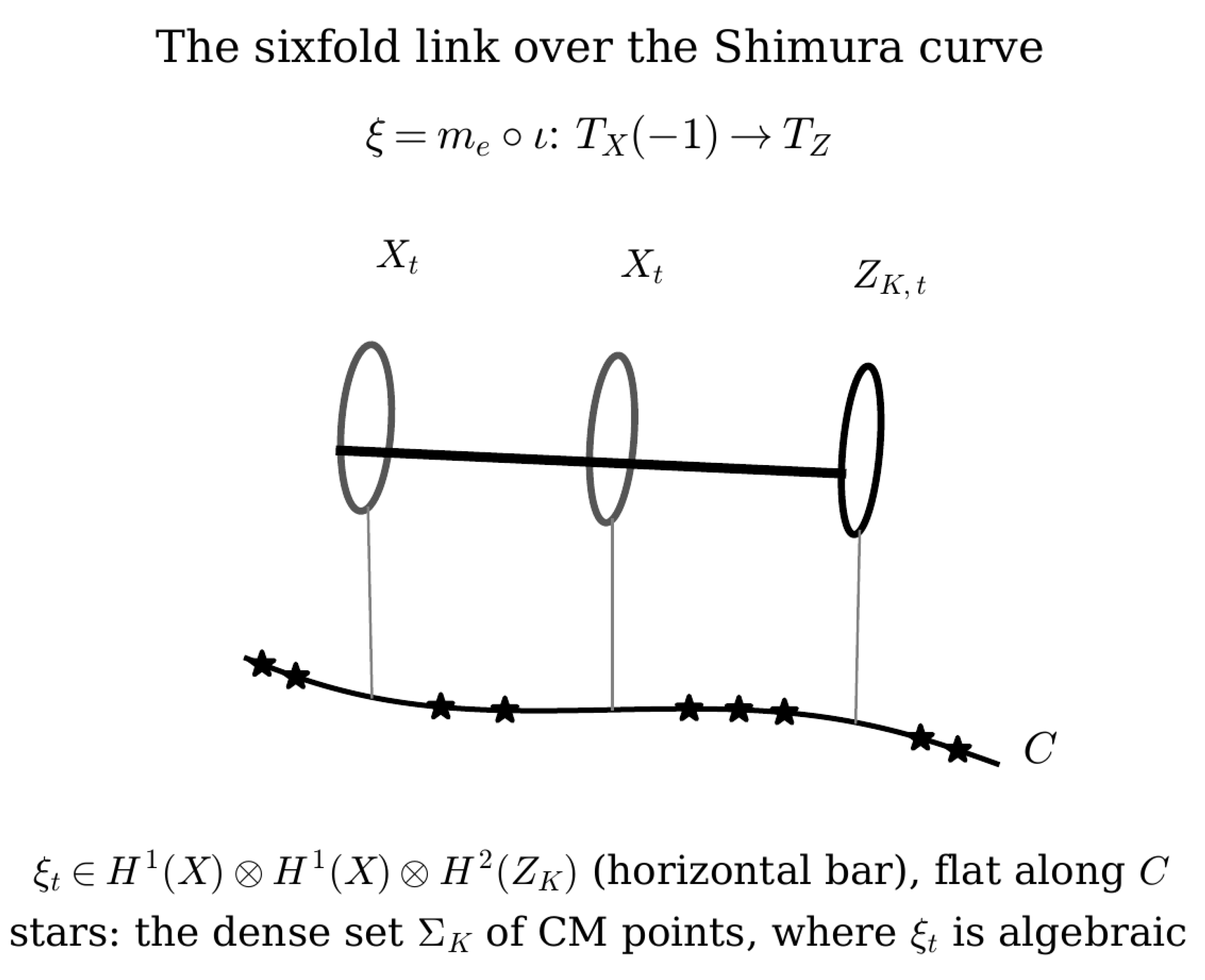
Theorem 37
(The sixfold link). Let be a point at which has Hodge group G, and let ξ be a nonzero element of .
- (i)
- for the identification ι of Lemma 36, so for a unique . The -invariant classes of degree four on have dimension 26; they are Hodge classes at every t, at a very general t they are all the Hodge classes of degree four, and there ξ and are the only ones in the Künneth component .
- (ii)
- If ξ is algebraic, then , the composite with the adjoint for the Lefschetz pairing on and the intersection pairing on , is an algebraic endomorphism of equal to with , .
- (iii)
- For every the pull-back acts on by ; so the real multiplication of by F is algebraic, for every K.
- (iv)
- If ξ is algebraic, the algebraic operators , , span on ; the exceptional classes of are algebraic at t, and so is every Hodge class on every power of X. This holds for every CM extension of F.
- (v)
- Conversely, if the exceptional classes are algebraic and some algebraic cycle on acts nonzero on , then every ξ is algebraic.
Proof.
(i) The Hodge group of lies in and maps onto ; it acts on and on through that image, since acts trivially on both. Both are the irreducible G-representation T with Proposition A21, so . The count is the dimension of the kernel of the six raising and lowering operators of on the torus-weight-zero part of , computed by Künneth type: gives , the line and ; gives , the Hodge classes of in ; gives ; and give 3 each; and , , , one each, products of divisor classes. The sum is 26. The Hodge group of the product lies in , so these 26 classes are Hodge classes at every t, and 26 is a lower bound for the Hodge classes of degree four. At a very general t the argument of Lemma 35, applied to the family over C, whose monodromy is again Zariski dense in G, gives Hodge group exactly , and then the 26 classes are all of them; the description of the Künneth component follows.
(ii) The adjoint of a correspondence for the Lefschetz pairing on and the polarised intersection pairing on is the transposed cycle composed with cup products with powers of the polarisations and the inverse Lefschetz isomorphism, which is algebraic on an abelian variety [63, §2]; so is algebraic. By Lemma 36, carries and carries a rational multiple of , and for , , so .
(iii) Right multiplication by K on commutes with the Hodge structure (Setting 6), so . An element is central in D, so it acts on by the scalar , and on by ; that is, . If is an endomorphism for an integer , then is a rational multiple of the action of the graph, hence algebraic.
(iv) By (ii) and (iii), is algebraic, and since commutes with it equals on , and zero on the complement of in , because lies in . The squares span F over , as , so these operators span . Let . Compose with the product map and its adjoint, both built from , the diagonal and and hence algebraic Lemma A27: the composite acts on the primitive part U of by the element of F, irrational when x is. With the identity and the projector onto this generates , so by Proposition A21 the exceptional classes of are algebraic, and then every Hodge class on every power of is algebraic by Theorem A24. The classes are flat along C, but by Lemma 2 algebraicity at t gives algebraicity on the stratum through t and, through the Hecke correspondences of C, on a countable dense set; whether some stratum is all of C is not decided by this argument, so the conclusion is stated at t.
(v) By Theorem A24 the Hodge conjecture holds for all powers of X once the exceptional classes are algebraic. A cycle on acting nonzero on the irreducible carries it isomorphically onto a summand of ; projecting onto that summand and composing with an isomorphism to , a Hodge class on and algebraic, gives an algebraic nonzero element of ; composing with the algebraic , , gives every element of that line, and transposing gives every . □
So the real multiplication of T is algebraic on the side of for every , and the open problem is only to transport it to X. The hypothesis on the exceptional classes in (v) is removed by the next theorem, which uses the motivic Galois group. For an abelian variety Y the Lefschetz standard conjecture holds and homological and numerical equivalence agree [72], so the homological motives generated by Y form a semisimple [61] neutral Tannakian category with the Betti fibre functor, after the usual change of the commutativity constraint by the algebraic Künneth projectors [63]. Its group is reductive, contains the Mumford–Tate group , commutes with , and for all the algebraic classes in are its invariants; hence if and only if the Hodge conjecture holds for all powers of Y. We write for algebraic classes and for Hodge classes.
Proposition 41
(Powers of ). At a point t at which has Hodge group , in particular at a very general point, the ring of Hodge classes of is generated by divisor classes for every , and the Hodge conjecture holds for all powers of . At every , lies in the image of .
Proof.
Over the group is with two-dimensional, and since is self-dual; so . By the first fundamental theorem for [41, App. F] the invariants in a mixed tensor power of the and are spanned by complete contractions. The exterior algebra is a quotient of the tensor algebra and taking invariants of a reductive group is exact, so the invariants in are spanned by products of invariants of degree two. These are the Hodge classes of degree two, which are divisor classes, so the Hodge ring is generated by divisors, and the Hodge conjecture follows by the Lefschetz theorem. At every t, and the three forms of Lemma 35 are algebraic, so lies in the group of K-linear g with for all c; over this is restricted to a common , connected of dimension 13, and it contains the connected image of , of dimension 13; so the two coincide. □
At a very general point for , and for (Appendix C).
Theorem 38
(The link is all or nothing). Let with , , for a CM extension of F, and let be the image of . The following are equivalent.
- (i)
- Some nonzero link class is algebraic.
- (ii)
- Every link class is algebraic.
- (iii)
- For some some algebraic cycle on acts nonzero on , that is, is isomorphic, as a homological motive, to a direct summand of some .
- (iv)
- Every -invariant class on every is algebraic.
Each of them implies that the exceptional classes of are algebraic. If moreover t is very general, they are equivalent to
- (v)
- for some there is an algebraic class on outside ,
and exactly one of the following holds:(I)every Hodge class on every is algebraic;(II)for all the algebraic classes on are exactly . Case(I)holds if and only if one is algebraic.
At a very general t the -invariant classes are all the Hodge classes, so (iv) is the Hodge conjecture for all .
Proof.
Put and , a subgroup of the fibre product over the Tate character that surjects onto both factors and contains ; is the representation.
Step 1. (i)⇒(iii): is such a cycle, with . (iv)⇒(ii)⇒(i): the are -invariant.
Step 2: (iii) implies . Let be the nonzero morphism of motives. is a simple Hodge structure, T being irreducible for G, so is an isomorphism onto a submotive , and , , is an algebraic action of F on by Theorem 37(iii). So is an N-stable subspace on which N commutes with F and acts by the adjoint representation. Let . As V is irreducible for , the centre of the reductive algebra acts by scalars in , hence is zero, and is semisimple. Over , with the eigenspaces of F, each -stable of dimension three, with acting on as and trivially on , . The image of in is semisimple and contains , a maximal subalgebra of , so it is or , the same for all i since the Galois group permutes the i transitively and is defined over . If it were , the image of in would surject onto each factor and contain ; then meets the i-th factor in an ideal containing , so , of rank six, impossible for a quotient of a subalgebra of , of rank four. So the image is , the image of , and with the kernel and . The irreducible faithful -module V is with B a faithful irreducible -module, so , and . Hence and . An element normalises and preserves each , hence each ideal ; automorphisms of are inner, so for some g, and centralises , hence is a scalar. Thus , the Hodge conjecture holds for all powers of X, and the exceptional classes are algebraic.
Step 3. (iii)⇒(ii): by Step 2 the exceptional classes are algebraic, and Theorem 37(v) gives every .
Step 4. (i)⇒(iv). By Step 2 and Proposition 41, , and H fixes up to the Tate character. Over an element of is with , and ; it acts on by and on by , and with commuting with . So it fixes if and only if , that is with in the centre of G. On D a central element is right multiplication by the element of , and on D is the element of ; so with , an element of . Hence , and the algebraic classes, the H-invariants, contain the -invariants.
Step 5: t very general. Then by Proposition 41, , and is the image of . Let , a normal subgroup of . If then , and the algebraic classes in are the invariants of , that is : this is (II), which contradicts (v). If , then from and we get for all , hence and . Otherwise is a proper normal subgroup of the -simple group G, hence finite, is a central torus, and for the map is a homomorphism from the connected group to a finite group, hence trivial; so lies in the centre, which acts on trivially. Then the representation of H on factors through , that is, the motive lies in the Tannakian subcategory generated by and is a direct summand of some : this is (iii), and (I) holds by Steps 2 to 4. So (v) implies (iii), and if (iii) fails then (II) holds. The cases (I) and (II) exclude each other, and (i) implies (v), because : its component on the side of Z lies in , which contains no Hodge class. □
At a very general point the counts of Hodge classes on , against those of , are , , , in degrees on , , , in degrees on , and , in degrees on (Appendix C); by Theorem 38 all the mixed classes are algebraic as soon as one is, and in case (II) none of them is. The first mixed classes on itself live in degree six, through the primitive part U of rather than through T.
Theorem 39
(The tenfold link). Let be the primitive part, over the sum of the , , and let F act on U by , with on .
- (i)
- The -invariants of contain each exactly once, inside , and their sum is a rational sub-Hodge structure isomorphic to . At t with , ; through the polarisation of its elements are Hodge classes . At a very general t the Hodge classes in this Künneth component are , of dimension , and the Hodge classes of of degree at most four are sums of products of classes of the two factors.
- (ii)
- acts on by , and these elements span F over .
- (iii)
- If one nonzero η is algebraic at a point t with , then F acts algebraically on , the exceptional classes of are algebraic, and the Hodge conjecture holds for all powers of .
- (iv)
- At a very general t, is algebraic if and only if is, if and only if the Hodge conjecture holds for all .
- (v)
- For and every is algebraic.
Proof.
(i) The G-type needs even degree in and in and none in , so it can only occur in , whose -invariants are by Lemma 36(i); this contains once, and it is the image of under the cup product. The Galois group permutes the places, so is defined over ; acts trivially, and the Hodge structure is induced by as in Lemma 36, which gives by weight. The are pairwise non-isomorphic irreducible G-modules, so over and the Hom space is an F-line. The dimension counts are computed in Appendix C.
(ii) acts on by . The -span of the multiplicative set is a subalgebra, hence a subfield of F; it is not , since forces and then , a cubic field having no quadratic subfield. So it is F.
(iii) The adjoint for the polarisations is algebraic on abelian varieties, is nonzero because is injective and the polarisation forms are definite on each Hodge type, and ; by (ii) these span . With the identity and the projector onto this is ; conclude by Proposition A21 and Theorem A24.
(iv) If is algebraic, Theorem 38 gives every Hodge class on . Conversely is an algebraic class on outside , since contains no Hodge class, so (v) of Theorem 38 holds.
(v) Theorem 41(iii). □
Proposition 42
(Hyper-Kähler carriers give ). Let be projective hyper-Kähler varieties of type whose transcendental spaces are Hodge isometric to , , totally positive. Every composite of rational Hodge isometries between them that returns to acts on T by , and every composite of Hodge similarities by an element of .
Proof.
A Hodge isometry is a Hodge endomorphism of T, hence for some , and it is an isometry iff . A composite returning to j is with , and a composite of similarities is with , which in a cubic field forces . The isometries are algebraic by [26,77], which is why the statement matters: they realise between and and between their moduli spaces of sheaves, but every return is trivial. □
6.15. The Link at the Points of Complex Multiplication
The class is flat along C, so the natural first test of Theorem 37 is the countable set of special points. When K contains an imaginary quadratic field the test succeeds on a dense set, with published inputs only.
Setting 7
(CM conventions). Let with imaginary quadratic. Fix ; the embeddings of K are , restricting to on F and to ι on k, and their conjugates , . Let E be an elliptic curve with complex multiplication by k, of type , and A an abelian threefold with complex multiplication by K of type . The type is not lifted from k, so A is simple; E and A are determined up to isogeny by their types. Let be the set of points whose CM field, the F-subalgebra of D generated by the stabiliser torus, is F-isomorphic to K.
Theorem 40
(Hodge classes on ). Let k act on through on A and through the complex multiplication on E.
- (i)
- is an abelian fourfold of Weil type: the ι-eigenspace of k on is spanned by of type and of type , and its Weil plane satisfies with .
- (ii)
- For all the ring of Hodge classes of is generated by divisor classes and the classes , , .
- (iii)
- B carries a k-compatible polarisation of discriminant one. Hence is algebraic [76, Thm. 1.5], and the Hodge conjecture holds for every .
Proof.
(i) A vector of the -eigenline of of a CM abelian variety has type exactly when lies in the CM type; read this off and . The Rosati involution of any polarisation of a CM abelian variety is complex conjugation on its CM field, so the product polarisation is k-compatible.
(ii) has the basis (, an embedding of K) and (, ), eigenvectors of the torus with pairwise distinct characters on wedge monomials. The Hodge classes are stable under this torus, hence spanned by the monomials they contain, and a monomial is a Hodge class iff all its Galois conjugates have type [100]. For a monomial with factors resp. and factors resp. put and . The conjugates of are , , and their complements; the type condition for a conjugate and its complement gives by subtraction for , hence . So a Hodge monomial is, up to sign, a product of conjugate pairs , and of quadruples or . For fixed the span of the pairs is Galois stable and of type , hence spanned by divisor classes. For , the homomorphism has and , so the coefficient of the quadruple with indices in is . These are distinct monomials in the coordinates of , linearly independent as functions on its Zariski dense set of rational points; so the , span all quadruples.
(iii) and , all k-compatible; positivity is a sign condition on a at the three real places. The hermitian form of on the k-space is, up to a rational multiple, ; on the k-basis of K given by a -basis of F the first block is the rational matrix , of determinant up to a square. So the discriminant is , and , which has the sign required for positivity, makes it trivial. The hypotheses of [76, Thm. 1.5] are signature , compatibility and discriminant one; they hold. Pull-backs and products of algebraic classes are algebraic, so (ii) gives the rest. □
Theorem 41
(The link on a dense set of special points). Let as in Setting 7.
- (i)
- is countable and dense in .
- (ii)
- For , and . In particular .
- (iii)
- For and all the Hodge conjecture holds for . Every link class and every exceptional class of is algebraic.
Proof.
(ii) First let be a fixed point of . Write with . Left multiplication by and right multiplication by act on K by and on by , so both summands are sub-Hodge structures stable under the right action of K, and with CM threefolds for K. In the notation of Setting 6 the right -eigenline of K is and that of is , where is the character of the left torus. Type sits on , and , with the -line, according to the fixed point. So the CM types are and (, ). One is the lift of , giving ; the other is the conjugate of , giving A after twisting the action by complex conjugation. For : the torus acts on through G with the eight distinct characters , , so is a commutative étale algebra of degree eight commuting with the Hodge structure. The Galois orbits of the sign vectors are , with stabiliser , and the other six, with the stabiliser of fixing the index 3; so and . The character has type iff ; for the type of is and that of is , and gives the conjugate types and the same isogeny classes. For general the CM field is , , by Skolem–Noether; left multiplication by commutes with the right K-action and carries to for a fixed point , and the representation of G on V extends to , so both and are isomorphic to their values at .
(i) By Skolem–Noether every F-embedding of K in D is conjugate to the given one, and has exactly one fixed point in the upper half plane, since makes a compact torus in . So consists of images of fixed points of the countably many tori , , and is countable; it contains the images of the points with and , the fixed points of in the upper half plane. is the set of F-points of a Zariski open subset of affine four-space and is dense in , so these g are dense in , which acts transitively and continuously on the upper half plane; the orbit of is dense, and so is its image in C.
(iii) By (ii), ; apply Theorem 40. The classes and the exceptional classes are Hodge classes at every t (Theorem 37(i)). □
Table 7.
The link class along the Shimura curve C. “Algebraic” means proved here with published inputs; the alternative of Lemma 2 says the algebraic locus of is C or countable.
Table 7.
The link class along the Shimura curve C. “Algebraic” means proved here with published inputs; the alternative of Lemma 2 says the algebraic locus of is C or countable.
| Points | Decomposition of , | Status of |
|---|---|---|
| , | , | algebraic (Thm. 41) |
| CM, field , | powers of algebraic; open | |
| CM, field without imag. quadr. subfield | simple, octic | open (degree-12 Weil class) |
| not CM (Prop. 44) | simple, | open; equivalent to for all (Thm. 38); implied by one algebraic (Thm. 44); not reached by divisors, Weil classes and homomorphisms (Prop. 45) |
Neither link is reached at a very general point by the published algebraicity theorems, which produce Weil classes and pull-backs of them, or work through hyper-Kähler varieties.
Proposition 43
(No Weil class and no hyper-Kähler carrier). Let t be very general.
- (i)
- Let be a number field, an abelian variety with and free of rank r over , , and a homomorphism. Then , or lies in a sum of Künneth components with . Consequently ξ is not in the algebra generated by divisor classes and all such pull-backs, and neither is η.
- (ii)
- is not of Weil type, its signatures at the three places being , , , and for an imaginary quadratic has signature .
- (iii)
- No projective hyper-Kähler variety of generalised Kummer type or of OG6 type has a transcendental Hodge structure containing T.
Proof.
(i) X is simple with [87], and is the commutant of in , which is the field K, so is simple; . preserves the isotypic decomposition into powers of X, powers of and the rest, so as -modules of ranks , and . The homomorphism f has zero component into , so unless . If with , then , so is an -vector space, , and . So the degree of in the variables of X lies in . In degree four the generators are divisor classes, which are sums of classes pulled back from the two factors since , and pull-backs of degree four, which have X-degree zero; so the degree-four part of the algebra lies in , while has its component in and . In degree six on a product of generators has X-degree two only if exactly one divisor class of X occurs among its factors, so the component in lies in , while and .
(ii) The -eigenspace of is , of type for and of type for (Setting 6); for k add over the three places.
(iii) A variety of generalised Kummer type has and one of OG6 type , and a projective variety has Picard number at least one, so the transcendental rank is at most six or seven, while T has rank nine. □
By (iii), the constructions of Floccari and Fu through varieties of OG6 type [39] and of van Geemen and Rapagnetta through hyper-Kähler sixfolds of K3[3] type [119], which start from an abelian fourfold of Weil type of discriminant one, do not apply at a very general point, where ; at the points of complex multiplication of C, where is of Weil type (Remark 15), they give a second proof of the Hodge conjecture for the powers of when the discriminant is one. For and and the quaternion algebras of the triangle groups and , ramified at two real places, Bouchet, Hanselman, Pieper and Schiavone write down two explicit families of curves of genus four over whose Jacobians are Mumford fourfolds [16]; so for these the fourfolds of this section are Jacobians of explicit curves, and Theorem 14 settles (F3′) for the corresponding K3 surfaces , while the exceptional classes of remain open.
Remark 15
(Every special point, and the residual class). At any CM point t with CM field , as Hodge structures, consists of Hodge classes, and with a sum of products of divisor classes and ; so is algebraic iff is. The fourfold is always of Weil type: contains when , with signature , and the computation of Theorem 40(ii) shows that the Hodge ring of every power of is generated by divisors and pull-backs of its Weil plane. The Hodge conjecture for all powers of then follows from [76, Thm. 1.5] whenever carries a -compatible polarisation of discriminant one, which julia/mumfordresidual.jl exhibits for , and the cubic field of discriminant 148, and at every point of complex multiplication from Markman’s theorem for all abelian fourfolds of Weil type [78,79]. When L has no imaginary quadratic subfield, is equivalent to a single Hodge line over the degree-twelve CM field , the pull-back of a Weil class for M on an abelian variety isogenous to with ; no algebraicity theorem covers Weil classes for CM fields of degree larger than two, and [80] sets up this case without closing it.
6.16. Non-Special Points, a Squaring Lemma and a Third Link
The statements made above at a very general point hold at every point of C that is not a point of complex multiplication, and the middle cohomology of carries a canonical tensor decomposition that gives a third link class, with an explicit geometric prediction in the families of [16]. We call a CM point if is a torus.
Proposition 44
(Every non-CM point is generic). Let not be a CM point and a CM extension of F. Then , and . Hence Lemma 35 with , Proposition 41, the counts of Theorem 37(i), the statements of Theorem 38 for a very general point, Theorem 39(i) and Proposition 43 hold at t.
Proof.
is a connected reductive subgroup of containing the weight, and its derived group H is a connected semisimple subgroup of G. Over , , and a connected semisimple subgroup of with nontrivial projections is a product of copies of , each embedded diagonally, through isomorphisms, into the factors of one block of a partition of ; the projections of H are all trivial or all nontrivial because permutes the three factors transitively, and the partition is Galois stable, hence or , as a transitive subgroup of contains a three-cycle. In the diagonal case the components of the Hodge cocharacter in at the three places are identified by isomorphisms, but is nontrivial only at . So , and t is a CM point, or . For : (Setting 6), and its image in contains the image of , whose Mumford–Tate group is ; so maps onto and equals G. Its image in the torus contains the images of the weight and of , which generate that torus by the proof of Lemma 35. So . Finally maps onto , and the kernel of is finite (an element acting trivially on D acts on V by a sign, as in Step 4 of the proof of Theorem 38); both groups are connected of the same dimension, so they are equal. The cited statements use only these groups. □
Since the families descend to a number field, the algebraic locus of a flat class such as is C or a countable union of points defined over (Lemma 2); so algebraicity of at one point outside is equivalent to algebraicity on all of C.
Over write for the eigenspace of the right action of K on D for an embedding of K, so and with , the embeddings above . A CM type of K is a choice of one embedding above each ; put and .
Theorem 42
(Tensor decomposition of ). Let be any point, and .
- (i)
- The V-isotypic part Π of for the action of G is a sub-Hodge structure of dimension 64, and over the eight CM types.
- (ii)
- is a sub-Hodge structure of of dimension 8, of CM type, of weight two, with Hodge numbers , and evaluation is an isomorphism of Hodge structures. Over , with K acting on the line by , of type for .
- (iii)
- The Hodge structure does not depend on t: it is the space of flat sections of over a finite cover of C.
- (iv)
- If as in Setting 7 and , then is defined over , of type , and , the transcendental part of , for every elliptic curve E with complex multiplication by k. Hence , and is a direct summand of at every .
Proof.
(i) Over , with . As a G-module is the standard representation of the factor above , so and are trivial; a summand is isomorphic to exactly when for one above each and otherwise, that is, when it is . V is defined over as a G-module, so is defined over ; it is stable under , G and the commuting torus , hence under , so it is a sub-Hodge structure. (ii) The Hodge structure of is given by a cocharacter of , in which G is normal, so the G-invariants of form a sub-Hodge structure on which acts through the torus : it is of CM type. V is absolutely irreducible with , so and evaluation is an isomorphism of G-modules and of Hodge structures. Right multiplication by K acts by endomorphisms of Z, hence on M by Hodge endomorphisms, with the eight distinct characters . The factor of above , , has type if and otherwise, and the factor above carries the Hodge structure of ; so and has type . Two types have , two have and four have . (iii) Over a finite cover of C carrying both families the monodromy is an arithmetic subgroup of , acting through on and by left multiplication on D, Zariski dense in G; so the flat global sections are the G-invariants , and by the theorem of the fixed part [4,33] they form a sub-Hodge structure independent of t. (iv) . The Galois group permutes the when it fixes k and maps to otherwise, so is a Galois orbit and is defined over ; by (ii) it has type on and on . acts through , which spans k, so is a one-dimensional k-vector space with k acting on its -line by . The same holds for , spanned over by and , with k acting on the first factor; a weight-two Hodge structure on a one-dimensional k-vector space with is determined by the embedding acting on , and replacing that embedding by its conjugate does not change the abstract Hodge structure. So , and evaluation gives . Hence , using the polarisation. is a direct summand of , , and polarisable Hodge structures are semisimple, so is a direct summand. □
At a point that is not a CM point there is no Hodge class in itself (Appendix C.5): the twist by is needed.
Theorem 43
(Squaring lemma). Let X be a Mumford fourfold with , Y an abelian variety such that every Hodge class on every power of Y is algebraic, and B an abelian variety of CM type. Suppose that an algebraic class γ on acts nonzero on , that is is nonzero.
- (a)
- Every Hodge endomorphism of is algebraic as a class on ; the exceptional classes of are algebraic, and the Hodge conjecture holds for every power of X.
- (b)
- If and at a point t that is not a CM point, then the link classes are algebraic, and the Hodge conjecture holds for every .
Proof.
The Künneth projectors are algebraic, so we may take a component on which is nonzero, a Hodge class in up to a Tate twist. Let and its derived group. Then maps onto , acts trivially on N because its image in the torus is trivial, and fixes . Put , a sub-Hodge structure as is normal in , and let be the inclusion of the V-isotypic part (V is absolutely irreducible for ). As N is -trivial, ; write . A polarisation of N is algebraic on , the Lefschetz decomposition and pairing being algebraic on abelian varieties. A polarisation of U is -invariant, the V-isotypic part is orthogonal to the others, and there , since the invariant bilinear forms on V are ; the Weil operators satisfy , so polarises R.
Let . It is the action of the class obtained from on by intersecting with and pushing forward, so it is algebraic and a morphism of Hodge structures, and with . Contracting s with gives , nonzero by the Hodge–Riemann relations, since is a nonzero rational class of type in the polarised Hodge structure . So , and c is injective.
(a) The adjoint for the polarisations of and is algebraic, by the Lefschetz theory on [63,72] and by the hypothesis on Y. The Hodge endomorphism of is positive definite for , hence invertible, and its inverse is a polynomial in it. For the class is a Hodge class on , hence algebraic, and . In particular the operators , , on , extended by zero on the other isotypic parts, are algebraic: these are the exceptional classes, and Theorem A24 gives every power of X. (b) Now , and (Lemma 36). By semisimplicity a nonzero Hodge morphism extends to a Hodge morphism , a Hodge class on , algebraic by Propositions 44 and 41. The algebraic morphism from to is G-equivariant, so it vanishes on the isotypic parts of other than T, which occurs once; it is a nonzero element of (Theorem 37(i)), an algebraic . Theorem 38 gives the rest. □
The hypothesis that B is of CM type is what makes act trivially on N; for and the diagonal one has .
Theorem 44
(The third link). Let and E be as in Setting 7, and for let be the space of flat Hodge classes in , suitably twisted; write for a nonzero element.
- (a)
- Through , the maps , , with a basis of and the dual basis, lie in and form a two-dimensional space of flat sections, of Hodge type at every t; at a point that is not a CM point it is the space of all Hodge classes in that Künneth component. Every is injective on .
- (b)
- For every is algebraic.
- (c)
- At a point t that is not a CM point, if one is algebraic then every link class is algebraic, the exceptional classes of are algebraic, and the Hodge conjecture holds for every .
- (d)
- At a point t that is not a CM point, is algebraic if and only if every Hodge class on every is algebraic. In particular, if is algebraic then so are the Weil classes of the abelian tenfold , with k acting through K on and by the conjugate of the complex multiplication on E, of signature .
- (e)
- The algebraic locus of γ is C or a countable dense subset containing .
Proof.
(a) By Theorem 42(iii), (iv) these maps correspond to the elements x of through evaluation, so they are flat, and they are Hodge classes because is a sub-Hodge structure on which k acts by Hodge endomorphisms. The count at a point that is not a CM point is in Appendix C.5. There is simple, so is injective; at the other points is the flat transport of an injective map. (b) By Theorem 41(ii), , and Theorem 40(iii) applies. (c) Theorem 43(b) with and . (d) If is algebraic, then by (c) and Theorem 38, and ; so lies in the fibre product over the weight characters. Over , with in the component of and in that of , and P acts on them by characters and , with for . A nonzero rational has both components nonzero, being fixed by complex conjugation, so . Now and maps onto (Proposition 44); is surjective with kernel , so . is connected: the loop with , is closed in , and its lift to through with , runs from the identity to the element of the kernel. Hence , and every Hodge class on every is algebraic. The converse is trivial. has signature (Proposition 43(ii)) and with the conjugate action has signature , so is of Weil type of signature , and its Weil classes are Hodge classes. (e) Lemma 2, (b) and Theorem 41(i). □
The Weil classes of (d) are the first Hodge classes on a product that are not generated by divisors: there is none for and a plane in degree ten for (Appendix C.5). The converse of (d) does not follow from the classes known so far: the element with , fixes every Hodge class on every , lies in , fixes the Weil classes of (d), on which P acts through , and has .
For and , Bouchet, Hanselman, Pieper and Schiavone consider the genus-four curves () whose Jacobians are the Mumford fourfolds over the triangle curves, and the hypergeometric curves and , whose Pryms are isogenous to fourth powers of abelian sixfolds with an action of , resp. ; they conjecture that has a summand isomorphic to , with , elliptic curves with complex multiplication by , [16, Conj. 5.1, 5.2].
Corollary 18
(The conjectures of Bouchet–Hanselman–Pieper–Schiavone, conditionally). Let and assume
- (I)
- for every t there is a point of the Shimura curve of with and , possibly after replacing the action of by its conjugate,
which is what the descriptions of the two period maps in [16, Thm. 1.2, Thm. 4.15, §5.3], together with the results on the hypergeometric families quoted there, give. Then is a direct summand of for every t, which is [16, Conj. 5.1, 5.2]. If at one fibre t that is not a CM point some algebraic cycle on acts nonzero on , for instance a correspondence on inducing the summand composed with the projection to the Prym part, then the exceptional classes of are algebraic and the Hodge conjecture holds for every power of .
Proof.
with , resp. , and embeds in , a CM extension of F embedding in every quaternion algebra over F ramified only at real places. Theorem 42(iv) at gives the summand of , and is a direct summand of , the image of an idempotent of on the Prym part; conjugating the action of does not change . The second statement is Theorem 43(a) with , and , the hypothesis on Y holding by Propositions 44 and 41. □
Neither , nor is reached by the operations that produce the known algebraic classes.
Proposition 45
(No-go for divisors, Weil classes and homomorphisms). Let X be a Mumford fourfold with , and let be the smallest system of subspaces , for all and all abelian varieties Y with , that contains
- (1)
- the divisor classes,
- (2)
- all classes pulled back from Y, algebraic or not,
- (3)
- all with a homomorphism to an abelian variety with an action of a number field for which is free over , and w in the Weil space ,
and is closed under cup products and under pull-back and push-forward along homomorphisms . Then , where acts diagonally on , and is the subalgebra generated by divisor classes. In particular the exceptional classes of , the link classes ξ, η and γ are not in .
Proof.
implies by Poincaré reducibility, and , so a homomorphism is a pair with M an integral matrix and ; and commute with the diagonal . (1) , since , and is -invariant. (2) is clear. (3) with , and preserves this decomposition, so as -modules, with acting on through . For an embedding of the -eigenspace of is , and acts on the line by . The Weil space is spanned over by the lines , so it lies in , and pulls it back into . Cup products and , preserve this subspace. By the first fundamental theorem for [41, App. F] the invariants in are generated by those of degree two, , which are divisor classes. The exceptional classes and have components in , whose -invariants are zero; has its component in , and ; and has degree one in the variables of X, where . □
Proposition 45 contains Proposition 43(i): even the algebraicity of all Weil classes of all number fields in all dimensions would not give , or by these operations. A proof has to produce a cycle whose class breaks the -symmetry, that is, a cycle tied to the geometry of , such as the correspondence of Corollary 18, or a deformation argument from .
6.17. Where the Link Stops
Theorem 37 replaces the Kuga–Satake variety of Theorem A23, of dimension , by an abelian sixfold over the same curve, and it replaces the irrationality that had to be extracted from anticommuting Clifford blocks by the real multiplication of , which is algebraic for every K (Theorem 37(iii)): for every K every link closes the target. By Theorem 38 the sixfold link is all or nothing: one algebraic cycle on some acting nonzero on gives the Hodge conjecture for every , and without it the algebraic classes on these products are exactly . It is an equivalent form of the target, not a reduction to something smaller.
The missing step is the algebraicity of one class at one point of C that is not a CM point; by Proposition 44 every such point behaves like a very general one, and by Theorem 44 one algebraic would suffice. It is exceptional: its component in is the nine-dimensional T, not a multiple of , so it is not invariant under and not in the Lefschetz algebra of (Lemma 1); the theorems that prove the conjecture when the Hodge ring is generated by divisors do not apply, and by Propositions 43 and 45 neither divisor classes, Weil classes for any field in any dimension and homomorphisms, nor hyper-Kähler varieties of Kummer or OG6 type can be fed in: what is needed is a cycle that sees the geometry of , of which the correspondence predicted by Bouchet, Hanselman, Pieper and Schiavone (Corollary 18) is the most concrete candidate; the tenfold link of Theorem 39 is equivalent to and meets the same obstruction. When , Theorem 41 gives on the dense set , so by Lemma 2 the algebraic locus of is either countable and dense or all of C; deciding between the two is the variational Hodge conjecture for one flat section over a curve, and it is open. When K contains no imaginary quadratic field, the smallest open instance is the residual class of Remark 15 at the fixed point of : one Hodge line over a CM field of degree twelve on a tenfold. This is the price of staying inside abelian varieties, and it is the exact statement that (F2) needs at its smallest instance.
Table 8.
Every statement of the paper with its status. “Proved” means proved in the text from the cited results; “open” means not proved here or elsewhere to our knowledge.
Table 8.
Every statement of the paper with its status. “Proved” means proved in the text from the cited results; “open” means not proved here or elsewhere to our knowledge.
| statement | where | status | what it needs |
| ′) | Thm. 1 | proved | – |
| (F3′) for fourfolds with zero-cycles on a threefold | Prop. 3 | proved from [24] | – |
| (F2) ⇔ | Thm. 8 | proved | – |
| six minimal sufficient sets | Prop. 4 | proved, checked in Lean | – |
| dichotomy of the algebraic locus | Lem. 2 | proved | – |
| (F2) as propagation from CM points | Thm. 9 | proved | – |
| Weil loci dense with CM base point | Prop. 6 | proved | – |
| chains make e with algebraic | Thm. 10 | proved | a chain of the right multiplier |
| symplectic chains reach exactly | Prop. 20 | proved | – |
| algebraic on two-dimensional families | Thm. 11 | proved | – |
| , algebraic on one-dimensional families | Thm. 13 | proved | – |
| on all powers and Hilbert schemes of the Fricke surfaces | Thm. 13 | proved | – |
| similarities act by multipliers | Prop. 9 | proved | – |
| finite-group correspondences give abelian E | Prop. 10 | proved | – |
| for , X in the dihedral families | Cor. 2 | proved | – |
| (F3′) for , or , | Thm. 14 | proved | – |
| where the dihedral mechanism stops | Prop. 11 | proved | – |
| (F3′) for , other cubic F or other D | Sect. 5.10 | open | a non-similarity correspondence |
| every in transcendental rank six, on all powers | Thm. 16 | proved from [42] | – |
| which embed in some | Lem. 11 | proved | – |
| : Kuga–Satake, , (F3′) on , | Cor. 3 | proved from [43] | – |
| , Witt index two: the same | Cor. 4 | proved from [43] | – |
| Witt index of the trace form of degree-two real multiplication | Thm. 17 | proved | – |
| families of Witt index two, resp. one, for every real quadratic field | Cors. 5, 6 | proved | – |
| dense curves of Witt index two in every family with real multiplication of degree two | Thm. 18 | proved from [43] | – |
| the Hodge locus of the class on is the Hecke graph | Thm. 19 | proved from [26] | – |
| algebraic points dense in the Hecke family; Shioda–Inose representative | Cors. 7, 8 | proved from [26,81] | – |
| kernels of equivalences, Euler forms, Kummer graphs do not attain the bound | Cor. 9, Props. 18, 19 | proved | – |
| the semiregularity count on | Prop. 16 | proved given (HH), (HH′) | – |
| an object at a point of the Hecke graph with | Sect. 5.10 | open | such an object |
| in rank ; , in rank six: , (F3′) on , | Thm. 12, Cor. 1 | proved from [115] | – |
| reach of symplectic quotients in rank | Prop. 8 | proved | – |
| , Witt index one, , e.g. in Table 4 | Cor. 6 | open | a correspondence not from [43] |
| Hodge classes on all powers of S: E and | Prop. 13 | proved from [116] | – |
| K3 surfaces of Kummer type over : (F3′) and on all powers | Prop. 14 | proved | – |
| Fricke Kuga–Satake fourfold: | Prop. 15 | proved | – |
| for the other surfaces of Sect. 5 | Rem. 2 | open | a cycle on |
| (F3′) in general | – | open | – |
| product object of polarised shape | Thm. 21 | proved | – |
| direct sums never semiregular | Prop. 22 | proved | – |
| annihilator of the secant pieces is the product locus | Thm. 22 | proved | – |
| secant and line-bundle pieces orthogonal | Prop. 24 | false for every realisation | – |
| (P2′) at a product point | Sect. 6.5 | open | of secant sheaves |
| the Ext groups at the CM point | Lem. 15 | proved | – |
| no two-step cancellation of diagonal classes | Prop. 25 | proved | – |
| three line bundles at | Prop. 26 | proved, fail | – |
| isolated Ext blocks at | Prop. 27 | proved, fail | – |
| a threefold piece outside every closed chain | Prop. 28 | proved, fail | – |
| further pieces within one shift of the thirty-two | Cor. 12 | proved, fail | – |
| twists along ; discriminant of | Rems. 7, 8 | proved | – |
| at most five line bundles, any twists, every polarisation | Thm. 23 | proved, fail | – |
| six or seven line bundles; eight outside two arrangements | Lem. 23, Rem. 9 | enumeration, fail | – |
| the rest of the support cuts a threefold in an ample divisor | Thm. 24 | proved | – |
| two threefolds meeting along a surface carry nothing | Thm. 25 | proved | – |
| objects on the thirty-two threefolds of one family | Cor. 13 | proved, fail | – |
| objects on the sixty-four threefolds of both families | Thm. 26 | proved, fail | – |
| a smooth complete intersection cannot carry the rest | Prop. 31 | proved, fail | – |
| an ample divisor in the support empties the localised obstruction | Prop. 32 | proved | – |
| (P2′) at : two arrangements of eight, or ten or more line bundles | Rem. 9 | open | the chain products |
| : shifts in seven consecutive integers | Cor. 16, Thm. A9 | proved, fail (all) | – |
| , : every line-bundle convolution, every placement and group | Thm. A9 | proved, fail | – |
| line-bundle convolutions: pieces off lie on cycles of excess zero | Thm. A10 | proved | – |
| pieces of any kind: convex sets; exclusions (Cor. A4); transverse threefolds with at most multiples of | Thms. A17, A18 | proved, fail | – |
| 260 line bundles at passing every graph test | Prop. A12 | proved, enumeration | – |
| the 260 pieces: Koszul cubes, whole-cube sets (Prop. A13), one generic cube | Thms. A19, A20 | proved, fail; enumeration | – |
| the 260 pieces: the remaining twisting cochains | Sect. A.5 | open | as a function of |
| equivariant criterion; two-shift bounds at | Cor. 11, Thm. A21 | proved from [98]; enumeration | – |
| an étale Prym map of triple covers at genus four | Prop. 39 | proved | – |
| sextic CM fields: the count excludes nothing | Rem. 14 | enumeration | – |
| split -folds give all -folds; odd pieces | Props. 33, 34 | proved from [78] | – |
| Weil classes of sixfolds of CM type | Cor. 15 | proved from [78] | – |
| for sixfolds with CM by a degree-twelve field | Thm. 29 | proved from [78], enumeration | – |
| Markman’s construction gives split forms only; trace form | Thm. 27, Cor. 14 | proved | – |
| Weil classes on the quaternionic loci of every non-split family | Thm. 28 | proved | – |
| the Lemma 11.3 mechanism on eightfolds; integrality on secant planes | Thm. 30, Cor. 17 | proved, fail | – |
| indefinite secant planes miss the polarised Weil eightfolds | Thm. 35 | proved | – |
| Weil classes of a very general non-split sixfold | Sects. 6.9, 6.11 | open | a definite secant plane with [98] or [79, Qu. 11.4], or a decomposition passing Thm. A17 |
| real multiplication of algebraic; one link ⇒ exceptional classes, every K | Thm. 37 | proved | – |
| the link is all or nothing | Thm. 38 | proved | – |
| the tenfold link is equivalent to | Thm. 39 | proved | – |
| link on the dense set , | Thm. 41 | proved from [76] | – |
| no Weil class for any field and no Kummer or OG6 carrier reaches , | Prop. 43 | proved | – |
| non-CM points are generic; as a tensor product | Prop. 44, Thm. 42 | proved | – |
| squaring lemma; one algebraic suffices | Thms. 43, 44 | proved | – |
| the summands conjectured in [16] | Cor. 18 | proved given (I) | – |
| divisors, Weil classes and homomorphisms do not reach | Prop. 45 | proved | – |
| the link at a very general point | Sect. 6.17 | open | a cycle that sees the geometry of |
| dominant maps, blow-ups, derived equivalences preserve the defect | Prop. 47 | proved | – |
| residues of complete intersections | Prop. 48 | proved | rational residues |
| for as a vanishing mass gap | Prop. 49 | proved | – |
| exceptional classes of | – | open | – |
| (F2) in general | – | open | – |
| the Hodge conjecture | – | open | (F2) and (F3′) |
7. What Is Proved and What Is Open
Table 8 lists the statements. Three remarks on what the table says.
The two open statements are not independent problems that happen to add up to the conjecture; they are two halves of one phenomenon. Both say that the algebraic locus of a flat Hodge class, a countable union of closed strata through a dense set of points of complex multiplication, is not meagre. For (F2) the dense set is supplied by explicit cycles at CM points and the first instance is a single class on an abelian fourteenfold or a single Ext group on an eightfold; for (F3′) the dense set is supplied by the K3 surfaces with complex multiplication and by the chains of Section 5, and the first instance is a cubic real multiplication on one K3 surface of Picard number 13, which Theorem 14 supplies for the fields and with the algebra ramified at two real places, and which stays open for every other pair of a cubic field and an algebra.
Each construction of this paper ends at a question with a definite answer. Whether some convolution of the pieces of Theorem 21 has is a finite computation in the Ext algebra of two sheaves on a fourfold; at the point of complex multiplication every group entering it is written down in Lemma 15, Proposition 26 answers it in the negative for every convolution with three powers of L, Proposition 27 answers it in the negative for two threefolds at one shift and for every placement of the thirty-five pieces, Proposition 28 with Corollary 12 for every further piece of positive twist within one shift of the thirty-two, Theorem 23 for at most five line bundles at any twists and every polarisation, the enumeration of Remark 9, with Lemma 23, for six and seven and for eight outside two arrangements, Corollary 13 and Theorem 26 for every convolution of threefold pieces, of one family or of both, at any twists and shifts, and for the configurations left, the two arrangements of eight and ten or more line bundles, with or without threefolds, it is the rank of the products along the chains of Proposition 25 and along the cycles through the line bundles, the support of the object being constrained by Theorem 24 and Propositions 30 and 31. Whether the link is algebraic is a question about one Hodge class on one abelian variety, equivalent by Theorem 38 to the existence of one algebraic cycle on some acting nonzero on ; Theorem 41 answers it on a dense set of special points when K contains an imaginary quadratic field, so that what remains is whether the algebraic locus of a flat class over a curve, known to be dense, is the whole curve. Whether a correspondence acting on otherwise than by a similarity exists is a question about one K3 surface; for or and Theorem 14 answers it, and for every other pair it is open, with Proposition 11 marking the three places where the present mechanism fails. For the Weil classes of sixfolds the line-bundle convolutions at and are excluded for every arrangement and every group action (Theorem A9), and so is the semiregularity mechanism of Markman’s Lemma 11.3 on eightfolds (Theorem 30, Corollary 17), while the secant planes of indefinite classes miss the polarised family (Theorem 35); what remains is an object on a definite secant plane with Perry’s G-semiregularity for an equivariant structure that is not a product (Theorem 33) or an affirmative answer to Markman’s Question 11.4, a decomposition satisfying Theorem A17, which the 260 pieces of Proposition A12 do for every twisting cochain at the level of graphs and which Theorems A19 and A20 decide only for the cochains they cover, or the very general non-split sixfold. For real multiplication of degree two in transcendental rank at least eight, outside in ranks eight and ten and the lattice conditions of Proposition 8, it is an object at one point of the Hecke graph with equal to the bound of Proposition 16, which suffices if the Hochschild inputs (HH) and (HH′) hold (Section 5.10). For the link of a Mumford fourfold it is a cycle that sees the geometry of : divisor classes, Weil classes and homomorphisms cannot produce it (Proposition 45). A negative answer to the first closes that route, as the analogous question on closed; a positive answer to any of them proves the corresponding statement at its first instance.
7.1. Specialisation, Degeneration and Blow-Ups
Three devices are often proposed for passing from the members where a class is known to be algebraic to the others, and we record exactly what each one proves.
Proposition 46.
Let be a smooth projective family over an irreducible base and ξ a flat Hodge class on its fibres.
- (i)
- If is algebraic at the generic point of a curve then it is algebraic at every point of C. The converse implication, from one point of C to its generic point, holds when is the Chern character of a perfect complex whose semiregularity map is injective, and in no greater generality is it known.
- (ii)
- Let be the blow-up of a smooth projective variety X along a smooth closed subvariety Z of codimension c. Then . In particular the Hodge conjecture for is equivalent to the Hodge conjecture for X and for Z, and a blow-up never reduces the defect of a variety.
- (iii)
- For the Weil classes of and the exceptional class of a Mumford fourfold, every degeneration to a fibre with a semistable model on which the limit class is algebraic has its lift to the generic fibre as its missing step, and for the Mumford fourfold no degeneration keeping the class of Hodge type exists, since the Hodge locus of the class is a compact Shimura curve.
Proof.
(i) Specialisation of cycles along a curve [44, Ch. 20] sends an algebraic cycle on the generic fibre to one on each special fibre with the same flat cohomology class; this is the direction used by Schoen’s degeneration and by Proposition 6. In the other direction the algebraic locus is a countable union of closed sets by Lemma 2, and a point in one stratum says nothing about the stratum being the whole base; the one proved lift is the semiregularity theorem of Bloch, Buchweitz and Flenner [11,20], which is the content of Theorem 20. (ii) Manin’s decomposition of the motive of a blow-up [75], , is realised by the algebraic correspondences and , which are compatible with Hodge classes and with algebraic classes; so both the Hodge classes and the algebraic classes of decompose accordingly, and the quotients add. Since every summand is non-negative, the defect of is at least that of X, and a blow-down along a smooth centre Z lowers the defect by exactly that of Z in the shifted degrees. (iii) A flat class has a limit in the limit mixed Hodge structure of a semistable fibre, and on a totally degenerate fibre the graded pieces are combinatorial and every class is algebraic on the components; the return to the generic fibre is the lift of (i), with the same unproved step. For a Mumford fourfold the Hodge locus of the exceptional class is the compact Shimura curve of Proposition A22, which has no boundary, so no fibre at which the class is still of Hodge type degenerates. □
7.2. Dominating Maps, Birational Models and Derived Equivalences
Write for the defect of the conjecture in degree , for the defect of (F3′), and . The conjecture for X is . The following proposition records how the surgeries of birational geometry move these numbers; Figure 14 draws it.
Proposition 47
(Defects under surgery). Let X, Y be smooth complex projective varieties.
- (i)
- If is surjective and generically finite, then and for every p. In particular no blow-up along a singular centre, weighted blow-up, resolution of a modification or finite cover of X has a smaller defect than X.
- (ii)
- If X and Y are birational, then and , ; for the difference is a signed sum of defects , , of smooth projective varieties Z of dimension less than d.
- (iii)
- If induces an isomorphism from onto whose inverse is induced by a cycle, for instance the kernel of an equivalence between the derived categories of X and Y, then and .
- (iv)
- Let be a projective family, smooth over the punctured disc, with a flat Hodge class ξ on the smooth fibres that is algebraic on a crepant resolution of the special fibre , or on the components of a semistable model of . Then ξ is algebraic on for if and only if the specialisation sends an algebraic class to an algebraic class, which is the statement (V) for the family; the monodromy plays no role, since it fixes ξ.
Proof.
(i) is multiplication by the degree, so is an injective morphism of Hodge structures and . If is algebraic then so is ; hence and embeds into . For the same argument applies because of a class reached from an abelian variety is , reached from the same one. The coarse space of a weighted blow-up has quotient singularities and with rational coefficients, so the argument is unchanged there.
(ii) By weak factorisation [3] a birational map between smooth projective varieties is a composite of blow-ups and blow-downs along smooth centres with smooth projective intermediate varieties, and Proposition 46(ii) gives the change of at each step as . For the terms are and , which vanish by the Lefschetz theorem; for they are with , hence with after , and these vanish by hard Lefschetz and Lefschetz on Z.
(iii) By the projection formula sends into , since is a sum of classes of type and cup product and push-forward are morphisms of Hodge structures up to Tate twists; it sends algebraic classes to algebraic classes because is the class of a cycle and the push-forward of a cycle is a cycle; and it sends to by composing correspondences. The inverse does the same in the other direction, so the two total quotients are isomorphic. The kernel of a Fourier–Mukai equivalence and the kernel of its inverse are cycles by Mukai’s and Orlov’s description of the inverse functor [96], which is the equivalence with kernel the dual of the original one shifted by the dimension.
(iv) is monodromy invariant, so by the local invariant cycle theorem it is the specialisation of a class in , which pulls back to or to the components of the semistable model; the hypothesis says that the pulled back class is algebraic there, and push-forward keeps it algebraic on . Cycles specialise from the generic fibre to the special fibre [44, Ch. 20] and not the other way, so the remaining step is exactly the one in the statement. If the limit cycle on lifts to the family, its restriction to has class ; conversely if is algebraic the specialisation of a representing cycle is a cycle on with class the limit of , and the specialisation map sends that class to . The vanishing cycles, on which the monodromy acts, are orthogonal to the invariant part, and is invariant, so no condition on them enters. □
Items (i) to (iii) say that every surgery available in birational and derived geometry carries the defect of X into its output as long as the open class survives there, and loses the class only in outputs of lower dimension, the centres, where it has become a defect of those varieties. Both open statements of this paper sit in degree four, (F2) for the Weil classes and the exceptional classes, (F3′) for the classes of on a K3 surface, and in degree four the defect is a strict birational invariant by (ii) and a derived invariant by (iii); so the open classes are present, and not known to be algebraic, on every birational model and every Fourier–Mukai partner of the varieties that carry them. Item (iv) is the reason that degenerations to products of elliptic curves, where every Hodge class is algebraic [91], do not close (F2): the class returns to the smooth fibre only through (V). Flows of Kähler metrics change no complex structure between their surgeries, and the surgeries themselves are the contractions and flips of the minimal model programme, covered by (i) and (ii); the surgery of Perelman has no counterpart for Hodge structures, since it cuts a manifold along spheres and a Hodge structure has no local pieces to cut.
The devices therefore relocate the two open statements without weakening them. The one true reduction in shape is Theorem 9: the whole of (F2) is equivalent to a lift from CM points along polarised abelian schemes, and the lift along each scheme is a question about one semiregular object at one point.
7.3. Residues and Mass-Minimising Currents
Two analytic descriptions of algebraic classes are exact, and we record what each reduces the conjecture to. The first is Griffiths’ residue calculus on hypersurfaces [48]. For a smooth hypersurface of even dimension and degree d, with Jacobian ring and , the residues of the forms identify with .
Proposition 48
(Residues of complete intersections). Let be as above, and suppose that with a complete intersection of codimension in whose ideal is generated by the .
- (i)
-
Let θ be the hyperplane class and the Jacobian determinant of , a polynomial of degree . Then[122, Thm. 1.1].
- (ii)
- Let be the span of the classes of the determinants over all such decompositions of F. If the rational span of the residues of and contains , the Hodge conjecture holds for X.
Proof.
(i) is the cited theorem; the degree of the determinant is . (ii) By (i) every residue of an element of is a rational combination of and of classes of complete intersections in X, so it is algebraic. The Hodge conjecture for a hypersurface holds outside the middle degree by the Lefschetz hyperplane theorem, and in the middle degree it is the statement that consists of algebraic classes. □
The proposition replaces a cycle by a polynomial, and the open step becomes the statement that the polynomials of have enough rational residues. Deciding whether a given element of has a rational residue requires its periods, so the residue calculus moves the conjecture from cycles to transcendental numbers without closing it. On a Fermat hypersurface the linear subspaces cut out by , , are of this form, since factors into linear forms; whether their residues and those of the other decompositions exhaust is again a question about periods.
The second description uses currents and is the analogue for cycles of the flows of geometric analysis. Let X be a smooth complex projective variety of dimension N, h an ample class with Kähler form , and . For let be the infimum of the masses of the integral currents in , put , and call the gap of . We identify with by Poincaré duality.
Proposition 49
(Mass-minimising currents).
- (i)
- Every class β contains an integral current of mass , and , with equality if and only if β is the class of an effective algebraic cycle with integer coefficients.
- (ii)
- Let . The image of α in is algebraic if and only if for some integers and .
- (iii)
- There are X and α with for every although for some : for a very general hypersurface of degree D divisible by for an integer prime to 6, , and the generator α of .
Proof.
(i) By the compactness theorem of Federer and Fleming [40] the integral currents in of mass at most form a compact set for the flat topology, and mass is lower semicontinuous, so the infimum is attained. For an integral current T in , Wirtinger’s inequality, that has comass one with equality exactly on the complex -planes with their canonical orientation, gives , the last value depending only on because is closed [53]. If equality holds, T is calibrated by , hence a closed positive current of bidimension [53], and by King’s theorem [62] a closed positive integral current of that bidimension is with positive integers and irreducible analytic subvarieties, which are algebraic by Chow’s theorem. Conversely, for an effective cycle the tangent planes of the smooth locus of each are complex, so the current has mass and .
(ii) If , then is the class of an effective cycle by (i), and in . Conversely let be rationally algebraic, so that is a torsion class for an integer and effective cycles ; multiplying by its order, in . Write . For r large the ideal sheaf of each twisted by is globally generated, so p general members of containing meet in a complete intersection of codimension p containing , and ; the cycle of minus is effective. Then , effective, and (i) gives with .
The analytic part of the variational approach is therefore complete. A minimiser exists in every class without any flow, so a mass-decreasing flow of a cycle, with whatever surgeries along its singularities, can at best reach it; what such a flow cannot provide is the equality case, and the equality case is the whole conjecture: by (ii) the Hodge conjecture for a class is the vanishing of the gap of for one pair . Part (iii) shows that the multiplier e cannot be omitted, since integral minimisers of a class that is rationally algebraic need not be calibrated for any k, and so no argument by integral currents alone, including one modelled on Ricci flow with surgery, proves the conjecture without passing to rational coefficients. For the Weil classes of and the exceptional classes of a Mumford fourfold the gap of is not known to vanish for any .
Apart from Proposition 16(b),(c), Corollary 18 and Remark A4, which name their hypotheses, nothing in the paper assumes an open statement, and the statements that rest on an enumeration are marked as such. The machine checks of Appendix D recompute the finite quantities; beyond those enumerations they do not carry any proof.
Funding
No funding of any kind, internal or external, was received for this work. The authors met its costs themselves.
Institutional Review Board Statement
The work raises no ethical question; it involves no human participants, no animals and no personal data.
Data Availability Statement
No data were generated. The Lean 4 file and the Julia checks of Appendix D are in the repository github.com/creelie/fermat-hodge- [9]. Nothing in the paper rests on them: every statement proved in the text has its proof there, and the statements obtained by enumeration are marked as such.
Conflicts of Interest
None of the authors has a competing interest, and neither do the institutions with which they are or were affiliated, which had no part in the work.
Appendix A. Weil Classes, the Polarised Criterion and Mumford Fourfolds: Statements and Proofs
This appendix states and proves the results on Weil classes, on the polarised semiregularity criterion, on convolutions of line bundles, on the closure graph, on Mumford fourfolds and on K3 surfaces with real multiplication that the body of the paper uses. It is self-contained apart from the published literature it cites. The numbering is that of the appendix; the notation is that of the paper, with the additions fixed in each subsection.
Appendix A.1. Abelian Varieties of Weil Type for a CM Field
Setting 8
(Weil type for a CM field). Let F be a CM field of degree with maximal totally real subfield , and write for the nontrivial automorphism of , which is complex conjugation under every embedding. The real places of are , and each extends to a conjugate pair of embeddings of F into . Let V be an F-vector space of dimension , let be a nondegenerate hermitian form, F-linear in the first variable, and fix a totally imaginary , that is . Put
a nondegenerate alternating -bilinear form with . For each τ let , a vector space of dimension over , and let be the signature of the hermitian form induced by H on it. We say that is of-Weil typeif for every τ, and we call the class of in its discriminant δ; it is totally positive. A polarised abelian variety of dimension with and as F-modules with polarisation E is of -Weil type when is. We work throughout with ; a complex structure on is the same datum as one on the tangent space. The Weil classes of A are
the -subspace whose complexification is , where runs over the eigenspaces of F on ; it is a one-dimensional F-vector space, of dimension over . Write
: every abelian variety of -Weil type has algebraic Weil classes.
The period domain is the set of complex structures J on commuting with F and polarised by E, and the group acts on it. We fix an arithmetic subgroup and write for the quotient, for the projection, for the universal family and for the set of s at which is algebraic.
Definition A1
(The imaginary quadratic case). For the field is imaginary quadratic and . We then write for the two eigenspaces of K, for the two-dimensional rational space of Weil classes, for the class of the polarisation E, and . We fix generators of the lines , so that ; a real class of is once . Since , the form E vanishes on and on , so
and H identifies with the dual of as a representation of .
Theorem A1
(The Hodge ring in the imaginary quadratic case). Let A be an abelian -fold of Weil type for the imaginary quadratic field K with . Then
that is, the space of Hodge classes of degree is for and for . The equality holds for every abelian variety of Weil type for K.
Proof.
The Hodge classes are the invariants of in , and taking invariants commutes with extension of scalars, so we compute the invariants of in
An invariant is a vector of weight zero. Fix a basis of , the diagonal torus, and for the monomials in the basis and its dual. The weight of is modulo , with entries in , so it is zero only for , for and for . The last two occur for and and give the invariant lines and , which span . For the invariants in form the line of scalars, by Schur’s lemma, since is irreducible. By (A1) the class lies in this summand; it is invariant, and nonzero for because is a nondegenerate form on a space of dimension . This gives the list. Finally by (A1), with no hypothesis on the Hodge group. □
Proposition A1
(The Weil classes of a CM field). Keep Setting 8, with of -Weil type.
- (i)
- A polarised complex structure J is the same as an -orthogonal decomposition for every τ, with definite of the sign of on and of the opposite sign on ; then and , so every class in is of type . The spaces form a flat subsystem of of rank on which acts trivially, and is connected of dimension .
- (ii)
- If one nonzero element of is algebraic, every element is.
- (iii)
- If , the Hodge ring of is generated by and by , so the Hodge conjecture for in every degree is equivalent to the algebraicity of . For the space is the m-dimensional space of classes , .
- (iv)
- Two members of -Weil type have isomorphic , so every one of them is a fibre of π.
Proof.
(i) A complex structure commuting with F preserves each , since acts diagonally, and is -linear on it for the structure , so it is on two complementary -subspaces . Write with . For and one has , so forces for , and replacing x by then forces : the decomposition is orthogonal. For , , so positivity is the sign condition stated. Conversely such a decomposition defines a polarised J. Under the space , the -eigenspace of J on , meets in the image of and in the conjugate of the image of , which gives the two equalities of dimensions. Since has signature and is definite, of opposite signs, on the complementary orthogonal subspaces , both have dimension n. So each is the sum of its intersections with and , both of dimension n, and a generator of is of type . The subspace of is defined by the action of F on V alone and does not depend on s, so it is flat; acts on by the F-determinant, which is 1. Finally, the choice of is a point of the bounded symmetric domain of , of dimension , and is the product over .
(ii) For the endomorphism acts on by , through an algebraic correspondence, so the algebraic classes in form a -subspace stable under multiplication by every . By the polarisation identity, in characteristic zero every product of elements of a field is a rational combination of -th powers of sums of the ; taking shows that the -th powers span F over , and since every element of F is a rational multiple of an element of , so do the with . Hence the -span of is for every .
(iii) Hodge classes are the invariants of the Hodge group, which here is . Over it is with , and H identifies with , so with the -th factor of the group acting on the -th tensor factor alone. The invariants of a product group in a tensor product of representations are the tensor product of the invariants, and the invariants of in are generated by the pairing and the two determinants, by the weight computation in the proof of Theorem A1. The classes are Hodge classes: J commutes with t and preserves E, hence preserves the -twisted form , which for totally positive t is again a polarisation of . The complexified span of the is , and the complexification of contains all the determinants. So the -algebra generated by and has complexification equal to the ring of invariants, hence equals . Since divisor classes are algebraic, the conjecture reduces to , and by (ii) to one class. For the last sentence, the invariants in are when : a summand or has an -invariant only if equals 2, and a summand mixing two different has none. So has dimension m, and it contains the classes , which form an m-dimensional space because is injective on , E being nondegenerate.
(iv) Two hermitian forms over of the same rank, the same discriminant and the same signature at every real place of are isomorphic [106, Ch. 10, §6]. So the datum determines up to isomorphism, and the Hodge structure of any member is, by (i), a polarised complex structure on that , that is a point of . □
Lemma A1
(The Hodge group of a very general member). Keep Setting 8. For every one has , and there is a countable union Z of proper closed analytic subsets of such that for every .
Proof.
The Hodge group of commutes with and preserves E, so it lies in : an F-linear map preserving preserves H, because H is recovered from E and the action of F: the trace form of F is nondegenerate, so is determined by the values , . It fixes every Hodge class, in particular the Weil classes, which are Hodge classes by Proposition A1(i); an element g of acts on by , so and .
For the second statement let T be the set of rational tensors that are not fixed by , a countable set, and for let be the set of s at which t is a Hodge class, of type with , for the Hodge structure induced by . The condition is that t lies in the p-th step of the Hodge filtration, which varies holomorphically with s, so is a closed analytic subset of . It is proper. Otherwise t is fixed by for every , where is the Hodge representation, which acts on the part through , and hence by the subgroup N of that these tori generate. Since is one orbit of and , the group N is a connected normal subgroup of , so its Lie algebra is an ideal of , a sum of some of these simple summands. It contains every summand, because acts on as the complex structure J, which is on and on by Proposition A1(i), and is therefore not central in the factor . So , which is Zariski dense in the connected group , and t would be fixed by , contrary to .
Put . The Hodge group of is the subgroup of fixing every rational Hodge class in the spaces [35, §3]. For each such class is fixed by , so , and equality follows from the first statement. □
Theorem A2
(A base point in every family, for every CM field). Let be of -Weil type with discriminant δ. Then contains a point with the following properties.
- (i)
- is isogenous to , where is an abelian m-fold with complex multiplication by F of type and its conjugate; there is an H-orthogonal basis of V with totally positive for and totally negative for , and for , for .
- (ii)
- For put and let be the F-balanced part of , spanned by the classesfor dual -bases , of F with respect to the trace form. Every is a Hodge class of type , hence a divisor class, and is a one-dimensional F-vector space with .
- (iii)
- The Weil classes are the productswhich lie in , span it as f runs over F, and are polynomials with rational coefficients in divisor classes. In particular is algebraic, and for every F, every and every δ.
Proof.
(i) Since has signature at every , the determinant has sign at every real place, so , a representative of , is totally positive, and the diagonal form with n positive and n negative entries has the same dimension, the same discriminant and the same signatures as H. Hermitian forms over are classified by these invariants [106, Ch. 10, §6], so and the standard basis is the required orthogonal basis , with . Write and define J on to be on , with . The decomposition , is -orthogonal, with of sign on and of the opposite sign on , so Proposition A1(i) makes J a point of . On the structure J is multiplication by the element of , so each is a rational sub-Hodge structure of weight one with F-action, polarised by the restriction of E; that is, it is the of an abelian m-fold with complex multiplication by F, of CM type , which by the computation in Proposition A1(i) is , where and . For the are totally positive, so and ; for the signs are reversed and . So splits up to isogeny as stated.
(ii) Write , a line, so that and has type exactly when . For dual bases, if and 0 otherwise, because the matrices and are inverse transposes by the definition of the trace form. Let be the component of in , a generator of that line, so that for . Hence in the class has component on the diagonal and zero off it. In particular it is F-balanced: acting through the first factor and through the second agree on it, both multiplying the component at by , and this is the identity . Since , exactly one of , has type , so every component, hence , has type ; and is rational, being a sum of wedges of rational vectors. By the Lefschetz theorem on classes it is a divisor class. As f varies the components vary independently, so and .
(iii) The complexification of is spanned by , a generator of . In the product , the component indexed by , with the embedding chosen in the i-th factor, carries the coefficient , which vanishes unless and then equals . So up to the sign of the reordering, an element of which is rational because it is a rational polynomial in rational classes; as f runs over F the vectors span , so the span . Each is a rational combination of n-fold products of the divisor classes , and a product of divisor classes is algebraic. □
Appendix A.2. The Algebraic Locus of the Weil Classes
Theorem A3
(Density and strata of the algebraic locus). Fix with and keep Setting 8.
- (i)
- holds if and only if , and then the Hodge conjecture holds in every degree for every member of the family with .
- (ii)
- is stable under , every -orbit in is dense, and is dense.
- (iii)
- is the preimage under p of a countable union of Zariski closed subsets of ; either , or is meagre.
- (iv)
- The following are equivalent: is closed; has an interior point; ; the Hodge conjecture holds in every degree for for all s outside a countable union of proper closed analytic subsets of .
Proof.
(i) By Proposition A1(i) and (iv), every abelian variety of -Weil type has its Hodge structure at some point of , so is the algebraicity of at every point, and by Proposition A1(iii) it gives the conjecture at the members with full Hodge group.
(ii) An element carries J to and induces, after clearing denominators, an isogeny ; pull-back and push-forward along an isogeny carry algebraic classes to algebraic classes, and g fixes pointwise by Proposition A1(i). So is stable.
For the density we show that the closure L of in contains the identity component, which acts transitively on . First, the form H is isotropic over . It is indefinite at every real place, its signature being . At every finite place v its trace form is a quadratic form in variables over the local field , hence isotropic, and a hermitian form is isotropic as soon as its trace form is [106, Ch. 10, §1]. Since hermitian forms over the quadratic extension satisfy the Hasse principle [106, Ch. 10, §6], H is isotropic. Let be the cone of isotropic vectors, a quadric cone in the -dimensional -space V with a nonzero -point. Projection from that point shows that the projective quadric of its lines is -rational, so it satisfies weak approximation at the archimedean places, being dense in . Hence the -points of X are dense in its points over , which are the products of the isotropic cones of the .
For an isotropic vector let be the unipotent radical of the stabiliser of the line , a unipotent -group. The exponential identifies with an -vector space and with the corresponding real space, so is dense in . Hence L contains for every rational isotropic v, and its Lie algebra contains for every and every rational isotropic v. The map is continuous on and rational v are dense in , so the closed subspace contains for every isotropic . The span of these is stable under the adjoint action of , which permutes the isotropic lines, so it is a nonzero ideal of the simple Lie algebra , hence everything. Thus and , so every -orbit in is dense. Since is nonempty by Theorem A2 and -stable, it contains a dense orbit.
(iii) The quotient is a quasi-projective variety by the theorem of Baily and Borel [10]; after passing to a neat subgroup of finite index it is smooth and carries the polarised abelian scheme . By Proposition A1(i) the group fixes pointwise, so every descends to a flat section of over that is a Hodge class at every point. Fix a -basis of . By Lemma 2(i) the algebraic locus of each is a countable union of Zariski closed subsets, and so is the finite intersection , whose preimage is ; by Proposition A1(ii) it equals each . The alternative is Lemma 2(ii), since p is a local homeomorphism and the preimage of a nowhere dense closed set is nowhere dense and closed.
(iv) If is closed it is closed and dense by (ii), hence everything. If it has an interior point it is not meagre, by Baire’s theorem, and (iii) gives . If , the Hodge conjecture holds for every member with by (i), and these are the members outside the set Z of Lemma A1. Finally, if the Hodge conjecture holds outside a countable union of proper closed analytic subsets, then contains the complement of , since the Weil classes are Hodge classes at every point; this complement is not meagre, and (iii) gives . □
Corollary A1
(The algebraic locus, for every CM field). For every CM field F of degree , every and every discriminant δ, the polarised period domain of the family of -Weil type is connected of dimension , its very general member has Hodge group , and the algebraic locus of the Weil classes
- (i)
- contains a point at which is isogenous to a product of abelian varieties with complex multiplication by F and the Weil classes are polynomials with rational coefficients in divisor classes;
- (ii)
- is dense in ;
- (iii)
- is the preimage of a countable union of Zariski closed subsets of , and is either or meagre.
Proof.
Proposition A1(i), Lemma A1, Theorem A2 and Theorem A3(ii), (iii). □
Proposition A2
(The K-valued Weil class is multiplicative). Let , write , and let A be of Weil type for K with and a K-basis of V. Put , and
Then spans , its conjugate spans , and form a rational basis of . If , are of Weil type for K, of dimensions , , then with the diagonal action and the product polarisation is of Weil type, and for the basis obtained by concatenation
that is, , the products being cup products after pull-back along the two projections.
Proof.
The vector satisfies , so it lies in the eigenspace on which acts by ; call it . These vectors are the images of the K-basis under the projection , up to the factor , so they form a basis of and their product spans . The conjugate spans , so and are rational, lie in and span it. The product is of Weil type because as K-modules with polarisation , so the hermitian form is , of signature . In (A2) for the concatenated basis the product splits as
with no sign, the factors being taken in the order of the basis. Expanding with and comparing rational parts and -parts, which is legitimate because the classes are rational and are linearly independent over , gives (A3). □
Appendix A.3. The Polarised Semiregularity Criterion
Setting 9
(Polyvector fields, evaluation and semiregularity). Let A be an abelian variety of dimension g. Write
graded by ; by the Hochschild–Kostant–Rosenberg isomorphism this is the Hochschild cohomology of A, as a graded ring because the Todd class of A is trivial [28,31]. Its part of degree one, , has dimension , and its part of degree two is
The algebra acts on : a class of acts by wedge product and a class of by contraction; the two families of operators involve disjoint generators, so they anticommute and the action is an action of the exterior algebra. We write for the action of ξ on γ, and , for the classes ξ of the given degree with . On the action is the derivation that replaces one factor of type by its image, so is the space of first order deformations of A along which γ stays of Hodge type to first order [48].
Let E be a nonzero perfect complex on A with Atiyah class , normalised so that . The evaluation map is
the contraction with the exponential of the Atiyah class [55, Theorem A], [12], and the semiregularity map is
They satisfy
by [12, Proposition 6.2.1 and Corollary 6.3.2]. This form of the identity uses that the Todd class of A is 1; on a general variety the comparison is twisted by (Remark 5). More generally extends to a homomorphism of graded rings and to all degrees, with [12, Section 6], [28,31]; the form in degrees other than two is used only in Proposition A17(iii). Buchweitz and Flenner use the opposite sign for the Atiyah class, which changes only the sign of the middle term of and does not affect any statement below.
Theorem A4
Lemma A2
(Injective semiregularity deforms the complex). Let be a germ of a complex manifold, a smooth proper family of complex tori with fibre over , and a bounded complex of holomorphic vector bundles on whose Chern character extends to a flat section of Hodge classes over S. If is injective, there is a neighbourhood U of such that for every the fibre carries a bounded complex of holomorphic vector bundles whose Chern character is the parallel transport of .
Proof.
By the theorem of Buchweitz and Flenner in Pridham’s form (Theorem A4, [11,102]; the argument applies to compact complex manifolds), every obstruction to extending E along an Artinian deformation of inside S vanishes. The deformations of the complex structure inside S together with those of the holomorphic structures and differentials of are governed by a differential graded Lie algebra of Dolbeault type with finite dimensional cohomology, and Kuranishi’s method [66], in the form of [46, Sections 2–3], gives an analytic germ with a morphism and a complex of holomorphic vector bundles on the pulled back family of tori deforming , whose completion is a hull of the formal deformation functor. The vanishing of the obstructions says that is formally smooth, hence smooth, so its image contains a neighbourhood U of . Chern characters are locally constant in families, which gives the last statement. When is the analytic germ of a polarised abelian scheme and , the same conclusion follows from Lieblich’s algebraic stack of complexes [71], which is locally of finite presentation over the base with tangent space and obstruction space , and then U is the image of a smooth morphism, hence Zariski open. □
Remark A1
(Twisted and first order deformations). Perry proves that a semiregular perfect complex with on a fibre of a smooth proper family deforms as a complex twisted by a Brauer class that vanishes on that fibre, over an étale neighbourhood of the locus where stays of Hodge type, and that this class then stays algebraic [98, Thm. 1.1]; this answers [78, Conj. 7.3.9]. It does not decide [79, Question 11.4], which asks whether injectivity of on the image of suffices. At first order it does: the obstruction to deforming E along is [57], and by (A4), which vanishes when v is tangent to the Hodge locus of ; so if is injective on , then E deforms to first order along every first order deformation in that locus. The obstructions of higher order need not lie in the image of , and the question remains open there.
Theorem A5
(The annihilator is the mixed part of a splitting). Let A be an abelian -fold of Weil type for K with , write , for the Hodge components of , each of dimension n, and , and let with . Put
- (i)
- and ; in particular .
- (ii)
- , of dimension ; it is , and it equals .
- (iii)
- Contraction with is injective on , and contraction with is injective on ; the two images meet in exactly one line, in degree .
- (iv)
- For every ,where for and is the line of(iii). So for , while , and the annihilator is the ideal generated by its degree-two part together with that one line.
Proof.
Choose bases of and of , and bases of and of (the bar is notation only: complex conjugation carries to ), so that and , and write for the dual basis of .
(i) Of the basis operators, kills because already occurs in it, and kills because no y occurs in it; so . Conversely, the classes are linearly independent, as are the classes , and the two families lie in different summands of , so no nonzero combination of the operators and kills : , of dimension . The computation for Q is the same with the roles of the two eigenspaces exchanged, and with , so . A class of degree one that kills kills and separately, the two images lying in different summands and , so it lies in .
(iii) A monomial sends to , and these are linearly independent for distinct pairs , which is the injectivity; the statement for Q is symmetric. For the intersection, the image of is spanned by monomials with no factor x and all n factors , and the image of , by the same computation, by monomials with no factor y and all n factors . Both images are spanned by monomials, so their intersection is spanned by the monomials common to both, and the only such monomial is . It is the image of and of , both of degree . So the intersection is the single line spanned by that class.
(ii) and (iv) Decompose . A summand with annihilates , because it has a factor in P and the action is an action of the algebra, and annihilates for the same reason with Q; so it lies in the annihilator of . The sum of these summands over all k is the ideal generated by , since each of their monomials has, after reordering, a factor with and . On the remaining two summands, has and has , so a combination annihilates if and only if . By (iii) both contractions are injective and their images meet only in degree , in one line; so this happens only for , and then only on the line spanned by , with and scaled so that . In degree zero the annihilator is zero because . Taking and , so that , gives (ii), the dimension being ; the general count is plus the exceptional line. □
Setting 10
(Polarised characters). Let A be an abelian -fold of Weil type for the imaginary quadratic field K, , with polarisation class θ, in the notation of Definition A1, and let , , be a nonzero real class of . For complex numbers put
and let be the rank of the Hankel matrix , , , theHankel rankof γ. A class of polarised shape with is of this form after replacing ω by . Write for the rank of the contraction , .
Choose a basis of with for and for . By (A1) and since θ is nondegenerate of type , there is a unique basis of with , , and then for and for . Write for the wedge product with a class x of type and for the contraction with the tangent vector dual to a basis vector x of type . For put
in , in and , and in . These classes form a basis of the space of Theorem A5.
Theorem A6
(The polarised criterion). In Setting 10:
- (i)
- For ,so that and , whatever is. For and the same holds, with and .
- (ii)
- The classes span the tangent space of the polarised family at A, and they lie in . For , if for some , then , the first order Hodge locus of γ, is exactly this tangent space; and if the whole of is this tangent space, with no component in or in .
- (iii)
- Let E be a perfect complex on A with . Then , with no hypothesis on . If equality holds, is onto with kernel and is injective.
- (iv)
- Let E be a perfect complex on A with and injective. Then E deforms with A over an open subset of , the Weil classes are algebraic on every member of the family , and the Hodge conjecture holds in every degree for every member with Hodge group .
Proof.
(i) Let the torus act on by , . It preserves the Hodge decomposition and , and scales by ; the action of is equivariant. The basis of formed by the operators , , , consists of weight vectors of weights , so a weight of has at most two nonzero coordinates, and for two such weights never differ by a nonzero multiple of . Decompose into weight components . Then , and have weights , and , and all the weights so obtained from the different are distinct. Hence
and the last two meet in by Theorem A5(ii) and its proof. For and the equality is Theorem A5(ii) itself. The space is the sum over of the four-dimensional weight spaces of weight spanned by , and is stable under the torus, so the computation splits pair by pair. Fix , drop the indices, and put and . The are even with , so , and since and , direct evaluation gives
So for and ,
The classes , , are nonzero, because is a nondegenerate form on the span of the basis vectors other than , and they have distinct degrees; so kills exactly when . The map is onto with kernel spanned by , which gives dimensions for each of the pairs.
(ii) A first order deformation of A in carries the action of K exactly when it is K-linear, that is, lies in , with basis the and ; and it keeps the polarisation exactly when it kills . By the formulas of (i) with , a combination kills exactly when for all pairs. So the tangent space of , which has dimension by Proposition A1(i), is spanned by the classes . These kill every by the same formulas, and they kill because they lie in ; so they lie in for every . For , by (i) the intersection of with consists of the combinations with in each pair, that is, with for ; if some with is nonzero this forces . If then .
(iii) By (A4), , so . If equality holds, is onto and its kernel has the dimension of , hence equals it. Every class of is then for some , and vanishes only for ; so is injective.
(iv) Since is rational, is a nonzero rational Weil class and the are rational. The classes and are flat sections of Hodge classes over (Proposition A1(i)), so is. Since A is projective, E is isomorphic to a bounded complex of vector bundles, and Lemma A2 gives an open neighbourhood U of the point of A in over which E deforms: every , , carries a bounded complex of holomorphic vector bundles with . The abelian variety is projective, so is algebraic and its Chern character is the class of an algebraic cycle with rational coefficients. Its component of degree is , so is algebraic, and then every class of is algebraic by Proposition A1(ii). So the algebraic locus contains the open set U, and by Theorem A3(iv). The last statement is Theorem A1. □
Remark A2
(The range of n and the Hankel rank). The formula is proved for , which is the range in which Theorem 20 is applied in the paper; the values used there are for and for , both with . For the two weights and of differ by , the three annihilators in the proof of (i) are coupled in one block, and can exceed by at most two; parts (ii) (first sentence), (iii) and (iv) hold for every with defined as the rank of the contraction. The matrix has three columns, so ; for a general polynomial p, and exactly when satisfy a linear recurrence , , with , that is, when p is one of , , , , according to the roots of .
The criterion cannot be met by a complex whose Chern character is a multiple of a Weil class alone. This is proved on the larger family of Weil tori.
Setting 11
(Weil tori). Let A be an abelian -fold of Weil type for K, with its action of K, and the two eigenspaces, each of dimension . For complementary n-dimensional subspaces the subspace of is the space of holomorphic 1-forms of a complex structure on the real torus underlying A; call the resulting complex torus . On the field K acts with signature , so is a Weil torus in the sense of [124], and every complex structure on that real torus commuting with K and of signature arises in this way. The pairs form a connected complex manifold S of dimension , containing the point of A; the polarised Weil family is the submanifold of dimension on which the polarisation of A is of type , and the tangent space of S is the space of K-linear first order deformations in Theorem A5(ii). Since spans and X is holomorphic while Y is antiholomorphic, the Weil classes are of type on every . We say that a property holds for a very general member of S if it holds outside a countable union of proper analytic subsets.
Lemma A3
(The Hodge classes of a very general Weil torus). For a very general member T of S, for , , and is the rational Weil plane.
Proof.
There are countably many rational classes, and the Hodge locus of each is an analytic subset of the connected manifold S; so a rational class that is of Hodge type at a very general member is of Hodge type on all of S. Let be the group of K-linear automorphisms of V. Its real points act transitively on S, since acts transitively on pairs of complementary subspaces. The Mumford–Tate group M of a very general member lies in G, since K acts by endomorphisms of every member, and it contains the Mumford–Tate group of every member, whose Hodge classes include those of the very general one. So the real Lie algebra of M contains the complex structure of every member, which is the derivative of its Hodge cocharacter, and therefore contains the -span of one . This span is an ideal of containing the non-central element , which acts on by i on X and by on Y; hence it contains , and M contains . Over this is acting on , whose invariants are spanned by 1, , and . Hodge classes are invariant under M, which gives the statement. □
Lemma A4
(A very general Weil torus has no subvarieties). A very general member T of S has no analytic subsets other than finite sets and T itself.
Proof.
Let be an irreducible analytic subset of codimension c with . For every Kähler class the class satisfies , so is a nonzero Hodge class of degree . By Lemma A3 this forces and into the Weil plane. Take for the class of a positive definite hermitian form that is block diagonal for the splitting . Its blocks lie in and , both inside , so every power of has a factor from and a factor from in each term, and because spans the top exterior power of . So , which is impossible. □
Proposition A3
(Coherent sheaves on a very general Weil torus). Let and let T be a very general member of S. Every coherent analytic sheaf F on T has in for . For this is Voisin’s theorem that every coherent sheaf on a general Weil torus of dimension four has [124, Theorem 10], whose proof we follow.
Proof.
Chern classes of coherent sheaves on T exist in rational Deligne cohomology, extend those of bundles and are additive [47], so they are Hodge classes. By Lemma A4 the torsion of F, the locus where the torsion-free quotient is not locally free, and the cokernel of the map from that quotient to its reflexive hull are all supported on finite sets, and a sheaf supported on a finite set has Chern character in the top degree only. So it suffices to treat a reflexive sheaf G. Every coherent sheaf on T has , since (Lemma A3); so every torsion-free sheaf has slope zero for every Kähler class, and a torsion-free sheaf is stable for one Kähler class exactly when it has no saturated subsheaf of intermediate rank, which does not depend on the class. A Jordan–Hölder filtration of G therefore has stable torsion-free factors , stable for every Kähler class, and . By the theorem of Bando and Siu [25] the stable reflexive sheaf carries an admissible Hermite–Einstein metric for every Kähler class and satisfies , with equality exactly when is a projectively flat vector bundle. Here and . For that group is zero; for it is the Weil plane, and then for the class of the proof of Lemma A4. In either case equality holds for some , so is a projectively flat bundle with , hence flat, and its rational Chern classes of positive degree vanish. Since and differ only on a finite set, for , and the same holds for G and for F. □
Theorem A7
(The pure form of the criterion is never met). Let , let A be an abelian -fold of Weil type for K, ω a nonzero rational Weil class, and E a perfect complex on A with , . Then is not injective. In particular, if then .
Proof.
Suppose that is injective. Since A is projective, E is isomorphic to a bounded complex of holomorphic vector bundles. The class is of Hodge type on every member of the family S of Setting 11, so by Lemma A2 every member with s in a neighbourhood U of the point of A in S carries a bounded complex of holomorphic vector bundles whose Chern character is the parallel transport of . Choose very general. By Proposition A3, , while it is the transport of , which is not zero. This contradiction proves that is not injective. If , then and equality would force to be injective, by Theorem A6(i) for and (iii). □
Appendix A.4. Convolutions of Line Bundles on E 0 6 and E 0 8
This subsection treats the convolutions, the iterated cones of shifted line bundles, at the member , , of the family of Weil type for . Their Chern character is the same signed sum of exponentials as for a direct sum, but their groups are cut down by the maps between the pieces. Proposition A4 writes a signed sum of line bundles that is exactly a real Weil class; for every convolution of those pieces with three multiples of the polarisation, in any order and with any shifts, twists and placement of the multiples, Theorem A9 gives , also for the invariant part under any finite group acting by translations and twists. The larger bounds at (Theorem A12) and at for the arrangements of Theorem A13 to Corollary A3 measure how far those convolutions are from the criterion. A perfect complex E with of polarised shape is said to meet the polarised criterion if , the equality case of Theorem A6(iii).
Setting 12
(Convolutions). Let A be an abelian variety of dimension g with a flat Kähler metric, and let be line bundles on A with hermitian metrics of constant curvature, hermitian forms and pairwise distinct first Chern classes. For integers put . Aconvolutionof is an object E given by a one-sided twisted complex13
with , so that . Write and for its harmonic forms, so that , and write π, G and for the harmonic projection, the Green operator and the homotopy, with and . A form of degree q in is a morphism of degree ; we call q its degree and, when , call itsexcess. When is nondegenerate, is concentrated in the single degree , the number of negative eigenvalues [19, Chapter 3].
Lemma A5
(The harmonic model). In Setting 12:
- (i)
- E is isomorphic to a convolution of the same pieces with , and then with harmonic. Substituting repeatedly, every is a finite sum of planar binary trees whose leaves are components with , whose internal vertices compose, and whose internal edges carry .
- (ii)
- is the cohomology of , graded by w, with the differential , where .
- (iii)
- For , the component of in is a sum of terms , one for each planar binary tree T with leaves, internal vertices composing, on the internal edges other than the root, whose leaves read in order are the components along a path in which one step is and the others are components with . The degree of such a term is the sum of the degrees of its leaves minus .
The terms with k leaves in (iii) are the Massey products of length k of the pieces;14 (iii) is all that is used of them below.
Proof.
(i) Suppose for . Conjugating by , with g of degree 0 supported at distance r, replaces for by , where depends only on , and leaves the components at smaller distance unchanged. With the new component is , and gives . Induction on r gives , and then by the Maurer–Cartan equation. The component involves only components at distance less than , so the substitution ends. (ii) The endomorphism complex of E is with the differential . Blockwise, the inclusion of harmonic forms, and form a strong deformation retraction of onto , and Q raises , so is nilpotent. The basic perturbation lemma gives a homotopy equivalence of with , with the chain maps on and . (iii) Each Q in composes with one component of on the left or on the right; writing that component as in (i) gives the trees, the edges from (i) and those from being exactly the internal edges other than the root. Composition adds degrees, h lowers them by one, and a binary tree with k leaves has internal edges. □
Proposition A4
(A pure Weil class from line bundles). Let , with coordinates and , let act by i on and by on , and let θ be the product principal polarisation; then A is an abelian -fold of Weil type for , with complex multiplication. Write for the surface with coordinates , so that . For and let be a line bundle whose hermitian form is on and zero between different surfaces, and put .
- (i)
- α and span the Weil classes of A, and
- (ii)
- For distinct integers and signs , the character has Hankel rank 3, so for . A convolution with this character of the bundles , with , and of three line bundles with has pieces and diagonal classes of degree two: 525 against at , and 3668 against 104 at .
Proof.
The hermitian forms have imaginary parts integral on , so the line bundles exist. On write of the restriction as , where , , and . Since ,
For , is u when and 0 when , so the left side of (i) is . Now and , so , because and repeat a differential, and likewise . This gives . The differentials , , and span the i-eigenspace of K on , and spans its top exterior power, which is a Weil class, and the conjugate one. (ii) The moments make the Hankel matrix of Setting 10 a product of Vandermonde matrices of rank 3, and Theorem A6(i) gives r for . The counts are immediate. □
The pieces and have a degenerate difference as soon as and share a coordinate. The rest of this subsection computes what the Massey products can do to the diagonal classes of such a convolution. The pieces are external products over the surfaces , and the first tool is a bound on how far a product can lower the degree on each surface.
Lemma A6
(Degree drop on a product). Let with a product metric, and let every be an external product with a product metric. Decompose the leaves of a term of Lemma A5(iii) with k leaves into tensor products of harmonic forms on the factors. Then the output has degree on , where is the sum of the degrees of the leaves on and , , and
where is the number of leaves whose component on is not a multiple of the unit section of (such a unit occurs only where source and target agree on ).
Proof.
The Laplacian is , so with , which lowers the degree on by one and keeps the others; expand every internal edge accordingly, and let be the number of edges carrying . Let , and be the forms whose component on is -harmonic, a multiple of the unit, or in the image of . The operators G and , , preserve all three, kills and , kills , and multiplication by an element of preserves , and . For an edge e carrying let be the set of leaves below e whose component on is not a unit. If the value below e lies in and the term vanishes. If e lies below the next such edge with , everything composed in between lies in , the value at lies in , and the term vanishes; if is the set of all such leaves for the highest such edge, the value at the root lies in and kills it. So in a nonzero term the sets are distinct, of size at least two, different from the whole set, and pairwise nested or disjoint. Together with the whole set they form a family of that kind, which has at most members, since its members are the internal vertices of a forest with leaves in which every internal vertex has at least two children. Hence . □
Proposition A5
(Nothing enters the diagonal). Keep Proposition A4 with , and let be distinct with . For every convolution E of the pieces and , in any order, with any shifts of the given parities and with the pieces twisted by any line bundles of degree zero, no element of degree one of has a differential with a nonzero diagonal component. Consequently
Proof.
A term of Lemma A5(iii) that reaches a diagonal class in has k leaves of degree one running around a closed path ; the pieces before the step x increase from c and those after it increase to c, so the path passes through k distinct pieces; and the output has degree , where are the degrees of the leaves, so the total excess is 0. The step from to has degree 1 on each surface where , the difference there having eigenvalues , and at least 0 elsewhere. If the two differ on at least two surfaces; otherwise the step has even degree, the shifts having opposite parities. Either way its excess is at least 1. The difference between and has eigenvalues on every surface, so it is definite: the step has degree 0 and excess if it goes up the value , where and , and degree and excess if it goes down; the same holds between the . A maximal run of the cycle through the starts and ends at the value p, or is the whole cycle, so it has at least one step down and at most three steps up; its excess is at least . So every cycle has excess at least 1. Twisting by line bundles of degree zero leaves the forms unchanged and can only make some vanish. For the inequality, the diagonal components of cocycles of degree two vanish on coboundaries, so is at least the dimension of their image, which contains the kernel of on . □
At the bound on a run is 0 and a cycle through the three multiples can reach the diagonal; this is why the analysis below starts at .
The hypothesis can be removed, and then the diagonal of the obstruction decides the question for every convolution of these pieces at once. The first input is the range of degrees of the cohomology of a line bundle on an abelian surface, including the degenerate case.
Lemma A7
(Cohomology of a line bundle on an abelian surface). Let N be a line bundle on an abelian surface B whose hermitian form has positive and negative eigenvalues. Then unless . Consequently, if and , then unless , where now count the eigenvalues of the hermitian form of N, the orthogonal sum of those of the .
Proof.
If the form is nondegenerate, is concentrated in degree [88, §16], [19, Chapter 3]. If it is zero, and . Otherwise exactly one eigenvalue is nonzero. The kernel W of the form is the kernel of its imaginary part, which is integral on the lattice , so is a lattice in W and is an elliptic curve in B; let be the quotient, an elliptic curve. The form vanishes on , so restricts trivially to for every , and N has isomorphic restrictions to all fibres of f. If is nontrivial, of degree zero, then and . If it is trivial, by the seesaw principle, and has the sign of . Then , and : indeed , the family being isotrivial with translation-invariant of the fibre, and the extension splits because vanishes on a curve. So , which is nonzero only for if and only for if . In all cases . The second statement follows from the Künneth formula. □
Theorem A8
(Nothing enters the diagonal, for every placement). The conclusion of Proposition A5 holds for all pairwise distinct integers , without the hypothesis : for and every convolution E of the pieces and , in any order, with any shifts of the given parities and any twists of degree zero, every closed path of distinct pieces whose steps have degree one and nonzero harmonic groups has total excess at least 1, so no element of degree one of has a differential with a nonzero diagonal component.
Proof.
As in the proof of Proposition A5, it suffices to show that every closed path through distinct pieces, with steps of degree one and Ext degrees , has ; twisting by bundles of degree zero leaves the hermitian forms unchanged and can only make harmonic groups vanish. The steps between two bundles have excess at least 1, by the argument of that proof. Put and let the value be , . On every surface the form of has the eigenvalues . By Lemma A7, a step has Ext degree if , if , if and if ; for a step the same holds with replaced by . The form of is times the identity, so a step between multiples has if it raises and if it lowers it. Hence a step that strictly raises has excess at least ; every other step touching a multiple has excess at least , and exactly if it lowers between two multiples or between a multiple and a bundle at value distance at least 2.
A closed path through bundles only has excess at least . A closed path through multiples only has at most three steps, at least one of which lowers ; its excess is at least . Otherwise cut the path into its steps between bundles , each of excess at least 1, and its maximal runs through distinct multiples. A run starts and ends at the value p, so at least one of its steps does not raise . If two or more do not, its excess is at least . If exactly one step s does not raise , three cases occur. If s lies between multiples, it lowers , and the run has excess at least . If s is the first step, the values increase strictly from to p along the run, so ; for the step s has excess and the run at least , and for the run has excess at least . If s is the last step, the same argument applies with . Since , every run has excess at least , and so has every closed path. □
The diagonal components of a class of degree two are therefore well defined. The next lemma computes them on the image of the characteristic map, in the generality of Setting 12. Call a cycle of excess zero through a piece a closed path through distinct pieces with nonzero harmonic groups , each step of degree , and .
Lemma A8
Proof.
By Lemma A5(iii), a term of , x of degree one, with a nonzero component in runs along a closed path from a to a whose steps have degree one; as in the proof of Proposition A5, its pieces are distinct and its total excess is 0, so it is a cycle of excess zero through . There is none, so coboundaries of degree two have zero component in , and is well defined. As in the proof of Proposition 23(i), the Atiyah class of E is represented in the Dolbeault model by , where is the sum of the -parts of the Chern connections; this is , with the constant curvature form of , normalised to represent , and strictly upper triangular because is. So is block upper triangular, with diagonal blocks , which are forms with constant coefficients. The quasi-isomorphism of Lemma A5(ii) has , which maps upper triangular elements to strictly upper triangular ones, while h preserves blocks; so the diagonal block of is for upper triangular z. Forms with constant coefficients are harmonic for the flat metric, so the component of in is the part of type of , which is , and for . □
Lemma A9
(A Weil deformation moving every piece). In Proposition A4, let send and and the other to 0; in the usual notation . Then , , , and for every
Proof.
The i-eigenspace of K on is spanned by and , , and by and . The map sends to and to , so it is K-linear. It acts on as the derivation that replaces a factor by and a factor by (Setting 9). In the notation of the proof of Proposition A4, the only forms of containing or are , , and , and
The first two cancel; since this gives , hence , and the displayed formula. Its two monomials are linearly independent and , so it is not zero. A K-linear first order deformation that kills is tangent to , by the proof of Theorem A6(ii). □
Theorem A9
(No convolution of the pieces meets the criterion). Let , let be pairwise distinct integers, and let E be a convolution of the bundles and of Proposition A4 on , in any order, with any shifts of the given parities for the , any shifts of the and any twists of degree zero, and let . Then and , so
which is 58 at and 105 at . If is a finite group acting on as in Corollary 11 and E carries a G-equivariant structure, then also . In particular no such convolution meets the polarised criterion or the equivariant criterion, at or at .
Proof.
The class , with given by the shifts of the , has Hankel rank 3, so by Proposition A4(ii). By Theorem A8 no cycle of excess zero passes through any piece, so Lemma A8 applies to every piece, and with Lemma A9 the component of at each is ; so . Since by Theorem A6(ii), (A4) gives . Let . By (A4), is the image of the contraction with , of dimension , and contains ; so . If E is G-equivariant, by the proof of Corollary 11, and the same count applies inside . Equality in the criterion would make injective on , respectively on . □
The numerical bounds of Theorems A12 and A13 to Corollary A3, of Section 6.10 and of Theorem A21 below are larger than and remain valid where they apply; Theorem A9 covers every arrangement, every placement of the and every group G. The same argument gives a necessary condition for an arbitrary convolution of line bundles on an arbitrary abelian variety of Weil type.
Theorem A10
(A necessary condition for line-bundle convolutions). Let A be an abelian -fold of Weil type for K, , with polarisation θ, and let E be a convolution of line bundles as in Setting 12, possibly G-equivariant as in Theorem A9, with of polarised shape, . Then some piece has , and if one such piece lies on no cycle of excess zero, then , so E does not meet the criterion or its equivariant form. Equivalently, in a convolution of line bundles meeting either criterion, every piece whose class is not a multiple of θ lies on a cycle of excess zero.
Proof.
The classes lie in and in , so ; if every were in , then would lie in . Let be a piece with on no cycle of excess zero, so that is defined and by Lemma A8. Suppose for all . The polarisation identifies with , with and with , and a K-linear first order deformation kills exactly when its two components are X and ; so is the block of , acting on by derivations. The class c is real and the complex conjugates of these derivations again kill ; they form the opposite block , and they kill c too. The two off-diagonal blocks of for the decomposition generate , because their brackets span the trace-free diagonal blocks. So c is invariant under . In the invariants are the line of the identity, spanned by , since is irreducible and nontrivial for . So , a contradiction. Hence some has , and the count of the proof of Theorem A9, ordinary and equivariant, applies to v with the rank of the contraction with . □
Remark A3
(Cycles of length two). Let the pieces be external products over , as in Lemma A6, and let have positive and negative eigenvalues. By Lemma A7, lives in degrees and in degrees . A cycle of excess zero through exactly the two pieces , has Ext degrees with , , so has rank at most 2. If the difference is indefinite, , and degree one in both directions forces : the two pieces enter with the same sign. In the decomposition of Proposition A4 the differences of rank at most two occur only between and with differing in one coordinate; they are indefinite, with eigenvalues , and the two pieces have opposite signs. So a line-bundle decomposition of a Weil class that can satisfy Theorem A10 needs pieces of equal sign whose forms differ by an indefinite form of rank two, pieces whose forms differ by a semidefinite form of rank at most two, or cycles of excess zero through at least three pieces.
Remark A4
(Twisted deformations). In Theorem A9, for every : the diagonal components of are all equal to β, while those of vanish at the and vary with at the . If the obstruction to deforming E along as a complex twisted by a Brauer class that vanishes at A, as in [98, Thm. 1.1], is the image of in (an identification not checked here), then these convolutions do not deform to first order along even as twisted complexes. Section A.5 extends Theorem A10 to convolutions of pieces of any kind.
Proposition A6
(Cup products on the diagonal). Keep Proposition A5 with , so that has dimension . The terms of on with two leaves, the cup products, vanish on the 45 diagonal classes of the , and on the 480 diagonal classes of the they have a kernel of dimension at least 204. So their kernel on has dimension at least 249.
Proof.
For the cup products in are , since y has even degree. On a surface where the pieces differ, has degree 1, the only degree of the cohomology there, and the product with a component of y of positive degree lands in a degree where the cohomology vanishes. The pieces differ from every other piece on every surface, which gives the first statement. Write by its type , , the degrees on the three surfaces: three types of dimension one and three types of dimension four. The degree count on each surface and the parity of degrees show that and can carry a nonzero cup product on the type only if either differs from by a sign in one coordinate outside the support of , or is multiplied by or in two coordinates and is 2 on the third. Let be the graph on the 32 pieces with these edges. If each component is constant on the connected components of , every cup product vanishes. For the coordinate is constant along the edges, and the eight pieces with a given are connected, so has 4 components; for the edges change the sign of only, and has 16 components. The kernel therefore contains a space of dimension . □
Theorem A11
(The diagonal on ). Let and let E be a convolution of the 32 bundles and of as in Proposition A4, with and signs , so that and the polarised criterion asks for .
- (i)
- The Massey products of length at least three vanish on , except those of length four along a path taken in this order in the convolution, which occur only if and take values in , of dimension .
- (ii)
- , and unless the order and the signs are as in (i). In particular E does not meet the polarised criterion when , since , nor when the signs or the order differ from (i).
- (iii)
- If E meets the polarised criterion, then the length four products of (i) have rank at least on the kernel of the cup products, and .
The same holds for with E replaced by its dual.
Proof.
(i) By Lemma A5(iii) a term with leaves acting on at a piece c runs along a chain of distinct pieces, increasing in the order of the convolution, whose steps are components of degree one, with y inserted at c. Its value lies in , in degree , where is the sum of the excesses of the steps; so , and must be nonzero in degree . By the proof of Proposition A5 a step between two has excess at least 1, with equality only between pieces of opposite parities, and a step between pieces at different values of has excess and degree 0 going up, excess 5 and degree 6 going down. Let U and D be the numbers of steps up and down and the total excess of the steps between two , so that . For two distinct , differing in coordinates, vanishes above degree ; for pieces at different values it sits in degree 0 if the target is higher and in degree 6 if it is lower.
Two observations remove chains. First, a chain of total excess has no step down, and so consists of steps between followed by at most three steps up. Second, let be two consecutive steps of degree 0, sections and of line bundles. The Maurer–Cartan equation of the proof of Proposition A8(i) has, in , one term for each chain from a to c of total excess . If is the only such chain, the equation reads , a product of holomorphic sections being holomorphic and so harmonic; since A is connected, or vanishes, and every term along a chain through both steps is zero.
Here every step up ends at one of , so , and . If , the chain is pieces followed by multiples in increasing order. When it ends at an , gives , so s and e differ in one coordinate and ; then the two steps change the parity twice, whereas s and e have opposite parities. When it ends at a multiple, e lies above s, so , which forces , and the chain ; by the first observation is the only chain of excess from to , and the second removes it. If , then , so is , or and is 3, 2 or 3. For the piece s is a multiple and e lies below it. With the three steps up would end at three multiples other than s, which do not exist. With the chain has three steps, and a step down lands at an , since a fourth multiple does not exist. It is , removed by the second observation at ; or with and , that is ; or with , that is , removed at . For , with , the pieces s and e are differing in one coordinate; the last step is the step down, preceded by three steps up from s, so the chain is , removed at .
Only remains. Its steps have degrees 0, 6 and 0, so degree one forces , and ; this gives the signs, and the value lies in , whose dimension is . (ii) By Proposition A5 it suffices to bound the kernel of on . By Proposition A6 the cup products have a kernel Y of dimension at least 249, and on Y the differential is the sum of the products of (i), of rank at most . (iii) follows from (ii). For the dual, preserves and sends the configuration with p, to the one with , , the set of the being stable under . □
The placements of the on both sides of p are not covered by Theorem A11. There two families of fourfold products occur instead of one, and no convolution carries both.
Proposition A7
(Placements on both sides of p). Keep Theorem A11, but let and .
- (i)
- The Massey products of length at least three vanish on unless . In that case the only ones that act have length four and run along one of the pathstaken in this order in the convolution, with . The products along (a) take values in , of dimension , and those along (b) in , of dimension . A convolution carries at most one of the two kinds, since (a) puts before and (b) puts before .
- (ii)
- If E meets the polarised criterion, then , and the products along (a) or those along (b) have rank at least 192 on the kernel of the cup products. For (b) this needs . The sixteen targets of (a) have dimension , so for (a) the count gives no condition.
For and the same holds for , and the condition on the signs becomes .
Proof.
(i) We use the notation and the two observations of the proof of Theorem A11(i). Now ; a step up ends at , at , or at an coming from , so again and . If , the values do not decrease along the chain. When e lies above s, forces , and the chain , removed at , the only chain of excess from to . When e and s have the same value, they are two joined by steps between , which is excluded as before. If , is , or . For , e lies below s. With the steps up end at , and an following ; then s is an , so , which is followed by a step: impossible. With the chain has three steps and no two consecutive . As is the lowest piece, it is never the end of a step up, and a step up into an comes from ; so two consecutive steps up end at or . The chain cannot start at . If it starts at an , it ends at with the step down, after two steps up: , removed at . If it starts at , the first step goes down and the last two go up, ending at ; the middle piece is then an entered from , and the chain is , path (b). If it starts at , then , so the last two steps are not both up; the first step goes up to , the second down, and the third up into from : the chain is , path (a). For , and s, e are differing in one coordinate. The last step enters e from , since a step down into e would follow three steps up from s, one more than the values allow; is entered by the step down, after two steps up from s: , removed at . Along (a) the steps have degrees 0, 6 and 0, so degree one forces , and . Along (b) they have degrees 6, 0 and 0, which forces , and . This gives the signs and puts the values in and in . On the line bundle has the hermitian form , with eigenvalues and determinant , which gives the first dimension. The second is that of Theorem A11(i) with , in place of , . (ii) Proposition A5 and Proposition A6 do not depend on the placement of the , so as in Theorem A11(ii) , where is the rank on the kernel of the cup products of the products of (i) that E carries, and unless . The criterion asks for 57, so , and exactly when . For the last statement, preserves , sends p and the to and the , reverses the order of the pieces and changes every sign. □
The Maurer–Cartan equation can be solved for one order of the pieces.
Proposition A8
(An explicit convolution). Keep Theorem A11 with and , take the pieces to be external products and of line bundles on the , and order them as , , the sixteen with , , the sixteen with , with the shifts 0, 1, , , .
- (i)
- The components that the degrees allow are , , , components in for the pairs with that differ in one or two coordinates, and components in , , which we take to be zero. For harmonic components the Maurer–Cartan equation is exactlyand every solution is the harmonic part of a convolution E with .
- (ii)
- There are solutions with every and .
- (iii)
- For every solution , so E does not meet the polarised criterion.
Proof.
(i) A component from to has degree , and the forms give the cohomology of each pair: and sit in degree 0, , and in degree 6, and in degree 2 exactly for the pairs listed; no other pair has cohomology in the degree a component needs. Put recursively, as in Lemma A5(i), and . Then and , so by induction on the twisted complex exists exactly when . The components of come from paths of two or more components; those that land in a nonzero group are in and in , while the product along would lie in and composed with a component in in degree eight. The signs are , which gives the Chern character by Proposition A4(i). (ii) Take and the to be external products of nonzero sections on the . On each the products with their factors map , of dimension 35, to spaces of dimensions 24 and 16, so they have kernels of dimensions at least 11 and 19. A sum of external products whose factor on one surface lies in the first kernel and whose factor on another lies in the second is a nonzero with , which solves (i).15 (iii) The sixteen with have shift and the others , so Lemma A10 below applies to every pair of them that differ in all three coordinates: there are 112 such pairs, and their groups have dimensions adding up to . □
The classes counted in (iii) are the ones no product can reach. Two pieces , that differ in every coordinate have a difference that is indefinite on every surface, so is , concentrated in degree three, of dimension ; no component can join them, and if their shifts differ by one their classes have degree two.
Lemma A10
(Pieces that differ everywhere). Keep Proposition A5 with . Suppose that for some integer r either and , , have the shifts , , , or and they have the shifts , , or , , ; these are the shifts forced by the paths of Theorem A11(i) and of Proposition A7(i), (a) and (b), with r the shift of the on the path. Let , differ in all three coordinates, with . Then vanishes on , and no element of degree one has a differential with a nonzero component there. Consequently
the sum running over the pairs of this kind.
Proof.
Only the shifts are used, and the order of the pieces only removes components, so we ignore it. A component from to of degree q has . Between distinct the degree q is at least 2: there is no , and occurs only for pieces differing in one coordinate, which have opposite parities, while would need equal shifts. So a component between two lowers the shift by at least one, and by exactly one only in degree two. For a multiple let and be the shifts of an that a component from reaches and from which a component reaches : and when , and , when . Between the multiples the degrees allow only in the first case, in the second, and in the third. Let be the largest and the least over the multiples reachable from , respectively reaching , through these steps, included. The values, in the order , , and relative to r, are
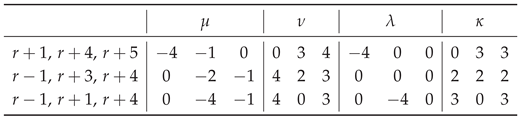 and in all three cases, for all i and k,
while and by definition. A run through multiples goes from the shift to , so every chain of components from one L to another lowers the shift, by at least two if it passes through a multiple and by exactly one only if it is a single component of degree two. In particular a chain from an L of shift x into has , and a chain from to an L of shift y has .
By Lemma A5(iii), a term of on a class u of degree in runs along a chain , the step u, and a chain , and since the degrees of the components telescope, its value lies in in degree
Write and , so that .
Nothing reaches . Let u have degree one, so , with chains from a to and from to b and . If and are both pieces L, then and , not both with equality, so ; is impossible, and needs either , and then a chain from a to b lowering the shift by one, a single component in , or , differing in one coordinate, of opposite parities, against . If and is an L, then u lies in the degree of a component, so , while . If is an L and , then and . If and , then ; for this is at least 2, and for the class u lies in the degree of a step , so and again . Each case contradicts .
vanishes on . Here u is the class itself and a term lands in , , in degree , with chains from c to a and from b to e. If c and e are both pieces L, then ; is impossible, and otherwise a class of degree at least 5 needs c, e differing in one coordinate, in degree 5, so against their opposite parities. If and e is an L, the degree is that of a component when , but . If c is an L and , it is that of a component when , but . If and , then , against .
For the inequality: a coboundary has no component on (Proposition A5) and none on these groups, so the cocycles of and of these groups span a space that meets the coboundaries only in zero. Twisting the pieces by line bundles of degree zero does not change , the forms being nondegenerate on every surface, and can only remove components. □
Theorem A12
(No convolution of these pieces meets the criterion). Keep Proposition A5 with : let E be any convolution of the 32 bundles and of , , , with and , in any order, with any shifts of the given parities and with the pieces twisted by any line bundles of degree zero. Then . In particular no such convolution meets the polarised criterion, which asks for 57.
Proof.
Replacing E by or , which preserves , we may assume that the are as in Theorem A11 or in Proposition A7. If no fourfold product of those results acts, . Otherwise the path fixes the shifts of the as in Lemma A10, with r the shift of every on a path; let P be the sixteen pieces of the parity of r, Q the other sixteen, and m the number of pieces on paths.
The fourfold products act on only through the classes at the and at the m pieces on paths, so their rank is at most , and by Proposition A6 . If this is at least 69.
Let , so that at least ten pieces of P have the shift r. Every has 3, 6 and 7 partners in P differing from it in one, two and three coordinates, and for the seven six times and once.16 If , at most six pieces of P lack the shift r, so one of the seven has it, and Lemma A10 gives at least 16 classes. If , consider for each type of the form the partner obtained by changing the sign of the coordinate where vanishes. By the proof of Proposition A6, is the only piece with which W can carry a nonzero cup product on the type , and conversely; a cup product between them needs a component of degree two, hence shifts differing by one. If they do, the classes of type equal at W and and zero elsewhere have vanishing cup products, and , of shift , lies on no path; if they do not, the classes of type at W alone have vanishing cup products. Either way these 4 classes lie in , 12 for each such W, and those of different W are independent, since is injective. Adding over Q, Lemma A10 gives . □
At there are 128 pieces , and the classes that no product reaches are again those between pieces that differ in three coordinates and have adjacent shifts. The shifts along a chain are now controlled by counting alone.
Lemma A11
(Shifts along chains at ). Keep Proposition A4 with , take the to be external products of line bundles on the , let be distinct with , and let E be a convolution of the and of with shifts of the given parities. Call a component of , or an element of degree one of in one group , a step from to ; a step of degree q has . Put and .
- (i)
- A step between distinct has degree at least two, so it lowers the shift by at least one, and by exactly one only in degree two. A step in keeps the shift.
- (ii)
- A step between an and a multiple, or between two multiples, has degree 0 if it goes up the value ϕ and 8 if it goes down, so it raises the shift by one or lowers it by seven.
- (iii)
- A sequence of steps from an to an through multiples, distinct before one marked step and distinct after it, where the marked step may lie in at a multiple, lowers the shift by at least four. Consequently a sequence of steps from one to another, at most one of them not a component, lowers the shift by at least one, and by exactly one only if it consists of steps between pieces , one of degree two and the others in .
Proof.
(i) For the group is the tensor product over the surfaces of of a line bundle with a nondegenerate form, on the surfaces where and differ, and of on the others, the factors of and on those being equal. So its degrees are at least k, and degree one needs . Then the ratio in the one coordinate is the ratio of and , which is , and the shifts have opposite parities, while a step of degree one keeps the shift. (ii) The forms of have the eigenvalues on every surface, which have the sign of ; the form of is . A definite form has cohomology in degree 0 if it is positive and if it is negative [19, Chapter 3].17 (iii) Let U and D be the numbers of steps up and down outside ; by (ii) the shift changes by . The values start and end at p and pass through the values of multiples, so . If , the values increase strictly before the step down and strictly after it, so those before it lie above p and those after it below p, each multiple occurs once, and : the drop is at least four.18 If , at most six multiples occur, counted with repetition, so there are at most seven steps outside , , and the drop is at least nine. For the consequence, split the sequence at the pieces it visits: each part through multiples lowers the shift by at least four, and by (i) each other part lowers it by at least one, unless it lies in . □
Theorem A13
(Two shifts on ). Keep Lemma A11, and let and differ in exactly three coordinates and have the shifts . Then has its classes of degree two in , of dimension , which is 16 or 64, and:
- (i)
- for every convolution, no element of degree one has a differential with a nonzero component in ;
- (ii)
-
if the occupy two consecutive shifts, those with the shift s and the others , for a sign ϵ and an integer s, then vanishes on these groups, and for every order of the pieces, every choice of the shifts of the and every placement of the ,In particular E does not meet the polarised criterion, which asks for .
Proof.
Write and . By the proof of Lemma A11(i), has degrees 3, 4 and 5, the last two from the surface where and agree, and its classes of degree have degree ; the dimension of is the product over the three other surfaces of the determinants , as in Lemma A10.
(i) As in the proof of Lemma A10, a term of the differential of an element u of degree one in with a component in runs along a chain of components , the step u, and a chain , with . This is a sequence of steps from W to V, one of them u, lowering the shift by one. By Lemma A11(iii) it consists of steps between pieces , one of degree two and at most one, u, in . If u is not in , it is the step of degree two and both chains are empty, against . If u is in , the rest is a single component of degree two, in .
(ii) A term of on runs along chains of components and , not both empty, and lands in in degree . No piece other than W lies on the first chain: by Lemma A11(iii) it would have the shift at least . Likewise only multiples follow V on the second chain, and each chain has at most three pieces besides W or V. Let U and D be the numbers of steps up and down along both chains, so that ; by Lemma A11(ii), and , and the degree is
If , this degree is 3, so , and because the values return to ; then , which is impossible. If , the group sits in degree 0 if and in degree 8 if , by Lemma A11(ii). Degree 0 needs with , so the values increase strictly, the multiples are distinct and . Degree 8 needs , so and ; the values increase strictly before the step down, from , and after it, up to , so the five values along the path, with W and V counted once, are distinct, and four of them are values of multiples, of which there are three. So no term reaches a nonzero group, and vanishes on .
By (i) and (ii) the classes of these groups are cocycles of degree two, and no nonzero combination of them is a coboundary, since every coboundary has zero components there. Each piece of the shift s has 28 partners of the other parity differing from it in exactly three coordinates,19 all of the shift , and the 28 groups have dimensions adding up to 640; there are 64 pieces of the shift s. □
The hypothesis of (ii) is the arrangement of the explicit convolution of Proposition A8 at , where the sixteen pieces of each parity share a shift. The pieces must not be twisted by line bundles of degree zero here, unlike in Theorem A12: a twist that is nontrivial on the surface where and agree removes .
With a third shift, a component of degree two can follow or precede a class of , so the differential no longer vanishes on these classes. When the three shifts are consecutive, such terms reach only the groups between the highest and the lowest shift, which are too small to remove the classes.
Theorem A14
(Three consecutive shifts on ). Keep Lemma A11, and suppose that the shifts of the lie in for an integer s. By their parities, for a sign ϵ, the pieces with have the shift and the others the shift s or ; let T and B be the sets of pieces of the shifts s and . Then, for every order of the pieces, every choice of the shifts of the and every placement of the :
- (i)
- every two pieces , that differ in exactly three coordinates have shifts differing by one, and the groups of Theorem A13, taken from the piece of the larger shift, have dimensions adding up to 40960;
- (ii)
- maps the sum of these groups into , and on them it consists of cup products with a single component of degree two;
- (iii)
In particular E does not meet the polarised criterion. When T or B is empty this is Theorem A13(ii).
Proof.
(i) The ratios in the three coordinates have product , so the two pieces have opposite parities: one has the shift and the other s or . Each of the 64 pieces of the shift has 28 such partners, whose groups have dimensions adding up to 640, as in the proof of Theorem A13; this gives .
(ii) Let with . As in the proof of Theorem A13(ii), a term of runs along chains of components and , not both empty, and lands in in degree . The shifts of the pieces differ by at most two, so by Lemma A11(iii) no part of a chain between two pieces passes through a multiple. Hence a chain that starts at a multiple is a run of distinct multiples, , followed by pieces only; let and be the numbers of its steps up and down the value before , so that by Lemma A11(ii) and . Likewise a chain ending at a multiple ends with a run from a piece with steps up and down, and . Put if c is a piece and if e is one, and ; then .
If c and e are both pieces , each nonempty chain lowers the shift by at least one, so , while gives at most 5. So the degree is 5, , , and the two chains together consist of one component, of degree two by Lemma A11(i): the term is a cup product of x with that component.
If and e is a piece , the degree is , and sits in degree 0 or 8 by Lemma A11(ii). Degree 0 needs , and degree 8 needs , so and ; both contradict . The case of a piece c and a multiple e is the same with the second run.
If and , the degree is with and . For it is 3, so ; is impossible, since the values would increase from to p along the first run and from p to along the second, and gives . For , sits in degree 0 if and 8 if . Degree 0 needs , so and ; but then the multiples of the first run have values below p and those of the second values above p, so they are distinct and . Degree 8 needs , so and : the runs have at least four steps, so some multiple lies on both. One run increases strictly. If it is the second, its values lie in , while those of the first lie at or above before its step down and below p after it. If it is the first, its values lie in , while those of the second lie above p before its step down and at or below after it. Either way no multiple lies on both runs, a contradiction.
(iii) By Theorem A13(i), which holds for every convolution, no coboundary has a component in these groups, so the kernel of on their sum injects into , and by (ii) its dimension is at least 40960 minus the dimension of the targets. For pieces c, e of the same parity, is nonzero only when they differ in two or three coordinates, and each piece has such partners with groups of dimensions adding up to 960.20 So the sum in (iii) is at most , which already gives . The dimension of depends only on the ratio , so the sum is the weight of the cut of a weighted Cayley graph on the group of ratios of two pieces of one parity, of order 64 and degree 960. For the vector of the cut, the weight is , with A the weighted adjacency matrix and its least eigenvalue. Its eigenvalues are the character sums . A character is with , up to adding ; put , , and . By the list in the footnote, the ratios that move the pair of coordinates contribute , and those that fix only the coordinate o contribute . Summing,
If , the sum of the is odd, so an odd number of them are odd, , and the value is at least . If , an even number are odd: with none or four, and the value is at least 192; with two, , and would force the to be , whose sum is not divisible by 4, so and the value is at least . If , the value is , and : when all have the same parity, , and when two are odd, and W is a sum of two of and two of , so . Hence ,21 and the sum is at most . □
The groups of Theorem A13 join two pieces whose shifts differ by one. All groups between pieces whose shifts differ by three, and thirteen kinds between pieces whose shifts differ by two, are also left alone by the differential, and with them the argument covers every arrangement of the shifts within five consecutive values. For pieces a and b call the spread of ; its classes of degree two have degree . For call their ratio; it moves the coordinates where it differs from 1, and it changes the parity, , exactly when the product of its entries is . As before, .
Lemma A12
(Groups of spread two and three). Keep Lemma A11, and let E be any convolution of the and the , in any order, with any shifts of the given parities and any placement of the .
- (i)
- For a class x of degree two in of positive spread, every term of has all its leaves between pieces .
- (ii)
- Let , let move all four coordinates, one of them by , and let . The classes of degree two of form , of dimension ; no element of degree one has a differential with a nonzero component in it, and vanishes on it.
- (iii)
- Let and . The classes of degree two of lie in , and vanishes on them.
- (iv)
- Let ζ and differ in exactly three coordinates, with . Every term of on runs along chains of components and between pieces that together lower the shift by one or two.
Proof.
Write , and . As in the proof of Theorem A13(ii), a term of on a class of degree two in runs along chains of components and , not both empty, and lands in in degree , which is 3 if .
(i) Let be the first piece of the first chain and the last of the second, and put . By Lemma A11(iii), , and if a multiple lies between and a or between b and . Before the first chain is a run of distinct multiples, with steps up and steps down the value and ; after the second chain is a run with and steps, . By Lemma A11(ii) the term has degree , where and . If c and e are pieces, this is ; a multiple on a chain makes it at least 8, but only for , where the degree is 3. If and e is a piece, sits in degree 0 if and in degree 8 if . Degree 0 needs . Degree 8 needs a step down on the run from to p, so , and then . Both contradict , and a piece c with a multiple e is the same. Let and . For the degree is 3, so ; would give , and would make the values increase from to p and then from p to . For , sits in degree 0 if and in degree 8 if . Degree 0 needs , so and ; but then the first run lies below p and the second above, so the multiples are distinct and . Degree 8 needs , since with the values would satisfy ; then gives and , so the runs have at least four steps and share a multiple, which the last paragraph of the proof of Theorem A14(ii) excludes.
(ii) By the proof of Lemma A11(i), is the tensor product of four groups and sits in degree 4, of dimension ; the ratio is , with , or a permutation of , with .22 A coboundary with a component in is a sum of terms of Lemma A5(iii) along a path of morphisms of degree one, one of them an element u and the others components, that lowers the shift by two. By Lemma A11(iii) no multiple lies on it, and by Lemma A11(i) each step between distinct pieces lowers the shift by at least one. So the path consists of a component of degree three from a to b, which lies in , and a class of or ; or of two steps of degree two, possibly with a class of at one of the three pieces. The output has degree one on every surface. Without the class of the two steps have degrees adding up to one on every surface, so they move disjoint pairs of coordinates and have degree zero elsewhere; a step of degree two changes the parity, so its two moved entries have product and are or , and has no entry . With the class of , Lemma A6 gives a drop of one on a surface where all three leaves have positive degree, and the output has degree at least two there.
Now let a term of on carry the components , , between pieces by (i), and land in ; let K be the set of coordinates fixed by the ratio of c and e, and the drop of the chains. The output has degree . Let be the number of the of positive degree on ; the class x has degree one there, so Lemma A6 bounds the drop on by . For the output has degree 1 on , so the degrees of the there add up to at most , which forces . For the undo the entry , so , and the output has degree at least there, hence exactly 2. So , that is . The components change the parity X times modulo two, and together their ratio is on K and 1 elsewhere, so
For the ratio the left side is . For a permutation of the left side is real only if K contains both or neither of the coordinates moved by , and then it is again . So no term is nonzero.
(iii) The classes of degree two have degree 5. By (i) a term of on them lands in degree , with the drop of the chains between pieces. For this is at least 8, which needs and degree 3. For the pieces c, e have shifts differing by four, hence the same parity, so their ratio moves at least two coordinates and has no degree above 6.
(iv) By (i) a term lands in degree , with the drop of the chains between pieces. For the degree is at least 8, which needs . For the degree is 7, which needs a ratio moving one coordinate, hence opposite parities, while is even. □
The groups of (ii) are reached by no coboundary and left by no term in every convolution, so they survive in as soon as the shifts give them the spread two. That happens along every edge of a Cayley graph that crosses between two shift values of one parity, and a cut of that graph is never light.
Lemma A13
(Cuts of a Cayley graph). Let G be a finite abelian group, a generating set and a weight, extended by 0 to G. For every subset with ,
the minimum over the proper subgroups H of G. For the group of the 64 ratios of pieces of one parity, with S the thirteen ratios of Lemma A12(ii) and , the minimum is 1024, attained only at , so every such cut weighs at least 1024.
Proof.
The left side is . Let H be the stabiliser of T, a proper subgroup since . Then T and are unions of cosets of H, and for the set is nonempty, since , so it has at least elements. This gives the inequality. In , written additively as the quadruples in of sum 0, the ratios of type generate, since the differences of two of them give every . The weights are 256 once and 64 otherwise, and . So is 1024 for , at least , which is 1536, 2560 and 3072, for , and at least for , because some generator lies outside H.23 □
Theorem A15
(One parity at two or three values). Keep Lemma A11, and suppose that the shifts of the pieces with take exactly two values s and , or exactly three values , s and , for a sign ϵ and an integer s. Then, for every order of the pieces, all shifts of the other pieces, every choice of the shifts of the and every placement of the ,
In particular E does not meet the polarised criterion.
Proof.
Let T be the set of pieces of parity at the shift s; it is neither empty nor all of them. Two pieces of parity , one in T and the other not, have shifts differing by exactly two. When their ratio is one of the thirteen of Lemma A12(ii), the group from the piece of the larger shift to the other is reached by no coboundary and killed by no term, so its classes inject into , and those of different pairs lie in different summands . Their dimensions add up to the weight of the cut of the Cayley graph of Lemma A13, since the pieces of parity form a coset of ; so they add up to at least 1024. □
Theorem A16
(Shifts three apart). Keep Lemma A11, and suppose that the pieces with all have the shift s and the others have shifts in . Then, for every order, every choice of the shifts of the and every placement of the ,
Proof.
Every piece W of parity and every piece V of parity have shifts differing by three. By Lemma A12(iii) the classes of degree two of the group from the higher to the lower of the two lie in , and vanishes on them. For each W these groups have dimensions adding up to 1072.24 A coboundary with a component in such a group runs along a path of morphisms of degree one that lowers the shift by three; no multiple lies on it, by Lemma A11(iii), and a step between distinct pieces lowers the shift by at least one, while no piece has a shift strictly between those of W and V. So the path is the component between W and V together with a class of at one of them, and the components of all coboundaries in these groups come from over the 128 pieces, of dimension . The classes are cocycles, and at most 1024 dimensions of them are coboundaries. □
When one parity sits at a single shift, the groups of Theorem A13 survive next to it unless pieces of the other parity crowd it from both sides.
Proposition A9
(A gap of four). Keep Lemma A11, let the pieces with all have the shift y, and let T be the set of pieces of parity at the shift . If T is not empty and no piece has the shift or , then for every order, every choice of the shifts of the and every placement of the , the groups with and V differing from W in exactly three coordinates are reached by no coboundary and killed by no term, and
The same holds with , , replaced by , , and the groups .
Proof.
By Theorem A13(i), which holds for every convolution, no coboundary reaches these groups. By Lemma A12(iv) a term of on runs along chains of components between pieces into W and out of V that lower the shift by one or two in all; the first would pass through a piece at the shift or , the second through one at or . The shifts have parity , whose pieces are all at y, and , are excluded. Each has 28 partners V, all at the shift y, with groups of dimensions adding up to 640. The second statement has the same proof, with the chains into V and out of W in place of those into W and out of V. □
Corollary A2
(Five consecutive shifts). Keep Lemma A11. If the shifts of the 128 pieces lie in five consecutive integers, then, for every order, every choice of the shifts of the and every placement of the , ; no such convolution meets the polarised criterion.
Proof.
Let the values be , with one parity at values in and the other at values in . If the second parity takes both its values, or the first takes two values two apart or all three, Theorem A15 applies. Otherwise the second parity sits at one value y and the first at one value or at . One value each, at an odd distance at most three: Theorem A13 or Theorem A16. The first at : for the pieces at are not empty and , are empty, and for the pieces at are not empty and , are empty, so Proposition A9 applies. The least of the bounds is 640. □
Within six consecutive values two arrangements are left, up to exchanging the parities: each parity at one shift, five apart, and the parities at and . The first is settled by the diagonal, whose classes at a shift with no other piece nearby can be reached only through all three multiples, and the second by the groups of Theorem A13 once more.
Lemma A14
(The diagonal at a lonely shift). Keep Lemma A11, and let the pieces with all have the shift s and the others the shift , for a sign ϵ and an odd integer . Let be a diagonal class at a piece a, and let a term of in Lemma A5(iii) be nonzero. Then a is the only piece on its path, the path passes through , and , and the shifts of a, , , are pairwise incongruent modulo 4.
Proof.
Write the path as , with the chain of components into a and the chain out of a not both empty, so that , since the components of a convolution go up the order of the pieces. Let and be the first and the last piece on it and ; before and after the path is a run of distinct multiples, with U steps up and D steps down the value in all. As in the proof of Lemma A12(i), now with , the term has degree by Lemma A11(ii). A sequence of components from one piece to another lowers the shift by Lemma A11(iii), and the pieces have the shifts s and ; so , and exactly when a is the only piece on the path.
If c and e are pieces, then and , and since and . If c is a multiple and e a piece, then sits in degree 0 or 8. Degree 0 needs , so and . Degree 8 needs : for this gives and ; for it gives and , which is at least one because the run before is not empty and at most three, so ; but then the path lowers the shift by seven from to e, by a single component, of degree eight between distinct pieces, or by a run through multiples, and neither is possible.25 A piece c with a multiple e is the same with the runs exchanged. If c and e are multiples, both runs are nonempty and together pass through at most three multiples, so and . Degree 0 needs , so and . Degree 8 needs ; gives , so , which is excluded as before; gives , so and ; gives .
So in every case and : the path consists of a and the three multiples, with three steps. A step up raises the shift by one and a step down lowers it by seven, so every step adds one modulo 4, and the four nodes of the path have the shifts modulo 4 in the order of the path.26 □
Proposition A10
(Single shifts). Keep Lemma A11, and suppose that the pieces with all have the shift s and the others all have the shift , for a sign ϵ and an odd integer g. Then, for every order, every choice of the shifts of the and every placement of the ,
Proof.
Exchanging the parities, we may take . For and this is Theorem A13 and Theorem A16. Let . If a term of were nonzero on a diagonal class at a piece of shift s and another on a diagonal class at a piece of shift , then by Lemma A14 the shifts of the three multiples would be pairwise incongruent modulo 4 and miss both the residue of s and that of , which differ, since g is odd. So at one of the two shifts vanishes on the 28 diagonal classes of each of the 64 pieces there, and by Proposition A5, which holds for , these 1792 classes inject into .27 □
Proposition A11
(Interleaved shifts). Keep Lemma A11, and suppose that the shifts of the pieces with take exactly the two values s and , and those of the others exactly the two values and . Then, for every order, every choice of the shifts of the and every placement of the , .
Proof.
Let A and be the pieces of parity at the shifts s and , and B and those of parity at and ; all four are nonempty. Let W and V differ in exactly three coordinates, with , that is and , or and . By Theorem A13(i) no coboundary reaches , and by Lemma A12(iv) a term of on it passes through a piece at the shift or or at or . These are , , , for and , , , for , and no piece has these shifts. So the groups inject into .
Let be the group of the ratios of two pieces, of order 128, which acts simply transitively on the pieces, and the 28 ratios that move exactly three coordinates and change the parity, with the weight D, which adds up to 640 (Theorem A13). With the pairs above are exactly the edges of the Cayley graph of between X and its complement ; so the dimensions add up to the weight of that cut, and X is neither empty nor everything. Written additively, as the quadruples in of even sum, the differences of two ratios of type give every , which generate the quadruples of sum 0 modulo 4, and the elements of have sum 2 modulo 4; so generates . In Lemma A13, gives 640; for at most elements of lie in H, at most four of them of weight 64, so is at least , , and ; for some lies outside H, and so does , which gives weight at least 32, or 64 if ; and for the weight outside H is at least 16. So every such cut weighs at least 640.28 □
Corollary A3
(Six consecutive shifts). Keep Lemma A11. If the shifts of the 128 pieces lie in six consecutive integers, then, for every order, every choice of the shifts of the and every placement of the , ; no such convolution meets the polarised criterion.
Proof.
By Corollary A2 we may assume that the shifts take both values s and of the window ; let the parity at s have its values in and the other in . If one of them takes two values two apart, or three, Theorem A15 applies. Otherwise the first takes or and the second or . For and this is Proposition A10, and for and it is Proposition A11. For and , Proposition A9 applies in its second form with : the shift is taken and , are not. For and it applies in its first form with : the shift is taken and , are not. The least of the bounds is 640. □
Appendix A.5. Pieces of Any Kind
Theorem A10 and Proposition 28 say that in a convolution meeting the criterion every piece outside every closed chain has its Chern character in . The same holds for every convex set of pieces, for pieces of any kind. Throughout, A is an abelian -fold of Weil type for an imaginary quadratic field K, a member of with polarisation , the eigenspace decomposition for K, through , spanning , and the tangent space of the family. We say that Emeets the criterion when , or for a G-equivariant E as in Corollary 11, equals the rank of the contraction with .
Setting 13
(Convolutions of perfect complexes). Let be perfect complexes on A, each represented by a bounded complex of holomorphic vector bundles, integers and . Let with the differential D, the sum of and the internal differentials, so that its cohomology is . A convolution of in this order is a one-sided twisted complex with of total degree one and ; every object obtained by iterated cones in this order is of this form, since the Dolbeault complexes form a pretriangulated enhancement. In each block choose a subcomplex of D-closed forms mapping isomorphically to , a projection π onto it and a homotopy h with and , which exist for every complex by a choice of complements. The proof of Lemma A5 uses only these identities, so (i)–(iii) hold verbatim. Let Γ be the directed graph on the pieces with an edge , , when is nonzero in total degree one; its directed cycles are the cycles of excess zero. Let consist of the edges with , in the gauge of Lemma A5(i); it has no directed cycle, δ being strictly upper triangular, and by the trees of Lemma A5(i), implies a path of from a to b. A set C of pieces is-convexif every walk of Γ that starts and ends in C stays in C, and-convexif every walk consisting of a path of , at most one edge of Γ and a path of that starts and ends in C stays in C; a Γ-convex set is δ-convex for every δ. Put . Fix a block diagonal -connection on ; then is represented by , block upper triangular with diagonal blocks and off-diagonal blocks , as in the proofs of Proposition 23 and Lemma 18.
Theorem A17
(Convex sets of pieces). In Setting 13, let C be δ-convex. Then is a twisted complex and . If E meets the criterion, ordinary or equivariant, and has the polarised shape, then and .
Proof.
Every term below is labelled by a walk: a nonzero gives a path of from x to y, and a nonzero block of needs or a chain of nonzero -components from c to d, because is built from the diagonal blocks and the blocks . For , a nonzero term of gives a walk of , so , and the Maurer–Cartan equation of is the block of that of ; so is a twisted complex. For of total degree one, the component of in is a sum of trees along a walk from a through components of , one component with or in , and components of to b (Lemma A5(iii)); for the walk stays in C, and , h and composition act blockwise, so the C-block of is . Likewise, for , whose C-block is , the block of is a sum over walks , , , so the C-block of is . If , then for some x, and taking C-blocks gives .
If E meets the ordinary criterion, is injective because is the contraction with by (A4), so ; in the equivariant case by the proof of Corollary 11, is injective there, and the same follows. Then , the last inclusion by (A4) for . The tangent space kills and , so it lies in and kills ; contraction with preserves the degree, so it kills every graded piece of , and Lemma A15 gives , hence , the subspace being defined over . □
Remark A5
(Special cases). A single piece is Γ-convex exactly when it lies on no cycle of excess zero, so Theorem A10 and Proposition 28 are the case of one piece. A strongly connected component of Γ is Γ-convex, as is every set closed under successors or under predecessors in Γ. No assumption on the Hankel rank is used.
Lemma A15
(Invariant classes). If satisfies for all , then .
Proof.
As in the proof of Theorem A10, is the block of acting by derivations on , and since c is real its complex conjugates, the block , kill c too; the two blocks generate , so c is -invariant. With , , and the are irreducible and pairwise non-isomorphic for and trivial for . So the invariants are the line of the identity for each , spanned by , and the lines and , spanned by and . □
For the joint kernel of and its conjugate on is computed in julia/invcheck.jl; the kernel of alone has dimension 344 for and 1696 for , so the reality of c is needed.
Lemma A16
(Abelian subvarieties). Let and let be a translate of an abelian subvariety with . Then .
Proof.
Let be the underlying subvariety, and . Then with spanning , and a constant vector satisfies exactly when . We show that a nonzero element of in degree , with only if , is killed by no . If and : , with since is nondegenerate, and multiplication by is injective on by the Lefschetz theorem, as . If , write and ; in the bigrading by , has bidegree , has , and has and , all distinct for , so the three terms vanish separately. If the first case gives ; if , w is real and nonzero, so , and , force . □
Corollary A4
(Exclusions). Let E be a convolution meeting the criterion, ordinary or equivariant, with of polarised shape. Then every piece , with Z a translate of an abelian subvariety, and F a vector bundle on Z, and every semihomogeneous vector bundle piece whose slope is not in , lies on a cycle of excess zero. Otherwise , or , exceeds the rank of the contraction with .
Proof.
A piece on no cycle of excess zero is -convex, so its Chern character lies in the graded subspace by Theorem A17. The lowest component of is , excluded by Lemma A16. A semihomogeneous bundle has , whose degree-two part must lie in , since lives in degree . □
For semihomogeneous bundles the Ext groups lie in windows. For a hermitian form X write for the numbers of positive and negative eigenvalues.
Lemma A17
(Cohomology windows). Let B be an abelian variety of dimension g and G a semihomogeneous vector bundle on B of slope δ, , and .
- (i)
- unless .
- (ii)
- If is a line bundle, either or for every , and the second case holds when L restricts trivially to the connected component of the kernel of its hermitian form; in particular when L is nondegenerate, and when for a surjective homomorphism f with connected kernel and M nondegenerate.
For semihomogeneous bundles F, of slopes δ, , vanishes outside .
Proof.
By [83, Sects. 5–6], with simple semihomogeneous of slope and unipotent, an iterated extension of , so it suffices to treat a simple E; and for an isogeny and a line bundle L on Y, with . Since , in , whose hermitian form is the pullback along the isomorphism and has the same inertia. Let L be a line bundle on Y and . For , , and the character of on the lattice of K is , trivial on ; so all fibres of carry isomorphic restrictions . If is nontrivial, [88, §8], so and . If is trivial, with M nondegenerate on by the seesaw theorem, , and by the projection formula and the vanishing theorem [88, §16] with , and ; so exactly for . For as in (ii), and L is trivial on it. The last statement holds because is semihomogeneous with . □
Lemma A18
(Subadditivity of inertia). For hermitian forms X, Y on , .
Proof.
Let U be a subspace of dimension on which is negative definite, and P, Q subspaces of dimensions , on which , . On the form is both and negative definite, so and . □
Lemma A19
(Cycles of semihomogeneous bundles). If a cycle of excess zero of length k passes through two semihomogeneous bundle pieces a, b of slopes , and through semihomogeneous bundles only, then .
Proof.
An edge e from c to has degree , and around the cycle. By Lemma A17, , and by Lemma A18, is at most the sum of the along the arc from a to b and at most the sum along the arc from b to a. Adding gives the claim. □
Corollary A5
(Nondegenerate slope differences). No convolution of at most semihomogeneous vector bundles whose slope differences are pairwise nondegenerate meets the criterion, ordinary or equivariant.
Proof.
A cycle of excess zero would have length at most and pass through two pieces whose slope difference has rank , against Lemma A19. So is acyclic, every piece is -convex, and by Corollary A4 every slope lies in ; then , which is not of polarised shape. □
Lemma A20
(Windows of Lagrangian pieces). Let Z, be translates of abelian subvarieties of dimension n with , F, vector bundles on Z, and M a vector bundle on A. Then , , and vanishes for and not for .
Proof.
The first is adjunction for the locally free M. Locally for a regular sequence, and the Koszul resolution shows that the local Ext sheaves of vanish except in degree n, where they are with trivial normal bundle; the local-to-global spectral sequence degenerates. For the third, , so is finite and nonempty; at each point the restrict to a regular system of parameters on , so the local Ext sheaves are skyscrapers in degree n, nonzero there. □
Let F be semihomogeneous on Z with slope , let be the eigenvalues of the hermitian form of relative to the positive form of , and let be semihomogeneous on A with slope . By Lemmas A17 and A20, with , the degrees lie in the windows for , for , for with , for , and between two transverse pieces.
Theorem A18
(Transverse Lagrangian pieces and multiples of ). Let and let E be a convolution, possibly G-equivariant, of proper pieces , with translates of abelian subvarieties of dimension n, for and semihomogeneous on , and of ℓ semihomogeneous bundles of slopes with pairwise distinct t. If , or if and no two proper pieces have , then every proper piece lies on no cycle of excess zero, and E does not meet the criterion, ordinary or equivariant.
Proof.
A shortest closed walk through a piece is a simple cycle, and along a cycle with at least the lower end of its window; so it suffices to show that the cost of every simple cycle through a proper piece is positive. From the windows, an edge costs , costs , costs , an up step , , costs and a down step costs . Cut the cycle at its proper pieces into d direct segments and m segments , . With W down steps, multiples of used, hence up steps, and the sum of the counts and over the segments,
(a) If , then and . (b) If , then . (c) If , and , then . (d) If , and , each segment is one increasing run from to followed by a proper piece , and since the multiples are distinct; if , every eigenvalue of is below or above , so contributes at least n to ; and for all s would give . So and . (e) If , , , there are one proper piece and one run , and ; for every is counted at least once, so , and for , . For every case gives . Under the condition on the shifts no edge has , so , cases (a) and (c) do not occur, and (b), (d), (e) give for . The conclusion follows from Corollary A4; without proper pieces . □
The thresholds are those of the windows: an exhaustive search over window-admissible cycles, in julia/windowsearch.jl, finds cycles of cost zero at with edges between proper pieces and at without them, for with up to two proper pieces and for with one, for instance at . Whether such cycles carry nonzero classes, and the cases with edges between proper pieces, without, supports that are not transverse or of mixed dimension, and equal slopes, are open.
All the tests above depend on only, and does not depend on . They do not decide every configuration. Let with the coordinates and blocks of Proposition A4, . For let , a surjective homomorphism with connected kernel, and , whose hermitian form has eigenvalues 0 and 2 on ; , and is the threefold of Appendix B.
Proposition A12
(A configuration passing every graph test). For each of the 32 elements with put if and otherwise, and take the cube of eight line bundles
with and , together with four line bundles , , , of classes at the shifts : 260 pieces.
- (i)
- Every convolution E of these pieces has with of Hankel rank 3, so .
- (ii)
- For every choice of the twists, Γ contains the 46 edges inside each cube of Lemma A21(i) and the 196 edges between pieces whose classes differ by a nondegenerate form, and these 1668 edges form a strongly connected graph on all 260 pieces.
So in every convolution of these pieces, in any order and for every twisting cochain, every piece lies on a cycle of excess zero, the only nonempty Γ-convex set is the set of all pieces, and Theorem A17 in its Γ-form, Theorem A10, Proposition 28 and Corollary A4 do not apply.
Proof.
(i) Inside a cube, , since and twists are numerically trivial, and because is surjective with connected kernel . On , in the notation of the proof of Proposition A4, and ; the computation there gives . The four multiples of give p, whose moments over four distinct exponents make the Hankel matrix of rank 3. (ii) The classes inside a cube differ by pullbacks along homomorphisms with connected kernel, so all window groups of Lemma A21(i) are nonzero by Lemma A17(ii), whatever the twists; a nondegenerate difference has nonzero cohomology in its index by the same lemma. Strong connectivity is a finite check. □
The identity (i), the Hankel rank, the edge counts and the strong connectivity are checked in exact arithmetic in julia/cubeexample.jl and julia/collapse.jl. For a suitable choice of there is moreover a pair of edges of degree one in both directions between and with , and with it the 196 nondegenerate edges and the 384 up and 384 down edges of the cubes already form a strongly connected graph with 385 cycles of length two; these cycles have semidefinite differences of rank at most two, as Remark A3 requires. For , Proposition 22 excludes E. The rest of this subsection decides the criterion for this configuration for the twisting cochains of two kinds. Shifts are cohomological degrees: a block has total degree .
Lemma A21
(Windows of the configuration). In Proposition A12:
- (i)
- Inside a cube, Γ has an edge exactly when , , which gives 46 edges; the only edges into come from the and the only edges out of go to the , all of degree 0.
- (ii)
- Between a cube and the multiples of θ the only groups of total degree one are, for , and , and , and for , , , and .
- (iii)
- Among the multiples of θ the edges are , , of degree 0, and , , of degree 6.
- (iv)
- Between pieces of different cubes the difference is nondegenerate only for and for all j, of signature with the only group in degree 3 and total degree .
Say that a cube Q satisfies if all groups between a piece of Q and a piece of another cube with degenerate difference vanish. This holds for outside finitely many translates of proper subtori of , and then Γ has no edge between Q and another cube. The twists aregenericif holds for all 32 cubes.
Proof.
(i) has class , of inertia . An edge needs degree in the window of Lemma A17, which forces , and these groups are nonzero by Lemma A17(ii); counting pairs gives . (ii) On each block the eigenvalues of lie in ; both are positive for and both negative for . So is concentrated in degree 0 for and in degree 6 for , and dually is concentrated in degree 6 for and in degree 0 for ; requiring total degree one selects the listed pairs. (iii) The groups are with and . (iv) On the difference is , nondegenerate exactly when both terms occur with different kernels, and then of signature . For : by the proof of Lemma A17, unless restricts trivially to , and the P with trivial form a coset of the kernel of the surjection , proper since . □
Lemma A22
(Koszul cubes). Let a cube Q be -convex and suppose that, in the gauge , the components of δ between pieces of Q are nonzero exactly on the 12 edges . Then , where is a translate of , , and ; for every δ, .
Proof.
On an edge , , and a term has by convexity, with both factors on edges that raise by one, impossible. So , which is one-dimensional because : with and the canonical section. The block of the Maurer–Cartan equation holds by convexity (proof of Theorem A17), and on holomorphic sections, so on every square. The standard signs satisfy the same equations, so is a -valued cocycle on the 2-skeleton of the cube, the boundary of a ball and simply connected; it is a coboundary , and rescaling the pieces by turns into the Koszul complex of the regular sequence , the being independent linear coordinates [36, Cor. 17.5], twisted by . Each is constant on , so is trivial. The Chern character is computed in the proof of Proposition A12(i). □
Lemma A23
(Regrouping). Let be a partition of the pieces such that the quotient of by has no directed cycle. Then E is a convolution of the objects , , in a linear order of the blocks, and Setting 13 and Theorem A17 apply to this presentation.
Proof.
Each edge of the support of expands to a path of , so the quotient of the support of by has no directed cycle either. Order the blocks by a linear extension and each block internally as before; stays strictly upper triangular and the twisted complex is unchanged. Grouping consecutive blocks gives a one-sided twisted complex over twisted complexes, which is E [18, Sects. 1–3], and the are perfect. □
Theorem A19
(Koszul cubes fail). In Proposition A12, suppose that the hypothesis of Lemma A22 on δ holds for all 32 cubes, and that the quotient of by the partition into cubes and single multiples of θ has no directed cycle. Then , and E does not meet the criterion. The second condition holds for generic twists.
Proof.
By Lemmas A22 and A23, E is a convolution of at the shift and of . By Grothendieck duality with trivial normal bundle, and , and is definite of sign ; so the first group lives in degree 3 or 6, the second in 0 or 3, and with the shifts against the only groups of total degree one are for and for . For two threefolds let ; is empty or a union of translates of an abelian d-fold, and as in Lemma 16(i),(ii), translations and twists changing only global groups, which can only vanish, only for . Total degree one needs ; needs , impossible, and needs equal shifts, hence , so , differ in at least two coordinates and . So the edges of the new graph are , , , , , and , all increasing in the order . Every lies on no cycle, so by Theorem A17, against Lemma A16; with Theorem 20, . For generic twists has no edges between cubes, so a directed cycle of the quotient enters and leaves cubes through the edges of Lemma A21(ii); in each cube every entry piece is contained in every exit piece (entries in and exit for , entry ⌀ and exits in for ), and the up edges give a path of from the entry to the exit, so a cycle of the quotient would lift to one of . □
After Lemma A22 the configuration is that of Setting 5 with , translated threefolds, twists and line bundles at the shifts , which do not form an interval; translation and twists can only remove edges, so Lemma 22, Lemma 21(ii) and Proposition 28 give the same conclusion. The collapsed graph is checked in julia/collapse.jl, both for generic twists and in the model in which every window group is nonzero, with 37252 edges in the uncollapsed graph; in that model a single collapsed cube is chain-free for only 4 of the 32 cubes, against 32 for generic twists.
Lemma A24
(Components). Let run over the components of the undirected graph underlying . Then , and if E meets the criterion, for every .
Proof.
has no component between different , so the twisted complex is a direct sum. A walk consisting of a path of , one edge of and a path of that starts in stays in up to the edge of and then in the component of its end, so it returns to only if it never left; is -convex, and Theorem A17 applies. □
Proposition A13
(Convex sets of whole cubes). Let C be the union of the cubes in a set U and of some multiples of θ, and suppose C is δ-convex and E meets the criterion. Then U is empty, the set of all 32 cubes, or one of 42 sets of 16 cubes, each with eight cubes with and eight with ; neither set of cubes of one value of c is among them. This applies to every component of Lemma A24 made of whole cubes and multiples of θ.
Proof.
By Lemma A22, for every , , and by Theorem A17 its component in lies in , that is, in , which meets in . The 35 classes span a space of dimension 25, the signed combinations of the lying in form a space of dimension 10, and its vectors with coefficients in of the required signs are the 44 listed sets, by julia/subsets.jl. □
Theorem A20
(One generic cube). Let a cube Q satisfy and be -convex, δ being otherwise arbitrary, and suppose that and contains an edge , or and contains an edge . Then , and E does not meet the criterion.
Proof.
Let . By Lemma A23, with blocks Q and single pieces, E is a convolution of and the other 252 pieces: a cycle of the quotient through Q would be a path of leaving Q and returning. For a piece outside Q, Lemma A21 and give no block in total degree one; is with the composition with , and by the perturbation lemma its cohomology is that of , which vanishes in total degree one. For , with positive definite, so only occurs, in total degree : nothing in degree 0, in degree one and in degree two, so . Let Y be the set of y, , with , nonempty by hypothesis, and x its last element in the order. The x-component of , , is a sum over chains with nonzero . For , gives a path of from to , whose last edge comes from some with by Lemma A21(i), against the choice of x. The term with is , and in a nonzero would again give some ; so is a nonzero holomorphic section of . Then is -closed of Dolbeault degree 0, so , as h vanishes in degree , and for , A being integral. So , has no edge out in the regrouped presentation, and it lies on no cycle; Theorem A17 gives , against Lemma A16. For the argument is dual: no group of total degree one enters Q except from ; lives in and total degree , so ; with x the first with , only the direct term survives and , so has no edge in and lies on no cycle. □
Theorem A20 allows arbitrary components of inside the cube, lateral and downward ones included; without the edge into , respectively out of , d can vanish on . Under , Q is -convex for when every piece of Q entered by an edge of from outside reaches along , and for when reaches every piece of Q with an edge of leaving Q; both hold for Koszul cubes.
Lemma A25
(An isolated top piece). Let Q have , satisfy , and have no edge of into . If E meets the criterion, has a path from to some .
Proof.
The edges of into come only from the (Lemma A21), and none lies in ; so a walk of the form path, edge, path from back to it ends with an edge of preceded by a path of from to . Without such a path is -convex, and Theorem A17 gives ; but has a hermitian form of rank 3, so it is not in . □
Corollary A6
(The shape of ). Suppose the twists are generic and E meets the criterion. Then
- (i)
- for every cube with , has a path from to some with ;
- (ii)
- for every cube with , either is a sink of , or and has a path from some with through multiples of θ to .
Proof.
(i) Without an edge of into apply Lemma A25. With one, Q is not -convex by Theorem A20; under the only edge of leaving Q is , so the escaping path starts at and re-enters at or some . (ii) Without an edge of out of it is a sink, its only edges in going to the . Otherwise Q is not -convex by Theorem A20; the only edge of entering Q is , and the exits are the and . □
So for generic twists no cube is closed and Koszul-like: every cube with sends back into itself, through lateral or downward components or through the multiples of . Whether some twisting cochain gives is open in exactly the following cases: generic twists and a cube with without an edge of into , where Lemma A25 gives a path back from and can be nonzero; generic twists and a cube with whose is a sink of ; cubes that are not block-compatible, where a path of leaves a cube through multiples of and returns, so that the convex hulls contain multiples of and parts of other cubes and Proposition A13 restricts only hulls made of whole cubes; and special twists, where groups between cubes with degenerate difference are nonzero and may use them, including Koszul cubes that are not block-compatible. Deciding them requires as a function of , that is, the higher products , , of the theta functions along the cycles: sections composed with lateral classes of degree one and with the classes of degrees six and three on the edges through the multiples of . No equivariant structure has been constructed on this configuration, and whether an analogue exists at a point of complex multiplication of a non-split family for is open.
Appendix A.6. Equivariant Convolutions on E 0 8
Theorem A9 excludes every equivariant convolution of the pieces of Proposition A4. This subsection determines the groups that act, describes the invariant parts of the harmonic groups, and gives larger lower bounds for in the arrangements with two shifts; they show how the bounds of Theorems A13 to Corollary A3, which rest on off-diagonal groups, change under a group action. Write , and for the parity, . Fix a piece among the . For let , where , and let G be the group of the that fix every piece up to isomorphism, a subgroup of .
Proposition A14
(The group and the invariant groups). Keep Proposition A4, with the external products of line bundles on the surfaces , and with any twists of degree zero.
- (i)
- , where is generated by if all are odd, and otherwise. The group G is isotropic for the commutator pairing of Mukai’s central extension, so it acts genuinely on , and its linearisations of a piece form a torsor under .
- (ii)
-
Let all be odd, and give the pieces G-linearisations; on the factor the linearisations of and differ by a character of . For and differing exactly on the set S of surfaces, with ,Between two multiples, and between a bundle and a multiple with , the invariant part is times the whole group, for all linearisations.
- (iii)
- The diagonal groups are fixed pointwise by G.
Proof.
(i) The functor fixes L exactly when , that is, when . The forms are orthogonal sums over the surfaces, so the condition splits as a condition on each component : for a line bundle on with form H, K consists of the x with for all , because for all exactly when . For the ratio of two bundles with , the form is and the condition is ; the values occur, and give . Every unit multiple of h is h modulo . For , with , the conditions read and modulo ; for they give if d is even and if d is odd. For the condition is , which satisfies when is even. This gives G. The commutator pairing of two elements and is [84]; it is 1 for in different factors, the form being an orthogonal sum, and for , since is real. So G is isotropic, the restricted extension of G by is abelian and splits, and G acts genuinely; two splittings, and two linearisations of a piece, differ by a character of G.
(ii) The group acts factorwise on , and the invariants of an external tensor product under a product group are the tensor product of the invariants. On the factor is , on which translations act trivially, so acts by the scalar . On the form is nondegenerate, the factor is , of dimension , and it is the irreducible representation of weight one of the theta group of [86, Section 1]; the generator of lies in by (i) and acts through a lift with . Since the commutator pairing of N is perfect on , some has , and a lift of x conjugates to ; so the eigenvalues of have equal multiplicities . This gives the formula. Between multiples, and between and with , the forms are nondegenerate on every surface, and the same argument gives the factor on each of the n surfaces.
(iii) Translations act trivially on , and the linearisation of a piece acts on its own endomorphisms by conjugation, which is trivial on scalar classes. □
For the pieces with all odd, the groups of Theorem A13, of dimension 16 and 64, have invariant parts of dimension 2 and 8 when the characters agree on the fourth surface, and 0 otherwise; the same factor applies to every off-diagonal group used in Theorems A12 and A13 to Corollary A3, whose bounds therefore do not carry over to . The diagonal does carry over, by (iii). The equivariant problem is an ordinary problem on an isogenous abelian variety.
Proposition A15
(The equivariant count is an ordinary count). Let all be odd, , and the quotient.
- (i)
- is stable under , so is of Weil type for , and identifies with compatibly with the Hodge structures and the action of ; in particular corresponds to .
- (ii)
- satisfies for . The G-equivariant objects of correspond to objects of with , and .
- (iii)
- Under (ii) the linearisations of a piece correspond to the twists of its descent by the line bundles of order two in .
Proof.
(i) modulo , so is stable under , and is an isogeny of degree 16 commuting with ; an isogeny induces an isomorphism of rational Hodge structures. (ii) because . The genuine action of G is unique up to a character (Proposition A14(i)), so after a twist it is the transport by of the action of by translations. The group acts freely, so -equivariant coherent sheaves are sheaves on [88, §7, Proposition 2], the derived category of equivariant sheaves is the equivariant derived category [37], and since is invertible the morphisms in the equivariant category are the invariants of the morphisms. (iii) Two linearisations differ by a character of , and the characters of are the line bundles in the kernel of on . □
The identification in (ii) uses the twist by , which exists at the single point A; the deformation statement along the family is the equivariant one of Corollary 11. For the counts below the lemma on unit leaves is needed; a leaf is a unit on if its component there is a multiple of the unit section of .
Lemma A26
(Unit leaves). In the situation of Lemma A6, let a term of Lemma A5(iii)have leaves, and suppose that one leaf ℓ is, on every surface where it is not a unit, the only leaf that is not a unit. Then the term is zero.
Proof.
Let J be the set of surfaces where ℓ is not a unit. For , an edge carrying has at most one leaf below it that is not a unit on , so the term vanishes by the proof of Lemma A6 unless no edge carries . Then every value along the tree has a component on that is harmonic, equal to that of ℓ or to a unit, and on such forms G, and the , , act through the remaining factors. So the term is , where is the same tree with ℓ replaced by a unit. In the unit composes with its sibling X to give X; if the parent is the root, X is not a leaf because , so and ; otherwise the edge above the parent applies h to X, which is 0 if X is a harmonic leaf and if . □
Proposition A16
(The diagonal at ). Keep Lemma A11, and let E be a convolution of the 131 pieces in any order, with any shifts of the given parities and, when all are odd, any G-linearisation. Let , of dimension .
- (i)
- .
- (ii)
- The cup products have a kernel of dimension at least on .
- (iii)
- Every term of on with leaves either runs through bundles only, along strictly decreasing shifts, or has exactly four leaves along a path of one of the following types, according to the placement: if ; or if ; or if ; if . A convolution carries at most one of these types, and all the bundles L on its paths have the same shift, so their number m is at most 64.
- (iv)
- If no term of the first kind occurs, .
- (v)
- Terms of the first kind vanish on the classes of the four types with a component of degree two on one surface.
Proof.
(i) By Theorem A8 coboundaries have no diagonal components, and by Proposition A14(iii) the diagonal classes are invariant; since is invertible, is the cohomology of the invariant part of , and the argument of Proposition A5 applies to it. (ii) For the cup products are . Decompose by its type , : four types of dimension one and six types of dimension four. The multiples differ from every other piece on every surface, where has its only degree, so the 84 diagonal classes of the multiples lie in the kernel. Between two bundles , the product with a -class can be nonzero only if vanishes on the surfaces where they differ. For fixed join and when they agree on the support of ; the -classes constant on the components of this graph lie in the kernel, and the components are the sets of pieces with fixed coordinates on the support, 4 for the types and 16 for the types . This gives the bound, which Program cupkernel confirms. (iii) A term acting on y at a piece runs along distinct pieces , , and its value lies in in degree , , where U and D are the numbers of steps up and down the value and is the total excess of the steps between bundles , each at least 1 (Lemma A11). If only bundles occur, each step lowers the shift (Lemma A11(i)). Otherwise is nonzero only in degree 0 or 8 when , and in degrees when are bundles differing in coordinates; an exhaustive enumeration of the chains through multiples that pass this test (Program mchains; at most nine steps, since , , ) leaves, besides the six types, chains containing two consecutive steps up with b a multiple whose value is the only value strictly between and . Such a pair is the only chain of total excess from a to c, so the component of in reads , a product of holomorphic sections on the connected A; one factor vanishes and so does the term. The six survivors have and . Their steps have degrees 0, 8, 0 in some order, which fixes the shift of L in terms of those of the multiples; the two types for one placement order two multiples oppositely, and the order of the pieces is fixed. (iv) The terms of the second kind depend on y only through its components at the multiples and at the m bundles on their paths. (v) Let . On the output has degree , where is the sum of the degrees on of the other leaves that are not units there, each at least 1; Lemma A6 gives , so would give . Hence y is the only leaf that is not a unit on , it is a unit on the other surfaces, and Lemma A26 applies. □
Theorem A21
(Two shifts, every linearisation). Keep Proposition A16, and suppose that the bundles with have the shift s and the others the shift , with g odd and . Then for every G-linearisation, every order, all shifts of the and every placement of the ,
Proof.
A term of the first kind in Proposition A16(iii) needs three distinct shifts, so by (iv) there . Between two bundles a component of degree one has degree at least two, so it cannot join pieces of one shift (degree one would need one differing coordinate and equal parities) and it goes from the higher shift to the lower one, in degree , with degree 1 on each of the surfaces where the pieces differ.
If , a cup product of such a component with a -class needs on S and on the other surfaces, where is the degree of the component there; summing, , impossible for . So the cup products vanish on , and .
Let ; after renaming, is at s and the other parity at . For a pair , a at s and b at , differing in exactly three coordinates and agreeing on , the classes of degree two lie in ; by Theorem A13(i),(ii), whose proofs use only the shifts and apply to invariant , vanishes on them and no coboundary reaches them. By Proposition A14(ii) the invariant part has dimension if and 0 otherwise. For j and the slice is the set of the 32 pieces with , with the graph whose edges are the pairs of opposite parity differing in the other three coordinates, weighted by ; each pair above lies in exactly one slice. Put in . Since the parities on an edge differ, the edge carries invariant classes exactly when takes different values at its ends, so the invariant classes in a slice have dimension the weight of the cut defined by . Program slices shows that the 16 slice graphs are 7-regular and connected, with weighted degree 20 and weighted minimum cut 20 [113]. So a slice on which is not constant contributes at least 20 invariant classes. A nonzero invariant component of between bundles joins pieces of opposite parities with and equal characters on every agreeing surface k (Proposition A14(ii)), so the slice of its ends is not constant. Let be the set of nonconstant slices and ; the cup products are then supported on pairs all of whose agreeing slices lie in . Coboundaries have no components on or on the groups above, so the diagonal kernel and the invariant classes in those groups inject together into , and
where bounds the kernel of the cup products from below as in Proposition A16(ii): is the number of components of the graph on the bundles whose edges are the pairs of opposite parity on which a component of degree two can multiply a -class nontrivially ( on S, and , or with on some agreeing surface k) and all of whose agreeing slices lie in . Program twolevel, over the 6885 sets with , finds the minima 3668, 3668, 3632, 3545, 3428, 3311 of for , so the bound is at least 1792, 1812, 1796, 1729, 1632, 1535; for the slices alone give 120. □
For the linearisation every is constant: all 40960 classes of Theorem A13 have zero invariant part, and every component of between bundles vanishes, so E joins the only through the multiples and the diagonal gives . For a nontrivial group the off-diagonal bounds of the ordinary case are not available, and the two-shift bound rests on the diagonal and the cuts of the slices; Theorem A9 rests on the diagonal alone and covers every arrangement, including and three or more shifts.
Appendix A.7. The Count for Sextic CM Fields
Setting 14
(The flat secant space of a sextic CM field). Let be a sextic CM field with totally real cubic subfield , real places and totally positive, and let X be a principally polarised abelian sixfold with real multiplication by the ring of integers of , so that with the eigenspace of , of dimension four and Hodge type . Let be the component of the polarisation on , so that , and . For and put and , and let be the span of the eight . The Galois group permutes the , so the span is a rational subspace of the algebra generated by the ; since , with , so the eight classes are independent and ; and . A real class has . Write for the number of nonzero ; for the number of sign pairs such that for some ε with and ; for the rank of the matrix whose rows are indexed by and whose columns by the two other signs; and, for and , for the matrix with fixed. Let be the rank of the contraction , , where is the part of degree k of in Setting 9, and write , where is v with the sign of its components of degree changed. For and let
where in each sum.
Proposition A17
(The count in degree six). In Setting 14, let be a nonzero real class.
- (i)
-
,So and , with equality when every is nonzero and every is invertible, which holds outside a proper Zariski closed subset of . When the support of w is a pair , so that , one has ; this is the case of a class in the secant plane of an imaginary quadratic subfield of F.
- (ii)
- . For a CM field of degree , with X of dimension and exponentials, the same computation gives : the Euler form on the secant space is definite, of sign .
- (iii)
- Let be a perfect complex on X with and put . Then for every k. If , and , the least values, then , and this is compatible with exactly whenthecondition of the count: when , and when .
Proof.
(i) Choose a basis of and of with , and let span . Then and are the tensor products over j of the corresponding algebras of the three factors, , and contraction is compatible with the factorisation; with , two distinct numbers. The blocks of shift the three Hodge bidegrees of by different amounts, so their images are independent and is the sum of their ranks. Inside a block the bookkeeping rests on two facts about one factor: the two classes are linearly independent, and so are the subspaces of , since for ; whereas for every , so that the summands of a block through share the factor and are combined, not juxtaposed. On one factor, contraction into is as follows. For , with , because contraction with a tangent vector is a derivation; is onto, its kernel has dimension two, and because and determines . For , since , one finds , for and 0 for , and : the image of is the line , , and the pairs fill . For , kills , because every element of it contains or together with a further factor, and the further factor kills .
Now count. The block acts on v by ; on the summand only the with contribute, and they map it isomorphically onto tensored with a nonzero class as soon as one such is nonzero. Both signs occur in the support of a nonzero real w, since , so the block has rank 4 and . The block is the sum of the four summands , each of dimension four; the summand indexed by maps isomorphically onto tensored with the class , which is nonzero exactly when the pair occurs in the support, and to zero otherwise; so the block has rank . The block maps to with , where runs over the four sign patterns of the other two places and the are independent; as fills , the rank is the dimension of the span of , which is . This gives . In degree three the block is the sum of eight summands , of dimension eight, on each of which exactly one term of v acts, isomorphically when and by zero otherwise: rank . The block factors through by , which is onto, and on the map is followed by tensoring with independent classes, of rank ; the two values of give independent images. The blocks contribute nothing. This gives . The maximal values are and ; the conditions for them are the nonvanishing of the and of the determinants of the , which are polynomials in the coordinates of v, nonzero on . If the support of w is a pair , then , , and every has one nonzero entry, so .
(ii) Since , , and gives and . The dual of is , so , which is 0 unless , where it is . Hence .
(iii) The evaluation map and the semiregularity map of Setting 9 in degree k satisfy , so the kernel of lies in the annihilator of v and . Serre duality on the sixfold gives , so for the least values, and by Riemann–Roch on an abelian variety ; this determines , and is the stated inequality. With the maximal ranks it reads , and with it reads . □
Proposition A18
(Integral flat characters in degree six). Keep the notation of Proposition A17.
- (i)
- For every perfect complex on a complex torus of dimension six, is even. So the condition of Proposition A17(iii) holds for every whose character has .
- (ii)
- For every nonzero real , , with equality only if . So for every shape the condition of Proposition A17(iii) is implied by .
- (iii)
- The rational points of are the classes , and
- (iv)
- For , the classes and are integral points of with and , so they satisfy the condition of Proposition A17(iii).
Proof.
(i) The Chern character of a perfect complex on a complex torus is integral, since by the Künneth theorem the topological K-theory of a real torus is generated by products of classes pulled back from its circle factors, whose Chern characters are integral; and by Riemann–Roch. Write , so that . The terms k and are equal, since and classes of even degree commute, so they contribute an even number when . For write in the basis of given by the products of six elements of a basis of ; since and , is even. For the condition of Proposition A17(iii) is , and is a negative even integer by Proposition A17(ii).
(ii) For j and let be the slice , with rows and columns indexed by the signs at the two other places. The matrices are and its transpose, so . Since , is the complex conjugate of with its rows and its columns reversed, so the two slices have the same rank . Let S be the support of w and . By Proposition A17(i),
The set S is stable under , which exchanges the two slices along each place; so N is even, each slice has nonzero entries, , and , the projection of S to the signs at j and being stable under negation. Also and , and a slice whose nonzero entries lie in one row or one column has rank one. If , then , with the signs at the two other places, so every slice along a place is and . Now take the four values of N in turn.
If , every is 4 and (A6) is . When every is 2 this is at most , with equality exactly when every is 2, and then and . When some is 1, the two other k are at most 1 and (A6) is at most .
If , S misses one pair . As and differ at every place, they never have the same signs at two places, so every sign pair at two places occurs in S, every is 4, and (A6) is at most .
If , , and after replacing by if necessary, and differ at exactly one place j. For the two other places k and l one has and . The two nonzero entries of a slice along k are and with the same sign, whose indices agree at l; they lie in one row or one column, so , and likewise . Hence (A6) is at most .
If , , every is 2, every is 1, and every is 2, the two slices along j having their nonzero entries at different positions; so (A6) is , the value of Proposition A17(i).
So , with equality only at , and the threshold of Proposition A17(iii) is at most 26.
(iii) Since and , , so the eight exponentials and the eight products with span the same complex space, the change of basis being the tensor cube of an invertible matrix. The Galois group permutes the , the and the compatibly, so , indexed by the subsets a of with for , is rational exactly when for every inducing ; the stabiliser of , and of its complement, is the stabiliser of , which gives the form . The involution and the integral are multiplicative over the three factors, with ; on one factor , and the mixed products are odd in . So , which is the formula.
(iv) For , and . The polarisation is principal, so each is integral, and so are the real and imaginary parts and . They are and , so and by Proposition A17(ii); expanding gives the coordinates. □
Appendix A.8. The Rules of the Closure Graph
The statements (L), (M), (V) and (F3) are those of Section 3.3. Recall André’s definition [6]: a class on a smooth projective variety X is motivated if there are a smooth projective variety Y and algebraic classes on with , where * is the Lefschetz involution of for a product polarisation. An algebraic class is motivated (take Y a point and ).
Proposition A19
(The conjecture for the varieties that are not abelian is the conjecture). Let A be a complex abelian variety of dimension and let . Then X is a smooth complex projective variety that is not an abelian variety, and if every Hodge class of degree on X is algebraic, then so is every Hodge class of degree on A. Consequently the statement
the Hodge conjecture holds for every smooth complex projective variety that is not an abelian variety
implies the Hodge conjecture for every abelian variety, and it is equivalent to .
Proof.
X is smooth and projective of dimension . By the Künneth formula , while an abelian variety of dimension has ; so X is not an abelian variety. (Equally, X contains the rational curves , and every morphism from to a complex torus is constant, since it lifts to the universal cover [19, Chapter 1].)
Let be the projection and , a smooth divisor that maps isomorphically onto A, so that in . Let be a Hodge class of degree on A. Pull-back along a morphism is a morphism of Hodge structures, so is a Hodge class of degree on X, and by hypothesis for an algebraic cycle Z on X with rational coefficients. The projection formula gives
The cycle class map is compatible with intersection products and with proper push-forward [44, Chapter 19]], so the left side is the class of the cycle and is algebraic. A point, the abelian variety of dimension zero, satisfies the conjecture trivially.
So the displayed statement gives the conjecture for every abelian variety, and with it the conjecture for every smooth complex projective variety. The converse is immediate: the displayed statement is a special case of . □
Theorem A22
(The rules with premises (L), (M), (V)).
- (i)
- (L)and (M) together imply .
- (ii)
- (L) implies (V).
- (iii)
- (V) implies .
- (iv)
- (L) implies .
Proof.
(i) Let be a Hodge class on X. By (M), with algebraic on . By (L) the Lefschetz standard conjecture holds for , so the involution * is induced by an algebraic correspondence [63, Proposition 1.4.4 and Theorem 2.9]; hence , the product and its push-forward are algebraic. This is André’s observation that motivated classes are algebraic as soon as the Lefschetz involutions are [6, §2.1].
(ii) Let be a smooth projective morphism over a smooth connected base, a flat section of that is a Hodge class at every point, and with algebraic. Then is motivated, so is motivated for every by André’s deformation theorem [6, Théorème 0.5], and a motivated class is algebraic under (L) by the proof of (i).
(iii) A polarised abelian scheme over a smooth connected base is a smooth projective family, so (V) gives statement (iii) of Theorem 9, which is equivalent to by that theorem. Its proof uses Theorem A2, André’s theorem on Hodge classes of CM type [5] and Proposition 5, and no statement of this subsection.
(iv) By (ii) and (iii). □
Appendix A.9. Mumford Fourfolds
The notation of this subsection refines Setting 1; the polarisation class of X is , and denotes the space of Hodge classes in .
Proposition A20
(The Hodge ring is not generated by divisor and Weil classes). Let X be a complex abelian fourfold whose Hodge group is a -form of an almost direct product of three copies of , acting on through the tensor product of the three standard representations, with ; such fourfolds exist and form families of dimension one, by Mumford [87], and by [91, 2.5(i)] they are exactly the fourfolds with and Hodge group smaller than . Then:
- (i)
- the Hodge ring of X is generated by the polarisation: ;
- (ii)
- and , while the products of divisor classes span a subspace of dimension 6 in ;
- (iii)
- the two remaining classes lie in and are Weil classes of no CM field acting on , on a quotient of it, or on an abelian subvariety of it.
In particular the statement that every Hodge class on an abelian variety lies in the subring generated by divisor classes and Weil classes of quotients is false in dimension eight, though true through dimension five [91].
Proof.
Hodge classes are the invariants of the Hodge group, so is the space of -invariants in , and acting diagonally on . Over the group is and the weights of V under its maximal torus are the eight sign vectors . Write with , on which acts orthogonally. The Cauchy formula [41, §6.1], with , and , gives and . Under , , , , , and , the decomposition of the algebraic curvature tensors in dimension four into the self-dual and anti-self-dual Weyl parts, the traceless Ricci part and the scalar part. Hence
each with one trivial summand, which is (i). For (ii), and the invariants in are , since every summand is self-dual; the counts are , total 8, the 4 coming from the four distinct irreducible summands of . Likewise the invariants in number . The divisor classes of are the three symplectic forms , , on built from the polarisation of V. Their six pairwise products are linearly independent: they lie in the summands with , each is nonzero, and in the summand the classes and correspond, as maps , to a multiple of the projection onto and to a multiple of the identity. The -invariants of number by the same count, since , and under ; so the six products are all the classes a Hodge group equal to would allow. For (iii), the Weil classes of an abelian variety Y with respect to a CM field are, by definition, the classes in with (Setting 8; here F denotes a CM field). A CM field acting on lies in , so it is imaginary quadratic, , and its Weil classes lie in , while the two classes of (ii) have degree four. Every proper abelian subvariety and every proper quotient of is isogenous to X, because X is simple, and contains no CM field, so X carries no Weil classes at all. This is the statement of [91, 0.1(iii)] that the exceptional classes of are not of Weil type. The last sentence is (ii) and (iii) together with the theorem of [91] for dimension at most five. □
Setting 15
(Mumford type). Let X be as in Proposition A20, with , polarisation ψ and polarisation class , and let . Over the Hodge cocharacter is nontrivial on exactly one of the three factors of G: on it has weights with , and V has only the two weights , so exactly one is nonzero. Since , it follows that G is -simple: the Lie algebra of a -factor not containing that geometric factor would consist of Hodge classes in , that is, of endomorphisms of X. So G is the image in of , where F is a totally real cubic field, D is a quaternion algebra over F split at one real place and definite at the other two, and , with , and is the group of elements of reduced norm one [45,87]; the kernel is the central subgroup of triples of signs with product one. Over , , where is the standard representation of ; the Galois group permutes the three factors as it permutes the three embeddings, and . Put
where is the space of quaternions of reduced trace zero, regarded as a -vector space of dimension nine, and trd is the reduced trace. Over , with , and acts on by . Write for multiplication by a. The space is a sub-Hodge structure of weight zero.
Proposition A21
(The two classes are a real multiplication). In Setting 15:
- (i)
- , where U is the primitive part, of dimension 27, and overeach of dimension nine. The summand is of type , and and have Hodge numbers .
- (ii)
- The algebra of Hodge endomorphisms of is , acting by scalars on , with acting on by . Through Poincaré duality and the Lefschetz isomorphism this algebra is the space of Hodge classes in the Künneth component of ; the subalgebra is spanned by the products of divisor classes that lie there, and the two classes of Proposition A20(ii) may be taken to be the elements of F of trace zero.
- (iii)
- is a Hodge structure of K3 type with Hodge numbers , and its Hodge endomorphisms are the , . The G-invariant symmetric forms on T are the , and polarises if and only if λ is totally positive.
Proof.
(i) is the decomposition of in the proof of Proposition A20, where appears as the summand of highest weight 2 on the i-th and j-th factors. The Hodge cocharacter acts trivially on and and splits , so has type and has one dimension of each of the types , , .
(ii) A Hodge endomorphism commutes with the Mumford–Tate group , and acts on by scalars, so the Hodge endomorphisms are the G-endomorphisms. Over the four summands , , , are irreducible and pairwise non-isomorphic, so the G-endomorphisms are the combinations of the four projections. The Galois group fixes the projection onto and permutes the other three as it permutes the indices k, that is, as it permutes the embeddings of F. For an endomorphism acting on by is therefore Galois invariant, hence rational, and with the scalars on these exhaust the rational points, which form . Poincaré duality identifies with , and carries onto it; both are given by algebraic classes, and on an abelian variety so is the inverse of the Lefschetz isomorphism [63, §2]. The products of divisor classes in are and in the notation of the proof of Proposition A20. They are invariant under the whole of , whose endomorphisms of are spanned by the identity and the projection onto , and they are linearly independent, being a multiple of the projection and a multiple of the identity (proof of Proposition A20); so they span , and any complement of in may serve as the two remaining classes.
(iii) The adjoint action of the Hodge cocharacter is trivial on and and has weights , 0, 1 on , so T has Hodge numbers in the types , , , and is of K3 type. Its Hodge endomorphisms are again the G-endomorphisms, and the argument of (ii), applied to the three pairwise non-isomorphic summands , gives F acting by multiplication. On each the invariant symmetric forms are the multiples of , and for , so the Galois-invariant ones are the . At and the algebra is Hamilton’s quaternions, is of type , and is negative on nonzero pure quaternions. At the form on is negative on the line of type , the Lie algebra of the rotations fixed by the Hodge cocharacter, and positive on its orthogonal complement, the real points of the types and . The Hodge–Riemann relations for a structure of K3 type ask for exactly these signs after multiplication by , so polarises precisely when every is positive. □
Lemma A27
(The product map). For let be the class that corresponds under ψ to the alternating form on V. Then μ is a G-equivariant map , and:
- (i)
- for it restricts to an isomorphism , and it carries onto ;
- (ii)
- for put and let be its adjoint for the form on and the Lefschetz pairing on . Then preserves and acts on U as the elementwhere ν is a nonzero rational number independent of e and λ.
Proof.
Equivariance is clear, since is built from and the action of on V. An element acts on V through the i-th factor and lies in the symplectic Lie algebra of , so and is the form . If and with , then acts as on , and the form is times the product of , and ; the first two are symmetric because x and y lie in , and is an isomorphism , so maps isomorphically onto . If , then on , because x and y are trace-free matrices, and .
For (ii), is self-adjoint for , and the adjoint of a map out of is times its adjoint for , so with the adjoint for . This map is G-equivariant, so it preserves and each , and carries into , on which is multiplication by . Hence is times on . The summands of are pairwise non-isomorphic and self-dual, so B is nondegenerate on , and by Schur’s lemma the pull-back of B along the isomorphism is with ; then on . As is symmetric in its two arguments and the exchange of the factors is an isometry of , with s that exchange, and on . On the split model , , the permutations of the three factors preserve , hence , B and , and also , while they permute the ; so , and is one and the same nonzero number on the three summands , rational because is defined over . By Proposition A21(ii) an endomorphism of U acting on by is the element of F. □
Theorem A23
(One K3 surface for the two classes). In Setting 15, let be totally positive.
- (i)
- There is a projective K3 surface of Picard number thirteen and an isomorphism of Hodge structures carrying the intersection form to . Its Kuga–Satake variety is isogenous to .
Proof.
(i) The quadratic space has dimension nine and signature by Proposition A21(iii), and of a K3 surface with its intersection form has dimension 22 and signature . Over a nondegenerate quadratic space embeds isometrically in every nondegenerate space of dimension at least three larger, and over the signatures allow it, so by the Hasse–Minkowski theorem for representations of forms by forms [95, §§63, 66] there is an isometric embedding of into , where is the K3 lattice. The line satisfies and for , so by the surjectivity of the period map there is a K3 surface with a marking that carries to ℓ [58, Chs. 6–7]. A rational class is of type exactly when it is orthogonal to ℓ, and its component in T is then a rational class of type in , that is a G-invariant vector of ; there is none, since G is semisimple. So , of dimension 13 and signature , and with the form . A class of positive square in makes projective [58, Ch. 8].
For the Kuga–Satake variety, note first that over the space T is the orthogonal sum of the three ternary spaces , so is the graded tensor product of the . Scaling a ternary form does not change its even Clifford algebra, so is the spin group of for every , and maps to by multiplication in the Clifford algebra, with the same kernel as its map to , so that G is a subgroup of ; as a representation of the i-th factor, is four copies of . Hence is as a representation of G over , and over as well, because V is absolutely irreducible. The Hodge structures on and on are both given by lifts of weight one of the same homomorphism through , and two such lifts coincide.29 So as Hodge structures, and is isogenous to . For the form used by Galluzzi this is her theorem [45]; van Geemen proves the corresponding splitting for every K3 surface with real multiplication [118]. □
Remark A6.
In Theorem A23 the field F is the totally real cubic field of the Mumford fourfold, an arbitrary one admitting a quaternion algebra as in Setting 15; it need not be Galois over , so the Galois group of its normal closure may be . By Proposition A21(iii) the field of Hodge endomorphisms of is F, so has real multiplication by F with . The Kuga–Satake variety has dimension .
Theorem A24
(Every power of a Mumford fourfold). In Setting 15, suppose that the two exceptional classes of Proposition A20(ii) are algebraic on . Then every Hodge class on is algebraic, for every .
Proof.
Over keep and , as in the proof of Lemma A27. For regard as the Künneth component of of multidegree , whose projector is algebraic [63, §2]. Call an endomorphism of algebraic if it is the action on of an algebraic cycle on that preserves . Composing with the Künneth projector, the algebraic endomorphisms form a -algebra, and they carry algebraic classes in to algebraic classes.
Step 1: reduction to multilinear invariants. Let and . The map sending to is surjective and G-equivariant for the trivial action on , so it is surjective on G-invariants, G being reductive. For the image of is , where is the homomorphism with rows , and such tensors span . So is spanned by the classes with f a homomorphism and , and it suffices to show that every element of is algebraic.
Step 2: degree four. The space has dimension eight, the product of the dimensions of the three spaces of -invariants in . Let be the span of the multilinear components of the classes , for and a homomorphism, and of the products of two divisor classes of . By Proposition A20(ii) is spanned by the six products of divisor classes and the two exceptional classes, so under the hypothesis every element of is algebraic. For , read as a correspondence from the first two factors of to the last two, let be the endomorphism of . The pairing on V is nondegenerate by hard Lefschetz and G-invariant, so is an isomorphism , and is algebraic when t is. We show that the and the composites , for , span . Over , is the algebra of functions on the eight sign patterns , where is the eigenvalue of the exchange of the two copies of ; the patterns with , the odd ones, make up .
(a) Let . The multilinear component of depends only on the Künneth component of in , and it is that component read as a tensor , so vanishes on and takes values in . These components fill , of dimension 4 by Proposition A21(ii); so the span the functions supported on the four odd patterns.
(b) The map is f composed with the exchange of the factors 2 and 3 of , which permutes the factors of up to sign. On the -invariants are spanned by , and , where is on the factors a and b; up to a common sign their hats are 1, and . The exchange of the factors 2 and 3 swaps the first and the third and changes the sign of the second, so on functions of it carries to and to . Applied to the indicator of the odd pattern it gives . The identity is for the multilinear component of a product of two divisor classes, the pull-backs of the class on along the projections of to the factors and , so lies in the span of the , . As runs through , , , , h takes the values , so is the indicator of ; subtracting the indicator of , from (a), leaves that of . The same argument with the factors permuted gives the other two even patterns with two minus signs, and the indicator of is 1 minus the other seven.
So the and span . Since composition is bilinear and is spanned by the same pull-backs and products of a basis of Hodge classes, the -algebra of algebraic G-endomorphisms of has dimension 8: every G-endomorphism of is algebraic.
Step 3: the partial swaps. Over , , and is spanned by 1 and the exchange of the two copies of . In a basis of the matrix units and are dual for the trace form of , and ; removing the centre, spanned by the identity 1 with , gives , with for dual bases , of under the trace form. So the come from the three summands of T. The Galois group permutes the as it permutes the embeddings , so for the endomorphism is rational, hence algebraic by Step 2. For and let and act as and on the factors i and of and as the identity on the others; is algebraic, being induced by the product of a cycle inducing with the diagonals of the other factors. By Schur–Weyl duality is the image of , generated by the adjacent transpositions, and the commutant of in is the tensor product of the three commutants; so is generated by the . For a basis of F the matrix is invertible, the square of its determinant being the discriminant of F, so each is a -linear combination of the . The -algebra generated by the therefore lies in and spans it over , so it is : every G-endomorphism of is algebraic. Its dimension is the cube of , the sum of the squares of the multiplicities in : for and for , where .
Step 4: all multilinear invariants. By the first fundamental theorem for the invariants in are spanned by the images of under the permutations of the factors. So is spanned by the images of under the operators that permute the factors of the three separately, which lie in , and the map , , is surjective. The class in is that of the divisor on (proof of Theorem A23(ii)), up to a nonzero factor, and is, up to sign, the product of its pull-backs along the projections of to the pairs of factors ; so it is algebraic, and by Step 3 so is every element of . Step 1 concludes. □
Proposition A22
(The Hodge locus of an exceptional class). In Setting 15, let be the period domain of polarised Hodge structures of weight one on , a Siegel upper half space of dimension ten, let be the point of X, and let , , be an exceptional class, regarded by Proposition A21(ii) as an endomorphism of . The connected component through of the locus in where e is a Hodge class is the orbit , of dimension one, and its image in the moduli space of polarised abelian fourfolds is a compact curve. In particular no fibre of a degenerating family of polarised abelian fourfolds at which e is still of Hodge type is singular.
Proof.
Let be the stabiliser of e and its Lie algebra. Since e is G-invariant, is a G-stable subspace of containing . Over ,
the sum of and of an irreducible representation of dimension 27. So is or . In the second case e would commute with on , where U is irreducible for , and would act on U by a rational scalar, against . Hence and the identity component of M is G. The class e is a Hodge class at exactly when the homomorphism takes values in , hence in . Homomorphisms from the compact group to are locally rigid up to conjugation, so the connected component of this locus through is the orbit . Since is modulo a finite central subgroup and the stabiliser of contains the compact factors and a circle of the first factor, the orbit is a copy of the upper half plane. Its image in the moduli space is the quotient by an arithmetic subgroup of . The algebra D is a division algebra, being definite at two real places, so G is anisotropic over and the quotient is compact [101, Theorem 4.12]; this is the compactness of Mumford’s curves [87]. A singular fibre of a degenerating family gives a point of the boundary of the moduli space in the closure of the locus, and a compact curve has no such point. □
Appendix A.10. The Very General K3 Surface with Real Multiplication
Setting 16
(A family with real multiplication). Let E be a totally real field of degree and T a finite-dimensional -vector space with an action of E and a nondegenerate symmetric form q for which E acts by self-adjoint maps, so that for a unique E-bilinear form . Put , and suppose that has signature at one real place of E and is negative definite at the others. Let , and
one of its two components, a bounded symmetric domain of dimension . For let be the Hodge structure of K3 type on T with , and their orthogonal complement; it is polarised by . Each acts on by the scalar and is self-adjoint, so it is an endomorphism of the Hodge structure . Let , so that , and write for the identity component, which acts transitively on through its first factor. When is embedded isometrically in for the K3 lattice Λ, the surjectivity of the period map gives for every ω a K3 surface with , and then is the orthogonal complement in T of the rational classes of type of .
Proposition A23
(The very general member). In Setting 16 there is a countable union Z of proper closed analytic subsets of such that for every the Hodge structure has no nonzero rational class of type and . In the geometric situation, and the field of Hodge endomorphisms of is E for . The proof uses the hypothesis on m only through .
Proof.
The Hodge structure is given by , acting by on , by on and trivially on their orthogonal complement; it commutes with E, lies in , and for .
(a) No nonzero is orthogonal to every . The lines , , span , since is a nonempty open subset of the nondegenerate quadric in , so such a t would have zero image in ; but is injective, since T is a free E-module and is injective.
(b) An endomorphism f of T that is an endomorphism of Hodge structures at every is multiplication by an element of E. Such an f commutes with every , hence with the elements of the Lie algebra of that span the Lie algebras of the groups . They lie in , which acts on by zero, and their span is stable under , since , so it is an ideal of . That ideal has nonzero projection to every simple ideal, as the eigenvalues of on show also for , where and is the tensor product of the two standard representations; so it is all of , and f commutes with . For the representation of on is irreducible and nontrivial, so f preserves and and acts on by a scalar . An automorphism of , acting on through the second factor, commutes with f and maps onto , so f acts on the latter by ; and every embedding of E is of the form . So is multiplication by an element e of on , and e is fixed by because f is defined over ; hence .
For the set of with is a closed analytic subset of , and for so is the set where f is an endomorphism of Hodge structures, namely where and , the adjoint. By (a) and (b) these sets are proper for and . There are countably many of them; let Z be their union. A rational class of T is of type for exactly when it is orthogonal to , so outside Z there is none, and . In the geometric situation this gives . □
Appendix B. The Point of Complex Multiplication in Coordinates
This appendix works out, in coordinates, the objects of Lemma 15 and Proposition 25 on : the Hodge ring, the Weil plane, an explicit family of abelian threefolds whose classes combine to the Weil class, their intersection numbers, and the dimensions of every Ext group between the pieces built from them.
Appendix B.1. The Forms and the Hodge Ring
Write for the coordinates of , , group the factors into the three surfaces with coordinates , , and let act by i on and by on . Put
In the real coordinates one has , the volume form of the j-th factor, of integral one over ,30 and , so that the real and imaginary parts of are rational classes and is the complex conjugate of . All four forms have type . The polarisation is
the principal polarisation of the product; the hermitian forms of Lemma 15 with all give itself.
The Hodge group of is the circle acting by z on and by on , so the Hodge classes of degree are exactly the rational classes of type , of dimension :
In degree two these are the 36 hermitian forms on , the Picard number of . The K-eigenspaces of are spanned by (eigenvalue i) and by their conjugates, so the Weil plane is spanned over by
and over by and . The relation is visible term by term: contains twice and contains twice, so for each k, since already contains and .
Appendix B.2. The Elliptic Curves C ζ and the Threefolds Z ζ
For let be the kernel of , an elliptic curve isomorphic to , and for let , an abelian threefold.
Lemma A28.
- (i)
- in , and .
- (ii)
- on ; is finite exactly when for all j, and then .
- (iii)
- has degree two on each factor, and ; in particular .
- (iv)
- Writing for ,and therefore
Proof.
(i) is the fibre over 0 of the surjective homomorphism , , so with , and
which is the formula. A product of subvarieties of the factors has the product class.
(ii) On the only nonzero products of two of the four forms are and (reorder to ), and . Hence . Directly: a point of has , so v runs over the kernel of on , of order , and is then determined. The statement for follows factor by factor.
(iii) , since , , , all repeat a differential. So with the point class of the j-th factor, , and .
(iv) The left side of (A11) is , which factors as the product of the three sums ; these are read off from (i), using or 0 according as or not. Then . □
Equation (A12) is the analogue, with abelian threefolds in place of line bundles, of the signed sum of the 32 line bundles on in Proposition A4: the 32 threefolds with , taken with the sign , have classes adding up to 32 times the real Weil class. Together with three powers of L this is a Chern character of polarised shape and Hankel rank three at , and by Lemma 15(i) it is one of the shapes a convolution must realise. Two of these threefolds with for one or two indices j meet along a curve or a surface, so Lemma 15(ii) does not apply to them and Lemma 16 gives their groups; Proposition 26 shows that no convolution of these thirty-five pieces meets the criterion. Figure A1 draws the curves, the dimensions of the Ext groups and the chains.
Figure A1.
The point of complex multiplication. Left: the three Weil surfaces and the four elliptic curves in each, kernels of ; a threefold picks one curve in each surface, and the 32 threefolds with , signed by that product, add up to . Middle: the dimensions of by degree for (the ), (degrees 0 to 3) and (degrees 3 to 6). Right: the closed chains of Proposition 25; every two-step chain has total degree at least three, and the shortest chains reaching degree two run through three twists of one threefold with degrees .
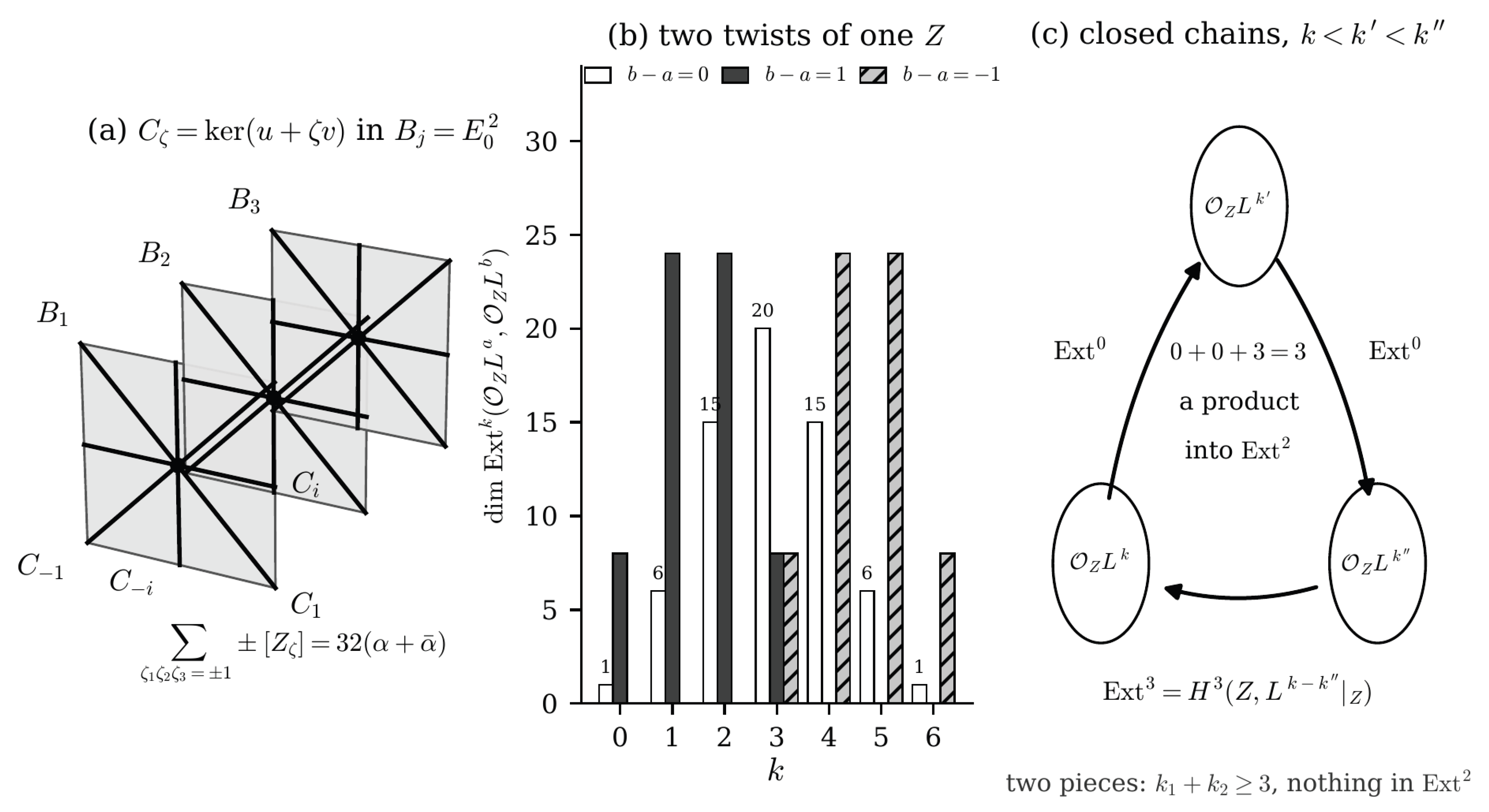
Appendix B.3. The Dimensions in Lemma 15
For the threefolds the numbers of Lemma 15 are explicit. Table A1 lists, for every pair of piece types, the degrees k in which is nonzero and its dimension; here is the difference of the twists, , with for all j, and .
Table A1.
The Ext groups between two pieces at , from Lemma 15; , for the threefolds .
| from | to | degrees k | |
| : | |||
| , | |||
| , | |||
| 3 | |||
| , | 3 | ||
| , | 6 | ||
| , | 0 | ||
| , | 3 | ||
| , | 0 | ||
| , | 6 | ||
Each row of the table restates the corresponding item of Lemma 15, with from (iii) above and from (A8). Two features of the table drive Proposition 25. Every group between two pieces of different twist is concentrated in degree 0, in degree 3 or 6, or in the range 0 to 3 for two twists of one threefold; and a group in degree at most two between distinct pieces occurs only from a lower twist to a higher one, or from to . The bookkeeping of the proposition is then the following count. A closed chain of m pieces whose edges have Ext degrees carries an m-fold product into of the first piece. For the table gives, for each unordered pair of distinct piece types, the two degrees and their sum:
so no two-step product reaches degree two. For the sum must be 3 with two edges of degree zero, and the table leaves exactly the ascending chains , , closed by the degree-three edge , of dimension . The program julia/cmpointext.jl enumerates the chains of two and three pieces over four twists and two threefolds and confirms both statements, together with the identities of Lemma A28. Figure A2 shows the table as the matrix of the twelve pieces, and the distribution of the total degree over every closed chain of two and of three distinct pieces: the two-piece chains begin at total degree three, and the twenty-four ordered three-piece chains of total degree three are the eight ascending triples of twists of one threefold, each read from its three starting pieces.
Figure A2.
The degrees of the Ext groups between the twelve pieces , , , , of Table A1. Left: the degrees in which is nonzero, shaded by the least one; degree zero occurs only from a lower twist to a higher one and from to . Right: the number of closed chains of two and of three distinct pieces by total degree, on a logarithmic scale; no two-piece chain has total degree below three, and the three-piece chains of total degree three are those of Proposition 25.
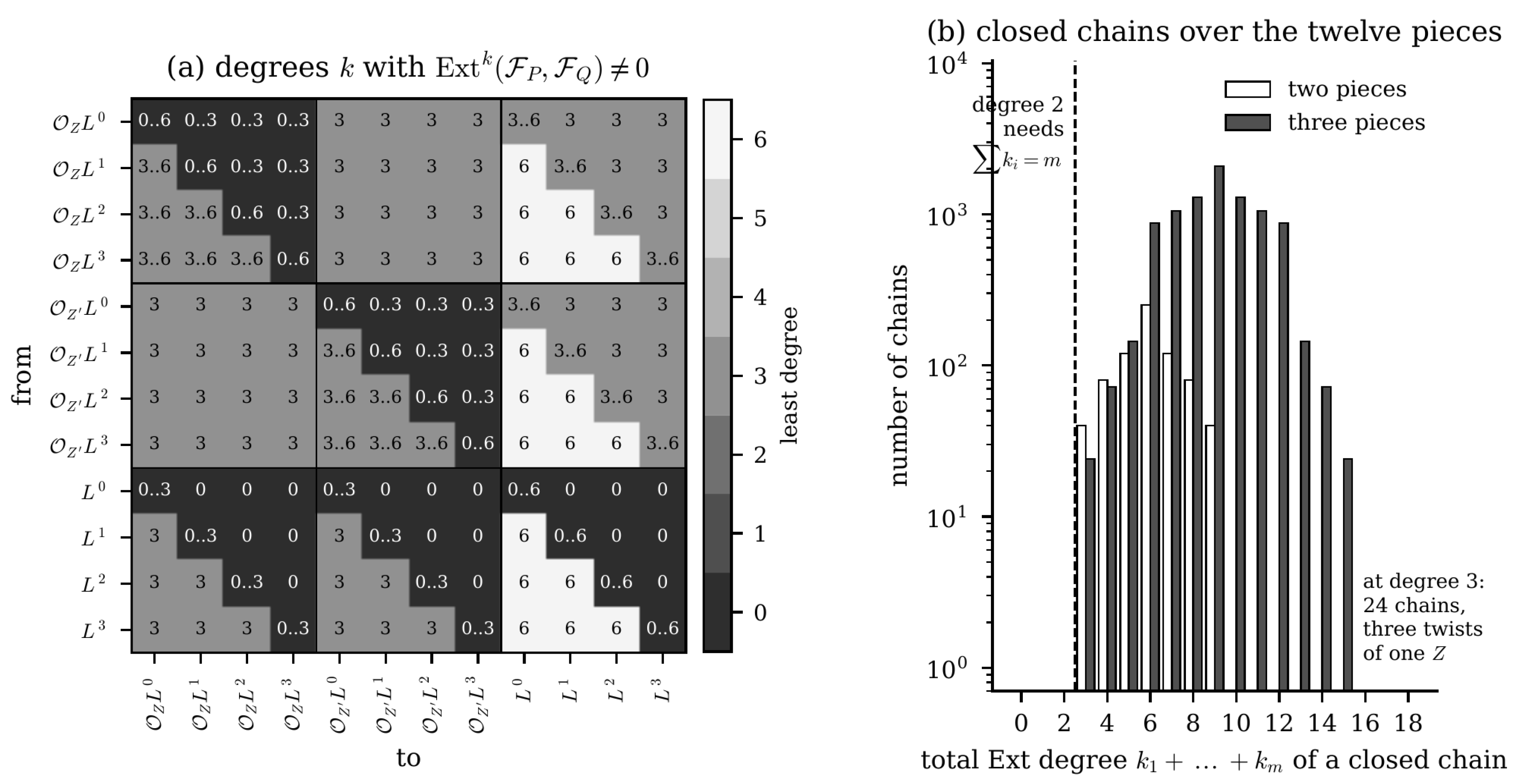
Appendix C. Finite Computations
This appendix carries out the finite computations used in the proofs of the text and of Appendix A. The programs named in each paragraph repeat them, in exact arithmetic except in Appendix C.6 (Appendix D); the hand computations given here are complete, except for the enumerations that are stated as such.
Appendix C.1. Lemma 11
Rank at most five. A rational quadratic space of rank at least five that is indefinite is isotropic by Meyer’s theorem [108, Chap. IV, §3.2], so a space T of signature is with after reordering, and
since ; this is with up to squares. Spaces of rank 2, 3, 4 embed in one of rank five of signature , by adding negative squares. The program k3wittindex.jl confirms this on all 34606 diagonal forms with entries in and on 2000 random isotropic forms. The example after Corollary 3: with , so , give .
Rank six. For and , and , so
which is (c)⇒(a) with . The witnesses printed by k3wittindex.jl are , of discriminant , with and ; , of discriminant 115, with , since , and ; and , of discriminant 161, with and . Over the 1980 diagonal forms with and in , the local criterion (d) and the existence of in (c) agree; 1484 forms have Witt index two and 496 Witt index one, among them and , which the program confirms to embed in no with squarefree, as (a)⇔(b) predicts for every m. No space of signature embeds in a space of signature , which is (iii).
Appendix C.2. Table 4
For the binary form has, in the basis , the Gram matrix
which is for and the hyperbolic plane for . It is positive definite if is totally positive, negative definite if is totally negative, and of signature if . So for with of negative norm and positive at and totally negative has signature , and W has signature at and at . The data are:
| e | diagonal form of T | p | , | ||
| 2 | 3 | ||||
| 3 | 3 | ||||
| 5 | 2 | ||||
| 6 | 2 | ||||
| 7 | 7 |
In each row is a square in : , , , , . At such p the spaces and have the same rank and discriminant, so they are isometric if and only if their Hasse invariants agree [108, Chap. IV, Thm. 7]; they do not, so , condition (d) of Lemma 11(ii) fails, and T has Witt index one. For instance for , : modulo squares in the diagonal form is ; the Hilbert symbols of units are 1, and , and the product over the fifteen pairs is , while since all entries are units. For the program k3wittindex.jl also evaluates by tame symbols and finds it nonzero at p, as Theorem 17 requires; on 7000 random spaces W for the criterion of Theorem 17 agrees with the Hasse invariants at all 3160 pairs with p odd.
Appendix C.3. Split Polarisations
Lemma 28 is proved for every totally real sextic L; splitpolarisation.jl exhibits the polarisations in four fields: , , , defined by , , , of polynomial discriminants , and , and the field defined by , of discriminant 17609533 and Galois group , which contains Frobenius elements of cycle types , and at . Each polynomial has six real roots by Sturm sequences and is irreducible modulo one prime. For , , and each of the 20 sign vectors with three entries , an element with is found with and up to squares, checked by Hilbert symbols at the primes dividing ; the Gram matrix is recomputed exactly and has signature . Elements with the same signs but non-split also occur, which is why the choice in Lemma 28 is needed.
Appendix C.4. Sixfolds with Complex Multiplication by KL
cmsixfolds.jl lists the transitive subgroups of by closing generating pairs under composition: there are 279, in 16 conjugacy classes, distinguished by order and cycle statistics. For each and each , 1953 pairs in all, it forms the CM type , , and for enumerates the subsets S of the twelve embeddings with and for every . It then compares their span with the span of products of elements of , the divisor classes: , , in all cases, and is spanned by and the sections of Theorem 29; the Weil classes are needed in 332 of the 1953 cases. By Poincaré duality give . For and the dimensions are those stated after Theorem 29. For , , , with Galois groups , , acting regularly, each field has two imaginary quadratic subfields, and of the 64 CM types 40 have divisor-generated Hodge rings and 24, in two orbits of twelve, need exactly the two Weil classes of one of them.
Appendix C.5. Hodge Classes on X a ×Z K b
At a very general point the Hodge group of is the image of , which over acts on and on , . Powers of . By the Cauchy formula , over partitions with at most two rows, and the -invariants of are one-dimensional for and zero otherwise. So the invariants of one factor in have dimension . For this is in , and gives . For the partitions in a box give , so one factor contributes , and the coefficients of in degrees are 1, 12, , and . Products. linkinvariants.jl computes the invariants of the torus and the kernels of the raising and lowering operators of on the weight-zero part of , Künneth component by Künneth component, and compares with the dimension of computed from the factors. With for and for , the dimension of in degree is : on in degrees it is , , and ; on in degrees it is , and ; on in degrees it is and . The program finds 10, 20, 29, 35; 26, 98, 293; 134, 995 Hodge classes. In degree six on the Künneth components , , , have dimensions , 7, 3, 1, the 3 of being of Theorem 39(i), and in degree four there is no mixed class; on in degree four the total is 26, with in the component . The multiplicities used in Lemma 36 and Theorem 39(i) are: occurs once in and in , and not in or ; occurs once in and in . Finally, for F defined by , and , of discriminants 49, 81, 148, the elements for , , are irrational, so with 1 they span F, as in Theorem 39(ii).
Products with . Let t be a point that is not a CM point, and E the elliptic curve with complex multiplication by k of Theorem 44, with . The Hodge group of projects onto those of and of E, and its derived group is G, so it is the image of with a torus; write its characters as , so that has character 0, the summands and of have characters , with the standard basis, and , have and . The projection of to is onto, because the Hodge group of is the image of , so has rank at least 3; and the classes of Theorem 44(a), which are Hodge classes by the proof of that theorem, have over a nonzero component in ( on the second factor E), of character when the signs of the are chosen so that has character ; this character is therefore trivial on . So the characters trivial on are the multiples of , and a vector in the cohomology of a product of copies of X, and E is a Hodge class exactly when it is G-invariant of character for some . . The characters of are sums of three vectors , whose coordinate sum is odd, and forces ; so there is no Hodge class. By Theorem 42(i) the V-isotypic part of is , with one factor above each place, so . Adding two factors E. Now , and is excluded as before. For , , the factor is a line and the part of of character , one vector of above each place, is the summand , whose G-invariants in form a line; the case is conjugate. So the Hodge classes in form a -plane, the k-line of ; replacing by adds two summands of character and nothing else. . The cohomology of X has character 0, so a Hodge class has and ; the part of character of consists of Hodge classes of , so every Hodge class on is a sum of products of Hodge classes on the two factors, and there are no mixed classes. . For the same argument applies. Otherwise . For the part above each place i must have character , hence lie in an odd exterior power of , ; both and are of type and have no invariants, and is trivial for G, so there is no Hodge class. For , possible only for , the factor of is the line spanned by the product of the four classes in degree four, resp. its conjugate, and the part above each place must have character , which in occurs only in , resp. , a trivial G-line. This gives one class for and one for , both in degree : no mixed class for and a plane in degree ten for . The program r4gamma.jl counts the G-invariants of each character by the multiplicities of the weights 0 and 2 of each factor and confirms these numbers, together with the totals 26 and 20 computed above.
Appendix C.6. The Hochschild Rank on S 1 ×S 2
The proof of Proposition 16(a) reduces to the kernel of , which is with . On the L-part every qualifies, which gives dimensions after removing and from the -dimensional ; on it gives . Since , . For the map is the identity, the kernel is the diagonal, of dimension 22, and ; without the bivector the two copies of are removed from the domain and one dimension from the kernel, so . The program fullht2rank.jl realises with the Mukai pairing and a period s in for and , checks that and agree with the contraction with the bivector and with the cup product with , written out directly, and computes the three ranks R, r and the rank on alone from singular values for seven shapes of v in each of the 20 cases: four with given U-blocks, one with random N-components and a random , a similitude, and the two special eigenvalue cases of (a). In all 140 cases the ranks agree with the formulas of (a), v is a Hodge class, and ; for , the seven values of R are 25, 25, 26, 26, 22, 24, 25, so the generic value , the similitude value 22 and the special values and all occur. The controls and its negative dual give , . Contracting into in place of v changes the rank for some shapes, which is why v and not enters Proposition 16. The ranks are read from the singular values with relative threshold .
Appendix C.7. Hermitian Forms of Weil Type
Theorem 27. For the trace form is , of discriminant , so is hyperbolic exactly when its Hasse invariants are those of hyperbolic planes, by Hasse–Minkowski. The program cliffordcheck.jl draws 2400 diagonal forms of signature , , with entries of absolute value in , for , tests hyperbolicity of through the local invariants at every prime dividing and at infinity, and finds it equivalent to at every place, in 497 split and 1903 non-split cases; for the 251 non-split forms with it confirms with anisotropic, the Witt index of ; and on 180 binary forms of signature that the trace form is hyperbolic exactly when .
Theorem 28(ii) for . Let with basis , , , and , , on , with acting by left multiplication. In the K-basis of V, with : and , so ; and , so ; and , , so . Hence , of signature exactly when , and modulo squares, which is the case of in . The program qmdisc.jl takes , , , , , , and , and for two random hermitian matrices each checks in exact arithmetic that is alternating with , that H is K-hermitian of signature , and that is a norm from K.
Appendix C.8. Convolutions on
Lemma A9 and Theorem A9. has dimension , that is for and for ; the rank of the contraction with is , that is 57 and 104, so the bound of Theorem A9 is 58 and 105. The program contractioncheck.jl works in the exterior algebra over on the forms , , and checks the Weil identity ; that , computed as the K-linear v with , has dimension and contains ; that for all 32, resp. 128, pieces and ; that the map , , has rank 3, resp. 6, for every ; and that , resp. 104, with in the kernel.
Theorem A8. With the Ext degree of a step between a bundle and is bounded below by Lemma A7 applied to the eigenvalues on each surface. The program excesscheck.jl computes, for , the least excess of a step between bundles over all , resp. , ordered pairs, which is 1, and the least total excess of a closed path of distinct pieces among four bundles and the three multiples, over every order of p among the , which is 2; excessgeneral.jl drops the hypothesis and runs over all pairwise distinct , using the degree ranges of Lemma A7, and finds the least total excess 1 for , attained at , and 2 for ; this is the bound of the proof, and no placement gives total excess 0.
Proposition A16(ii). There are 128 bundles , with , and three multiples, so 131 pieces. On the space of one piece decomposes by the types , : four types of dimension 1 and six types of dimension , in all 28; so . For the components of the graph of the proof are the four sets , and for the sixteen sets , so the kernel has dimension at least ; cupkernel.jl recomputes the components by union–find on the potential edges.
Proposition A16(iii). The program mchains.jl enumerates the chains of distinct pieces among one bundle class L and the multiples , with steps up (excess ), down (excess 7) and between bundles (excess at least 1), for each of the four positions of p among the values, keeps those that pass the degree test of the proof and removes those with two consecutive steps up through a multiple whose value is the only one strictly between. For each position five chains pass the degree test; one, two, two and one survive, namely ; and ; and ; , with the multiples numbered by increasing value. These are the six types: each has four leaves, the three multiples and one bundle, and .
Proposition A14. On one surface the forms are and , and fixes a piece L exactly when for all , . For and this is a congruence on a modulo ; the program equivgroup.jl solves it over the 8-torsion points for eight placements at and finds , generated by , exactly when all are odd, and otherwise, G isotropic for the commutator pairings, and dividing , since for .
Theorem A21: the slices. In the slice a piece is joined to when they differ in the three other coordinates by units with , so that the parities differ. Among the 27 triples in the product is exactly for and the six orderings of : an odd number of factors gives a product , and two factors with one give only when they are i and . So the graph is 7-regular with edges, and the weights are and , of sum at each vertex. A single vertex is a cut of weight 20; slices.jl computes the global minimum cut of each of the 16 slice graphs by the algorithm of Stoer and Wagner [113] in exact integers and finds 20, and checks connectedness.
Theorem A21: the totals. There are sets of at most five slices. For no edge survives, each piece is its own component and ; with all edges the bound is the 484 of Proposition A16(ii). The program twolevel.jl computes , 3668, 3632, 3545, 3428, 3311 for by union–find on the edges of the theorem, so that is 1792, 1812, 1796, 1729, 1632, 1535; for the slices give at least .
Appendix D. Machine Checks
Every finite quantity used in the proofs is recomputed by the Julia programs of the repository [9], and the combinatorial and arithmetic statements among them are also proved in Lean 4. No statement proved in the text rests on these checks, except the enumerations that are stated as such: those of Proposition 27, Theorem 29, Proposition A16(iii) and Theorem A21, the strong connectivity in Proposition A12(ii) and the list of Proposition A13, Remarks 9 and 14, the Picard number of Remark 1 and the counts of Appendix C that are marked as computed; and the rest guard against slips in the hand computations.
Lean.
The file lean/HodgeClosure.lean (Lean 4.24.0, no Mathlib) contains ninety-nine theorems. Section 1 encodes the eight statements and the rule set of Table 2 as data, computes closures by iteration, and proves by evaluation that the closures of , , , and contain , that the closures of , , , , , , and do not, and that the list of minimal sufficient sets, computed from the rule set alone, has exactly six members, those of Proposition 4. Section 2 proves the dimension counts of Section 6: for , for with mixed directions, the values and 104 of the lower bound, and the Hodge class count 26 of Theorem 37(i) as a sum of Künneth contributions. Section 3 proves the polynomial identities behind the Fricke families of Section 5.4: at level 7 and at level 5, by exact arithmetic on coefficient lists, together with the root products and , the Euler numbers 12 and 24, the Shioda–Tate counts giving Picard number at least 16, the transcendental rank 6, the dimensions of the dihedral Hecke algebras, and the polynomial identity behind the sign of Lemma 9: with , the Vélu coefficients of the quotient of (2) by , computed from the kernel polynomial by Newton’s identities on coefficient lists, and , , the identity holds at both levels, which is . Section 4 proves the Dickson identities and behind the families of Theorem 14, that 2 has order three in and in , so that 2 is inert in both cubic fields, and the sign pattern of the conjugates of at the three real places. Section 5 proves the finite statements of Appendix B: the binomial identity , the intersection numbers and in the basis of the -forms of with the pairing , , the twisted sums , the identity as an equality of the 64 coefficients of the triple products over , the counts 48, 8, 75 and 18 with the Euler characteristics, and the two chain statements of Proposition 25 over the twelve pieces of Appendix B.3, each by decide. Section 6 encodes the pieces of Table 6 and the Ext dimensions of Lemmas 15 and 16, and proves that the isolated blocks of Lemma 17 sum to 7213, 2605, 2605, 0, 0 and 5325 at the six configurations named in the table; the reachability relation along blocks of total degree one is supplied as a certificate, which the kernel checks to be reflexive, to contain every such block and to be closed under one more step, before the sum is evaluated by decide +kernel. From the same certified relation it proves that the configurations (a) and (c) of the table have 32 and 22 threefold pieces outside every directed cycle of the graph of Section 6.6; and, by evaluating the Ext dimensions on every pair, that no edge of enters a piece at shift 1 from the thirty-two pieces or from the pieces , , , and , , with , that , and do enter, and that put each of the thirty-two pieces on a cycle of length six. Section 7 proves further arithmetic of Section 6 and Section 5: the four values , 48, 39, 30 of at (Remark 7), the two Gram blocks and of and its determinant for the squarefree (Lemma 12), the numerical conditions of Nikulin’s criterion and the order of the discriminant group of , the discriminants 49, 81 and 148 of the cubic fields of Theorems 14 and 41, and the factorials in the coefficients of used in Remark 7. Section 8 proves the arithmetic of Section 5.8, Section 6.9 and Section 6.14 and of Appendix C, with Hilbert symbols and Hasse invariants computed from valuations and Euler’s criterion: the Gram matrices, signatures, discriminants and the failing Hasse invariant of the five spaces of Table 4; the witnesses of Witt index two and one after Corollary 4 and the rank-five example ; the count of 1484 forms of Witt index two among the 1980 diagonal forms, evaluated by decide +kernel from condition (d) of Lemma 11(ii); the Hodge numbers of and of Proposition 41 and the dimensions of the products of the algebras after Theorem 38; the count of Theorem 39; the identity and the norm identity behind Theorem 37(iii), and the linear system of the type conditions in the proof of Theorem 40(ii), on finite grids; the counts and of Theorem 29; the discriminants of the sextic fields of Appendix C; and the degrees of Proposition 43. Section 9 proves the finite statements of Section 5.9, Section 6.9 and Section 6.16, of Appendix A.6 and of Appendices Appendix C.5 and Appendix C.8: the identity for behind Theorem 28(iii), as an equality of all coefficients in the exterior algebra; that divides for all pairs of the 128 pieces (Proposition A14); that every slice graph is 7-regular of weighted degree 20; the type count 28, and the kernel bound 484 of Proposition A16(ii); the threshold , the totals 1792, 1812, 1796, 1729, 1632, 1535, the number 6885 of slice sets and the bound 120 of Theorem A21; the least excess 1 of a step between two bundles over all ordered pairs at (Theorem A8); the bounds 58 and 105 of Theorem A9; the targets of Proposition 16 and the bound 44 of Corollary 9; the table of Proposition 18, for squarefree ; the self-intersection of Proposition 19; and the counts 8, 0 and 2 of Appendix C.5, by evaluating the characters and -weights. Section 10 proves the finite statements of Section 6.11 and of Section A.5: the contraction ranks and of Lemma 30, with and at ; the Euler characteristic of the forced dimensions and the rank 48 of the Künneth contraction in Theorem 30; the equivalence for ; for the lattice of Theorem 32, that lies in and is never , and that the least nonzero value of on the box is 32; the positivity of the cost bounds of Theorem A18 for up to the thresholds and ; the 46 edges inside a cube, the edges into and out of , and the 32 cubes, sixteen with , of Lemma A21; and the acyclicity of the collapsed graph of Theorem A19. Every theorem is checked by #print axioms: eighty-five use no axiom; the two inequalities of Section 2 and the two statements of Section 10 proved with the arithmetic tactic use propext and Quot.sound; and the six isolated-block counts and the two chain-free counts of Section 6, the identity of Section 9 and the cube-window count of Section 10 use propext; native_decide is not used. The file compiles in about five minutes on one core.
Julia.
The directory julia/ holds fifty-two programs for Julia 1.11.7 that use only the standard modules LinearAlgebra, Random and Printf. Each prints one line PASS or FAIL per check and a final count, and exits with a nonzero code if a check fails; julia/runall.jl runs all of them. Together they make 904 checks, all of which pass, in about nine minutes; the outputs are deterministic, with fixed seeds where generic data are drawn. Arithmetic is exact (integers, Rational{BigInt}, Gaussian rationals, , residues modulo primes with rational reconstruction) except in three places: the ranks of productobject.jl, convolutionchecks.jl and fullht2rank.jl, computed from singular values with relative tolerance , resp. in the last, which agree with the closed formulas, and the roots of in frickefamilies.jl, computed with 256-bit floating point. Table A2 lists the programs.
Table A2.
The Julia programs of the repository, the results they check and their number of checks.
| program | what it checks | checks |
| quadraticforms.jl | Hilbert symbols, Hasse invariants and the Hasse–Minkowski classification, shared by the lattice programs | 10 |
| closuregraph.jl | closures of the 256 subsets of the eight statements, the six minimal sets (Prop. 4), the rules with the literature adjoined and the blow-up bookkeeping of Prop. 46 | 18 |
| sqrt6chain.jl | Thm. 11: the 165 forms over (98 embed, 67 do not), the complements, both orders of the chain, Varesco’s , as controls | 25 |
| frickefamilies.jl | fibre types, Euler numbers and of the Fricke families; the Fricke involution on j; the twist identity; the Hecke algebras for | 41 |
| frickesign.jl | Lemma 9: kernel polynomials, Vélu’s quotient, , the twist constants, | 32 |
| frickepicard.jl | Rem. 1: point counts over , the characteristic polynomial of Frobenius on T and its factorisation over | 12 |
| frickelattice.jl | Prop. 15(i): and the rational isometries of root lattices | 21 |
| zetainvariants.jl | Thm. 14: the trace forms of against the transcendental lattices for , three contrasting algebras, the Dickson identity | 19 |
| kummertype.jl | Prop. 14 against a direct search; the counts and | 15 |
| ranksix.jl | Lemma 12 and Thm. 16 for the 305 squarefree ; the embeddings in | 35 |
| productobject.jl | Thm. 21 in the exterior-algebra model at : Hodge loci, cross terms, Hankel rank, , 104 | 32 |
| convolutionchecks.jl | Prop. 23: contraction ranks, the annihilators under the orthogonality hypotheses, the block trace | 26 |
| annihilatorexact.jl | Thm. 22 over : formula (11) and the annihilator of dimension | 34 |
| riemannrochpieces.jl | the polynomial (12) and the thirty-one supports of Prop. 24 | 8 |
| cmpointext.jl | Lemmas 15, A28 and Prop. 25: Koszul cohomology, the twisted groups, the closed chains of two and three pieces | 14 |
| cmpointcounts.jl | Table 6 and Lemma 17: the Chern characters, , , and the isolated blocks | 13 |
| cmpointchains.jl | Prop. 28, Cor. 12, Rem. 6: the graph and its directed cycles | 12 |
Table A3.
The Julia programs of the repository (continued).
| program | what it checks | checks |
| linebundlechains.jl | Thm. 23, Rem. 9: the arrangements of line bundles and their counts | 6 |
| linebundlefine.jl | rule E3* (Lemma 23), conditions C1–C4 in two implementations, the 165 and 269 states, the nine-bundle arrangements | 17 |
| chernh.jl | Rem. 7: the weight-zero Chern character against for , the ranks 57, 48, 39, 30 | 9 |
| threefoldsupports.jl | Section 6.8: Thm. 25, Lemmas 25, 27, 26 and Thm. 26 in exact arithmetic | 16 |
| coverboundary.jl | Prop. 39: smoothness of , the divisor of , , the rank nine | 10 |
| sexticlattice.jl | Rem. 14: the integral points of over the twelve cubic fields and their least values of | 24 |
| sixfoldlink.jl | Thm. 37: , the -invariants, the count 26, the weights of ; the shared isogeny factor at | 55 |
| mumfordcm.jl | Thms. 40, 41: invariants by Künneth type, Pohlmann’s criterion on and on | 51 |
| mumforddisc.jl | Thm. 40(iii): and discriminant one, for four cubic fields | 24 |
| mumfordresidual.jl | Rem. 15: the residual case , the Hodge torus, the lattices and dimensions, the fields of degree twelve, discriminant-one polarisations | 86 |
| k3wittindex.jl | Lemma 11, Cors. 3, 4, Thm. 17, Cors. 5, 6: embeddings in , the Witt index in rank six, the counts , the local criterion for trace forms with the local symbols over E computed independently | 20 |
| splitpolarisation.jl | Lemma 28 on four totally real sextic fields: for each of the twenty sign patterns a split , its Gram determinant, signature and symbols | 37 |
| cmsixfolds.jl | Thm. 29: the 279 transitive subgroups of , the Hodge rings of the 1953 pairs , the cyclotomic fields of degree twelve | 7 |
| linkinvariants.jl | Prop. 41, Thms. 38, 39: Hodge numbers of and of the subalgebras | 14 |
| r4gamma.jl | Thms. 42, 44: Hodge classes on by characters and -weights (App. Appendix C.5) | 12 |
| fullht2rank.jl | Prop. 16: the operators , the ranks R, r for seven shapes in 20 cases, the control | 25 |
| cliffordcheck.jl | Thm. 27: hyperbolicity of against the quaternion algebra, the binary criterion, the Witt index | 3 |
| qmdisc.jl | Thm. 28(i),(ii): the polarisations of type II, signature , modulo norms | 21 |
| contractioncheck.jl | Lemma A9, Thm. A9: the Weil identity, , , , 104 | 10 |
| excesscheck.jl | Thm. A8 for : excess of steps and of closed paths | 4 |
| excessgeneral.jl | Thm. A8: closed paths for all placements of the | 2 |
| equivgroup.jl | Prop. A14: the groups , isotropy, | 8 |
| cupkernel.jl | Prop. A16(ii): the components and the kernel bound 484 | 4 |
| mchains.jl | Prop. A16(iii): the chains through the multiples and the six surviving types | 5 |
| slices.jl | Thm. A21: the 16 slice graphs and their minimum cuts | 2 |
| twolevel.jl | Thm. A21: over the 6885 slice sets, the totals and 120 | 3 |
| secantranks.jl | Lemmas 30, 31, Thm. 30: contraction ranks into secant classes, the forced dimensions, , the ideal sheaf of a point | 16 |
| kunnethrank.jl | Lemma 30 for ; the rank 48 of the Künneth contraction on (Thm. 30) | 7 |
| kappa.jl | Thm. 35 on : Orlov’s equivalence on cohomology, and for six pairs, the rank-zero case | 10 |
| lattice.jl | Thm. 32: for forty forms, on the integral generators, the lattice | 4 |
| invcheck.jl | Lemma A15: the joint kernel of and its conjugate on , | 4 |
| windowsearch.jl | Thm. A18: least cost of a cycle through a proper piece, the thresholds and | 4 |
| cubeexample.jl | Prop. A12: , Hankel rank 3, the Koszul windows, strong connectivity | 6 |
| collapse.jl | Lemma A21, Thm. A19: the window graph in two models, the collapsed graph, entries and exits of cubes | 7 |
| subsets.jl | Prop. A13: the 44 unions of whole cubes with Chern character in | 4 |
| total | 904 |
Acknowledgements
The paper builds on the theorems of Eyal Markman on Weil classes and on Hodge isometries, of Salvatore Floccari on sixfolds of generalised Kummer type, of Kenji Koike on Weil sixfolds, on the work of Bert van Geemen, Matthias Schütt and Mauro Varesco on real multiplication of K3 surfaces, on Nikolay Buskin’s theorem on Hodge isometries, on the semiregularity theory of Spencer Bloch, Ragnar-Olaf Buchweitz and Hubert Flenner, and on the descriptions of Hodge classes on abelian varieties by Henry Pohlmann, Ben Moonen, Yuri Zarhin, Yves André and James Milne. We thank Priyabrata Mandal for the earlier collaboration on the closure graph and the polarised criterion, whose results are reproved in Appendix A.
Author Contributions
Deep Bhattacharjee, who leads the project, posed the problem in the form treated here, carried out the research and wrote the paper. The proofs are by Deep Bhattacharjee: the reduction and the dichotomy, the theorems on real multiplication and on the Fricke families, the transcendental rank six construction, the Witt index criteria and the dense curves, the results on Weil sixfolds with a split polarisation, the sixfold link and its behaviour at the points of complex multiplication, the constructions and exclusions at the points and , and the appendices. Deep Bhattacharjee made all the computations, the Lean 4 file and the Julia checks of Appendix D and the figures, and brought the work to its present state. Ushashi Bhattacharya read the manuscript and verified its arguments and references. Both authors approved the final version.
Open Gluon and Anaxia
Two tools built by D. B. stand behind the way this project was organised. Open Gluon is a workspace D. B. assembled and maintains, which keeps pinned copies of the mathematical libraries, the source record of the project and the checks in one reproducible place. Anaxia, the engine of the eBLLM project, is the construction engine of D. B.: it stores each construction as a route with its input, its output, the obligations that must be discharged and a test that makes the route fail when an obligation is skipped, and it certifies finite statements in exact rational arithmetic. D. B. wrote both and developed them from the constructions of earlier papers. Three of their constructions were used here. The first is the encoding of the stopping points of the paper as typed targets, from which Anaxia built the candidate configurations at of Table 6, the quotient chains of Proposition 20 and the first enumerations of the chains of line bundles behind Remark 9. The second is the reading of supports from a localised obstruction, which led to the statements of Section 6.8. The third is a Frobenius test on elliptic K3 surfaces, which first showed that a Fricke self-map is a complex and not a real multiplication, the observation behind Lemma 9. The engine proposes routes and tests them; every statement of this paper is proved in the text.
References
- D. Arinkin and A. Căldăraru, When is the self-intersection of a subvariety a fibration?, Adv. Math. 231 (2012), no. 2, 815–842. [CrossRef]
- A. Andreotti and T. Frankel, The Lefschetz theorem on hyperplane sections, Ann. of Math. (2) 69 (1959), 713–717. [CrossRef]
- D. Abramovich, K. Karu, K. Matsuki and J. Włodarczyk, Torification and factorization of birational maps, J. Amer. Math. Soc. 15 (2002), no. 3, 531–572. [CrossRef]
- Y. André, Mumford–Tate groups of mixed Hodge structures and the theorem of the fixed part, Compositio Math. 82 (1992), no. 1, 1–24. numdam.org/item/CM_1992__82_1_1_0.
- Y. André, Une remarque à propos des cycles de Hodge de type CM, in Séminaire de Théorie des Nombres, Paris, 1989–90, Progr. Math. 102, Birkhäuser, Boston, 1992, 1–7.
- Y. André, Pour une théorie inconditionnelle des motifs, Inst. Hautes Études Sci. Publ. Math. 83 (1996), 5–49. [CrossRef]
- M. Artebani, A. Sarti and S. Taki, K3 surfaces with non-symplectic automorphisms of prime order, Math. Z. 268 (2011), no. 1–2, 507–533. [CrossRef]
- M. F. Atiyah, Vector bundles and the Künneth formula, Topology 1 (1962), no. 3, 245–248. [CrossRef]
- D. Bhattacharjee and U. Bhattacharya, Lean 4 file and Julia checks for this paper, GitHub repository creelie/fermat-hodge-, release v5.0.0, 2026. https://github.com/creelie/fermat-hodge-.
- W. L. Baily, Jr. and A. Borel, Compactification of arithmetic quotients of bounded symmetric domains, Ann. of Math. (2) 84 (1966), no. 3, 442–528. [CrossRef]
- R.-O. Buchweitz and H. Flenner, A semiregularity map for modules and applications to deformations, Compositio Math. 137 (2003), no. 2, 135–210. [CrossRef]
- R.-O. Buchweitz and H. Flenner, The global decomposition theorem for Hochschild (co-)homology of singular spaces via the Atiyah–Chern character, Adv. Math. 217 (2008), no. 1, 243–281. [CrossRef]
- D. Bhattacharjee, Generalization of quartic and quintic Calabi–Yau manifolds fibered by polarized K3 surfaces, Research Square, 2022. [CrossRef]
- D. Bhattacharjee, Calabi–Yau saturation universality: toric mirror laws, Hodge statistics, and the higher-dimensional landscape, Int. J. Professional Studies 21 (2026), 211–256. [CrossRef]
- D. Bhattacharjee, N=1/F-theory resolutions, Int. J. Professional Studies 21 (2026), 945–982. [CrossRef]
- T. Bouchet, J. Hanselman, A. Pieper and S. Schiavone, Mumford-type Shimura curves contained in the Torelli locus, preprint, 2025. arXiv:2510.00093.
- W. Barth, K. Hulek, C. Peters and A. Van de Ven, Compact Complex Surfaces, 2nd ed., Ergebnisse der Mathematik und ihrer Grenzgebiete (3) 4, Springer, Berlin, 2004. [CrossRef]
- A. I. Bondal and M. M. Kapranov, Enhanced triangulated categories, Math. USSR-Sb. 70 (1991), no. 1, 93–107. [CrossRef]
- C. Birkenhake and H. Lange, Complex Abelian Varieties, 2nd ed., Grundlehren der mathematischen Wissenschaften 302, Springer, Berlin, 2004. [CrossRef]
- S. Bloch, Semi-regularity and de Rham cohomology, Invent. Math. 17 (1972), 51–66. [CrossRef]
- A. Borel, Some metric properties of arithmetic quotients of symmetric spaces and an extension theorem, J. Differential Geom. 6 (1972), 543–560. [CrossRef]
- A. Borel, Linear algebraic groups, second edition, Graduate Texts in Mathematics 126, Springer, New York, 1991. [CrossRef]
- P. Brosnan, Discriminants of Hermitian forms, maximal degenerations and Kontsevich’s tropical approach to the Hodge conjecture, preprint, 2026. arXiv:2609.14169.
- S. Bloch and V. Srinivas, Remarks on correspondences and algebraic cycles, Amer. J. Math. 105 (1983), no. 5, 1235–1253. [CrossRef]
- S. Bando and Y.-T. Siu, Stable sheaves and Einstein–Hermitian metrics, in: Geometry and Analysis on Complex Manifolds, World Sci. Publ., River Edge, NJ, 1994, pp. 39–50.
- N. Buskin, Every rational Hodge isometry between two K3 surfaces is algebraic, J. Reine Angew. Math. 755 (2019), 127–150. [CrossRef]
- E. Bayer-Fluckiger, B. van Geemen and M. Schütt, K3 surfaces with real or complex multiplication, Algebr. Geom., to appear. arXiv:2401.04072.
- A. Căldăraru, The Mukai pairing, II: the Hochschild–Kostant–Rosenberg isomorphism, Adv. Math. 194 (2005), no. 1, 34–66. [CrossRef]
- A. Căldăraru and S. Willerton, The Mukai pairing, I: a categorical approach, New York J. Math. 16 (2010), 61–98.
- A. Conte and J. P. Murre, The Hodge conjecture for fourfolds admitting a covering by rational curves, Math. Ann. 238 (1978), 79–88. [CrossRef]
- D. Calaque, C. A. Rossi and M. Van den Bergh, Căldăraru’s conjecture and Tsygan’s formality, Ann. of Math. (2) 176 (2012), no. 2, 865–923. [CrossRef]
- M. A. de Cataldo and L. Migliorini, The Chow groups and the motive of the Hilbert scheme of points on a surface, J. Algebra 251 (2002), no. 2, 824–848. [CrossRef]
- P. Deligne, Théorie de Hodge. II, Inst. Hautes Études Sci. Publ. Math. 40 (1971), 5–57. [CrossRef]
- P. Deligne, La conjecture de Weil pour les surfaces K3, Invent. Math. 15 (1972), 206–226. [CrossRef]
- P. Deligne, Hodge cycles on abelian varieties (notes by J. S. Milne), in: Hodge Cycles, Motives, and Shimura Varieties, Lecture Notes in Math. 900, Springer, Berlin, 1982, pp. 9–100.
- D. Eisenbud, Commutative Algebra with a View Toward Algebraic Geometry, Graduate Texts in Mathematics 150, Springer, New York, 1995. [CrossRef]
- A. Elagin, On equivariant triangulated categories, preprint, 2014. arXiv:1403.7027. arXiv:1403.7027.
- C. Faber, Prym varieties of triple cyclic covers, Math. Z. 199 (1988), 61–79. [CrossRef]
- S. Floccari and L. Fu, The Hodge conjecture for Weil fourfolds with discriminant 1 via singular OG6-varieties, J. Math. Pures Appl. (9) 210 (2026), 103876. [CrossRef]
- H. Federer and W. H. Fleming, Normal and integral currents, Ann. of Math. (2) 72 (1960), 458–520. [CrossRef]
- W. Fulton and J. Harris, Representation Theory: A First Course, Graduate Texts in Mathematics 129, Springer, New York, 1991. [CrossRef]
- S. Floccari, Sixfolds of generalized Kummer type and K3 surfaces, Compos. Math. 160 (2024), no. 2, 388–410. [CrossRef]
- S. Floccari, K3 surfaces associated with varieties of generalized Kummer type, Geom. Topol. 30 (2026), no. 3, 1129–1154. [CrossRef]
- W. Fulton, Intersection Theory, 2nd ed., Ergebnisse der Mathematik und ihrer Grenzgebiete (3) 2, Springer, New York, 1998. [CrossRef]
- F. Galluzzi, Abelian fourfold of Mumford-type and Kuga–Satake varieties, Indag. Math. (N.S.) 11 (2000), no. 4, 547–560. [CrossRef]
- W. M. Goldman and J. J. Millson, The deformation theory of representations of fundamental groups of compact Kähler manifolds, Inst. Hautes Études Sci. Publ. Math. 67 (1988), 43–96. [CrossRef]
- J. Grivaux, Chern classes in Deligne cohomology for coherent analytic sheaves, Math. Ann. 347 (2010), no. 2, 249–284. [CrossRef]
- P. A. Griffiths, On the periods of certain rational integrals. I, Ann. of Math. (2) 90 (1969), 460–495. [CrossRef]
- A. Grothendieck, Techniques de construction et théorèmes d’existence en géométrie algébrique IV: les schémas de Hilbert, Séminaire Bourbaki, Vol. 6 (1960/61), Exp. No. 221, 249–276; reprinted by Soc. Math. France, Paris, 1995. numdam.org/item/SB_1960-1961__6__249_0.
- A. Garbagnati and A. Sarti, Symplectic automorphisms of prime order on K3 surfaces, J. Algebra 318 (2007), no. 1, 323–350. [CrossRef]
- R. Goodman and N. R. Wallach, Symmetry, Representations, and Invariants, Graduate Texts in Mathematics 255, Springer, New York, 2009. [CrossRef]
- R. Hartshorne, Local Cohomology, a seminar given by A. Grothendieck, Lecture Notes in Mathematics 41, Springer, Berlin, 1967. [CrossRef]
- R. Harvey and H. B. Lawson, Calibrated geometries, Acta Math. 148 (1982), 47–157. [CrossRef]
- W. V. D. Hodge, The topological invariants of algebraic varieties, in: Proceedings of the International Congress of Mathematicians (Cambridge, Mass., 1950), Vol. 1, Amer. Math. Soc., Providence, 1952, pp. 182–192. Zbl 0048.41701.
- S. Huang, A note on a question of Markman, J. Pure Appl. Algebra 225 (2021), no. 9, 106673. [CrossRef]
- D. Huybrechts, E. Macrì and P. Stellari, Derived equivalences of K3 surfaces and orientation, Duke Math. J. 149 (2009), no. 3, 461–507. [CrossRef]
- D. Huybrechts and R. P. Thomas, Deformation-obstruction theory for complexes via Atiyah and Kodaira–Spencer classes, Math. Ann. 346 (2010), no. 3, 545–569. [CrossRef]
- D. Huybrechts, Lectures on K3 Surfaces, Cambridge Studies in Advanced Mathematics 158, Cambridge University Press, Cambridge, 2016. [CrossRef]
- D. Huybrechts, Motives of isogenous K3 surfaces, Comment. Math. Helv. 94 (2019), no. 3, 445–458. [CrossRef]
- L. Illusie, Complexe cotangent et déformations I, Lecture Notes in Math. 239, Springer, Berlin, 1971. [CrossRef]
- U. Jannsen, Motives, numerical equivalence, and semi-simplicity, Invent. Math. 107 (1992), no. 3, 447–452. [CrossRef]
- J. R. King, The currents defined by analytic varieties, Acta Math. 127 (1971), 185–220. [CrossRef]
- S. L. Kleiman, Algebraic cycles and the Weil conjectures, in: Dix exposés sur la cohomologie des schémas, Advanced Studies in Pure Mathematics 3, North-Holland, Amsterdam, 1968, pp. 359–386. Zbl 0198.25902.
- K. Koike, Algebraicity of some Weil Hodge classes, Canad. Math. Bull. 47 (2004), no. 4, 566–572. [CrossRef]
- J. Kollár, Trento examples, in: Classification of Irregular Varieties (Trento, 1990), Lecture Notes in Mathematics 1515, Springer, Berlin, 1992, 134–139. [CrossRef]
- M. Kuranishi, New proof for the existence of locally complete families of complex structures, in: Proc. Conf. Complex Analysis (Minneapolis, 1964), Springer, Berlin, 1965, pp. 142–154.
- N. Kurnosov, A. Soldatenkov and M. Verbitsky, Kuga–Satake construction and cohomology of hyperkähler manifolds, Adv. Math. 351 (2019), 275–295. [CrossRef]
- T. Y. Lam, Introduction to Quadratic Forms over Fields, Graduate Studies in Mathematics 67, Amer. Math. Soc., Providence, RI, 2005. [CrossRef]
- W. Landherr, Äquivalenz Hermitescher Formen über einem beliebigen algebraischen Zahlkörper, Abh. Math. Sem. Univ. Hamburg 11 (1935), no. 1, 245–248. [CrossRef]
- S. Lefschetz, L’analysis situs et la géométrie algébrique, Collection de monographies sur la théorie des fonctions, Gauthier-Villars, Paris, 1924. JFM 50.0663.01.
- M. Lieblich, Moduli of complexes on a proper morphism, J. Algebraic Geom. 15 (2006), no. 1, 175–206. [CrossRef]
- D. I. Lieberman, Numerical and homological equivalence of algebraic cycles on Hodge manifolds, Amer. J. Math. 90 (1968), no. 2, 366–374. [CrossRef]
- G. Lombardo, Abelian varieties of Weil type and Kuga–Satake varieties, Tohoku Math. J. (2) 53 (2001), no. 3, 453–466. [CrossRef]
- S. Ma, On K3 surfaces which dominate Kummer surfaces, Proc. Amer. Math. Soc. 141 (2013), no. 1, 131–137. [CrossRef]
- Ju. I. Manin, Correspondences, motifs and monoidal transformations, Math. USSR-Sb. 6 (1968), no. 4, 439–470. [CrossRef]
- E. Markman, The monodromy of generalized Kummer varieties and algebraic cycles on their intermediate Jacobians, J. Eur. Math. Soc. 25 (2023), no. 1, 231–321. [CrossRef]
- E. Markman, Rational Hodge isometries of hyper-Kähler varieties of K3[n] type are algebraic, Compos. Math. 160 (2024), no. 6, 1261–1303. [CrossRef]
- E. Markman, Cycles on abelian 2n-folds of Weil type from secant sheaves on abelian n-folds, preprint, arXiv:2502.03415 (2025). [CrossRef]
- E. Markman, Secant sheaves and Weil classes on abelian varieties, in: Proceedings of the International Congress of Mathematicians 2026, Vol. 3, 2026, pp. 586–602. [CrossRef]
- E. Markman, Secant sheaves on abelian n-folds with real multiplication and Weil classes on abelian 2n-folds with complex multiplication, preprint, 2025. arXiv:2509.23079.
- D. R. Morrison, On K3 surfaces with large Picard number, Invent. Math. 75 (1984), no. 1, 105–121. [CrossRef]
- A. Mostaed, McMullen’s curve, the Weil locus, and the Hodge conjecture for abelian sixfolds, preprint, 2026. arXiv:2603.20268.
- S. Mukai, Semi-homogeneous vector bundles on an abelian variety, J. Math. Kyoto Univ. 18 (1978), no. 2, 239–272. [CrossRef]
- S. Mukai, Duality between D(X) and D() with its application to Picard sheaves, Nagoya Math. J. 81 (1981), 153–175. [CrossRef]
- S. Mukai, On the moduli space of bundles on K3 surfaces, I, in: Vector bundles on algebraic varieties (Bombay, 1984), Tata Inst. Fund. Res. Stud. Math. 11, Tata Institute of Fundamental Research, Bombay, 1987.
- D. Mumford, On the equations defining abelian varieties. I, Invent. Math. 1 (1966), 287–354. [CrossRef]
- D. Mumford, A note of Shimura’s paper “Discontinuous groups and abelian varieties”, Math. Ann. 181 (1969), 345–351. [CrossRef]
- D. Mumford, Abelian varieties, Tata Institute of Fundamental Research Studies in Mathematics 5, Oxford University Press, London, 1970.
- V. K. Murty, Exceptional Hodge classes on certain abelian varieties, Math. Ann. 268 (1984), no. 2, 197–206. [CrossRef]
- B. Moonen and Yu. G. Zarhin, Hodge classes and Tate classes on simple abelian fourfolds, Duke Math. J. 77 (1995), no. 3, 553–581. [CrossRef]
- B. Moonen and Yu. G. Zarhin, Hodge classes on abelian varieties of low dimension, Math. Ann. 315 (1999), no. 4, 711–733. [CrossRef]
- J. Neukirch, Algebraic Number Theory, Grundlehren der mathematischen Wissenschaften 322, Springer, Berlin, 1999. [CrossRef]
- V. V. Nikulin, Integral symmetric bilinear forms and some of their applications, Math. USSR Izv. 14 (1980), no. 1, 103–167. [CrossRef]
- V. V. Nikulin, Finite automorphism groups of Kähler K3 surfaces, Trans. Moscow Math. Soc. 1980, no. 2, 71–135.
- O. T. O’Meara, Introduction to quadratic forms, Classics in Mathematics, Springer, Berlin, 2000, reprint of the 1973 edition (Grundlehren der mathematischen Wissenschaften 117, 1963). ISBN 3-540-66564-1. Zbl 1034.11003.
- D. O. Orlov, Equivalences of derived categories and K3 surfaces, J. Math. Sci. (New York) 84 (1997), no. 5, 1361–1381. [CrossRef]
- D. O. Orlov, Derived categories of coherent sheaves on abelian varieties and equivalences between them, Izv. Math. 66 (2002), no. 3, 569–594. [CrossRef]
- A. Perry, The semiregularity theorem for equivariant noncommutative varieties, preprint, 2026. arXiv:2604.00511.
- A. Polishchuk, Lefschetz type formulas for dg-categories, Selecta Math. (N.S.) 20 (2014), no. 3, 885–928. [CrossRef]
- H. Pohlmann, Algebraic cycles on abelian varieties of complex multiplication type, Ann. of Math. (2) 88 (1968), 161–180. [CrossRef]
- V. P. Platonov and A. S. Rapinchuk, Algebraic groups and number theory, Pure and Applied Mathematics 139, Academic Press, Boston, 1994, translated from the Russian by R. Rowen. ISBN 0-12-558180-7. Zbl 0841.20046.
- J. P. Pridham, Semiregularity as a consequence of Goodwillie’s theorem, Forum Math. Sigma 12 (2024), e126. arXiv:1208.3111. [CrossRef]
- I. Reiner, Maximal orders, London Mathematical Society Monographs. New Series 28, Oxford University Press, Oxford, 2003, corrected reprint of the 1975 edition. ISBN 0-19-852673-3. Zbl 1024.16008.
- J. J. Ramón Marí, On the Hodge conjecture for products of certain surfaces, Collect. Math. 59 (2008), no. 1, 1–26. [CrossRef]
- U. Schlickewei, The Hodge conjecture for self-products of certain K3 surfaces, J. Algebra 324 (2010), no. 3, 507–529. [CrossRef]
- W. Scharlau, Quadratic and Hermitian Forms, Grundlehren der mathematischen Wissenschaften 270, Springer, Berlin, 1985. [CrossRef]
- J.-P. Serre, Géométrie algébrique et géométrie analytique, Ann. Inst. Fourier 6 (1956), 1–42. [CrossRef]
- J.-P. Serre, A Course in Arithmetic, Graduate Texts in Mathematics 7, Springer, New York, 1973. [CrossRef]
- M. Schütt and T. Shioda, Elliptic surfaces, in: Algebraic Geometry in East Asia (Seoul, 2008), Adv. Stud. Pure Math. 60, Math. Soc. Japan, Tokyo, 2010, pp. 51–160. [CrossRef]
- G. Shimura, On analytic families of polarized abelian varieties and automorphic functions, Ann. of Math. (2) 78 (1963), 149–192. [CrossRef]
- T. Shioda and N. Mitani, Singular abelian surfaces and binary quadratic forms, in: Classification of algebraic varieties and compact complex manifolds, Lecture Notes in Math. 412, Springer, Berlin, 1974, 259–287. [CrossRef]
- H. Sterk, Finiteness results for algebraic K3 surfaces, Math. Z. 189 (1985), no. 4, 507–513. [CrossRef]
- M. Stoer and F. Wagner, A simple min-cut algorithm, J. ACM 44 (1997), no. 4, 585–591. [CrossRef]
- C. Soulé and C. Voisin, Torsion cohomology classes and algebraic cycles on complex projective manifolds, Adv. Math. 198 (2005), 107–127. [CrossRef]
- M. Varesco, Hodge similarities, algebraic classes, and Kuga–Satake varieties, Math. Z. 305 (2023), paper no. 69. [CrossRef]
- M. Varesco, The Hodge conjecture for powers of K3 surfaces of Picard number 16, Michigan Math. J. 75 (2025), no. 5, 1085–1116. [CrossRef]
- B. van Geemen, Kuga–Satake varieties and the Hodge conjecture, in: The Arithmetic and Geometry of Algebraic Cycles (Banff, 1998), NATO Sci. Ser. C Math. Phys. Sci. 548, Kluwer, Dordrecht, 2000, pp. 51–82.
- B. van Geemen, Real multiplication on K3 surfaces and Kuga–Satake varieties, Michigan Math. J. 56 (2008), no. 2, 375–399. [CrossRef]
- B. van Geemen and A. Rapagnetta, Hyperkähler sixfolds, abelian fourfolds of Weil type and a Hodge class, preprint, 2026. arXiv:2607.18341. arXiv:2607.18341.
- B. van Geemen and A. Sarti, Nikulin involutions on K3 surfaces, Math. Z. 255 (2007), no. 4, 731–753. [CrossRef]
- B. van Geemen and M. Schütt, On families of K3 surfaces with real multiplication, Forum Math. Sigma 13 (2025), Paper No. e2. [CrossRef]
- R. Villaflor Loyola, Periods of complete intersection algebraic cycles, Manuscripta Math. 167 (2022), 765–792. [CrossRef]
- C. Voisin, Hodge Theory and Complex Algebraic Geometry I, Cambridge Studies in Advanced Mathematics 76, Cambridge University Press, Cambridge, 2002. [CrossRef]
- C. Voisin, A counterexample to the Hodge conjecture extended to Kähler varieties, Int. Math. Res. Not. 2002, no. 20, 1057–1075. [CrossRef]
- A. Weil, Abelian varieties and the Hodge ring, in: Œuvres Scientifiques, Collected Papers, Vol. III (1964–1978), Springer, New York, 1979, pp. 421–429.
- Yu. G. Zarhin, Hodge groups of K3 surfaces, J. Reine Angew. Math. 341 (1983), 193–220. [CrossRef]
| 1 | Mumford constructed [87] abelian fourfolds X whose Hodge group is a -form of acting on , of dimension eight, through the tensor product of the three two-dimensional representations; the form comes from a quaternion algebra over a totally real cubic field F that is split at one real place and ramified at the other two, and the corestriction to of that algebra is the matrix algebra, which is what makes the representation rational. Such an X is simple, has , is not of CM type, and its Hodge group is smaller than the full symplectic group although no endomorphism accounts for the loss; its Shimura curve is compact. The exceptional classes of [90] live in degree four on (equivalently in of as a Hodge structure of weight zero) and span the invariants of the Hodge group that are not generated by the polarisation, and no one has proved them algebraic. The fourfold enters this paper because it is the smallest variety on which (F2) has an unsettled instance that no CM point reaches directly. |
| 2 | For a smooth projective variety X of dimension d with hyperplane class h, (L) asks that the inverse of the hard Lefschetz isomorphism be induced by an algebraic cycle on for every p; it is known for abelian varieties, surfaces and the varieties whose cohomology is spanned by algebraic classes, and open for a general threefold. A Hodge class is motivated in André’s sense when it is obtained from classes of algebraic cycles by cup products, pull-backs, push-forwards and the inverse Lefschetz operators, on X and on the products ; (M) asks that every Hodge class be of this kind, which is weaker than the conjecture by exactly the use of the inverse Lefschetz operator. (V) asks that a flat Hodge class in a smooth projective family be algebraic on every fibre once it is algebraic on one; Grothendieck observed that (V) follows from the conjecture, and the converse is open. (F3) concerns the varieties that are not abelian and makes no statement about abelian varieties at all; it is the complement, inside the conjecture, of (F2), and the pair (F2), (F3) is the coarsest division of the conjecture that this paper refines. |
| 3 | The theorem says that for a polarisable variation of Hodge structure over a smooth connected quasi-projective base S, the space of global flat sections, which is the subspace of a fibre fixed by the monodromy group, is a sub-Hodge structure of , and the Hodge structure it carries does not depend on s. Deligne proved it for the variations of a smooth projective morphism, where it follows from the degeneration of the Leray spectral sequence and the weight filtration of a smooth compactification; André proved it for every polarisable variation by showing that the connected monodromy group is a normal subgroup of the derived group of the generic Mumford–Tate group. In the situation of the text the section is flat, so its value at one point is fixed by the monodromy; if that value has type at one point, the sub-Hodge structure of flat sections contains it as a Hodge class, and since that Hodge structure is the same at every point, has type everywhere. |
| 4 | A subset of a topological space is meagre when it is a countable union of nowhere dense sets, that is, of sets whose closure has empty interior. The Baire category theorem states that a complete metric space, or a locally compact Hausdorff space, is not meagre in itself; a connected complex manifold such as is locally compact, so the theorem applies to it. A proper Zariski closed subset of an irreducible variety has empty interior in the analytic topology, because a holomorphic function vanishing on an open set vanishes identically on a connected manifold; so a countable union of proper Zariski closed subsets is meagre, and the alternative in (ii) is exactly whether one of the countably many closed strata of (i) is the whole of S. |
| 5 | The curve parametrises elliptic curves with a cyclic subgroup of order N; it has genus zero exactly for and , and for and a coordinate is the Hauptmodul with , so for and for ; this is why is 125 in one case and 49 in the other. The Fricke involution sends to , which exchanges the two cusps 0 and ∞ of and, on the moduli interpretation, replaces by the quotient with the image of as its distinguished subgroup. Applying it twice gives , so it is an involution, and in the coordinate t it reads because turns the quotient of eta functions into its reciprocal up to the constant , squared to by the exponent. |
| 6 | Families of K3 surfaces polarised by a fixed lattice also occur as the fibres of Calabi–Yau threefolds, the quartic and quintic ones being studied in [13]; the chains of this section act on the fibres only, and the Hodge classes of such a total space are not considered here. |
| 7 | The Dickson polynomial is the unique polynomial of degree n with ; for the map from to itself is a cover of degree n with monodromy group the dihedral group , totally ramified over ∞ [121, Lem. 4.3], since it is the quotient of , on which acts by and , by the involution. For it is the cyclic cover . The identity follows from the defining equation with v replaced by . |
| 8 | Explicitly , the case of ; for it is , so the family contains the surfaces . |
| 9 | Reaching F means producing, by algebraic correspondences from to itself, Hodge endomorphisms of that generate the cubic field , which is what (F3′) asks of this surface, since the class of a generator of F in is a Hodge class reached from no abelian variety as long as it is not algebraic. The correspondences built in this section, and every correspondence whose components have geometric genus at most one, act on as similarities, and a composite of similarities is a similarity; by Proposition 9(ii) a similarity lies in when is odd, so it generates nothing. The correspondences coming from finite group actions act through abelian fields by Proposition 10(iii), and a cubic field whose Galois closure has group is not abelian. The two propositions together say what a correspondence realising F must look like: an irreducible component with and transcendental rank at least eighteen, not arising from a finite group; no construction in the literature produces one. |
| 10 | The Hankel matrix of a sequence has entries . If is a sum of m terms with distinct and nonzero , the matrix factors as with V the Vandermonde matrix of the , so its rank is m; conversely a sequence whose Hankel matrix has finite rank m satisfies a linear recurrence of order m and is a sum of m exponentials with polynomial coefficients. For the polynomial part of a Chern character, writing it as means , so the number of exponentials needed is the Hankel rank of , provided the degree allows the recurrence to be read off, which it does for ; the cap at three records that the criterion of Theorem 20 does not distinguish further. |
| 11 | For a perfect complex on a smooth projective variety the semiregularity map of Buchweitz and Flenner [11] is the linear map sending to the trace of , where is the Atiyah class; it generalises Bloch’s map for a subvariety [20], which is the case of the structure sheaf of the subvariety. Its value is that the obstruction to deforming along a first-order deformation of X lies in and is sent by to the obstruction to keeping of Hodge type; so when is injective, deforms wherever its Chern character stays a Hodge class, and the Chern character of the deformed complex is algebraic there. The dimension count of the theorem is the arithmetic of this statement: the rank of is at least the rank of the contraction into , so is at least , and equality forces injectivity. |
| 12 | The direction matters: if then every -invariant is H-invariant, so containment of the Hodge group in a known group bounds the Hodge classes from below, never from above. |
| 13 | Every object obtained from by iterated cones in this order is of this form, because the Dolbeault complexes form a differential graded enhancement of the full subcategory of line bundles. All the objects of this subsection are given in this way. |
| 14 | In the language of -categories they are the higher products of the minimal model of the line bundles, evaluated on the Maurer–Cartan element of the twisted complex; for they are cup products. |
| 15 | Such solutions are far from unique: the equations of (i) are linear in each of , , separately, and the components on the 144 pairs do not enter them at all. |
| 16 | The ratios of two pieces of opposite parities have product ; when all three differ from 1 they are , with , or a permutation of , with . |
| 17 | This is Mumford’s index theorem: a line bundle on an abelian variety whose hermitian form is nondegenerate with i negative eigenvalues has cohomology only in degree i. On the form of is , with eigenvalues , and makes both of the sign of ; over the four surfaces the index is 0 or 8. The hypothesis is what keeps the steps between a piece and a multiple out of the middle degrees. |
| 18 | The bound is attained: with p below the three values , the run , up three times and down once, changes the shift by . With p in the middle, , the run up through and , down to and up to changes it by as well. |
| 19 | The ratios in the three coordinates have product , so they are , with , or a permutation of , with ; with four places for the coordinate where they agree this gives partners and classes. |
| 20 | The ratios have product 1. In two coordinates they are , with , or , , with ; then has dimension , and the six pairs of coordinates give . In three coordinates they are a permutation of or of , with , and has dimension 16; the four triples give . In four coordinates sits in degree 4. |
| 21 | The eight values are 960, 384, 192, 96, , , and . The bound 18432 is attained by the cut against , so 22528 is the best bound that this count gives. |
| 22 | A ratio that moves every coordinate has entries in and product 1. With a among them it is or has exactly two entries and the entries i and , twelve ratios; together thirteen, and . The other eight ratios have all four entries in and ; (ii) makes no statement about them. |
| 23 | The orders of the subgroups of are powers of two. A cut at one vertex weighs exactly 1024, so the bound is sharp. |
| 24 | Let the ratio move k coordinates. For it is in one coordinate, , and is tensored with the part of degree four of on the other three surfaces, of dimension : four partners with 60 each. For it is or , , and the part of degree three on the other two surfaces has dimension : twelve partners with 16 each. For the part of degree two on the last surface has dimension one, and the 28 partners give 640 as in Theorem A13. For the group sits in degree 4. So . |
| 25 | Between distinct pieces . A run from a piece through distinct multiples to a piece has steps, at least one up and one down, and lowers the shift by with : by 6, 5, 4 for , by 13, 12 for and by 20 for , never by seven. |
| 26 | With the values and p, the path with visits the four nodes in the order of their values; a path with and ending in degree eight visits the largest j values in increasing order and then the others, . So each placement has exactly four such paths, and for each the shifts of the multiples are determined by . |
| 27 | The proof does not look at the classes between the two parities. For these are classes of degree two in groups , on which vanishes by Lemma A12(i); but the coboundaries of the loops in , and, when two multiples have suitable shifts, the products along runs , reach them, and counting alone gives nothing there. |
| 28 | The subgroups of have orders that are powers of two. A cut at a single vertex weighs exactly 640, so the bound is sharp. |
| 29 | They differ by a homomorphism from the anisotropic torus to the centre of , whose identity component is , and such a homomorphism is trivial. |
| 30 | The fundamental domain of is the unit square, so ; this normalisation makes every form in (A7) integral on the lattice , and all intersection numbers below are integers computed as integrals of top forms. |
Figure 1.
The plan of the paper. The conjecture is equivalent to (F2) and (F3′) (Theorem 1, Proposition 4); the locus of either statement is dense, contains every CM point and is all or meagre (Section 4). For (F3′) the first class is the real multiplication of K3 surfaces: the chain of quotients for (Theorem 11), the Fricke isogenies (Theorem 13), the cyclic cubic fields on the surfaces of Mumford type (Theorem 14), every real quadratic field in rank six (Theorem 16), Floccari’s theorem at Picard number at least sixteen and on dense curves (Corollary 3, Theorems 17 and 18), and the steps at which each stops (Propositions 9 and 11). For (F2) the first class is the Weil classes of a product of two fourfolds: the product object (Theorem 21), the point of complex multiplication (Lemma 15 to Remark 9), Weil sixfolds with a split polarisation (Corollary 15, Theorem 29) and the sixfold link (Theorems 37, 38 and 41); the defect survives the operations of Proposition 47.
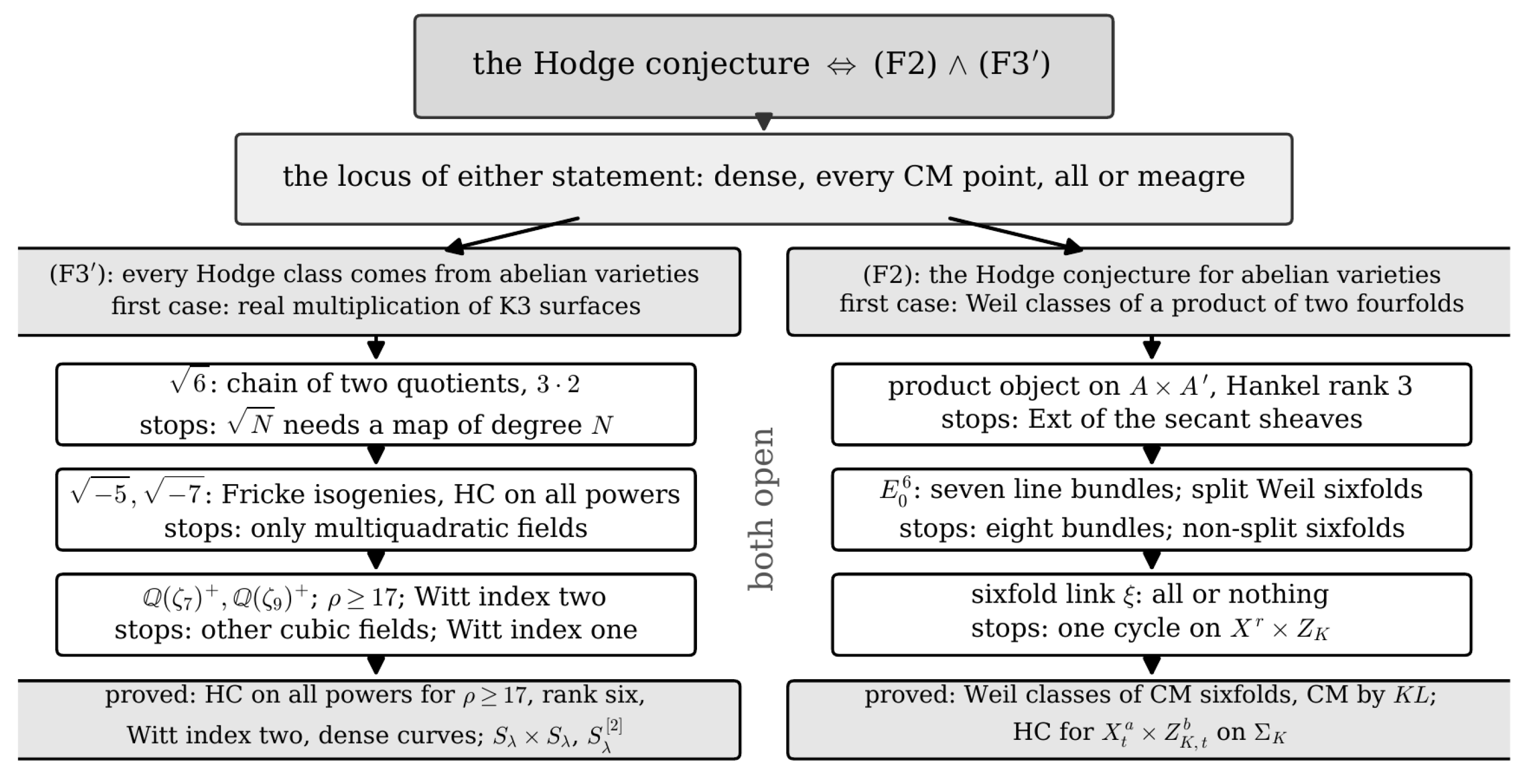
Figure 4.
The chain of Theorem 11: the quotient of by a symplectic automorphism of order three, a Hodge isometry (algebraic by Buskin), and the quotient of by a Nikulin involution. The multipliers compose to 6.
Figure 4.
The chain of Theorem 11: the quotient of by a symplectic automorphism of order three, a Hodge isometry (algebraic by Buskin), and the quotient of by a Nikulin involution. The multipliers compose to 6.
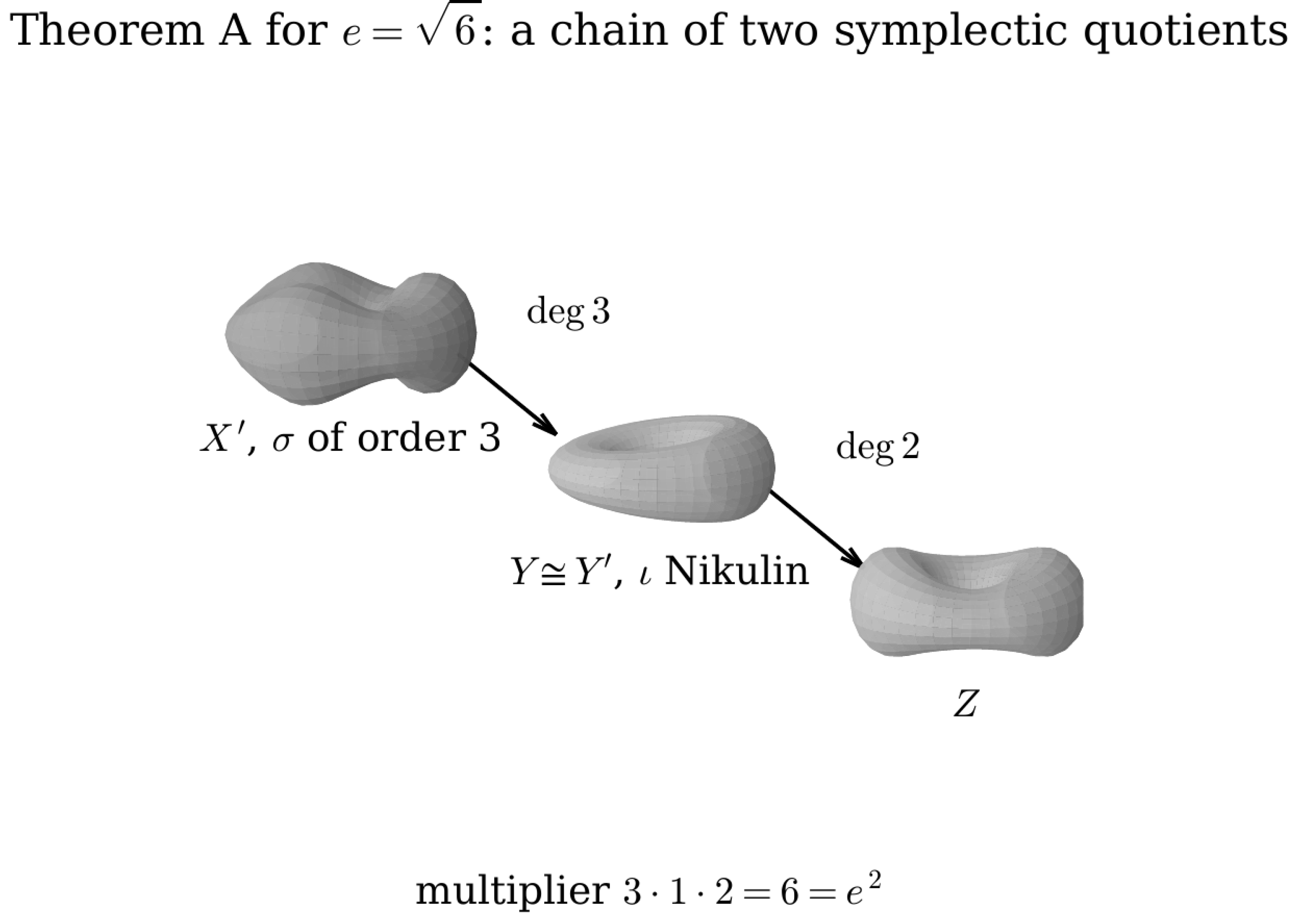
Figure 7.
Where the dihedral mechanism stops, Proposition 11. (i) Over or the Mumford algebras are and the algebras ramified at two real places and at two places above a split prime p; a rank-twelve family unimodular away from has square discriminant and carries only . (ii) The period domain of the rank-eighteen family is four-dimensional, the image of the family is a threefold, and the Shimura curves of the surfaces of Mumford type for the other algebras lie in the domain; whether the threefold meets them is the open transport condition. (iii) The finite subgroups of acting on the base produce only , , , and ; a cubic field arises only from the dihedral groups , , and .
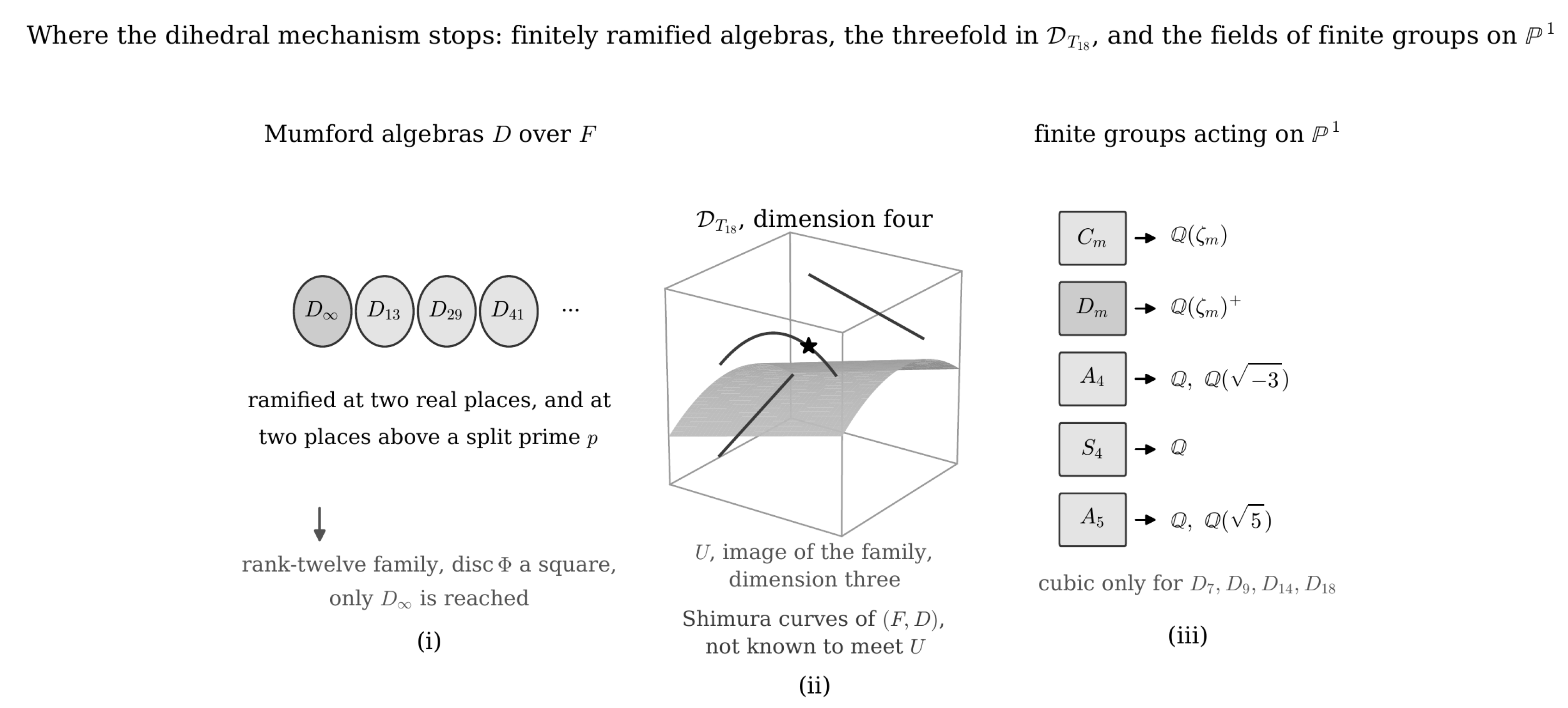
Figure 8.
Projective K3 surfaces by Picard number , the height of a bar being the dimension of the family. Dark: the Kuga–Satake correspondence is algebraic by Floccari’s theorem and the Hodge conjecture holds on every power and Hilbert scheme of points; this is every member for (Corollary 3) and, for , exactly the surfaces whose transcendental space has Witt index two (Corollary 4). Light: Floccari’s theorem does not apply, since embeds in no (Lemma 11).
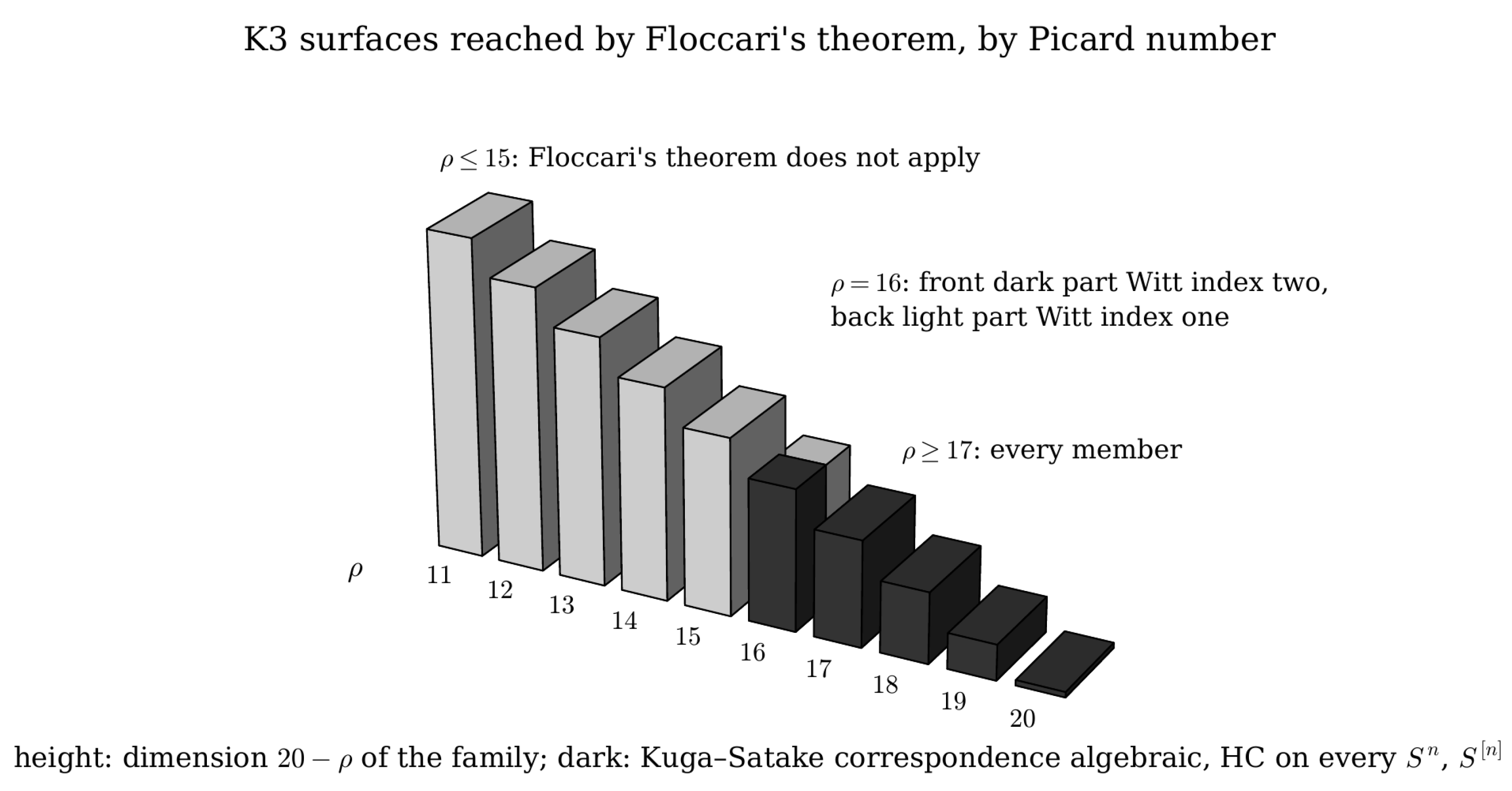
Figure 9.
The period domain of a family of K3 surfaces with real multiplication by a real quadratic field E, of dimension , and the curves of Theorem 18, one for each three-dimensional E-subspace of the shape of Corollary 5. On every curve the real multiplication is algebraic and the Hodge conjecture holds on all powers and Hilbert schemes of points; the union of the curves is dense and meagre, and the very general member is open.
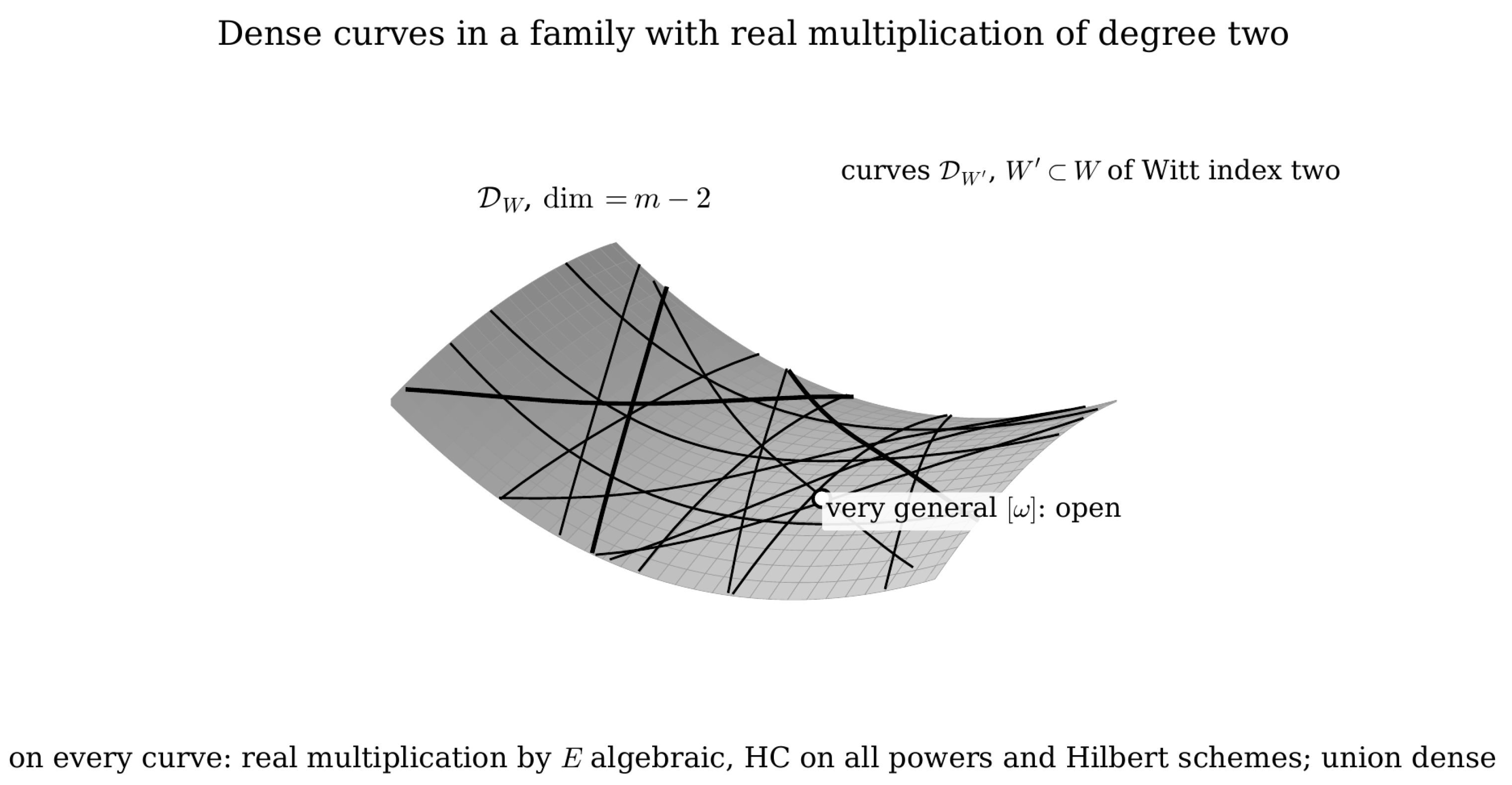
Figure 10.
The lower bound of Theorem 20 for and Hankel rank . The two labelled bars are the product cases of Theorem 21.
Figure 10.
The lower bound of Theorem 20 for and Hankel rank . The two labelled bars are the product cases of Theorem 21.
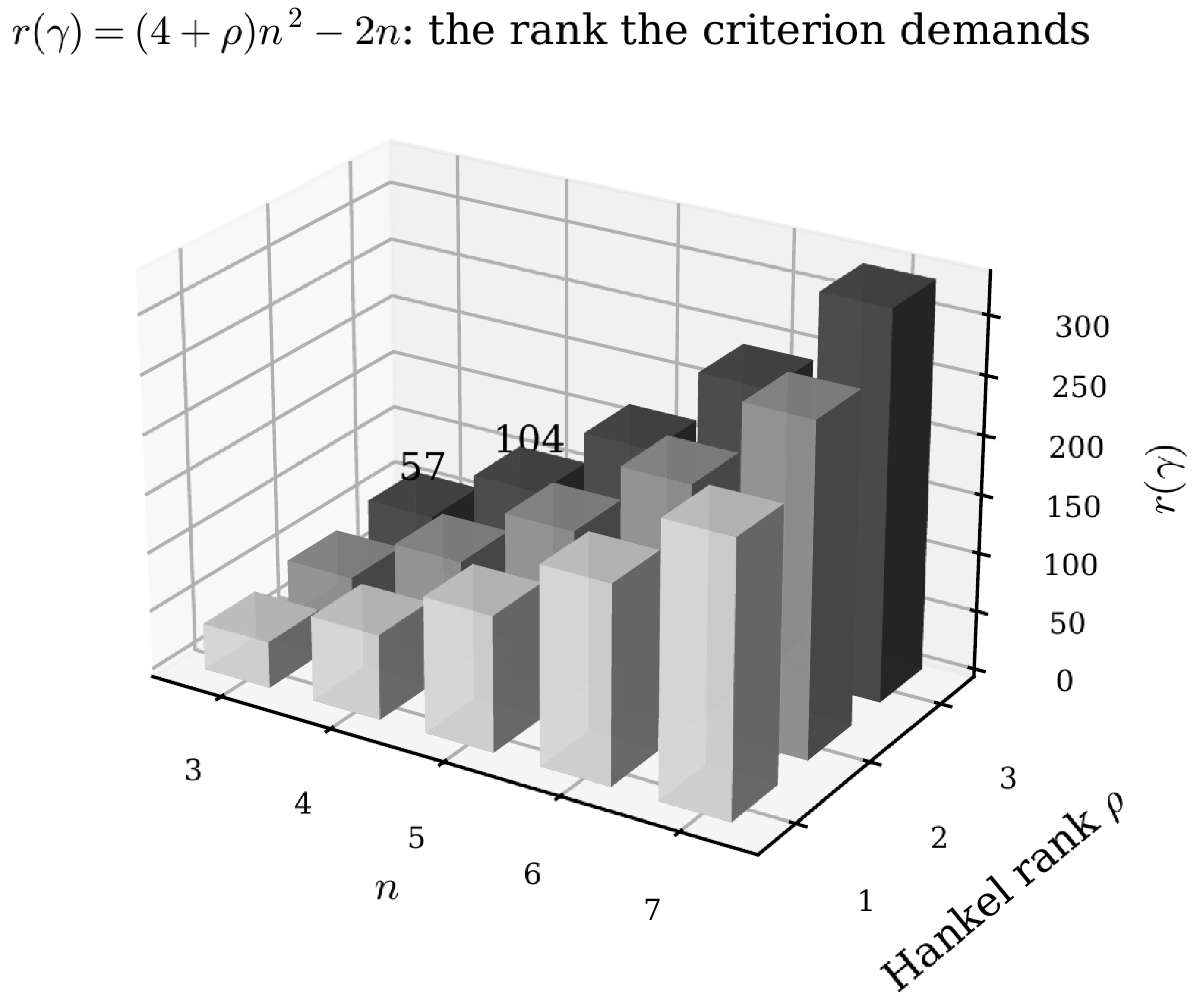
Figure 11.
The domain near a product point . The curve is the product locus, whose tangent space has dimension ; the mixed directions obstruct every exterior product , and only the combined object of Theorem 21 has the full tangent space as first-order Hodge locus.
Figure 11.
The domain near a product point . The curve is the product locus, whose tangent space has dimension ; the mixed directions obstruct every exterior product , and only the combined object of Theorem 21 has the full tangent space as first-order Hodge locus.
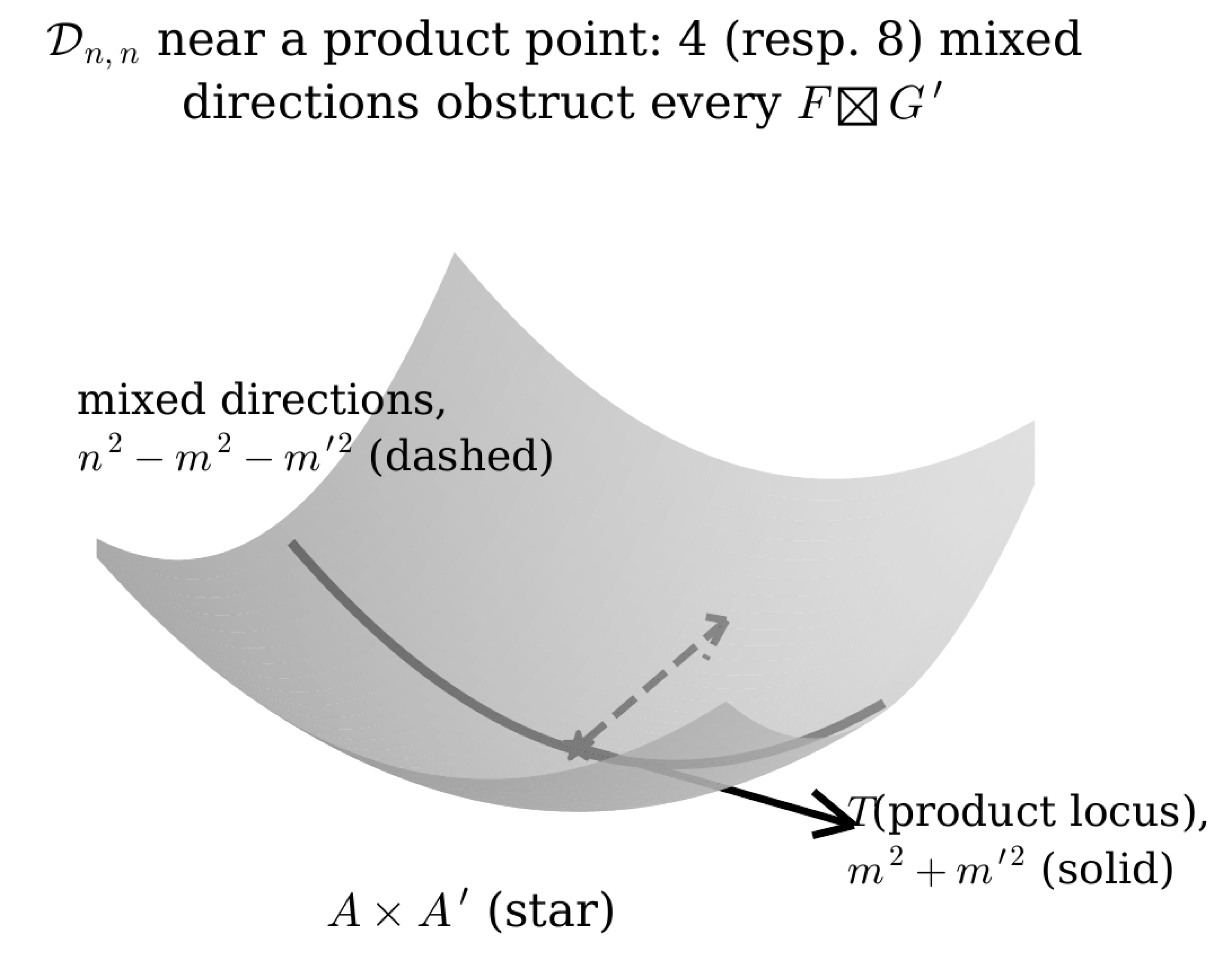
Figure 12.
Left: the period domain of abelian sixfolds of Weil type for K and discriminant ; the Weil classes are algebraic at every point of complex multiplication (stars, Corollary 15) and on the six-dimensional subdomains with a K-line as sub-Hodge structure (curves, Proposition 34(c)). Right, schematically: at a point with complex multiplication by the K-compatible polarisations are the forms , with the signs of the CM type; Lemma 28 finds one with (solid), to which Markman’s theorem applies.
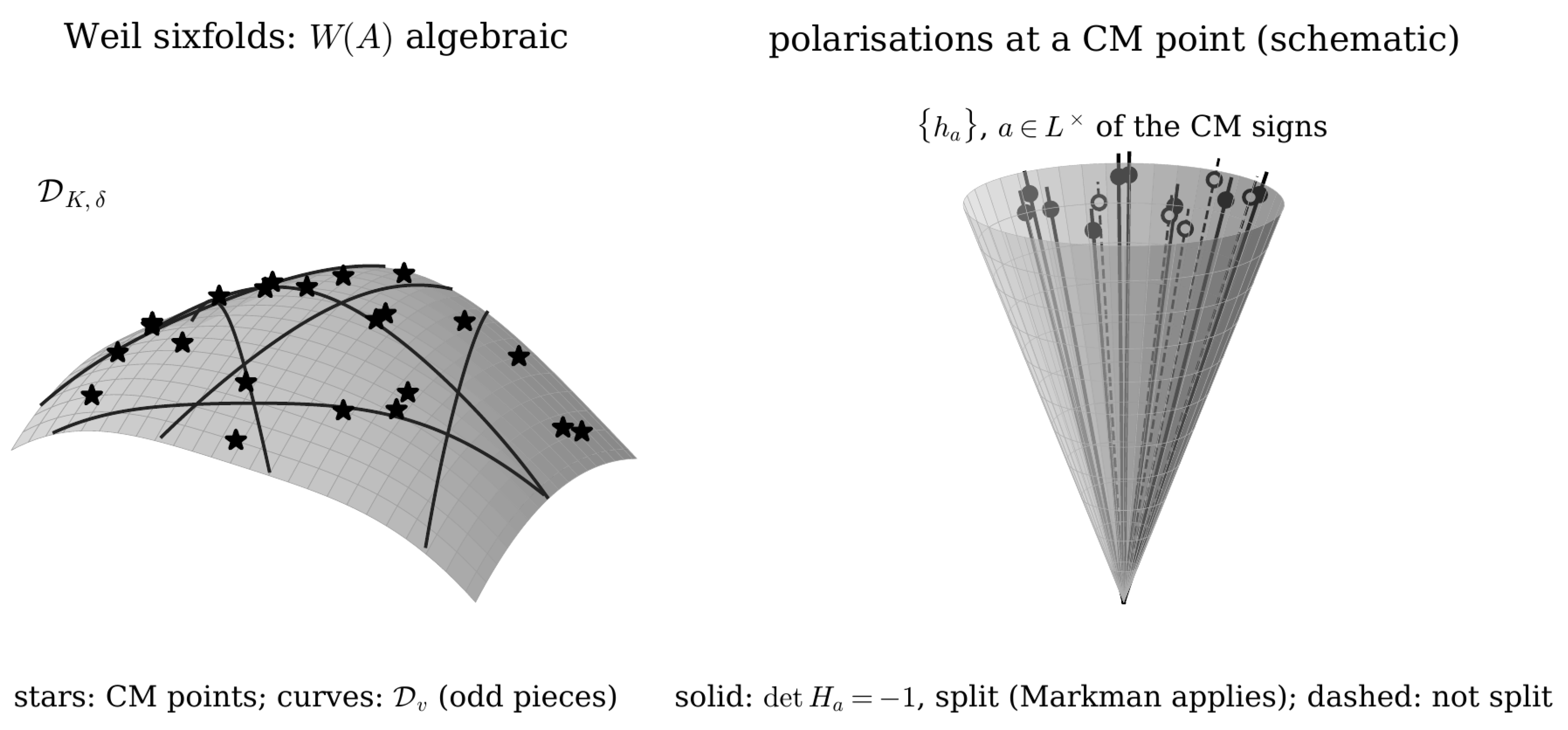
Figure 14.
Where the defect goes under surgery. A blow-up along Z carries the Hodge classes of X to and adds those of Z, so the quotient grows by the defect of the centre; a dominating map carries the defect of X into Y; a Fourier–Mukai equivalence permutes degrees and preserves the total defect; a degeneration to loses the class only in the special fibre, from which no cycle lifts.
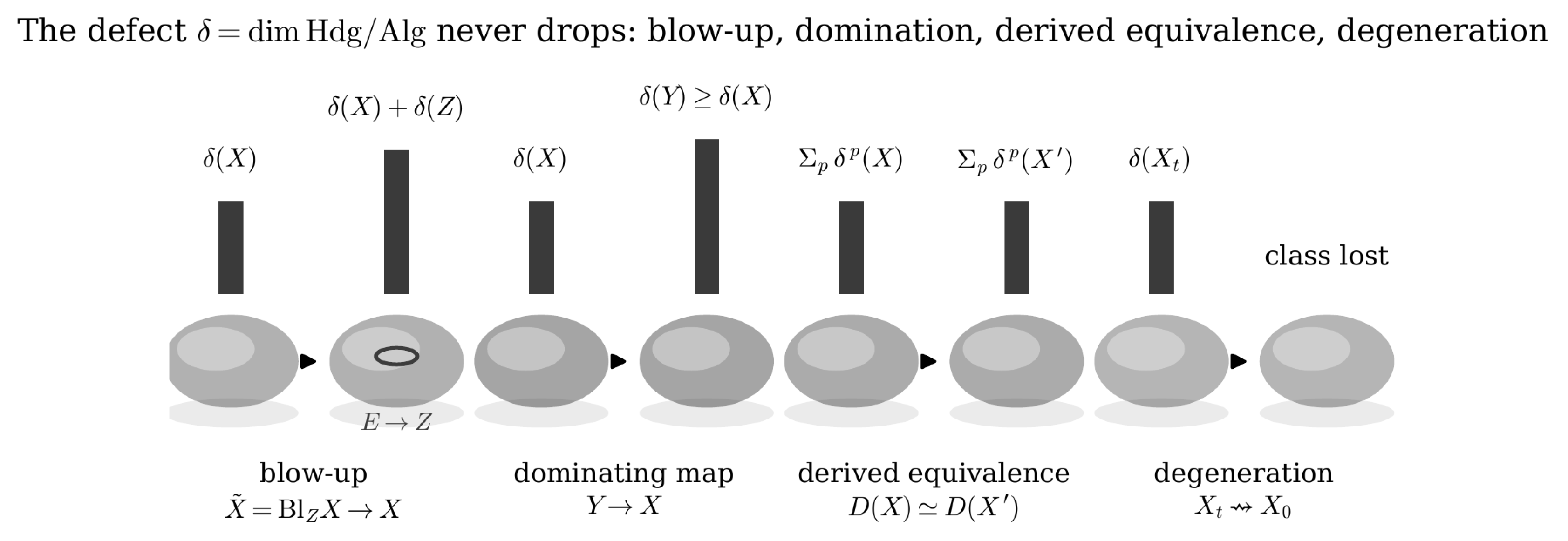
Table 1.
The main results. “Corollary” marks a statement whose decisive input is a published theorem, named in the text.
Table 1.
The main results. “Corollary” marks a statement whose decisive input is a published theorem, named in the text.
| Statement | Where | Status |
| ’), | Thm. 1 | proved |
| algebraic locus is all or meagre; dense for Weil classes | Thm. 2 | proved |
| real multiplication by through chains of quotients | Thm. 3 | proved |
| Hodge conjecture on all powers of the Fricke families, | Thm. 13 | proved |
| real multiplication by , | Thm. 14 | proved |
| every in rank six, all powers | Thm. 16 | corollary [42] |
| K3 surfaces with : on all powers and Hilbert schemes | Cor. 3 | corollary [43] |
| which Floccari’s theorem reaches; Witt index in rank six | Lem. 11, Thm. 17 | proved |
| dense curves in every family with real multiplication of degree two | Thm. 18 | proved, via [43] |
| Weil classes of sixfolds with complex multiplication | Cor. 15 | corollary [78] |
| for sixfolds with complex multiplication by | Thm. 29 | proved; enumeration |
| real multiplication of algebraic; the link is all or nothing | Thms. 37, 38 | proved |
| link classes on the dense set | Thm. 41 | corollary [76] |
| : at most seven line bundles; eight outside two arrangements | Thm. 23, Rem. 9 | proved; enumeration |
| , : no line-bundle convolution meets the criterion, with any group | Thm. A9 | proved |
| eightfolds from fourfolds: Markman’s Lemma 11.3 fails; indefinite secants miss the polarised locus | Thms. 30, 35 | proved |
| Weil classes on dense quaternionic loci of non-split sixfolds; Markman’s forms split | Thms. 28, 27 | proved |
| non-split sixfolds: cyclic covers reach them only on loci of dimension ; no transport from hyper-Kähler or Kuga–Satake varieties | Prop. 40, Thm. 36 | proved |
| Hodge locus of degree-two real multiplication on is the Hecke graph | Thm. 19 | proved, via [26] |
| Mumford link: one suffices; divisors, Weil classes, homomorphisms do not | Thm. 44, Prop. 45 | proved |
| , (F2) and (F3′) | Sect. 7 | open |
Table 2.
The rule set. A rule with two premises needs both. The closure of a set of statements under these rules, and the list of minimal sets whose closure contains , are computed by hand in the text and checked in Lean (Appendix D).
Table 2.
The rule set. A rule with two premises needs both. The closure of a set of statements under these rules, and the list of minimal sets whose closure contains , are computed by hand in the text and checked in Lean (Appendix D).
| premises | conclusion | proof |
| (F3), (F2), (F3′), , (M) | definitions; [6] | |
| (F3) | Prop. A19 | |
| (F2) | Theorem 8 | |
| (F2) | definition | |
| , (F3′) | Proposition 1 | |
| (L), (M) | [6]; Thm. A22 | |
| (L) | Thm. A22 | |
| (V) | Thm. A22 |
Table 3.
Rational invariants used in Theorem 11(iii). Hasse invariants are at every prime not shown.
Table 3.
Rational invariants used in Theorem 11(iii). Hasse invariants are at every prime not shown.
| space | rank | signature | d | |||
| 8 | 10 | |||||
| 2 | ||||||
| 10 | ||||||
| 10 | ||||||
| 14 |
Table 6.
The isolated-block bound of Lemma 17 over the configurations at . “Polarised” counts the configurations of the family in the window whose Chern character has the polarised shape; “least” is the smallest bound among them, with the configuration attaining it. The criterion needs .
Table 6.
The isolated-block bound of Lemma 17 over the configurations at . “Polarised” counts the configurations of the family in the window whose Chern character has the polarised shape; “least” is the smallest bound among them, with the configuration attaining it. The criterion needs .
| family (least bound attained at) | polarised | least |
| thirty-five pieces, at shifts | 1 | 7213 |
| the same at shifts or | 2 | 2605 |
| (a) four line bundles (, , , ) | 2401 | 0 |
| (b) one threefold at a second shift | 0 | |
| (c) one threefold at three twists ( at , and at , ) | 432 | 0 |
| (d) a second threefold meeting along a surface, at the shift of and a neighbouring one ( at , ) | 6 | 5325 |
Disclaimer/Publisher’s Note: The statements, opinions and data contained in all publications are solely those of the individual author(s) and contributor(s) and not of MDPI and/or the editor(s). MDPI and/or the editor(s) disclaim responsibility for any injury to people or property resulting from any ideas, methods, instructions or products referred to in the content. |
© 2026 by the authors. Licensee MDPI, Basel, Switzerland. This article is an open access article distributed under the terms and conditions of the Creative Commons Attribution (CC BY) license (http://creativecommons.org/licenses/by/4.0/).
Copyright: This open access article is published under a Creative Commons CC BY 4.0 license, which permit the free download, distribution, and reuse, provided that the author and preprint are cited in any reuse.