

Submitted:
29 January 2026
Posted:
02 February 2026
You are already at the latest version
Abstract
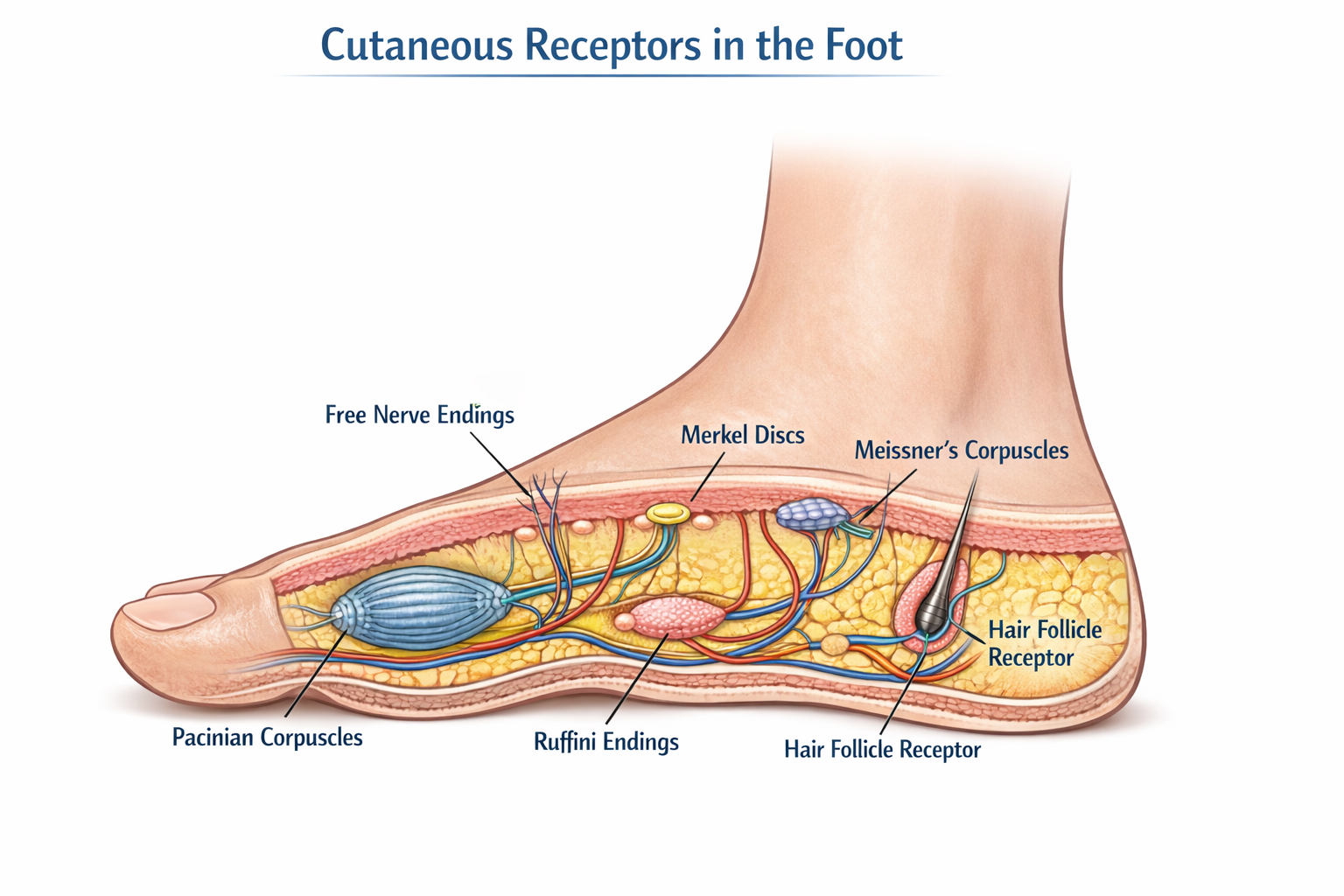
In much of the reflexology literature, the claim that the foot contains approximately 7,000 nerve endings has been widely disseminated and used as a foundational explanation for the therapeutic effects of plantar stimulation. However, this figure lacks verifiable anatomical and neurophysiological support and does not align with current principles of sensory neurophysiology.This article presents a critical review of this quantitative paradigm and proposes a shift in focus toward a functional understanding of the plantar nerve receptors involved in the sensory stimulation used in reflexology.From a neurophysiological perspective, the effectiveness of a stimulus does not depend on the number of nerve endings activated, but rather on the functional properties of nerve receptors, including their specialization, receptive field, depth, and adaptive capacity, as well as their integration within somatosensory afferent pathways.Plantar skin exhibits a highly specialized sensory organization consistent with its roles in weight-bearing and mechanical perception, involving multiple types of nerve receptors capable of transducing mechanical stimuli into meaningful neural signals. Within this framework, reflexology can be understood as a complementary therapy based on the functional activation of plantar nerve receptors and the central modulation of afferent information, without reliance on arbitrary or unverified numerical claims.
Keywords:
reflexology
; plantar nerve receptors
; clinical reflexology
; neurophysiology
; complementary therapies
Copyright: This open access article is published under a Creative Commons CC BY 4.0 license, which permit the free download, distribution, and reuse, provided that the author and preprint are cited in any reuse.


