

Submitted:
19 August 2026
Posted:
21 August 2026
You are already at the latest version
Abstract
Concurrent cognitive activity during emotional-memory retrieval may alter subjective memory characteristics, particularly imagery vividness and emotional intensity, possibly through competition for limited working-memory resources. Experimental dual-task paradigms have used visuospatial, motor, articulatory, and other cognitively demanding tasks. However, deliberate covert rehearsal of structured, emotionally neutral linguistic material during emotional-memory retrieval appears to have received comparatively limited theoretical attention. This article introduces Linguistic Dual-Task Integration (LDTI), a hypothesis-generating neurocognitive framework proposing that repetitive covert rehearsal of emotionally neutral linguistic material during intentional emotional-memory activation may constitute a form of concurrent verbal working-memory engagement. Rather than treating language solely as a vehicle for communication or cognitive restructuring, LDTI examines covert linguistic rehearsal as an active cognitive task that may influence the conditions under which emotional memories are retrieved and processed. The framework integrates working-memory research with theoretical perspectives on inner speech, executive control, attentional prioritization, and autobiographical memory. It hypothesizes that neutral linguistic rehearsal may recruit verbal working-memory resources while emotionally salient autobiographical representations remain active, thereby altering proximal characteristics of retrieval. Executive stabilization and altered attentional priority are treated as secondary hypotheses, whereas autobiographical integration is positioned as a distal possibility. Whether any observed effects reflect linguistic organization, phonological or articulatory interference, expectancy, or generic cognitive load is a central empirical question. LDTI is not presented as a validated psychotherapeutic intervention and makes no claim of clinical efficacy or superiority over established trauma-focused treatments. Instead, it specifies falsifiable predictions, competing explanations, boundary conditions, and a staged research agenda for investigating covert neutral linguistic rehearsal during emotional-memory processing.
Keywords:
trauma memory
; emotional memory
; working memory
; inner speech
; dual-task processing
; executive control
; autobiographical memory
; attentional priority
; EMDR
1. Introduction
Traumatic experiences can challenge the processes through which emotionally significant events are encoded, retrieved, and integrated into autobiographical memory. Although acute stress responses may be adaptive in the context of threat, exposure to trauma can be associated with persistent changes in memory retrieval, attention, emotion regulation, and self-referential processing that contribute to post-traumatic stress disorder (PTSD) and related conditions. In PTSD, intrusive trauma memories may be experienced with pronounced perceptual vividness, affective intensity, and a sense of presentness, features associated with involuntary recollections, flashbacks, and recurrent distress (Brewin et al., 1996; Ehlers & Clark, 2000; Brewin, 2014). These features should not be generalized to all trauma memories or to all trauma-exposed individuals.
Influential trauma-memory models propose disturbances in the representation and contextual integration of trauma memories. Dual-representation accounts distinguish verbally accessible, contextually integrated representations from situationally accessible sensory–affective representations that may support cue-driven re-experiencing when contextual integration is insufficient (Brewin et al., 1996; Brewin, 2014). The cognitive model of PTSD similarly emphasizes poorly elaborated and insufficiently contextualized trauma memories, strong associative priming, and appraisals that maintain a sense of current threat (Ehlers & Clark, 2000). These models are influential theoretical accounts rather than evidence that trauma memories are invariably fragmented or predominantly non-verbal.
Trauma-focused approaches such as prolonged exposure, cognitive processing therapy, narrative exposure therapy, and eye movement desensitization and reprocessing differ in how they use exposure, cognitive meaning, narrative organization, and concurrent task engagement (Foa et al., 2007; Resick et al., 2016; Schauer et al., 2011; Shapiro, 2018). LDTI is not intended to replace or modify these treatments. Its narrower purpose is to isolate a candidate cognitive manipulation for experimental study: covert rehearsal of neutral linguistic material while an emotional autobiographical memory is intentionally active.
Working-memory accounts propose that a concurrent task can reduce the vividness or emotional intensity of mental imagery when retrieval and the secondary task compete for limited resources (Andrade et al., 1997; Gunter & Bodner, 2008; van den Hout & Engelhard, 2012). Such effects depend on task demand and experimental conditions and do not establish a single exclusive mechanism. Although verbal and articulatory dual tasks have been studied, the possible contribution of structured neutral linguistic rehearsal—separable from phonological load, semantic meaning, expectancy, and generic task difficulty—has not been clearly integrated into trauma-memory accounts.
The present article introduces Linguistic Dual-Task Integration (LDTI) as a hypothesis-generating framework concerning the parallel engagement of covert neutral linguistic rehearsal and intentional emotional-memory retrieval. It specifies proposed mechanisms, competing explanations, conceptual boundaries, and critical tests. LDTI therefore formalizes structured neutral linguistic rehearsal as an experimentally testable variable; it does not assume that language has a therapeutic effect.
The proposed contribution of LDTI is to isolate structured, covertly rehearsed, emotionally neutral linguistic material as a candidate dual-task manipulation during emotional-memory retrieval and to test whether any effects exceed those produced by load-matched articulatory, visuospatial, and motor controls.
2. Materials and Methods
This manuscript presents a conceptual and hypothesis-generating framework and does not report original empirical data, experimental interventions, or analyses involving human or animal participants. Accordingly, no materials, datasets, biological samples, or software code were generated or analyzed in the course of this work.
The methodological approach consists of a structured, purposive theoretical synthesis rather than a systematic review or meta-analysis. Literature was organized around the framework's principal constructs: trauma and emotional-memory retrieval, working-memory and dual-task interference, verbal and articulatory interference, inner speech, executive control, attentional prioritization, autobiographical memory processing, and competing mechanistic explanations. Foundational theoretical models were considered alongside experimental dual-task studies and review literature capable of defining boundary conditions or alternative explanations. Particular attention was given to work directly relevant to the criticisms that a language-based account must distinguish structured linguistic rehearsal from generic cognitive load, articulatory suppression, meaningful repetitive speech, and established trauma-focused procedures. Because the search was purposive rather than systematic, the cited literature should not be interpreted as exhaustive. The framework was developed by separating independently supported observations from LDTI-specific inferences and translating the latter into explicit competing hypotheses and falsification criteria. This approach is intended to support concise theory development rather than to establish efficacy or provide an exhaustive evidence synthesis. The framework is not proposed as a clinical protocol and is not intended for immediate therapeutic application.
Because no empirical study was conducted, ethical approval was not required. No human or animal subjects were involved. No datasets were generated or deposited in public repositories. There are no restrictions on the availability of materials, as none were created for this work.
Generative artificial intelligence-assisted language tools were used for linguistic and stylistic refinement, not for data generation or analysis. The author critically reviewed and revised the output and assumes full responsibility for the manuscript.
3. Conceptual Framework and Hypotheses Development
3.1. Nature and Scope of the LDTI Framework
Linguistic Dual-Task Integration (LDTI) is proposed as a hypothesis-generating conceptual neurocognitive framework rather than as an established therapeutic intervention or a validated mechanistic model. Its purpose is to organize existing findings from partially overlapping areas of cognitive and trauma research into a coherent set of empirically testable propositions concerning the role of covert linguistic rehearsal during emotional-memory retrieval.
The framework is based on an integrative, purposive theoretical synthesis rather than a systematic review or meta-analysis. Accordingly, the literature discussed here should not be interpreted as exhaustive. Evidence is drawn from domains directly relevant to LDTI: trauma-memory processing, working-memory and dual-task research, verbal and articulatory interference, inner speech, executive control, autobiographical memory, attention, and repetitive verbal activity. These findings provide conceptual building blocks but do not constitute direct evidence for LDTI. Theory building therefore proceeds by separating independently supported observations from LDTI-specific inferences and by specifying competing hypotheses and falsification criteria.
This distinction is fundamental. LDTI does not infer that a proposed mechanism is established merely because its individual components are supported by existing research. Evidence that emotional imagery consumes working-memory resources and separate evidence that inner speech engages verbal working-memory processes do not demonstrate that covert neutral linguistic rehearsal modifies traumatic memories. They provide a rationale for a testable hypothesis, not direct evidence for it.
The scientific contribution of LDTI therefore lies primarily in specifying the relationships that should be tested, identifying plausible competing explanations, and defining observations that would weaken or support its central propositions.
3.2. From Established Findings to the LDTI Hypothesis
The theoretical development of LDTI begins with several observations that have empirical support independently of the framework.
First, intrusive trauma memories, particularly in PTSD, may be retrieved with pronounced perceptual vividness and emotional intensity and may capture attention and interfere with ongoing cognitive activity. Contemporary trauma-memory theories further propose that cue-driven accessibility, temporal and spatial contextualization, and integration within autobiographical memory contribute to involuntary re-experiencing and a sense of presentness (Brewin et al., 1996; Ehlers & Clark, 2000; Brewin, 2014). These propositions concern symptom phenomenology and do not imply that every trauma memory has the same characteristics.
Second, working memory has limited processing capacity. When a secondary task is performed concurrently with emotional imagery, the two activities may compete for available resources. Experimental studies show that concurrent cognitive activity can reduce imagery vividness and, under some conditions, emotional intensity (Andrade et al., 1997; Gunter & Bodner, 2008; van den Hout & Engelhard, 2012). This evidence supports a working-memory account but does not establish it as the only explanation.
Third, the modality of interference may matter. Experimental findings concerning modality-specific interference indicate that verbal or articulatory tasks and visuospatial tasks may interact differently with different characteristics of mental imagery (Kemps & Tiggemann, 2007). Such findings make it inappropriate to assume in advance that every secondary task is functionally equivalent.
Fourth, inner speech is itself a cognitive process. Inner speech contributes to rehearsal, planning, behavioral regulation, metacognitive monitoring, and maintenance of goal-directed cognition and involves verbal working-memory and executive-control processes (Morin, 2005; Alderson-Day & Fernyhough, 2015; Perrone-Bertolotti et al., 2014).
LDTI emerges from the intersection of these observations.
The inferential step can be expressed as follows:
Background observation 1: Emotional-memory retrieval engages cognitive resources and may compete with concurrent processing.
Established observation 2: Concurrent cognitive activity can interfere with aspects of emotional imagery.
Established observation 3: Inner speech and covert verbal rehearsal recruit verbal working-memory and executive processes.
LDTI inference: If emotionally salient memory retrieval and covert neutral linguistic rehearsal occur simultaneously, the two processes may interact within limited working-memory and attentional capacity.
This final proposition is not an established finding. It represents the core LDTI hypothesis and therefore requires direct experimental testing.
3.3. What Is Novel—and What Is Not Novel—About LDTI?
LDTI does not claim that dual-task processing is novel. The general principle that concurrent cognitive activity can alter the subjective characteristics of emotional imagery has already been investigated extensively, particularly within research examining working-memory explanations of EMDR and related experimental paradigms.
Likewise, repetitive speech and verbal or articulatory dual-task interference are not novel. Prior experimental work has examined concurrent articulation during the retrieval of emotional autobiographical memories and has demonstrated modality-specific interference effects (Kemps & Tiggemann, 2007). Repetition of words, phrases, syllables, or mantras also occurs in numerous cognitive, contemplative, and therapeutic contexts.
The proposed novelty of LDTI is therefore narrower.
LDTI therefore does not claim novelty for verbal dual-task engagement itself. Its narrower contribution is to formalize covert rehearsal of structured, emotionally neutral linguistic material during intentional emotional-memory retrieval and to test whether effects attributable to linguistic organization can be distinguished from phonological or articulatory interference, semantic processing, expectancy, generic cognitive load, and non-verbal dual-task engagement.
For example, a participant might intentionally retrieve a distressing autobiographical memory while covertly and continuously rehearsing an emotionally neutral sentence supplied by the experimenter, such as:
“The lamp is beside the chair.”
The framework does not propose that the semantic meaning of this sentence is therapeutic. The sentence does not reinterpret the traumatic experience, communicate safety, challenge a dysfunctional belief, or construct an alternative autobiographical narrative.
Instead, the experimental question concerns the cognitive operations necessary to maintain the sentence while the emotional memory remains active.
These operations may include phonological rehearsal, temporal sequencing, covert articulation, performance monitoring, and allocation of attention between simultaneously active representations.
A second condition might involve repetition of neutral syllables:
“ba-da-ka-ta, ba-da-ka-ta…”
A third might require a visuospatial task, while a fourth might involve a repetitive motor task.
If all conditions produce equivalent effects after cognitive load is adequately matched, there would be little justification for a language-specific explanation. Such a result would support a more parsimonious generic dual-task account.
Conversely, reproducible differences between structured linguistic rehearsal and appropriately matched control conditions would justify further investigation of language-related mechanisms.
Thus, LDTI does not claim that language is inherently therapeutic. Its proposed contribution is to make the possible role of structured neutral linguistic rehearsal during emotional-memory retrieval an explicit and falsifiable experimental question.
3.4. Core Hypothesis
The core hypothesis of LDTI is intentionally restricted:
During intentional retrieval of an emotionally salient autobiographical memory, concurrent covert rehearsal of structured, emotionally neutral linguistic material may compete for limited working-memory and attentional resources and thereby alter proximal, measurable characteristics of ongoing memory processing.
The most proximal predicted outcomes are therefore not clinical recovery or memory integration. They are experimentally measurable changes such as:
subjective imagery vividness;
subjective emotional intensity;
accuracy or continuity of concurrent linguistic performance;
attentional allocation; and
working-memory performance.
For example, participants could first retrieve a standardized negative autobiographical memory and rate its vividness and emotional intensity. They could subsequently retrieve the same memory under different experimental conditions.
One condition would involve memory retrieval alone.
A second would involve memory retrieval plus covert rehearsal of a neutral sentence.
A third could involve repeated phonologically simple syllables.
A fourth could involve a visuospatial working-memory task.
A fifth could involve a motor dual task.
If neutral linguistic rehearsal reliably altered prespecified proximal outcomes relative to retrieval alone, this would support a dual-task effect of the linguistic condition.
It would not, by itself, demonstrate language specificity or therapeutic benefit.
A language-related interpretation would require reproducible differences from appropriately load-matched articulatory and non-linguistic control conditions, together with evidence that expectancy and task difficulty do not explain the effect.

Table 1.
Formal LDTI hypotheses and principal falsification tests.
| Hypothesis | Prediction | Critical comparison | Result weakening the hypothesis |
|---|---|---|---|
| H1 — Dual-task effect | Neutral linguistic repetition during emotional-memory retrieval alters proximal measures such as imagery vividness and/or emotional intensity. | Retrieval alone vs. retrieval + neutral linguistic repetition. | No reproducible difference on prespecified proximal outcomes. |
| H2 — Language-specificity | If language contributes beyond generic cognitive load, linguistic and load-matched non-linguistic dual tasks will differ. | Neutral linguistic repetition vs. visuospatial and motor dual tasks matched for demand, pacing, and expectancy. | Equivalent effects across adequately matched modalities. |
| H3 — Linguistic organization | If linguistic organization contributes beyond phonological/articulatory interference, organized neutral sentences will differ from minimally linguistic verbal controls. | Neutral sentence vs. meaningless syllables/unrelated neutral words under matched demand. | No difference after phonological load and task difficulty are controlled. |
| H4 — Executive stabilization | Concurrent linguistic repetition preserves independently measured executive performance during emotional-memory activation. | Retrieval alone and matched non-linguistic controls vs. linguistic condition. | No preservation beyond matched control tasks. |
| H5 — Downstream integration | Any later change in contextualization or autobiographical organization occurs only as a distal outcome and requires separate evidence. | Delayed contextualization, temporal organization, coherence, or intrusion measures. | Only immediate vividness/distress changes without independent delayed memory effects. |
3.5. Competing Hypothesis: Generic Cognitive Load
The most parsimonious alternative to LDTI is that any observed effect of linguistic repetition is fully explained by generic working-memory competition.
According to this account, the relevant variable is not language but cognitive demand.
For example, suppose that memory vividness decreases by a similar magnitude during:
neutral sentence repetition,
visuospatial tracking,
alternating tapping, and
a sufficiently demanding counting task.
If cognitive load is comparable across conditions, such a result would provide little evidence for a language-specific mechanism. Instead, it would support the broader hypothesis that emotional imagery becomes less vivid whenever available working-memory resources are occupied by a competing task.
This competing explanation is not peripheral to LDTI. It constitutes one of the framework’s principal falsification tests.
3.6. Phonological Interference Versus Linguistic Organization
Even if verbal and non-verbal tasks produce different effects, this would not by itself establish that covert linguistic rehearsal is responsible.
A verbal task can recruit several partially separable processes, including phonological rehearsal, articulation, lexical access, syntactic organization, semantic processing, and executive monitoring.
Experimental controls are therefore required to distinguish these possibilities.
For example, four verbal conditions could be compared:
Condition A — repetitive syllables:
“ba-da-ka-ta”
Condition B — unrelated neutral words:
“table – cloud – pencil – window”
Condition C — syntactically organized neutral sentence:
“The lamp is beside the chair.”
Condition D — personally meaningful sentence:
“I am safe now.”
The conditions differ in linguistic organization and semantic relevance while retaining verbal activity.
If meaningless syllables and syntactically organized neutral sentences produce equivalent effects, phonological-loop taxation may provide a more parsimonious explanation than higher-order linguistic organization.
If organized language produces reproducibly different effects despite comparable task demand, a stronger language-related hypothesis would become plausible.
The personally meaningful condition provides another important comparison. If “I am safe now” produces effects that differ from semantically neutral material, these differences may reflect appraisal, expectancy, self-reassurance, or emotional meaning rather than the mechanism proposed by LDTI.
3.7. Secondary Hypothesis: Executive Stabilization
LDTI further proposes a secondary and more speculative hypothesis concerning executive control.
For the purposes of the framework, executive stabilization refers to preservation of goal-directed attentional control and measurable executive performance during emotional-memory activation.
It should not be interpreted as a subjective feeling of being “anchored,” nor as an assumed therapeutic effect.
Consider two experimental situations.
During memory retrieval alone, increasing emotional activation might be accompanied by deteriorating performance on an independent measure of attentional or executive control.
During memory retrieval plus structured internal linguistic repetition, executive performance might be relatively preserved.
Such a finding would be consistent with the executive-stabilization hypothesis.
Candidate measures could include working-memory accuracy, interference control, sustained-attention performance, error monitoring, or task-switching indices.
Importantly, reduced emotional intensity alone would not constitute evidence of executive stabilization. The construct requires independent measurement.
The corresponding null hypothesis is equally important:
Neutral linguistic repetition does not preserve executive performance during emotional-memory activation beyond the effects produced by matched non-verbal cognitive tasks.
If this null pattern were repeatedly observed, the executive component of LDTI would require revision or removal.
3.8. Secondary Hypothesis: Altered Attentional Priority
A further hypothesis concerns the distribution of attention during emotional-memory retrieval.
Emotionally salient representations may dominate ongoing processing. Concurrent linguistic activity could potentially alter this relative attentional priority because cognitive resources must simultaneously be allocated to maintaining the verbal sequence.
This possibility is referred to cautiously within LDTI as altered attentional priority.
The stronger term salience redistribution should be regarded as a possible neurocognitive interpretation rather than an established mechanism.
For example, a participant recalling a highly distressing scene might initially report that visual imagery occupies nearly all subjective attention. During a concurrent linguistic task, the emotional memory may remain accessible while attention must also be allocated to maintaining the linguistic sequence.
If objective or behavioral measures demonstrated a reproducible change in attentional allocation, this would support the attentional-priority hypothesis.
It would still not demonstrate that a specific neural salience network had been modified. Claims regarding network-level mechanisms would require direct neurophysiological investigation.
3.9. Autobiographical Integration as a Downstream Hypothesis
Autobiographical integration occupies a different theoretical level from the core dual-task mechanism.
LDTI does not propose that repeating a neutral sentence directly integrates a traumatic memory.
Nor should an immediate reduction in vividness or emotional intensity be interpreted as evidence that a memory has been reconsolidated, contextualized, or successfully integrated into autobiographical memory.
Instead, a more limited downstream hypothesis can be formulated:
If emotional memories can be repeatedly retrieved while goal-directed cognitive processing remains sufficiently available, such processing conditions might facilitate later contextualization or autobiographical organization.
This proposition requires independent evidence.
For example, an experiment demonstrating an immediate reduction in vividness after linguistic dual-task engagement would test the proximal working-memory hypothesis.
A later assessment examining temporal organization, contextual detail, narrative coherence, involuntary intrusions, or autobiographical accessibility would address a different question concerning longer-term memory processing.
The first finding cannot be used as evidence for the second.
Accordingly, autobiographical integration is positioned as a downstream theoretical possibility, not as an established consequence or defining mechanism of LDTI.
3.10. Hierarchy of the LDTI Framework
The complete conceptual framework can therefore be organized into four evidential levels:
Level 1 — Established theoretical foundations
Emotional-memory retrieval, limited working-memory capacity, dual-task interference, and the involvement of inner speech in verbal working memory and executive functioning are supported independently by existing research.
Level 2 — Core LDTI hypothesis
Covert neutral linguistic rehearsal performed concurrently with emotional-memory retrieval may produce measurable working-memory and attentional competition.
This is the principal hypothesis that must be tested directly.
Level 3 — Extended LDTI hypotheses
Concurrent linguistic organization may contribute to preservation of executive control and altered attentional priority during emotional activation.
These mechanisms are more speculative and require independent operationalization and testing.
Level 4 — Downstream hypothesis
Repeated emotional-memory processing under such conditions may potentially influence subsequent autobiographical contextualization or integration.
This is the most distal proposition and cannot be inferred from immediate dual-task effects.
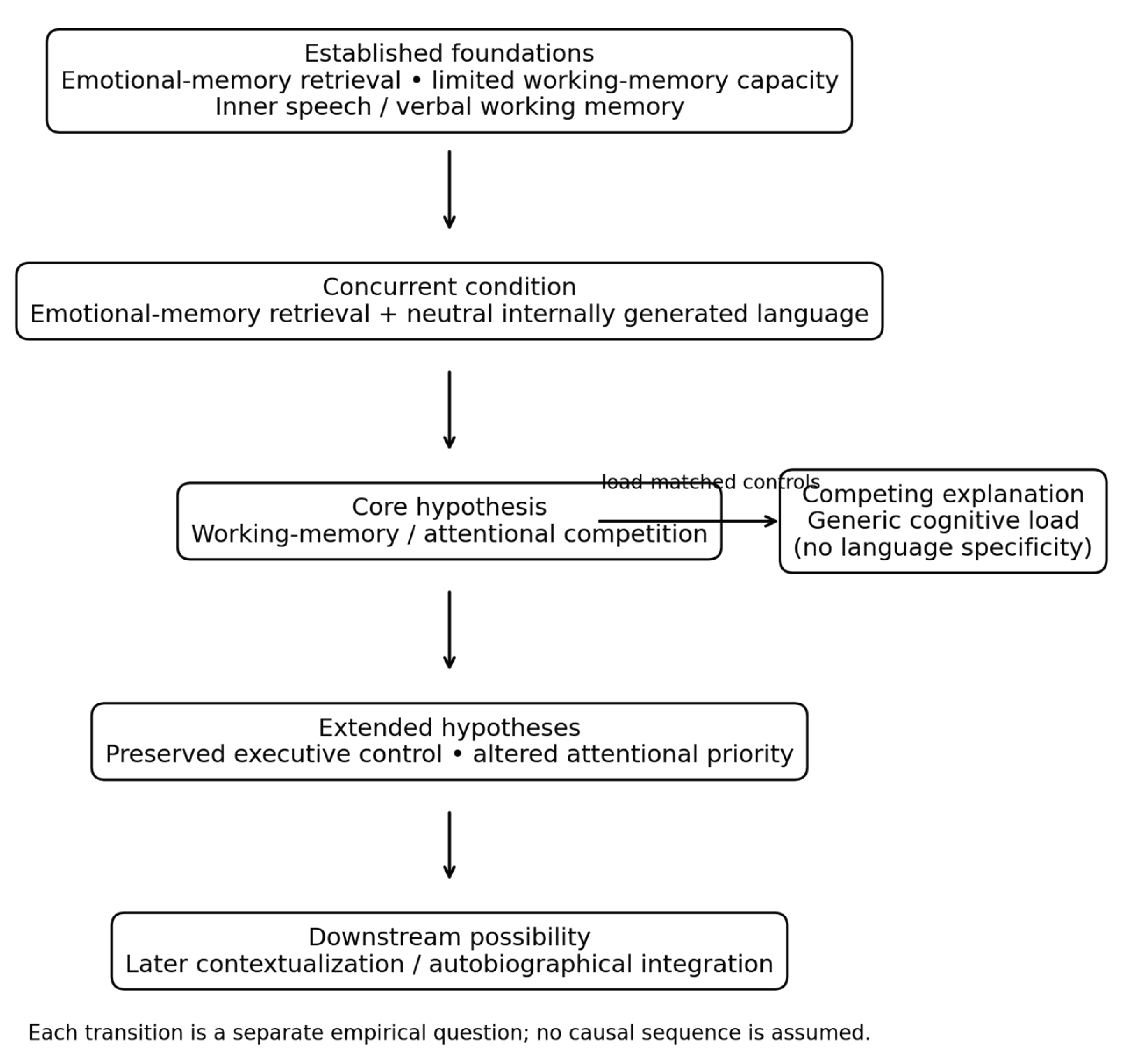
The hierarchy can therefore be summarized as:
Established evidence
↓
Emotional-memory retrieval + covert neutral linguistic rehearsal
↓
Core hypothesis: working-memory/attentional competition
↓
Extended hypotheses: preserved executive control and altered attentional priority
↓
Downstream possibility: subsequent autobiographical contextualization/integration
Each transition represents a separate empirical question rather than an assumed causal sequence.
Figure 1.
Hierarchical conceptual model of LDTI. The core hypothesis concerns concurrent working-memory/attentional competition; executive stabilization and altered attentional priority are secondary hypotheses, while autobiographical integration is a distal possibility requiring independent evidence.
Figure 1.
Hierarchical conceptual model of LDTI. The core hypothesis concerns concurrent working-memory/attentional competition; executive stabilization and altered attentional priority are secondary hypotheses, while autobiographical integration is a distal possibility requiring independent evidence.
3.11. Falsifiability of the Framework
The value of LDTI depends upon its capacity to generate findings that could contradict it.
The framework would require substantial revision if neutral linguistic repetition consistently failed to alter any proximal measure of emotional-memory processing relative to retrieval alone.
The language-specific component would be weakened if linguistic repetition produced effects indistinguishable from load-matched non-verbal tasks.
The linguistic-organization hypothesis would be weakened if neutral sentences produced no differences from simple articulatory suppression or meaningless syllable repetition after cognitive demand was controlled.
The executive-stabilization hypothesis would be weakened if independent executive-performance measures showed no preservation beyond matched control tasks.
Similarly, the downstream integration hypothesis would not be supported merely by immediate reductions in vividness or distress; it would require independent evidence of later changes in contextualization or autobiographical organization.
Conversely, reproducible modality-specific effects surviving controls for cognitive load, expectancy, semantic meaning, articulatory activity, and task difficulty would justify progressively stronger investigation of language-related mechanisms.
3.12. Summary of the Conceptual Framework
LDTI is therefore best understood neither as a new trauma therapy nor as a claim that repetitive language possesses intrinsic therapeutic properties. It is a hypothesis-generating conceptual neurocognitive framework that isolates a specific unresolved question within emotional-memory research: whether covert neutral linguistic rehearsal represents a distinguishable form of concurrent cognitive engagement during emotional-memory retrieval.
The framework proceeds deliberately from established evidence to increasingly speculative hypotheses. Its core proposition concerns verbal working-memory and attentional competition. Executive stabilization and altered attentional priority represent secondary hypotheses, while autobiographical integration remains a downstream theoretical possibility requiring separate evidence.
This structure allows the framework to accommodate several possible outcomes. Evidence for language-specific effects would support further development of LDTI. Evidence that linguistic repetition is indistinguishable from other matched cognitive tasks would favor generic working-memory accounts. Evidence that no meaningful effect occurs would challenge the core hypothesis itself.
Accordingly, the scientific value of LDTI does not depend upon confirmation of all of its proposed mechanisms. Its value lies in converting a previously broad conceptual proposition into a hierarchy of explicit, competing, and falsifiable hypotheses that can be investigated experimentally.
4. Discussion
4.1. Theoretical Interpretation and Mechanistic Implications
The present article introduced LDTI as a hypothesis-generating framework for examining covert neutral linguistic rehearsal during emotional-memory processing. It does not propose a psychotherapy or challenge the efficacy of established trauma-focused interventions. Its narrower question is whether structured linguistic rehearsal should be treated as a separately testable dual-task condition during emotional-memory activation.
The central premise is intentionally modest. Concurrent tasks can influence emotional imagery under some conditions, but structured neutral linguistic rehearsal has not been clearly integrated into existing dual-task accounts as a distinct, controlled manipulation. LDTI therefore calls for comparisons that separate linguistic organization from articulatory load, generic executive demand, expectancy, and task difficulty.
The framework does not assume that language-specific mechanisms exist. If linguistic rehearsal produces effects equivalent to adequately matched non-linguistic tasks, generic working-memory competition would be the more parsimonious explanation. Only reproducible differences after load, pacing, expectancy, and difficulty are controlled would justify further investigation of language-related mechanisms.
Trauma-memory theories provide complementary accounts of intrusive recollection, current threat, contextualization, and autobiographical organization without implying that all trauma memories constitute a single abnormal memory type. Accordingly, LDTI focuses specifically on intrusive or distressing autobiographical memories under defined experimental conditions. Emotional Processing Theory, inhibitory-learning accounts, cognitive models of PTSD, dual-representation theory, and integrative trauma-memory frameworks emphasize partly different processes—including fear activation and corrective learning, expectancy violation, appraisal, contextualization, sensory–affective retrieval, and autobiographical organization (Foa & Kozak, 1986; Brewin et al., 1996; Ehlers & Clark, 2000; Foa et al., 2007; Craske et al., 2014; Brewin, 2014; Ford, 2018). LDTI does not propose an alternative theory of trauma memory or assume that any single account fully explains symptom persistence or therapeutic change. Rather, these models provide the theoretical context for asking whether a concurrent cognitive task can alter proximal characteristics of emotional-memory retrieval without assuming broader therapeutic or integrative effects.
Experimental evidence indicates that secondary cognitive tasks performed during emotional-memory retrieval can reduce imagery vividness and subjective emotional intensity under some conditions (Andrade et al., 1997; van den Hout & Engelhard, 2012). Working-memory accounts explain such effects in terms of competition for limited processing resources, but concurrent tasks may differ in modality, cognitive demand, pacing, and executive requirements. The central question for LDTI is therefore not whether dual-task interference can occur, but whether structured covert linguistic rehearsal produces effects distinguishable from those of adequately matched articulatory and non-linguistic tasks. If linguistic rehearsal produces no effects beyond those attributable to generic working-memory taxation, the more parsimonious domain-general explanation should be preferred.
Inner speech and covert verbal rehearsal are active cognitive operations involved in phonological maintenance, planning, sequencing, monitoring, and goal-directed regulation (Vygotsky, 1987; Morin, 2005; Perrone-Bertolotti et al., 2014; Alderson-Day & Fernyhough, 2015). These properties justify investigating structured linguistic rehearsal as a distinct experimental condition, but they do not establish that language is intrinsically more organizing, regulatory, or therapeutically effective than non-linguistic activity. LDTI therefore uses short, emotionally neutral, overlearned linguistic material to minimize autobiographical meaning, cognitive restructuring, positive self-instruction, and emotional associations. Neutrality cannot eliminate semantic processing completely, however, and comparisons with meaningless syllables, neutral words, meaningful sentences, articulatory controls, and load-matched non-verbal tasks are necessary to distinguish phonological, articulatory, lexical, semantic, expectancy-related, and domain-general effects.
Within the core LDTI hypothesis, an emotionally salient autobiographical memory remains intentionally accessible while covert neutral linguistic rehearsal is performed concurrently. Repeated internal verbalization is expected to recruit verbal working-memory resources, including phonological maintenance and covert articulation, while potentially requiring monitoring and temporal sequencing (Baddeley, 2000, 2012; Alderson-Day & Fernyhough, 2015). The framework does not assume that this process suppresses emotional content or directly weakens the underlying memory representation. Its narrower prediction is that concurrent linguistic engagement may alter the allocation of limited processing resources while the emotional representation remains active. Consequently, immediate reductions in vividness or emotional intensity would constitute proximal dual-task effects and should not, by themselves, be interpreted as evidence of therapeutic change, autobiographical integration, or a language-specific mechanism.
Executive stabilization and altered attentional priority represent secondary rather than core hypotheses. Executive stabilization is defined operationally as preservation of goal-directed attentional control and measurable executive performance during emotional-memory activation; it is not synonymous with emotional suppression. Similarly, although salience-network models provide a neurocognitive context for studying prioritized processing of behaviorally relevant information (Seeley et al., 2007; Menon, 2011), they do not establish that linguistic rehearsal modifies salience-network function. LDTI therefore treats altered attentional priority as the behavioral hypothesis and salience-network involvement only as a candidate neurophysiological explanation requiring direct testing.
Autobiographical integration lies still further downstream. Changes in vividness, emotional intensity, executive control, or attentional allocation cannot establish improved contextualization or autobiographical organization. Any such effect would require independent longitudinal evidence and formal mediation testing. LDTI therefore distinguishes a core hypothesis of concurrent working-memory and attentional competition from secondary hypotheses concerning executive stabilization and attentional priority, while treating autobiographical integration as a distal theoretical possibility. Each level remains independently testable and falsifiable, and simpler explanations—particularly generic working-memory taxation—should be preferred whenever they account adequately for observed effects.
4.2. Relationship of LDTI to Existing Trauma-Focused Approaches
LDTI should not be interpreted as a replacement for evidence-based trauma-focused psychotherapies. It focuses on one candidate experimental variable—covert neutral linguistic rehearsal—within emotional-memory research. Its distinctiveness is provisional and depends on demonstrating that its manipulation and comparisons are not already captured by existing verbal dual-task paradigms. Procedural overlap with EMDR-related dual tasks, tapping, mindfulness, and repetitive verbal/mantram practices therefore motivates stronger controls rather than supporting a unique mechanism.
Rather than positioning LDTI in opposition to existing trauma-focused interventions, the present framework conceptualizes it as complementary to current theoretical models. Similarities and differences should therefore be understood primarily at the level of proposed neurocognitive mechanisms rather than therapeutic procedures.
Although LDTI shares the general principle of concurrent cognitive engagement with EMDR, the present framework does not assume that covert linguistic rehearsal necessarily produces stronger effects than externally guided visuospatial tasks. Rather, LDTI proposes that language represents a theoretically distinct cognitive modality whose contribution should be examined empirically.
EMDR has an established clinical evidence base, whereas the relative contribution of eye movements and other mechanisms remains debated. Working-memory taxation is one prominent account among several proposed explanations (Shapiro, 2018; van den Hout & Engelhard, 2012). This literature supports testing concurrent-task mechanisms but does not provide efficacy evidence for LDTI.
LDTI overlaps with working-memory accounts of EMDR in proposing that a secondary task can influence emotional-memory retrieval. Its proposed manipulation differs operationally: EMDR commonly uses therapist-guided eye movements or other dual-attention tasks, whereas LDTI tests covert neutral linguistic rehearsal. This operational difference does not establish a different mechanism.
Covert linguistic rehearsal plausibly engages phonological rehearsal, covert articulation, and performance monitoring, whereas eye movements impose prominent visuospatial and oculomotor demands. Because both tasks can also recruit domain-general attention and executive control, direct load-matched comparisons are required before modality-specific inferences are made.
The present framework does not claim that covert linguistic rehearsal produces stronger or more durable effects than bilateral eye movements. Whether language-specific mechanisms exist beyond generic working-memory competition remains an empirical question requiring direct experimental comparison under carefully controlled conditions. Accordingly, LDTI should be viewed as extending, rather than replacing, current dual-task theories of emotional-memory processing.
Contemporary accounts of exposure-based treatment draw on emotional-processing and inhibitory-learning perspectives. PE emphasizes repeated confrontation with trauma-related memories and avoided situations, providing opportunities for emotional processing and new learning concerning threat and safety (Foa et al., 2007; Craske et al., 2014).
Unlike PE, LDTI is not a treatment model and does not primarily address extinction, inhibitory learning, or exposure dose. Its experiments would use emotional-memory activation to test a concurrent cognitive manipulation; any relation to clinical exposure procedures remains hypothetical.
CPT seeks to modify dysfunctional trauma-related beliefs through cognitive restructuring, evaluation of maladaptive interpretations, and development of more adaptive appraisals (Resick et al., 2016).
In CPT, language is used to examine meanings and appraisals. LDTI instead attempts to minimize therapeutic semantic content by using neutral material. Because neutral sentences still undergo lexical and semantic processing, articulatory and minimally semantic controls are essential.
This distinction separates language as meaning from language as cognitive process, representing one of the principal theoretical contributions of the present framework.
NET conceptualizes trauma recovery as the chronological integration of fragmented traumatic experiences into a coherent autobiographical life narrative. Language therefore functions primarily as a means of constructing temporal continuity and autobiographical meaning (Schauer et al., 2011).
NET explicitly uses narration and temporal organization to construct an autobiographical account. LDTI does not assume that neutral rehearsal constructs narrative meaning. Any later change in contextualization or autobiographical organization is a distal hypothesis requiring independent delayed measures and cannot be inferred from immediate changes in vividness or distress.
Mindfulness-based interventions cultivate sustained, nonjudgmental awareness of present-moment experience while reducing habitual cognitive elaboration and emotional reactivity. Their proposed mechanisms include attentional flexibility, decentering, acceptance, and alterations in self-referential processing.
Mindfulness and LDTI differ operationally: mindfulness commonly cultivates nonjudgmental awareness and decentering, whereas LDTI introduces continuous covert linguistic rehearsal during memory activation. Mindfulness is not accurately characterized as minimal cognitive engagement, and its mechanisms are not reducible to a single contrast with LDTI.
Potential similarities between LDTI and mantra-based practices warrant explicit consideration. Repetitive verbalization itself is not novel and has long been employed within contemplative, meditative, and religious traditions. Nevertheless, the mechanisms proposed within these traditions differ from those advanced here.
Traditional mantra practices frequently employ spiritually meaningful, emotionally significant, or culturally embedded verbal material intended to influence awareness, attention, emotional state, or contemplative experience. By contrast, LDTI intentionally employs emotionally neutral and semantically non-therapeutic linguistic material. The repeated phrase is not expected to produce beneficial effects because of its semantic content, symbolic meaning, or motivational value. Instead, its theoretical function is to recruit verbal working-memory systems while minimizing confounding influences arising from cognitive restructuring, expectancy effects, or emotionally meaningful self-instruction. Empirical work on silent mantram repetition also indicates that repetitive verbal practices can be associated with psychological and health outcomes, although the interventions are heterogeneous and typically include meaningful or spiritually selected material rather than semantically neutral dual-task stimuli (Hulett et al., 2023). This literature is therefore relevant as a comparator but cannot be taken as direct evidence for LDTI.
Similarities between LDTI and mantram repetition are procedural. Whether neutral rehearsal differs from meaningful repetitive speech—and whether either differs from matched articulatory load—requires direct experimental testing.
LDTI is best understood as a provisional framework asking whether structured neutral linguistic rehearsal constitutes a distinguishable dual-task manipulation during emotional-memory activation. The question is not yet resolved, and the framework's incremental value depends on comparison with prior verbal and articulatory paradigms.
At present, no definitive answer exists. The available evidence supports the broader principle that concurrent cognitive activity may influence emotional-memory processing. Whether covert linguistic rehearsal contributes mechanisms extending beyond generic cognitive load remains unknown. The primary scientific value of LDTI therefore lies not in claiming superiority over existing models but in articulating a clearly defined, theoretically grounded, and empirically falsifiable hypothesis that can be evaluated through systematic experimental research.
Table 2.
Conceptual comparison of LDTI with selected trauma-focused and repetitive-attention approaches.
Table 2.
Conceptual comparison of LDTI with selected trauma-focused and repetitive-attention approaches.
| Approach | Concurrent task | Primary mechanism | Role of language | Evidence status | LDTI distinction |
| EMDR | Eye movements/other dual-attention tasks | Multiple proposed mechanisms; working-memory taxation is one account | Usually not the concurrent-task mechanism | Established clinical efficacy; mechanisms debated | Internally generated neutral language is the experimental variable |
| PE | None required | Exposure / inhibitory learning / emotional processing | Narrative description and meaning | Established clinical efficacy | Concurrent verbal load is not the treatment principle |
| CPT | None required | Cognitive restructuring | Semantic and meaning-focused | Established clinical efficacy | LDTI minimizes therapeutic semantic content |
| NET | Narrative construction | Autobiographical integration | Narrative and chronological | Established clinical use/evidence | LDTI does not construct a life narrative |
| Mindfulness / mantram | Repetitive attention or meaningful verbal repetition may occur | Attention, decentering, acceptance; mechanisms vary | Often meaningful or contemplative | Empirical literature exists; heterogeneous | LDTI pairs neutral language specifically with intentional emotional-memory retrieval |
| LDTI | Neutral internally generated linguistic activity | Core: hypothesized verbal WM/attentional competition; extended mechanisms remain testable | Process emphasized over meaning | Theoretical; no direct efficacy evidence | Tests whether this verbal modality adds anything beyond matched generic |
4.3. Alternative Explanatory Models and Critical Evaluation of LDTI
Any apparent effect of linguistic rehearsal may arise from generic working-memory competition, executive demand, attentional stabilization, expectancy, perceived control, semantic processing, repeated retrieval, or measurement reactivity. The framework therefore treats these as competing explanations rather than assuming the LDTI account.
This distinction is particularly important because contemporary emotional-memory research has repeatedly demonstrated that similar behavioral outcomes may emerge from different underlying neurocognitive processes. Consequently, reductions in subjective distress, imagery vividness, or physiological arousal cannot by themselves establish the validity of any specific theoretical mechanism. Rather than interpreting supportive findings as confirmation of LDTI, future research should attempt to determine which explanatory model best accounts for observed data while systematically excluding competing interpretations.
Perhaps the strongest competing explanation derives from working-memory theory itself. According to this interpretation, emotional imagery competes with any sufficiently demanding concurrent cognitive task for limited processing resources. Consequently, covert linguistic rehearsal would represent only one example among many possible dual-task paradigms.
If this explanation proves correct, linguistic repetition should not differ systematically from visuospatial tracking, eye movements, alternating tapping, counting tasks, or other cognitive activities after cognitive demand has been appropriately matched. Such findings would substantially weaken language-specific interpretations while strengthening general working-memory accounts of emotional-memory modulation. This possibility is fully compatible with the present framework and represents one of its principal falsification criteria.
A second explanation is that domain-general executive engagement, rather than language, drives any effect. Structured linguistic rehearsal requires monitoring, sequencing, and maintenance, but similar demands can be produced by non-verbal tasks.
Under this interpretation, language would merely represent one method of recruiting executive-control networks rather than possessing unique regulatory properties. Future neuroimaging studies should therefore determine whether verbal repetition recruits executive systems differently from matched non-verbal tasks.
Another possible explanation emphasizes attentional regulation. Rather than influencing emotional memories directly, repetitive linguistic activity may simply stabilize attentional focus by reducing uncontrolled shifts between intrusive emotional material and unrelated internal cognition.
Such stabilization might occur independently of verbal content and therefore reflect a broader principle of sustained attentional control. Distinguishing attentional stabilization from language-specific mechanisms will require experimental paradigms capable of separately manipulating attention and verbal working-memory load.
Psychological interventions frequently produce expectancy effects. Participants instructed to perform repetitive verbal activity during emotional-memory retrieval may experience increased perceived control, greater task engagement, or stronger therapeutic expectations. Observed improvements might therefore arise from expectancy rather than neurocognitive mechanisms.
Future studies should incorporate expectancy-matched control conditions to determine whether linguistic repetition exerts effects beyond perceived control.
Although LDTI intentionally employs emotionally neutral linguistic material, complete elimination of semantic processing is unlikely. Even neutral words possess lexical meaning and may activate implicit cognitive associations. Accordingly, future research should investigate whether semantic complexity influences observed effects.
Comparisons among meaningless syllables, emotionally neutral words, autobiographically relevant words, and emotionally meaningful sentences may help determine whether semantic processing contributes to the proposed mechanism.
The present framework intentionally avoids assuming that reconsolidation necessarily explains observed behavioral effects. Immediate reductions in emotional intensity should not, by themselves, be interpreted as evidence that a long-term memory representation has undergone reconsolidation. Behavioral change following retrieval may reflect multiple processes, and claims of reconsolidation require evidence capable of distinguishing reconsolidation from competing explanations (Lane et al., 2015; Kredlow et al., 2016).
Consequently, demonstration of immediate behavioral change should not be interpreted as evidence for reconsolidation. Future studies claiming reconsolidation effects should provide evidence for memory reactivation and destabilization, demonstrate persistence beyond immediate performance changes, and address plausible competing explanations.
LDTI specifies conditions under which its central assumptions would require revision. The framework would be substantially weakened if future research consistently demonstrated that linguistic repetition produces no measurable effects relative to emotional-memory retrieval alone; does not differ from matched non-verbal dual tasks; is fully explained by generic working-memory taxation; recruits executive-control systems indistinguishably from matched non-verbal paradigms; or fails to replicate across independent laboratories.
Conversely, consistent evidence demonstrating modality-specific behavioral, physiological, or neurobiological effects would strengthen the language-specific component of the framework.
4.4. Testable Predictions and Future Research
A theoretical framework derives scientific value from its capacity to generate predictions that may support, modify, or falsify its central assumptions. The present framework therefore proposes several empirically testable hypotheses.
First, covert neutral linguistic rehearsal is predicted to alter prespecified proximal outcomes, such as imagery vividness or emotional intensity, relative to retrieval alone. Second, a language-related mechanism would require differences from articulatory and non-linguistic tasks despite adequate matching of load, pacing, expectancy, and difficulty. Equivalent outcomes would favor a modality-independent account.
Third, neurophysiological studies could test whether simultaneous linguistic rehearsal and emotional-memory activation are associated with patterns of activity or connectivity that differ from adequately matched control conditions. Candidate measurements may include prefrontal, anterior cingulate, inferior frontal, and broader executive-control systems, but no region or network is assumed to be uniquely or causally involved. Any network-level interpretation should depend on direct measurement and comparison with articulatory and non-verbal controls.
Fourth, future studies should examine whether individual differences in verbal ability, working-memory capacity, imagery vividness, executive functioning, dissociative tendencies, or trauma-related symptom severity moderate observed effects. These are candidate moderators rather than established predictions and should be prespecified where theoretically justified.
Future work should begin with controlled laboratory studies rather than clinical outcome trials. A minimum design would compare retrieval alone, covert rehearsal of a neutral sentence, a phonological or articulatory control using neutral syllables, a visuospatial task, and a motor task. Cognitive demand, pacing, expectancy, and difficulty should be calibrated and measured rather than assumed to be matched. Comparisons among meaningless syllables, neutral words, neutral sentences, and personally meaningful sentences could help separate articulation, lexical processing, linguistic organization, semantic meaning, and expectancy (Kemps & Tiggemann, 2007).
Outcome measures should include subjective ratings of imagery vividness and emotional intensity, behavioral measures of executive functioning, physiological indicators such as heart-rate variability and skin conductance, and neuroimaging techniques including functional magnetic resonance imaging or electroencephalography where feasible. Only after the underlying cognitive mechanisms have been adequately characterized should feasibility studies be considered in trauma-exposed populations. Clinical trials investigating efficacy should remain contingent upon prior demonstration of mechanistic validity and safety.
Primary outcomes should be prespecified and separated by explanatory level. Immediate behavioral outcomes may include imagery vividness and emotional intensity; executive stabilization should be evaluated with independent performance-based measures; attentional-priority hypotheses require dedicated behavioral or neurophysiological indices; and autobiographical integration requires delayed measures of contextualization, temporal organization, or memory coherence. A finding at one level should not be interpreted as evidence for mechanisms at another level without appropriate mediation or longitudinal tests.
4.5. Limitations
The primary limitation is that LDTI remains a theoretical model and no direct empirical evidence currently supports its proposed mechanisms. Accordingly, no conclusions regarding therapeutic efficacy, clinical utility, safety, or comparative effectiveness should be drawn from the present article. The framework deliberately integrates constructs from trauma-memory theory, working-memory and dual-task research, executive control, inner-speech research, attention, and longer-term memory processing that operate at different explanatory levels. Their juxtaposition provides hypotheses, not evidence that the proposed links are causal. The purposive synthesis used here is also not an exhaustive systematic review; consequently, claims of novelty remain provisional and should be reassessed as the verbal, articulatory, and dual-task literature develops.
The proposed language-specific mechanisms remain speculative. It is entirely possible that covert linguistic rehearsal exerts no measurable effects beyond those predicted by generic cognitive-load theories. The present framework explicitly recognizes this possibility and should therefore be interpreted as falsifiable rather than confirmatory. Finally, LDTI intentionally focuses on mechanistic hypotheses rather than therapeutic procedures. Practical clinical implementation falls outside the scope of the present article and should not precede systematic experimental evaluation.
5. Conclusions
Trauma research increasingly examines the cognitive and neurobiological processes associated with the retrieval, contextualization, and modification of distressing memories. Within this broader context, LDTI identifies a theoretical question at the intersection of trauma-memory research, working-memory theory, executive control, and inner speech. The framework neither claims language-specific superiority nor assumes therapeutic efficacy. Instead, it provides a structured and falsifiable model from which experimental research may proceed.
Whether covert neutral linguistic rehearsal represents a distinct mechanism of emotional-memory modulation remains unknown. The contribution of LDTI is therefore conditional: it specifies the comparisons needed to determine whether structured linguistic rehearsal adds explanatory value beyond articulatory interference, expectancy, and generic cognitive load. LDTI is offered as a provisional framework for systematic investigation, not as a completed account of memory change or a clinical protocol.
Supplementary Materials
No supplementary materials are associated with this manuscript.
Author Contributions
Conceptualization, A.E.; methodology, A.E.; writing—original draft preparation, A.E.; writing—review and editing, A.E. The author has read and agreed to the published version of the manuscript.
Institutional Review Board Statement
Not applicable. This study did not involve human participants or animals and did not require ethical approval.
Informed Consent Statement
Not applicable. This manuscript does not report research involving human participants.
Data Availability Statement
No new data were created or analyzed in this study. Data sharing is not applicable to this article.
Conflicts of Interest
The author declares no conflicts of interest.
References
- Alderson-Day, B.; Fernyhough, C. Inner speech: Development, cognitive functions, phenomenology, and neurobiology. Psychological Bulletin 2015, 141(5), 931–965. [Google Scholar] [CrossRef] [PubMed]
- Andrade, J.; Kavanagh, D.; Baddeley, A. Eye-movements and visual imagery: A working memory approach to the treatment of post-traumatic stress disorder. British Journal of Clinical Psychology 1997, 36(2), 209–223. [Google Scholar] [CrossRef] [PubMed]
- Baddeley, A. D. The episodic buffer: A new component of working memory? Trends in Cognitive Sciences 2000, 4(11), 417–423. [Google Scholar] [CrossRef] [PubMed]
- Baddeley, A. D. Working memory: Theories, models, and controversies. Annual Review of Psychology 2012, 63, 1–29. [Google Scholar] [CrossRef] [PubMed]
- Brewin, C. R. Episodic memory, perceptual memory, and their interaction: Foundations for a theory of posttraumatic stress disorder. Psychological Bulletin 2014, 140(1), 69–97. [Google Scholar] [CrossRef] [PubMed]
- Brewin, C. R.; Dalgleish, T.; Joseph, S. A dual representation theory of posttraumatic stress disorder. Psychological Review 1996, 103(4), 670–686. [Google Scholar] [CrossRef] [PubMed]
- Craske, M. G.; Treanor, M.; Conway, C. C.; Zbozinek, T.; Vervliet, B. Maximizing exposure therapy: An inhibitory learning approach. Behaviour Research and Therapy 2014, 58, 10–23. [Google Scholar] [CrossRef] [PubMed]
- Ehlers, A.; Clark, D. M. A cognitive model of posttraumatic stress disorder. Behaviour Research and Therapy 2000, 38(4), 319–345. [Google Scholar] [CrossRef] [PubMed]
- Foa, E. B.; Hembree, E. A.; Rothbaum, B. O. Prolonged exposure therapy for PTSD: Emotional processing of traumatic experiences, therapist guide; Oxford University Press, 2007. [Google Scholar] [CrossRef]
- Foa, E. B.; Kozak, M. J. Emotional processing of fear: Exposure to corrective information. Psychological Bulletin 1986, 99(1), 20–35. [Google Scholar] [CrossRef]
- Ford, J. D. Trauma memory processing in posttraumatic stress disorder psychotherapy: A unifying framework. Journal of Traumatic Stress 2018, 31(6), 933–942. [Google Scholar] [CrossRef] [PubMed]
- Gunter, R. W.; Bodner, G. E. How eye movements affect unpleasant memories: Support for a working-memory account. Behaviour Research and Therapy 2008, 46(8), 913–931. [Google Scholar] [CrossRef] [PubMed]
- Kemps, E.; Tiggemann, M. Reducing the vividness and emotional impact of distressing autobiographical memories: The importance of modality-specific interference. Memory 2007, 15(4), 412–422. [Google Scholar] [CrossRef] [PubMed]
- Hulett, J. M.; Corona, M.; Hartman, B. M.; Bormann, J. E. A systematic review of interventional trials reporting relationships between silent mantram repetition and health in adults. Complementary Therapies in Clinical Practice 2023, 50, 101709. [Google Scholar] [CrossRef] [PubMed]
- Kredlow, M. A.; Unger, L. D.; Otto, M. W. Harnessing reconsolidation to weaken fear and appetitive memories: A meta-analysis of post-retrieval extinction effects. Psychological Bulletin 2016, 142(3), 314–336. [Google Scholar] [CrossRef] [PubMed]
- Lane, R. D.; Ryan, L.; Nadel, L.; Greenberg, L. S. Memory reconsolidation, emotional arousal, and the process of change in psychotherapy: New insights from brain science. Behavioral and Brain Sciences 2015, 38, e1. [Google Scholar] [CrossRef] [PubMed]
- Menon, V. Large-scale brain networks and psychopathology: A unifying triple network model. Trends in Cognitive Sciences 2011, 15(10), 483–506. [Google Scholar] [CrossRef] [PubMed]
- Morin, A. Possible links between self-awareness and inner speech: Theoretical background, underlying mechanisms, and empirical evidence. Journal of Consciousness Studies 2005, 12(4-5), 115–134. [Google Scholar]
- Perrone-Bertolotti, M.; Rapin, L.; Lachaux, J. P.; Baciu, M.; Loevenbruck, H. What is that little voice inside my head? Inner speech phenomenology, its role in cognitive performance, and its relation to self-monitoring. Behavioural Brain Research 2014, 261, 220–239. [Google Scholar] [CrossRef] [PubMed]
- Resick, P. A.; Monson, C. M.; Chard, K. M. Cognitive processing therapy for PTSD: A comprehensive manual; Guilford Press, 2016. [Google Scholar]
- Schauer, M.; Neuner, F.; Elbert, T. Narrative exposure therapy: A short-term treatment for traumatic stress disorders, 2nd ed.; Hogrefe Publishing, 2011. [Google Scholar]
- Seeley, W. W.; Menon, V.; Schatzberg, A. F.; Keller, J.; Glover, G. H.; Kenna, H.; Reiss, A. L.; Greicius, M. D. Dissociable intrinsic connectivity networks for salience processing and executive control. Journal of Neuroscience 2007, 27(9), 2349–2356. [Google Scholar] [CrossRef] [PubMed]
- Shapiro, F. Eye movement desensitization and reprocessing (EMDR) therapy: Basic principles, protocols, and procedures, 3rd ed.; Guilford Press, 2018. [Google Scholar]
- van den Hout, M. A.; Engelhard, I. M. How does EMDR work? Journal of Experimental Psychopathology 2012, 3(5), 724–738. [Google Scholar] [CrossRef]
- Vygotsky, L. S. Thinking and speech. In The collected works of L. S. Vygotsky; Rieber, R. W., Carton, A. S., Eds.; Plenum Press, 1987; Vol. 1, pp. 39–285. [Google Scholar]
Disclaimer/Publisher’s Note: The statements, opinions and data contained in all publications are solely those of the individual author(s) and contributor(s) and not of MDPI and/or the editor(s). MDPI and/or the editor(s) disclaim responsibility for any injury to people or property resulting from any ideas, methods, instructions or products referred to in the content. |
© 2026 by the authors. Licensee MDPI, Basel, Switzerland. This article is an open access article distributed under the terms and conditions of the Creative Commons Attribution (CC BY) license (http://creativecommons.org/licenses/by/4.0/).
Copyright: This open access article is published under a Creative Commons CC BY 4.0 license, which permit the free download, distribution, and reuse, provided that the author and preprint are cited in any reuse.