

Submitted:
18 January 2026
Posted:
20 January 2026
You are already at the latest version
Abstract
Objective: To construct an interdisciplinary hypothesis framework connecting the Traditional Chinese Medicine (TCM) "Fire" theory with modern metabolic science, providing a biological and material basis explanation for understanding "physiological fire" and "pathological fire." Methods and Main Viewpoints: By systematically integrating classic TCM theory with findings from modern metabolic science, gut microbiota, and inflammation research, this paper proposes "Food Fire" as the core hypothesis. This hypothesis posits that the energy metabolic flux initiated by food intake is the key carrier of TCM "Fire." An orderly, controlled metabolic state corresponds to "physiological fire" (Shao Huo), which is the "vital qi" sustaining life. In contrast, metabolic overload caused by long-term excessive or imbalanced diets, triggering mitochondrial stress, chronic inflammation, and gut microbiota dysbiosis, corresponds to "pathological fire" (Zhuang Huo), manifesting as TCM syndromes like "Shanghuo" (upward flaming of fire) and "consumption of qi and injury to fluids." Results and Conclusion: Analysis using Type 2 Diabetes Mellitus (corresponding to TCM "Xiao Ke" or wasting-thirst syndrome) demonstrates that the "Food Fire" hypothesis effectively integrates TCM pathological mechanisms like "Zhuang Huo consuming qi" with metabolic disorders resulting from nutritional excess (e.g., insulin resistance, chronic inflammation) at both phenomenological and mechanistic levels. This study provides a dynamic and operable research framework for the modern interpretation of core TCM theories, potentially promoting substantive dialogue and collaboration between TCM and modern medicine in the field of metabolic diseases. This paper presents a conceptual hypothesis awaiting subsequent empirical validation.
Keywords:
TCM fire theory
; food fire
; energy metabolism
; integrative medicine
; metabolic disorder
; hypothesis
1. Introduction
The philosophical element of "Fire" within TCM theory is a core yet complex concept. Under appropriate conditions, it can propel life activities, representing a vibrant "physiological fire." However, when excessive, it becomes a "pathological fire," such as the commonly referred to "Shanghuo," which, from a Western medical perspective, often corresponds to inflammation. "Fire" manifests in various forms in TCM; the focus here is on one specific aspect. As a philosophical element, it represents an embodiment within micro-material foundations and dynamic biological mechanisms, forming an important interface for communication between TCM and modern medicine.
Modern life science essentially views life as a precisely regulated process of energy flow and transformation. Food, as the input of external energy and matter, undergoes digestion, absorption, and a series of cellular metabolic processes, ultimately being converted into adenosine triphosphate (ATP) and biological structures. We observe a high degree of correspondence between TCM descriptions of "Fire," especially the pathological phenomena caused by "pathological fire" such as "rapid digestion with rapid hunger" (Xiao Gu Shan Ji) and "consumption of qi and injury to fluids" (Hao Qi Shang Jin), and metabolic disorders resulting from nutritional excess (e.g., high metabolic rate, insulin resistance, chronic inflammation).
Therefore, we propose a core hypothesis: The state induced by excessive food intake and its resulting abnormal metabolic responses is the key material carrier and driving element of TCM "pathological fire." Herein, we define "Food Fire" as follows: The metabolic state initiated by food input, operating within normal limits, is termed "physiological fire" (Shao Huo in TCM). When this state becomes abnormal due to quantity or quality (e.g., long-term high-fat, high-sugar diets), causing energy metabolism to exceed the body's regulatory capacity and triggering cellular stress and dysregulation, it is termed "pathological fire" (Zhuang Huo in TCM).
This paper aims to systematically elaborate on this hypothesis and demonstrate its utility in integrating traditional theory with modern pathological findings, using Type 2 Diabetes Mellitus as an example.
2. Hypothesis Construction
"Qi transformation" (Qi Hua) is a core concept in TCM explaining the transformation of substance and energy, closely related to digestion, absorption, and energy production. The Su Wen states: "Flavor returns to the form, the form returns to qi" [1], implying the transformation process from food (flavor) to body structure (form) and functional energy (qi) [1]. This process begins in the intestines and stomach, particularly involving the small intestine's functions of "receiving and transforming" (Shou Sheng Hua Wu) and "separating the clear from the turbid" (Fen Qing Bie Zhuo). This is illustrated in the figure below.
[Picture: The diagram depicts a proposed correspondence between the stages of food-derived energy generation and the state of “Shao Huo” (physiological fire). ① Food Intake. ② Gastric Digestion. ③ Absorption in Small Intestine: Represented by the uptake of glucose molecules via intestinal villi. ④ Cellular Uptake: Nutrients enter the target cell. ⑤ Mitochondrial ATP Production: Represented by the integration of the TCA cycle and oxidative phosphorylation within mitochondria, yielding ATP. Note: This is a conceptual simplification focusing on carbohydrate metabolism; actual pathways are more comprehensive.]
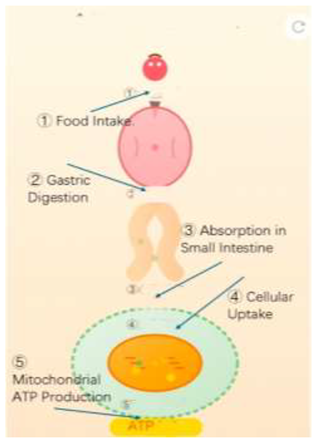
From a modern metabolic perspective, the essence of "Qi transformation" is energy flow and transformation: Food is digested and broken down into small-molecule nutrients (glucose, fatty acids, amino acids), absorbed into the bloodstream, and transported to cells throughout the body. Within the mitochondria, these substrates undergo efficient, orderly oxidation via the tricarboxylic acid (TCA) cycle and oxidative phosphorylation. Energy is gradually released and stored in ATP, while simultaneously generating heat to maintain body temperature. This controlled, efficient state of energy transformation and utilization corresponds to "Shao Huo" or "physiological fire," which is the "vital qi" (Yuan Qi) sustaining life activities.
This orderly, controlled process of energy release and utilization corresponds to "Shao Huo" (physiological fire), the "vital qi" that maintains body temperature and all physiological functions.
When food intake consistently exceeds the body's needs (dietary irregularities), this metabolic flux becomes overloaded. Excess energy substrates flood the cells, leading to: increased mitochondrial oxidative stress, dysregulation of metabolic pathways, activation of systemic inflammation, and disruption of the gut microbiota.
3. Gut Microbiota and Inflammation
The persistent intake of excessive food, i.e., the state of "pathological fire," can induce gut microbiota dysbiosis. This dysbiosis is characterized by an increased relative abundance of pro-inflammatory Gram-negative bacteria (e.g., Bacteroides, Proteobacteria, Enterobacteriaceae) [2]. Research indicates that such microbiota disturbances are significant triggers for inflammatory bowel disease (IBD) [3]. This suggests that gut microbiota and their mediated inflammatory responses could be a potential pathway through which "Food Fire" transforms into "pathological fire."
4. Empirical Analysis: Using Type 2 Diabetes Mellitus as a Model
Type 2 Diabetes Mellitus is a typical disease state of imbalance, caused by food intake exceeding the body's tolerance capacity, leading to adverse metabolic reactions. TCM refers to this as "Xiao Ke" syndrome (wasting-thirst).
TCM long ago proposed that "dietary irregularities" (Yin Shi Shi Jie) can cause "Xiao Ke" syndrome. Modern research confirms that long-term high-calorie diets are the primary environmental risk factor for diabetes. This directly corresponds to the excessive input of "Food Fire."
Modern pathological manifestations of "Zhuang Huo": The "Zhuang Huo" induced by excessive nutrition manifests at the molecular and cellular levels as chronic low-grade inflammation. In TCM, this is referred to as "Shanghuo," a manifestation of "Zhuang Huo."
5. Calories and Aging
The concept of "Food Fire" here must be applied within the range required for the organism's operation, thereby maintaining a balance between daily nutritional needs and the body's relevant organs.
In modern science, the daily caloric expenditure is a crucial benchmark for maintaining body weight and basic physiological activities. If caloric intake is appropriate, it can be regarded as "moderate" or "Shao Huo." Furthermore, appropriate dietary intake can regulate key factors like insulin, thereby delaying aging [4]. The Su Wen · Shang Gu Tian Zhen Lun begins by stating: "The sages of ancient times who understood the Dao patterned themselves upon Yin and Yang, harmonized themselves with the arts and methods. They ate and drank in moderation, arose and retired at regular times, neither recklessly exhausting themselves nor overexerting their minds. Thus, they could maintain unity of body and spirit, and live out their natural lifespan, reaching one hundred years before departing." [1] This passage underscores the profound impact of "Food Fire" on human health.
6. Discussion
The "Fire" discussed in this paper from the TCM perspective is not simply equivalent to the modern concept of fire, as it is primarily a philosophical concept. This article aims to translate this philosophical concept of "Fire" into a form understandable by modern science.
Explanatory Power of the Hypothesis:
* Explaining the "Obesity Paradox": Although obese individuals have surplus energy stores, their metabolic systems are in a "Zhuang Huo" state—characterized by insulin resistance (resembling "suppression of yin fluids"), chronic inflammation ("Shanghuo"), and disordered energy metabolic pathways. Although there is an abundance of "Fire," it is pathological fire that consumes healthy qi (Zheng Qi), making them prone to complications like diabetes. Furthermore, since "Fire" is a philosophical concept, the "Food Fire" proposed here likely represents only one facet of TCM "Fire."
7. Conclusion
We propose that "Food Fire," as a modern interpretation of TCM "Zhuang Huo," provides a metabolic science-based, dynamic, and operable research framework for understanding core TCM theories. This hypothesis identifies the homeostasis of food intake and metabolic flux as the key criterion for distinguishing between physiological "Shao Huo" and pathological "Zhuang Huo." Using T2DM as an example, it demonstrates the high consistency between the TCM concept of "Zhuang Huo consuming qi and injuring yin" and metabolic disorders caused by nutritional excess. This is not merely a conceptual correspondence but points towards potential philosophical and biological pathways. We believe this interdisciplinary perspective can facilitate substantive dialogue and collaborative research between traditional medicine and modern life science in areas of common concern, such as metabolic diseases.
Of course, "Fire" in TCM is a broad philosophical concept, and the "Fire" proposed in this paper represents only one specific aspect of TCM "Fire."
Author Statement
The author is an independent researcher, and this study received no funding from any institution or foundation. The "Food Fire" hypothesis proposed in this paper is derived from a systematic integration of existing literature and logical reasoning. It is a conceptual hypothesis paper aimed at providing new research directions for interdisciplinary dialogue between Traditional Chinese Medicine and modern medicine. All citations are clearly marked. During the writing process, AI tools were utilized to assist with literature retrieval, language polishing, and logical structuring. However, the core ideas, hypothesis construction, argumentation framework, and final conclusions were independently developed by the author. Translation of abstracts and key terms from cited English literature was also assisted by AI. As a theoretical framework exploration, this paper currently lacks experimental data. Colleagues in relevant fields are encouraged to conduct empirical research based on this work, to jointly validate and refine the proposed hypothesis.
References
- Huang Di Nei Jing (The Yellow Emperor's Inner Canon). (This is an ancient Chinese classic.).
- Yongqiang, Li; Wenjuan, Tang; Yongjian, Zhou. Role of Intestinal Flora and Its Metabolites in the Pathogenesis, Progression, and Treatment of Nonalcoholic Fatty Liver Disease [J]. Journal of Clinical Hepatology 2023, 39(8), 1805–1810. [Google Scholar]
- Ni, J; Wu, G D; Albenberg, L; et al. Gut microbiota and IBD: causation or correlation?[J]. Nature Reviews Gastroenterology & Hepatology 2017, 14(10), 573–584. [Google Scholar]
- Trisal, A.; Singh, A.K. Clinical Insights on Caloric Restriction Mimetics for Mitigating Brain Aging and Related Neurodegeneration. Cell Mol Neurobiol 2024, 44, 67. [Google Scholar] [CrossRef] [PubMed]
Disclaimer/Publisher’s Note: The statements, opinions and data contained in all publications are solely those of the individual author(s) and contributor(s) and not of MDPI and/or the editor(s). MDPI and/or the editor(s) disclaim responsibility for any injury to people or property resulting from any ideas, methods, instructions or products referred to in the content. |
© 2026 by the authors. Licensee MDPI, Basel, Switzerland. This article is an open access article distributed under the terms and conditions of the Creative Commons Attribution (CC BY) license (http://creativecommons.org/licenses/by/4.0/).
Copyright: This open access article is published under a Creative Commons CC BY 4.0 license, which permit the free download, distribution, and reuse, provided that the author and preprint are cited in any reuse.


