

Submitted:
15 January 2026
Posted:
16 January 2026
You are already at the latest version
Abstract
Ecosystem-based adaptation practice has emerged as a sustainable approach to enhance smallholder farmers’ climate resilience while delivering multiple social, economic and environmental co-benefits. This study explores the perceived co-benefits from adopting ecosystem-based adaptation practices and examines how the perceived co-benefits shape adoption decisions among smallholder farmers. A mixed-method approach was used involving household survey of 360 smallholder farmers targeting household heads in purposive sampling scheme, key informant interviews and focus group discussions. The key findings of the study revealed mixed cropping (83.9%), integrated crop-livestock (57.2%) and mulch tillage (51.1%) as the most widely adopted practices. In addition, the study revealed that smallholder farmers perceived multiple ecological co-benefits from adopting ecosystem-based adaptation practices such as improved soil fertility, water retention, erosion control, pests’ regulation and agrobiodiversity improvement, while boosting crop productivity, food security and income diversification. Furthermore, smallholder farmers were found to value ecosystem-based adaptation practices that rely on low cost, local available inputs and traditional knowledge. The key motivators for adoption were found to be livelihood diversification, local inputs reliance and soil quality management. It is concluded that smallholder farmers adopt ecosystem-based adaptation practices that offer tangible co-benefits, and the adaptation initiative becomes effective when linked to local community perspective.
Keywords:
co-benefits
; ecosystem-based adaptation
; climate change
; livelihood
; sustainable
; resilience
; smallholder farmers
1. Introduction
Climate change is a global growing threat that significantly impact agriculture and food security [1]. Smallholder farmers in developing countries are vulnerable to climate extreme events as their agricultural production and livelihoods are impacted. The impact of climate change on agriculture is critical to the estimated 32 million people in Mozambique, where agriculture is the basis of its economy contributing to about 27.5% of the total Gross Domestic Product (GDP) where 4.3 million farmers operates in small scale level [2]. Over the past decade, climate extreme such as agricultural dry spells caused by late onset (delayed November rains) and early cessation (lack of February – March rains) has been a critical issue that heightened droughts impacts on crop yields among rainfed farming communities in Mozambique [3]. During the 2015 – 2016 El-Nino event across southern Africa, the southern and central regions of Mozambique experienced severe drought conditions which caused significant reduction in maize yields by 20%-30% affecting the staple crop for the majority of the population. The large proportion of maize failure was due to the erratic rainfall patterns that resulted in a delayed onset and early cessation of rains during the growing seasons [4].
One effective method to supporting smallholder farmers in maintaining their farm-based livelihoods amidst the growing challenges of climate change and variability is by promoting farm management practices such as ecosystem-based adaptation practices that utilize agrobiodiversity and ecosystem services to offer valuable adaptation benefits [5]. Ecosystem-based adaptation practices in the context of agriculture is defined as agricultural management practices that use or take advantage of biodiversity or ecosystem services or processes either at the plot, farm or landscape level to help increase the ability of crops or livestock to adapt to climate change and variabilities [6]. For ecosystem-based adaptation practices to be appropriate for smallholder farmers, these practices must help increase food security, increase or diversify sources of income generation, take advantage of local or traditional knowledge, be based on local inputs, and have low implementation and labour cost [6]. Ecosystem-based approaches can mitigate the impacts of climate change while providing multiple co-benefits which contribute to poverty alleviation, biodiversity conservation and resilient livelihood [7]. Although there is no standard definition of co-benefit in the context of ecosystem-based adaptation practices, for the purpose of his study, co-benefit is defined from the view point of [8] as additional positive outcomes derived from ecosystem-based adaptation beyond the core gaol of adaptation in the form of ecosystem goods and services such as improved water supply, soil fertility, biodiversity, livelihoods, reduced disaster risk, and enhance well-being.
The co-benefits obtained from ecosystem-based adaptation practices make adoption appealing and viable by connecting climate resilience with food security, yield stability, income diversification and reduced reliance on external inputs [9]. Meaning that adoption of ecosystem-based adaptation practices by smallholder farmers is not only an additional cost, but an incentive that can enhance their livelihoods. The perception of smallholder farmers on co-benefits is across interconnected dimensions which include direct improvement in ecosystem-services and resource quality, tangible adaptation benefits through the reduction of vulnerability to climate risk, livelihood and food security benefits [10]. An effective ecosystem-based adaptation practices that offer observable benefits foster positive perceptions among the smallholder farmers which intern increases their willingness to adopt and sustain ecosystem-based adaptation practices [11]. Very few studies, however, have attempted to understand smallholder farmers’ perspective on the relationship between ecosystem-based adaptation practices and the co-benefits at farm-level and co-benefits that influence adoption decisions among smallholder farmers.
The objectives of this study were (1) to identify co-benefits smallholder farmers perceived from adoption of ecosystem-based adaptation practices, (2) to analyse the relationship between the perceived co-benefits and the ecosystem-based adaptation practices, (3) to determine the key co-benefits influencing the adoption decisions.
This study aims to address three key questions regarding the adoption of ecosystem-based adaptation practices by smallholder farmers: (1) What co-benefit smallholder farmers perceive from adopting ecosystem-based adaptation practices? (2) How do the perceived co-benefits relate to the ecosystem-based adaptation practices? and (3) What co-benefit influences the adoption of ecosystem-based adaptation practices among smallholder farmers.
The study delineates smallholder farmers’ perception on relationship between co-benefits and ecosystem-based adaptation practices, and how the co-benefits influence the adoption decision of the smallholder farmers. The findings bridge the gap between scientific investigations and smallholder farmers’ real-world experiences by identifying which ecosystem-based adaptation practices provide the most valued environmental and socioeconomic benefits. These insights guide policymakers and development actors to design context-specific and farmers’ centred strategies that enhance the effectiveness of adaptation initiatives and sustainable farming that offer low cost, locally tailored solutions drawn on farmers’ local knowledge and realities.
2. Materials and Methods
2.1. Study Area
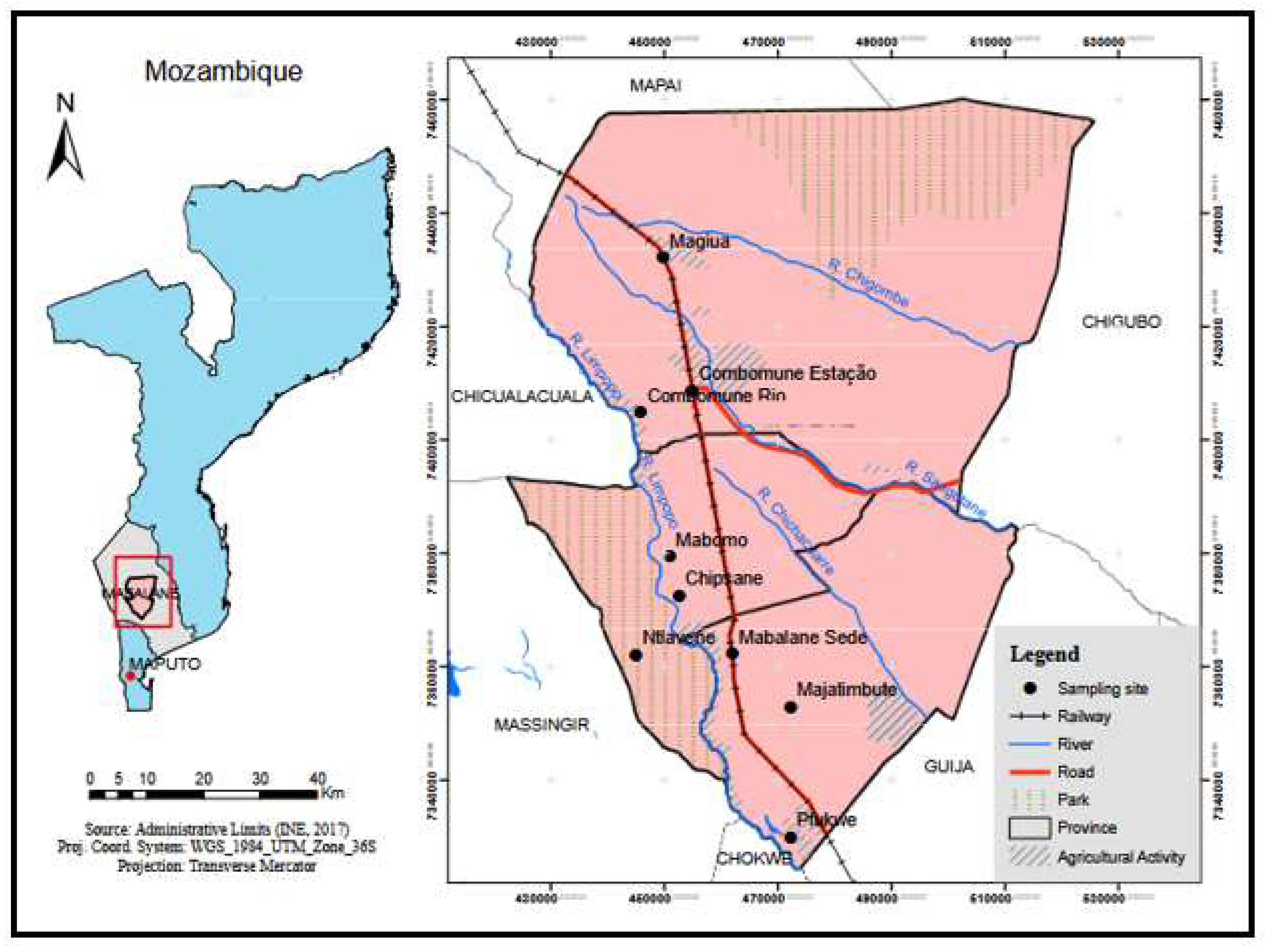
Mabalane district is located in Gaza Province (Lat 23.849°S, Lon 32.62°E) approximately 314 Km North of the capital Maputo. The area is approximately 9580 Km2 of which 75% is ASALs (arid and semi-arid lands). The population is 32,040 inhabitants with the population density of 3 people per Km2, far below the national average of 25 people per Km2 [12]. The district share part of the Great Limpopo Transfrontier Park about 1600 Km2 and it belongs to the drainage basin of the Limpopo which includes River Limpopo the main perennial, River Chigombe, River Sangutane and River Chichakuarre are all seasonal [13].
The climate is tropical arid with average temperature of 24°C, rainfall is low and variable, averaging 623mm/year falling mostly from November to March. The evapotranspiration is very high at 1413 mm/year more than the rainfall [12]. The forest ecosystems consist of woodland that cover greater than 80% of the land mainly consisting of Mopane (Colophospermun mopane) woodlands [14].
The area is gradually flat to undulating and the soils consist of marine deposits overlain in some places by more recent colluvial and alluvial deposits. Soil close to the river are sandy and fertile, while the rest are loamy sand in texture (82% sand, 13% silt, 5% clay) with low carbon and nutrient content (0.4% C, 0.05% N) [15].
The major economic activity include charcoal production and commercialization, households’ livelihoods depend traditionally on rainfed agriculture and livestock keeping [16]. The farms have an average 4.1 hectors with the main agricultural products including maize, beans, pumpkin, sweet potato, water melon, cassava and groundnuts, both of which are threaten by negative effects of climate change [17].
Figure 1.
The study area.
2.2. Definition and Scope of the Study
Ecosystem-based adaptation was derived from the concept of ecosystem which evolved in the field of ecology into one of the most fundamental ideas which has a wide range of application in ecological research and problem management [18]. The ecosystem-based adaptation is focused on the premise that ecosystem services are very key in helping people adapt to the adverse impacts of climate change [19]. It is widely recognized that ecosystem services have adaptation benefits where a well-managed ecosystems have a greater potential to adopt to climate change, resist and recover more easily from extreme weather events and provide a range of benefits on which people depend [20].
There are several definitions of ecosystem-based adaptation, in 2009, the concept of ecosystem-based adaptation was defined by the secretariate of the Convention on Biological Diversity (CBD) as the “use of biodiversity and ecosystem services to help people adapt to the adverse impacts of climate change” [19]. This definition was altered by Convention on Biological Diversity in 2010 to make it more holistic by referring ecosystem-based adaptation as the sustainable management, conservation and restoration of ecosystem as part of an overall adaptation strategy that takes into account the multiple social, economic and cultural co-benefits for local communities [21].
The above altered definition was based on three adaptation approaches focusing on “human well-being”; “ecosystem management, conservation, restoration”; and “climate change adaptation” including restoration of mangroves to shield them against storm and sea-level rises, the management of water sheds to protect against droughts and flooding, the management of range lands to inhibit desertification and land degradation and more sustainably managed fisheries and forestry to address food insecurity [22]. These three adaptation approaches distinguish ecosystem-based adaptation from some forms of community-based adaptation with more specific goal, for example, introducing improved crops for smallholder farmers focuses on immediate community needs such as increasing yields while taking less account of the potential long-term impacts on the ecosystem.
However, for this study, we adopt Vignola et al., 2015 definition of Ecosystem-based adaptation for agricultural systems as agricultural management practices that use or take advantage of biodiversity or ecosystem services or processes either at the plot, farm or landscape level to help increase the ability of crops or livestock to adapt to climate change and variabilities. Vignola et al., 2015 definition expanded the definition of the concept by the Convention on biological Diversity (CBD, 2010) to encompass both human and natural systems by incorporating managed ecosystems such as plot, farm, landscape and integrating social, economic, and institutional dimensions for a more holistic approach to reduce vulnerability. Vignola et al., 2015 definition agrees with the concept that ecosystem-based management practice is beneficial for farmers at both landscape and on-farm level [18].
It is important to know that in the context of droughts, most mitigation strategies, particularly those developed traditionally by smallholder farmers are ecosystem-based [7]. Locally-adapted sustainable agricultural practices and strategies that strengthen ecosystem functioning exist in order to address challenges such as land degradation, food insecurity and lack of access to agricultural inputs [23]. The potential in the local adaptation can help reduce the susceptibility of the agro-ecosystem (croplands, rangelands, agro-forests etc..) to droughts risks and increase preparedness through diversification of agricultural production. In such sustainable ecosystem services, the capacity of nature is used to buffer farmers and communities against the impacts of climate change and natural hazards [24].
There are more similarities between the two concepts of Eco-Disaster Risk Reduction (Eco-DDR) and Ecosystem-based Adaptation (EbA) than divergence, especially in addressing climate-related hazards [25] and the benefits both approaches provide are beyond strictly disaster risk reduction and climate change adaptation functions. Both concepts emphasize the use of biodiversity and ecosystem services in a sustainable way and refer to the restoration of degraded/transformed agro-ecosystems. Importantly, Eco-DRR and EbA stress the generation of economic, social and environmental co-benefits when compared to other more conventional disaster risk reduction and climate change adaptation measures such as dams and dikes [18]. When considering ecosystem-based approaches for disaster risk reduction and climate change adaptation, taking a landscape perspective is critical. Typically, decisions on land use changes need to be informed by the flow of ecosystem services at the landscape scale [26]. The multifunctional approach supports the idea that ecosystem services flow needs to be managed at multiple scales and integrate ecological principles at field, farm and landscape scale [27]. Ecosystem-based approaches do not necessarily focus on measures themselves, but also on how to best combine them at the field, farm and landscape levels to maximize disaster risk reduction, climate change adaptation and development objectives. Some approaches target the landscape level, while others are farm or field level, but can be of landscape level approaches [18].
However, there are differences in the scope and approach between the two concepts of ecosystem-based adaptation and eco-disaster risks reduction that lie on the nature of the hazards to be addressed. Ecosystem-based adaptation addresses climate-related natural hazards, while eco-disaster risk reduction deals with other types of disasters such as earthquakes. A more subtle difference that will impact the type of approach and measure adapted, relates to the timeframe of the underlying analysis. Additionally, planning for effective ecosystem-based adaptation requires taking into account long-term changes in frequency and intensity, as well as future potential impacts from climate change including slow-onset events. While on the other hand, eco-disaster risk reduction typically deals with current risks and disaster.
2.3. Theoretical Framework
Different theoretical frameworks exist with key elements and criteria to select practices that fit to be ecosystem-based helped to evaluate the measures’ efficacy in promoting adaptive capacity and resilience while providing multiple benefits.
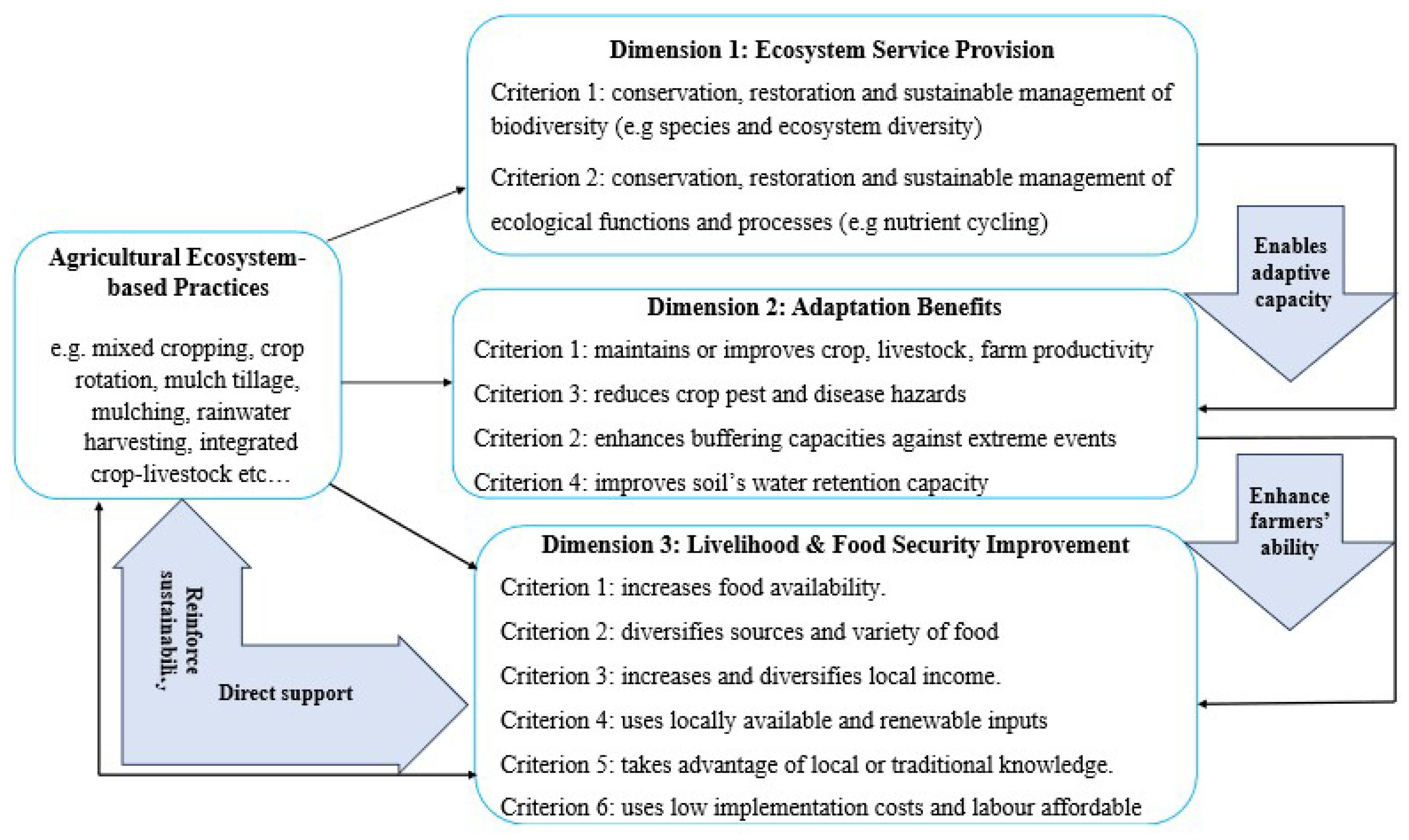
For the purpose of this study, Vignola et al. (2015) framework was adapted for identifying ecosystem-based adaptation practices and co-benefits smallholder farmers perceived from their adaptation at farm-level. The framework is relevant for use in the context of smallholder farmers and is valuable in simulating careful consideration of agricultural practices that are suitable for smallholder farmers to reduce vulnerability to climate change while also conserving the capacity of agroecosystems to provide both on-and off-site ecosystem services [28]. The framework is based on applied interdisciplinary theories that are drawn from various disciplines such as ecology, sociology and economics to develop practical strategies for climate change adaptation in the agricultural communities. As such, Vignola et.al 2015 framework has been applied to the wide variety of agricultural systems that exist globally, from smallholder coffee farmers in Mesoamerica to smallholder farmers in the Otti basin, Togo [11].
The framework was used to identify agricultural practices that fit to be considered ecosystem-based adaptation practices appropriate for smallholder farmers and also to provide indicators for identifying co-benefits smallholder farmers perceived from the adoption of ecosystem-based adaptation practice at farm level.
Therefore, a given agricultural practice that provides at least one co-benefit in all the three dimensions (“ecosystem service provision, “adaptive benefits”, “livelihood and food security improvement”) is considered ecosystem-based adaptation practice appropriate for smallholder farmers [6]. The underlying criteria for each dimension are presented in the figure below.
Figure 2.
Theoretical framework, Source: Adopted and modified from Vignola et al. (2015) by the author.
Figure 2.
Theoretical framework, Source: Adopted and modified from Vignola et al. (2015) by the author.
2.4. Sampling and Data Collection
The sample size (n = 360) was derived from Cochran’s formula for sample size of finite population given by: S = Z2 PQ/E2 [29], where S is the sample size, Z2 is the deviation set at 1.96, P is the number of smallholders in the locality, Q = 1- P, and E is 5% margin of error.
The source of the statistics of the smallholder farmers population was Serviço Distrital de Actividades Económicas (SDAE), a government institution that provides technical support to local communities and stakeholders particularly in the sector of agriculture, fisheries and climate resilience at district level. The district registered a total of 5479 producer farmers, 1643 men and 3836 women. A total number of 44 farmer’s associations are registered of which 33 are active with 754 members composing of 226 men and 528 women.
Due to lack of detailed statistics of the producer farmers in the three administrative posts of the district and their localities, a stratified sampling was carried out where the sample size was equally divided across the three administrative posts (approximately 120 farmers each) and further sub-divided for the nine localities (approximately 40 farmers per locality). The localities were selected randomly to include areas near river Limpopo where most farming activities take place due to the fertile soils and water availability for irrigation and the dry areas far away to cover diverse agroecological niche. Within each locality, household heads were selected using a random walk sampling method. When sample quota was not met in a selected locality data collection was extended to the nearest eligible village to complete the shortfall.
Data collection was carried out using a mixed-method approach that includes semi-structured questionnaires, key informant interviews, and gendered specific focus group discussions to allow free sharing of information. A pretest of the questionnaires was conducted during a renaissance survey to obtain prior information that could be essential for data collection. The questionnaire was adjusted where the term intercropping was changed to mixed cropping appropriate for the farming practice farmers adopt in the study area. Survey questionnaires were used to collect data at farm household level targeting farm household heads (husband or wife). The questionnaires topics included: socio-demographic characteristics of the respondents, farming practices, types of food crops planted, co-benefits farmers perceived from the practices, factors influencing the adoption of ecosystem-based practices.
Considering language barrier as the study was conducted in English language and the official language is Portuguese language; majority of the farmers speak local language Changana. As such guided interviews using questionnaire was conducted to allow establishment of trustworthiness with the respondent hence providing validation of the responses [30]. The questionnaire provided opportunity for the respondent to add any other information if they exist and were not among those in the questions. The respondents were interviewed in their homestead or farms to avoid interruption of their work. The questionnaires were administered to the respondents in Changana language by the research assistants.
To supplement the information and ensure quality control check of the data, two gender specific focus group discussions were conducted in both Portuguese and Changana language in each of the administrative post: (Mabalane Sede, Ntlavene and Combomune Estação respectively). Each focus group consisted of a maximum 12 participants optimal for facilitating interaction and ensuring diverse perspectives [31]. In each administrative post, 5 key informant interviews were held with individuals selected based on their technical skills, social position, experience and knowledge to capture diverse perspective without redundancy [32].
The representative group of both male and female were selected with the help of the district agriculture extension officers. Participants were chosen based on their direct experience with farming practices and yields in semi-arid conditions, and duration of residence in the study area which was taken into account to be at least more than 5 years. Producer farmers who practice irrigation and monoculture mainly for commercial purposes were excluded from the survey.
2.5. Data Analysis
Descriptive statistics of the identified ecosystem-based adaptation practices were generated using IBM SPSS statistical package version 25 to determine the most commonly adopted ecosystem-based adaptation practices with the frequency of each practice expressed as a percentage of the overall total. The identification process of EbA followed the underlying criteria for each of the three dimensions in the theoretical framework.
The relationships between the co-benefits perceived by the smallholder farmers and ecosystem-based adaptation practices were defined by conducting Correspondence Factor Analysis (CFA) with a chi-square independence test setting α (type I error) at 5%.
The perceptions of the co-benefits were projected into a system of Factorial axes resulting from the Correspondence Factorial Analysis (CFA) to identify the latent factors influencing the adoption of the identified ecosystem-based adaptation practices among smallholder farmers. Factors extracted were based on eigenvalue greater than 1, communality loading above 0.3, rotation based on Promax, and the threshold for factor loading cut-offs was 0.60 for interpreting strong relationship [33].
3. Results
3.1. Identified Ecosystem-Based Adaptation Practices
Based on the theoretical framework guideline, the study identified mixed cropping, integrated crop-livestock, mulch tillage, crop rotation, agroforestry, mulching and rainwater harvesting were the common ecosystem-based adaptation practices used by the respondents as adaptation strategies to cope up with the effects of dry spell in their farming systems. Mixed cropping, integrated crop-livestock and mulch tillage were found the most highly adopted ecosystem-based adaptation practices compared to the other identified practices as shown in Figure 3.
3.2. Relationships Between EbA Practices and the Perceived Co-Benefits
The results of the correspondence analysis revealed a statistically significant relationship at 5% significance level (p-value < 0.001) between ecosystem-based adaptation practices smallholder farmers adopt at farm level and the co-benefits they perceived from implementing those practices. The chi-square test revealed that the association between the variables included in the correspondence analysis was statistically significant. A close association was also observed among the ecosystem-based adaptation practices. Table 1, Table 3 and Table 5 show frequency cross-tabulation of ecosystem-based adaptation practices and their associated co-benefits as reported by smallholder farmers according to the three dimensions. The tables have counts for each practice-co-benefit combination and active margins used as inputs for the correspondence analysis.
3.2.1. Dimension-1: Ecosystem Service Provision
The summary table (Table 2) presents how much variation in the data is explained by each extracted dimension, the value of the total chi-square (1402.726) and significant (p-value < 0.001) indicate a statistically significant association between the variables analysed. Dimension 1 explained the majority of variation in the data and captured the dominant pattern of the association (69.3%), whereas dimension 2 explained additional 28% of the variation. Dimension 3, 4 and 5 explained less than 3% of the total variation (inertia) contributing very little to the overall variation, hence neglected for the interpretation.
The result of the correspondence analysis on the biplot (Figure 4) revealed that the two dimensions (dimension 1 and 2) from the summary table accounted for 97.3% of the total inertia (Axis-1 = 69.3% and Axis-2 = 28%). This suggests that the correspondence analysis of the two axes explained 97.3% of the information.
3.2.2. Dimension-2: Adaptation Benefits
The summary table (Table 4) shows that the analysis extracted three dimensions (dimension 1, dimension 2 and dimension 3). Dimension 1 explained the highest proportion of inertia (54%), followed by dimension 2 (41.6%), the two dimension together accounting for 95.6% of the total variation. Dimension 3 contributes 4.4% offering limited additional insight that is negligible for the interpretation. The analysis revealed that, the association between the variables was statistically significant with chi-square = 764.749 and P-value < 0.001.
The result of the correspondence analysis showed on the biplot (Figure 5) revealed that Axis-1 explains 54% of the information about perceptions of ecosystem-based adaptation practices, whereas Axis-2 accounts 41.6% meaning that the correspondence analysis of the two axes explained 95.6% of the information.
3.2.3. Dimension-3: Livelihood and Food Security Improvement
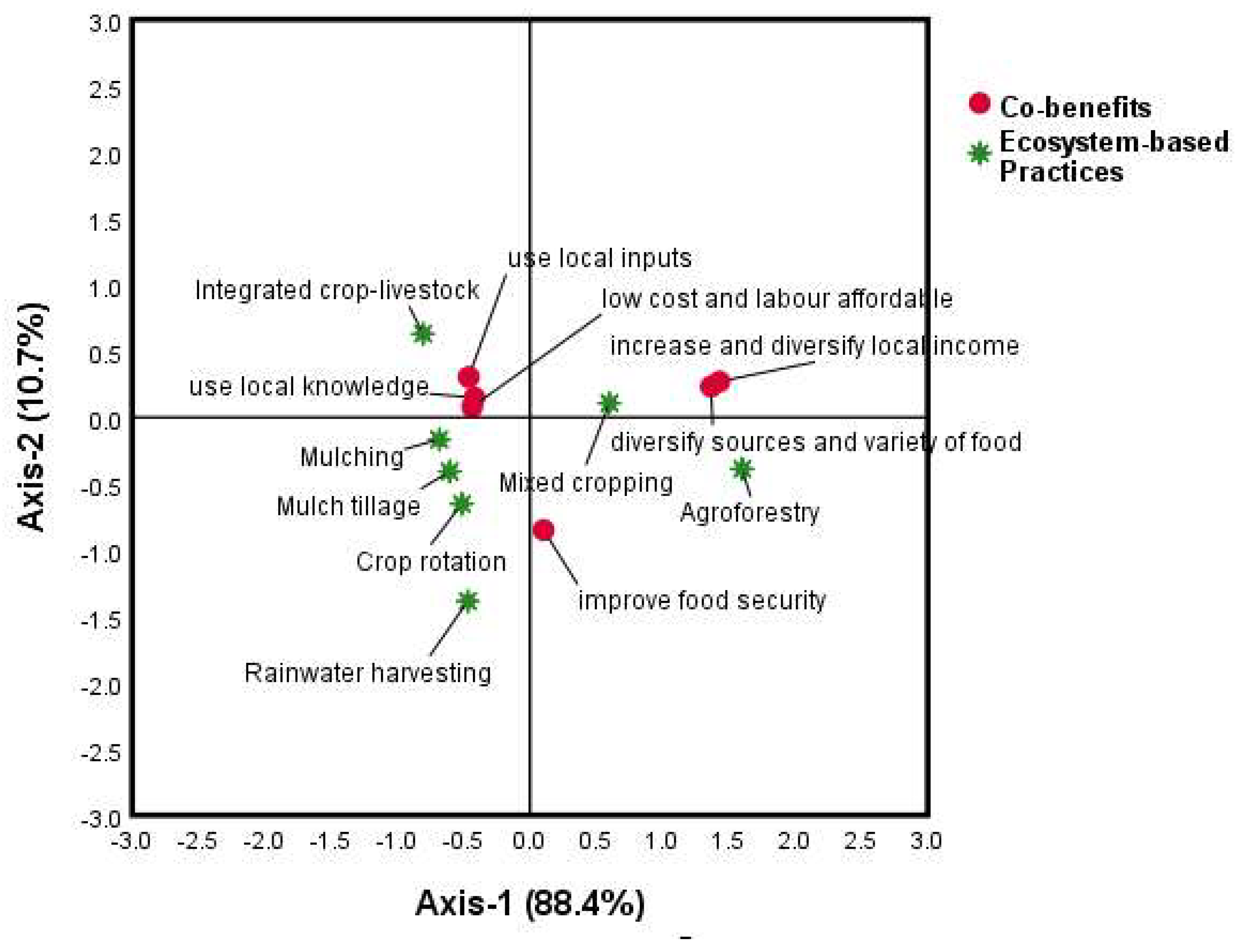
The summary table (Table 6) of the correspondence analysis revealed a statistically significant association between the variables with the value of the total chi-square = 952.182 and p-value < 0.001. The analysis extracted five dimensions. Dimension 1 explained the majority of variation in the data and captured the dominant pattern of the association (88.4%), whereas dimension 2 explained substantially 10.7% of the variation. Dimension 1 and 2 together account for 99.1% of the total variation. Dimension 3, 4 and 5 contributions are negligible.
The result on the biplot (Figure 6) revealed that Axis-1 explains 88.4% of the association, whereas Axis-2 explains 10.7% which implies that 99.1% of the information is being explained by the correspondence analysis of the two axes.

Table 1.
Frequency cross-tabulation for Ecosystem Service Provision.
| Correspondence Table | |||||||
|---|---|---|---|---|---|---|---|
| Ecosystem-based Adaptation Practices | Co-benefits | ||||||
| Improve soil fertility and quality | Improve soil nutrients regulation | Improve water infiltration and control erosion | Surface runoff regulation | Agrobiodiversity improvement-pollinators | Agrobiodiversity improvement-plant diversity | Active Margin | |
| Mixed cropping | 285 | 289 | 295 | 212 | 5 | 35 | 1121 |
| Crop rotation | 89 | 90 | 15 | 14 | 3 | 2 | 213 |
| Mulch tillage | 183 | 116 | 171 | 81 | 1 | 2 | 554 |
| Mulching | 29 | 10 | 25 | 12 | 0 | 0 | 76 |
| Agroforestry | 23 | 9 | 14 | 1 | 38 | 39 | 124 |
| Integrated crop-livestock | 206 | 195 | 1 | 0 | 0 | 0 | 402 |
| Rainwater harvesting | 4 | 0 | 8 | 10 | 0 | 0 | 22 |
| Active Margin | 819 | 709 | 529 | 330 | 47 | 78 | 2512 |
Table 2.
Summary table for Ecosystem Service Provision.
| Summary | ||||||||
|---|---|---|---|---|---|---|---|---|
| Dimension | Singular Value | Inertia | Chi- Square | Sig. | Proportion of Inertia | Confidence Singular Value | ||
| Accounted for | Cumulative | Standard Deviation | Correlation | |||||
| 2 | ||||||||
| 1 | 0.622 | 0.387 | 0.693 | 0.693 | 0.035 | 0.027 | ||
| 2 | 0.395 | 0.156 | 0.280 | 0.973 | 0.012 | |||
| 3 | 0.111 | 0.012 | 0.022 | 0.995 | ||||
| 4 | 0.050 | 0.002 | 0.004 | 0.999 | ||||
| 5 | 0.020 | 0.000 | 0.001 | 1.000 | ||||
| Total | 0.558 | 1402.726 | .000a | 1.000 | 1.000 | |||
a. 30 degrees of freedom.
Table 3.
Frequency cross-tabulation for Adaptation Benefits.
| Correspondence Table | |||||
|---|---|---|---|---|---|
|
Ecosystem-based Adaptation Practices |
Co-benefits | ||||
| Improve crop productivity | Reduce pests and diseases incidents | Improve buffering capacity | Improve soil water retention | Active Margin | |
| Mixed cropping | 299 | 282 | 288 | 262 | 1131 |
| Crop rotation | 94 | 95 | 5 | 7 | 201 |
| Mulch tillage | 176 | 5 | 108 | 173 | 462 |
| Mulching | 25 | 1 | 22 | 26 | 74 |
| Agroforestry | 16 | 3 | 37 | 14 | 70 |
| Integrated crop-livestock | 204 | 1 | 0 | 0 | 205 |
| Rainwater harvesting | 10 | 0 | 7 | 9 | 26 |
| Active Margin | 824 | 387 | 467 | 491 | 2169 |
Table 4.
Summary table for Adaptation Benefits.
| Summary | ||||||||
| Dimension | Singular Value | Inertia | Chi- Square | Sig. | Proportion of Inertia | Confidence Singular Value | ||
| Accounted for | Cumulative | Standard Deviation | Correlation | |||||
| 2 | ||||||||
| 1 | 0.436 | 0.190 | 0.540 | 0.540 | 0.014 | -0.122 | ||
| 2 | 0.383 | 0.147 | 0.416 | 0.956 | 0.017 | |||
| 3 | 0.125 | 0.016 | 0.044 | 1.000 | ||||
| Total | 0.353 | 764.749 | .000a | 1.000 | 1.000 | |||
a. 18 degrees of freedom.
Table 5.
Frequency cross-tabulation for Livelihood and Food Security Improvement.
| Correspondence Table | |||||||
|---|---|---|---|---|---|---|---|
| Ecosystem-based Adaptation Practices | Co-Benefits | ||||||
| Improve food security | Diversify sources and variety of food | Increase and diversify local income | Use local inputs | Use local knowledge | Low cost and labour affordable | Active Margin | |
| Mixed cropping | 295 | 293 | 280 | 246 | 276 | 273 | 1663 |
| Crop rotation | 90 | 6 | 2 | 56 | 88 | 95 | 337 |
| Mulch tillage | 163 | 4 | 2 | 170 | 169 | 172 | 680 |
| Mulching | 20 | 0 | 0 | 27 | 26 | 27 | 100 |
| Agroforestry | 35 | 37 | 36 | 6 | 6 | 6 | 126 |
| Integrated crop-livestock | 46 | 3 | 1 | 204 | 204 | 204 | 662 |
| Rainwater harvesting | 9 | 0 | 0 | 4 | 4 | 6 | 23 |
| Active Margin | 658 | 343 | 321 | 713 | 773 | 783 | 3591 |
Table 6.
Summary table for Livelihood and Food Security Improvement.
| Summary | ||||||||
|---|---|---|---|---|---|---|---|---|
| Dimension | Singular Value | Inertia | Chi Square | Sig. | Proportion of Inertia | Confidence Singular Value | ||
| Accounted for | Cumulative | Standard Deviation | Correlation | |||||
| 2 | ||||||||
| 1 | 0.484 | 0.235 | 0.884 | 0.884 | 0.011 | -0.106 | ||
| 2 | 0.168 | 0.028 | 0.107 | 0.991 | 0.015 | |||
| 3 | 0.047 | 0.002 | 0.008 | 1.000 | ||||
| 4 | 0.009 | 0.000 | 0.000 | 1.000 | ||||
| 5 | 0.001 | 0.000 | 0.000 | 1.000 | ||||
| Total | 0.265 | 952.182 | .000a | 1.000 | 1.000 | |||
a. 30 degrees of freedom.
3.3. Factors Influencing Smallholder Farmers’ Adoption Decisions
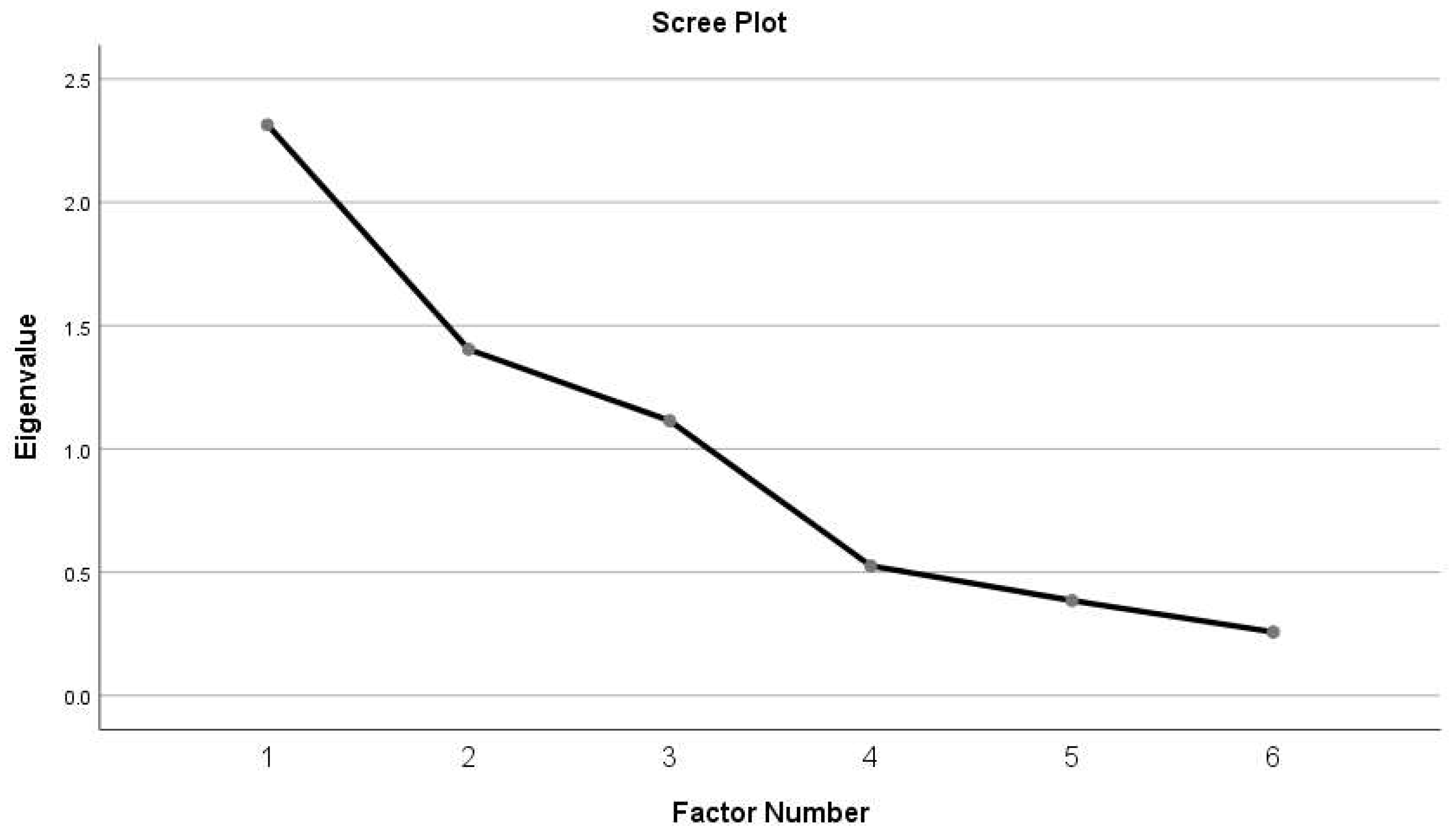
The statistical test confirmed sufficient intercorrelations among variables (P < 0.001) with no multicollinearity (chi-square = 594.774) shown in Table 7. The result of the factor analysis in Table 9 revealed three distinct factors (1) livelihood diversification, (2) local inputs reliance and (3) soil quality management explaining 61% of the variance in smallholder farmer’s motivations for adopting the ecosystem-based adaptation practices as shown in Table 8.
Table 7.
Bartlett’s test of sampling adequacy.
| KMO and Bartlett's Test | ||
|---|---|---|
| Kaiser-Meyer-Olkin Measure of Sampling Adequacy. | 0.585 | |
| Bartlett's Test of Sphericity | Approx. Chi-Square | 594.774 |
| df | 15 | |
| Sig. | 0.000 | |
Table 8.
The explained variance in the dataset.
| Total Variance Explained | |||||||
|---|---|---|---|---|---|---|---|
| Factor | Initial Eigenvalues | Extraction Sums of Squared Loadings | Rotation Sums of Squared Loadingsa | ||||
| Total | % of Variance | Cumulative % | Total | % of Variance | Cumulative % | Total | |
| 1 | 2.315 | 38.575 | 38.575 | 1.989 | 33.155 | 33.155 | 1.714 |
| 2 | 1.404 | 23.397 | 61.972 | 0.910 | 15.164 | 48.319 | 1.508 |
| 3 | 1.114 | 18.571 | 80.543 | 0.765 | 12.751 | 61.070 | 1.018 |
| 4 | 0.525 | 8.754 | 89.297 | ||||
| 5 | 0.385 | 6.417 | 95.715 | ||||
| 6 | 0.257 | 4.285 | 100.000 | ||||
Figure 7.
Screen plot showing the number of retained factors.
From Table 9, three factors emerged from the pattern matrix indicating how different co-benefits cluster according to smallholder farmers’ perception. Each of the three factors contain two strongly loading variables meaning that farmers valued ecosystem-based adaptation practices for diversifying livelihoods through improved food variety and local income, for relying on local inputs and traditional knowledge, and for enhancing soil fertility and nutrient regulation. Together these factors show that ecosystem-based adaptation practices support economic stability, cultural compatibility and a long-term soil health in smallholder systems.
Table 9.
Underlying factors identified from Principal Axis Factoring.
| Pattern Matrixa | |||
|---|---|---|---|
| Co-benefits | Factor | ||
| Factor 1: Livelihood Diversification |
Factor 2: Local Inputs Reliance |
Factor 3: Soil Quality Management |
|
| Diversify sources and variety of food | 0.886 | ||
| Increased and diversify local income | 0.828 | ||
| Use local inputs | 0.782 | ||
| Use local traditional knowledge | 0.770 | ||
| Improvement of soil fertility and quality | 0.718 | ||
| Improvement of soil nutrient regulation | 0.661 | ||
4. Discussion
Following the theoretical framework, the study identified seven different ecosystem-based adaptation practices used by smallholder farmers at farm level. The result revealed that mixed cropping, integrated crop-livestock, mulch tillage, crop rotation, agroforestry, mulching and rainwater harvesting were the common ecosystem-based adaptation practices used by the respondents as adaptation strategies in their farming systems. The practices can be categorised into three groups such as: 1. Conservation tillage which include practices such as mixed cropping, crop rotation, mulch tillage and mulching. 2. Soil and water conservation practices such as rainwater harvesting. 3. Integrated soil fertility management practices such as agroforestry and integrated crop-livestock [11]. Mixed cropping, integrated crop-livestock and mulch tillage were found to be the most widely adopted ecosystem-based adaptation practices by the respondents compare to the other identified practices.
The correspondent analysis biplot for dimension 1: Ecosystem service provision (Figure 3) revealed distinct patterns of association between ecosystem-based adaptation practices and the co-benefits perceived by the smallholder farmers. On the lower half of the plot at the right quarter, crop rotation and integrated crop-livestock were closely associated and perceived to relate to improvement of soil fertility and quality as well as soil nutrients regulation. This finding suggests that practices combining crop diversification and livestock integration play a central role in maintaining soil health through organic matter enrichment, nutrient cycling, and enhanced microbial activity [34]. Similar results were reported by Polat, (2018) revealing that diversified crop-livestock rotations enhanced soil structure, fertility, and biological quality, reinforcing the link between rotational diversity and soil nutrient dynamics. On the left quarter, agroforestry is distinctively isolated suggesting that Smallholder farmers perceived it as a unique ecosystem-based adaptation practice primarily relate to improvement of agrobiodiversity for pollinators and plant diversity. This aligns with the finding by Mbow et al., (2014), highlighting that tree-based farming systems enhance biodiversity by providing habitat for pollinators and understory vegetation, while simultaneously stabilizing microclimates and improving long-term ecosystem resilience. The distinct position of agroforestry underscores its multifunctional ecological role that extends beyond soil related benefits to broader ecosystem services such as biodiversity conservation and habitat enhancement [37]. On the upper half at the right quarter, mixed cropping, mulch tillage and mulching are closely associated and perceived to relate to improve water infiltration and erosion control, surface runoff regulation, improve soil fertility and quality, and soil nutrients regulation. These results correspond with the empirical evidence from the studies of Thierfelder & Wall, (2009) who demonstrated that conservation agriculture practices particularly mulching and mulch tillage enhance soil moisture retention, reduce runoff and erosion, and improve organic matter content. The close association between mixed cropping, mulch tillage and mulching suggests that smallholder farmers recognize their synergistic benefits in improving soil productivity under variable rainfall conditions [39]. Conversely, rainwater harvesting was distinctively isolated meaning that smallholder farmers perceived it mainly in relation to surface runoff regulation and improve water infiltration and erosion control, but less connected with soil fertility or nutrient benefits. This finding means that the contribution of rainwater harvesting to soil nutrient enrichment is indirect and depends on complementary soil management practices [40].
For dimension 2: Adaptation benefits (Figure 4), the results showed that on the lower half of the biplot, at the left quarter, integrated crop-livestock is distinctively isolated and perceived to relate to improve crop productivity. This perception reflects the synergistic relationship between crops and livestock in nutrient recycling, organic matter addition and soil fertility enhancement. Livestock manure is a valuable nutrient source, improving soil organic carbon and structure which enhance crop yield potential [41]. This finding is consistent with the studies of Beddow et al., (2010) who found that integrated systems enhance nutrient cycling efficiency and resource use, leading to higher and more stable yield. Whereas on the left quarter, agroforestry, mulch tillage, mulching and rainwater harvesting are closely associated and perceived to relate to improve buffering capacity and soil water retention. This cluster reflects farmers’ recognition of the complementary roles these practices play in enhancing soil moisture dynamics and mitigating water stress. Agroforestry through tree-crop interactions, increase soil organic matter, reduce evaporation, and enhance infiltration [36]. Similarly, mulch tillage and mulching conserve soil moisture by reducing surface evaporation, improve infiltration and moderating soil temperature [38]. Rainwater harvesting complements agroforestry, mulch tillage and mulching by capturing and storing runoff, improving soil moisture availability during dry period. On the upper half at the left quarter, mixed cropping is distinctively isolated and is perceived to relatively relate to multiple co-benefits including improvement of buffering capacity, soil water retention, crop productivity and reduced pests and diseases incidents. This finding reflects the benefits of mixed farming system, for instant, in Mabalane district crop such as maize is mainly mixed with pumpkin, beans, water melon, groundnuts or sweet potatoes. The perception of such multi-functionality is consistent with ecological principles of diversity and complementarity [43]. Mixed cropping systems improve resource use efficiency by enhancing canopy coverage, soil shading and complementary rooting patterns leading to better water retention and reduced erosion [44]. Moreover, mixed cropping reduces pest and disease outbreaks by interrupting pest life cycles and providing habitat for beneficial insects [45]. These perceived co-benefits reflect the ecological and agronomic basis of diversification strategies that enhance both productivity and resilience. On the right quarter, crop rotation is distinctively isolated and perceived to relate to reduced pests and diseases incidents. Crop rotation interrupts pest and pathogen cycles, reduces soil-borne diseases and limits nutrient depletion [46]. Rotating crops with different rooting depths and nutrient demands also improves soil structure and nutrient availability, which contributes indirectly to pest and disease suppression [47].
For dimension 3: Livelihood and food security improvement (Figure 5), on the lower half of the biplot, at the right quarter, agroforestry is distinctively isolated and perceived to relate to diversify sources and food variety and, increased and diversify local income. This finding is in consistent with the studies of Mbow et al., (2014) that trees and perennial crops integrated into farming systems provide fruits, nuts, fodder, fuelwood and timber which contribute to household food supply and generating marketable products that supplement income. Whereas, at the left quarter, mulch tillage, mulching and crop rotation are closely associated. However, mulch tillage and mulching are perceived to relate to use local inputs, traditional knowledge, low cost and labour affordable whereas, crop rotation is perceived to relate to improve food security. This association reflects smallholder farmers’ perceptions that mulch tillage and mulching are practices that can be implemented using local materials such as crop residues and organic matter. The relation between these practices (mulch tillage and mulching) and traditional knowledge emphasizes the role of indigenous experience in sustainable soil management. Smallholder farmers often adopt low-cost and knowledge intensive practices that aligns with their resource constraints and cultural familiarities [48]. Although crop rotation was associated near these practices, and distinctly perceived to relate to food security improvement is grounded in the fact that rotational cropping enhances soil fertility, reduce pest and disease pressure, and promote stable yields, which directly influence food availability [47].
On the upper half of the biplot, at the right quarter, mixed cropping is distinctively isolated and is perceived to relate to diversify sources and variety of food as well as increased and diversify local income. This is consistent with the finding of Makate et al., (2016) that mixed cropping not only stabilizes yields under climatic uncertainty but also provide farmers with diverse market options and sources of nutrition. Whereas at the left quarter, integrated crop-livestock is distinctively isolated and perceived to relate to use local inputs, local knowledge, low cost and labour affordable. This perception underscores smallholder farmers’ understanding of the complementarities between crops and livestock within their traditional farming systems. A study by Paul et al., (2020) found that integrated systems enhance resource use efficiency, minimize production cost, aligning with smallholder farmers’ socioeconomics realities. This confirms that smallholder farmers recognize integrated crop-livestock as low cost and local knowledge-based that is practical and accessible for sustaining livelihoods under changing climatic conditions.
Co-benefits perceived from adoption of ecosystem-based adaptation practices often serve as the primary incentive for smallholder farmers to adopt and sustain these practices [11].
The result of the factorial analysis revealed that livelihood diversification is the dominant factor influencing the adoption of ecosystem-based adaptation practices, reflecting smallholder farmers’ efforts to enhance food security and improve income. This suggests that smallholder farmers do not value ecosystem-based adaptation practices only for their environmental benefits but also for their capacity to increase household resilience. This finding aligns with the studies by Altieri et al., (2015) and Pretty et al., (2011), which highlighted the role of agroecological practices in boosting food production and economic stability for the smallholder farmers. Local inputs reliance was revealed as the second factor, highlighting the importance of traditional knowledge systems and the use of local available resources in the adoption process. Smallholder farmers prefer practices grounded in indigenous knowledge and accessible inputs, suggesting culturally relevant and cost-effective solutions are more likely to be adopted. This finding is consistent with the study of Pretty et al., (2003), who argued that sustainable agriculture often relies on knowledge than external inputs. Supporting this, a study by Snapp et al., (2002) revealed that low-cost, locally developed practices were central to the success of sustainable farming initiative in Malawi. Soil quality management was the third factor, underscoring smallholder farmers’ ecological motivations, particularly, the need to improve and maintain soil fertility and nutrient regulation. This finding reinforces the role of ecosystem-based adaptation practices in supporting long-term agricultural productivity through enhanced soil health. A study by Knowler & Bradshaw, (2007) identified soil degradation as a major driver of conservation practices adaptation. Studies by Cervantes-Godoy & Dewbre, (2020) is consistent with the finding, recognizing soil health as foundational to the delivery of ecosystem services and sustainable agriculture.
Limitation: The study is based on cross-sectional data and is geographically limited. The study focused only on the influence of co-benefits on adoption decision of smallholder farmers. Factors such as socioeconomics and household characteristics, farm and biophysical characteristics, institutional and informational factors influencing adoption and non-adoption of ecosystem-based adaptation practices among smallholder farmers were not included in the study. Future research should be able to address those factors for policy formulation to scale up the adoption process.
5. Conclusions
The study revealed seven ecosystem-based adaptation practices that smallholder farmers employ as strategy to enhance climate resilience, soil health and livelihood stability. The ecosystem-based adaptation practices were categorized into conservation tillage, soil and water conservation, and integrated soil fertility management systems. The correspondence analysis revealed that smallholder farmers’ perceptions of co-benefits cluster around three main ecosystem functions: (1) soil fertility and nutrient cycling (mixed cropping, crop rotation and integrated crop-livestock), (2) biodiversity enhancement (agroforestry), and (3) soil water regulation and erosion control (mulching, mulch tillage, and rainwater harvesting). Mixed cropping, integrated crop-livestock and mulch tillage were the most widely adopted practices, reflecting their perceived efficiency in improving soil fertility, water retention, and farm productivity. Smallholder farmers’ perceptions were found aligning closely with empirical evidence from prior scientific studies, confirming diversified and integrated systems enhance resource-use efficiency, reduce pest and disease pressure, and strengthen livelihood resilience. The study also revealed that smallholder farmers value ecosystem-based adaptation practices not only for environmental sustainability but also for livelihood diversification, income generation and food security enhancement.
The study underscores the intertwined relationship between ecological and socioeconomic co-benefits, demonstrating that smallholder farmers’ adoption decisions are strongly driven by perceived practical, low cost and local knowledge-based advantages.
To optimize the resilience and sustainability of agricultural systems, the study recommends policymakers and development patterns to prioritize the promotion of local, low cost, and resource-efficient ecosystem-based adaptation practices. The effective integration of indigenous and local knowledge with scientific innovation is critical to this process. Participatory research and extension programs are essential to foster smallholder farmers’ adoption decisions and improve sustainable outcomes.
6. Patents
Not applicable
Supplementary Materials
The following supporting information can be downloaded at: https://www.mdpi.com/article/doi/s1, Figure S1: title; Table S1: title; Video S1: title.
Author Contributions
Conceptualization, Waran Claudius Patrick; and Methodology, Waran Claudius Patrick; map of the study area, Jaime Carlos Macuácua; validation, Nicia Giva; formal analysis, Waran Claudius Patrick; writing original draft preparation, Waran Claudius Patrick; writing review and editing, Nicia Giva; Supervision, Nicia Giva; funding acquisition, Waran Claudius Patrick. All authors have read and agreed to the published version of the manuscript
Funding
“The study was funded by the Centre of Excellence in Agri-Food Systems and Nutrition (CE-AFSN) in Mozambique under a scholarship for master program offered at Eduardo Mondlane University from March 2024 to March 2026”
Institutional Review Board Statement
“Not applicable”.
Informed Consent Statement
Informed consent was obtained from Serviço Distrital de Actividades Económicas (SDAE) in Mabalane district.
Data Availability Statement
The raw data supporting the conclusions of this article will be made available by the main author on request.
Acknowledgments
This study is part of the research as a requirement for the award of MSc. in Climate Change in Agrarian Systems in the Department of Agriculture Economics and Rural Development, Faculty of Agronomy and Forestry Engineering, Universidade Eduardo Mondlane in Mozambique. Thanks to the Dean of the Faculty of Agronomy and Forestry Engineering: Professor Ernesto Uetimane Junior, Director of the Centre of Excellence in Agri-food Systems and Nutrition: Professor Rogerio Chiulele, Director of the Postgraduate studies: Professor Silvia Sitoe, Course Coordinator for Climate Change in Agrarian Systems: Professor Luis Artur, for providing a simulating academic environment; and my supervisor: Professor Nicia Giva for her technical guidance; smallholder farmers and the extension officers from Serviço Distrital de Actividades Económicas (SDAE) in Mabalane District for their unwavering support during data collection process.
Conflicts of Interest
There is no conflict of interest declared by the authors.
Abbreviations
The following abbreviations are used in this manuscript:
| MDPI | Multidisciplinary Digital Publishing Institute |
| DOAJ | Directory of open access journals |
| TLA | Three letter acronym |
| LD | Linear dichroism |
| CBD CE-AFSN CFA EbA Eco-DRR Fig GDP MSc. PhD RII SDAE WAI |
Convention on Biological Diversity Centre of Excellency in Agri-Food Systems and Nutrition Correspondence Factorial Analysis Ecosystem-based Adaptation Eco-Disaster Risk Reduction Figure Gross Domestic Product Masters of Science Doctor of Philosophy Relative Important Index Serviço Distrital de Actividades Económicas Weighted Average Index |
References
- Wiebe, K.; Robinson, S.; Cattaneo, A. Climate Change, Agriculture and Food Security; Elsevier Inc., 2018; ISBN 9780128121351.
- Mondlhane, C.; Munjonji, L.; Victorino, Í.; Huenchuleo, C.; Pimentel, P.; Cornejo, P. Sustainable Agricultural Alternatives to Cope with Drought Effects in Semi-Arid Areas of Southern Mozambique : Review and Strategies Proposal. 2025, 1, 1–20.
- Baez, J.E.; Caruso, G.; Niu, C. Extreme Weather and Poverty Risk: Evidence from Multiple Shocks in Mozambique. Econ. Disasters Clim. Chang. 2020, 4, 103–127, doi:10.1007/s41885-019-00049-9. [CrossRef]
- Rembold, F.; Lemoine, G.; Perez-Hoyos A.; Kerdiles H.; European Commission. Joint Research Centre. Impact of El Niño on Agriculture in Southern Africa for the 2015; 2016; ISBN 9789279582097.
- Mburu, S.W.; Koskey, G.; Kimiti, J.M.; Ombori, O.; Maingi, J.M.; Njeru, E.M. Agrobiodiversity Conservation Enhances Food Security in Subsistence-Based Farming Systems of Eastern Kenya. Agric. Food Secur. 2016, 5, 1–10, doi:10.1186/s40066-016-0068-2. [CrossRef]
- Vignola, R.; Alice, C.; Bautista-solis, P.; Avelino, J.; Rapidel, B.; Donatti, C.; Martinez, R. Agriculture , Ecosystems and Environment Ecosystem-Based Adaptation for Smallholder Farmers : De Fi Nitions , Opportunities and Constraints. "Agriculture, Ecosyst. Environ. 2015, 211, 126–132, doi:10.1016/j.agee.2015.05.013. [CrossRef]
- Dorren, L.; Schwarz, M. Ecosystem-Based Disaster Risk Reduction and Adaptation in Practice; 2016; Vol. 42; ISBN 978-3-319-43631-9.
- IPCC Climate Change 2014 Part A: Global and Sectoral Aspects; 2014; ISBN 9781107641655.
- Alpizar, F.; Donatti, C.; Avelino, J. Ecosystem-Based Practices for Smallholders ’ Adaptation to Climate Extremes : Evidence of Benefits and Knowledge Gaps in Latin America. 2022.
- Vignola, R.; Alice, C.; Bautista-solis, P.; Avelino, J.; Rapidel, B.; Donatti, C.; Martinez, R. Agriculture , Ecosystems and Environment Ecosystem-Based Adaptation for Smallholder Farmers : De Fi Nitions , Opportunities and Constraints. "Agriculture, Ecosyst. Environ. 2015, 211, 126–132, doi:10.1016/j.agee.2015.05.013. [CrossRef]
- Abbey, G.A. Ecosystem-Based Adaptation Practices of Smallholder Farmers in the Oti Basin , Togo : Probing Their Effectiveness And. 2023, 535–551.
- Ng’ang’a, S.K.; Jeannette, V.; Notenbaert, A.; Moyo, S.; Herrero, M. Household Livelihood Strategies and Livestock Benefits Dependence in Gaza Province of Mozambique. African J. Agric. Res. 2011, 6, 560–572.
- Ministério de Administração Estatal Perfil Do Distrito de Mabalane Província de Gaza. Ministério Da Administração Estatal. 2005, 55p.
- Falcão, M.P. Charcoal Production and Use in Mozambique, Malawi, Tanzania, and Zambia: Historical Overview, Present Situation and Outlook. Conf. Charcoal Communities Africa 2008, 20–34.
- Woollen, E.; Ryan, C.M.; Baumert, S.; Vollmer, F.; Grundy, I.; Fisher, J.; Fernando, J.; Luz, A.; Ribeiro, N.; Lisboa, S.N. Charcoal Production in the Mopane Woodlands of Mozambique: What Are the Trade-Offs with Other Ecosystem Services? Philos. Trans. R. Soc. B Biol. Sci. 2016, 371, doi:10.1098/rstb.2015.0315. [CrossRef]
- Baumert, S.; Luz, A.C.; Fisher, J.; Vollmer, F.; Ryan, C.M.; Patenaude, G.; Zorrilla-Miras, P.; Artur, L.; Nhantumbo, I.; Macqueen, D. Charcoal Supply Chains from Mabalane to Maputo: Who Benefits? Energy Sustain. Dev. 2016, 33, 129–138, doi:10.1016/j.esd.2016.06.003. [CrossRef]
- CIAT; World Bank Climate-Smart Agriculture in Mozambique. Clim. Agric. Mozambique 2017, 25.
- Dong-Uuro, P.P.; Peprah, K. Ecosystem-Based Adaptation Practices to Stem Climate Change Impacts: Smallholder Farmers’ Perspectives. Clim. Policy 2024, 24, 573–585, doi:10.1080/14693062.2023.2269121. [CrossRef]
- Secretariat of the Convention on Biological Diversity Connecting Biodiversity and Climate Change Mitigation and Adaptation: Report of the Second Ad Hoc Technical Expert Group on Biodiversity and Climate Change; 2009; ISBN Technical Series No. 41.
- Uy, N.; Shaw, R. The Role of Ecosystems in Climate Change Adaptation and Disaster Risk Reduction. Community, Environ. Disaster Risk Manag. 2012, 12, 41–59, doi:10.1108/S2040-7262(2012)0000012009. [CrossRef]
- Ladekjær, M.; Funder, M. Nature-Based Solutions to Development and Climate Change Challenges: Understanding Ecosystem-Based Adaptation Approaches; 2021; ISBN 9788772360515.
- Chong, J. Ecosystem-Based Approaches to Climate Change Adaptation: Progress and Challenges. Int. Environ. Agreements Polit. Law Econ. 2014, 14, 391–405, doi:10.1007/s10784-014-9242-9. [CrossRef]
- Mabhaudhi, T.; Hlahla, S.; Chimonyo, V.G.P.; Henriksson, R.; Chibarabada, T.P.; Murugani, V.G.; Groner, V.P.; Tadele, Z.; Sobratee, N.; Slotow, R.; et al. Diversity and Diversification: Ecosystem Services Derived From Underutilized Crops and Their Co-Benefits for Sustainable Agricultural Landscapes and Resilient Food Systems in Africa. Front. Agron. 2022, 4, 1–17, doi:10.3389/fagro.2022.859223. [CrossRef]
- Dinesh, D. Agricultural Practices and Technologies to Enhance Food Security, Resilience and Productivity in a Sustainable Manner: Messages for SBSTA 44 Agriculture Workshops. CCAFS Work. Pap. 2016, 146, 80.
- Whelchel, A.W.; Beck, M.W. Decision Tools and Approaches to Advance Ecosystem-Based Disaster Risk Reduction and Climate Change Adaptation in the Twenty-First Century. Adv. Nat. Technol. Hazards Res. 2016, 42, 133–160, doi:10.1007/978-3-319-43633-3_6. [CrossRef]
- Vignola, R.; Gonzalez-Rodrigo, B.; Lane, O.; Marchamalo, M.; McDaniels, T. A Scenario Approach to Assess Stakeholder Preferences for Ecosystem Services in Agricultural Landscapes of Costa Rica. Reg. Environ. Chang. 2017, 17, 605–618, doi:10.1007/s10113-016-1051-y. [CrossRef]
- McGranahan, D.A. Ecologies of Scale: Multifunctionality Connects Conservation and Agriculture across Fields, Farms, and Landscapes; 2014; Vol. 3; ISBN 1701231786.
- Kissi, A.E.; Villamor, G.B.; Abbey, G.A. Ecosystem-Based Adaptation Practices of Smallholder Farmers in the Oti Basin, Togo: Probing Their Effectiveness and Co-Benefits. Ecologies 2023, 4, 535–551, doi:10.3390/ecologies4030035. [CrossRef]
- Hasan, M.K.; Kumar, L. Determining Adequate Sample Size for Social Survey Research. Bangladesh Agril Univ 2024, 22, 146–157.
- Nanfuka, S.; Mfitumukiza, D.; Egeru, A. Characterisation of Ecosystem-Based Adaptations to Drought in the Central Cattle Corridor of Uganda. African J. Range Forage Sci. 2020, 37, 257–267, doi:10.2989/10220119.2020.1748713. [CrossRef]
- Nyumba, T.; Wilson, K.; Derrick, C.J.; Mukherjee, N. The Use of Focus Group Discussion Methodology: Insights from Two Decades of Application in Conservation. Methods Ecol. Evol. 2018, 9, 20–32, doi:10.1111/2041-210X.12860. [CrossRef]
- Muellmann, S.; Brand, T.; Jürgens, D.; Gansefort, D.; Zeeb, H. How Many Key Informants Are Enough? Analysing the Validity of the Community Readiness Assessment. BMC Res. Notes 2021, 14, 1–6, doi:10.1186/s13104-021-05497-9. [CrossRef]
- MacCallum, R.C.; Widaman, K.F.; Zhang, S.; Hong, S. Sample Size in Factor Analysis. Psychol. Methods 1999, 4, 84–99, doi:10.1037/1082-989X.4.1.84. [CrossRef]
- Vanolli, S.; Dias, H.B.; Bonini, F.; Augusto, R.; Lamparelli, C.; Sergio, P.; Magalh, G.; Cherubin, M.R. Crop – Livestock Integrated Systems Improve Soil Health in Tropical Sandy Soils. 2025, 1–17.
- Polat, A. Open PRAIRIE : Open Public Research Access Institutional Repository and Information Exchange Impacts of Diverse Crop Rotations and Integrated Crop-Livestock System on Soil Quality in South Dakota CROP-LIVESTOCK SYSTEM ON SOIL QUALITY IN SOUTH DAKOTA. 2018.
- Mbow, C.; Smith, P.; Skole, D.; Duguma, L.; Bustamante, M. Achieving Mitigation and Adaptation to Climate Change through Sustainable Agroforestry Practices in Africa. Curr. Opin. Environ. Sustain. 2014, 6, 8–14, doi:10.1016/j.cosust.2013.09.002. [CrossRef]
- Mathieu, A.; Rivest, M.M.D. Enhancement of Agroecosystem Multifunctionality by Agroforestry : A Global Quantitative Summary. 2025, 1–19, doi:10.1111/gcb.70234. [CrossRef]
- Thierfelder, C.; Wall, P.C. Soil & Tillage Research Effects of Conservation Agriculture Techniques on Infiltration and Soil Water Content in Zambia and Zimbabwe. 2009, 105, 217–227, doi:10.1016/j.still.2009.07.007. [CrossRef]
- Mbanyele, V.; Mtambanengwe, F.; Nezomba, H.; Groot, J.C.J.; Mapfumo, P. Comparative Short-Term Performance of Soil Water Management Options for Increased Productivity of Maize-Cowpea Intercropping In. J. Agric. Food Res. 2021, 5, 100189, doi:10.1016/j.jafr.2021.100189. [CrossRef]
- Grum, B.; Assefa, D.; Hessel, R.; Kessler, A.; Ritsema, C.; Geissen, V. EFFECT OF IN SITU WATER HARVESTING TECHNIQUES ON SOIL AND NUTRIENT LOSSES IN SEMI-ARID NORTHERN ETHIOPIA. 2017, 1027, 1016–1027, doi:10.1002/ldr.2603. [CrossRef]
- Zhang, L. Impacts of Livestock Manure Resource Utilization on Soil Health and Crop Yield : Mechanisms , Effects , and Future Perspectives. 2025, 0, 119–126, doi:10.54254/2753-8818/81/2025.21332. [CrossRef]
- Beddow, J.M.; Pardey, P.G.; Fischer, R.A.; Edmeades, G.O.; Nutrition, P.; Service, M.; Munns, R.; Tester, M.; Peoples, M.B.; Mosier, A.R.; et al. Smart Investments in Sustainable “ B. 2010.
- Wenda-piesik, A.; Synowiec, A. Productive and Ecological Aspects of Mixed Cropping System. 2021, 10–12.
- Duivenboodew, N.V.A.N.; Paln, M.; Studer, C.; Bielders, L. Cropping Systems and Crop Complementarity in Dryland Agriculture to Increase Soil Water Use Efficiency : A Review. NJAS - Wageningen J. Life Sci. 2000, 48, 213–236, doi:10.1016/S1573-5214(00)80015-9. [CrossRef]
- Altieri, M.A.; Nicholls, C.I.; Henao, A.; Lana, M.A. Agroecology and the Design of Climate Change-Resilient Farming Systems. 2015, 869–890, doi:10.1007/s13593-015-0285-2. [CrossRef]
- Armona, N.E.Z.C.; Aza, M.A.C.O.D.; Scobar, S.E.E.; Alindo, V.I.C.G. Does Plant Diversity Benefit Agroecosystems ? A Synthetic Review. 2011, 21, 9–21.
- Deyn, G. De; Gattinger, A.; Lori, M.; Symnaczik, S.; Ma, P. Organic Farming Enhances Soil Microbial Abundance and Activity — A Meta-Analysis and Meta-Regression. 2017, 1–25.
- Pretty, J.; Benton, T.G.; Bharucha, Z.P.; Dicks, L. V; Flora, C.B.; Godfray, H.C.J.; Goulson, D.; Hartley, S.; Lampkin, N.; Morris, C.; et al. For Sustainable Intensification. Nat. Sustain. 2018, 1, 441–446, doi:10.1038/s41893-018-0114-0. [CrossRef]
- Makate, C.; Wang, R.; Makate, M.; Mango, N. Crop Diversification and Livelihoods of Smallholder Farmers in Zimbabwe : Adaptive Management for Environmental Change. Springerplus 2016, doi:10.1186/s40064-016-2802-4. [CrossRef]
- Paul, B.K.; Koge, J.; Maass, B.L.; Notenbaert, A.; Peters, M.; Groot, J.C.J. Tropical Forage Technologies Can Deliver Multiple Benefits in Sub-Saharan Africa . A Meta-Analysis. 2020.
- Altieri, M.A.; Nicholls, C.I.; Henao, A.; Lana, M.A. Agroecology and the Design of Climate Change-Resilient Farming Systems. Agron. Sustain. Dev. 2015, 35, 869–890, doi:10.1007/s13593-015-0285-2. [CrossRef]
- Pretty, J.; Toulmin, C.; Williams, S. Sustainable Intensification in African Agriculture. Int. J. Agric. Sustain. 2011, 9, 5–24, doi:10.3763/ijas.2010.0583. [CrossRef]
- Pretty, J. Social Capital and the Collective Management of Resources. Science (80-. ). 2003, 302, 1912–1914, doi:10.1126/science.1090847. [CrossRef]
- Snapp, S.; Kanyama-Phiri, G.; Kamanga, B.; Gilbert, R.; Wellard, K. Farmer and Researcher Partnerships in Malawi: Developing Soil Fertility Technologies for the near-Term and Far-Term. Exp. Agric. 2002, 38, 411–431, doi:10.1017/S0014479702000443. [CrossRef]
- Knowler, D.; Bradshaw, B. Farmers’ Adoption of Conservation Agriculture: A Review and Synthesis of Recent Research. Food Policy 2007, 32, 25–48, doi:10.1016/j.foodpol.2006.01.003. [CrossRef]
- Cervantes-Godoy, D.; Dewbre, J. The Future of Food and Agriculture: Trends and Challenges; 2020; Vol. 4; ISBN 1815-6797.
Figure 3.
Identified ecosystem-based practices.
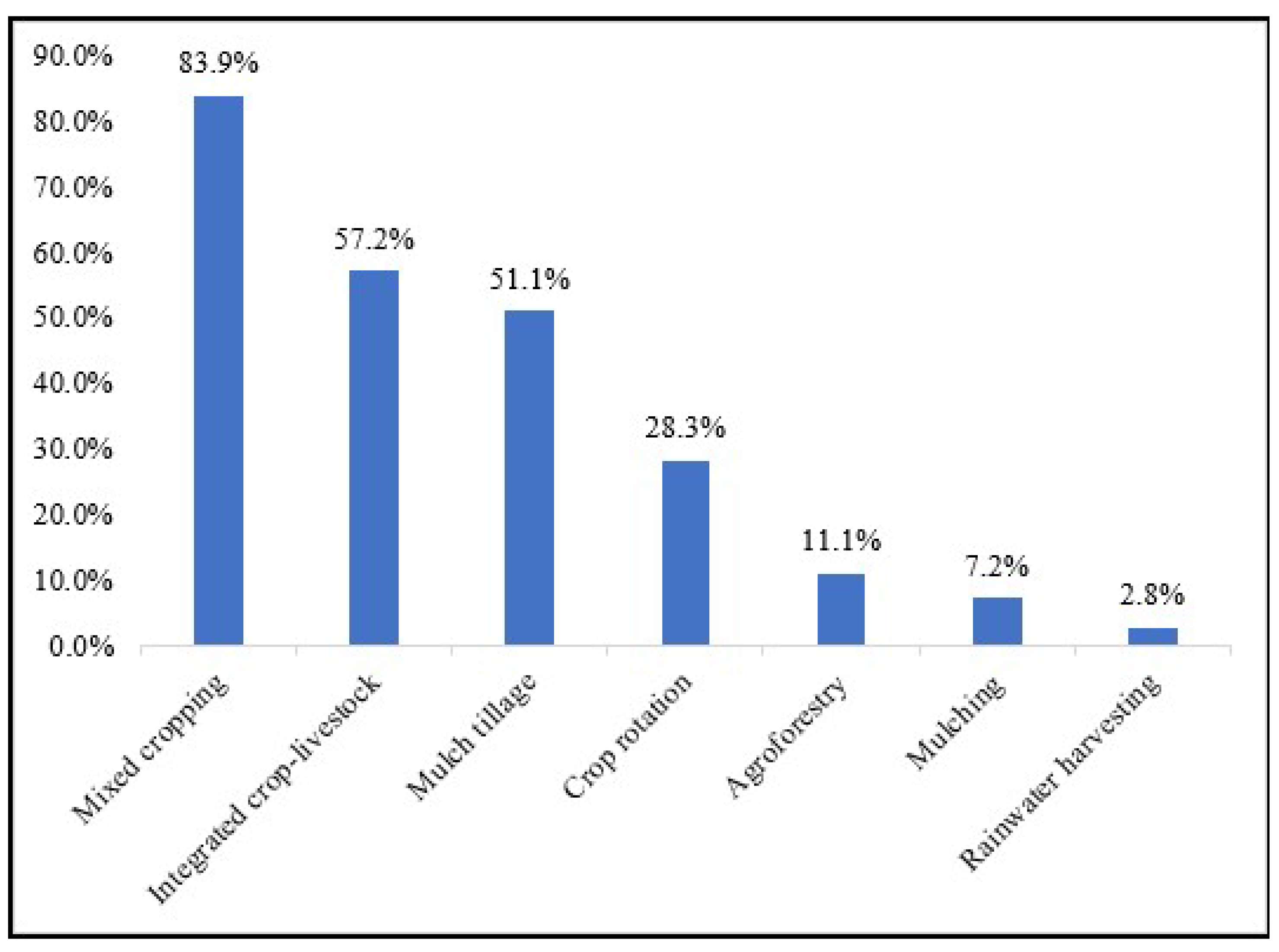
Figure 4.
Projection of co-benefits and EbA practices into system of axes for Ecosystem Service Provision.
Figure 4.
Projection of co-benefits and EbA practices into system of axes for Ecosystem Service Provision.
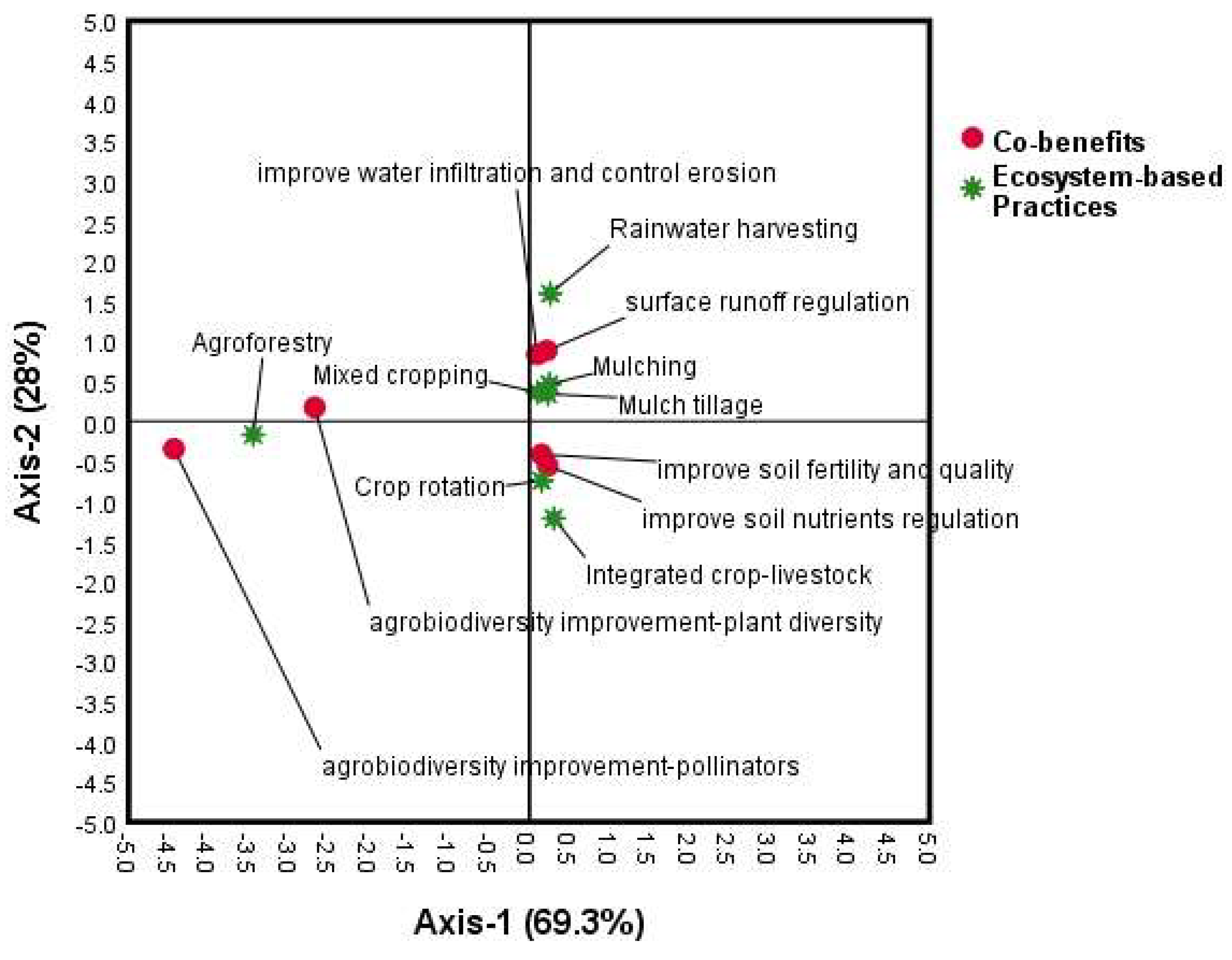
Figure 5.
Projection of co-benefits and EbA practices into system of axes for Adaptation Benefits.
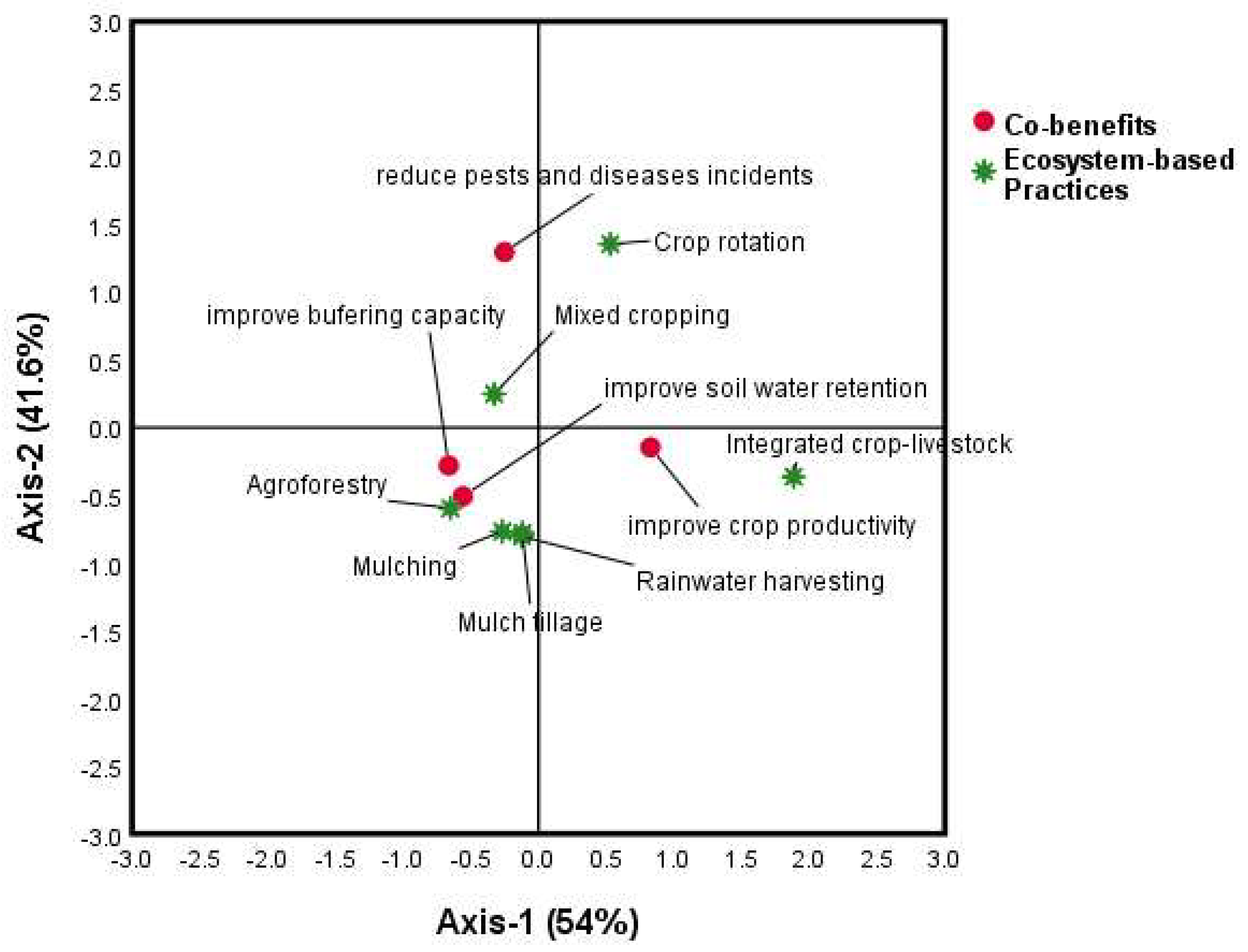
Figure 6.
Projection of co-benefits and EbA practices into system of axes for Livelihood and Food Security Improvement.
Figure 6.
Projection of co-benefits and EbA practices into system of axes for Livelihood and Food Security Improvement.
Disclaimer/Publisher’s Note: The statements, opinions and data contained in all publications are solely those of the individual author(s) and contributor(s) and not of MDPI and/or the editor(s). MDPI and/or the editor(s) disclaim responsibility for any injury to people or property resulting from any ideas, methods, instructions or products referred to in the content. |
© 2026 by the authors. Licensee MDPI, Basel, Switzerland. This article is an open access article distributed under the terms and conditions of the Creative Commons Attribution (CC BY) license (http://creativecommons.org/licenses/by/4.0/).
Copyright: This open access article is published under a Creative Commons CC BY 4.0 license, which permit the free download, distribution, and reuse, provided that the author and preprint are cited in any reuse.