
Submitted:
14 January 2026
Posted:
14 January 2026
You are already at the latest version
Abstract
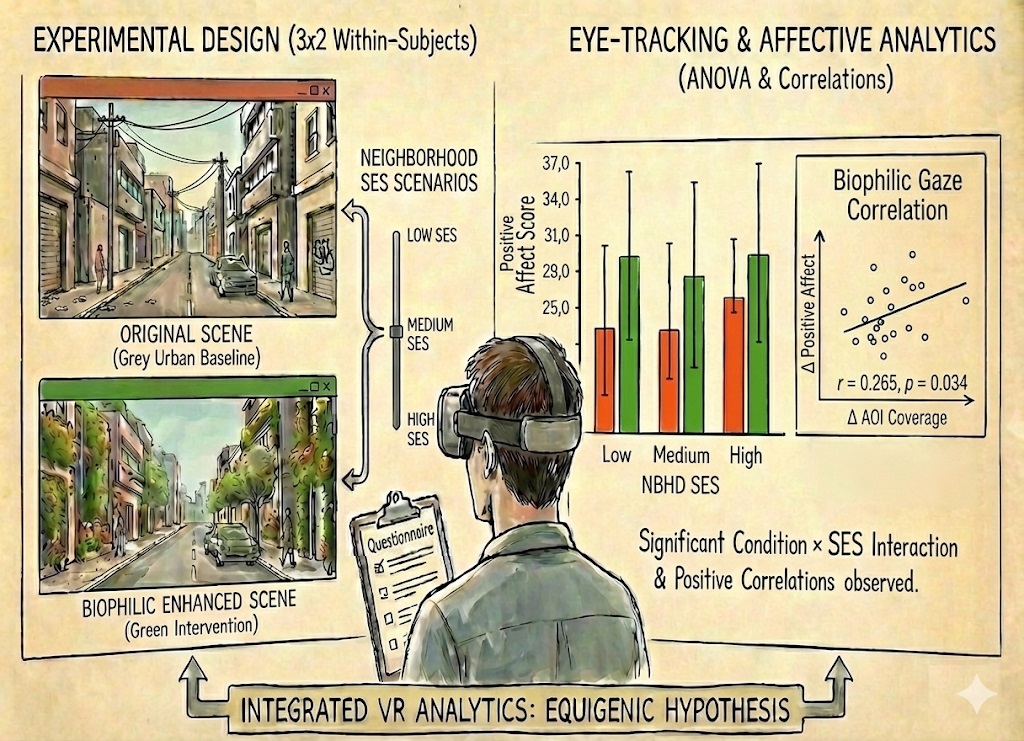
This study investigates the psychological and attentional impact of biophilic urban interventions using an immersive virtual reality (VR) framework integrated with real-time eye-tracking. Specifically, it examines whether bio-aesthetic enhancements can mitigate perceptual inequalities across neighborhoods of varying socioeconomic status (SES). Sixteen participants viewed original and digitally enhanced fixed-viewpoint 360° videos of Low-, Medium-, and High-SES environments while a comprehensive suite of oculomotor dynamics and psychometric responses were recorded. Results confirmed a significant Condition × SES interaction across both subjective preference (Liking) and aesthetic evaluation, identifying biophilic design as a "socio-perceptual equalizer": while baseline ratings consistently favored High-SES areas, interventions in Low-SES contexts yielded the highest marginal gains, effectively bridging the gap with privileged environments. Eye-tracking metrics revealed that this convergence is mechanistically driven by active visual engagement ("Nature Gaze"), with enhanced Low-SES scenes eliciting the highest fixation counts and visual coverage. However, a critical dissociation emerged between immediate affective improvement and objective stress reduction. Elevated saccadic velocities observed in high-contrast Low-SES interventions suggest a state of "hard fascination" or novelty-induced arousal. This implies that while biophilia boosts positive affect rapidly, physiological restoration is a dose-dependent process, requiring sufficient exposure duration to transition from curiosity-driven scanning to the "soft fascination" necessary for stress recovery. These findings validate integrated XR analytics as a high-fidelity tool for evidence-based urban design and support the equigenic hypothesis.
Keywords:
virtual reality (VR)
; eye-tracking
; visual attention
; biophilic design
; attention restoration theory
; urban well-being
; socioeconomic status
; environmental psychology
Copyright: This open access article is published under a Creative Commons CC BY 4.0 license, which permit the free download, distribution, and reuse, provided that the author and preprint are cited in any reuse.


