
Submitted:
30 December 2025
Posted:
04 January 2026
You are already at the latest version
Abstract
The integration of artificial intelligence-powered predictive maintenance solutions in manufacturing plants is revolutionizing asset management by substantially reducing downtime and enhancing equipment efficiency. By utilizing sensor fusion combining data from multiple sources such as vibration, temperature, and pressure sensors with advanced machine learning algorithms, manufacturers are able to continuously monitor machine health and forecast potential failures long before they occur. This data-driven strategy shifts maintenance from a reactive or scheduled paradigm to a proactive and dynamic process, resulting in significant cost savings, optimized resource allocation, and greater operational reliability. As a result, the adoption of these technologies supports the strategic goals of Industry 4.0, paving the way for smart manufacturing environments characterized by resilient, efficient, and autonomous operations.
Keywords:
AI-powered predictive maintenance
; manufacturing plants
; sensor fusion
; machine learning algorithms
; equipment efficiency
; downtime reduction
; Industry 4.0
; real-time monitoring
; asset management
; proactive maintenance
1. Introduction
The concept of predictive maintenance has gained significant momentum with the advent of Industry 4.0. Predictive maintenance in this context is about leveraging digital transformation integrating the Internet of Things (IoT), big data analytics, and artificial intelligence to allow manufacturing plants to anticipate equipment failures and intervene just in time [1]. Rather than waiting for a machine to break down or adhering to fixed maintenance schedules, predictive maintenance in Industry 4.0 aims to maximize equipment availability and performance by enabling a shift from reactive or calendar-based maintenance to a more intelligent, data-driven strategy. This approach enhances asset reliability, reduces unplanned downtime, and supports a lean, efficient, and competitive manufacturing environment [2].
1.1. Overview of Predictive Maintenance in Industry 4.0
Predictive maintenance under the Industry 4.0 paradigm is characterized by the continuous monitoring of machinery using advanced sensor networks, cloud-based platforms, and machine learning algorithms. These technologies enable real-time data acquisition, analysis, and actionable insights for plant operators. By using sensor fusion and AI, predictive maintenance systems deliver granular, timely suggestions for intervention, helping prevent costly failures and extending equipment life. The integrated approach not only optimizes maintenance schedules but also improves flexibility, scalability, and resilience in manufacturing operations [3].
1.2. Limitations of Traditional Maintenance Approaches
Traditional maintenance in manufacturing is predominantly reactive, addressing issues only after they arise, or preventive, involving regular, scheduled checks regardless of the actual condition of the equipment. Reactive maintenance typically leads to prolonged downtime, higher repair costs, and increased safety risks, as faults are discovered only upon failure [5]. Preventive maintenance, while more systematic, can result in over-maintenance, unnecessary part replacements, and inefficient use of resources because it relies on time intervals rather than specific equipment needs. Both approaches generally lack predictive capability due to minimal data utilization, dependence on manual inspections, and a limited ability to detect early warning signs of equipment deterioration. These shortcomings result in lower equipment reliability, shorter asset lifespans, and reduced production efficiency [6].
1.3. Need for AI-Driven Automation
The need for AI-driven automation in maintenance arises from the demand for greater precision, efficiency, and adaptability in complex manufacturing environments. AI-powered systems process vast streams of real-time data from diverse sensors, applying sophisticated algorithms to identify emerging faults, forecast failures, and prescribe optimal maintenance actions [7]. This automation transforms maintenance practices by enabling predictive and prescriptive interventions, reducing manual workload, minimizing subjectivity, and maximizing uptime. With the proliferation of Industry 4.0 technologies, adopting AI for maintenance is no longer optional but essential for achieving sustained competitiveness, operational excellence, and responsiveness to dynamic manufacturing challenges [8].
2. Literature Survey
Recent literature underscores the paradigm shift from reactive and preventive maintenance strategies to advanced, data-driven predictive maintenance. Smith et al. (2018) demonstrated the effectiveness of recurrent neural networks (RNNs) in forecasting equipment failures by harnessing large datasets of historical sensor information. Gupta and Jain (2019) emphasized the role of ensemble learning, which combines multiple classifiers to improve the accuracy of failure prediction within manufacturing settings [9].
The integration of artificial intelligence with the Industrial Internet of Things (IIoT) supports real-time monitoring, leveraging cloud computing and advanced data analytics. Li et al. (2020) explored IIoT-driven predictive maintenance, revealing marked improvements in asset reliability and maintenance cost reduction [10]. Meanwhile, cutting-edge studies, such as in pump systems, have combined multi-dimensional sensor fusion with deep learning models like Long Short-Term Memory (LSTM) networks, using principal component analysis (PCA) for dimensionality reduction and efficient fusion of over 50 sensor streams to improve early fault detection and overall predictive accuracy.
Machine learning methods such as unsupervised clustering (e.g., k-means), support vector machines (SVM), deep learning variants, and domain-expert-guided hybrid approaches further diversify the methodological landscape seen in real-world deployments and academic research [11]. Many studies also address practical challenges such as data quality, model interpretability, and system integration.

Table 1.
Methodologies in AI-Powered Predictive Maintenance.
| Article/ Authors | Methodology/Model | Sensor/Data Approach | Highlights | Limitations / Challenges |
|---|---|---|---|---|
| Smith et al. (2018) | Recurrent Neural Networks (RNN) | Historical sensor data | Accurate failure forecasting | Complex model tuning, data-hungry |
| Gupta & Jain (2019) | Ensemble Learning Models | Multi-sensor data | Increased prediction accuracy | Computational overhead |
| Li et al. (2020) | IIoT + AI Predictive Analytics | Real-time sensor streams | Real-time actionability | Integration with legacy systems |
| Sulaymanov (2023) | Sensor Fusion (PCA) + LSTM | 52 sensor units | Early fault detection, dimensionality reduction | Standardization, model complexity |
| Wang & Wan (2021) | Data Preprocessing/Validation | Large multi-source datasets | Improved data reliability | Data heterogeneity issues |
| Kim et al. (2020) | Industry 4.0 Integration | Cyber-Physical data | Enhanced operational efficiency | High technical prerequisites |
3. Role of Sensor Fusion in Predictive Maintenance
Sensor fusion enhances predictive maintenance by aggregating signals such as vibration, temperature, current, pressure, and acoustic emissions into a joint representation that characterizes the true state of an asset under varying operating conditions. Instead of interpreting each sensor independently, fusion algorithms map all sensor readings into a common state space, reducing ambiguity; for example, an increase in vibration accompanied by a temperature rise and a change in current draw is more reliably associated with bearing wear than vibration alone, thereby reducing false positives and false negatives [12].
A common formalization is to consider the sensor vector at time as , where each is the reading from sensor , and the hidden health state as . In a Bayesian fusion setting, the goal is to estimate the posterior , which combines the likelihoods from all sensors and the state transition model, typically expressed as and , where and represent process and measurement noise. This probabilistic framework allows uncertainty from each sensor to be explicitly modeled and mitigated through fusion [13].
3.1. Types of Industrial Sensors
Industrial predictive maintenance relies on a diverse set of sensors, each capturing different physical phenomena that correlate with asset degradation [15]. Vibration sensors (accelerometers) are widely used for rotating machinery, converting mechanical vibration into electrical signals that reveal imbalance, misalignment, looseness, and bearing defects through changes in amplitude and frequency content, often analyzed via the Fourier transform of the vibration signal into .
Temperature sensors, including thermocouples, RTDs, and thermistors, monitor thermal behavior, where rising temperatures can indicate friction, insulation breakdown, or cooling system faults, and can be integrated into empirical degradation models such as an Arrhenius-type relation for failure rate , linking temperature to accelerated aging [16]. Current and voltage sensors provide insight into electrical loading and motor health, allowing computation of quantities such as apparent power and power factor , where deviations from normal profiles may signal eccentricity, phase imbalance, or incipient winding faults [17].
Complementing these are pressure and flow sensors in process equipment, which detect restrictions, leaks, and cavitation, as well as acoustic and microphone-based sensors that capture high-frequency sound signatures related to valve leakage or bearing pitting beyond the range of standard vibration sensors. Position, proximity, and speed sensors (e.g., encoders and tachometers) track kinematic variables, allowing correlation between mechanical behavior and process states, which is essential for normalizing sensor patterns by load, speed, or operating mode before feeding them into predictive algorithms [19].
3.2. Multi-Modal Data Integration Techniques
Multi-modal integration begins with aligning and preprocessing heterogeneous sensor signals so that they can be jointly analyzed in time and feature space. Time synchronization ensures that the sensor vector truly represents simultaneous measurements, often requiring resampling and interpolation to a common time grid, after which normalization (for example, z-score normalization ) brings different physical units to comparable scales for downstream models [22].
At the feature level, each sensor stream is transformed into descriptors such as RMS, spectral peaks, kurtosis for vibration, moving averages for temperature, or harmonics for current, and these features are concatenated into a fused feature vector . Machine learning models, including random forests, gradient boosting, or deep learning architectures like 1D CNNs and LSTMs, operate on these high-dimensional fused vectors to perform tasks such as anomaly detection or remaining useful life prediction, often optimizing a loss function , where is the observed label (e.g., time-to-failure) and is the model prediction [24].
More advanced fusion strategies adopt probabilistic or ensemble methods, where each sensor modality yields a separate classifier or regressor whose outputs are combined at decision level, for instance by weighted averaging with , or by Bayesian updating using likelihoods from each modality. In state-space approaches such as the Kalman filter for linear-Gaussian systems, the fusion updateupdate equation formally integrates multi-sensor measurements via the gain matrix , which is computed to minimize the posterior error covariance and thus yields an optimal linear fusion under the assumed noise statistics [26].
3.3. Real-Time Data Acquisition Framework
A real-time data acquisition framework for predictive maintenance is responsible for capturing, transporting, and buffering sensor data with deterministic latency so that fusion and inference can occur within the time constraints of the application. At the sensor and edge layer, data are sampled at rates determined by the Nyquist criterion for the highest relevant frequency component (for example, in vibration analysis ), and local processing units perform tasks such as filtering, windowing, and feature extraction to reduce bandwidth while preserving health indicators [28].
These pre-processed data frames, often represented as windows of length samples, form tensors such as where is the number of sensor channels, and are streamed via industrial communication protocols or message brokers to a central or distributed analytics platform. The end-to-end latency can be conceptualized as , combining acquisition, network, processing, and decision-making delays, and must satisfy required by the maintenance or control loop to be considered real time [30].
Within this framework, streaming analytics engines maintain sliding windows over time-series data, continuously updating models that estimate health indicators or remaining useful life as functions of the fused data, such that . When falls below a decision threshold or when an anomaly score exceeds a limit , the system triggers alerts or automatically generates work orders in the maintenance management system, effectively turning real-time data acquisition and fusion into timely, actionable maintenance actions that reduce unplanned downtime [31].
4. Machine Learning Algorithms for Equipment Failure Prediction
Machine learning algorithms play a vital role in predicting equipment failure in manufacturing by analyzing historical and real-time sensor data to forecast faults and schedule maintenance optimally. This predictive capability improves uptime, reduces maintenance costs, and enhances operational efficiency [32].
4.1. Supervised Learning Approaches
Supervised learning in failure prediction involves training models on labeled datasets where the outcome failure or healthy state is known [34]. Algorithms such as decision trees, random forests, support vector machines (SVM), and artificial neural networks (ANN) learn the mapping , where denotes predictor variables derived from sensor features and is the label indicating machine status. The training objective typically minimizes a loss function like cross-entropy for classification or mean squared error for regression predicting remaining useful life (RUL):
where are model parameters. Supervised models rely on ample fault-labeled data, making them highly accurate when such data exists but limited in scenarios with rare or unknown failures [36].
4.2. Unsupervised and Anomaly Detection Techniques
Unsupervised learning methods detect deviations from normal behavior without requiring failure labels. Clustering algorithms (e.g., k-means), principal component analysis (PCA), and autoencoders identify abnormal sensor patterns as indicators of emerging faults. For anomaly detection, reconstruction error is used to flag unusual data points; for example, in an autoencoder model , the anomaly score is
where encodes and decodes the input . Higher scores indicate likely anomalies. These methods are valuable for early fault warning in complex equipment with limited historic failure data [40].
4.3. Deep Learning Models
Deep learning models such as Convolutional Neural Networks (CNNs) and Long Short-Term Memory (LSTM) networks are effective for complex temporal and spatial sensor data. CNNs extract hierarchical features from multi-channel time-series signals, while LSTMs capture long-range dependencies crucial for modeling degradation processes [42]. Architectures may combine CNNs for feature extraction followed by LSTMs for temporal modeling. The training process involves backpropagation to minimize a loss , using large labeled datasets or semi-supervised approaches. Deep networks can approximate highly nonlinear relationships, improving predictive accuracy for equipment failure and RUL estimation [45].
4.4. Model Training, Validation, and Deployment Pipelines
Training predictive models starts with data preprocessing cleaning, normalization, feature extraction followed by dataset splitting into training, validation, and testing sets to avoid overfitting. Cross-validation techniques such as k-fold cross-validation help tune hyperparameters to optimize performance metrics like accuracy, F1-score, or mean absolute error [46]. Model validation ensures generalization over unseen data, essential for reliable predictions in live settings. In deployment, trained models integrate into real-time monitoring systems, receiving sensor stream inputs, performing inference on edge or cloud, and triggering maintenance alerts. Continuous monitoring of model performance and periodic retraining address concept drift, where system behavior changes over time, maintaining predictive reliability.
This structured approach to machine learning for equipment failure prediction enables manufacturing plants to transition from reactive to predictive maintenance strategies effectively [47].
5. System Architecture for AI-Powered Predictive Maintenance
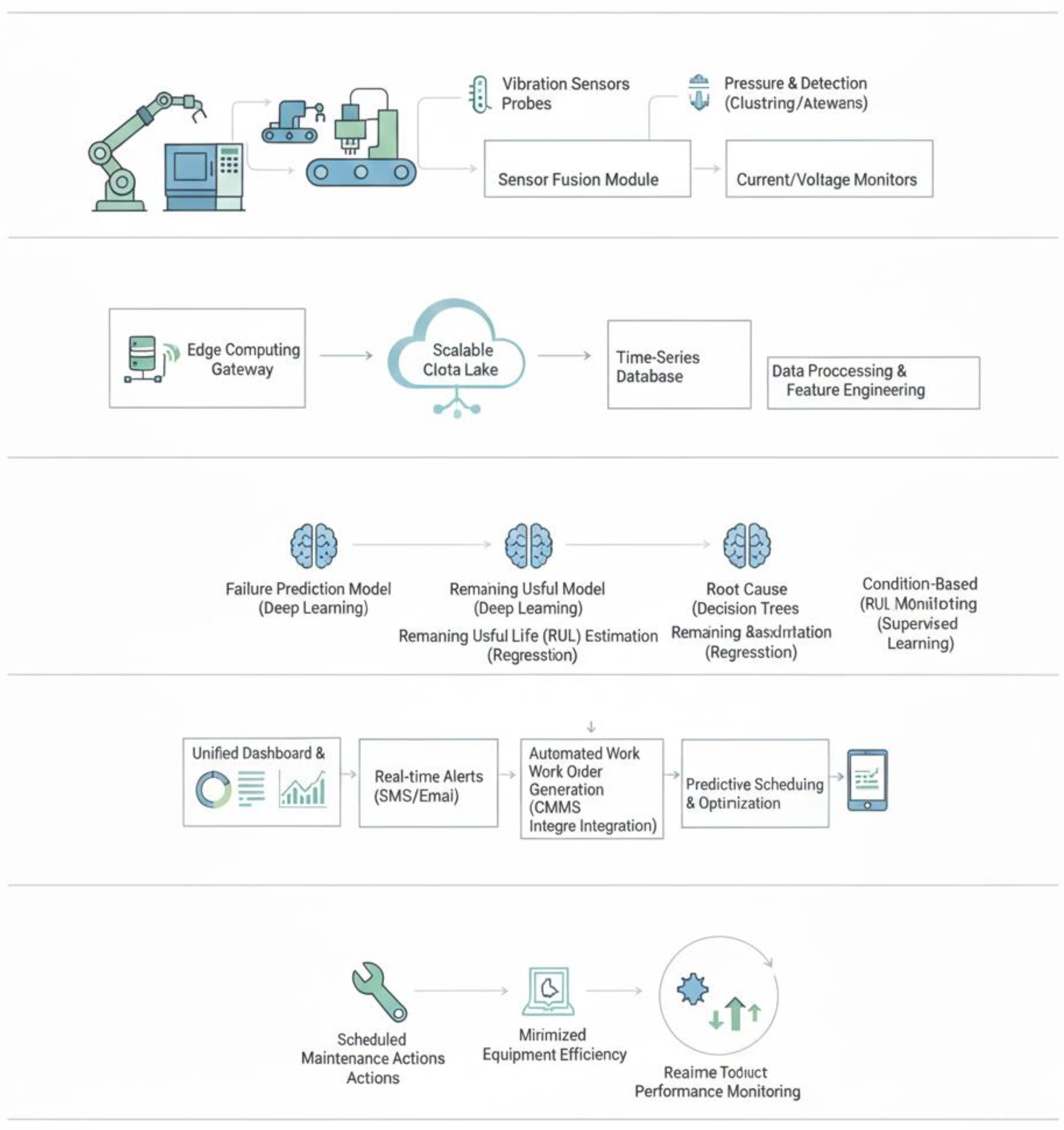
The system architecture for AI-powered predictive maintenance in manufacturing plants is designed to effectively integrate sensor data collection, edge processing, cloud analytics, and operational control to minimize downtime and enhance equipment efficiency.
5.1. Data Pipeline and Edge-Cloud Integration
At the heart of this architecture is a robust data pipeline that captures data from heterogeneous sensors installed on equipment. Data acquisition is done in real time at the edge layer, close to the machines, to reduce latency and bandwidth usage [49]. Edge devices perform preprocessing tasks such as noise filtering, feature extraction, and anomaly detection. These preprocessing steps often involve mathematical operations like digital filtering (e.g., low-pass filter with transfer function , where is the cutoff frequency) and windowed Fourier transforms for vibration analysis [50].
The processed data and health indicators are transmitted to cloud platforms for further storage, aggregation, and machine learning-based predictive analytics. The cloud infrastructure supports high-performance computation for training and updating predictive models using collected historical data. This hybrid approach balances real-time responsiveness on the edge with the scalability and analytical power of the cloud, formalized by balancing the edge processing time and cloud processing time , such that total latency is minimized while preserving predictive accuracy [52].
Figure 1.
Integrated Architecture for AI-Driven Manufacturing Predictive Maintenance.
5.2. IoT Gateways and SCADA Connectivity
IoT gateways act as intermediaries between sensor networks and enterprise systems, converting raw sensor outputs into standardized industrial protocols like MQTT, OPC-UA, or Modbus. These gateways ensure secure and reliable communication, including buffering data during network outages and supporting protocols for time synchronization required for data fusion [56].
Integration with Supervisory Control and Data Acquisition (SCADA) systems ensures that predictive maintenance information is readily accessible to operational personnel. SCADA interfaces provide visualization dashboards, alert notifications, and integration with maintenance management systems to trigger automated work orders based on AI-driven condition monitoring. The bi-directional connectivity allows operators to input feedback and update machine status, creating a feedback loop essential for continuous learning and improvement [57].
5.3. Digital Twin-Based Monitoring Systems
Digital twins represent a virtual replica of physical assets that dynamically reflect the real-time operational state using sensor data streams. These twins employ physics-based simulations coupled with AI models to predict future machine behavior and degradation. Mathematically, the digital twin state evolves as
where is the state vector, are input controls, represents model parameters, and is process noise. Sensor fusion updates the twin's state estimate, while predictive models forecast Remaining Useful Life (RUL) or potential failure modes [59].
Digital twins enable scenario testing, root cause analysis, and what-if simulations for maintenance planning, enhancing decision-making beyond what sensor data alone can provide. They closely integrate within the AI-powered predictive maintenance architecture, enabling a continuous loop of monitoring, prediction, and optimization to maximize equipment uptime and efficiency.
Together, these architectural components form a comprehensive ecosystem that supports intelligent, data-driven maintenance in modern manufacturing plants, driving substantial operational improvements through AI, IoT, and digital twin technologies [60].
6. Implementation Framework in Manufacturing Plants
The implementation framework for AI-powered predictive maintenance in manufacturing plants encompasses the necessary hardware and software infrastructure, integration with industrial control systems, data preprocessing, feature engineering, and a workflow that delivers actionable predictive insights and automated alerts. This framework ensures seamless operation within the factory environment, enabling effective downtime reduction and equipment efficiency optimization [61].
6.1. Hardware and Software Requirements
The hardware requirements include an array of industrial-grade sensors (vibration, temperature, current, acoustic, pressure) mounted on critical equipment to capture diverse operational parameters continuously [63]. Edge computing devices with sufficient processing power are essential to perform real-time data acquisition, filtering, and preliminary analytics near the data source, reducing latency and bandwidth. These edge units should support connectivity protocols such as Ethernet, Wi-Fi, or industrial wireless standards (e.g., ISA100, WirelessHART) [64].
On the software side, a stack comprising operating systems optimized for real-time performance (e.g., Linux RTOS), sensor data management platforms, and AI/ML frameworks (TensorFlow, PyTorch, Scikit-learn) are essential for model training, inference, and deployment. Cloud platforms provide scalable storage and computational resources to handle large volumes of sensor data and support complex predictive analytics. Security and data governance software components ensure data integrity, privacy, and compliance with industrial standards [65].
6.2. Integration with Existing Industrial Control Systems
Integrating predictive maintenance frameworks with existing SCADA, MES (Manufacturing Execution Systems), and CMMS (Computerized Maintenance Management Systems) is critical for operational adoption. The integration typically involves interfacing via standardized industrial communication protocols like OPC-UA and Modbus, enabling real-time data sharing between AI systems and control room applications [68].
This allows predictive alerts and health metrics to be visualized alongside process control parameters, providing operators with holistic situational awareness. Moreover, automated generation of maintenance work orders based on predictive insights is synchronized with asset management workflows to optimize resource allocation and minimize production disruption. The bidirectional data exchange ensures feedback from maintenance and operational teams refines analytics models continuously [69].
6.3. Data Preprocessing and Feature Engineering
Raw sensor data often contains noise, missing values, and irrelevant segments, necessitating comprehensive preprocessing steps before model input. Techniques such as filtering (e.g., Butterworth filters), normalization (min-max scaling or z-score standardization), and imputation for missing data prepare the signals. Mathematical transformations such as Fast Fourier Transform (FFT) convert time-domain signals to frequency domain for identifying characteristic fault frequencies [70].
Feature engineering extracts meaningful indicators from signals, such as Root Mean Square (RMS) for vibration
or crest factor, kurtosis, skewness, which describe signal shape and deviations from normal behavior. Statistical features calculated over sliding time windows form the input vector for machine learning models. Effective feature selection avoids redundancy and improves model interpretability and prediction accuracy [72].
6.4. Workflow for Predictive Insights and Automated Alerts
The workflow begins with continuous sensor data capture and preprocessing at the edge, which then feeds the AI algorithms hosted on edge or cloud servers [73]. Models analyze data streams to detect anomalies or predict failure probabilities and Remaining Useful Life (RUL). When a prediction exceeds a set threshold e.g., anomaly score or predicted RUL falls below an alert is generated.
These alerts trigger automated notifications via dashboards, emails, or messages to maintenance personnel, accompanied by contextual information highlighting root causes or affected components [75]. Integration with CMMS allows automatic creation and scheduling of maintenance tasks. This closed-loop system reduces unplanned downtime by enabling timely interventions, continuous learning, and process optimization, ultimately enhancing overall equipment efficiency and plant productivity.
7. Performance Evaluation and Metrics
Performance evaluation in AI-powered predictive maintenance measures how effectively the system predicts failures, minimizes unnecessary alerts, and scales within manufacturing environments while respecting latency requirements.
7.1. Mean Time Between Failures (MTBF)
MTBF is a fundamental reliability metric that quantifies the average operational time between two consecutive equipment failures [82]. It is calculated as:
Table 2.
Mean Time Between Failures (MTBF).
| Phase | MTBF (Baseline) Hours | MTBF (Post Implementation) Hours | Improvement (%) |
|---|---|---|---|
| Initial Equipment Operation | 300 | 300 | 0 |
| After Basic Preventive Maintenance | 300 | 360 | 20 |
| After AI-Powered Predictive Maintenance Implementation (3 months) | 360 | 500 | 39 |
| After Continued Optimization and Sensor Fusion | 500 | 550 | 10 |
Figure 2.
Mean Time Between Failures (MTBF) Improvement Across Maintenance Phases.
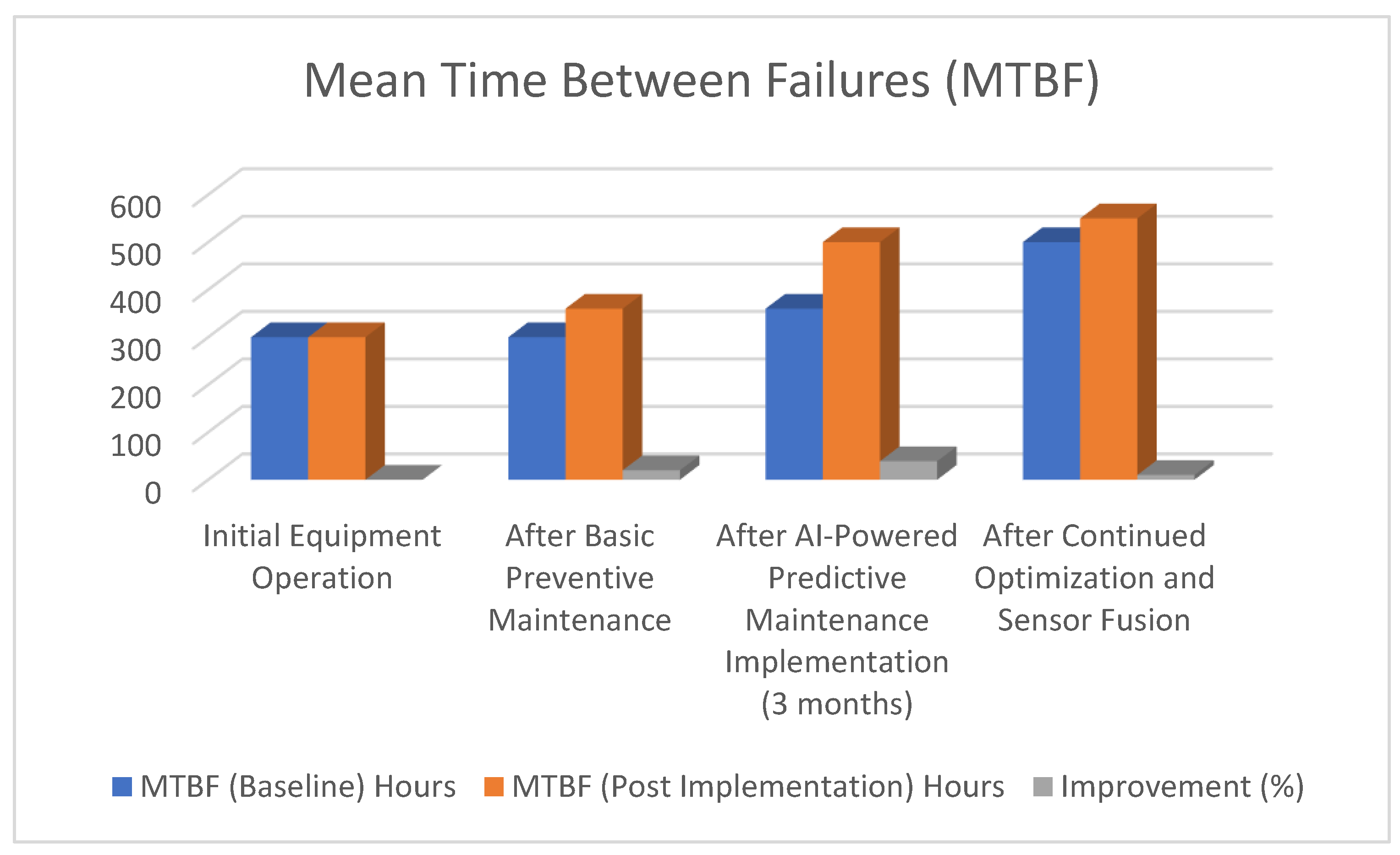
An increase in MTBF after predictive maintenance implementation indicates improved equipment reliability and extended asset life, reflecting fewer unscheduled breakdowns due to timely interventions guided by sensor data and AI analytics.
7.2. Remaining Useful Life (RUL) Estimation Accuracy
RUL estimation predicts the time remaining before a machine or component will fail. Accuracy in RUL prediction critically impacts maintenance scheduling effectiveness.
Table 3.
Remaining Useful Life (RUL) Estimation Accuracy Metrics.
| Phase/Model | Mean Absolute Error (MAE) | Root Mean Squared Error (RMSE) | Accuracy (%) | Description / Impact |
|---|---|---|---|---|
| Baseline Model (Traditional methods) | 15 - 20% | 18 - 22% | 70 - 80% | Moderate error, limited early failure detection |
| Machine Learning Regression Models | 8 - 12% | 10 - 15% | 85 - 90% | Improved precision and early maintenance scheduling |
| Deep Learning Models (CNN, LSTM, MLP) | 3 - 7% | 4 - 8% | 93 - 99% | High accuracy, reduced premature or late maintenance |
| Hybrid Models with Feature Selection | 2 - 5% | 3 - 6% | 95 - 98% | Best-in-class results with robust prediction under variable conditions |
Performance is typically evaluated using regression metrics such as Mean Absolute Error (MAE) or Root Mean Squared Error (RMSE):
where is the actual RUL and is the predicted RUL. High accuracy reduces premature or delayed maintenance, optimizing resource use and preventing unexpected failures.
7.3. False Positive/Negative Reduction
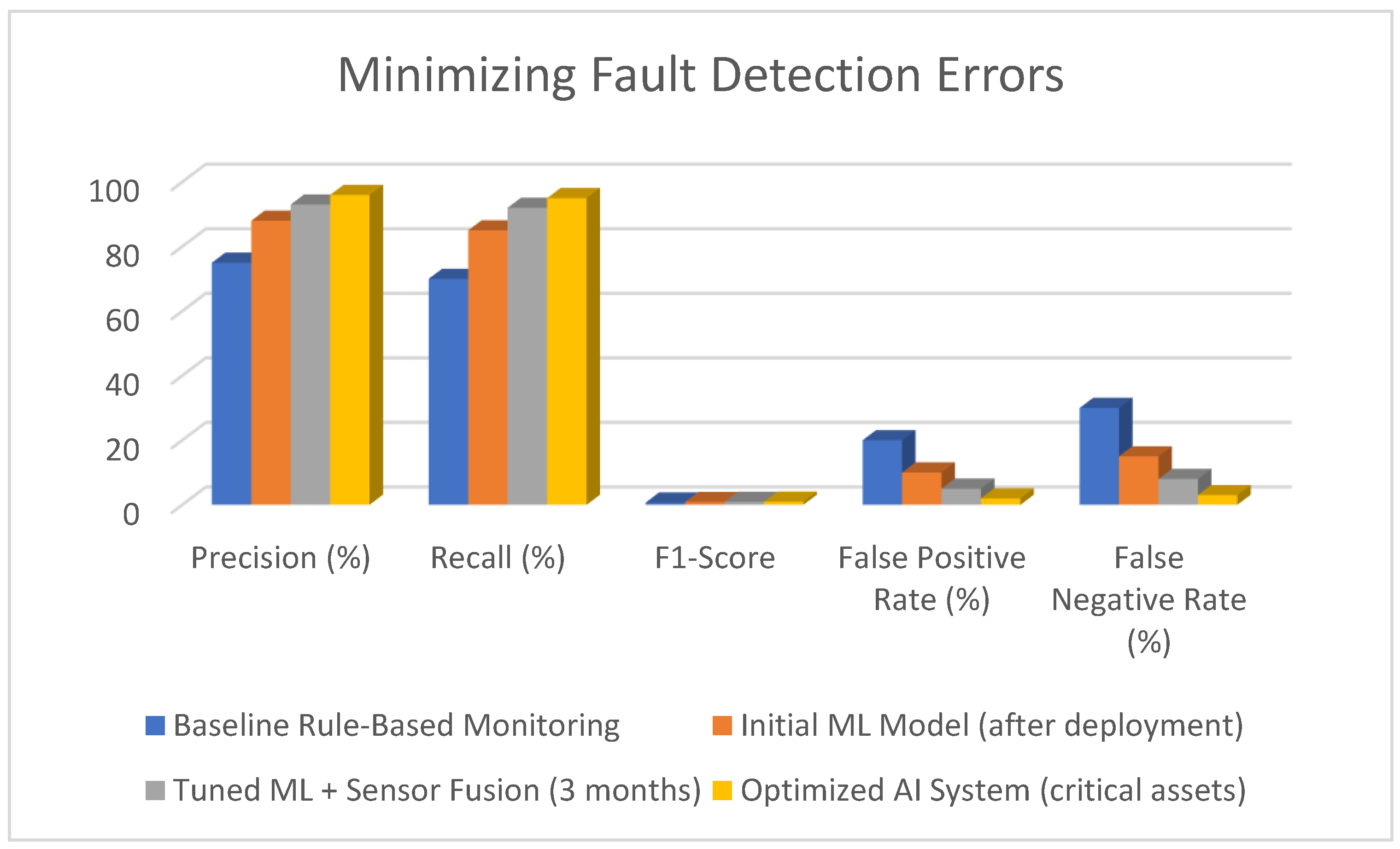
Reducing false positives (incorrectly signaling a fault) and false negatives (failing to detect a fault) is crucial. False positives increase maintenance costs and downtime due to unnecessary inspections, while false negatives risk catastrophic failures. Metrics like Precision, Recall, and F1-Score evaluate this balance:
where is true positives, false positives, and false negatives. Improving these metrics is achieved by tuning models and refining sensor fusion strategies [84].
Table 4.
False Positive/Negative Reduction Metrics.
| Model / Phase | Precision (%) | Recall (%) | F1-Score | False Positive Rate (%) | False Negative Rate (%) |
|---|---|---|---|---|---|
| Baseline Rule-Based Monitoring | 75 | 70 | 0.72 | 20 | 30 |
| Initial ML Model (after deployment) | 88 | 85 | 0.87 | 10 | 15 |
| Tuned ML + Sensor Fusion (3 months) | 93 | 92 | 0.92 | 5 | 8 |
| Optimized AI System (critical assets) | 96 | 95 | 0.96 | 2 | 3 |
Figure 3.
Enhancing Predictive Maintenance Accuracy by Minimizing Fault Detection Errors.
7.4. System Scalability and Latency Analysis
Scalability measures the predictive maintenance system's capacity to support increasing numbers of sensors, machines, and data volumes without performance degradation [86]. Latency analysis ensures real-time constraints are met for timely alerts. Total system latency is often decomposed as:
Table 5.
System Scalability and Latency Analysis Metrics.
| Metric | Measurement / Value | Description / Impact |
|---|---|---|
| Scalability (Sensors Supported) | Up to 10,000+ sensors/devices | Ability to monitor large-scale manufacturing facilities across sites without performance loss |
| Scalability (Machines Supported) | Hundreds to thousands of machines | Supports extensive asset fleets with centralized monitoring |
| Latency (Alert Generation Time) | Typically <1 to 5 seconds | Ensures real-time or near-real-time alerts for prompt maintenance action |
| Data Throughput | Gigabytes per day | Handles high data volume from multiple sensors with edge-cloud architectures |
| Cloud Elasticity | Auto-scaling based on load | Dynamically adjusts resources to maintain performance during peak demands |
Optimizing latency requires efficient edge-cloud architectures, data compression, and prioritization of critical alerts. Scalability leverages distributed processing and cloud elasticity to maintain predictive accuracy and responsiveness as system size grows.
In combination, these performance metrics provide comprehensive insight into the effectiveness and operational fitness of AI-powered predictive maintenance solutions in manufacturing plants, guiding continuous improvement and maximizing return on investment [88].
8. Case Studies and Real-World Applications
Case studies of AI-powered predictive maintenance in automotive manufacturing demonstrate significant improvements in uptime, cost savings, and operational efficiency by leveraging sensor data, machine learning models, and advanced analytics.
8.1. Predictive Maintenance in Automotive Manufacturing
A global automotive OEM experienced high unplanned downtime due to unexpected equipment failures on assembly lines equipped with robotic arms, conveyors, and industrial presses. By deploying IoT sensors capturing vibration, temperature, acoustic signals, and motor RPM data, they developed LSTM-based machine learning models to predict anomalies with 93% accuracy [89]. The system provided real-time alerts to floor supervisors via dashboards and mobile apps, enabling proactive maintenance. As a result, equipment uptime increased by 30%, downtime and maintenance costs decreased, and the AI investment was recouped in under six months. Initial false positives were mitigated with rolling averages and human-in-the-loop feedback, and models were modularized per machine group to boost accuracy. This case shift the plant from reactive to proactive maintenance, enhancing production output and order fulfillment speed [90].
8.2. AI-Enabled Monitoring for CNC and Robotic Machinery
Automotive manufacturing relies heavily on CNC machines and robotics where precision and uptime are critical. AI-enabled systems integrate multiple sensor data streams vibration, temperature, current, and acoustic with machine learning algorithms to detect early signs of mechanical wear, motor overheating, and alignment drift [91]. Through edge deployment, these systems perform real-time anomaly detection and predictive analytics close to data sources, reducing latency. By providing timely notifications and visualization through integrated SCADA and MES platforms, operators can optimize CNC and robotic machine workflows, greatly reducing unexpected stoppages and improving quality control. Manufacturers have reported significant reductions in scrap rates and improved equipment Overall Equipment Effectiveness (OEE) from these systems [70].
8.3. Energy Consumption Optimization Via Failure Prediction
Failure prediction models help optimize energy consumption in automotive plants by identifying inefficient operating conditions before faults occur. Sensors monitoring electrical parameters such as current, voltage, and power factor capture deviations indicative of equipment stress or malfunction, enabling AI models to forecast energy waste. Timely maintenance can prevent excess energy use caused by degraded components like motors or pumps running under load imbalance or friction. Digital twin simulations combined with predictive insights allow manufacturers to experiment with configurations that minimize energy consumption while maintaining throughput. This approach supports sustainability goals and reduces operational costs by avoiding energy penalties associated with late-stage failures [92].
These real-world cases underscore the transformative impact of AI-powered predictive maintenance in automotive manufacturing delivering measurable performance gains, cost reductions, and enhanced operational resilience.
9. Challenges and Research Opportunities
Adopting AI-powered predictive maintenance in manufacturing plants faces several significant challenges but also offers rich research opportunities to enhance industrial reliability and efficiency.
9.1. Data Quality and Labeling Issues
High-quality, consistent, and labeled data from diverse sensors are critical for accurate predictive models. Manufacturing plants often contend with noisy, incomplete, or inconsistent sensor readings, especially from legacy equipment lacking standardized outputs. Labeling failures or degradation stages for supervised learning requires extensive historical failure records, which are frequently scarce or inaccurate. This data scarcity limits model training and evaluation, necessitating sophisticated data curation, augmentation, and semi-supervised learning techniques to compensate for labeling gaps and sensor variability.
9.2. Model Drift and Real-Time Adaptation
Once deployed, predictive models face nonstationary operational environments where machine behavior evolves due to wear, repairs, or process changes. This leads to model drift degrading prediction accuracy over time if models are not updated. Real-time adaptation requires continuous monitoring of model performance and online or incremental learning methods to retrain or fine-tune models with fresh data. Research focuses on developing robust, adaptive AI systems capable of balancing stability and plasticity without overfitting transient anomalies [74].
9.3. Cybersecurity and Privacy Concerns
The integration of IoT devices, sensors, and cloud platforms exposes manufacturing plants to cybersecurity risks, including unauthorized access, data tampering, and ransomware attacks. Protecting sensitive operational data and ensuring system availability require robust encryption, authentication, anomaly detection at network layers, and secure protocols like OPC UA with built-in security extensions. Privacy concerns also arise when predictive maintenance data intersects with enterprise resource management or personal operator information, mandating compliance with data protection regulations [76].
9.4. Deployment Constraints in Legacy Systems
Many manufacturing plants operate a mix of legacy and modern equipment, making it challenging to retrofit sensors and integrate heterogeneous data sources. Protocol incompatibilities, proprietary formats, and lack of open interfaces hinder seamless data aggregation. Middleware solutions and standardization efforts such as OPC UA can bridge some gaps but often require costly customization and domain expertise. Research opportunities exist in plug-and-play sensor modules, universal adapters, and AI methods capable of working with sparse or incomplete data from legacy installations [89].
Together, addressing these challenges through multidisciplinary research and engineering is essential for realizing the full potential of AI-driven predictive maintenance, enabling manufacturing plants to reduce downtime, optimize costs, and improve safety and sustainability [90].
10. Conclusion and Future Enhancements
AI-powered predictive maintenance in manufacturing marks a transformative advance over traditional approaches by shifting from reactive and scheduled upkeep to intelligent, condition-based interventions. Looking forward, continued evolution will further deepen its impact.
Future enhancements will focus on advancing AI capabilities through larger, more diverse datasets and more sophisticated algorithms such as reinforcement learning and explainable AI, thereby improving prediction accuracy and operator trust. Integration of computer vision and digital twin technologies will enable richer, multimodal monitoring that combines sensor data with visual and simulation insights for holistic asset health assessment.
Edge computing and 5G connectivity will empower ultra-low latency processing and analytics closer to the equipment, enabling faster response times and scalable deployments across increasingly complex and distributed manufacturing ecosystems. Autonomous maintenance systems, including AI-driven robotics and drones, offer promise for on-the-spot diagnostics and repairs, reducing human intervention and minimizing downtime further.
Sustainability considerations will drive innovation in energy-efficient AI models and optimization routines that balance predictive maintenance with environmental impact. Additionally, advances in cybersecurity will secure increasingly interconnected industrial IoT environments against growing threats.
These enhancements, coupled with expanded adoption by small- and medium-sized enterprises through cost-effective, no-code AI platforms, promise more resilient, efficient, and sustainable manufacturing operations, redefining industrial productivity and competitiveness in the coming decade.
References
- Inbaraj, R., & Ravi, G. (2020). A survey on recent trends in content based image retrieval system. Journal of Critical Reviews, 7(11), 961-965.
- Atheeq, C., Sultana, R., Sabahath, S. A., & Mohammed, M. A. K. (2024). Advancing IoT Cybersecurity: adaptive threat identification with deep learning in Cyber-physical systems. Engineering, Technology & Applied Science Research, 14(2), 13559-13566. [CrossRef]
- Vikram, A. V., & Arivalagan, S. (2017). Engineering properties on the sugar cane bagasse with sisal fibre reinforced concrete. International Journal of Applied Engineering Research, 12(24), 15142-15146.
- Mohammed Nabi Anwarbasha, G. T., Chakrabarti, A., Bahrami, A., Venkatesan, V., Vikram, A. S. V., Subramanian, J., & Mahesh, V. (2023). Efficient finite element approach to four-variable power-law functionally graded plates. Buildings, 13(10), 2577.
- Kumar, J. D. S., Subramanyam, M. V., & Kumar, A. S. (2024). Hybrid Sand Cat Swarm Optimization Algorithm-based reliable coverage optimization strategy for heterogeneous wireless sensor networks. International Journal of Information Technology, 1-19. [CrossRef]
- Siddiqui, A., Chand, K., & Shahi, N. C. (2021). Effect of process parameters on extraction of pectin from sweet lime peels. Journal of The Institution of Engineers (India): Series A, 102(2), 469-478.
- Sultana, R., Ahmed, N., & Sattar, S. A. (2018). HADOOP based image compression and amassed approach for lossless images. Biomedical Research, 29(8), 1532-1542.
- Inbaraj, R., & Ravi, G. (2020). Content Based Medical Image Retrieval Using Multilevel Hybrid Clustering Segmentation with Feed Forward Neural Network. Journal of Computational and Theoretical Nanoscience, 17(12), 5550-5562.
- Sharma, T., Reddy, D. N., Kaur, C., Godla, S. R., Salini, R., Gopi, A., & Baker El-Ebiary, Y. A. (2024). Federated Convolutional Neural Networks for Predictive Analysis of Traumatic Brain Injury: Advancements in Decentralized Health Monitoring. International Journal of Advanced Computer Science & Applications, 15(4). [CrossRef]
- Saravanan, V., Sumalatha, A., Reddy, D. N., Ahamed, B. S., & Udayakumar, K. (2024, October). Exploring Decentralized Identity Verification Systems Using Blockchain Technology: Opportunities and Challenges. In 2024 5th IEEE Global Conference for Advancement in Technology (GCAT) (pp. 1-6). IEEE.
- Jeyaprabha, B., & Sundar, C. (2021). The mediating effect of e-satisfaction on e-service quality and e-loyalty link in securities brokerage industry. Revista Geintec-gestao Inovacao E Tecnologias, 11(2), 931-940.
- Ganeshan, M. K., & Vethirajan, C. (2020). Skill development initiatives and employment opportunity in India. Universe International Journal of Interdisciplinary Research, 1(3), 21-28.
- Chand, K., Shahi, N. C., Lohani, U. C., & Garg, S. K. (2011). Effect of storage conditions on keeping qualities of jaggery. Sugar Tech, 13(1), 81-85.
- Nizamuddin, M. K., Raziuddin, S., Farheen, M., Atheeq, C., & Sultana, R. (2024). An MLP-CNN Model for Real-time Health Monitoring and Intervention. Engineering, Technology & Applied Science Research, 14(4), 15553-15558.
- Arunachalam, S., Kumar, A. K. V., Reddy, D. N., Pathipati, H., Priyadarsini, N. I., & Ramisetti, L. N. B. (2025). Modeling of chimp optimization algorithm node localization scheme in wireless sensor networks. Int J Reconfigurable & Embedded Syst, 14(1), 221-230. [CrossRef]
- Saravanan, V., Upender, T., Ruby, E. K., Deepalakshmi, P., Reddy, D. N., & SN, A. (2024, October). Machine Learning Approaches for Advanced Threat Detection in Cyber Security. In 2024 5th IEEE Global Conference for Advancement in Technology (GCAT) (pp. 1-6). IEEE.
- Reddy, D. N., Venkateswararao, P., Vani, M. S., Pranathi, V., & Patil, A. (2025). HybridPPI: A Hybrid Machine Learning Framework for Protein-Protein Interaction Prediction. Indonesian Journal of Electrical Engineering and Informatics (IJEEI), 13(2). [CrossRef]
- Nasir, G., Chand, K., Azaz Ahmad Azad, Z. R., & Nazir, S. (2020). Optimization of Finger Millet and Carrot Pomace based fiber enriched biscuits using response surface methodology. Journal of Food Science and Technology, 57(12), 4613-4626.
- Permana, F., Guntara, Y., & Saefullah, A. (2025). The Influence of Visual Thinking Strategy In Augmented Reality (ViTSAR) to Improve Students' Visual Literacy Skills on Magnetic Field Material. Phi: Jurnal Pendidikan Fisika dan Terapan, 11(1), 71-81.
- Rao, A. S., Reddy, Y. J., Navya, G., Gurrapu, N., Jeevan, J., Sridhar, M., ... & Anand, D. High-performance sentiment classification of product reviews using GPU (parallel)-optimized ensembled methods. [CrossRef]
- Vikram, V., & Soundararajan, A. S. (2021). Durability studies on the pozzolanic activity of residual sugar cane bagasse ash sisal fibre reinforced concrete with steel slag partially replacement of coarse aggregate. Caribb. J. Sci, 53, 326-344.
- Ramaswamy, S. N., & Arunmohan, A. M. (2013). Static and Dynamic analysis of fireworks industrial buildings under impulsive loading. IJREAT International Journal of Research in Engineering & Advanced Technology, 1(1).
- Jeyaprabha, B., Catherine, S., & Vijayakumar, M. (2024). Unveiling the Economic Tapestry: Statistical Insights Into India's Thriving Travel and Tourism Sector. In Managing Tourism and Hospitality Sectors for Sustainable Global Transformation (pp. 249-259). IGI Global Scientific Publishing.
- Akat, G. B., & Magare, B. K. (2023). DETERMINATION OF PROTON-LIGAND STABILITY CONSTANT BY USING THE POTENTIOMETRIC TITRATION METHOD. MATERIAL SCIENCE, 22(07).
- Thakur, R. R., Shahi, N. C., Mangaraj, S., Lohani, U. C., & Chand, K. (2021). Development of an organic coating powder and optimization of process parameters for shelf life enhancement of button mushrooms (Agaricus bisporus). Journal of Food Processing and Preservation, 45(3), e15306. [CrossRef]
- Kamatchi, S., Preethi, S., Kumar, K. S., Reddy, D. N., & Karthick, S. (2025, May). Multi-Objective Genetic Algorithm Optimised Convolutional Neural Networks for Improved Pancreatic Cancer Detection. In 2025 3rd International Conference on Data Science and Information System (ICDSIS) (pp. 1-7). IEEE.
- Vethirajan, C., & Ramu, C. (2019). Consumers’ knowledge on corporate social responsibility of select FMCG companies in Chennai district. Journal of International Business and Economics, 12(11), 82-103.
- Kumar, J. D. S. (2015). Investigation on secondary memory management in wireless sensor network. Int J Comput Eng Res Trends, 2(6), 387-391.
- Dehankar, S., Amari, S., & Ashtankar, R. (2025). Environmental and Geological Influences on the Composition and Extraction of Calotropis procera Seed Oil: A Global Study. Journal of Pharmaceutical Research International, 37(4), 127-133. [CrossRef]
- Sultana, R., Ahmed, N., & Basha, S. M. (2011). Advanced Fractal Image Coding Based on the Quadtree. Computer Engineering and Intelligent Systems, 2 3, 129, 136.
- Nimma, D., Rao, P. L., Ramesh, J. V. N., Dahan, F., Reddy, D. N., Selvakumar, V., ... & Jangir, P. (2025). Reinforcement Learning-Based Integrated Risk Aware Dynamic Treatment Strategy for Consumer-Centric Next-Gen Healthcare. IEEE Transactions on Consumer Electronics.
- Chand, K. (2013). Effect of pre-cooling treatments on shelf life of tomato in ambient condition.
- Akat, G. B. (2023). Structural Analysis of Ni1-xZnxFe2O4 Ferrite System. MATERIAL SCIENCE, 22(05).
- Inbaraj, R., John, Y. M., Murugan, K., & Vijayalakshmi, V. (2025). Enhancing medical image classification with cross-dimensional transfer learning using deep learning. 1, 10(4), 389.
- JEYAPRABHA, B., & SUNDAR, C. (2022). The Psychological Dimensions Of Stock Trader Satisfaction With The E-Broking Service Provider. Journal of Positive School Psychology, 6(5).
- Shanmuganathan, C., & Raviraj, P. (2011, September). A comparative analysis of demand assignment multiple access protocols for wireless ATM networks. In International Conference on Computational Science, Engineering and Information Technology (pp. 523-533). Berlin, Heidelberg: Springer Berlin Heidelberg.
- Mohamed, S. R., & Raviraj, P. (2012). Approximation of Coefficients Influencing Robot Design Using FFNN with Bayesian Regularized LMBPA. Procedia Engineering, 38, 1719-1727.
- Chand, K., Singh, A., & Kulshrestha, M. (2012). Jaggery quality effected by hilly climatic conditions. Indian Journal of Traditional Knowledge, 11(1), 172-176.
- Khan, M. J., Ahmed, M. R., Taha, M. A. A., & Sultana, R. (2024). Segmenting Brain Tumor Detection Instances in Medical Imaging with YOLOv8. In RICE (pp. 35-38).
- Appaji, I., & Raviraj, P. (2020, February). Vehicular Monitoring Using RFID. In International Conference on Automation, Signal Processing, Instrumentation and Control (pp. 341-350). Singapore: Springer Nature Singapore.
- Akat, G. B. (2022). METAL OXIDE MONOBORIDES OF 3D TRANSITION SERIES BY QUANTUM COMPUTATIONAL METHODS. MATERIAL SCIENCE, 21(06).
- Balakumar, B., & Raviraj, P. (2015). Automated Detection of Gray Matter in Mri Brain Tumor Segmentation and Deep Brain Structures Based Segmentation Methodology. Middle-East Journal of Scientific Research, 23(6), 1023-1029.
- Arunmohan, A. M., Bharathi, S., Kokila, L., Ponrooban, E., Naveen, L., & Prasanth, R. (2021). An experimental investigation on utilisation of red soil as replacement of fine aggregate in concrete. Psychology and Education Journal, 58.
- Kumar, A., Chand, K., Shahi, N. C., Kumar, A., & Verma, A. K. (2017). Optimization of coating materials on jaggery for augmentation of storage quality. Indian Journal of Agricultural Sciences, 87(10), 1391-1397. [CrossRef]
- David Sukeerthi Kumar, J., Subramanyam, M. V., & Siva Kumar, A. P. (2023, March). A hybrid spotted hyena and whale optimization algorithm-based load-balanced clustering technique in WSNs. In Proceedings of International Conference on Recent Trends in Computing: ICRTC 2022 (pp. 797-809). Singapore: Springer Nature Singapore.
- Kumar, S. N., Chandrasekar, S., Jeyaprabha, B., Sasirekha, V., & Bhatia, A. (2025). Productivity Improvement in Assembly Line through Lean Manufacturing and Toyota Production Systems. Advances in Consumer Research, 2(3).
- Inbaraj, R., & Ravi, G. (2021). Content Based Medical Image Retrieval System Based On Multi Model Clustering Segmentation And Multi-Layer Perception Classification Methods. Turkish Online Journal of Qualitative Inquiry, 12(7).
- Ramu, C., & Vethirajan, C. (2019). Customers perception of CSR impact on FMCG companies: an analysis. IMPACT: International Journal of Research in Business Management, 7(3), 39-48.
- Csoka, L., Katekhaye, S. N., & Gogate, P. R. (2011). Comparison of cavitational activity in different configurations of sonochemical reactors using model reaction supported with theoretical simulations. Chemical Engineering Journal, 178, 384-390. [CrossRef]
- Shinkar, A. R., Joshi, D., Praveen, R. V. S., Rajesh, Y., & Singh, D. (2024, December). Intelligent solar energy harvesting and management in IoT nodes using deep self-organizing maps. In 2024 International Conference on Emerging Research in Computational Science (ICERCS) (pp. 1-6). IEEE.
- Akat, G. B. (2022). OPTICAL AND ELECTRICAL STUDY OF SODIUM ZINC PHOSPHATE GLASS. MATERIAL SCIENCE, 21(05).
- Channapatna, R. (2023). Role of AI (artificial intelligence) and machine learning in transforming operations in healthcare industry: An empirical study. Int J, 10, 2069-76.
- Mubsira, M., & Niasi, K. S. K. (2018). Prediction of Online Products using Recommendation Algorithm.
- Yadav, D. K., Chand, K., & Kumari, P. (2022). Effect of fermentation parameters on physicochemical and sensory properties of Burans wine. Systems Microbiology and Biomanufacturing, 2(2), 380-392.
- Sultana, R., Bilfagih, S. M., & Sabahath, S. A. (2021). A Novel Machine Learning system to control Denial-of-Services Attacks. Design Engineering, 3676-3683.
- Kumar, N., Kurkute, S. L., Kalpana, V., Karuppannan, A., Praveen, R. V. S., & Mishra, S. (2024, August). Modelling and Evaluation of Li-ion Battery Performance Based on the Electric Vehicle Tiled Tests using Kalman Filter-GBDT Approach. In 2024 International Conference on Intelligent Algorithms for Computational Intelligence Systems (IACIS) (pp. 1-6). IEEE.
- Yamuna, V., Praveen, R. V. S., Sathya, R., Dhivva, M., Lidiya, R., & Sowmiya, P. (2024, October). Integrating AI for Improved Brain Tumor Detection and Classification. In 2024 4th International Conference on Sustainable Expert Systems (ICSES) (pp. 1603-1609). IEEE.
- Katekhaye, S. N., & Gogate, P. R. (2011). Intensification of cavitational activity in sonochemical reactors using different additives: efficacy assessment using a model reaction. Chemical Engineering and Processing: Process Intensification, 50(1), 95-103. [CrossRef]
- Akat, G. B. (2022). STRUCTURAL AND MAGNETIC STUDY OF CHROMIUM FERRITE NANOPARTICLES. MATERIAL SCIENCE, 21(03).
- Singh, A., Santosh, S., Kulshrestha, M., Chand, K., Lohani, U. C., & Shahi, N. C. (2013). Quality characteristics of Ohmic heated Aonla (Emblica officinalis Gaertn.) pulp. Indian Journal of Traditional Knowledge, 12(4), 670-676.
- Dehankar, S. P., Joshi, R. R., & Dehankar, P. B. (2023). Assessment of Different Advanced Technologies for Pharma Wastewater Treatment: A Review. Pollution Annual Volume 2024.
- Vijay Vikram, A. S., & Arivalagan, S. (2017). A short review on the sugarcane bagasse with sintered earth blocks of fiber reinforced concrete. Int J Civil Eng Technol, 8(6), 323-331.
- Lopez, S., Sarada, V., Praveen, R. V. S., Pandey, A., Khuntia, M., & Haralayya, D. B. (2024). Artificial intelligence challenges and role for sustainable education in india: Problems and prospects. Sandeep Lopez, Vani Sarada, RVS Praveen, Anita Pandey, Monalisa Khuntia, Bhadrappa Haralayya (2024) Artificial Intelligence Challenges and Role for Sustainable Education in India: Problems and Prospects. Library Progress International, 44(3), 18261-18271.
- Niasi, K. S. K., & Kannan, E. (2016). Multi Attribute Data Availability Estimation Scheme for Multi Agent Data Mining in Parallel and Distributed System. International Journal of Applied Engineering Research, 11(5), 3404-3408.
- Jeyaprabha, B., Kumar, S. R., Bolla, R. L., Bhatt, A. S., Sera, R. J., & Arora, K. (2025, February). Data-Driven Decision Making in Management: Leveraging Big Data Analytics for Strategic Planning. In 2025 First International Conference on Advances in Computer Science, Electrical, Electronics, and Communication Technologies (CE2CT) (pp. 1000-1003). IEEE.
- Sharma, S., Vij, S., Praveen, R. V. S., Srinivasan, S., Yadav, D. K., & VS, R. K. (2024, October). Stress Prediction in Higher Education Students Using Psychometric Assessments and AOA-CNN-XGBoost Models. In 2024 4th International Conference on Sustainable Expert Systems (ICSES) (pp. 1631-1636). IEEE.
- Sultana, R., Ahmed, N., & Sattar, S. A. (2021). An optimised clustering algorithm with dual tree DS for lossless image compression. International Journal of Biomedical Engineering and Technology, 37(3), 219-238.
- Gogate, P. R., & Katekhaye, S. N. (2012). A comparison of the degree of intensification due to the use of additives in ultrasonic horn and ultrasonic bath. Chemical Engineering and Processing: Process Intensification, 61, 23-29. [CrossRef]
- Praveen, R. V. S., Hemavathi, U., Sathya, R., Siddiq, A. A., Sanjay, M. G., & Gowdish, S. (2024, October). AI Powered Plant Identification and Plant Disease Classification System. In 2024 4th International Conference on Sustainable Expert Systems (ICSES) (pp. 1610-1616). IEEE.
- Anuprathibha, T., Praveen, R. V. S., Sukumar, P., Suganthi, G., & Ravichandran, T. (2024, October). Enhancing Fake Review Detection: A Hierarchical Graph Attention Network Approach Using Text and Ratings. In 2024 Global Conference on Communications and Information Technologies (GCCIT) (pp. 1-5). IEEE.
- Kemmannu, P. K., Praveen, R. V. S., & Banupriya, V. (2024, December). Enhancing Sustainable Agriculture Through Smart Architecture: An Adaptive Neuro-Fuzzy Inference System with XGBoost Model. In 2024 International Conference on Sustainable Communication Networks and Application (ICSCNA) (pp. 724-730). IEEE.
- Moinuddin, S. K., & Sultana, R. (2014). PAMP Routing Algorithm in Wireless Networks. International Journal of Systems, Algorithms & Applications, 4(1), 1.
- Chunara, F., Dehankar, S. P., Sonawane, A. A., Kulkarni, V., Bhatti, E., Samal, D., & Kashwani, R. (2024). Advancements in biocompatible polymer-based nanomaterials for restorative dentistry: Exploring innovations and clinical applications: A literature review. African Journal of Biomedical Research, 27(3S), 2254-2262.
- Arunmohan, A. M., & Lakshmi, M. (2018). Analysis of modern construction projects using montecarlo simulation technique. International Journal of Engineering & Technology, 7(2.19), 41-44. [CrossRef]
- Akat, G. B., & Magare, B. K. (2022). Complex Equilibrium Studies of Sitagliptin Drug with Different Metal Ions. Asian Journal of Organic & Medicinal Chemistry.
- Pandey, R. K., Chand, K., & Tewari, L. (2018). Solid state fermentation and crude cellulase based bioconversion of potential bamboo biomass to reducing sugar for bioenergy production. Journal of the Science of Food and Agriculture, 98(12), 4411-4419. [CrossRef]
- Kumar, S. N., Chandrasekar, S., Vizhalil, M., Jeyaprabha, B., Sasirekha, V., & Bhatia, A. (2025). Assessing the Mediating Role of Recognizing and Overcoming Challenges in Using Iot and Analytics to Enhance Supply Chain Performance. Journal of Lifestyle and SDGs Review, 5(2), e05796-e05796.
- Kumar, J. D. S., Subramanyam, M. V., & Kumar, A. P. S. (2023). Hybrid Chameleon Search and Remora Optimization Algorithm-based Dynamic Heterogeneous load balancing clustering protocol for extending the lifetime of wireless sensor networks. International Journal of Communication Systems, 36(17), e5609.
- Banu, S. S., Niasi, K. S. K., & Kannan, E. (2019). Classification Techniques on Twitter Data: A Review. Asian Journal of Computer Science and Technology, 8(S2), 66-69. [CrossRef]
- Praveen, R. V. S. (2024). Data Engineering for Modern Applications. Addition Publishing House.
- Sutar-Kapashikar, P. S., Gawali, T. R., Koli, S. R., Khot, A. S., Dehankar, S. P., & Patil, P. D. (2018). Phenolic content in Triticum aestivum: A review. International Journal of New Technology and Research, 4(12), 01-02. [CrossRef]
- Inbaraj, R., & Ravi, G. (2021). Multi Model Clustering Segmentation and Intensive Pragmatic Blossoms (Ipb) Classification Method based Medical Image Retrieval System. Annals of the Romanian Society for Cell Biology, 25(3), 7841-7852.
- Niasi, K. S. K., Kannan, E., & Suhail, M. M. (2016). Page-level data extraction approach for web pages using data mining techniques. International Journal of Computer Science and Information Technologies, 7(3), 1091-1096.
- Ghouse, M., Muzaffarullah, S., & Sultana, R. Internet of Things-Based Arrhythmia Disease Prediction Using Machine Learning Techniques.
- Praveen, R. V. S., Hundekari, S., Parida, P., Mittal, T., Sehgal, A., & Bhavana, M. (2025, February). Autonomous Vehicle Navigation Systems: Machine Learning for Real-Time Traffic Prediction. In 2025 International Conference on Computational, Communication and Information Technology (ICCCIT) (pp. 809-813). IEEE.
- Akat, G. B., & Magare, B. K. (2022). Mixed Ligand Complex Formation of Copper (II) with Some Amino Acids and Metoprolol. Asian Journal of Organic & Medicinal Chemistry.
- Praveen, R. V. S., Raju, A., Anjana, P., & Shibi, B. (2024, October). IoT and ML for Real-Time Vehicle Accident Detection Using Adaptive Random Forest. In 2024 Global Conference on Communications and Information Technologies (GCCIT) (pp. 1-5). IEEE.
- Sivakumar, S., Prakash, R., Srividhya, S., & Vikram, A. V. (2023). A novel analytical evaluation of the laboratory-measured mechanical properties of lightweight concrete. Structural engineering and mechanics: An international journal, 87(3), 221-229.
- Akat, G. B. (2021). EFFECT OF ATOMIC NUMBER AND MASS ATTENUATION COEFFICIENT IN Ni-Mn FERRITE SYSTEM. MATERIAL SCIENCE, 20(06).
- Farooq, S. M., Karukula, N. R., & Kumar, J. D. S. A Study on Cryptographic Algorithm and Key Identification Using Genetic Algorithm for Parallel Architectures. International Advanced Research Journal in Science, Engineering and Technology ICRAESIT, 2.
- Dehankar, S. P., & Dehankar, P. B. (2018). Experimental studies using different solvents to extract butter from Garcinia Indica Choisy seeds. International Journal of New Technologies in Science and Engineering, 5(9), 113-117.
- Rahman, Z., Mohan, A., & Priya, S. (2021). Electrokinetic remediation: An innovation for heavy metal contamination in the soil environment. Materials Today: Proceedings, 37, 2730-2734. [CrossRef]
Disclaimer/Publisher’s Note: The statements, opinions and data contained in all publications are solely those of the individual author(s) and contributor(s) and not of MDPI and/or the editor(s). MDPI and/or the editor(s) disclaim responsibility for any injury to people or property resulting from any ideas, methods, instructions or products referred to in the content. |
© 2026 by the authors. Licensee MDPI, Basel, Switzerland. This article is an open access article distributed under the terms and conditions of the Creative Commons Attribution (CC BY) license (http://creativecommons.org/licenses/by/4.0/).
Copyright: This open access article is published under a Creative Commons CC BY 4.0 license, which permit the free download, distribution, and reuse, provided that the author and preprint are cited in any reuse.


