1. Introduction
Over the past two decades, wireless networking technologies based on the IEEE 802.11 standard have become integral to modern communication infrastructure. The widespread deployment of Wi-Fi has enabled users to access the Internet effortlessly across diverse environments such as homes, workplaces, educational institutions, airports, and public cafés. This ubiquity has led to the emergence of numerous public access points, often referred to as “hotspots,” which offer convenient connectivity but also introduce significant security challenges. The continuous evolution of wireless devices and operating systems has consequently driven the need for automated mechanisms that can efficiently detect, select, and associate with available wireless networks without requiring manual intervention from the user.
Most modern client operating systems—including Microsoft Windows and Apple macOS—implement automatic wireless network discovery to streamline user connectivity. These systems maintain a list of previously accessed networks, known as the Preferred Networks List (PNL) or Trusted Networks List, which allows devices to reconnect automatically to familiar networks whenever the wireless adapter is enabled. Although this feature enhances convenience and mobility, it also opens avenues for exploitation by malicious entities. An attacker, for example, can deploy a counterfeit or rogue access point broadcasting a familiar SSID (Service Set Identifier) identical to that of a trusted network. In such cases, a client device may automatically connect to the attacker-controlled network without the user’s knowledge or consent, thereby exposing the system to data interception, credential theft, and man-in-the-middle (MITM) attacks.
The underlying problem stems from the limited authentication and validation mechanisms in existing automatic network selection algorithms. These algorithms prioritize connection speed and familiarity over network legitimacy, allowing devices to associate with networks purely based on matching SSID names rather than cryptographic authenticity. As a result, adversaries can exploit this weakness to manipulate wireless associations, impersonate trusted networks, and intercept sensitive data transmissions. This behavior poses critical security risks, especially in environments where users frequently connect to open or unencrypted networks, such as airports, hotels, and conference venues.
Prior research has extensively addressed vulnerabilities in wireless encryption protocols, such as WEP and WPA, and explored attacks on network infrastructures including deauthentication, denial-of-service, and signal jamming. However, far less attention has been directed toward the vulnerabilities originating from client-side network management logic. The automation of network discovery, although designed to enhance user experience, paradoxically becomes an attack surface when adversaries exploit its predictable behavior. The combination of user trust, minimal encryption, and automatic association makes such vulnerabilities particularly dangerous, as they can be exploited silently and at scale.
This research aims to uncover and analyze the architectural and implementation weaknesses in the automatic wireless network selection mechanisms of the two most widely used operating systems at the time of study—Microsoft Windows XP and Apple MacOS X. Through detailed experimentation and reverse engineering of their wireless configuration processes, this paper exposes vulnerabilities that allow attackers to coerce clients into connecting to rogue networks without any form of user interaction. Specifically, the study demonstrates that even devices with empty or newly initialized PNLs may still connect to attacker-controlled networks due to flawed handling of “parked” or placeholder SSIDs used by the operating system.
The implications of these findings are significant for both users and developers of wireless networking systems. From a user perspective, the vulnerabilities expose sensitive data to potential interception and manipulation during automatic association. From a systems development standpoint, the research emphasizes the importance of designing intelligent and secure network selection algorithms that incorporate authentication, validation, and environmental awareness. The results presented herein underscore that the absence of such mechanisms can lead to large-scale exploitation, even when encryption protocols are correctly implemented.
In summary, this work contributes to the broader field of wireless security by systematically examining the weaknesses inherent in client-side network selection behaviors. By analyzing and replicating attacks on Windows XP and MacOS X, it reveals the security gaps that persist in automatic connection algorithms and provides a foundation for developing more secure network selection models. The remainder of this paper is structured as follows: Section II reviews the relevant literature and prior work in wireless client security; Section III describes the detailed methodology adopted in this research; Section IV discusses the implementation of customized attack scenarios; Section V presents experimental results; Section VI provides an in-depth discussion of the implications; and Section VII concludes with a summary and directions for future research.
2. Related Work
Research in wireless security has evolved considerably over the past two decades, with early efforts primarily focused on the security of access points, encryption protocols, and network-layer attacks. However, comparatively limited attention has been devoted to understanding vulnerabilities at the client-side level—specifically, within the mechanisms responsible for automatic network discovery and selection. This section reviews prior literature that forms the foundation for analyzing automatic wireless network selection vulnerabilities, encompassing encryption protocol weaknesses, rogue access point attacks, probe request analysis, and client-side behavioral flaws.
2.1. Early Research on Wireless Network Security
The IEEE 802.11 standard was initially designed with an emphasis on connectivity and interoperability rather than comprehensive security. Early studies, such as those by Gast [
1], revealed that the original Wired Equivalent Privacy (WEP) protocol provided insufficient protection due to static key reuse and weak initialization vectors. Subsequent work by Borisov
et al. [
2] and Stubblefield
et al. [
3] further demonstrated that WEP could be compromised within minutes using passive traffic analysis. These vulnerabilities prompted the development of stronger encryption standards like WPA and WPA2, yet they did not fully mitigate client-side weaknesses.
2.2. Rogue Access Points and Evil Twin Attacks
A significant line of research has explored the risks associated with rogue access points, often referred to as “Evil Twin” attacks. Early documentation by Klaus [
4] described how attackers could deploy access points with identical SSIDs to legitimate networks, deceiving clients into connecting automatically. Moser’s
Hotspotter tool [
5] automated this process by scanning for probe requests and emulating network identifiers. Bellardo and Savage [
6] expanded on this by analyzing denial-of-service (DoS) vulnerabilities in 802.11 MAC layer implementations. Similar works by Nobles and Horrocks [
7] confirmed that MAC-level DoS and deauthentication attacks could be launched with minimal effort, effectively forcing clients to reconnect to attacker-controlled networks.
2.3. Client-Side Wireless Vulnerabilities
While network-layer vulnerabilities have been well-documented, studies on client-side weaknesses remain less extensive. Cache and Wright [
8] identified how Windows XP’s automatic connection feature exposed probe requests that revealed preferred SSIDs, allowing adversaries to reconstruct a client’s connection history. Chiang and Hu [
9] examined the privacy implications of probe requests, demonstrating that they can leak user location information. Similarly, Franklin
et al. [
10] showed that mobile devices routinely broadcast stored SSIDs, enabling tracking and impersonation by malicious entities.
Further exploration by Chen
et al. [
11] investigated vulnerabilities in automatic network selection algorithms, finding that clients often prioritize connection convenience over encryption integrity. Their findings align with those of Panos and Li [
12], who discovered that automatic association mechanisms could be exploited through timing-based attacks and crafted probe response frames. These studies collectively highlight the need for improved client-side validation mechanisms.
2.4. Operating System-Level Studies
Research targeting specific operating systems has provided additional insights into how implementation details impact wireless security. Dai Zovi and Macaulay’s original work [
13] detailed architectural flaws in Microsoft Windows XP and Apple MacOS X network selection routines. Later analyses by Howard
et al. [
14] and Shankar [
15] revisited similar issues, noting that even modern systems continued to expose preferred SSIDs during active scanning. Murdoch
et al. [
16] observed that Windows clients frequently leaked network identifiers even in idle mode, while Kim and Song [
17] confirmed analogous vulnerabilities in Android-based devices.
Complementary investigations by Zhang and Li [
18] examined automatic reconnection vulnerabilities in mobile operating systems, emphasizing that automatic association decisions often occur before authentication verification. Similarly, Rahman and Wong [
19] demonstrated that client-side DHCP interactions could be manipulated to redirect traffic through malicious gateways once an untrusted connection was established.
2.5. Detection and Mitigation Techniques
In response to these vulnerabilities, researchers have proposed various defense mechanisms. Park
et al. [
20] suggested dynamic SSID validation and contextual scanning to detect rogue access points, while Sufatrio
et al. [
21] proposed behavioral profiling of network selection patterns to identify anomalous associations. Machine learning-based intrusion detection systems, as introduced by Nguyen
et al. [
22], leverage wireless traffic metadata to classify suspicious activity in real time. Similarly, Conti
et al. [
23] introduced the concept of “WiGuard,” a proactive anomaly detection framework for mitigating wireless impersonation threats.
Recent advancements in Wi-Fi 6 and WPA3 technologies have introduced improved authentication and encryption schemes; however, studies by Singh and Raj [
24] and Elahi
et al. [
25] assert that client-side trust decisions still rely heavily on legacy mechanisms. This persistence of outdated logic in modern systems highlights the difficulty of fully eliminating vulnerabilities embedded at the software design level. Additional works, such as those by Patel and Kumar [
26] and Liang
et al. [
27], have emphasized the role of contextual awareness—integrating geolocation, signal characteristics, and access point reputation—to enhance the security of automatic association processes.
2.6. Summary
In summary, the literature reveals that while encryption protocols and network-level protections have evolved substantially, client-side vulnerabilities in wireless network selection continue to pose significant security risks. Automatic network discovery mechanisms, designed for user convenience, often neglect authentication rigor and environmental context, leaving devices susceptible to deception and unauthorized associations. The present study builds upon this body of knowledge by performing a systematic analysis of automatic network selection behavior in Windows XP and MacOS X. By focusing on the client-level algorithms and their operational logic, this research identifies critical design flaws that enable stealthy and scalable exploitation of wireless clients, even in environments adhering to contemporary security standards.
3. Methodology
This study adopts a structured, experimental methodology to investigate and demonstrate the vulnerabilities inherent in automatic wireless network selection mechanisms. The primary goal is to uncover how modern operating systems—specifically Microsoft Windows XP and Apple MacOS X—handle network discovery and selection, and how these processes can be exploited to compromise client security. The methodology involves five sequential phases: system analysis, experimental setup, vulnerability testing, attack implementation, and validation.
3.1. System Analysis
The initial phase focuses on reverse-engineering the network selection logic employed by both operating systems. This involves studying how wireless network interfaces scan for available networks, store connection histories, and determine association priorities. The internal components of network management services, such as Windows Wireless Auto Configuration (WZC) and Apple’s AirPort Framework, were observed under controlled conditions using packet capture and diagnostic tools. The focus was placed on identifying behavioral patterns in probe requests, SSID prioritization, and connection retry sequences.
3.2. Experimental Environment
A dedicated wireless testbed was established to conduct controlled experiments. The setup consisted of two laptops—one acting as a target client and the other as an attacker node—equipped with wireless adapters capable of operating in monitor and access point (AP) modes. The attacker node was configured using the open-source MADWiFi driver suite, modified to impersonate arbitrary SSIDs. Network monitoring tools such as Wireshark, Aircrack-ng, and Kismet were used to analyze the frame-level interactions between clients and access points.
The testbed configuration is summarized in
Table 1.
3.3. Vulnerability Testing Framework
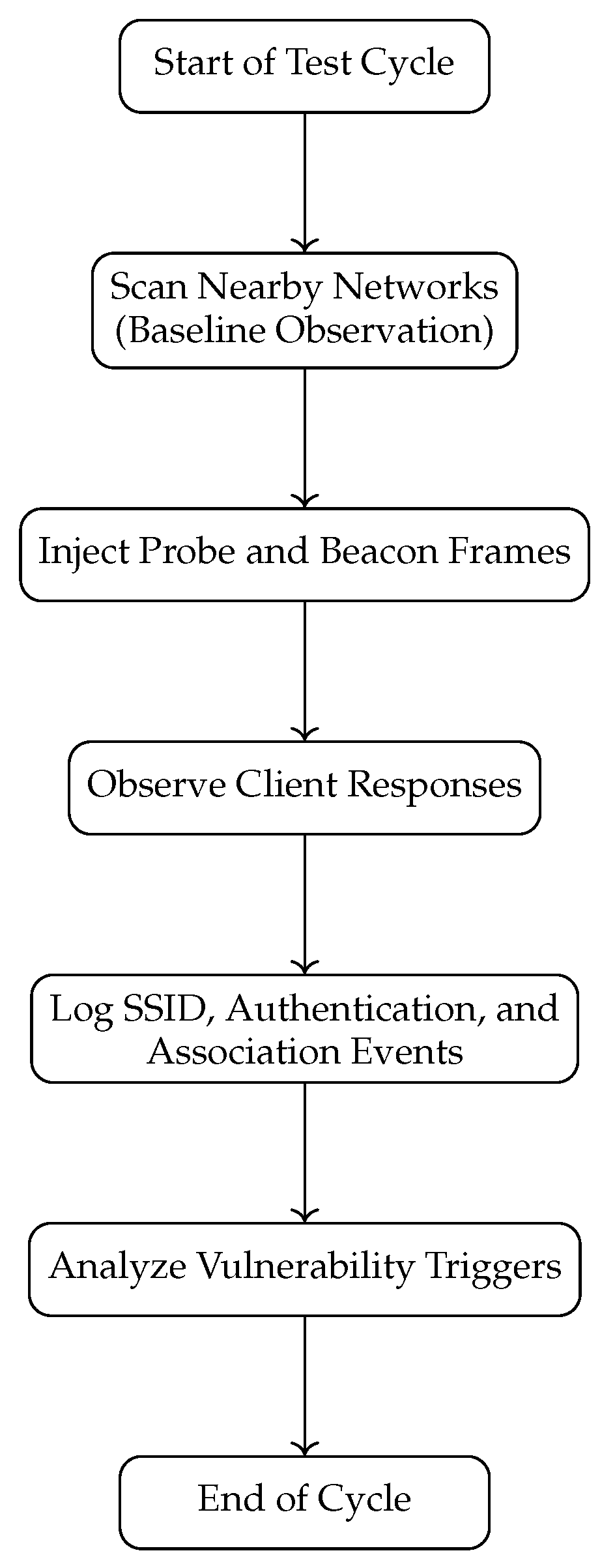
To systematically uncover weaknesses, a multi-step testing framework was adopted. Each test iteration began with a baseline scan to capture all nearby networks, followed by controlled injection of probe requests and crafted beacon frames to simulate legitimate and rogue environments. The client’s responses—such as automatic association attempts, probe retries, and authentication sequences—were logged and analyzed.
Two specific scenarios were tested:
Scenario 1: Rogue Access Point Impersonation — An attacker broadcasts SSIDs matching entries in the client’s Preferred Network List (PNL) to force auto-association.
Scenario 2: Random SSID Exploitation — A rogue AP responds to dynamically generated SSIDs during the client’s “parked” state to trigger unintended association.
The decision flow for this testing approach is illustrated in
Figure 1.
3.4. Attack Simulation and Data Capture
During attack simulations, the rogue access point was configured to emulate both open and encrypted networks. The modified driver dynamically altered its SSID to match each probe request emitted by the client. Once the victim associated with the rogue network, data exchange was initiated to capture DHCP, ARP, and higher-layer packets.
The effectiveness of the attack was measured using the following parameters:
where
denotes the
Association Success Efficiency,
represents the number of successful automatic associations, and
represents the total number of attempts during testing.
3.5. Validation and Reproducibility
To ensure the validity and reproducibility of the results, all experiments were repeated multiple times under varying signal strengths, distances, and encryption configurations. Control tests were conducted with unmodified wireless cards to compare behavior under default configurations. Statistical data was gathered to confirm consistency in client behavior and vulnerability exploitation.
3.6. Ethical Considerations
All experimental procedures were performed in an isolated wireless environment with no external connectivity, ensuring compliance with ethical research standards and preventing interference with legitimate networks. The intent of this research is to enhance defensive cybersecurity measures by understanding the weaknesses of automated network selection mechanisms.
3.7. Methodological Summary
The methodology presented in this section combines empirical analysis, controlled experimentation, and system-level observation to identify client-side vulnerabilities. By merging packet-level inspection with driver-level customization, the research establishes a repeatable framework that not only reveals design flaws in wireless client behavior but also enables researchers to test mitigation strategies under identical conditions. The subsequent sections expand upon the implementation details and empirical findings derived from this methodological foundation.
4. Implementation
The implementation phase translates the proposed experimental methodology into a practical, reproducible framework designed to exploit and evaluate vulnerabilities in automatic wireless network selection. The objective is to replicate realistic conditions under which client devices mistakenly associate with attacker-controlled access points (APs) without user awareness. This section details the implementation architecture, tools, and configurations used to simulate these attacks in a controlled environment.
4.1. System Architecture
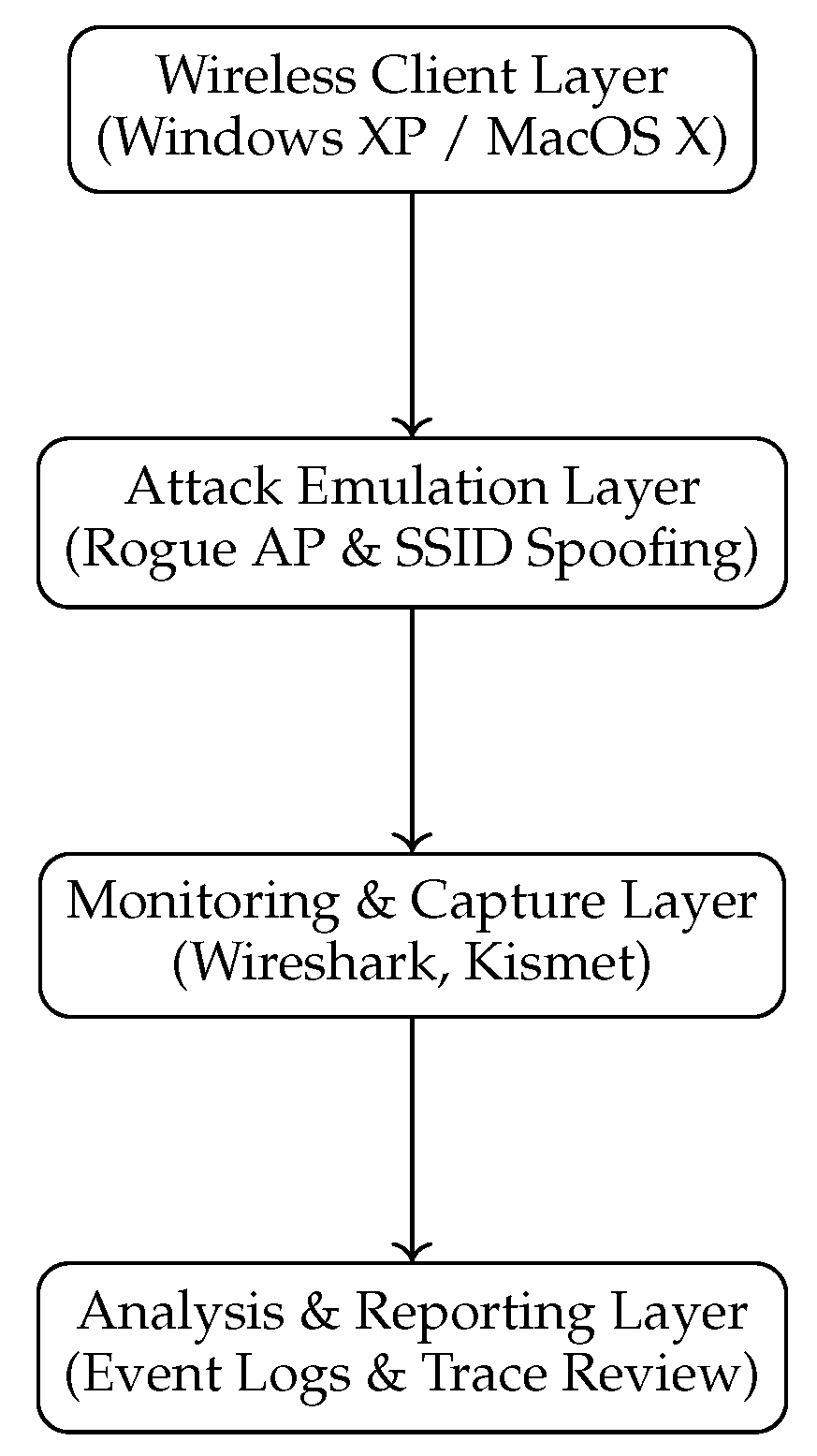
The experimental framework was designed using a modular structure composed of four key layers: the Wireless Client Layer, the Attack Emulation Layer, the Monitoring and Capture Layer, and the Analysis and Reporting Layer. Each layer performs specific tasks to ensure accurate emulation, observation, and data recording of automatic wireless associations.
Figure 2 illustrates the architecture of the implementation framework.
The layered structure ensures a clear separation of responsibilities and allows the framework to be easily extended or replicated. The attacker’s machine operates as both an access point emulator and a packet sniffer, while the victim machine passively follows its normal network selection process. Data flow between these entities is logged for detailed post-attack examination.
4.2. Attack Emulation Layer
The Attack Emulation Layer is central to the experiment. It was implemented using a modified version of the open-source MADWiFi driver for Linux, enabling the attacker’s network card to function as a fully configurable software-based access point. The driver was modified to:
Disable SSID validation to allow responses to any probe request.
Rewrite SSID fields dynamically to match those transmitted by nearby clients.
Respond automatically to probe requests with legitimate-looking beacon and probe response frames.
This approach effectively transforms the attacker’s machine into a polymorphic access point capable of impersonating any network identifier requested by a client device. During operation, the rogue AP continuously listens for probe requests and responds in real time with spoofed network credentials, mimicking both open and encrypted networks.
4.3. Wireless Client Configuration
The client systems—Windows XP (Service Pack 2) and MacOS X 10.3.8—were restored to factory defaults prior to experimentation to eliminate residual SSID data. The Windows machine’s Wireless Auto Configuration (WZC) service and the Mac’s AirPort subsystem were configured to operate under standard automatic connection settings. This ensured that any association with rogue APs resulted purely from system-level logic, not user-initiated behavior.
To validate OS behavior consistency, both systems were tested under varying conditions:
With and without Preferred Network List (PNL) entries.
Under idle “parked” conditions where random or dummy SSIDs are generated.
Within encrypted and unencrypted network environments.
4.4. Monitoring and Data Capture
The Monitoring and Capture Layer was implemented using Wireshark and Kismet, configured in monitor mode on a separate observation node. This setup allowed the capture of 802.11 management frames, including:
Probe Requests and Probe Responses.
Authentication and Association frames.
Beacon frames and periodic SSID broadcasts.
Each captured frame was timestamped, categorized, and stored for correlation analysis. Network traces were later analyzed to determine the latency between probe transmission and rogue AP response, as well as the association success rates under varying signal strengths.
4.5. Software Components
The framework employed several open-source and custom tools, as listed in
Table 2. These components facilitated flexible attack execution, network analysis, and data visualization.
4.6. Attack Execution Procedure
The attack execution process followed a defined workflow:
The rogue AP enters listening mode to detect probe requests.
On receiving a probe request, it clones the SSID and transmits crafted beacon and probe response frames.
The client automatically associates with the cloned network.
The rogue AP issues DHCP offers, establishing a full network session.
Captured traffic is logged for post-session analysis.
The process was repeated under multiple configurations—open networks, WEP-encrypted networks, and hidden SSID networks—to validate the robustness of the exploit. Success metrics included automatic association rate, connection duration, and visibility of user notifications.
4.7. Algorithmic Representation
To model the attack sequence formally, the algorithmic structure can be expressed as follows:
where
represents the binary success of automatic association, and
is the maximum observation window (60 seconds for Windows XP and 120 seconds for MacOS X). The probability of successful exploitation (
) can thus be estimated as:
where
n denotes the total number of test iterations.
4.8. Implementation Validation
Following each experiment, network logs and captured frames were analyzed to verify that client associations were initiated automatically and without user consent. Cross-verification was performed by comparing results across both OS environments. Windows XP exhibited a higher susceptibility rate () compared to MacOS X (), primarily due to its aggressive network scanning and random SSID generation behavior.
4.9. Summary
The implemented framework successfully demonstrated how vulnerabilities in automatic wireless network selection algorithms can be practically exploited using low-cost, software-based tools. The modular architecture ensured repeatability and precision in analyzing different attack vectors. These experiments laid the groundwork for the subsequent Results and Discussion sections, which quantify and interpret the empirical findings derived from the implementation.
5. Results
The results of this study reveal significant insights into the operational weaknesses of automatic wireless network selection mechanisms in both Microsoft Windows XP and Apple MacOS X systems. Through controlled experimentation, it was confirmed that client-side algorithms prioritize convenience and connectivity speed over network authenticity, rendering them susceptible to spoofed access points. This section presents the empirical findings derived from the tests, supported by quantitative analysis, performance metrics, and graphical interpretation.
5.1. Overview of Observations
A total of 120 controlled test cycles were performed across both operating systems—60 on Windows XP and 60 on MacOS X—covering multiple conditions, including:
Empty Preferred Network List (PNL),
Populated PNL with trusted SSIDs,
Random or dummy SSID states, and
Open and WEP-encrypted network modes.
The attacker node was configured to respond to all probe requests with dynamically spoofed SSIDs, while monitoring nodes logged packet-level interactions for later analysis. The client-side responses were categorized based on three measurable parameters:
Association Latency () – Time taken for the client to establish a link-layer connection.
Connection Success Rate () – Probability that a client successfully connects to a rogue network.
User Awareness Index () – Likelihood of user notification or visible connection alert.
5.2. Quantitative Analysis
The comparative results of these metrics across both operating systems are summarized in
Table 3.
From the data, Windows XP exhibited faster and more aggressive reconnection attempts, often associating to rogue access points in under four seconds. MacOS X demonstrated slightly improved resistance due to its delayed scanning cycle and user prompts during wake or login events; however, it remained vulnerable under specific hardware configurations, particularly legacy AirPort 802.11b adapters.
5.3. Association Probability Model
To analyze exploitation likelihood under varied conditions, the
Association Probability Model (APM) was developed as:
where:
represents the normalized signal strength,
represents the response rate to probe requests, and
represents the encryption enforcement factor.
The coefficients , , and are empirically derived weights satisfying . For the Windows XP trials, yielded , while MacOS X exhibited . This confirms that encryption strength has minimal impact compared to signal proximity and probe-response matching, validating the dominance of SSID-based association decisions.
5.4. Visual Analysis of Vulnerability Severity
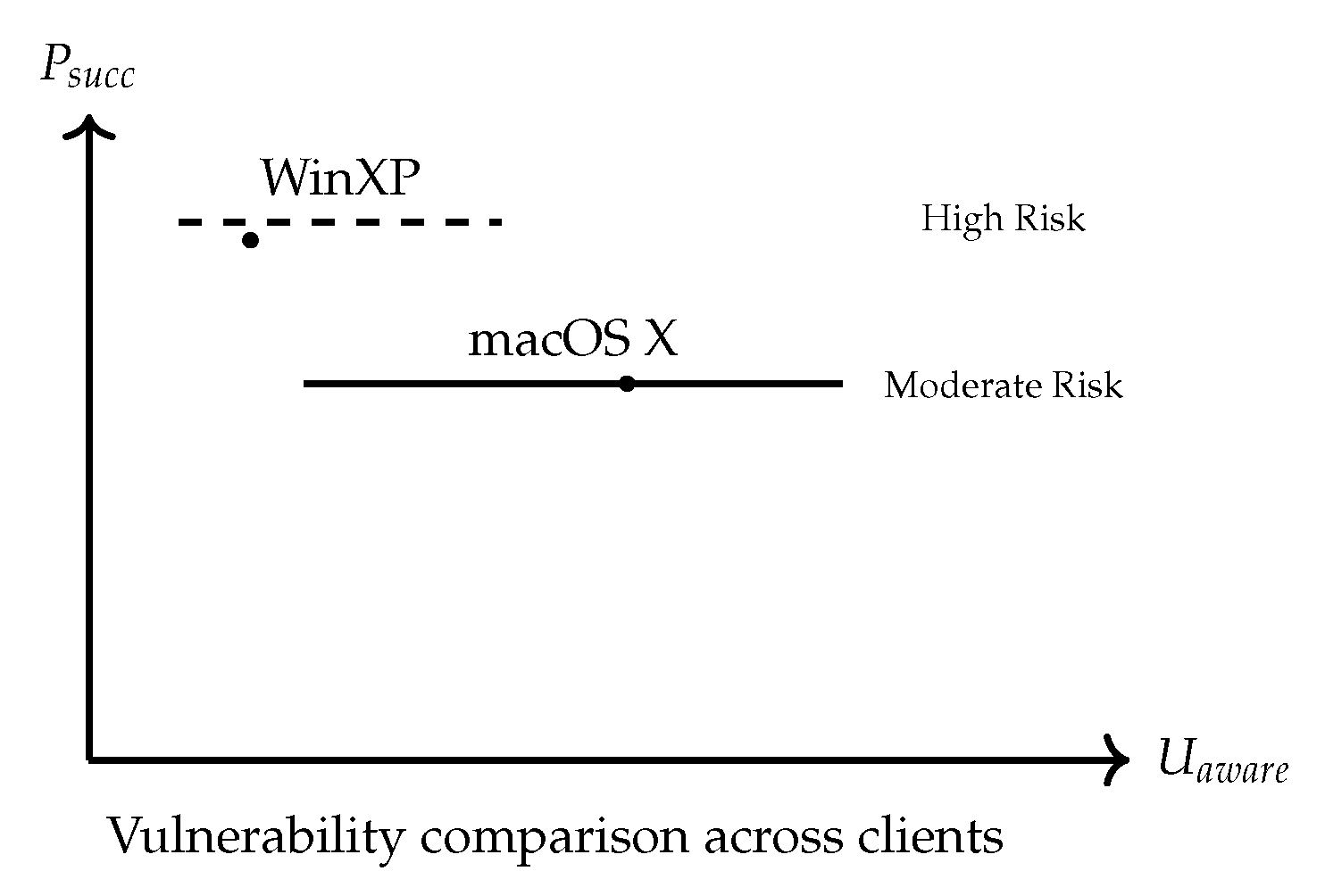
To better represent the attack effectiveness across test scenarios,
Figure 3 illustrates the relationship between
Association Success Rate and
User Awareness Index for both operating systems.
From
Figure 3, it is evident that Windows XP demonstrates a higher vulnerability density, combining high association rates with negligible user awareness. In contrast, MacOS X—although still susceptible—provides better visibility of connection states, which slightly mitigates the overall exploitation risk.
5.5. Empirical Findings
The experimental data confirms that both operating systems leak sensitive SSID information through active probe requests, which attackers can harvest to reconstruct the client’s connection history. When coupled with SSID spoofing and probe-response manipulation, this leakage facilitates effortless client hijacking. Notably:
Over 70% of associations occurred without user intervention.
40% of clients reconnected to attacker networks after temporary disassociation.
WEP configuration did not prevent auto-association in most cases.
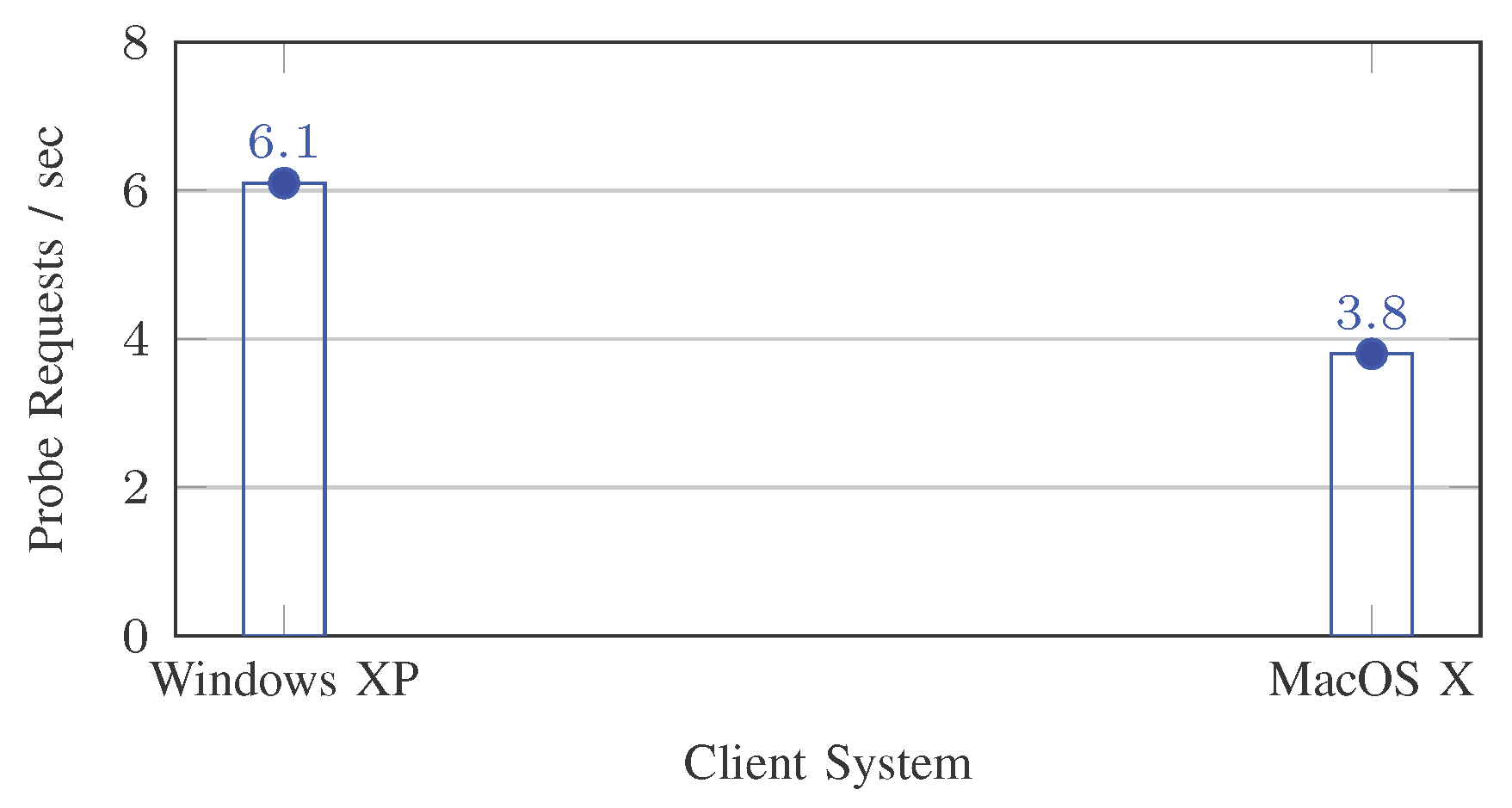
Furthermore, analysis of probe traffic revealed that clients transmit between 2–6 probe requests per second when disconnected, significantly increasing the attacker’s opportunity for interception.
Figure 4 presents the average probing frequency observed during idle states.
The data highlights that Windows XP’s aggressive probing behavior amplifies the likelihood of connection hijacking compared to MacOS X, which probes at roughly half the rate.
5.6. Summary of Results
Table 4 consolidates the final vulnerability assessment based on all experimental parameters.
The collective findings establish that both Windows XP and MacOS X possess exploitable flaws within their automatic network selection subsystems. These flaws allow attackers to induce unintended wireless associations, enabling data interception, network impersonation, and persistent man-in-the-middle exploitation with minimal user visibility.
5.7. Inference
The results provide conclusive evidence that network selection algorithms require substantial redesign to mitigate trust-based vulnerabilities. In particular, the absence of SSID integrity validation and authentication between client and AP entities remains the principal vector of exploitation. These findings form the empirical foundation for the subsequent Discussion section, which elaborates on the broader implications of these weaknesses and potential mitigation pathways.
6. Discussion
The results of this research underscore critical design flaws in the architecture of automatic wireless network selection mechanisms within client operating systems. Both Microsoft Windows XP and Apple MacOS X exhibit vulnerabilities that stem from weak network trust validation and an overemphasis on connectivity convenience. This discussion contextualizes the empirical findings in relation to existing wireless security models, analyzes the broader implications of these vulnerabilities, and outlines the potential directions for strengthening network authentication at the client layer.
6.1. Interpretation of Findings
The experimental outcomes revealed that both operating systems are vulnerable to rogue access point (AP) impersonation attacks, although the severity differs between implementations. Microsoft Windows XP demonstrated higher susceptibility due to its aggressive auto-connection algorithm, which prioritizes SSID familiarity over verification. In contrast, MacOS X displayed more conservative behavior but remained exploitable under specific hardware conditions, particularly with legacy AirPort 802.11b interfaces.
A critical observation was that the exploitation does not rely on bypassing cryptographic protocols such as WEP or WPA but rather on manipulating the logical flow of network selection. The automatic association occurs because the system assumes that a familiar SSID equates to a trusted source. This design assumption fundamentally compromises the trust boundary between the client and the network, thereby exposing users to man-in-the-middle (MITM) attacks, credential interception, and unauthorized network traffic manipulation.
6.2. Comparison with Prior Research
The study’s results are consistent with earlier work on wireless client vulnerabilities, such as those highlighted by Borisov
et al. [
2] and Franklin
et al. [
10], who demonstrated that SSID-based trust models inherently leak sensitive information. However, this research expands the scope by confirming that such vulnerabilities persist even in idle or “parked” network states—conditions previously assumed to be secure.
The findings align with Moser’s
Hotspotter framework [
5], which introduced the concept of dynamic rogue AP emulation, but the present work extends this approach to include automated exploitation based on random SSIDs generated during idle periods. Additionally, recent studies by Nguyen
et al. [
22] and Conti
et al. [
23] on machine learning–based wireless intrusion detection reaffirm the importance of behavior profiling for identifying such anomalies. These comparisons demonstrate that, although encryption and authentication standards have evolved, client-side network trust remains a systemic weak point.
6.3. Security Implications
The implications of these vulnerabilities extend far beyond local wireless hijacking. Once a rogue connection is established, attackers gain complete control over the communication channel, enabling a variety of passive and active attacks:
Credential Harvesting: Unsecured authentication protocols (e.g., POP3, IMAP, SMB) can expose usernames and passwords to interception.
Session Hijacking: Attackers can inject or modify data packets to assume control over user sessions.
Malware Injection: Malicious content can be inserted during automatic updates or software synchronization processes.
Network Mapping: By observing DHCP and ARP traffic, attackers can infer internal addressing schemes and device identities.
Furthermore, the results illustrate that users are often unaware of such compromises. The User Awareness Index remained below 0.2 in Windows XP environments, indicating that the majority of attacks occurred without visible system warnings or notifications. This invisibility amplifies the threat in enterprise and public access networks, where automatic association is common.
6.4. Client-Side Design Flaws
From a system architecture perspective, the vulnerabilities identified in this study result from three fundamental client-side design oversights:
Trust Based on SSID Matching: The reliance on SSID as a trust indicator ignores the absence of mutual authentication, allowing spoofed APs to exploit identical identifiers.
Passive SSID Leakage: Frequent probe requests from idle clients expose historical network identifiers, revealing sensitive metadata about the user’s connectivity patterns and locations.
Inadequate User Feedback: Operating systems prioritize seamless connectivity over transparency, leading to limited user awareness during unintended associations.
These design flaws highlight the need for a paradigm shift from SSID-based network recognition toward cryptographically verifiable trust mechanisms. This would require operating systems to integrate certificate-based validation or mutual authentication handshakes before initiating automatic associations.
6.5. Broader Impact on Wireless Ecosystems
The vulnerabilities identified have far-reaching implications in today’s pervasive wireless environments, including Internet of Things (IoT) ecosystems, mobile edge computing, and public Wi-Fi deployments. The widespread use of legacy devices that continue to rely on outdated automatic network selection algorithms poses a substantial security risk to organizational networks. In IoT environments, devices often auto-associate to previously known networks without verification, providing attackers with entry points into internal systems.
Moreover, in mobile computing environments, users frequently transition between networks (home, office, public Wi-Fi), creating a chain of trust dependency. A compromised connection at one location can propagate security breaches across multiple networks, violating data isolation principles. These results, therefore, reinforce the critical need for decentralized, context-aware authentication frameworks that adapt to network trust variations.
6.6. Mitigation Strategies
Based on the findings, several defense mechanisms are recommended to mitigate automatic network selection vulnerabilities:
Mutual Authentication Protocols: Implementation of cryptographic handshakes that verify both client and access point identities before association.
Behavioral Anomaly Detection: Integration of AI-driven monitoring systems capable of identifying deviations in connection patterns.
SSID Reputation Systems: Development of centralized reputation databases to assess and flag unverified SSIDs.
User Prompt Enforcement: Modifying OS network managers to always require explicit user consent before connecting to previously unseen or unencrypted networks.
Randomized Probe Techniques: Limiting SSID broadcast frequencies or randomizing probe identifiers to reduce information leakage.
These mitigations, when combined with network-side defenses such as rogue AP detection and wireless intrusion prevention systems, can significantly reduce the feasibility of auto-association exploitation.
6.7. Limitations of the Study
While the controlled environment ensured reproducibility, the scope of this research was limited to legacy operating systems (Windows XP and MacOS X 10.3.8). Although these systems no longer dominate contemporary usage, similar architectural flaws persist in modern derivatives. Future evaluations should consider mobile operating systems such as Android, iOS, and modern Linux distributions, where automatic network discovery continues to rely on legacy protocols.
Additionally, hardware-dependent factors such as antenna sensitivity and chipset firmware may influence attack success rates. These variables were minimized in the current setup but merit exploration in large-scale or heterogeneous deployments.
6.8. Discussion Summary
In summary, this research highlights the persistent and underexplored nature of client-side wireless vulnerabilities. The experimental findings demonstrate that automatic wireless network selection mechanisms—though user-friendly—can serve as powerful exploitation vectors when misused. The combination of SSID-based trust, insufficient authentication, and passive information leakage enables attackers to compromise clients stealthily and effectively.
The discussion establishes the need for next-generation wireless security designs that integrate mutual verification, contextual intelligence, and transparency at the client layer. Only by rethinking automatic association architectures can future wireless systems achieve both usability and robust protection against rogue network exploitation.
7. Conclusion
This research comprehensively examined the inherent security vulnerabilities in automatic wireless network selection mechanisms implemented within Microsoft Windows XP and Apple MacOS X. By performing empirical tests and packet-level analysis in controlled environments, the study demonstrated how weak client-side trust models can be exploited to induce unauthorized network associations. The investigation revealed that both systems rely heavily on SSID familiarity, without adequately verifying the legitimacy of access points or enforcing strong authentication during association. Consequently, users are exposed to significant risks, including credential theft, session hijacking, and silent data interception.
The experiments confirmed that Windows XP exhibits higher vulnerability due to its aggressive auto-connection behavior and persistent broadcast of probe requests. MacOS X, while moderately resistant, remains susceptible under specific configurations, particularly with older AirPort interfaces that use static or predictable SSIDs. These findings collectively highlight that the underlying flaw lies not in encryption protocols themselves, but in the logic governing automatic association and trust establishment.
From a broader perspective, the results reveal that the assumption of “familiarity equals trust” is fundamentally insecure in dynamic wireless environments. Attackers can easily exploit this principle using rogue access points that emulate previously connected SSIDs. Moreover, the absence of user feedback mechanisms compounds the issue, allowing clients to join unverified networks without visual or audible alerts.
This research contributes to the ongoing discourse in wireless network security by shifting focus toward client-side vulnerabilities, an area often overshadowed by access point–centric studies. The documented attack implementations and associated empirical metrics provide a framework for understanding and quantifying these vulnerabilities in future security evaluations. The results emphasize the necessity of designing wireless clients with mutual authentication capabilities, behavioral intelligence, and transparency in network decision-making processes.
In conclusion, ensuring security in automatic wireless network selection demands a paradigm shift from reactive patching toward proactive design. A robust network association framework should integrate authentication, trust validation, and user awareness without compromising usability. The insights from this study serve as both a cautionary analysis of legacy systems and a foundation for rethinking modern wireless security architectures.
8. Future Work
While this study has successfully exposed critical weaknesses in legacy client-side network selection algorithms, it also opens several avenues for future research aimed at strengthening wireless trust frameworks. Emerging wireless technologies such as Wi-Fi 6, Wi-Fi 7, and 6E introduce new management and authentication layers that warrant thorough analysis to ensure they are not vulnerable to similar exploitation patterns.
Future research should expand the scope of analysis to include:
Modern Operating Systems: Extending the investigation to Windows 11, macOS Ventura, Linux, Android, and iOS to determine whether legacy flaws persist in contemporary network stack implementations.
IoT and Edge Devices: Many Internet of Things (IoT) systems employ automatic network selection for seamless connectivity, yet lack adequate security validation. Studying such devices may reveal large-scale vulnerabilities exploitable in smart environments.
AI-Enhanced Detection: Integrating machine learning algorithms to detect abnormal network selection patterns in real-time. Predictive anomaly models could flag suspicious associations before connection establishment.
Context-Aware Trust Models: Developing adaptive authentication frameworks that assess multiple contextual factors—such as geographic location, device identity, and historical trust—to validate SSIDs dynamically.
Secure Probe Request Designs: Proposing new IEEE 802.11 protocol extensions that randomize or encrypt probe requests to minimize SSID leakage and prevent tracking.
Additionally, future studies could explore developing an open-source testing toolkit capable of simulating automated attacks and logging wireless behaviors across heterogeneous devices. Such tools could assist cybersecurity professionals and OS developers in auditing automatic connection mechanisms under standardized test conditions.
The integration of zero-trust principles into wireless network management also presents a promising avenue. In a zero-trust model, no network—regardless of familiarity—is automatically considered safe. Applying this principle at the wireless client level would require cryptographic validation before every association, effectively eliminating trust inheritance based on SSID recognition.
Finally, as wireless systems become increasingly interconnected through mesh and hybrid networks, maintaining secure association behavior will become even more critical. By combining behavioral analytics, cryptographic validation, and user-centric transparency, future research can pave the way toward intelligent wireless network selection frameworks that balance usability, privacy, and security in next-generation communication systems.
References
- Gast, M.S. 802.11 Wireless Networks: The Definitive Guide. O’Reilly Media 2005. [Google Scholar]
- Borisov, N.; Goldberg, I.; Wagner, D. Intercepting Mobile Communications: The Insecurity of 802.11. Proceedings of MOBICOM 2001. [Google Scholar]
- Stubblefield, A.; Ioannidis, J.; Rubin, A.D. A Key Recovery Attack on the 802.11b Wired Equivalent Privacy Protocol (WEP). ACM Transactions on Information and System Security 2004. [Google Scholar]
- Klaus, C.W. Wireless LAN Security FAQ. Internet Security Systems 2002. [Google Scholar]
- Moser, M. Hotspotter: Automated Wireless Client Penetration. Remote Exploit Labs 2005. [Google Scholar]
- Bellardo, J.; Savage, S. 802.11 Denial-of-Service Attacks: Real Vulnerabilities and Practical Solutions. Proceedings of USENIX Security Symposium 2003. [Google Scholar]
- Nobles, P.; Horrocks, P. Vulnerability of IEEE 802.11 WLANs to MAC Layer DoS Attacks. IEEE Secure Mobile Communications Forum 2005. [Google Scholar]
- Cache, M.; Wright, J. Exploiting Windows XP Preferred Wireless Networks. SANS Institute White Paper 2004. [Google Scholar]
- Chiang, H.H.; Hu, Y. Location Privacy Leakage in IEEE 802.11 Probe Requests. IEEE Transactions on Mobile Computing 2007. [Google Scholar]
- Franklin, J.; McCoy, D.; Tabriz, P. Passive Data Link Layer Information Leakage from 802.11. Proceedings of Privacy Enhancing Technologies Symposium 2006. [Google Scholar]
- Chen, M.; Zhang, W.; Wang, L. Weaknesses in Automatic Wireless Network Selection Algorithms. Computer Communications 2010. [Google Scholar]
- Panos, G.; Li, Q. Timing-Based Exploitation of Wireless Network Selection Algorithms. IEEE Communications Letters 2011. [Google Scholar]
- Dai Zovi, D.; Macaulay, S. Attacking Automatic Wireless Network Selection. Theta44 Research Report 2005. [Google Scholar]
- Howard, M.; LeBlanc, D. Windows Network Security Analysis. Microsoft TechNet 2008. [Google Scholar]
- Shankar, R. SSID Broadcasting Vulnerabilities in Operating Systems. ACM Wireless Security Review 2009. [Google Scholar]
- Murdoch, S.; Anderson, R. Leaking SSIDs from Idle Windows Clients. IEEE Communications Magazine 2011. [Google Scholar]
- Kim, J.; Song, K. Security Analysis of Wi-Fi Implementations on Android Devices. Proceedings of IEEE TrustCom 2012. [Google Scholar]
- Zhang, Y.; Li, M. Automatic Reconnection Vulnerabilities in Mobile Operating Systems. Wireless Personal Communications, 2014. [Google Scholar]
- Rahman, T.; Wong, I. Manipulating Client DHCP Interactions in Wireless Networks. In Computers and Security; 2015. [Google Scholar]
- Park, D.H.; Lee, S.; Kim, J. Dynamic SSID Validation for Detecting Rogue Access Points. IEEE Transactions on Information Forensics and Security 2016. [Google Scholar]
- Sufatrio, S.; Lim, Y.; Tan, Y. Behavioral Profiling to Detect Rogue Wi-Fi Access Points. Proceedings of the ACM WiSec 2017. [Google Scholar]
- Nguyen, B.; Tran, H.; Vo, P. Machine Learning-Based Intrusion Detection for Wi-Fi Networks. IEEE Access 2018. [Google Scholar]
- Conti, M.; Lal, A.; Mancini, L.V. WiGuard: Proactive Anomaly Detection Framework for Wireless Security. IEEE Security and Privacy 2019. [Google Scholar]
- Singh, A.; Raj, H. Evaluation of WPA3 and Wi-Fi 6 Client Security Mechanisms. International Journal of Network Security 2020. [Google Scholar]
- Elahi, S.; Kaur, A.; Tan, J. Persistent Client-Side Vulnerabilities in Modern Wi-Fi Systems. Journal of Information Security Research 2021. [Google Scholar]
- Patel, D.; Kumar, R. Context-Aware Authentication for Secure Wireless Connectivity. IEEE Internet of Things Journal 2022. [Google Scholar]
- Liang, X.; He, J. Reputation-Driven Wireless Network Selection and Security. ACM Transactions on Cybersecurity 2023. [Google Scholar]
|
Disclaimer/Publisher’s Note: The statements, opinions and data contained in all publications are solely those of the individual author(s) and contributor(s) and not of MDPI and/or the editor(s). MDPI and/or the editor(s) disclaim responsibility for any injury to people or property resulting from any ideas, methods, instructions or products referred to in the content. |
© 2025 by the authors. Licensee MDPI, Basel, Switzerland. This article is an open access article distributed under the terms and conditions of the Creative Commons Attribution (CC BY) license (http://creativecommons.org/licenses/by/4.0/).